The Associated Press journalist who reported a US intelligence official’s false claim that Russia had launched missiles at Poland last week has been fired.
As we discussed previously, AP’s anonymously sourced report which said “A senior U.S. intelligence official says Russian missiles crossed into NATO member Poland, killing two people” went viral because of the massive implications of direct hot warfare erupting between Russia and the NATO alliance. AP subsequently retracted its story as the mainstream political/media class came to accept that it was in fact a Ukrainian missile that had struck Poland.
AP’s firing of reporter James LaPorta looks at this time to be the end point of any accountability for the circulation of this extremely dangerous falsehood. AP spokesperson Lauren Easton says no disciplinary action will be taken against the editors who waved the bogus story through, and to this day the public has been kept in the dark about the identity of the US official who fed such extremely egregious misinformation/disinformation to the public through the mainstream press.
Important that AP accounts for publishing the false claim that Russia fired missiles into Poland. But the much more important task is finding out why an anonymous senior US intelligence official fed AP that false claim. https://t.co/6YmAn0VDap
It is utterly inexcusable for AP to continue to protect the anonymity of a government official who fed them such a profoundly significant falsehood. This didn’t just affect AP staff, it affected the whole world; we deserve to know what happened and who was responsible, and AP has no business obstructing that knowledge from us.
LaPorta’s firing looks like this is yet another instance where the least powerful person involved in a debacle is being made to take the fall for it. A powerful intelligence official will suffer no consequences for feeding false information to the press — thereby ensuring that it will happen again — and no disciplinary action will be taken against LaPorta’s superiors, despite the absolute buffoonery that subsequent reporting has revealed on their part.
Internal AP communications viewed by The Post show some confusion and misunderstanding during the preparations of the erroneous report.
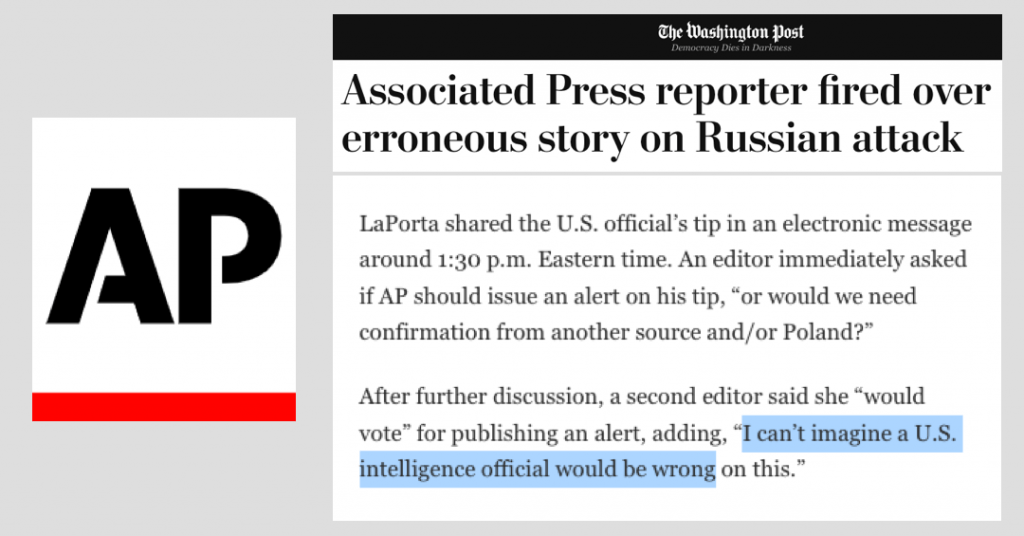
LaPorta shared the U.S. official’s tip in an electronic message around 1:30 p.m. Eastern time. An editor immediately asked if AP should issue an alert on his tip, “or would we need confirmation from another source and/or Poland?”
After further discussion, a second editor said she “would vote” for publishing an alert, adding, “I can’t imagine a U.S. intelligence official would be wrong on this.”
“I can’t imagine a US intelligence official would be wrong on this.”
Can you imagine not being able to imagine a US intelligence official being wrong? This would be an unacceptable position for any educated adult to hold, much less a journalist, still less an editor, and still less an editor of one of the most influential news agencies on earth.
These are the people who publish the news reports we read to find out what’s happening in the world. This is the baby-brained level of thinking these people are serving the public interest with.
Antiwar commentator Daniel Larison writes the following of the AP editor’s shocking quote:
Skepticism about official claims should always be the watchword for journalists and analysts. These are claims that need more scrutiny than usual rather than less. If you can’t imagine that an intelligence official could get something important wrong, whether by accident or on purpose, you are taking far too many things for granted that need to be questioned and checked out first.
Intelligence officials of many governments feed information to journalists and have done so practically ever since there was a popular press to feed information to, and that information certainly should not be trusted just because an official source hands it over. It is also always possible for intelligence officials to just get things wrong, whether it is because they are relying on faulty information or because they were too hasty in reaching conclusions about what they think they know.
Whether the AP’s source was feeding them a line or was simply mistaken, a claim as provocative and serious as this one should have been checked out much more thoroughly before it got anywhere near publication. The AP report in this case seems to have been a combination of a story that was “too good to check” and a culture of deference to official sources in which the editors didn’t feel compelled to make the effort to check.
"If you can’t imagine that an intelligence official could get something important wrong, whether by accident or on purpose, you are taking far too many things for granted that need to be questioned and checked out first." https://t.co/u6VWdxsOG3https://t.co/4D7S9PisM3
Indeed, the only reason the press receive such explicit protections in the US Constitution is because they are supposed to hold the powerful to account. If the editors of a wildly influential news agency will just unquestioningly parrot whatever they are fed by government officials while simultaneously protecting those officials with anonymity, they are not holding the powerful to account, and are in fact not meaningfully different from state propagandists.
They are state propagandists. Which is probably why they are sipping lattes in the AP newsroom while Julian Assange languishes in prison.
As Jacobin’s Branko Marcetic observed, this is far from the first time AP has given the cover of anonymity to US government officials circulating bogus claims of potentially dangerous consequence, like the time it reported an official’s evidence-free assertion which later proved false that Iran had carried out an attack on four oil tankers off the coast of the United Arab Emirates, or the time it let another one anonymously claim that “Iran may try to take advantage of America’s troop withdrawals from Iraq and Afghanistan.”
Irresponsible journalism from the AP, but this strikes me as quite damning and suggests it's more than just one reporter that's the problem. After all, this isn't even close to the first time the AP has published a false, war-baiting claim by a anon official. pic.twitter.com/id4bWr4zdz
Powerful government official who fed AP a false story: Zero accountability
AP editor who asked if a report should immediately be published upon receipt of the story: Zero accountability
Second AP editor who says she can’t imagine a U.S. intelligence official would be wrong: Zero accountability
Journalist who wrote the story: Singular accountability
In a sane society, power and responsibility would go hand in hand. A disaster would be blamed on the most powerful people involved in its occurrence. In our society it’s generally the exact opposite, with the rank-and-file taking all of the responsibility and none of the power.
Our rulers lie to us, propagandize us, endanger us, impoverish us, destroy journalism, start wars, kill our biosphere and make our world dark and confusing, and they suffer no consequences for it. We cannot allow them to continue holding all of the power and none of the responsibility. This is backwards and must end.
We have pretty much burned our bridges at this point. Unless you’re prepared to mindfuck yourself, and gaslight yourself, and confess, and convert, there’s no going back to “normal” society (which we couldn’t go back to anyway, on account of how it doesn’t exist anymore) — CJ Hopkins
Thirty-seven billion more dollars for Ukraine? (That’s thirty-seven thousand millions of dollars, by the way.) Bringing the total this year to a click-or-two over ninety billion (ninety-thousand millions), on top of whatever Sam Bankman-Fried’s FTX company funneled through that sad-sack international money laundromat — soon to be the darkest backwater of a European failed state since Field Marshal Melchior von Hatzfeldt of Westphalia left Bohemia a corpse-strewn wasteland after the Battle of Jankau (1645).
It really doesn’t matter how much more money we pound down that rat-hole, you understand, because by the time various parties — the weapons-makers, Volodymyr Zelensky, sundry members of the US House of Representatives, The Biden family, the World Economic Forum — are finished creaming off their fair shares, poor Ukraine won’t have enough cash-on-hand to replace six fuse-boxes in Zaporizhzhia.
Against this backdrop, the USA enters a holiday season near-death spiral as unspooling scandals battle a collapsing economy for supremacy of the alt news sites. Case-in-point: the aforementioned FTX monkey business, a metastasizing tumor of the body politic. This complex fraud will smolder for a few weeks before it explodes into an extinction-grade event for the Democratic Party. The usual suspects among the mainstream media are trying to ignore it for the moment, but the shreds of this exploding money-borg are already sticking to guilty parties far and wide across the political landscape.
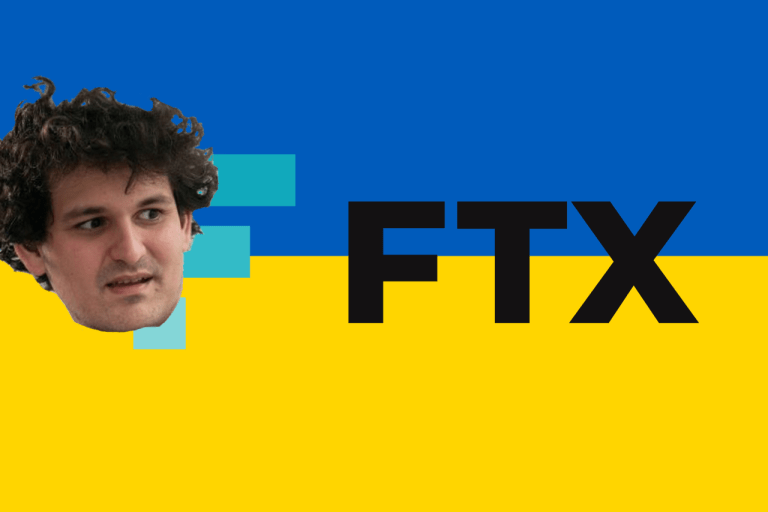
FTX commander-in-chief Sam Bankman-Fried remains at large after steering the crypto-currency trading platform into a bankruptcy so hideously tangled that the assigned liquidator in court proceedings, one John Ray III, who oversaw the Enron aftermath years ago, was boggled by what he’s found so far (and it’s early in the game): Namely, a company run by a handful of twenty-something drug freaks with no idea what they were doing, no record-keeping, and a slime trail of misappropriated investor’s funds leading to Kiev and Geneva through various crooked American political action committees, and the halls of Congress — with echos in ballot harvesting shenanigans which shaped the outcome of this month’s US elections.
Mr. Bankman-Fried is still scheduled as a main speaker for Accenture’s Nov. 30 DealBook Conference in New York ($2,499 for a ticket), along with Ukrainian President Volodymyr Zelensky and US Treasury Secretary Janet Yellen. Odds on him showing up? Or even being alive elsewhere on this planet then?
The extended family Bankman-Fried is the quintessence of Woke aristocracy. Dad Joe Bankman and mom Barbara Fried are both law professors at Stanford. She also acted as a money-bundler for the Democratic Party and ran two non-profit “voter registration” orgs (against the IRS laws which only permit non-partisan organized voter registration). Brother Gabe Bankman-Fried headed a non-profit named Guarding Against Pandemics (funded by Sam), which lobbies Congress to construct new platforms for medical tyranny. Aunt Linda Fried is Dean of the Columbia U’s Public Health school, and is associated with Johns Hopkins, which ran the October 2019 Event 201 pandemic drill (sponsored by the Gates Foundation) months before the Covid-19 outbreak.
Sam’s girlfriend, Caroline Ellison, ran the Alameda Investments arm of the FTX empire (that is, FTX’s own money laundromat). Her dad, Glenn Ellison is chair of MIT’s Econ School. His former colleague on the MIT Econ faculty, Gary Gensler, who specialized in blockchains there, is now head of the Securities and Exchange Commission, an agency that Sam Bankman Fried was attempting to rope into a regulation scheme to eliminate FTX’s crypto-currency competitors. Caroline’s mom, Sara Fisher Ellison is an MIT econ prof specializing in the pharmaceutical industry (fancy that!). Caroline Ellison is currently on-the-run.
The sum total of all this professional and academic accomplishment is also the quintessence of Woke-Jacobin turpitude in service to a political faction that seeks maximum moneygrubbing while acting to overthrow every norm of behavior in the conduct of elections, and perhaps in American life generally. That’s some accomplishment. It’s also a lesson in why the managerial elite of our country are no longer trustworthy. They have gotten away with crimes against the nation for years, which has only made them bolder and more reckless.
Wait for the FTX bankruptcy to unwind, along with all the political ramifications it entails, not to mention the financial afterburn in the whole crypto market, very likely extending into and befouling the rest of the banking system. This is going to be a clusterfuck for the ages, and will propel the USA into a depression with no visible horizon.
The Ukrainian government mysteriously disappeared online records of its fundraising arrangement with the FTX crypto scam just days before the scandal erupted. The initiative claims to have raised $60 million for Ukraine, but where did the money go?
The demise of FTX, the fifth-biggest cryptocurrency exchange by trade volume in 2022, and the second-largest by holdings, has sent a wave of chaos through global financial markets.
As the turbulence grows, the government of Ukraine is conducting an ongoing cleanup and whitewashing operation to rid any and all references to a high-level cryptocurrency fundraising arrangement it struck with FTX from the web. Eerily, it seems to have commenced just days before the scandal erupted.
Online records unearthed by The Grayzone claim tens of millions were raised by FTX for the Ukrainian government, and put to a variety of belligerent uses. But with the company now exposed as a Potemkin village lacking underlying assets, and major question marks hanging over whether its operations were from day one fraudulent top to bottom, where does that leave the supposedly successful donation scheme? Were those sums truly raised, and if so, to what purposes were they actually put?
FTX’s destruction resulted from a mass sell-off of the company’s native bitcoin token, FTT, by the rival exchange, Binance. Its value plummeted, prompting a three-day “run” on billions of dollars worth of cryptocurrency, which in turn created – or exposed – a “liquidity crisis” within FTX, as it did not have the available assets required to redeem client withdrawals. FTX filed for bankruptcy on November 11th.
FTX founder and top Democrat Party donor Sam Bankman-Fried now faces criminal investigations in the Bahamas, where the exchange was headquartered, and calls for official investigations into the largely unregulated cryptocurrency industry are reverberating across the globe.
The sudden death of FTX has been compared to the 2008 disintegration of Lehman Brothers that precipitated the financial crisis.
Massive customer holdings have apparently gone missing thanks to a secret “back door” in the FTX bookkeeping system that allowed Bankman-Fried to make changes to the company’s financial records without any accountability. This connivance may have been used to hide at least $10 billion in client funds Bankman-Fried transferred from exchange to another company he founded, digital asset trader Alameda Research.
While mainstream media pores over the details of Bankman-Fried’s gargantuan crypto scam, not one single major outlet has investigated or even acknowledged FTX’s relationship with the government of Ukraine.
Were client holdings unaccountably and illegally funneled into the West’s proxy war? Or did the supposed aid FTX sent to Kiev find its way into the hands of Ukrainian scammers, corrupt warlords and illicit actors?
The corporate media’s failure to explore these questions appears all the more perverse given Bankman-Fried’s flamboyant promotion of his intimate financial relationship with the government of Ukrainian President Volodymyr Zelensky.
FTX pledges to “turn bitcoin into bullets, bandages and other war materiel” for Ukraine
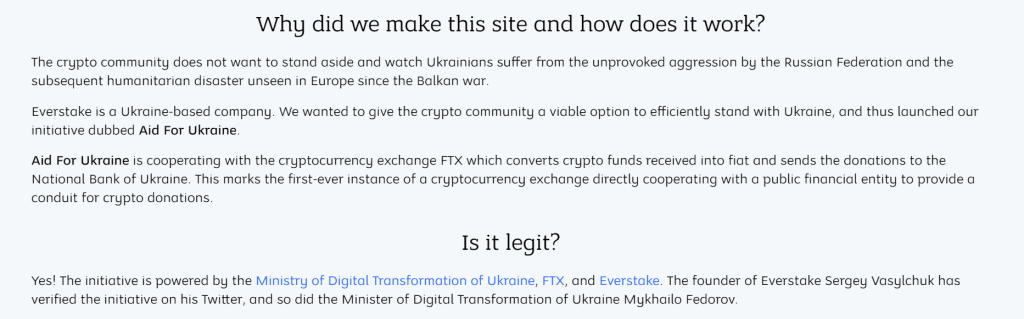
The partnership between FTX and the Ukrainian government was first publicized on March 14th when the leading cryptocurrency website CoinDesk announced Kiev had launched a dedicated webpage for cryptocurrency donations dubbed Aid for Ukraine.
Under its auspices, FTX pledged to “convert crypto contributions to Ukraine’s war effort into fiat for deposit” at the National Bank of Kiev, allowing the embattled government to “turn bitcoin into bullets, bandages and other war materiel.” CoinDesk stated the initiative “deepens an unprecedented tie-up between public and private sector forces in crypto.”
Oleksandr Bornyakov, an official at Ukraine’s Ministry of Digital Transformation, hinted to CoinDesk about an “upcoming NFT collection” auction to “give the next boost to the crypto fundraising process.”
(Bornyakov’s Ministry of Digital Transformation played a key role in the successful, Zelensky-led campaign to cancel The Grayzone’s Max Blumenthal and Aaron Mate’s appearance at Web Summit, a major international gathering of the tech industry in Lisbon, Portugal).
In a press release accompanying the announcement of the FTX partnership with Ukraine, Bankman-Fried explained that, “at the onset of the conflict in Ukraine, FTX felt the need to provide assistance in any way it could.” He promised that the arrangement provided “the ability to deliver aid and resources to the people who need it most.”
Kiev disappears Aid for Ukraine site days before FTX scandal goes public
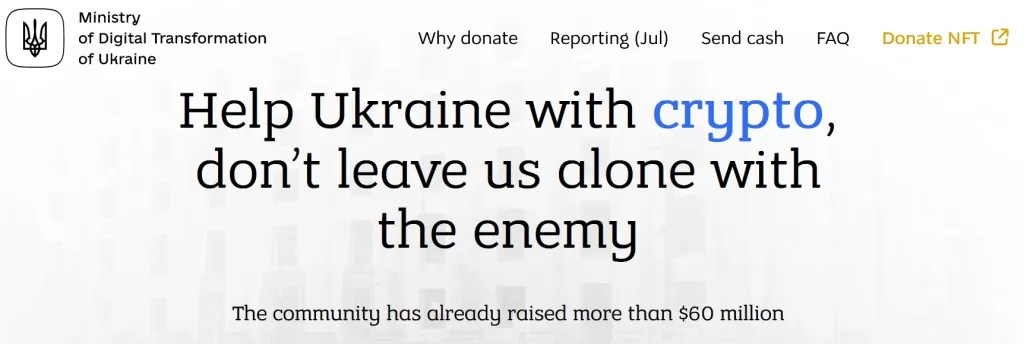
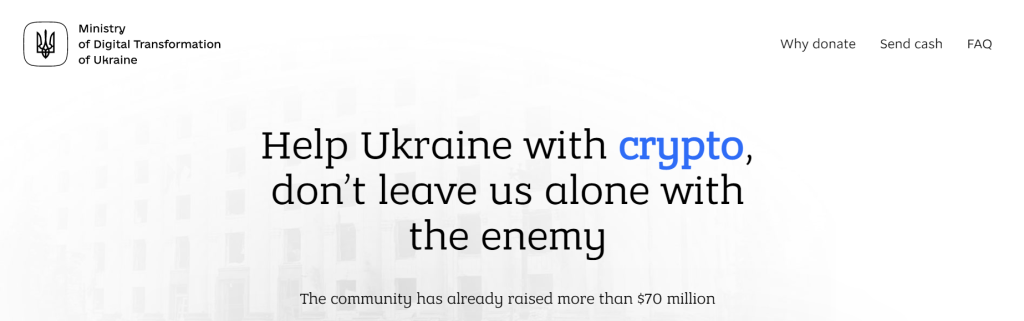
The Aid for Ukraine webpage has now been deleted, but can still be accessed via the Internet Archive. Until very recently, it encouraged visitors to “help Ukraine with crypto” and pleaded, “don’t leave us alone with the enemy.”
The site featured promotional quotes from an assortment of Ukrainian government officials and bitcoin bros – among them, FTX’s founder.
Mykhailo Fedorov, Ukraine’s deputy Prime Minister, and Minister of Digital Transformation of Ukraine, thanked “the crypto community” for funding the purchase of helmets, bulletproof vests, and night vision devices. For his part, Bankman-Fried declared himself “incredibly excited and humbled” to “support crypto donations to Ukraine.”
The last available Internet Archive capture of Aid for Ukraine” took place on the afternoon of October 26th. Throughout the webpage’s existence, the Internet Archive captured multiple snapshots of it weekly. This clearly indicates the page was purged by Kiev in late October, several days before the FTX crisis initially broke out.
Once it was deleted, the Ukrainian government created a standalone websiteon November 1st to promote the endeavor. The page was identical, and quotes from Bankman-Fried, and references to FTX’s involvement and its logo, remained in place until the morning of November 15th.
Was the original webpage’s dumping and erasure, and the shift to a totally new interface, at that time merely a spooky coincidence, or were the Ukrainians warned of what was coming? What did Kiev know, and when did it know it?
Bankman-Fried channeled millions to Biden through “stealth” PAC
Though FTX has been accused of serving as a money laundering vehicle for the US Democratic Party, concrete evidence supporting this claim has yet to materialize. But given Bankman-Fried’s background as one of the most prolific donors to the Democrats, and the role he played as a nexus between party power-brokers and the cryptocurrency sphere, the allegations are understandable.
Bankman-Fried is the son of Stanford law professor Barbara Friedman, founder of a shadowy Super PAC called Mind the Gap which quietly channeled millions to Democratic party candidates, primarily from nameless Silicon Valley investors.
The organization has no website or social media footprint, and its founders do not advertise their involvement publicly. Chosen through complex data analysis, beneficiaries of the Super PAC often have no idea themselves who or what has donated to their campaigns.
“The raison d’être is stealth,” an individual “with ties to the organization” told Vox back in 2020.
Bankman-Fried establishment of FTX in April 2019 – the same month Joe Biden announced his 2020 Presidential run – has added to the intrigue surrounding the scandal. Once vast sums started flowing into and through the FTX exchange, its founder channeled profits into Biden’s campaign coffers. Oddly, Bankman-Fried had no prior history of political giving.
Throughout the 2020 campaign, Bankman-Fried gifted over $5 million to Biden and groups supporting him. This reportedly helped fuel a potentially decisive “nine-figure, eleventh-hour blitz of TV advertising” targeting swing states, and made the crypto bro the second-largest donor to the president, right behind Michael Bloomberg.
Bankman-Fried claimed this wellspring of generosity was “motivated less by specific issues than by the Biden team’s ‘generic stability and decision-making process.’” Such an apparent lack of enthusiasm for the President stands at odds with the staggering sums he has pumped into Democratic party coffers ever since.
In 2022 alone, Bankman-Fried lavished almost $40 million on Democratic candidates, campaigns, and PACs. The giving spree made him the second-largest individual donor to Democratic causes, behind liberal venture capitalist George Soros.
More recently, Bankman-Fried pledged to donate a staggering $1 billion between this year and 2024 to ensure a Democratic victory in the next presidential vote. On October 14th, however, he completely backtracked, branding the investment a “dumb” move. Something scandalous was brewing behind the scenes.
One week later, the Texas State Securities Board announced it was investigating FTX on suspicion of selling unregistered securities. The development went largely unnoticed by the media. To the extent it generated any interest at all, it was framed as just one of several examples of financial authorities scrutinizing crypto players.
What happened to the $60 million raised by Aid for Ukraine?
If FTX was indeed laundering funds for the proxy war in Ukraine, the slightest indication that regulators were investigating its operations would have triggered alarm bells throughout Washington – and by extension, Kiev. This may be why the Ukrainian government switched the Aid for Ukraine webpage with a dedicated website, and scrubbed the original entirely from the internet just days after the announcement.
Also curious are the Internet Archive captures of the Aid for Ukraine website that show records of funds purportedly flowing to Kiev via Bitcoin had not been updated since July. At the time, the webpage reported that over $60 million had been raised by the “community.” This figure is reflected on the updated standalone Aid for Ukraine fundraising site.
A breakdown of spending on the new Aid for Ukraine website states Kiev had spent a total of $54,573,622 in cryptocurrency donations by July 7th on a wide variety of equipment, vehicles, drones, “lethal equipment” and other resources. One of the biggest single expenditures was $5,250,519 on a “worldwide anti-war media campaign,” the details of which would only “be published after our victory” due to “security reasons.”
Ukrainian government officials and private sector actors involved in the operation of Aid for Ukraine have scoffed at suggestions of impropriety regarding its use, but have only raised further questions with their denials.
Oleksandr Bornyakov of Ukraine’s Ministry of Digital Transformation declared that Aid for Ukraine simply used FTX to “convert donations into fiat in March.” The CEO of Everstake, the “validator” company that in theory guaranteed crypto funds donated via Aid for Ukraine reached Kiev’s Ministry of Defense, also thanked “every crypto holder for donating…in those early day [sic], when every cent and every minute was crucial.”
Taken in tandem, these comments suggest Aid for Ukraine was set up purely to receive donations in the initial stages of the war, and the $60 million figure represents sums received and converted in the weeks immediately following the launch of the initiative. This interpretation is reinforced by an Everstake staffer’s presentation at a cryptocurrency conference at Web Summit on November 1st, on the subject of “raising [over] $60m in crypto for Ukraine.”
Our Segment Lead @jane_everstake is getting ready to speak at a #FILLisbon panel about @_AidForUkraine and raising >$60m in crypto for Ukraine. The panel kicks off in just 15 min, at 11.30 Lisbon time. Don’t miss it if you’re there! pic.twitter.com/wTnC9Qfqvx
But an Internet Archive capture of Aid for Ukraine on April 1st adds to the confusion, showing that two-and-a-half-weeks after the initiative launched, the webpage was updated to claim “over $70 million” had been raised from crypto donors. This was revised down to “over $60 million” five days later.
More strangely, Aid for Ukraine records show that from the time of the initiative’s launch to April 14th, a total of $45,103,538 was spent. This means just $9,470,084 was spent between April 14 and July 7th, a period in which the war developed into a “bloody war of attrition” according to The Guardian.
This leaves a gap of at least $5.5 million in the money Aid for Ukraine claimed to have raised in its initial weeks, and the funds it says it distributed in Ukraine.
The disparity was confirmed in a tweet by the official Aid for Ukraine Twitter account, posted on the evening of November 15th, which stated that “out of $60 million received, $54 million have already been spent on Ukraine’s humanitarian and military needs.”
7/11 Here is a tweet from Deputy Minister of Digital Transformation of Ukraine @abornyakov refuting those rumors:https://t.co/vUsGNkkjh5
This implies that no further funds of any size were received after early April, and the total has remained static ever since, despite the resource being open for donations. Which would be highly unusual.
The government of Ukraine, FTX, and Everstake all now have serious questions to answer. Namely, why the funds purportedly raised appear to have decreased in a span of a few days, why no donations have been received since then on the Aid for Ukraine webpage or its new website, how much has been donated since the alleged initial influx, and where did the rest of the money go?
Ukraine: a black hole for Western aid
Stories of potential financial impropriety by Ukrainian officials and the country’s military are invariably ignored or outright buried by the Western media. An August exposé by the Kyiv Independent documented wide-ranging abuses by the leadership of a wing of the International Legion, including sexual harassment, looting, threatening soldiers at gunpoint and sending them unprepared on reckless missions. Though the Kyiv Independent often influences Western media’s coverage of the Ukraine conflict, this story was completely ignored in mainstream quarters.
That same month, CBS broadcast an investigative feature revealing that only 30 percent of Western arm shipments to Ukraine ever reach the frontline. Due to intense backlash from the Pentagon and other powerful sources, CBS temporarily pulled its own documentary and an accompanying promotional trailer and article from the web. The feature has since been “updated” to claim that “the situation has significantly improved” since filming, and “a much larger quantity now gets where it’s supposed to go.”
When it comes to Ukraine, Democrats at the highest levels are also immensely skilled at burying embarrassing stories. In December 2015, Joe Biden coerced Kiev’s then-leader Petro Poroshenko into firing prosecutor general Viktor Shokin as a condition for the US underwriting a $1 billion IMF loan to Ukraine.
“I’m going to be leaving here in six hours. If [Shokin] is not fired, you’re not getting the money,” Biden threatened.
With Shokin’s firing, the experienced lawyer’s ongoing probe into the energy giant Burisma ended as well. Which meant that Burisma’s most famous board member, Hunter Biden, the son of then-US Vice President’s son, eluded official scrutiny.
Now, a politically connected crypto-billionaire who used a secret financial “back door” to fleece customers of ungodly sums of money has become the latest character in the saga of shady US aid to Ukraine. And though the collapse of his FTX firm is front page news, mainstream outlets are studiously avoiding the Ukraine angle.
From its founding in 2017, the one-man company rose to a “partner organisation” of the WEF and second largest donor to Biden and the Democrats’ mid-term election. It has now gone bust.
Sam Bankman-Fried during the Bitcoin 2021 conference. (Cointelegraph, CC BY 3.0, Wikimedia Commons)
NOTE: This is is what I think of as a signpost article — it points you to something the mainstream media is deliberately not giving the prominence it needs, but I have no personal expertise or inside knowledge to give you. I am just giving you a start to get going. Several readers will have a much better understanding than I, and I encourage you to give your thoughts in comments below.
The FTX story seems truly remarkable. From being founded only in 2017 it rose to be a “partner organisation” of the World Economic Forum and the second largest donor to U.S. President Joe Biden and the Democrats’ mid-term election campaign. It has now gone completely bust, taking every penny of its depositors’ money with it.
That is some trajectory.
The World Economic Forum has deleted its FTX page, but the Wayback machine has it:
I suppose it is inevitable that dodgy chancers would create derivatives markets for gambling on crypto, but I confess I had not given the matter much thought. It goes without saying that in those five years the founder of FTX had managed to take a huge personal fortune out of the company before it went bust.
FTX was a one-man company belonging to Sam Bankman-Fried. The board consisted of him, an employee and the company lawyer. Over $20 billion of investors’ funds from FTX were funneled to a fund management company, Alameda Research, also owned by Sam Bankman-Fried.
Bankman-Fried donated $37 million to the Democrats for the 2022 elections. Every penny of that originated with duped FTX investors. That is in addition to the $5 million given to the Biden 2020 campaign. FTX, of course, crashed instantly after those mid-term elections, which is interesting timing.
The BBC and The Guardian were constantly bombarding us with the term “democracy denier” in their coverage of the U.S. elections, strangely not in reference to presidential candidate Hillary Clinton’s ludicrous claims that Russian interference was the cause of her loss in 2016.
I view as a joke any notion that the U.S. is a democracy. Democracy is about giving citizens a choice of political direction. The 2022 elections saw a simply incredible expenditure on campaigning of $ 9.7 billion. Yes, nearly $10 billion. This is not democracy. It is a huge exercise in corporate control from which the ordinary citizen is frozen out.
Despite an aggressive tribalism which has stalemated the political system for decades, the difference in policy platform between Democrats and Republicans is highly marginal, with no alternative on offer to rampant and uninhibited commercial exploitation of the population by the super-wealthy.
The Democrats are marginally more keen on attacking other countries; the Republicans are marginally more against measures to curb carbon emissions. Vaunted differences on immigration and welfare turn out to be very small indeed, with very little changing when the White House does.
American elections are simply about the super-rich funneling in vast donations, expecting to benefit when their team gets its nose in the trough, or often donating to both sides to benefit either way.
I am not sure what the connection to democracy is supposed to be.
One simple fact illustrates the true nature of the bribery fest. By far the majority of the funds channeled through Political Action Committees, or PACs, are given to incumbents who face no serious threat to re-election anyway.
The PACs are interested in bribing those in power, not changing those in power. They are simply lobby groups with an opportunity for legal bribery. To illustrate that, the largest donating PACs are:
National Association of Realtors National Beer Wholesalers Association American Israel Public Affairs Committee Credit Union National Association Blue Cross/Blue Shield American Crystal Sugar
It is worth noting that Bankman-Fried donated 10 times as much as the largest PAC donation. This brought access — he and his brother had meetings inside the White House on March 7, April 22 and May 12.
It is perhaps unsurprising therefore that FTX was involved in Ukraine, offering to exchange cryptocurrency for fiat and send it to Ukraine in an official partnership with the Ukrainian government. This from their press release
“Aid For Ukraine is cooperating with the cryptocurrency exchange FTX which converts crypto funds received into fiat and sends the donations to the National Bank of Ukraine. This marks the first-ever instance of a cryptocurrency exchange directly cooperating with a public financial entity to provide a conduit for crypto donations. Earlier this month, FTX already converted $1 million worth of SOL and transferred it to the National Bank of Ukraine.”
The collapse of the Bankman Fried scam was allegedly caused by hackers stealing what should have been a comparatively small portion of the assets of FTX, had they not been hived off elsewhere. Doubtless we will shortly hear from state salaried conspiracy theorists that this was Russia/Guccifer/an ISP address traced by Bellingcat to inside the Kremlin. What we really have here is an Allen Stanford for 2022, with added political connections. We would do well to heed the advice of crypto developer Nikolai Mushegian, who had as his Twitter profile: “Larpers who self-style as CEOs or CTOs or VCs are a bigger problem than the establishment. They can’t build anything and will sell you out in 2 seconds.” His final tweet was posted on Oct. 28:
The next day he drowned in the sea off a beach in Puerto Rico, where he lived. He was fully clothed including a jacket. The police are not treating it as homicide so presumably their theory is suicide by wading out to sea.
States of course have a massive incentive to destroy non-fiat currencies, or convert them into a new category of regulation. I am interested in the current discussion on smart state digital currencies where the state can track, control and block any transaction and know in real time exactly where each citizen or entity is spending or keeping every penny.
It occurs to me this is the wrong way round. The state belongs to its citizens, not the citizens to the state. We should be able to track online every single penny of public money in real time and see how it is spent. Imagine being able to follow every penny of the billions the Tories spent on fraudulent PPE contracts, for example.
The only people whose personal currency should be able to be tracked are those who hold, or have held, positions of power in the state. Their wealth and dealings should be available in great detail to public view. As for the rest of us, our money is ours and we are entitled to privacy.
It explains why Washington is so worried about China’s explosive growth. It explains why the US continues to hector China on the issues of Taiwan and the South China Sea. It explains why Washington sends congressional delegations to Taiwan in defiance of Beijing’s explicit requests. It explains why the Pentagon continues to send US warships through the Taiwan Strait and ship massive amounts of lethal weaponry to Taipei. It explains why Washington is creating anti-China coalitions in Asia that are aimed at encircling and provoking Beijing. It explains why the Biden administration is stepping up its trade war on China, imposing onerous economic sanctions on its businesses, and banning critical high-tech semi-conductors that are “are essential not just… for virtually every aspect of modern society, from electronic products and transport to the design and production of all manner of goods.” It explains why China has been singled-out in the US National Security Strategy (NSS) as “the only competitor with both the intent and, increasingly, the capability to reshape the international order.” It explains why Washington now regards China as its biggest and most formidable strategic adversary that must be isolated, demonized and defeated.
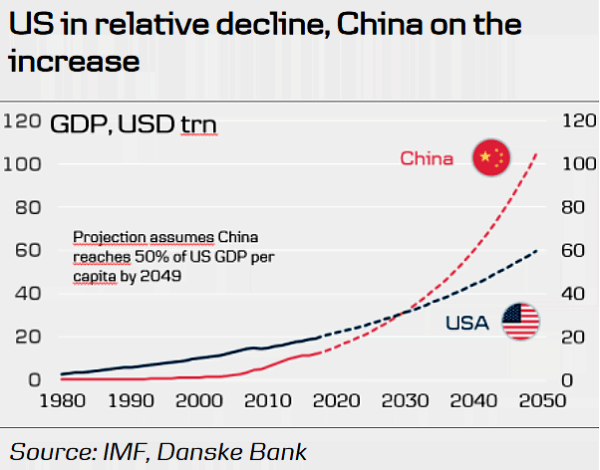
The chart above explains everything, not just the hostile diplomatic jabs that are designed to discredit and humiliate China, but also the openly belligerent policies that are aimed at Russia as well. People need to understand this. They need to see what is really going on so they can put events in their proper geopolitical context.
And what “context” is that?
The context of a Third World War; a war that was thoroughly-planned, instigated and (now) prosecuted by Washington and Washington’s proxies. That’s what’s really going on. The increasingly violent conflagrations we see cropping-up in Ukraine and Asia are not the result of “Russian aggression” or “evil Putin”. No. They are the actualization of a sinister geopolitical strategy to quash China’s meteoric rise and preserve America’s dominant role in the world order. Can there be any doubt about that?
No. None.
This is why we are experiencing the redivision of the world into warring blocs. This is why we are seeing the roll back of 30 years of Globalization and massive suppyline disruption. And this is why Europe has been thrust headlong into frigid darkness and forced deindustrialisation. All of these suicidal policies were concocted for one purpose and one purpose alone, to maintain America’s exalted spot in the global system. That is why all of humanity is presently embroiled in a Third World War; a war that is designed to prevent China from becoming the world’s biggest economy; a war that is designed to preserve US global primacy. Check out this excerpt from an article at the World Socialist Web Site:
An October 19 Financial Times article by Edward Luce, entitled “Containing China is Biden’s explicit goal,” sounded the following alarm: “Imagine that a superpower declared war on a great power and nobody noticed. Joe Biden this month launched a full-blown economic war on China—all but committing the US to stopping its rise—and for the most part, Americans did not react.
“To be sure, there is Russia’s war on Ukraine and inflation at home to preoccupy attention. But history is likely to record Biden’s move as the moment when US-China rivalry came out of the closet.”
Moreover, last week, a top Biden administration official indicated that the US was preparing new bans on China in key hi-tech areas. Speaking at the Center for a New American Security, Alan Estevez, the under-secretary of Commerce for Industry and Security, was asked if the US would ban China from accessing quantum information science, biotechnology, artificial intelligence software or advanced algorithms. Estevez admitted that this was already being actively discussed. “Will we end up doing something in those areas? If I was a betting person, I would put down money on that,” he said….
Luce concluded his Financial Times article cited above by declaring: “Will Biden’s gamble work? I’m not relishing the prospect of finding out. For better or worse, the world has just changed with a whimper not a bang. Let us hope it stays that way.”…(“Biden’s technology war against China”, World Socialist Web Site)
Once again, look at the chart. What does it tell you?
The first thing it tells you is that the hostilities we see in Ukraine (and eventually Taiwan), can be traced back to a fundamental shift in the global economy. China is growing stronger. It’s on a path to overtake the United States economy within the decade. And with growth, come certain benefits. As the world’s biggest economy, China will naturally become Asia’s regional hegemon. And, as Asia’s regional hegemon it will be able “to settle regional disputes in its own favor and to de-legitimize U.S. regional and global leadership.”
Can you see the problem here?
For nearly two decades, the US has oriented its foreign policy around a “rebalancing of forces” strategy called the “pivot to Asia”. In short, the US intends to be the dominant player in the world’s most populous and prosperous region, Asia. Can you see how China’s rise derails Washington’s plan for the future?
The United States is not going to let this happen without a fight. Washington is not going to let China muscle-it-out of the markets that it plans to dominate. That’s not going to happen. And if you think that’s going to happen, you’d better think again. The United States will go to war to avoid a scenario in which the US plays “second fiddle” to China. In fact, the foreign policy establishment has already decided that the US will engage China militarily for that very objective.
So, our thesis is simple; we think WW3 has already begun. That’s all we’re saying. The ructions we see in Ukraine are merely the first salvo in a Third World War that has already triggered an unprecedented energy crisis, massive worldwide food insecurity, a catastrophic break-down in global supply lines, widespread and out-of-control inflation, the steady reemergence of extreme nationalism, and the redivision of the world into warring blocs. What more proof do you need?
And it’s all economic. The origins of this conflict can all be traced back to the seismic changes in the global economy, the rise of China and the unavoidable decline of the United States. It is a case of one empire replacing the other. Naturally, a transition of this magnitude is going to generate tectonic changes in global distribution of power. And along with those changes will come more flashpoints, more devastation, and the looming prospect of nuclear war. And this is precisely how things are playing out.
So, how does the chart explain what is happening in Ukraine?
Washington’s proxy war in Ukraine is actually aimed at China not Russia. Russia is not a peer competitor and Russia does not have the economic wherewithal to displace the United States in the global order. NordStream, however, did pose a significant risk to the US by greatly strengthening Moscow’s economic relations with the EU and particularly with Europe’s industrial powerhouse, Germany. The Moscow-Berlin alliance—which was mutually beneficial and key to German prosperity—had to be sabotaged to prevent further economic integration that would have drawn the continents closer together into the world’s biggest free trade zone.Washington had to stop that in order to preserve its economic stranglehold on Europe and defend the dollar as the world’s reserve currency. Even so, no one expected the US to blow up the pipeline itself in—what appears to be—the greatest act of industrial terrorism in history. That was truly shocking.
In essence, Washington sees Russia as an obstacle to its “pivot” plan to encircle, isolate and weaken China. But Russia is not the greatest threat to US global primacy; not even close. That designation belongs to China.
The Third World War is being waged to contain China not Russia. What the war in Ukraine suggests is that—among foreign policy elites—there is general agreement that, The road to Beijing goes through Moscow. That appears to be the consensus view. In other words, US powerbrokers want to weaken Russia in order to spread US military bases across Asia. Ultimately, the military will be called upon to enforce Washington’s economic rule over its new Asian subjects. If that day ever comes.
We think it is extremely unlikely that Washington’s ambitious plan will succeed, but we have no doubt that it will be implemented all the same. Tens of millions of people are likely to die in a desperate attempt to turn-back the clock to the fleeting ‘unipolar moment’ and the equally short-lived American Century. It is a tragedy beyond comprehension.
Something wicked bubbles just beneath the surface of the collective conscience. Our society is rife with corruption, predation, perversion, over-consumption, violence, addiction and so much more. Somehow enough is never enough, as if the driving force behind human existence is pure want.
This is not true, though, for we know that spiritually well beings are content beings, looking no further than the present moment’s blessings for satisfaction. We don’t have an inherent need for want. Want is a symptom, not the condition. It’s something that enters when the spirit is untended to.
It must then be a spiritual illness which plagues society. Something secretly driving so many of us mad with insatiable desire for sensation and objects. Unforgiving cravings that manifest in any way imaginable, from sex, to money, to food, to power and even in the need to be perfect. It’s a war against the self, waged unconsciously by the self. A below subconscious campaign of self-annihilation.
There are no contemporary metaphors to understand this kind of emptiness. The void just is. And since the void is so rarely acknowledged and so rarely looked at deeply, it sits in the shadows driving us mad, steering with impulse.
In Chinese Buddhist philosophy, though, there is a story that fits. The hungry ghost.
“In Chinese Buddhist teachings, “hungry ghosts are unable to take in or assimilate what they desperately need. The problem lies in their constricted throats — which cannot open for nourishment. They wander aimlessly in search of relief that is not forthcoming.”” [Source]
Interestingly, according to some of its origin myths, the hungry ghost was born out an act of cruelty. In many of the stories, it is a wealthy man’s wife who did some terrible thing to a monk, and when she eventually dies her spirit takes the form of the hungry ghost, forever lurking in purgatory, unable to ever fill its distorted belly and therefore always needing and wanting more.
The hungry ghost, then, is an expression of karma.
Hungry ghosts are the demon-like creatures described in Buddhist, Taoist, Hindu, Sikh, and Jain texts as the remnants of the dead who are afflicted with insatiable desire, hunger or thirst as a result of bad deeds or evil intent carried out in their life times. [Source]
In the realm of hungry ghosts, a deep drama between the ego and the ghost plays out ad infinitum. It’s an interplay that feeds the ego just enough for it to survive, so that in turn the ego can feed the hungry ghost. A dead-end cul-de-sac of sorts. A looping projection of one of our worst human vulnerabilities.
“The work of the ghost does not want to completely destroy its prey. Having fed off the other through dissociative trajectories of turbulence, the ego again becomes more robust. The hungry ghost now has, as companion and source of nurture, a replenished ego on which internal feeding may resume inside the space of erasure until the plenitude of the ghost-within again permeates the intersubjective.” ~ Nick Totton, Psychoanalysis and the Paranormal: Lands of Darkness
Spiritually healthy people understand their cravings for what they, expressions of innumerable forms of pain. Manifestations of the suffering caused by disconnection from the self, and from nature. And the self is nature. There really is no distinction between the two. The illusion is of separateness.
The ghosts are there to remind us that our real work is transmuting our suffering and cruelty into resilience and compassion. It’s not enough to numb the pain, it must be used to our advantage, for our growth, to serve as a catalyst for transformation, and to provide a chrysalis in which the transformation can take place.
“We are social beings. When we feel disconnected or alienated, we experience pain. Addiction, depression, anger, and violence are different ways we react to pain. To heal our society we must heal the emotional wounds.” ~Chris Agnos
Few understand this more clearly than Dr. Gabor Maté, whose work with drug addicts has transformed our understanding of what it means to be stuck in the realm of hungry ghosts.
The Tenant by Roman Polanski, considered the last chapter of the Polish-French director’s notorious “apartment trilogy” (after Repulsion and Rosemary’s Baby), sketches a masterful adaptation of Roland Topor’s psychological horror novel on the screen and leads the unsuspicious viewer into the darkest corners of a paranoid person’s mind struggling with a myriad of social and community stereotypes in 1970’s Paris.
There’s no place like home
Polanski not only directed The Tenant but took on the main character’s costume to play the anxious character of Trelkovsky, a middle-aged Polish-born French-naturalized bureaucrat, who is planning to rent a tiny condo in a far from ordinary apartment house in Paris.
The former tenant committed suicide, the landlord is a grumpy old man, and the residential community is full of xenophobic prejudices. All the conditions are set for a surrealistic and dramatic experience.
Whether it is owned or rented, a house is arguably the most private place in anyone’s life, a space where individuals are entitled to live their undisturbed, non-public existence as they see fit.
In Trelkovsky’s case, there is no place for such privacy: instead, he becomes a constant victim of contemptuous comments from his neighbors targeting his Polish origins, his lifestyle and at some point is even asked to sign a petition to kick out other tenants from the apartment house.
In this sense, the residential community portrayed in The Tenant is a clear representation of a resentful and hypocritical society full of stigma and prejudices, where the individual is cornered with no place to thrive.
Polanski and the anti-hero
Trelkovsky can hardly cope with such a harsh environment and becomes convinced that his neighbors want to drive him to suicide, just as they allegedly did with the previous tenant.
Given the protagonist’s evident paranoid behavior and the tyrannical policy of the residential community, this duality and continuous tension bring out the hidden bisexuality, trans-sexuality, and paranoid fear that pave the way for the complete mental and sexual transformation of Trelkovsky.
Whatmakes this film absolutely unique is the portrayal of an utterly vulnerable character with no courage to stand up against any type of abnormality in his life, even forced to lie in the most trivial cases. Trelkovsky’s character is founded on the lack of the most basic norms of personality, an anti-hero whose identity can easily be shaped and transformed by his environment and surroundings.
The majestic peak of Polanski’s horror psychological drama is how it brings up the ruthless question of whether it is possible for an already paranoid and disturbed person to merge into a community, and what happens if he or she can’t.
And most importantly, how a group of bullies can light up latent psychological problems in an individual’s mind and bring these mental and social challenges to the surface in an irredeemable way.







 After the Crash