Two for Tuesday
Reply

By Taut Bataut
Source: New Eastern Outlook
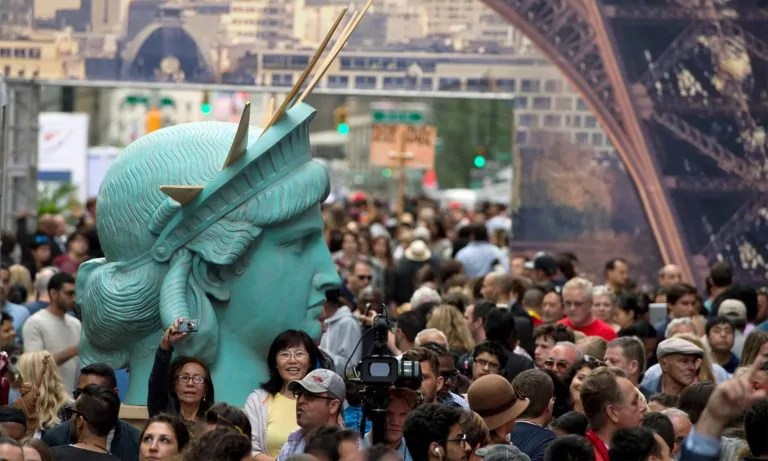
The basis of the US-led liberal world order was laid at the end of the World War 2. However, the United States and the Soviet Union kept on fighting over the spread and influence of their respective ideologies till the 1990s. The United States’ victory in the Cold War established its hegemony over the globe. Many Western philosophers, at that time, believed that the US-led liberal world order was here to stay. Famous American political philosopher, Francis Fukuyama, in his book “The End of History and the Last Man,” also endorsed this notion. However, the turn of the 21st century exposed many flaws in the liberal world order. For the past two decades, the world has witnessed numerous wars, chaos, and turmoil in almost every region. And at the core of most of these wars and conflicts, there is one common factor: The United States. The latter has waged wars, sparked chaos, and thrown governments in many countries under the pretense of democracy.
Most of the world’s financial institutions, including the World Bank, IMF, etc., are under US control. These institutions were created to financially assist the underdeveloped and developing nations. However, the United States has long been using these institutions to put the global south under duress to implement pro-US policies. This augmented a feeling of being under the dominance of the United States, especially among the poor countries of the world. Allegedly, the United States also holds the reins of the Financial Action Task Force (FATF). Although the rationale behind the creation of this institution was to curb terror financing and money laundering. However, this institution, too, has been reduced merely to a tool for the United States to pressure the countries that do not conform to the latter’s policies. China, Pakistan, and many other countries have raised concerns about the politicization of this institution by the United States and its allies. Even some of the US allies admitted to using this forum for political leverage over their enemies in the past.
The United Nations is considered the fundamental organ of the US-led world order. Initially, this institution was created to provide representation to all the member countries of the world and to resolve their disputes peacefully. However, the basic structure of the institution was faulty since its creation, as it provided extensive powers to 5 major countries. This inculcated a feeling of deprivation among other member countries. The United States has used this power for its own benefit a host of times throughout history. Recently, the United States has also vetoed a UN resolution calling for a peaceful ceasefire in Gaza. This has further sparked hostile sentiment among third-world countries against the US-led liberal world order. Moreover, the lack of power to enforce the UN resolution has also led to the failure of this system. On multiple occasions, the United States has even ignored and rejected the United Nations and has become the source of chaos and turmoil in different countries around the world. The United States’ unilateral decision to attack Iraq is one of the major substantiations of the failure of this world order.
The recent Israel-Hamas war has exposed the inadequacies of this world order. The United Nations failed to protect the lives of innocent civilians, including children and women, against Israel’s genocide. The United States and its Western allies provided protection to Israel in its ethnic cleansing operations in Gaza. South Africa registered a case against Israel’s genocide in Gaza in the International Court of Justice (ICJ) on 29th December 2023, calling for an immediate ceasefire. However, the ICJ ended up making a weak decision after hearing both sides. It declared Israel’s actions genocidal. However, it did not call for an immediate ceasefire in the Gaza Strip. This proved detrimental to the already ruptured image of the liberal institutions. Pro-Palestinian people around the globe took this decision as an attempt by the ICJ to appease both sides.
To fill all this void created by the US-dominated liberal world order, Russia and China have emerged as a new hope for the global south. China and Russia are leading an inclusive world order through BRICS. The expansion of BRICS has provided underdeveloped and developing countries with an opportunity to have their say in global affairs. Chinese President Xi Jinping stated at the BRICS Summit 2023 that all countries should have an equal opportunity to excel in global modernization. More than 40 countries have shown interest in joining BRICS recently. This demonstrates the declining faith of the world in the US-led liberal world order. To stay relevant and to preserve its integrity, the institutions of international liberal order will have to give more space to the global south. Otherwise, it is bound to be replaced by a new and more inclusive world order led by emerging economies.
By John & Nisha Whitehead
Source: The Rutherford Institute
“The madmen are in power.”— Philip K. Dick, The Man in the High Castle
The debate over U.S. foreign aid is a distraction.
That’s not to say that the amount of taxpayer money flowing to foreign countries in the form of military and economic assistance is insignificant. Even at less than 1% of the federal budget, the United States still spends more on foreign aid than any other nation.
The latest foreign aid spending bill includes $95 billion for Ukraine, Israel and Taiwan.
Since World War II, the U.S. has given more foreign aid to Israel than any other country ($318 billion), with the bulk of those funds designated for Israel’s military efforts.
Even so, more than 150 countries around the world receive U.S. taxpayer-funded assistance.
As Forbes reports, “U.S. foreign aid dwarfs the federal funds spent by 48 out of 50 state governments annually. Only the state governments of California and New York spent more federal funds than what the U.S. sent abroad each year to foreign countries.”
Whether or not that some of that foreign aid is used for legitimate purposes, the global welfare system itself is riddled with corruption and waste. As Adam Andrzejewski rightly asks, “Do taxpayers instinctively know that they are funding choir directors in Turkmenistan, filmmakers in Peru, aid for poultry farmers Tanzania, and sex education workshops for prostitutes in Ethiopia?”
The problem is not so much that taxpayers are unaware of how their hard-earned dollars are being spent. Rather, “we the people” continue to be told that we have no say in the matter.
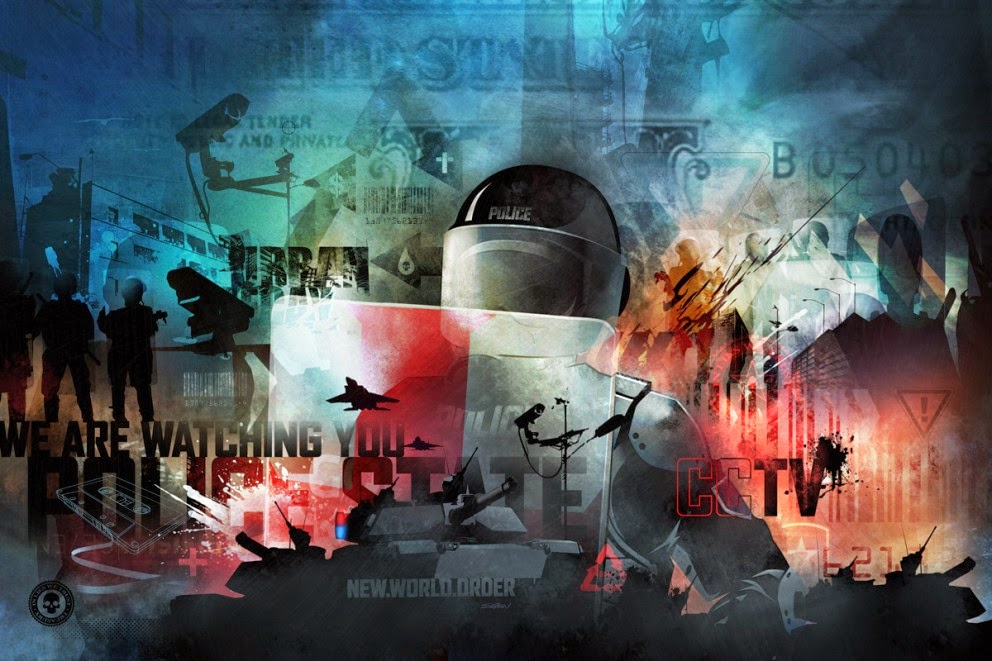
We have no real say in how the government runs, or how our taxpayer funds are used, but that doesn’t prevent the government from fleecing us at every turn and forcing us to pay for endless wars that do more to fund the military industrial complex than protect us, pork barrel projects that produce little to nothing, and a police state that serves only to imprison us within its walls.
This financial tyranny persists whether it’s a Democrat or Republican at the helm.
At a time when the government is spending money it doesn’t have on programs it can’t afford, the national debt continues to grow, our infrastructure continues to deteriorate, and our borders continue to be breached.
What is going on?
The “government of the people, by the people, for the people” has been overtaken by a shadow government—a corporatized, militarized, entrenched global bureaucracy—that is fully operational and running the country.
This powerful international cabal made up of international government agencies and corporations—let’s call it the Global Deep State—is just as real as the corporatized, militarized, industrialized American Deep State, and it poses just as great a threat to our rights as individuals under the U.S. Constitution, if not greater.
Clearly, we have entered into a new world order: fascism on a global scale.
It remains unclear whether the American Deep State (“a national-security apparatus that holds sway even over the elected leaders notionally in charge of it”) answers to the Global Deep State, or whether the Global Deep State merely empowers the American Deep State. However, there is no denying the extent to which they are intricately and symbiotically enmeshed and interlocked.
Consider the extent to which our lives and liberties are impacted by this international convergence of governmental and profit-driven corporate interests in the surveillance state, the military industrial complex, the private prison industry, the intelligence sector, the security sector, the technology sector, the telecommunications sector, the transportation sector, and in recent years, the pharmaceutical-health sector.
All of these sectors are dominated by mega-corporations operating on a global scale and working through government channels to increase their profit margins. The profit-driven policies of these global corporate giants influence everything from legislative policies to economics to environmental issues to medical care.
Global Disease
The COVID-19 pandemic propelled us into a whole new global frontier in which those hoping to navigate this interconnected and highly technological world of contact tracing, vaccine passports and digital passes find themselves grappling with issues that touch on deep-seated moral, political, religious and personal questions for which there may be no clear-cut answers.
Our ability to access, engage and move about in the world has now become dependent on which camp we fall into: those who have been vaccinated against whatever the powers-that-be deem to be the latest Disease X versus those who have not.
This is what M.I.T. professor Ramesh Raskar refers to as the new “currency for health,” an apt moniker given the potentially lucrative role that Big Business (Big Pharma and Big Tech, especially) will play in establishing this pay-to-play marketplace. The airline industry has been working on a Travel Pass. IBM is developing a Digital Health Pass. And the U.S. government has been all-too-happy to allow the corporate sector to take the lead.
“It is the latest status symbol. Flash it at the people, and you can get access to concerts, sports arenas or long-forbidden restaurant tables. Some day, it may even help you cross a border without having to quarantine,” writes Heather Murphy for the New York Times. “The new platinum card of the Covid age is the vaccine certificate.”
Global Surveillance
Spearheaded by the National Security Agency, which has shown itself to care little for constitutional limits or privacy, the surveillance state has come to dominate our government and our lives.
Yet the government does not operate alone. It cannot. It requires an accomplice. Thus, the increasingly complex security needs of our massive federal government, especially in the areas of defense, surveillance and data management, have been met within the corporate sector, which has shown itself to be a powerful ally that both depends on and feeds the growth of governmental bureaucracy.
Take AT&T, for instance. Through its vast telecommunications network that crisscrosses the globe, AT&T provides the U.S. government with the complex infrastructure it needs for its mass surveillance programs. According to The Intercept:
“The NSA considers AT&T to be one of its most trusted partners and has lauded the company’s ‘extreme willingness to help.’ It is a collaboration that dates back decades. Little known, however, is that its scope is not restricted to AT&T’s customers. According to the NSA’s documents, it values AT&T not only because it ‘has access to information that transits the nation,’ but also because it maintains unique relationships with other phone and internet providers. The NSA exploits these relationships for surveillance purposes, commandeering AT&T’s massive infrastructure and using it as a platform to covertly tap into communications processed by other companies.”
Now magnify what the U.S. government is doing through AT&T on a global scale, and you have the “14 Eyes Program,” also referred to as the “SIGINT Seniors.” This global spy agency is made up of members from around the world (United States, United Kingdom, Australia, Canada, New Zealand, Denmark, France, Netherlands, Norway, Germany, Belgium, Italy, Sweden, Spain, Israel, Singapore, South Korea, Japan, India and all British Overseas Territories).
Surveillance is just the tip of the iceberg when it comes to these global alliances, however.
Global War Profiteering
War has become a huge money-making venture, and America, with its vast military empire and its incestuous relationship with a host of international defense contractors, is one of its biggest buyers and sellers.
The American military-industrial complex has erected an empire unsurpassed in history in its breadth and scope, one dedicated to conducting perpetual warfare throughout the earth. For example, while erecting a security surveillance state in the U.S., the military-industrial complex has perpetuated a worldwide military empire with American troops stationed in 177 countries (over 70% of the countries worldwide).
Although the federal government obscures so much about its defense spending that accurate figures are difficult to procure, we do know that since 2001, the U.S. government has spent more than $1.8 trillion in the wars in Afghanistan and Iraq (that’s $8.3 million per hour). That doesn’t include wars and military exercises waged around the globe, which are expected to push the total bill upwards of $12 trillion by 2053.
The illicit merger of the global armaments industry and the Pentagon that President Dwight D. Eisenhower warned us against more than 50 years ago has come to represent perhaps the greatest threat to the nation’s fragile infrastructure today. America’s expanding military empire is bleeding the country dry at a rate of more than $15 billion a month (or $20 million an hour)—and that’s just what the government spends on foreign wars. That does not include the cost of maintaining and staffing the 1000-plus U.S. military bases spread around the globe.
Incredibly, although the U.S. constitutes only 5% of the world’s population, America boasts almost 50% of the world’s total military expenditure, spending more on the military than the next 19 biggest spending nations combined. In fact, the Pentagon spends more on war than all 50 states combined spend on health, education, welfare, and safety. There’s a good reason why “bloated,” “corrupt” and “inefficient” are among the words most commonly applied to the government, especially the Department of Defense and its contractors. Price gouging has become an accepted form of corruption within the American military empire.
It’s not just the American economy that is being gouged, unfortunately.
Driven by a greedy defense sector, the American homeland has been transformed into a battlefield with militarized police and weapons better suited to a war zone. President Biden, marching in lockstep with his predecessors, has continued to expand America’s military empire abroad and domestically in a clear bid to pander to the powerful money interests (military, corporate and security) that run the Deep State and hold the government in its clutches.
Global Policing
Glance at pictures of international police forces and you will have a hard time distinguishing between American police and those belonging to other nations. There’s a reason they all look alike, garbed in the militarized, weaponized uniform of a standing army.
There’s a reason why they act alike, too, and speak a common language of force: they belong to a global police force.
For example, Israel—one of America’s closest international allies and one of the primary yearly recipients of more than $3 billion in U.S. foreign military aid—has been at the forefront of a little-publicized exchange program aimed at training American police to act as occupying forces in their communities. As The Intercept sums it up, American police are “essentially taking lessons from agencies that enforce military rule rather than civil law.”
This idea of global policing is reinforced by the Strong Cities Network program, which trains local police agencies across America in how to identify, fight and prevent extremism, as well as address intolerance within their communities, using all of the resources at their disposal. The cities included in the global network include New York City, Atlanta, Denver, Minneapolis, Paris, London, Montreal, Beirut and Oslo.
The objective is to prevent violent extremism by targeting its source: racism, bigotry, hatred, intolerance, etc. In other words, police—acting as extensions of the United Nations—will identify, monitor and deter individuals who exhibit, express or engage in anything that could be construed as extremist.
Of course, the concern with the government’s anti-extremism program is that it will, in many cases, be utilized to render otherwise lawful, nonviolent activities as potentially extremist.
Keep in mind that the government agencies involved in ferreting out American “extremists” will carry out their objectives—to identify and deter potential extremists—in concert with fusion centers (of which there are 78 nationwide, with partners in the private sector and globally), data collection agencies, behavioral scientists, corporations, social media, and community organizers and by relying on cutting-edge technology for surveillance, facial recognition, predictive policing, biometrics, and behavioral epigenetics (in which life experiences alter one’s genetic makeup).
This is pre-crime on an ideological scale and it’s been a long time coming.
Are you starting to get the picture now?
The government and its global partners have struck a deal that puts the American people on the losing end of the bargain.
On almost every front, whether it’s the war on drugs, or the sale of weapons, or regulating immigration, or establishing prisons, or advancing technology, or fighting a pandemic, if there is a profit to be made and power to be amassed, our freedoms are being eroded while the Global Deep State becomes more entrenched.
We’ve been losing our freedoms so incrementally for so long—sold to us in the name of national security and global peace, maintained by way of martial law disguised as law and order, and enforced by a standing army of militarized police and a political elite determined to maintain their powers at all costs—that it’s hard to pinpoint exactly when it all started going downhill, but we’re certainly on that downward slope now, and things are moving fast.
Given the dramatic expansion, globalization and merger of governmental and corporate powers, we’re not going to recognize this country 20 years from now.
As I make clear in my book Battlefield America: The War on the American People and in its fictional counterpart The Erik Blair Diaries, the U.S. government will not save us from the chains of the Global Deep State. It’s too busy selling us to the highest bidder.

By Julian Rose
Source: Waking Times
The traditional gulf between science and metaphysics is undergoing a dramatic metamorphosis as the discovery of a ‘quantum entanglement’ between particles previously recognised as being miles apart, is further revealed.
In an experiment observed by scientists, when one of these particles spins around, its sister particle – although a long way off – also spins around. Responding as though never separated.
“Quantum entanglement is the phenomenon that occurs when a duet of particles are generated, interact, or share spatial proximity in such a way that the quantum state of each particle of the group cannot be described independently of the state of the others, including when the particles are separated by a large distance.” (Wikipedia)
The existence of such entanglement is both compelling and comprehensible, and I want to have a go at explaining why.
Let’s start by recognising that the Universe is ‘One’, all elements interconnecting with each other via invisible, energetic pulsating wavelengths.
The separation of particles that have previously been part of one mass, is only ‘separation’ on the classic physical plane, but not on the quantum plane.
Just because they no longer physically connect with each other, does not mean they are separated on the quantum level. They aren’t. They remain unified.
This is what in spiritual terminology is meant by ‘oneness’. This ‘oneness’ is vibrational. Such a state is experienced when one is attuned to essence: that which resonates ‘is-ness’ when undisturbed by external or internal mental intrusion. In this state there is no time, distance or resistance (gravity). No separation.
Although the speed of passage of a thought or energetic psychic exertion is often discussed within this context, it is not strictly relevant; because there is a simultaneity of connection occurring at well over the speed of light. At this level, the essence of the Universe is microscopically repeated in a dew drop and a sub atomic particle; all elements of existence remaining connected, therefore at one with the original manifestation. Mirrors of one originator, one source.
Viewed under a powerful microscope, the minutest of sub atomic particles are at one moment ‘specs’ and at another ‘waves’ according to Niels Bohr’s early quantum experiments. Even transforming again, into what Bohr described as a ‘dance’.
How these minute particles react depends equally upon the perspective and influence of the person engaged with them (the viewer) as with their independent existence as cosmic matter. They are simultaneously both mundane 3D and Universal God sparks.
It seems that once ‘together’ means always together in universal reality. The physical separation factor plays no part in altering this oneness.
At the most elemental levels, energy and matter are inseparable. Matter is congealed energy and takes on increasing levels of density according to its vibratory speed of resonance. The lower the speed the denser matter becomes and the more constricted becomes the movement of pure energy.
The Universe is both matter and ether. Particles or energetic expressions travelling outside of the constrictions of gravitational fields are not subject to resistance – being slowed down. Thus ‘God Speed’ is a powerful blessing for anyone wished it!
Classical science can only describe but not ‘experience’, intuitional higher consciousness which equates with ‘God Speed’. Intuitional consciousness places the experiencer within, not outside the quantum of existence.
Science looks in from ‘the outside’ but can, by intellectual effort and focussed concentration, recognise some of the component parts that make up the workings of cosmic consciousness, of Godliness; but falls short of ‘being’ (experiencing) what it describes.
Thus ‘quantum entanglement’ is not so mysterious. However, exploring it requires dynamic equilibrium between the two hemispheres of the brain, which accordingly reveals this entanglement to be a manifestation of the supreme interconnectivity of God consciousness.
It is the unseen glue, that along with stars, planets and other celestial objects, holds the Universe together. God consciousness resides in the heart and is openly available to all human beings. However, it sleeps within until awakened.
Huge efforts are being made to prevent humanity waking up and realising its power. Such is the paradoxical nature of existence that the struggle to overcome the dark suppressors of human evolution – both internal and external – creates the friction necessary to bring about the self-realisation of our deep spiritual powers that might otherwise remain dormant.
It also equips us with the power to defeat the dark imposters and set a new agenda for the future of life on earth.
Effort is required – nothing positive comes without effort. But the pleasure arising from a growing realisation of our quantum entanglement with our Creator far exceeds the limited and transient pleasures available to us in an unrealised, largely third density (3D) state, divorced from conscious contact with the source of our existence.
Embracing such ‘an entanglement’ will bring about a metamorphosis in human consciousness and an extraordinary new era of life on earth and beyond.
An era in which no distinction can be made between God and Man.

One Eyed Jacks
Hollywood Century, 1961: In which things start to get out of hand
By Tim Brayton
Source: Alternate Ending
The one thing that can never be claimed of the 1961 Western One-Eyed Jacks is that it’s like other movies. Lumbering and bloated, often compelling, always gorgeous, and at times astonishingly bizarre in its attempt to force the psychological impulses of mid-century naturalist theater acting into the framework of a bog-standard Western revenge thriller, I haven’t decided whether or not it “works”, though I am inclined to say it does. But this is the kind of film in which functioning according to any conventional metric was out of the question long before the filming wrapped and the final cut was issued into theaters, and its considerable fascinations are mostly disconnected from its objective quality or lack thereof.
The film began life as a screenplay by Samuel Fuller, adapting Charles Neider’s novel The Authentic Death of Hendry Jones, to be directed by Stanley Kubrick, then just emerging from his enfant terrible years, and starring Marlon Brando. It certainly did not end up that way. When the film entered production in the second half of 1958, Brando’s early career as cinema’s most famous practitioner of Method acting had just begun its slow but steady drift into the wobbly and weird middle period, where he seemed more interested in indulging unspoken private whims than serving the needs of the picture (for a more graphic depiction of this process, I would point you to the actor’s next released film after One-Eyed Jacks, the marvelously clumsy 1962 version of Mutiny on the Bounty). To put it a little more bluntly, Brando had begun his irrevocably slide into becoming a prima donna of the first order. Kubrick had ego problems of his own, of course, as would shortly be thrown in to the sharpest relief on the production of Spartacus, but in the late ’50s, there was no question who was going to win. Brando was one of the biggest names the movies had, and he pulled rank over Kubrick at every turn; eventually, the conflict between the men resulted in Kubrick leaving the production, either because he simply couldn’t stand to be around his star any longer, or because Brando demanded that he be fired.
This left a movie with no clear direction and an in-progress rewrite by Calder Willingham, and nobody in charge to make things right; eventually, Brando assumed the role of director himself, for the first and only time in his career, extensively re-working the screenplay with yet a third writer, Guy Trosper (he and Willingham received final credit onscreen). It would be easy to regard the finished product as a vanity project, and in a lot of ways, that’s precisely what it is. Undoubtedly, there’s no missing that it’s a first-time effort by a man who didn’t necessarily want to direct (the film’s box office failure certainly hurt Brando’s future dreams in that direction if he had them, though I feel like a man of his stature could have finagled another directing assignment somewhere in all the years to come, if he’d been inclined), though it also doesn’t feel lazy or slapdash. Without having ever seen the film, I had rather assumed it would resemble secondhand Elia Kazan set in the West, Kazan being the director most responsible for shaping Brando into the cinematic figure he became. But there’s barely a trace of any such influence in a film that gives itself over to plenty of poetic, narratively fuzzy sequences in which the stillness and peace of the outdoors trumps anything to do with character or plot (and there would have allegedly been plenty more of them in Brando’s original cut, running well in excess of four hours; Paramount carved it down to two hours and 21 minutes, and neither the studio nor the actor-director were happy with that process).
Brando was lucky to have a seasoned old vet to help him shape the visuals: One-Eyed Jacks was shot by Charles Lang, a great and varied cinematographer who worked in everything from light comedy to film noir to character drama, and made visual successes out of material that wouldn’t seem to require any visual sensibility at all (he triumphed on what must have been the immensely thankless job of filming Some Like It Hot, a screenplay-dominated movie if one ever existed). Westerns are, of course, the exact opposite of movies that don’t require strong visuals, and his contribution to One-Eyed Jacks is the glue that holds everything together no matter how badly the drama wants to strain apart or, more often, dissolve into a fog of aimlessness. This is a film with a truly inspiring amount of depth to its compositions and blocking: how much of that was Brando’s theater-honed sensibility, how much was Lang’s desire to show off, how much was simply the sheer power of collaboration, it’s not mine to say. The results are what matter, and the result is a film that constantly offers to pull us in, through the action, into the rooms, and to appreciate the spaces between characters and what that says about their motivations and relative domination of any given moment. It is as impressively three-dimensional as any actual 3-D movie I’ve ever seen. And that’s without even pausing to mention the gorgeous use of color, the penetrating blue of the sky and the dusty, out-of-time feeling to the ground and the interiors.
Anyway, One-Eyed Jacks is something of a visual masterpiece, which I don’t mean as a slight, or as a backhanded compliment. Westerns, as much as any genre, tend to live or die on the quality of their images, which often do a lot of the heavy lifting for defining characters and conflict and themes and emotions. And so it is with this movie, where the way that people exist in the context of their environment tell us more about them than what they say or how they say it. And this is useful to the film, since it is in a lot ways a very stiff and unconvincing piece of storytelling.
Anyway, here’s the idea behind it: there are two bank robbers, Rio (Brando), and Dad Longworth (Karl Malden, whose casting was a chief sticking point between Kubrick and Brando). They’re being chased outside of Sonora, Mexico, in 1880, by the Rurales; Dad promises to get fresh horses and return for Rio, but he simply chickens out, leaving his partner to be taken by the law and imprisoned for five years, till he escapes. At that point, Rio teams up with fellow inmate Chico Modesto (Larry Duran) and the clearly untrustworthy Bob Amory (Ben Johnson), and tracks Dad to Monterey, California, where the turncoat has established himself as the much-loved sheriff, with a beautiful Mexican wife, Maria (Katy Jurado), and a beautiful stepdaughter, Louisa (Pina Pellicer). Eager for revenge on all fronts, Rio plots to steal from the Monterey bank to humiliate Dad and seduce Louisa to symbolically cuckold him, but then he goes and falls in love with the girl instead. And after Dad administers a terrible injury to his hand, and he has a chance to think for weeks while he recuperates, Rio begins to reconsider everything he has planned.
There’s absolutely no obvious reason under the sun for this to take 141 minutes, and One-Eyed Jacks doesn’t provide any non-obvious ones. It’s an indulgent film, is all: full of lengthy, go-nowhere scenes that allow Brando and his co-stars to bat dialogue and situations back and forth in longueurs that I suppose resemble Actors Studio exercises, or something those lines; there’s an aimlessness to the rhythm of scenes for which the only possible justification is that it “feels like life”, not that it in any way works dramatically. And, too, a lot of the film consists of the camera resting on Brando, doing a lot of small-scale business to show off his character and what he’s thinking about. A little bit of it goes a long way, and it doesn’t help that Brando’s performance is nowhere near one of his best: he strands himself with an accent that’s so off-base it’s rather more funny than anything, and threads the script with the most bluntly obvious “overthrowing the father” metaphor imaginable (for serious, Malden’s character has the given name “Dad”?) that provides very little to play that isn’t flat and obvious.
The acting as a whole is a mixed bag, which surprised me a little – apparently, Brando-the-director spent most of his time helping Pellicer into her character and out of her pants, and not to much of an end: she still gives the stiffest performance in the movie with the least modulation of her line deliveries, and only comes alive when she gets to play bigger, negative emotions. The rest of the cast range from excellent (Malden’s flop-sweating authority, Slim Pickens in a remarkable reined-in performance of admirable nastiness) to simply mediocre (Brando himself), and given the film’s obvious desire to be a modernist psychological drama in Western trappings, the inconsistency of the characterisations is a real problem.
The good thing, then, is that One-Eyed Jacks works best when it’s not the film it openly wants to be, and instead can be some kind of weird fever dream of clashing tones and visual abstraction. Especially in its opening quarter or so, the film induces a kind of whiplash in its extreme fluctuations of mood from scene to scene, and cut to cut; it’s laid back here, angry here, mildly comic here, tense here, thoughtful here, and all within five minutes. There’s a deranged electricity to it that’s not exactly the same (or even in the same wheelhouse) as solid genre filmmaking, but it’s a movie with real, palpable ambition to find new, challenging, different things to do with the form. Its radicalism has been overstated by its partisans (psychologically deep Westerns, and Westerns fronted by antiheroes, weren’t exactly new news in 1961), and so has its effectiveness, but that the film is brassy and unique is pretty much beyond dispute. It’s symptomatic in some ways of the bloat and loss of focus that marks so much Hollywood filmmaking of the 1960s, but it would be a lot harder to consider that a problem if every one of those bloated epics of the period had such demented, unpredictable personality as Brando’s captivating folly.
By By Jean Shaoul
Source: Defend Democracy Press
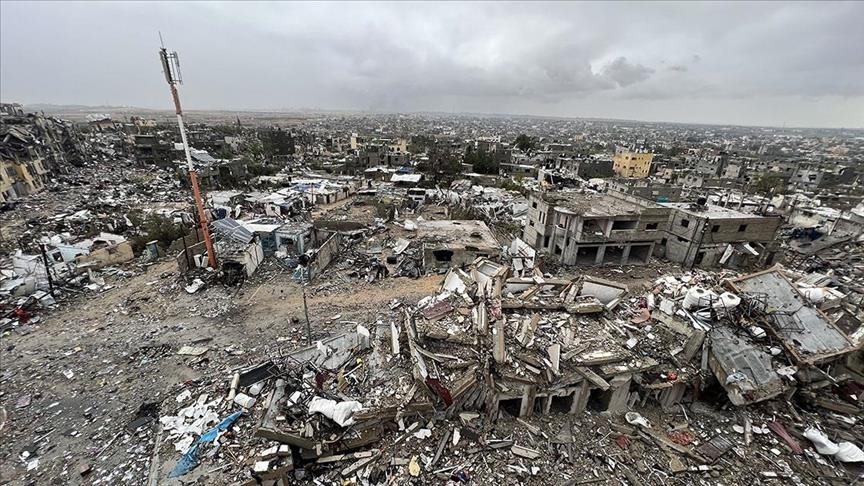
As Israel’s fascist government prepares to launch a massive ground invasion to take over Rafah city, discussions are now under way about setting up 15 campsites—each with around 25,000 tents—across the southwestern part of the Gaza Strip, to house the million-plus Palestinians that have taken refuge in the city.
These tent cities are to be funded by the United States and Arab despots and operated by the butcher of Cairo, Egypt’s Abdel Fattah el-Sisi. Egypt and other Arab regimes are in effect providing Israeli Prime Minister Benjamin Netanyahu with the ability to claim he has assured the “safe passage” he said he would provide so that the planned ground invasion could take place. As Netanyahu again declared as Israel mounted a massive aerial bombardment of the city, his real goal is “total victory”—which means killing as many Palestinians as possible and driving the rest into the desert.
That such proposals could even be discussed with the Arab regimes confirms that their collusion with Israel’s genocidal offensive against Gaza, from day one, has now become direct participation in its ethnic cleansing through a second Nakba.
Israel has already killed at least 29,000 people, mostly women, children and the elderly, buried thousands more under the rubble, and displaced approximately 86 percent of Gaza’s population—1.7 million out of 2.3 million people. The majority are now sheltering in Rafah, close to the border with Egypt where they face famine, lack access to clean water and medical care and the imminent prospect of extermination.
Egypt, the most populous Arab state with 104 million people and the key frontline state, has for decades played a criminal role as a direct accomplice in Israel’s suppression of the Palestinians and its de facto border guard.
Since signing a peace treaty with Israel in 1979, Cairo has extended its ties with Tel Aviv, importing natural gas from Israel for refining and re-export, coordinating security over their shared border and the Gaza Strip, maintaining Israel’s blockade on Gaza, and strictly limiting the movement of people and goods across its borders after Hamas took control in 2007. Egypt stood by when Israel launched murderous assaults on the besieged enclave in 2008-9, 2012, 2014, the 2018-29 Great March of Return and 2021.
When the Gaza offensive started in October, Israel’s “wartime proposal” to push Gaza’s 2.3 million Palestinians into Egypt’s Sinai desert was met with a furious response from Cairo. However, this was not out of any concern for the Palestinians but because of what El-Sisi called “Gaza’s existential threat to Egypt’s national security.” If a million Gazans crossed the border, he warned, this would lead to a resurgence of Islamist “militancy” in Sinai.
When El-Sisi refers to a resurgence of Islamist militancy, he means a renewal of the mass popular opposition known as the 25 January Revolution, which in 2011, at the height of the “Arab Spring”, ended Mubarak’s personal rule. On July 3, 2013, the junta was able to resume power in a military coup thanks to the political bankruptcy of the bourgeois liberal opposition and their pseudo-left appendages in the Revolutionary Socialists, who provided leading personnel for the anti-Islamist Tamarod movement through which the military and its billionaire backers prepared the political ground for the coup. El-Sisi has brutally crushed all dissent ever since and the last thing he wants is millions of displaced and angry Palestinians to act as the focus for broader political opposition to his regime, to US imperialism and all its allies in the region.
The army has already fortified the concrete border wall with Gaza, installing barbed wire to prevent the Palestinians from crossing into the Sinai and deploying troops and 40 tanks along the border.
El-Sisi, speaking at a press conference on October 18 with German Chancellor Olaf Scholz in Cairo, argued that Israel could move Gaza’s Palestinians to Israel’s Negev desert instead of Sinai “until Israel is capable of defeating Hamas and Islamic Jihad. Afterwards, Palestinians could return to their homeland.”
Reports are circulating, citing the Sinai Foundation for Human Rights, that Egypt is constructing an eight-square-mile walled enclosure in northern Sinai to host Palestinians forcibly expelled from Gaza, though this is described as a “contingency plan” in the event Palestinians succeed in breaching the reinforced border.
But wherever the de facto concentration camps being discussed are eventually established, Egypt and the other Arab regimes involved are giving a greenlight for mass murder in Rafah. On Sunday, with breathtaking cynicism Egyptian officials, responding to these latest proposals for tent cities, told Israel that they would not object to a military operation in Rafah as long as it is conducted without harming Palestinian civilians. Army Radio also said that Egypt had emphatically denied reports it might pullout of its 1979 Camp David treaty if Israel attacked Rafah.
All the oil-rich despots are working openly with Israel to enable it to pursue its genocidal war, even deepening their ties to ensure Israel can continue the war without hindrance. They cover their treachery with crocodile tears over the plight of the Palestinians in Gaza, support for South Africa’s case against Israel at the International Court of Justice and appeals for an urgent meeting of the toothless UN Security Council that is subject to Washington’s veto “to prevent Israel from causing an imminent humanitarian disaster for which everyone who supports the aggression is responsible.”
Jordan has played the most open role in repressing popular opposition to Israel. It shares a long border with Israel and is home to over 2.2 million registered Palestinian refugees driven there by wars between 1947 and 1967, and their descendants. Around half of its 11 million population are of Palestinian descent, of whom around two thirds have been granted citizenship, but they face discrimination while nearly 400,000 still live in 10 refugee camps. Jordan has maintained a “cold peace” with Israel following a US Clinton administration-brokered normalization treaty in 1994.
The Jordanian government has banned protests along its border with the West Bank and clamped down on protests against Israel’s war on Gaza. According to Human Rights Watch (HRW), it has “arrested or harassed” over 1,000 pro-Palestine protesters who have called for the Jordanian government to take action against Israel. Lama Fakih, HRW’s Middle East director, said “Jordanian authorities are trampling the right to free expression and assembly to tamp down Gaza-related activism.”
Last week, the authorities arrested activist, Khaled al-Natour, after he shared posts calling for the lifting of the blockade on Gaza, as part of the government’s heightened crackdown on pro-Palestine activists, under a controversial new cybercrime law. According to Amnesty International, the vaguely worded law, passed in August, gives the government huge latitude to crack down on free speech and has been used to arrest and charge at least six political activists for their “social media posts expressing pro-Palestinian sentiments or criticizing the authorities’ policies towards Israel and advocating for public strikes and protests.”
Jordan, along with several other Arab states, is also playing a central role in keeping Israel’s economy functioning during the war.
According to Israel’s television Channel 13, the United Arab Emirates-based PureTrans FZCO and Israel-based Trucknet, which provides logistics technology for the Arab shipping companies, are transporting vital goods, including food, plastics, chemicals and electronic devices and components, between Dubai’s Jebel Ali Port and Haifa port, via roads passing through Saudi Arabia and Jordan.
The route was established prior to the Gaza offensive. In June, Miri Regev, Israel’s Minister of Transportation and Road Safety, announced plans to develop the route, stating on X/Twitter that “the overland transportation of the goods will shorten the time by 12 days and greatly reduce the existing waiting time due to the wire problem. We will do it and we will succeed.” In September, Trucknet signed a shipping agreement with the UAE and Bahrain.
The plans also include a railway line, yet to be agreed, linking the UAE and Israel with a high-speed train service between Israel’s northern city of Beit She’an and southern port of Eilat on the Red Sea.
The route has assumed greater strategic significance since October and especially because of Houthi attacks on Israeli-linked shipping in the Red Sea, helping Israel circumvent the shipping blockade and cutting the 14-day sea route around the Cape to four days.
Acutely conscious of the mass opposition within its already restive population to Israel’s genocidal war, Jordan denied that goods were being transported to Israel via its territory. But television reports showing trucks from the UAE crossing Jordanian territory to reach Israel exposed this lie, sparking anger and demonstrations against Jordan’s ‘shameful land bridge’ to Israel.
The Dubai-Haifa “land corridor” was in fact first mooted in 2017 by Israel’s transport minister Yisrael Katz and highlighted at the signing in 2020 of the Abraham Accords with the UAE and Bahrain–and later with Sudan and Morrocco–that ended the participants’ long-standing economic boycott of Israel. It made apparent Israel’s economic ties with the Gulf states that had long been kept under wraps.
The Accords not only signified the ditching of their long defunct adherence to securing a “two-state solution,” even as Netanyahu threatened to annex one third of the West Bank, illegally occupied by Israel since the 1967 Arab Israeli war. It crucially paved the way for trade and investment deals with Tel Aviv, particularly in arms, technology and cyberware, and Israel’s broader economic integration into the region begun clandestinely after the 1993 Oslo Accords.
Bahrain could only sign up to the Accords with the tacit consent of its paymaster in Saudi Arabia. Riyadh is now directly involved in the Dubai-Haifa corridor as part of its efforts to extract as many concessions as possible from Washington, including a defence agreement, commitment of “security” support, arms and fighter jets and help with a civilian nuclear program, even as it expanded its economic and political links with China to strengthen its bargaining position.
The land corridor is a key concern for the US and European imperialist powers. It is aimed at positioning the Israeli port of Haifa as a major gateway to Europe, altering the political and economic map of the region by bypassing the Red Sea and furthering Israel’s integration into the Gulf states’ economies.
Haifa would be the linchpin of the India-Middle East Europe Economic Corridor (IMEC), a major transport infrastructure project aimed at integrating India, the Gulf and Europe while avoiding Iran, which would bring India closer to US imperialism and counter China’s Belt and Road Initiative. Oman’s Salalah Port, which has extensive ties with India, could also become part of the new network.
The project, which excludes Turkey, the largest non-oil economy in the Middle East, has aroused Ankara’s wrath, with government officials saying that the most suitable route for east-west trade passes through Turkey not Greece. It also undermines Egypt’s Suez Canal that is already suffering financial losses from the diversion of shipping round the Cape, intensifying its economic and social crisis.
The Arab regimes now account for one quarter of Israel’s $12.5 billion defence exports. Leaders from the UAE have also reiterated their commitment to the Abraham Accords, with UAE presidential foreign affairs adviser Anwar Gargash telling a conference in Dubai last month, “The UAE has taken a strategic decision, and strategic decisions are long-term.”
The bilateral flow of goods has exploded, expanding from $11.2 million in 2019 to $2 billion, excluding software, from January to August 2023, according to Israel’s UAE ambassador. The UAE-Israel partnership deal that came into force last year lowered tariffs with the aim of increasing bilateral trade to $10bn within five years. While far less than Israel’s trade with the European Union and Turkey, this is nevertheless far more than Israel’s trade with Egypt and Jordan.
As Israeli CEOs told the Financial Times, amid the Gaza genocide it has been “business as usual,” with new investment plans going ahead and the UAE’s airline continuing its flights to Tel Aviv even as others cancel theirs.
While Saudi Arabia was never a “frontline state” in the Arab Israeli conflict, in October 1973 it led the Organisation of Petroleum Exporting Countries’ (OPEC) ban on the export of oil to those countries that had supported Israel during the October 1973 Arab Israeli War. The war began after Egypt and Syria launched a surprise attack on Israel in an ultimately unsuccessful attempt to recover the territories lost in the 1967 war. Only Iraq and Libya did not take part in the oil embargo that was lifted in March 1974, by which time the price of oil had risen nearly threefold, massively increasing the oil states’ wealth and reactionary political influence in the region.
50 years later, there has been no mention of a similar embargo in defence of the 2.3 million Palestinians in Gaza, indicating the monarchies’ backing for Israel’s war, paid for and planned by the Biden administration, to assert US hegemony over the resource-rich region and suppress all opposition to Washington and its regional allies and to their own regime.
Israel’s war on Gaza has done nothing to derail Washington’s long-running efforts to broker a normalization deal between Israel and Saudi Arabia. A potential Saudi-Israel deal is a crucial part of its bid to settle the Gaza conflict with Riyadh indicating its willingness to proceed with discussions. For their part, the US and UK have consolidated the reversal of their previous opposition to Riyadh’s war to unseat the Houthis in Yemen, launching hundreds of aerial strikes on the Houthis in response to their attacks on shipping linked to Israel aimed at putting pressure on Israel to end its war and blockade of Gaza.
The Arab regimes, whose populations hold them in contempt, have made a pact with the devil: support for Israel—and by implication US imperialism—in return for Washington’s commitment to back their “security” in the event of a new “Arab Spring” or mass movement to unseat them, and to wage war against Iran, which has backed opposition forces to their rule, as part of its preparations for war on China.
Julian Assange’s lawyers — in a final bid on Tuesday to stop his extradition — fought valiantly to poke holes in the case of the prosecution to obtain an appeal.

By Chris Hedges
Source: Scheer Post
By the afternoon the video link, which would have allowed Julian Assange to follow his final U.K. appeal to prevent his extradition, had been turned off. Julian, his attorneys said, was too ill to attend, too ill even to follow the court proceedings on a link, although it was possible he was no longer interested in sitting through another judicial lynching. The rectangular screen, tucked under the black wrought iron bars that enclosed the upper left hand corner balcony of the courtroom where Julian would have been caged as a defendant, was perhaps a metaphor for the emptiness of this long and convoluted judicial pantomime.
The arcane procedural rules — the lawyers in their curled blonde wigs and robes, the spectral figure of the two judges looking down on the court from their raised dais in their gray wigs and forked white collars, the burnished walnut paneled walls, the rows of lancet windows, the shelves on either side filled with law books in brown, green, red, crimson, blue and beige leather bindings, the defense lawyers, Edward Fitzgerald KC and Mark Summers KC, addressing the two judges, Dame Victoria Sharp and Justice Johnson, as “your lady” and “my lord” — were all dusty Victorian props employed in a modern Anglo-American show trial. It was a harbinger of a decrepit justice system that, subservient to state and corporate power, is designed to strip us of our rights by judicial fiat.
The physical and psychological disintegration of Julian, seven years trapped in the Ecuadorian Embassy in London and nearly five years held on remand in the high-security HM Prison Belmarsh, was always the point, what Nils Melzer the former U.N. Special Rapporteur on torture calls his “slow-motion execution.” Political leaders, and their echo chambers in the media, fall all over themselves to denounce the treatment of Alexei Navalny but say little when we do the same to Julian. The legal farce grinds forward like the interminable case of Jarndyce and Jarndyce in Charles Dickens’ novel Bleak House. It will probably grind on for a few more months — one can’t expect the Biden administration to add the extradition of Julian to all its other political woes. It may take months to issue a ruling, or grant one or two appeal requests, as Julian continues to waste away in HM Prison Belmarsh.
Julian’s nearly 15-year legal battle began in 2010 when WikiLeaks published classified military files from the wars in Iraq and Afghanistan — including footage showing a U.S. helicopter gunning down civilians, including two Reuters journalists in Baghdad. He took refuge in London’s Ecuadorian embassy, before being arrested by the Metropolitan Police in 2019 who were permitted by the Ecuadorian embassy to enter and seize him. He has been held for nearly five years in HM Prison Belmarsh.
Julian did not commit a crime. He is not a spy. He did not purloin classified documents. He did what we all do, although he did it in a far more important way. He published voluminous material, leaked to him by Chelsea Manning, which exposed U.S. war crimes, lies, corruption, torture and assassinations. He ripped back the veil to expose the murderous machinery of the U.S. empire.
The two-day hearing is Julian’s last chance to appeal the extradition decision made in 2022 by the then British home secretary, Priti Patel. On Wednesday the prosecution will make its arguments. If he is denied an appeal he can request the European Court of Human Rights (ECtHR) for a stay of execution under Rule 39, which is given in “exceptional circumstances” and “only where there is an imminent risk of irreparable harm.” But the British court may order Julian’s immediate extradition prior to a Rule 39 instruction or may decide to ignore a request from the ECtHR to allow Julian to have his case heard by the court.
District Judge Vanessa Baraitser in January 2021, at Westminster Magistrates’ Court, refused to authorize the extradition request. In her 132-page ruling, she found that there was a “substantial risk” Julian would commit suicide due to the severity of the conditions he would endure in the U.S. prison system. At the same time, she accepted all the charges leveled by the U.S. against Julian as being filed in good faith. She rejected the arguments that his case was politically motivated, that he would not get a fair trial in the U.S. and that his prosecution is an assault on the freedom of the press.
Baraitser’s decision was overturned after the U.S. government appealed to the High Court in London. Although the High Court accepted Baraitser’s conclusions about Julian’s “substantial risk” of suicide if he was subjected to certain conditions within a U.S. prison, it also accepted four assurances in U.S. Diplomatic Note no. 74, given to the court in February 2021, which promised Julian would be treated well. The “assurances” state that Julian will not be subject to Special Administrative Measure. They promise that Julian, an Australian citizen, can serve his sentence in Australia if the Australian government requests his extradition. They promise he will receive adequate clinical and psychological care. They promise that, pre-trial and post-trial, Julian will not be held in the Administrative Maximum Facility in Florence, Colorado.
The defense must convince the two judges that the District Judge made serious legal errors to see an appeal granted.
They argued that espionage is, as a matter of law, a political offense and that the extradition treaty with the U.S. prohibits extradition for political offenses. They focused on the extensive UK law, common law and international law that defines espionage as a “pure political offense” because it is directed against a state apparatus. For this reason, those charged with espionage should be protected from extradition. The lawyers spent a long time adjudicating the case of Chelsea Manning to justify her leak of documents that exposed war crimes as in the public interest, then arguing that if she was justified in leaking the documents Julian was justified in publishing them.
As the day wore on it became evident that the two judges were not well versed in the case, constantly asking for citations and expressing surprise that senior officials in the U.S., such as Mike Pompeo when he was head of the CIA, said Julian would not be protected by the First Amendment in an American court because he was not a citizen. Julian’s lawyers brought up past espionage cases, such as that of MI5 agent David Shayler, prosecuted under the Official Secrets Act 1989 for passing secret documents to The Mail on Sunday in 1997 — which included the names of agents. He also disclosed that MI5 (Britain’s domestic intelligence service) kept files on prominent politicians, including Labour ministers, and that MI6 (Britain’s foreign intelligence service) was involved in a plot to assassinate Libyan leader Colonel Momar Gaddafi. The British extradition request was rejected by the French Cour d’Appel because it was a “political offense.”
All 18 counts filed against Julian allege that his purpose was “that such information so obtained could be used to the injury of the United States and the advantage of any foreign nation.”
The hearing was, after those in 2020 that focused on Julian’s mental and psychological health, refreshing in that it discussed the crimes committed by the U.S. and the importance of making them public. The two judges rarely interrupted, unlike other court proceedings for Julian I have attended where the judge often condescendingly cut short the defense. This may be a reflection of the broad public support, including by major media organizations, which have belatedly rallied behind Julian. Hundreds of people thronged the entrance to The Royal Courts of Justice, an expansive Victorian Gothic stone building adorned with statues of Jesus, Moses, Solomon and Alfred the Great, the celebrated pillars of the English legal tradition, to call for Julian’s freedom.
The afternoon session was different. On about a half dozen occasions the judges halted the defense to ask about how the leaks, because they were not thoroughly redacted, had endangered lives, although the U.S. has never been able to provide evidence of anyone whose life was lost as a result of the leaks. This canard has long been the cross on which U.S. officials have sought to crucify Julian. The two judges — one wonders if they had been given instructions during the lunch break — hurled these accusations at the defense lawyers until we adjourned.
“These indiscriminate disclosures were condemned by The Guardian and The New York Times,” Judge Sharp admonished the defense team. “They could have been done differently.”
This reference was especially egregious since the unredacted documents were first made public not by WikiLeaks or Julian but by the website Cryptome after reporters from The Guardian printed the password to the unredacted documents in their book.
The U.S. is officially seeking Julian’s extradition, where he potentially faces up to 175 years in prison, for the 2010 publication of the Iraq and Afghanistan war logs and US diplomatic cables. But the U.S. did not request his extradition until the release in March 2017 of the files known as Vault 7 which detailed how the CIA could hack Apple and Android smartphones and turn internet-connected televisions — even when they were off — into listening devices. Joshua Schulte, a former CIA employee, was found guilty last year of four counts each of espionage and computer hacking and one count of lying to FBI agents after handing over classified materials to WikiLeaks. He was given a forty-year sentence in February.
After the release of Vault 7 then CIA Director Mike Pompeo called WikiLeaks “a non-state hostile intelligence service.” The Attorney General at the time, Jeff Sessions, said that Julian’s arrest was a priority. By August the U.S. Senate had passed a 78-page intelligence finance bill which included a sentence declaring that “it is the sense of Congress that Wikileaks and the senior leadership of Wikileaks resemble a non-state hostile intelligence service often abetted by state actors and should be treated as such a service by the United States.” In May 2019 the Trump administration accused Julian of violating the Espionage Act and asked the UK to extradite him to stand trial in the U.S. Trump has called the allegations against Julian treason and called for “the death penalty or something.” Other politicians, including former Republican presidential candidate Mike Huckabee, have also called for Julian to be executed.
If Julian is extradited and additionally charged for the release of the Vault 7 documents, Fitzgerald told the court, “it could result in additional charges that merit the death penalty for aiding and abetting the enemy.” The U.S., he said, especially if Trump is elected again to the presidency, could easily “reformulate these charges into a capital offense.”
Summers brought up President Donald Trump’s request for “detailed options” of how to assassinate Julian when he was in the Ecuadorian Embassy. “Sketches were even drawn up,” he said, adding that the plot fell apart when the UK authorities backed down, especially over a potential shootout, in the streets of London”.
“The evidence showed that the US was prepared to go to any lengths, including misusing its own criminal justice system, to sustain impunity for US officials in respect of the torture/war crimes committed in its infamous ‘war on terror’, and to suppress those actors and courts willing and prepared to try to bring those crimes to account,” he said.
The lawyers were right. The CIA is the driving force behind the extradition. The leak was highly embarrassing and to the CIA highly damaging. The CIA intends to make Julian pay. Schulte, who leaked Vault 7, was given a forty year sentence. Julian, if extradited, will be next.
The final stage of Israel’s genocide in Gaza, an orchestrated mass starvation, has begun. The international community does not intend to stop it.
By Chris Hedges
Source: Scheer Post
There was never any possibility that the Israeli government would agree to a pause in the fighting proposed by Secretary of State Antony Blinken, much less a ceasefire. Israel is on the verge of delivering the coup de grâce in its war on Palestinians in Gaza – mass starvation. When Israeli leaders use the term “absolute victory,” they mean total decimation, total elimination. The Nazis in 1942 systematically starved the 500,000 men, women and children in the Warsaw Ghetto. This is a number Israel intends to exceed.
Israel, and its chief patron the United States, by attempting to shut down the United Nations Relief and Works Agency for Palestine Refugees in the Near East (UNRWA), which provides food and aid to Gaza, is not only committing a war crime, but is in flagrant defiance of the International Court of Justice (ICJ). The court found the charges of genocide brought by South Africa, which included statements and facts gathered by UNWRA, plausible. It ordered Israel to abide by six provisional measures to prevent genocide and alleviate the humanitarian catastrophe. The fourth provisional measure calls on Israel to secure immediate and effective steps to provide humanitarian assistance and essential services in Gaza.
UNRWA’s reports on conditions in Gaza, which I covered as a reporter for seven years, and its documentation of indiscriminate Israeli attacks illustrate that, as UNRWA said, “unilaterally declared ‘safe zones’ are not safe at all. Nowhere in Gaza is safe.”
UNRWA’s role in documenting the genocide, as well as providing food and aid to the Palestinians, infuriates the Israeli government. Prime Minister Benjamin Netanyahu accused UNRWA after the ruling of providing false information to the ICJ. Already an Israeli target for decades, Israel decided that UNRWA, which supports 5.9 million Palestinian refugees across the Middle East with clinics, schools and food, had to be eliminated. Israel’s destruction of UNRWA serves a political as well as material objective.
The evidence-free Israeli accusations against UNRWA that a dozen of the 13,000 employees had links to those who carried out the attacks in Israel on Oct. 7, which saw some 1,200 Israelis killed, did the trick. It led 16 major donors, including the United States, the U.K., Germany, Italy, the Netherlands, Austria, Switzerland, Finland, Australia, Canada, Sweden, Estonia and Japan, to suspend financial support for the relief agency on which nearly every Palestinian in Gaza depends for food. Israel has killed 152 UNRWA workers and damaged 147 UNRWA installations since Oct. 7. Israel has also bombed UNRWA relief trucks.
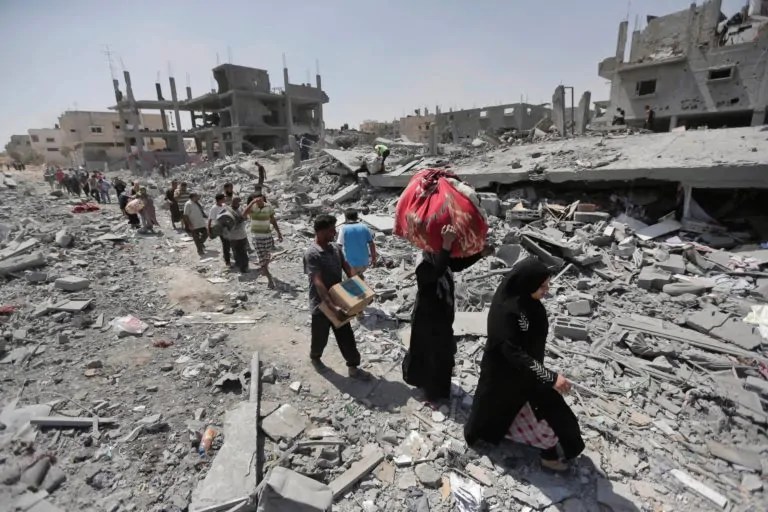
More than 27,708 Palestinians have been killed in Gaza, some 67,000 have been wounded and at least 7,000 are missing, most likely dead and buried under the rubble.
More than half a million Palestinians – one in four – are starving in Gaza, according to the U.N. Starvation will soon be ubiquitous. Palestinians in Gaza, at least 1.9 million of whom have been internally displaced, lack not only sufficient food, but clean water, shelter and medicine. There are few fruits or vegetables. There is little flour to make bread. Pasta, along with meat, cheese and eggs, have disappeared. Black market prices for dry goods such as lentils and beans have increased 25 times from pre-war prices. A bag of flour on the black market has risen from $8.00 to $200 dollars. The healthcare system in Gaza, with only three of Gaza’s 36 hospitals left partially functioning, has largely collapsed. Some 1.3 million displaced Palestinians live on the streets of the southern city of Rafah, which Israel designated a “safe zone,” but has begun to bomb. Families shiver in the winter rains under flimsy tarps amid pools of raw sewage. An estimated 90 percent of Gaza’s 2.3 million people have been driven from their homes.
“There is no instance since the Second World War in which an entire population has been reduced to extreme hunger and destitution with such speed,” writes Alex de Waal, executive director of the World Peace Foundation at Tufts University and the author of “Mass Starvation: The History and Future of Famine,” in the Guardian. “And there’s no case in which the international obligation to stop it has been so clear.”
The United States, formerly UNRWA’s largest contributor, provided $422 million to the agency in 2023. The severance of funds ensures that UNRWA food deliveries, already in very short supply because of blockages by Israel, will largely come to a halt by the end of February or the beginning of March.
Israel has given the Palestinians in Gaza two choices. Leave or die.
I covered the famine in Sudan in 1988 that took 250,000 lives. There are streaks in my lungs, scars from standing amid hundreds of Sudanese who were dying of tuberculosis. I was strong and healthy and fought off the contagion. They were weak and emaciated and did not. The international community, as in Gaza, did little to intervene.
The precursor to starvation – undernourishment – already affects most Palestinians in Gaza. Those who starve lack enough calories to sustain themselves. In desperation people begin to eat animal fodder, grass, leaves, insects, rodents, even dirt. They suffer from diarrhea and respiratory infections. They rip up tiny bits of food, often spoiled, and ration it.
Soon, lacking enough iron to produce hemoglobin, a protein in red blood cells that carries oxygen from the lungs to the body, and myoglobin, a protein that provides oxygen to muscles, coupled with a lack of vitamin B1, they become anemic. The body feeds on itself. Tissue and muscle waste away. It is impossible to regulate body temperature. Kidneys shut down. Immune systems crash. Vital organs – brain, heart, lungs, ovaries and testes — atrophy. Blood circulation slows. The volume of blood decreases. Infectious diseases such as typhoid, tuberculosis and cholera become an epidemic, killing people by the thousands.
It is impossible to concentrate. Emaciated victims succumb to mental and emotional withdrawal and apathy. They do not want to be touched or moved. The heart muscle is weakened. Victims, even at rest, are in a state of virtual heart failure. Wounds do not heal. Vision is impaired with cataracts, even among the young. Finally, wracked by convulsions and hallucinations, the heart stops. This process can last up to 40 days for an adult. Children, the elderly and the sick expire at faster rates.
I saw hundreds of skeletal figures, specters of human beings, moving forlornly at a glacial pace across the barren Sudanese landscape. Hyenas, accustomed to eating human flesh, routinely picked off small children. I stood over clusters of bleached human bones on the outskirts of villages where dozens of people, too weak to walk, had laid down in a group and never gotten up. Many were the remains of entire families.
In the abandoned town of Mayen Abun bats dangled from the rafters of the gutted Italian mission church. The streets were overgrown with tussocks of grass. The dirt airstrip was flanked by hundreds of human bones, skulls and the remnants of iron bracelets, colored beads, baskets and tattered strips of clothing. The palm trees had been cut in half. People had eaten the leaves and the pulp inside. There had been a rumor that food would be delivered by plane. People had walked for days to the airstrip. They waited and waited and waited. No plane arrived. No one buried the dead.
Now, from a distance, I watch this happen in another land in another time. I know the indifference that doomed the Sudanese, mostly Dinkas, and today dooms the Palestinians. The poor, especially when they are of color, do not count. They can be killed like flies. The starvation in Gaza is not a natural disaster. It is Israel’s masterplan.
There will be scholars and historians who will write of this genocide, falsely believing that we can learn from the past, that we are different, that history can prevent us from being, once again, barbarians. They will hold academic conferences. They will say “Never again!” They will praise themselves for being more humane and civilized. But when it comes time to speak out with each new genocide, fearful of losing their status or academic positions, they will scurry like rats into their holes. Human history is one long atrocity for the world’s poor and vulnerable. Gaza is another chapter.
INDIAN COUNTRY NEWS
"It is the duty of every man, as far as his ability extends, to detect and expose delusion and error"..Thomas Paine
Human in Algorithms
From the Roof Top
I See This
blog of the post capitalist transition.. Read or download the novel here + latest relevant posts
अध्ययन-अनुसन्धानको सार
 After the Crash