After the Crash

Dispatches From a Long Recovery (Est. 10/2024)

After the Crash

The Movie Every Screwed Millennial Should Watch

514460241_640

By Arthur Chu

Source: Alternet

Jennifer Phang’s indie science fiction film “Advantageous,” a darling of 2015’s Sundance, came to Netflix Instant Streaming earlier this week. If you’re a millennial, you have Netflix. If you’re an un- or underemployed millennial, you have time. Every un- or underemployed millennial needs to see this movie.

We live in a renaissance of science fiction film and TV and “geek” culture in general — the accelerating pace of technological change thanks to Moore’s Law makes it hard to deny we’re living in “the future,” we’re all part-machine-part-human for practical purposes now, no one can guess what element of science fiction is next to become science fact, blah blah blah.

You’ve heard that song and dance before. They use it to sell everything from splashy popcorn blockbusters with robot villains to artsy thinky indie dramas with robot antiheroes.

But “Advantageous” is the first science fiction film I’ve seen that really grasps something I think is core to the experience of us young people who are on the bleeding edge of the troubling trend of Machines Taking Our Jobs Away.

And the core theme of the film that makes it so important is also the one that I worry will scare a lot of its audience away. Because this is a science fiction film but not an action film — there’s no violence, no gunplay. There’s no heroes or villains, precious little of good-vs-evil conflict. There’s no pulsing electronic backbeat and even though there’s smartphones and holograms, there’s not that much visible technology, no one tapping madly at keyboards while incomprehensible lines of green text scroll down the monitor.

Which makes sense, actually. These are all things we imagined would happen in “the future” of the 2010s back in the 1980s. The fears that defined the genre we call “cyberpunk” that set the tone for dark, dystopian futures for a generation were 1980s fears — fears of street gang violence, fears of nuclear war, fears of the drug trade. An adult in the 1980s, imagining a member of my generation, imagined someone doing designer drugs at raves, casually gunning people down in the street and hacking into the mainframe to trick China into launching their ICBMs.

We don’t do a lot of that. In fact, the least fortunate of our Lost Generation of millennials don’t do a lot of anything.

What “Advantageous” is that other science fiction films aren’t is quiet.

That’s my experience of being an unemployed millennial in the 2000s. Long stretches of unnerving silence. Being one of a handful of unlucky young people walking aimlessly around in the middle of the day when civilized people are at work. Failing to make eye contact with each other or speak because we’ve forgotten how to have in-person conversations. Turning to social media or aimless Web surfing to fill the long stretches of emptiness, of boredom.

I’ve joked, darkly, that the worst thing about being unemployed isn’t not having any money but not having anything to do.

And to a large extent that’s what “Advantageous” is about. Yes, the eerily empty streets our characters walk through might be a result of the film’s limited budget — but it also makes sense within the film’s setting. All the buildings are empty; all the stores are closed. Homeless people wander the parks and sleep in the bushes and stare numbly into the distance. (At one point the characters try to walk into a restaurant only to find that it’s been boarded up and the owner, sitting inside, ignores them. They treat this as a normal, everyday occurrence.)

We’re told that the world is in the grip of a tech-driven economic recession. There’s no jobs for anyone — anything the small elite of wealthy customers need done, they can get a machine to do for them better than any human can. Our protagonist, Gwen, is a spokesmodel for a cosmetics — essentially an eye-candy job.

Even though she mentions having gone to grad school and hoping to go into teaching, there’s no jobs out there for teachers now that people can get any information they want from machines. The only job out there for a flesh-and-blood human who’s not already rich is a job that involves looking pretty and smiling at rich people to try to sway their opinions, and it’s a job she’s lucky to get and devastated to lose.

(Every college-educated millennial who’s ended up taking a position in sales because it was the only thing on offer ought to be feeling a familiar twinge right now.)

The film gets a lot of mileage out of taking all-too-familiar scenes from the 2009 recession and exaggerating them just enough to make them fully dystopian. Anyone who’s dealt with the infuriating process of being forced to apply for jobs through poorly-designed automated Web forms will feel Gwen’s pain as she argues with a recruiter telling her her résumé has been “red flagged” and she slowly realizes, as the recruiter’s voice on the phone devolves into ELIZA-like nonsense responses, that she can’t get a job because she’s talking to a poorly-programmed machine that’s taken someone else’s job.

Anyone who’s felt the intense pressure of the college-application arms race will sigh at Gwen’s daughter, Jules — who appears to be 11 or 12 but talks, reads and writes at the college level — calmly telling her mother about a journal article she read describing how her generation’s high-pressure lifestyle means she’s likely to become infertile by her 20s.

Jules needs a $10,000 deposit to get into an exclusive summer camp in order to get into an exclusive prep school. Without those credentials, she’s unlikely to get a job — any job — at all. Her genius-level abilities are barely enough to get her foot in the door, and without connections and credentials and money, she’ll never be able to walk through it.

It sounds like an exaggeration, if you personally haven’t witnessed a Facebook feed filled with top-ranked students from top-ranked schools with thousands of dollars of student loan debt clawing and trampling each other to get minimum-wage call center work.

And Gwen’s response to the impossible situation of trying to secure a future for her daughter when she doesn’t even have an income anymore isn’t to pick up a gun and start shooting anyone. The long scenes of her sitting in brooding silence while racking her brains for a solution are, in fact, punctuated by explosions going off in the far distance, part of a hopeless war against the government by unnamed “rebel forces” — but those explosions are oddly silent, oddly peaceful, and they never feel completely real.

It feels like the warlike shouting and chanting from Zuccotti Park that most of us sat at home and watched on TV — a revolution I now feel happened mainly because our generation felt the essential frustration, the essential wrongness of the actual soundtrack of the recession, an eerie passive silence, and some of us tried to force some noise into the silence just to fill it up.

But it didn’t work, because there was no victory condition, no enemy to defeat, no Death Star to blow up. In retrospect the protests feel as futile as the quiet clouds of smoke in the “Advantageous” skyline. You can’t blow up an entire world, an entire economic system; you can’t beg it for mercy or shout moral imprecations at it either. Break things, throw things, scream things — at the end of the day you still don’t have a job.

I think on some level we’ve always understood this. I think on some level we’re silent because the damage done to us was done through silence — no one beat us up or assaulted us or stole anything from us. All that happened was the phone didn’t ring, the email never came, the poorly designed Web form spat out an automated “You will be contacted shortly” that was a lie.

“Advantageous” is a quiet film, and a pretty one. The city Gwen and Jules’ cramped apartment exists in is gorgeous and clean. When we do hear music, it’s not pulsing techno or anarchic punk but a street musician plying his trade, playing beautiful classical pieces on the violin — perhaps he got a degree from Juilliard only to end up as destitute as Gwen.

The gritty slums of the cyberpunk milieu purported to be about a world where technology was grinding down humanity but what they really showed was a world where humans could still strike back at things — could graffiti the walls, shatter the windows, shoot pockmarks into billboards, and the property owners couldn’t keep up with the damage. Vandalism is, at the very least, a sign of human activity — a sign that someone out there is still doing something.

The eerie Disney cleanness of Gwen’s city’s streets — the way the damage caused by the rebel bombings causes no one any concern and is seemingly fully repaired overnight — is a sign of a world where the things have won and the people have given up.

That, for me, was the worst thing about the recession — seeing shiny storefronts and clean-swept streets and all the trappings of a thriving economy — but none of us participating in it. The recovery from our recession was a so-called “jobless recovery” — still plenty of stuff being made, still plenty of money, in the hands of increasingly few people, to buy things with. The economy of things is doing fine, and always has been. It’s only the economy of people that collapsed.

The anger that comes from feeling oppressed, exploited, used — that’s one thing. The weary, quiet frustration from feeling ignored, forgotten, useless — that’s something different.

There are other themes in “Advantageous.” It’s mentioned that women have borne the brunt of this recession because, a suited executive bluntly tells Gwen, people fear the social disruptions frustrated men might cause more than they fear frustrated women —something that rings eerily true in the past few years, where a handful of men who feel left behind by the modern world are increasingly willing to channel their grievances into extremist ideologies and trying to puncture our generation’s silence with escalating acts of violence.

Gwen, a highly intelligent woman who’s been reduced to making a living solely off her looks, is being replaced by her employer because they want a younger and more “universal” look for their brand. Gwen is portrayed by Jacqueline Kim, an Asian-American actress who turned 50 this year and who co-wrote the script for “Advantageous” — it’s hard not to see this plot point as reflecting Kim’s real career.

And then there’s the climactic decision Gwen must make, whether to take advantage of a “cosmetic procedure” that involves uploading her mind into a more youthful, racially-ambiguous body. While it’s far from a unique conceit, in the context of this film the idea of reducing people, especially women, into commodities, where technology makes our identity mutable and economics makes it negotiable, takes on extra resonance.

We live in a world where cheap and plentiful technology has made us cheap — the market for human labor is glutted. There’s too many of us out there, we’re too easily replaceable, almost none of us are specifically needed for anything. As a result, just to survive — just to avoid being irrelevant — we give away more of ourselves than we have in generations, selling our timeour privacyour rights just for a chance not to be left behind.

How much further will it go, “Advantageous” asks. How much less needed can people get, as the things get smarter and shinier and more efficient? How much more will you have to give away, if they ask you to — your body? Your mind? Your soul?

The film doesn’t give any easy answers. But that’s the question we all need to be asking.

Arthur Chu is an actor, comedian and blogger.
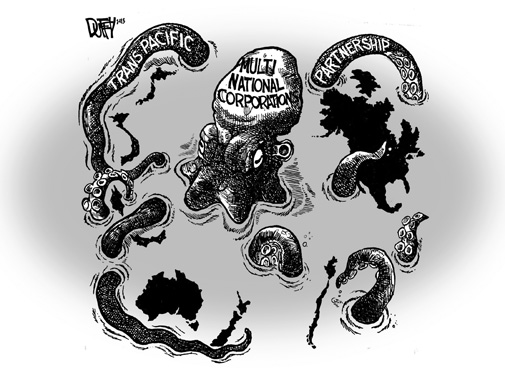
Congress Approves Greater Corporate Predation

2013-08_cartoon

By Stephen Lendman

Source: Steve Lendman Blog

On June 18, House members narrowly approved fast track Trade Promotion Authority (TPA) – using procedural gimmicks, bribes and heavy pressure, the usual way corrupt politicians operate.

On June 23, Senate members followed suit. A cloture motion to end debate passed – clearing the way for a Wednesday vote expected to support TPA.

Public Citizen President Robert Weissman commented saying:

The usual “legislative contortions an gimmicks…hand(ed) (corporate predators) their top priority” – the right to ram through Congress with minimal debate and no amendments anti-consumer rapacious trade deals no responsible societies would tolerate.

Overwhelming public opposition doesn’t matter. So-called “free” trade deals are hugely unfair.

People know “these deals will means more export of jobs, more downward pressure on wages,” said Weissman – plus more environmental destruction and loss of consumer protections.

Proposed TPP and TTIP trade bills are corporate scams – designed to rip off populations for maximum profits, no matter the cost to human lives and welfare.

They’ll wreck public healthcare. They’ll make it unaffordable for growing millions. They’ll undermine food safety. They’ll advance environmental destruction. Their secret provisions if made public would cause mass outrage.

Weissman struck a positive note saying when “the American people see what (are) actually in (these) agreements, they are going to force their representatives in Washington to vote (them) down.”

Environmental organization 350.org executive director May Boeve expressed “outrage that Congress…voted to fast track pollution, rather than the job-creating clean energy we need to address climate change.”

“It’s clear this deal would extend the world’s dependence on fracked gas, forbid our negotiators from ever using trade agreements in the fight against global warming, and make it easier for big polluters to burn carbon while suing anyone who gets in the way.”

“That’s why we’re so disappointed President Obama has taken up the banner for ramming this legislative pollution through the halls of Congress, in a way he never pushed for a climate bill.”

Food and Water Watch executive director Wenonah Hauter said “(s)enators who who provided the margin of Fast Track victory will face angry voters in their next elections.”

“Constituents will hold them accountable for putting the interests of transnational corporations ahead of the public.”

Monied interests run things. Whatever they want, they get. Congressional support for fast track and nightmarish trade deals to follow alone show why America is unfit to live in.


Stephen Lendman lives in Chicago. He can be reached at lendmanstephen@sbcglobal.net.

His new book as editor and contributor is titled “Flashpoint in Ukraine: US Drive for Hegemony Risks WW III.”

http://www.claritypress.com/LendmanIII.html

Visit his blog site at sjlendman.blogspot.com.

Listen to cutting-edge discussions with distinguished guests on the Progressive Radio News Hour on the Progressive Radio Network.

The Prison Industry in the United States: Big Business or a New Form of Slavery?

national-occupy-day-in-support-of-prisoners-022012-by-kevin-rashid-johnson-web

By Vicky Pelaez

Source: Global Research

Human rights organizations, as well as political and social ones, are condemning what they are calling a new form of inhumane exploitation in the United States, where they say a prison population of up to 2 million – mostly Black and Hispanic – are working for various industries for a pittance. For the tycoons who have invested in the prison industry, it has been like finding a pot of gold. They don’t have to worry about strikes or paying unemployment insurance, vacations or comp time. All of their workers are full-time, and never arrive late or are absent because of family problems; moreover, if they don’t like the pay of 25 cents an hour and refuse to work, they are locked up in isolation cells.

There are approximately 2 million inmates in state, federal and private prisons throughout the country. According to California Prison Focus, “no other society in human history has imprisoned so many of its own citizens.” The figures show that the United States has locked up more people than any other country: a half million more than China, which has a population five times greater than the U.S. Statistics reveal that the United States holds 25% of the world’s prison population, but only 5% of the world’s people. From less than 300,000 inmates in 1972, the jail population grew to 2 million by the year 2000. In 1990 it was one million. Ten years ago there were only five private prisons in the country, with a population of 2,000 inmates; now, there are 100, with 62,000 inmates. It is expected that by the coming decade, the number will hit 360,000, according to reports.

What has happened over the last 10 years? Why are there so many prisoners?

“The private contracting of prisoners for work fosters incentives to lock people up. Prisons depend on this income. Corporate stockholders who make money off prisoners’ work lobby for longer sentences, in order to expand their workforce. The system feeds itself,” says a study by the Progressive Labor Party, which accuses the prison industry of being “an imitation of Nazi Germany with respect to forced slave labor and concentration camps.”

The prison industry complex is one of the fastest-growing industries in the United States and its investors are on Wall Street. “This multimillion-dollar industry has its own trade exhibitions, conventions, websites, and mail-order/Internet catalogs. It also has direct advertising campaigns, architecture companies, construction companies, investment houses on Wall Street, plumbing supply companies, food supply companies, armed security, and padded cells in a large variety of colors.”

According to the Left Business Observer, the federal prison industry produces 100% of all military helmets, ammunition belts, bullet-proof vests, ID tags, shirts, pants, tents, bags, and canteens. Along with war supplies, prison workers supply 98% of the entire market for equipment assembly services; 93% of paints and paintbrushes; 92% of stove assembly; 46% of body armor; 36% of home appliances; 30% of headphones/microphones/speakers; and 21% of office furniture. Airplane parts, medical supplies, and much more: prisoners are even raising seeing-eye dogs for blind people.

CRIME GOES DOWN, JAIL POPULATION GOES UP

According to reports by human rights organizations, these are the factors that increase the profit potential for those who invest in the prison industry complex:

. Jailing persons convicted of non-violent crimes, and long prison sentences for possession of microscopic quantities of illegal drugs. Federal law stipulates five years’ imprisonment without possibility of parole for possession of 5 grams of crack or 3.5 ounces of heroin, and 10 years for possession of less than 2 ounces of rock-cocaine or crack. A sentence of 5 years for cocaine powder requires possession of 500 grams – 100 times more than the quantity of rock cocaine for the same sentence. Most of those who use cocaine powder are white, middle-class or rich people, while mostly Blacks and Latinos use rock cocaine. In Texas, a person may be sentenced for up to two years’ imprisonment for possessing 4 ounces of marijuana. Here in New York, the 1973 Nelson Rockefeller anti-drug law provides for a mandatory prison sentence of 15 years to life for possession of 4 ounces of any illegal drug.

.The passage in 13 states of the “three strikes” laws (life in prison after being convicted of three felonies), made it necessary to build 20 new federal prisons. One of the most disturbing cases resulting from this measure was that of a prisoner who for stealing a car and two bicycles received three 25-year sentences.

. Longer sentences.

. The passage of laws that require minimum sentencing, without regard for circumstances.

. A large expansion of work by prisoners creating profits that motivate the incarceration of more people for longer periods of time.

. More punishment of prisoners, so as to lengthen their sentences.

HISTORY OF PRISON LABOR IN THE UNITED STATES

Prison labor has its roots in slavery. After the 1861-1865 Civil War, a system of “hiring out prisoners” was introduced in order to continue the slavery tradition. Freed slaves were charged with not carrying out their sharecropping commitments (cultivating someone else’s land in exchange for part of the harvest) or petty thievery – which were almost never proven – and were then “hired out” for cotton picking, working in mines and building railroads. From 1870 until 1910 in the state of Georgia, 88% of hired-out convicts were Black. In Alabama, 93% of “hired-out” miners were Black. In Mississippi, a huge prison farm similar to the old slave plantations replaced the system of hiring out convicts. The notorious Parchman plantation existed until 1972.

During the post-Civil War period, Jim Crow racial segregation laws were imposed on every state, with legal segregation in schools, housing, marriages and many other aspects of daily life. “Today, a new set of markedly racist laws is imposing slave labor and sweatshops on the criminal justice system, now known as the prison industry complex,” comments the Left Business Observer.

Who is investing? At least 37 states have legalized the contracting of prison labor by private corporations that mount their operations inside state prisons. The list of such companies contains the cream of U.S. corporate society: IBM, Boeing, Motorola, Microsoft, AT&T, Wireless, Texas Instrument, Dell, Compaq, Honeywell, Hewlett-Packard, Nortel, Lucent Technologies, 3Com, Intel, Northern Telecom, TWA, Nordstrom’s, Revlon, Macy’s, Pierre Cardin, Target Stores, and many more. All of these businesses are excited about the economic boom generation by prison labor. Just between 1980 and 1994, profits went up from $392 million to $1.31 billion. Inmates in state penitentiaries generally receive the minimum wage for their work, but not all; in Colorado, they get about $2 per hour, well under the minimum. And in privately-run prisons, they receive as little as 17 cents per hour for a maximum of six hours a day, the equivalent of $20 per month. The highest-paying private prison is CCA in Tennessee, where prisoners receive 50 cents per hour for what they call “highly skilled positions.” At those rates, it is no surprise that inmates find the pay in federal prisons to be very generous. There, they can earn $1.25 an hour and work eight hours a day, and sometimes overtime. They can send home $200-$300 per month.

Thanks to prison labor, the United States is once again an attractive location for investment in work that was designed for Third World labor markets. A company that operated a maquiladora (assembly plant in Mexico near the border) closed down its operations there and relocated to San Quentin State Prison in California. In Texas, a factory fired its 150 workers and contracted the services of prisoner-workers from the private Lockhart Texas prison, where circuit boards are assembled for companies like IBM and Compaq.

[Former] Oregon State Representative Kevin Mannix recently urged Nike to cut its production in Indonesia and bring it to his state, telling the shoe manufacturer that “there won’t be any transportation costs; we’re offering you competitive prison labor (here).”

PRIVATE PRISONS

The prison privatization boom began in the 1980s, under the governments of Ronald Reagan and Bush Sr., but reached its height in 1990 under William Clinton, when Wall Street stocks were selling like hotcakes. Clinton’s program for cutting the federal workforce resulted in the Justice Departments contracting of private prison corporations for the incarceration of undocumented workers and high-security inmates.

Private prisons are the biggest business in the prison industry complex. About 18 corporations guard 10,000 prisoners in 27 states. The two largest are Correctional Corporation of America (CCA) and Wackenhut, which together control 75%. Private prisons receive a guaranteed amount of money for each prisoner, independent of what it costs to maintain each one. According to Russell Boraas, a private prison administrator in Virginia, “the secret to low operating costs is having a minimal number of guards for the maximum number of prisoners.” The CCA has an ultra-modern prison in Lawrenceville, Virginia, where five guards on dayshift and two at night watch over 750 prisoners. In these prisons, inmates may get their sentences reduced for “good behavior,” but for any infraction, they get 30 days added – which means more profits for CCA. According to a study of New Mexico prisons, it was found that CCA inmates lost “good behavior time” at a rate eight times higher than those in state prisons.

IMPORTING AND EXPORTING INMATES

Profits are so good that now there is a new business: importing inmates with long sentences, meaning the worst criminals. When a federal judge ruled that overcrowding in Texas prisons was cruel and unusual punishment, the CCA signed contracts with sheriffs in poor counties to build and run new jails and share the profits. According to a December 1998 Atlantic Monthly magazine article, this program was backed by investors from Merrill-Lynch, Shearson-Lehman, American Express and Allstate, and the operation was scattered all over rural Texas. That state’s governor, Ann Richards, followed the example of Mario Cuomo in New York and built so many state prisons that the market became flooded, cutting into private prison profits.

After a law signed by Clinton in 1996 – ending court supervision and decisions – caused overcrowding and violent, unsafe conditions in federal prisons, private prison corporations in Texas began to contact other states whose prisons were overcrowded, offering “rent-a-cell” services in the CCA prisons located in small towns in Texas. The commission for a rent-a-cell salesman is $2.50 to $5.50 per day per bed. The county gets $1.50 for each prisoner.

STATISTICS

Ninety-seven percent of 125,000 federal inmates have been convicted of non-violent crimes. It is believed that more than half of the 623,000 inmates in municipal or county jails are innocent of the crimes they are accused of. Of these, the majority are awaiting trial. Two-thirds of the one million state prisoners have committed non-violent offenses. Sixteen percent of the country’s 2 million prisoners suffer from mental illness.

On the State of “Careers”

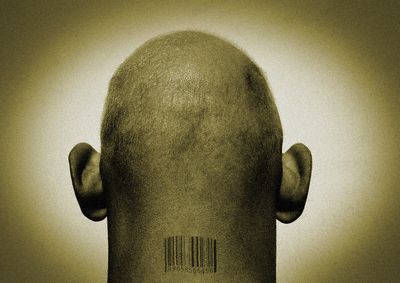
Bar Code on Bald Man's Neck

By Klint Finley

Source: Technoccult

Is digital journalism a viable career? Financial journalist and media pundit Felix Salmon says no.

His lengthy and dismal assessment of the future of journalism as a career path — ie, a job where your salary increases over time and you make enough money to support a family — was, shall we say, widely panned by other journalists who think he’s being a negative nancy and discouraging young people from entering the field. Personally, I think things are even worse than Salmon says.

Now, Salmon and I are in pretty good posiitons. Him more so than I, but neither of us is cranking out Examiner.com articles for $0 a pop just to build a portfolio in hopes of landing a staff writer job at a community newspaper that pays less than an entry level job at Home Depot. Neither of us is cranking out 10+ “stories” a day for a clickbait site just to make rent. Neither one of us just got laid off from a major urban daily after 20 years. We’re part of the lucky few that get paid a living wage, or better, to produce journalism.

But it’s not just journalism. The entire economy is now geared towards turning humans into fungible commodities. And it’s hard to build a career in an environment where there’s no point in asking for a raise because there are hundreds, perhaps thousands, of people who would do your job for even less than you do.

This is nothing new to billions of manual laborers who are used to being treated like cogs in a machine. But once upon a time unions were able to help workers actually band together to demand things like predictable hours and livable working conditions. That has changed. but the do what you love mantra managed to turn those few jobs that robots can’t yet do into sub-minimum wage gigs that require graduate degrees.

You might think you can escape this fate by becoming a programmer. But code bootcamps are cranking out hundreds of people who can crank out CRUD apps all day. And when you start to go grey, the tech industry will toss you out like an 8-track tape.

I don’t mean to imply that all precariat — from the middle class white guy with a PhD to Rwandan woman who came to the U.S. with nothing — are equally affected by this mechanization of humanity. But we are all affected.

The answer isn’t in picking the right career for the machine age. It’s changing the system.

The Transformer: Sabotage for Peace

514_230x230_NoPeel

By William T. Hathaway

Source: Dissident Voice

A former student of mine works as a janitor. After graduating from college he worked as a market researcher and an advertising salesperson, but both jobs soured him on the corporate world. He hated being a junior suit, and the thought of becoming a senior suit was even worse.

He finds being a janitor a much better job. He’s left alone, it’s low pressure, and what he does improves the world rather than worsens it. The pay’s lousy but that’s standard these days. He loves music, so he loads up his MP3 and grooves to the sounds. Although the work is routine, it’s brightened by occasional bits of human interest: used condoms in executive wastebaskets, marijuana butts in the emergency stairwell, a twenty-dollar bill under a desk. His shift is from 6 p.m. to 2 a.m., and afterwards he hits the late-night clubs, where he can enjoy the scene with the advantage of being sober. He works for a janitorial service company, and one of their clients is a defense contractor — not secret weapons, just ordinary supplies.

The man is a pacifist. Originally he felt that rallies, petitions, marches, and picketing would help turn public opinion against the war, and when the majority of Americans opposed it, our political representatives would vote to stop it. That’s what democracy means. The first part turned out to be true. Polls showed a clear majority of Americans wanted the war ended and our troops brought home. In 2006 they elected Democratic majorities in the House and Senate who said they would do this. But rather than bringing the soldiers home, “our” representatives voted more money for the war so more soldiers could be sent to Iraq, a surge of troops for another attempt to crush the resistance there. Several months later they voted additional billions for a US troop surge to Afghanistan.

In 2008 the people elected Barack Obama on a pledge to bring peace. But the war still continues with thousands dying, despite the will of the voters to end it.

He began to realize the politicians aren’t representing us but what he calls the corpses, short for corporations. The majority of those want the war to continue. It’s the corporate majority that rules, not the citizens. That’s the democracy we have. When business leaders turn against the war, then it will end.

What would make them turn against it? When they stop making a profit from it, he concluded.

Finally feeling glad to be part of the corporate world, he decided to stage a surge for peace. He bought a 10-amp step-up transformer at an electronics flea market, the kind used to increase voltage from 110 to 220. Next time he was scheduled to work at the defense contractor and the weatherman predicted a thunder storm, he brought the transformer along in his dinner box. At the first flash of lightning, he took it to the data processing center. First he unplugged all the computers and auxiliaries from the surge protectors and zapped them with 220. Then he plugged them back in and zapped the surge protectors. A clear case of surge-protector failure: the damned things must’ve let the surge through before they shut down.

The stench of sizzled electronics gave him a headache, but other than that he felt fine. He figured the lost work and ruined equipment put a hefty dent in profits. The company will try to pass those costs on to the government, but with budget deficits and taxes already cripplingly high, congress will finally have to admit they don’t have enough money to conquer Iraq and Afghanistan.

The lost work also cuts into the military supply line. If supplies are reduced, war operations have to be reduced. Soldiers can’t fight without logistics. Both economically and tactically, destroying war supplies helps to end war.

He’s aware that direct action like this is unpopular. Many people are afraid of government repression that will make their already difficult situation even more unpleasant. But he’s convinced that their difficult situation — working long hours for low pay, living in a deteriorating society, raising children amid fear and hostility — is caused by the same forces that drove us to war. Capitalism manifests now as invasion in Iraq and Afghanistan, as privatization and impoverishment in Latin America, and as the destruction of the middle class in the industrial nations. It’s the same system operating in different environments.

Rather than sheepishly obeying in hopes of avoiding more punishment, he feels we must actively rebel and seize the power that has been usurped from us. This struggle won’t be comfortable, but it will be meaningful. By taking charge of our history, we’ll earn the gratitude of future generations. Otherwise our and their lives will be continually constricted by the rule of capital. He’s convinced the time is ripe for change, and it needs to be fundamental, not superficial.

He grew up in a small town where his family owned the local hardware store. When he was in high school, Wal-Mart moved to town. Their family store couldn’t compete with Wal-Mart and went broke. His father became a clerk in the Wal-Mart hardware department at a wage less that what he had paid his lowest employee. Soon he was joined there by the former owners of the local clothing, appliance, sporting goods, and toy stores, all of which had gone broke. Despite their expertise, none was hired as a department manager, all clerks, because they might harbor resentment. The managers were long-term Wal-Mart employees brought in from outside.

But it wasn’t just Wal-Mart that used economics of scale to destroy home-grown businesses. Many farmers in the area had to sell out to corporate agriculture. Local restaurants were replaced by cheaper chains. The real estate office was driven out by a discount franchise. And all the workers were making much less than before. The whole town, except for a few big new houses, became bleak.

His parents had enough money saved so he could go to college with the help of student loans and part-time jobs. But his younger brother and sister couldn’t. The brother went into the navy, where he wouldn’t have to actually fight, and the sister worked at Wal-Mart.

What’s happening to small businesses in the USA is happening to small countries overseas. Their economies are getting taken over, sucked into the maw of transnational corporations. The World Bank and International Monetary Fund are economic weapons in this conquest. Countries that resist face other weapons, from CIA subversion to outright invasion. Feudalism has been revived and globalized. The nobility are the corporate rulers, the yeomen are their declining ranks of employees, and the serfs are the rest of us worldwide — the huge majority.

He’s certain that we’re not going to change this system without a fight, and we’d better start now while we still have some freedoms. Hoping to make basic changes through liberal reform is a delusion. We cling to that hope because we’ve been raised with the comforting myth that we live in a democracy. But behind the “we, the people” rhetoric lies entrenched power determined to maintain itself. The rulers are willing to change only in ways that make more profit, such as expanding the labor pool to include women and blacks, thus enabling them to reduce wages.

The “have a nice life” days are over in the USA. Conditions are getting inexorably worse. Americans are beginning to get the same treatment as people in the client states. As protest to this grows, the power elite will try to crush it. They’ll scapegoat the radicals, blaming them for the problems, trying to make them the target of rising populist anger. But dissidents aren’t causing these conditions, they’re resisting them. The conditions are caused by the predatory nature of capitalism.

In opposing this process, he’s a pacifist but not a passivist. He fights, but only in ways that don’t injure living creatures. Currently his transformer is stowed away, awaiting the next weather report when he can transform more war computers into peaceful scrap.


William T. Hathaway is an adjunct professor of American studies at the University of Oldenburg in Germany. “The Transformer” is a chapter from Radical Peace: People Refusing War, which presents the experiences of peace activists who have moved beyond protest into direct action: helping soldiers to desert, destroying computer systems, trashing recruiting offices, burning military equipment, and sabotaging defense contractors. Chapters are posted at Trineday. William T. Hathaway’s new book, Lila, the Revolutionary, is a fable for adults about an eight-year-old girl who sparks a world revolution for social justice. Chapters are posted here and a selection of his writing is available at his website. Read other articles by William.

So how should we “really” refer to these United States of America?

Print

By Dave Lefcourt

Source: OpEdNews.com

So how should we really refer to these United States of America? A banana republic? How about an oligarchic plutocracy? They both fit quite admirably with what we’ve become. Actually I prefer the more vernacular US of BS. Sure it’s crude, base, coarse and of course “politically incorrect” but take a close look at America.

In almost every area one can think of it’s pretty much the same. Truth and honesty is what we’re indoctrinated with, yet in reality we’re a country imbued with dishonesty and lying. Hell, even with little kids nowadays it’s the parents always yammering “good job” here and “good job” there. My god, leave the little tyke alone. He, she will get it together without the constant praising fearing without it he’ll somehow become a failure.

Think about it; from the way we conduct war to being held personally accountable, the “American Dream” to our “color blindness” on race, from “official” Washington to the “independent” MSM, and how it’s all dispensed to the people, it’s all the same BS.

We go to war to bring “freedom and democracy” to the people we invade and occupy. That’s how “dubya” Bush put it to the American people. We commit torture but call it “enhanced interrogation techniques”. We kill innocents in those wars but refer to it as “collateral damage”; come on.

This didn’t all begin with our latest wars against “terrorists”. In Viet Nam, it was the Viet Cong and the North Vietnamese Communists and every VC we killed were the “enemy” including women and children. “Winning” that war was calculated based on the number of “enemy” reported killed. Read Nick Turse’s, “Kill Anything That Moves” where “My Lai” wasn’t an aberration-as the Army said it was-but an everyday occurrence. Terrorists are just the latest manifestation of a contrived, mortal “enemy” we’re told we must fight.

Now everyone we kill are all called “terrorists”, insurgents, al Qaeda, Taliban, ISIS. But of course our killing with drones and missile strikes isn’t “terrorism” it’s what; winning the “hearts and minds”?

Go back further to our wars and “diplomacy” with our own indigenous people. It was all part of what we were taught in our schools called, “Manifest Destiny”. Well that was manifested with every treaty “official” Washington brokered with the true natives of this country being broken. The indigenous know it and now live with the circumstances that was forcibly thrust upon them. Plundering, confiscating the land and what’s now called genocide was really what it was about. You know, “from sea to shining sea”.

As far as who is held to account for their actions today, it’s mostly the poor, black or brown, those profiled, harassed, rousted and often killed but rarely are the police held accountable for their actions.

In the Ferguson police killing of Michael Brown, the grand jury exonerated officer Darren Wilson even though one of those testifying had earlier admitted to prosecutor Bob McCulloch to not being at the scene-which he later publicly stated she “clearly wasn’t present at the scene”- yet he let the panel hear her false testimony and they subsequently voted to acquit Wilson. As for McCulloch I believe he remains as the prosecutor in Ferguson.

We’re supposed to be “color blind” when it comes to race and ethnicity and enforcing the law, yet it’s not just Ferguson where the injustice is occurring it’s a country wide phenomenon. Our largest minorities are those disproportionately incarcerated. Justice? What justice? And for whom?

The “American Dream…a hoax. “Work hard, get an education, get a good job, get married and own a big house”. Maybe that’s true for a handful but the reality for most college students is debt for life. There’s over a $trillion in college student debt with outrageous interest rates tacked on. Too many are working as bartenders and wait staff. They can’t find jobs in their area of study as outsourcing of jobs has become endemic.

As “Americans” we embrace “capitalism” and despise “socialism”. Yet when the financial “masters of the universe” and the big banks brought the financial system to its knees with its fraudulent excesses in 2008, they were “bailed” out by the FED and the US Treasury-and unlike college students now get $billions in FED loans at near zero interest rates. It was government “socialism” that came to the rescue keeping the vultures afloat but sold as a “bailout” to the public. As far as “accountability” for the fraud they committed, other than a few millions in fines-and always with the stipulation they admit no wrongdoing as part of the settlement- that were miniscule and insignificant compared to the billions they made with their financial scheming, it was simply a financial bump in the road. And most significantly none went to jail. How’s that for equal justice under the law!

Our “defense” industry, Lockheed Martin, Boeing, Raytheon, General Dynamics, Northrop Grumman -the big five of the lot- are considered as “independent” corporations but they’re all pretty much owned by the Defense Department-formerly known as the “War Department” until changed after WWII-as the bulk of their earnings is from government spending called innocently as “fiscal” policy. Well that fiscal policy goes to the tune of a $trillion each year when all expenditures are considered i.e. armaments, over a 1000 military bases, wars and occupations, homeland security, NGO’s directly funded by the government, the NSA, CIA, independent contractors, NASA, the VA et al. All against “enemies” not really a threat but conjured up as so to the public to make them fearful so “official” Washington can justify the bloated, unnecessary expenditures.

Every other 1st world post industrialized country has public health insurance for all, in essence a single payer, Medicare type system run by the government. Accept for those 65 and older on Medicare in this country we now have “Obama” care, the Affordable Care Act system still leaves millions without health insurance. But it sure increased the “benefits” to the private health care behemoths, essentially a monopoly with no competition- whereby they divide the country into distinct areas so they don’t compete with each other, akin to the mafia, that is inefficient, has excessive overhead costs but sold as the best health system in the world while in actuality its 37th in the world in delivering health care. So to an imagined “good ole boy” who remarks, “We ain’t got no stinkin socialized medicine in this country. What are ya some kinda commie or somethin?” Ah, but I digress.

And lastly- there’s no way to elaborate on all the BS befouling America in such a short piece; just substitute your own; the crock is endless – there’s the corporate MSM. What may have been a time of an independent free press, naturally skeptical of government with investigative journalism unearthing official wrongdoing has descended into what can best be described as the “ministry of propaganda”, a compliant, complicit, enabling organ of the state.

It “informs” us alright but mostly with lies, distortions and misinformation rather than keeping the public informed with the truth as it really is, not some fictionalized version to keep it in good stead with “official” Washington.

But that corporate MSM fits in quite nicely with this pieces hypothesis, the US of BS.

And an increasingly dangerous one at that not only to others in the world but also for Americans.

But don’t tell that to most Americans, we’re still “the land of the free and the home of the brave” .

Yeah, BS to the very end.

About the Author:

Retired. The author of “DECEIT AND EXCESS IN AMERICA, HOW THE MONEYED INTERESTS HAVE STOLEN AMERICA AND HOW WE CAN GET IT BACK”, Authorhouse, 2009

We wink to them, Good Night!

Liberation-Through-Lucid-Living-Creating-Your-Lucid-Reality

By The Raqs Media Collective

Source: Adbusters

For the past few decades, globally, many well-meaning but demoralized people, especially artists and intellectuals, but also activists, have been losing sleep. They suffer from a peculiarly debilitating activist insomnia consisting of relentless Facebook posting, forwarded petitions and other rituals of narrowing particularity that have taken the place of heretical, insurrectionary and transcendental visions.

We are restless, exhausted through the operation of the worst, most damaging technique available to torturers: sleep deprivation. We could all do with a “sleep in” on the long night shifts. It appears as if there has been a generalized forgetting of the arts and sciences of dreaming, especially lucid dreaming.

This makes it sobering, and even mildly therapeutic, to undertake a close reading of a different account of sleep, and of awakening — the one that opens this essay, from Faridabad Workers News (FMS), a workers’ newspaper.

During our regular night shifts, the general manager used to be abrasive with any worker he saw dozing. He used to take punitive action against them. One night, one hundred and eight of us went to sleep, all together, on the shop floor. Managers, one after the other, who came to check on us, saw us all sleeping in one place, and returned quietly. We carried on like this for three nights. They didn’t misbehave with us, didn’t take any action against us. Workers in other sections of the factory followed suit. It became a tradition of sorts.

We have been reading FMS — which is produced by some friends in Faridabad, a major industrial suburb of Delhi and one of the largest manufacturing hubs of Asia — for the past 25 years. The paper has a print run of 12 thousand, is distributed at regular intervals by workers, students, and itinerant fellow travellers at various traffic intersections, and is read on average by two hundred thousand workers all over the restless industrial hinterland of Delhi.

Over the years, this four-page, A1-size paper full of news and reports of what working people are doing and thinking in one of the biggest industrial concentrations of Asia has acted as a kind of reality check, especially against the echolalia — manic or melancholic, laudatory or lachrymose — that issues forth at regular intervals from the protagonists as well as the antagonists of the new world order. In these circumstances, the paper acts as a kind of weather vane, a device which helps us scent the wind, sense undercurrents and keep from losing our head either in the din of the ecstatic overture for capital and the state, or in the paralyzing grief over their attempts to strengthen their sway.

The issue of FMS, published a week before the results of India’s elections unleashed a frenzy of mourning and celebration, talks about questions coming to shore. It says,

While distributing the paper, we were stopped twice and advised: “Don’t distribute the paper here. Workers here are very happy. Are you trying to get factories closed?” That reading, writing, thinking and exchange can lead to factory closures — where does this thought come from?

Perhaps this fear is a result of messages that circulate between the mobile phones of tailors. Or perhaps this fear emerges because workers on the assembly line are humming!

The industrial belt that surrounds Delhi has been going through a deep churning over the last few years. Hundreds of thousands of young men and women are gathering enormous experience and thought at an early age. They are giving force to waves of innovative self-activity, finding new ways of speaking and thinking about life and work, creating new forms of relationships. In the gathering whirlwind of this milieu, many long-held assumptions have been swept away, and fresh, unfamiliar possibilities have been inaugurated. Here we are presenting some of the questions that have coursed through our conversations and which continue to murmur around us.

Why should anyone be a worker at all?

This question has gained such currency in these industrial areas that some readers may find it strange that it is being mentioned here at all. But still, we find it pertinent to underscore the rising perplexity at the demand that one should surrender one’s life to that which has no future. And again, why should one surrender one’s life to something that offers little dignity?

If we put aside the fear, resentment, rage and disappointment in the statement “What is to be gained through wage work after all?” we can begin to see outlines of a different imagination of life. This different imagination of life knocks at our doors today, and we know that we have between us the capacity, capability and intelligence to experiment with ways that can shape a diversity of ways of living.

Do the constantly emerging desires and multiple steps of self-activity not bring into question every existing partition and boundary?

In this sprawling industrial zone, at every work station, in each work break — whether it’s a tea break or a lunch break — conversations gather storm. Intervals are generative. They bring desires into the open, and become occasions to invent steps and actions. No one is any longer invested in agreements that claim that they might be able to bring forth a better future in three years, or maybe five. Instead, workers are assessing constantly, negotiating continually; examining the self and examining the strength of the collective, ceaselessly. And with it, a wink and a smile: “Let’s see how a manager manages this!” The borders drawn up by agreements are breached, the game of concession wobbles, middlemen disaggregate.

When we do — and can do — everything on our own, why then do we need the mediation of leaders?

“Whether or not to return to work after a break, and across how many factories should we act together — we decide these things on our own, between ourselves,” said a seamstress. Others concurred: “When we act like this, on our own, results are rapid, and our self-confidence grows,” and elaborated, “on the other hand, when a leader steps in, things fall apart; it’s disheartening. When we are capable of doing everything on our own, why should we go about seeking disappointment?”

Are these various actions that are being taken today breaking the stronghold of demand-based thinking?

The most remarkable and influential tendency that has emerged in this extensive industrial belt cannot be wrapped up, contained in, or explained via the language of conditions, demands and concessions. Why? Over the years, the dominant trend has been to portray workers as “poor things,” which effectively traps them in a language that makes them seem like victims of their condition and dependent on concessions. And then they are declared as being in thrall to the language of conditions, demands and concessions. This is a vicious cycle. In the last few years, the workers of Maruti Suzuki (Manesar) have ripped through this encirclement.

“What is it that workers want? What in the world do workers want?”

The company, the local government, the central government were clueless in 2011, they stayed clueless through 2012 and they are still clueless. This makes them nervous. That is why, when workers exploded despite the substantial concessions being offered by management, it resulted in six hundred paramilitary commandos being deputed to restore “normalcy.” One hundred and forty seven workers are political prisoners even today.

Do these questions hold for everyone, everywhere in the world?

The April 2014 issue of FMS featured a categorical statement.

Today we can say with full confidence that an unsettling courses through seven billion people. It is inspired by the desire for an assertion of the overflowing of the surplus of life. It is an expression of creative, boundless astonishment.

Today we can say with full confidence that an unsettling courses through seven billion people. And relatedly, a crisis-laden astonishment: What happens to the colossal wealth that is being produced? Where does it go? How is it that such a tiny sliver from it reaches daily life?

Astonishment is an interesting emotion. It can signal a profound delight alloyed with surprise, as well as the kind of deep anger that borders on puzzled rage. In dreams, we are far more comfortable with astonishment than we are when we are awake and distracted. This double-edged astonishment features both a joy at the self-discovery of the multitude’s own capacities as a planetary force, as well as a recognition of how life itself is being drained of worth and value. This takes us to a new ground — a place of radical uncertainty. Here, both the perils and the potentials of a new global subjectivity lie in wait. Why can we not see them? Why can we not hear them call out? Perhaps they are feigning sleep, restoring themselves with an unauthorized midshift siesta that could break, if they wanted it to, any moment.

Perhaps, in places, it has already broken.

Emergence of factory rebels. Attack on factories by congregations of workers. Frightened management. Industrial areas turn into war zones. Rising numbers of workers as political prisoners. Courts that keep refusing bail. A mounting rebuttal on shop floors of the unsavory behavior of managers and supervisors. The dismantling of the managerial game of concessions. Irrelevance of middlemen. An acceleration of linkages and exchanges between workers.

“This,” says the paper, “is the general condition of today.”

The one thing that we can say with certainty is that management no longer knows what workers are thinking. They do not know what happens next.

Ebullitions all around, the unshackling of factories. Workers refuse to leave the factory. The undoing of the occupation of factories by management. Making factories unfettered spaces for collective gathering. Creating environments that invite the self, others, the entire world to be seen anew. Ceaseless conversation, deep sleep, thinking, the exchange of ideas. The joining together of everyone in extended relays of singing. The invention of new relationships. Whirling currents of possibility opened up by the making of collective claims on life.

This too is the general condition of today.

So how will the sinking ship of the state keep sailing? How will orders be given and obeyed if so few are even speaking the language of the captain anymore? For the ship not to sink, at least not yet, these orders must at least appear to be given and obeyed. Someone must semaphore.

Perhaps the rise of nationalism of the far right across the world is not as much a sign of the increasing power of capital and the state as it is a recognition, by those at the helm of affairs, of their own besieged situation. They are under siege. Once again the rulers do not know what is going on in the minds of those they rule. For all practical purposes, the subjects are opaque, oblivious to every command. Management does not even know whether the workers are asleep or awake. When they are asleep, they seem to be animated by the current of vivid dreams. When they are awake, they doze at the machine. Is this why every leader asks his nation to awaken? So that he can be reassured that they are at least listening to him? The more they sleep, the louder is the call to rise.

This is the time to dream lucidly. To envision and realize the things that one cannot do when one is awake, distracted, bored, busy. This is the time for hearing voices, to become open to the murmur of the universe, for heresy, for audacious conversations, for acts to turn factories into orchards and a laughter that makes standing armies into brass bands.

Let them who rule risk fatigue with their watchfulness.

We wink to them, good night!

— The Raqs Media Collective plays a plurality of roles, appearing as artists, curators and philosophical agent provocateurs in India. This piece appeared in the e-flux journal No. 56, June 2014.

Related Video:

300

MAY DAY – The International Labor Day

crane13

Source: The Anarchist International

May 1st, International Workers’ Day, commemorates the historic struggle of working people throughout the world, and is recognized in most countries. The United States of America and Canada are among the exceptions. This despite the fact that the holiday began in the 1880s in the USA, linked to the battle for the eight-hour day, and the Chicago anarchists.

The struggle for the eight-hour day began in the 1860s. In 1884, the Federation of Organized Trades and Labor Unions of the United States and Canada, organized in 1881 (and changing its name in 1886 to American Federation of Labor ) passed a resolution which asserted that “eight hours shall constitute a legal day’s work from and after May 1, 1886, and that we recommend to labor organizations throughout this district that they so direct their laws as to conform to this resolution”. The following year the Federation repeated the declaration that an eight-hour system was to go into effect on May 1, 1886. With workers being forced to work ten, twelve, and fourteen hours a day, support for the eight-hour movement grew rapidly. In the months prior to May 1, 1886, thousands of workers, organized and unorganized, members of the organization Knights of Labor and of the federation, were drawn into the struggle. Chicago was the main center of the agitation for a shorter day. The anarchists were in the forefront of the Central Labor Union of Chicago, which consisted of 22 unions in 1886, among them the seven largest in the city.

During the Railroad strikes of 1877, the workers had been violently attacked by the police and the United States Army. A similar tactic of state terrorism was prepared by the bureaucracy to fight the eight-hour movement. The police and National Guard were increased in size and received new and powerful weapons financed by local business leaders. Chicago’s Commercial Club purchased a $2000 machine gun for the Illinois National Guard to be used against strikers. Nevertheless, by May 1st, the movement had already won gains for many Chicago workers. But on May 3, 1886, police fired into a crowd of strikers at the McCormick Harvester Machine Company, killing at least one striker, seriously wounding five or six others, and injuring an undetermined number. Anarchists called for a mass meeting the next day in Haymarket Square to protest the brutality.

The meeting proceeded without incident, and by the time the last speaker was on the platform, the rainy gathering was already breaking up, with only about two hundred people remaining. It was then a police column of 180 men marched into the square and ordered the meeting to disperse. At the end of the meeting a bomb was thrown at the police, killing one instantly, six others died later. About seventy police officers were wounded. Police responded by firing into the crowd. How many civilians were wounded or killed from police bullits never was ascertained exactly. Although it was never determined who threw the bomb, the incident was used as an excuse to attack anarchists and the labor movement in general. Police ransacked the homes and offices of suspected radicals, and hundreds were arrested without charge. A reign of police terror swept over Chicago. Staging “raids” in the working-class districts, the police rounded up all known anarchists and other socialists. “Make the raids first and look up the law afterward!” publicly counseled the state’s attorney.

Anarchists in particular were harassed, and eight of Chicago’s most active were charged with conspiracy to murder in connection with the Haymarket bombing. A kangaroo court found all eight guilty, despite a lack of evidence connecting any of them to the bomb-thrower, and they were sentenced to die. In October 9, 1886, the weekly journal Knights of Labor published in Chicago, carried on page 1 the following announcement: “Next week we begin the publication of the lives of the anarchists advertised in another column.”

The advertisement, carried on page 14, read: The story of the anarchists, told by themselves; Parsons, Spies, Fielden, Schwab, Fischer, Lingg, Engle, Neebe. The only true history of the men who claim that they are condemned to suffer death for exercising the right of Free Speech: Their association with Labor, Socialistic and Anarchistic Societies, their views as to the aims and objects of these organizations, and how they expect to accomplish them; also their connection with the Chicago Haymarket Affair. Each man is the author of his own story, which will appear only in the “Knights of Labor” during the next three months, – the great labor paper of the United States, a 16-page weekly paper, containing all the latest foreign and domestic labor news of the day, stories, household hints, etc. A co-operative paper owned and controlled by members of the Knights of Labor, and furnished for the small sum of $1.00 per annum. Adress all communications to Knights of Labor Publishing Company, 163 Washington St., Chicago, Ill. Later this journal and the paper Alarm published the autobiographies of the Haymarket men.

Albert Parsons, August Spies, Adolf Fischer and George Engel were hanged on November 11, 1887. Louis Lingg committed suicide in prison. The authorities turned over the bodies to friends for burial, and one of the largest funeral processions in Chicago history was held. It was estimated that between 150,000 to 500,000 persons lined the route taken by the funeral cortege of the Haymarket martyrs. A monument to the executed men was unveiled June 25, 1893 at Waldheim Cemetery in Chicago. The remaining three, Samuel Fielden, Oscar Neebe and Michael Schwab, were finally pardoned in 1893.

On June 26, 1893, the governor of Illinois, John Peter Altgeld, issued the pardon message in which he made it clear that he was not granting the pardon because he believed that the men had suffered enough, but because they were innocent of the crime for which they had been tried, and that they and the hanged men had been the victims of hysteria, packed juries and a biased judge. He noted that the defendants were not proven guilty because the state “has never discovered who it was that threw the bomb which killed the policeman, and the evidence does not show any connection whatsoever between the defendants and the man who threw it.”

International Workers’ Day is the commemoration of the Haymarket Event in Chicago in 1886. In 1889, the first congress of the Second International, meeting in Paris for the centennial of the French Revolution and the Exposition Universelle (1889), following an initiative from the American Federation of Labor, called for international demonstrations on the 1890 anniversary of the Chicago protests. These were so successful that May Day was formally recognized as an annual event at the International’s second congress in 1891.

It is not surprising that the state, business leaders, mainstream union officials, and the media would want to hide the true history of May Day. In its attempt to erase the history and significance of May Day, the United States government declared May 1st to be “Law Day”, and gave the workers instead Labor Day, the first Monday of September – a holiday devoid of any historical significance.

Nevertheless, rather than suppressing the labor and anarchist movements, the events of 1886 and the execution of the Chicago anarchists, spokesmen of the movement for the eight-hour day, mobilized many generations of radicals. Emma Goldman, a young immigrant at the time, later pointed to the Haymarket affair as her political birth. Instead of disappearing, the anarchist movement only grew in the wake of Haymarket.

As workers, we must recognize and commemorate May Day not only for it’s historical significance, but also as a time to organize around issues of vital importance of today for the working-class broadly defined, i.e. the grassroots – the people seen as a class in contrast to the superiors in income and/or rank – economically and/or political/administrative.

The May Day Manifestos of the International Workers of the World affiliated to the Anarchist International, from the latest years are published on its Webpage, click here!

Lara Trace Hentz

INDIAN COUNTRY NEWS

In Saner Thought

"It is the duty of every man, as far as his ability extends, to detect and expose delusion and error"..Thomas Paine

ZEDJournAI

Human in Algorithms

Rooster Crows

From the Roof Top

Aisle C

I See This

The Free

blog of the post capitalist transition.. Read or download the novel here + latest relevant posts

अध्ययन-अनुसन्धान(Essential Knowledge of the Overall Subject)

अध्ययन-अनुसन्धानको सार