
Reimagining Money

What if markets were designed to build trust instead of wealth?

By Douglas Rushkoff

(The Atlantic)

Bitcoin was conceived as a modern solution to an ages-old problem: How can two parties agree on and verify an exchange of value? In this sense, Bitcoin is an effective technology, in that it trains the massive processing power of distributed personal computers on the same situation that paper currency was built to resolve. But in important ways, Bitcoin transposes some of the shortcomings of traditional currency onto the digital realm. It ignores a whole host of questions about the potential to reimagine what money can be designed to emphasize: What sorts of money will encourage admirable human behavior? What sorts of money systems will encourage trust, reenergize local commerce, favor peer-to-peer value exchange, and transcend the growth requirement? In short, how can money be less an extractor of value and more a utility for its exchange?Around the world, people have proposed experimental, tentative answers to these questions. What follows are three ways that people have toyed with rearranging the priorities of transactions—all of which would encourage a radical reimagination of what money is and can do.

The simplest approach to limiting the delocalizing, extractive power of central currency is for communities to adopt their own local currencies, pegged or tied in some way to a central currency. One of the first and most successful contemporary efforts is the Massachusetts BerkShare, which was developed to help keep money from flowing out of the Berkshire region.

One hundred BerkShares cost $95 and are available at local banks throughout the region. Participating local merchants then accept them as if they were dollars—offering their customers what amounts to a 5-percent discount for using the local money. Although it amounts to selling goods at a perpetual discount, merchants can in turn spend their local currency at other local businesses and receive the same discounted rate. Nonlocals and tourists purchase goods with dollars at full price, and those who bother to purchase items with BerkShares presumably leave town with a bit of unspent local money in their pockets.

The 5-percent local discount may seem like a huge disadvantage to take on—but only if businesses think of themselves as competing individuals. In the long term, the discount is more than compensated for by the fact that BerkShares can circulate only locally. They remain in the region and come back to the same stores again and again. Even if nonlocal stores, such as Walmart, agree to accept the local currency, they can’t deliver it up to their shareholders or trap it in static savings. The best Walmart can do is use it to pay their local workers or purchase supplies and services from local merchants.

* * *

Unlike local discount currencies, cooperative community currencies don’t need to be pegged to the dollar at all. They are not purchased into existence but are worked into circulation. They are best thought of less like money than like exchanges.

The simplest form of cooperative currency is a favor bank, such as those founded in Greece and other parts of southern Europe during the Euro crisis. Incapable of finding work or sourcing Euros, people in many places lost the ability to transact. Even though a majority of what they needed could be produced locally, they had no cash with which to trade. So they built simple, secure trading websites—mini-eBays—where people offered their goods and services to others in return for the goods and services they needed. The sites did not record value amounts so much as keep general track of who was providing what to the community and coordinate fair exchanges. This casual, transparent solution works particularly well in a community where people already know one another and freeloaders can be pressured to contribute.

Larger communities have been using “time dollars,” a currency system that keeps track of how many hours people contribute to one another. Again, a simple exchange is set up on a website, where people list what they need and what they can contribute. The bigger and more anonymous a community, the more security and verification is required. Luckily, dozens of startups and nonprofit organizations have been developing apps and website kits via which local or even nonlocal communities can establish and run their own currencies.

Time exchanges tend to work best when everybody values their time the same way or is providing the same service. Time dollars are extremely egalitarian, valuing each person’s time the same as anyone else’s. An “hour” is worth one hour of work, whether it is performed by a plumber or a psychotherapist.

The Japanese recession gave rise to one of the most successful time exchanges yet, called Fureai Kippu, or “Caring Relationship Tickets.” People no longer had enough cash to pay for their parents’ or grandparents’ health-care services—but because they had moved far away from home to find jobs, they couldn’t take care of their relatives themselves either. The Fureai Kippu exchange gave people the ability to bank hours of eldercare by taking care of old people in their communities, which they could then spend to get care for their own relatives far away. So one person might provide an hour of bathing services for an elder in her neighborhood in return for someone preparing meals for her grandfather who lives in another city. As the Caring Relationship Tickets became accepted things of value, people began using them for a variety of services.

Although a person can do a bunch of work in order to bank enough hours to get a whole bunch of services, most time exchanges put a limit on how many hours members can accumulate. They also put a limit on how many hours a person can owe. This way a freeloader can be removed from the system, and the entire community can absorb the cost of the unearned hours pretty easily.

* * *

How might traditional banks participate effectively in the financial rehabilitation of the communities they serve? Here’s just one possibility:

Sam’s Pizzeria is thriving as a local business, and Sam needs $200,000 to expand the dining room and build a second restroom. Normally, the bank would evaluate his business and credit and then either reject his loan request or give him the money at around 8 percent interest. The risk is that he won’t get enough new business to fill the new space, won’t be able to pay back the loan, and will go out of business. Indeed, part of the cost of the loan is that speculative risk.

In another approach, the banker could make Sam a different offer. The bank could agree to put up $100,000 toward the expansion project at 8 percent if Sam is able to raise the other $100,000 from his community in the form of market money: Sam is to sell digital coupons for $120 worth of pizza at the expanded restaurant at a cost of $100 per coupon. The bank can supply the software and administrate the escrow. If Sam can’t raise the money, then it proves the community wasn’t ready, and the bank can return everyone’s money.

If he does raise the money, then the bank has gained the security of a terrific community buy-in. Sam got his money more cheaply than if he borrowed the whole sum from the bank, because he can pay back the interest in retail-priced pizza. The community lenders have earned a fast 20 percent on their money—far more than they could earn in a bank or mutual fund. And it’s an investment that pays all sorts of other dividends: a more thriving downtown, more customers for other local businesses, better real-estate values, a higher tax base, better public schools, and so on. These are benefits one can’t see when buying stocks or abstract derivatives. Meanwhile, all the local “investors” now have a stake in the restaurant’s staying open at least long enough for them to cash in all their coupons. That’s good motivation to publicize it, take friends out to eat there, and contribute to its success.

For its part, the bank has diversified its range of services, bet on the possibility that community currencies will gain traction, and demonstrated a willingness to do something other than extract value from a community. The bank becomes a community partner, helping a local region invest in itself. The approach also provides the bank with a great hedge against continued deflation, hyperinflation, or growing consumer dissatisfaction with Wall Street and centrally issued money. If capital lending continues to contract as a business sector, the bank has already positioned itself to function as more of a service company—providing the authentication and financial expertise small businesses still need to thrive.

The bank transforms itself from an agent of debt to a catalyst for distribution and circulation. Like money in a digital age, it becomes less a thing of value in itself than a way of fostering the value creation and exchange of others.


This article has been adapted from Throwing Rocks at the Google Bus: How Growth Became the Enemy of Prosperity.
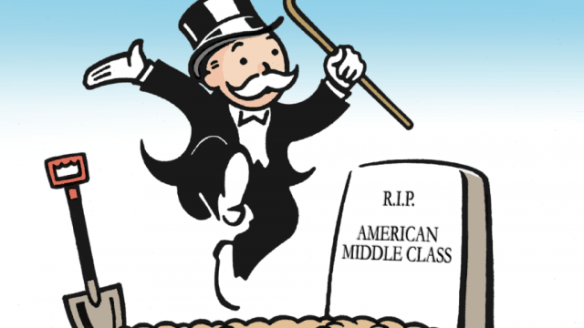
Disposable Americans: The Numbers are Growing

middle-class

By Paul Buchheit

Source: Information Clearing House

As often noted in the passionate writings of Henry Giroux, poor Americans are becoming increasingly ‘disposable’ in our winner-take-all society. After 35 years of wealth distribution to the super-rich, inequality has forced much of the middle class towards the bottom, to near-poverty levels, and to a state of helplessness in which they find themselves being blamed for their own misfortunes.

The evidence keeps accumulating: income and wealth — and health — are declining for middle-class America. As wealth at the top grows, the super-rich feel they have little need for the rest of society.

Income Plummets for the Middle Class

According to Pew Research, in 1970 three of every ten income dollars went to upper-income households. Now five of every ten dollars goes to them.

The Social Security Administration reports that over half of Americans make less than $30,000 per year. That’s less than an appropriate average living wage of $16.87 per hour, as calculated by Alliance for a Just Society.

Wealth Collapses for Half of Us

Numerous sources report that half or more of American families have virtually no savings, and would have to borrow money or sell possessions to cover an emergency expense. Between half and two-thirds of Americans have less than $1,000.

For every $100 owned by a middle-class household in 2001, that household now has just $72.

Not surprisingly, race plays a role in the diminishing of middle America. According to Pew Research, the typical black family has only enough liquid savings to last five days, compared to 12 days for the typical Hispanic household, and 30 days for a white household.

Our Deteriorating Health

In a disgraceful display of high-level disregard for vital health issues, House Republicans are attempting to cut back on lunches for over 3 million kids.

The evidence for the health-related disposability of poor Americans comes from a new study that finds nearly a 15 year difference in life expectancy for 40-year-olds among the richest 1% and poorest 1% (10 years for women). Much of the disparity has arisen in just the past 15 years.

It’s not hard to understand the dramatic decline in life expectancy, as numerous studies have documented the health problems resulting from the inequality-driven levels of stress and worry and anger that make Americans much less optimistic about the future. The growing disparities mean that our children will likely see less opportunities for their own futures.

It May Be Getting Worse

The sense derived from all this is that half of America is severely financially burdened, at risk of falling deeper into debt.

It may be more than half. The Wall Street Journal recently reported on a JP Morgan study’s conclusion that “the bottom 80% of households by income lack sufficient savings to cover the type of volatility observed in income and spending.” Fewer than one in three 25- to 34-year-olds live in their own homes, a 20 percent drop in just the past 15 years.

It may be even worse for renters. The number of families spending more than half their incomes on rent — the ‘severely’ cost-burdened renters — has increased by a stunning 50 percent in just ten years. Billionaire Steve Schwarzman, whose company Blackstone has been buying up tens of thousands of homes at rock-bottom prices and then renting them back while waiting out the housing market, finds the growing anger among voters “astonishing.”

What’s astonishing is the disregard that many of the super-rich have for struggling Americans.


Paul Buchheit is a college teacher, an active member of US Uncut Chicago, founder and developer of social justice and educational websites (UsAgainstGreed.org, PayUpNow.org, RappingHistory.org), and the editor and main author of “American Wars: Illusions and Realities” (Clarity Press). He can be reached at paul@UsAgainstGreed.org.

Bureaucratic Insanity is Yours to Enjoy

1980

Reposted below is Dmitry Orlov’s review of the new publication from Club Orlov Press: “Bureaucratic Insanity: The American Bureaucrat’s Descent into Madness” by Sean J. Kerrigan.

By Dmitry Orlov

Source: ClubOrlov

In contemporary United States a child can be charged with battery for throwing a piece of candy at a schoolfriend. Students can be placed in solitary confinement for cutting class. Adults aren’t much better off: in 2011 the Supreme Court decided in 2011 that anyone the police arrest, even for an offense as minor as an unpaid traffic ticket, can be strip-searched. These acts of official violence are just the tip of the iceberg in our society.

The number of rules and laws to which Americans, mostly unbeknownst to them, are subject, is hilariously excessive. But what makes this comedy unbearable is that these rules and laws are often enforced with an overabundance of self-righteous venom. Increasingly, contemporary American bureaucrats—be they police, teachers or government officials—are obsessed with following strict rules and mercilessly punishing all those who fail to comply (unless they are very rich or politically connected).

In so doing, these bureaucrats have become so liberated from the constraints of common sense that the situation has gone far beyond parody and is now a full-blown farce. Consider this recent news story involving a Virginia sixth-grader, the son of two schoolteachers and a member of the school’s program for gifted students. The boy was targeted by school officials after they found a leaf, probably a maple leaf, in his backpack. Someone suspected it to be marijuana. The leaf in question was not marijuana (as confirmed by repeated lab tests). End of story, wouldn’t you think?

Not at all! The 11-year-old was expelled and charged with marijuana possession in juvenile court. These charges were eventually dropped. He was then forced to enroll in an alternative school away from his friends, where he is subjected to twice-daily searches for drugs and periodic evaluation for substance abuse problems—all of this for possession of a maple leaf.

“It doesn’t matter if your son or daughter brings a real pot leaf to school, or if he brings something that looks like a pot leaf—okra, tomato, maple, buckeye, etc. If your kid calls it marijuana as a joke, or if another kid thinks it might be marijuana, that’s grounds for expulsion,” the Washington Post cheerfully reassures us.

A reasonable school official would recognize the difference between a technical violation caused by an oversight and a conscious attempt to smuggle drugs into the school. But school officials were intent on ignoring their own better sense, instead favoring harsh punishments.

In his new book, Bureaucratic Insanity: The American Bureaucrat’s Descent into Madness, Sean Kerrigan documents dozens of eyebrow-raising examples in which America’s rule-enforcers perversely revel in handing out absurd and unfair punishments for minor infractions. They demand total and complete submission, driven by a perverse compulsion to “put us in our place” and to “teach us a lesson.” They mercilessly punish even the most inconsequential transgressions in order to maximize our terror and humiliation.

When Sean first began following this story several years ago, he became mesmerized by this bizarre carnival of unreason. “Where is all this pent-up rage coming from?” he wondered, “and why is it being directed toward the weakest and most vulnerable members of society?” And then news stories like those mentioned above grew more and more common. Eventually, he started compiling a list of the most egregious abuses, trying to detect patterns, searching for some explanation for why your average garden-variety bureaucrat has morphed into a monster and has started to take sadistic pleasure in the suffering of innocent people.

Some people might argue that this kind of behavior is the result of political correctness gone amok. Others point to the irrational fear of terrorism and mass shootings. Yet others might think that it has to do with the bureaucrats’ fear of losing their jobs—merely for failing to comply with the exact letter of some rule. While there may be some truth to each of these explanations, they are far from adequate. Many of these bureaucratic abuses have nothing to do with political constraints on free speech, or with guns or terrorism, and in most cases the bureaucrats have the power to minimize harm, but instead they choose to maximize it.

In looking closer at each individual instance, it became clear that most of the offending bureaucrats weren’t even attempting to use their judgment but were mindlessly following written rules. Even in the most nurturing and humanistic professions—teachers and physicians—their practitioners have been robotized to such an extent that they now perform a very narrow range of actions. Thanks to all the progress in IT, their work is now quite detached from physical reality. Much of their work now consists of monotonously, mindlessly pounding at the computer keyboard. Consequently, a large portion of their waking lives has taken on an ethereal, pointless quality. Even teachers, who once had a relatively free reign in forming the minds of the next generation, are now forced to behave like machines, teaching to standardized tests and working a grueling average of 53 hours a week.

The psychological effects of this pressure have been profound. Minus the opportunities to make their own decisions and to see those positive effects of their efforts, their work has become personally meaningless, alienating, depersonalizing and psychologically damaging. As a result of this damage, American bureaucrats, although they may look like mild-mannered professionals, have become prone to sudden bouts of aggressive, sadistic behavior. They are unable to act out their repressed rage in any socially acceptable way other than by doling out punishments, fines, rejections, expulsions and other forms of objective, systemic violence.

The road to hell is paved with good intentions, and rest assured that this is all being done for our own good. The purpose of all of these rules and laws, from the perspective of the American system of governance, is to maximize control over everything that can be controlled and to micromanage every possible detail of our lives—in order to make them better! From student testing all the way to global trade, those in leadership positions are trying to centralize as much authority as possible in order to maximize efficiency, profit, American power… while minimizing our dignity, well-being and happiness. Oops!

In his book Bureaucratic Insanity, Sean traces the development of this trend from the early years of the industrial revolution to the modern day, from its initial appearance in factory life and in the military, to it later metastasizing to the office, and now taking over America’s schools. He argues persuasively, based on a careful and thorough review of literature in history, philosophy, psychology, anthropology and social criticism, that the average American bureaucrat is literally, clinically insane. The average American bureaucrat has a warped perception of reality and an intense, repressed self-hatred. Their only way to vent their rage is by punishing others using bureaucratic methods. They demand absolute conformity because it is their only way to give their meaningless lives some semblance of meaning. They suppress all thoughts that might lead them to discover the true nature of their condition, because that would cause them to spiral down into outright schizophrenia.

The book concludes with an assessment of what we can do to insulate ourselves from this seemingly unstoppable trend, and of how we can reinvigorate our lives by giving it real meaning.


Against meaninglessness and precarity: the crisis of work

work

By David Frayne

Source: ROAR Magazine

If work is vital for income, social inclusion and a sense of identity, then one of the most troubling contradictions of our time is that the centrality of work in our societies persists even when work is in a state of crisis. The steady erosion of stable and satisfying employment makes it less and less clear whether modern jobs can offer the sense of moral agency, recognition and pride required to secure work as a source of meaning and identity. The standardization, precarity and dubious social utility that characterize many modern jobs are a major source of modern misery.

Mass unemployment is also now an enduring structural feature of capitalist societies. The elimination of huge quantities of human labor by the development of machine technologies is a process that has spanned centuries. However, perhaps due to high-profile developments like Apple’s Siri computer assistant or Amazon’s delivery drones, the discussion around automation has once again been ignited.

An often-cited study by Carl Frey and Michael Osborne anticipates an escalation of technological unemployment over the coming years. Occupations at high risk include the likes of models, cooks and construction workers, thanks to advances such as digital avatars, burger flipping machines and the ability to manufacture prefabricated buildings in factories with robots. It is also anticipated that advances in artificial intelligence and machine learning will allow an increasing quantity of cognitive work tasks to become automated.

What all of this means is that we are steadily becoming a society of workers without work: a society of people who are materially, culturally and psychologically bound to paid employment, but for whom there are not enough stable and meaningful jobs to go around. Perversely, the most pressing problem for many people is no longer exploitation, but the absence of opportunities to be sufficiently and dependably exploited. The impact of this problem in today’s epidemic of anxiety and exhaustion should not be underestimated.

What makes the situation all the crueler is the pervasive sense that the precarious victims of the crisis are somehow personally responsible for their fate. In the UK, barely a week goes by without a smug reaffirmation of the work ethic in the media, or some story that constructs unemployment as a form of deviance. The UK television show Benefits Street comes to mind, but perhaps the most outrageous example in recent times was not from the world of trash TV, but from Dr. Adam Perkins’ thesis, The Welfare Trait. Published last year, Perkins’ book tackled what he defined as the “employment-resistant personality”. Joblessness is explained in terms of an inter-generationally transmitted psychological disorder. Perkins’ study is the most polished product of the ideology of work one can imagine. His study is so dazzled by its own claims to scientific objectivity, so impervious to its own grounding in the work ethic, that it beggars belief.

It seems we find ourselves at a rift. On the one hand, work has been positioned as a central source of income, solidarity and social recognition, whereas on the other, the promise of stable, meaningful and satisfying employment crumbles around us. The crucial question: how should societies adjust to this deepening crisis of work?


This is an excerpt from David Frayne’s “Towards a Post-Work Society”, which will appear in ROAR Issue #2, The Future of Work, scheduled for release in June/July.

Fuck Work

 tumblr_mkr6eleomu1qiyurho1_r2_500

Economists believe in full employment. Americans think that work builds character. But what if jobs aren’t working anymore?

By James Livingston

Source: aeon

Work means everything to us Americans. For centuries – since, say, 1650 – we’ve believed that it builds character (punctuality, initiative, honesty, self-discipline, and so forth). We’ve also believed that the market in labour, where we go to find work, has been relatively efficient in allocating opportunities and incomes. And we’ve believed that, even if it sucks, a job gives meaning, purpose and structure to our everyday lives – at any rate, we’re pretty sure that it gets us out of bed, pays the bills, makes us feel responsible, and keeps us away from daytime TV.

These beliefs are no longer plausible. In fact, they’ve become ridiculous, because there’s not enough work to go around, and what there is of it won’t pay the bills – unless of course you’ve landed a job as a drug dealer or a Wall Street banker, becoming a gangster either way.

These days, everybody from Left to Right – from the economist Dean Baker to the social scientist Arthur C Brooks, from Bernie Sanders to Donald Trump – addresses this breakdown of the labour market by advocating ‘full employment’, as if having a job is self-evidently a good thing, no matter how dangerous, demanding or demeaning it is. But ‘full employment’ is not the way to restore our faith in hard work, or in playing by the rules, or in whatever else sounds good. The official unemployment rate in the United States is already below 6 per cent, which is pretty close to what economists used to call ‘full employment’, but income inequality hasn’t changed a bit. Shitty jobs for everyone won’t solve any social problems we now face.

Don’t take my word for it, look at the numbers. Already a fourth of the adults actually employed in the US are paid wages lower than would lift them above the official poverty line – and so a fifth of American children live in poverty. Almost half of employed adults in this country are eligible for food stamps (most of those who are eligible don’t apply). The market in labour has broken down, along with most others.

Those jobs that disappeared in the Great Recession just aren’t coming back, regardless of what the unemployment rate tells you – the net gain in jobs since 2000 still stands at zero – and if they do return from the dead, they’ll be zombies, those contingent, part-time or minimum-wage jobs where the bosses shuffle your shift from week to week: welcome to Wal-Mart, where food stamps are a benefit.

And don’t tell me that raising the minimum wage to $15 an hour solves the problem. No one can doubt the moral significance of the movement. But at this rate of pay, you pass the official poverty line only after working 29 hours a week. The current federal minimum wage is $7.25. Working a 40-hour week, you would have to make $10 an hour to reach the official poverty line. What, exactly, is the point of earning a paycheck that isn’t a living wage, except to prove that you have a work ethic?

But, wait, isn’t our present dilemma just a passing phase of the business cycle? What about the job market of the future? Haven’t the doomsayers, those damn Malthusians, always been proved wrong by rising productivity, new fields of enterprise, new economic opportunities? Well, yeah – until now, these times. The measurable trends of the past half-century, and the plausible projections for the next half-century, are just too empirically grounded to dismiss as dismal science or ideological hokum. They look like the data on climate change – you can deny them if you like, but you’ll sound like a moron when you do.

For example, the Oxford economists who study employment trends tell us that almost half of existing jobs, including those involving ‘non-routine cognitive tasks’ – you know, like thinking – are at risk of death by computerisation within 20 years. They’re elaborating on conclusions reached by two MIT economists in the book Race Against the Machine (2011). Meanwhile, the Silicon Valley types who give TED talks have started speaking of ‘surplus humans’ as a result of the same process – cybernated production. Rise of the Robots, a new book that cites these very sources, is social science, not science fiction.

So this Great Recession of ours – don’t kid yourself, it ain’t over – is a moral crisis as well as an economic catastrophe. You might even say it’s a spiritual impasse, because it makes us ask what social scaffolding other than work will permit the construction of character – or whether character itself is something we must aspire to. But that is why it’s also an intellectual opportunity: it forces us to imagine a world in which the job no longer builds our character, determines our incomes or dominates our daily lives.

In short, it lets us say: enough already. Fuck work.

Certainly this crisis makes us ask: what comes after work? What would you do without your job as the external discipline that organises your waking life – as the social imperative that gets you up and on your way to the factory, the office, the store, the warehouse, the restaurant, wherever you work and, no matter how much you hate it, keeps you coming back? What would you do if you didn’t have to work to receive an income?

And what would society and civilisation be like if we didn’t have to ‘earn’ a living – if leisure was not our choice but our lot? Would we hang out at the local Starbucks, laptops open? Or volunteer to teach children in less-developed places, such as Mississippi? Or smoke weed and watch reality TV all day?

I’m not proposing a fancy thought experiment here. By now these are practical questions because there aren’t enough jobs. So it’s time we asked even more practical questions. How do you make a living without a job – can you receive income without working for it? Is it possible, to begin with and then, the hard part, is it ethical? If you were raised to believe that work is the index of your value to society – as most of us were – would it feel like cheating to get something for nothing?

We already have some provisional answers because we’re all on the dole, more or less. The fastest growing component of household income since 1959 has been ‘transfer payments’ from government. By the turn of the 21st century, 20 per cent of all household income came from this source – from what is otherwise known as welfare or ‘entitlements’. Without this income supplement, half of the adults with full-time jobs would live below the poverty line, and most working Americans would be eligible for food stamps.

But are these transfer payments and ‘entitlements’ affordable, in either economic or moral terms? By continuing and enlarging them, do we subsidise sloth, or do we enrich a debate on the rudiments of the good life?

Transfer payments or ‘entitlements’, not to mention Wall Street bonuses (talk about getting something for nothing) have taught us how to detach the receipt of income from the production of goods, but now, in plain view of the end of work, the lesson needs rethinking. No matter how you calculate the federal budget, we can afford to be our brother’s keeper. The real question is not whether but how we choose to be.

I know what you’re thinking – we can’t afford this! But yeah, we can, very easily. We raise the arbitrary lid on the Social Security contribution, which now stands at $127,200, and we raise taxes on corporate income, reversing the Reagan Revolution. These two steps solve a fake fiscal problem and create an economic surplus where we now can measure a moral deficit.

Of course, you will say – along with every economist from Dean Baker to Greg Mankiw, Left to Right – that raising taxes on corporate income is a disincentive to investment and thus job creation. Or that it will drive corporations overseas, where taxes are lower.

But in fact raising taxes on corporate income can’t have these effects.

Let’s work backward. Corporations have been ‘multinational’ for quite some time. In the 1970s and ’80s, before Ronald Reagan’s signature tax cuts took effect, approximately 60 per cent of manufactured imported goods were produced offshore, overseas, by US companies. That percentage has risen since then, but not by much.

Chinese workers aren’t the problem – the homeless, aimless idiocy of corporate accounting is. That is why the Citizens United decision of 2010 applying freedom of speech regulations to campaign spending is hilarious. Money isn’t speech, any more than noise is. The Supreme Court has conjured a living being, a new person, from the remains of the common law, creating a real world more frightening than its cinematic equivalent: say, Frankenstein, Blade Runner or, more recently, Transformers.

But the bottom line is this. Most jobs aren’t created by private, corporate investment, so raising taxes on corporate income won’t affect employment. You heard me right. Since the 1920s, economic growth has happened even though net private investment has atrophied. What does that mean? It means that profits are pointless except as a way of announcing to your stockholders (and hostile takeover specialists) that your company is a going concern, a thriving business. You don’t need profits to ‘reinvest’, to finance the expansion of your company’s workforce or output, as the recent history of Apple and most other corporations has amply demonstrated.

So investment decisions by CEOs have only a marginal effect on employment. Taxing the profits of corporations to finance a welfare state that permits us to love our neighbours and to be our brothers’ keeper is not an economic problem. It’s something else – it’s an intellectual issue, a moral conundrum.

When we place our faith in hard work, we’re wishing for the creation of character; but we’re also hoping, or expecting, that the labour market will allocate incomes fairly and rationally. And there’s the rub, they do go together. Character can be created on the job only when we can see that there’s an intelligible, justifiable relation between past effort, learned skills and present reward. When I see that your income is completely out of proportion to your production of real value, of durable goods the rest of us can use and appreciate (and by ‘durable’ I don’t mean just material things), I begin to doubt that character is a consequence of hard work.

When I see, for example, that you’re making millions by laundering drug-cartel money (HSBC), or pushing bad paper on mutual fund managers (AIG, Bear Stearns, Morgan Stanley, Citibank), or preying on low-income borrowers (Bank of America), or buying votes in Congress (all of the above) – just business as usual on Wall Street – while I’m barely making ends meet from the earnings of my full-time job, I realise that my participation in the labour market is irrational. I know that building my character through work is stupid because crime pays. I might as well become a gangster like you.

That’s why an economic crisis such as the Great Recession is also a moral problem, a spiritual impasse – and an intellectual opportunity. We’ve placed so many bets on the social, cultural and ethical import of work that when the labour market fails, as it so spectacularly has, we’re at a loss to explain what happened, or to orient ourselves to a different set of meanings for work and for markets.

And by ‘we’ I mean pretty much all of us, Left to Right, because everybody wants to put Americans back to work, one way or another – ‘full employment’ is the goal of Right-wing politicians no less than Left-wing economists. The differences between them are over means, not ends, and those ends include intangibles such as the acquisition of character.

Which is to say that everybody has doubled down on the benefits of work just as it reaches a vanishing point. Securing ‘full employment’ has become a bipartisan goal at the very moment it has become both impossible and unnecessary. Sort of like securing slavery in the 1850s or segregation in the 1950s.

Why?

Because work means everything to us inhabitants of modern market societies – regardless of whether it still produces solid character and allocates incomes rationally, and quite apart from the need to make a living. It’s been the medium of most of our thinking about the good life since Plato correlated craftsmanship and the possibility of ideas as such. It’s been our way of defying death, by making and repairing the durable things, the significant things we know will last beyond our allotted time on earth because they teach us, as we make or repair them, that the world beyond us – the world before and after us – has its own reality principles.

Think about the scope of this idea. Work has been a way of demonstrating differences between males and females, for example by merging the meanings of fatherhood and ‘breadwinner’, and then, more recently, prying them apart. Since the 17th century, masculinity and femininity have been defined – not necessarily achieved – by their places in a moral economy, as working men who got paid wages for their production of value on the job, or as working women who got paid nothing for their production and maintenance of families. Of course, these definitions are now changing, as the meaning of ‘family’ changes, along with profound and parallel changes in the labour market – the entry of women is just one of those – and in attitudes toward sexuality.

When work disappears, the genders produced by the labour market are blurred. When socially necessary labour declines, what we once called women’s work – education, healthcare, service – becomes our basic industry, not a ‘tertiary’ dimension of the measurable economy. The labour of love, caring for one another and learning how to be our brother’s keeper – socially beneficial labour – becomes not merely possible but eminently necessary, and not just within families, where affection is routinely available. No, I mean out there, in the wide, wide world.

Work has also been the American way of producing ‘racial capitalism’, as the historians now call it, by means of slave labour, convict labour, sharecropping, then segregated labour markets – in other words, a ‘free enterprise system’ built on the ruins of black bodies, an economic edifice animated, saturated and determined by racism. There never was a free market in labour in these united states. Like every other market, it was always hedged by lawful, systematic discrimination against black folk. You might even say that this hedged market produced the still-deployed stereotypes of African-American laziness, by excluding black workers from remunerative employment, confining them to the ghettos of the eight-hour day.

And yet, and yet. Though work has often entailed subjugation, obedience and hierarchy (see above), it’s also where many of us, probably most of us, have consistently expressed our deepest human desire, to be free of externally imposed authority or obligation, to be self-sufficient. We have defined ourselves for centuries by what we do, by what we produce.

But by now we must know that this definition of ourselves entails the principle of productivity – from each according to his abilities, to each according to his creation of real value through work – and commits us to the inane idea that we’re worth only as much as the labour market can register, as a price. By now we must also know that this principle plots a certain course to endless growth and its faithful attendant, environmental degradation.

Until now, the principle of productivity has functioned as the reality principle that made the American Dream seem plausible. ‘Work hard, play by the rules, get ahead’, or, ‘You get what you pay for, you make your own way, you rightly receive what you’ve honestly earned’ – such homilies and exhortations used to make sense of the world. At any rate they didn’t sound delusional. By now they do.

Adherence to the principle of productivity therefore threatens public health as well as the planet (actually, these are the same thing). By committing us to what is impossible, it makes for madness. The Nobel Prize-winning economist Angus Deaton said something like this when he explained anomalous mortality rates among white people in the Bible Belt by claiming that they’ve ‘lost the narrative of their lives’ – by suggesting that they’ve lost faith in the American Dream. For them, the work ethic is a death sentence because they can’t live by it.

So the impending end of work raises the most fundamental questions about what it means to be human. To begin with, what purposes could we choose if the job – economic necessity – didn’t consume most of our waking hours and creative energies? What evident yet unknown possibilities would then appear? How would human nature itself change as the ancient, aristocratic privilege of leisure becomes the birthright of human beings as such?

Sigmund Freud insisted that love and work were the essential ingredients of healthy human being. Of course he was right. But can love survive the end of work as the willing partner of the good life? Can we let people get something for nothing and still treat them as our brothers and sisters – as members of a beloved community? Can you imagine the moment when you’ve just met an attractive stranger at a party, or you’re online looking for someone, anyone, but you don’t ask: ‘So, what do you do?’

We won’t have any answers until we acknowledge that work now means everything to us – and that hereafter it can’t.

On the Process of Awakening

lifestyle

By Charles Hugh Smith

Source: Of Two Minds

We cannot help but feel a hunger for authenticity, honesty, spiritual solace and human connection, but these are precisely what is scarce in our social and economic structure.

There is a tremendous amount of pain in our society. There are many sources of this pain: the emotional desertification of dysfunctional families, the knowledge that we don’t fit in and never will, a widening disconnect between the narratives we’re told are true and our experience, and a social and economic structure that tosses many of us on the trash heap.

The lifestyle we’re told we need to be happy is unattainable to many, and disconcertingly unsatisfactory to the top 10% who reach it.

We cannot help but feel a hunger for authenticity, honesty, spiritual solace and human connection, but these are precisely what is scarce in our social and economic structure.

The process of awakening has many paths. For some, the path starts with the incoherence of official explanations and narratives. For others, it’s the inner search for truth via psychotherapy or spiritual practice.

For some, it’s an investigation into the way our economic and political hierarchy function. For others, art is the starting point: a film, a novel, a comic, a song.

For many of us, it begins with this simple but devastating realization: I don’t fit in. I don’t fit in, have never fit in and never will fit in. I play along because it’s easier on me and everyone I interact with to do so, and I value my independence which means I have to find a way to support myself. That is difficult, as what I like to do has little to no value in our economy.

What interests me is how the epidemic of pain and alienation that characterizes our society is the direct result of how our economy and social order is structured. Incoherence, self-destruction, pain and alienation are the only possible outputs of the system we inhabit.

I have explored this dynamic in my books, starting with Survival+ in 2009 and working forward to my latest book, Why Our Status Quo Failed and Is Beyond Reform. (My other books are: A Radically Beneficial World: Automation, Technology and Creating Jobs for All; Get a Job, Build a Real Career and Defy a Bewildering Economy; The Nearly Free University and the Emerging Economy: The Revolution in Higher Education; Resistance, Revolution, Liberation: A Model for Positive Change; Why Things Are Falling Apart and What We Can Do About It and An Unconventional Guide to Investing in Troubled Times.)

I recently had an amazing free-form 1:50 hour conversation on these topics with New Zealand talk-show host Vinny Eastwood. Any conversation that stretches from the erosion of community to loneliness to Daniel Ellsberg to Marx to Taoism to alienation to Michelangelo Antonioni and on to the process of awakening is amazing in my view.

Here’s Vinny’s page with listening/viewing/downloading options, and the program on Youtube (please ignore my goofy expressions): The magic of bitcoin and cryptocurrencies (1:49:54)

My conclusion may strike many as radical, but to me it is self-evident: the primary source of the rot, insecurity, inequality and alienation of our society is the way we create and distribute money, which is the conduit for creating and distributing political power.

I explain why this is so in my books A Radically Beneficial World: Automation, Technology and Creating Jobs for All and Why Our Status Quo Failed and Is Beyond Reform.

If we don’t change the way money is created and distributed, we change nothing. Money = power. If we don’t devise a form of money that is beyond the reach of central banks and states, all “reform” is just window-dressing, simulacra of “change” that simply solidifies the system’s bogus claim of being reformable.

Cryptocurrencies are in their infancy. There will be many more iterations of Cryptocurrencies beyond bitcoin and Ethereum; recall that bitcoin went public in 2009.

There are security challenges with cryptocurrencies, and the potential for central-state meddling via backdoors in computer operating systems. But once we understand that community and the potential for a less toxic society and economy are crippled by the centralized structure of the state and its money, then there is no way forward but to develop structures of money, work, community, purpose and meaning that are outside the direct control of the state and central bank.

This sort of “crazy talk” is unwelcome. As I noted earlier this week on my chart of the Ministry of Propaganda, in the status quo, skepticism is always a conspiracy or a hoax.

So instead we consider an exploding opiate epidemic, an epidemic of obesity and metabolic illnesses, a discourse of inchoate rage and a Grand Canyon-sized gap between what we’re told is true and what we experience as true “normal.” These things are not normal; they are manifestations of a system that can only generate one output: self-destruction.

Review: The Utopia of Rules, by David Graeber

index

By Jonathan Woolley

Source: Gods & Radicals

Reading a book about bureaucracy may not sound like an exciting way to spend a weekend off with my family. And yet, having just started David Graeber’s latest – A Utopia of Rules – when I wasn’t making tea for my elderly grandmother, I curled up in a comfy chair with this little pink book, mocked up to look like one of the forms it excoriates, and excited by each new page. Although many of the ideas Graeber presents here aren’t new, the clarity and force with which they are drawn together and set out is a rare pleasure – a contrast with turgid official paperwork that was almost certainly intentional.

Graeber – a social anthropologist, anarchist, and prominent leftist thinker, based at the London School of Economics (LSE) – develops his argument, in part, by thinking ethnographically with his own personal experiences of officialdom, beginning with a heartbreaking account of his own struggle to deal with his elderly mother’s Medicaid application. In response to this, he introduces the book as a series of short essays on different facets of what he calls “total bureaucratisation” – defined as “the gradual fusion of public and private power into a single entity, rife with rules and regulations whose ultimate purpose is to extract wealth in the form of profits”. Bureaucracy is not a simple matter of red-tape created by the state tying up private enterprise, as right-wing pundits would have us believe: Graeber points out that bureaucratic forms have become intrinsic to both private and public spheres.

While the Left has been largely unable to produce a critique of bureaucracy, the Right has such a critique – but efforts to “roll back” the state by the Right have had the opposite effect, producing even more paperwork than ever. This leads Graeber to propose what he calls “the Iron Law of Liberalism”, which states that “any market reform, any government initiative intended to reduce red tape and promote market forces will have the ultimate effect of increasing the total number of regulations, the total amount of paperwork, and the total number of bureaucrats the government employs.”

In stressing the coeval nature of the free market and an expansive state, Graeber directs his analysis away from shallow criticism of big government, towards the common institutional basis of all inequality, found at the heart of neoliberal governance. Given the extent to which the general public in the English-speaking world continue to view the expansive state and the “free” market as antithetical to one another and synonymous with the Left and the Right of politics respectively, this is an important point to make.

With the foundations laid, Graeber’s lucid prose carries the reader briskly through a sequence of stand-alone essays, each of which engages with a particular aspect of total bureaucratisation today. Each of these, Graeber claims, will need to be addressed by any critique of bureaucracy the Left might develop. Dead Zones of the Imagination utilises feminist theory of imaginative labour to develop the argument that bureaucracy – in addition to being stupid – exists to create stupidity. Its impersonal procedures, backed up by threat of violence, ensure that those in positions of authority – especially the police – are able to avoid doing the imaginative labour of empathising with others, while forcing those others to engage in imaginative labour towards the authorities, simply in order to avoid physical harm. Police insist upon being able to “define the situation” – those who contest this, rather than violent criminals, are the ones who are routinely meet with physical violence. This serves to emphasise a very basic point: don’t underestimate the importance of physical violence, even if it takes place behind a veil of paper.

In Of Flying Cars and the Declining Rate of Profit, Graeber turns his attention to the trajectory of technological development in the modern world. Why is it, he asks, that in the 1950s we were able to explore space, and expected to be surrounded by robotic servants and flying cars by now, but that this awesome potential has not been realised? The answer, he suggests, is that rather than cause social change by itself, the direction of technological innovation is directed by financial interests – so that instead of pursuing automation and space travel that could disrupt existing economic relations on Earth, major funders have prioritised less disruptive research lines, such as information technology. The greatest achievement of the late 20th century – the Internet – is revealed as decidedly chimeric; both a tool for enhanced communication, but also a means of surveillance and manipulation on an industrial scale. The promise of technology has been broken in favour of labour discipline and social control; R&D budgets have been slashed in favour of boosting executive pay and shareholder dividends. Instead of being allowed to pursue their research interests, academics are increasingly forced to spend more and more of their time doing paperwork. Rather than a driver of social change, technology is itself subject to the demands of capital.

The Utopia of Rules, or Why We Really Love Bureaucracy After All concludes the triptych, by exploring the ways in which bureaucracy can, in fact, be deeply enchanting – when it works well – providing human beings with a sense of predictability and certainty that can be deeply seductive. While the second essay uses science fiction to reflect upon the curious falling short of innovation, this essay turns to magic and fantasy fiction in an attempt to understand how the appeal of bureaucratic rationality is generated. Graeber argues that the elaborate angelic hierarchies and formulaic modes of ritual address, developed in the Rennaissance but that now enliven Western Ceremonial Magic, actually reflect a political imaginary – a vision of the chaotic, violent world of the Middle ages reordered according to a spiritualised version of the old, lost, Roman bureaucracy. Nowadays, however, this vision is inverted – fantasy fiction today constructs a pseudo-Medieval world, where bureaucracy is almost entirely absent, where creativity is directly channelled into reality via magic, and where leadership is acquired on the basis of personal virtue and conquest, rather than through impersonal qualification or graduate recruitment. However, while giving us an opportunity to vicariously enjoy a world without bureaucracy, medievalist fantasies – with their perennial sense of threat and danger – nonetheless reinforce our sense that it’s probably preferable to live with the devil we know. Just as the gruesome spectacle of Gladitorial combat both beguiled and repulsed the populace of Rome from the idea of democracy, the blood-soaked cities of Westeros instil in us a fear of a world without bureaucratic order.

Perhaps the most fascinating contestation made by Graeber – albeit, only in passing – is that bureaucratic rationality rests upon a resolutely spiritual set of commitments. The idea that numbers and their rational appraisal can help one to understand and manipulate reality, reaches back to the Pythagoreanism of ancient Greece. They, in turn, directly inspired Plato, the father of Western formalism, and in turn the Medieval angelic hierarchies mentioned above. This commitment to the power of logic and pure numbers conferred upon bureaucracy a utopian air; bureaucrats envision a world of perfect harmony, governed by well-designed, efficient institutions, and develop frameworks that attempt to make that world a reality. The fact that the complexity of the world-as-lived rarely fits these lofty ideals ensures that bureaucracy requires constant enforcement – with the force in question being the threat of violence meted out by private security, the police or the military.

But it is in the Appendix – Batman and the Problem of Constituent Power – that we find some of Graeber’s most timely observations for the present moment. In a playful analysis of the cultural and political significance of superheroes, Graeber points out that – building upon his analysis of medievalist fantasy in the previous chapter – comics teach the same kind of lesson. In pitting basically passive superheroes who seek to preserve the status quo against endlessly creative and scheming villains who wish to unseat it, comics allow the reader to vicariously enjoy the thrill of unfettered creative potential, only to enforce the idea that such potential necessarily leads to violence, and that violence is in turn the only way that it can be controlled.

In the Marvel and DC Universes, the only alternative to bureaucracy is violent creativity of villains – in short, fascism. This, in turn, allows Graeber to highlight a broad distinction between the left and the right: “Ultimately, the division between left-and right-wing sensibilities turns on one’s attitude towards the imagination. For the Left, imagination, creativity, by extension production, the power to bring new things and new social arrangements into being, is always to be celebrated. It is the source of all real value in the world. For the Right, it is dangerous; ultimately, evil. The urge to create is also a destructive urge. This kind of sensibility was rife in the popular Freudianism of the day [1950s]: where the Id was the motor of the psyche, but also amoral; if really unleashed, it would lead to an orgy of destruction. This is also what separates conservatives from fascists. Both agree that the imagination unleashed can only lead to violence and destruction. Conservatives wish to defend us against that possibility. Fascists wish to unleash it anyway. They aspire to be, as Hitler imagined himself, great artists painting with the minds, blood, and sinews of humanity.”

Following from the magistral philosophical treatise Debt: The First 5,000 years (2011), The Utopia of Rules is a more modest project. Graeber does not attempt to propose a leftist critique of total bureaucratisation within its pages, though he argues such a critique is long overdue. Nor does he advance a singular argument – his goal is simply to prompt a conversation. With the rise of the populist right, this conversation is more important than ever. The mainstream Left, Graeber points out, has for too long positioned itself on the side of state control, leaving critiques of bureaucracy to the Right. As the pro-market efforts of neoliberalism have done nothing but concentrate capital in the hands of the rentier classes, the frustration is now boiling over. And yet, in unveiling the mystical roots of stultifying modern paperwork, Graeber reveals a way forward for us – if total bureaucratisation is a spell laid over the world, that spell may be broken. We need not live out the fevered dreams of Renaissance mystics; we can awaken. Nor shall the dark blood and bone portraits of fascists necessarily hold sway over the human imagination, for the Left is just as creative as the right; indeed, unlike them, we can create without fear of creativity. The Right may aspire to break this world, but it is the birthright of the Left to make a better one.

“Why Don’t You Just Get a Better Job” and Other Dumb Shit People Say to Low-Income Earners Stuck in Precarious Work

precarious-work

By Chloe Ann King

Source: The Hampton Institute

For most of my working life I have been stuck in the hospitality industry which is lowly paid, painfully precarious and poorly regulated. In New Zealand, where I live, hospitality employers mostly treat you as nothing more than an easily replaceable unit to turn-over-profit. I have spent over a decade in this industry and as such I have become acutely aware of the fact that no matter how many shifts I work or how many poorly paid jobs I undertake; I will never have enough money to meet rising living costs.

Sometimes, my life is a bit depressing. You know what I mean? I get up, I go and work one of my multiple jobs and I come home. Each week I check my bank balance and I feel pretty put-out about how low my pay is as compared to how hard I worked for it.

Obviously, working hard at minimum wage jobs is never going to land me economic security. No matter how hard I have worked in the hospo industry I have never ever received a pay-rise, not once. The lie of “hard work” serves to convince us that if we fail to achieve happy, healthy and joy filled lives which are economically secure thanks to well paid jobs, it is because we failed to work hard enough for it. Constantly we are told that external factors do not affect us. This type of pervasive ‘positive’ rhetoric isendlessly used by many self-help Gurus such as Tony Robbins, one of America’s most well-known motivational speakers.

The lie of “hard work” is pitched to us – those from the working and lower classes, by not only self-help gurus and spiritualists but politicians and well intentioned high school teachers and even our parents, as being one of the best paths to prosperity. This myth is perpetuated and disseminated by the mainstream media as motivational newsworthy ‘human interest’ stories. However, there is very little which is human about these types of stories. The core of these news pieces has nothing to do with humanity or being human and everything to do with selfishness and individualism and play on insecurities and our need to compare our lives to others who we think or we are passive aggressively told, have it better than us.

A few months ago the NZ Herald (New Zealand’s most read newspaper which controls the national narrative) ran yet another one of these “motivational” articles on a young landlord named Gary Lin. Who has managed to buy up a staggering eleven properties citing “hard work” as a reason for his success. He told the NZ Herald,

“Work hard, work smart, save hard, and invest smart. Wealth creation is not rocket science – perseverance and hard work can get you there.”

As if wealth creation is something we should as young people, be aspiring to. In times of great wealth inequality, we should be demanding wealth dispersal not setting out to create and covet wealth for ourselves. Gary, unlike most of us, was given a hefty “leg up” or what we poor folk call a “handout” by his father in the sum of $200,000 as a wedding gift which allowed him to buy his first home which cost him $175,000. I guess for some people money really does grow on trees.

I hate to break it to you Gaz – can I call you Gaz? But “hard work” had nothing to do with your successes in life.

Gaz got lucky. He won the genetic lottery and was born into wealth – he did not earn the money that helped him buy his first home. It was given to him. Instead of using his unearned wealth to help others he made the choice to punch-down and profit off the growing number of people stuck in the rental trap by hoarding properties. Gaz has engaged in predatory behavior by renting his properties out at market rental rates. In an unregulated rental market the odds are never in favor of tenants. As George Monbiot wrote for the Guardian, Rent is another term for unearned income.”

People like Gaz rarely acknowledge their economic success is at the expense of those from the lower and working classes. To recognize this Gaz, might have to feel a little bit bad about how he came into his millionaire property portfolio. He might have some kind of world shattering epiphany that he is not as smart as he believes and his successes are owed more to an ability to stomach the ruthless actions and attitudes needed to ‘make it’ in a society that is quickly turning into a dystopian one. Which makes The Hunger Games, look like child’s play. Sociopathy and luck had more to do with Gaz’s successes in life than actual “hard work”, talent and intelligence.

Lawyer and anti-poverty activist David Tong, responded to Gaz’s flawed belief that anyone can own property if they just “work hard” enough, with these words:

“Motivational read from the NZ Herald: You too can be a rich property investor. If dad gives you a $200,000 gift”

“Hard work” and motivation don’t mean shit in a broken economy that was built on the blood, backs and bones of the working class and the most marginalized and vulnerable. Increasingly, accessing upward mobility – which buying property can help you obtain as well as a better quality of life, is becoming an impossible task because of low wages, insecure work and a flooded job market. People are just struggling to get off minimum wage let alone save for a house.

***

The New Zealand Council of Trade Unions states that “At least 30% of New Zealand’s workers – over 635,000 people – are in insecure work. We believe it may well cover 50% of the workforce.” No matter how hard you work it is impossible to get ahead when your employer only offers you inconsistent hours and denies your basic right to a guarantee of minimum hours.

Casual contracts are used widely within the hospitality and service industries and state that your employer owes you “no minimum of hours.” But the expectation is that you will cover and come in when needed and if you refuse you are often faced with penalties. Such as having your shifts cut the next week. Having the stability of a salary as opposed to waged work is a far off dream for so many of us. You can’t budget let alone save money for a house when you never know what your pay-check is going to be from one week to the next.

Economic insecurity because of cut shifts and insecure hours has been a major feature of my working life. For example, last year just before Christmas I had my shifts cut in half. I went from working between four and five shifts a week down to only two. I was given six days’ notice and when I pointed out how hard this would hit me economically to a Duty manager I was told, “I should go and find a second job” and reminded that “I was only on a casual contract so there was not much I could do about it.”

For the last few months I had been back-breakingly flexible for this employer. I had come in whenever I was needed and covered shifts at short notice. I had worked hard to make every customer’s experience an enjoyable one, all this for minimum wage. I spent most of December desperately scrounging around for a second job, as did two other workers who had suffered the same fate.

I popped into the same work soon after my shifts had been cut to collect my tips and one of the regulars who had been drinking, accosted me verbally and demanded to know why I was in such vocal support of the recent rolling strikes of Bunnings Warehouse workers. These workers had been subject to Zero Hour contracts, eternal bullying and harassment from managers and no guarantee of shifts or rosters. He said “why don’t these Bunnings workers just go out and get a better job”. This statement coming from a white male Baby Boomer who enjoyed free tertiary education and did not start his working life off in debt. All is crimson and gold in middle class Whiteywood, I guess.

“Why don’t you just go and get a better job?” This singular narrative epitomizes the ignorant attitudes of people like Gaz and the regular from my work whose name is ironically Gary, as well. It also puts the sole responsibility of finding well paid and meaningful work onto the worker, while absolving a government’s responsibility to push for job creation which serves their citizenry and the environment and to raise the minimum wage to a living wage, in New Zealand.

If over 30% of the workforce is stuck in precarious work and large sectors of the workforce earn below Aotearoa’s living wage of $19.25 an hour, finding “better work” is statistically impossible for a vast majority of us. There are thousands of hospitality businesses in Auckland, New Zealand, and only a handful pay a living wage and nearly none offer a guarantee of hours. As such telling people to “get a better job” is like telling them to buy a lotto ticket and live in hope they take out the jackpot.

***

No matter what the Gaz’s, Gary’s and the self-help superstars such as Tony Robbins of this world have to say on the myth of “hard work” and perseverance paying off one day, the reality is our ability to access upward mobility; buy a house; obtain a decent standard of living is tied to what type of work you can access. External factors not only deeply impact people’s lives they oppress those who do not benefit from certain types of privilege. Not all roads lead to Rome. More often than not for us poor folk they lead to roadblocks and hurdles that increase based on the colour of your skin, the class you were born into and/or your gender, how bodily abled you are and your sexuality or a combination of all of these.

People’s situations are complicated and difficult and cannot be curtailed into passive aggressive motivational “one liners” that nearly always punch-down and not up. Our working class struggles cannot be solved by a set of self-help rules or keys or steps which are meant to guide anyone to economic stability and lead you to the life of your dreams and a perfect job. In the book, The New Soft War on Women, the chapter entitled ‘Doing Well May Not Work Out So Well’, Caryl Rivers and Rosaling C. Barnett, write,

“We like to believe that the workplace is fair and that if we do a good job, we will be rewarded. After all, that’s the American way. But this belief is less true for women than it is for men. Indeed, too often women’s performance which is stellar gets fewer rewards than men do – even men who are less than outstanding.”

During a major speech at Wellesley College, presidential candidate Hillary Clinton, talked about the role women can play in politics and public life, she said,

“We know we’ve got to keep pushing at that glass ceiling. We have to try and break it… Obviously. I hope to live long enough to see a woman elected president of the United States.”

Encouraging women to break the glass ceiling is all well and good but what if moving off minimum wage and accessing a living wage, is no easy feat? In America alone, 6 out of every 10 women are stuck on minimum wage.

The Glass Ceiling is so high up most of us can barely even see it. Researchers at the non-profit group Catalyst point out, “[…] when you start from behind, it’s hard enough to keep pace, never mind catch up-regardless of what tactics you use.” Both Rivers and Barnett went on to write,

“Doing all the right things to get ahead-using those strategies regularly suggested in self-help books, coaching sessions and the popular press-pays off much better for men than it does for women.”

As women, we do not struggle to “get ahead” because of personal failings but this struggle is born from structural sexism which creates gendered inequality.

Telling white women and women of colour to be more ambitious and just “work harder” if they want to smash the Glass Ceiling and obtain a decent standard of living is almost laughable. Considering many women, in particular, indigenous women and women of colour, are still struggling to make it out of the basement. Still, self-help gurus such as Tony Robbins preach to millions that none of what I am writing about actually matters: race, gender… whatever you were born as, and into, does not have to hold you back. You just have to believe in yourself and follow the Tony Robbin’s step-by-step guide to snagging a life beyond anything you could ever dream of. Which he has called: ’12 Keys to an Extraordinary Life’. You couldn’t make this shit up. He said at a recent event:

“I don’t care if you are young or old, I don’t care what your colour is, what your gender is, what country you come from, if you understand the science of building wealth you can have an abundance of it. If you violate those rules [of the 12 keys to an Extraordinary Life] either because you’re ignorant to them or you don’t apply then, you are going to have financial stress”

Tony, who sounds uncomfortably like Gaz in his belief anyone can become a millionaire, may as well have just said “we are all one”! “Everyone can make it no matter what grinding and economically depressive situations you come from”! And be done with it.

Financial stress is not brought about because you have unknowingly violated one or more of the ’12 Keys to an Extraordinary Life’ which Tony has made tens of millions off. Violating female stereotypes of passivity have a lot more to do with our failure or success in the workplace than how hard we do, or do not, hustle for top positions and top earning brackets. Rivers and Barnett write, “Competent women violate the traditional female stereotype of passivity. And that violation can trigger a reaction of fear and loathing [in the workplace].”

Financial stress is brought about because of injustices such as the pay-gap and the coloured pay-gap. Something Tony, has clearly gone out of his way to ignore. Self-help gurus and people like Gaz and Gary tend to, “displace questions of social justice and frame their rhetoric by the individualist and corporatist values of a consumer society,” as both Jeremy Carrette and Richard King wrote in the book, Selling Spirituality: the silent take over of religion.

Both Rivers and Barnett point out in relation to the American pay gap,

“Hispanic/Latino women have the lowest median earnings, earning just 55 percent of the median weekly earnings of white men; black women have, median weekly earnings of 64 percent of those of white men.”

The pay gap for America’s first nation indigenous women also sits at 55 cents in the dollar compared to white men, as non-profit AAUW reports. Indigenous women are faced with earning nearly half of what white men do in America.

Similarly, in Aotearoa indigenous Maori and Pasifika women, face significant coloured/indigenous pay-gaps compared to white men and women. TheDominion Post, reported last year, “Maori and Pasifika women are more likely to be in the lowest paying jobs, which increases the poverty in their lives and communities.” The Human Rights Commission has been tracking unfairness and inequality at work and cites that Pasifika women on average earn $57,668 while white men earn $66,900. What this data shows us is that, “Men are paid more than women overall and within ethnic groups. The effects increase when combining several factors as is the case between New Zealand European men and Pacific women. These patterns have persisted over time.”

These “patterns” of women of colour and Indigenous women being paid significantly less than white men and women, to do the same damn jobs have “persisted” all over the world from America to Aotearoa. Injustice and oppression is locally and globally connected.

A more accurate description of what the aspirational metaphor of the Glass Ceiling is made out of is to say it is made from lead. So many women are much more likely to fall off what Rivers and Barnett have labelled the “glass cliff” than triumphantly smash the glass ceiling into a million little pieces. Following Tony Robbin’s guide to obtaining some magical, fairy-tale life, or any other pseudo bullshit glittery guides to financial freedom, aren’t going to be very effective for women born into a system which was built to silence and eradicate them.

The only thing I am aspiring to “smash” is white imperial patriarchal systems that at best disempower women and at worst, brutally and often violently oppress them.

***

As workers we are criticized for our behavior whether we are told we need to be “more ambitious” or we “just need to work harder” in response to our perceived failure to land a great job with good pay and consistent hours. I am so tired of listening to people who endlessly tell me to go and get a “better job” or a “real job” (what does that even mean?!). And I have lost count of the times I have been told by people who hold anti-protester positions to “go and get a job” while I am on the picket line or the protest ground. As if the low waged work I do counts for absolutely nothing. As if service industry work is some kind of phantom job.

This is for anyone who has ever told a service worker to go and get a “job” or a “real job”: why don’t you make your own double shot soy latte, flip your own burgers and pour your own damn beer and make your own designer espresso martini, which costs more than I make in an hour.

When as a worker, I refuse to put up with horrible workplace conditions and hit the picket line or call the Union as a form of resistance I have been called a “trouble maker”, “dirty hippy” and an “inconvenience”. I am proud to be all of those things. I am glad I stood up and was brave and risked job loss (sometimes I have lost my job for speaking out) and arrest in an attempt to better my workplace conditions. The only people who are “dirty” are those who seize on disaster capitalism and economically benefit from the oppression of others… I am looking at you Tony Robbin’s and Gaz.

We need more workers collectively rising up and following the lead of Health Care workers, Bunning Warehouse and Supermarket workers and more recently Bus drivers. Who have all relentlessly hit union backed picket lines to demand ‘fair pay for fair work’ and better work conditions, in New Zealand. And less people thinking magically one day their lives will get better if they just play by the rules and perform their duties at work without complaint. This is nothing but blind faith. It is like believing in god: no matter how long you patiently wait he is not going to come and save you.

People from the working classes and those who have been in the wake of the 2008 financial crash, disenfranchised from the middle and upper-classes can save each other. But we need to refuse to allow those who hold power to continue to pit us against one another in some kind of Capitalist Death Match. Where the only prize you get is some demeaning job where the wages are so low you have to pick between buying food or paying the electricity bill. Starving or freezing does not sound like much of a “win” to me. It sounds like bullshit.

The more people who push against injustice in staggering numbers the harder it is for the media to ignore us and distort our messages of resistance.

Many people’s grinding situations have nothing to do with individual ‘bad choices’ or laziness or you know, violating the ’12 Steps to an Extraordinary Life’. No matter how many times we hear rotten rhetoric like this we must refuse – absolutely – to accept these types of pervasive and dominant narratives. At their core these narratives use shame and ruggedly focus on the individual as a method to pacify and silence. We must disrupt language that is designed to disempower and divide workers while seeming to empower. We need to seek out ways to elevate the voices of our most vulnerable and the messages of people of conscience who can envision a better world and whose political imaginations outstretch the dominant reality.

Lastly, we need to fight and stand with other workers against employers who exploit their employees and view them as nothing more than units to turn-over capital. Jeremy Carrette and Richard King, went on to write in their before mentioned book:

“We are never obliged to accept the dominant version of reality (however conceived throughout history) without question.”