Trump escalates war threats after drone shootdown over Iran

By Bill Van Auken

Source: WSWS.org

US President Donald Trump authorized military strikes against Iran Thursday before unexpectedly cancelling them, the New York Times reported. The abrupt move leaves open the imminent possibility of a major new war in the Middle East with the potential to kill millions and spark a global military conflict.

The Times reported on Thursday that “Officials said the president had initially approved attacks on a handful of Iranian targets, like radar and missile batteries.”

The news came after Trump delivered a series of contradictory statements threatening retaliation over the Iranian downing of a unmanned drone spying on Iranian territory, while at the same time suggesting that the action may have been a “mistake” committed by a member of the Iranian military.

“It’s hard to believe it was intentional, if you want to know the truth,” Trump told reporters at the White House. “I think it could have been somebody loose and stupid that day.”

The statement contrasted with his reaction earlier in the day, when he declared that “Iran made a very big mistake” and answered reporters’ questions about whether it would lead to war by declaring, “You’ll find out.”

The US administration’s real intentions remain opaque. Trump summoned top congressional leaders to the White House “situation room” late Thursday for a classified briefing on Iran. Those attending included Senate Majority Leader Mitch McConnell, House Speaker Nancy Pelosi, Senate Minority Leader Charles E. Schumer, House Minority Leader Kevin McCarthy and the chairmen and ranking members of the House and Senate intelligence and armed services committees.

Such a meeting could well be the prelude to US military action.

Trump’s claim that the shootdown of the drone was a “mistake” is wildly at odds with what the Iranian government itself has said.

Iran’s Islamic Revolutionary Guard Corps (IRGC) immediately claimed responsibility for shooting down the drone, which took place near the strategic Strait of Hormuz, declaring that the action was meant to send a message to Washington.

“The message is that the guardians of the borders of Islamic Iran will decisively respond to the violation of any stranger to this land,” Gen. Hossein Salami, commander of the IRGC, said on Thursday. “The only solution for the enemies is to respect the territorial integrity and national interests of Iran,” he added in a speech that was broadcast live on Iranian television.

While Iran immediately acknowledged that it had shot down the drone because it had violated the country’s airspace in an “illegal and provocative” manner, the US military initially made no comment on the shootdown, beyond denying that any US aircraft were “operating in Iranian airspace today.”

The drone that was destroyed by an Iranian surface-to-air missile was an RQ-4B Global Hawk, used by the US Navy as a “Broad Area Maritime Surveillance Unmanned Aircraft System.” These aircraft, which have the wingspan of a 737 passenger jet, are stuffed with electronic surveillance equipment and cost the Pentagon upwards of $200 million apiece.

The drone is capable of flying at altitudes of up to 65,000 feet and has been used in the US military interventions in Iraq and Syria with no concern about it being vulnerable to attacks from the ground. The buildup to war against Iran, however, as the downing of the drone makes clear, is another matter.

Iran has reported that it brought down the drone with the Iranian-manufactured Sevom Khordad missile defense system. The country has also, however, received missile capabilities from Russia including the S400 surface-to-air missile system, which it has just begun to deploy.

The shooting down of the high-priced US drone has come as a shock to the Pentagon and another warning that the costs of an all-out US war against Iran will be far higher than US imperialism’s previous military interventions in the Middle East.

It marks the second time this month that a US drone has been shot down in the region. On June 6, a US MQ-9 Reaper drone was shot down by Houthi rebels over Yemen as it was supporting the near-genocidal war being waged against that country by Saudi Arabia and its allies, which has killed over 80,000 civilians and driven millions to the brink of starvation.

Iran itself has claimed to have downed or taken possession of five other US drones before the latest shootdown. In December 2011, it captured a US Lockheed Martin RQ-170 stealth drone operated from a base in Afghanistan and flying over Iranian territory. It was able to reverse-engineer the drone to produce its own version of the aircraft.

Once the US Central Command (CENTCOM) responded to Thursday’s downing of the drone over Iran, it claimed that the missile strike was an “unprovoked attack” and that the aircraft had been flying over international waters.

As in the case of the claims of Iranian responsibility for the damage to tankers in the Gulf of Oman, no evidence has been provided to substantiate the latest US charges over the downing of the drone.

Both the Pentagon and the Iranian government have provided maps supporting their respective claims that the drone was flying over international versus Iranian territory.

The truth of the matter is that there is no agreement between Washington and Tehran over what constitutes Iranian territory. It was the US-backed dictatorship of the Shah that laid Iran’s claim to territorial waters extending 12 nautical miles from its shores, including into the Strait of Hormuz, which at its narrowest is only 21 nautical miles.

Whatever the flight path of the US spy drone, the claim that its downing by an Iranian missile was “unprovoked” is ludicrous on its face.

The unmanned aircraft was being used to spy on Iran under conditions in which Washington has steadily escalated military threats against the country, with the dispatch of a carrier battle group, a bomber strike force led by nuclear-capable B-52s and an amphibious landing group carrying US Marines. This has been followed by the dispatch to the region of first 1,500 and then another 1,000 US troops, all in the name of “deterring” unsubstantiated claims of Iranian threats to “US interests” in the region.

This military buildup has been carried out in the context of a US economic siege against Iran that is tantamount to a state of war. The Trump administration, having unilaterally ripped up the 2015 Iranian nuclear agreement with the major powers, has carried out what it touts as a “maximum pressure” campaign. This act of economic strangulation is aimed at reducing Iranian energy exports to zero and starving the Iranian population into submission to the re-imposition of a US-backed puppet regime along the lines of the hated dictatorship of the Shah.

The strategic aim of this economic and military siege against Iran–pursued by Republican and Democratic administrations alike over the past 40 years–is to assert US hegemony over the oil-rich Middle East and thereby place Washington in a position to ration, or cut off, energy imports by the principal US global rival, China.

While there are indications of deep divisions within the US state apparatus over the drive toward war against Iran, the US provocations in the Persian Gulf are driving inexorably toward an armed conflict that could quickly claim the lives of tens of thousands.

At the same time, the tensions over the US siege against Iran with both Europe and China are an unmistakable warning that the eruption of a military confrontation could spill over into a new world war.

Bullet Points: How Forever War Will End

By

Source: Another Day in the Empire

Forget a popular movement to end the wars.

As George W. Bush said during his murder spree in Afghanistan and Iraq, the antiwar movement at that time (far larger than what we have today) was little more than a “focus group” ignored by the state (with the exception of sending out their operatives to spy on the movement and create disorder and factionalism).

Most Americans are numb to decades of expensive and debilitating wars. They prefer not to think about it. The corporate propaganda media provides plenty of fluff and chaff to distract them—spiked with hate screeds against the president—and the idea of a popular movement to end the wars is now nearly impossible.

Like former dirty trickster Karl Rove famously said, the American people really have no choice but to sit back and watch the creative destructionists “make history.” Any serious effort to mobilize an antiwar movement would be disrupted. The state has perfected the dark art of killing democratic action through subversion.

Economic Armageddon. It’s breathing down our necks, thanks to federal spending out of control for decades, at least half of it going to the “defense” department and associated death merchants.

“The United States recorded a government debt equivalent to 105.40 percent of the country’s Gross Domestic Product in 2017,” Trading Economics points out. “Government Debt to GDP in the United States averaged 61.70 percent from 1940 until 2017, reaching an all-time high of 118.90 percent in 1946 [after participating in the worst act of organized carnage in human history] and a record low of 31.70 percent in 1981.”

According to research conducted by William D. Harding and Mandy Smithberger, the “final annual tally for war, preparations for war, and the impact of war come to more than $1.25 trillion, more than double the Pentagon’s base budget [of the $750 billion Trump budget].”

Last year, the official tally for the national debt was $21,500 trillion. Some believe this is a lowball figure. John Williams of shadowstats.com has shown that with unfunded liabilities, the debt is actually closer to $222 trillion, a staggering number virtually unknown to the American people. Most don’t even realize the average public unfunded liability is $2 million per household (piled atop personal debt, which is at an all-time high).

Obviously, somewhere along the line, and I’d have to say soon, there will be a “reset,” an economic collapse and reordering of the game (on terms beneficial to the bankers). Empires typically fall when they become unsustainable.

Russia and China. Both nations have their own problems and are less than friendly to individual rights, although Russia is far better than totalitarian China. It is now obvious both are working to find an exit to the domination of Federal Reserve fiat funny money scheme that rules international economies and trade around the world. The US has weaponized this system by slapping sanctions on disfavored nations and those it has decided to invade and destroy (and with the current rhetoric from both sides of the one-sided war party, it is obvious the political class and its corporate directors are itching for a fight).

This is, of course, insane. I really do think the hubris—the indispensable nation, the exceptional nation—is so thick these fools can’t see how easily it would be to turn the world into a radioactive cauldron. On the other hand, I do believe, at least in regard to nuclear annihilation, somewhat saner heads will prevail.

News flash. If there is a non-nuclear (or limited nuclear) war with each or both (see the 2001 Sino-Russian Treaty of Friendship), it will not turn out good for the US, which has corrupted its defensive military capacity with a manufactured terror-asymmetrical posture.

This approach is effective in subversion operations to destabilize countries, particularly in the Middle East and South Asia. As we have seen since the end of the Second World War, the United States appears to be incapable of winning wars. This no mistake and primarily benefits Eisenhower’s military-industrial complex with a host of related new “national security” industries in addition to the war merchant stalwarts (Boeing, General Dynamics, General Electric, Lockheed-Martin, Raytheon, etc.), all feeding at the trough. Forever war is a forever profit stream for the ruling elite and its political class.

So, the conclusion is either economic collapse or defeat in a more or less conventional war will halt the trajectory the US is taking now as it is pulled along in a neocon spell with a president that has at best a sixth grade understanding of the world. Both probable outcomes are unthinkable.

Who knows. Maybe the American people will get off their duffs and demand the wars and provocations leading to war end. This was done in the 1960s and early 70s, primarily due to the Vietnam War protest that began in response to military servitude imposed on teenagers. The state ended a military draft, although it retained its “selective service” registration of potential future bullet-stoppers.

The moral aspect was secondary.

CODEPINK Denounces Illegal Entry and Arrest at DC Venezuelan Embassy and Vows to Keep Fighting to Protect the Embassy

By Medea Benjamin and Ariel Gold

Source: Code Pink

Thursday, May 16, Washington D.C. — At 9:30 AM in the morning, D.C. police officers illegally entered the Venezuelan embassy in Washington D.C. in the Georgetown neighborhood and arrested four activists lawfully living in the building since April 10, as guests of the legitimate Venezuelan government. The four activists are Margaret Flowers and Kevin Zeese (with the group Popular Resistance), Adrienne Pine (an academic) and David Paul (a CODEPINK member). They are part of the Embassy Protection Collective that has been living in the embassy since April 10.

“They are charged with ‘interference with certain protective functions.’ It is notable that they were not charged with trespassing, which makes it perfectly clear that the US government does not want to be in the position of having to explain who is lawfully in charge of these premises,” says the Embassy Protection Collective’s attorney Mara Verheyden Hilliard. “What we are seeing today is the most extraordinary violation of the Vienna Convention. The fact that the State Department has broken into a protected diplomatic mission to arrest the peace activists inside is something that will have repercussions the world over.”

“We denounce these arrests, as the people inside were there with our permission, and we consider it a violation of the Vienna Conventions,” says Deputy Foreign Minister Carlos Ron. “We do not authorize any of the coup leaders to enter our embassy in Washington DC. We call on the US government to respect the Vienna Conventions and sign a Protecting Power Agreement with us that would ensure the integrity of both our Embassy in Washington DC and the US Embassy in Caracas.” The US has been negotiating with Switzerland to take charge of its Caracas Embassy and Venezuela has been negotiating with Turkey to take charge of its DC Embassy. These critical negotiations will be broken, however, if the US illegally hands over the Venezuelan Embassy to the forces of opposition leader Juan Guaido.

On April 10, members of the Embassy Protection Collective, including activists from CODEPINK, Popular Resistance and the ANSWER Coalition, moved into the Venezuelan embassy in the Georgetown neighborhood of Washington, D.C. to serve as an interim embassy protection force to prevent the Trump administration from allowing representatives of non-elected opposition leader Juan Guiado from taking over the building as part of a repeatedly attempted and failed coup.

From April 10-April 30, members of the Embassy Protection Collective were able to come and go freely from the building, with up to 50 activists sleeping there. On April 30, a group of Guaidó supporters —coinciding with Guaidó’s failed call for an uprising inside Venezuela — descended on the embassy, determined to oust the activists and seize the building. They blared sirens, horns, and megaphones and surrounded the perimeter of the building with tents, refusing to allow food, medicine, supplies, or people to enter. Multiple peace activists were physically assaulted and arrested in attempts to approach the building with food. On May 8, Potomac Electric Power Company (Pepco), assisted by the Secret Service, cut electricity despite all utility bills being paid in full.

The Collective maintains that the arrests are illegal under Articles 22 and 45 of the 1961 Vienna Conventions on Diplomatic Relations, in which diplomatic premises are “inviolable” and agents of the receiving State may not enter them, except with the consent of the head of the mission. The Trump Administration has not only allowed illegal seizures of diplomatic premises belonging to Venezuela, but has actively facilitated it by giving the Military Attache building and the New York City Consulate to the opposition.

“This struggle is far from over. We will continue to fight to stop this embassy from being handed over by the Guaidó supporters,” says CODEPINK Codirector Medea Benjamin. “The Embassy Protection Collective recognizes that turning over the embassy over to Guaidó would place the U.S. embassy in Caracas in jeopardy. We will continue to use all methods at our disposal to keep the Venezuelan Embassy in Washington D.C. empty until a diplomatic solution — a Protecting Power Agreement — can be worked out between the U.S. and the Venezuelan governments.”

A Protecting Power Agreement would allow third countries to take charge of both the Venezuela and US Embassies. Such an agreement could lead to further negotiations to avoid a military conflict that would be catastrophic for Venezuela, the United States, and for the region. It could lead to a catastrophic loss of lives and mass migration from the chaos and conflict of war, exacerbating the existing humanitarian crisis stoked by U.S. economic sanctions. It could cost the United States trillions of dollars and become a quagmire similar to the U.S. intervention in Iraq and Afghanistan.


Related Article:

Who’s behind the pro-Guaido mob that besieged Venezuela’s embassy in Washington?


Decriminalizing the Drug War?

Calculating the Damage from a Century of Drug Prohibition

By Alfred W. McCoy

Source: TomDispatch.com

We live in a time of change, when people are questioning old assumptions and seeking new directions. In the ongoing debate over health care, social justice, and border security, there is, however, one overlooked issue that should be at the top of everyone’s agenda, from Democratic Socialists to libertarian Republicans: America’s longest war. No, not the one in Afghanistan. I mean the drug war.

For more than a century, the U.S. has worked through the U.N. (and its predecessor, the League of Nations) to build a harsh global drug prohibition regime — grounded in draconian laws, enforced by pervasive policing, and punished with mass incarceration. For the past half-century, the U.S. has also waged its own “war on drugs” that has complicated its foreign policy, compromised its electoral democracy, and contributed to social inequality. Perhaps the time has finally come to assess the damage that drug war has caused and consider alternatives.

Even though I first made my mark with a 1972 book that the CIA tried to suppress on the heroin trade in Southeast Asia, it’s taken me most of my life to grasp all the complex ways this country’s drug war, from Afghanistan to Colombia, the Mexican border to inner-city Chicago, has shaped American society. Last summer, a French director doing a documentary interviewed me for seven hours about the history of illicit narcotics. As we moved from the seventeenth century to the present and from Asia to America, I found myself trying to answer the same relentless question: What had 50 years of observation actually drilled into me, beyond some random facts, about the character of the illicit traffic in drugs?

At the broadest level, the past half-century turns out to have taught me that drugs aren’t just drugs, drug dealers aren’t just “pushers,” and drug users aren’t just “junkies” (that is, outcasts of no consequence). Illicit drugs are major global commodities that continue to influence U.S. politics, both national and international. And our drug wars create profitable covert netherworlds in which those very drugs flourish and become even more profitable. Indeed, the U.N. once estimated that the transnational traffic, which supplied drugs to 4.2% of the world’s adult population, was a $400 billion industry, the equivalent of 8% of global trade.

In ways that few seem to understand, illicit drugs have had a profound influence on modern America, shaping our international politics, national elections, and domestic social relations. Yet a feeling that illicit drugs belong to a marginalized demimonde has made U.S. drug policy the sole property of law enforcement and not health care, education, or urban development.

During this process of reflection, I’ve returned to three conversations I had back in 1971 when I was a 26-year-old graduate student researching that first book of mine, The Politics of Heroin: CIA Complicity in the Global Drug Trade. In the course of an 18-month odyssey around the globe, I met three men, deeply involved in the drug wars, whose words I was then too young to fully absorb.

The first was Lucien Conein, a “legendary” CIA operative whose covert career ranged from parachuting into North Vietnam in 1945 to train communist guerrillas with Ho Chi Minh to organizing the CIA coup that killed South Vietnamese President Ngo Dinh Diem in 1963. In the course of our interview at his modest home near CIA headquarters in Langley, Virginia, he laid out just how the Agency’s operatives, like so many Corsican gangsters, practiced the “clandestine arts” of conducting complex operations beyond the bounds of civil society and how such “arts” were, in fact, the heart and soul of both covert operations and the drug trade.

Second came Colonel Roger Trinquier, whose life in a French drug netherworld extended from commanding paratroopers in the opium-growing highlands of Vietnam during the First Indochina War of the early 1950s to serving as deputy to General Jacques Massu in his campaign of murder and torture in the Battle of Algiers in 1957. During an interview in his elegant Paris apartment, Trinquier explained how he helped fund his own paratroop operations through Indochina’s illicit opium traffic. Emerging from that interview, I felt almost overwhelmed by the aura of Nietzschean omnipotence that Trinquier had clearly gained from his many years in this shadowy realm of drugs and death.

My last mentor on the subject of drugs was Tom Tripodi, a covert operativewho had trained Cuban exiles in Florida for the CIA’s 1961 Bay of Pigs invasion and then, in the late 1970s, penetrated mafia networks in Sicily for the U.S. Drug Enforcement Administration. In 1971, he appeared at my front door in New Haven, Connecticut, identified himself as a senior agent for the Treasury Department’s Bureau of Narcotics, and insisted that the Bureau was worried about my future book. Rather tentatively, I showed him just a few draft pages of my manuscript for The Politics of Heroin and he promptly offered to help me make it as accurate as possible. During later visits, I would hand him chapters and he would sit in a rocking chair, shirt sleeves rolled up, revolver in his shoulder holster, scribbling corrections and telling remarkable stories about the drug trade — like the time his Bureau found that French intelligence was protecting the Corsican syndicates smuggling heroin into New York City. Far more important, though, through him I grasped how ad hoc alliances between criminal traffickers and the CIA regularly helped both the Agency and the drug trade prosper.

Looking back, I can now see how those veteran operatives were each describing to me a clandestine political domain, a covert netherworld in which government agents, military men, and drug traders were freed from the shackles of civil society and empowered to form secret armies, overthrow governments, and even, perhaps, kill a foreign president.

At its core, this netherworld was then and remains today an invisible political realm inhabited by criminal actors and practitioners of Conein’s “clandestine arts.” Offering some sense of the scale of this social milieu, in 1997 the United Nations reported that transnational crime syndicates had 3.3 million members worldwide who trafficked in drugs, arms, humans, and endangered species. Meanwhile, during the Cold War, all the major powers — Britain, France, the Soviet Union, and the United States — deployed expanded clandestine services worldwide, making covert operations a central facet of geopolitical power. The end of the Cold War has in no way changed this reality.

For over a century now, states and empires have used their expanding powers for moral prohibition campaigns that have periodically transformed alcohol, gambling, tobacco, and, above all, drugs into an illicit commerce that generates sufficient cash to sustain covert netherworlds.

Drugs and U.S. Foreign Policy

The influence of illicit drugs on U.S. foreign policy was evident between 1979 and 2019 in the abysmal failure of its never-ending wars in Afghanistan. Over a period of 40 years, two U.S. interventions there fostered all the conditions for just such a covert netherworld. While mobilizing Islamic fundamentalists to fight the Soviet occupation of that country in the 1980s, the CIA tolerated opium trafficking by its Afghan mujahedeen allies, while arming them for a guerrilla war that would ravage the countryside, destroying conventional agriculture and herding.

In the decade after superpower intervention ended in 1989, a devastating civil war and then Taliban rule only increased the country’s dependence upon drugs, raising opium production from 250 tons in 1979 to 4,600 tons by 1999. This 20-fold increase transformed Afghanistan from a diverse agricultural economy into a country with the world’s first opium monocrop — that is, a land thoroughly dependent on illicit drugs for exports, employment, and taxes. Demonstrating that dependence, in 2000 when the Taliban banned opium in a bid for diplomatic recognition and cut production to just 185 tons, the rural economy imploded and their regime collapsed as the first U.S. bombs fell in October 2001.

To say the least, the U.S. invasion and occupation of 2001-2002 failed to effectively deal with the drug situation in the country. As a start, to capture the Taliban-controlled capital, Kabul, the CIA had mobilized Northern Alliance leaders who had long dominated the drug trade in northeast Afghanistan, as well as Pashtun warlords active as drug smugglers in the southeastern part of the country. In the process, they created a post-war politics ideal for the expansion of opium cultivation.

Even though output surged in the first three years of the U.S. occupation, Washington remained uninterested, resisting anything that might weaken military operations against the Taliban guerrillas. Testifying to this policy’s failure, the U.N.’s Afghanistan Opium Survey 2007 reported that the harvest that year reached a record 8,200 tons, generating 53% of the country’s gross domestic product, while accounting for 93% of the world’s illicit narcotics supply.

When a single commodity represents over half of a nation’s economy, everyone — officials, rebels, merchants, and traffickers — is directly or indirectly implicated. In 2016, the New York Times reported that both Taliban rebels and provincial officials opposing them were locked in a struggle for control of the lucrative drug traffic in Helmand Province, the source of nearly half the country’s opium. A year later, the harvest reached a record 9,000 tons, which, according to the U.S. command, provided 60% of the Taliban’s funding. Desperate to cut that funding, American commanders dispatched F-22 fighters and B-52 bombers to destroy the insurgency’s heroin laboratories in Helmand — doing inconsequential damage to a handful of crude labs and revealing the impotence of even the most powerful weaponry against the social power of the covert drug netherworld.

With unchecked opium production sustaining Taliban resistance for the past 17 years and capable of doing so for another 17, the only U.S. exit strategy now seems to be restoring those rebels to power in a coalition government — a policy tantamount to conceding defeat in its longest military intervention and least successful drug war.

High Priests of Prohibition

For the past half-century, the ever-failing U.S. drug war has found a compliant handmaiden at the U.N., whose dubious role when it comes to drug policy stands in stark contrast to its positive work on issues like climate change and peace-keeping.

In 1997, the director of U.N. drug control, Dr. Pino Arlacchi, proclaimed a 10-year program to eradicate all illicit opium and coca cultivation from the face of the planet, starting in Afghanistan. A decade later, his successor, Antonio Maria Costa, glossing over that failure, announced in the U.N.’s World Drug Report 2007 that “drug control is working and the world drug problem is being contained.” While U.N. leaders were making such grandiloquent promises about drug prohibition, the world’s illicit opium production was, in fact, rising 10-fold from just 1,200 tons in 1971, the year the U.S. drug war officially started, to a record 10,500 tons by 2017.

This gap between triumphal rhetoric and dismal reality cries out for an explanation. That 10-fold increase in illicit opium supply is the result of a market dynamic I’ve termed “the stimulus of prohibition.” At the most basic level, prohibition is the necessary precondition for the global narcotics trade, creating both local drug lords and transnational syndicates that control this vast commerce. Prohibition, of course, guarantees the existence and well-being of such criminal syndicates which, to evade interdiction, constantly shift and build up their smuggling routes, hierarchies, and mechanisms, encouraging a worldwide proliferation of trafficking and consumption, while ensuring that the drug netherworld will only grow.

In seeking to prohibit addictive drugs, U.S. and U.N. drug warriors act as if mobilizing for forceful repression could actually reduce drug trafficking, thanks to the imagined inelasticity of, or limits on, the global narcotics supply. In practice, however, when suppression reduces the opium supply from one area (Burma or Thailand), the global price just rises, spurring traders and growers to sell off stocks, old growers to plant more, and new areas (Colombia) to enter production. In addition, such repression usually only increases consumption. If drug seizures, for instance, raise the street price, then addicted consumers will maintain their habit by cutting other expenses (food, rent) or raising their income by dealing drugs to new users and so expanding the trade.

Instead of reducing the traffic, the drug war has actually helped stimulate that 10-fold increase in global opium production and a parallel surge in U.S. heroin users from just 68,000 in 1970 to 886,000 in 2017.

By attacking supply and failing to treat demand, the U.N.-U.S. drug war has been pursuing a “solution” to drugs that defies the immutable law of supply and demand. As a result, Washington’s drug war has, in the past 50 years, gone from defeat to debacle.

The Domestic Influence of Illicit Drugs

That drug war has, however, incredible staying power. It has persisted despite decades of failure because of an underlying partisan logic. In 1973, while President Richard Nixon was still fighting his drug war in Turkey and Thailand, New York’s Republican governor, Nelson Rockefeller, enacted the notorious “Rockefeller Drug Laws.” Those included mandatory penalties of 15 years to life for the possession of just four ounces of narcotics.

As the police swept inner-city streets for low-level offenders, annual prison sentences in New York State for drug crimes surged from only 470 in 1970 to a peak of 8,500 in 1999, with African-Americans representing 90% of those incarcerated. By then, New York’s state prisons held a previously unimaginable 73,000 people. During the 1980s, President Ronald Reagan, a conservative Republican, dusted off Rockefeller’s anti-drug campaign for intensified domestic enforcement, calling for a “national crusade” against drugs and winning draconian federal penalties for personal drug use and small-scale dealing.

For the previous 50 years, the U.S. prison population had remained remarkably stable at just 110 prisoners per 100,000 people. The new drug war, however, doubled those prisoners from 370,000 in 1981 to 713,000 in 1989. Driven by Reagan-era drug laws and parallel state legislation, prison inmates soared to 2.3 million by 2008, raising the country’s incarceration rate to an extraordinary 751 prisoners per 100,000 population. And 51% of those in federal penitentiaries were there for drug offenses.

Such mass incarceration has led as well to significant disenfranchisement, starting a trend that would, by 2012, deny the vote to nearly six million people, including 8% of all African-American voting-age adults, a liberal constituency that had gone overwhelmingly Democratic for more than half a century. In addition, this carceral regime concentrated its prison populations, including guards and other prison workers, in conservative rural districts of the country, creating something akin to latter-day “rotten boroughs” for the Republican Party.

Take, for example, New York’s 21st Congressional District, which covers the Adirondacks and the state’s heavily forested northern panhandle. It’s home to 14 state prisons, including some 16,000 inmates, 5,000 employees, and their 8,000 family members — making them collectively the district’s largest employer and a defining political presence. Add in the 13,000 or so troops in nearby Fort Drum and you have a reliably conservative bloc of 26,000 voters (and 16,000 non-voters), or the largest political force in a district where only 240,000 residents actually vote. Not surprisingly, the incumbent Republican congresswoman survived the 2018 blue wave to win handily with 56% of the vote. (So never say that the drug war had no effect.)

So successful were Reagan Republicans in framing this partisan drug policy as a moral imperative that two of his liberal Democratic successors, Bill Clinton and Barack Obama, avoided any serious reform of it. Instead of systemic change, Obama offered clemency to about 1,700 convicts, an insignificant handful among the hundreds of thousands still locked up for non-violent drug offenses.

While partisan paralysis at the federal level has blocked change, the separate states, forced to bear the rising costs of incarceration, have slowly begun reducing prison populations. In a November 2018 ballot measure, for instance, Florida — where the 2000 presidential election was decided by just 537 ballots — voted to restore electoral rights to the state’s 1.4 million felons, including 400,000 African-Americans. No sooner did that plebiscite pass, however, than Florida’s Republican legislators desperately tried to claw backthat defeat by requiring that the same felons pay fines and court costs before returning to the electoral rolls.

Not only does the drug war influence U.S. politics in all sorts of negative ways but it has reshaped American society — and not for the better, either. The surprising role of illicit drug distribution in ordering life inside some of the country’s major cities has been illuminated in a careful study by a University of Chicago researcher who gained access to the financial records of a drug gang inside Chicago’s impoverished Southside housing projects.  He found that, in 2005, the Black Gangster Disciple Nation, known as GD, had about 120 bosses who employed 5,300 young men, largely as street dealers, and had another 20,000 members aspiring to those very jobs. While the boss of each of the gang’s hundred crews earned about $100,000 annually, his three officers made just $7.00 an hour, his 50 street dealers only $3.30 an hour, and their hundreds of other members served as unpaid apprentices, vying for entry-level slots when street dealers were killed, a fate which one in four regularly suffered.

So what does all this mean? In an impoverished inner city with very limited job opportunities, this drug gang provided high-mortality employment on a par with the minimum wage (then $5.15 a hour) that their peers in more affluent neighborhoods earned from much safer work at McDonald’s. Moreover, with some 25,000 members in Southside Chicago, GD was providing social order for young men in the volatile 16-to-30 age cohort — minimizing random violence, reducing petty crime, and helping Chicago maintain its gloss as a world-class business center. Until there is sufficient education and employment in the nation’s cities, the illicit drug market will continue to fill the void with work that carries a high cost in violence, addiction, imprisonment, and more generally blighted lives.

The End of Drug Prohibition

As the global prohibition effort enters its second century, we are witnessing two countervailing trends. The very idea of a prohibition regime has reached a crescendo of dead-end violence not just in Afghanistan but recently in Southeast Asia, demonstrating the failure of the drug war’s repression strategy. In 2003, Thai Prime Minister Thaksin Shinawatra launched a campaign against methamphetamine abuse that prompted his police to carry out 2,275 extrajudicial killings in just three months. Carrying that coercive logic to its ultimate conclusion, on his first day as Philippine president in 2016, Rodrigo Duterte ordered an attack on drug trafficking that has since yielded 1.3 million surrenders by dealers and users, 86,000 arrests, and some 20,000 bodies dumped on city streets across the country. Yet drug use remains deeply rooted in the slums of both Bangkok and Manila.

On the other side of history’s ledger, the harm-reduction movement led by medical practitioners and community activists worldwide is slowly working to unravel the global prohibition regime. With a 1996 ballot measure, California voters, for instance, started a trend by legalizing medical marijuana sales. By 2018, Oklahoma had become the 30th state to legalize medical cannabis. Following initiatives by Colorado and Washington in 2012, eight more states to date have decriminalized the recreational use of cannabis, long the most widespread of all illicit drugs.

Hit by a surge of heroin abuse during the 1980s, Portugal’s government first reacted with repression that, as everywhere else on the planet, did little to stanch rising drug abuse, crime, and infection. Gradually, a network of medical professionals across the country adopted harm-reduction measures that would provide a striking record of proven success. After two decades of this ad hoc trial, in 2001 Portugal decriminalized the possession of all illegal drugs, replacing incarceration with counseling and producing a sustained drop in HIV and hepatitis infections.

Projecting this experience into the future, it seems likely that harm-reduction measures will be adopted progressively at local and national levels around the globe, while various endless and unsuccessful wars on drugs are curtailed or abandoned. Perhaps someday a caucus of Republican legislators in some oak-paneled Washington conference room and a choir of U.N. bureaucrats in their glass-towered Vienna headquarters will remain the only apostles preaching the discredited gospel of drug prohibition.

Two New Reports Point to Further US Decline & Higher Risk of War

By James ONeill

Source: New Eastern Outlook

Two recent reports from the United States strongly suggest the United States is planning a major war with Russia and China, but are far from certain that they could in fact succeed in such a war. The reports also provide insights into how the United States will meet the budgetary demands of such war preparations, but almost zero appreciation of the social and human costs of such policies.

The first of these reports is entitled “Providing for the Common Defence” (November 2018). It is the report prepared for the purpose of assessing the National Defence Strategy document released in early 2018.

It acknowledges that changes “at home and abroad are diminishing US military advantages,” and that this diminution of these “advantages” poses a threat to “vital United States interests.”

Geopolitical shifts in the regional power structures are “undermining deterrence of United States adversaries and confidence of United States allies, thus increasing the likelihood of military conflict”. Should such a conflict eventuate, the United States could “suffer unacceptably high casualties and a loss of major capital assets.”

The report says that “America is losing its advantage in key war fighting areas such as air and missile defence, cyber and space operations, anti-surface and anti- submarine warfare, long range ground-based fires, and electronic warfare”.

It further acknowledges that “America’s edge is diminishing or has disappeared in many key technologies that underpin US military superiority”.

Such frankness is not without precedent in US strategy papers and the implications of the above quotations are a probable reason why the report has received almost zero coverage in the western mainstream media.

Acknowledgements of technological deficiency and strategic disadvantage do not sit comfortably with the image of an all-powerful America willing and able to defeat any threat to its own global interests or those of its allies. The latter prefer the comfortable delusion of an omnipotent US “umbrella.”

The Commission’s strategy for addressing this perceived falling behind and consequent loss of military omnipotence is however itself fatally flawed. The proposed “solution” is to spend vastly greater sums of money at a rate of 3-5% above inflation.

That means that a significantly greater share of the federal budget would have to be devoted to military spending. The only way that could be achieved, given that the United States government already has a huge growing deficit ($22 trillion and counting) would have to come, the report acknowledges, by cuts to social spending such as pensions, Medicare and social security. The “trade-offs” the report acknowledges will be “difficult”, a statement that seriously under- estimates the social devastation that such cuts would bring about.

This argument is put forward in a society which already spends more on defence than that spent by the next eight national military budgets combined. United States national infrastructure, in everything from bridges to schools is already crumbling; and these proposals will only accelerate that downward trend.

It does not seem to occur to the report writers that the entire premise that the United States should maintain its attempt to control the world for the benefit of the United States is neither desirable nor wanted by the vast majority of the worlds nations as evidenced by multiple UN General Assembly resolutions.

The second report is issued by the United States Government Accountability Office (GAO) and is entitled: National Security: Long Range Emerging Threats Facing the United States as Identified by Federal Agencies (December 2018.) It has received even less publicity then the ‘Providing for the Common Defence’ document.

The probable reason for this mainstream media reticence is because the GAO report actually details where the United States is lagging in military capability viz a viz its two perceived principal rivals: Russia and China.

The fact of relative military weakness is not new. Andrei Martyanov in his book Losing Military Supremacy (2018) provided a detailed analysis of why Russian military technology was superior to the United States in several important fields. What Martyanov said about Russia applies with equal validity to Chinese technology.

Martyanov’s argument was dramatically illustrated by President Putin’s 1st March 2018 address to the Russian Parliament. The initial American reaction was to discount Putin’s claims, although within days the military industrial complex was demanding more funds to counteract the superiority of Russian weaponry outlined in Putin’s speech.

The GAO Report now provides an authoritative acknowledgement that Putin was not bluffing. Under the section of the report headed “Weapons” it has this to say:

Hypersonic weapons. China and Russia are pursuing hypersonic weapons because their speed, altitude, and maneuverability may defeat most missile defence systems, and they may be used to improve long range conventional and nuclear strike capabilities. There are no existing countermeasures.

Missiles. Adversaries are developing missile technology to attack the United States in novel ways and challenge US missile defence, including conventional and nuclear ICBMs, sea launched land attack missiles, and space based missiles that could orbit the earth.

Aircraft. China and Russia are developing new aircraft, including stealth aircraft, which could fly faster, carry advanced weapons, and achieve greater ranges. Such aircraft could force US aircraft to operate at further distances and put more US targets at risk.

There is more in the same vein. The only caveat to add to those points is the use of the conditional tense. The use of such words as “may” or “could” is redundant. That technology is already operational (www.thesaker.is 1 March 2018).

A number of commentators have argued that the technology gap between Russian and Chinese systems and that of United States is now measured in decades. There is no evidence to suggest this gap could be bridged in the foreseeable future. A more likely scenario is that the technological gap could widen.

Although there are powerful voices in the United States administration and ‘deep state’ generally sufficiently delusional and frankly crazy enough to believe that the United States could “win” a nuclear war with Russia and/or China, the GAO report should act as a constraint on their wilder ambitions.

History demonstrates that it is unwise to underestimate the extent to which the United States will go to maintain its self appointed role is the world’s dominant hegemon, (see Michael Pembroke’s Korea (2018). The reality is that the era of United States dominance is now well past.

Rather than risk a nuclear war that would wreak unimaginable losses upon all the world’s peoples, including for the first time the United States, the more likely scenario will be an intensification of what Andrei Korybko calls ‘hybrid warfare.’ A current illustration of this is the campaign being waged against Huawei, ostensibly because of the potential for Chinese cyber espionage but in reality to weaken and undermine China’s 2025 program for leadership in artificial intelligence, quantum information and other sophisticated technologies, and enforce America’s allies to buy their inferior products.

Proxy wars in the Middle East, Africa, Asia and Latin America are also likely to increase exponentially.

These two reports demonstrate that the United States has lost its previous technological and military superiority, but equally, that it is willing to go to extraordinary lengths to prevent any further erosion of its world wide role and its replacement by the two emerging countervailing superpowers, Russia and China. Whether or not that American determination will tip the world into a catastrophic nuclear exchange will be one of the major questions for 2019.

National Bankruptcy as a Board Game

By Dmitry Orlov

Source: Club Orlov

Most people are familiar with the game Monopoly. Its goal is to teach capitalist kiddies a valuable lesson about capitalism; namely, that in running a business it isn’t useful to shoot for some happy modicum of accommodation with your competitors or to strive for a sustainable steady state. Instead, what you need to do to survive (never mind win) is to grow as quickly as possible and eat up your competitors alive, or you’ll get eaten up yourself. That’s not just a game; that’s exactly how capitalism actually works, and if that doesn’t work for you (it doesn’t for most people) then that’s exactly how capitalism doesn’t work.

And so the Waltons couldn’t just run Walmart as a mart; they had to make it into a global empire—just in order to survive. Now, most governments in the world realize that this sort of unbridled capitalism is harmful and seek to regulate it. For instance, Russia has a Federal Antimonopoly Service. The US Justice Department has an Antitrust Division, which is aptly named if its mission is to destroy Americans’ trust in their government’s ability to regulate business. It also has a website which currently says: “Due to the lapse in appropriations, Department of Justice websites will not be regularly updated.” Perhaps that’s all right for a country that seeks to monopolize everything—international finance and law, defense procurement and, of course, the dispensation of “freedom and democracy” and “universal values.”

Most people are also familiar with the concept of national debt. The federal debt of the US government currently equals… never mind; it’s going up much faster than you can write it down. If you want to watch it go up real time, you can look it up here. The exact number is useless: if you take a snapshot of it—say, $21,921,420,945,123.00—that will no longer be the payoff amount by the time you write out the check, and if you write out the check, no matter who you are, it will bounce. But it won’t even get that far: if you mail that check to the US Treasury Department, they wouldn’t be able to deposit it because “Due to the lapse in appropriations…” (You get the picture.)

The debt goes up all the time, and the rate at which it goes up is accelerating. The concept of acceleration may not be intuitive for some of you, so let me explain. Debt goes up with some speed. Acceleration is the amount by which that speed increases, measured in, for example, dollars per minute per minute. Calculating it is a fun little arithmetic exercise. During Barak Obama’s reign it went up by $8.6 trillion, starting from $11.6 trillion and gong up to $20.2 trillion. Trump plans to add $4.8 trillion during his first three years. (Relevant numbers can be looked up here).

Thus, Obama’s velocity was $8.6 trillion over 8 years—roughly $1 trillion per year or $2 million per minute while Trump’s velocity is roughly $1.6 trillion per year or a little over $3 million per minute. Therefore, the acceleration is only a few cents per minute per minute—but it sure adds up! Acceleration tends to sneak up on you. For instance, if you want to gain some intuitive appreciation for acceleration due to gravity (9.81m or 32 feet per second per second) then try jumping off a chair while keeping your knees straight. You can also ponder the fact that satellites that fall out of Earth’s orbit tend to burn up on reentry as they decelerate due to friction with the atmosphere.

Any sane, numerate person can tell you that increases in debt are fine provided your revenues are increasing significantly faster, but if that’s not the case then the eventual result is bankruptcy. And that is most definitely not the case. Hence the name of this board game is National Bankruptcy. But I am not sure what the objective of the game should be. Is it to go bankrupt as quickly and efficiently as possible, or is to go bankrupt as slowly and painfully as possible?

I am quite sure that players who aren’t on a path to national bankruptcy would prefer to keep it that way, and would furthermore prefer to be rid of all sovereign debt issued by whoever is going to go bankrupt before that happens. (Russia seems to have that problem solved already while China is far behind.) In any case, I am a very serious person who doesn’t like jokes and doesn’t have time to play games, board games included, so I’ll leave it to others to ponder such questions. Still, the board game metaphor seems useful for discussing this topic.

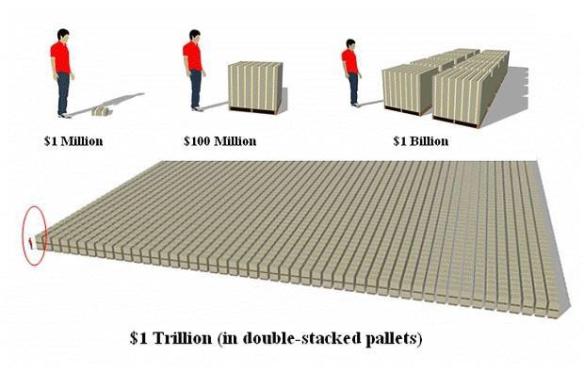
One problem with playing this game is the problem of scale. People have a problem appreciating such huge numbers. They are familiar with what a dollar is, but what’s a trillion? Here it is, represented as double-stacked pallets of $100 bills.

That seems a bit cumbersome for our board game. Reasonable values for the chips in our National Bankruptcy game would be $100 billion, $500 billion and $1 trillion. We could use a few $5 trillion and $10 trillion chips too, though not too many because I doubt that the game would go on long enough to make them useful.

I propose that for the sake of this game we introduce a handy new unit called a “piffle” which is equal to $100 billion. A trillion is 10 piffles, 10 trillion is 100 piffles. Then our chips can be 1, 5, 10, 50 and 100 piffles. Piffles allow us to express various huge quantities without going through any arithmetic contortions. US federal debt is currently 220 piffles. US trade deficit for 2018 was 6 piffles while the US defense budget was 7 piffles. For 2019 the federal budget deficit (covered by increased borrowing) is 10 piffles and rising while tax revenues are just 3 piffles and falling. The interest payment on federal debt is 3 piffles but with rising interest rates it’s going to 5 piffles within a few years.

Speaking of rising interest rates… just today Trump wished for 0% interest rates again, like Obama had while he was running up his 80 piffles’ worth of debt. But now it’s hovering around 3% and is unlikely to go down no matter what Trump wishes. Why? Well, here’s the reason. The US imports much more than it exports because it can’t afford to or lacks the ability to make all the stuff it needs; that’s why there are 6 piffles’ worth of trade deficit. When other nations sell to the US more than they buy, they end up holding lots of piffles, and since the US needs lots of piffles (remember, the budget deficit is 10 piffles) it makes plenty of sense to borrow that money right back. A little while back it was possible to borrow it back at 0% interest because the US was powerful enough to threaten those who refused to play this game with military annihilation (cue pictures of bombed-out Libya and Iraq). But times have changed, and unless the US bribes its debt-holders with 3% interest rate or better—no deal.

How have times changed? There are two effects worth mentioning. First, the military annihilation threat isn’t working any more. Yes, the US still spends a stunning, record-shattering sum of 7 piffles on defense, but none of that is working. Call it the free money effect. When people spend their own hard-earned money, they tend to be careful with it, but if it’s somebody else’s money that they got for free never intending to pay it back, then they tend to throw caution to the wind. And so US military spending has become less and less effective over time, in one of two ways: procurement costs have gone through the roof, and the resulting products have become useless.

In terms of procurement costs, the purchasing parity between the US and (just as an example) Russia seems to be at least ten to one: to get the same result, the US has to spend at least ten times more than Russia. And so although Russia spends well less than 1 piffle on defense, its military is far more effective. In terms of product uselessness, the Pentagon now resembles a woman who has a closet jam-packed with expensive designer labels but has absolutely nothing to wear because her entire wardrobe is no longer fashionable. There is the entire set of aircraft carriers none of which can operate close enough to enemy shores to be of any use at all because they can be readily sunk using hypersonic rockets launched from very far away. There are the stockpiles of Tomahawk cruise missiles which can’t make it past Soviet-era air defense systems (with a few electronics and software upgrades). There are the Patriot air defense systems which are useless even for stopping Soviet-era SCUD missiles, never mind anything more modern.

Add to this Russia’s (and soon China’s) new hypersonic weapons with conventional payloads and new air and space defense systems such as the S-400: these provide what’s known as “escalation dominance.” Suppose the US does something unspeakably nasty and Russia and/or China decide to teach it a lesson. They now have the ability to blow up any target within the US without getting anywhere near it and without placing any of their military assets at risk.

They could, for instance, take out the US electric grid in a way that will take many months to get it back on line. They can then reliably intercept anything that the US tries to retaliate with. Of course, the US can become suicidal—that’s always a risk—and launch a full-on nuclear first strike, then sit back and wait to be completely obliterated along with much of the rest of the planet. But that’s not a military strategy, that’s pure suicide, and the officers in charge of military strategy tend to be emotionally stable family men who look forward to playing with their grandchildren upon retirement.

So, why then should the US continue to spend 7 piffles on defense? The sad answer is that it will go bankrupt whether it zeroes out the defense budget or not. If the defense budget goes to 0, then there is still 3 piffles’ worth of budget deficit left, plus those 6 piffles of trade deficit aren’t going anywhere but up. But what about MAGA?—you might ask—What about firing up US manufacturing, bringing the jobs back and exporting our way out of this? After all, if we turn those 6 piffles of trade deficit into 6 piffles of trade surplus, suddenly it all works out and bankruptcy becomes avoidable.

No, sorry, that just not realistic. You see, in order to get an industrial economy going again the US needs several things. It needs cheap energy, cheap labor, low cost of doing business and readily available markets, both domestic and export. And the US doesn’t have any of these. In terms of energy—and oil is by far the most important form of energy—in 2019 the US will import exactly as much oil as it did in 1998—around 8 million barrels a day. Yes, the shale oil industry has sprung up in the meantime, and the US is currently producing 11.5 million barrels per day. But also in the meantime US oil consumption has gone up a lot—to 20 million barrels a day, which is a stunning 20% of the world’s consumption for 4.4% of the world’s population.

And so the oil deficit is still very much there. Plus the shale oil patch has never made any money but has accumulated over 2 piffles’ worth of debt and has spent over a piffle’s worth more than it made. With interest rates going up they are unlikely to be able to borrow enough to keep up the same hectic drilling rate, and with declines from existing wells at over half a million barrels per day per month it won’t take many months to whittle down that 11.5 million barrels per day, forcing the US to either boost imports or cut consumption.

But the oil price has gone down a lot lately, so there shouldn’t be a problem in any case, right? Again, sorry, no. Peak Oil for most countries has come and gone. There is now only a handful of countries left that are able to meaningfully boost oil production: Russia, Canada (mostly tar sands), Iran, Iraq, United Arab Emirates, Kuwait and Brazil. Russia has recently announced that it isn’t planning to boost production. Saudi Arabia is a huge oil producer but does not seem to have any spare capacity left. Canada’s tar sands patch is a money-losing environmental disaster. Iran and Iraq (call them Iranq, since they are both Shia Moslem, are politically aligned and neither loves America too much) aren’t exactly going to gallop to the rescue. That leaves UAE, Kuwait and Brazil, and if you add them all up together that’s nowhere near enough. So, get ready for oil price spikes, followed by a wave of demand destruction, followed by oil price collapses, followed by supply destruction—you know, the usual.

Moving on to labor. In order to stay competitive, the US will need to lower its median wage a lot. It has to be lower than what the Chinese and the Southeast Asians earn because the US needs to outcompete them to steal their export market share. Without various other major changes this will cause US workers to either rebel or starve to death in short order. The changes involve nationalizing medicine and education to drive down their costs by a factor of 1000 or so, converting to public transportation and pretty much banning the use of private cars to make transportation affordable, putting up high-rises right next to factories for affordable worker housing and so on. That’s a lot of piffles’ worth of effort!

The cost of doing business is a tough one too. The US spends way more on courts and lawyers, insurance and regulatory compliance than most other countries, and the regulatory maze that entrepreneurs have to run in order to run even a small and simple business is very costly and absolutely confounding. How does one take a machete to that whole ridiculous, corrupt scheme? I have no idea. It’s an imponderable. The Chinese would probably just call it a “cultural revolution,” round up all the lawyers and the bureaucrats, make them wear dunce caps and sandwich boards that say “I am what is wrong with this country” and march them in procession while pelting them with rocks and beating them with sticks. Something like that…

Finally, there is the question of export markets. What exactly is the US going to export more effectively than other countries are exporting already? China out-manufactures just about anybody on the planet and isn’t about to give up its spot. Russia exports grain and other foodstuffs (all non-GMO, unlike the US), nuclear and space technology, defense technology (that actually works) and much else. Pakistan and India, and various other countries, export textiles. The world is full up with product. It’s consumers to bankrupt that are in short supply. And if the US cuts its labor rates to make itself competitive, then its consumer base will shrink rather dramatically.

So it looks like bankruptcy is it, no use fighting it. But what should the US do in the meantime? I suggest that it should put up some really huge walls—just for the sake of leaving behind some spectacular ruins for future generations to marvel at. The one along the southern border seems to be going up already, but there should be at least two more. There needs to be a wall along the Mason-Dixon line, because given the heated state of US politics there needs to be a way to prevent people from trying to reenact the Civil War (a misnomer, that!) with actual real weapons and live ammo. And there also needs to be a wall along the northern border, to keep various groups of armed troglodytes from escaping to Canada and ransacking it (it’s the least we can do for our peaceful northern neighbors). How much will these three walls cost? Glad you asked! They will cost roughly 0.005 piffles apiece, 0.015 piffles total—a truly piffling amount. That’s my 0.000000002 piffle’s worth. But, you know, it’s the thought that counts.

Oh, and if you want to actually design this National Bankruptcy board game, please resist the temptation to contact me about it. Seriously, I don’t like games, board games especially. I am a very serious person who doesn’t have time for such piffles.

Reflections on 2018, Forecasting 2019

By Robert J. Burrowes

In many ways it is painful to reflect on the year 2018; a year of vital opportunities lost when so much is at stake.

Whether politically, militarily, socially, economically, financially or ecologically, humanity took some giant strides backwards while passing up endless opportunities to make a positive difference in our world.

Let me, very briefly, identify some of the more crucial backward steps, starting with the recognition by the Bulletin of the Atomic Scientists in January that the year had already started badly when they moved the Doomsday Clock to two minutes to midnight, the closest it has ever been to ‘doomsday’ (and equal to 1953 when the Soviet Union first exploded a thermonuclear weapon matching the US capacity). See ‘It is now two minutes to midnight’.

This change reflected the perilous state of our world, particularly given the renewed threat of nuclear war and the ongoing climate catastrophe. It didn’t even mention the massive and unrelenting assault on the biosphere (apart from the climate) nor, of course, the ongoing monumental atrocities against fellow human beings.

Some Lowlights of 2018

  1. The global elite, using key elite fora such as the Group of 30, the Trilateral Commission, the Bilderberg Group and the World Economic Forum, continued to plan, generate and exacerbate the many ongoing wars, deepening exploitation within the global economy, climate and environmental destruction, and the refugee crisis, among many other violent impacts, in pursuit of greater elite power, profit and privilege.
  1. International organizations (such as the United Nations, the World Bank and International Monetary Fund) and national governments used military forces, legal systems, police forces and prison systems around the world to serve the global elite by defending its interests against the bulk of the human population, including those individuals and organizations audacious enough to challenge elite power, profit and privilege.
  1. $US1.7 trillion was officially spent worldwide on military weapons to kill fellow human beings and other lifeforms, and to destroy the biosphere. See ‘Global military spending remains high at $1.7 trillion’.

However, so out-of-control is this spending that the United States has now spent $US21trillion on its military in the past 20 years for which it cannot even account! That’s right, $US1trillion each year, including 2018, above the official US national budget for killing is ‘lost’. See Army General Fund Adjustments Not Adequately Documented or Supported, ‘Has Our Government Spent $21 Trillion Of Our Money Without Telling Us?’ and ‘The Pentagon Can’t Account for $21 Trillion (That’s Not a Typo)’.

  1. War and other military violence continued to rage across the planet wreaking devastation on many countries and regions, particularly in the Middle East and Africa. If you missed this, read what is happening to Yemen, described as ‘ the world’s worst [humanitarian] crisis in decades’ with ‘three quarters of the entire Yemeni population – 22 million women, children and men – dependent on some form of humanitarian assistance to survive.’ See ‘Yemen: UN chief hails “signs of hope” in world’s worst man-made humanitarian disaster’.
  1. Not content with the nature and extent of the military violence they are inflicting already, during 2018 elites continued to plan how to do it more effectively in future with research and development of artificial intelligence just one manifestation of this: ‘an “arms race in AI” is now underway, with the U.S., China, Russia, and other nations (including Britain, Israel, and South Korea) seeking to gain a critical advantage in the weaponization of artificial intelligence and robotics’ so that ‘artificial intelligence will be applied to every aspect of warfare, from logistics and surveillance to target identification and battle management’. See ‘“Alexa, Launch Our Nukes!” Artificial Intelligence and the Future of War’.
  1. The United States government unilaterally withdrew from the Intermediate Nuclear Forces (INF) Treaty (which limits the deployment of intermediate range nuclear weapons).
  1. Another significant proportion of global private financial wealth – conservatively estimated by the Tax Justice Network in 2010 to already total between $US21 and $US32 trillion – has been invested virtually tax-free through the world’s still-expanding black hole of more than 80 ‘offshore’ tax havens (such as the City of London Corporation, Jersey, Guernsey, the Isle of Man, Bermuda, the Cayman Islands, Hong Kong, Nauru, St. Kitts, Antigua, Tortola, Switzerland, the Channel Islands, Monaco, Cyprus, Gibraltar and Liechtenstein). This is just financial wealth. ‘A big share of the real estate, yachts, racehorses, gold bricks – and many other things that count as non-financial wealth – are also owned via offshore structures where it is impossible to identify the owners.’ See Tax Justice Network.

Controlled by the global elite, Wall Street and other major banks manage this monstrous diversion of wealth under Government protection. ‘Their business is fraud and grand theft.’ Tax haven locations offer more than tax avoidance. ‘Almost anything goes on.’ It includes ‘bribery, illegal gambling, money laundering, human and sex trafficking, arms dealing, toxic waste dumping, conflict diamonds and endangered species trafficking, bootlegged software, and endless other lawless practices.’ See ‘Trillions Stashed in Offshore Tax Havens’.

  1. The world’s major corporations continued to inflict enormous ongoing violence (in a myriad of ways) in their pursuit of endless profit at the expense of living beings (human and otherwise) and Earth’s biosphere by producing and marketing a wide range of life-destroying products ranging from nuclear weapons and nuclear power to junk food, pharmaceutical drugs, synthetic poisons and genetically mutilated organisms (GMOs). These corporations include those involved in the following industries: weapons manufacturers, major banks and their ‘industry groups’ like the International Monetary Conference, asset management firms, investment companies, financial services companies, fossil fuel (coal, oil and gas) corporations, technology corporations, media corporations, major marketing and public relations corporations, agrochemical (pesticides, seeds, fertilizers) giants, pharmaceutical corporations, biotechnology (genetic mutilation) corporations, mining corporations, nuclear power corporations, food multinationals and water corporations. You can see a list of the major corporations in this article: ‘The Global Elite is Insane Revisited’.
  1. More than a billion people continued to live under occupation, dictatorship or threat of genocidal assault. See, for example, ‘500 Years is Long Enough! Human Depravity in the Congo’.
  1. 36,500,000 human beings (mainly in Africa, Asia and Central/South America) were starved to death.
  1. 18,250,000 children were killed by adults in wars, by starving them to death, and in a large variety of other ways.
  1. 8,000,000 children were trafficked into sexual slavery; executed in sacrificial killings after being kidnapped; bred to be sold as a ‘cash crop’ for sexual violation, to produce child pornography (‘kiddie porn’) and ‘snuff’ movies (in which children are killed during the filming); ritually tortured and murdered as well as raped by dogs trained for the purpose. See ‘Humanity’s “Dirty Little Secret”: Starving, Enslaving, Raping, Torturing and Killing our Children’.
  1. Hundreds of thousands of individuals were kidnapped or tricked into slavery, which now denies 46,000,000 human beings the right to live the life of their choice, condemning many individuals – especially women and children – to lives of sexual slavery, forced labor or as child soldiers. See The Global Slavery Index’ and 46 million people living as slaves, latest global index reveals’.
  1. Well over 100,000 people (particularly Falun Gong practitioners) in China, where an extensive state-controlled program is conducted, were subjected to forced organ removal for the trade in human organs. See Bloody Harvest and The Slaughter.
  1. 15,750,000 people were displaced by war, persecution or famine. There are now 68,500,000 people, more that half of whom are children and 10,000,000 of whom are stateless, who have been forcibly displaced worldwide and remain precariously unsettled, usually in adverse circumstances. One person in the world is forcibly displaced every two seconds. See ‘Figures at a Glance’.
  1. Millions of people were made homeless in their own country as a result of war, persecution, ‘natural’ disasters, internal conflict, poverty or as a result of elite-driven national economic policy. The last time a global survey was attempted – by the United Nations back in 2005 – an estimated 100 million people were homeless worldwide. As many as 1.6 billion people lack adequate housing (living in slums, for example). See ‘Global Homelessness Statistics’.
  1. 73,000 species of life (plants, birds, animals, fish, amphibians, insects and reptiles) on Earth were driven to extinction with the worldwide loss of insects, including vital pollinators such as bees, now between 75% and 90%, depending on the species. See ‘Insect Decimation Upstages Global Warming’. Have you seen a butterfly recently?
  1. Separately from global species extinctions, Earth continued to experience ‘a huge episode of population declines and extirpations, which will have negative cascading consequences on ecosystem functioning and services vital to sustaining civilization. We describe this as a “biological annihilation” to highlight the current magnitude of Earth’s ongoing sixth major extinction event.’ Moreover, local population extinctions ‘are orders of magnitude more frequent than species extinctions. Population extinctions, however, are a prelude to species extinctions, so Earth’s sixth mass extinction episode has proceeded further than most assume.’ See ‘Biological annihilation via the ongoing sixth mass extinction signaled by vertebrate population losses and declines’ and ‘Biological Annihilation on Earth Accelerating’.
  1. Wildlife trafficking, worth up to $20 billion in 2018, is pushing many endangered species to the brink of extinction. Illegal wildlife products include jewelry, traditional medicine, clothing, furniture, and souvenirs, as well as some exotic pets, most of which are sold to unaware/unconcerned consumers in the West. See, for example, Stop Wildlife Trafficking.
  1. 16,000,000 acres of pristine rainforest were destroyed (with more than 40,000 tropical tree species now threatened with extinction). See ‘Measuring the Daily Destruction of the World’s Rainforests’, ‘Estimating the global conservation status of more than 15,000 Amazonian tree species’ and ‘Half of Amazon Tree Species Face Extinction’.
  1. Vast quantities of soil were washed away as we destroyed the rainforests, and enormous quantities of both inorganic constituents (such as heavy metals like cadmium, chromium, lead, mercury, nickel and zinc) and organic pollutants (particularly synthetic chemicals in the form of fertilizers, pesticides and herbicides) were dumped into the soil as well, thus reducing its nutrients and killing the microbes within it. We also contaminated enormous quantities of soil with radioactive waste. See Soil-net, ‘Glyphosate effects on soil rhizosphere-associated bacterial communities’ and ‘Disposing of Nuclear Waste is a Challenge for Humanity’.
  1. The TEPCO nuclear power plant in Fukushima, Japan discharged 109,000 tons of radioactive waste into the Pacific Ocean killing an incalculable number of fish and other marine organisms and indefinitely contaminating expanding areas of that ocean. See ‘Fukushima: A Nuclear War without a War: The Unspoken Crisis of Worldwide Nuclear Radiation’.
  1. Human use of fossil fuels to power aircraft, shipping and vehicles (among other purposes) released 10 billion metric tons (gigatons) of carbon dioxide into Earth’s atmosphere, a 2.7% increase over 2017. See ‘Global Carbon Budget 2018’ and ‘Carbon dioxide emissions will hit a record high globally in 2018’. As a measure of their concern elite-controlled governments and corporations around the world are currently planning or have under construction 1,380 new coal plants? That’s right. 1,380 new coal plants. In 59 countries. See ‘NGOs Release List of World’s Top Coal Plant Developers’ and ‘2018 Coal Plant Developers List’.
  1. 90 billion land animals and 60 billion marine animals were killed for human consumption, more than 100 million animals were killed for laboratory purposes in the United States alone and there were other animal deaths in shelters, zoos and in blood sports. See ‘How Many Animals Are Killed Each Year?’

In addition, 40 million animals were killed for their fur. Approximately 30 million of these animals were raised on fur farms and killed, about 10 million wild animals were trapped and killed, and hundreds of thousands of seals were killed for their fur. See ‘How Many Animals are Killed Each Year?’

  1. Farming of animals for human consumption released 7,100,000,000 tonnes of CO2-equivalent into Earth’s atmosphere. About 44% of livestock emissions were in the form of methane (which was 44% of anthropogenic CH4 emissions), 29% as Nitrous Oxide (which was 53% of anthropogenic N2O emissions) and 27% as Carbon Dioxide (which was 5% of anthropogenic CO2 emissions). See ‘GHG Emissions by Livestock’.
  1. Human use of fossil fuels and farming of animals released 3.2 million metric tons of (CO2 equivalent) nitrous oxide (N2O) into Earth’s atmosphere. See ‘Nitrous oxide emissions’.
  1. As a result of previous greenhouse gas (GHG) emissions and the consequent rise of about one degree celsius in the global temperature, causing the melting of Arctic permafrost and undersea methane ice clathrates, an incalculable quantity of methane was uncontrollably released into the atmosphere during 2018 (with the quantity being released getting ever closer to ‘exploding’). See ‘7,000 underground gas bubbles poised to “explode” in Arctic’ and ‘Release of Arctic Methane “May Be Apocalyptic,” Study Warns’.
  1. Ice in the Antarctic is melting at a record-breaking rate, losing 219 billion tonnes of ice in 2018 at a rate that has accelerated threefold in the last five years. See ‘Antarctic ice melting faster than ever, studies show’.
  1. An incalculable amount of agricultural poisons, fossil fuels and other wastes was discharged into the ocean, adversely impacting life at all ocean depths – see ‘Staggering level of toxic chemicals found in creatures at the bottom of the sea, scientists say’ – and generating ocean ‘dead zones’: regions that have too little oxygen to support marine organisms. See ‘Our Planet Is Exploding With Marine “Dead Zones”’.
  1. At least 8 million metric tons of plastic, of which 236,000 tons were microplastics, was discharged into the ocean. See ‘Plastic waste inputs from land into the ocean’ and ‘Plastics in the Ocean’.
  1. Earth’s fresh water and ground water was further depleted and contaminated. These contaminants included bacteria, viruses and household chemicals from faulty septic systems; hazardous wastes from abandoned and uncontrolled hazardous waste sites (of which there are over 20,000 in the USA alone); leaks from landfill items such as car battery acid, paint and household cleaners; the pesticides, herbicides and other poisons used on farms and home gardens; radioactive waste from nuclear tests; and the chemical contamination caused by hydraulic fracturing (fracking) in search of shale gas, for which about 750 chemicals and components, some extremely toxic and carcinogenic like lead and benzene, have been used. See ‘Groundwater contamination’, ‘Groundwater drunk by BILLIONS of people may be contaminated by radioactive material spread across the world by nuclear testing in the 1950s’ and ‘Fracking chemicals’.
  1. The longstanding covert military use of geoengineering – spraying tens of millions of tons of highly toxic metals (including aluminium, barium and strontium) and toxic coal fly ash nanoparticulates (containing arsenic, chromium, thallium, chlorine, bromine, fluorine, iodine, mercury and radioactive elements) into the atmosphere from jet aircraft to weaponize the atmosphere and weather – in order to enhance elite control of human populations, continued unchecked. Geoengneering is systematically destroying Earth’s ozone layer – which blocks the deadly portion of solar radiation, UV-C and most UV-B, from reaching Earth’s surface – as well as adversely altering Earth’s weather patterns and polluting its air, water and soil at incredible cost to the health and well-being of living organisms and the biosphere. See ‘Geoengineering Watch’.
  1. As one outcome of our dysfunctional parenting model and political systems, fascism continued to rise around the world. See ‘The Psychology of Fascism’.
  1. Despite the belief that we have ‘the right to privacy’, privacy (in any sense of the word) was ongoingly eroded in 2018 and is now effectively non-existent, particularly thanks to Alphabet (owner of Google). Taken together, ‘Uber, Amazon, Facebook, eBay, Tinder, Apple, Lyft, Foursquare, Airbnb, Spotify, Instagram, Twitter, Angry Birds… have turned our computers and phones into bugs that are plugged in to a vast corporate-owned surveillance network. Where we go, what we do, what we talk about, who we talk to, and who we see – everything is recorded and, at some point, leveraged for value.’ Moreover, given Google’s integrated relationship with the US government, the US military, the CIA, and major US weapons manufacturers, there isn’t really anything you can do that isn’t known by those who want to know it. In essence, Google is ‘a powerful global corporation with its own political agenda and a mission to maximise profits for shareholders’ and it partly achieves this by expanding the surveillance programs of the national security state at the direction of the global elite. See ‘Google’s Earth: How the Tech Giant Is Helping the State Spy on Us’ and the documentary ‘The Modern Surveillance State’.
  1. The right to free speech was ongoingly eroded in 2018. For just a couple of examples in the United States alone, see ‘Marc Lamont Hill On Getting Fired From CNN, His Remarks On Palestine + More’ and ‘A Texas Elementary School Speech Pathologist Refused to Sign a Pro-Israel Oath, Now Mandatory in Many States – so She Lost Her Job’.
  1. Believing that we know better than evolution, humans created the first gene-edited baby in 2018. See ‘Why we are not ready for genetically designed babies’ and China’s Golem Babies: There is Another Agenda’.
  1. An incalculable amount of junk was added to the 100 trillion items of junk already in Space. See ‘Space Junk: Tracking & Removing Orbital Debris’.
  1. Incalculable amounts of antibiotic waste, nuclear waste, nanowaste and genetically engineered organisms were released into Earth’s biosphere. See ‘Junk Planet: Is Earth the Largest Garbage Dump in the Universe?’
  1. Ongoing violence against children – see Why Violence? and Fearless Psychology and Fearful Psychology: Principles and Practice – ensured that more people will grow up accepting (and quite powerless to challenge) our dysfunctional and violent world, as described above.
  1. The corporate media, education and entertainment industries continued to distract us from reality ensuring that most people remain oblivious to our predicament and their own role in it, let alone what they can do to respond powerfully.

While the above list of the setbacks humanity and the Earth suffered in 2018 is very incomplete, it still provides clear evidence that humanity is rapidly entering a dystopian future far more horrific than the worst novel or film in the genre. The good news is that, at the current rate, this dystopian world will be shortlived as humans drive themselves over the edge of extinction. See ‘Human Extinction by 2026? A Last Ditch Strategy to Fight for Human Survival’.

But so that the picture is clear and ‘balanced’: were there any gains made against this onslaught?

Of course, it goes without saying that the global elite, international organizations (such as the United Nations), governments, corporations and other elite agents continued to live in delusion/denial endlessly blocking any initiative requiring serious action that would cut into corporate profits, or arguing over tangential issues of insignificant consequence to humanity’s future.

In short, I could find no record of official efforts during the year to plan for the development and implementation of a comprehensive, just and sustainable peace, but perhaps I missed it.

Separately from this, there have been some minor activist gains: for example, some western banks and insurance companies are no longer financially supporting the expansion of the western weapons industry and the western coal industry, some rainforest groups have managed to save portions of Earth’s rainforest heritage, and activist groups continue to work on a variety of issues sometimes making modest gains.

In essence however, as you probably realize, many of the issues above are not even being tackled and, even when they are, activist efforts have been hampered by inadequate analysis of the forces driving conflicts and problems, limited vision (particularly unambitious aims such as those in relation to ending war and the climate catastrophe), unsophisticated strategy (necessary to have profound impact against a deeply entrenched, highly organized and well-resourced opponent, with the endless lobbying of elite institutions, such as governments and corporations, despite this effort simply absorbing and dissipating our dissent, as is intended – as Mark Twain once noted: ‘If voting made a difference, they wouldn’t let us do it.’) and failure to make the difficult decisions to promote necessary solutions that are ‘unpopular’.

Fundamentally, these ‘difficult decisions’ include the vital need to campaign for the human population, particularly in the West, to substantially reduce their consumption – by 80% – involving both energy and resources of every kind as the central feature of any strategy to curtail destruction of the environment and climate, to undermine capitalism and to eliminate the primary driver of war: violent resource acquisition from Middle Eastern and developing nations for the production of consumer goods and services for western consumers.

While we live in the delusion that we can simply substitute renewable energy for fossil fuels and nuclear power (or believe such delusions that a 1.5 degrees celsius increase above the preindustrial temperature is acceptable or that we have an ‘end of century’ timeframe to solve the climate crisis), we ignore the fundamental reality that Earth’s biosphere is under siege on many fronts as a result of our endless extraction of its natural resources – such as fresh water, minerals, timber and, again, fossil fuels – for consumer production and the provision of services that go well beyond energy.

In short, for example, we will not save the world’s rainforests because we switch to renewable energy. We must reduce demand for the consumer products that require rainforest inputs. We must stop mining the Earth for minerals that end up in our mobile phones, computers, vehicles, ships and aircraft by not using the products and services these minerals make possible. We must stop eating meat and other animal products. And so the list goes on.

Forecasting 2019

In many ways it is painful to forecast what will happen in 2019 mainly because of the absurd simplicity of doing so: It will be another year when vital opportunities will be lost when so much is at stake.

Given the insanity of the global elite – see ‘The Global Elite is Insane Revisited’ – which will continue to drive the dynamics producing the lowlights mentioned above with the active complicity of their agents in governments and corporations coupled with a human population that is largely terrified, self-hating and powerless to resist – see ‘In Defense of the Human Individual’ – it is a straightforward task to forecast what will happen in 2019.

So let me forecast 40 lowlights for 2019:

  1. See list above.
  2. See list above.
  3. See list above.

.
.

  1. See list above.

So unless you play your part, 2019 and the few years thereafter will simply be increasingly worse versions of 2018 and it will all be over by 2026. See ‘Human Extinction by 2026? A Last Ditch Strategy to Fight for Human Survival’ which cites a wide range of scientific and other evidence which you are welcome to consider for yourself if this date seems premature.

Responding Powerfully

If you already feel able to act powerfully in response to this multifaceted crisis, in a way that will have strategic impact, you are invited to consider joining those participating in The Flame Tree Project to Save Life on Earth, which outlines a simple plan for you to systematically reduce your consumption, by at least 80%, involving both energy and resources of every kind – water, household energy, transport fuels, metals, meat, paper and plastic – while dramatically expanding your individual and community self-reliance in 16 areas, so that all environmental and climate concerns are effectively addressed.

If you are also interested in conducting or participating in a campaign to systematically address one of the issues identified above, you are welcome to consider acting strategically in the way that Mohandas K. Gandhi did. Whether you are engaged in a peace, climate, environment or social justice campaign, the 12-point strategic framework and principles are the same. See Nonviolent Campaign Strategy. And, for example, you can see a basic list of the strategic goals necessary to end war and halt the climate catastrophe. See ‘Strategic Aims’.

If you want to know how to nonviolently defend against a foreign invading power or a political/military coup, to liberate your country from a dictatorship or a foreign occupation, or to defeat a genocidal assault, you will learn how to do so in Nonviolent Defense/Liberation Strategy.

If you are interested in nurturing children to live by their conscience and to gain the courage necessary to resist elite violence fearlessly, while living sustainably despite the entreaties of capitalism to over-consume, then you are welcome to make ‘My Promise to Children’.

To reiterate: capitalism, war and destruction of the environment and climate are outcomes of our dysfunctional parenting of children which distorts their intellectual and emotional capacities, destroys their conscience and courage, and actively teaches them to over-consume as compensation for having vital emotional needs denied. See ‘Love Denied: The Psychology of Materialism, Violence and War’.

If your own intellectual and/or emotional functionality is the issue and you have the self-awareness to perceive that, and wish to access the conscience and courage that would enable you to act powerfully, try ‘Putting Feelings First’.

And if you want to be part of the worldwide movement committed to ending all of the violence identified above, consider signing the online pledge of ‘The People’s Charter to Create a Nonviolent World’.

In summary: if we do not rapidly, systematically and substantially reduce our consumption in several key areas and radically alter our parenting model, while resisting elite violence strategically on several fronts, homo sapiens will enter Earth’s fossil record within a few years. Given the fear, self-hatred and powerlessness that paralyses most humans, your choices in these regards are even more vital than you realize.


Biodata: Robert J. Burrowes has a lifetime commitment to understanding and ending human violence. He has done extensive research since 1966 in an effort to understand why human beings are violent and has been a nonviolent activist since 1981. He is the author of Why Violence? His email address is flametree@riseup.net and his website is here.

Robert J. Burrowes
P.O. Box 68
Daylesford, Victoria 3460
Australia

Email: flametree@riseup.net

Websites:
Nonviolence Charter
Flame Tree Project to Save Life on Earth
‘Why Violence?’
Feelings First
Nonviolent Campaign Strategy
Nonviolent Defense/Liberation Strategy
Anita: Songs of Nonviolence
Robert Burrowes
Global Nonviolence Network

Wake From The Nightmare Or Eternal Sleep For Humanity

By Frank Scott

Source: Dissident Voice

The tradition of the dead generations weighs like a nightmare on the minds of the living.

— Karl Marx

Marx offered a thought for all seasons but one that might especially ring true during what is supposed to be a season of peace, joy and humanity. Contradicted by the ever more insanely harsh reality of marketing mass murder under the guise of creating freedom, much of our race, though still too few to radically transform the totality of our reality, has begun to rise in defense of all against a system that profits only a few. France’s recent experience was part of a hopeful trend in that segments of a public which has been bought, sold and rented into near poverty showed they are tired and demanded social justice over becoming what capital sees as a loss of its private profits. Their awakening from humanity’s nightmare, however brief it may seem, is inspiring as well as overdue. The actions of a predominately working class group of citizens demonstrating with enough fervor to force the French government to at least renege on some issues is in stark contrast to Americans trooping off to the polls to “resist” a personality while their system – the same one the French are up in arms about – disintegrates all around them. If we have anything to be happy about during the annual shopping frenzy of an alleged spiritual time for humanity, in a small way it’s a few changes in our congress, but in a greater way it’s the sign of awakening we see in France which will hopefully spread to more places in the New Year.

The social democratic salvation capital arranged after the depression of the twenties and thirties has collapsed and become a renewal of the worst forms of fascist capital that preceded and soon followed that brief cosmetic safety for some made possible only by the reduction to disfigured ugliness of others. The rise in status of a new middle class for millions in the western world was only possible with the misery of greater multitudes in what was called the third, or undeveloped world, but also the poverty class in that same west. There were people sleeping on the streets of America before, during, and after the last breakdown of capital given the brand name “the great depression”. This latest collapse that began in 2008 and is very possibly the last one that will wake up more than the French is only different in that it is worse and the numbers in the street have grown so much only the intellectually and morally blind cannot see them.

The wealth accumulation of the return to market fundamentalist roots was and continues to be shared by a shrinking minority while growing majorities have seen the facade of humanity brought about by social democratic capitalism dissolve in the reality of a take-no-prisoners brand of marketing. This Artificially Intelligent farce not only prides itself on the creation of poverty and warfare but dulls the sense of many of its innocent subjects by filling heads with propaganda that passes for news, entertainment to distract consciousness further, and the combination of the two that marketers call “infotainment”.

Thus we have a perverse form of capital therapy that herds us into near frenzied lynch mobs of genuinely frustrated and set upon souls directing energy at everything but the cause of most if not all the things that plague us. Rich individuals approaching deity status with economic powers beyond those of past royal despots are relatively invisible while some of their employees in government attract enough attention to be replaced by other of their employees who appeal to one or another interest or identity group affording pleasure to some, pain to most and continued ruling power to the incredibly rich minority at the top of the modern pyramid of capital.

Preposterous stories blaming Russia, China, Iran and possibly the Tooth Fairy for every sign of failure in what passes for a language perversion called the “free world” confuse and convince enough among the well fed and supposedly educated classes for the moment. When hardship eventually hits them in a material, rather than mental way, they will hopefully leave their identity groups and join the human race in the work necessary to transform global society.

Until the public good comes before private profit, things will get worse for all of us and any focus that continues separation of humans from potential majorities into smaller identity groups is simply the age old divide and conquer strategies always employed by minority rulers. This helps lead people with individual moral codes that find poverty and injustice intolerable to not only tolerate but to practice the most dreadful social policies imaginable. Privately, we Americans are as good, kind, compassionate, decent, and humane as any people on earth. Socially, however, we spend trillions on war, billions on pets, leave millions to live in poverty and hundreds of thousands to live on the street, and thus collectively become among the most degenerate moral perverts on the planet.

The skin tone, ethnicity, religion, sex or sexual preference of those serving capital while eating meals and flushing toilets at the white house or in slightly lesser roles in congress makes no difference to their victims reduced to cleaning the debris of death and destruction in the places where they oversee the bombing and looting. After their homes and nations are ruined we welcome some of them as migrants offering us cheap labor and a balm for our souls to maintain holiday spirit until the next slaughter we conduct. Food, clothing and shelter are basic human needs, not separate identity practices. They become so under private profit first economics that assure only some of the public will experience good, and that group is shrinking. The only way to assure a better life for all is for the ruling power to come from people who put the public good first, before any private gain is considered. Everyone has to be assured of food, clothing and shelter before anyone can aspire and work for even more by achieving private profit at the market. There is only one way to achieve that change and end society’s nightmare: the democratic forces of humanity must replace the market forces of capital. Happy New Year.