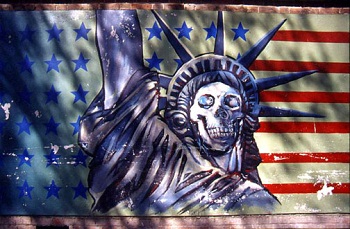
The IMF Changes its Rules to Isolate China and Russia

Related Podcast: Michael Hudson on “Guns and Butter” 2/3/16:
index

By Michael Hudson

Source: Michael-Hudson.com

A nightmare scenario of U.S. geopolitical strategists is coming true: foreign independence from U.S.-centered financial and diplomatic control. China and Russia are investing in neighboring economies on terms that cement Eurasian integration on the basis of financing in their own currencies and favoring their own exports. They also have created the Shanghai Cooperation Organization (SCO) as an alternative military alliance to NATO.[1] And the Asian Infrastructure Investment Bank (AIIB) threatens to replace the IMF and World Bank tandem in which the United States holds unique veto power.

More than just a disparity of voting rights in the IMF and World Bank is at stake. At issue is a philosophy of development. U.S. and other foreign investment in infrastructure (or buyouts and takeovers on credit) adds interest rates and other financial charges to the cost structure, while charging prices as high as the market can bear (think of Carlos Slim’s telephone monopoly in Mexico, or the high costs of America’s health care system), and making their profits and monopoly rents tax-exempt by paying them out as interest.

By contrast, government-owned infrastructure provides basic services at low cost, on a subsidized basis, or freely. That is what has made the United States, Germany and other industrial lead nations so competitive over the past few centuries. But this positive role of government is no longer possible under World Bank/IMF policy. The U.S. promotion of neoliberalism and austerity is a major reason propelling China, Russia and other nations out of the U.S. diplomatic and banking orbit.

On December 3, 2015, Prime Minister Putin proposed that Russia “and other Eurasian Economic Union countries should kick-off consultations with members of the SCO and the Association of Southeast Asian Nations (ASEAN) on a possible economic partnership.”[2] Russia also is seeking to build pipelines to Europe through friendly secular countries instead of Sunni jihadist U.S.-backed countries locked into America’s increasingly confrontational orbit.

Russian finance minister Anton Siluanov points out that when Russia’s 2013 loan to Ukraine was made, at the request of Ukraine’s elected government, Ukraine’s “international reserves were barely enough to cover three months’ imports, and no other creditor was prepared to lend on terms acceptable to Kiev. Yet Russia provided $3 billion of much-needed funding at a 5 per cent interest rate, when Ukraine’s bonds were yielding nearly 12 per cent.”[3]

What especially annoys U.S. financial strategists is that this loan by Russia’s National Wealth Fund was protected by IMF lending practice, which at that time ensured collectability by withholding credit from countries in default of foreign official debts, or at least not bargaining in good faith to pay. To cap matters, the bonds are registered under London’s creditor-oriented rules and courts.

Most worrisome to U.S. strategists is that China and Russia are denominating their trade and investment in their own currencies instead of dollars. After U.S. officials threatened to derange Russia’s banking linkages by cutting it off from the SWIFT interbank clearing system, China accelerated its creation of the alternative China International Payments System (CIPS), and its own credit card system to protect Eurasian economies from the threats made by U.S. unilateralists.

Russia and China are simply doing what the United States has long done: using trade and credit linkages to cement their diplomacy. This tectonic geopolitical shift is a Copernican threat to New Cold War ideology: Instead of the world economy revolving around the United States (the Ptolemaic idea of America as “the indispensible nation”), it may revolve around Eurasia. As long as global financial control remains grounded in Washington at the offices of the IMF and World Bank, such a shift in the center of gravity will be fought with all the power of an American Century (and would-be American Millennium) inquisition.

Any inquisition needs a court system and enforcement vehicles. So does resistance to such a system. That is what today’s global financial, legal and trade maneuvering is all about. And that is why today’s world system is in the process of breaking apart. Differences in economic philosophy call for different institutions.

To U.S. neocons the specter of AIIB government-to-government investment creates fear of nations minting their own money and holding each other’s debt in their international reserves instead of borrowing dollars, paying interest in dollars and subordinating their financial planning to the U.S. Treasury and IMF. Foreign governments would have less need to finance their budget deficits by selling off key infrastructure. And instead of dismantling public spending, a broad Eurasian economic union would do what the United States itself practices, and seek self-sufficiency in banking and monetary policy.

Imagine the following scenario five years from now. China will have spent half a decade building high-speed railroads, ports, power systems and other construction for Asian and African countries, enabling them to grow and export more. These exports will be coming online to repay the infrastructure loans. Also, suppose that Russia has been supplying the oil and gas energy for these projects on credit.

To avert this prospect, suppose an American diplomat makes the following proposal to the leaders of countries in debt to China, Russia and the AIIB: “Now that you’ve got your increased production in place, why repay? We’ll make you rich if you stiff our adversaries and turn back to the West. We and our European allies will support your assigning your nations’ public infrastructure to yourselves and your supporters at insider prices, and then give these assets market value by selling shares in New York and London. Then, you can keep the money and spend it in the West.”

How can China or Russia collect in such a situation? They can sue. But what court in the West will accept their jurisdiction?

That is the kind of scenario U.S. State Department and Treasury officials have been discussing for more than a year. Implementing it became more pressing in light of Ukraine’s $3 billion debt to Russia falling due by December 20, 2015. Ukraine’s U.S.-backed regime has announced its intention to default. To support their position, the IMF has just changed its rules to remove a critical lever on which Russia and other governments have long relied to ensure payment of their loans.

The IMF’s role as enforcer of inter-government debts
When it comes to enforcing nations to pay inter-government debts, the IMF is able to withhold not only its own credit but also that of governments and global bank consortia participating when debtor countries need “stabilization” loans (the neoliberal euphemism for imposing austerity and destabilizing debtor economies, as in Greece this year). Countries that do not privatize their infrastructure and sell it to Western buyers are threatened with sanctions, backed by U.S.-sponsored “regime change” and “democracy promotion” Maidan-style. The Fund’s creditor leverage has been that if a nation is in financial arrears to any government, it cannot qualify for an IMF loan – and hence, for packages involving other governments. That is how the dollarized global financial system has worked for half a century. But until now, the beneficiaries have been U.S. and NATO lenders, not been China or Russia.

The focus on a mixed public/private economy sets the AIIB at odds with the Trans-Pacific Partnership’s aim of relinquishing government planning power to the financial and corporate sector, and the neoliberal aim of blocking governments from creating their own money and implementing their own financial, economic and environmental regulation. Chief Nomura economist Richard Koo, explained the logic of viewing the AIIB as a threat to the U.S.-controlled IMF: “If the IMF’s rival is heavily under China’s influence, countries receiving its support will rebuild their economies under what is effectively Chinese guidance, increasing the likelihood they will fall directly or indirectly under that country’s influence.”[4]

This was the setting on December 8, when Chief IMF Spokesman Gerry Rice announced: “The IMF’s Executive Board met today and agreed to change the current policy on non-toleration of arrears to official creditors.” Russian Finance Minister Anton Siluanov accused the IMF decision of being “hasty and biased.”[5] But it had been discussed all year long, calculating a range of scenarios for a sea change in international law. Anders Aslund, senior fellow at the NATO-oriented Atlantic Council, points out:

The IMF staff started contemplating a rule change in the spring of 2013 because nontraditional creditors, such as China, had started providing developing countries with large loans. One issue was that these loans were issued on conditions out of line with IMF practice. China wasn’t a member of the Paris Club, where loan restructuring is usually discussed, so it was time to update the rules.
The IMF intended to adopt a new policy in the spring of 2016, but the dispute over Russia’s $3 billion loan to Ukraine has accelerated an otherwise slow decision-making process.[6]

The target was not only Russia and its ability to collect on its sovereign loan to Ukraine, but China even more, in its prospective role as creditor to African countries and prospective AIIB borrowers, planning for a New Silk Road to integrate a Eurasian economy independent of U.S. financial and trade control. The Wall Street Journal concurred that the main motive for changing the rules was the threat that China would provide an alternative to IMF lending and its demands for crushing austerity. “IMF-watchers said the fund was originally thinking of ensuring China wouldn’t be able to foil IMF lending to member countries seeking bailouts as Beijing ramped up loans to developing economies around the world.”[7] So U.S. officials walked into the IMF headquarters in Washington with the legal equivalent of suicide vests. Their aim was a last-ditch attempt to block trade and financial agreements organized outside of U.S. control and that of the IMF and World Bank.

The plan is simple enough. Trade follows finance, and the creditor usually calls the tune. That is how the United States has used the Dollar Standard to steer Third World trade and investment since World War II along lines benefiting the U.S. economy. The cement of trade credit and bank lending is the ability of creditors to collect on the international debts being negotiated. That is why the United States and other creditor nations have used the IMF as an intermediary to act as “honest broker” for loan consortia. (“Honest broker” means being subject to U.S. veto power.) To enforce its financial leverage, the IMF has long followed the rule that it will not sponsor any loan agreement or refinancing for governments that are in default of debts owed to other governments. However, as the afore-mentioned Aslund explains, the IMF could easily

change its practice of not lending into [countries in official] arrears … because it is not incorporated into the IMF Articles of Agreement, that is, the IMF statutes. The IMF Executive Board can decide to change this policy with a simple board majority. The IMF has lent to Afghanistan, Georgia, and Iraq in the midst of war, and Russia has no veto right, holding only 2.39 percent of the votes in the IMF. When the IMF has lent to Georgia and Ukraine, the other members of its Executive Board have overruled Russia.[8]

After the rules change, Aslund later noted, “the IMF can continue to give Ukraine loans regardless of what Ukraine does about its credit from Russia, which falls due on December 20.[9]

The IMF rule that no country can borrow if it is in default to a foreign government was created in the post-1945 world. Since then, the U.S. Government, Treasury and/or U.S. bank consortia have been party to nearly every major loan agreement. But inasmuch as Ukraine’s official debt to Russia’s National Wealth Fund was not to the U.S. Government, the IMF announced its rules change simply as a “clarification.” What its rule really meant was that it would not provide credit to countries in arrears to the U.S. government, not that of Russia or China.

It remains up to the IMF board – and in the end, its managing director – whether or not to deem a country creditworthy. The U.S. representative can block any foreign leaders not beholden to the United States. Mikhail Delyagin, Director of the Institute of Globalization Problems, explained the double standard at work: “The Fund will give Kiev a new loan tranche on one condition: that Ukraine should not pay Russia a dollar under its $3 billion debt. … they will oblige Ukraine to pay only to western creditors for political reasons.”[10]

The post-2010 loan packages to Greece are a case in point. The IMF staff saw that Greece could not possibly pay the sums needed to bail out French, German and other foreign banks and bondholders. Many Board members agreed, and have gone public with their whistle blowing. Their protests didn’t matter. President Barack Obama and Treasury Secretary Tim Geithner pointed out that U.S. banks had written credit default swaps betting that Greece could pay, and would lose money if there were a debt writedown). Dominique Strauss-Kahn backed the hard line US- European Central Bank position. So did Christine Lagarde in 2015, overriding staff protests.[11]

Regarding Ukraine, IMF executive board member Otaviano Canuto, representing Brazil, noted that the logic that “conditions on IMF lending to a country that fell behind on payments [was to] make sure it kept negotiating in good faith to reach agreement with creditors.”[12] Dropping this condition, he said, would open the door for other countries to insist on a similar waiver and avoid making serious and sincere efforts to reach payment agreement with creditor governments.

A more binding IMF rule is Article I of its 1944-45 founding charter, prohibiting the Fund from lending to a member state engaged in civil war or at war with another member state, or for military purposes in general. But when IMF head Lagarde made the last loan to Ukraine, in spring 2015, she merely expressed a vapid token hope there might be peace. Withholding IMF credit could have been a lever to force peace and adherence to the Minsk agreements, but U.S. diplomatic pressure led that opportunity to be rejected. President Porochenko immediately announced that he would step up the civil war with the Russian-speaking population in the eastern Donbass region.

The most important IMF condition being violated is that continued warfare with the East prevents a realistic prospect of Ukraine paying back new loans. The Donbas is where most Ukrainian exports were made, mainly to Russia. That market is being lost by the junta’s belligerence toward Russia. This should have blocked Ukraine from receiving IMF aid. Aslund himself points to the internal contradiction at work: Ukraine has achieved budget balance because the inflation and steep currency depreciation has drastically eroded its pension costs. But the resulting decline in the purchasing power of pension benefits has led to growing opposition to Ukraine’s post-Maidan junta. So how can the IMF’s austerity budget be followed without a political backlash? “Leading representatives from President Petro Poroshenko’s Bloc are insisting on massive tax cuts, but no more expenditure cuts; that would cause a vast budget deficit that the IMF assesses at 9-10 percent of GDP, that could not possibly be financed.”[13]

By welcoming and financing Ukraine instead of treating as an outcast, the IMF thus is breaking four of its rules:

  1. Not to lend to a country that has no visible means to pay back the loan. This breaks the “No More Argentinas” rule, adopted after the IMF’s disastrous 2001 loan.
  2. Not to lend to a country that repudiates its debt to official creditors. This goes against the IMF’s role as enforcer for the global creditor cartel.
  3. Not to lend to a borrower at war – and indeed, to one that is destroying its export capacity and hence its balance-of-payments ability to pay back the loan.
  4. Finally, not to lend to a country that is not likely to carry out the IMF’s austerity “conditionalities,” at least without crushing democratic opposition in a totalitarian manner.

The upshot – and new basic guideline for IMF lending – is to split the world into pro-U.S. economies going neoliberal, and economies maintaining public investment in infrastructure n and what used to be viewed as progressive capitalism. Russia and China may lend as much as they want to other governments, but there is no global vehicle to help secure their ability to be paid back under international law. Having refused to roll back its own (and ECB) claims on Greece, the IMF is willing to see countries not on the list approved by U.S. neocons repudiate their official debts to Russia or China. Changing its rules to clear the path for making loans to Ukraine is rightly seen as an escalation of America’s New Cold War against Russia and China.

Timing is everything in such ploys. Georgetown University Law professor and Treasury consultant Anna Gelpern warned that before the “IMF staff and executive board [had] enough time to change the policy on arrears to official creditors,” Russia might use “its notorious debt/GDP clause to accelerate the bonds at any time before December, or simply gum up the process of reforming the IMF’s arrears policy.”[14] According to this clause, if Ukraine’s foreign debt rose above 60 percent of GDP, Russia’s government would have the right to demand immediate payment. But President Putin, no doubt anticipating the bitter fight to come over its attempts to collect on its loan, refrained from exercising this option. He is playing the long game, bending over backward to behave in a way that cannot be criticized as “odious.”

A more immediate reason deterring the United States from pressing earlier to change IMF rules was the need to use the old set of rules against Greece before changing them for Ukraine. A waiver for Ukraine would have provided a precedent for Greece to ask for a similar waiver on paying the “troika” – the European Central Bank (ECB), EU commission and the IMF itself – for the post-2010 loans that have pushed it into a worse depression than the 1930s. Only after Greece capitulated to eurozone austerity was the path clear for U.S. officials to change the IMF rules to isolate Russia. But their victory has come at the cost of changing the IMF’s rules and those of the global financial system irreversibly. Other countries henceforth may reject conditionalities, as Ukraine has done, as well as asking for write-downs on foreign official debts.

That was the great fear of neoliberal U.S. and Eurozone strategists last summer, after all. The reason for smashing Greece’s economy was to deter Podemos in Spain and similar movements in Italy and Portugal from pursuing national prosperity instead of eurozone austerity. “Imagine the Greek government had insisted that EU institutions accept the same haircut as the country’s private creditors,” Russian finance minister Anton Siluanov asked. “The reaction in European capitals would have been frosty. Yet this is the position now taken by Kiev with respect to Ukraine’s $3 billion eurobond held by Russia.”[15]

The consequences of America’s tactics to make a financial hit on Russia while its balance of payments is down (as a result of collapsing oil and gas prices) go far beyond just the IMF. These tactics are driving other countries to defend their own economies in the legal and political spheres, in ways that are breaking apart the post-1945 global order.

Countering Russia’s ability to collect in Britain’s law courts
Over the past year the U.S. Treasury and State Departments have discussed ploys to block Russia from collecting by suing in the London Court of International Arbitration, under whose rules Russia’s bonds issued to Ukraine are registered. Reviewing the excuses Ukraine might use to avoid paying Russia, Prof. Gelpern noted that it might declare the debt “odious,” made under duress or corruptly. In a paper for the Peterson Institute of International Economics (the banking lobby in Washington) she suggested that Britain should deny Russia the use of its courts as a means of reinforcing the financial, energy and trade sanctions passed after Crimea voted to join Russia as protection against the ethnic cleansing from the Right Sector, Azov Battalion and other paramilitary groups descending on the region.[16]

A kindred ploy might be for Ukraine to countersue Russia for reparations for “invading” it and taking Crimea. Such a claim would seem to have little chance of success (without showing the court to be an arm of NATO politics), but it might delay Russia’ ability to collect by tying the loan up in a long nuisance lawsuit. But the British court would lose credibility if it permits frivolous legal claims (called barratry in English) such as President Poroshenko and Prime Minister Yatsenyuk have threatened.

To claim that Ukraine’s debt to Russia was “odious” or otherwise illegitimate, “President Petro Poroshenko said the money was intended to ensure Yanukovych’s loyalty to Moscow, and called the payment a ‘bribe,’ according to an interview with Bloomberg in June this year.”[17] The legal and moral problem with such arguments is that they would apply equally to IMF and U.S. loans. They would open the floodgates for other countries to repudiate debts taken on by dictatorships supported by IMF and U.S. lenders.

As Foreign Minister Sergei Lavrov noted, the IMF’s change of rules, “designed to suit Ukraine only, could plant a time bomb under all other IMF programs.” The new rules showed the extent to which the IMF is subordinate to U.S. aggressive New Cold Warriors: “since Ukraine is politically important – and it is only important because it is opposed to Russia – the IMF is ready to do for Ukraine everything it has not done for anyone else.”[18]

In a similar vein, Andrei Klimov, deputy chairman of the Committee for International Affairs at the Federation Council (the upper house of Russia’s parliament) accused the United States of playing “the role of the main violin in the IMF while the role of the second violin is played by the European Union, [the] two basic sponsors of the Maidan – the … coup d’état in Ukraine in 2014.”[19]

Putin’s counter-strategy and the blowback on U.S.-European relations
Having anticipated that Ukraine would seek excuses to not pay Russia, President Putin refrained from exercising Russia’s right to demand immediate payment when Ukraine’s foreign debt rose above 60 percent of GDP. In November he even offered to defer any payment at all this year, stretching payments out to “$1 billion next year, $1 billion in 2017, and $1 billion in 2018,” if “the United States government, the European Union, or one of the big international financial institutions” guaranteed payment.[20] Based on their assurances “that Ukraine’s solvency will grow,” he added, they should be willing to put their money where their mouth was. If they did not provide guarantees, Putin pointed out, “this means that they do not believe in the Ukrainian economy’s future.”

Implicit was that if the West continued encouraging Ukraine to fight against the East, its government would not be in a position to pay. The Minsk agreement was expiring and Ukraine was receiving new arms support from the United States, Canada and other NATO members to intensify hostilities against Donbas and Crimea.

But the IMF, European Union and United States refused to back up the Fund’s optimistic forecast of Ukraine’s ability to pay in the face of its continued civil war against the East. Foreign Minister Lavrov concluded that, “By having refused to guarantee Ukraine’s debt as part of Russia’s proposal to restructure it, the United States effectively admitted the absence of prospects of restoring its solvency.”[21]

In an exasperated tone, Prime Minister Dmitry Medvedev said on Russian television: “I have a feeling that they won’t give us the money back because they are crooks … and our Western partners not only refuse to help, but they also make it difficult for us.” Accusing that “the international financial system is unjustly structured,” he nonetheless promised to “go to court. We’ll push for default on the loan and we’ll push for default on all Ukrainian debts,” based on the fact that the loan

was a request from the Ukrainian Government to the Russian Government. If two governments reach an agreement this is obviously a sovereign loan…. Surprisingly, however, international financial organisations started saying that this is not exactly a sovereign loan. This is utter bull. Evidently, it’s just an absolutely brazen, cynical lie. … This seriously erodes trust in IMF decisions. I believe that now there will be a lot of pleas from different borrower states to the IMF to grant them the same terms as Ukraine. How will the IMF possibly refuse them?[22]

And there the matter stands. On December 16, 2015, the IMF’s Executive Board ruled that “the bond should be treated as official debt, rather than a commercial bond.”[23] Forbes quipped: “Russia apparently is not always blowing smoke. Sometimes they’re actually telling it like it is.”[24]

Reflecting the degree of hatred fanned by U.S. diplomacy, U.S.-backed Ukrainian Finance Minister Natalie A. Jaresko expressed an arrogant confidence that the IMF would back the Ukrainian cabinet’s announcement on Friday, December 18, of its intention to default on the debt to Russia falling due two days later. “If we were to repay this bond in full, it would mean we failed to meet the terms of the I.M.F. and the obligations we made under our restructuring.”[25]

Adding his own bluster, Prime Minister Arseny Yatsenyuk announced his intention to tie up Russia’s claim for payment by filing a multibillion-dollar counter claim “over Russia’s occupation of Crimea and intervention in east Ukraine.” To cap matters, he added that “several hundred million dollars of debt owed by two state enterprises to Russian banks would also not be paid.”[26] This makes trade between Ukraine and Russia impossible to continue. Evidently Ukraine’s authorities had received assurance from IMF and U.S. officials that no real “good faith” bargaining would be required to gain ongoing support. Ukraine’s Parliament did not even find it necessary to enact the new tax code and budget conditionalities that the IMF loan had demanded.

The world is now at war financially, and all that seems to matter is whether, as U.S. Defense Secretary Donald Rumsfeld had put matters, “you are for us or against us.” As President Putin remarked at the 70th session of the UN General Assembly regarding America’s support of Al Qaeda, Al Nusra and other allegedly “moderate” ISIS allies in Syria: “I cannot help asking those who have caused this situation: Do you realize now what you have done? … I am afraid the question will hang in the air, because policies based on self-confidence and belief in one’s exceptionality and impunity have never been abandoned.”[27]

The blowback
America’s unilateralist geopolitics are tearing up the world’s economic linkages that were put in place in the heady days after World War II, when Europe and other countries were so disillusioned that they believed the United States was acting out of idealism rather than national self-interest. Today the question is how long Western Europe will be willing to forego its trade and investment interests by accepting U.S.-sponsored sanctions against Russia, Iran and other economies. Germany, Italy and France already are feeling the strains.

The oil and pipeline war designed to bypass Russian energy exports is flooding Europe with refugees, as well as spreading terrorism. Although the leading issue in America’s Republican presidential debate on December 15, 2015, was safety from Islamic jihadists, no candidate thought to explain the source of this terrorism in America’s alliance with Wahabist Saudi Arabia and Qatar, and hence with Al Qaeda and ISIS/Daish as a means of destabilizing secular regimes in Libya, Iraq, Syria, and earlier in Afghanistan. Going back to the original sin of CIA hubris – overthrowing the secular Iranian Prime Minister leader Mohammad Mosaddegh in 1953 – U.S. foreign policy has been based on the assumption that secular regimes tend to be nationalist and resist privatization and neoliberal austerity.

Based on this assumption, U.S. Cold Warriors have aligned themselves against democratic regimes seeking to promote their own prosperity and resist neoliberalism in favor of maintaining their own traditional mixed public/private economies. That is the back-story of the U.S. fight to control the rest of the world. Tearing apart the IMF’s rules is only the most recent chapter. Arena by arena, the core values of what used to be American and European social democratic ideology are being uprooted by the tactics being used to hurt Russia, China and their prospective Eurasian allies.

The Enlightenment’s ideals were of secular democracy and the rule of international law applied equally to all nations, classical free market theory (of markets free from unearned income and rent extraction by special interests), and public investment in infrastructure to hold down the cost of living and doing business. These are all now to be sacrificed to a militant U.S. unilateralism. Putting their “indispensable nation” above the rule of law and parity of national interests (the 1648 Westphalia treaty, not to mention the Geneva Convention and Nuremburg laws), U.S. neocons proclaim that America’s destiny is to prevent foreign secular democracy from acting in ways other than in submission to U.S. diplomacy. Behind this lie the special U.S. financial and corporate interests that control American foreign policy.

This is not how the Enlightenment was supposed to turn out. Industrial capitalism a century ago was expected to evolve into an economy of abundance worldwide. Instead, we have American Pentagon capitalism, with financial bubbles deteriorating into a polarized rentier economy and a resurgence of old-fashioned imperialism. If and when a break comes, it will not be marginal but a seismic geopolitical shift.

The Dollar Bloc’s Financial Curtain
By treating Ukraine’s repudiation of its official debt to Russia’s National Wealth Fund as the new norm, the IMF has blessed its default. President Putin and foreign minister Lavrov have said that they will sue in British courts. The open question is whether any court exist in the West not under the thumb of U.S. veto?

America’s New Cold War maneuvering has shown that the two Bretton Woods institutions are unreformable. It is easier to create new institutions such as the AIIB than to retrofit the IMF and World Bank, NATO and behind it, the dollar standard – all burdened with the legacy of their vested interests.

U.S. geostrategists evidently thought that excluding Russia, China and other Eurasian countries from the U.S.-based financial and trade system would isolate them in a similar economic box to Cuba, Iran and other sanctioned adversaries. The idea was to force countries to choose between being impoverished by such exclusion, or acquiescing in U.S. neoliberal drives to financialize their economies under U.S. control.

What is lacking here is the idea of critical mass. The United States may arm-twist Europe to impose trade and financial sanctions on Russia, and may use the IMF and World Bank to exclude countries not under U.S. hegemony from participating in dollarized global trade and finance. But this diplomatic action is producing an equal and opposite reaction. That is the Newtonian law of geopolitics. It is propelling other countries to survive by avoiding demands to impose austerity on their government budgets and labor, by creating their own international financial organization as an alternative to the IMF, and by juxtaposing their own “aid” lending to that of the U.S.-centered World Bank.

This blowback requires an international court to handle disputes free from U.S. arm-twisting. The Eurasian Economic Union accordingly has created its own court to adjudicate disputes. This may provide an alternative to Judge Griesa’s New York federal kangaroo court ruling in favor of vulture funds derailing Argentina’s debt settlements and excluding that country from world financial markets.

The more nakedly self-serving U.S. policy is – from backing radical fundamentalist outgrowths of Al Qaeda throughout the Near East to right-wing nationalists in Ukraine and the Baltics – then the greater the pressure will grow for the Shanghai Cooperation Organization, AIIB and related institutions to break free of the post-1945 Bretton Woods system run by the U.S. State, Defense and Treasury Departments and their NATO superstructure of coercive military bases. As Paul Craig Roberts recently summarized the dynamic, we are back with George Orwell’s 1984 global fracture between Oceania (the United States, Britain and its northern European NATO allies as the sea and air power) vs. Eurasia as the consolidated land power.

Footnotes:

[1] The SCO was created in 2001 in Shanghai by the leaders of China, Russia, Kazakhstan, Kyrgyzstan, Tajikistan, and Uzbekistan. India and Pakistan are scheduled to join, along with Iran, Afghanistan and Belarus as observers, and other east and Central Asian countries as “dialogue partners.”

[2] “Putin Seeks Alliance to Rival TPP,” RT.com (December 04 2015). The Eurasian Economic Union was created in 2014 by Russia, Belarus and Kazakhstan, soon joined by Kyrgyzstan and Armenia. ASEAN was formed in 1967, originally by Indonesia, Malaysia the Philippines, Singapore and Thailand. It subsequently has been expanded. China and the AIIB are reaching out to replace World Bank. The U.S. refused to join the AIIB, opposing it from the outset.

[3] Anton Siluanov, “Russia wants fair rules on sovereign debt,” Financial Times, December 10, 2015.

[4] Richard Koo, “EU refuses to acknowledge mistakes made in Greek bailout,” Nomura, July 14, 2015.

[5] Ian Talley, “IMF Tweaks Lending Rules in Boost for Ukraine,” Wall Street Journal, December 9, 2015.

[6] Anders Aslund, “The IMF Outfoxes Putin: Policy Change Means Ukraine Can Receive More Loans,” Atlantic Council, December 8, 2015. On Johnson’s Russia List, December 9, 2015, #13. Aslund was a major defender of neoliberal shock treatment and austerity in Russia, and has held up Latvian austerity as a success story rather than a disaster.

[7] Ian Talley, op. cit.

[8] Anders Åslund, “Ukraine Must Not Pay Russia Back,” Atlantic Council, November 2, 2015 (from Johnson’s Russia List, November 3, 2015, #50).

[9] Anders Aslund, “The IMF Outfoxes Putin,” op. cit.

[10] Quoted in Tamara Zamyantina, “IMF’s dilemma: to help or not to help Ukraine, if Kiev defaults,” TASS, translated on Johnson’s Russia List, December 9, 2015, #9.

[11] I provide a narrative of the Greek disaster in Killing the Host (2015).

[12] Reuters, “IMF rule change keeps Ukraine support; Russia complains,” December 8, 2015.

[13] Anders Aslund, “The IMF Outfoxes Putin,” op. cit.

[14] Anna Gelpern, “Russia’s Bond: It’s Official! (… and Private … and Anything Else It Wants to Be …),” Credit Slips, April 17, 2015.

[15] Anton Siluanov, “Russia wants fair rules on sovereign debt,” Financial Times, op. cit.. He added: “Russia’s financing was not made for commercial gain. Just as America and Britain regularly do, it provided assistance to a country whose policies it supported. The US is now supporting the current Ukrainian government through its USAID guarantee programme.”

[16] John Helmer, “IMF Makes Ukraine War-Fighting Loan, Allows US to Fund Military Operations Against Russia, May Repay Gazprom Bill,” Naked Capitalism, March 16, 2015 (from his site Dances with Bears).

[17] “Ukraine Rebuffs Putin’s Offer to Restructure Russian Debt,” Moscow Times, November 20, 2015, from Johnson’s Russia List, November 20, 2015, #32.

[18] “Lavrov: U.S. admits lack of prospects of restoring Ukrainian solvency,” Interfax, November 7, 2015, translated on Johnson’s Russia List, December 7, 2015, #38.

[19] Quoted by Tamara Zamyantina, “IMF’s dilemma,” op. cit.

[20] Vladimir Putin, “Responses to journalists’ questions following the G20 summit,” Kremlin.ru, November 16, 2015. From Johnson’s Russia List, November 17, 2015,  #7.

“Lavrov: U.S. admits lack of prospects of restoring Ukrainian solvency,” November 7, 2015, translated on Johnson’s Russia List, December 7, 2015, #38.[21]

In Conversation with Dmitry Medvedev: Interview with five television channels,” Government.ru, December 9, 2015, from Johnson’s Russia List, December 10, 2015,  #2[22]

[23] Andrew Mayeda, “IMF Says Ukraine Bond Owned by Russia Is Official Sovereign Debt,” Bloomberg, December 17, 2015.

[24] Kenneth Rapoza, “IMF Says Russia Right About Ukraine $3 Billion Loan,” Forbes.com, December 16, 2015. The article added: “the Russian government confirmed to Euroclear, at the request of the Ukrainian authorities at the time, that the Eurobond was fully owned by the Russian government.”

[25] Andrew E. Kramer, “Ukraine Halts Repayments on $3.5 Billion It Owes Russia,” The New York Times, December 19, 2015.

[26] Roman Olearchyk, “Ukraine tensions with Russia mount after debt moratorium,” Financial Times, December 19, 2015.

[27] “Violence instead of democracy: Putin slams ‘policies of exceptionalism and impunity’ in UN speech,” http://www.rt.com, September 29, 2015. From Johnson’s Russia List, September 29, 2015, #2.

A Critical Update on the Failing Global Economy

stock-footage-hd-spinning-currency-globe-no-background-alpha-matte-at-seconds

By Phillip J. Watt

Source: The Mind Unleashed

The matrix-media will have us believe that the global economy is only experiencing a temporary glitch and that everything will be fine, however that is simply an outright lie. After several decades of saturating the world with unbacked currency and mountains of debt, the can we’ve been kicking has finally run out of road.

As you would know, stocks are plummeting across the globe and since their peak in around mid 2015, individual regions have lost 10-40% in stock value. In total, on the 20th of January the MSCI global stock market index reflected that the world’s markets had officially entered a bear market, which is 20% or more. This is just the beginning, too.

The exceptionally poor start to stocks in 2016 has somewhat been driven by ‘fears’ about China’s economic troubles, but really it is because many of the fundamentals of the global economy are extremely weak. For example, oil, which sustains the financial health of many countries and industries, has crashed over 70% in the last 2 years, whilst the Baltic Dry Index, which measures the amount of raw materials being shipped around the planet, is at a record low of 298 (to put this into context, just before the great recession of 2008 is was over 11,000).

More examples are that in early 2016, North Atlantic cargo shipping almost came to a halt and the U.S. orders in the trucking industry “for Class 8 trucks – the big rigs that haul freight on North American highways – plunged 48% from a year ago”. Furthermore, the retail sector is falling apart, with tens of thousands of job cuts and shop doors closing at an alarming rate.

For a deeper analysis of the data which scream that we’re steam-rolling towards a long over-due debt reset, which might even end in a sustained global depression such as that of the 1930′s, read “22 Signs That The Global Economic Turmoil We Have Seen So Far In 2016 Is Just The Beginning”.

OFFICIAL REPORTING IS FALSE

Given the ‘faith’ that stakeholders need to have in this economic system to keep it from imploding, the governmental data and the mainstream media cannot be truthful in what they report to the world, otherwise news of doom would be a self-fulfilling prophecy. It’s ridiculous to design an economic model in this way, yet regardless of the epic failure of Keynesian economics and the Wall Street casino, any investor who doesn’t recognize this by now is unfortunately in line for some serious financial loss.

To solidify the point, all official numbers in the U.S. and elsewhere are manipulated; shadow stats have made that abundantly clear. For example, real unemployment in the U.S. is above 20% and many of those who are actually working are in low-paying, part-time jobs.

Further to the true state of the labor market in America, many university graduates are working in hospitality or an unrelated field. Something like half of all under 25 yr olds still live with their parents or grandparents. Labor participation rates are at the lowest level in 38 years. Over 45 million people are on food subsidies and poverty and homelessness is increasing not just in America, but all around the globe.

Brazil, Canada, Russia and other countries are already in recession, amplified by the collapse of oil and commodity prices. Unofficial figures suggest the US is too. Canada in particular has seen massive inflation in food and other necessities, so it is likely that we can expect that to emerge in other countries as well.

This shit is really getting serious.

WHO IS AT FAULT?

Unfortunately, the masses don’t yet understand that most central banks around the world are private companies owned by private families i.e. the oligarchs. Essentially, this and the other banking organisations that they own is a century-old scam that robs the people of their riches.

Simply, the U.S. Government has effectively been taken over by an oligarchy, as evidenced by this Princeton University study in 2014. It’s no surprise then that this small group of so-called elites benefited from the largest transfer of wealth in human history, which happened in the 2008 GFC.

The 1%, particularly the 0.1%, economically prospered from the illegal, unethical and unprecedented bank bailouts, whilst the 99% suffered with losses in superannuation, savings, homes and employment. Many also lost their lives due to overdose, suicide and other self-abuse, which was due to their loss of livelihood and economic independence brought about by the global monetary scam.

WHAT HAPPENS NEXT?

The recovery from the GFC of 2008 never occurred, particularly for the main street economy (the real economy, not the Wall street economy). It’s happening all over again because unlike Iceland, there were no incarcerations for the fraudulent bankers and no serious revolution to the banking and finance sector.

This time though, it appears the shadow order (who have monopolized the banking and corporate sectors and effectively control western foreign and domestic policy) are not quite ready for another recessionary/depressionary round because they don’t yet have all their mechanisms in place to offer ‘the solution’ (i.e. global currency, trade agreements and governance).

They’ve got processes such as High Frequency Trading that prop up stocks by buying them back with the money they manifest from nothing (Plunge Protection Teams). They’ve been in overdrive trying to keep it afloat, but to no avail, because the real economy is drying up. As mentioned, global trade is tanking and many businesses are either going into liquidation or laying off thousands of workers each, so it’s easy to imagine that we’re going to hear about a major corporation going bust any day now.

This might just be the black swan event that ‘officially’ triggers the next crisis.

History indicates what will likely happen next: war. When a superpower and their economic hegemony is in collapse (such as the end of petrodollar and the U.S. Dollar as the world’s reserve currency), going to war can distract the populace from the true reasons of an economic crash and the associated suffering that emerges as a result. Essentially, the blame can be shifted to foreign entities.

This is why a high probability exists for a massive false flag to occur over the coming weeks/months to convince the masses to go to war with Russia, China and/or Iran. Saudi Arabia and Iran’s tensions are high right now so they might use that platform; it may in fact be orchestrated for this aim.

In the very short term, however, expect more dramatic policy measures, such as more mass money creation (QE) and even negative interest rates by the Federal Reserve (just like they’ve recently done at Japan’s central bank). They might even attempt widespread bank bail-ins, as already implemented in Italy, Portugal and Cyprus.

As explained in this Reuters article:

“so-called bail-ins typically mean wiping out creditors’ investments, slashing their value or converting them into shares in the bank. Uninsured depositors could get caught along with professional investors”.

In other words, they’re once again planning to steal the hard-earned cash of the little guy, but instead of doing it via tax-funded bail-outs as they did in 2008, they’re going to do it directly by commandeering the financial assets that people house in banks.

Yet, no matter what they do in the short term, they cannot stop the massive bubbles in debt, derivatives (over 1.5 quadrillion dollars), real estate, stocks, and bonds from inevitably popping. It might happen tomorrow or it might hold off for another year, yet regardless of the exact timing, any one of these or other triggers could easily send the global economy into a severe and sustained global depression.

Preparing accordingly, therefore, is nothing short of wise.

WHAT TO DO NEXT?

The potential for it to get seriously ugly over the coming months and years is very real, so both individually and collectively, we should be taking this very seriously.

Whatever does happen though, I do feel it will be in our collective favor. Their matrix of control is crashing; so many more people are now aware of the agenda to create a global governance, as well as the propaganda narratives they convey through the mainstream media that they either own or control.

In other words, we need to accept that all ‘official truths’ are a farce and they’ve been unarguably exposed and documented for the world to see as clear as day. Excitingly, the mainstream ‘truths’ are even beginning to be viewed by the masses as the bullshit of a pathological liar.

To prepare financially, many alternative economists recommend to exit all high risk investments such as stocks. For example, do you know where your superannuation is invested? There will no doubt be massive swings in stocks in the coming weeks, but the risk is high that they will continue to decrease at the least, and dramatically crash at the worst.

Also, to prepare physically, have you secured food and water insurance? Just like we get insurance for our health, car, home contents etc., in these times we should do the same with our basic necessities. I’m sure those in Canada are wishing they stocked up on essential goods because now they’re spending all their hard earned cash on just surviving.

For a deeper discussion on how to prepare, read “70 Tips That Will Help You Survive What Is About To Happen To America”.

FINAL THOUGHTS

These are exciting times because the western world is waking up to the lies and deceptions they’ve been force-fed (much of it is of course common knowledge in places like Russia and parts of Europe etc.). The mainstream narrative in every way you could possibly imagine is a complete fabrication to elicit your consent, especially for war. Yet, even though all of this is driving the awakening needed for humanity’s evolution, there are real risks for all of us.

Organizing our lives in as many self-sufficient ways as possible is simply being street smart. Arming ourselves with the right information is not just for the benefit of ourselves, but our family, friends and community as a whole. And of course, don’t feed the fear machine; we’re electro-magnetic beings in an electro-magnetic universe and how we think and feel does ripple out into the waters.

Make sure it’s worthy energy.

And remember, the banking sector is the head of the snake. This is the fundamental control mechanism of the powers-that-will-no-longer-be that we need to disassemble, because everything else of importance will naturally follow suit. For further information on how to create a better world for our personal future, as well as the future of humanity, see the articles linked below.

ABOUT THE AUTHOR

Phillip J. Watt lives in Australia. His written work deals with topics from ideology to society, as well as self-development. Follow him on Facebook or visit his website.

FURTHER READING

http://themindunleashed.org/2015/08/we-are-the-people-weve-been-waiting-for.html

http://themindunleashed.org/2015/08/this-is-how-to-create-true-freedom-for-humanity.html

http://themindunleashed.org/2015/10/whilst-the-old-system-crashes-a-new-one-is-being-built.html

http://themindunleashed.org/2016/01/how-to-say-no-to-war-with-ken-okeefe-2.html

http://themindunleashed.org/2016/01/12-methods-to-unplug-from-the-matrix.html

http://themindunleashed.org/2015/12/the-risks-for-2016-economic-collapse-more-false-flags-and-wwiii.html

http://themindunleashed.org/2015/12/information-that-society-needs-to-wake-the-fuk-up.html

http://themindunleashed.org/2015/09/the-dirty-secret-about-money-that-is-finally-being-exposed-to-the-masses.html

http://themindunleashed.org/2015/11/why-do-we-allow-private-families-to-control-the-worlds-money.html

War fraud: The great lies behind imperial warfare in the 21st century

By Mark Taliano

Source: Intrepid Report

The “War On Terror” and “The War On Drugs” are both fraudulent, and they are both related. In a classic example of “reverse projection”, ”the War on Terror” is literally a “War for Terror,” and the “War on Drugs” is literally a “War for Drugs.”

Terror, coupled with the illegal trade in narcotics, particularly heroin, is enabling the orchestration, and funding, of illegal warfare which serves the interests of an international oligarch class as it destroys humanity.

The barbarity of the military operations conducted by the West is beyond the imagination of most domestic audiences, even when details are publicized.

Broadly speaking, we can decode the 9/11 terror wars using a simple formula:

  • Problem
  • Reaction
  • Solution

NATO imperialists engineer or exploit problems to create reactions, with a view to creating previously planned solutions. Typically, problems (i.e, 9/11 crimes) serve to engineer public consent (reaction) for illegal invasions (solution).

The “end-game” also contradicts publically stated goals. Evidence demonstrates that the invasions of Afghanistan, Iraq, Libya, and Syria, as well as the war in Ukraine, were launched and prosecuted with a view to destroy each country through invasion, occupation, plunder, and to establish military footholds. The popular notion that the wars are being prosecuted for humanitarian purposes is absolutely ridiculous.

Afghanistan

In Afghanistan, for example, drug-trafficking warlords such as Gulbuddin Hekmatyar were used to create extremist “jihadist” armies (mujahideen) to destroy the Soviet-protected socialist republic. The long-standing CIA-terror group alliance, which pre-dates Afghanistan, continues to be empowered by profits from illegal drug trafficking: According to U.S sources, the production of opium (which is eventually processed into heroin) has increased “40-fold” since the initial invasion of Afghanistan.

So, the invasion destroyed a secular, socialist government and filled the vacuum with extremist drug-trafficking terrorist warlords. But imperialists gained a military foothold in the country.

Iraq

We all know now that the fraudulent “Weapons Of Mass Destruction” pretext was used for the criminal invasion of Iraq. The engineered problem was followed by mixed reactions from a less gullible public, but the invasion (solution), was launched (on the heels of genocidal sanctions) anyway.

Joe Quinn reports that in this invasion, US Death Squads manufactured a civil war to divert attention from the real culprits: the occupiers. A 10,000 strong “Shia militia” under US command is used to terrorize the population and to destroy Iraqi grassroots resistance. Often, the terrorists bomb civilian targets and falsely blame innocent groups—false flag tactics—which in turn create engineered friction and retaliation. Black propaganda operations are a CIA specialty. Consequently, Iraq is now an unstable terrorist quagmire, whereas before the invasion it was a modern, well-developed country free of any identifiable terror groups.

Libya

The NATO invasion of Libya, previously the wealthiest country in Africa, was also a product of repeated Western lies, and now, it too, is a hotbed of terrorism, vice, and drug trafficking. Erin Banco reports in “Drug And Human Trafficking In ‘Lawless’ Libya Is Funding ISIS” that the West’s “lack of foresight has enabled different groups of fighters to traffic a continuous supply of arms, drugs and people across Libya’s borders, helping to bankroll some of the world’s most violent terrorists.”

Syria

The invasion of Syria is following predictable patterns as well. A constellation of extremist, mercenary terror groups, including ISIS—all supported by the West—are trying to destroy Syria. Drug trafficking, stolen oil and artifacts are being used to finance the mass murder, and death squads, often under the cover of the Free Syrian Army (FSA) are being used to create a “civil war,” and to destroy President Assad’s government. The terror and mass murder are primarily orchestrated externally with a view to making Syria safe for Wahhabism, barbarity, and a NATO military presence.

A Wikileaks cable indicates that since 2011, more than 230,000 people have died and a million have been injured. But despite the so-far-successful alliance of Syria, Iran, and Russia in destroying the mercenary terrorists and in saving Syria, the West can take some consolation: the US already has a military foothold in the country. Only time will tell if the West succeeds in creating and sustaining yet another unstable, terrorist-infested vassal state.

Despite what naysayers might think, the NATO-perpetrated holocaust is in many respects a neocon success story: a succession of previously independent countries have been destroyed, and a NATO presence has been installed. In fact, the wars for Terror and Drugs are winning, despite ostensible setbacks.

The whole process of death and destruction is not rational or moral, and the degeneracy is beyond evil. Commentators call it imperialism.


The Militarization of the Superhero

quitely_all_star_superman

Editor’s note: In honor of Grant Morrison’s 56th birthday, enjoy Dan Sanchez’s excellent analysis of the humanist anti-militarist messages of Morrison’s body of work.

By Dan Sanchez

Source: Voices of Liberty

Grant Morrison Vs. the Super-Soldiers

At this year’s Comic-Con (a huge event in the worlds of comics and superhero blockbusters), celebrated writer Grant Morrison:

“…told a crowd of 2,600 that he’s done all he can with traditional superheroes. He’s sick of the ‘military entertainment complex,’ in which today’s characters always seem to be working for the government…” [Rolling Stone]

The creative industry’s booming superhero sector would be wise to take this criticism to heart, as Morrison is the preeminent genius of the genre. He wrote the most commercially successful graphic novel ever, his 1989 Batman: Arkham Asylum, as well as the comic series All-Star Superman (2005–2008), widely acclaimed as one of the all-time best stories about that archetypal superhero.

The Scottish scribe is not only a master practitioner of the genre, but is even its foremost philosopher, having written the definitive book on the superhero, the national bestselling Supergods: What Masked Vigilantes, Miraculous Mutants, and a Sun God from Smallville Can Teach Us About Being Human, which the Memphis Flyer aptly described as:

“…at once a well-researched history, an entertaining memoir, intriguing cosmological analysis, and a surprising personal revelation…”

Morrison’s disdain for the militarization of his art form is in line with his upbringing. As he relates in Supergods, his father was:

“…a working-class World War II veteran who’d swapped his bayonet for a Campaign for Nuclear Disarmament badge and became a pacifist “Spy for Peace” in the Committee of 100.”

As Morrison has explained in interviews, his father did not suffer from “shell shock” so much as from a “political shock.” His dad remembered first believing that he was going to war to “fight fascism,” and then realizing that “we were just as bad as they were,” after witnessing atrocity after atrocity.

Raised by both parents according to “pacifist principles,” young Morrison once told a Boy Scouts recruiter:

“I refuse to be part of any paramilitary organization, and that includes the Boy Scouts.”

In the sixties, his father was arrested protesting the American nuclear missile bases then located in Scotland. Morrison tells of growing up in the terrifying shadow of:

“…the Bomb, always the Bomb, a grim and looming, raincoated lodger, liable to go off at any minute, killing everybody and everything. (…)

Accompanying imagery was provided by the radical antiwar samizdat zines my dad brought home from political bookstores on High Street. Typically, the passionate pacifist manifestoes within were illustrated with gruesome hand-drawn images of how the world might look after a spirited thermonuclear missile exchange.”

In his childhood home, these horrific images contested with the “shiny futurity” of the covers of his “mum’s beloved science fiction paperbacks.” This struggle played out on his TV screen as well, until victory was claimed for optimism by the dramatic arrival of superheroes into his life:

“On television, images of pioneering astronauts vied with bleak scenes from Hiroshima and Vietnam: It was an all-or-nothing choice between the A-Bomb and the Spaceship. I had already picked sides, but the Cold War tension between Apocalypse and Utopia was becoming almost unbearable. And then the superheroes rained down across the Atlantic, in a dazzling prism-light of heraldic jumpsuits, bringing new ways to see and hear and think about everything.”

Ironically, these saving superheroes entered Scotland in the duffle bags of the very same American soldiers who also delivered the Bomb. As Morrison put it in an interview, they brought with them both the disease and the cure.

The sunny, scifi superheroes of the “Silver Age” of comics flew and swung into Morrison’s psyche, saving him from the debilitating existential terror of the Bomb. For the Hulk, having a Gamma Bomb blow up in his face was only the beginning of his career. The Flash could outrun a nuclear blast wave without breaking a sweat. And Superman could stroll out of ground zero without so much as a sun tan.

“Before it was a Bomb, the Bomb was an Idea. Superman, however, was a Faster, Stronger, Better Idea. It’s not that I needed Superman to be “real,” I just needed him to be more real than the Idea of the Bomb that ravaged my dreams. I needn’t have worried; Superman is so indefatigable a product of the human imagination, such a perfectly designed emblem of our highest, kindest, wisest, toughest selves, that my Idea of the Bomb had no defense against him.”

For Morrison, the superheroes were a hopeful, defiant answer to nuclear nihilism, because they were:

“…the best current representation of something we all might become, if we allow ourselves to feel worthy of a tomorrow where our best qualities are strong enough to overcome the destructive impulses that seek to undo the human project…”

Since childhood, the superhero represented to Morrison the antithesis of the ultimate form of warfare. It is no wonder that he would now speak out against its military conscription.

Morrison later turned his love for superheroes into a career as comic book writer. Early in that career, Alan Moore, a fellow Brit, revolutionized the genre, starting in 1982 with his dark, deconstructionist Marvelman (later retitled Miracleman for fear of Marvel Comics’ lawyers). In this revised origin story, Moore recast Britain’s classic Superman-type character as having been engineered as a living weapon by the Royal Air Force.

Moore inaugurated what Morrison calls the “Dark Age” of superhero comics. Realism, political analogy, dystopia, mass carnage, graphic violence, and antiheroes characterized this new age, as well as higher literary standards.

Moore’s first American title was Watchmen (published in 1986–87 and made into a Hollywood movie in 2009). Written during the heightened nuclear tensions of the Reagan years, Moore’s Watchmen was also haunted by the Bomb. Morrison described it as a:

“…murder mystery set against a familiar backdrop of Cold War nuclear paranoia, but located in an alternate history where the appearance of one single American superhuman in 1959 had deformed and destabilized global politics, economies, and culture itself.”

That single superhuman was Doctor Manhattan, who placed his godlike powers in the service of the US government, swinging the Cold War’s balance of power in America’s favor, and making the Vietnam War a cakewalk instead of a quagmire.

Watchmen launched the comic world’s analog to pop music’s “British Invasion” of American culture, an invasion that also included writers such as Neil Gaiman and Morrison himself.

America’s answer to the British “Dark Age” Invasion was Frank Miller: especially his hardboiled 1986 Batman story The Dark Knight Returns. The story also features Superman, and in Hollywood influenced both The Dark Knight Rises and the upcoming Superman v Batman: Dawn of Justice. Morrison wrote:

“The thoroughly modern Batman of The Dark Knight Returns was an antiestablishment rebel and ruthless pragmatist, but Miller’s Superman was an idealistic government stooge in the pay of an all but mummified Ronald Reagan, president forever and ever, amen. A memorable sequence of panels introducing Superman to the story depicted a visual dissolve of the flag on the White House roof, where the rippling stripes of Old Glory morphed into an abstract close-up detail of the famous S shield.”

Morrison further characterized Miller’s Batman as:

“…no bleeding-heart liberal but a rugged libertarian.”

…and his Superman, in contrast, as a:

“…compromised champion of the powers that be, serving the letter of the law, no matter how corrupt its administration became.”

Miller’s story, like Moore’s, also featured the threat of nuclear war and such themes as superhero registration/regulation. And both Watchmen and The Dark Knight Returns are often assigned reading in university courses.

The Cold War, Reagan-era superhero could sometimes be a government stooge, like Moore’s Doctor Manhattan and Miller’s Superman. But in such instances, he was recognized as a stooge.

This has often not been the case for the post-Cold War super-stooge. Starting in the “humanitarian interventionist” Clinton era, the western superhero began celebrating what Charles Krauthammer called America’s “unipolar moment” by strutting the globe, not as government lackeys, but as government badasses.

This was especially the case in the title Stormwatch under the authorship of Warren Ellis, yet another Brit, starting in 1996. Ellis’s heroes were, as Morrison put it:

“…UN-sanctioned operatives with a mandate to monitor superhuman activity and to police violations of the various protocols and sanctions governing the use of extranormal abilities. Costumes became functional field outfits, designed for espionage and black-ops work. Ellis suggested a new take on the T.H.U.N.D.E.R. Agents–S.H.I.E.L.D. model, combining spy thrills with grimy, violent superheroics in a world of genetic manipulation, weaponized flesh, and budget restrictions.”

In 1999, Ellis went even further in this vein with The Authority. Ellis’s new superteam was an updated “Justice League,” with its own parallels of Superman and Batman. The powers and costumes were alike, but the similarities ended there. As Morrison wrote:

“The Justice League never resorted to lethal force, but Ellis’s heroes would happily cut off your head and beat you to death with it if that’s what it took to stop you from being a dictator or a “bastard.” These hombres meant business, and the bad guys could no longer rely on that handy code against killing, which had kept superheroes in check for so long.”

The “heroes” of the Authority decapitated, dismembered, and impaled with abandon. In Marvelman, Alan Moore graphically showed what would happen in the “real world” when supervillains got their hands on frail mortals. Now superheroes too were gleefully exploring the myriad ways to disrupt human anatomy.

The Authority was as ambitious as it was severe. As Morrison wrote:

“The opening page of The Authority no. 1 showed Earth as seen from space accompanied by a single caption. ‘They think there’s no one left to save the world.’”

But the classic superhero trope of “saving the world” had a distinctly imperial ring with this team of, in Morrison’s words, “strutting imperial warrior superhumans.”

“Unlike Alan Moore’s troubled heroes, the members of the Authority were comfortable with their powers, using them sensibly to fight “bastards” and improve the lot of everyone on planet Earth. It was the utopian vision of [Superman creators] Siegel and Shuster strained through British cynicism and delivered on the end of a spiked leather glove. It… suggested a new kind of superfascist, one who was on our side.”

Also unlike the superheroes of yesteryear, these “friendly” imperial superfascists did not shy away from incurring extensive “collateral damage,” if that’s what it took to terminate the superhuman dictators, terrorists, and other “bastards” plaguing the planet.

In one storyline, to defeat an enemy empire on a parallel Earth, the Authority wages total war on the planet. In the last battle, the team’s shaman, called the Doctor, floods the entire Italian peninsula with a move of two fingers, killing everyone on it, man, woman, and child.

The team leader then issues a triumphal global broadcast, announcing the regime change:

“This is Jenny Sparks for the Authority. Albion is free of the Blue. Sicily and the Italian capital infrastructure are gone. If needed, we can annihilate the Hanseatic regions within the hour. If we’re asked to, we will go into China and Japan. If we have to, we will personally expunge the royal blood and military rape culture from the face of the planet. We’re here to give you a second chance. Make a world worth living in. We are the Authority. Behave.”

Morrison liked both Stormwatch and The Authority, and was even creatively involved in the latter. But in hindsight, he now sees that their spirit presaged dark things to come, both in superhero fiction and global superpower reality.

“For a while, it was exciting. In The Authority, the no-nonsense army toughs were on our side for a change, but it was a particular kind of power fantasy: that of impotent liberals, who feared deep down that it was really only force and violence that got things done and not patient diplomacy, and that only soldiers and very rich people had the world figured out. Gifted Irish writer Garth Ennis had occupied this territory for years; his soldier-hardman heroes influenced the new generation of supermen and women. These books were a capitulation to a kind of thinking that would come to dominate the approaching first decade of the new millennium. Soon the no-compromise bomb and ‘cripple what you don’t agree with’ approach of the Authority would be put to practice in the real world with horrific results. And it wouldn’t be liberals doing the damage”

Throughout the 90s, Morrison’s own career was taking off as well, but in a decidedly non-militaristic direction. After the smash hit of his 1989 Arkham Asylum, he was a hot commodity in the comics industry. But his subsequent explorations of the superhero were worlds away from the “grim ‘n’ gritty” comics of the 80s and 90s.

In his titles Animal Man, Doom Patrol, and The Invisibles, Morrison preferred to explore the intersection of the cosmic, the quirky, and the counter-cultural. Morrison’s gonzo inventiveness and bubbling-over genius quickly made a splash. With obscure superheroes, he felt free to take the genre in radically experimental directions, infusing it with such elements as transcendentalism, surrealism, and even dadaism, making his books cult classics among more discerning and literary comic readers.

But sometimes quirkiness just isn’t called for, so in 1997, when he got a crack at the Justice League itself and its all-star roster (Superman, Batman, Wonder Woman, the Flash, etc) in the title JLA, he gave these iconic characters the iconic (yet still boldly and brilliantly inventive) treatment they deserved.

“There would be no obtrusive postmodern meta-tricks in JLA, just unadulterated, gee-whiz, unadorned sci-fi myths in comic form, giving back to the superheroes the respect and dignity a decade of ‘realism’ and harsh critique had stripped away.”

Morrison had no interest joining a paramilitary organization as a boy, and he had no interest writing one as an adult. And so Morrison’s Justice League members were not “operatives” or “imperial warrior superhumans,” but genuine superheroes.

In the first storyline, the Justice League repelled an alien invasion: and unlike the Authority, did so without harming innocents. In this story, it was the villains and not the heroes who promised to “make the world a better place” by taking it over and remaking it. Morrison ends the adventure with an exchange that cautions against interventionism:

Wonder Woman: “When does intervention become domination?”

Superman: “I can only tell you what I believe, Diana. Humankind has to be allowed to climb to its own destiny. We can’t carry them there.”

In another storyline, the League takes on the “Ultramarines,” who, like Marvelman, were bio-engineered, duped, and exploited by the military.

And in his final story, “World War III,” the great menace is not a person, but a psychic weapon on auto-pilot called Mageddon, which causes its victims to destroy each other by instilling in them “war fever.” Ages ago it destroyed its godlike creators, and now it threatens to destroy humanity by pitting it against itself.

The Justice League manages to temporarily confer superpowers to all the people of Earth, who then together vanquish Mageddon. For his finale, Morrison has an embodiment of war itself as the villain, and regular people rising up and becoming superheroes to defeat it. Thus, a decade before he wrote Supergods, Morrison had already manifested his vision of the superhero as:

“…the best current representation of something we all might become [represented by the population of Earth becoming superheroes], if we allow ourselves to feel worthy of a tomorrow where our best qualities are strong enough to overcome the destructive impulses [represented by Mageddon] that seek to undo the human project…”

Morrison returned to the Justice League in his 2000 graphic novel, JLA: Earth 2. The villains of that tale, the Crime Syndicate of America, are basically the Authority taken to its logical conclusion: a team of JLA-doppelgänger super-tyrants ruling an alternate Earth with an iron fist.

In a scene that will warm the hearts of hard money advocates and fans of George Orwell, paper money is seen raining down on the alternate-Earth city of Metropolis, causing brawls to break out as the impoverished subjects scramble for it. Next we see that the bills are being cast from an overhead satellite by Ultraman, the evil-twin version of Superman, who tells his robotic servant Brainiac:

“By the time they realize the notes are fake, the economy will be in ruins again.”

Down below, one of the citizens reaches his breaking point, a la Orwell’s Winston Smith.

“…not real! It’s crap! It’s just more crap from the sky! From Ultraman! I can’t take any more of them looking down at us as though we’re-”

A red light is seen penetrating the clouds, and “Winston” is incinerated mid-sentence. Ultraman, his eyes still glowing from his use of heat vision, says:

“They insult me within earshot. They know what to expect. Big Brother is watching you.”

He might have just as well echoed Ellis’s Jenny Sparks and said, “We are the Authority. Behave.”

Of course unlike in The Authority, the swaggering imperialists of the Crime Syndicate are obviously villains. And it is gratifying to see Morrison’s Justice League show them what real superheroes are made of. A similar feeling can also be had reading Morrison’s JLA/WildC.A.T.S. inter-series crossover, in which the League tackles (though later teams up with) another obnoxious paramilitary (C.A.T.S stands for Covert Action Teams) super-group of the “grim ‘n’ gritty” tradition.

Then 9/11 happened, and the militarization of the superhero, like the concurrent militarization of the police, went into overdrive.

What must have been particularly grating for Morrison, was that it was spearheaded by his own protege Mark Millar, a fellow Scot who had made his name after he was selected to take over writing The Authority on Morrison’s recommendation.

In his hugely influential The Ultimates, Millar gave the Avengers (Marvel Comics’ chief super-team) an Authority makeover. Captain America cut villains in half with his shield while shouting jingoistic catchphrases. The Hulk ate innocent people while rampaging, causing little more trouble for the team than a PR headache. And the whole team was a government project.

Morrison’s analysis of his friend’s title was as withering as it was perceptive and eloquent.

“The Ultimates, re-created with Mark Millar’s gleefully right-leaning heroes, gave a voice to Bush’s America’s posturing, superheroic fantasies of global law enforcement in a posttraumatic world. (…)

President George W. Bush himself turned up to welcome Captain America to the new millennium with the words “WELL, WHAT’S YOUR VERDICT ON THE 21ST CENTURY, CAPTAIN AMERICA? COOL OR UNCOOL?,” to which the Captain replied, “COOL, MISTER PRESIDENT. DEFINITELY COOL.” With photorealistic renderings of George W. Bush embracing an equally believable Captain America, there could be no mistaking the dizzying, stifling collapse of fact into fantasy. (…)

The fear of a sinister military-industrial underworld that haunted Moore’s Marvelman was inverted to become a joyous embrace of Republican America’s undeniable access to the best guns, the best soldiers, and the best superheroes in the world. For Mark Millar, it was a given that any real-world superhero would be co-opted by the powers that be and recruited as a soldier. The Moore-Miller Superman of the eighties, that helpless, unreconstructed tool of the ruling class, became the template for a new generation of reengineered characters. In The Ultimates, everyone worked for the government, but it was all cool. In the first decade of the twenty-first century, superheroes strove to preserve and embody the values of a defiant military-industrial corporate complex or they didn’t work at all. The brief era of The Authority had passed and left the “bastards” in charge as usual.”

For Morrison, all of this had a bleak upshot:

“The last pirate art form had swapped its Jolly Roger for the Stars and Stripes once again, and this time it looked as if there was no turning back.”

This is the key background to Morrison’s Comic-Con pronouncement discussed at the beginning. At that conference, he told ComicBook.com:

“…for the last fifteen years at least — certainly since 9/11 — I think America’s been processing the horror of those images through their art, through their popular art in particular.

That’s why I think superheroes became from ordinary people who went out at night to make the world a better place, they’ve become I think agents of the military-entertainment complex. The Avengers work for the government, and it’s been like that since Mark [Millar] did The Ultimates. Batman as seen by Christopher Nolan and subsequently is a soldier. He wears military gear with his ordinance and his machines. For me, it became quite reductive. It was an interesting way to look at it for a while, but it’s persisted for so long that I’m quite bored with the idea that the best superheroes can represent is some aggressive version of the military.”

Millar’s Ultimates seem to have been a major influence on the phenomenally successful Marvel Cinematic Universe films. Not all of that influence has been bad; two great characterizations — Tony Stark as a cocky billionaire playboy genius, played so perfectly by Robert Downey, Jr., and even the casting of Samuel L. Jackson as Nick Fury — both came straight from the pages of Ultimates. But the tight integration between the Avengers and the SHIELD government agency did too.

Thankfully, the Avengers of the films are not nearly as fascist as the Ultimates. In fact, to a large extent they take a marvelously anti-authoritarian and anti-militarist stance. See for example my articles on Captain America: Winter Soldier and Avengers: Age of Ultron.

Yet, the militarization of the Avengers is bleeding into its merchandise, even targeting its most impressionable audiences. For example, the title of an Avengers sticker book for children, “Top Agents & Most Wanted,” seems to recast the Avengers as some sort of super-FBI.

Fortunately, even after Ultimates, Morrison had not given up trying to remind people what a true superhero is. Superman and friends had saved Morrison’s psyche from the Bomb. Now Morrison would return the favor by saving Superman from possibly imminent militarization by writing All-Star Superman. Morrison wrote of how doing so brought his life full circle.

“I wrote my personal best story of the world’s greatest superhero, for my favorite artist to draw, overlooking a loch where Trident submarines still sailed in all their stately satanic splendor, with black bellies full of hellfire sufficient to blind and vaporize me in a fraction of a heartbeat, even as it liquefied the ancient stones of my walls, cracked Scotland in half, and turned the world into a refrigerated postnuclear litter tray. I wrote it scant miles from the former American navy base, where my parents had protested, where Dad had been arrested, and where American comics had arrived in Scotland with the sailors and submariners. It felt like ground zero, the center of a web of coincidence and personal mythology…”

All-Star Superman was Morrison’s defiant response to post-9/11 culture and what it was doing to the genre. In it, he even outdid his own work on JLA in beautifully distilling the essence of the superhero.

“As the first few years of the twenty-first century wore on, I wondered just how badly people, especially young people, were being affected by the overwhelmingly alarmist, frightening, and nihilistic mass media narratives that seemed to boil with images of death, horror, war, humiliation, and pain to the exclusion of almost everything else, on the presumed grounds that these are the kinds of stories that excite the jaded sensibilities of the mindless drones who consume mass entertainment. Cozy at our screens in the all-consuming glare of Odin’s eye, I wondered why we’ve chosen to develop in our children a taste for mediated prepackaged rape, degradation, violence, and “bad-ass” mass-murdering heroes.

And so All-Star Superman: our attempt at an antidote to all that, which dramatized some of the ideas in Supergods by positioning Superman as the Enlightenment ideal paragon of human physical, intellectual, and moral development that Siegel and Shuster had originally imagined. A Vitruvian Man in a cape, our restorative Superman would attempt to distill the pure essence of pop culture’s finest creation: baring the soul of an indestructible hero so strong, so noble, so clever and resourceful, he had no need to kill to make his point. There was no problem Superman could not solve or overcome. He could not lose. He would never let us down because we made him that way. He dressed like Clark Kent and took the world’s abuse to remind us that underneath our shirts, waiting, there is an always familiar blaze of color, a stylized lighting bolt, a burning heart.”

One scene bottles the lightning that is the superhero concept most elegantly of all. In a fleeting interlude between mega-crises, Superman’s super-hearing picks up the voice of a therapist stuck on a train, desperately trying to keep a suicidal patient on the phone until he can reach her. The troubled girl, with purple hair and facial piercings, drops her phone off the ledge of a skyscraper. She closes her tear-streaked eyes and prepares to jump. Suddenly Superman is standing behind her with his hand on her shoulder.

“Your doctor really did get held up, Regan. It’s never as bad as it seems.”

As she turns wide-eyed to face him, he says:

“You’re much stronger than you think you are. Trust me.”

Regan collapses into Superman’s arms, and he hugs her in silence as his cape billows in the wind.

These five panels and two dozen words have literally saved lives. At Comic-Con, Morrison spoke of how moved he was to meet actual kids who decided against committing suicide after reading this scene. It made him more convinced than ever that superheroes, when written as superheroes, can make a real and positive difference in people’s lives.

The Grant Morrison superhero is no souped-up super-soldier taking twisted pleasure in the hunting of men, like an American Sniper or an American Cop, using “saving people” as a mere excuse. He is not some semi-sadistic adolescent power fantasy.

The superhero according to Morrison takes what’s best in us, personifies it in a sigil-draped figure, and shows it springing into action, inspiring us to emulation.

The superhero according to Morrison takes what’s best in us, personifies it in a sigil-draped figure, and shows it springing into action, inspiring us to emulation. It imparts that not even the sky is the limit if we choose to bring out in ourselves those noble qualities which the superhero personifies.

Like Superman with the suicidal girl, the superhero reminds us that we’re stronger than we think we are. Stronger than despair. Stronger than hate. Strong enough to someday achieve scifi marvels. To even be stronger than the Bomb. Stronger than War.

The Wickedness of [US] Foreign Policy

us-imperialism-nepal-south-asia-revolution

By Sheldon Richman

Source: Center for a Stateless Society

If you want to see how inhumane people can be, just watch those who make and execute foreign policy. We could spend all day discussing the cruelties that politicians and bureaucrats commit against people who live inside the United States. Think how many are caged like wild animals because they manufacture, sell, or consume disapproved substances; gamble where government has forbade it; traded sexual services for money; possessed a gun they weren’t “supposed” to possess; etc. ad infinitum. Naturally, America leads the world in locking up people.

But at least the policy of mass imprisonment gets increasing attention. Subject to far less scrutiny is how America’s (mis)leaders, (mis)representatives and public (self-)servants treat foreigners, especially those with dark skins and a still-unfamiliar religion. When we talk about foreign policy, how easy it is to get wrapped up in abstractions like empire,intervention, nonintervention, and kinetic military action. These are important concepts to understand, of course, but foreign-policy conversations often become sterile examinations of “policy,” when what we need is a full awareness of the harm to individual human beings, the destruction of their families, homes, communities, and societies. These persons are the victims of our rulers’ geopolitical stratagems, which seemly outrank all other considerations. Yet each victim has a story embodying unique relationships and aspirations, a story that is permanently changed by an American cluster bomb, drone-launched missile, or special-ops mission.

The best that can be said of the perpetrators of this carnage and social devastation is that they are guilty of gross negligence. Many of their acts, however, cross into the territory of premeditated murder and the infliction of mayhem with malice aforethought.

One need not look hard for the most egregious examples taking place right at this moment. In Yemen the Obama administration gives indispensable material support to Saudi Arabia’s barbaric war — war ought not to require a qualifier like barbaric, but it seems necessary these days — on the poorest population in the region. The U.S.-facilitated starvation blockade and cluster-bombing take an untold number of Yemeni lives while devastating the social order. Policymakers — a euphemism for the architects of devastation — can rationalize this cruelty in geopolitical terms — the Houthis, who incidentally are fighting al-Qaeda-affiliated jihadis, are (falsely) said to be instruments of Iran — but the fact remains that individual persons who did no harm to anyone are being slaughtered and starved with the help of American politicians and military bureaucrats.

Or how about Syria? U.S. conduct carries out a seemingly incoherent policy of simultaneously targeting the regime of President Bashar al-Assad and one of his chief adversaries, the Islamic State, while helping another Islamist group, al-Nusra Front, that has pledged allegiance to Ayman al-Zawahiri, Osama bin Laden’s successor as head of al-Qaeda, perpetrators of the 9/11 attacks. Estimates of the death total in Syria’s civil war reach as high as 340,000, a number that represents the toll at the hands of both government and rebel forces. (The total is sometimes invidiously attributed to Assad’s military alone.) The injured and refugees are probably uncountable.

What must be understood is that most of these deaths, injuries, and dispossessions would probably not have occurred had the Obama administration — most especially Secretary of State Hillary Clinton — not early on intensified the civil war by declaring Assad’s regime “illegitimate,” demanding that he “go” (i.e., die), and overseeing the transfer weapons and jihadi fighters from Benghazi, Libya. While doing all this, the Obama administration was thwarting promising efforts toward a negotiated settlement, which might have stopped or at least reduced the killing of innocent persons. For details see these three articles by the excellent investigate journalist Jonathan Marshall.

And then there’s Libya itself, which Clinton boasts is an example of “smart power at its best.” In 2011 she had egg on her face because she was on the wrong side of the Arab Spring, having defended Egypt’s military dictator, Hosni Mubarak, as a family friend and trusted world leader to the bitter end while throngs of aggrieved Egyptians were in the streets demanding his exit. Needing to clean up her image (perhaps in preparation for her quest for the presidency), she along with administration national-security VIPs Samantha Power and Susan Rice persuaded a reluctant Obama that the residents of Benghazi had to be saved from Col. Muammar Gaddafi’s alleged genocidal designs. The only problem was that Gaddafi had no genocidal designs. (Also see this and this.) And in a classic exhibition of mission-creep, the U.S.-led NATO air campaign went from protecting Benghazi to changing the regime in Tripoli, prompting Clinton to gloated, “We came. We saw. He died.” (Gaddafi was killed extrajudicially, reportedly in a most gruesome manner.)

Since the U.S. intervention, Libya has been wracked by sectarian civil war — even the Islamic State now holds territory there — prompting many Libyans to flee to Europe, which now has to contend with a growing refugee crisis. As noted, the Libyan power vacuum, featuring the unlocking of Gaddafi’s arsenal of heavy weapons, helped to boost the Islamist rebel militias in Syria, to the delight of U.S. allies Turkey (which fears the Kurds) and Saudi Arabia (which fears Iran and the Shi’ites). After the nightmare in Iraq, one has to wonder what Clinton was thinking. The closest thing we have to an answer is from then-Secretary of War Robert Gates, an opponent of the intervention, who said, “We were playing it by ear.” (And let’s not forget: destabilization itself can be an objective.)

Of course we could point to Iraq, George W. Bush’s invasion of which in 2003 set most of the aforementioned mayhem in motion, and Afghanistan, but the story is largely the same: innocent lives are sacrificed to the politicians’ grand agenda. Little people living small lives can’t be allowed to stand in the way.

The Joy of Conspiracy Denial

Denialism

By Carol Cleveland

Source: OpEdNews.com

Recently I read another stinging rebuke of the 9-11 conspiracy theorists for their frightful mishandling of evidence, their will to believe only what gives them psychological comfort, and their general state of delusion. It was not the first I had read, nor will it be the last. The writer held unwaveringly to the party line: all those who seek to discredit the official, announced version of the events of 9-11 are “conspiracy theorists”- and should not be listened to. That this position constitutes an attempt at prior censorship does not seem to bother the deniers, nor the fact that the central tenets of conspiracy denial are an ad hominem attack. We are told that conspiracy theorists are crazy, or at least cowardly clingers to delusions that they find comforting.

It occurred to me that I haven’t seen anyone examine the mental comforts of conspiracy denial, using the handy tools of amateur psychology. It’s my guess that there’s considerable comfort to be had, especially for men, from an acceptance of the official explanation for 9-11. This is not to say that many women aren’t happy with the Arab hijacker theory, but for men, the provision of a clear enemy to fight is always especially gratifying.

To accept the official announcements of the story of 9-11 is instantly satisfying in several ways. Commercial airliners, hijacked by suicide terrorists, flew into buildings at the behest of a really smart master-terrorist named Osama Bin Laden. This is an immediately credible scenario””many of us had heard the name Bin Laden, and “knew” he was a terrorist who lived on the other side of the world. Indeed, the WTC had been attacked once before. And terrorism itself certainly exists–both sides of the 9-11 controversy can agree on that. So, to accept the official announcements that followed the attacks enabled you quickly to locate all the blame for the attacks in a tiny evil army of foreigners, all out of immediate reach, but accessible to the U.S. Army, you bet. The hijackers themselves were all dead, and their leader was extremely hard to find, but American forces could find and punish them. No need, really, to conduct any investigations or solve any mysteries–an evil super-hero with a small army of mentally enslaved unfortunates was able to penetrate the defenses of the finest air force in the world to murder 3000 Americans. A fluke, but in life and in sports, stuff like that happens.

The fact that this reads like a comic book plot doesn’t seem to be a source of embarrassment for the anti-truther movement. In fact, an evil mastermind who, through mindless suicidal drones, wreaks havoc on good and decent people is the major plot driver of The Lord of the Rings, and many other fantasy and science fiction epics. Mythically speaking, it’s golden.

And under the broad strokes of the main story, there’s also a layer of historically accurate information that supports the main plot line. Joe and Jane Six-Pack would accept the unadorned story eagerly, but there’s something to satisfy the more thoughtful as well. The back story is that American foreign policy for the last 30 years could easily result in some very unhappy Arabs. CIA meddling in the politics of Iran and Iraq, and above all, our support for Israel, have been highly unpopular on the Arab street. Well-read people could find the anti-American sentiments of the terrorists quite credible, if regrettable.

So the psychological comforts of the official story are several and real: you get a clearly defined enemy, a simple solution to a complex foreign policy problem, you get to feel morally superior to your enemy because you’re more civilized and don’t kill civilians, and finally, if you know something of the history of American policy in the Near East, you get to feel superior to those who don’t.
It’s entirely understandable that any American should believe the official 9-11 story. And, of course, to consider seriously for an instant that there could be something seriously wrong with that story, to imagine that as possible, really does change everything, just like 9-11 itself. If there’s a chance that Americans colluded in those horrors, then the entire mental structure of our sanity, which we’ve lived in all our lives, has a serious crack, a San Andreas Fault, right down the middle. If we think it possible that “We have met the enemy, and he is us,” then everything previously unthinkable is thinkable.

In fairness to their enemies among the truthers, the conspiracy deniers should admit that there is much psychological comfort in their own position, and that conspiracy theorists do not have a monopoly on convenient but deluded assumptions. 9-11 is, after all, a heap of facts, and it is open to human inquiry. Whether the heap was created by our enemies’ hatred or something worse has yet to be decided.


Jihadi John Version 2.0

JihadiJohnV1V2

By Ulson Gunnar

Source: Land Destroyer

It didn’t take long for IS (Islamic State) to find a new cartoon-style villain to fill the shoes of Mohammed “Jihadi John” Emwazi. The masked villain often appeared in high-value productions, narrating them with a perfect British accent, as the enemies of IS were slain in increasingly elaborate and equally gruesome manners.

Just as Jihadi John’s villainy reached a crescendo, the US claimed it targeted and killed him in a drone strike. Nothing resembling actual confirmation was produced afterward, and many questioned the value or impact of eliminating what was for all intents and purposes merely a figurehead.

Instead of actually identifying and dismantling IS on the battlefield, the US appears to be faux-fighting the organization in a public relations campaign mimicking the simplistic narratives children might see during a G.I Joe episode on Saturday morning:

“The bad guy died, we are winning.”  

However, Western audiences have a shrinking attention span coupled with a growing awareness that everything they see on the news is likely at the very least, ‘spun.’ Despite this skepticism, US and European news services insist on serving up intelligence-insulting narratives seemingly designed for the minds of children, not educated, informed adults.

So just as Jihadi John’s memory began to fade from the collective narrative the US and European media pummels its audiences with daily, Jihadi John version 2.0 has been introduced. This IS doppelganger denizen appears almost identical to his predecessor, with the only difference being his brandishing of a pistol instead of a combat knife.

CNN reports in its article New ‘Jihadi John’? British-sounding militant features in new ISIS video, that:

An English-speaking child, and a British-sounding militant who brings to mind ISIS’ previous propagandist, ‘Jihadi John,’ appear in the latest, chilling propaganda video from ISIS.

In the video, which has not yet been independently verified, the child says that the group will kill “kuffar’ — nonbelievers — “over there,” referring to the West, while the adult threatens and insults British Prime Minister David Cameron. 

The speaker’s accent and dress bring to mind the previous — masked — face of the terror group, Mohammed Emwazi, otherwise known as “Jihadi John.” Emwazi was understood to have been killed in Raqqa late last year in an airstrike which specifically targeted the Briton. His absence lends credence to Western intelligence agencies’ belief that he is indeed dead.

Jihadi John 2.0 is still narrating IS’ high-value productions, which include gruesome executions, and the US and European media is still using him as the very convenient, extremely easy-to-hate face of IS. That Jihadi John 2.0 is taunting British Prime Minister David Cameron, is highly suspicious, considering that the British have been “fighting” IS for over a month now, but have conducted only 3 airstrikes, versus dozens of strikes daily by Russia accompanied by offensives carried out by a reinvigorated Syrian military on multiple fronts.

It’s almost as if this cartoon character, Jihadi John, is meant to intentionally offend Western sensibilities, provoking support for an otherwise unpopular and unjustifiable foreign military adventure in a country the US and UK do not otherwise belong meddling in.

Who is Jihadi John 2.0? Who Knows? Who Cares?

Ultimately, it doesn’t matter who any of the incarnations of Jihadi John are. The role this figurehead plays in IS’ overall operation is actually superficial at best, and under closer scrutiny, aiding and abetting US and European meddling in the region by providing an overly obvious justification to continually perpetuate geopolitical dynamics in the region aimed at transforming the Middle East into a shape more suitable to Western interests.

That the United States invested time, money, and energy into allegedly killing “Jihadi John,” instead of identifying, exposing, and dismantling IS’ logistical networks, including those stretching into NATO territory itself in Turkey, seems to indicate the US is not serious at all about actually fighting or stopping IS, and instead, just interested in appearing to do so.

That CNN thinks this is a story instead of asking just why the US is not trying to get to the bottom of IS’ source of money, supplies, weapons, fighters and political support, tells you that CNN is not interested in journalism, but like Jihadi John himself (selves?) they are nothing more than propagandists attempting to manipulate, not inform the public’s perception.

Does “Creative Destruction” Include the State?


uncle-sam-gun-head

By Charles Hugh Smith

Source: Of Two Minds

When do we get to exercise democracy and fire every factotum, apparatchik, toady and lackey in the state who has abused his/her authority?

Everyone lauds “creative destruction” when it shreds monopolies and disrupts private enterprise “business as usual.” If thousands lose their middle-class livelihoods– hey, that’s the price of progress.

Improvements in productivity and efficiency can’t be stopped, and those employed making buggy whips and collecting horse manure from fetid streets will have to move on to other employment.

This raises an obvious question few dare ask: does this inevitable process of creative destruction include the state? If not, why not? Aren’t the state and the central bank the ultimate monopolies begging to be disrupted for the benefit of all? If government is inefficient and unproductive, shouldn’t it be “creatively destroyed” in the same fashion as private enterprise?

The obvious answer is yes. Why should a monopoly (government) remain untouched by new knowledge and competition as it skims the cream from society to fund its own monopolies and grants one monopoly/cartel privilege after another to its private-sector cronies?

Under the tender care of the state, we now have uncompetitive, inefficient parastic cartels dominating higher education, national defense, healthcare insurance, pharmaceuticals and hospitals– to name but a few of the major industries that are now state-enforced cartels thanks to the heavy hand of the state (i.e. regulatory capture).

Under the tender mercies of the state, prosecutors have a 90% conviction rate thanks to rigged forensic evidence, threats of life imprisonment (better to plea-bargain than risk years in America’s gulag) and other strong-arm tactics that presume guilt, not innocence. We have the best judicial system that money can buy, meaning you’re jail-bait if you can’t put your hands on a couple hundred thousand for legal defense and the all-important media campaign.

No wonder “we’re number one” in false convictions, innocent people rotting away in the drug gulag and overcrowded prisons. The citizenry are fish in a barrel for overzealous prosecutors and “get tough on drugs” politicos.

And for goodness sake, don’t get caught with cash–you must be a drug lord! Only drug lords have more than $200 cash on them at any one time. Once again, the state monopoly on force reckons you’re guilty until proven innocent–and in cases where your cash and car were “legally stolen” (a.k.a. civil forfeiture) by the state, that will cost you months or years and tens of thousands in legal fees to get your property back–unless you’re targeted for further investigation.

As I have described here in detail, the state can empty your bank account on the barest suspicion that you might owe more taxes than you paid. Due process and rule of law have been replaced with legalized looting and harassment by government in America.

Orwell and Kafka Do America: How the Government Steals Your Money–“Legally,” Of Course (March 24, 2015)

Welcome to the Predatory State of California–Even If You Don’t Live There (March 20, 2012)

The Predatory State of California, Part 2 (March 21, 2012)

Criminalizing Poverty For Profit: Local Government’s New Debtors Prisons

Pimping the Empire, Conservative-Style

Pimping the Empire, Progressive-Style

When the Savior State Becomes the Enemy of the People (October 30, 2009)

As for using your rights to uncover whatever illegal spying and dirty tricks the state imposed on you in years past–good luck getting a Freedom of Information claim processed. The state’s organs of security are busy targeting suspected terrorists with drone strikes, and your trivial concerns about constitutional rights don’t count.

In fact, why exactly are you asking? Your inquiry is highly suspicious.

If there is a difference between the U.S. national security state and the Stasi, it is merely technological. We don’t have to depend on snitches; we got high-tech tools, pilgrim.

There are two systems under our state: one for insiders and one for the rest of us. Insiders get a free pass, everyone else gets the state’s boot on their neck. If you’re Hillary Clinton, rules are for the little people who haven’t managed to skim tens of millions in bribes ( a.k.a. speaking fees and campaign contributions). There is no financial crime that can’t be turned into a heroic expression of America’s greatness–if you can afford the bribes.

Here’s how bad it is: let’s say you’re a senior U.S. senator whose husband is the penultimate crony insider worth hundreds of millions of dollars. This is a power couple to be reckoned with, wielding state and private-wealth power.

So what did the national security state say when the senator asked for minimal factual reports on agency activities? Blow chow, honey.

The lady in question is senior U.S. senator Dianne Feinstein, who is married to investment banker/financier Richard Blum. Interestingly, Feinstein had carried the national security state’s water for years in the senate, defending our Stasi/KGB from inquiry or even the dimmest light of media exposure.

Hey, America’s Stasi: you guys really know how to reward your water carriers.

The full story can be found in the new book Lords of Secrecy: The National Security Elite and America’s Stealth Warfare.

Here’s my question: when do we get to exercise democracy and fire every factotum, apparatchik, toady and lackey in the state who has abused his/her authority, trampled on our constitutional rights, participated in civil forfeiture, threatened innocent citizens, looted the system for personal gain and committed malfeasance? It’s called accountability and rule of law, people.

If you can’t fire your Stasi, KGB, corrupt prosecutors, greedy cops and parasitic politicos, then you don’t have a real democracy, you just have a phony facsimile of democracy, an empty shell that’s up held up as propaganda to a skeptical world.