The Journey of a Psychedelic Marine

high-res-psymar-683x1024

The following is excerpted from Psychedelic Marine: A Transformational Journey from Afghanistan to the Amazon by Alex Seymour, published by Inner Traditions. This book follows Royal Marine Commando Alex Seymour as he copes with the extremes he’s experienced in the war through ayahuasca ceremonies in the Amazon.

By Alex Seymour

Source: Reality Sandwich


Force is temporary, consumes energy, moves from one location to another. Power is self-sustaining, permanent, stationery and invincible.
David R. Hawkins

We boarded the large motorized canoe that would take us all to where the riverbank met the jungle. The moon shone overhead, the water reflecting its brilliance like a mirror. The air temperature was a comfortable 75˚F. Ten minutes later the boatman killed the motor, and the canoe began to drift toward the riverbank. Waiting on shore to greet us was Alfredo, who prepared the ayahuasca, and his crew of four men, who had already cleared a space in the jungle for the ceremony and would act as a safety team.

We stepped ashore. Torches flicked on, and everyone trod off in single file into the jungle, each person walking quickly and staying close to the person in front. No one wanted to get left behind or stray off the freshly beaten path. We came to the clearing. A quick flick of the torch revealed it to be about twenty meters wide. Standing in the middle were eight tiny Shipibo women. None of these medicine or holy women was taller than five feet and most appeared to be quite old. None flinched as our torchlights passed over their faces, their eyes shining brightly in the swathes of light.

Torchlight was the only light. Insects buzzing, and occasional whispers from group members were the only sounds apart from the gentle footfall of people as they moved around, choosing a place to sit. Twenty thin mattresses had been laid out around the edge of the clearing. The Shipibo shamanas—all trained ayahuasqueros—sat in a row in the middle. César, an elderly man with a wide, beatific smile—the Shipibo master ayahuasquero—was seated on the ground at one end of the line of women. He nodded a welcome to each of us as we settled in.

The mood was somber. We all attended to our own needs, making ourselves comfortable as best we could, aware of the implications of where we were and what we were about to do. Most checked to ensure their torch, water, and other comfort items were close to hand.

Andreas called us all to rise from our mattresses and move toward the middle of the clearing and form a circle. He said “Argonauts . . . happiness is a choice! And know this: it’s also a skill, and with intention you can commit to making that choice and learning that skill.”

He instructed us to face north and hold our arms up toward the sky with hands outstretched. He began an incantation, his voice booming into the darkness: “To the eagle of the north, soar above us. Look out for us and guide us as we journey inside.”

He shuffled his bulk a quarter to the left, and we followed suit. “To the hummingbirds in the west, fly near and protect us, let your wings beat softly over us as we make this journey inside to peace.”

We turned south. “To the spirit of the Anaconda, encircle us with your protective strength as we seek love from the Divine Mother of the forest.”

Facing east. “To the spirit of the jaguar, give us your courage, your agility as we seek a connection to you and the spirit of the forest and of the Earth and the mighty river.”

Turning for the last time back to the center of the clearing, we lowered our arms, completing the calling in of the directions with a loud ho. This ritual would start the ceremony each night.

César began to sing very softly. Andreas called out names in groups of four, and we crept forward to receive a cup from one of the female ayahuasqueros. Each person stoically drank the foul-tasting brew, a few shuddered in disgust as the thick brown gloop made its way from mouth to throat to stomach. We crept back to our mattresses and prepared to journey. Andreas admonished us to remain sitting upright for the next twenty minutes to ensure the ayahuasca sank deep into our stomachs. César stopped singing, and we sat in silence, waiting for the brew to take effect.

Out of nowhere a long swathe of light snaked into my peripheral vision. OK, here we go . . . Within minutes phantasmagorical visions erupted volcanically in cataclysmic sensory overload. I watched multicolored geometrical shapes morph into organic sentient forms. As the visions came on in full force, I steadied myself. You’re grounded, you are sane.Despite the attempt to self-soothe, the sensations escalated to the completely otherworldly.

The eight tiny Shipibo women singing icaros were unbelievable! Their voices harmonized beautifully in layer upon layer of exquisite choral vibration. Each of them was singing an entirely different song, but it was woven into an aural tapestry, a giant sound-shawl gently laid over us. Alien, yet soothing. Pure South American genius.

The singing was the cue for us to lie down flat on our mats. A few people had already started purging into their buckets. I glanced up at the sky and the jungle canopy above. Wow! I could only see a chunk of sky filling one-third of my visual field. The rest was a mass of dark foliage. The jungle was dancing! This was my first session outdoors, and everywhere the branches, shrubs, and vines were bathed in neon light and were in motion in a primordial dance. Through the dancing canopy, stars were shining like I’d never seen light shine before. Luminescence from a thousand fireflies flickered on and off. Seeing them burst here and there, flashing one second, dark the next, it seemed Peter Pan’s Tinkerbell and her friends had come to visit. I extended my arms trying to grab them, like a child reaching for bubbles. Then I lay still, and they landed on my outstretched forearms, lights flickering on and off in concert. This couldn’t be happening! It was too magical!

The visual fireworks began to settle down, and I focused on my intention: show me how to trust. Overwhelmingly the thoughts were of my friend JJ. Over the next hour there wasn’t a minute that went by when I didn’t think of him. Here was that sense of the divine once again. I was feeling interconnected to everything, sensing how life on Earth was about us, the collective, not the individual. It’s our separation that’s causing our dis-ease and war. We are connected! My sense of ego diminished to something infinitesimally insignificant—to practically nothing—and it felt so good. For the first time in my life, I actually felt sensations emanating from my heart—emotions literally becoming heartfelt. Much of this energy was directed toward JJ. I sensed the pain from the catastrophe he had suffered in a way that was far more than empathy. JJ, I feel you—all the way from the Amazon. My God, our God, dear God, I feel you in my soul, brother. I felt comparable to a disciple and sensed that JJ was a true holy man. These were the extraordinarily peculiar thoughts that looped over and over for an hour. I got a sense that JJ had been born before and had been revered. It sounds insane, of course, but if you met him, you would know this was not an entirely insane thought.

My hands moved involuntarily, forming into a prayer position. An energy was controlling the actual physical position of my hands, so much so that when my hands moved away from one another, within a minute they mysteriously drew back together again in the prayer position, fingertips extended, touching lightly. Why did this always happen? I’m not religious but had an overwhelming sense that ayahuasca was teaching me something. JJ is a schoolteacher. I thought that he should come to the Amazon and drink. It was such a natural fit: the plant teacher and the schoolteacher. Together a formidable force for good. JJ come to the Amazon and drink ayahuasca. I recommend it 100 percent. I recommend it 1,000 percent. How ridiculous does that sound? But the same thought spilled over and over and over. I recommend it 1,000 percent. The words refused to go away.

The reverie was disturbed by queer noises coming from the people lying nearby. Until now everyone had remained disciplined and quiet. Occasionally, someone called out for Andreas, and he strode into the middle of the circle, his huge bulk silhouetted against ambient light from the moon and asked, “Who called me?”

When the person identified him- or herself, he went over and solved the problem. During the briefing on the ship, Andreas had told us that if someone appeared to be troubled or in need of assistance, we were to ignore them. He and his team would be on hand immediately to lend any assistance. He asked us to be selfish, to focus only on ourselves, to pay attention only to our intention. Hard as it might be, if someone needed assistance, we should not concern ourselves or take action—no matter how anguished the person seemed to be. “Do not help anyone!” he had explicitly commanded. Taking that instruction to heart had amplified the anticipation of what was to come.

But now exceptionally unusual noises were coming from a woman lying a few mattresses away. She was making a weirdahhh sound, more than a sigh, lasting as it did for five to ten seconds at a time. It started at a low pitch and rose higher and higher, or sometimes the reverse. Initially, rather than a woman in ecstasy, it sounded eerie. But it developed into much more than that—as if she were encountering an entity that possessed majesty so astounding that she was awed to a state where mere words were useless to express its magnificence. It was unnerving, the feeling you’d get from a wolf howling in the wild. She uttered occasional gasps of wonder, although she sounded simultaneously fearful and humbled in her rapture. At times it seemed as if she were on the cusp of either a scream or an uncontrollable laugh. I’d never heard anything like it. The noise must have been involuntary, because Andreas had instructed us to remain silent throughout the ceremony unless we needed his assistance. But as the ceremonies unfolded over the coming nights, this woman continued to make the same sounds.

In between my own intermittent gasps of wonder, introspection reigned. Understanding the significance of being able to detach my self from the ego was as insightful as learning the magnitude of the golden rule as a child. If only I could have parked my ego before now. It was infuriating that the solution to much of life’s angst had always been hidden in plain sight if only the veil could have been lifted. The fights I could have sidestepped, the conflicts and squabbles, the overwhelming enormity of self-inflicted suffering that could have been avoided didn’t bear thinking about. And with new comprehension I realized that it is entirely possible to cruise through life, from birth to death, and never even get out of the third gear of consciousness: asleep, awake, occasionally drunk. Repeat for eighty years. Die. There are men I know who will do this, of that there is no doubt. The unholy triumvirate of laws, beliefs, and culture will tragically exclude them from the psychedelic experience. A psychedelic encounter for many men would be like food to an anorexic—what could nourish them is denied, and denied by their own volition.

When the ceremony ended I lay there for a couple of minutes and watched the scene unfold as people rose up, shook themselves out of their introspection, and began talking. Robert, the heart surgeon, was near the foot of my mattress with Andreas, and I watched them embrace, two giants hugging. They held each other for a long while, an intimate moment. Andreas whispered in Robert’s ear. He listened intently for what seemed like an eternity, then slowly nodded and embraced Andreas again, only this time they placed their hands on each other’s upper arms and stared at each other in deep affection. Then they parted. I smiled, noticing a queue had formed behind Robert of other people who also wanted to thank Andreas. He asked us to thank César and the shamanas. We all clapped appreciatively, and they smiled rather shyly and nodded their heads in acknowledgment.

Back on board the ship, there was a celebratory atmosphere. Everyone seemed relieved that they’d gotten through the ceremony and were safe, sanity intact. Everyone I talked to was still very much feeling the aftereffects of the brew. People laughed, hugged, and kissed, inquiring, “So, how was it for you?”

I sat up on the top deck and shared a cigarette with Josh and Julian, the two young Americans. We were still feeling spaced out and woozy. I was thirsty and went to the dining room to grab a fruit juice. Glancing through the dining-room window, I saw Andreas sitting at the head of the long dining table on a high-backed chair reminiscent of a throne. He held a huge staff in his hand—a silent monarch. Two Australians—Phil and Trey—flanked him, sitting on each side, eyes closed, perhaps meditating. It was comically theatrical. I crashed into the room, breaking their trance. Andreas looked over, unfazed.

“Alex, how are you?” he asked, smiling warmly.

“Feeling supergood!” I gushed.

I got the juice, we said good night, and I trotted off to my cabin. Panos was still not back, and so I went over to the full-length mirror and stared at my reflection. My pupils were dilated. The beard—my first—longer than ever. Stripped to the waist, I could see ribs poking through. A pendulous crystal wrapped in a cross-section of ayahuasca vine hung on a leather cord around my neck. A castaway stared back at me—a grown-up Lord of the Flies survivor.

Panos returned, and we greeted each other like old friends. He looked deeply vulnerable as he described how he had developed what he referred to as a dark energy, a shadow, in his stomach area. He even had a specific name for this darkness—an Erebus, a kind of entity living in him. One of the reasons he had come on this trip was to try to manage his relationship with this Erebus. I surmised that Erebus were common to his part of Europe, a kind of ghoul that took up residence in certain unlucky people. He asked earnestly, “Do you have the same kind of thing where you come from?”

“I really don’t think so.”

Every night when he went to bed, he would liberally sprinkle Agua de Florida around him and tap his stomach with an eagle feather. While waiting to join the group back in Iquitos, he’d purchased the enormous feather, which was two feet long and six inches at its widest. He loved it, so much so that, before going to sleep each night, he gently waved it up and down, tapping the tip of the feather on his midriff, where the Erebus resided, furnishing himself the comfort he needed. The Agua de Florida is a sweet perfume often used by shamans and ayahuasqueros in ceremony to cleanse a person or environment of dark energy. It made our room stink.

Now, with this story of the Erebus, I understood that ritual—and that Panos was very superstitious. Sweet and gentle but plagued with doubts and conflicts exacerbated not only by his inability to see without glasses—to see things as they really are—but also by archaic beliefs about energies that could only be managed with rituals and potions. Then again, the shamans believed in and did the same thing. At the quantum level who really knows exactly what is happening?

In all the time we shared a room, Panos never once inquired about my life outside the Mythic Voyage: where I came from, who I was, if I had a family. I think he just enjoyed using his imagination.

I lay down and began to think about the war and the unorthodox possibility of how ayahuasca could help military men prepare for war and heal from war. If we could give modern combatants a sense of the possibility of an afterlife, as I had had with my very first experience with DMT, based on their own direct mystical experience and not something that was merely taught or dependent on faith, then this had to be worth exploring and a potential source of comfort. I lay there thinking that so much pain is endured by emotionally wounded troops. On returning to the US, more troops were committing suicide each year than were actually killed in Afghanistan. There are many men I know who have returned from serving in Iraq and Afghanistan who have suffered greatly, who are, at the very least, disillusioned. A friend of mine has serious post-traumatic stress disorder, is addicted to nicotine, and has been prescribed strong antidepressant medication for the last three years. Veterans like these are denied legal access to natural substances that can induce mystical states. Many feel misunderstood. Some go rogue and postal. Suicides are rife. Everyone loses. Surely, if a natural psychedelic could inspire me with such renewed optimism and faith in the value of life, then it could conceivably be of benefit to other veterans, too.

A totally unexpected gateway had opened in me to compassion, empathy, and a sense of everlasting life after death. The time for being culturally nudged into the seemingly blunt binary choice of being a religious believer or an atheist was over. This was a new alternative: spiritual. A new third way.

I drifted off to sleep feeling a genuine sense of forgiveness for my father and stepfathers. Once and for all, I had to just let that shit go.

Libeled by the Washington Post in a ‘False News’ McCarthyite Attack on Alternative Media

america-under-communism

By Dave Lindorff

Source: This Can’t Be Happening

Is the Pentagon behind this massive hit on independent journalism?

Saturday Matinee: In the Year of the Pig

in-the-year-of-the-pig1

“In the Year of the Pig” (1968) by Emile De Antonio (Point of Order, Underground, Rush to Judgement) was one of the earliest Vietnam War documentaries and was often greeted with hostility during its run in theaters by pro-war audiences. It combines interviews with a wide range of journalists, politicians, activists and key military personnel (including Harry Ashmore, Daniel Berrigan, Philippe Devillers, David Halberstam, Roger Hilsman, Jean Lacouture, Kenneth P. Landon, Paul Mus, Charlton Osburn, Harrison Salisbury, Ilya Todd, John Toller, David K. Tuck, David Werfel and John White), international newsreels and archival footage to create a scathing portrait of America’ escalating involvement in Vietnam. Horrific images speak for themselves in the most controversial film of de Antonio’s career.

http://www.dailymotion.com/video/xm7wme_in-the-year-of-the-pig_shortfilms

Neoliberalism: Serving the Interests of the International Business Elitists

41rnwuTZinL._SX332_BO1204203200_-201x300

By Edward S. Herman

Source: Dissident Voice

Mark Weisbrot, a co-director with Dean Baker of the Center for Economic and Policy Research (CEPR), has written an enlightening book that pulls together many of the analyses that CEPR has been producing over the past several decades. The book, Failed: What the “Experts” Got Wrong about the Global Economy, is important and useful because it provides an alternative framework of analysis to the one used by establishment experts, media and policy-makers. What is more, this alternative framework and description of reality is well supported by empirical evidence and is convincing. It is marginalized in the mainstream because it runs counter to the interests of the powerful, who over the past three decades, have successfully pushed for a neoliberal world order that scales back the earlier welfare state advances and pursues trickle-down economics and the well-being of the affluent.

In fact, an important feature of Weisbrot’s analysis is his recognition of the extent to which policy failures have flowed from biased analyses that serve a small elite and punish the majority, and that policy successes have often followed the loss of power by those serving elite interests. His first chapter is entitled “Troubles in Euroland: When the Cures Worsen the Disease,” whose central theme is that the long crisis and malperformance of Europe’s economies, and especially the weaker ones of Greece, Portugal, Spain and to a lesser extent, Italy, were in large measure the result of poor policy choices. The crisis, which dates back to 2008, was not due to high sovereign debt, which was only threateningly high in Greece, but rather the refusal of the policy-making “troika,” the European Central Bank (ECB), European Community and IMF, to carry out expansionary policies that would allow the poor countries to grow out of their deficit position.

The Fed met the U.S. crisis with an easy money program which, when combined with modest fiscal expansion efforts, quickly mitigated this crisis (although the fiscal actions fell short of what was needed for a full recovery). But the ECB refused to carry out a comparable expansion policy, and there was no Europe-wide fiscal program in the EU system. So the poor countries were forced to depend for recovery on an “internal devaluation” of cutbacks in mainly social budgets, given that external devaluations for individual countries were ruled out by the use of a common currency, the euro. This didn’t do the job, so the eurozone remained in a depressed state, even up to the present.

Weisbrot shows that this policy failure was deliberate, with the troika leaders–mainly the ECB–taking advantage of the weaker countries’ vulnerability to force on them structural and policy changes that served the interests of the international business elite. These changes, including cutbacks on public outlays for education, health care, social security, and poverty alleviation, mainly harmed ordinary citizens. So did the enforced pro-cyclical monetary and fiscal policies themselves, which produced a eurozone crisis of unemployment and foregone output that extended for six years and is still ongoing. Weisbrot points out that this policy and process was a notable application of Naomi Klein’s “shock doctrine,” according to which elites take advantage of painful developments (here macro-distress) to force policy changes that could not be obtained through a democratic process like a national political vote of approval. Weisbrot shows that the troika leaders were quite conscious of the fact that they were pursuing “reforms” that the public wouldn’t support outside of shock conditions.

This process rested on the undemocratic structure of macro-policy-making in the European community. One of neoliberalism’s instruments is an “independent” central bank, where independent means not subject to democratic control. The ECB meets that standard well, more so than the Fed; and in its statute the ECB is only required to meet a price stability objective, so it is free to ignore unemployment and even deliberately increase it. Neoliberal practice is also encouraged by the 1992 Maastricht Treaty, which placed ceilings on the size of budget deficits and total public debt (3 and 60 percent respectively). These unnecessary ceilings are often breached, but provide levers to put pressure on weaker countries.

The countries victimized by the ECB’s pressure for painful internal devaluation could in theory exit from the euro and rely on expansion via currency devaluation and newly feasible monetary and fiscal expansion. But the risks in the cutoff of aid and money market access and the turmoil in any transition are severe, and although Syriza was voted into power in Greece on an anti-austerity program and pledge, it did not see fit to exit. In this connection Weisbrot discusses the case of Argentina, which, in the midst of a calamitous recession in 2001-2002 did default on its large external debt, ended its peg of the peso to the dollar, froze bank deposit accounts, and installed controls over capital movements. This caused immediate chaos and a worsened crisis, but as Weisbrot stresses, after only a single quarter of further GDP decline (5 percent), freed of its externally imposed constraints, Argentina began its recovery, taking three and a half years to regain its pre-recession level of output, but with real growth of some 100 percent over the next 11 years. Greece, which had a peak GDP loss of 25 percent, and which is still mired in a badly depressed economy, could hardly have fared worse than Argentina if it had exited years ago. Whether that option should still be taken is debatable, and Weisbrot discusses the pros and cons without coming to a definite conclusion, but that an exit might well have a positive result is suggested by the Argentinian experience.

A major theme of Failed is the negative impact of neoliberalism on the growth of low and middle-income countries and the welfare of their people. A major chapter on “The Latin American Spring” features evidence that the triumph of neoliberalism in the years from 1980 to the end of the 1990s was a dismal economic and welfare failure, Per capita GDP growth fell from 3.3. percent per year, 1960-1980 to 0.4 percent 1980-2000, rising again to 1.8 percent in the years 2000-2014. The earlier period (1960-1980) was one of widespread government intervention in the interest of rapid economic development; the middle years were dominated by the triumph of neoliberalism, with widespread imposition of structural adjustment programs under IMF and World Bank auspices, lowering trade and investment barriers, and ruthlessly cutting back development and welfare state programs. The years 2000-2014 saw a resurgence of economic growth, but not up to the pre-Reagan years.

Weisbrot shows that the new spurt in economic growth was closely associated with the victory of leftist governments in quite a few Latin American states, starting in 1998, He also presents a great deal of evidence showing that the growth spurt resulted in major improvements in a range of human welfare indicators, like reduced infant mortality, poverty reduction, more widepread schooling, enlarged pensions, and greater income equality. Thus, for example, the Brazilian poverty rate, which had remained virtually unchanged in the eight neoliberal years before the victory of the Workers Party, saw a 55 percent drop in that rate during the years 2002-2013. Similar changes in this and other welfare measures took place in Ecuador, Bolivia and other Latin states that escaped the neoliberal trap. Although these changes brought improved lives and prospects to millions, Weisbrot points out that the U.S. mainstream has played dumb, refusing to feature and reflect on the significance of this widespread improvement in human welfare and its strange efflorescence associated with the decline in U.S. and IMF-World Bank influence in Latin America.

Weisbrot stresses the importance of democratization and policy space in these growth and welfare improvements. The ECB narrowed that policy space in the eurozone, making it difficult for national leaders to expand or otherwise help improve social conditions. This reflected the weakening of democracy in the eurozone, with the ECB, EC and IMF able to make decisions that local democratic governments would not be able to make. Similarly, the loss of power over Latin governments by the U.S. and IMF following the left political triumphs from 1998, and their record of anti-people actions and other policy failures, made for policy space. So also did the rise of China as an economic power, providing a market for Latin products and loans without political conditions. Weisbrot notes that the common orthodox position that the democratic West would be more likely to help poorer countries develop democracies as compared with what authoritarian China would likely do is fallacious. China lends widely without intervening politically. The United States has a long record of support of undemocratic regimes that will serve as its political instruments and/or provide a “favorable climate of investment.” (This writer’s The Real Terror Network was a dossier of U.S. support of National Security States in Latin America and of its active involvement in many counter-revolutionary “regime changes.”)

It is arguable that an unrecognized benefit of the Iraq and Afghanistan wars was their distracting U.S. officials from major efforts to halt the trend toward democratic government in Latin America, although their participation in the attempts at regime change in Venezuela and their successful support of an undemocratic coup in Honduras in 2009 shows that the longstanding anti-democratic policy thrust of the U.S. leadership is not dead. (Mrs. Clinton, of course, fully supported the Honduras coup. So we may see a more energetic pursuit of the traditional U.S. policy of hostility to democracy in Latin America with her election.)

Weisbrot stresses throughout the importance of per capita growth for improving the human condition. A problem with this premise is that the human race may be growing too fast for ecological survival. Weisbrot confronts this issue, arguing that while population growth is a definite negative productivity growth may on balance be a means of coping by increasing food output and lowering the cost of wind turbines, solar panels and other improvements. However, increases in incomes tend to increase the preference for meat, larger houses, and other resource depleters, so that productivity improvements may, on balance, place even more pressure on the environment.

Weisbrot is possibly over-optimistic on this front. But his book is rich in compelling analyses and data that show how the mainstream live in an Alice-In-Wonderland economic world and the important things we may do to escape that Wonderland.


Edward S. Herman is an economist and media analyst with a specialty in corporate and regulatory issues as well as political economy and the media. Read other articles by Edward.

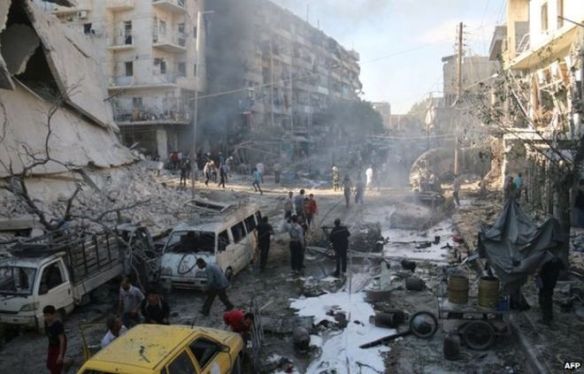
A Nonviolent Strategy to Liberate Syria

_74590478_00e0aa73-8303-4224-89de-0029b5e5eae1

Editor’s note: While we do not completely agree with the author’s analysis of factors leading to the strife in Syria, we share his desire for greater peace, freedom and stability in the region.

By Robert J. Burrowes

In early 2011, as the Arab Spring was moving across North Africa and the
Middle East, small groups of nonviolent activists in Syria, which has
been under martial law since 1963, started protesting against the brutal
dictatorship of Bashar al-Assad and demanding democratic reforms, the
release of political prisoners, an increase in freedoms, abolition of
the emergency law and an end to corruption.

By mid-March these protests, particularly in cities such as Damascus,
Aleppo and Daraa, had escalated and the ‘Day of Rage’ protest on 15
March 2011 is considered by many to mark the start of the nationwide
uprising against the Assad dictatorship. The dictatorship’s reaction to
the protests became violent on 16 March and on 18 March, after Friday
prayers, activists gathered at the al-Omari Mosque in Daraa were
attacked by security forces with water cannons and tear gas, followed by
live fire; four nonviolent activists were killed.

Within months, as the nonviolent protests expanded and spread, the
regime had killed hundreds of activists and arbitrarily arrested
thousands, subjecting many of them to brutal torture in detention. This
pattern has continued unchecked. For the earliest of a succession of
reports that document this regime violence against nonviolent activists,
see the Human Rights Watch report ‘”We’ve Never Seen Such Horror” Crimes
against Humanity by Syrian Security Forces‘.

For the most recent report, see the UN Human Rights Council report ‘Out
of Sight, Out of Mind: Deaths in Detention in the Syrian Arab Republic‘.

In recent commentaries on the war in Syria, both long-time solidarity
activist Terry Burke – see ‘U.S. Peace Activists Should Start Listening
to Progressive Syrian Voices
– and long-term Middle East scholar Professor Stephen Zunes have
encouraged the anti-war movement to listen to Syrian voices in framing
their response, particularly given the tendency within some sections of
it to support ‘the extraordinarily brutal Assad regime – a family
dictatorship rooted in the anti-leftist military wing of the Baath
Party’. See ‘Anti-war movement must listen to voices within Syria’s
civil war’.

One such Syrian voice is that of scholar and nonviolent activist
Professor Mohja Kahf. In her account of the Syrian uprising against the
Assad dictatorship – see ‘Then and Now: The Syrian Revolution to Date. A
young nonviolent resistance and the ensuing armed struggle
– Professor Kahf offers the following introductory paragraphs:

‘The Syrian uprising sprang from the country’s grassroots, especially
from youth in their teens, and adults in their twenties and thirties.
They, not seasoned oppositionists, began the uprising, and are its core
population. They share, rather than a particular ideology, a
generational experience of disenfranchisement and brutalization by a
corrupt, repressive, and massively armed ruling elite in Syria.

‘The uprising began nonviolently and the vast majority of its populace
maintained nonviolence as its path to pursue regime change and a
democratic Syria, until an armed flank emerged in August 2011.

‘The Syrian Revolution has morphed. From midsummer to autumn 2011, armed
resistance developed, political bodies formed to represent the
revolution outside Syria, and political Islamists of various sorts
entered the uprising scene. Since then, armed resistance has
overshadowed nonviolent resistance in Syria.

‘…political bodies and support groups for the revolution’s militarized
wing, have become venues for internal power struggles among opposition
factions and individuals, and entry-points for foreign powers attempting
to push their own agendas into a revolution sprung from Syrian
grievances, grown from the spilling of Syrian blood on Syrian soil.

‘Many in the global peace community can no longer discern the Syrian
uprising’s grassroots population through the smoke of armed conflict and
the troubling new actors on the scene. Further, some in the global left
or anti-imperialist camp understand the Syrian revolution only through
the endgame of geopolitics. In such a narrative, the uprising population
is nothing but the proxy of U.S. imperialism.

‘Such critics may acknowledge that the Assad regime is brutal, but
maintain from their armchairs that Syrians must bear this cost, because
this regime has its finger in the dike of U.S. imperialism, Zionism, and
Islamism. Or, perhaps they agree that a revolution against a brutal
dictator is not a bad idea, but wish for a nicer revolution, with better
players. Eyes riveted to their pencils and rulers and idées fixés, such
critics abandon a grassroots population of disenfranchised human beings
demanding basic human freedoms in Syria. This is a stunning and cruel
failure of vision.

‘The voices of the original grassroots revolution of Syria are
nonviolent, nonsectarian, noninterventionist, for the fall of the Assad
regime, and for the rise of a democratic, human rights upholding Syria
that is bound by the rule of law. They are still present in this
revolution. Who will hear them now, after so much dear blood has been
spilled, so much tender flesh crushed under blasted blocks of cement, so
much rightful anger unleashed?’

Other Syrian voices offer a similar account. See, for example, the
recent book by Robin Yassin-Kassab and Leila al-Shami titled ‘Burning
Country: Syrians in Revolution and War’
reviewed in ‘Book Review: Burning Country‘.

If Syrians and their solidarity allies are to develop and implement a
successful nonviolent grassroots strategy to end the war in/on Syria and
remove the Assad dictatorship, then we need a sound strategic framework
that guides the comprehensive planning of our strategy. Obviously, there
is no point designing a strategy that is incomplete or cannot be
successful.

A sound strategic framework simply enables us to think and plan
strategically so that once our strategy has been elaborated, it can be
widely shared and clearly understood by everyone involved. It also means
that nonviolent actions can then be implemented because they are known
to have strategic utility and that precise utility is understood in
advance. There is little point taking action at random, especially if
our opponent is powerful and committed (even if that ‘commitment’ is
insane, which is frequently the case).

There is a simple diagram presenting a 12-point strategic framework
illustrated here in the form of the ‘Nonviolent Strategy Wheel‘.

In order to think strategically about nonviolently resolving a violent
conflict, a clearly defined political purpose is needed; that is, a
simple summary statement of ‘what you want’. However, given the
complexity of the multifaceted conflict in the case of Syria, it is
strategically simpler to identify two political purposes. These might be
stated thus: 1. To end the war in/on Syria, and 2. To establish a
democratic form of government in Syria (which, obviously, requires
removal of the dictatorship).

Once the political purpose has been defined, the two strategic aims
(‘how you get what you want’) of the strategy acquire their meaning.
These two strategic aims (which are always the same whatever the
political purpose) are as follows: 1. To increase support for your
campaign by developing a network of groups who can assist you. 2. To
alter the will and undermine the power of those groups who support the
war/dictatorship.

While the two strategic aims are always the same, they are achieved via
a series of intermediate strategic goals which are always specific to
each struggle. To keep this article reasonably straightforward, I have
only identified a set of strategic goals that would be appropriate in
the context of ending the war in/on Syria below. For a basic set of
strategic goals appropriate for ending the dictatorship, see ‘Strategic
Aims‘.

Before listing the strategic goals for ending the war, I wish to
emphasize that I have only briefly discussed two aspects of a
comprehensive strategy to end the war in/on Syria: its political purpose
and its two strategic aims (with its many subsidiary strategic goals).
For the strategy to be effective, all twelve components of the strategic
framework should be planned (and then implemented). See Nonviolent
Defense/Liberation Strategy.
This will require, for example, that tactics that will achieve the
strategic goals must be carefully chosen and implemented bearing in mind
the vital distinction between the political objective and strategic goal
of any such tactic. See ‘The Political Objective and Strategic Goal of
Nonviolent Actions‘.

Strategic goals to end the war in/on Syria

I have outlined a basic list of strategic goals below although, it
should be noted, the list would be considerably longer as individual
organizations should be specified separately.

Many of these strategic goals would usually be tackled by action groups
working in solidarity with Syria campaigning within their own country.
Ideally they would be undertaken by activist groups with existing
expertise in the relevant area (for example, experience in campaigning
against a weapons corporation) but this is not essential.

Of course, individual activist groups would usually accept
responsibility for focusing their work on achieving just one or a few of
the strategic goals (which is why any single campaign within the overall
strategy is readily manageable).

It is the responsibility of the struggle’s strategic leadership to
ensure that each of the strategic goals, which should be identified and
prioritized according to their precise understanding of the
circumstances in Syria, (so, not necessarily precisely as identified
below) is being addressed (or to prioritize if resource limitations
require this).

So here is a set of strategic goals to end the war in/on Syria:

(1) To cause the women in [women’s organizations WO1, WO2, WO…] in Syria
to join the liberation strategy by participating in [your nominated
nonviolent action(s)/campaign(s) and/or constructive program
activities]. For example, simple nonviolent actions would be to wear a
national symbol (such as a badge of the Syrian revolutionary flag and/or
ribbons in the national colors) and/or to boycott all media outlets
supporting the war. For this item and many items hereafter, see the list
of possible actions that can be taken here: ‘198 Tactics of Nonviolent Action‘.

(2) To cause the workers in [trade unions T1, T2, T…] in Syria to join
the liberation strategy by participating in [your nominated nonviolent
action(s)/campaign(s) and/or constructive program activities]. For
example, this might include withdrawing their labor from occupations
that support the Syrian military forces.

(3) To cause young people in Syria to resist conscription into the
Syrian military forces.

(4) To cause young people in Syria to refuse recruitment into the Free
Syrian Army, al-Qaeda and its affiliates/allies, the Islamic State
(Daesh) and its allies.

(5) To cause the members of [religious denominations R1, R2, R…] in
Syria to join the liberation strategy by participating in [your
nominated nonviolent action(s)/campaign(s) and/or constructive program
activities].

(6) To cause the members of [ethnic communities EC1, EC2, EC…] in Syria
to join the liberation strategy by participating in [your nominated
nonviolent action(s)/campaign(s) and/or constructive program
activities].

(7) To cause the activists, artists, musicians, intellectuals and other
key social groups in [organizations O1, O2, O…] in Syria to join the
liberation strategy by participating in [your nominated nonviolent
action(s)/campaign(s) and/or constructive program activities].

(8) To cause the students in [student organizations S1, S2, S…] in Syria
to join the liberation strategy by participating in [your nominated
nonviolent action(s)/campaign(s) and/or constructive program
activities].

(9) To cause the soldiers in [military units M1, M2, M…] to refuse to
obey orders from the dictatorship to arrest, assault, torture and shoot
nonviolent activists and the other citizens of Syria.

(10) To cause the police in [police units P1, P2, P…] to refuse to obey
orders from the dictatorship to arrest, assault, torture and shoot
nonviolent activists and the other citizens of Syria.

(11) To cause young people in [the US, NATO countries, Russia and other
countries fighting in Syria] to refuse recruitment into their respective
military forces.

(12) To cause conscripts into the military forces of [NATO countries,
Russia and other countries fighting in Syria] that still use
conscription to conscientiously refuse to perform military duties.

(13) To cause military personnel in the military forces of [the US, NATO
countries, Russia and other countries fighting in Syria] to refuse
deployment to the war in/on Syria.

(14) To cause young people in [your country] to refuse recruitment into
the Free Syrian Army, al-Qaeda and its affiliates/allies, the Islamic
State (Daesh) and its allies.

(15) To cause former soldiers in [your country] to refuse recruitment as
mercenaries by corporations that supply ‘military contractors’ to fight
in Syria.

(16) To cause the activists in [peace groups P1, P2, P…] in [your
town/city/country] to resist the war on Syria by encouraging their
members to boycott [all/specified nonmilitary products] of [weapons
corporations W1, W2, W…]. For example, this might include boycotting all
commercial flights that use Boeing and Airbus passenger aircraft given
the heavy involvement of these corporations in the production of
military aircraft.

(17) To cause the activists in [environment groups E1, E2, E…] in [your
town/city/country] to resist the war on Syria by encouraging their
members to boycott [all/specified nonmilitary products] of [weapons
corporations W1, W2, W…]. For example, this might including boycotting
all commercial products of General Electric given the heavy involvement
of this corporation in the production of military engines, systems and
services.

(18) To cause the workers in [trade unions or labor organizations T1,
T2, T….] in [your town/city/country] to resist the war on Syria by
encouraging their members to boycott [all/specified nonmilitary
products] of [weapons corporations W1, W2, W…].

(19) To cause the women in [women’s organizations WO1, WO2, WO…] in
[your town/city/country] to resist the war on Syria by encouraging their
members to boycott [all/specified nonmilitary products] of [weapons
corporations W1, W2, W…].

(20) To cause the members of [religious denominations R1, R2, R…] in
[your town/city/country] to resist the war on Syria by encouraging their
members to boycott [all/specified nonmilitary products] of [weapons
corporations W1, W2, W…].

(21) To cause the members of [ethnic communities EC4, EC5, EC…] in [your
town/city/country] to resist the war on Syria by encouraging their
members to boycott [all/specified nonmilitary products] of [weapons
corporations W1, W2, W…].

(22) To cause the artists, musicians, intellectuals and other key social
groups in [organizations O4, O5, O…] in [your town/city/country] to
resist the war on Syria by encouraging their members to boycott
[all/specified nonmilitary products] of [weapons corporations W1, W2,
W…].

(23) To cause the students in [student organizations S1, S2, S…] in
[your town/city/country] to resist the war on Syria by encouraging their
members to boycott [all/specified nonmilitary products] of [weapons
corporations W1, W2, W…].

(24) To cause the consumers in [your town/city/country] to resist the
war on Syria by boycotting [all/specified nonmilitary products] of
[weapons corporations W1, W2, W…].

(25) To cause more individuals in [your town/city/country] to resist the
war on Syria by conscientiously resisting paying [part/all] of their
taxes for war.

(26) To cause more organizations in [your town/city/country] to resist
the war on Syria by conscientiously resisting paying [part/all] of their
taxes for war.

(27) To cause [weapons corporations W4, W5, W…] to convert from the
manufacture of military weapons to [the specified/negotiated
socially/environmentally beneficial products].

(28) To cause [banks B1, B2, B…] to cease financing the weapons
industry.

(29) To cause bank customers to shift their deposits to ethical banks
and credit unions that do not finance (or are otherwise involved in) the
weapons industry.

(30) To cause [religious organizations R4, R5, R…] to divest from the
weapons industry.

(31) To cause [superannuation funds S1, S2, S…] to divest from the
weapons industry.

(32) To cause superannuation fund customers to shift their money to
ethical funds that do not finance (or are otherwise involved in) the
weapons industry.

(33) To cause [insurance companies I1, I2, I…] to divest from the
weapons industry.

(34) To cause insurance customers to shift their policies to ethical
insurance companies that do not finance (or are otherwise involved in)
the weapons industry.

(35) To cause [corporations C1, C2, C…] that provide
[services/components] for [weapons corporations W1, W2, W…] to cease
doing so.

(36) To cause the workers in [trade unions or labor organizations T4,
T5, T…] to withdraw their labor from [weapons corporations W1, W2, W…]
[partially/wholly], [temporarily/permanently].

(37) To cause the workers in [trade unions or labor organizations T7,
T8, T…] to withdraw their labor from [corporations C1, C2, C…]
[partially/wholly], [temporarily/permanently].

(38) To cause [corporations C4, C5, C…] that provides
[services/supplies] to [military bases MB1, MB2, MB…] to cease doing so.

(39) To cause the workers in [trade unions or labor organizations T10,
T11, T…] who work in/supply [military bases MB1, MB2, MB…] to withdraw
their labor [partially/wholly], [temporarily/permanently].

(40) To cause the workers in [trade unions or labor organizations T13,
T14, T…] to withdraw their labor from [corporations C4, C5, C…]
[partially/wholly], [temporarily/permanently].

(41) To cause [corporations C7, C8, C…] that manufacture and supply spy
satellites for military purposes to cease doing so.

(42) To cause the workers in [trade unions or labor organizations T16,
T17, T…] to withdraw their labor from [corporations C7, C8, C…]
[partially/wholly], [temporarily/permanently].

(43) To cause [corporations C10, C11, C…] that provide
[services/components] for the militarization of space to cease doing so.

(44) To cause the workers in [trade unions or labor organizations T19,
T20, T…] to withdraw their labor from [corporations C10, C11, C…]
[partially/wholly], [temporarily/permanently].

(45) To cause [corporations C13, C14, C…] that provide private military
contractors (mercenaries) to fight in wars to cease doing so.

(46) To cause the private military contractors (mercenaries) who fight
in wars to withdraw their labor from [corporations C13, C14, C…].

(47) To cause the soldiers in [military units M1, M2, M…] in [your
town/city/country] to refuse to obey orders to [arrest, assault, torture
and shoot, depending on your local circumstances] nonviolent activists
campaigning against the war.

(48) To cause the police in [police units P1, P2, P…] in [your
town/city/country] to refuse to obey orders to [arrest, assault, torture
and shoot, depending on your local circumstances] nonviolent activists
campaigning against the war.

(49) To cause individual members of the military forces at [Military
Base MB1/Drone Base DB1/Navy Ship NS1/Air Force Base AFB1/Army unit
AU1/Marines unit MU1] in [your town/city/country] to resign.

(50) To cause individual members of those corporations that
employ/supply private military contractors (mercenaries) to resign.

As you can see, the two strategic aims are achieved via a series of
intermediate strategic goals.

Not all of the strategic goals will need to be achieved for the strategy
to be successful but each goal is focused in such a way that its
achievement functionally undermines the power of those conducting the
war.

The difference between success and failure in any struggle is the
soundness of the strategy.


Biodata: Robert J. Burrowes has a lifetime commitment to understanding and ending human violence. He has done extensive research since 1966 in an effort to understand why human beings are violent and has been a nonviolent activist since 1981. He is the author of ‘Why Violence?‘ His email address is flametree@riseup.netand his website is at http://robertjburrowes.wordpress.com

Robert J. Burrowes
P.O. Box 68
Daylesford
Victoria 3460
Australia
Email: flametree@riseup.net

Websites:
Nonviolence Charter
Flame Tree Project to Save Life on Earth
‘Why Violence?’
Nonviolent Campaign Strategy
Nonviolent Defense/Liberation Strategy
Anita: Songs of Nonviolence
Robert Burrowes
Global Nonviolence Network

Why Okinawa Should Matter

2015051815015274208

By Richard Falk

Source: Foreign Policy Journal

Okinawa has been a mostly unhappy host of American military bases, and the issue has been prominent at times on the agenda of the Japanese peace movement.

When President Barack Obama visited Hiroshima in May of 2016, there was an effort to persuade him to put Okinawa on his travel itinerary, but as has happened frequently throughout the long tortured history of Okinawa, the request was ignored, and the people of the island were once more disappointed. In an important sense, Okinawa is the most shameful legacy of Japan’s defeat in World War II, exceeding even the sites of the atomic attacks by its daily reminders of a continued colonialist encroachment on Okinawan national dignity and wellbeing.

Actually, Okinawa is being victimized by overlapping exploitations with that of the United States reinforced and legitimized by mainland Japan. For the United States, Okinawa serves as a hub for its strategic military operations throughout the Pacific, with at least 14 separate military bases occupying about 20% of the island. Kadena Air Base was used for B-29 bombing missions during the Korean War more than a half century ago, and the island was used as a major staging area throughout the Vietnam War. It has also been used as a secret site for the deployment of as many as 1,000 nuclear warheads in defiance of Japanese declared no-nukes policy. Actually, in recent years Okinawa rarely receives global news coverage except when there occurs a sex crime by American servicemen that provokes local outrage and peaceful mass demonstrations followed by the strained apologies of local American military commanders.

Japan’s role in the misfortunes of Okinawa is more than one of a passive acceptance of the enduring side effects of its defeat and humiliation in World War II. After a series of military incursions, Japan finally conquered Okinawa and the Ryukyu island chain of which it is a part in 1879, and then imposed its rule in ways that suppressed the culture, traditions, and even the language of the native populations of the islands. What is virtually unknown in the West is that Okinawa was the scene of the culminating catastrophic land battle between the United States and Japan in the spring of 1945 that resulted in the death of an astounding one-third of the island’s civilian population of then 300,000 and its subsequent harsh military administration by the United States for the next 27 years until the island was finally turned back to Japan in 1972. Despite an estimated 60-80% of Okinawans being opposed to the U.S. bases, confirmed by the recent election of an anti-bases governor of prefecture, the government in Tokyo, currently headed by a dangerous militarist, Shinzo Abe, is comfortable with the status quo, which allows most of the unpopular continuing American military presence to be centered outside of mainland Japan, and hence no longer a serious political irritant within the country.

What the plight of Okinawans exemplifies is the tragic ordeal of a small island society, which because of its small population and size, entrapment within Japan, and geopolitical significance, failed to be included in the decolonizing agenda that was pursued around the world with such success in the last half of the 20th century. This tragic fate that has befallen Okinawa and its people results from being a ‘colony’ in a post-colonial era. Its smallness of current population (1.4 million) combined with its enclosure within Japanese sovereign statehood and its role in pursuing the Asian strategic interests of the United States, as well as joint military operations with Japan make it captive of a militarized world order that refuses to acknowledge the supposedly inalienable right of self-determination, an entitlement of all peoples according to common Article 1 of both human rights covenants. In this respect, Okinawa, from a global perspective, is a forgotten remnant of the colonial past, which means it is subjugated and irrelevant from the perspective of a state-centric world order. In this respect, it bears a kinship with such other forgotten peoples as those living in Kashmir, Chechnya, Xinjiang, Tibet, Hawaii, Puerto Rico, Palau, Marianas Islands, among many others.

There are other ways of being forgotten. I have for many years been concerned about the Palestinian ordeal, another geopolitical and historical casualty of Euro-American priorities and the colonialist legacy. Here, too, the indigenous population of Palestine has endured decades of suffering, denials of basic rights, and a dynamic of victimization initiated a century ago when the British Foreign Office issued the Balfour Declaration pledging support to the world Zionist movement for the establishment of a Jewish Homeland in historic Palestine, later placed under the tutorial role of the United Kingdom with the formal blessings of the League of Nations until the end of World War II. Instead of Japan playing the intermediate role as in Okinawa, it is Israel that pursues its own interests and teams with the United States and Europe as a strategic partner to carry forward its shared geopolitical goals throughout the Middle East and North Africa. Of course, there are crucial differences. Japan is constrained as a partner by its postwar peace constitution, which Abe is keen to circumvent and dilute, while Israel has become a military powerhouse in the region, enjoying a special relationship with the United States that includes the incredible assurance by Washington of a military capability capable of defeating any foreseeable combination of Arab adversaries. Also, unlike Okinawa, there are no American military bases in Israel. There is no need for them. Israel acts as an American surrogate, and sometimes even vice versa. Yet the result is the same—force projection unconnected with self-defense, but vital for upholding regional strategic interests that involve maintaining a visible military presence and offering allies in the region credible promises of protection.

When we raise questions about the future of Okinawa, we come face to face with the role and responsibility of global civil society. The Palestinian goals appear to remain more ambitious than those of the Okinawans, although such an impression could be misleading. The Palestinian movement is centered upon realizing the right of self-determination, which means at the very least an end to occupation and a diplomacy that achieves a comprehensive, sustainable, and just peace. For Okinawans, long integrated into the Japanese state, earlier dreams of independence seem to have faded, and the focus of political energy is currently devoted to the anti-bases campaign. Taking moral globalization seriously means conceiving of citizenship as borderless with respect to space and time, an overall identity I have described elsewhere under the label ‘citizen pilgrim,’ someone on a life journey to build a better future by addressing the injustices of the present wherever encountered.

In this respect, acting as citizen pilgrims means giving attention to injustices that the world as a whole treats as invisible except when an awkward incident of lethal abuse occurs. Okinawa has been effectively swept under the dual rugs of statism (Okinawa is part of the sovereign state of Japan) and geopolitics (Okinawa offers the United States indispensable military bases), and even the mainly Japanese peace movement may have grown fatigued and distracted, being currently preoccupied with its opposition to the revival of Japanese militarism under Abe’s leadership. Whether attention to the plight of Okinawa will give rise to false hopes is a concern, but the aspiration is to produce an empowering recognition throughout the world that for some peoples the struggle against colonialism remains a present reality rather than a heroic memory that can be annually celebrated as an independence day holiday. Until we in the United States stand in active solidarity with such victims of colonialist governance we will never know whether more can be done to improve prospects of their emancipation. This awareness and allegiance is the very least that we can do if we are to act in the spirit of a citizen pilgrimage.


This article was originally published at RichardFalk.Wordpress.com. An earlier version first appeared in the Japanese publication Ryukyu Shimpo.


Who Lost: A Biased Media, Pundits, Pollsters, Political Parties, Warmongers, the Corporatocracy, Pay-to-Play Grifters, Neoliberals

1596525_630x354

Editor’s Note: While the parties mentioned may have lost in the short run, it’s likely they’ll soon regroup for future assaults on humanity and the planet.

By Charles Hugh Smith

Source: Of Two Minds

Fake Progressives are perfectly fine with soaring inequality and corrupt governance, as long as everyone’s public utterances are politically correct.

Sometimes who lost is more important than who won. Let’s review who lost the election:

1. Let’s start with the Corporatocracy, which expected to once again wield unlimited influence by funding political campaigns with millions of dollars in contributions and speaking fees.

2. A biased mainstream media. My mom-in-law was watching CBS all night, so that’s what we watched. All the pundits/anchors spoke in the hushed tones of a funeral. For two hours, the only images of campaign workers shown were the sad faces of Clinton supporters; not one image of jubilant Trump supporters was broadcast until Trump gave his acceptance speech.

When one of the talking heads noted that Hillary never generated the enthusiasm of the Sanders or Trump campaigns, his comment was followed by a stony silence. That he had given voice to a self-evident truth was not welcome.

3. Mainstream punditry: they got it wrong from the start and remained close-minded and arrogant in their postured superiority.

The punditry applied a double standard to Trump and Hillary. Trump’s speeches and ethically questionable history were judged by moral standards, and he was declared unfit.

Hillary’s actions, on the other hand, were judged by strictly legalistic standards: well, you can’t indict her, so she’s fit for office.

Dear punditry: you can’t use double standards to promote your biases and retain any shred of credibility.

4. Pollsters. Having rigged the polls via over-sampling and under-sampling, they were laughably wrong. Here is a typical headline from election night, from the New York Times: Trump Takes Florida, Closing In on a Stunning Upset.

Only the pollsters and the MSM were stunned.

5. Political parties. As my friend G.F.B. observed, both parties ran 20th century campaigns in the 21st century. Both parties lost for this reason; both are hopelessly out of touch with a rapidly changing America.

Democrats upset with losing should look at their party’s system of Super-Delegates that squelched Bernie Sander’s bid.

6. Warmongers. Many Americans are sick and tired of interventionist, globalist warmongering. The only possible way they could register their opposition to warmongering was to vote for Trump.

7. Pay-to-Play Grifters. Let the investigations, indictments, prosecutions and convictions begin as soon as Trump is sworn in.

8. Neoliberals. Globalization boils down to freeing mobile capital to rove the globe for opportunities to strip-mine cheap resources, assets and labor and then move on, leaving ruined communities behind.

9. Bonus loser: Fake Progressives. Fake Progressives are perfectly fine with soaring inequality and corrupt governance, as long as everyone’s public utterances are politically correct. So the oppressor class is acceptable as long as they speak respectfully while stepping on your neck.

Real Progressives see jobs and community as solutions, not welfare and central planning. Real Progressives see the eradication of warmongering Imperial pretensions and corrupt pay-to-play grifting as the essential projects of liberty and democracy.

The real Hunger Games: the Capitalist recipe to maximise profits while ‘having fun’

peacekeeper

By Sky Wanderer

Source: Investment Watch

Introduce a political economy upon the arbitrary axiom that Capitalism is the one and only economic system for mankind, and introduce a narcissistic moral philosophy that you as a Capitalist represent unsurpassable objective moral virtues.

You as a Capitalist hire politicians to implement policy as per your moral and economic philosophy and redefine ‘democracy’ as the political system to sustain Capitalism. Then from such position of self-established authority, abolish unions and all labour-representation, thus force your employees into a race-to-the-bottom contest to compete for jobs by accepting lower and lower wages.

Give decent jobs and benefits to only those who belong to your noble circles. For everyone else reintroduce slavery in the form of “workfare”. The goal is that you pay the lowest wages for jobs done by the fittest slaves, who will survive the contest. If you wish, you can call the contest “real Hunger Games”.

To speed up the process, extend the race-to-the-bottom into global scope so that you will have access to the cheapest and fittest labour everywhere on the planet. Never mind that your slaves will have to live out of a suitcase and every time when you lay them off and labour demand calls them elsewhere, they will have to relocate to yet another continent.

To further accelerate the process, make good use of your 3rd-world colonies, your Mideast colonising wars and your secretly sponsored mercenaries (ISIS). Via your “leftist” assistants, organise a massive refugee crisis to import the cheapest possible workforce via your war-refugees and economic migrants. These migrants are the fittest contestants who – glad just to escape your bombs – will worship you as their saviours and will work for you for literally zero payment. The migrants will not only boost your profits to sky-high levels but will rapidly pull down the overall wages of your domestic employees.

Meanwhile keep increasing the prices so your slaves can’t pay for food, energy, heat and shelter from their next-to-zero incomes. If some of them attempt to survive by taking bank-loans to acquire shelter, education and meet other basic needs, but they can’t repay the loans from their low incomes, you can just evict them from their homes via your banks.

When you made them homeless this way, make sure their ugly presence won’t spoil the beauty of your city. Install pretty anti-homeless spikes, so when they crush onto the pavement they will die, and you can just collect their bodies. To project your capitalist moral virtues into eternity, incorporate the beauty of your anti-homeless spikes into the modern concept of art and beauty.

Introduce private banking to enable yourself to creating new money when you wish. This way you can easily indebt the entire society, soon you can even purchase the whole planet.

Meanwhile dismantle public healthcare, so those of your slaves who are still alive but get sick, will die without treatment. Eliminate (privatise) all affordable public services, destroy the public sphere, abolish all public spaces and welfare benefits. To have a dandy excuse for such policy, make sure to keep the country in ever increasing debt by taking countless £ billions of government loans, and transfer the responsibility of these odious debts onto your slaves. Refer to these debts as the reason for the crisis, then refer to the crisis as the reason for these debts, then refer to the debts and the crisis as the reason for austerity and spending cuts. Then you can increase the public debt again and continue the same loop ad infinitum.

Make sure your very own mainstream media and academia would never reveal the truth that the never-ending crisis and mass-unemployment are due to your private banking and debt- and profit-mongering dysfunctional capitalist system, and keep the real disastrous indicators of the state of economy in secret.

Instead of admitting the truth, use the divide et impera strategy to make your victims blame themselves and one another. To increase the fun, produce reality shows where the still active part of your slaves will blame the disabled and the unemployed, meanwhile make the local poor blame the immigrant poor for the overall misery that you inflicted. Then establish offices where the local poor dressed as fancy clerks will evict the immigrant poor, meanwhile watch how all of them are begging for their lives until they give up and commit suicide.

Enjoy!