From Russia, with Panic

Cozy bears, unsourced hacks—and a Silicon Valley shakedown

By Yasha Levine

Source: The Baffler

The Russians hacked America.

After Donald Trump’s surprise victory in November, these four words reverberated across the nation. Democratic Party insiders, liberal pundits, economists, members of Congress, spies, Hollywood celebrities, and neocons of every stripe and classification level—all these worthy souls reeled in horror at the horribly compromised new American electoral order. In unison, the centers of responsible opinion concurred that Vladimir Putin carried off a brazen and successful plan to throw the most important election in the most powerful democracy in the world to a candidate of his choosing.

It seemed like a plotline from a vintage James Bond film. From his Moscow lair, Vladimir Putin struck up an alliance with Julian Assange to mount a massive cyber-offensive to discredit Hillary Clinton and her retinue of loyal Democratic Party operatives in the eyes of the American public.

The plot was full of twists and turns and hair-raising tangents, including tales of Russian-American retiree-agents sunning in Miami while collecting payoffs from Russia’s impoverished pension system. But the central ruse, it appears, was to enter the email server of the Democratic National Committee and then tap into the Gmail account belonging to John Podesta, founder of the Center for American Progress and premier D.C. Democratic insider.

As the long 2016 general election campaign unwound, WikiLeaks released a steady stream of embarrassing revelations from the DNC—though the disclosures were no more compromising than what you’d find in the correspondence of any mid-sized private-sector company: dumb boardroom gossip, petty press intrigues, and sleazy attempts to undermine a well-placed executive rival (namely Bernie Sanders). Truly, it would have been astonishing to learn that the DNC went about its business in any other way. But the sheer fact of the data breach was dispositive in the eyes of Democratic operatives and their many defenders in the liberal press. After all, WikiLeaks also reportedly collected data from the Republican National Committee, and did nothing with it. Clearly this was cyber-espionage of the most sophisticated variety.

On the Trump side of the ledger, things were murkier. Trump’s political advisers indeed had ties to Russia and Ukraine—but this was hardly surprising given the authoritarian-friendly lobbying climate within Washington. During the campaign the GOP nominee was disinclined to say anything critical about Putin. Indeed, breaking with decades of Republican tradition, Trump openly praised the Russian leader as a powerful, charismatic figure who got things done. But since the candidate also refused to disclose his tax returns, a commercial alliance with the Russian autocrat was necessarily a matter of conjecture. That didn’t stop theories from running wild, culminating in January with the titillating report from BuzzFeed that U.S. intelligence agencies believed that Putin had compromising footage of Trump cavorting with prostitutes at a Moscow hotel previously patronized by Barack and Michelle Obama. Not only was the Yank stooge defiling the very room where the first couple had stayed, but he allegedly had his rented amorous companions urinate in the bed. Behold, virtuous American republic, the degradation Vladimir Putin has in store for you!

Taking the Piss

The dossier published by BuzzFeed had been circulating for a while; on closer inspection, it appeared to be repurposed opposition research from the doomed Jeb Bush campaign. Its author was a former British intelligence operative apparently overeager to market salacious speculation. By the end of this latest lurid installment of the Russian hacking saga, no one knew anything more than they had when the heavy-breathing allegations first began to make their way through the political press. Nevertheless, the Obama White House had expelled Russian diplomats and expanded sanctions against Putin’s regime, while the FBI continued to investigate reported contacts between Trump campaign officials and Russian intelligence operatives during the campaign.

This latter development doesn’t exactly inspire confidence. As allegations of Russian responsibility for the DNC hack flew fast and furious, we learned that the FBI never actually carried out an independent investigation of the claims. Instead, agency officials carelessly signed off on the findings of CrowdStrike, a private cybersecurity firm retained by the Democratic National Committee. Far from establishing an airtight case for Russian espionage, CrowdStrike made a point of telling its DNC clients what it already knew they wanted to hear: after a cursory probe, it pronounced the Russians the culprits. Mainstream press outlets, primed for any faint whiff of great-power scandal and poorly versed in online threat detection, likewise treated the CrowdStrike report as all but incontrovertible.

Other intelligence players haven’t fared much better. The Director of National Intelligence produced a risible account of an alleged Russian disinformation campaign to disrupt the 2016 presidential process, which hinged on such revelations as the state-sponsored TV news outlet Russia Today airing uncomplimentary reports on the Clinton campaign and reporting critically on the controversial U.S. oil-industry practice of fracking as a diabolical plot to expand the market for Russian natural gas exports. In a frustratingly vague statement to Congress on the report, then-DNI director James Clapper hinted at deeper and more definitive findings that proved serious and rampant Russian interference in America’s presidential balloting—but insisted that all this underlying proof must remain classified. For observers of the D.C. intelligence scene, Clapper’s performance harkened back to his role in touting definitive proof of the imminent threat of Saddam Hussein’s WMD arsenal in the run-up to the U.S. invasion of Iraq.

It’s been easy, amid the accusations and counteraccusations, to lose sight of the underlying seriousness of the charges. If the hacking claims are true, we are looking at a truly dangerous crisis that puts America’s democratic system at risk.

The gravity of the allegation calls for a calm, measured, meticulously documented inquiry—pretty much the opposite of what we’ve seen so far. The level of wild assertion has gotten to the point that some of the most respected pro-Western voices in Russia’s opposition have expressed alarm. As much as they despise Putin, they don’t buy the bungled investigations. “In the real world outside of soap operas and spy novels . . . any conclusions concerning the hackers’ identity, motives and goals need to be based on solid, demonstrable evidence,” wrote Leonid Bershidsky. “At this point, it’s inadequate. This is particularly unfortunate given that the DNC hacks were among the defining events of the raging propaganda wars of 2016.”

The lack of credible evidence, the opaque nature of cyber attacks, the partisan squabbles and smears, and the national-security fearmongering have all made this particular scandal very difficult to navigate. It may be years before we find out what really happened. Meanwhile, I’d like to tell a cautionary tale. It’s a story about the last time American and European cyber experts accused Russia of launching an attack against another country—and nearly provoked a war with a nuclear power. The moral of the tale is that cyberwarfare is a fraught and high-stakes theater of conflict, in which the uncertain nature of cyber-attack attribution can be exploited to support any politicized version of events that one chooses.

All Georgians Now

On August 8, 2008, war broke out between Georgia and Russia. Backed up by heavy artillery, truck-mounted Grad rockets, and tanks, Georgia launched a surprise invasion of South Ossetia, a tiny mountainous breakaway republic on its northern flank that had been at the center of a long-simmering regional territorial dispute. A prolonged artillery barrage reduced parts of Tskhinvali, South Ossetia’s capital, to rubble. Civilians were given no warning—those not killed in the initial assault hid in basements or fled on foot. A Russian peacekeeping force, which had been stationed in South Ossetia under an Organization for Security and Cooperation in Europe agreement since 1992, was targeted in the attack. By the end of the first day, Georgian troops were on the verge of taking the whole city.

Mikheil Saakashvili, Georgia’s charismatic nationalist president, had campaigned on a nationalistic platform, promising to reabsorb the country’s breakaway regions. His initial success did not last long. Russian jets pounded Georgian military command posts and communications, while Russian troops streamed into South Ossetia. By the end of day two, the tide had turned: Georgian forces began retreating. By day five, Russian forces had control over South Ossetia and huge swaths of northern Georgia. Tanks and infantry entered several northern towns and moved around unimpeded just an hour away from Tbilisi, Georgia’s capital, where euphoria and jubilation turned to sickly fear. News footage showed Saakashvili cowering as Russian jets flew overhead. He appeared on television nervously chewing his tie, prompting the BBC to ask wryly: “The Georgian president chews over his next move. Is he weaker or stronger than before?”

Weaker, definitely. But in the war’s aftermath, Russia and Georgia were each determined to claim victim status. Russia pointed out that Georgia had started the war; Georgia blamed Russia for launching a full-scale invasion. President Saakashvili appealed to the United States, hoping it would intervene militarily on Georgia’s behalf.

The Bush White House was firmly aligned with Georgia. For years, Georgia had been an important neocon project in a grander scheme to peel away former Soviet Republics from Moscow’s influence. American NGOs and soft-power outfits like USAID backed Saakashvili’s rise to power during the country’s “Rose Revolution.” Since 2004, the Bush administration had lavished military aid on Saakashvili’s government, outfitted its army, and trained its soldiers. John McCain and Hillary Clinton jointly nominated Saakashvili for the Nobel Peace Prize in 2005. Support for Georgia was bipartisan and continued right up to Georgia’s attack on South Ossetia; more than a thousand American troops held a joint exercise with Georgia near the South Ossetian border in July.

As a complement to the Georgia PR offensive, the Bush White House continued to hammer away at its stable of anti-Putin talking points. For years, the United States had portrayed Vladimir Putin as a strongman leader bent on world domination. The invasion of Georgia seemed to confirm the official narrative: Russia would stop at nothing to crush the democratic aspirations of its neighbors.

It was a dangerous moment. Vice president Dick Cheney pushed for directly engaging the Russians in “limited military options”—including aerial bombardment to seal the Roki Tunnel linking North Ossetia and South Ossetia that was being used to transport reinforcements. Luckily, president George W. Bush, who had a street in Tbilisi named after him, wavered, sensibly fearing a real war with Russia.

The episode occurred during a U.S. presidential election. Senator John McCain used the conflict to showcase his hawkish foreign policy bona fides, arguing that America needed to intervene to protect Georgia’s budding democratic society from the authoritarian Putin. Claiming that “today, we are all Georgians,” McCain called for NATO forces to be deployed against Russia, which would have triggered a war with a nuclear power.

I was in Moscow at the time, reporting on the war. Those who had covered the region understood that Georgia was no innocent. The ethnic conflict between Ossetians and Georgians has old, festering roots—indeed, Georgia’s invasion of South Ossetia was centuries in the making. The Ossetians consider the territory of South Ossetia to be native lands they have occupied for centuries, while Georgians view Ossetians as relatively recent interlopers. When South Ossetia declared its independence after the breakup of the Soviet Union, Georgia’s ultra-nationalistic first president attempted to quash the independence movement by force. After a short war, South Ossetia stood its ground—and Georgia and South Ossetia squared off in an uneasy peace administered by Russian, Georgian, and South Ossetian peacekeepers. Two-thirds of the breakaway republic were ethnic Ossetians. They feared Georgia and favored Russia as a military bulwark. Russia handed out Russian passports to South Ossetians and provided military protection, making the territory a de facto member of the Russian Federation.

Seasoned observers of the region’s tangled geopolitics understood that Russia shared amply in the blame but that the fault lay primarily with President Saakashvili. When he came to power, he took on the mantle of a medieval Georgian king who had unified the country. “Today Georgia is split and humiliated. We should unite to restore Georgia’s territorial integrity. Georgia has existed and will exist. Georgia will become a united strong country,” he declared in 2004. With deteriorating political support at home, Saakashvili was itching for a popular war. Skirmishes increased along Georgia’s border with Abkhazia and South Ossetia; finally, Georgia fired the first shot.

Suddenly, America found itself at the edge of a precipice: a war over a complex sectarian conflict in a remote part of the world. American policymakers wanted a simple explanation, and conveniently, they were offered one: cyber-aggression.

The Sites Go Out in Georgia

When war broke out, a slew of Georgian websites came under attack. The Central Bank of Georgia was hacked, according to Russian reports. Its internal networks were not penetrated, but the hackers tinkered with the homepage to give the Georgian unit of currency, the lari, a less than favorable exchange rate, forcing the government to issue an order that suspended all electronic banking services. Georgia’s Ministry of Foreign Affairs was hacked, its homepage replaced with a slideshow depicting Mikhail Saakashvili as Hitler. “And he will suffer the same fate,” read an ominous message beside it.

A Russian-language forum called “Stop Georgia” suddenly came online, hosted in, of all places, the United States. Against a green camouflage-inspired background, its creators decried Georgia’s propaganda war against Russia. “We, as representatives of the Russian hacker-underground, will not tolerate provocations from Georgia.” The forum was crude and looked like it had been put together in a few hours. Its primary function was to distribute a simple, easily available program permitting anyone with a computer and an internet connection to become part of a denial-of-service attack swarm. The forum conveniently provided a list of Georgian target websites and helped organize and direct the cyber-mob action.

Georgian officials proclaimed these cyber attacks a strategic maneuver by the Russian military designed to take out the country’s communication system, facilitating the Russians’ armed invasion. The coordinated nature of the attacks, they insisted, showed that Russia had planned the invasion long in advance. “The opening shots of the Russian invasion of Georgia were fired over the Internet, proving Russian online aggression predated Georgian actions,” declared an official report by the Georgian government. The government called the people behind the attack “cyber terrorists.”

Cybersecurity experts came out of the woodwork to confirm and expand on Georgia’s allegations. Some implicated a shadowy cybercrime group from St. Petersburg that analysts had dubbed the “Russian Business Network” and linked it to the FSB, Russia’s secret police. Others claimed that Nashi, a Kremlin-backed young nationalist group, was involved. American military officials weighed in, agreeing that Russia had used cyber attacks to confuse and disorient the Georgian government. “The Russians just shot down the government command nets so they could cover their incursion,” Michael Wynne, former U.S. Air Force Secretary, told the AP on August 13.

One hack in particular became a sort of poster action for the sinister Russian cyber-offensive and conveniently doubled as a warning signal for greater Russian-authored threats ahead. In July, just after secretary of state Condoleezza Rice had visited Georgia and reaffirmed America’s support for the country’s desire to exit Russia’s sphere of influence, President Saakashvili’s site had been taken down by a stream of junk requests with a string of text that read: “win+love+in+Rusia.”

What did it all mean? The war had barely ended, but John Markoff, longtime technology reporter for the New York Times, offered an answer: “As it turns out, the July attack may have been a dress rehearsal for an all-out cyberwar once the shooting started between Georgia and Russia. According to Internet technical experts, it was the first time a known cyber attack had coincided with a shooting war.” Other journalists chimed in as well: the Wall Street Journal, CNN, the Washington Post. The consensus, according to cyber experts, was that Russia was indeed behind the attacks—and the rhetoric was getting more and more belligerent.

And so, within the space of a news cycle or two, internet analysts turned into warmongers and cyber-hawks, comparing rudimentary internet attacks to atomic weapons. “These attacks in effect had the same effect that a military attack would have. That suddenly means that in cyberspace anyone can build an A-bomb,” Rafal Rohozinski, a respected cyber analyst with Citizen Lab, told the Washington Post. The Financial Times concurred: “The crisis in Georgia has not only stoked fears of a belligerent Russia. It has also served as a reminder that a new style of warfare—potentially as devastating as those that terrified previous generations—is almost upon us: cyberwar.”

That’s right: defacing a government website with a repetitive string of crude slogans was now the twenty-first-century equivalent of a nuclear first strike. The hysteria sloshed around and spilled over into fears that America was defenseless against similar attacks from Russia. “It’s a grave concern be the same thing could happen here in America,” CNN host John Roberts exclaimed.

Point, Click, Panic

I began investigating the cyberwar as soon as it erupted. I knew something about the way computers, websites, and the internet worked, having spent two years studying computer science at UC Berkeley, and I had serious doubts about the cyber dimension of the Russia-Georgia War. The hacks and attacks all seemed rather crude and for the most part targeted non-critical cyber portals: ceremonial government websites, several news sites, the public-facing website of a central bank. This was hardly the ruinous infrastructure offensive that cybersecurity experts were warning people about. As I got deeper into the story—interrogating my contacts in Moscow, traveling to Georgia, interviewing hackers, politicians, and cyber experts in Europe, Russia, and the United States—the cyberwar battle cries sounded more and more like ideologically manufactured hysteria.

To be sure, the assaults were troubling. Hacks against Georgian websites took place, they were in some way connected to the war, and Russia’s cyber criminal world had ties to the country’s security establishment. But it was an enormous—and dangerous—leap to interpret these attacks as a pre-planned Russian intelligence operation, possibly justifying an American military response. What’s more, it seemed clear that most of the people doing the investigating were working backward. They started from the premise that Russia started the war and then proceeded to show that the cyber attacks were an element of this premeditated invasion.

Living in Moscow, I saw a striking split-screen effect taking hold around the Georgia crisis. America was freaking out about the danger of Russian cyber attacks, while people I talked to in Russia mocked the hysteria. Looking at my reporting notes from that time, I can’t find a single Russian source who took it seriously. Nikita Kislitsin, former editor of Russia’s Hacker magazine, laughed at Western cybersecurity experts who suggested that the Georgian attacks were the entering wedge of a sophisticated plan for complete Russian takeover, explaining that hackers can have all sorts of unconventional motives for taking part in a political web war. One regular contributor to his magazine’s how-to break-in section, for example, had hacked into a few Georgian sites just so he had something to write—and brag—about. Kris Kaspersky, a well-known Russian hacker and security expert, also ridiculed the notion that the Georgia hacks were hatched as part of a military intelligence campaign. “A prepubescent kid could have carried out the attacks,” Kaspersky told me. “A well-funded organization like the FSB can pull off much more effective Web site attacks.” Bringing down a few rinky-dink government and newspaper websites is a far cry from network warfare, Kaspersky argued. Indeed, it was at least as plausible that the hacks could have been self-inflicted: “In these kinds of conflicts, you have to look at who benefits,” he said. “If I was Georgia, I would attack myself.”

The Fog of the Data Log

There was a second, underreported side to the conflict: the cyber attacks went in both directions.

Even before the war broke out in August, South Ossetian websites came under attack. A few days before the shelling of South Ossetia began, someone skillfully broke into the website of the Republic’s television station, replacing news items on the number of Georgian troops killed in a shootout with South Ossetian troops with ones that claimed Russian mercenary fighters were among the casualties. As Georgian tanks rolled across the border, other South Ossetian news sites—some of which were hosted in Moscow—came under cyber attack. The website of South Ossetia’s Ministry of Information, a clearinghouse for South Ossetian news, buckled under a denial-of-service attack. At the same time, Russian news sites—including the Kremlin-funded Russia Today—were hit and suffered downtime during the war.

If you squinted at the conflict and looked at it from Russia’s and South Ossetia’s perspective, you could use the cyber attacks to prove the opposite of what Georgia and Western cyber experts were claiming: the cyber attacks proved that Georgia had planned its military invasion. And that was exactly what the South Ossetians were telling me. “They hoped that a media blackout of the atrocities they were committing against a civilian population would reduce resistance to the invasion, both locally and globally,” Yuri Beteyev, the founder and editor in chief of OsInform, South Ossetia’s only news agency, told me. He had been in Tskhinvali when Georgia’s heavy artillery rolled into town.

I traveled to Tbilisi, looking for evidence of the alleged Russian attack. I had scheduled interviews with newspapers, government agencies, and internet service providers. They all made grand claims about Russian cyber attacks, all of them short on specific evidence. Caucasus Online, one of Georgia’s largest ISPs, claimed the attacks started the day before the military action—which served in the company’s view as undeniable proof that the Russian government was coordinating them. But ISP officials could not provide any supporting data, and when I requested a sample of their logs from that day, company spokesmen claimed the data had been deleted.

I was shown a former Soviet government compound in the center of Tbilisi. The building was a modernist fortress: a slab of granite and concrete perched at the top of a steep hill. The seventh floor housed Georgia’s National Security Council, the coordinating body for the country’s military and intelligence agencies. In this ultrasecure location, Georgian officials spun a series of talking points about how the cyberwar proved Russian aggression. “For a small country like ours, information is the most powerful tool with which you can protect yourself. The Russians knew this,” Security Council director Alexander Lomaia told me. “One day, we find out that we are cut off from the world. All major websites—including government and media—were attacked. Their aim was to limit our ability to electronically communicate, and they succeeded.”

But Georgia is a poor, largely rural country with low internet connectivity outside the capital. Its level of cyber-activity ranked below that of countries like Nigeria, Bangladesh, Bolivia, and El Salvador. You could hardly launch a real cyber attack if you wanted too, since few Georgians outside Tbilisi used the internet at all, let alone for anything important. It was all hype and bluster—and very superficial.

Indeed, as in Moscow, critical journalists and techies in Georgia dismissed much of the hype. Yes, there were cyber attacks. Yes, they could have been directed by the Russian government. But they were so amateur and inconsequential that they had little effect. Their biggest contribution, in fact, was to bolster Georgian counter-propaganda claims, as each little hack was taken up by the Georgian government and broadcast as proof of Russian aggression. One journalist told me his colleagues had cheered news of Georgia-based cyber attacks against Russia. “A wave of jubilation spread through the forum when they managed to take down Russia Today for a few hours.” Patriotic hackers doing their part to fight Russia? This is exactly what cyber experts accused Russian security services of orchestrating against Georgia as part of the military invasion.

Following the Money

By the time I left Georgia in October, the cyberwar story was no longer obsessing political leaders and media producers in the West. Congress had voted to bail out Wall Street. The Georgia-Russia War dropped out of America’s collective memory almost as quickly as it had appeared, eclipsed by a scarier and much more direct threat to America: the meltdown of our financial system and the threat of a new Great Depression.

A year later, a European Union commission issued a detailed report that showed just how empty all the talk about cyber attacks and premeditated Russian war really was. The report put the blame for starting the war squarely on Georgia. But by then the Georgia-Russia War was ancient news. No one cared, and the report barely got a mention in the press. But Silicon Valley noticed.

While the financial industry was teetering on the brink of oblivion, another industry was being born: the cybersecurity complex. By now it is a multibillion-dollar boondoggle, employing shoddy forensic techniques and politicized investigations. But it is highly profitable. The boom has been driven by the grim leaky reality of our digital world. Not a month goes by without some huge corporation or government agency getting hacked, its data splattered across the internet or siphoned off for the exclusive use of scammers, corporate spies, and intelligence agencies.

Cybersecurity firms have stepped up to the challenge. They’ve attracted funding from the biggest and most powerful venture capital houses: Sequoia, Google Capital, and the like. Not surprisingly, the CIA’s in-house VC outfit, In-Q-Tel, has been a leading investor in this space. All these firms position themselves as objective forensic investigators, patiently sifting through the evidence to find the guilty party and then figuring out how to defend against it. They have been involved with diagnosing and attributing big hacks for shamefaced clients like Target, J.P. Morgan, and Sony Pictures. Investors and intelligence agencies sing the praises of the critical services these outfits offer in an online environment teeming with hostile threats.

But in private conversations, as well as little-noticed public discussions, security professionals take a dimmer view of the cybersecurity complex. And the more I’ve looked at the hysteria surrounding Russia’s supposed hacking of our elections, the more I’ve come to see it as a case study of everything wrong and dangerous about the cyber-attribution business.

Fancy Bears, Cozy Bears—Oh My!

Take CrowdStrike, the hottest cybersecurity firm operating today. Based in Irvine, California, CrowdStrike was launched in 2012 by two veterans of the cyber-attribution business: George Kurtz and Dmitri Alperovitch. Both previously worked for McAfee, an antivirus-turned-massive-cybersecurity firm now partially owned by Intel. But Kurtz and Alperovitch saw a market opportunity for a new boutique type of cyber-defense outfit and decided to strike out on their own. They also brought on board Shawn Henry, a top FBI official who had been in charge of running the agency’s worldwide cyber investigations.

CrowdStrike positioned itself as a next-generation full-service cybersecurity firm. Company officials argued that cybersecurity was no longer just about defense—there was too much data and too many ways of getting at it to protect everything all the time. You had to know your attacker. “Knowing their capabilities, objectives, and the way they go about executing on them is the missing piece of the puzzle in today’s defensive security technologies,” wrote CrowdStrike cofounder George Kurtz. “By identifying the adversary . . . we can hit them where it counts.”

CrowdStrike hit the big time in 2015 with a $100 million infusion from Google Capital (now Capital G), Google’s first-ever investment in a cybersecurity company. It was good timing, because CrowdStrike was about to be catapulted into the front ranks of cyber-threat assessors. Sometime in April or May, CrowdStrike got a call from the Democratic National Committee to investigate a possible intrusion into their servers. The company’s investigators worked with surprising efficiency. As one DNC insider explained to the New York Times, the company was able to make a definite attribution within a day. There was no doubt, CrowdStrike told its DNC clients—the Russian government did it.

The results of CrowdStrike’s investigation were first broken by the Washington Post and then followed up in greater detail by CrowdStrike itself. In a post entitled “Bears in the Midst,” Dmitri Alperovitch attributed the hack to two distinct and very nefarious “Russian espionage” groups: Cozy Bear and Fancy Bear, among the most sophisticated cyber-operators CrowdStrike had ever come across. “In fact, our team considers them some of the best adversaries out of all the numerous nation-state, criminal and hacktivist/terrorist groups we encounter on a daily basis,” he wrote. “Their tradecraft is superb, operational security second to none and the extensive usage of ‘living-off-the-land’ techniques enables them to easily bypass many security solutions they encounter.”

These cyberspooks were allegedly behind a string of recent attacks on American corporations and think tanks, as well as recent penetrations of the unclassified networks of the State Department, the White House, and the U.S. Joint Chiefs of Staff. According to CrowdStrike, Cozy Bear was most likely the FSB, while Fancy Bear was linked to the “GRU, Russia’s premier military intelligence service.”

Here, the cyber experts were telling us, was conclusive evidence that both the FSB and the GRU targeted the central apparatus of the Democratic Party. CrowdStrike’s findings didn’t just cause a sensation; they carpet-bombed the news cycle. Reports that Vladimir Putin had tried to hack America’s democratic process raced around the world, making newspaper front pages and setting off nonstop cable news chatter.

The story got even hotter after a hacker who called himself Guccifer 2.0 suddenly appeared. He took credit for the DNC hack, called CrowdStrike’s investigation a fraud, and began leaking select documents pilfered from the DNC—including a spreadsheet containing names and addresses of the DNC’s biggest donors. The story finally started going nuclear when WikiLeaks somehow got hold of the entire DNC email archive and began dribbling the data out to the public.

A Terrible System

CrowdStrike stuck to its guns, and other cybersecurity firms and experts likewise clamored to confirm its findings: Russia was behind the attack. Most journalists took these security savants at their word, not bothering to investigate or vet their forensic methods or look at the way CrowdStrike arrived at its conclusions. And how could they? They were the experts. If you couldn’t trust CrowdStrike and company, who could you trust?

Unfortunately, there were big problems with CrowdStrike’s account. For one thing, the names of the two Russian espionage groups that CrowdStrike supposedly caught, Cozy Bear and Fancy Bear, were a fiction. Cozy Bear and Fancy Bear are what cyber monitors call “Advanced Persistent Threats,” or APTs. When investigators analyze an intrusion, they look at the tools and methods that the hackers used to get inside: source code, language settings, compiler times, time zones, IP settings, and so on. They then compare all these things against a database of previously recorded hacks that is shared among cyber professionals. If the attack fits an old profile, they assign it to an existing APT. If they find something new, they create a group and give it an official name (say, APT911) and then a cooler moniker they can throw around in their reports (say, TrumpDump).

CrowdStrike followed the protocols for existing APTs. Its investigation of DNC servers turned up two known threat actor groups: APT28 and APT29. Depending on the cybersecurity firm doing the analysis, these two APTs have been called by all sorts of names: Pawn Storm, Sofacy, Sednit, CozyCar, The Dukes, CozyDuke, Office Monkeys. Neither of them has ever been linked by any cybersecurity firm to the Russian government with certainty. Some firms have tried—most notably FireEye, CrowdStrike’s bigger and wealthier competitor. But FireEye’s evidence was ridiculously thin and inferential—in nearly any other industry, it would have been an embarrassment. Consider, for example, FireEye’s report on APT29:

We suspect the Russian government sponsors the group because of the organizations it targets and the data it steals. Additionally, APT29 appeared to cease operations on Russian holidays, and their work hours seem to align with the UTC +3 time zone, which contains cities such as Moscow and St. Petersburg.

Or consider FireEye’s report on APT28—which, among other things, attributes this attack group to a Russian intelligence unit active in Russia’s “invasion of Georgia,” an invasion that we know never took place.

They compile malware samples with Russian language settings during working hours consistent with the time zone of Russia’s major cities, including Moscow and St. Petersburg.While we don’t have pictures of a building, personas to reveal, or a government agency to name, what we do have is evidence of long-standing, focused operations that indicate a government sponsor—specifically, a government based in Moscow.

So, FireEye knows that these two APTs are run by the Russian government because a few language settings are in Russian and because of the telltale timestamps on the hackers’ activity? First off, what kind of hacker—especially a sophisticated Russian spy hacker—keeps to standard 9-to-5 working hours and observes official state holidays? Second, just what other locations are in Moscow’s time zone and full of Russians? Let’s see: Israel, Belarus, Estonia, Latvia, Moldova, Romania, Lithuania, Ukraine. If non-Russian-speaking countries are included (after all, language settings could easily be switched as a decoy tactic), that list grows longer still: Greece, Finland, Turkey, Jordan, Lebanon, Syria, Iraq, Saudi Arabia, Somalia, Yemen, Ethiopia, Kenya—the countries go on and on.

The flimsiness of this evidence didn’t stop CrowdStrike. Its analysts matched some of the tools and methods used in the DNC hack to APT28 and APT29, slapped a couple of Russian-sounding names with “bear” in them on their report, and claimed that the FSB and GRU did it. And most journalists covering this beat ate it all up without gagging.

“You don’t know there is anybody there. It’s not like it’s a club and everyone has a membership card that says Fancy Bear on it. It’s just a made-up name for a group of attacks and techniques and technical indicators associated with these attacks,” author and cybersecurity expert Jeffrey Carr told me. “There is rarely if ever any confirmation that these groups even exist or that the claim was proven as correct.”

Carr has been in the industry a long time. During the Russia-Georgia war, he led an open-source intelligence effort—backed by Palantir—in an attempt to attribute and understand the actors behind the cyberwar. I read his reports on the conflict back then and, even though I disagreed with some of his conclusions, I found his analysis nuanced and informative. His findings at the time tracked with those of the general cybersecurity industry and bent toward implicating the Russian government in the cyber attacks on Georgia. But these days Carr has broken with the cyberworld consensus:

Any time a cyber attack occurs nowadays you have cybersecurity companies looking back and seeing a historical record and seeing assignments on responsibility and attribution and they just keep plowing ahead. Whether they are right or wrong, nobody knows, and probably will never know. That’s how it works. It’s a terrible system.

This is forensic science in reverse: first you decide on the guilty party, then you find the evidence that confirms your belief.

Not for Attribution

Over time, bad evidence was piled on top of unsubstantiated claims and giant inductive leaps of logic to the point that, if you tried to figure out what was actually happening, you’d lose all sense of direction.

Matt Tait, a former GCHQ analyst and founder of Capital Alpha Security who blogs under the influential Twitter handle @pwnallthethings, found a Word document pilfered from the DNC and leaked by Guccifer 2.0. As he examined its data signatures, he discovered that it had been edited by Felix Edmundovich—a.k.a. Felix Dzerzhinsky, founder of the Cheka. To him, it was proof that Guccifer 2.0 was part of the same Russian intelligence operation. He really believed that the super sophisticated spy group trying to hide its Russian ties would register its Microsoft Word processor in the name of the leader of the infamously brutal Soviet security service.

Meanwhile, Thomas Rid, a cyber expert based in London, drew a straight line from the DNC hacks to the attempted hacking of the Germans and TV5 to attacks on Georgia and Baltic States—even though on closer inspection none of those efforts had been linked to the Russian government.

John Podesta’s Gmail account was hacked with a rudimentary spear-phishing attack that tricked him into entering his password with a fake Google login page. His emails ended up on WikiLeaks, too. All sorts of people linked this to Russian military intelligence, with no concrete evidence to speak of.

Sensing its moment had arrived, CrowdStrike went into frenetic PR mode. The company released a series of cyber-attribution reports illustrated with sexy communist robots wearing fur hats, using visual marketing techniques in lieu of solid evidence.

After Donald Trump won the presidency, all these outlandish claims were accepted as unassailable truth. The “hacking” of the 2016 presidential election was the ultimate damning conclusion that cybersecurity experts were now working backward from. Just as Georgia’s compromised net infrastructure provided conclusive proof of Russia’s concerted plan to invade Georgia, Trump’s improbably successful presidential run demonstrated that Russian subterfuge, rather than the collapse of American political institutions, had elected a dangerous outsider president.

Watching this new round of cyber-attribution hysteria, I got a queasy feeling. Even Dmitri Alperovitch’s name sounded familiar. I looked through my notes and remembered why: he was one of the minor online voices supporting the idea that the cyber attacks against Georgia were some kind of Russian plot. Back then, he was in charge of intelligence analysis at Secure Computing Corporation, a cybersecurity company that also made censorship tools used by countries like Saudi Arabia. He was now not only running his own big shop, but also playing a central role in a dangerous geopolitical game.

In other words, the election-hacking panic was a stateside extension of the battle first joined on the ISP frontiers of the Georgia-Russia war. Impressionable journalists and Democratic party hacks who ignore this background do so at their peril—and ours.

Lessons from George Orwell’s ‘1984’

1984

By Ethan Indigo Smith

Source: Waking Times

“Political language is designed to make lies sound truthful and murder respectable, and to give an appearance of solidity to pure wind.” — George Orwell

Some fictional literature is so profound as to be relevant for decades. George Orwell’s timeless 1984 is one such literary work. One of the most influential books of our time, its message resonates today as much as it did when it was first published over 65 years ago — as shown by its recent surge to the #1 spot on Amazon’s bestseller list.

So what can 1984 teach us about the modern day?

At its core, 1984 is a post-WWII interpretation of the relationship between individuals and institutions. It changed the course of social history by spawning new language relating to the structure and mechanisms of our society, expanding the scope of human language and thought, and therefore, humanity’s understanding of itself. And that legacy seems perfectly fitting, for in the story of 1984, the world is controlled by so many restrictions that even the expressiveness of the official language, “Newspeak”, is deliberately narrowed by the ruling institutions in a way that limits the ability of individuals to express “thoughtcrime” — that which is deemed illegal by the “Inner Party”, the State.

As a work of fiction, 1984 provides a stark view of a burgeoning culture of totalitarianism. As a work of symbolism, however, it stands as a reflection of modern fact in The U.S.A. and the world today. Within its narrative, the five freedoms of the First Amendment of the United States Constitution were infringed and removed; in particular, the freedom of speech was so restricted that there was only one source of news operated by the official governing body and an entire branch of government was dedicated to steadily eliminating language deemed detrimental to the State.

Orwell created new phrases like “Newspeak” (the official, limited language) and its antonym “Oldspeak”, “Goodthink” (thoughts that are approved by the Party) and its antonym “Crimethink”, and “Doublethink” (the normalized act of simultaneously accepting two contradictory beliefs). The new language allowed his narrative to portray and expose age-old structures of thought and language manipulation – structures that have exponentially escalated in the modern day.

In 1984 all opposition is controlled and absorbed into the background. ‘Big Brother’ is the human image that represents The Inner Party (and the Party line) via the Telescreen providing an ‘official’ narrative while appropriating and misrepresenting the notion of brotherhood and unity into a ‘brand name’ — one that actually instills a psychology of collectivism, not brotherhood, just as the controllers in our own world instill nationalism and war-mindedness in the name of “freedom” and “liberty”. Indeed, the Telescreen is the primary means through which norms were forced on the society and false imagery and narratives embedded in its collective consciousness. Totally transfixed on the Party line, as told by the Telescreen, the fictional society of 1984 has lost the ability to think such that it will believe two plus two is five, as the saying goes, as long as it is presented as such on the Telescreen. They have been captive to this set up their entire lives, and, with language and thought restricted and outlawed, they are blind to their own captivity, unable to discern for themselves. Thus, lies are made to be “truths” using logic so distorted that it not only convinces the masses that two plus two equal five, but that war is peace, freedom is slavery, and ignorance is strength.

In reality, individual ignorance is strength to institutions. Such distortions of language and thought (and, incidentally, history) are the perfect means by which to disempower and co-opt an entire society — means that are not limited to the works of fiction. Orwell knew that ideas do not exist separately from language. Language, in both spoken and written forms, is essential to our ability to form and communicate thoughts and ideas. That is why today the United States government, the shadow powerbrokers that control it, and the mainstream media that support it (the entirety of which is owned by only 6 corporations) continue their war on “fake news” — i.e. ideas that are skeptical of government pronouncements, and information that proves them to be false — taking aim not just at independent journalism but independent thought itself. While government surveillance of its own people continues to increase, government secrecy is at an all-time high, the sharing of ideas that challenge the status quo is becoming more heavily censored, releasing information on institutional and State activity is now punishable by law, and whistleblowers from inside the State are systematically destroyed. If that wasn’t Orwellian enough, Donald Trump’s advisors have begun coining phrases like “alternative facts”, and we have even seen the creation of an Orwellian “Ministry of Truth”, an “international fact-checking network” charged with deciding what is “truth” and what is “fake news”.

If the events of 1984 continue to hold true, and the ruling Party of today gets its way, words and ideas will soon become not only censored, but illegal and eliminated altogether, controlled by increasingly totalitarian governments steering our society down a dystopian path of censorship, blind belief, and misinformation — all in the name of the State. However, as our minds are freed, one at a time, we are ultimately finding that our society is heavily embedded with such norms and structures that perpetuate false imagery, preserving the status quo of the State from the ‘threat’ of individual thinking — hence the modern war on “fake news”. We are beginning, as a society, to question such falsehood, and exercise our inherent freedom to expose it.

“Freedom is the freedom to say that two plus two make four. If that is granted, all else follows”. ~ George Orwell

The Last Man in Europe

The original working title to 1984 was ‘The Last Man in Europe.’ This descriptive and evocative title idea provides a clear glimpse into George Orwell’s intent, and encapsulates a main point of 1984, a title perhaps too revealing to be anything but a working title. Certainly, that is the way many of us feel when we first become aware of lies and partial-truths that are presented as reality by those in control of our society today, and accepted in totality by seemingly everyone else – it is as if we are the last lone person. Indeed, the road of the freethinker can be a lonely one, and the story’s protagonist, patriot Winston Smith, is made to believe he is the last person who questions, who looks, listens and speaks.

In a totalitarian society — be it Orwell’s fictional world or the increasingly authoritarian political regimes of today — the official narratives portrayed by the “official” media portray that a society is in consensus with the State, and that those engaged in Thoughtcrime (whether or not it is legally a crime) are isolated social outcasts and lunatics, and demeaned as “rebels” and “conspiracy theorists” (despite the existence of actual conspiracy, against which the truly conscious mind must inevitably rebel.) Yet in reality, Crimethink is what differentiates we freethinkers from those who are lost in the spell of societal illusion and, therefore, pose a threat to the status quo of the State. But this is part of the trap of Goodthink — it creates the illusion of consensus, and therefore, engenders isolation in those who do not concede.

As a master of his craft, nothing Orwell wrote was off the cuff. Now it is not overtly spoken in the book, but there are four types of people in the fictional realm of 1984. There are three described classes and a suggested fourth, only later is it implied that the Brotherhood, anti-establishment rebels — has been eliminated from the narrative jut as those in power sought to eliminate them from the society.

The Secret to 1984 is ‘4’

1984 is in part an expose on the four basic types of people in a society, the four types of institutions and the four types of institutional lies that enable them.

Characterized by how they respond to information, modern societies are made up of four archetypes of people — idiots, zealots, elitists and patriots. Idiots refuse information, zealots blindly refute information, elitists misuse information, and patriots seek and distribute information. Despite dramatic alterations in the world’s geopolitical landscape, and some fluctuation of individuals from one group/role to another over time, the dynamic between these groups has historically remained the same, and are inevitably intertwined: Idiots avoid all new pertinent information in order to maintain their perspective, never questioning the status quo. Zealots ask certain questions of certain information, ignoring unaligned information in order to maintain their perspective, supporting the status quo at all costs. Elitists question information in order to manipulate and reap gains off those who don’t know, benefiting from the status quo. Patriots question information to educate themselves and share it with others, in order that we might enhance our lives and progress beyond the status quo.

It is no wonder, then, that the patriot has been all but deleted from today’s socio-political landscape, with those acting as true patriots being demonized by the State, and the meaning of the word “patriot” distorted and confused (by the likes of George W. Bush Jr.) to mean an unquestioning, flag-waving, with-us-or-against-us brand of nationalistic idiocy. (Check out my article, The First Amendment – The REAL Patriot Act for a deeper discussion of this.) Using a practice so well-defined by Orwell that it is known today as Orwellian speak, institutions transfer and confuse words and ideas by mixing up themselves, their policies and their products with patriotic ideas and words. They take the meaning of words and archetypes, and flip them on their heads: War is peace, freedom is slavery, ignorance is strength, and true patriotism (such as that shown by government whistleblowers) is traitorous.

In reality, the true patriots, the rebels who see through the lies of institutions and act accordingly, are removed from public consciousness in exactly the same way. In “Orwellian” fashion, the fourth deleted class of people in 1984, the Brotherhood, who are working to bring down the fascist Inner Party, are deleted through the admission of language. The other three types, which are specifically mentioned in the-book-within-the-book, the fictional The Theory and Practice of Oligarchical Collectivism, are the High, the Middle and the Low castes. Similarly, the other three types of people depicted in the society of Oceania are the Inner Party, the Outer Party and the Proles. The social classes interact very little.

The Inner Party and Outer Party make up 2% of the population, and are the institutionalized controllers of Oceania. They are akin to modern politicians and the financial elite, working with and against one another, and clamoring to gain and maintain power. They have privileges the other castes do not, including being able to (temporarily) turn off the propaganda-spewing Telescreens.

However, there is a pecking order within the Party. The Outer Party are given state administrative jobs and are composed of the more educated members of society. They are responsible for the direct implementation of the Party’s policies but have no say in decision making. They are the “artificial middle class” and as such, have strict rules applied to them. They are allowed “no vices other than cigarettes and Victory Gin”, are spied on via their Telescreens, and are encouraged to spy on each other, and to report suspicious activities to Big Brother.

The lower class of workers that perform the majority of menial tasks and labors are known as the Proles. They live in the poorest of conditions, are not educated, and instead are kept entertained with alcohol, gambling, sports, fiction and pornography (called “prolefeed”) — the 1984 equivalent of “bread and circus”.

According to the Inner Party and the Telescreen it controls, those who might challenge the system – the important fourth type of person – simply do not exist. The Brotherhood, the organization of patriots, are portrayed by the controlling ‘Inner Party’ as only a rumor, and the notion of their existence is belittled by the Inner Party, via the Telescreen. In Oceania, if the Telescreen is t be believed, there are no patriots, nor is such action allowed — and any who think that way are isolated by the divide-and-conquer tactic used by empires past and present. Thus, like so many in our failing society, Smith believes himself to be ‘The Last Man in Europe’…

“During times of universal deceit, telling the truth becomes a revolutionary act.” – George Orwell

And yet, as the character of Winston Smith accurately observes in his diary, “If there is any hope, it lies with the Proles” — just as our hope for today lies with the so-called “99%”. The “proles” in our society must begin to look beyond the bread and circus, beyond the prolefeed, and become a true brotherhood, and sisterhood, by questioning information, educating themselves, and sharing what they learn with others in order that we might overcome institutional oppression and finally create the ‘golden age’ that is our combined potential.

God and Gold is Within

“We shall meet in the place where there is no darkness.” — George Orwell, 1984

Nothing Orwell wrote was by accident. The name of the character who leads the Brotherhood rebellion is named Emmanuel Goldstein, a name that translates roughly to mean God (Emmanuel) and gold are within (Goldstein). The use of this character name by Orwell asserts a developed, even transmuted human being, who has transcended the imposed limitations of the system he is opposed to, and grown from dull to refined, disempowered to empowered. It also reveals Orwell’s knowledge of how such patriotism and rebellion can become revolution.

The word “prole” is short for prolétariat, a French word derived from the Latin proletarius, meaning “a man whose only wealth is his offspring, or whose sole service to the state is as father”. A word evoking pure institutionalized collectivism, it suggests that the individual has no value other than the labor and progeny he provides to the State. (If you’re only value to the state is as a breeder and consumer, well what kind of world does, sorry, would that result in??) Now compare that definition to the name Emmanuel Goldstein, Golden Godliness is Within. In complete contrast, it is a statement of inner development, of individual enlightenment and empowerment — which, as Orwell knew, are the only forces that can successfully lead a rebellion against the institutional oppression of both fiction and reality.

So, you see, the secret to 1984 is ‘4’. Its most powerful message is in its omissions: in the omission of information, which is the only way the Party/State can maintain authoritarian control, and in the deliberately-omitted fourth human archetype, the righteous rebel, the marginalized voice of descent who is led to believe he is the “last man in Europe”. But in fact, the last man in Europe is you and I. We are everywhere. And, as we open our minds and our mouths, and embrace the gold within, we re-tell the lost narrative of the Brotherhood, and turn our Proles into our Brothers.

Cycle of Insurgency: How the US military is expected to put down an insurrection

Suspect Death

By Justin King

Source: The Fifth Column

One of the overriding questions when discussing an insurgency within the United States has always been the debate over how the military would respond. Those who hope for the military to break ranks and join the resistance will be disappointed. Those who would believe the military will employ surgical strikes to remove dissidents through technology will be surprised. The American people don’t have to guess how the US military would respond any longer. Two respected academics chose to war game a scenario using the United States Operating Concept (2010) as a guide.

The first thing to understand about an insurrection is that it isn’t terrorism. The terms are often used interchangeably by the media, but there is a significant difference.

As pointed out throughout this series, insurgencies that matured through the cycle of insurgency win. Always. There is a reason for this. Insurgencies, though typically weaker militarily, have great advantages over their adversaries. One of the greatest small unit commanders and unconventional warfare experts in modern times, Richard Marcinko, described three things needed to win in combat: speed, surprise, and violence of action. When transferred to the strategic and operational levels, the insurgency possesses these attributes. The greatest advantages of the insurgency are:

Mobility: The refusal to stay in a static location negates technologically advanced weapons systems.
Initiative: The insurgency is able to choose the time and place of most of the battles they fight.
Surprise: Because the insurgents have the ability to choose the time and place of the fight, they can select moments when the opposition is weakest.
Camouflage: The insurgent does not wear a uniform. As the father of modern insurgency, Michael Collins, said: “Our uniform will be that of the man on the street and the peasant in the field.” This makes distinguishing between friend and foe difficult for the opposition.
Unpredictability: A force that is unpredictable on a battlefield is dangerous. Field commanders train to fight conventional wars, in which both sides attempt to take and hold territory, the insurgent seeks destabilization of the opposition’s government, not land. Tactics designed to defeat a conventional army are useless against an enemy that doesn’t seek to hold territory. The value of remaining unpredictable has created an adage in military circles: “Professional soldiers are predictable, but the world is full of amateurs.” The implied meaning is that the amateur is more dangerous.
Factional divides: In a conventional military setting, a force should function like a well-oiled machine and have clear command and control. Insurgencies typically operate with loose alliances between factions who follow a particular commander. Sometimes they work together, sometimes they don’t. Just when the opposition gains a feel for the tactics and strategy of an insurgent commander, a new one arises. This leads to unpredictable actions being taken by the various factions, which increases their overall effectiveness.
Civilian sympathies: Insurgencies typically maintain a great deal of support from the local populace, which means the opposition can’t move without information detailing those moves reaching the insurgents. In a conventional conflict, the lines of battle hinder civilians from collecting intelligence and passing it to the opposing force. It can be done, but it is difficult. Insurgencies have no front lines.

Insurgencies maintain several other key advantages, but they are more nuanced and are beyond the scope of this article.

The US Army has adopted a doctrine of “Full Spectrum Operations”. Loosely it means the combination of offensive, defensive, and either stability operations overseas or civil support operations on U.S. soil. It’s a concept developed for conventional wars, with little application in unconventional conflicts. To produce a desired outcome (a US military win), the scenario has to be carefully crafted. The academics who published Full Spectrum Operations in the Homeland: A “Vision” of the Future were able to accomplish that. The scenario they present is:

The Great Recession of the early twenty-first century lasts far longer than anyone anticipated.  After a change in control of the White House and Congress in 2012, the governing party cuts off all funding that had been dedicated to boosting the economy or toward relief.  The United States economy has flatlined, much like Japan’s in the 1990s, for the better part of a decade.  By 2016, the economy shows signs of reawakening, but the middle and lower-middle classes have yet to experience much in the way of job growth or pay raises.  Unemployment continues to hover perilously close to double digits, small businesses cannot meet bankers’ terms to borrow money, and taxes on the middle class remain relatively high.  A high-profile and vocal minority has directed the public’s fear and frustration at nonwhites and immigrants.  After almost ten years of race-baiting and immigrant-bashing by right-wing demagogues, nearly one in five Americans reports being vehemently opposed to immigration, legal or illegal, and even U.S.-born nonwhites have become occasional targets for mobs of angry whites.

In May 2016 an extremist militia motivated by the goals of the “tea party” movement takes over the government of Darlington, South Carolina, occupying City Hall, disbanding the city council, and placing the mayor under house arrest.  Activists remove the chief of police and either disarm local police and county sheriff departments or discourage them from interfering.  In truth, this is hardly necessary.  Many law enforcement officials already are sympathetic to the tea party’s agenda, know many of the people involved, and have made clear they will not challenge the takeover.  The militia members are organized and have a relatively well thought-out plan of action.

With Darlington under their control, militia members quickly move beyond the city limits to establish “check points” – in reality, something more like choke points — on major transportation lines.  Traffic on I-95, the East Coast’s main north-south artery; I-20; and commercial and passenger rail lines are stopped and searched, allegedly for “illegal aliens.”  Citizens who complain are immediately detained.  Activists also collect “tolls” from drivers, ostensibly to maintain public schools and various city and county programs, but evidence suggests the money is actually going toward quickly increasing stores of heavy weapons and ammunition.  They also take over the town web site and use social media sites to get their message out unrestricted.

The scenario continues with descriptions of the activities of politicians prior to the military being involved, but the actions of the “insurgent” already guarantee a US military victory. In the presented scenario, the insurgents surrender every single advantage they have. They attempt to hold territory, losing the advantages of mobility, surprise, initiative, and unpredictability. Because they are operating openly and in a defined area, they have lost the advantage of camouflage. The battle lines established by the insurgents themselves at the checkpoints negate the benefits of civilian sympathy. They have a unified command structure that reduces unpredictability.

In the scenario, DOD responds to this threat by establishing a “show of force” to demoralize the insurgents. They then mount offensive operations by surprise to take down the checkpoints. Towards the end of the campaign, the military seizes power and radio stations and so on. It then begins mopping up operations once the civilians of Darlington have fled.

When faced with the realities of a modern insurgency, this response is completely fictional. There can be no “show of force” to insurgents who don’t take and hold territory. Because the insurgency would operate in a loosely defined area, it would be the US military setting up checkpoints (as in Iraq) that would be ambushed, not the insurgents. Wise insurgents would use mobile communications to spread their message, not a static radio station. The power stations would have been destroyed to foster a belief in the civilian populace that the government can’t even keep the lights on, much less defeat the insurgency. The civilians that conveniently remove themselves from the battlefield in the scenario will be in the line of fire during an insurgency because there is no front line. There is nowhere to evacuate to.

The academics responsible for this scenario specifically created a simple set of conditions that allowed them to explore the logistical aspects of the doctrine on US soil, without considering the real world applications. The US counterinsurgency doctrine is fundamentally flawed. Even when practiced in a foreign country, away from the intense criticism of the US media and populace, it failed to pacify Iraq or Afghanistan. In the US, the doctrine is worthless.

In the joint publication on counterinsurgency doctrine used by all branches, even before the table of contents, it spells out the expected failure. On page iii it states:

“US counterinsurgency efforts should provide incentives to the host-nation government to undertake reforms that address the root causes of the insurgency.”

In a US-based insurgency, the United States is the “host-nation government”. While the above scenario makes for a fun read, current US doctrine is to meet the demands of domestic insurgents, while protecting as much of its credibility as possible.

Former World Bank Staffer Explains How Neoliberalism Is Destroying The World

neoliberal

By Dylan Charles

Source: Waking Times

More destructive than bombs, money has become the weapon of choice for the global elite, for the hidden hand of finance can plunder and conquer entire nations, assimilate whole cultures, exploit resources and rape the earth while forcing billions into poverty, all with the surprising stealth of pen-strokes and business contracts.

Neoliberalism is the economic and political philosophic driving force in the world today. It suggests that human progress is the result of competition, best expressed by an extremist version of unfettered capitalism, where privatization of profits and socialization of losses are acceptable ethics, regardless of human and environmental costs incurred along the way.

Neoliberalism is the killer plague of the 21st century. Neoliberalism is economic fascism. It is a criminal doctrine. Globalized neoliberalism privatizes public goods for private profit. Neoliberalism led by Washington with the shameful complicity of Europe has in the last fifteen years killed between 12 and 15 million people by wars, famine, deprived health services… forced refugees. Today a small world elite of corporate and Wall Street CEOs and selected politicians call the shots. ~Peter Koenig

First defined in 1938, its global implementation today is the product of the Washington Consensus of 1989 which describes a set of economic prescriptions for developing and crisis-wracked nations created by the World Bank, the International Monetary Fund and the U.S. Treasury Department. It is a policy which relies on the creation of social and financial crises to distract and soften target nations and peoples, creating problems while providing the ‘solutions.’

At present, Mexico is on the brink of revolution, a direct result of the fallout of three decades of neoliberal policy.

It [Neoliberalism] finds that representative democracy has been perverted through fear, putting central political decisions in the hands of power groups with special interests.The social impact of this process has been devastating, with a polarized income distribution, falling wages, increased precarious jobs, rising inequality, and extreme violence. Health conditions have also deteriorated and disorders associated with violence, chronic stress, and a changing nutritional culture have become dominating. [Source]

Journalist George Monbiot describes neoliberalism as follows:

Neoliberalism sees competition as the defining characteristic of human relations. It redefines citizens as consumers, whose democratic choices are best exercised by buying and selling, a process that rewards merit and punishes inefficiency. It maintains that “the market” delivers benefits that could never be achieved by planning.

Attempts to limit competition are treated as inimical to liberty. Tax and regulation should be minimised, public services should be privatised. The organisation of labour and collective bargaining by trade unions are portrayed as market distortions that impede the formation of a natural hierarchy of winners and losers. Inequality is recast as virtuous: a reward for utility and a generator of wealth, which trickles down to enrich everyone. Efforts to create a more equal society are both counterproductive and morally corrosive. The market ensures that everyone gets what they deserve. ~[Source]

Economic hitman turned whistleblower, John Perkins, wrote in detail of his ‘boots-on-the-ground’ experiences in conquering third-world nations through economic aid and infrastructure financing in his seminal classic, Confessions of an Economic Hitman. He’s since been on a world crusade to expose the madness of neoliberalism, seeking redemption by connecting with many of the indigenous cultures he previously had worked to enslave and oppress.

In recent years, Greece has become a more visible victim of this policy as the IMF and the European Union have forced the people of this ancient culture into austerity and starvation as part of a plan of economic restructuring to force repayment of illegitimate debts to international bankers.

Speaking at The Delphi Initiative in 2015, economist, geopolitical analyst, and former World Bank staffer, Peter Koenig, explained the scourge of this political and economic philosophy and how it is destroying our world today.

What we are confronted with today is the globalization, and the globalization basically that we are living is like a fetish of the neoliberals. The neoliberals who want to reduce the world to one culture, to one set of values, all based on greed consumption and maximizing profits. ~Peter Koenig

Koenig also speaks of neoliberalism as the root of the type of endless global conflict we see today, including wars of occupation and their resulting terrorism, noting that the U.S. economy is now so dependent on military spending that if peace were to break out, our economy would collapse.

Although from 2015, Koenig’s message is critically important today as the world continues to wake up to the reality that our lives are in the hands of a small exploitative group of inhumane corporations and governments who will stop at nothing to control the resources which make life possible, including water, destroying any civilization that stands in its way.


The Deep State’s Dominant Narratives and Authority Are Crumbling

By Charles Hugh Smith

Source: Of Two Minds

This is why the Deep State is fracturing: its narratives no longer align with the evidence.

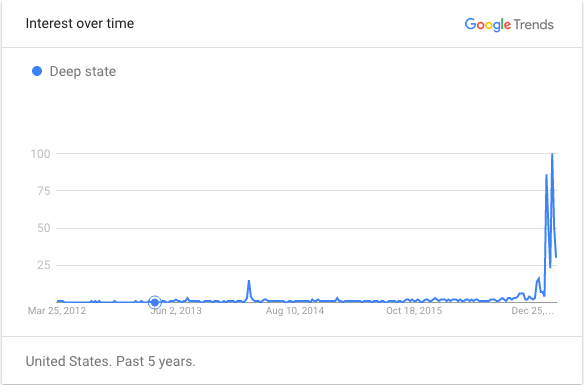
As this chart from Google Trends illustrates, interest in the Deep State has increased dramatically in 2017. The term/topic has clearly moved from the specialist realm to the mainstream. I’ve been writing about the Deep State, and specifically, the fractures in the Deep State, for years.

Amusingly, now that “Progressives” have prostituted themselves to the Security Agencies and the Neocons/Neoliberals, they are busy denying the Deep State exists. For example, There is No Deep State (The New Yorker).

In this risible view, there is no Deep State “conspiracy” (the media’s favorite term of dismissal/ridicule), just a bunch of “good German” bureaucrats industriously doing the Empire’s essential work of undermining democracies that happen not to prostrate themselves at the feet of the Empire, murdering various civilians via drone strikes, surveilling the U.S. populace, planting bugs in new iPhones, issuing fake news while denouncing anything that questions the dominant narratives as “fake news,” arranging sweetheart deals with dictators and corporations, and so on.

The New Yorker is right about one thing–the Deep State is not a “conspiracy:” it is a vast machine of control that is largely impervious to the views or demands of elected representatives or the American people. The key to understanding this social-political-economic control is to grasp that control of the narratives, expertise and authority is control of everything. Allow me to illustrate how this works.

The typical politician has a busy daily schedule of speaking at the National Motherhood and Apple Pie Day celebration, listening to the “concerns” of important corporate constituents, attending a lunch campaign fundraiser, meeting with lobbyists and party committees, being briefed by senior staff, and so on.

Senior administrators share similarly crowded schedules, minus the fundraising but adding budget meetings, reviewing employee complaints and multiple meetings with senior managers and working groups.

Both senior elected officials and senior state administrators must rely on narratives, expertise and authority because they have insufficient time and experience to do original research and assessment.

Narratives create an instant context that “makes sense” of various data points and events. Narratives distill causal factors into an explanatory story with an implicit teleology–because of this and that, the future will be thus and so.

For example: because Iraq has weapons of mass destruction (WMD), the future promises the terrible likelihood (more than a possibility, given Iraqi deployment of poison gas in the Iraq-Iran War) that America or its allies will be devastated by Iraqi weapons of mass destruction. This teleology leads to the inescapable need to eliminate Iraq’s weapons of mass destruction by any means necessary, and remove the political will to use them by removing Iraq’s leader from power.

Politicos and senior administrators rely on expertise and authority as the basis of deciding whether something is accurate and actionable. Professional specialists are assumed to have the highest available levels of expertise, and their position in institutions that embody the highest authority give their conclusions the additional weight of being authoritative. The experts’ conclusion doesn’t just carry the weight of expertise, it has been reviewed by senior officials of the institution, and so it also carries the weight of institutional authority.

So when the C.I.A. briefing by its experts claims Iraq has WMD, and the briefing includes various threads of evidence that the institution declares definitive, who is a non-expert to challenge this conclusion and teleology? On what technical basis does the skeptic reject the expertise and authority of the institution?

We can now define the Deep State with some precision. The Deep State is fundamentally the public-private centralized nodes that collect, archive and curate dominant narratives and their supporting evidence, and disseminate these narratives (and their implicit teleologies) to the public via the media and to the state agencies via formal and informal inter-departmental communication channels.

By gaining control of the narratives, evidence, curation and teleology, each node concentrates power. the power to edit out whatever bits contradict the dominant narrative is the source of power, for once the contradictory evidence is buried or expunged, it ceases to exist.

For example, the contradictory evidence in the Pentagon Papers was buried by being declared Top Secret. The bureaucratic means to bury skeptical (i.e. heretical) views or evidence are many. Sending the authors to figurative Siberia is remarkably effective, as is burying the heretical claims in a veritable mountain of data that few if any will ever survey.

Curation is a critical factor in maintaining control of the narrative and thus of control; the evidence is constantly curated to best support the chosen narrative which in turn supports the desired teleology, which then sets the agenda and the end-game.

The senior apparatchiks of the old Soviet Union were masters of curation; when a Soviet leader fell from favor, he was literally excised from the picture–his image was erased from photos.

This is how narratives are adjusted to better fit the evidence. Thus the accusation that “the Russians hacked our election” has been tabled because it simply doesn’t align with any plausible evidence. That narrative has been replaced with variants, such as “the Russians hacked the Democratic National Committee.” Now that this claim has also been shown to be false, new variants are popping up weekly, with equally poor alignment with evidence.

The primary claim of each Deep State node is that its expertise and authority cannot be questioned. In other words, while the dominant narrative can be questioned (but only cursorily, of course), the expertise and authority of the institutional node cannot be questioned.

This is why the Deep State is fracturing: the expertise and authority of its nodes are delaminating because its narratives no longer align with the evidence. If various Security Agencies sign off on the narrative that “Russia hacked our election” (a nonsense claim from the start, given the absurd imprecision of the “hacking”–hacking into what? Voting machines? Electoral tallies?), and that narrative is evidence-free and fact-free, i.e. false, then the expertise and authority of those agencies comes into legitimate question.

Once the legitimacy of the expertise and authority is questioned, control of the narrative is imperiled. The control of the narrative is control of the teleology, the agenda and the end-game–in other words, everything. If the institution loses control of the dominant narrative, it loses its hold on power.

This is why the Deep State is in turmoil–its narratives no longer make sense, or are in direct conflict with other nodes’ narratives or have been delegitimized by widening gaps between “definitive” claims and actual evidence.

There is indeed a Deep State, but its control of dominant narratives, and thus its source of control and power, is crumbling. The gap between the narratives and the evidence that supports them has widened to the point of collapse.


The U.S. Deep State Rules – On Behalf of the Ruling Class

By Glen Ford

Source: Black Agenda Report

“The U.S. Deep State is unlike any other, in that there is no other global superpower bent on world domination.”

The Deep State is busy denying that it exists, even as it savages a sitting president and brutally bitch-slaps its host society, demanding the nation embrace its role as global psycho thug and kick some Russian ass. The New York Times, always available to divert attention from the essential facts of who rules America, points to Egypt, Turkey and Pakistan as the natural habitats of Deep States. Apparently, Deep State-infected countries tend to be nations with majority Muslim populations, whose military-intelligence apparatus hovers over society and periodically seizes control of the civil government.

The Times quoted high-ranking operatives of the Deep State to prove that such structures are alien to the U.S. Michael V. Hayden, who ran the CIA under Democratic President Obama and Republican George Bush, recoiled at the term. He “would never use” the words Deep State in connection with his own country. “That’s a phrase we’ve used for Turkey and other countries like that, but not the American republic.”

Loren DeJonge Schulman, a former Obama National Security Council official, claimed to be repelled by the very idea of an American Deep State. “A deep state, when you’re talking about Turkey or Egypt or other countries, that’s part of government or people outside of government that are literally controlling the direction of the country no matter who’s actually in charge, and probably engaging in murder and other corrupt practices,” she said.

Apparently, Ms. Schulman did not consider it murder when Obama and his top national security advisors met every Tuesday at the White House to decide who would be assassinated by drone or other means. But she is “shocked” to hear “that kind of [Deep State-phobic] thinking from” President Trump “or the people closest to him.”

Once the Times had located the nexus of Deep Statism in the Muslim world, the lesser lights at The New Yorker endorsed the corporate media consensus that the U.S. is Deep State-free. Staff writer David Remnick admits that U.S. presidents “have felt resistance, or worse, from elements in the federal bureaucracies,” citing Eisenhower’s warnings against the military-industrial complex, Lyndon Johnson’s “pressure from the Pentagon,” and the “rebuke” of Obama’s Syria policy through the State Department’s “dissent channel.” However, he denies that any “subterranean web of common and nefarious purpose” threatens the orderly and transparent processes of the U.S. political system.

In reality, the U.S. Deep State is by far the world’s biggest and most dangerous version of the phenomenon; a monstrous and not-so subterranean “web of common and nefarious purpose” that is, by definition, truly global, since its goal is to rule the planet. Indeed, the Deep States of Turkey, Egypt and Pakistan — all nominal U.S. allies – are midgets in comparison and must operate in a global environment dominated by Washington’s Deep State apparatus. So vast is the imperial Deep State, that its counterparts in other nations exist largely to collaborate with, resist, or keep tabs on the U.S. behemoth, the predator that seeks to devour all the rest.

What is a Deep State? The U.S. Deep State is unlike any other, in that there is no other global superpower bent on world domination. (Washington’s political posture is also unique; no other nation claims to be “exceptional” and “indispensable” and thus not subject to the constraints of international law and custom.) Indeed, the U.S. is so proudly and publicly imperialist that much of what should be secret information about U.S. military and other capabilities is routinely fed to the world press, such as the 2011 announcement that the U.S. now has a missile that can hit any target on the planet in 30 minutes, part of the Army’s “Prompt Global Strike” program. Frightening the rest of the world into submission — a form of global terrorism — is U.S. public policy.

However, arming and training Islamic jihadist terrorists to subvert internationally recognized governments targeted by the U.S. for regime change is more than your usual variety of covert warfare: It is a policy that must forever be kept secret, because U.S. society would suffer a political breakdown if the facts of U.S. and Saudi nurturing of the international jihadist network were ever fully exposed. This is Deep State stuff of the highest order. The true nature of U.S. foreign policy in the 21st century, and the real character of the current wars in Syria and Iraq, must be hidden from the U.S. public at all cost. An alternative reality must be presented, through daily collaboration between corporate media, corporate universities, and the public and covert organs of the U.S. State.

What part of the New York Times coverage of the war against Syria is a lie? Damn near all of it. What role does the Deep State play in crafting the lies dutifully promulgated by the corporate media? That’s impossible to answer, because the Deep State is a network of relationships, not a clearly delineated zone or space or set of organizations. The best way to describe the imperial Deep State is: those individuals and institutions that are tasked with establishing the global supremacy of the corporate ruling class. Such activities must be masked, since they clash with the ideological position of the ruling class, which is that the bourgeois electoral system of the United States is the world’s freest and fairest. The official line is that the U.S. State is a work of near-perfection, with checks and balances that prevent any class, group or section from domination over the other. The truth is that an oligarchy rules, and makes war on whomever it chooses — internationally and domestically — for the benefit of corporate capital.

The Deep State and its corporate imperatives manifestly exists when corporate lobbyists and lawyers are allowed to draw up the Trans Pacific Partnership global “trade” agreement, but the contents are kept secret from the Congresspersons whose duty is to vote on the measure. The Deep State is where corporate power achieves its class aims outside the public processes of government. It’s where the most vicious class warfare takes place, whether on a foreign killing field, or in the corporate newsroom that erases or misrepresents what happened on that battlefield.

At this stage of capitalism, the U.S. ruling class has less and less use for the conventional operations of the bourgeois state. It cannot govern in the old way. More and more, it seeks to shape events through the levers of the collaborating networks of the Deep State. It’s number one global priority is to continue the military offensive begun in 2011, and to break Russia’s resolve to resist that offensive. The ruling class and its War Party, now consolidated within the Democratic Party and regrouping among Republicans, have effectively neutralized a sitting president whose party controls both Houses of Congress, less than two months into his term.

Only a Deep State could pull that off.


BAR executive editor Glen Ford can be contacted at Glen.Ford@BlackAgendaReport.com.

Glen Ford’s blog

The Democrats’ Dangerous Diversion

By Nicolas J S Davies

Source: Consortium News

The current debate over “fake news” has reminded me of a conversation I had several years ago with a former citizen of East Germany, now living in the United States. He explained that, in East Germany, everybody knew that what the media told them about their own country was a bunch of lies and propaganda. So they assumed that what the media told them about the West was just propaganda, too.

Now living in the U.S., he had come to realize that a lot of what the East German media said about life in the U.S. was actually true. There really are people living on the street, people with no access to healthcare, widespread poverty, a lack of social welfare and public services, and many other problems, as the East German media accurately reported, and as the Chinese government also noted in its latest report on human rights in the U.S.

My friend wished he and his countrymen had understood the difference between what their media told them about their country and what they reported about the West. Then they could have made more intelligent choices about which aspects of life in the West to adopt, instead of allowing Western experts to come in and impose the entire neoliberal model on their country.

In the West, of course, the state media of East Germany and other Communist countries were held up to ridicule. I remember hearing that people in the U.S.S.R. would open their newspapers in the morning and have a good laugh at the latest “fake news” in Pravda. But, as my German friend eventually understood, there was some truth amongst the propaganda, and the hidden danger of such a corrupted media system is that people end up not knowing what to believe, making informed democratic choices almost impossible.

In the end, people all over Eastern Europe were cornered into a false choice between two ideological systems that both came as top-down package deals, instead of being able to take charge of their own societies and democratically decide their own future.

In the U.S., we live under a two-party political system, not a one-party system as in East Germany, and our media reflect that. As each of our two main political parties and our media have fallen more totally under the sway of unbridled plutocratic interests, our mass media has devolved into a bifurcated version of what my friend observed in East Germany, triply corrupted by commercial interests, partisan bias and ideological and nationalist propaganda.

Down the Rabbit Hole 

Since the 2016 election campaign, our political system seems to have devolved into something like the nonsense world of Lewis Carroll’s Alice In Wonderland, with Donald Trump as the Queen of Hearts, Hillary Clinton as Humpty Dumpty, the Republicans and Democrats as Tweedledum and Tweedledee, the election as the Caucus Race (which Lewis Carroll based on U.S. political caucuses) and the whipsawed American public as the permanently baffled Alice.

In Lewis Carroll’s Caucus Race, an assortment of creatures ran randomly around a racetrack with no start or finish line, until the Dodo called the race over, declared them all winners and told Alice (the public?) she had to give them all prizes.

In similar fashion, the 2016 election between two of the most unpopular presidential candidates in U.S. history seems to have no finish line, but to live on in round-the-clock campaigns to corral the public into one of its two camps. The artificial, top-down nature of both these campaigns should be a warning that, like the election campaigns they grew out of, they are designed to corral, control and direct masses of people, not to offer real solutions to any of the serious problems facing our country and the world.

On one hand, we have President Trump, Republican Congressional leaders, Breitbart, Fox News and Rush Limbaugh, spouting nonsense worthy of Lewis Carroll, even in major presidential speeches, while dismissing criticism as “fake news.”

The Trump camp will never acknowledge that only a quarter of voting-age Americans voted for him, nor that even less of us share his views or the interests he represents. In this corrupt two-party system, no effort or expense is spared to persuade the public that we must vote for one of the two major party presidential candidates, whether we agree with either of them or not. But that cuts both ways, leaving most of the public unrepresented no matter who wins, and depriving any new government of a genuine popular mandate.

But Republican leaders play a more straightforward winner-take-all game than the Democrats. So they will try to ride Trump’s victory and their Congressional majorities as far as they will take them on all fronts: more tax breaks for the wealthy and corporations; more draconian cuts in social spending; more privatization of healthcare, education and other public services; more detention and deportation of immigrants; a more aggressive police response to social problems and public protest; more destruction of the natural world and the climate; and more increases in a military budget that already broke post-WWII records under Bush and Obama, to fuel a more openly aggressive and dangerous war policy – in other words, more of all the things that most Americans would agree we have already had too much of.

On the other side, Democratic Party leaders and the CIA, supported by the New York Times, the Washington Post, CNN and MSNBC, have conjured up unproven charges that Russia stole the election for Trump as the heart of their campaign against him. In Trump, history has handed them a political opponent with a piñata of vulnerabilities, from unprecedented conflicts of interest to policies that benefit only his own wealthy class to willful ignorance of how almost everything he is responsible for as president really works.

And yet the cabal formerly known as the Clinton campaign shows little interest in pointing out that our new Emperor has no clothes on, let alone in seriously resisting his repressive, plutocratic policies, and is instead obsessed with convincing the public that a birthmark on his naked bum looks like a hammer and sickle.

A Saving Grace?

Paradoxically, if Trump really reduced tensions between the U.S. and Russia, as his hawkish Democratic opponents fear, that could be the saving grace of his entire presidency. George W. Bush’s and Barack Obama’s regime change wars, NATO expansion and the U.S.-backed coup in Ukraine have ignited a new Cold War that many respected scientists believe has raised the risk of human mass extinction to its highest level since the 1950s.

In the pursuit of false security based on post-Cold War triumphalism and a fleeting mirage of military supremacy, our corrupt leaders have jeopardized not just our security but our very existence, leaving us at two and a half minutes to midnight on the Bulletin of the Atomic Scientists (BAS)Doomsday Clock.

As Jonathan Marshall at Consortiumnews.com reported on March 10, experts from the Federation of American Scientists, the Natural Resources Defense Council and MIT wrote in a recent BAS article that new “super-fuzes” installed on U.S. nuclear warheads since 2009 have significantly increased the danger of nuclear war by giving the U.S. the ability to destroy all Russia’s fixed land-based nuclear missiles with only a fraction of U.S. own weapons.

Coupled with President Obama’s deployment of a formerly illegal ABM (anti-ballistic missile) system on Aegis missile destroyers and at bases in Eastern Europe, the authors wrote that this upgrade to U.S. nuclear warheads is “exactly what one would expect to see if a nuclear-armed state were planning to have the capacity to fight and win a nuclear war by disarming enemies with a surprise first strike.” They concluded that “Russian planners will almost surely see the advance in fuzing capability as empowering an increasingly feasible U.S. preemptive nuclear strike capability.”

In the case of a suspected Russian nuclear missile launch, the U.S. satellite-based early warning system can give President Trump 30 minutes to judge whether we are really facing a nuclear attack or not. But Russia’s land-based early warning system is not so generous. In the case of a suspected U.S. nuclear launch targeting Russia, President Putin would have as little as 7 to 13 minutes to decide whether Russia was really under nuclear attack and whether to retaliate.

In the midst of escalating tensions over Syria, Ukraine, Iran or some other new crisis, a realistic fear of a U.S. first strike could force a hasty decision by Russian officials and seal the fate of humanity. The BAS authors believe that this predicament leaves Russia little choice but to pre-delegate its nuclear launch authority to lower levels of command, increasing the risk of an accidental or mistaken launch of nuclear weapons.

In an epitome of understatement, they point out that, “Forcing this situation upon the Russian government seems likely to be detrimental to the security interests of the United States and its Western allies.”

While U.S. officials are largely silent about the dangers of these developments in U.S. nuclear weapons policy, President Putin has spoken frankly about them and expressed dismay that the U.S. has rejected every Russian offer of cooperation to reduce these risks. Talking to a group of journalists at the St. Petersburg International Economic Forum in June 2016, he concluded, “I don’t know how this is all going to end. … What I do know is that we will need to defend ourselves.”

But despite the existential dangers of deteriorating relations with Russia, Democratic Party leaders have grasped the CIA’s unproven “assessments” that Russia may have tried to influence the outcome of the U.S. election as a lifeline by which to salvage their positions of power after their party’s electoral implosion.

Since the leadership of the Democratic Party was taken over by the corporate-backed Democratic Leadership Council (DLC) a generation ago, it has followed an unwritten rule that it must never accept responsibility for losing an election, nor respond to signs of public disaffection with any weakening of its commitment to pro-corporate, neoliberal policies. In its desperation to prevent the democratic reform of the Democratic Party, it is aggressively tarring nuclear-armed Russia with the same brush it used to tar and feather Ralph Nader after the 2000 election.

The mortal aversion of Democratic Party leaders to progressive reform suggests that they prize their own control of the party even above winning elections, the rational purpose of any political party. Their ugly smear campaign against Keith Ellison, the progressive candidate for Democratic National Committee (DNC) chair, mirrored the DNC’s corrupt campaign to undermine Sen. Bernie Sanders in the Democratic primaries and the DLC cabal’s bare-knuckles response to progressive challengers for the past 30 years.

For the DLC Democrats to snatch defeat from the jaws of the long-term victory that the country’s shifting demographics seem to guarantee their party requires a truly historic level of corruption.

Their unshakable commitment to fight tooth and nail for the interests of their wealthy campaign contributors over those of poorer, younger and darker-skinned voters in every election, every national, state and local party committee and on every issue, even as they pretend they are doing the exact opposite, could only be a viable political strategy in Lewis Carroll’s Wonderland. In the real world, their demonstrated disdain for the people from whose votes they derive their power is a strategy for political suicide.

Different Kind of Politics

These corrupt party leaders and their corporate media cheerleaders dare not remind us that Bernie Sanders’s candidacy for president inspired more enthusiasm and drew bigger crowds than Trump’s or Clinton’s, despite one eightieth of the early media promotion lavished on Trump by some corporate media and the fact that almost the entire Democratic Party establishment lined up against him.

For decades, DLC Democrats have run on vague messages about “values” to avoid being cornered into explicit progressive policy positions that might alienate their wealthy patrons. Sanders was greeted with open arms by younger voters ready for a renaissance of real politics based on actual policies that solve real problems, like universal healthcare, free college tuition, progressive taxation to pay for it all and a more cautious approach to U.S.-backed “regime change” in other countries.

By contrast, an analysis of campaign messaging by the Wesleyan Media Project found that “Clinton’s message was devoid of policy discussions” when compared to other recent presidential campaigns, including even Trump’s, and that this was a critical factor in her failure.

According to opinion polls, Bernie Sanders may now be the most popular politician in America. Polls consistently showed that Sanders was likely to beat Trump in the general election if the Democratic Party allowed him to get that far, but the DNC fundraising machine pulled out every trick in the book to make sure that didn’t happen. If truth be told, Sanders’s success was probably a more accurate reflection of the evolving political views of a majority of Americans in 2016 than the billion-dollar auction of the presidency between the Game Show King and the Queen of Chaos.

These two camps represent factions of the powerful interests that have controlled American politics for decades, from the military-industrial complex and the CIA to the dirty energy and for-profit “healthcare” industries, to say nothing of the commercial media industry itself, which covered this election all the way to the bank and for whom the show must go on and on and on … and on.

Lies of Both Sides.

Like the people of East Germany in the 1980s, we now face the challenge of a society in crisis, compounded by a treacherous media environment, with not just one, but two competing camps presenting us with false, self-serving interpretations of the multi-faceted crisis their corruption has spawned. While they compete for our trust, they share a common interest in insisting that one of the two mythological worldviews they have staked out must be right.

But as Cornel West recently told the students at my local high school in Miami in a Black History Month speech, “You don’t have to choose between the lies on one side and the lies on the other side.” So the question becomes where to turn for something other than lies, and how to recognize the truth when we stumble across it.

The paradox of our Internet age is that we nearly all have access to a wider range of media than ever before, yet we are still exposed and susceptible to corporate, partisan and ideological propaganda. In theory, we no longer have to be victims of for-profit media whose business models prioritize their profits over their duty to inform the public. But in reality, we do not form our views of the world as independently as we think we do.

This is easier to grasp in the case of commercial advertising than in the arena of political or ideological indoctrination. There is a well-known dictum in the business world that goes, “I know that half the money we spend on advertising is wasted. I just don’t know which half.” The flip-side of this is that the other half is not wasted.

So the advertising industry in the United States spends $220 billion per year, $700 for each man, woman and child in the country, to sell us products and services. And yet we still like to think that we make independent, rational choices about our spending, based on enlightened self-interest and cultivated tastes, not on the work of copywriters churning out pitches, images and jingles in ad agency cubicles.

One of the by-products of the mass monetization of American politics since the 1980s is that politics has become a profitable new arena for advertising, marketing and public relations firms. Its practitioners apply the techniques and experience they’ve developed in other areas to the world of politics, helping politicians and parties to convert the money they raise from wealthy campaign contributors into votes, and ultimately into power over all our lives. So we should be just as wary of political marketing and advertising as of the commercial variety. We should also be more humble in recognizing our own vulnerability to these profitable forms of persuasion and deception.

My copy of Alice in Wonderland has a quotation from James Joyce in the front of the book: “Wipe your glasses with what you know.” What we know is often our best protection against being misled by advertisers, politicians and pundits, if we will only remember what we know and trust it over the misinformation that surrounds us.

“Wiping our glasses with what we know” can provide a reality check on the current Russophobia campaign. We know very well that the U.S. and Russia possess the bulk of the world’s nuclear weapons, and that war between our two countries would likely mean death for ourselves and our families and the end of life as we know it for people everywhere.

We also know that it is our country and its allies, not Russia, that have launched invasions, military occupations, bombing campaigns, coups and drone wars against at least ten countries in the past 20 years, while Russia only recently become engaged in two of these conflict zones when its interests were directly impacted by our actions.

So we can see that the greatest danger in this relationship is not the threat of some unprovoked and unprecedented act of Russian aggression. The more real and serious danger is that a confrontation with Russia over one of the hot spots we have ignited will lead to an escalation of tensions in which a mistake, a misunderstanding, a miscalculation, a bluff called, a “red line” crossed or some other kind of failed brinksmanship will trigger a war that will escalate to the use of nuclear weapons, and from there to Armageddon.

Even with the lines of communication set up after the Cuban missile crisis and the stabilization of the Cold War balance of terror by the principle of Mutually Assured Destruction (MAD), we now know that we came very close to Armageddon many times, including simply by accident.

Instead of being corralled by either side in the “Russia did it” campaign, we should be urging our leaders to sit down and talk seriously with Russia’s leaders, to stop taking dangerous actions that exacerbate tensions, uncertainties and mutual isolation, and to return to serious negotiations to leave our children and grandchildren a peaceful world, free of nuclear weapons, where these dangers will no longer threaten them.

Amid lies and distortions on all sides, the corruption of politics and media by commercial interests and the billion dollars per year our government spends directly on public relations and propaganda, James Joyce’s advice can still serve us well. Make sure to wipe your glasses with what you know as you read or watch “news” from any source or listen to politicians of any party, and we may just find a way out of this rabbit hole before the roof crashes in on us.


Nicolas J S Davies is the author of Blood On Our Hands: the American Invasion and Destruction of Iraq.  He also wrote the chapters on “Obama at War” in Grading the 44th President: a Report Card on Barack Obama’s First Term as a Progressive Leader.

Saturday Matinee: Battle Royale 2

“Battle Royale 2: Requiem” (2003) is an under-appreciated yet boldly provocative sequel taking place three years after the events of the first Battle Royale. The protagonists of the previous film have joined other survivors of past Battle Royales to form a terror cell known as Wild 7. After a major bomb attack, a new class of high-schoolers kidnapped by the government are forced to raid Wild 7’s island hideout and assassinate the group within 72 hours. Battle Royale 2 was director Kinji Fukasaku’s final project, who died of cancer shortly after filming began. The majority of the the film was directed by his son Kenta Fukasaku who wrote the screenplays for both films.

Watch the film with English subtitles here.