Two for Tuesday
Reply


By Caitlin Johnstone
Source: CaitlinJohnstone.com
People keep asking me to weigh in on the US presidential race and its candidates, which is what always happens whenever there’s a US presidential race on because media saturation makes it so central in the minds of Americans it’s often the main issue they want to talk about, even if they’re fairly aware.
I really don’t have anything to say about who Americans should vote for, other to repeat what I’ve said already about the fact that you can’t vote your way out of a mess you never voted yourself into in the first place.
But what I can do instead is offer my American friends some questions to ask that would probably be much more helpful to them and their nation than the question “Which presidential candidate should we vote for?”
Here are 15 such questions:
1. Why does nothing change no matter who we vote for?
2. Why does US foreign policy always continue along the same trajectory regardless of the president’s party or platform?
3. What keeps our voting population split right down the middle into two political factions of equal size, with neither side ever gaining enough of a majority to democratically change society in any meaningful way?
4. Why does the stalemate described in #3 always seem to benefit the rich, the powerful, and the war-horny?
5. Why is it that the most consequential US government policies like plutocratic influence, privatization, globalization, ecocidal capitalism and nuclear brinkmanship are never on the ballot? Why do these things keep happening, against our interests, without our ever voting for them or electing anyone who campaigned on the pledge to enact them?
6. If our federal government’s behavior never changes no matter who we elect, could it be that there are other bodies involved in government policy-setting whom we did not elect, and who remain in positions of influence regardless of the comings and goings of our official elected government?
7. If the above is the case, then who is it? Who’s really calling the shots in this country?
8. Could it be that everything we’ve been told about our country, our government, our political processes and our world is untrue?
9. If so, what are the implications of the fact that our schools and our media have been feeding us lies since we were small?
10. What forces would be responsible for keeping all these lies flowing throughout our society? What might keep an ostensibly free press spinning more or less the same lies throughout the western world day after day, year after year, generation after generation?
11. Is it possible that our entire electoral system is a sham designed to give the public the illusion of control so that they’ll let oligarchs and empire managers run the country undisturbed?
12. If the electoral system is a sham, then how do we enact the changes we so desperately need?
13. Is it possible that there are other ways to effect change in the United States which don’t involve casting a pretend vote in a fake election?
14. Could it be that those other means of forcing change are precisely what the charade of casting pretend votes in fake elections is meant to divert us from?
15. Should we perhaps spend less energy bickering about who should get sworn into the White House a year and a half from now, and more energy examining other possible avenues toward advancing meaningful change?

By Pepe Escobar
Source: The Unz Review
The massive psyops is ongoing. Everyone familiar with the
Transition Integrity Project (TIP) knew how this would imperatively play out. I chose to frame it as a think tank gaming exercise in my Banana Follies column. This is a live exercise. Yet no one knows exactly how it will end.
US intel is very much aware of well-documented instances of election fraud. Among them: NSA software that infiltrates any network, as previously detailed by Edward Snowden, and capable of altering vote counts; the Hammer supercomputer and its Scorecard app that hacks computers at the transfer points of state election computer systems and outside third party election data vaults; the Dominion software system, known to have serious security issues since 2000, but still used in 30 states, including every swing state; those by now famous vertical jumps to Biden in both Michigan and Wisconsin at 4am on November 4 (AFP unconvincingly tried to debunk Wisconsin and didn’t even try with Michigan); multiple instances of Dead Men Do Vote.
The key actor is the Deep State, which decides what happens next. They have weighed the pros and cons of placing as candidate a senile, stage 2 dementia, neocon warmonger and possible extorsionist (along with son) as “leader of the free world”, campaigning from a basement, incapable of filling a parking lot in his rallies, and seconded by someone with so little support in the Dem primaries that she was the first to drop out.
The optics, especially seen from vast swathes of the imperial-interfered Global South, may be somewhat terrible. Dodgy elections are a prerogative of Bolivia and Belarus. Yet only the Empire is able to legitimize a dodgy election – especially in its own backyard.
Welcome to the New Resistance
The GOP is in a very comfortable position. They hold the Senate and may end up picking up as may as 12 seats in the House. They also know that any attempt by Biden-Harris to legislate via Executive Orders will have…consequences.
The Fox News/ New York Post angle is particularly enticing. Why are they suddenly supporting Biden? Way beyond internal family squabbles worthy of the Successionsaga, Rupert Murdoch made it very clear, via the laptop from hell caper, that he has all sorts of kompromat on the Biden family. So they will do whatever he wants. Murdoch does not need Trump anymore.
Nor, in theory, does the GOP. Former CIA insiders assure of serious backroom shenanigans going on between GOP honchos and the Biden-Harris gang. Trade-offs bypassing Trump – which most of the GOP hates with a vengeance. The most important man in Washington will be in fact GOP Senate majority leader Mitch McConnell.
Still, to clear any lingering doubts, a vote recount would be absolutely necessary in all 6 contested states – WI, MI, PA, GA, NV and AZ. Through hand counting. One by one. The DoJ would need to act on it, immediately. Not gonna happen. Recounts cost a ton of money. There’s no evidence Team Trump – on top of it short of funds and manpower – will be able to convince Daddy Bush asset William Barr to go for it.
While relentlessly demonizing Trump for spreading “a torrent of misinformation” and “trying to undermine the legitimacy of the US election”, mainstream media and Big Tech have declared a winner – a classic case of pre-programming the sheep multitudes.
Yet what really matters is the letter of the law. State legislatures decide whose electors go to the Electoral College to appoint the President.
Here it is – Article II, Section 1, Clause 2: Each state shall appoint electors “in such Manner as the Legislature Thereof May Direct.”
So this has nothing to do with governors, not to mention the media. It’s up to GOP state legislatures to act accordingly. The drama may roll out for weeks. The first step of the Electoral College procedure takes place on December 14. The final determination will only happen in early January.
Meanwhile, talk of a New Resistance is spreading like wildfire.
Trumpism, with 71 million + votes, is firmly established as a mass movement. No one in the GOP commands this kind of popular appeal. By sidelining Trumpism, the GOP may be committing seppuku.
So what will Deplorables do?
The always indispensable Alastair Crooke hits the nail on the head in a powerful essay: Trump is the President of Red America. And depending on how the scripted (s)election tragicomedy develops next, the Deplorables are bound to become The Ungovernables.
Crooke references a crucial parallel evoked by historian Mike Vlahos, who shows how the current American saga mirrors Ancient Rome in the last century of the Republic, pitting the Roman elite against the Populares – which today are represented by Red (Trumpist) America:
“This was a new world, in which the great landowners, with their latifundia [the slave-land source of wealth], who had been the ‘Big Men’ leading the various factions in the civil wars, became the senatorial archons that dominated Roman life for the next five centuries — while the People, the Populares, were ground into a passive — not helpless — but generally dependent and non-participating element of Roman governance: This sapped away at the creative life of Rome, and eventually led to its coming apart.”
So as much as the Dem machine had wanted it, Trump is not yet Imperator Caesar Augustus, whom the Greeks called Autokrator (autocrat), but was a de facto monarch. The American Augustus, Tiberius and most of all Caligula is still further on down the road. He will definitely be a benign, humanitarian imperialist.
In the meantime, what will imperial Big Capital do?
The West, and especially the American Rome, is on the edge of a double precipice: the worst economic depression ever, coupled with imminent, myriad, uncontrollable explosions of social rage.
So the Deep State is reasoning that with Biden – or, sooner rather than later, Supreme shakti and Commander-in-Chief Maa Durga Kamala – the path gets smoother towards the Davos Great Reset. After all, to reset the chess pieces, first the chessboard must be knocked over. This will be one step beyond Dark Winter – which not accidentally was evoked by teleprompter-reading Biden himself on the final presidential debate. The script gets ominously closer to the Rockefelller Foundation’s 2010 Lock Step.
Meanwhile, Plan B is kept in ready, steady, go mode: the lineaments of a global rampage, focused on “malign” Russia’s sphere of influence to satisfy a “revived” NATO and the military-industrial complex, which selected the now media-appointed President-Elect in the first place because he’s no more than a pliant cardboard figure.
By Raul Diego
Source: Mint Press News
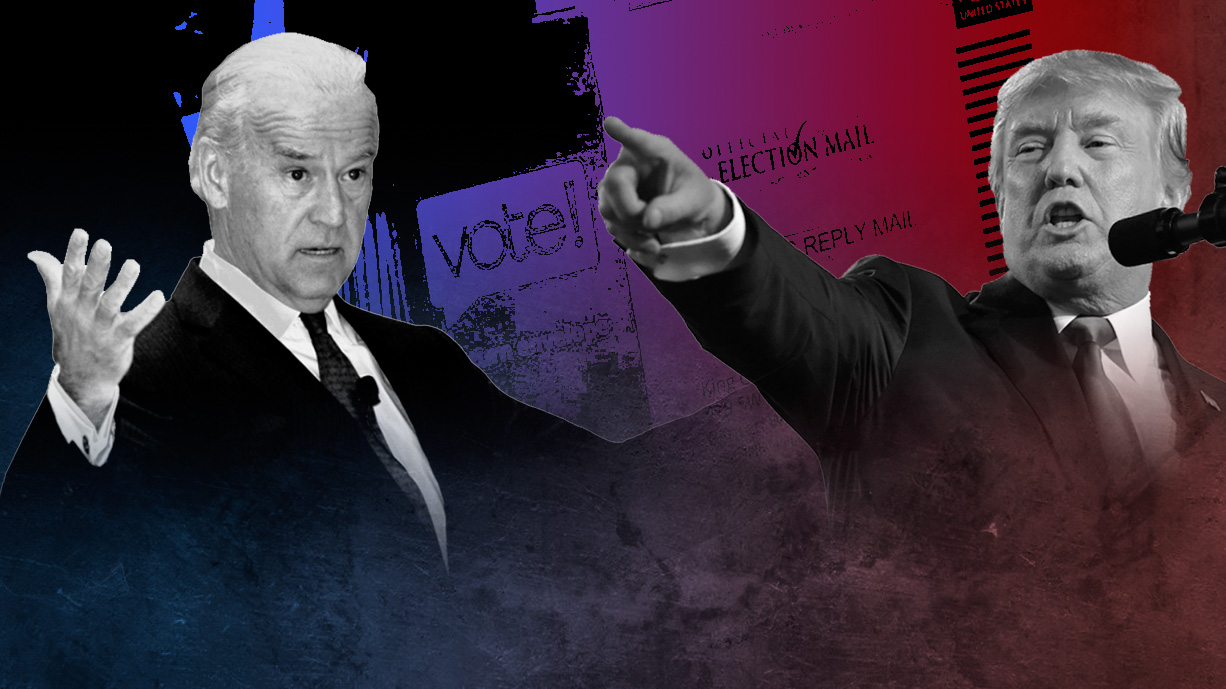
American democracy is in limbo after the long-anticipated, contested election has finally come to pass. More than a week removed from November 3, Democrats and Republicans peddle their own version of events as a corporate media blitzkrieg tries to manufacture consent for Joe Biden as president-elect in true Guaidó style. Trump plays the villain, ensconced in the Oval Office while his cabinet officials pitch weak legal challenges that fail to address substantive issues of electoral fraud and serve to simply prolong the stalemate and build up the tension for the grand finale.
Despite evidence of fatal vulnerabilities underlying the electronic voting infrastructure of the United States that leave the systems at the very heart of the democratic process open to election rigging on a massive scale, much of the American public is unaware of the extent of the problem and how easily election results can be manipulated without leaving a trace.
The bumbling incompetence of the Trump administration provides cover for the machinations of the U.S. establishment, which more nuanced independent coverage has revealed in great detail. Taking the deliberate preparations made for this particular eventuality into consideration, complete with table-top exercises and the creation of new federal agencies and programs since the start of the 2016 presidential race, it is clear that the 2020 Election was targeted as an opportunity to fundamentally transform the American political juggernaut, in tandem with the ongoing worldwide economic reset.
A statement released last Thursday by the director of one of the newest agencies, in charge of overseeing cybersecurity infrastructure in the United States, claimed that there was “no evidence […] any voting system deleted or lost votes, changed votes, or was in any way compromised.” Chris Krebs, the head of the Cybersecurity & Infrastructure Security Agency (CISA), directly contradicted the Trump-appointed chairman of the Federal Election Commission (FEC), who last week told the conservative outlet Newsmax that voter fraud was definitely taking place.
Part of the Cybersecurity & Infrastructure Security Agency’s mission centers on assuring compliance with DHS dictates surrounding election security protocols. The standalone federal agency with oversight from the Department of Homeland Security was formed two years after an embarrassing incident involving DHS occurred during the 2016 general election, when Georgia’s then secretary of state, – now governor – Brian Kemp, announced that cyberattacks on its voting systems had been traced to the federal law enforcement agency.
In 2020 with CISA firmly in place, DHS’ cybersecurity division implemented a “24/7 war room” to ostensibly guard against election hacking. CISA’s Krebs, a former cybersecurity policy director at Microsoft, led the effort to “monitor a network of every state’s election system simultaneously until every vote is counted,” according to News Nation, which was allowed to bring a camera crew into the operation in Fort Meade, Maryland.
In the lead up to the 2020 election, warnings about Russian and Iranian cyberwarriors running roughshod over the electoral contest were everywhere in U.S. media. Dire warnings of an existential threat to democracy by foreign actors that never materialized were leveraged to implement new security measures in partnership with the private sector. Krebs floated the excuse for a conspicuously absent horde of Eurasian hackers, that America’s enemies chose to “sit out this election” in a recent New York Times article.
The fact is that neither Russia nor Iran have anywhere near the level of access to America’s election system as the handful of private companies who are part of an electronic voting machine cartel, which currently controls over 92% of the elections market in the United States.
In a prolific time for draconian government overreach, one of the lesser-known pieces of legislation proposed by the Bush administration was the Help America Vote Act (HAVA), passed by a Republican-controlled House and a unanimous vote by a Democrat-led Senate in December 2001. The bill was signed into law 11 months later and “greatly accelerated the full computerization of U.S. elections,” according to Jonathan Simon, an election integrity advocate and author of “Code Red, Computerized Election Theft and The New American Century,” in an interview with MintPress.
Simon describes the legislation’s carrot-and-stick approach to goad states into adopting technologies like touchscreen voting systems known as DREs, which were later replaced with barcode systems or BMDs, which were “entirely lacking in cyber-security provisions to protect the increasingly concealed process it promoted.” Among the bill’s authors is none other than the current Senate leader and Republican kingmaker, Mitch McConnell, who has defended Trump’s right to challenge the election results without committing to a particular outcome.
“If, as was claimed,” Simon continues, “HAVA would make voting easier and thus increase turnout, as we can see clearly today, that was decidedly not a GOP goal, certainly not of a tactician like McConnell.” The partisan motivations Simon ascribes to HAVA are clear enough, and, as he points out, should have been clear to Democrats as well. But, the argument that the American liberal establishment had no inkling of the ramifications fails to account for the Democrats’ own forays into the closely held universe of electronic voting systems.
A week ago, FOX Anchor Maria Bartiromo casually let slip on air that House Speaker Nancy Pelosi’s chief of staff, Sidney Powell, had become a lobbyist for Dominion Voting Systems – one of a handful of companies that maintain a close-knit cartel of electronic voting systems, which together control 92% of the election marketplace. Nevertheless, Dominion’s market share is dwarfed by ES&S; the largest election voting machine company in the United States and whose “subcontractors that [do] the actual programming, maintenance, and distribution” are controlled by GOP political allies, according to Simon.
The wrangling these firms engage in to steal electoral markets from each other, and the inseparable political problems such dynamics can cause, was on full display in Louisiana just before the 2018 midterm elections when its Democrat governor, John Bel Edwards, canceled a $95 million dollar contract that had been awarded to Dominion after competitor ES&S filed a complaint about the contracting process. Edwards was accused by his Republican secretary of state of siding “with his political buddies over election security,” which contradicts the prevailing notions of a pure partisan split along this issue.
Experts on both sides of the political divide concede that both voter fraud and election fraud occur with considerable frequency since the advent of electronic voting machines. In addition to Dominion and ES&S, only five other companies dominate this space: Tenex, SGO/Smartmatic, Hart InterCivic, Demtech, and Premier (formerly Diebold).
Virtually all have been accused of vote count manipulation or other irregularities associated with their systems. Hart, for instance, was accused of vote flipping (the practice of switching the votes from one candidate to their opponent) in Texas. Dominion also ran into issues in the Lone Star state when its systems failed certification over accessibility problems.
“Much of the equipment being used to record and count votes,” explains Jonathan Simon, “is either modem-equipped, which leaves it highly vulnerable to remote interference, or programmed with the use of other computers than are internet-connected, allowing the alteration of memory cards and code running in either precinct-level machines (like BMDs, DREs, or Optical Scanners) or central tabulators.”
Examples of these dangerous weaknesses were explored in a recent video published by a self-styled national security professional, L. Todd Wood, where conservative elections security expert, Russ Ramsland, breaks down his findings from a forensic analysis of a 1000+ page voter log taken out of Dallas County’s central tabulation center in the aftermath of the 2018 midterm elections.
Ramsland identified instances of votes being replaced in 96 precincts, an inordinate number of database “updates” and other serious irregularities that point to vote-count manipulation and amount to election fraud. His most explosive allegation centered around claims of real-time vote-swapping in the 2019 gubernatorial election in Kentucky, where Ramsland asserts that thousands of votes originally given for the Republican candidate were swapped live on a CNN broadcast and added to the tally of the Democratic candidate, Andy Beshear, who would end up winning the election.
Ramsland also alleged that the election data of that race was being stored in a server in Frankfurt, Germany before being cycled through the central tabulation database, which syncs automatically with the numbers shown to television viewers. This server has been pounced on by Trump supporters in recent days and repeated by Rudy Giuliani in his podcast on Friday when he also purported to have direct evidence of election fraud.
While it is practically impossible for the layman to unravel the complexities underlying the encryption and cloud technologies underlying the present-day election system in the United States, few can doubt that moving towards a digital voting system removes whatever last vestiges of control the regular American citizen had in a once participatory exercise of democracy.
Asked if democracy can even exist under such conditions, Simon refers to a prediction he made in “CODE RED,” in which he augurs “an inexorable progression to where we are now: public trust eroded, the losers making wild allegations, no one able to prove anything, [and] everyone kind of waking up to the realization that our concealed computerized vote-counting process does not yield evidence-based results.”
Giuliani’s promises of whistleblowers coming forward to save the day for the MAGA crowd and call the election off aren’t likely to produce anything of consequence as this charade only serves to further pave the way for the ruling classes, who are consolidating their grip on power and wealth at mind-boggling speeds thanks to the peculiar advantages bestowed upon them by the pandemic protocols. Real evidence of election fakery is too widespread to confront as part of a national discussion, as that would threaten the position of the politicians who depend on a rigged system and the powerful interests that control them.
With the extremes of the American political spectrum lighting up in deep reds and blues, whatever emerges out of the ashes won’t resemble much that came before it, and regardless of the election results, America’s inexorable march towards techno-fascism is moving right along.
Actual voter and election fraud takes place in every national American election and is just as prevalent in state and municipal elections, as well. From vote splitting to voter suppression tactics to direct manipulation of election results, both political parties have usurped the electoral processes to lie and cheat their way into power more than once.
But with the advent of digital voting systems, even the scandals we always seem to hear about far too late will vanish from sight, as well. The most straightforward aspect of democracy – voting – is disappearing behind a curtain of ones and zeros that only technocratic lackeys will be able to pull back. Trump, who was plucked from the reality TV screen like Jeff Daniels in “The Purple Rose of Cairo” and inserted into the national contest for the highest office in the land, will do nothing to change that.
Publically available FBI documents show the sitting president has been an FBI informant since the early eighties and his rise to the highest office in the land was not the case of a brash, independent billionaire who decided to run for president to “Make America Great Again.” After all, Donald Trump’s long-standing ties with the very “deep state” many of his staunchest supporters are convinced he is dismantling, actually reveals a factional war among the ruling class behind the scenes.
With a president who is as deep state as it gets, if there’s something we can take away from the last four years and these last few days since the election, it’s that the American establishment’s over-the-top partisanship has been a ruse undertaken to hide the fact that they are united in waging a class war like never before.

By Max Blumenthal
Source: The Grayzone
At the time of publication, twelve hours after voting in the Democratic Party’s Iowa caucuses ended, the results have not been announced. The delay in reporting is the result of a failed app developed by a company appropriately named Shadow Inc.
This firm was staffed by Hillary Clinton and Barack Obama campaign veterans and created by a Democratic dark money nonprofit backed by hedge fund billionaires including Seth Klarman. A prolific funder of pro-settler Israel lobby organizations, Klarman has also contributed directly to Pete Buttigieg’s campaign.
The delay in the vote reporting denied a victory speech to Sen. Bernie Sanders, the presumptive winner of the opening contest in the Democratic presidential primary. Though not one exit poll indicated that Buttigieg would have won, the South Bend, Indiana mayor took to Twitter to confidently proclaim himself the victor.
The bizarre scenario was made possible by a mysterious voting app whose origins had been kept secret by Democratic National Committee officials. For hours, it was unclear who created the failed technology, or how it wound up in the hands of Iowa party officials.
Though a dark money Democratic operation turned out to be the source of the disastrous app, suspicion initially centered on former Hillary Clinton campaign manager Robby Mook and his Russiagate-related elections integrity initiative.
While Iowa Democratic Party Chairman Troy Price refused to say who was behind the failed app, he told NPR that he “worked with the national party’s cybersecurity team and Harvard University’s Defending Digital Democracy project…” Price did not offer details on his collaboration with the Harvard group, however.
The New York Times reported that this same outfit had teamed up with Iowa Democrats to run a “drill of worst-case scenarios” and possible foreign threats, but was also vague on details.
Robby Mook, the former campaign manager for Hillary Clinton’s failed 2016 presidential campaign, was the co-founder of Defending Digital Democracy. His initiative arose out of the national freakout over Russian meddling that he and his former boss helped stir when they blamed their loss on Russian interference. Mook’s new outfit pledged to “protect from hackers and propaganda attacks.”
He founded the organization with help from Matt Rhoades, a former campaign manager for Republican Mitt Romney whose public relations company was sued by a Silicon Valley investor after it branded him “an agent of the Russian government” and “a friend of Russian President, Vladimir Putin.” Rhoades’ firm had been contracted by a business rival to destroy the investor’s reputation.
As outrage grew over the delay in Iowa caucus results, Mook publicly denied any role in designing the notorious app.
Hours later, journalist Lee Fang reported that a previously unknown tech outfit called Shadow Inc. had contracted with the Iowa Democratic Party to create the failed technology. The firm was comprised of former staffers for Obama, Clinton and the tech industry, and had been paid for services by the Buttigieg campaign.

FEC filings show the Iowa Democratic party and Buttigieg campaign paid Shadow Inc.
Shadow Inc. was launched by a major Democratic dark money nonprofit called Acronym, which also gave birth to a $7.7 million Super PAC known as Pacronym.
According to Sludge, Pacronym’s largest donor is Seth Klarman. A billionaire hedge funder, Klarman also happens to be a top donor to Buttigieg and Amy Klobuchar.
Though he has attracted some attention for his role in the campaign, Klarman’s prolific funding of the pro-settler Israel lobby and Islamophobic initiatives has gone almost entirely unmentioned.
Seth Klarman is the founder of the Boston-based Baupost Group hedge fund and a longtime donor to corporate Republican candidates. After Donald Trump called for forgiving Puerto Rico’s debt, Klarman – the owner of $911 million of the island’s bonds – flipped and began funding Trump’s opponents.
The billionaire’s crusade against Trump ultimately led him to Mayor Pete’s wine cave.
By the end of 2019, Klarman had donated $5600 to Buttigieg and pumped money into the campaigns of Amy Klobuchar, Cory Booker and Kamala Harris as well.
The billionaire’s support centrist candidates appears to be not only by his own financial interests, but by his deep and abiding ideological commitment to Israel and its expansionist project.
As I reported for Mondoweiss, Klarman has been a top funder for major Israel lobby outfits, including those that support the expansion of illegal settlements and Islamophobic initiatives.
Klarman was the principal funder of The Israel Project, the recently disbanded Israeli government-linked propaganda organization that lobbied against the Iran nuclear deal and backed the Israeli settlement enterprise.
Klarman has heaped hundreds of thousands of dollars on the Middle East Media Research Institute (MEMRI) and the American Jewish Committee. And he funded The David Project, which was established to suppress Palestine solidarity organizing on campuses across the US and battled to block the establishment of a Muslim community center in Boston.
Through his support for the Friends of Ir David Inc, Klarman directly involved himself in the Israeli settlement enterprise, assisting the US-based tax exempt arm of the organization that oversaw a wave of Palestinian expulsions in the occupied East Jerusalem neighborhood of Silwan.
Other pro-Israel groups reaping the benefits of Klarman’s generosity include Birthright Israel, the AIPAC-founded Washington Institute for Near East Policy, and the Foundation for the Defense of Democracies (FDD), a neoconservative think tank that helped devise Trump’s “maximum pressure” campaign of economic warfare on Iran.
Klarman is the owner of the Times of Israel, an Israeli media outlet that once published a call for Palestinian genocide. (The op-ed was ultimately removed following public backlash).
In recent weeks, Buttigieg has sought to distinguish himself from Sanders on the issue of Israel-Palestine. During a testy exchange this January with a self-proclaimed Jewish supporter of Palestinian human rights, the South Bend mayor backtracked on a previous pledge to withhold military aid to Israel if it annexed parts of the West Bank.
Another recipient of Klarman’s funding, Amy Klobuchar, has taken a strongly pro-Israel line, vowing to support Trump’s relocation of the US embassy from Tel Aviv to Jerusalem.
Like Klarman, Donald Sussman is a hedge funder who has channeled his fortune into Pacronym. He has given $1 million to the Super PAC and was also top donor to Clinton in 2016.
Sussman’s Paloma Partners operates through a series of offshore shell companies, and received tens of millions of dollars in the 2009 federal bailout of the banking industry.
His daughter, Democratic operative Emily Tisch Sussman, declared on MSNBC in September that “if you still support Sanders over Warren, it’s kind of showing your sexism.”
https://twitter.com/ibrahimpols/status/1177719744096559110
As Democratic elites like the Sussmans braced for a Bernie Sanders triumph in Iowa, a mysterious piece of technology spun out by a group they supported delayed the vote results, preventing Sanders from delivering a victory speech. And the politician many of them supported, Pete Buttigieg, exploited the moment to declare himself the winner. In such a strange scenario, the conspiracy theories write themselves.

By Bob Fitrakis and Harvey Wasserman
Source: FreePress.org
Finally, the major for-profit media is approaching consensus that it’s easy to hack U.S. political elections. Even candidates Hillary Clinton and Donald Trump are raising unprecedented doubts – from very different directions – about the reliability of the upcoming vote count.
Ultimately, there is just one solution: universal hand-counted paper ballots, with carefully protected voter registration rolls, and a transparent chain of custody.
The corporate media and the Democrats are obsessed with the “Russians.” Donald Trump rants about a mythological army of voters voting multiple times.
But the real threat to our election system comes from private for-profit corporations that register voters, control voter databases, then count and report the vote with secret proprietary software and zero transparency, accountability, or recourse.
After ignoring or attacking the reportage since Florida 2000 of Bev Harris, Greg Palast, freepress.org and numerous others, the corporate media seems finally to be getting the message: under the current system, any American election – even the one for president – can be stripped and flipped by a tiny handful of electronic hackers working anywhere from the Kremlin to a party HQ to a state governor’s office to a teenager’s garage.
Here is some of what the mainstream media is finally admitting. In an article posted on July 28, 2016, NBC News pointed out that our elections are vulnerable to hacking because they “are not part of the vast ‘critical infrastructure protection’ safety net set up by the Department of Homeland Security.”
CBS News wrote August 10, 2016, about “the hackers at Symantec Security Response” who demonstrated how “Election Day results could be manipulated by an affordable device you can find online.”
Former national coordinator for counter-terrorism Richard Clarke, reporting for ABC News on August 19, 2016, analyzed the particular security problems related to battleground states like Ohio and Florida: “In 2000 and 2004, there were only a handful of battleground states that determined which presidential candidate had enough Electoral College votes to win. A slight alteration of the vote in some swing precincts in swing states might not raise suspicion. Smart malware can be programmed to switch only a small percentage of votes from what the voters intended. That may be all that is needed, and that malware can also be programmed to erase itself after it does its job, so there might be no trace it ever happened.” Clarke was on the White House National Security Council during both Bill Clinton’s and George W. Bush’s administrations.
Zeynep Tufekci, an associate professor at the North Carolina School of Information and Library Science, in his August 12, 2016 New York Times op-ed “The Election Won’t Be Rigged but It Could Be Hacked,” wrote: “The mere existence of this discussion is cause for alarm. The United States needs to return, as soon as possible, to a paper-based, auditable voting system in all jurisdictions that still use electronic-only, unverifiable voting machines.”
On August 30, 2016, the Washington Post wrote: “Deleting or altering data on voter rolls could cause mayhem on Election Day disenfranchising some voters. Many voting machines themselves also are vulnerable, especially touch-screen systems that do not create a paper record as a guard against fraud or manipulation.” The Post also supplied a list of the 15 states with the most vulnerable voting systems.
The list of those now admitting the obvious includes the Boston Globe, The Atlantic, USA Today, The Guardian, Mother Jones, and Politico, some of which have previously mocked those of us reporting on this issue. Most important has been the highly influential The Hill, which weighed in on May 2, 2016 with “Election fraud feared as hackers target voter records.” The lede was straightforward: “A series of data breaches overseas are spurring concerns that hackers could manipulate elections in the United States.”
Trump advisor Roger Stone wrote a column in The Hill with the headline: “Can the 2016 Elections Be Rigged? You Bet.” He also referred to our latest summary volume, “The Strip & Flip Selection of 2016: Five Jim Crows & Electronic Election Theft,” as “a must-read book on the strip and flip techniques used to rig these machines.”
But in the 2016 primary election, there are other must-reads as well. Perhaps the most important is Election Justice USA’s report entitled “Democracy Lost: A Report on the Fatally Flawed 2016 Democratic Primaries.” This report cites six major areas of election irregularities in this year’s 26 primary elections:
1) Targeting voter suppression
2) Registration tampering
3) Illegal voter purges
4) Exit poll discrepancies
5) Evidence for voting machine tampering
6) The security (or lack thereof) of various voting machines types.
In their 96-page report, Election Justice researchers documented how Hillary Clinton’s campaign benefited from these “various types of fraud.” Their conclusion: “Based on this work, Election Justice USA has established an upper estimate of 184 pledged delegates lost by Senator Bernie Sanders as a consequence of specific irregularities and instances of fraud.”
Election Justice’s well-documented estimate that Sanders lost 184 delegates means that if the election had been conducted fairly, the Senator from Vermont would now be the Democratic nominee.
Another document essential to understanding election irregularities that allowed Hillary Clinton to capture the Democratic Party nomination is a paper co-authored by Axel Geijsel of Tilburg University in the Netherlands and Rodolfo Cortes Barragan of Stanford University. Their analysis found that primary election results in states with the most vulnerable and hackable voting machines and without a paper trail overwhelmingly favored Hillary Clinton 65 percent to 35 percent. Sanders led Clinton 51 percent to 49 percent in states where the vote count could be verified with a paper trail.
The correlation between the increased Clinton vote and the increased vulnerability of the voting machines has been avoided like the plague by the corporate media.
Equally important to read is mathematician Richard Charnin’s blog. Charnin is a man the mainstream media often attacks – but not with mathematical formulas to rebut Charnin’s detailed analysis. Rather they attack him because, like the vast majority of Americans, he believes that John F. Kennedy was not killed by a lone gunman. In 2016, official Democratic primary vote counts compared to exit poll results were significantly outside the margin of error in 12 of 26 states. Charnin concluded that the probability of those official vote tallies being correct are one in 78 billion. There were no such discrepancies in this year’s Republican primaries.
Now 16 years after the theft of the presidency in Florida 2000, and a dozen since it was done again in Ohio 2004, the corporate media are approaching consensus that it is indeed very easy to strip millions of legitimate citizens from the voting rolls, and then to hack electronic voting machines and computerized central tabulators to flip the official final outcome.
The threat to this year’s election does not come from non-existent armies of mythological hordes voting multiple times. It comes from the private partisan companies with their secret proprietary software that control the voter rolls, the electronic machines, and ultimately the final outcome at all levels of government. The mega-corporations are the ones that flipped George W. Bush into the White House and Hillary Clinton into the Democratic nomination, not to mention manipulating countless Senate, House, and state and local elections along the way.
For a hopelessly vulnerable electronic election system which is flawed, hackable and riggable from top to bottom, there is just one solution: transparent unhackable voter rolls, and universal hand-counted paper ballots open to public scrutiny from the precinct level to the final official tallies, as dutifully reported by our slowly awakening corporate media.
Bob Fitrakis & Harvey Wasserman are co-authors of The Strip & Flip Selection of 2016: Five Jim Crows & Electronic Election Theft, available at www.freepress.org and www.solartopia.org, where Bob’s Fitrakis Files and Harvey’s Solartopia! can also be found.

By David Swanson
Source: Let’s Try Democracy
The 2016 Republican presidential primary was rigged. It wasn’t rigged by the Republicans, the Democrats, Russians, space aliens, or voters. It was rigged by the owners of television networks who believed that giving one candidate far more coverage than others was good for their ratings. The CEO of CBS Leslie Moonves said of this decision: “It may not be good for America, but it’s damn good for CBS.” Justifying that choice based on polling gets the chronology backwards, ignores Moonves’ actual motivation, and avoids the problem, which is that there ought to be fair coverage for all qualified candidates (and a democratic way to determine who is qualified).
The 2016 Democratic presidential primary was rigged. It wasn’t rigged by bankers, misogynists, Russians, Republicans, or computer hackers. It was rigged by the Democratic National Committee and its co-conspirators in the media, many of whom have helpfully confessed (in case it wasn’t obvious) in emails leaked from the DNC and from John Podesta. The DNC chose Hillary Clinton and worked hard to make sure that she “won.” Nobody has produced a hint of evidence as to who leaked the emails that added unnecessary confirmation of this rigging, but they should be thanked for informing us, whoever they are.
The FBI investigation of Hillary Clinton’s misuse of email was as rigged as the non-prosecution of the CEO of Wells Fargo. The U.S. political system is bought and paid for. Without millions of dollars to funnel to television networks for advertising, any candidate is rigged right out of participating. This rigging of the system is not fixed by someone like Donald Trump pretending for a while that he won’t take bribes, that he’ll spend only his own money, because most people don’t have that kind of money to spend. This rigging is not fixed by making someone like Hillary Clinton take her bribes through her family foundation or requiring that her political action committees remain theoretically separate from the campaign they are collaborating hand-in-glove with, because money buys power.
The debates are rigged by a private entity with no official status that calls itself the Commission on Presidential Debates and transforms open debates among multiple candidates into exclusively bipartisan joint appearances with many large and fine points negotiated beforehand.
Actual governance of the United States is rigged. Congress plans to attempt to ram through a number of intensely unpopular measures just after the election, including a supplemental spending bill for more wars and including the Trans-Pacific Partnership. The hope is that most people will have tuned out after the election circus, and that most of them will forget what happened 2 or 4 years later.
The demonization of Vladimir Putin is rigged. Nobody has seen evidence that he or his government did us the favor of informing us of the DNC’s corruption. He proposed a ban on cyber “war” that was rejected by the United States, for goodness sake. There’s no evidence that Russia shot down an airplane in Ukraine or invaded Ukraine or seized Crimea or plotted attacks on the United States. The United States pulled out of the ABM treaty, expanded NATO to Russia’s border, built missile bases, arranged military “exercises,” facilitated a Ukrainian coup, and pushed a string of hostile lies. Russia has shown even more restraint than your typical U.S. voter (who usually sits home and does not vote, especially in primaries).
Military spending is rigged. Nobody knows it amounts to over half of U.S. discretionary spending. Nobody knows it’s as much in the U.S. as in the rest of the world (allies and otherwise) combined. Nobody pays attention to the bribes from war profiteers, or to the threats held over Congress members to pull weapons jobs out of districts or states. Supporters of both big candidates claim their candidate plans to cut military spending. Both candidates have said the exact opposite. The debates and interviews steer clear of the whole topic.
The shapes of the districts are blatantly rigged by gerrymandering. The existence of the Senate, in which Rhode Island and Wyoming each have as much say as California is rigged against the popular will. The electoral college is rigged against the popular will and in favor of concentrating national campaigns in a handful of “swing states.”
Voter registration is rigged. A handful of states have now made it automatic, as most states have long-since done for military draft registration. In the rest of the country, thousands of young people run around registering voters, imagining they are engaged in “activism.” Meanwhile, the right to vote can be denied to anyone by claiming they aren’t registered.
People’s names are stripped from voting rolls through a so-called justice system that brands them as felons, and through the careful rigging of those rolls by corrupt and partisan state governments that intentionally strip out people likely to vote for a particular party. This includes racial profiling. Bob Fitrakis, Harvey Wasserman, Greg Palast and others have reported extensively on these practices.
Election day is rigged as well. It’s not a holiday. Most people have to work. Poor districts and racial minority districts tend to have fewer machines and longer lines. ID requirements are used to deny people the right to vote. Intimidation and racial profiling by partisan activists serve the same function of rigging the election. The myths and lies about the virtually nonexistent phenomenon of “voter fraud” also serve to rig the election.
The election machines are also rigged. That is to say: instead of verifiable paper ballots publicly hand-counted in front of observers from all interested parties in each polling place, we have a faith-based system of voting on black-box machines that can never, even in theory, be checked for accuracy. These machines have been very easily hacked in demonstrations. These machines have visibly flipped votes before the eyes (and cameras) of countless voters. These machines have almost certainly played a key role in flipping the results of numerous elections.
Now, the wider the margin of victory, the less likely an electronic flipping. And the fact that machines can easily be used to steal an election does not mean that they always will be. But it was very odd during the late summer of 2016 to watch the U.S. media announce that these machines were totally unreliable — just what many of us had been saying for years. But the media said this in order to accuse Russia of planning to sabotage the coming U.S. election, or in order to accuse Russia of exactly what these media reports themselves did: plant seeds of doubt in U.S. minds.
Those doubts should be there. People should watch for visible problems with machines and with partisan and racist intimidators, and report all such to 1-866-OUR-VOTE, to county clerks, to secretaries of state, and to corporate and independent media. Then we should work for necessary reforms, including a respectful cessation of the U.S. government’s routine practice of interfering in elections and overthrowing governments in other people’s countries — a practice that has clearly resulted in the U.S. media projecting such behavior on others.
Ultimately, an unrigging of the U.S. system might take the form of amending the U.S. Constitution to slip in words like these:
The rights protected by the Constitution of the United States are the rights of natural persons only.
Artificial entities, such as corporations, limited liability companies, and other entities, established by the laws of any State, the United States, or any foreign state shall have no rights under this Constitution and are subject to regulation by the People, through Federal, State, or local law. The privileges of artificial entities shall be determined by the People, through Federal, State, or local law.
The judiciary shall not construe the spending of money to influence elections to be speech under the First Amendment.
All elections for President and members of the United States House of Representatives and the United States Senate shall be entirely publicly financed. No political contributions shall be permitted to any federal candidate, from any other source, including the candidate. No political expenditures shall be permitted in support of any federal candidate, or in opposition to any federal candidate, from any other source, including the candidate. The Congress shall, by statute, provide limitations on the amounts and timing of the expenditures of such public funds and provide criminal penalties for any violation of this section.
State and local governments shall regulate, limit, or prohibit contributions and expenditures, including a candidate’s own contributions and expenditures, for the purpose of influencing in any way the election of any candidate for state or local public office or any state or local ballot measure.
The right of the individual U.S. citizen to vote and to directly elect all candidates by popular vote in all pertinent local, state, and federal elections shall not be violated. Citizens will be automatically registered to vote upon reaching the age of 18 or upon becoming citizens at an age above 18, and the right to vote shall not be taken away from them. Votes shall be recorded on paper ballots, which shall be publicly counted at the polling place. Election day shall be a national holiday.
Nothing contained in this amendment shall be construed to abridge the freedom of the press. During a designated campaign period of no longer than six months, free air time shall be provided in equal measure to all candidates for federal office on national, state, or district television and radio stations, provided that each candidate has, during the previous year, received the supporting signatures of at least five percent of their potential voting-age constituents. The same supporting signatures shall also place the candidate’s name on the ballot and require their invitation to participate in any public debate among the candidates for the same office.
INDIAN COUNTRY NEWS
"It is the duty of every man, as far as his ability extends, to detect and expose delusion and error"..Thomas Paine
Human in Algorithms
From the Roof Top
I See This
blog of the post capitalist transition.. Read or download the novel here + latest relevant posts
अध्ययन-अनुसन्धानको सार
 After the Crash