
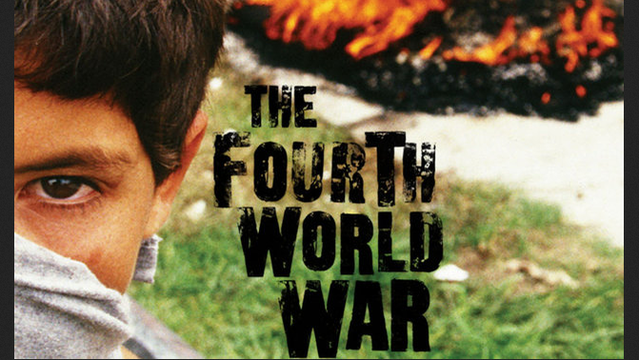
From Big Noise Films:
| From the front-lines of conflicts in Mexico, Argentina, South Africa, Palestine, Korea, and the North; from Seattle to Genova, and the War on Terror in New York, Afghanistan, and Iraq, The Fourth World War is the story of men and women around the world who resist being annihilated in this war.While our airwaves are crowded with talk of a new world war, narrated by generals and filmed from the noses of bombs, the human story of this global conflict remains untold. The Fourth World War brings together the images and voices of the war on the ground. It is a story of a war without end and of those who resist.The product of over two years of filming on the inside of movements on five continents, The Fourth World War is a film that would have been unimaginable at any other moment in history. Directed by the makers of This Is What Democracy Looks Like and Zapatista, produced through a global network of independent media and activist groups, it is a truly global film from our global movement. |
For English speakers, portions of the film may need translation, activated by clicking on the “CC” button on bottom right corner of the video (on some mobile device browsers the function can be found on the upper right corner).

Neil Kramer recently posted an interesting piece on hypnosis, Neural Linguistic Programing and social control. He began his essay with an analysis of the tricks of illusionist Darren Brown. While seemingly magic, they’re actually a skillful use of various psychological reading and manipulation techniques which exploit subconscious and unconscious processes (ie. mirroring, eye accessing cues, cold reading and NLP). To explain some of the psychological mechanisms behind such “Jedi mind tricks”, he provides the following description of a hypnotic handshake:
Many actions are learned and operate as a single chunk of behavior: shaking hands and tying shoelaces being two good examples. However, if the behavior is diverted or frozen midway, the person literally has no mental space for this. He is stopped in the middle of unconsciously executing a behavior without a corresponding pattern. The mind crashes, suspending itself in trance until either something happens to give a new direction, or it reboots itself. A skilled hypnotist uses that momentary confusion and suspension of normal processes to induce a TDS trance.
By interrupting the pattern of a normal handshake in a particular manner, the hypnotist causes the subject to wonder what is going on. If the handshake continues to develop in a way which is out-of-keeping with expectations, a simple, non-verbal trance is created, which may then be reinforced by the hypnotist. All these responses happen naturally and automatically without telling the subject to consciously focus on an idea.
Also intriguing and relevant to the current moment is Kramer’s analysis of how principles of hypnosis are used by corporate media as a tool for mass control and manipulation:
Confusion is a tool used by hypnotists to put the subject into an altered state. The slumbering brain state induced by injudiciously watching TV and surfing the net achieves exactly the same thing. This is how the Empire implants its messages deep into the minds of the great unwashed masses. To the unconscious observer, the messages are not properly perceived at the point of entry. They are nevertheless permanently recorded in precise detail and influence the individual emotionally, intellectually, and physically with their latent memes.
For this to have impact on a mass scale, people need to also believe that they are finite, separate, the world happens “out there”, and they are essentially powerless. Once this is achieved, the covert messaging is much more readily absorbed. The isolated little human seeks comfort and reassurance wherever he can find it. If the mind is suitably controlled, the thrill of a new gadget, the delight of a new snack food, the consolation of a new TV drama, and the platitudes of government, may constitute all the solace required to get through another day. The prescribed messaging sinks in and no-one is any the wiser.
This deception can be swiftly dismantled with one simple mental gear shift: for the common man to cease regarding his mind as some plain old fiddle churning out the tunes of unseen dubious impresarios – and instead to recognize it as an exquisite Stradivarius violin that is at its greatest when playing the authentic and beautiful music of his own making.
Read the complete essay here: http://neilkramer.com/hypnotic-handshakes-jedi-mind-tricks.html
YouTube user Hypernosis0’s channel features a number of clips deconstructing Darren Brown’s techniques including the following example:
This episode of Stuff They Don’t Want You to Know examines how marketers employ behavioral psychology and neuroscience to encourage consumerism:

Though it was released late last year, I just recently found this provocative speech from Benjamin Bratton which addresses problems of the TED talks format ironically delivered as a TED talk (hat tip to 21st Century Wire).
Many of the issues brought up by Bratton have previously been addressed through satire in various Onion Talks.
Despite its problems, in defense of TED it is to their credit that they allowed a forum for an anti-TED presentation. There have also been a few thought provoking TED talks that I felt did not fall into the trap of over-simplification and yet conveyed ideas elegantly and efficiently. Unfortunately, some of those have been censored for ideological reasons, including this must-see talk by Nick Hanauer about economic inequality:
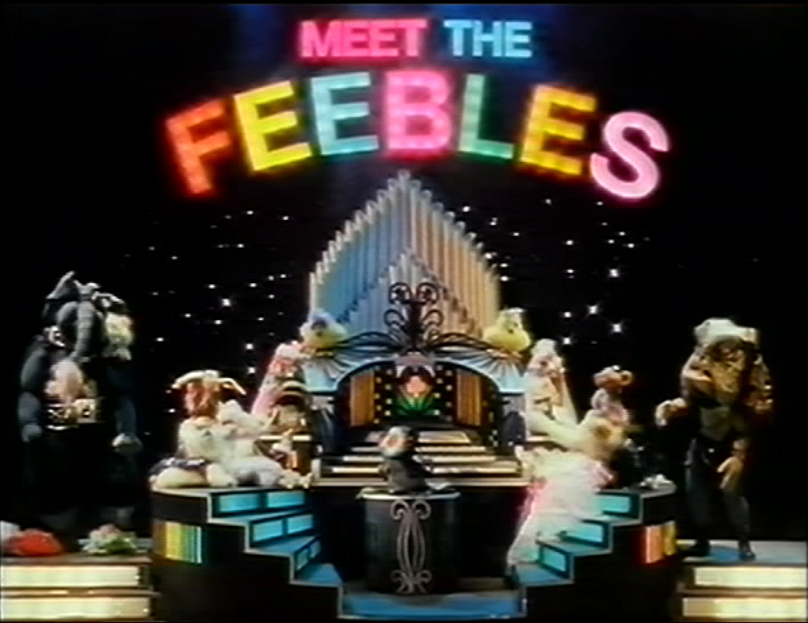
Long before director Peter Jackson’s Lord of the Rings blockbusters and even before the moderate success of his cult horror film “Dead Alive”, he created a gleefully twisted take on the Muppets, “Meet the Feebles” (1989). A brief synopsis from IMDB:
Heidi, the star of the “Meet The Feebles Variety Hour” discovers her lover Bletch, The Walrus, is cheating on her, and with all the world waiting for the show the assorted co-stars must contend with their own problems. These include drug addiction, extortion, robbery, disease, Drug dealing, and even murder. While this is happening the love between two of the stars is threatened by the devious Trevor the Rat, who wishes to exploit the young starlet for use in his porno movie business.

By Ralph Nader
Originally posted at Counterpunch.org
Dear President Obama:
As you ponder your potential moves regarding President Vladimir V. Putin’s annexation of Crimea (a large majority of its 2 million people are ethnic Russians), it is important to remember that whatever moral leverage you may have had in the court of world opinion has been sacrificed by the precedents set by previous American presidents who did not do what you say Mr. Putin should do – obey international law.
The need to abide by international law is your recent recurring refrain, often used in an accusatory context toward Mr. Putin’s military entry in Crimea and its subsequent annexation, following a referendum in which Crimean voters overwhelmingly endorsed rejoining Russia. True, most Ukrainians and ethnic Tatars boycotted the referendum and there were obstacles to free speech. But even the fairest of referendums, under UN auspices, would have produced majority support for Russia’s annexation.
Every day, presidential actions by you violate international law because they infringe upon national sovereignties with deadly drones, flyovers and secret forays by soldiers – to name the most obvious.
President Bush’s criminal invasion and devastation of Iraq in 2003 violated international law and treaties initiated and signed by the United States (such as the Geneva Conventions and the UN Charter). What about your executive branch’s war on Libya, now still in chaos, which was neither constitutionally declared, nor authorized by Congressional appropriations?
“Do as I say, not as I do,” is hard to sell to Russians who are interpreting your words of protest as disingenuous. This is especially the case because Crimea, long under the rule of the Ottoman Empire, became part of Russia over 200 years ago. In 1954, Soviet leader, Nikita Khrushchev gave Crimea to Ukraine, which was then part of the Soviet Union, out of sympathy for what Ukraine endured under the Nazi invasion and its atrocities. It mattered little then because both “socialist republics,” Ukraine and Crimea, were part of the Soviet Union. However, it is not entirely clear whether Khrushchev fully complied with the Soviet constitution when he transferred Crimea to Ukraine.
Compare, by the way, the United States’ seizure of Guantanamo from Cuba initially after the Spanish-American War, which was then retained after Cuba became independent over a century ago.
The Russians have their own troubles, of course, but they do have a legitimate complaint and fear about the United States’ actions following the collapse of the Soviet Union. Led by President William Jefferson Clinton, the United States pushed for the expansion of the military alliance NATO to include the newly independent Eastern European countries. This was partly a business deal to get these countries to buy United States fighter aircrafts from Lockheed Martin and partly a needless provocation of a transformed adversary trying to get back on its feet.
As a student of Russian history and language at Princeton, I learned about the deep sensitivity of the Russian people regarding the insecurity of their Western Front. Hitler’s attack on the Soviet Union took many millions of Russian lives. The prolonged Nazi siege of the city of Leningrad alone is estimated to have cost over 700,000 civilian lives, which is about twice the total number of United States soldiers killed in World War II.
The memories of that mass slaughter and destruction, and of other massacres and valiant resistance are etched deeply in Russian minds. The NATO provocation was only one of the West’s arrogant treatments of post-Soviet Russia, pointed out in the writings of Russian specialist, NYU professor Stephen Cohen (see his pieces in The Nation here:http://www.thenation.com/authors/stephen-f-cohen). That sense of disrespect, coupled with the toppling of the elected pro-Russian President of Ukraine in February, 2014 (which was not lawful despite his poor record) is why Mr. Putin’s absorption of Crimea and his history-evoking speech before the Parliament, was met with massive support in Russia even by many of those who have good reasons to not like his authoritarian government.
Now, you are facing the question of how far to go with sanctions against the Russian government, its economy and its ruling class. Welcome to globalization.
Russia is tightly intertwined with the European Union, as a seller and buyer of goods, services and assets, and to a lesser but significant degree with the United States government and its giant corporations such as oil and technology companies. Sanctions can boomerang, which would be far worse than just being completely ineffective in reversing the Russian annexation of Crimea.
As for sanctions deterring any unlikely future Russian moves westward into Ukraine, consider the following role reversal. If Russia moved for sanctions against the United States before Afghanistan, Iraq, Libya, Yemen and other attacks, would that have deterred either you or George W. Bush from taking such actions? Of course not. Such an outcome, politically and domestically, would not be possible.
If you want continued Russian cooperation, as you do, on the critical Iranian and Syrian negotiations, ignore the belligerent baying pack of neocons who always want more United States wars, which they and their adult children avoid fighting themselves. Develop a coalition of economic support for Ukraine, with European nations, based on observable reforms of that troubled government. Sponsor a global conference on how to enforce international law as early as possible.
Drop the nonsense of evicting Russia from the G8 – a get-together forum of leaders. Get on with having the United States comply with international law, and our constitution on the way to ending the American Empire’s interventions worldwide, as has been recommended by both liberal and conservative/libertarian lawmakers, along with much public opinion.
Concentrate on America, President Obama, whose long unmet necessities cry out from “sea to shining sea.”
Ralph Nader is a consumer advocate, lawyer and author of Only the Super-Rich Can Save Us! He is a contributor to Hopeless: Barack Obama and the Politics of Illusion, published by AK Press. Hopeless is also available in a Kindle edition.
Editor’s note: Those unfamiliar with the life and career of Ralph Nader should check out the excellent documentary “An Unreasonable Man” (2006), which happens to be available on YouTube:
INDIAN COUNTRY NEWS
"It is the duty of every man, as far as his ability extends, to detect and expose delusion and error"..Thomas Paine
Human in Algorithms
100% Accurate Google Sheets + KDP Book Formatting | 24hr Delivery
From the Roof Top
I See This
blog of the post capitalist transition.. Read or download the novel here + latest relevant posts
अध्ययन-अनुसन्धानको सार

