It’s the End of the World as We Know It . . . and He Feels Fine

paul_kingsnorth

By Daniel Smith

Source: NYTimes Magazine

Late one night last August, on the chalk downlands of southern England, Paul Kingsnorth stood in a field beside an old-growth forest, two yurts and a composting toilet. Kingsnorth is 41, tall, slim and energetic, with sweeping brown hair and a sparse beard. He wears rimless glasses and a silver stud in his ear, and he talks with great ardor, often apologizing for having said too much or for having said it too strongly.

On this occasion, Kingsnorth was silent. It was the final night of Uncivilization, an outdoor festival run by the Dark Mountain Project, a loose network of ecologically minded artists and writers, and he was standing with several dozen others waiting for the festival’s midnight ritual to begin. Kingsnorth, a founder of the group, had already taken part in several sessions that day, including one on contemporary nature writing; a panel about the iniquities of mainstream psychiatric care; and a reading from his most recent book, “The Wake,” a novel set in the 11th century and written in a “shadow language” — a mash-up of Old and modern English. He had also helped his two young children assemble a train set while trying to encapsulate his views on climate change and environmental degradation in what Kingsnorth describes as an era of global disruption. The “human machine,” as he sometimes puts it, has grown to such a size that breakdown is inevitable. What, then, do we do?

In the clearing, above a pyre, someone had erected a tall wicker sculpture in the shape of a tree, with dense gnarls and hanging hoops. Four men in masks knelt at the sculpture’s base, at cardinal compass points. When midnight struck, a fifth man, his head shaved smooth and wearing a kimono, began to walk slowly around them. As he passed the masked figures, each ignited a yellow flare, until finally, his circuit complete, the bald man set the sculpture on fire. For a couple of minutes, it was quiet. Then as the wicker blazed, a soft chant passed through the crowd, the words only gradually becoming clear: “We are gathered. We are gathered. We are gathered.”

After that came disorder. A man wearing a stag mask bounded into the clearing and shouted: “Come! Let’s play!” The crowd broke up. Some headed for bed. A majority headed for the woods, to a makeshift stage that had been blocked off with hay bales and covered by an enormous nylon parachute. There they danced, sang, laughed, barked, growled, hooted, mooed, bleated and meowed, forming a kind of atavistic, improvisatory choir. Deep into the night, you could hear them from your tent, shifting every few minutes from sound to sound, animal to animal and mood to mood.

The next morning over breakfast, Dougie Strang, a Scottish artist and performer who is on Dark Mountain’s steering committee, asked if I’d been there. When he left, at 3 a.m., he said, people were writhing in the mud and singing, in harmony, the children’s song “Teddy Bears’ Picnic.” (“If you go down in the woods today, you’re sure of a big surprise.”) “Wasn’t it amazing?” he said, grinning. “It really went mental. I think we actually achieved uncivilization.”

The Dark Mountain Project was founded in 2009. From the start, it has been difficult to pin down — even for its members. If you ask a representative of the Sierra Club to describe his organization, he will say that it promotes responsible use of the earth’s resources. When you ask Kingsnorth about Dark Mountain, he speaks of mourning, grief and despair. We are living, he says, through the “age of ecocide,” and like a long-dazed widower, we are finally becoming sensible to the magnitude of our loss, which it is our duty to face.

Kingsnorth himself arrived at this point about six years ago, after nearly two decades of devoted activism. He had just completed his second book, “Real England,” a travelogue about the homogenizing effects of global capitalism on English culture and character. “Real England” was a great success — the first of his career. All the major newspapers reviewed the book; the archbishop of Canterbury and David Cameron (then the opposition leader) cited it in speeches; Mark Rylance, the venerated Shakespearean actor, adopted it as a kind of bible during rehearsals for his hit play “Jerusalem.” Yet Kingsnorth found himself strangely ambivalent about the praise. “Real England” was a painful book to write. For months he interviewed publicans, shopkeepers and farmers fighting to maintain small, traditional English institutions — fighting and losing. Everywhere Kingsnorth traveled, he saw the forces of development, conglomeration and privatization flattening the country. By the time he published his findings, he was in little mood to celebrate.

At the same time, he felt his longstanding faith in environmental activism draining away. “I had a lot of friends who were writing about climate change and doing a lot of good work on it,” he told me during a break from his festival duties. “I was just listening and looking at the facts and thinking: Wow, we are really screwed here. We are not going to stop this from happening.”

The facts were indeed increasingly daunting. The first decade of the 21st century was shaping up to be the hottest in recorded history. In 2007, the Arctic sea ice shrank to a level not seen in centuries. That same year, the NASA climatologist James Hansen, who has been ringing the climate alarm since the 1980s, announced that in order to elude the most devastating consequences, we’d need to maintain carbon dioxide in the atmosphere at a level of 350 parts per million. But we’d already surpassed 380, and the figure was rising. (It has since reached 400 p.p.m.) Animal and plant species, meanwhile, were dying out at a spectacular rate. Scientists were beginning to warn that human activity — greenhouse-gas emissions, urbanization, the global spread of invasive species — was driving the planet toward a “mass extinction” event, something that has occurred only five times since life emerged, 3.5 billion years ago.

“Everything had gotten worse,” Kingsnorth said. “You look at every trend that environmentalists like me have been trying to stop for 50 years, and every single thing had gotten worse. And I thought: I can’t do this anymore. I can’t sit here saying: ‘Yes, comrades, we must act! We only need one more push, and we’ll save the world!’ I don’t believe it. I don’t believe it! So what do I do?”

The first thing that Kingsnorth did was draft a manifesto. Also called “Uncivilization,” it was an intense, brooding document that vilified progress. “There is a fall coming,” it announced. “After a quarter-century of complacency, in which we were invited to believe in bubbles that would never burst, prices that would never fall . . . Hubris has been introduced to Nemesis.”

The initial print run of “Uncivilization” was only 500 copies. Yet the manifesto gained widespread attention. The philosopher John Gray reviewed it in The New Statesman. Professors included it on their reading lists. An events space in Wales invited Kingsnorth and Dougald Hine, Dark Mountain’s co-founder, to put on a festival; 400 people showed up. Doug Tompkins, the billionaire who started the outdoor-apparel company the North Face, and his wife, Kristine Tompkins, the former C.E.O. of Patagonia, offered financing and invited Kingsnorth and his family to spend two months on land they own in southern Chile.

There were others, however, who saw Kingsnorth’s new work as a betrayal. With waters rising, deserts spreading and resource wars looming, how could his message be anything but reckless — even callous? He and his sympathizers were branded “doomers,” “nihilists” and (Kingsnorth’s favorite epithet) “crazy collapsitarians.” One critic, a sustainability advocate, published an essay in The Ecologist — a magazine Kingsnorth once helped run — comparing Dark Mountaineers to the complacent characters in the Douglas Adams novel “The Restaurant at the End of the Universe”: “Diners [who] enjoyed watching the obliteration of life, the universe and everything whilst enjoying a nice steak.”

Kingsnorth regards such charges with equanimity, countering that the only hope he has abandoned is false hope. The great value of Dark Mountain, he has claimed, is that it gives people license to do the same. “Whenever I hear the word ‘hope’ these days, I reach for my whiskey bottle,” he told an interviewer in 2012. “It seems to me to be such a futile thing. What does it mean? What are we hoping for? And why are we reduced to something so desperate? Surely we only hope when we are powerless?”

Instead of trying to “save the earth,” Kingsnorth says, people should start talking about what is actually possible. Kingsnorth has admitted to an ex-activist’s cynicism about politics as well as to a worrying ambivalence about whether he even wants civilization, as it now operates, to prevail. But he insists that he isn’t opposed to political action, mass or otherwise, and that his indignations about environmental decline and industrial capitalism are, if anything, stronger than ever. Still, much of his recent writing has been devoted to fulminating against how environmentalism, in its crisis phase, draws adherents. Movements like Bill McKibben’s 350.org, for instance, might engage people, Kingsnorth told me, but they have no chance of stopping climate change. “I just wish there was a way to be more honest about that,” he went on, “because actually what McKibben’s doing, and what all these movements are doing, is selling people a false premise. They’re saying, ‘If we take these actions, we will be able to achieve this goal.’ And if you can’t, and you know that, then you’re lying to people. And those people . . . they’re going to feel despair.”Whatever the merits of this diagnosis (“Look, I’m no Pollyanna,” McKibben says. “I wrote the original book about the climate for a general audience, and it carried the cheerful title ‘The End of Nature’ ”), it has proved influential. The author and activist Naomi Klein, who has known Kingsnorth for many years, says Dark Mountain has given people a forum in which to be honest about their sense of dread and loss. “Faced with ecological collapse, which is not a foregone result, but obviously a possible one, there has to be a space in which we can grieve,” Klein told me. “And then we can actually change.”

Kingsnorth would agree with the need for grief but not with the idea that it must lead to change — at least not the kind of change that mainstream environmental groups pursue. “What do you do,” he asked, “when you accept that all of these changes are coming, things that you value are going to be lost, things that make you unhappy are going to happen, things that you wanted to achieve you can’t achieve, but you still have to live with it, and there’s still beauty, and there’s still meaning, and there are still things you can do to make the world less bad? And that’s not a series of questions that have any answers other than people’s personal answers to them. Selfishly it’s just a process I’m going through.” He laughed. “It’s extremely narcissistic of me. Rather than just having a personal crisis, I’ve said: ‘Hey! Come share my crisis with me!’ ”

In 2012, in the nature magazine Orion, Kingsnorth began to publish a series of essays articulating his new, dark ecological vision. He set his views in opposition to what he called neo-environmentalism — the idea that, as he put it, “civilization, nature and people can only be ‘saved’ by enthusiastically embracing biotechnology, synthetic biology, nuclear power, geoengineering and anything else with the prefix ‘new’ that annoys Greenpeace.” Or as Stewart Brand, the 75-year-old “social entrepreneur” best known as the publisher of the ” Whole Earth Catalog,” has put it: “We are as gods and have to get good at it.”

For Kingsnorth, the notion that technology will stave off the most catastrophic effects of global warming is not just wrong, it’s repellent — a distortion of the proper relationship between humans and the natural world and evidence that in the throes of crisis, many environmentalists have abandoned the principle that “nature has some intrinsic, inherent value beyond the instrumental.” If we lose sight of that ideal in the name of saving civilization, he argues, if we allow ourselves to erect wind farms on every mountain and solar arrays in every desert, we will be accepting a Faustian bargain.

When Kingsnorth describes how he came to this way of thinking, he nearly always begins with an ancient chalk hill outside Winchester, not far from the site of the recent Uncivilization festival. It was 1992, and the conservative British government was about to break ground on a vast network of highways across England.

The highways were proposed three years earlier by Margaret Thatcher, whose administration announced that they would constitute the “biggest road-building program since the Romans.” As it happened, they would also cut through areas that had remained unspoiled since the Romans. Direct opposition to the program began at a hill called Twyford Down, through which the government planned to build a six-lane highway. The purpose of the road was to reduce the commute to London by a matter of minutes. In 1992, a small band of radicals calling themselves the Dongas staged a demonstration. Soon road protests were popping up across the country, drawing support from itinerant hippies, the working classes and the nobility.

Students of popular movements often credit the road protests of the 1990s with radicalizing a generation of British youth. This is certainly true of Kingsnorth. While at Oxford, he spent many weekends at Twyford Down — locking arms, waving placards, shouting slogans. He found it intoxicating to put himself on the line for a cause. At Twyford Down, he was arrested for the first time, for chaining himself, along with 50 others, to a bridge. He loved it. (He later sued the police and received a settlement of $5,000.) Kingsnorth was even more intoxicated by the proud impracticality of the protests. The core of the demonstrators’ complaints was not that the new highways would worsen air pollution, cause car accidents or fracture communities; it was that some things, like wilderness and beauty, were — despite, or perhaps because of, their “uselessness” — more important than getting to work on time. The motivation was raw, intuitive and, in its Wordsworthian love of the Arcadian, very, very English. In an essay titled “Confessions of a Recovering Environmentalist,” Kingsnorth wrote that after Twyford Down, he “vowed, self-importantly, that this would be my life’s work: Saving nature from people. Preventing the destruction of beauty and brilliance, speaking up for the small and the overlooked and the things that could not speak for themselves.”

It proved easier to make this vow than to act on it. The chief obstacle was his father: a driven, competitive man who scraped his way up from a working-class background to become the head of a manufacturing firm. Kingsnorth’s father was not without a love of the outdoors, but it was a striving, willful kind of love. He often took Kingsnorth on long, arduous hiking trips, forcing him to carry heavy packs and disappearing far up the trail to teach his son the virtues of independence and struggle.

These trips were both trials and revelations. It was while backpacking with his father on the moors of Cornwall and atop the hills of Northumberland that Kingsnorth had his first cathartic experiences in nature — experiences that were responsible for the direction his life was now taking. But his father wasn’t prone to seeing that as a consolation. “I’d gone off to Oxford as a guy in jeans and a T-shirt,” Kingsnorth says, “then I started wearing tie-dye tops and putting beads in my hair and walking around in big boots, as dudes do.”

Kingsnorth wouldn’t tell his father about his arrest for 10 years. Nor would he find a way to elude the expectations placed on him. His 20s were an awkward — and not very successful — mix of idealism and ambition. At Oxford he was editor of Cherwell, the university’s longest-running student newspaper, whose staff has included Graham Greene, W. H. Auden and (on the business end) Rupert Murdoch. He parlayed this honor into an entry-level position as a researcher at The Independent, in London. He was miserable. He found the work frivolous and his superiors out of touch. In 1995, seven years after the creation of the Intergovernmental Panel on Climate Change and six years after a global treaty regulating CFCs, he had to explain to an editor the difference between global warming and ozone depletion.

Kingsnorth lasted on Fleet Street for less than a year. He stayed in London another two, working for a poorly run nonprofit, writing a protest novel no one wanted to publish and getting increasingly fed up with the congestion and noise. Finally he returned to Oxford, figuring he would freelance. The rent was cheap, and in the late 1990s the pubs were filled with green activists and writers. But Kingsnorth has always found it difficult to stand still — another trait, he says, he inherited from his father. In 2001, hungry to travel, he took his agent’s advice to write a book about the growing anti-globalization movement, which came to prominence two years before when thousands gathered to protest the World Trade Organization in Seattle.

For Kingsnorth, the anti-globalization movement was both opportunity and mission. He attended mass protests in Prague, where he was tear-gassed for the first time, and Genoa, where the police shot and killed a young anarchist two streets from where Kingsnorth was marching. The experiences radicalized him anew. “It was similar to what I’d felt at the road protests,” he told me. “Here’s millions of people who don’t like this way of measuring the world, don’t like this way of living, don’t like this way of seeing the world.” He made reporting trips to four continents, tracing the movement’s roots and common themes.

His timing could not have been worse. His book came out in March 2003, during the first week of the Iraq war. It landed “with an inaudible thud.” He returned to Oxford and spent the next few years writing pamphlets, articles and another novel (for which, again, he could not find a publisher), and he began “Real England.”

In August 2007, as he was picking flowers in the small back garden of his house, he got a call that his father had killed himself. Kingsnorth’s father had been living in Cyprus, in semiretirement. His marriage had fallen apart. He had a nervous breakdown and spent time in a psychiatric hospital. One morning, he wrote a bitter suicide note, got in his car and drove full speed into a parked truck.

Kingsnorth’s reaction to his father’s death was conflicted. He’d often suspected that behind his own drive to achieve — to have his opinions aired on television and his books published by mainstream presses, to lead mass movements — was a need to satisfy his father’s more conventional expectations of him. Now that need was obsolete. He felt a sense of release, as if he’d been given permission to say what he wanted to say, in any way he wanted to say it. He felt he could finally, with a clear conscience, “go to the margins.” All he had to do was figure out what that meant.

“Do you know what the ‘first follower’ is?” Dougald Hine, Dark Mountain’s co-founder, asked me. It was Friday at dusk during the Uncivilization festival, and we had taken our dinners out to the woods to talk. We were sitting on logs, our paper plates balanced on our knees.

The first follower is a concept introduced by the musician and entrepreneur Derek Sivers in a short TED talk titled, “How to Start a Movement.” In the talk, Sivers shows an amateur video that begins with a shirtless man gyrating wildly on a hillside at what seems to be a concert. For a while the man dances alone, swinging his hips and arms as if possessed, or more likely high. Eventually someone joins him, and they hold hands and gyrate together. Before you know it, a full-fledged dance party has broken out.

“The point being,” Hine said, “that the first follower transforms you from a lunatic into someone who’s got the beginning of something.”

For Hine, the equivalent of the lone dancer was a pair of blog posts Kingsnorth wrote in late 2007. The first was a bilious rant announcing his retirement from journalism. (“The media can go hang. I’ve had it. I’m out.”) The second, written after yet another international climate conference sputtered out, expressed his “joyous” abandonment of hope that global warming could be stopped. Hine was just turning 30. A scruffy, bright-eyed man with an unruly mop of hair, he had for years worked, unhappily and off and on, as a radio reporter for the BBC. Like Kingsnorth, he quit in a spasm of disgust. Also like Kingsnorth, Hine experienced a transformation in his feelings about climate change: first an obsessive phase of turning off light switches and idling electronics; then a despondent “Oskar Schindler phase of ‘It’s never enough’ ”; then a point of curious repose. He emailed Kingsnorth and introduced himself. In the fall of 2008, they met at a pub in Oxford to discuss how they might collaborate.

During their first meeting, Kingsnorth and Hine spent most of their time exchanging influences — “showing each other our maps,” is how Hine puts it. Hine talked about his passion for the author and critic John Berger, who for the past four decades has lived and farmed in a small French village, and for the late Austrian priest and polymath Ivan Illich, a fierce critic of Western culture. Kingsnorth, in turn, introduced Hine to the American poet Robinson Jeffers, who quickly became a kind of lodestar for Dark Mountain.

Jeffers is little read today, but he was one of the most celebrated writers of the 1930s and 1940s. A friend of Edward Weston and D. H. Lawrence, he lived, as one critic put it, “like a reclusive movie-star-wizard” in a stone tower overlooking the Pacific, writing hundreds of poems endowed with the spirit of what he came to call Inhumanism — “a shifting of emphasis and significance from man to not-man.” At a time when the Great Depression was destroying millions of lives and Europe was militarizing for a new war, Jeffers saw human history as an inexorable, almost naturally destructive force. “The beauty of modern/Man is not in the persons,” he wrote in “Rearmament,” a poem that became the epigraph for “Uncivilization,’, “but in the/Disastrous rhythm, the heavy and mobile masses, the dance of the/Dream-led masses down the dark mountain.”

Kingsnorth and Hine’s aspirations for their manifesto weren’t revolutionary, but neither were they nihilistic. Each man draws a distinction between a “problem,” which can be solved, and a “predicament,” which must be endured. “Uncivilization” was firm in its conviction that climate change and other ecological crises are predicaments, and it called for a cadre of like-minded writers to “challenge the stories which underpin our civilization: the myth of progress, the myth of human centrality and the myth of separation from ‘nature.’ ”

Writers whose work more or less fit the manifesto’s bill answered Kingsnorth’s and Hine’s call. In 2010, he and Hine published the first in what has become a series of Dark Mountain books — literary journals, essentially — hard-bound and lavishly illustrated. Naomi Klein is by far the best known of the contributors, but the series also includes lengthy interviews with the cultural ecologist David Abram and the social critic Derrick Jensen.

Kingsnorth and Hine consider the books to be the heart of Dark Mountain’s work. Had it not been for the surge of interest that greeted the manifesto, Kingsnorth might have stopped there, retreating into the private life of a father and an artist. Retreat was, after all, what he was after — or what he thought he was after. In 2009, he and his wife, a psychiatrist with the National Health Service, decided to move from Oxford to Cumbria, in the far north of England. Kingsnorth wanted to spend his time writing; taking his children for hikes in the hills, as his father had taken him; and improving his skills on the scythe, a tool he valued for its simplicity and efficiency. (For the past three summers, he has taught scything classes in the area around his home.) Instead he found himself at the head of a burgeoning organization that even its critics might concede was changing the environmental debate in Britain and the rest of Europe. It was a slightly awkward position. Just when Kingsnorth had publicly abandoned faith in movements, he became the leader of one.

On the first night of the Uncivilization festival, in an open-sided shelter made of soft-wood planks and cedar shingles drawn from the surrounding woods, there was a concert. A choral group from London, the Songlines Choir, stood in front of a wide clay fireplace and performed music from Cape Verde and Turkey, as well as a song based on a poem that appeared in the third Dark Mountain book. The song centered on the plaintive, almost pleading refrain, “What matters is already here.” All the performers were dressed in fire-engine red. Later, a singer-songwriter named Marmaduke Dando — he describes himself, alternately, as “a neo-pagan vaudeville crooner” and the “bard of disempire” — sang a bitter and languid ballad titled “Love My Country, Hate My State.”

Watching the concert at the edge of the shelter, I met a young woman, Sarah Thomas, who’d spent the summer backpacking around England. Halfway through the show, we decided to check out an art project by Strang, the Scottish artist, that had emerged as the festival’s most popular draw. It was raining, and we walked up and down hills in the dark until we came to a tiny makeshift hut with a red door and a round wooden sign that read “Charnel House for Roadkill.”

The installation was inspired by a Barry Lopez essay in which he suggests that people pay respect to the lives of animals killed crossing roads and highways. (“You never know,” Lopez writes, “the ones you give some semblance of a burial, to whom you offer an apology, may have been like seers in a parallel culture. It’s an act of respect, a technique of awareness.”) The hut was cramped and eerie, decorated with the bones of small animals in illuminated glass cases. Haunting music was piped in from an iPod. You walked through a curtain, sat down and put on a heavy papier-mâché mask — a badger surrogate. Directly across from you, seated behind a window in the back wall, was another person — a volunteer — also wearing a badger mask. He or she sat silently, except when mirroring whatever movements you made, until, driven by emotion, fatigue, satisfaction or plain discomfort, you left.

Sitting in the hut, the air stale and the light almost nonexistent, I thought of something Hine told me earlier. “People think that abandoning belief in progress, abandoning the belief that if we try hard enough we can fix this mess, is a nihilistic position,” Hine said. “They think we’re saying: ‘Screw it. Nothing matters.’ But in fact all we’re saying is: ‘Let’s not pretend we’re not feeling despair. Let’s sit with it for a while. Let’s be honest with ourselves and with each other. And then as our eyes adjust to the darkness, what do we start to notice?’ ”

Hine compared coming to terms with the scope of ecological loss to coming to terms with a terminal illness. “The feeling is a feeling of despair to begin with, but within that space other things begin to come through.” Yet arriving at this acute state of “awareness of what’s worth doing with the time you’ve got left” isn’t always easy for Dark Mountain’s followers. “Some people come here,” Hine told me, “they get very excited by the fact that people are inspired, and they go: ‘Right! Great! So what’s the plan?’ ” He and Kingsnorth have worked hard to check this impulse, seeing Dark Mountain as a space to set aside what Kingsnorth refers to as “activist-y” urges.

This wasn’t always the case. At the first festival, in 2010, Kingsnorth behaved the way he thought the leader of a new movement ought to behave. He proselytized. He lectured. He gave a talk that he describes as “Here’s what’s wrong with environmentalism, and this is what must change!” But he quickly concluded that a didactic tone was inappropriate for the new group. Dark Mountain had more in common with the anarchism of Occupy Wall Street than with the collectivism of 350.org: everyone was to choose his or her own course of action. Recently, Kingsnorth and Hine decided not to hold any more festivals. They want to focus their limited resources on publishing more books more frequently, but they also don’t want the gatherings to ossify into a predictable program — or worse, an annual party.

For more conventional activists, Dark Mountain’s insistence on remaining impractical can be not only disorienting but also irksome. George Monbiot, one of the England’s most prominent environmental journalists, is among Kingsnorth’s oldest friends. In 2009, after the manifesto was published, he and Kingsnorth held a debate in The Guardian, for which Monbiot writes a column. It was a heated exchange. Kingsnorth argued that civilization was approaching collapse and that it was time to step back and talk about how to live through it with dignity and honor. Monbiot responded that “stepping back” from direct political action was equivalent to a near-criminal disavowal of one’s moral duty. “How many people do you believe the world could support without either fossil fuels or an equivalent investment in alternative energy?” he asked. “How many would survive without modern industrial civilization? Two billion? One billion? Under your vision, several billion perish. And you tell me we have nothing to fear.”

Naomi Klein also sees a troubling abdication in Kingsnorth’s work. “I like Paul, but he’s said rather explicitly that he’s giving up,” she told me. “We have to be honest about what we can do. We have to keep the possibility of failure in our minds. But we don’t have to accept failure. There are degrees to how bad this thing can get. Literally, there are degrees.”

On the surface, it can indeed seem as if Kingsnorth is giving up. Last week, he and his wife made a long-planned move to rural Ireland, where they will be growing much of their own food and home schooling their children — a decision, he explained to me, that stemmed in part from a desire to distance himself from technological civilization and in part from wanting to teach his children skills they might need in a hotter future. Yet Kingsnorth has never intended to retreat altogether. For the past three years, he has spent a good portion of his time trying to stop a large supermarket from being built in Ulverston, in northern England. “Why do I do this,” he wrote to me in an email, anticipating my questions, “when I know that in a national context another supermarket will make no difference at all, and when I know that I can’t stop the trend caused by the destruction of the local economy, and when I know we probably won’t win anyway?” He does it, he said, because his sense of what is valuable and good recoils at all that supermarket chains represent. “I’m increasingly attracted by the idea that there can be at least small pockets where life and character and beauty and meaning continue. If I could help protect one of those from destruction, maybe that would be enough. Maybe it would be more than most people do. “

It’s an ethic reflected in the novel he has just published. When he was a schoolboy, Kingsnorth told me, his teachers described the Norman Conquest, in 1066, as a swift transformation. An army of Norman and French soldiers from across the channel invaded England and swept away Anglo-Saxon civilization. The old ways vanished, and a new world emerged. He was surprised to learn, much later, that a resistance movement bedeviled the conquerors for a full decade. These resisters were known as the Silvatici, or “wild men.” Eventually William the Conqueror drove them from the woods and slaughtered every last one of them. They were doomed from the start, and knew it. But that hadn’t stopped them from fighting.

In Kingsnorth’s telling, it also didn’t stop them from wondering whether they should keep fighting. On the afternoon following the concert, standing in the wooden shelter, he described his novel as being both about the collapse of a civilization and about the collapse of long-cherished certainties about what it means to be civilized. His introductory remarks were lively and entertaining, but nervously so, as if he were reluctant to begin. Later, he told me it was the first time he’d ever read publicly from the book. He read a strange excerpt, a sort of dream vision about a young boy and a stag. “I have no idea which part of my subconscious I dredged this up from,” he later wrote me, “but the conversation they end up having is pretty much the conversation I have with myself at the moment when it comes to what the hell I can possibly do to be of any use at all”:

when will i be free saes the cilde to the stag

and the stag saes thu will nefer be free

then when will angland be free

angland will nefer be free

then what can be done

naht can be done

then how moste i lif

thu moste be triewe that is all there is

be triewe

be triewe

“I hope these ramblings are of some use to you!” he signed off. “I will have a glass of wine now and try not to worry about it.”

Breaking: Moguls Fear AI Apocalypse

Matrix-Machines-Best-Movie-AI

By Jacob Silverman

Source: The Baffler

A funny thing happened on the way to the Singularity. In the past few months, some of the tech industry’s most prominent figures (Elon Musk, Bill Gates), as well as at least one associated guru (Stephen Hawking), have publicly worried about the consequences of out-of-control artificial intelligence. They fear nothing less than the annihilation of humanity. Heady stuff, dude.

These pronouncements come meme-ready—apocalyptic, pithy, trading on familiar Skynet references—grade-A ore for the viral mill. The bearers of these messages seem utterly serious, evincing not an inkling of skepticism. “I think we should be very careful about artificial intelligence,” Elon Musk said. “If I had to guess at what our biggest existential threat is, it’s probably that.”

“The development of full artificial intelligence could spell the end of the human race,” said Stephen Hawking, whose speech happens to be aided by a comparatively primitive artificial intelligence.

Gates recently completed the troika, sounding a more circumspect, but still troubled, position. During a Reddit AMA, he wrote: “I agree with Elon Musk and some others on this and don’t understand why some people are not concerned.”

It’s easy to see why these men expressed these fears. For one thing, someone asked them. This is no small distinction. Most people are not, in their daily lives, asked whether they think super-smart computers are going to take over the world and end humanity as we know it. And if they are asked, the questioner is usually not rapt with attention, lingering on every word as if it were gospel.

This may sound pedantic, but the point is that it’s pretty fucking flattering—to one’s ego, to every nerd fantasy one has ever pondered about the end of days—to be asked these questions, knowing that the answer will be immediately converted (perhaps, by a machine!) into headlines shared all over the world. Musk, a particularly skilled player of media hype for vaporous ideas like his Hyperloop, must have been aware of these conditions when he took up the question at an MIT student event in October.

Another reason Silicon Valley has begun spinning up its doomsday machine is that the tech industry, despite its agnostic leanings, has long searched for a kind of theological mantle that it can drape over itself. Hence the popularity of Arthur C. Clarke’s maxim: “Any sufficiently advanced technology is indistinguishable from magic.” Any sufficiently advanced religion needs its eschatological prophecies, and the fear of AI is fundamentally a self-serving one. It implies that the industry’s visionaries might create something so advanced that even they might not be able to control it. It places them at the center of the mechanical universe, where their invention—not God’s, not ExxonMobil’s—threatens the human species.

But AI is also seen as a risk worth taking. Rollo Carpenter, the creator of Cleverbot, an app that learns from its conversations with human beings, told the BBC, “I believe we will remain in charge of the technology for a decently long time and the potential of it to solve many of the world problems will be realised.”

There’s a clever justification embedded in here, the notion that we have to clear the runway for technologies that might solve our problems, but that might also, Icarus-like, become too bold, and lead to disaster. Carpenter’s remarks are, like all of the other ones shared here, conveniently devoid of any concerns about what technologies of automation are already doing to people and economic structures now. For that’s really the fear here, albeit in a far amplified form: that machines will develop capabilities, including a sense of self-direction, that render human beings useless. We will become superfluous machines—which is the same thing as being dead.

For many participants in today’s technologized marketplace, though, this is already the case. They have been replaced by object-character recognition software, which can read documents faster than they can; or by a warehouse robot, which can carry more packages; or by an Uber driver, who doesn’t need a dispatcher and will soon be replaced by a more efficient model—that is, a self-driving car. The people who find themselves here, among the disrupted, have been cast aside by the same forces of technological change that people like Gates and Musk treat as immutable.

Of course, if you really worry about what a business school professor might call AI’s “negative externalities,” then there all kinds of things you can do—like industry conclaves, mitigation studies, campaigns to open-source and regulate AI technologies. But then you might risk deducing that many of the concerns we express regarding AI—a lack of control, environmental devastation, a mindless growth for the sake of growth, the rending of social and cultural fabric in service of a disinterested higher authority ravenous for ever-more information and power—are currently happening.

Take a look out the window at Miami’s flooded downtown, the e-waste landfills of Ghana, or the fetid dormitories of Foxconn. To misappropriate the prophecy of another technological sage: the post-human dystopia is already here; it’s just not evenly distributed yet.

Jacob Silverman’s book, Terms of Service: Social Media and the Price of Constant Connection, will be published in March.

Get Big or Get Out: Complex Systems and Reciprocal Ecocide

Europe-must-change-policy-on-GM-crops-warn-experts

By Gary Gripp

Source: The Hampton Institute

For awhile now I have been saying that the complex systems which supposedly serve us actually serve themselves: they call the tune and we dance as directed. But I haven’t offered a whole lot of examples of what I mean. Now I would like to remedy that by offering some examples of how systems may interlock with each other and lock us into their individual and collective agendas. I will jump in – not at the beginning, but in medias res – the world I was born into, in the middle of World War Two.

At this time, the bomb factories were manufacturing great guns here in America thanks to a discovery made in Germany in the early part of the twentieth century by Fritz Haber. The Haber process, for which Haber received the Nobel Prize, is a way of turning atmospheric nitrogen into ammonia, which can in turn be used as a basis for making military weapons like bombs. Munitions factories built amazing industrial capacity during the war years, but then, finally, the war came to an end. With such industrial infrastructure already in place, but with the cash flow drying up, there was incentive within these corporate-owned businesses to keep all their interconnected systems of extraction, production, and distribution chugging along, which, thanks to the Green Revolution, they were able to do by cranking out artificial fertilizer, pesticides, and other agro-chemicals.

During these same war years scientist Norman Borlaug was developing hybrid strains of wheat and other grains that required intensive irrigation and just the kinds of artificial fertilizers that these erstwhile bomb factories were now turning out. And thus began a revolution in land use, a population explosion, and a movement of people off the land and into cities. The institution of the small family farm, where parents and children worked together to make a living off the land, would come to be seen as an archaic way of life, and American Secretary of Agriculture, Ezra Taft Benson, would intone the new mantra of “Get big or get out” of agriculture. A later Secretary of Agriculture, Earl Butz, would enjoin those still on the farm to “plant fencerow to fencerow,” getting rid even of kitchen gardens and the trees that acted as wind breaks and thermal insulation in order to maximize “efficiency” in this industrial model of the economies of scale. In this atmosphere of postwar boom-times, America’s once small-scale farming became large-scale agribusiness where giant machines, artificial fertilizer, hybridized seed, and imported irrigation water became the order of the day. This trend continues, as less than two percent of Americans now make their living farming, while genetic engineering is touted as a technological breakthrough that will “feed the world.”

Many, many systems are involved in this revolution that has changed the face of America in our lifetimes. Two cultural institutions that preceded this land-use and societal revolution are the corporation and the banks, and both these have served as important drivers to the way things played out on the ground and in people’s lives. What keeps the banks in business is the culturally established convention of interest on debt. Money is borrowed to accomplish some desired project with the understanding (in the form of a contract) that all the money would be paid back plus a large bonus to the lenders: interest paid on debt is a huge factor in our economic system and a driver of continual growth. The system imperative of interest on debt is in fact a pyramid scheme that requires new players to enter the game in order to keep this system going. Likewise, the corporation, with its imperative to earn profits for shareholders above any societal or other value, requires management decisions that maximize profits while minimizing costs and risks to that single class of people. And this imperative is also a driver of growth. The “get big or get out” injunction applies not only to farmers; it applies at nearly all levels of business.

Between them, Fritz Haber and Norman Borlaug are credited with allowing the human population to grow to twice the size that it could have without the intervention of the systems their innovations set in motion. A burgeoning population in turn drives all the systems to do more and more: more extraction, more production, more distribution, more consumption, along with more waste products coming out of each one of these systems of the global industrial economy. Add to this the revolution of rising expectations, where everybody wants to live in the lavish way we do, and you have a recipe for using up every last asset of a living planet, until it is stripped down to a lifeless cinder. This is the direction we are headed in, and we are not slowing this juggernaut down; in fact, it is accelerating, as we add more people, more systems, and more drivers to push us at breakneck speed, toward what?

But let’s go back and consider some other implications of bomb factories becoming a driver of industrial-style agriculture. We have built one hell of a lot of dams in the last half of the twentieth century in order to supply irrigation water to chemically-enhanced crops on machine-carved, corporately-owned land. Redistributing the natural flow of rivers has been less than a boon to fish populations, including migratory fish like steelhead and salmon. Runoff of nitrogen-rich chemical fertilizers has created dead zones in the Gulf of Mexico, and everywhere this form of agriculture (temporarily) flourishes. All the little scraps of land that were once saved for wildlife by the small farmer have been effectively removed in the name of efficiency. The relationship that the small farmer once had to the land is all but gone now, replaced by a relationship to massive machines, and to the banks. All those small farmers who have lost their land to the economics of giant-sized agribusiness have surrendered a life they loved for something far less satisfactory, and how much less satisfactory is attested to by many a farmer suicide-sometimes by drinking the poisonous chemicals used to saturate the land. And the land itself is now all but dead, its living topsoil blown and washed away, and what is left depleted of its living, soil-building organisms. When the organisms that build soil health are drenched with poisons and leached away, the plants that grow in this diminished medium are robbed of much of their nutritional value, including many of the vitamins, minerals, and phytonutrients that are so important to human health. Deprived of full nutrition, the health of the people suffers-as we now see all around us.

This is just a sketch of some the interconnected systems that impinge on our lives. I personally don’t see much opportunity here for human interventions that are going to make meaningful change, and the reasons for this are several. The systems we find ourselves entangled in all seem to share in the same imperative for growth, and this growth manifests in several ways. One way it manifests can be seen is in the growth of medium-sized corporations in global mega-corporations, through mergers, buyouts, and hostile takeovers, resulting in an ever greater concentration of power in the hands of a few. This is a trend that became evident in post-war America, and has only intensified in the years since-despite lip service to anti-trust laws designed to prevent monopolistic distortions of a market that calls itself ‘free.’ The explosion of the human population, from 1.6 billion at the twentieth century’s start to 6.1 billion at its end, is another obvious example of the growth imperative gone off the rails. What may not be so obvious is how feedback loops between our population growth and the complex systems in which we were – and are – entangled, have swapped roles as driver in the growth of the other; were, and are, mutually reinforcing causes, while also being mutually reinforcing effects, of synergistic runaway growth. I personally don’t see that we humans have the clear option of disconnecting ourselves from these systems that both serve us and cause us to serve them. Something from outside this entangled relationship could break these very sticky bonds-something big, like Mother Nature, for instance. Short of such an intervention, I don’t expect to see our trajectory changing direction anytime soon.

Gates Foundation’s Seed Agenda in Africa ‘Another Form of Colonialism,’ Warns Protesters

Screen-Shot-2015-03-24-at-8.27.09-AM

‘This neoliberal agenda of deregulation and privatization poses a serious threat to food sovereignty and the ability of food producers and consumers to define their own food systems and policies,’ says campaigners

By Lauren McCauley

Source: CommonDreams.org

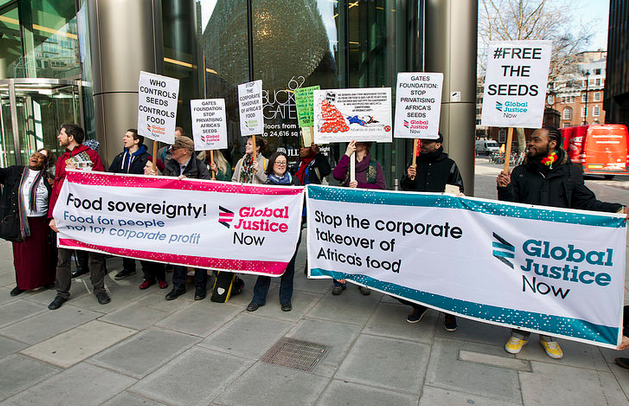
Food sovereignty activists are shining a light on a closed-door meeting between the Bill and Melinda Gates Foundation (BMGF) and the United States Agency for International Development (USAID), which are meeting in London on Monday with representatives of the biotechnology industry to discuss how to privatize the seed and agricultural markets of Africa.

Early Monday, protesters picketed outside the Gates Foundation’s London offices holding signs that called on the foundation to “free the seeds.” Some demonstrators handed out packets of open-pollinated seeds, which served as symbol of the “alternative to the corporate model promoted by USAID and BMGF.” Others smashed a piñata, which they said represented the “commercial control of seed systems;” thousands of the seeds which filled the pinata spilled across the office steps. A similar protest is expected later Monday in Seattle, Washington, where BMGF is headquartered.

The meeting was convened to discuss a report put forth by Monitor-Deloitte, which was commissioned by BMGF and USAID to develop models for the commercialization of seed production in Africa, especially “early generation seed,” and to identify ways in which the African governmental sectors could facilitate private involvement in African seed systems. The study was conducted in Ethiopia, Ghana, Nigeria, Tanzania and Zambia on maize, rice, sorghum, cowpea, common beans, cassava and sweet potato.

However, food sovereignty activists are sounding the alarm over the secret meeting. Heidi Chow, food sovereignty campaigner with Global Justice Now, which organized Monday’s protest, warned that the agenda being promoted by these stakeholders will only increase corporate control over seeds.

“This is not ‘aid’ – it’s another form of colonialism,” said Chow. “We need to ensure that the control of seeds and other agricultural resources stay firmly in the hands of small farmers who feed the majority of the population in Africa, rather than allowing big agribusiness to dominate even more aspects of the food system.”

In a blog post, Chow further explained:

For generations, small farmers have been able to save and swap seeds. This vital practice enables farmers to keep a wide range of seeds which helps maintain biodiversity and helps them to adapt to climate change and protect from plant disease. However, this system of seed saving is under threat by corporations who want to take more control over seeds. Big seed companies are keen to grow their market share of commercial seeds in Africa and alongside philanthropic organizations like the Gates Foundation and aid donors, they are discussing new ways to increase their market penetration of commercial seeds and displacing farmers own seed systems.

Corporate-produced hybrid seeds often produce higher yields when first planted, but the second generation seeds will produce low yields and unpredictable crop traits, making them unsuitable for saving and storing. This means that instead of saving seeds from their own crops, farmers who use hybrid seeds become completely dependent on the seed companies that sell them.

Further, many of the seeds produced by these biotechnology giants are sold alongside chemical fertilizer and pesticides, manufactured by the very same companies, the use of which often leads to widespread environmental destruction and other health problems.

As others noted, while the meeting attendees included representatives from the World Bank and Syngenta, the world’s third biggest seed and biotechnology company, no farmers or farming organizations were represented at the talks.

“Seeds are vital for our food system and our small farmers have always been able to save and swap seeds freely,” Ali-Masmadi Jehu-Appiah, chair of Food Sovereignty Ghana, said in a press statement. “Now our seed systems are increasingly under threat by corporations who are looking to take more control over seeds in their pursuit of profit. This meeting will push this corporate agenda to hand more control away from our small farmers and into the hands of big seed companies.”

Reporting on the Monitor-Deloitte study, Ian Fitzpatrick, a food sovereignty researcher for Global Justice Now, said that documents circulated ahead of the meeting revealed a neo-liberal agenda “laid bare.”

Fitzpatrick writes:

The report recommends that in countries where demand for patented seeds is weaker (i.e. where farmers are using their own seed saving networks), public-private partnerships should be developed so that private companies are protected from ‘investment risk’. It also recommends that that NGOs and aid donors should encourage governments to introduce intellectual property rights for seed breeders and help to persuade farmers to buy commercial, patented seeds rather than relying on their own traditional varieties.

Finally, in line with the broader neoliberal agenda of agribusiness companies across the world, the report suggests that governments should remove regulations (like export restrictions) so that the seed sector is opened up to the global market.

“This neoliberal agenda of deregulation and privatization, currently promoted in almost every sphere of human activity—from food production to health and education—poses a serious threat to food sovereignty and the ability of food producers and consumers to define their own food systems and policies,” Fitzpatrick adds.

AGRA Watch, a program of the grassroots group Community Alliance for Global Justice, notes that the BMGF-USAID commercial seed agenda further “extends U.S. foreign policy into Africa on behalf of corporate interests.”

Phil Bereano, food sovereignty campaigner with AGRA Watch and an Emeritus Professor at the University of Washington added: “This is an extension of what the Gates Foundation has been doing for several years—working with the US government and agribusiness giants like Monsanto to corporatize Africa’s genetic riches for the benefit of outsiders. Don’t Bill and Melinda realize that such colonialism is no longer in fashion? It’s time to support African farmers’ self-determination.”

5 Things Busy People Can Do to Fight the Rising Control System

maxresdefault

By Bernie Suarez

Source: Truth and Art TV

Want to implement small-scale, realistic tasks in your own life to strike back at the control system? Have you been seeing the daily headlines, the lies, the deceit and the global enslavement agenda in full swing and feeling that you aren’t doing enough to fight back because of your busy schedule? Feeling helpless and overwhelmed by the idea that a small group of psychopaths at the very top would push for a global order that involves their full enjoyment of life while you and the rest of humanity live as miserable slaves forever? Don’t have time to be a full-time activist, be involved in marches, or downright challenge the court system? Wondering what small things you can do to fight back as you deal with the hustle and bustle of your own life working to pay bills, obtain an education, or raising children?

Here are five subtle actions you can incorporate into your busy schedule to start pushing back and start making a difference. If you think any of these simple steps is too difficult then give yourself time to adapt. Work on weaning yourself off of your usual habits and slowly changing the hard-to-break habits keeping you from maximally fighting back while continuing your busy life.

1- Turn off your TV and shut off mindless entertainment

This is for some people a difficult thing to do so for those people it may be more realistic to wean down how much entertainment and TV you absorb. A key to this commitment is realizing that TV watching is a medical-physiological issue. Realize that when you watch TV there is a real physical reaction going on in your brain and that addiction to TV and entertainment (like gambling and alcohol) is one problem among many others associated with TV watching.

When someone is an addict they are taught that overcoming denial is a big part of the recovery process and you can’t recover if you deny that you have a problem to begin with. Likewise being addicted to TV and entertainment must not be underestimated as just another incidental habit. It is a real addiction and TV flicker rates have a lot to do with it. I recall for year I watched TV and during that time of my life whenever I was in a room without TV it felt very uncomfortable. I couldn’t understand why it felt so uncomfortable but I knew it was. I now realize that was because there is a physiological addiction involved in TV watching.

As you can imagine, successfully committing to watching less or no TV while living a busy life will free up a lot of time which can then be used for doing creative things, improving relationships, starting a group, picking up a book, doing research, and a lot of other pro-active things you thought you didn’t have time for.

2- Optimize your online privacy

Another subtle thing you can do to strike back at the control system while managing a busy schedule is to learn a few things about online privacy. Start cleaning up your computer and unplugging some of the links put in place for private corporations and even government to potentially spy on you. Learn about what an IP address is. Realize that an IP address can be used to track where you are. Go to your browser and type in the address ‘myipaddress.com’ and this website will read back to you your own IP address.

Become familiar with this concept then become familiar with the concept of ‘Proxy Servers’ and Tor browsers. Do some basic research on the issue and decide for yourself if you want to occasionally (or always) go online using a privacy optimized server. This may not be for everyone but at least be familiar with what it is in case you want or feel you need to use one some day. A proxy server or Tor browser will allow you to browse online without your IP address being traced or tracked.

Also, here’s something you should be doing every day. Depending on which browser you are using, become familiar on how to delete cookies from you computer. Cookies are like tiny robot programs installed on your computer by sites you visit. These robots are installed without your permission and are used to track you. For many browsers (Firefox, Google Chrome) it will be under ‘privacy’ options and/or ‘clear browsing data’. Then look for a link or option for deleting cookies. As I said, know that these cookies are installed on your private computer every single time you go a website. Get in the habit of clearing these cookies unless you want every site you visit to also know what other sites you are visiting. By using cookies many corporations are able to monitor your shopping habits and many other things about you. They rely on the fact that you don’t know how to clear your cookies or perhaps are too lazy to delete them every time you go online. Why not become familiar with cookies and what they do? Still not sure? Just do an online search for “how to clear cookies” then specify the browser you are using.

The point is to start doing little things that will make surveillance more difficult and to educate yourself about some small things that add up and can make a difference later on.

3- Use technology strategically

This topic in some ways is a continuation of the online privacy. Start doing small things to make the police surveillance state a bit more difficult for them to carry out. Be smart about how you use your smart phone. If possible, consider reverting back to a not-so-smart phone. If your phone company allows you to use an older phone it’s something you MAY want to consider.

Remember the time when we all bought small cameras to take pictures and we purchased video cameras to make videos? Why can’t we go back to using individual electronics again? Why do we need to use our phones for everything we do? Why have we become conditioned to living our entire lives using our phones? Have you considered this may have been planned to help enslave humanity? Studies now show smart phones are proven to have a negative impact on human relationships making people more selfish, more easily distracted and more stressed out among other things.

Furthermore, have you read the ‘Terms and Conditions‘ of the license agreements you agree to every time you download a cell phone (or any) app? Do you realize that for many of these redundant and often useless apps you sign away your privacy? Read the agreements very carefully, that is exactly what you are doing almost every time you download a cell phone app. Is this lifestyle really necessary? No it isn’t, and it’s one of the small things you can do to fight back. Take back your privacy and commit to a smart life instead of a smart phone.

Also, you can stop taking “selfies” and broadcasting your image all over your own cell phone. Realize the control system has mastered the facial recognition technology and these self produced images only help the opposition keep track of your facial features and what you look like recently, information that can be added to whatever information the system may already have about you. Remember every bit of content you pack your smart phone with can be legally stolen from your phone and given to anyone including law enforcement or even a fusion center that may have created a file for you without you knowing. Since the revelations of Edward Snowden we all know how NSA is violating the privacy of average Americans and although these measures may not entirely prevent NSA from doing what it does, at least you are doing something to fight back and you are making it more difficult for them to get your information. Imagine if everyone does their part to resist in some way how much harder it becomes for NSA.

Other things you can do is periodically change your contact information like your phone number(s), emails, and addresses. There is no law that says you can’t have multiple emails, addresses and phone numbers if for no other reason than to make yourself harder to track. Be creative instead of being predictable. It’s not about being paranoid it’s about smartly preparing for the worse case scenario, being a tiny bit smarter than the next person, being creative, and being vigilant about the world we now factually live in. Not all of these measures are for everyone but again, these are subtle things some of us can do while living a busy hectic life.

4- Be mindful where you spend your money

This is an issue that everyone can and should do something about. Each of us makes decisions every day about where we spend our money and who we give our money to. If you know a corporation is a part of the problem stop giving them your money. Is a decision like this not practical to implement immediately? Then decrease how much money you spend with that store. Here are a few other suggestions:

Buy only what you need. Resist mindless advertisements that try to get you to spend money on things you don’t need. Realize that like TV, shopping is another subtle addiction that you may need to break. Break away from the habit of going shopping as a form of entertainment and instead practice saving and smartly investing your money.

So where should you spend your money? Support alternative media with donations and online purchases. Support organizations and stores that share your values. Identify those entities that support the freedom and liberty we all wish to see come to fruition and then support those platforms. Invest in your own health and survival. Instead of spending money on things you don’t need buy things that empower you and your ability to survive free from government. Do your part to buy smartly, and if everyone does this we can greatly contribute to a shift in paradigm even as we live our busy lives.

5- Don’t give government a reason to arrest or fine you

Finally, regardless of what you do, know that government (City, State and Federal) needs your money badly and they pay a lot of people to look for reasons to take your money (or your freedom which is worth money to them) away from you. We’ve all seen the big city parking police scouring neighborhoods looking for any car parked in front of a meter that is one minute over the limit. We’ve seen throughout the U.S. how police often set up hidden speed traps so they can pull you over for a speeding ticket. Realize that police are rewarded for giving out tickets and the cities have quotas for tickets. The control system NEEDS your money or your freedom to fund its very own control over you. This is why they set up traffic light cameras, create stringent rules and DUI checkpoints throughout the city in hopes of catching violators. Realize this and stay focused every day being careful to not give the control system an excuse to transfer any of your hard earned money into their pockets. Do what you can to not be arrested, not get a ticket and not be harassed for money by the control system.

If none of this works, if you end up with tickets or arrested, or if you simply want to become a more effective change agent while living a busy life then educate yourself about the legal system and how it is rigged against you. Take time on your off days to learn some of the basics of how the system tricks each and every one of us from the time of birth into consenting to be ruled, robbed and controlled. Again, some may feel they don’t have time to learn about the legal system but, like learning about online privacy, learning how to legally take control of your own life is a priceless piece of knowledge to obtain in your spare time.

So there it is. All of these things can be done by someone caught up in a busy hectic lifestyle. All of us have spare time, some of us have more spare time than others. Ultimately, you choose your road and what kind of life you want to live. These ideas are for those you really care and really want to make a difference but realize that time is precious. Go ahead, start making your list and put some of things into action. Don’t worry about not being able to do all of this, just start somewhere. This is a guideline not a set of rules. Peace and love.

Is the Web Destroying the Cultural Economy?

Internet-devices-globe-world-connected

By Charles Hugh Smith

Source: Of Two Minds

Are we entering a cultural Dark Age, where the talented cannot earn a living creating culture?

Longtime correspondent G.F.B. recently sent me this 13-minute Interview with Andrew Keen. This is my first exposure to Keen, and his view that the democratization of the Web is great for politics but a disaster for what he calls the Cultural Economy— the relatively small but important slice of the economy that pays creators and artists to make culture: music, literature, art and serious journalism.

The title of Keen’s 2007 book encapsulates his dire perspective: The Cult of the Amateur: How blogs, MySpace, YouTube, and the rest of today’s user-generated media are destroying our economy, our culture, and our values.

(His 2012 book had a similar theme: Digital Vertigo: How Today’s Online Social Revolution Is Dividing, Diminishing, and Disorienting Us)

(Author Scott Timberg makes some of the same points in his new book Culture Crash: The Killing of the Creative Class (via Cheryl A.)

Keen touches on a great many ideas and themes in this brief interview, but his core point is this: by enabling everyone to express themselves on an essentially equal footing, the Web has undermined legitimate journalism and buried the talented few in an avalanche of mediocrity–in his words, talent is “lost in a sea of garbage.”

By eliminating the middleman who added value by sorting the wheat from the chaff–the film studio, the music labels, the publishers–the Web has created a cultural landscape where “soft, ordinary” content such as cute cat videos garner the most “likes” and clicks–the digital world’s metric for popularity and thus value in the marketplace.

Keen tossed off one of his most interesting ideas as an aside: that the break-up of community and the resulting loss of identity has generated a universal drive to establish an identity via self-expression: everybody feels they can compose a song, write a novel or make a movie.

Keen is at his most provocative (to the democratized ideal of the amateur making it big) when he declares the vast majority of people are talentless: talent is by definition scarce. We can’t all be equally talented, nor can anyone generate culturally valuable content without mastering their craft over thousands of hours of practice.

Keen unapologetically calls the previous arrangement an “industrial meritocracy.” He feels this hierarchical meritocracy is being destroyed and there is nothing to replace it.  This will result in a cultural Dark Age where the talented cannot earn a living creating culture. The only avenue left for creators of content that can be copied and distributed digitally (music, digital art, writing) is to find wealthy patrons to support their work.

One of G.F.B.’s points in our conversation was the Web’s “level playing field” is an artificial construct, much like the playing field in a stadium. But outside the stadium, the geography is anything but level.  Put other way, global corporations have great advantages in the supposedly “level playing field” of the Web.

Keen mentions that what will remain scarce in this tsunami of digital content is access to the artist, live performances and art that cannot be digitized, such as sculpture and paintings. As I have discussed in previous Musings, musicians who perform constantly can make a living in this environment, because their free music on the web builds an audience for their live performances.  But not every band performs enough to make a go of this model.

In Keen’s  view, it is now essentially impossible for bands, artists and writers to create a “brand” that will generate an income. Only those creators who entered the digital age with an established brand can leverage their recognition into an income.

As a completely marginal creator of content who never rose within the industrial meritocracy lauded by Keen, I  think Keen makes some excellent points but overstates his case for a cultural Dark Age.

As G.F.B. pointed out in our conversation on this topic, a new class of curators is arising within the Web, people who sift through the vast outpouring of content and select the best or most interesting (in their view). Those curators who succeed are adding value just as the industrial middlemen did in the pre-digital model. In some small way, I think Of Two Minds performs a bit of this curation.

It seems to me that the digital age requires every creator of content to not only be perseverant but to focus a great deal of time and energy on marketing their content–precisely what the industrial media and cultural industrial-model companies once did for their talent.

There is no longer enough money in creating content to pay an office full of people to issue press releases and arrange book tours.  In the publishing world, promotion is increasingly up to the authors; as Keen noted, only those authors with brands that were established in the pre-digital age can sell enough content to support industrial-type promotion.

We can bemoan this, or we can grasp the nettle and realize that  it is no longer enough to practice one’s craft for the fabled 10,000 hours–one must also invest another 10,000 hours in promoting and marketing one’s content/cultural creations.  That dual process (creation and marketing) is so arduous, so impoverishing, so demanding, only the driven few can sustain it long enough to claw their way through the mountains of mediocrity.

Making a living at cultural content was always brutally Darwinian; perhaps all that’s changed is the nature of the Darwinian selection process.

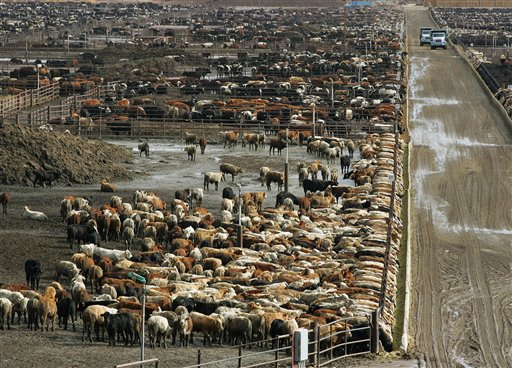
People as Livestock: The Cult of Fundamentalist Materialism and the Cheapening Life

Farm to Fork

I first encountered the term “Fundamentalist-Materialism” in the work of Robert Anton Wilson; it appears in several of his non-fiction works, including “The Cosmic Triggger” series. As far as I know R.A.W. was the originator of this philosophical designation.”

Is there any inherent value to an individual human life? 

By Dan Mage

Source: OpEdNews.com

Authoritarians of the left, libertarians of the right, objectivists, conservatives and even liberals and progressives fixated on “jobs” and “rehabilitation” of the socioeconomically dysfunctional give the answer “no; ” sometimes directly (as in the case of the Stalinist and the American conservative) and other times through actions, policies, and preferences (as in the case of elements of the “occupation” movement distancing themselves from “homeless bums,” “drug users,” and “ex-cons”).

Most of all, those with the power to set wages, prices, working conditions and societal expectation for those who have nothing left but their time and “docile bodies”*(Foucault) to sell, control and trade in human lives as commodities. While most of the supposedly civilized world frowns on chattel slavery (although a good bit of it goes on, especially in the sex trade, where prosecution of traffickers is the exception rather than the rule), the legal technicality of ownership is superfluous to the trade in human lives, time, labor, and in Reichian terms orgones.

What do Stalinism, objectivism, authoritarian capitalism, and global corporatism all have in common ? They are in my opinion fundamentalist-materialist cults that value the inanimate over the living, the concrete over the abstract and have effectively reduced the vast majority of the human race to livestock, or wild beasts to be hunted down, captured, contained, broken, or in the alternative, simply slaughtered and destroyed.

I have been told that it has always been thus, and perhaps in terms of humanity’s historical failings this is true. There is however no historical precedent for the establishment of a global value system through electronic multi-sensory media. Even the best efforts of the Catholic Church, Protestant missionaries and Islamic holy-warriors do not equal the technology and level of sophistication in the application of “industrial psychology.”

The message remains the same though, as it has been throughout history: “Obey or suffer.” Individual disobedience or even mere failure to “produce” in spite of the individual’s best efforts will result in stigmatization, marginalization, a degrading dependency on the state and, as state support for the economically disengaged is cut back and removed, starvation, homelessness and imprisonment; even the fact of homelessness is defined as a criminal offense by more local jurisdictions with each passing year.

The fact is that life is cheap; the idealistic visions of humanitarians are swept aside by those advocates of “austerity” and “tough choices,” whose calculations in service of usury on a global scale will determine the level of human suffering in each nation up to and including death by starvation, disease, and the inevitable outcome of manufactured scarcity, war.

The blurry and dim imagery of the concretes of suffering fades from vision in the glare of the deadly abstractions; political ideologies, religions, money that does not exist anywhere other than in the record keeping of the money lenders remains in clear focus. The conclusion returns stark, glaring and obvious: human life is a commodity, the value of which is consistently decreasing. The devaluation of an individual human life to a unit of production and consumption, which therefore can be discarded if determined to have no economic value, is all that is required for the machinery of mass exterminations and genocide to be set in motion.

Arguing about wages, prices, social systems and ways of arranging economies, even in cases where “progress” is made, will be useless. The dominance of the fundamentalist-materialist cults, as well as the authoritarian religions that create legitimacy for them in the eyes of the masses (and even Stalin, the ultimate fundamentalist-materialist, allowed for the return of religion as an adjunct of the state when he realized its value) will continue to crush and compress human life, until the perverted and inverted values themselves are overthrown, shattered, burned and buried.

When will the biocentric (life centered) ethos replace the thanatocentric (death centered) ethos as the dominant culture’s value system? I cannot answer even the “if” of this question, let alone the question itself. The fact that the power to collect interest on nonexistent money and the lifestyles that such usury on a global scale supports is presented, and apparently accepted, as an immutable law of nature rather than as an imposition of culture’s order on the true nature of humanity seems by way of this very acceptance to be a “natural law.” Images of vultures waiting for starving children to crawl to their deaths and mothers weeping over infants at the bottoms of pits do not move the master manipulators of numbers. If anything, only the fact that the die-offs are not more extensive is cause for lamentation.

Do we care anymore? I’m not speaking of our little “jobs” and “futures,” and relative degree of comfort/discomfort in oppression that seems to be everyone’s primary concern. I’m demanding of myself, of you and above all of those who have declared themselves to be “leaders;” what is it that matters to you? Do you feel anything at all? Can we set aside all calculations save for those needed to ease human suffering? The primary demand of all protests, occupations, strikes, boycotts and further actions of increasing effect and extremity will be “Life First!”

The life of one human being hanging on the edge of death, in suffering, is too high a price to pay, for all the glorious achievements of the fundamentalist-materialist cults, their leaders and their adherents. The cult of power, authority, war, and property as a weapon of coercion has, for all its trillions of dollars and stockpiled weapons of mass destruction, a single and fatal vulnerability; to function it depends on obedience. For obedience to be guaranteed, the “obey or suffer” directive must be enforceable. This directive is only enforceable if the doctrine of fundamentalist-materialism enjoys continued acceptance as a “fact of life,” rather than the monstrous fraud that it is.

*The term “docile bodies” is a chapter title in Michel Foucault’s “Discipline and Punish: The Birth of the Prison” 1977, Random House, NY, NY.


Welcome to the Matrix: Enslaved by Technology and the Internet of Things

m2m-graphic1-2013-01-564x317_contentfullwidth

By John W. Whitehead

Source: The Rutherford Institute

“There will come a time when it isn’t ‘They’re spying on me through my phone’ anymore. Eventually, it will be ‘My phone is spying on me.’” ― Philip K. Dick

If ever Americans sell their birthright, it will be for the promise of expediency and comfort delivered by way of blazingly fast Internet, cell phone signals that never drop a call, thermostats that keep us at the perfect temperature without our having to raise a finger, and entertainment that can be simultaneously streamed to our TVs, tablets and cell phones.

Likewise, if ever we find ourselves in bondage, we will have only ourselves to blame for having forged the chains through our own lassitude, laziness and abject reliance on internet-connected gadgets and gizmos that render us wholly irrelevant.

Indeed, while most of us are consumed with our selfies and trying to keep up with what our so-called friends are posting on Facebook, the megacorporation Google has been busily partnering with the National Security Agency (NSA), the Pentagon, and other governmental agencies to develop a new “human” species, so to speak.

In other words, Google—a neural network that approximates a global brain—is fusing with the human mind in a phenomenon that is called “singularity,” and they’ve hired transhumanist scientist Ray Kurzweil to do just that. Google will know the answer to your question before you have asked it, Kurzweil said. “It will have read every email you will ever have written, every document, every idle thought you’ve ever tapped into a search-engine box. It will know you better than your intimate partner does. Better, perhaps, than even yourself.”

But here’s the catch: the NSA and all other government agencies will also know you better than yourself. As William Binney, one of the highest-level whistleblowers to ever emerge from the NSA said, “The ultimate goal of the NSA is total population control.”

Science fiction, thus, has become fact.

We’re fast approaching Philip K. Dick’s vision of the future as depicted in the film Minority Report. There, police agencies apprehend criminals before they can commit a crime, driverless cars populate the highways, and a person’s biometrics are constantly scanned and used to track their movements, target them for advertising, and keep them under perpetual surveillance.

Cue the dawning of the Age of the Internet of Things, in which internet-connected “things” will monitor your home, your health and your habits in order to keep your pantry stocked, your utilities regulated and your life under control and relatively worry-free.

The key word here, however, is control.

In the not-too-distant future, “just about every device you have — and even products like chairs, that you don’t normally expect to see technology in — will be connected and talking to each other.”

By 2018, it is estimated there will be 112 million wearable devices such as smartwatches, keeping users connected it real time to their phones, emails, text messages and the Internet. By 2020, there will be 152 million cars connected to the Internet and 100 million Internet-connected bulbs and lamps. By 2022, there will be 1.1 billion smart meters installed in homes, reporting real-time usage to utility companies and other interested parties.

This “connected” industry—estimated to add more than $14 trillion to the economy by 2020—is about to be the next big thing in terms of societal transformations, right up there with the Industrial Revolution, a watershed moment in technology and culture.

Between driverless cars that completely lacking a steering wheel, accelerator, or brake pedal, and smart pills embedded with computer chips, sensors, cameras and robots, we are poised to outpace the imaginations of science fiction writers such as Philip K. Dick and Isaac Asimov. By the way, there is no such thing as a driverless car. Someone or something will be driving, but it won’t be you.

The 2015 Consumer Electronics Show in Las Vegas is a glittering showcase for such Internet-connected techno gadgets as smart light bulbs that discourage burglars by making your house look occupied, smart thermostats that regulate the temperature of your home based on your activities, and smart doorbells that let you see who is at your front door without leaving the comfort of your couch.

Nest, Google’s $3 billion acquisition, has been at the forefront of the “connected” industry, with such technologically savvy conveniences as a smart lock that tells your thermostat who is home, what temperatures they like, and when your home is unoccupied; a home phone service system that interacts with your connected devices to “learn when you come and go” and alert you if your kids don’t come home; and a sleep system that will monitor when you fall asleep, when you wake up, and keep the house noises and temperature in a sleep-conducive state.

The aim of these internet-connected devices, as Nest proclaims, is to make “your house a more thoughtful and conscious home.” For example, your car can signal ahead that you’re on your way home, while Hue lights can flash on and off to get your attention if Nest Protect senses something’s wrong. Your coffeemaker, relying on data from fitness and sleep sensors, will brew a stronger pot of coffee for you if you’ve had a restless night.

It’s not just our homes that are being reordered and reimagined in this connected age: it’s our workplaces, our health systems, our government and our very bodies that are being plugged into a matrix over which we have no real control.

Moreover, given the speed and trajectory at which these technologies are developing, it won’t be long before these devices are operating entirely independent of their human creators, which poses a whole new set of worries. As technology expert Nicholas Carr notes, “As soon as you allow robots, or software programs, to act freely in the world, they’re going to run up against ethically fraught situations and face hard choices that can’t be resolved through statistical models. That will be true of self-driving cars, self-flying drones, and battlefield robots, just as it’s already true, on a lesser scale, with automated vacuum cleaners and lawnmowers.”

For instance, just as the robotic vacuum, Roomba, “makes no distinction between a dust bunny and an insect,” weaponized drones—poised to take to the skies en masse this year—will be incapable of distinguishing between a fleeing criminal and someone merely jogging down a street. For that matter, how do you defend yourself against a robotic cop—such as the Atlas android being developed by the Pentagon—that has been programmed to respond to any perceived threat with violence?

Unfortunately, in our race to the future, we have failed to consider what such dependence on technology might mean for our humanity, not to mention our freedoms.

Ingestible or implantable chips are a good example of how unprepared we are, morally and otherwise, to navigate this uncharted terrain. Hailed as revolutionary for their ability to access, analyze and manipulate your body from the inside, these smart pills can remind you to take your medication, search for cancer, and even send an alert to your doctor warning of an impending heart attack.

Sure, the technology could save lives, but is that all we need to know? Have we done our due diligence in asking all the questions that need to be asked before unleashing such awesome technology on an unsuspecting populace?

For example, asks Washington Post reporter Ariana Eunjung Cha:

What kind of warnings should users receive about the risks of implanting chip technology inside a body, for instance? How will patients be assured that the technology won’t be used to compel them to take medications they don’t really want to take? Could law enforcement obtain data that would reveal which individuals abuse drugs or sell them on the black market? Could what started as a voluntary experiment be turned into a compulsory government identification program that could erode civil liberties?

Let me put it another way. If you were shocked by Edward Snowden’s revelations about how NSA agents have used surveillance to spy on Americans’ phone calls, emails and text messages, can you imagine what unscrupulous government agents could do with access to your internet-connected car, home and medications? Imagine what a SWAT team could do with the ability to access, monitor and control your internet-connected home—locking you in, turning off the lights, activating alarms, etc.

Thus far, the public response to concerns about government surveillance has amounted to a collective shrug. After all, who cares if the government can track your whereabouts on your GPS-enabled device so long as it helps you find the fastest route from Point A to Point B? Who cares if the NSA is listening in on your phone calls and downloading your emails so long as you can get your phone calls and emails on the go and get lightning fast Internet on the fly? Who cares if the government can monitor your activities in your home by tapping into your internet-connected devices—thermostat, water, lights—so long as you can control those things with the flick of a finger, whether you’re across the house or across the country?

As for those still reeling from a year of police shootings of unarmed citizens, SWAT team raids, and community uprisings, the menace of government surveillance can’t begin to compare to bullet-riddled bodies, devastated survivors and traumatized children. However, both approaches are just as lethal to our freedoms if left unchecked.

Control is the key here. As I make clear in my book A Government of Wolves: The Emerging American Police State, total control over every aspect of our lives, right down to our inner thoughts, is the objective of any totalitarian regime.

George Orwell understood this. His masterpiece, 1984, portrays a global society of total control in which people are not allowed to have thoughts that in any way disagree with the corporate state. There is no personal freedom, and advanced technology has become the driving force behind a surveillance-driven society. Snitches and cameras are everywhere. And people are subject to the Thought Police, who deal with anyone guilty of thought crimes. The government, or “Party,” is headed by Big Brother, who appears on posters everywhere with the words: “Big Brother is watching you.”

Make no mistake: the Internet of Things is just Big Brother in a more appealing disguise.

Even so, I’m not suggesting we all become Luddites. However, we need to be aware of how quickly a helpful device that makes our lives easier can become a harmful weapon that enslaves us.

This was the underlying lesson of The Matrix, the Wachowski brothers’ futuristic thriller about human beings enslaved by autonomous technological beings that call the shots. As Morpheus, one of the characters in The Matrix, explains:

The Matrix is everywhere. It is all around us. Even now, in this very room. You can see it when you look out your window or when you turn on your television. You can feel it when you go to work… when you go to church… when you pay your taxes. It is the world that has been pulled over your eyes to blind you from the truth.

“What truth?” asks Neo.

Morpheus leans in closer to Neo: “That you are a slave, Neo. Like everyone else you were born into bondage. Born into a prison that you cannot smell or taste or touch. A prison for your mind.”