
Terrorizing School Children in the American Police State

stpp

By Henry Giroux

Source: Counterpunch

Americans live in an age, to rephrase, W.E.B. Dubois, in which violence has become the problem of the twenty-first century. As brutalism comes to shape every public encounter, democratic values and the ethical imagination wither under the weight of neoliberal capitalism and post-racial racism. Giving way to the poisonous logics of self-interest, privatization, and the unfettered drive for wealth, American society reneges on the social contract and assumes the role of a punishing state.[i] Under the regime of a predatory neoliberalism, compassion and respect for the other are viewed increasingly with contempt while the spectacle of violence titillates the multitudes and moves markets. A free-market mentality now drives and corrupts politics, destroys social protections, celebrates a hyper-competitiveness, and deregulates economic activity. As politics is emptied of any sense of social responsibility, the apostles of casino capitalism preach that allegedly amoral economic activity exacts no social costs, and in doing so they accelerate the expanding wasteland of disposable goods and people.[ii] One consequence is a vast and growing landscape of human suffering, amplified by a mass-mediated metaphysics of retribution and violence that more and more creeps into every commanding institution of American society, now serving a myriad of functions such as sport, spectacle, entertainment, and punishment. Alain Badiou rightly calls those who run our current political system a “regime of gangsters.”[iii] These so called gangsters produce a unique form of social violence. According to Badiou, they:

Privatize everything. Abolish help for the weak, the solitary, the sick and the unemployed. Abolish all aid for everyone except the banks. Don’t look after the poor; let the elderly die. Reduce the wages of the poor, but reduce the taxes on the rich. Make everyone work until they are ninety. Only teach mathematics to traders, reading to big property-owners and history to on-duty ideologues. And the execution of these commands will in fact ruin the lives  of millions of people.[iv]

Increasingly, institutions such as schools, prisons, detention centers, and our major economic, cultural and social institutions are being organized around the production of violence. Rather than promote democratic values and a respect for others or embrace civic values, they often function largely to humiliate, punish, and demonize any vestige of social responsibility. Violence both permeates and drives foreign policy, dominates popular culture, and increasingly is used to criminalize a wide range of social behaviors, especially among African-Americans.[v] In part, the totality of violence in American society can be understood in terms of its doubling function. At one level, violence produces its own legitimating aesthetic as part of a broader spectacle of entertainment, offering consumers the pleasure of instant gratification, particularly in the visibility and celebration of extreme violence. This is evident in television series such as Game of Thrones and Hannibal, endless Hollywood films such as Dread (2012), Django (2012), and Mad Max: Fury Road (2015), and video games such as Grand Theft Auto 4 (2008), and Mortal Combat (2011), and Battlefield Hardline (2015).

At another level, violence functions as a brutalizing practice used by the state to squelch dissent, incarcerate poor minorities of class and color, terrorize immigrants, wage a war on minority youth, and menace individuals and groups considered disposable or a threat. Not only does such violence destroy the conditions and institutions necessary to develop a democratic polity, it also accelerates abusive forms of punitiveness and control that extend from the prisons to other institutions such as schools. In this instance, violence becomes the ultimate force propagating what might be called punishment creep. The punishment creep that has moved from prisons to other public spheres now has a firm grip on both schools and the daily rituals of everyday life. Margaret Kimberly captures one instance of the racist underside of punishment creep. She writes: “Black people are punished for driving, for walking down the street, for having children, for putting their children in school, for acting the way children act, and even for having children who are killed by other people. We are punished, in short, because we still exist.”[vi]

Violence in America has always been defined partly by a poisonous mix of chauvinism, exceptionalism, and terrorism that runs through a history marked by genocidal assaults against indigenous Native Americans, the brutality of slavery, and a persistent racism that extends from the horror of lynchings and chain gangs to a mass incarceration state that criminalizes black behavior and subjects many black youth to the shameful dynamics of the school-to-prison-pipeline and unprecedented levels of police abuse. Violence is the premier signature of what Ta-Nehisi Coates calls “The Dreamers,” those individuals and groups who have “signed on, either actively or passively, to complicity in everything from police shootings to real estate redline, which crowds blacks into substandard housing in dangerous neighborhoods…The Dream is about the totality of white supremacy in American history and its cumulative weight on African-Americans, and how one attempts to live with that.”[vii] In part, violence whether produced by the state, corporations, or racist individuals is difficult to abstract from an expression of white supremacy, which functions as an index for demanding “the full privileges of the state.”[viii]

Police violence against African-Americans has become highly visible and thrust into the national spotlight as a result of individuals recording acts of police abuse with their cell phones and other tools of the new technologies. In the last few years, there has been what seems like a torrent of video footage showing unarmed black people being assaulted by the police. For instance, there is the shocking video of Walter Scott being shot in the back after fleeing from his car; Eric Garner dying as a result of being put in a chock hold by a white policeman who accused him of illegally selling cigarettes; the tragic killing of Freddie Gray who after making eye contact with a police officer was put in a police van and purposely given a jarring ride that resulted in his death; and the needless shooting of 12 year-old Tamir Rice for playing with a pellet gun in the snow in a park, and so it goes. All of these deaths are morally indefensible and are symptomatic of the deep-seated racism and propensity for violence in many police forces in the United States.

Yet, as Jeah Lee observes, while such crimes have attracted national attention, the “use of force by cops in schools…. has drawn far less attention [in spite of the fact that] over the past five years at least 28 students have been seriously injured, and in one case shot to death, by so-called school resource officers—sworn, uniformed police assigned to provide security on k-12 campuses.”[ix] Increasingly as public schools hand over even routine disciplinary problems to the police, there is a resurgence of cops in schools. There are over 17,000 school resource officers in more than half of the schools in the United States.[x] In spite of the fact that violence in schools have dropped precipitously, school resource officers are the fastest growing segment of law enforcement.

In part, the militarizing of schools and the accompanying surge of police officers are driven by the fear of school shootings, particularly in the aftermath of the Columbine High School tragedy in 1999, and the massacre that took place at Sandy Hook Elementary School in 2013, both of which have been accentuated by the ever present wave of paranoia that followed the terrorist attacks of 9/11.[xi] What advocates of putting police in the schools refuse to acknowledge is that the presence of police in schools has done nothing to stop such mass shootings. While the fear of school shootings are overestimated, the fact remains that schools are still one of the safest places for children to be. Caught under the weight of a culture of fear and a rush to violence, many young people in schools are the most recent victims of a punishing state in a society that “remains in a state of permanent, endless war,” a war that is waged through militarized policies at home and abroad. [xii]

What has become clear is that cops in schools do not make schools safer. Erik Eckholm reporting for the New York Times stated that judges, youth advocates, parents, and other concerned citizens “are raising alarm about what they have seen in the schools where officers are already stationed: a surge in criminal charges against children for misbehavior that many believe is better handled in the principal’s office.”[xiii] In Texas, police officers have written “more than 100,000 misdemeanor tickets each year” and many of these students “face hundreds of dollars in fines, community service, and in some cases, a lasting record that could affect applications for jobs or the military.”[xiv] The transformation of disciplinary problems into criminal violations has often resulted in absurd if not tragic results. For instance, in 2009, in Richardson, Texas “a 14-year old boy with Asperger’s syndrome was given a $364 police citation for using an expletive in his classroom.”[xv] It gets even more ludicrous. “A 12-year-old student in Stuart, Florida, was arrested in November 20008 for ‘disrupting a school function.’ The ‘disruption’ was that the student had ‘passed gas.’”[xvi]

Similarly, a number of civil rights groups have reported that the presence of police in schools often “means more suspensions, which disproportionately affect minority students.” [xvii] Many of the young people who end up in court are poor black and brown students, along with students with disabilities. What must be recognized is that schools in general have become combat zones where it is routine for many students to be subjected to metal detectors, surveillance cameras, uniformed security guards, weapons searches, and in some cases SWAT team raids and police dogs sniffing for drugs.[xviii] Under such circumstances, the purpose of schooling appears to be to contain and punish young people, especially those marginalized by race and class, rather than educate them. What is beyond doubt is that “Arrests and police interactions… disproportionately affect low-income schools with large African-American and Latino populations.”[xix] For the many disadvantaged students being funnelled into the “school-to-prison pipeline,” schools ensure that their futures look grim indeed, as their educational experiences acclimatize them to forms of carceral treatment.[xx] There is more at work here than a flight from responsibility on the part of educators, parents, and politicians who support and maintain policies that fuel this expanding edifice of law enforcement against the young and disenfranchised. Underlying the repeated decisions to turn away from helping young people is the growing sentiment that youth, particularly minorities of color and class, constitute a threat to adults and the only effective way to deal with them is to subject them to mind-crushing punishment. Students being miseducated, criminalized, and arrested through a form of penal pedagogy in prison-type schools provides a grave reminder of the degree to which the ethos of containment and punishment now creeps into spheres of everyday life that were largely immune in the past from this type of state and institutional violence.

No longer are schools spaces of joy, critical teaching, and support, as too many are now institutions of containment and control that produce pedagogies of conformity and oppression and in the name of teaching to the test serve to kill the imagination. Within such schools, the lesson that young people are learning about themselves is that they can’t engage in critical thinking, be trusted, rely on the informed judgments of teachers and administrators, and that their behavior is constantly subject to procedures that amount to both an assault on their dignity and a violation of their civil liberties. Schools have become institutions in which creativity is viewed as a threat, harsh discipline a virtue, and punishment the reward for not conforming to what amounts to the dictates of a police state. How many more images of young school children in handcuffs do we have to witness before it becomes clear that the educational system is broken, reduced largely to a punishing factory defined by a culture of fear and an utter distrust of young people?

According to the Advancement Project, schools have become increasingly intolerant of young people, imposing draconian zero tolerance policies on them by furthering a culture steeped in criminalizing often minor, if not trivial, student behaviors. What is truly alarming is not only the ways in which young people are being ushered into the criminal justice system and treated less as students than as criminals, but the harsh violence to which they are often subjected by school resource officers. According to a report by Mother Jones, Jonathan Hardin, a Louisville Metro Police officer, in 2014 “was fired after his alleged use of force in two incidents at Olmsted Academy North middle school: He was accused of punching a 13-year-old student in the face for cutting the cafeteria line, and a week later of putting another 13-year-old student in a chokehold, allegedly knocking the student unconscious and causing a brain injury.”[xxi] In a second incident that year, “Cesar Suquet, then a 16-year-old high school student in Houston, was being escorted by an officer out of the principal’s office after a discussion about Suquet’s confiscated cell phone. Following a verbal exchange, police officer Michael Y’Barbo struck Suquet at least 18 times with a police baton, injuring him on his head, neck and elsewhere.”[xxii] Y’Barbo claimed that beating a student with a police baton was “reasonable and necessary” and “remains on regular assignment including patrol.”[xxiii] There are have also been incidents where students have been shot, suffered brain injuries, and have been psychologically traumatized. Jaeah Lee cites a young black high school student in Detroit who after a troubling interaction with a school police officer speaks for many young people about the dread and anxiety that many students experience when police occupy their schools. He states that “”Many young people today have fear of the police in their communities and schools.”[xxiv]

If one important measure of a democracy is how a society treats its children, especially young children who are black, brown, or suffer from disabilities, there can be little doubt that American society is failing. As the United States increasingly models its schools after prisons, students are no longer viewed as a social investment in the future. A deadly mixture of racism and violence in the 21st century has become increasingly evident in the violence being waged against young people in American schools. If students in general are now viewed as a potential threat, black students are regarded increasingly as criminals. One result is that schools increasingly have come to resemble war zones, spaces marked my distrust, fear, and demonization. With more police in the schools than ever before, security has become more important than providing children with a critical education and supportive learning environment. As authority in many of the schools is often handed over to the police and security forces who are now asked to deal with all alleged disciplinary problems, however broadly defined, the power and autonomy of teachers and school administrators are weakened at the expense of the safety of the students. This loss of authority is clear in New York City where school administrators have no control over security forces who report directly to local police departments.

In most cases, the disciplinary problems that take place in schools involve trivial the infractions such as violating a dress code, scribbling on a desk, or holding a 2-inch toy gun. The assault on children in the public schools suggest that black and brown children cannot view schools as safe places where they can be given a quality education. Instead, schools have become sites of control, testing, and punishment all too eager to produce pedagogies of repression, and more than willing to erect, once again, what has been called the school-to-prison pipeline, especially for youth of color. Roxane Gay is right in observing that

Black children are not allowed to be children. They are not allowed to be safe, not at home, not at pool parties, not driving or sitting in cars listening to music, not walking down the street, not in school. For black children, for black people, to exist is to be endangered. Our bodies receive no sanctity or safe harbor.[xxv]

It is inconceivable that in an alleged democracy poor minorities at all grade levels in the public schools are subjected to shameful criminal practices such as being handcuffed and carted off to jail for minor incidents— and that such draconian practices could take place in a society that views itself as a democracy. Stripped of their public mission as institutions that nurture young people to become informed, critically engaged citizens, schools have become punishing factories all too willing to turn disciplinary authority over to the police and to usher students into the harsh bureaucracy of the criminal justice system.[xxvi]

One recent example of a particularly disturbing incident of police brutality was captured in a series of videos recorded in West Spring High School in South Carolina. Prior to the incident being filmed, a young black student named Shakara took out her cellphone in class. The teacher asked her for it and when she refused to hand it over, she was asked to leave the class. The teacher then called the vice principal. Rather than attempt to defuse the situation, the vice principal called for a School Resource Officer.  At this point, Officer Ben Fields enters the classroom. One of Shakira’s classmates, Niya Kenny, asked her classmates to start filming because as she put it: “I told them to start filming because we know his reputation–well, I know it.” In what follows, as filmed by one of the students, Officer Ben Fields approaches the young woman, appears to give her no time to stand up and proceeds by grabbing her left arm while placing his right arm around her neck; he then lifts her desk, pulls her out of her seat, slams her to the ground, and drags her across the floor before handcuffing her. The video is difficult to watch given the extreme level of violence used against a high school student. The young woman was arrested as was Kenny, who both filmed the incident and loudly protested the treatment of Shakara. Fields was fired soon afterwards, but incredulously both students are being charged with “disturbing schools, a crime punishable by up to ninety days in jail or a thousand dollar fine.”[xxvii]

What has emerged after the incident went viral was information indicating that Fields had a previous reputation for being aggressive with students, and he was viewed as a threat by many students who nicknamed him “Officer Slam.” Moreover, he had a previous record of violently assaulting people.[xxviii] The question that should be asked as a result of this shocking act of police violence against a young black girl is not how Fields got a job in a school working with children, but what kind of society believes that police should be in the school in the first place. Whatever happened to teacher and administrator responsibility? Sadly, it was a school administrator who called in the police at Spring Valley High School because the student would not turn over her phone. Even worse, when Sheriff Leon Lott announced his decision to fire Fields, he pointed out that the classroom teacher and administrator supported actions of the police officer and made it clear that “they also had no problems with the physical part.”[xxix] Both the teacher and administrator should be fired. This incident was in all probability a simple disciplinary problem that should have been handled by responsible educators. Students should not be treated like criminals. It is one thing to not assume responsibility for students, but another to subject them to brutal assaults by the police.

Lawlessness runs deep in American society and has been normalized. Brutal attacks on defenseless children rarely get the attention they deserve and when they do the corporate media refuses to acknowledge that America has become a suicidal society willing even to sacrifice its own children to an expanding punishing state that protects the interests of the corporate and financial elite.[xxx] How else to explain the shameless defense of such a brutal assault against a young black girl by pundits such as CNN’s Harry Houck and Don Lemon, who implied that such violence was warranted because Shakara did not respect the officer, as if the beating of a black child by a police officer, who happens also to be a body-builder, who can lift 300 pounds, justifies such actions. This is a familiar script in which black people are often told that whatever violence they are subject to is legitimate because they acted out of place, did not follow rules that in reality oppress them, or simply refused to fall in line. The other side of this racist script finds expression in those who argue that any critique of the police endangers public safety. In this dangerous discourse, the police are the victims, a line of argument recently voiced in different ways by both President Obama and by James Comey, the director of the Federal Bureau of Investigation. This discourse not only refuses to recognize the growing visibility of police violence, it shores up one of the foundations of the authoritarian state, suggesting that the violence propagated by the police should not be subject to public scrutiny. As an editorial in the New York Times pointed out, this “formulation implies that for the police to do their jobs, they need to have free rein to be abusive. It also implies that the public would be safer if Americans with cellphones never started circulating videos of officers battering suspects in the first place….This trend is straight out of Orwell.”[xxxi]

Educators, young people, parents and others concerned about violence in schools need to organize and demand that the police be removed from school. Not only is their presence a waste of taxpayer’s money and an interference with children’s education, have they also pose a threat to student safety.[xxxii] Instead of putting police in schools, money should be spent on more guidance teachers, social workers, teachers, community intervention workers, and other professionals who are educated and trained to provide a safe and supportive environment for young people. It is particularly crucial to support those social services, classroom practices, and policies that work to keep students in schools. Everything possible should be done to dismantle the school-to-prison pipeline and the underlying forces that produce it. At the same time, more profound change must take place on a national level since the violence waged by the police is symptomatic of a society now ruled by a financial elite who trade in cruelty, punishment, and despair. American society is broken, and the violence to which it appears addicted to will continue until the current configurations of power, politics, inequality, and injustice are eliminated.

The increasing visibility of police brutality in schools and in the streets speaks to a larger issue regarding the withering of democracy in the United States and the growing lawlessness that prevails in a society in which violence is both a spectacle and sport–and one of the few resources left to use to address social problems. America is paying a horrible price for turning governance at all levels over to people for whom violence serves as the default register for addressing important social issues. The Spring Valley High School case is part of a larger trend that has turned schools across the country into detention centers and educators into hapless bystanders as classroom management is ceded to the police. What we see in this incident and many others that have not attracted national attention because they are not caught on cellphones are the rudiments of a growing police state. Violence is now a normalized and celebrated ideal for how America defines itself–an ideal that views democracy as an excess or, even worse, a pathology. This is something Americans must acknowledge, interrogate, and resist if they don’t want to live under a system of total terror and escalating violence.

Notes.

[i] I have taken up this theme in The Violence of Organized Forgetting (San Francisco: City Lights Books, 2014).

[ii] Brad Evans and Henry A. Giroux, Disposable Futures: The Seduction of Violence in the Age of the Spectacle (San Francisco: City Lights Books, 2015).

[iii] Alain Badiou, The Rebirth of History (London: Verso, 2012), 12.

[iv] Ibid., 13.

[v] Jody Sokolower, “Schools and the New Jim Crow: An Interview With Michelle Alexander,” Truthout, (June 4, 2013). http://www.truth-out.org/news/item/16756-schools-and-the-new-jim-crow-an-interview-with-michelle-alexander

[vi]. Margaret Kimberly, “Jail for Sending Their Kid to School? How America Treats Black Women and Children Like Criminals” AlterNet, (May 9, 2012). Online:

http://www.alternet.org/story/155330/jail_for_sending_their_kid_to_school_how_america_treats_black_women_and_children_like_criminals/

[vii] Mary Ann Gwinn, “Author Ta-Nehisi Coates: ‘In this country, white is receiving the full privileges of the state,’” The Seattle Times (October 14, 2015). Online: http://www.seattletimes.com/entertainment/books/qa-with-ta-nehisi-coates-author-of-between-the-world-and-me/

[viii] Ibid.

[ix] Jeah Lee, “Chokeholds, Brain Injuries, Beatings: When School Cops Go Bad,” Mother Jones (July 14, 2015). Online: http://www.motherjones.com/politics/2015/05/police-school-resource-officers-k-12-misconduct-violence

[x] Amy Goodman, “When School Cops Go Bad: South Carolina Incident Highlights Growing Police Presence in Classrooms,” Democracy Now!, (October 27, 2015).Online: http://www.democracynow.org/2015/10/28/when_school_cops_go_bad_south

[xi] Jessica Glenza, “’Good guys’ with guns: how police officers became fixtures in US schools,” The Guardian (October 28, 2015). Online: http://www.theguardian.com/us-news/2015/oct/28/sworn-police-officers-us-schools-guns

[xii] Glenn Greenwald, “Arrest of 14-Year-Old Student for Making a Clock: the Fruits of Sustained Fearmongering and Anti-Muslim Animus,” The Intercept (September 16, 2015). https://theintercept.com/2015/09/16/arrest-14-year-old-student-making-clock-fruits-15-years-fear-mongering-anti-muslim-animus/

[xiii] Erik Eckholm, “With Police in Schools, More Children in Court,” The New York Times, (April 12, 2013). Online: http://www.nytimes.com/2013/04/12/education/with-police-in-schools-more-children-in-court.html

[xiv] Ibid., Eckholm, “With Police in Schools, More Children in Court.”

[xv] Advancement Project, Test, Punish, and Push Out: How ‘Zero Tolerance’ and High-Stakes Testing Funnel Youth in the School-To-Prison Pipeline (Washington, D.C.: Advancement Project, March 2010). Online at: http://www.advancementproject.org/sites/default/files/publications/rev_fin.pdf

[xvi] Ibid., Advancement Project.

[xvii] Greg Toppo, “Civil rights groups: Cops in schools don’t make students safer,” USA Today, (October 28, 2015). Online: http://www.usatoday.com/story/news/2015/10/28/school-resource-officer-civil-rights/74751574/

[xviii] Criminal InJustice Kos, “Criminal InJustice Kos: Interrupting the School to Prison Pipeline,” DailyKos (March 30, 2011). Online at: http://www.dailykos.com/story/2011/03/30/960807/-Criminal-InJustice-Kos:-Interrupting-the-School-to-Prison-Pipeline

[xix] Smartypants, “A Failure of Imagination,” Smartypants Blog Spot (March 3, 2010). Online at: http://immasmartypants.blogspot.com/2010/03/failure-of-imagination.html

[xx] See Mark P. Fancher, Reclaiming Michigan’s Throwaway Kids: Students Trapped in the School-to Prison Pipeline (Michigan: ACLU, 2011). Online at: http://www.njjn.org/uploads/digital_library/resource_1287.pdf; and Advancement Project, Test, Punish, and Push Out: How ‘Zero Tolerance’ and High-Stakes Testing Funnel Youth in the School-To-Prison Pipeline (Washington, D.C.: Advancement Project, March 2010). Online at: http://www.advancementproject.org/sites/default/files/publications/rev_fin.pdf

[xxi] Ibid., Lee, “Chokeholds, Brain Injuries, Beatings: When School Cops Go Bad.”

[xxii] Ibid., Lee, “Chokeholds, Brain Injuries, Beatings: When School Cops Go Bad.”

[xxiii] Ibid., Chokeholds, Brain Injuries, Beatings: When School Cops Go Bad.”

[xxiv] Ibid., Lee, “Chokeholds, Brain Injuries, Beatings: When School Cops Go Bad.”

[xxv] Roxane Gay, “Where Are Black Children Safe?,” New York Times, (October 27, 2015). Online: http://www.nytimes.com/2015/10/30/opinion/where-are-black-children-safe.html

[xxvi] See: William Ayers, Rick Ayers, Bernardine Dohrn, eds. Zero Tolerance: Resisting the Drive for Punishment in Our Schools :A Handbook for Parents, Students, Educators, and Citizens (New York: The New Press, 2001); Henry A. Giroux, Youth in a Suspect Society (New York: Palgrave, 2009); Judith Kafka, The History of “Zero Tolerance” in American Public Schooling (New York: Palgrave, 2013).

[xxvii] Rashad, Arisha, Scott, Lyla and the rest of the ColorofCange Team, “ Editorial,” Color of Change (October 27, 2015). Email correspondence.

[xxviii] Andrew Emett, “Same Cop Who Attacked School Girl Also Caught Assaulting Army Vet in Similar Takedown,” Free Thought Project.com, (October 27, 2015); http://thefreethoughtproject.com/cop-slammed-high-school-girl-ground-assaulted-army-vet-similar-takedown/ ; see also Ibid., Goodman, “When School Cops Go Bad: South Carolina Incident Highlights Growing Police Presence in Classrooms.”

[xxix] Amy Davidson, “What Niya Kenny Saw,” The New Yorker (October 30, 2015). Online: http://www.newyorker.com/news/amy-davidson/what-niya-kenny-saw?mbid=nl_151031_Daily&CNDID=14760251&spMailingID=8208167&spUserID=MjY0MzU4NDM2ODAS1&spJobID=783800743&spReportId=NzgzODAwNzQzS0

[xxx] Sonali Kolhatkar, “Police Are the Greatest Threat Facing Black Kids in Schools,” Truth Dig, (October 27, 2015). http://www.truthdig.com/report/item/police_are_the_greatest_threat_facing_black_kids_in_school_20151028

[xxxi] Editorial, “Political Lies About Police Brutality,” The New York Times, (October 27, 2015). Online: http://www.nytimes.com/2015/10/27/opinion/political-lies-about-police-brutality.html?_r=0

[xxxii] See, for instance, Amanda Petteruti, Just Policy Institute, Education Under Arrest: The Case against Police in Schools,” Just Policy Institute (2011). http://www.justicepolicy.org/uploads/justicepolicy/documents/educationunderarrest_fullreport.pdf

 

Henry A. Giroux currently holds the McMaster University Chair for Scholarship in the Public Interest in the English and Cultural Studies Department and a Distinguished Visiting Professorship at Ryerson University. His most recent books are America’s Education Deficit and the War on Youth (Monthly Review Press, 2013) and Neoliberalism’s War on Higher Education (Haymarket Press, 2014). His web site is www.henryagiroux.com.

Mainstream Media Just Destroyed a National Security Level Crime Scene on LIVE TV

apartment-terrorist-redlands-msnbc

By William N. Grigg

Source: The Free Thought Project

If the San Bernardino shooting were not being treated as an episode of Homeland Security Theater, why would the FBI – the lead investigative agency in what has been described as an ISIS-linked act of mass terrorism – allow an MSNBC News crew to contaminate a crime scene? Why would a reporter be allowed to handle evidence with un-gloved hands – picking up licenses, identification cards, and other credentials, credit cards, and riffling through copies of the Koran?

NBC Anchor Andrea Mitchell explained that the landlord of the apartment rented by Sayed Farook and his wife, Tashfeen Malik, had allowed “the media to enter … en masse” and examine what was still an active crime scene. If, as several media reports have suggested, the couple had received repeated, mysterious visits to their home by yet-unidentified co-conspirators, the mere presence of multiple news crews might be sufficient to destroy forensic evidence. Any investigator with even a modicum of knowledge and experience will recognize that allowing reporters to handle evidence with bare hands will adulterate fingerprints and DNA traces that could be useful in identifying additional suspects.

Although the couple’s landlord had reportedly been told on December 3 that the police had finished examining the apartment, and FBI Director James B. Comey made a similar statement this afternoon (December 4), the San Bernardino Sheriff’s Office still considered the site an active crime scene.

“That is not a cleared crime scene,” a spokesman for the San Bernardino Sheriff’s Office shortly after the landlord used a crowbar to break the plywood seal to let the media – and, apparently, several bystanders, including a woman with a dog and another carrying a newborn child — into the apartment.

“The most important aspect of evidence collection and preservation is protecting the crime scene,” explains George Schiro, a forensic scientist with the Louisiana State Police Crime Laboratory. “This is to keep the pertinent evidence uncontaminated until it can be recorded and collected. The successful prosecution of a case can hinge on the state of the physical evidence at the time it is collected. The protection of the scene begins with the arrival of the first police officer at the scene and ends when the scene is released from police custody.”

The personal effects that were pawed by dozens of curious reporters were not the only potential source of valuable clues as to potential accomplices in the deadly shooting.

“Particular attention should be paid to the floor since this is the most common repository of evidence and it poses the greatest potential for contamination,” Schiro advises. This is why “the arrival of additional personnel can cause problems in protecting the scene”; non-essential people “should never be allowed into a secured crime scene unless they can add something (other than contamination) to the crime scene investigation.”
In addition to the apartment’s floors, the curtilage – “driveways, surrounding yards, pathways, etc.” – could likewise provide valuable evidence, assuming that it isn’t trampled out of existence by an eager herd of media personnel and curiosity seekers.

Aaron Elswick, a neighbor of Farook and his wife, claims that he had noticed “suspicious activity” at their apartment, and had been told by another neighbor that the couple had received “quite a few packages within a short amount of time, and they were actually doing a lot of work out in the garage.”

According to the SBSO, once again, the apartment had not been “released” from police custody at the time of the “media tour.” The reported cache of pipe bombs and ammunition had been removed. Instead, the visitors saw “what would have looked like a relatively normal cluttered household, notwithstanding a shredded front door that had been ripped from its hinges and cast aside as law enforcement officers broke in,” summarized the New York Times. “There were signs throughout the home of the residents’ Muslim faith: The sticker pasted on a chest of drawers (`Praise be to Allah Who relieved me from suffering and gave me relief’). And there were the books: `The Characteristics of the Prophet Muhammad’ in a linen closet and `Common Mistakes Regarding Prayer’ on the bedside table.”

To that segment of the media propagating the narrative that America’s Muslim population teems with latent suicide terrorists, those items – which are similar to those found in the home of at least one of the people killed in Tuesday’s mass shooting – are more incriminating than firearms.

Rather than seeking to learn the truth and tell it without fear or favor, the Legacy Media’s role in this affair is to promote public suspicion that will result in the expansion of government power at the expense of individual liberty – whether in the form of expanded surveillance of Muslim houses of worship, or new restrictions on the right to armed self-defense.

Interestingly, a dialectical synthesis of those views can be found in a bill sponsored by California Senator Diane Feinstein (D-California) shortly before the shooting that would have prevented people listed on the federal “no-fly” list from buying firearms. In an interview shortly after the shooting, Barack Obama lamented the failure of that bill to pass the Senate. Republican presidential contender Jeb Bush has expressed qualified support for that measure – if it were narrowed down to apply only to people subject to “an active investigation” on the part of the FBI.

It isn’t difficult to imagine a “bipartisan” push to promote such a “compromise” approach: Republican national security hawks might approve of expanded scrutiny of, and limitations on the personal liberties of, people who display symptoms of “incipient radicalization,” such as regular mosque attendance; anti-gun Democrats would favor new “common-sense” restrictions on gun ownership, while seeking to expand the “radicalization” profile to include other indicators, such as participation in anti-abortion protests. The corporate media, for its part, would frame the discussion in terms that would eventually lead to less freedom for everybody, rather than subjecting such proposals to intellectually rigorous scrutiny. That’s why the state-centered media cannot be considered trustworthy.

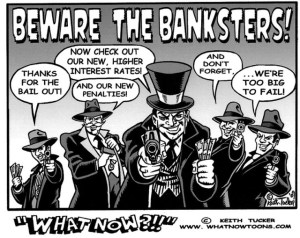
Bank Crimes Pay: Under the Thumb of the Global Financial Mafiocracy

banksters-too-big-to-fail-640x509

By Andrew Gavin Marshall

Source: Occupy.com

On Nov. 13, the United Kingdom’s Serious Fraud Office (SFO) announced it was charging 10 individual bankers, working for two separate banks, Deutsche Bank and Barclays, with fraud over their rigging of the Euribor rates. The latest announcement shines the spotlight once again on the scandals and criminal behavior that have come to define the world of global banking.

To date, only a handful of the world’s largest banks have been repeatedly investigated, charged, fined or settled in relation to a succession of large financial scams, starting with mortgage fraud and the Libor scandal in 2012, the Euribor scandal and the Forex (foreign exchange) rate rigging. At the heart of these scandals, which involve the manipulation of interest rates on trillions of dollars in transactions, lie a handful of banks that collectively form a cartel in control of global financial markets – and the source of worldwide economic and financial crises.

Banks such as HSBC, JPMorgan Chase, Barclays, Bank of America, Citigroup, Deutsche Bank, Royal Bank of Scotland and UBS anchor the global financial power we have come to recognize as fraud. The two, after all, are not mutually exclusive. In more explicit terms, this cartel of banks functions as a type of global financial Mafia, manipulating markets and defrauding investors, consumers and countries while demanding their pound of flesh in the form of interest payments. The banks force nations to impose austerity measures and structural reforms under the threat of cutting off funding; meanwhile they launder drug money for other cartels and organized crime syndicates.

Call them the global Mafiocracy.

In May, six major global banks were fined nearly $6 billion for manipulation of the foreign exchange market, which handles over $5 trillion in daily transactions. Four of the six banks pleaded guilty to charges of “conspiring to manipulate the price of U.S. dollars and euros exchanged.” Those banks were Citigroup, JPMorgan Chase, Barclays and Royal Bank of Scotland, while two additional banks, UBS and Bank of America, were fined but did not plead guilty to the specific charges. Forex traders at Citigroup, JPMorgan Chase and other banks conspired to manipulate currency prices through chat room groups they established, where they arrogantly used names like “The Mafia” and “The Cartel.”

The FBI said the investigations and charges against the big banks revealed criminal behavior “on a massive scale.” The British bank Barclays paid the largest individual fine at around $2.3 billion. But as one trader at the bank wrote in a chat room conversation back in 2010, “If you aint cheating, you aint trying.” The total fines, while numerically large, were but a small fraction of the overall market capitalization of each bank – though the fine on Barclays amounted to some 3.4% of the bank’s market capitalization, the highest percentage by far among the group.

Despite the criminal conspiracy charges covering the years 2007 through 2013, the banks and their top officials continue to lay the blame squarely at the feet of individual traders. Axel Weber, the former president of the German Bundesbank (the central bank of Germany), who is now chairman of Switzerland’s largest bank, UBS, commented that “the conduct of a small number of employees was unacceptable and we have taken appropriate disciplinary actions.”

Looking at the larger scale of bank fines and fraud in the roughly eight years since the global financial crisis, the numbers increase substantially. In addition to a 2012 settlement for mortgage-related fraud in the U.S. housing market, which amounted to some $25 billion, several large banks paid individual fines related to mortgage and foreclosure fraud – including a $16 billion fine for Bank of America, and $13 billion for JPMorgan Chase. Added to these are fines related to the rigging of the Libor rate (the interest rate at which banks lend to each other) and the Forex rigging, as well as money laundering, violating sanctions, manipulating the price of gold, manipulating the U.S. electricity market and assisting tax evasion, among other crimes.

According to a research paper published in June, the total cost of litigation (fines, penalties, settlements, etc.) paid by 16 major global banks since 2010 has reached more than $300 billion. Bank of America paid the most, amounting to more than $66 billion, followed by JPMorgan Chase, Lloyds, Citigroup, Barclays, RBS, Deutsche Bank, HSBC, BNP Paribas, Santander, Goldman Sachs, Credit Suisse, UBS, National Australia Bank, Standard Chartered and Société Générale.

Virtually all of these banks also appear on a list of data, compiled through 2007, revealing them to be among the most interconnected and powerful financial institutions in the world. This core group of corporations forms part of a network of 147 financial institutions that Swiss scientists refer to as the “super-entity,” which, through their various shareholdings, collectively controland own each other and roughly 40% of the world’s 43,000 largest transnational corporations.

In other words, the big banks – along with large insurance companies and asset management firms – do not simply act as a cartel in terms of engaging in criminal activities, but they form a functionally interdependent network of global financial and corporate control. Further, the banks work together in various industry associations and lobbying groups where they officially represent their collective interests.

The largest European banks and financial institutions are represented by the European Financial Services Round Table (EFR), whose membership consists of the CEOs or Chairmen of roughly 25 of the top financial institutions on the continent, including Deutsche Bank, AXA, HSBC, Allianz, RBS, ING, Barclays, BNP Paribas, UBS, and Credit Suisse, among others.

In the United States, the Financial Services Forum (FSF) represents the largest American along with some European banks and financial institutions. The Forum’s membership consists of less than 20 executives, including the CEOs or Chairmen of such firms as Bank of America, Morgan Stanley, JPMorgan Chase, Goldman Sachs, Citigroup, UBS, HSBC, AIG, Bank of New York Mellon, State Street Corporation, Deutsche Bank and Wells Fargo, among others.

And on a truly global scale, there is the Institute of International Finance (IIF), the premier global association representing the financial industry, with a membership of nearly 500 different institutions from more than 70 countries around the world, including banks, insurance companies, asset management firms, sovereign wealth funds, central banks, credit ratings agencies, hedge funds and development banks.

In addition to these various groups and associations, many of the same large banks and their top executives also serve as members, leaders or participants in much more secretive groups and forums – for example, the International Monetary Conference (IMC), a yearly meeting of hundreds of the world’s top bankers hosted by the American Bankers Association, which invites selected politicians, central bankers and finance ministers to attend their off-the-record discussions. In addition, there is the Institut International d’Etudes Bancaires (International Institute of Banking Studies), or IIEB, which brings together the top officials from dozens of Europe’s major financial institutions for discussions with central bankers, presidents and prime ministers in “closed sessions” with virtually no coverage in the media.

These financial institutions are major owners of government debt, which gives them even greater leverage over the policies and priorities of governments. Exercising this power, they typically demand the same thing: austerity measures and “structural reforms” designed to advance a neoliberal market economy that ultimately benefits those same banks and corporations. The banks in turn create the very crises that require governments to bail them out, racking up large debts that banks turn into further crises, pressuring economic reforms in return for further loans. The cycle of crisis and control continues, and all the while, the big banks and financial institutions engage in criminal conspiracies, fraud, manipulation and money-laundering on a massive scale, including acting as the financial services arm of the world’s largest drug cartels and terrorists organizations.

Welcome to the world governed by the global financial Mafiocracy – because if you’re not concerned, you’re not paying attention.

Why the Drug War Has Been a Forty-Year Lynching

nixon-war-on-drugs-quote

By Bob Fitrakis and Harvey Wasserman

Source: FreePress.org

The Drug War has been a forty-year lynching….
…the corporate/GOP response to the peace and civil rights movements.

It’s used the Drug Enforcement Administration and other policing operations as a high-tech Ku Klux Klan, meant to gut America’s communities of youth and color.

It has never been about suppressing drugs. Quite the opposite.

And now that it may be winding down, the focus on suppressing minority votes will shift even stronger to electronic election theft.

The Drug War was officially born June 17, 1971, (http://www.drugpolicy.org/new-solutions-drug-policy/brief-history-drug-war) when Richard Nixon pronounced drugs to be “Public Enemy Number One.” In a nation wracked by poverty, racial tension, injustice, civil strife, ecological disaster, corporate domination, a hated Vietnam War and much more, drugs seemed an odd choice.
In fact, the Drug War’s primary target was black and young voters.

It was the second, secret leg of Nixon’s “Southern Strategy” meant to bring the former Confederacy into the Republican Party.

Part One was about the white vote.

America’s original party of race and slavery (https://zinnedproject.org/materials/a-peoples-history-of-the-united-states-updated-and-expanded-edition/)was Andrew Jackson’s Democrats (born 1828).

After the Civil War the Party’s terror wing, the KKK, made sure former slaves and their descendants “stayed in their place.”

A century of lynchings (at least 3200 of them) (http://www.yale.edu/ynhti/curriculum/units/1979/2/79.02.04.x.html)efficiently suppressed the southern black community.

In the 1930s Franklin Roosevelt’s New Deal social programs began to attract black voters to the Democratic Party. John Kennedy and Lyndon Johnson’s support for civil and voting rights legislation, plus the 24th Amendment ending the poll tax, sealed the deal. Today blacks, who once largely supported the Party of Lincoln,  vote 90% or more Democrat (http://blackdemographics.com/culture/black-politics/).

But the Democrats’ lean to civil rights angered southern whites. Though overt racist language was no longer acceptable in the 1970s, Nixon’s Republicans clearly signaled an open door to the former Confederacy (https://www.thenation.com/article/why-todays-gop-crackup-is-the-final-unraveling-of-nixons-southern-strategy/).

But recruiting angry southern whites would not be enough for the Republicans to take the south. In many southern states more than 40% of potential voters were black. If they were allowed to vote, and if their votes were actually counted, all the reconstructed Democrat Party would need to hold the south would be a sliver of moderate white support.

That’s where the Drug War came in.

Reliable exact national arrest numbers from 1970 through 1979 are hard to come by.

But according to Michelle Alexander’s superb, transformative The New Jim Crow, and according to research by Marc Mauer and Ryan King of the Sentencing Project, more than 31,000,000 Americans were arrested for drugs between 1980 and 2007 (http://newjimcrow.com).

Further federal uniform crime report statistics compiled by www.freepress.org indicate that, between 2008 and 2014, another 9,166,000 were arrested for drug possession.
Taken together, than means well over 40,000,000 American citizens have been arrested for drugs in the four decades since Nixon’s announcement.
It is a staggering number: more than 10% of the entire United States, nearly four times the current population of Ohio, far in excess of more than 100 countries worldwide.
A number that has gutted the African-American community.  A national terror campaign far beyond the reach of even the old KKK.
Justice Department statistics indicate than half of those arrests have been for simple possession of marijuana.
According to US Bureau of Justice statistics, between 1980 and 2013, while blacks were 12% of the population, blacks constituted 30% of those arrested for drug law violations and nearly 40% of those incarcerated in all U.S. prisons.  Thus some 20,000,000 African-American men have been sent to prison for non-violent “crimes” in the past forty years.
If the Hispanic population is added in, as much as 60% of drug arrests are of racial or ethnic minorities.
On the 40th anniversary of the Drug War in 2010, the Associated Press used public records to calculate that the taxpayer cost of arresting and imprisoning all these human beings has been in excess of $1,000,000,000.
Sending them all to college would have been far cheaper.  It also would have allowed them to enhance and transform their communities.
Instead, they were taken from their families.  Their children were robbed of their parents.  They were assaulted by the prison culture, stripped of their right to vote and stopped from leading the kind of lives that might have moved the nation in a very different direction.
Nixon also hated hippies and the peace movement. So in addition to disenfranchising 20,000,000 African-Americans, the Drug War has imprisoned additional millions of young white and Hispanic pot smokers.
Thus the DEA has been the ultra-violent vanguard of the corporate culture war.
In 1983 Ronald Reagan took the Drug War to a new level.  Using profits from his illegal arms sales to Iran, he illegally funded the Contra thugs who were fighting Nicaragua’s duly elected Sandinista government.
The Contras were drug dealers who shipped large quantities of cocaine into the US—-primarily in the Los Angeles area—-where it was mostly converted to crack.
That served a double function for the GOP.
First, it decimated the inner city.
Then Reagan’s “Just Say No” assault—-based on the drugs his Contra allies were injecting into our body politic—-imposed penalties on crack far more severe than those aimed at the powdered cocaine used in the white community.
In 1970 the US prison population was roughly 300,000 people.  Today it’s more than 2.2 million, the largest in world history by both absolute number and percentage of the general population.  There are more people in prison in the US than in China, which has five times the population (http://www.bjs.gov/index.cfm?ty=tp&tid=11).

According to the Sentencing Project, one in seventeen white males has been incarcerated, one in six Latinos, and one in three blacks.
By all accounts the Drug War has had little impact on drug consumption in the US, except to make it more profitable for drug dealers (http://www.bjs.gov/index.cfm?ty=tp&tid=11).  It’s spawned a multi-billion-dollar industry in prison construction, policing, prison guards, lawyers, judges and more, all of them invested in prolonging the drug war despite its negative impacts on public health.

For them, the stream of ruined lives of non-violent offenders is just another form of cash flow.
Like the Klan since the Civil War, the Drug War has accomplished its primary political goal of suppressing the black vote and assaulting the African-American community.
It’s shifted control of the South from the Democrats back to the Republican Party. By slashing voter eligibility and suppressing black turnout, the Drug War crusade has helped the GOP take full control of both houses of the US Congress and a majority of state governments across the US.
But the repressive impacts hit everyone, and ultimately enhance the power of the corporate state.
Toward that end, the southern corporate Democrat Bill Clinton’s two terms as a Drug Warrior further broadened the official attack on grassroots America. Clinton was determined to make sure nobody appeared tougher on “crime.”  He escalated the decimation of our democracy far beyond mere party politics, deepening the assault on the black community, and the basic rights of all Americans for the benefit of his Wall Street funders.  Obama has been barely marginally better.
In political terms, the Nixon-Reagan GOP remains the Drug War’s prime beneficiary. Today’s Republicans are poised to continue dominating our electoral process through the use of rigged electronic registration rolls and voting machines. That’s a core reality we all must face.
But no matter which party controls the White House or Congress, by prosecuting a behavior engaged in by tens of millions of Americans, the Drug War lets the corporate state arrest (and seize assets from) virtually anyone it wants at any time. It has empowered a de facto corporate police state beyond public control.

Regardless of race, we all suffer from the fear, repression and random assaults of a drug-fueled repressive police force with no real accountability.
In the interim, the Drug War is not now and never has been about drugs.
Legalizing pot is just the beginning of our recovery process.
Until we end the Drug War as a whole, America will never know democracy, peace or justice.
____________________
THE SIXTH JIM CROW: ELECTRONIC ELECTION THEFT & THE 2016 SELECTION will be released by Bob Fitrakis & Harvey Wasserman by January, 2016. Their CITIZEN KASICH will follow soon thereafter. Bob’s FITRAKIS FILES are at www.freepress.org; Harvey’s ORGANIC SPIRAL OF US HISTORY will appear in 2016.

Related video:

Glenn Greenwald Stands by the Official Narrative

2014_09_Screen-Shot-2014-09-12-at-12.35.03-PM

By William A. Blunden

Source: Dissident Voice

Glenn Greenwald has written an op-ed piece for the Los Angeles Times. In this editorial he asserts that American spies are motivated primarily by the desire to thwart terrorist plots. Such that their inability to do so (i.e., the attacks in Paris) coupled with the associated embarrassment motivates a public relations campaign against Ed Snowden. Greenwald further concludes that recent events are being opportunistically leveraged by spy masters to pressure tech companies into installing back doors in their products. Over the course of this article what emerges is a worldview which demonstrates a remarkable tendency to accept events at face value, a stance that’s largely at odds with Snowden’s own documents and statements.

For example, Greenwald states that American spies have a single overriding goal, to “find and stop people who are plotting terrorist attacks.” To a degree this concurs with the official posture of the intelligence community. Specifically, the Office of the Director of National Intelligence specifies four topical missions in its National Intelligence Strategy: Cyber Intelligence, Counterterrorism, Counterproliferation, and Counterintelligence.

Yet Snowden himself dispels this notion. In an open letter to Brazil he explained that “these [mass surveillance] programs were never about terrorism: they’re about economic spying, social control, and diplomatic manipulation. They’re about power.”

And the public record tends to support Snowden’s observation. If the NSA is truly focused on combatting terrorism it has an odd habit of spying on oil companies in Brazil and Venezuela. In addition anyone who does their homework understands that the CIA has a long history of overthrowing governments. This has absolutely nothing to do with stopping terrorism and much more to do with catering to powerful business interests in places like Iran (British Petroleum), Guatemala (United Fruit), and Chile (ITT Corporation). The late Michael Ruppert characterized the historical links between spies and the moneyed elite as follows: “The CIA is Wall Street, and Wall Street is the CIA.”1

The fact that Greenwald appears to accept the whole “stopping terrorism” rationale is extraordinary all by itself. But things get even more interesting…

Near the end of his article Greenwald notes that the underlying motivation behind the recent uproar of spy masters “is to depict Silicon Valley as terrorist-helpers for the crime of offering privacy protections to Internet users, in order to force those companies to give the U.S. government ‘backdoor’ access into everyone’s communications.”

But if history shows anything, it’s that the perception of an adversarial relationship between government spies and corporate executives has often concealed secret cooperation. Has Greenwald never heard of Crypto AG, or RSA, or even Google? These are companies who at the time of their complicity marketed themselves as protecting user privacy. In light of these clandestine arrangements Cryptome’s John Young comments that it’s “hard to believe anything crypto advocates have to say due to the far greater number of crypto sleazeball hominids reaping rewards of aiding governments than crypto hominid honorables aiding one another.”

It’s as if Greenwald presumes that the denizens of Silicon Valley, many of whose origins are deeply entrenched in government programs, have magically turned over a new leaf. As though the litany of past betrayals can conveniently be overlooked because things are different. Now tech vendors are here to defend our privacy. Or at least that’s what they’d like us to believe. In the aftermath of the PRISM scandal, which was disclosed by none other than Greenwald and Snowden, the big tech of Silicon Valley is desperate to portray itself as a victim of big government.

You see, the envoys of the Bay Area’s new economy have formulated a convincing argument. That’s what they get paid to do. The representatives of Silicon Valley explain in measured tones that tech companies have stopped working with spies because it’s bad for their bottom line. Thus aligning the interests of private capital with user privacy. But the record shows that spies often serve private capital. To help open up markets and provide access to resources in foreign countries. And make no mistake there’s big money to be made helping spies. Both groups do each other a lot of favors.

And so a question for Glenn Greenwald: what pray tell is there to prevent certain CEOs in Silicon Valley from betraying us yet again, secretly via covert backdoors, while engaged in a reassuring Kabuki Theater with government officials about overt backdoors? Giving voice to public outrage while making deals behind closed doors. It’s not like that hasn’t happened before during an earlier debate about allegedly strong cryptography. Subtle zero-day flaws are, after all, plausibly deniable.

How can the self-professed advocate of adversarial journalism be so credulous? How could a company like Apple, despite its bold public rhetoric, resist overtures from spy masters any more than Mohammad Mosaddegh, Jacobo Árbenz, or Salvador Allende? Doesn’t adversarial journalism mean scrutinizing corporate power as well as government power?

Glenn? Hello?

Methinks Mr. Greenwald has some explaining to do. Whether he actually responds with anything other than casual dismissal has yet to be seen.

  1. Michael C. Ruppert, Crossing the Rubicon: The Decline of the American Empire at the End of the Age of Oil, New Society Publishers, 2004, Chapter 3, page 53.

Bill Blunden is an independent investigator whose current areas of inquiry include information security, anti-forensics, and institutional analysis. He is the author of several books, including The Rootkit Arsenal and Behold a Pale Farce: Cyberwar, Threat Inflation, and the Malware-Industrial Complex. He is the lead investigator at Below Gotham Labs. 

Little Murders in Retrospect

LittleMurders_blood2

By John R. Hall

Source: Dissident Voice

After their wildly successful anti-war classic Mash, actors Elliott Gould and Donald Sutherland ventured out on a very weak limb and made a film version of a hit and miss Broadway production.  Alan Arkin directed the film and played the part of mentally disturbed Lieutenant Practice of the NYPD.  The year was 1971.  My beautiful baby daughter had just entered the world.  I’d recently been convicted of twice refusing induction into the U.S. Army, and was awaiting my court date for sentencing.  Somehow, amid the mix of joy, sadness, and confusion, my wife and I managed to slip out and take in a movie.  Little Murders would haunt me for the rest of my life.

If you’re like virtually everyone I’ve ever quizzed about Little Murders, you not only missed seeing it, you’ve never even heard of it.  It is also likely that, if you happen to be among the few who actually saw it, you’d really like to forget it.  But, of course, you can’t.  44 years later I don’t remember all the gory details of the flick, but I do remember apathetic Alfred Chamberlain (Elliott Gould), focusing his camera on a newly deposited bowel movement in a toilet, and on a steaming pile of dog crap in a park.  He was a photographer and poop was his forte.  His subject matter of choice also reflected his world view.  If Alfred could have possibly cared less about anything, he would have.  Alfred’s world was shit.

Then one day while he was being beaten to a bloody pulp by street thugs, and not even bothering to defend himself, Alfred was saved by feisty, optimistic Patsy Newquist (Marcia Rodd).  Apathist that he was, Alfred tried to walk away without even thanking his heroine.  But Patsy fell for him, and decided to show him that the world wasn’t such a bad place after all.  It was no easy task, but she eventually married Alfred, put a hesitant smile on his glum face, taught him to fight for himself,  and convinced him that life was worth living.  Then she took a random bullet, splattering her husband with blood, and dying.

Little Murders took place in a somewhat exaggerated version of New York City, or Anytown, U.S.A.  Civil society had spiraled out of control and degenerated into a cesspool of fear, loathing, and random violence.  In spite of the raging nightmare of The Vietnam War, few Americans in 1971 would have believed that their country 44 years later would become such an accurate replica of the social wasteland of “Little Murders”.  But that is exactly where we are today, and then some; living in a world so violent and cold that there is nothing left which can shock us.  Mass murders, school shootings, infanticide, beheadings, immolation, cops run amok, manufactured terrorism, the Airport Gestapo, black sites and torture, endless wars for corporate profit, daily specter of nuclear annihilation.

But here in the U.S.A. we like to look on the bright side.  No sense in focusing on the negative when there’s so much positive energy in the world.  We’ve got Kim Kardashian’s ass to obsess about.  A spectacular spectators’ array of gladiator sports:  NFL, NBA, MLB, NHL, NCAA FB, Cage Fighting, NASCAR, Pro golf & tennis.  Black Friday deals on electronics, reality television, celebrity weddings, divorces, and sex changes, Dancing with the Stars, The Voice.  The upcoming Presidential Coronation Circus and Candy Crush.  Did I mention Kim Kardashian’s ass?  Thank God for Pollyanna’s Glad Game.  If not for such an array of inane, petty distractions, Americans would all end up like apathetic Alfred Chamberlain, or worse yet like angry, infuriated me.

Any American with his head screwed on straight should have suffered an extended and incurable case of righteous indignation by now.  While the National Rifle Association has succeeded in enshrining The Second Amendment alongside mom, home, and apple pie, little murders on the domestic front have been on the rise to the point that they’re as common as bedbugs in cheap motels.  But my countrymen do love their portable WMDs, apparently more than life itself.  It’s not just gun violence defining the nightmare which is America.  What has finally emerged is a complete lack of respect.  Respect for self and others, for all life forms, for Mother Earth itself.  Anyone paying attention can see it in their actions.  They litter the streets with their garbage, litter their skin with ill-conceived epidermal etchings, litter their bodies with poisonous food-like substances and soul-killing drugs, litter maternity wards with litters of unwanted children.  Alfred Chamberlain’s world has grown to fruition.

Of course, Americans have had plenty of inspiration as they’ve sacrificed their souls upon the alter of American Exceptionalism.  Their government has waged a nearly non-stop series of wars for corporate profit since Vietnam, Laos, and Cambodia.  Anyone paying a lick of attention knows that every one of these wars were waged for the benefit of Ronald McDonald and Mickey Mouse, and that official government explanations are only believed by fools.  At least our heroes in the White House, the Halls of Congress, and the Pentagon learned something during the Vietnam fiasco:  The new definition of winning a war is that you slaughter as many civilians as possible, bomb cities, destroy infrastructure, burn crops, and create enough chaos that the U.S. Military is forced to open permanent bases and swing wide the doors for corporate plunder.  Conveniently under armed protection.

This is exactly what happened in Afghanistan and Iraq, what went on in Libya recently, and what is now happening in Syria and elsewhere.  The American agenda is being rammed down the throats of unwilling participants wherever there are valuable resources to be plundered by Wall Street pirates.  Migrations of refugees from U.S. bombings seek asylum elsewhere, while foolish, careless Americans pay little heed.  A few hoorays for the red, white, and blue, thanks to our brave fighting men for slaughtering innocent foreigners, and back to watching Kim Kardashian’s ass over a can of Coca-Cola.  Things go better with Coke.

In 1971, I was shocked by the last scene of Little Murders, in which Alfred (still wearing his shirt splattered with his wife’s blood), and the father and brother of his recently deceased bride finally have a few moments of sheer joy.  Taking turns with a loaded rifle, they join in with their fellow New York citizens, becoming snipers from their apartment window,  Finding fun and laughter with each kill.  I’d no longer be shocked by the scene.  Now I get it.  It’s what species do in the final death throes of extinction.


Related Articles

“One of Those Little Things You Learn to Live with”:  On the Politics of Violence in Jules Feiffer’s Little Murders

Saturday Matinee: Little Murders

Turkey-NATO Crisis Sets The Scene For New European ‘EU Army’

nato-1

By Patrick Henningsen

Source: 21st Century Wire

They say there are no coincidences in politics and foreign affairs.

Less than 72 hours after Turkey shot down a Russian fighter inside of Syrian airspace, moves are already afoot to increase the role of Europe in Syria.

Germany has now joined the party this week by revealing its intention to deploy ground troops in the fight against ISIS. Angela Merkel’s government announced its plan to send 100 Bundeswehr Special Forces into Northern Iraq to support of the Kurdish Peshmerga forces.

Britain is not far behind either, as David Cameron intensifies his lobbying efforts to get his country into the war in Syria.

Is this part of a defacto NATO action now, or NATO by fiat? If only it were that simple…

There is much more going on here than meets the eye. With Germany now entering the fray, this brings a total of at least FIVE major NATO member states who are either actively involved in the fight, or about to enter the combat theater. The most important point here is that each and every one of these countries is in the conflict in clear violation of international law. Neither has the backing of the UN Security Council, or has an invitation from the legal and internationally recognized (including by the UN) government in Damascus. In addition, none of these actors is acting under NATO Article 5, in other words, none has been attacked by another internationally recognized nation-state of entity (although it’s curious why the western governments have insisted on referring to a brutal terrorist group as a “State”, unless of course, they recognize it as such, which somehow gives them the color of law in Article 5).

For all intents and purposes, NATO is already in. Here are the FIVE major NATO members, all of whom appear to be operating under highly dubious mandates in and around Syria:

France

Following the Paris Attacks on Friday the 13th, and still without any real evidence presented to the public that ISIS itself was responsible for the Paris Attacks – almost immediately, France deployed the full-force of its military supposedly to hit ISIS targets in the alleged Islamic State “stronghold” of Raqqa, Syria. Coincidentally, even mainstream reports questioned what the objective of France’s airstrikes were (all target data was supplied by the US), with some claiming that the French move was purely for show and that they could not confirm any actual ISIS militants were killed. Note that France had already been caught announcing its move of the aircraft carrier Charles de Gaulle to Syria on Nov 5th – a full week before the Paris attacks. Of course, no mention of this in the media.

Aside from giving the state license to unleash a new level of domestic Police State at home, more importantly, the Paris Attacks gave France an immediate “official” entry into the Syria War. Undoubtedly, this was a huge game-changer.

United States

When the ‘Islamic State Caliphate’ crisis public relations campaign was officially launched by the US-UK Government-Media Complex in June 2014 (before that, there was scant if little mention of this branded terror organization by western politicians and media outlets), it took some time before the US announced its grand ‘Anti-ISIS Coalition’. Perhaps ISIS needed more time to get organized, and to release a series of shocking internet videos of which the western media fed off – – and which were mostly proven as fakes and digital forgeries. Something was not right about the ISIS Crisis by US media outlets who were so enthralled with the sensational propaganda videos that no one dared question the lack of authenticity of what was eventually exposed as fake ISIS beheading video productions (the CIA has previously admitted staging such videos) or the ISIS narrative itself. Oddly, the western media treated anything coming out of ISIS HQ as sacred and unimpeachable in media terms. It wasn’t until Iranian and Hezbollah ground forces entered the fight against ISIS that US President Barack Obama finally decided it was time to move in August 2014 by waging airstrikes in Northern Iraq. Over the next few months, the US began assembling its ‘Anti-ISIS (ISIL) Coalition’, although it was hard to spot anyone else in the ‘Coalition’ other than the US.

It should be noted that on the first day of US airstrikes inside Syria (Sept 23, 2014), it was pretty clear that the US had actually bombed a series of empty buildings in Raqqa, Syria (somehow ISIS was tipped off before hand, weeks in advance, in fact). Not a good start to the “big push”. At that point, our suspicions were confirmed – that the US had no intention of actually rooting out ISIS, and that secretly Washington was actually hoping that ISIS and other terrorist brigades on the ground could do what their previous proxy ground force, the Free Syria Army, could not do – which was to overthrow the government in Damascus, which Washington and its allies refer to (just in like Iraq in 2003) the ‘Assad regime’.

Great Britain

It’s no surprise that the British Tory government has been chomping at the bit to get into the Syrian War. In August 2013, they nearly got their mandate, but lost in a Parliamentary vote. Some Tory ministers had public temper tantrums. As it turns out, the pretext for their entire push for war, ‘WMDs’, aka chemical weapons (Sarin) allegedly deployed by Syrian government forces – was exposed as a false flag attack and the US-UK’s attempt to blame Syrian President Bashar al Assad was a media fiction (just in like Iraq in 2003), a chemical attack launched by the US-led Coalition’s ‘Moderate Rebels” in order to blame the government of Syria and trigger a western intervention. The plan was a complete failure, so bad in fact, it caused the US to back off their own war vote a month later in September 2013.

It seems that the Paris Attacks have also given David Cameron some wind in his war sails too, and yesterday we discovered that the French government is now lobbying for Britain’s Royal Air Force to join in the scrum, with London stating that it, “will soon be working side by side with their French counterparts” in taking military action in Syria. In order to help sell this new leg of the war, the French were provided the use of famed ‘liberal’ British newspaper  The Guardian to openly lobby for British involvement by claiming it would “put additional and extreme pressure on the ISIS terror network”. The article goes on to describe the work Britain is already doing as part of the ‘Coalition’:

“The RAF has significant capabilities for precision airstrikes, aerial reconnaissance and air-to-air refuelling support,” he says. “On a daily basis, its Tornado aircrafts and unmanned drones are causing very severe damage to Isis in Iraq. The use of these capabilities over Syria would put additional and extreme pressure on the Isis terror network.”

So what’s Cameron’s rush to get deeper into the Syrian side of the conflict? It appears as if the Paris Attacks have given Cameron a new life-line on the Syria War vote, one he’s long been pursuing. The shock and horror of Paris will certainly help his case pass muster with public opinion in accepting his long-term agenda to deploy British military assets in Syria. One reason is to showcase British hardware to the world’s lucrative arms sales market, something Cameron is no stranger to after performing the role as sales closer for BAE Systems and other firms landing billion dollar contracts in the Gulf in recent years. Currently, Cameron is desperate to rescue those contracts which threaten to be scrapped over an ‘inconvenient’ human rights row between Westminster’s political left and the Kingdom over Saudi’s plan to behead and crucify a 17 old boy – the son of a Shia activist. Covering Saudi Arabia’s ghastly human rights record in favor of turning a few quid (tens of billions for 100 Typhoon jets and a prison contract) has always been an obsession of Westminster. Coupled with the Syria issue, this last row has prompted some of most amazing double speak and spin ever seen coming out of the Foreign Office, as evidenced by this humdinger about “The World’s Most Misunderstood Feudal Kingdom: Saudi Arabia”, seemingly straight out of the Office of Information Dispersal:

“One well-placed Whitehall source said: “It appears that the Saudis believe that they are being treated like a political football and had enough. It was only after the personal intervention of the Prime Minister that the situation has temporarily cooled but the Saudis want assurances.”

It gets worse, as Westminster is trying to sell the idea that somehow Saudi Arabia has ‘absolutely nothing to do’ with ISIS. Seriously…

“In the week that Andrew Parker, the head of MI5, warned that Britain is facing mass casualty attacks from Isil terrorists, Number 10 is desperate to ensure that it maintains good relations with Saudi Arabia, its most important ally in the Middle East. There were fears that the increased tensions between the two countries might result in the Saudis scaling down their vital intelligence-sharing arrangement with British intelligence, as well as jeopardising future lucrative arms deals with British firms such as BAE Systems.”

And we wonder why the public is mostly clueless as to what’s happening in Syria. They hardly stand a chance against such a relentless propaganda oracle.

Germany

This week, German Defense Minister Ursula von der Leyen, Foreign Minister Frank-Walter Steinmeier, Interior Minister Thomas de Maizière and Justice Minister Heiko Maas, drafted a plan for military intervention and held a secret meeting on Thursday – to discuss exactly how this would be managed in terms of public relations, Bild newspaper reported. There are some historic considerations regarding Germany in this story, too. RT adds here:

“The cabinet is set to discuss the bill that may raise the question of a constitutional change on December 17. German Basic Law has strict limits on military involvement since the end of World War II, originally destined to prevent a revival of Nazi crimes.”

Considering how Turkey’s recent dangerous provocation ‘stunt’ was no accident, and how NATO members are beginning to back away from Turkey slightly (albeit temporarily, at least), the international focus is finally shifting towards Turkey’s obvious and direct role in facilitating and even supporting the rise of ISIS and al Nusra (al Qaeda in Syria), and many other Islamic militant fighting groups active in Syria.

Turkey

Turkey is guilty on potentially two international war crimes according to the Geneva Conventions – shooting down an aircraft in Syrian airspace (it’s becoming clearer from multiple reports that the Turkish F16 air-to-air missile may have fired in Turkish airspace, but the missile hit the Russian fighter in Syrian airspace, a clear war crime), and also the fact that Turkey is providing direct support to the same jihadi Turkmen insurgents who then shot and killed a Russian pilot while he was parachuting in the air, another war crime. In fact, one of the NATO-backed ‘moderate’ terrorists who boasted of killing the downed pilot is actually a Turkish citizen with links to both elected officials and a ultra-nationalist group, the Grey Wolves, based in Turkey.

This is only the beginning of Turkey’s problems. President Recep Tayyip Erdogan has been accused of harboring a Sultan Complex – hoping to lead Turkey’s restoration to its former seat at the head of the Islamic world, in an Ottoman Caliphate redux. Add to this fresh allegations of his son Bilal’s business links to ISIS, and we can see how this mafia state may have too many crimes to answer for when it’s all said and done. If Turkey becomes an international pariah for its increasingly obvious collusion with ISIS and the wider terrorist conclave gallivanting freely through Syria and Turkey – then there could be calls for NATO to dump the rogue state and bad actor in the Syrian conflict.

Consider the Hegelian Dialectic as in, problem, reaction, solution. Problem: Turkey has ‘gone rogue’. Reaction: Turkey must leave NATO. Solution: the formation of a new, well-funded European-based multilateral military organization.What would that look like? Perhaps something like this…

‘New Model Army’ For Europe

If a major NATO player like Turkey is dumped from NATO, then this means that western central planners no longer have a multilateral ‘beach head’ positioned at the historic crossroads of Europe, Middle East and Asia.

Back in March 2015, 21WIRE reported something which many may have missed at the time, but what we thought was significant. European Commission President Jean-Claude Juncker announced that the European Union (EU) now needs a new standing army, or an “EU Army” – supposedly to “defend its values” from the sudden existential threats. He was not referring to ISIS, but to Russia. Two months later, Junker called for it again while saying, “Such an army would also help us to form common foreign and security policies and allow Europe to take on responsibility in the world.” Clearly this is no fluke, and it’s been brewing under our noses for a few years now. Back in Dec 2013, during a “heated” summit debate, Speaker of the European Parliament Martin Schulz called for the creation of a EU Army. The Telegraph reported:

“If we wish to defend our values and interests, if we wish to maintain the security of our citizens, then a majority of MEPs consider that we need a headquarters for civil and military missions in Brussels and deployable troops.” Geoffrey Van Orden MEP, the Conservative spokesman on European defence, said that the prime minister had “turned the tide on an EU army”. “It’s been a long haul to get to this position,” he said.

On the surface, one might read that NATO would be unhappy with a call from Brussels for a new EU Army, but Jucker’s call was only an opening salvo in a larger transatlantic political shift taking place right now. To prove our point, we can show our readers that right on cue this week, we see mainstream media propaganda being ramped-up to make the public used to the idea of an EU Army. Holding the baton on this story is ‘liberal’ newspaper The Independent:

“The British public is broadly supportive of the creation of a standing army for the European Union, a new poll suggests. The YouGov survey found that 36 per cent actively supported a permanent multi-national  force drawn from all the bloc’s nations, compared to only 29 per cent who opposed such a move.”

Anyone who has actually been paying attention to the declining state of the British military will know that it’s almost down to a level where it cannot possibly function autonomously. Soon, all that will remain are a few shiny set-pieces like the Trident nuclear submarine fleet, but more importantly – the key remaining component: a rapid reaction, special forces capability which will slot into the new EU Army matrix. Anything which is not fulfilling a role within the larger infrastructure will be scrapped.

Not convinced? Consider this little known fact, revealed in early 2011 in an investigation by the UK Column into David Cameron’s 50 year ‘Defence Pact’ with France – plan that was hatched behind closed doors through the front organization called the Franco British Council, a charity supposedly set up to foster good relations between Britain and France. This was one of many quiet moves engineered to nudge Britain’s military into an eventual EU Army.

For any remaining doubters that an EU Army is not only in the cards, but is in its final stages of planning between Germany, France and Britain and others, note how just two months ago, Angela Merkel was seen openly ‘horse trading’ with David Cameron – asking him to drop his (public) opposition to an EU Army… in exchange for Germany supporting Britain’s “renegotiation” of EU membership, presumably on issues of welfare spending and immigration. The Telegraph states:

“The German chancellor will ask Britain to stand aside as she promotes an ambitious blueprint to integrate continental Europe’s armed forces.”

“While there is no expectation or obligation for Britain to take part in steeper integration, the creation of an EU army could marginalise Britain within Nato and result in the United States downgrading the special relationship with Britain in favour of Paris and Berlin, experts warn.”

“The Telegraph has seen an unpublished position paper drawn up by Europe and Defence policy committees of Mrs Merkel’s party, the CDU, that sets out a detailed 10-point plan for military co-operation in Europe. It is understood to closely reflect her thinking, and calls for a permanent EU military HQ, combined weapons procurement and a shared military doctrine.”

“The paper says it is “urgent” to integrate armed forces “in the face of multifaceted crises”.

In other words, it’s more or less a done deal.

So regarding Syria, Turkey, Russia and NATO, as the elite adage goes, “Never let a good crisis go to waste”. There are 5 main points to consider right now:

1. Eurozone Crisis. The Greek economic meltdown, followed by Spain, Portugal, Cyprus and Ireland’s economic struggles means that the European Union’s Eurozone economic integrity is under threat – and by extension, so is their physical shape should any member state eventually want to leave the European Super State. US-led economic sanctions against Russia over the downing of MH17 in 2014 (a likely false flag event of  which the US accused Russia of being ‘responsible’.)

2. EU Crisis. Add to this the recent ‘Migrant Crisis’, and you have a public perception that European borders are under threat, too. In addition, Great Britain has seen a loud clamor to “leave the EU”, led recently by the ruling Tory Party, even though David Cameron has remained a committed Europhile his entire career. Many people viewed the Tory ‘Exit’ Campaign as mere play acting to win-over some available UKIP nationalist votes in the last general election. Ditto with Spain, who was recently blackmailed by Brussels over the prospect of a newly independent Catalonia. No surprise that Spain is set to play a key role in a new EU Army.

3. Migrant Crisis. The current ‘Migrant Crisis’ provides a perfect pretext to call for a new centralized, ‘federal’ EU Border Control Agency. This is a perfect fit with the EU Army. Funny how the entire Migrant Crisis has been unmasked as one of the most engineered and stage-managed crisis events in recent history. A perfect example of how a crisis is used to strengthen an EU Federal State framework. Then comes the killer: in October, Brussels offers Turkey its first step towards ‘normalization with Europe’, or soft membership into the EU. Brussels offered cash and visas to Turkey if it would ‘promise’ to help stop the flow of migrants into the EU. The terms of this latest deal were almost unbelievable. With most of the new ISIS recruits now coming from Turkey,  this new plan will give legal access into Europe for many Syria and Turkey-based ISIS and al Nusra Front terrorists. So Turkey could be out of NATO, but into the EU? Wow.

4. Terrorism Crisis. The Paris Attacks were important in order to join together the Syrian Conflict, the Migrant Crisis and the War on Terror (rebranded now to the ‘War on Radicalization’). From this one event grew a raft of emergency policies, decrees and military actions. For the security state – it was a grand slam. The Paris Attacks also triggered calls for a new EU ‘FBI’ agency to “help combat terror”. Add to this, other calls for an EU ‘CIA’ too. That’s right, all the trappings of a Federal Super State. Still, no one bothered to question the premise of the grand slam, in this case, a planted, fake Syrian passport which magically appeared at the scene of the alleged ISIS suicide bomb attack in Paris on Nov 13th. Forensically speaking, there is no actual proof that ISIS carried out the Paris Attacks. Still, everyone it seems, is assuming it’s ISIS and that it’s connected to Syria. Again, more power flowing to an EU Federal State framework.

4. NATO Crisis. The reality is that the North Atlantic Treaty Organization (NATO) is a Cold War relic that’s way outside the bounds of its original mandate, and has no real practical application in the 21st century. NATO used to have some air of moral mandate around the world but that’s fading quickly. By encircling Russia with missile batteries, signing-up Russia’s neighbors, NATO has become more of an offensive entity, rather than a defensive one. The real dirt on NATO’s hands comes with its dark partnership with NeoNazi factions to help achieve its military objectives in the Ukraine. We also learned this week how NATO has opened up a new proxy war front in Crimea, as western-backed NeoNazis carried out terrorist attacks against Crimean infrastructure, and perhaps the most disturbing report we’ve seen here – what looks like CIA support of Islamic Chechen militants brought into east Ukraine.

There’s another fundamental problem with NATO: funding. The US supplies NATO with approximately 75% of its funding which guarantees that NATO is always under Washington’s control, but the US needs to have real stakeholders in order to have a real ‘alliance’. Few have paid attention to NATO’s ongoing weakening of its military assets, mostly due to a lack of spending by the majority of its member states. Every NATO member state is expected to spend at least 2% of its annual GDP on defense spending. That’s not happening anymore, and there is absolutely nothing the Brussels HQ can do about it outside of the US giving money away to those in financial need. Weapons Welfare? That’s not happening either.

NATO’s days are numbered. All the tea leaves point to its schedule for decommissioning. All NATO needs is a good crisis to hasten that inevitability. Maybe Turkey has delivered the pretext Brussels needs. This does not necessarily mean that NATO would be winded-down, but that it would give way to another military structure – like an EU Army.

You’d expect Washington to be averse to a NATO downgrade, down to a second tier international organization. After all, the US has used NATO as a multilateral trojan horse of sorts – an alternative flag it could fly in order to bypass any due process or Constitutional restrictions in waging war around the globe. In other words, Washington has used NATO to cheat its own laws, and expand its geopolitical hegemony, and to drag along its European partners where possible to help make it look like a ‘team effort’, and a unilateral action. The truth is, regarding international affairs, the US has long-since replaced its NATO widget with the “Coalition” widget, and will wage war as and when. At home, it has replaced the near redundant Constitutional Declaration of War with the more fluid and flexible ‘Authorization of Military Force‘ (AUMF), and the National Defense Authorization Act (NDAA) – which essentially means that, on paper at least (through color of law, and not actual law), that the US is always under emergency war footing.

There is visible US-EU split, one which became evident during the planning of Washington’s coup d’etat in the Ukraine in 2013-2014, when the US Sate Department’s assistant secretary for European affairs, Victoria Nuland was caught on tape telling her colleague Ambassador Geoffrey Pyatt to, “F*ck the EU!”, as they argued over which US-backed puppet leader would be installed in Kiev.

What Washington really wants (and needs) now is a big Coalition partner, preferable one which is not directly governed by a local representative democracy, but governed by a remote, mostly unelected bureaucratic system. In this context, a new European multinational force would be the perfect ‘Coalition’ partner for Washington.

This is where this complex confluence of events is taking us – from Brussels, Paris, Syria, Ukraine, and Russia, all roads lead to an EU Army.

Neoliberalism, Austerity, and Authoritarianism

pnac-criminals-2-1

By Riad Azar

Source: New Politics

Ask anyone what neoliberalism means and they’ll tell you it’s an economic system that corresponds to a particular economic philosophy. But any real-world economic system has a corresponding political system to promote and sustain it. Milton Friedman, who has become known as the father of neoliberal thinking, claims in his text Capitalism and Freedom that “the role of the government … is t o do something that the market cannot do for itself, namely, to determine, arbitrate, and enforce the rules of the game.”* While neoliberalism’s advocates like to claim that the political system that corresponds to their economic preference is a democratic, minimal state, in practice, the neoliberal state has demonstrated quite the opposite tendency.

This essay will begin by sketching out the core tenets of neoliberal theory, tracing its history from the classical liberal tradition of the Enlightenment. I will then present some hypotheses on how relations between the neoliberal state and society operate, contrasting the state theories of Ralph Miliband and Nicos Poulantzas to create a framework that shows how the neoliberal state is a product and enforcer of anti-democratic practices. I will argue that the implementation of neoliberal economic policy, and the subsequent evolution of the neoliberal state, has historically been completed through anti-democratic methods. Further, in an effort to produce social relations that are more favorable to the accumulation of capital, austerity is employed as a tool to move further toward a market society, creating a larger, more interventionist state and promoting authoritarianism.

Neoliberalism in Theory

The term neoliberal is often convoluted, confused, and misinterpreted, especially in the American context where the center-left Democratic Party has traditionally held the title of liberal. The original liberals, or classical liberals as they are usually called, were those Enlightenment-era thinkers of Western European origin who desired to limit the authority of the feudal state and defended individual rights by restricting the power of the state, the crown, the nobility, and the church. The “neo” prefix serves as a romantic symbol, an attempt at establishing a (sometimes forced) common ground with historical figures like Adam Smith and the classical liberals, who challenged the tendencies of the monarchy to interfere in the economy for its own gain, producing inefficiency. Neoliberal economic thinkers are famously known for deriding government intervention in the economy, precisely because they trace their foundation to a period when markets were seen not just as a source of better economic outcomes, but as a weapon to challenge concentrated political power.

This revamping of liberalism appeared in the twentieth century at a time when its proponents believed they were facing a similar struggle against the expanded state apparatuses of Europe—communist, social-democratic, and fascist. Friedrich Hayek, whose text The Road to Serfdom, published in 1944, is arguably the most celebrated of the neoliberal canon, sought to show how government interference in the economy forms the basis of fascist and other totalitarian regimes, contrary to the then widely accepted notion that it was capitalist crisis that had produced fascism in Europe. For Hayek, the strong state, whether in the form of fascism, Soviet communism, or the creeping socialism of the British Labour Party, was to be eschewed.

If neoliberalism springs from a desire to combat the growing power and influence of the state, how is it that neoliberalism has produced not only a very robust state apparatus, but, as I will argue, an authoritarian one? The answer is that neoliberalism in practice has been quite different from its theory.

The Necessities of the State
in Neoliberal Theory

As David Harvey points out in A Brief History of Neoliberalism, the neoliberals’ economic ideals suffer from inevitable contradictions that require a state structure to regulate them. The first of these contradictions revolves around the role of law to ensure the individual’s superiority over the collective in the form of private ownership rights and intellectual property rights (patents and copyrights). A judicial system is necessary to designate and regulate the interaction between private actors on the market. While intimations of the regulatory state can be seen in this formulation, it is hardly anything controversial. Only the most extreme of laissez-faire economic thinkers would not acknowledge the requirement of a state structure that creates the space for and regulates contracts.

The second contradiction derives from the elites’ historical ambivalence regarding democracy and mass participation. If the people were free to make decisions about their lives democratically, surely the first thing they would do is interfere with the property rights of the elite, posing an existential threat to the neoliberal experiment. Whether these popular aspirations take the form of drives towards unionization, progressive taxation, or pushing for social policies that require the redistribution of resources, the minimal state cannot be so minimal that it is unable to respond to and crush the democratic demands of citizens. After all, as pointed out in the first contradiction, the neoliberal state exists in theory to guarantee the rights of the individual over the demands of a majority. Therefore, a system must be put in place that protects against the “wrong” decisions of a public that is supposed to buy, sell, act, and choose freely.

Two Levels of Authoritarianism

Any method that seeks to subvert the democratic demands of citizens, whether through force, coercion, or social engineering, is authoritarian. I argue here that the neoliberal state is authoritarian in two distinct but related forms. First, the historical imposition of neoliberalism on nation-states is the result of anti-democratic forces. Second, the maintenance of neoliberalism requires a market society achieved through a transformation in civil society. For this transformation to take place, welfare states must be slimmed down by austerity policies in order to turn over to the market potentially lucrative sectors of the social economy (in health care, education, social security, and so on). Public resources must become privatized; the public good must be produced by private initiative. Neoliberal economic policy can only function with a state that encourages its growth by actively shaping society in its own image, and austerity is the tool to push for that transformation. While the subversion of democracy is clearly authoritarian, the drive towards a market society and the social engineering necessary to maintain that society are further expressions of the de facto authoritarianism of neoliberalism and the neoliberal state.

Austerity traditionally has been defined as the economic policies surrounding deficit cutting. When public debt runs too high, according to the theory, the accounts must be balanced by cutting spending and raising taxes. It is important to look past the theory to see the results of austerity in practice and understand austerity as a social-historical force. To do this, one must define austerity from the perspective of its victims. Pablo Iglesias, leader of the Podemos party in Spain, in his February 17 appearance on the Democracy Now! show, did just that by arguing that austerity is when people are forced out of their homes, when social services do not work, when public schools lack resources, when countries do not have sovereignty and become the colonies of financial powers. He closes by saying that austerity is the end of democracy, because without democratic control of the economy, there is no democracy.

The State and Society

The nature of how the state affects society has been a contentious topic within left traditions. Most notably, the debate between Ralph Miliband and Nicos Poulantzas that took place in the pages of the New Left Review in the early 1970s refreshed the study of the state. Miliband, in his The State in Capitalist Society, stressed an instrumentalist position, arguing that the reproduction of capitalism in society is due to the socialization of the ruling class in the tradition of capitalist dogma. As a large proportion of those who dominate the state and control its levers come from an elite education (he was writing from the perspective of British politics in the mid-twentieth century), it’s no surprise that they believe their theories to be correct and just, while the state they run serves the interests of capital. The writings of Poulantzas, in particular Political Power and Social Classes, argued a structuralist position strongly influenced by the thought of Louis Althusser. He claimed that the relation between the ruling class and the state was an objective relation, meaning that the coincidence of bourgeois ideology with the ideology of the state was a matter of how the system itself is organized. Their two state theories, the former arguing that the state is an instrument of the ruling class and the latter arguing that the state is the objective result of the capitalist system, shed light on the differences in conceptualizing not only the capitalist state, but how the state relates to and is legitimized by society. Is the market society a result of policies implemented by individuals in power who are trained in a particular neoliberal tradition, or an objective outcome of capitalist social relations that are the superstructural product of a system?

What could arguably be the genius of neoliberalism is the way in which it takes these two approaches to state theory and blends them. On the one hand, for Miliband, the neoliberal state is the extension of ruling-class free-market ideology, propagated by government bureaucrats, military officials, and technocrats who can speak no other language than that of the privileged status of capital and who hold the belief that they are serving the greater good. On the other hand, as Poulantzas suggested, neoliberalism needs to ensure its own survival by bending civil society, political institutions, and democracy to its will.

A state that so blatantly puts the rights and needs of one small class of citizens over others cannot be installed without a struggle. And further analysis shows us that once neoliberal regimes come into power, a certain degree of social engineering and coercion are necessary in order to guarantee the submission of the population and ensure the smooth accumulation of capital. In what follows, I would like to lay out how neoliberal austerity regimes were installed, and also draw on hypotheses of how they are maintained. However, as each socio-political system is unique in its history, culture, norms, and traditions, the manifestation and maintenance of the neoliberal state differs depending on whether we are talking about core countries or peripheral ones, to use the terminology of World Systems Theory. The common denominator is the empowering of elites over the masses with the assistance of international forces through military action or financial coercion—a globalized dialectic of ruling classes.

Peripheral Neoliberal States

In the periphery, those countries that have been dominated by colonial and neocolonial developed countries, economic and political trends beginning in the 1970s show that neoliberalism has been installed by the use of force. The Latin American experience demonstrates how neoliberalism was established through military operations and coups d’état. In Chile, the democratically elected president Salvador Allende was overthrown and the U.S.-backed dictatorship of Augusto Pinochet proceeded to crush labor unions and popular movements, privatizing a chunk of the public sector. When Pinochet stepped down, initiating a transition to democracy, he left behind the constitution that he had signed and put in place after the coup. Demands to chip away at this “constitution of the dictatorship,” as it is referred to in Chile, are present in Chilean social movements, most recently the student movements seeking to reform the deeply unequal private higher education system. The reforms that were the bedrock of a reactionary counter-revolution in the country were brought about through force, violence, and physical coercion as seen in the torture and systematic repression of the regime’s opponents.

The maintenance of such a regime could only be guaranteed through the dissolution of civil society to ensure that all avenues of dissent were illegal. Political representation in the National Congress was impossible because it was dissolved as civil liberties were proscribed. Organizations of a civil society, including unions, political parties, and groups set up by the Catholic Church to tend to the needs of the families of the disappeared, were treated as opposition organizations and were forbidden. It is estimated that tens of thousands of Chileans were tortured, while up to 200,000 were exiled, shocking the population into submission through fear. The laws regulating dissent were so strict that when the plebiscite was held to transition to democracy, special arrangements needed to be made to allow political groups the ability to organize and campaign, an attempt to reinvigorate a minimal civic culture in the country.

While Chile was the first and one of the main examples of the growth of neoliberalism, it has been far from unique. Economic “shock therapy” has become central to U.S. foreign policy, from Argentina in 1976 to the reintegration of post-communist states into the global capitalist economy. A quick comparison between countries listed as “not-free” by Freedom House and those that employ free-market neoliberal policies stresses this point. From Kazakhstan and Azerbaijan in Central Asia, to the crisis-ridden state of Mexico, and the neoliberal reforms of dictators in the Middle East and North Africa, the notion that capitalism and democracy form a symbiotic relationship and support each other has been debunked. The dissolution of civil society goes hand in hand with the imposition of a neoliberal state through violence, in order to ensure that threats to the state’s activities remain unchallenged.

Core Neoliberal States

In core countries, meanwhile, austerity and authoritarianism follow a different pattern. There, neoliberal political systems have been created through financial coercion and are held hostage by financial interests due to the economic “necessities” created by bankruptcies and budget deficits. The test in this case is New York City, where the consequences of the depression of 1974-75 run deep. Kim Moody, in From Welfare State to Real Estate, traces the political and economic alliance that took advantage of social pressures from deindustrialization, white flight, and global economic crisis to implement the reforms that would give rise to a complete transformation of the city’s social fabric. His analysis shows how a united business elite was able to thwart the democratic interests of the city’s working classes by using the budget, the deficit, and financial coercion to rein in what they saw as an unsustainable welfare state. A crisis regime was put in place representing a business class unified in its desire to reshape the social democratic polity of New York City, using the city government to achieve this transformation. What began as a move by bankers to shut the city out of the bond market evolved by 1975 into the establishment of the Emergency Financial Control Board, which set its sights on imposing tuition on the City University of New York system, increasing the fares for mass transit, and limiting welfare payments. It’s a story that has become all too familiar in the twenty-first century and a tactic that is being replayed in other cities, states, and nations.

Given the history of uninterrupted constitutional rule in the United States, the installation of neoliberalism requires the engineering of society through the transformation of institutions. By giving the market the freedom to determine when wages will be lowered, when jobs will be shed, and when communities will be destroyed, while simultaneously dismantling social welfare programs to increase the market’s authority, a social crisis is produced that requires a police force to maintain order. This relationship has inspired the work of sociologist Loïc Wacquant for two decades. Combining a Marxist materialist approach to observe the socio-economic conditions that have influenced the growth of the American penal system with a Durkheimian symbolic perspective, which stresses how the prison serves as a symbol of disciplining power, his work Punishing the Poor argues that the expansion of correctional facilities should be seen as correlated with the rise of the neoliberal state. He notes how “welfare reform” corresponded with the expansion of the imprisoned population, signaling a shift in how contemporary neoliberal society treats the most vulnerable among us. This means that not only do prisons and jails serve as the place to physically keep those who have been convicted of criminal behavior, but they also serve as an alternative source of labor-power harvesting. The Thirteenth Amendment to the U.S. Constitution explicitly allows penal labor, and while this has historically been organized by state-run corporations such as UNICOR, recent legislation allows the private sector to tap into the penal labor pool. Meant as an alternative to outsourcing, this practice is referred to as “smart-sourcing” (see http://www.unicor.gov/services/contact_helpdesk/).

The consequences of neoliberal reform and the penal society in the United States are related in more ways than one. While prisons are filled with those who have been affected by the welfare-to-workfare policies and war-on-drugs-era sentencing laws of the 1980s and 1990s, prisons are also an example of the process of privatizing government institutions and insuring that those institutions create profit for private investors, making the neoliberal state an agent in this wealth redistribution. The process of regulatory capture, where special interests are able to control the agencies that are supposed to be regulating them in the public interest, illustrates this point. While the market dictates the scope of what is possible for state institutions that are beholden to government funding, the market also creates the conditions, during periods of financial crisis, that lead to the bankrupting of state institutions through austerity measures and the privatization of these public assets.

Europe has also been subjected to the establishment of neoliberalism through financial coercion; however, the European case presents us with an instance of unprecedented democratic subversion on behalf of international capital. This is not to say that the establishment of neoliberalism has been imposed from the outside with no domestic encouragement, but rather that Europe presents us with a particular case of an alliance between the bourgeoisie of individual European nation-states and their counterparts in international institutions such as the European Union (EU) and the European Central Bank (ECB). The rise of the political party Syriza in Greece and the election of Alexis Tsipras as prime minister, while nurturing a cautious hope, has also shown the extent to which the democratic aspirations of the citizens of Greece are sabotaged for the benefit of financial interests represented by the European Commission, the ECB, and the International Monetary Fund. The sovereignty of European countries is being attacked by advocates of neoliberalism under the guise of EU and ECB policy. In Italy, the technocratic government of Mario Monti was appointed without an election following the resignation of Silvio Berlusconi. Meanwhile in Ireland, the ECB held the democratically elected government in a stranglehold by attaching a series of austerity conditions to any bailout agreement. In practice, democratic demands must be made within the tight parameters that have been established by bankers, making a mockery of democracy itself.

The manifestation and maintenance of neoliberalism in Europe can be understood through the changing notions of citizenship in European countries. While at one time the citizenry was the sole constituency, a new group has evolved that claims dominance over the nation-state: creditors. According to the German political economist Wolfgang Streeck, in his work Buying Time: The Crisis of Democratic Capitalism, the growth of creditors has placed a strain on the state, allowing unelected and anti-democratic authorities to regulate how the state handles its relations with its citizens, and defining the nature of state-society relations. The introduction of this “constituency” of opposing interests into the political equation holds the polity of Europe within a loop. On the one hand, the government is supposed to be representative of the people, while on the other, international forces are recognized as citizens and therefore claim a voice in how the government conducts its business. While the neoliberal state was imposed through financial coercion, it is maintained through the creation of new political constituencies.

Conclusion

By blending the state theories of Miliband and Poulantzas, we are able to see the neoliberal state in a multidimensional form. It is not solely the result of the decisions of those in power, but also a complex system that constructs its own acquiescence. The neoliberal state is a qualitatively distinct form of the capitalist state. Its authoritarianism is present not only in its unquestioned defense of the interests of capital, but also in the way that it actively seeks to shape society to be more favorable to its goals. Peripheral countries have borne the burden of this violence as their position within the world system is secondary and practically dispensable. Core countries require a much more skilled intervention through the introduction of reforms and the transformation of institutions to solidify obedience in the form of the market society. Austerity, understood as a social-historical force, is the tool of the neoliberal state to subvert democracy and promote authoritarianism.