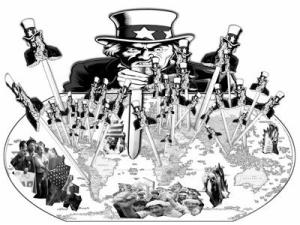
The Federal Reserve and the Global Fracture

Octopus 1912

An Interview with Finnish Journalist Antti J. Ronkainen

Michael Hudson

Source: The Unz Review

Antti J. Ronkainen: The Federal Reserve is the most significant central bank in the world. How does it contribute to the domestic policy of the United States?

Michael Hudson: The Federal Reserve supports the status quo. It would not want to create a crisis before the election. Today it is part of the Democratic Party’s re-election campaign, and its job is to serve Hillary Clinton’s campaign contributors on Wall Street. It is trying to spur recovery by resuming its Bubble Economy subsidy for Wall Street, not by supporting the industrial economy. What the economy needs is a debt writedown, not more debt leveraging such as Quantitative Easing has aimed to promote. But the Fed is in a state of denial that the U.S. and European economies are plagued by debt deflation.

The Fed uses only one policy: influencing interest rates by creating bank reserves at low give-away charges. It enables banks too make easy gains simply by borrowing from it and leaving the money on deposit to earn interest (which has been paid since the 2008 crisis to help subsidize the banks, mainly the largest ones). The effect is to fund the asset markets – bonds, stocks and real estate – not the economy at large. Banks also are heavy arbitrage players in foreign exchange markets. But this doesn’t help the economy recover, any more than the ZIRP (Zero Interest-Rate Policy) since 2001 has done for Japan. Financial markets are the liabilities side of the economy’s balance sheet, not the asset side.

The last thing either U.S. party wants is for the election to focus on this policy failure. The Fed, Treasury and Justice Department will be just as pro-Wall Street under Hillary. There would be no prosecutions of bank fraud, there would be another bank-friendly Attorney General, and a willingness to subsidize banks now that the Dodd-Frank bank reform has been diluted from what it originally promised to be.


So let’s go back to beginning. When the Great Financial Crisis escalated in 2008 the Fed’s response was to lower its main interest rate to nearly zero. Why?

The aim of lowering interest rates was to provide banks with cheap credit. The pretense was that banks might lend to help the economy get going again. But the Fed’s idea was simply to re-inflate the Bubble Economy. It aimed at restoring the value of the mortgages that banks had in their loan portfolios. The hope was that easy credit would spur new mortgage lending to bid housing prices back up – as if this would help the economy rather than simply raising the price of home ownership.

But banks weren’t going to make mortgage loans to a housing market that already was over-lent. Instead, homeowners had to start paying down the mortgages they had taken out. Banks also reduced their credit-card exposure by a few hundred billion dollars. So instead of receiving new credit, the economy was saddled with having to repay debts.

Banks did make money, but not by lending into the “real” production and consumption economy. They mainly engaged in arbitrage and speculation, and lending to hedge funds and companies to buy their own stocks yielding higher dividend returns than the low interest rates that were available.


In addition to the near zero interest rates, the Fed bought US Treasury bonds and mortgage backed securities (MBS) with almost $4 trillion during three rounds of Quantitative Easing stimulus. How have these measures affected the real economy and financial markets?

In 2008 the Federal Reserve had a choice: It could save the economy, or it could save the banks. It might have used a fraction of what became the vast QE credit – for example $1 trillion – to pay off the bad mortgages and write them down. That would have helped save the economy from debt deflation. Instead, the Fed simply wanted to re-inflate the bubble, to save banks from having to suffer losses on their junk mortgages and other bad loans.

Keeping these debts on the books, in full, let banks foreclose on defaulting homeowners. This intensified the debt-deflation, pushing the economy into its present post-2008 depression. The debt overhead is keeping it depressed.

One therefore can speak of a financial war waged by Wall Street against the economy. The Fed is a major weapon in this war. Its constituency is Wall Street. Like the Justice and Treasury Departments, it has been captured and taken hostage.

Federal Reserve chairwoman Janet Yellen’s husband, George Akerlof, has written a good article about looting and fraud as ways to make money. But instead of saying that looting and fraud are bad, the Fed has refused to regulate or move against such activities. It evidently recognizes that looting and fraud are what Wall Street is all about – or at least that the financial system would come crashing down if an attempt were made to clean it up!

So neither the Fed nor the Justice Department or other U.S. Government agencies has sanctioned or arrested a single banker for the trillions of dollars of financial fraud. Just the opposite: The big banks where the fraud was concentrated have been made even larger and more dominant. The effect has been to drive out of business the smaller banks not so involved in derivative bets and other speculation.

The bottom line is that banks made much more by getting Alan Greenspan and the Clinton-Bush Treasury officials to deregulate fraud than they could have made by traditional safe lending. But their gains have increased the economy’s overhead.


Do you believe Mike Whitney’s argument that QE was about a tradeoff between the Fed and the government: the Fed pumped the new bubble and saved the banks that the government didn’t need to bail out more banks. The government’s role was to impose austerity so that inflation and employment didn’t rise – which would have forced the Fed to raise interest rates, ending its QE program? source: http://www.counterpunch.org/2016/01/15/the-chart-that-explains-everything/]

That was a great chart that Mike put up from Richard Koo, and you should reproduce it here. It shows that the Fed’s enormous credit creation had zero effect on raising commodity prices or wages. But stock market prices doubled in just six years, 2008-15, and bond prices rose to new peaks. Banks left much of the QE credit on deposit with the Fed, earning an interest giveaway premium.

(Richard Koo: “The struggle between markets and central banks has only just begun,”

http://www.businessinsider.com/richard-koo-struggle-between-markets-and-central-banks-has-only-just-begun-2015-9?r=UK&IR=T

The important point is that the Fed (backed by the Obama Administration) refused to use this $4 trillion to revive the production-and-consumption economy. It claimed that such a policy would be “inflationary,” by which it meant raising employment and wage levels. The Fed thus accepted the neoliberal junk economics proposing austerity as the answer to any problem – austerity for the industrial economy, not the Fed’s own Wall Street constituency.


According to a Fed staff report, QE would lower the exchange rate of dollar to the other currencies causing competitiveness boost for the U.S. firms. Former finance minister of Brazil Guido Mantega, as well as the chairman of Central Bank of India Raghuram Rajan, have described the Fed’s QE as a “currency war.” What’s your take?

The Fed’s aim was simply to provide banks with low-interest credit. Banks lent to hedge funds to buy securities or make financial bets that yielded more than 0.1 percent. They also lent to companies to buy their own stock, and to corporate raiders for debt-financed mergers and acquisitions. But banks didn’t lend to the economy at large, because it already was “loaned up,” and indeed, overburdened with debt.

Lower interest rates did spur the “carry trade,” as they had done in Japan after 1990. Banks and hedge funds bought foreign bonds paying higher rates. The dollar drifted down as bank arbitrageurs could borrow from the Fed at 0.1 percent to lend to Brazil at 9 percent. Buying these foreign bonds pushed up foreign exchange rates against the dollar. That was a side effect of the Fed’s attempt to help Wall Street make financial gains. It simply didn’t give much consideration to how its QE flooding the global economy with surplus dollars would affect U.S. exports – or foreign countries.

Exchange rate shifts don’t affect export trends as much as textbook models claim. U.S. arms exports to the Near East, and many technology exports are non-competitive. However, a looming problem for most countries is what may happen when ending QE increases the dollar’s exchange rate. If U.S. interest rates go back up, the dollar will strengthen. That would increase the cost to foreign countries of paying dollar-denominated debts. Countries that borrowed all dollars at low interest will need to pay more in their own currencies to service these debts. Imagine what would happen if the Federal Reserve let interest rates rise back to a normal level of 4 or 5 percent. The soaring dollar would push debtor economies toward depression on capital account much more than it would help their exports on trade account.


You have said that QE is fracturing the global economy. What do you mean by that?

Part of the flood of dollar credit is used to buy shares of foreign companies yielding 15 to 20 percent, and foreign bonds. These dollars are turned over to foreign central banks for domestic currency. But central banks are only able to use these dollars to buy U.S. Treasury securities, yielding about 1 percent. When the People’s Bank of China buys U.S. Treasury bonds, it’s financing America’s dual budget and balance-of-payment deficits, both of which stem largely from military encirclement of Eurasia – while letting U.S. investors and the U.S. economy get a free ride.

Instead of buying U.S. Treasury securities, China would prefer to buy American companies, just like U.S. investors are buying Chinese industry. But America’s government won’t permit China even to buy gas station companies. The result is a double standard. Americans feel insecure having Chinese ownership in their companies. It is the same attitude that was directed against Japan in the late 1980s.

I wrote about this financial warfare and America’s free lunch via the dollar standard in Super Imperialism (2002) and The Bubble and Beyond (2012), and about how today’s New Cold War is being waged financially in Killing the Host (2015).


The Democrats loudly criticized the Bush administration’s $700 billion TARP-program, but backed the Fed’s QE purchases worth of almost $4 trillion during the Obama administration. How does this relate to the fact that officially, QE purchases were intended to support economic recovery?

I think you’ve got the history wrong. My Killing the Host describes how the Democrats supported TARP, while the Republican Congress opposed it on populist grounds. Republican Treasury Secretary Hank Paulson offered to use some of the money to aid over-indebted homeowners, but President-elect Obama blocked that – and then appointed Tim Geithner as Treasury Secretary. FDIC head Sheila Bair and by SIGTARP head Neil Barofsky have written good books about Geithner’s support for Wall Street (and especially for Citigroup and Goldman Sachs) against the interests of the economy at large.

If you are going to serve Wall Street – your major campaign contributors – you are going to need a cover story pretending that this will help the economy. Politicians start with “Column A”: their agenda to reimburse their campaign contributors – Wall Street and other special interests. Their public relations team and speechwriters then draw up “Column B”: what public voters want. To get votes, a rhetorical cover story is crafted. I describe this in my forthcoming J is for Junk Economics, to be published in March. It’s a dictionary of Orwellian doublethink, political and economic euphemisms to turn the vocabulary around and mean the opposite of what actually is meant.


How do TARP and QE relate to the Federal Reserve’s mandate about price stability?

There are two sets of prices: asset prices and commodity prices and wages. By “price stability” the Fed means keeping wages and commodity prices down. Calling depressed wage levels “price stability” diverts attention from the phenomenon of debt deflation – and also from the asset-price inflation that has increased the advantages of the One Percent over the 99 Percent. From 1980 to the present, the Fed has inflated the largest bond rally in history as a result of driving down interest rates from 20 percent in 1980 to nearly zero today, as you have noted.

Chicago School monetarism ignores asset prices. It pretends that when you increase the money supply, this increases consumer prices, commodity prices and wages proportionally. But that’s not what happens. When banks created credit (money), they don’t lend much to people to buy goods and services or for companies to make capital investments to employ more workers. They lend money mainly to transfer ownership of assets already in place. About 80 percent of bank loans are mortgages, and the rest are largely for stocks and bond purchases, including corporate takeovers and stock buybacks or debt-leveraged purchases. The effect is to bid up asset prices, while loading down the economy with debt in the process. This pushes up the break-even cost of doing business, while imposing debt deflation on the economy at large.

Wall Street isn’t so interested in exploiting wage labour by hiring it to produce goods for sale, as was the case under industrial capitalism in its heyday. It makes its gains by riding the wave of asset inflation. Banks also gain by making labour pay more interest, fees and penalties on mortgages, and for student loans, credit cards and auto loans. That’s the postindustrial financial mode of exploiting labor and the overall economy. The Fed’s QE program increases the price at which stocks, bonds and real estate exchange for labour, and also promotes debt leverage throughout the economy.


Why don’t economists distinguish between asset-price and commodity price inflation?

The economics curriculum has been turned into an exercise for students to pretend that a hypothetical parallel universe exists in which the rentier classes are job creators, necessary to help economies recover. The reality is that financial modes of getting rich by debt leveraging creates a Bubble Economy – a Ponzi scheme leading to austerity and shrinking markets, which always ends in a convulsion of bankruptcy.

The explanation for why this is not central to today’s economic theory is that the discipline has been captured by this neoliberal tunnel vision that overlooks the financial sector’s maneuvering to make quick trading profits in stocks, bonds, mortgages and derivatives, not to take the time and effort to develop long-term markets. Rentiers seek to throw a cloak of invisibility around how they make money. They know that if economists don’t measure their wealth and the public does not see it, voters will be less likely to bring pressure to regulate and tax it.

Today’s central economic problem is that inflating asset prices by debt leveraging extracts more interest and financial charges. When the resulting debt deflation ends up hollowing out the economy, creditors try to blame labour, or government spending (except for bailouts and QE to help Wall Street). It is as if debtors are exploiting their creditors.


If there is a new class war, what is the current growth model?

It’s an austerity model, as you can see from the eurozone and from the neoliberal consensus that cites Latvia as a success story rather than a disaster leading to de-industrialization and emigration. In real democracies, if economies polarize like they are doing today, you would expect the 99 Percent to fight back by electing representatives to enact progressive taxation, regulate finance and monopolies, and make public investment to raise wages and living standards. In the 19th century this drive led parliaments to rewrite the tax rules to fall more on landlords and monopolists.

Industrial capitalism plowed profits back into new means of production to expand the economy. But today’s rentier model is based on austerity and privatization. The main way the financial sector always has obtained wealth has been by privatizing it from the public domain by insider dealing and indebting governments.

The ultimate financial business plan also is to lend with an eye to end up with the debtor’s property, from governments to companies and families. In Greece the European Central Bank, European Commission and IMF demanded that if the nation’s elected representatives did not sell off the nation’s ports, land, islands, roads, schools, sewer systems, water systems, television stations and even museums to reimburse the dreaded austerity troika for its bailout of bondholders and bankers, the country would be isolated from Europe and faced with a crash. That forced Greece to capitulate.

What seems at first glance to be democracy has been hijacked by politicians who accept the financial class war ideology that the way for an economy to get rich is by austerity. That means lowering wages, unemployment, and dismantling government by turning the public domain over to the financial sector.

By supporting the banking sector even in its predatory and outright fraudulent behavior, U.S. and European governments are reversing the trajectory along which 19th-century progressive industrial capitalism and socialism were moving. Today’s rentier class is not concerned with long-term tangible investment to earn profits by hiring workers to produce goods. Under finance capitalism, an emerging financial over-class makes money by stripping income and assets from economies driven deeper into debt. Attacking “big government” when it is democratic, the wealthy are all in favor of government when it is oligarchic and serves their interests by rolling back the past two centuries of democratic reforms.


Does the Fed realize global turbulences what its unconventional policies have caused?

Sure. But the Fed has painted itself in a corner: If it raises interest rates, this will cause the stock and bond markets to go down. That would reverse the debt leveraging that has kept these markets up. Higher interest rates also would bankrupt Third World debtors, which will not be able to pay their dollar debts if dollars become more expensive in their currencies.

But if the Fed keeps interest rates low, pension funds and insurance companies will have difficulty making the paper gains that their plans imagined could continue exponentially ad infinitum. So whatever it does, it will destabilize the global economy.


China’s stock market has crashed, western markets are very volatile, and George Soros has said that the current financial environment reminds him of the 2008 crash. Should we be worried?

News reports make it sound as if debt-ridden capitalist economies will face collapse if the socialist countries don’t rescue them from their shrinking domestic markets. I think Soros means that the current financial environment is fragile and highly debt-leveraged, with heavy losses on bad loans, junk bonds and derivatives about to be recognized. Regulators may permit banks to “extend and pretend” that bad loans will turn good someday. But it is clear that most government reports and central bankers are whistling in the dark. Changes in any direction may pull down derivatives. That will cause a break in the chain of payments when losers can’t pay. The break may spread and this time public opinion is more organized against 2008-type bailouts.

The moral is that debts that can’t be paid, won’t be. The question is, how won’t they be paid? By writing down debts, or by foreclosures and distress sell-offs turning the financial class into a ruling oligarchy? That is the political fight being waged today – and as Warren Buffet has said, his billionaire class is winning it.


That’s all for now. Thank you Michael!

Death In Honduras: The Coup, Hillary Clinton And The Killing Of Berta Cáceres

dt.common.streams.StreamServer.cls

By Media Lens

Source: Dissident Voice

On February 28, Hillary Clinton told an audience from the pulpit of a Memphis church: ‘we need more love and kindness in America’. This was something she felt ‘from the bottom of my heart’.

These benevolent sentiments recalled the national ‘purpose’ identified by President George H.W. Bush in 1989, shortly before he flattened Iraq. It was, he said, ‘to make kinder the face of the nation and gentler the face of the world’.

Clinton, of course, meant North America, specifically the United States. But other places in America are short on love and kindness, too. Consider Honduras, for example.

On June 28, 2009, the Honduran President Manuel Zelaya was kidnapped at gunpoint by masked soldiers and forced into exile. Since the ousting, the country ‘has been descending deeper into a human rights and security abyss’ as the military coup ‘threw open the doors to a huge increase in drug trafficking and violence, and… unleashed a continuing wave of state-sponsored repression’. In 2012, Honduras had a murder rate of 90.4 per 100,000 population, then the highest rate in the world. In 2006, three years before the coup, the murder rate had stood at 46.2 per 100,000.

The years since 2009 have seen ‘an explosive growth in environmentally destructive megaprojects that would displace indigenous communities. Almost 30 percent of the country’s land was earmarked for mining concessions, creating a demand for cheap energy to power future mining operations. To meet this need, the government approved hundreds of dam projects around the country, privatizing rivers, land, and uprooting communities.’ In 2015, Global Witness reported that Honduras was ‘the most dangerous country to be an environmental defender’.COPINH

Berta Cáceres, a mother of four children, was co-founder and general coordinator of the COPINH (Consejo Cívico de Organizaciones Populares e Indígenas de Honduras) group opposing this state-corporate exploitation. Last year, Cáceres was awarded the Goldman Environmental Prize, the world’s leading award recognising grassroots environmental activists, for her work opposing a major dam project. Many of COPINH’s leaders have been murdered in recent years. In 2013, Cáceres said:

The army has an assassination list of 18 wanted human rights fighters with my name at the top. I want to live, there are many things I still want to do in this world. I take precautions, but in the end, in this country where there is total impunity I am vulnerable. When they want to kill me, they will do it.

Last week, on the night of March 3, armed men burst through the back door of Cáceres’s house and shot her four times, killing her in her bed. US media watch site Fairness and Accuracy in Reporting (FAIR) commented:

There was widespread outcry and grief over her death, and the story was covered by major media in the United States. But there was a glaring problem with the coverage: Almost none of it mentioned that the brutal regime that likely killed Cáceres came to power in a 2009 coup d’état supported by the United States, under President Barack Obama and then-Secretary of State Hillary.

Confidential – The Embassy Perspective

Following the 2009 coup, the United Nations, the Organization of American States (OAS) and the European Union all condemned Zelaya’s removal as a military coup. A confidential US Embassy cable, later published by Wikileaks, commented:

The Embassy perspective is that there is no doubt that the military, Supreme Court and National Congress conspired on June 28 in what constituted an illegal and unconstitutional coup against the Executive Branch… There is equally no doubt from our perspective that Roberto Micheletti’s assumption of power was illegitimate.

That was behind closed doors. In public, fifteen US House Democrats urged the US regime to ‘fully acknowledge that a military coup has taken place and… follow through with the total suspension of non-humanitarian aid, as required by law’. Writing for the Common Dreams website, Alexander Main supplied some detail:

Ann-Marie Slaughter, then director of Policy Planning at the State Department, sent an email to [Secretary of State] Clinton on August 16 [2009] strongly urging her to “take bold action” and to “find that [the] coup was a ‘military coup’ under U.S. law,” a move that would have immediately triggered the suspension of all non-humanitarian U.S. assistance to Honduras.

This, Hillary Clinton’s State Department refused to do, thus implicitly recognising the military takeover. As FAIR noted, Clinton makes clear in her memoirs that she had no intention of restoring President Zelaya to power:

In the subsequent days [after the coup] I spoke with my counterparts around the hemisphere, including Secretary Espinosa in Mexico. We strategized on a plan to restore order in Honduras and ensure that free and fair elections could be held quickly and legitimately, which would render the question of Zelaya moot.

In September 2009, US State Department officials blocked the OAS from adopting a resolution that would have rejected the legitimacy of Honduran elections carried out under the dictatorship, thus giving the coup the final US seal of approval.

Ousted former president, Manuel Zelaya, said last year:

Secretary Clinton had many contacts with us. She is a very capable woman, intelligent, but she is very weak in the face of pressures from groups that hold power in the United States, the most extremist right-wing sectors of the U.S. government, known as the hawks of Washington. She bowed to those pressures. And that led U.S. policy to Honduras to be ambiguous and mistaken.

Zelaya added:

President Obama has not wanted to hear our peoples. He has turned a deaf ear on the cry of the people. First we protested in the opposition. A few months ago, they physically removed me from the Congress, the National Congress, because our party mounted a peaceful protest. The military removed us, using tear gas in the Congress. They expelled us, beating us with batons, beating us into the street. This is the government that President Obama supports, a government that is repressive, a government that violates human rights, as has been shown by the very Inter-American Commission on Human Rights of the Organization of American States. It has shown this to be the case.

Alexander Main concluded:

A careful reading of the Clinton emails and Wikileaked U.S. diplomatic cables from the beginning of her tenure, expose a Latin America policy that is often guided by efforts to isolate and remove left-wing governments in the region.

An assertion supported by the increase in US military assistance to Honduras even as state-corporate violence has massively escalated. Noam Chomsky explained the logic:

Zelaya was moving somewhat tentatively towards the kinds of social reforms that the United States has always opposed and will try to stop if it can.

A Local Matter – The Media Response

Corporate politics and media, of course, never tire of proclaiming the West’s ‘responsibility to protect’ in places like Iraq, Libya and Syria. So how did these same humanitarians respond to the murder of a compassionate, respected and awesomely courageous activist in Honduras? FAIR commented on the overwhelming evidence of US support for the coup:

One wouldn’t know any of this reading US reports of Cáceres’ death. The coup, and its subsequent purging of environmental, LGBT and indigenous activists, is treated as an entirely local matter… The Washington Post, Guardian, NBC, CNN and NPR didn’t mention the 2009 coup that brought to power Cáceres’ likely murderers, let alone the US’s tacit involvement in the coup.

On the same day FAIR’s report was published, the first and only reference to these hidden truths in the UK press recorded by the Nexis media database was supplied by Jonathan Watts in the Guardian:

But Washington’s role is also controversial because the US backed the current government, which took power after a 2009 coup that ousted the democratically elected president Manuel Zelaya. The US is now providing fund [sic] for the Honduran police force.

Watts quoted International Rivers, an NGO that worked with Cáceres:

We must note that during the 2009 military coup in Honduras, the US government, with Hillary Clinton as secretary of state, worked behind the scenes to keep Honduras’ elected government from being reinstated. Additionally, the US government continues to fund the Honduran military, despite the sharp rise in the homicide rate, political repression, and the murders of political opposition and peasant activists.

While hardly exhaustive, this is the only mention of these issues we have found in the UK corporate press. A more recent piece by the Guardian’s Washington correspondent, David Smith, mentioned the coup but not US involvement. With touching naivety, Smith observed that ‘the US, determined to stop the flow of illegal immigrants from Central America, has been pouring money into Honduras’s security apparatus’.

The Times – so vocal in promoting Western ‘intervention’ to ‘protect’ human rights from Official Enemies – printed 68 words on the killing penned by the Associated Press. The Telegraph gave the story a single mention. In the Independent, Phil Davison wrote of Cáceres:

As if anyone needed reminding, her murder brought back to Honduras the dark days of the 1980s Central American guerrilla wars, in which they and their neighbours fought to rid themselves of dictators backed by the US.

But in stark contrast to the courage of Cáceres and so many others in Honduras, Davison was not able to bring himself to mention that the tyranny in Honduras is today being backed by the region’s great superpower. Also in the Independent, Caroline Mortimer made no mention of US complicity in the coup. Nor, unsurprisingly, did the BBC in two pieces here and here on the killing.

As ever, ‘mainstream’ ‘compassion’ turns out to be rooted in rather more ‘pragmatic’ concerns. If an Official Enemy had been responsible for Cáceres’s death, the cries of outrage, horror and denunciation would have blazed from our corporate front pages and TV screens. Action would have been demanded, perhaps even ‘intervention’. But when the horror is committed by a faithfully corrupt and brutal servant of Empire aided and abetted by the ‘Leader of the Free World’, none of the buttons on the vast, high-tech propaganda machine are pressed and the story is quickly buried along with the victim.

Needless to say, awareness of the kind offered here threatens to jam a spanner in the conditionally ‘compassionate’ propaganda waterworks and must be scrupulously ignored or, at best, ridiculed.


Media Lens is a UK-based media watchdog group headed by David Edwards and David Cromwell. The second Media Lens book, Newspeak: In the 21st Century by David Edwards and David Cromwell, was published in 2009 by Pluto Press. Read other articles by Media Lens, or visit Media Lens’s website.

Related Article: Before Her Assassination, Berta Cáceres Singled Out Hillary Clinton for Backing Honduran Coup (Democracy Now)

Fukushima@5

radioaktivitaet-fukushima-ia

(Source: Fairewinds.org)

Modern ghost towns, abandoned houses, and far stretching roads lined with plastic bags of radioactive garbage have replaced the once bustling neighborhoods and cities of the Fukushima Prefecture. Formerly home to thousands, the massive release of radiation has forced residents to evacuate their beautiful homeland, leaving the land they love behind without knowing whether or not they may ever return without putting their lives at risk. Join the Fairewinds Crew and ask yourself this: With 99 operating atomic power reactors generating electricity in the U.S., what’s so different about your home, your town, your state that what happened to Fukushima couldn’t happen to you and your family?

Many Japanese and millions of Americans are currently living in the shadow of atomic reactors, plutonium reprocessing plants, and atomic waste dumps. It will be five years in March since the triple meltdown at Fukushima Daiichi began and the Japanese public and people around the world continue to search for the truth about nuclear risk and honest answers to their energy future. Fukushima@5 exposes the truth of the ongoing atomic devastation caused by the nuclear meltdown at Fukushima Daiichi.

Related Podcast: Project Censored 03.08.16

The Mad Violence of Casino Capitalism

AmericanRoulette

By

Source: Counterpunch

American society is morally bankrupt and politically broken, and its vision of the future appears utterly dystopian. As the United States descends into the dark abyss of an updated form of totalitarianism, the unimaginable has become imaginable in that it has become possible not only to foresee the death of the essential principles of constitutional democracy, but also the birth of what Hannah Arendt once called the horror of dark times. The politics of terror, a culture of fear, and the spectacle of violence dominate America’s cultural apparatuses and legitimate the ongoing militarization of public life and American society.

Unchecked corporate power and a massive commodification, infantilization, and depoliticization of the polity have become the totalitarian benchmarks defining American society. In part, this is due to the emergence of a brutal modern-day capitalism, or what some might call neoliberalism. This form of neoliberal capitalism is a particularly savage, cruel, and exploitative regime of oppression in which not only are the social contract, civil liberties and the commons under siege, but also the very notion of the political, if not the planet itself. The dystopian moment facing the United States, if not most of the globe, can be summed up in Fred Jameson’s contention “that it is easier to imagine the end of the world than to imagine the end of capitalism.” He goes on to say that “We can now revise that and witness the attempt to imagine capitalism by way of imagining the end of the world.”1

One way of understanding Jameson’s comment is through the ideological and affective spaces in which the neoliberal subject is produced and market-driven ideologies are normalized. Capitalism has made a virtue out of self-interest and the pursuit of material wealth and in doing so has created a culture of shattered dreams and a landscape filled with “Broken highways, bankrupt cities, collapsing bridges, failed schools, the unemployed, the underpaid and the uninsured: all suggest a collective failure of will. These shortcomings are so endemic that we no longer know how to talk about what is wrong, much less set about repairing it.”[i]

Yet, there is a growing recognition that casino capitalism is driven by a kind of mad violence and form of self-sabotage and that if it does not come to an end what we will experience in all probability is the destruction of human life and the planet itself. Certainly, more recent scientific reports on the threat of ecological disaster from researchers at the University of Washington, NASA, and the Intergovernmental Panel on Climate Change reinforce this dystopian possibility.2 The undermining of public trust and public values has now given way to a market-driven discourse that produces a society that has lost any sense of democratic vision and social purpose and in doing so resorts to state terrorism, the criminalization of social problems, and culture of cruelty. Institutions that were once defined to protect and enhance human life now function largely to punish and maim.

As Michael Yates points out throughout this book, capitalism is devoid of any sense of social responsibility and is driven by an unchecked desire to accumulate capital at all costs. As power becomes global and politics remains local, ruling elites no longer make political concessions to workers or any other group that they either exploit or consider disposable.

Security and crisis have become the new passwords for imposing a culture of fear and for imposing what Giorgio Agamben has called a permanent state of exception and a technology of government repression.[ii] A constant appeal to a state of crisis becomes the new normal for arming the police, curtailing civil liberties, expanding the punishing state, criminalizing everyday behavior, and supressing dissent. Fear now drives the major narratives that define the United States and give rise to dominant forms of power free from any sense of moral and political conviction, if not accountability.

In the midst of this dystopian nightmare, there is the deepening abyss of inequality, one that not only separates the rich from the poor, but also increasingly relegates the middle and working classes to the ranks of the precariat. Concentrations of wealth and income generate power for the financial elite and unchecked misery for most people, a fear/insecurity industry, and a growing number of social pathologies.

Michael Yates in The Great Inequality provides a road map for both understanding the registers that produce inequality as well as the magnitude of the problems it poses across a range of commanding spheres extending from health care and the political realm to the environment and education. At the same time, he exposes the myths that buttress the ideology of inequality. These include an unchecked belief in boundless economic growth, the notion that inequality is chosen freely by individuals in the market place, and the assumption that consumption is the road to happiness. Unlike a range of recent books on inequality, Yates goes beyond exposing the mechanisms that drive inequality and the panoply of commanding institutions that support it. He also provides a number of strategies that challenge the deep concentrations of wealth and power while delivering a number of formative proposals that are crucial for nurturing a radical imagination and the social movements necessary to struggle for a society that no longer equates capitalism with democracy.

As Yates makes clear throughout this book, money now engulfs everything in this new age of disposability. Moreover, when coupled with a weakening of movements to counter the generated power of capitalists, the result has been a startling increase in the influence of predatory capitalism, along with inequities in wealth, income, power, and opportunity. Such power breeds more than anti-democratic tendencies, it also imposes constraints, rules, and prohibitions on the 99 percent whose choices are increasingly limited to merely trying to survive. Capitalists are no longer willing to compromise and have expanded their use of power to dominate economic, political, and social life. For Yates, it is all the more crucial to understand how power works under the reign of global capitalism in order to grasp the magnitude of inequality, the myriad of factors that produce it, and what might be done to change it.

Accompanying the rise of a savage form of capitalism and the ever-expanding security state is the emergence of new technologies and spaces of control. One consequence is that labor power is increasing produced by machines and robotic technologies which serve to create “a large pool of more or less unemployed people.” Moreover, as new technologies produce massive pools of unused labor, it also is being used as a repressive tool for collecting “unlimited biometric and genetic information of all of its citizens.”[iii]

The ongoing attack on the working class is matched by new measures of repression and surveillance. This new weaponized face of capitalism is particularly ominous given the rise of the punishing state and the transformation of the United States from a democracy in progress to a fully developed authoritarian society.   Every act of protest is now tainted, labeled by the government and mainstream media as either treasonous or viewed as a potential act of terrorism. For example, animal rights activists are put on the terrorist list. Whistleblowers such as Edward Snowden are painted as traitors. Members of the Black Lives Matter movement are put under surveillance,[iv] all electronic communication is now subject to government spying, and academics who criticize government policy are denied tenure or worse.

Under neoliberalism, public space is increasingly converted into private space undermining those sphere necessary for developing a viable sense of social responsibility, while also serving to transform citizenship into mostly an act of consumption. Under such circumstances, the notion of crisis is used both to legitimate a system of economic terrorism as well as to accentuate an increasing process of depoliticization. Within this fog of market induced paralysis, language is subject to the laws of capitalism, reduced to a commodity, and subject to the “tyranny of the moment….emaciated, impoverished, vulgarized and squeezed out of the meanings it was resumed to carry.”[v]

As the latest stage of predatory capitalism, neoliberalism is part of a broader economic and political project of restoring class power and consolidating the rapid concentration of capital, particularly financial capital.[vi] As a political project it includes “the deregulation of finance, privatization of public services, elimination and curtailment of social welfare programs, open attacks on unions, and routine violations of labor laws.”[vii] As an ideology, it casts all dimensions of life in terms of market rationality, construes profit making as the arbiter and essence of democracy, consuming as the only operable form of citizenship, and upholds the irrational belief that the market can both solve all problems and serve as a model for structuring all social relations. As a mode of governance, it produces identities, subjects, and ways of life driven by a survival-of-the fittest-ethic, grounded in the idea of the free, possessive individual, and committed to the right of ruling groups and institutions to exercise power removed from matters of ethics and social costs. As a policy and political project, it is wedded to the privatization of public services, the dismantling of the connection of private issues and public problems, the selling off of state functions, liberalization of trade in goods and capital investment, the eradication of government regulation of financial institutions and corporations, the destruction of the welfare state and unions, and the endless marketization and commodification of society.

Nothing engenders the wrath of conservatives more than the existence of the government providing a universal safety net, especially one that works, such as either Medicare or Social Security. As Yates points out, government is viewed by capitalists as an institution that gets in the way of capital. One result is a weakening of social programs and provisions. As Paul Krugman observes regarding the ongoing conservative attacks on Medicare, “The real reason conservatives want to do away with Medicare has always been political: It’s the very idea of the government providing a universal safety net that they hate, and they hate it even more when such programs are successful.”[viii] In opposition to Krugman and other liberal economists, Michael Yates argues rightly in this book that the issue is not simply preserving Medicare but eliminating the predatory system that disavows equality of wealth, power, opportunity, and health care for everyone.

Neoliberalism has put an enormous effort into creating a commanding cultural apparatus and public pedagogy in which individuals can only view themselves as consumers, embrace freedom as the right to participate in the market, and supplant issues of social responsibility for an unchecked embrace of individualism and the belief that all social relation be judged according to how they further one’s individual needs and self-interests. Matters of mutual caring, respect, and compassion for the other have given way to the limiting orbits of privatization and unrestrained self-interest, just as it is has become increasingly difficult to translate private troubles into larger social, economic, and political considerations. One consequence is that it has become more difficult for people to debate and question neoliberal hegemony and the widespread misery it produces for young people, the poor, middle class, workers, and other segments of society– now considered disposable under neoliberal regimes which are governed by a survival-of-the fittest ethos, largely imposed by the ruling economic and political elite. Unable to make their voices heard and lacking any viable representation in the process makes clear the degree to which the American public, in particular, are suffering under a democratic deficit producing a profound dissatisfaction that does not always translate into an understanding of how neoliberal capitalism has destroyed democracy or what it might mean to understand and challenge its diverse apparatuses of persuasion and power. Clearly, the surge of popularity behind the presidential candidacy of a buffoon such as Donald Trump testifies to both a deep seated desire for change and the forms it can take when emotion replaces reason and any viable analysis of capitalism and its effects seem to be absent from a popular sensibility.

What Michael Yates makes clear in this incisive book on inequality is that democratic values, commitments, integrity, and struggles are under assault from a wide range of sites in an age of intensified violence and disposability. Throughout the book he weaves a set of narratives and critiques in which he lays bare the anti-democratic tendencies that are on display in a growing age of lawlessness and disposability. He not only makes clear that inequality is not good for the economy, social bonds, the environment, politics, and democracy, Yates also argues that capitalism in the current historical moment is marked by an age that thrives on racism, xenophobia, the purported existence of an alleged culture of criminality, and a massive system of inequality that affects all aspects of society. Worth repeating is that at the center of this book, unlike so many others tackling inequality, is an attempt to map a number of modalities that give shape and purpose to widespread disparities in wealth and income, including the underlying forces behind inequality, how it works to secure class power, how it undermines almost every viable foundation needed for a sustainable democracy, and what it might mean to develop a plan of action to produce the radical imagination and corresponding modes of agency and practice that can think and act outside of the reformist politics of capitalism.

Unlike so many other economists such as Paul Krugman and Joseph Stiglitz who address the issue of inequality, Yates refuses the argument that the system is simply out of whack and can be fixed. Nor does he believe that capitalism can be described only in terms of economic structures. Capitalism is both a symbolic pathological economy that produces particular dispositions, values, and identities as well as oppressive institutional apparatuses and economic structures. Yates goes even further arguing that capitalism is not only about authoritarian ideologies and structures, it is also about the crisis of ideas, agency, and the failure of people to react to the suffering of others and to the conditions of their own oppression. Neoliberal capitalism has no language for human suffering, moral evaluation, and social responsibility. Instead, it creates a survival-of-the fittest ethos buttressed by a discourse that is morally insensitive, sadistic, cannibalistic, and displays a hatred of those whose labor cannot be exploited, do not buy into the consumerist ethic, or are considered other by virtue of their race, class, and ethnicity. Neoliberalism is the discourse of shadow games, committed to highlighting corporate power and making invisible the suffering of others, all the while leaving those considered disposable in the dark to fend for themselves.

Yates makes visible not only the economic constraints that bear down on the poor and disposable in the neoliberal age of precarity, he also narrates the voices, conditions, hardships and suffering workers have to endure in a variety of occupations ranging from automobile workers and cruise ship workers to those who work in restaurants and as harvester on farms. He provides a number of invaluable statistics that chart the injuries of class and race under capitalism but rather than tell a story with only statistics and mind boggling data, he also provides stories that give flesh to the statistics that mark a new historical conjuncture and a wide range of hardships that render work for most people hell and produce what has been called the hidden injuries of class. Much of what he writes is informed by a decade long research trip across the United States in which he attempted to see first-hand what the effects of capitalism have been on peoples’ lives, the environment, work, unions, and other crucial spheres that inform everyday life. His keen eye is particularly riveting as he describes his teaming up with Cesar Chavez and the United Farm Workers in the 1970s and his growing disappointment with a union that increasingly betrayed its own principles.

For Yates, the capitalist system is corrupt, malicious, and needs to be replaced. Capitalism leaves no room for the language of justice, the social, or, for that matter, democracy itself. In fact, one of its major attributes is to hide its effects of power, racial injustice, militarized state violence, domestic terrorism, and new forms of disposability, especially regarding those marginalized by class and race. The grotesque inequalities produced by capitalism are too powerful, deeply rooted in the social and economic fabric, and unamenable to liberal reforms.  Class disparities constitute a machinery of social death, a kind of zombie-like machine that drains life out of most of the population poisoning both existing and future generations.

The politics of disposability has gone mainstream as more and more individuals and groups are now considered surplus and vulnerable, consigned to zones of abandonment, surveillance, and incarceration. At one level, the expansive politics of disposability can be seen in the rising numbers of homeless, the growing army of debt-ridden students, the increasingly harsh treatment of immigrants, the racism that fuels the school-to-prison pipeline, and the growing attack on public servants. On another level, the politics of disposability has produced a culture of lawlessness and cruelty evident by the increasing rollback of voting rights, the war waged against women’s reproductive rights, laws that discriminate against gays, the rise of the surveillance state, and the growing militarization of local police forces. Yates argues convincingly that there is a desperate need for a new language for politics, solidarity, shared responsibilities, and democracy itself. Yates sees in the now largely departed Occupy Movement an example of a movement that used a new discourse and set of slogans to highlight inequality, make class inequities visible, and to showcase the workings of power in the hands of the financial elite. For Yates, Occupy provided a strategy that can be and is being emulated by a number of groups, especially those emerging in the black community in opposition to police violence. Such a strategy begins by asking what a real democracy looks like and how does it compare to the current society in which we live. One precondition for individual and social agency is that the horizons for change must transcend the parameters of the existing society, and the future must be configured in such a way as to not mimic the present.

What is remarkable about The Great Inequality is that Yates does not simply provide a critique of capitalism in its old and new forms, he also provides a discourse of possibility developed around a number of suggested policies and practices designed to not reform capitalism but to abolish it. This is a book that follows in the manner of Dr. Martin Luther King’s call to break the silence. In it Yates functions as a moral witness in reporting on the hardships and suffering produced by grotesque forms of inequality. As such, he reveals the dark threats that capitalism in its ruthlessly updated versions poses to the planet. Yet, his narrative is never far from either hope or a sense that there is a larger public for whom his testimony matters and that such a public is capable of collective resistance. The Great Inequality also serves to enliven the ethical imagination, and speak out for those populations now considered outcast and voiceless. Yates provides a furious reading of inequality and the larger structure of capitalism. In doing so he exhibits a keen and incisive intellect along with a welcomed sense of righteous fury.

Notes.

[i] Tony Judt, Ill Fares the Land, (New York, N.Y.: The Penguin Press, 2010), p. 12.

[ii] Giorgio Agamben, “The Security State and a theory of destituent power,” Philosophers for Change, (February 25, 2014). Online:

The security state and a theory of destituent power

[iii] Ibid., Agamben, “The Security State and a theory of destituent power,”

[iv] George Joseph, “Exclusive: feds regularly monitored black lives matter since ferguson,” Intercept (July 24, 2015). Online: https://firstlook.org/theintercept/2015/07/24/documents-show-department-homeland-security-monitoring-black-lives-matter-since-ferguson/; Deirdre Fulton, “Exposed: Big Brother Targets Black Lives:Government spying can be an ‘effective way to chill protest movements,’ warns Center for Constitutional Rights,” CommonDreams (July 24, 2015). Online: http://www.commondreams.org/news/2015/07/24/exposed-big-brother-targets-black-lives

[v] Zygmunt Bauman and Leonidas Donskis, Moral Blindness: The loss of Sensitivity in Liquid Modernity, (Cambridge, UK: Polity Press, 2013), p. 46.

[vi] I have taken up the issue of neoliberalism extensively in Henry A. Giroux, Against the Terror of Neoliberalism (Boulder: Paradigm, 2008) . See also, David Harvey, A Brief History of Neoliberalism (New York: Oxford University Press, 2007); Manfred B. Steger and Ravi K. Roy, Neoliberalism: A Very Short Introduction (New York: Oxford University Press, 2010); Gerad Dumenil and Dominique Levy, The Crisis of Neoliberalism (Cambridge: Harvard University Press, 2011). Henry A. Giroux, Twilight of the Social (Boulder: Paradigm, 2013); Henry A. Giroux, and in Against the Violence of Organized Forgetting: Beyond America’s Disimagination Machine (San Francisco: City Lights, 2014);

Wendy Brown, Undoing the Demos: Neoliberalism’s Stealth Revolution (Cambridge: Zone Books 2015).

[vii] Michael D. Yates, “Occupy Wall Street and the Significance of Political Slogans,” Counterpunch, (February 27, 2013). Online:http://www.counterpunch.org/2013/02/27/occupy-wall-street-and-the-significance-of-political-slogans/

[viii] Paul Krugman, “Zombies Against Medicare,” New York Times (July 27, 2015). Online: http://www.nytimes.com/2015/07/27/opinion/zombies-against-medicare.html?_r=0

This essay is excerpted from the introduction to The Great Inequality by Michael D. Yates.

Henry A. Giroux currently holds the McMaster University Chair for Scholarship in the Public Interest in the English and Cultural Studies Department and a Distinguished Visiting Professorship at Ryerson University. His most recent books are America’s Education Deficit and the War on Youth (Monthly Review Press, 2013) and Neoliberalism’s War on Higher Education (Haymarket Press, 2014). His web site is www.henryagiroux.com.

The Age of Authoritarianism: Government of the Politicians, by the Military, for the Corporations

what-corporate-america-wants

By John W. Whitehead

Source: The Rutherford Institute

“I was astonished, bewildered. This was America, a country where, whatever its faults, people could speak, write, assemble, demonstrate without fear. It was in the Constitution, the Bill of Rights. We were a democracy… But I knew it wasn’t a dream; there was a painful lump on the side of my head… The state and its police were not neutral referees in a society of contending interests. They were on the side of the rich and powerful. Free speech? Try it and the police will be there with their horses, their clubs, their guns, to stop you. From that moment on, I was no longer a liberal, a believer in the self-correcting character of American democracy. I was a radical, believing that something fundamental was wrong in this country—not just the existence of poverty amidst great wealth, not just the horrible treatment of black people, but something rotten at the root. The situation required not just a new president or new laws, but an uprooting of the old order, the introduction of a new kind of society—cooperative, peaceful, egalitarian.” ― Historian Howard Zinn

America is at a crossroads.

History may show that from this point forward, we will have left behind any semblance of constitutional government and entered into a militaristic state where all citizens are suspects and security trumps freedom.

Certainly, this is a time when government officials operate off their own inscrutable, self-serving playbook with little in the way of checks and balances, while American citizens are subjected to all manner of indignities and violations with little hope of defending themselves.

As I make clear in my book Battlefield America: The War on the American People, we have moved beyond the era of representative government and entered a new age—the age of authoritarianism. Even with its constantly shifting terrain, this topsy-turvy travesty of law and government has become America’s new normal.

Don’t believe me?

Let me take you on a brief guided tour, but prepare yourself. The landscape is particularly disheartening to anyone who remembers what America used to be.

The Executive Branch: Whether it’s the Obama administration’s war on whistleblowers, the systematic surveillance of journalists and regular citizens, the continued operation of Guantanamo Bay, or the occupation of Afghanistan, Barack Obama has surpassed his predecessors in terms of his abuse of the Constitution and the rule of law. President Obama, like many of his predecessors, has routinely disregarded the Constitution when it has suited his purposes, operating largely above the law and behind a veil of secrecy, executive orders and specious legal justifications. Rest assured that no matter who wins this next presidential election, very little will change. The policies of the American police state will continue.

The Legislative Branch:  It is not overstating matters to say that Congress may well be the most self-serving, semi-corrupt institution in America. Abuses of office run the gamut from elected representatives neglecting their constituencies to engaging in self-serving practices, including the misuse of eminent domain, earmarking hundreds of millions of dollars in federal contracting in return for personal gain and campaign contributions, having inappropriate ties to lobbyist groups and incorrectly or incompletely disclosing financial information. Pork barrel spending, hastily passed legislation, partisan bickering, a skewed work ethic, graft and moral turpitude have all contributed to the public’s increasing dissatisfaction with congressional leadership. No wonder 86 percent of Americans disapprove of the job Congress is doing.

The Judicial Branch: The Supreme Court was intended to be an institution established to intervene and protect the people against the government and its agents when they overstep their bounds. Yet through their deference to police power, preference for security over freedom, and evisceration of our most basic rights for the sake of order and expediency, the justices of the United States Supreme Court have become the guardians of the American police state in which we now live. As a result, sound judgment and justice have largely taken a back seat to legalism, statism and elitism, while preserving the rights of the people has been deprioritized and made to play second fiddle to both governmental and corporate interests.

Shadow Government: America’s next president will inherit more than a bitterly divided nation teetering on the brink of financial catastrophe when he or she assumes office. He or she will also inherit a shadow government, one that is fully operational and staffed by unelected officials who are, in essence, running the country. Referred to as the Deep State, this shadow government is comprised of unelected government bureaucrats, corporations, contractors, paper-pushers, and button-pushers who are actually calling the shots behind the scenes right now.

Law Enforcement: By and large the term “law enforcement” encompasses all agents within a militarized police state, including the military, local police, and the various agencies such as the Secret Service, FBI, CIA, NSA, etc. Having been given the green light to probe, poke, pinch, taser, search, seize, strip and generally manhandle anyone they see fit in almost any circumstance, all with the general blessing of the courts, America’s law enforcement officials, no longer mere servants of the people entrusted with keeping the peace but now extensions of the military, are part of an elite ruling class dependent on keeping the masses corralled, under control, and treated like suspects and enemies rather than citizens. In the latest move to insulate police from charges of misconduct, Virginia lawmakers are considering legislation to keep police officers’ names secret, ostensibly creating secret police forces.

A Suspect Surveillance Society: Every dystopian sci-fi film we’ve ever seen is suddenly converging into this present moment in a dangerous trifecta between science, technology and a government that wants to be all-seeing, all-knowing and all-powerful. By tapping into your phone lines and cell phone communications, the government knows what you say. By uploading all of your emails, opening your mail, and reading your Facebook posts and text messages, the government knows what you write. By monitoring your movements with the use of license plate readers, surveillance cameras and other tracking devices, the government knows where you go. By churning through all of the detritus of your life—what you read, where you go, what you say—the government can predict what you will do. By mapping the synapses in your brain, scientists—and in turn, the government—will soon know what you remember. And by accessing your DNA, the government will soon know everything else about you that they don’t already know: your family chart, your ancestry, what you look like, your health history, your inclination to follow orders or chart your own course, etc. Consequently, in the face of DNA evidence that places us at the scene of a crime, behavior sensing technology that interprets our body temperature and facial tics as suspicious, and government surveillance devices that cross-check our biometricslicense plates and DNA against a growing database of unsolved crimes and potential criminals, we are no longer “innocent until proven guilty.”

Military Empire: America’s endless global wars and burgeoning military empire—funded by taxpayer dollars—have depleted our resources, over-extended our military and increased our similarities to the Roman Empire and its eventual demise. The U.S. now operates approximately 800 military bases in foreign countries around the globe at an annual cost of at least $156 billion. The consequences of financing a global military presence are dire. In fact, David Walker, former comptroller general of the U.S., believes there are “striking similarities” between America’s current situation and the factors that contributed to the fall of Rome, including “declining moral values and political civility at home, an over-confident and over-extended military in foreign lands and fiscal irresponsibility by the central government.”

I haven’t even touched on the corporate state, the military industrial complex, SWAT team raids, invasive surveillance technology, zero tolerance policies in the schools, overcriminalization, or privatized prisons, to name just a few, but what I have touched on should be enough to show that the landscape of our freedoms has already changed dramatically from what it once was and will no doubt continue to deteriorate unless Americans can find a way to wrest back control of their government and reclaim their freedoms.

That brings me to the final and most important factor in bringing about America’s shift into authoritarianism: “we the people.” We are the government. Thus, if the government has become a tyrannical agency, it is because we have allowed it to happen, either through our inaction or our blind trust.

Essentially, there are four camps of thought among the citizenry when it comes to holding the government accountable. Which camp you fall into says a lot about your view of government—or, at least, your view of whichever administration happens to be in power at the time.

In the first camp are those who trust the government to do the right thing, despite the government’s repeated failures in this department. In the second camp are those who not only don’t trust the government but think the government is out to get them. In the third camp are those who see government neither as an angel nor a devil, but merely as an entity that needs to be controlled, or as Thomas Jefferson phrased it, bound “down from mischief with the chains of the Constitution.”

Then there’s the fourth camp, comprised of individuals who pay little to no attention to the workings of government, so much so that they barely vote, let alone know who’s in office. Easily entertained, easily distracted, easily led, these are the ones who make the government’s job far easier than it should be.

It is easy to be diverted, distracted and amused by the antics of the presidential candidates, the pomp and circumstance of awards shows, athletic events, and entertainment news, and the feel-good evangelism that passes for religion today. What is far more difficult to face up to is the reality of life in America, where unemployment, poverty, inequality, injustice and violence by government agents are increasingly norms.

The powers-that-be want us to remain divided, alienated from each other based on our politics, our bank accounts, our religion, our race and our value systems. Yet as George Orwell observed, “The real division is not between conservatives and revolutionaries but between authoritarians and libertarians.”

The only distinction that matters anymore is where you stand in the American police state. In other words, you’re either part of the problem or part of the solution.

Rent Strikes: ‘together we can defeat the housing market’

Rent-Strikers-1

By Matt Broomfield

Source: RoarMag.org

As they revive a long-dormant form of protest, rent strikers in London and San Francisco must learn lessons from the great strikes of the 20th century.

When you can no longer afford to pay your rent, only one course of action remains: stop paying it. On both sides of the Atlantic, tenants are militating against the unbearable pressure of the housing market via the only locus of power available to them — going on rent strike.

Midtown Apartments, San Francisco

Jose LaCrosby was an African-American hair stylist to the stars. Nina Simone, James Brown and Miles Davis all frequented his San Francisco salon. Terminally ill at the age of 89, LaCrosby was told by his doctors that he should return to die among his friends in Midtown Apartments.

But the City of San Francisco had just hiked rents by up to 300 percent. If the Korean War veteran wanted to move back in to a ground-floor apartment it would now cost him $3700 a month. LaCrosby had lived in Midtown for two decades, but he spent the last 7 months of his life under fluorescent lights in an anodyne hospice ward, unable to afford the grossly inflated rent.

LaCrosby’s treatment is symptomatic of the way Midtown is being used as an asset to be stripped for cash, says long-time resident and Save Midtown organizer Jay Majitov. “This community is being displaced by the greed and avarice of property pimps preying on the weak and the disenfranchised,” he explains. Many of Majitov’s neighbors moved into Midtown after being socially cleansed from other areas of San Francisco in the 1960s, on what they understood was a rent-to-buy agreement.

But though Midtown paid off its collective mortgage in 2007, the city reneged on its agreement to hand the building over to the tenants. Instead, Midtowners were hit with a threefold increase in rent, far outstripping the maximum increase set by San Francisco rent controls. Appalled by this betrayal of trust, the tenants of 65 Midtown apartments have been withholding their rent increase since August 2015.

University College London

On the face of it, LaCrosby’s working-class neighbors in Midtown have little in common with the primarily middle-class, primarily white students of University College London. But the price of UCL accommodation has risen by 56 percent in the last six years, and the university extracts £16 million annually in pure profit from their residences. The halls remain shabby, cramped and infested with cockroaches.

As a result, around 150 students are currently striking for a 40 percent rent decrease. “UCL call residents in halls customers, not students,” says David Dahlborn of UCL, Cut The Rent (UCL-CTR). “It’s sheer exploitation.”

There have been rumblings about wider rent strikes across the British left for months, while US activists in Portland and elsewhere are now looking to copy Midtown’s example. Yet until a couple of years ago, no one was talking about rent strikes at all.

The problem(s) with rent strikes

Once a cornerstone of tenants’ rights activism, since the 1980s the rent strike has largely been absent from the arsenal of the left. The most famous rent strike in history occurred in 1915, when the fear of a Bolshevik insurrection forced the UK government to appease strikers in Glasgow by introducing rent controls. As the Communist threat faded after the second Red Scare, so too did the need to form housing policy with one eye on the Kremlin, and the government’s attitude toward rent strikers hardened accordingly.

Given that many rent strikes occurred in mutual relation with industrial strikes, their decline in popularity can partially be ascribed to the decimation of workers’ right to strike by Thatcher and her successors. The UK now loses a tenth as many days to industrial action as it did in the 1980s, and “strike” has become a politically toxic term. (UCL-CTR advise their activists to avoid the word altogether when door-knocking.) The fragmentation of the left and the castration of the trade unions have left Britain without left-wing superstructures capable of amplifying wildcat rent strikes into a broader social movement.

There are also delocalized issues inherent in the mode of protest. The vulnerable people who stand to gain the most from a reduction in rent are also those most imperiled by eviction: working-class people, people of color, single mothers and the disabled, often living in social housing. According to Jay Majitov, many Midtowners will be forced out of state or onto the street if their strike is broken. There is no legal protection for rent strikers in the UK or the USA.

Recrimination can be brutal: after the arrest of rent strikers in Kings’ Cross in 1960, crowds of protesters were baton-charged and violently dispersed by mounted police. Mary Barbour and her army of Glaswegian housewives were forced to fight off heavy-handed bailiffs with wet clothes, rotten food and flour-bombs. Barbour would stomp round the tenements whirling a football rattle to summon her troops as the “factor” moved in.

Midtown property managers Mercy Housing have kept up an aggressive campaign of intimidation, towing residents’ cars for minor infractions and muscling into pensioners’ homes. “They came in as an occupying force, a colonizer. There’s no regard for cultural sensitivity or the long-term tenants,” says Majitov. Tenants have been told they face eviction if their grandchildren visit more than twice a week, or if they hold barbecues on their own property. “I’m sorry, man, but barbecues are what we do,” Majitov adds.

Making rent strikes work

An industrial striker does no work and so loses her pay, but rent strikers actually save money while they agitate, as astronomic rents stop crippling working people and start depreciating from the profits of housing companies. The more unbearable the financial burden on the renters, the keener the loss suddenly felt by the landlord, in an efficacious reversal of power dynamics.

Last year, UCL-CTR organized students from UCL and SOAS in a successful strike, securing £400,000 compensation after the university conceded it had left students in unlivable conditions among cockroaches, rats and incessant building works. London’s first genuine rent strike for 40 years only involved 50 students, but each individual striker made a tangible, measurable impact on the university’s finances. Glasgow 1915 and UCL-SOAS 2015 are century-spanning testaments to the fact that a well-executed rent strike can be devastatingly effective.

Historically, successful mass rent strikes have benefited from a united left providing the infrastructure to exponentially increase the strike’s effect across multiple homes and into the industrial sphere, rather than leaving isolated strikers at the mercy of the bailiffs. A New York strike in 1907 relied on the backing of a strong, active Socialist Party, and the Glasgow strikes would not have succeeded without union support.

As noted above, the male-dominated superstructures traditionally capable of supporting mass direct action have diminished in size and power. If they want to achieve this vital escalation, 21st century rent strikers must look to alternative, grassroots networks of activists.

Alternate support networks

Most successful rent strikes have been led by women. The distinction between rent strikes and industrial strikes should not be collapsed into a crude dichotomy between the male public sphere and the female domestic sphere. In 1907, 16-year-old Pauline Newman led strikes which secured rent reductions for 2000 New York families. She worked till 9pm in a textile factory before campaigning all night in the slums of Manhattan. Working-class women have always worked formally in the marketplace, as well as informally (and unpaid) in the home.

But Newman, the “East Side Joan of Arc”, was supported by housewives who spent the day going from tenement to tenement urging other families to join the strike. Working-class shop-floor networks intermeshed with female-dominated domestic networks. The Glasgow rent strike was sparked by landlords seeking to cow women into submission while their husbands were away fighting in the war. Again, Mary Barbour and her army rapidly spread information through the slums whenever the factor descended, militating via a social infrastructure which their landlords grossly underestimated.

Half of all British housing benefit recipients are single women. The average female flat-sharer in London earns £4236 less than her male counterpart, and twice as many women as men spend over half their salary on rent. Women have a disproportionate stake in the housing crisis, and male politicians continue to underestimate their ability to organize and resist. Though not a rent strike per se, the success of the Focus E15 mothers in resisting eviction attempts by Newham Council illustrates the continued power of localized, female, working-class support networks.

Interlocking working-class communities and communities of color have proven similarly capable of disseminating information and resistance. Rent strikers in 1930s Peckham relied on a rolling guard of unemployed laborers to defend their homes while successfully agitating for an improvement in living conditions. Majitov repeatedly emphasizes the importance of working-class solidarity in Midtown: “We don’t build apps, we don’t code. We drive buses and we deliver mail. And if this working-class community of color hadn’t stood together we would have been out a long time ago. ”

African-American Jean King (another woman) secured rent controls in St Louis after a year-long strike in 1969, while Majitov proudly notes that Save Midtown has the support of civil rights luminary Andrew Young, who successfully organized a rent strike alongside Martin Luther King in 1960s Chicago. Just like in Glasgow in 1907, Save Midtown have appointed tenant organizers with responsibility for contacting strikers across the development, and they are now reaching out to other African-American communities being abused by Mercy to launch a nationwide class action against the housing company.

The university bubble

A rent strike is a very different proposition for students, who are typically more privileged than the general population — a state of affairs maintained by the inaccessible rent conditions UCL-CTR are striking against. Many students have family homes to return to, and this can be leveraged against universities.

David Dahlborn explains: “When nothing had happened by the end of summer 2015, the international students who were on strike said ‘well, fuck it, I’m going home’. The university realized they couldn’t really send bailiffs to Mexico.” UCL capitulated soon after. Again, rent strikes reverse a power dynamic familiar to anyone who has tried to secure the return of a deposit from a suddenly evanescent landlord.

Students can also leverage the disjuncture between the public face of the academic university and its profit-making operations. “They say they’re concerned with education,” says UCL striker Aleksandra Tomaszewska. “But they’ve cut funding and bursaries while raising rent and tuition fees.”

Where housing companies are not hugely concerned with positive public relations, university authorities are at pains to emphasize that they provide a caring, nurturing environment. It would be a PR disaster for UCL to forcibly evict white, well-spoken, middle-class students. As with much student activism, student rent strikers can trade on their privilege to enjoy a much greater degree of security than their counterparts in council housing.

Universities constitute a ready-made network for the expansion of a strike. A successful rent strike at Sussex University in 1972-3 rapidly spread to 23 other universities. UCL-CTR is sharing advice and materials with student activists from SOAS, Imperial and Goldsmiths, as they seek to expand the current rent strike across the capital.

“Anyone could do it,” says Dahlborn, who repeatedly emphasizes the lateral organization of UCL-CTR. “Everybody on the strike is a potential organizer.” Students have more free time than workers; they have access to condensed bodies of left-leaning tenants paying vastly excessive rent; and they are keyed in to networks of information exchange between these bodies.

Rent strikes for the 21st century

Paradigms established by 20th century rent strikers could be instructive for those on the radical left wrangling about their relationship with Momentum and Jeremy Corbyn’s Labour Party. Newman and Barbour instigated their strikes alone, but willingly worked alongside hierarchical, party-rooted structures to replicate these actions on a wider scale.

But as Dahlborn argues, a successful general rent strike must ultimately emerge from coordinated grassroots action, as multiple localized organizations “replicate and generalize” tactics that have worked well elsewhere. An emphasis on the dispersal of power underpins much recent left-wing strategizing, and rent strikes can operate particularly effectively through decentralized, lateral organization.

“Together we are powerful, and united we can defeat the market,” Dahlborn says. The unity he describes is not monolithic but dispersed, varied and multiple. Strikes should be generated through grassroots networks, not mandated by top-down frameworks.

Networks of university activists provide one such structure. London’s Radical Housing Network, which unites housing co-ops, community action groups and union representatives, is another. (This organization could also facilitate liaison between university students and working-class activists).

Roger Hallam’s concept of “Conditional Commitment” involves assuring potential strikers that a strike will only go ahead once a certain number of other tenants have committed to the action. Successfully implemented by UCL-CTRE, this system of collective responsibility would function well in enabling dispersed networks of rent strikers to operate in unison.

Industrial strikes expose the gulf between the evaluated worth of employees’ labor and the evaluated worth of the products they manufacture. The fact that a rent strike is even tenable as a concept illustrates the fact that tenants, like workers, are treated as profit-making organs.

Historically, the establishment has therefore reacted ferociously to rent strikes, which expose the cruelty of market logic. A general rent strike called by a hypothetical national tenants’ union would likely meet with overwhelming opposition. But it would be much more difficult for the establishment to defeat a network of localized, coordinated strikes breaking out on university campuses and council estates across the country.

A Phony Victim, and a Lot of Real Ones

Justin Kelly’s cinematic doppelgänger: Fancy Lad from the film “Cabin Boy”

By Kevin Carson

Source: Center for a Stateless Society

In a recent open letter to the mayor (Julia Carrie Wong, “San Francisco tech worker: ‘I don’t want to see homeless riff-raff,’ The Guardian, Feb. 17), entitled tech bro Justin Keller whined that the sight of homeless people ruins his enjoyment of the local atmosphere in San Francisco. And when his family comes to visit, it just brings everybody down. Keller, owner of the Commando.io startup, added

I know people are frustrated about gentrification happening in the city, but the reality is, we live in a free market society. The wealthy working people have earned their right to live in the city. They went out, got an education, work hard, and earned it…. I shouldn’t have to see the pain, struggle, and despair of homeless people to and from my way to work every day.

But a closer look at the history of class privilege and ethnic cleansing in San Francisco suggests that “free market reality” isn’t as obvious as Keller makes it out to be.

About three days after reading about Keller’s traumatic encounters with the homeless (I can’t help thinking of “Cabin Boy” Chris Elliott — the Fancy Lad in a powdered wig — screaming in terror as a rabbit runs across his path), I learned of some other people in San Francisco with problems of their own.

Back in the ’60s, under the “Civic Redevelopment” program — San Francisco’s version of Urban Renewal — over 100 city blocks of black residential neighborhoods, businesses and churches deemed “slum areas” were bulldozed and their residents forcibly relocated. Under the cumulative effect of such Urban Renewal policies, in the ’60s and ’70s, the black population of San Francisco declined from 13.4% to less than 6% of the total. In 1968 the Midtown Park Apartments were opened to house residents “relocated” from one of the demolished neighborhoods, the Fillmore-Western Addition (“Petition — #BlackHomesMatter: Stop the displacement of long-term San Francisco residents at Midtown” Change.org).

Today, Midtown is a close-knit working-class community of long-time Black residents as well as immigrants from all over the world, including fixed-income seniors, disabled veterans, and children. Some tenants have lived at Midtown for over 40 years.

Despite decades of promises to convert the apartments to cooperative ownership by the residents, the city is once again collaborating with local real estate interests to rack rent the tenants, drive them out, and — ahem — “redevelop” the property.

Midtown residents have been working for decades towards the co-operative ownership of their homes and even paid off the mortgage for the Midtown property. Despite repeated promises from the City of San Francisco that Midtown residents would be eventual owners of their homes, two days before Christmas Eve in 2013, the City terminated the lease with the tenant’s association and without warning awarded it to Mercy Housing, a national Catholic affordable housing nonprofit. Since then, Mercy has raised the rent on many tenants (some up to 300%), implemented restrictive and discriminatory new rules, and has put forth plans to eventually demolish the entire Midtown property. Mercy Housing has also begun a program of harassing tenants – targeting seniors and tenants with low English literacy, cutting locks to enter apartments illegally and other tactics meant to intimidate tenants from fighting back.

The residents of 65 of the apartments have declared a tenant strike and are withholding rent in protest.

I guess that’s pretty small potatoes compared to the horror of having Mumsy and Daddy see a homeless person on their way to the grand tour of your new luxury condo.

Keller makes it clear, by the way, that his own idea of a “free market society” is fully compatible with such ethnic cleansing by the government. In his meltdown over the injustice of sensitive people like himself having to look at homeless people, he made positive reference to “street sweeps” by local government as a positive example:

I don’t have a magic solution … It is a very difficult and complex situation, but somehow during Super Bowl, almost all of the homeless and riff raff seem to up and vanish. I’m willing to bet that was not a coincidence. Money and political pressure can make change. So it is time to start making progress, or we as citizens will make a change in leadership and elect new officials who can.

So we live in the kind of “free market society” where local government, working on behalf of local real estate interests, can ethnically cleanse 100 city blocks of their inhabitants, in the process reducing the city’s black population by more than half, and then send uniformed thugs to drive people off the streets by the thousands for the crime of being homeless in public.

More generally, just about any city government is nothing but a showcase property of the local real estate interests, and its central function is to serve what Harvey Molotch called the “urban growth machine” by driving up real estate prices. And most of the many billions of dollars of wealth in Silicon Valley — with which tech bros like Keller are driving rents into the stratosphere — result from a business model centered on state-enforced “intellectual property” monopolies.

But it’s not as though these things are some kind of departure from the “free market” ideal, or that there has ever been a “free market society” at any point in history. Right-wing libertarians celebrate the 19th century Gilded Age as some kind of near laissez-faire utopia. But it never even remotely approached such a thing.

The so-called “laissez-faire” Gilded Age was heir to four centuries of land enclosure and other nullifications of customary peasant tenure rights in the land, mass enslavement, and the colonization and robbery of half the planet. Capitalism never emerged from a “free market”; it was a direct outgrowth of the “bastard feudalism” of the late Middle Ages, in which a major segment of the old landed classes reinvented themselves as agrarian capitalists and, in alliance with absolute monarchies and large mercantile interests, converted their own countries into prison societies and then forcibly conquered most of the world. The  so-called “lassez-faire” 19th century was built directly atop the structure of inequality and concentrated property resulting from these centuries of robbery.

And the political centerpiece of the Gilded Age was the Great Betrayal of 1877, in which Rutherford B. Hayes agreed to end Reconstruction in return for the electoral votes of the southern states, despite his having a minority of the popular vote. This was a devil’s bargain in which the agrarian capitalists of the former Confederacy were allowed to institute a regional system of Apartheid, in return for giving industrial capitalists uncontested control the American state. Once this control was secured, the national government immediately began imposing a top-down corporate transformation of the economic system, and using the full power of the federal government to suppress the workers’ and farmers’ movements.

This groundwork having been established, the twentieth century saw an alliance between large corporations and the American state so massive that the very distinction between “public” and “private” ceased to have meaning. The tech industry itself was a direct outgrowth of the corporate state, as even a cursory overview of the role of the military-industrial complex in creating the cybernetic revolution and building the Internet backbone should tell you.

So no, Justin — this is not a “free market society,” and you and your ilk did not earn your wealth. As Ann Richards said of George Bush, “you were born on third base and thought you hit a triple.” But I like even better a saying of Martin Luther King Jr’s: “When you see a turtle sitting on a fencepost, you know he had help getting up there.”

If there’s anybody in the tech industry pushing for something resembling a genuine “free market society,” it’s not the venture capitalists and start-ups. It’s the people trying to free information work from the legacy of its origins in the bureaucracy of a total war state, and rebuild it on the basis of horizontalism, self-organization and p2p, rather than allowing it to fall under the control of new corporate bureaucracies through government-enforced “intellectual property” enclosure; the drivers unionizing Uber and Lyft; the people jailbreaking proprietary apps or developing open-source, cooperative versions of them; the hackers doing their best to destroy proprietary information culture; and the people organizing freelancers’ unions, cooperative temp agencies and other cost- and income-pooling platforms for precarious labor. If a “free market society” actually means anything, it also encompasses the struggles of the people rendered homeless by government collusion with capital, for the right to exist in public spaces. And above all, it includes the people displaced from their homes by brutal ethnic cleansing schemes, who are fighting to maintain occupancy of apartments of which they, by any acceptable moral standard, are the rightful owners.

So to tie this all up, let’s break the power of the real estate interests and tech monopolies in alliance with local government. I call on everyone reading this to support the Midtown rent strikers, to express unconditional solidarity for their resistance to eviction, and to unconditionally condemn local government, law enforcement, and the real estate interests that stand to benefit from this robbery. Force the city government to honor its promises and immediately transfer ownership to the residents of Midtown Park Apartment. At the very least, sign the petition in support of them and circulate the story of this injustice as widely as possible.

Colonialism and Imperialism: Two Most Deadly Forms of Terrorism

imperialism_usa

By Andre Vltchek

Source: Dissident Voice

Terrorism has many forms and many faces, but the most terrible of them is cold cruelty.

We are asked to believe that terrorists consist of dirty lunatics, running around with bombs, machine guns and explosive belts. That’s how we are told to imagine them.

Many of them are bearded; almost all are “foreign looking”, non-white, non-Western. In summary they are wife beaters, child rapists and Greek and Roman statue destroyers.

Actually, during the Cold War, there were some white looking “terrorists” – the left-wingers belonging to several revolutionary cells, in Italy and elsewhere in Europe. But only now we are learning that the terrorist acts attributed to them were actually committed by the Empire, by several European right-wing governments and intelligence services. You remember, the NATO countries were blowing up those trains inside the tunnels, or bombing entire train stations…

It “had to be done”, in order to discredit the Left, just to make sure that people would not become so irresponsible as to vote for the Communists or true Socialists.

There were also several Latin American ‘terror’ groups – the revolutionary movements fighting for freedom and against oppression, mainly against Western colonialism. They had to be contained, liquidated, and if they held power, overthrown.

But terrorists became really popular in the West only after the Soviet Union and the Communist Block were destroyed through thousands of economic, military and propaganda means, and the West suddenly felt too exposed, so alone without anyone to fight. Somehow it felt that it needed to justify its monstrous oppressive acts in Africa, the Middle East, Latin America and Asia.

It needed a new “mighty”, really mighty, enemy to rationalize its astronomical military and intelligence budgets. It was not good enough to face a few hundred ‘freaks’ somewhere inside the Colombian jungle or in Northern Ireland or Corsica. There had to be something really huge, something matching that ‘evil’ Soviet “threat”.

Oh how missed that threat was, suddenly! Just a threat of course; not the danger of egalitarian and internationalist ideals…

And so the West linked terrorism with Islam, which is one of the greatest cultures on earth, with 1.6 billion followers. Islam is big and mighty enough, to scare the shit out of the middle class housewives in some Western suburb! And on top of that, it had to be contained anyway, as it was essentially too socialist and too peaceful.

At that time in history, all great secular and socialist leaders of Muslim countries, (like in Iran, Indonesia and Egypt), were overthrown by the West, their legacy spat on, or they were simply banned.

But that was not enough for the West!

In order to make Islam a worthy enemy, the Empire had to first radicalize and pervert countless Muslim movements and organizations, then create the new ones, consequently training, arming and financing them, so they could really look frightening enough.

There is of course one more important reason why “terrorism”, particularly Muslim “terrorism”, is so essential for the survival of Western doctrines, exceptionalism and global dictatorship: it justifies the West’s notion of absolute cultural and moral superiority.

This is how it works:

For centuries, the West has been behaving like a mad bloodthirsty monster. Despite the self-glorifying propaganda being spread by Western media outlets all over the world, it was becoming common knowledge that the Empire was raping, murdering and plundering in virtually all corners of the Globe. A few more decades and the world would see the West exclusively as a sinister and toxic disease. Such a scenario had to be prevented by all means!

And so the ideologues and propagandists of the Empire came up with a new and brilliant formula: Let’s create something that looks and behaves even worse than we do, and then we could trumpet that we are still actually the most reasonable and tolerant culture on earth!

And let’s make a real pirouette: let’s fight our own creation – let’s fight it in the name of freedom and democracy!”

This is how the new generation; the new breed of “terrorist” was born. And it lives! It is alive and well! It is multiplying like Capek’s Salamanders.

*****Western terrorism is not really discussed, although its most extreme and violent forms are battering the world relentlessly and have for a long time, with hundreds of millions of victims piling up everywhere.

Even the legionnaires and gladiators of the Empire, like the Mujaheddin, Al-Qaida, or ISIS, can never come close to the savagery that has been demonstrated time and again by their British, French, Belgian, German or US masters. Of course they are trying very hard to match their gurus and bread-givers, but they are just not capable of their violence and brutality.

It takes “Western culture” to butcher some 10 million people in just one single geographic area, in almost one go!

*****So what is real terrorism, and how could ISIS and others follow its lead? They say that ISIS is decapitating their victims. Bad enough. But who is their teacher?

For centuries, the empires of Europe were murdering, torturing, raping and mutilating people on all continents of the world. Those who were not doing so directly, were “investing” into colonialist expeditions, or sending its people to join genocidal battalions.

King Leopold II and his cohorts managed to exterminate around 10 million people of Western and Central Africa, in what is now known as the Congo. He was hunting people down like animals, forcing them to work on his rubber plantations. If he thought that they were not filling up his coffers fast enough, he did not hesitate to chop off their hands, or burn entire village populations inside their huts, alive.

10 million victims vanished. 10 million! And it did not take place in some distant past, in the “dark ages”, but in the 20th century, under the rule of so-called constitutional monarchy, and self-proclaimed democracy. How does it compare with the terrorism that is ruling over the territories occupied by ISIS? Let’s compare numbers and brutality level!

And the Democratic Republic of Congo has, since 1995, lost again close to 10 million people in a horrid orgy of terror, unleashed by the West’s proxies, Rwanda and Uganda (see the trailer to my film “Rwanda Gambit”).

Germans performed holocausts in South-Western Africa, in what is now Namibia. The Herero tribe was exterminated, or at least close to 90% of it was. People were first kicked out from their land and from their homes, and driven into the desert. If they survived, the German pre-Nazi expeditions followed, using bullets and other forms of mass killing. Medical experiments on humans were performed, to prove the superiority of the Germanic nation and the white race.

These were just innocent civilians; people whose only crime was that they were not white, and were sitting on land occupied and violated by the Europeans.

The Taliban never came close to this, or even ISIS!

To this day, the Namibian government is demanding the return of countless heads severed from its people: heads that were cut off and then sent to the University of Freiburg and several hospitals in Berlin, for medical experiments.

Just imagine, ISIS chopping thousands of European heads, in order to perform medical experiments aiming to demonstrate the superiority of the Arab race. It would be absolutely unthinkable!

Local people were terrorized in virtually all colonies grabbed by Europe, something that I have described in detail in my latest 840-page book “Exposing Lies of the Empire”.

What about the Brits and their famines, which they were using as population control and intimidation tactics in India! In Bengal at least 5 million died in 1943 alone, 5.5 million in 1876-78, 5 million in 1896-97, to name just a few terrorist acts committed by the British Empire against a defenseless population forced to live under its horrid and oppressive terrorist regime!

What I have mentioned above are just 3 short chapters from the long history of Western terrorism. An entire encyclopedia could be compiled on the topic.

But all this sits far from Western consciousness. European and North American masses prefer not to know anything about the past and the present. As far as they are concerned, they rule the world because they are free, bright and hard working. Not because for centuries their countries have plundered and murdered, and above all terrorized the world forcing it into submission.

The elites know everything, of course. And the more they know, the more they put that knowledge to work.

Terrorist trade and experience are passed on from Western masters to their new Muslim recruits.

The Mujahideen, Al-Qaida, ISIS – on closer examination, their tactics of intimidation and terrorization are not original at all. They are built on imperialist and colonialist practices of the West.

News about this, or even about the terror that has been inflicted on the Planet by the West, is meticulously censored. You would never see them on the programs broadcast by the BBC, or read about them in mainstream newspapers and magazines.

On the other hand, the violence and ruthlessness of the client terrorist organizations are constantly highlighted. They are covered in their tiniest detail, repeated, and “analyzed”.

Everybody is furious, horrified! The UN is “deeply concerned”, Western governments are “outraged”, and the Western public “has had enough – it does not want immigrants from those terrible countries that are breeding terrorism and violence”.

The West “simply has to get involved”. And here comes the War on Terror.

It is a war against the West’s own Frankenstein. It is a war that is never meant to be won. Because if it is won, god forbid, there would have to be peace, and peace means cutting defense budgets and also dealing with the real problems of our Planet.

Peace would mean the West looking at its own past. It would mean thinking about justice and rearranging the entire power structures of the Planet. And that can never be allowed.

And so the West is “playing” war games; it is “fighting” its own recruits (or pretending to fight them), while innocent people are dying.

No part of the world, except the West, would be able to invent and unleash something so vile and barbaric as ISIS or Al-Nusra!

Look closer at the strategy of these group-implants: it has no roots in Muslim culture whatsoever. But it is fully inspired by the Western philosophy of colonialist terrorism: “If you don’t fully embrace our dogmas and religion, then we will cut off your head, slash your throat, rape your entire family or burn your village or city to the ground. We will destroy your grand cultural heritage as we did in South America 500 years ago, and in so many other places.”

And so on and so on! It would really require great discipline not to see the connections!

*****In 2006 I was visiting my friend, a former President of Indonesia, and a great progressive Muslim leader, Abdurrahman Wahid, (known in Indonesia as “Gus Dur”). Our meeting was held at the headquarters of his massive Muslim body Nahdlatul Ulama (NU). At that time the NU was the biggest Muslim organization in the world.

We were discussing capitalism and how it was destroying and corrupting Indonesia. Gus Dur was a “closet socialist”, and that was one of the main reasons why the servile pro-Western Indonesian “elites” and the military deposed him out of the Presidency in 2001.

When we touched on the topic of “terrorism”, he suddenly declared in his typically soft, hardly audible voice: “I know who blew up the Marriott Hotel in Jakarta. It was done by our own intelligence services, in order to justify the increase in their budget, as well as aid that they have been receiving from abroad.”

Of course, the Indonesian army, intelligence services and police consist of a special breed of humans. For several decades, since 1965, they have been brutally terrorizing their own population, when the pro-Western coup toppled the progressive President Sukarno and brought to power a fascist military clique, backed by the predominantly Christian business gang. This terror took between 2-3 million lives in Indonesia itself, as well as in East Timor and (until now) in occupied and thoroughly plundered Papua.

3 genocides in only 5 decades!

The Indonesian coup was one of the greatest terrorist acts in the history of mankind. The rivers were clogged with corpses and changed their color to red.

Why? So that capitalism would survive and Western mining companies could have their booty, at the expense of a completely ruined Indonesian nation. So the Communist Party of Indonesia (PKI) would not be able to win elections, democratically.

But in the West, those 1965 intensive massacres planned by the Empire were never described as “terrorism”. Blowing up a hotel or a pub always is however, especially if they are frequented by Western clientele.

Now Indonesia has its own groups of “terrorists”. They returned from Afghanistan where they fought on behalf of the West against the Soviet Union. They are returning from the Middle East now. The recent attacks in Jakarta could be just a foreplay, a well-planned beginning of something much bigger, maybe an opening of the new “front” of toy soldiers of the Empire in Southeast Asia.

For the West and its planners – the more chaos the better.

Had Abdurrahman Wahid been allowed to stay as the President of Indonesia, there would, most likely, have been no terrorism. His country would have undergone socialist reforms, instituted social justice, rehabilitated Communists and embraced secularism.

In socially balanced societies, terrorism does not thrive.

That would be unacceptable to the Empire. That would mean – back to Sukarno’s day! The most populous Muslim nation on earth cannot be allowed to go its own way, to aim for socialism, and to annihilate terrorist cells.

It has to be at the edge. It has to be ready to be used as a pawn. It has to be scared and scary! And so it is.

*****The games the West is playing are complex and elaborate. They are murky and nihilist. They are so destructive and brutal that even the sharpest analysts are often questioning their own eyes and judgments: “Could all this be really happening?”

The brief answer is: “Yes it can. Yes it is, for many long decades and centuries.”

Historically, terrorism is a native Western weapon. It was utilized freely by people like Lloyd George, a British PM, who refused to sign the agreement banning aerial bombardment of civilians, using unshakeable British logic: “We reserve the right to bomb those niggers.” Or Winston Churchill who was in favor of gassing the ‘lower grade’ of races, like Kurds and Arabs.

That is why, when some outsider, a country like Russia, gets involved, launching its genuine war against terrorist groups, the entire West is consumed by panic. Russia is spoiling their entire game! It is ruining a beautifully crafted neo-colonialist equilibrium.

Just look how lovely everything is: after killing hundreds of millions all over the Globe, the West is now standing as the self-proclaimed champion of human rights and freedom. It is still terrorizing the world, plundering it, fully controlling it – but it is being accepted as the supreme leader, a benevolent advisor, and the only trustworthy part of the world.

And almost nobody is laughing.

Because everyone is scared!

Its brutal legions in the Middle East and Africa are destabilizing entire countries, their origins are easily traceable, but almost no one is daring to do such tracing. Some of those who have tried – died.

The more frightening these invented, manufactured and implanted terrorist monsters, the more beautiful the West looks. It is all gimmicks. It has roots in advertisement, and in hundreds of years of propaganda apparatus.

The West then pretends to fight those deep forces of darkness. It uses powerful, “righteous” language, which has clear bases in Christian fundamentalist dogma.

An entire mythology is unleashed; it feels like Wagner’s “Ring”.

The terrorists represent evil, not the enormous expenditure from the coffers of the US State Department, the European Union and NATO. They are more evil than the Devil himself!

And the West, riding on the white horse, slightly pissed on wine but always in good humor, is portrayed as both a victim and the main adversary of those satanic terrorist groups.

It is one incredible show. It is one terrible farce. Look underneath the horseman’s mask: look at those exposed teeth; that deadly grin! Look at his red eyes, full of greed, lust and cruelty.

And let us never forget: colonialism and imperialism are two most deadly forms of terrorism. And these are still the two main weapons of that horseman who is choking the world!

André Vltchek is a novelist, filmmaker, and investigative journalist. He has covered wars and conflicts in dozens of countries. His latest book is Exposing Lies of the Empire. He also wrote, with Noam Chomsky, On Western Terrorism: From Hiroshima to Drone Warfare. Andre is making films for teleSUR and Press TV. After living for many years in Latin America and Oceania, Vltchek presently resides and works in East Asia and the Middle East. He can be reached through his website or his Twitter. Read other articles by Andre.