CODEPINK Denounces Illegal Entry and Arrest at DC Venezuelan Embassy and Vows to Keep Fighting to Protect the Embassy

By Medea Benjamin and Ariel Gold

Source: Code Pink

Thursday, May 16, Washington D.C. — At 9:30 AM in the morning, D.C. police officers illegally entered the Venezuelan embassy in Washington D.C. in the Georgetown neighborhood and arrested four activists lawfully living in the building since April 10, as guests of the legitimate Venezuelan government. The four activists are Margaret Flowers and Kevin Zeese (with the group Popular Resistance), Adrienne Pine (an academic) and David Paul (a CODEPINK member). They are part of the Embassy Protection Collective that has been living in the embassy since April 10.

“They are charged with ‘interference with certain protective functions.’ It is notable that they were not charged with trespassing, which makes it perfectly clear that the US government does not want to be in the position of having to explain who is lawfully in charge of these premises,” says the Embassy Protection Collective’s attorney Mara Verheyden Hilliard. “What we are seeing today is the most extraordinary violation of the Vienna Convention. The fact that the State Department has broken into a protected diplomatic mission to arrest the peace activists inside is something that will have repercussions the world over.”

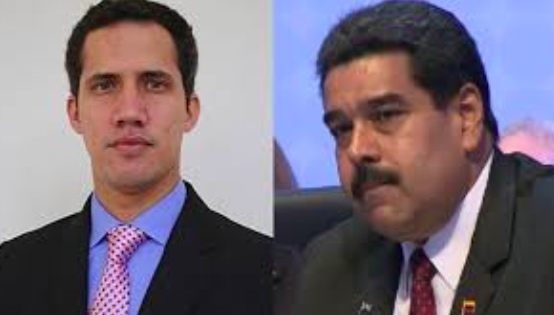
“We denounce these arrests, as the people inside were there with our permission, and we consider it a violation of the Vienna Conventions,” says Deputy Foreign Minister Carlos Ron. “We do not authorize any of the coup leaders to enter our embassy in Washington DC. We call on the US government to respect the Vienna Conventions and sign a Protecting Power Agreement with us that would ensure the integrity of both our Embassy in Washington DC and the US Embassy in Caracas.” The US has been negotiating with Switzerland to take charge of its Caracas Embassy and Venezuela has been negotiating with Turkey to take charge of its DC Embassy. These critical negotiations will be broken, however, if the US illegally hands over the Venezuelan Embassy to the forces of opposition leader Juan Guaido.

On April 10, members of the Embassy Protection Collective, including activists from CODEPINK, Popular Resistance and the ANSWER Coalition, moved into the Venezuelan embassy in the Georgetown neighborhood of Washington, D.C. to serve as an interim embassy protection force to prevent the Trump administration from allowing representatives of non-elected opposition leader Juan Guiado from taking over the building as part of a repeatedly attempted and failed coup.

From April 10-April 30, members of the Embassy Protection Collective were able to come and go freely from the building, with up to 50 activists sleeping there. On April 30, a group of Guaidó supporters —coinciding with Guaidó’s failed call for an uprising inside Venezuela — descended on the embassy, determined to oust the activists and seize the building. They blared sirens, horns, and megaphones and surrounded the perimeter of the building with tents, refusing to allow food, medicine, supplies, or people to enter. Multiple peace activists were physically assaulted and arrested in attempts to approach the building with food. On May 8, Potomac Electric Power Company (Pepco), assisted by the Secret Service, cut electricity despite all utility bills being paid in full.

The Collective maintains that the arrests are illegal under Articles 22 and 45 of the 1961 Vienna Conventions on Diplomatic Relations, in which diplomatic premises are “inviolable” and agents of the receiving State may not enter them, except with the consent of the head of the mission. The Trump Administration has not only allowed illegal seizures of diplomatic premises belonging to Venezuela, but has actively facilitated it by giving the Military Attache building and the New York City Consulate to the opposition.

“This struggle is far from over. We will continue to fight to stop this embassy from being handed over by the Guaidó supporters,” says CODEPINK Codirector Medea Benjamin. “The Embassy Protection Collective recognizes that turning over the embassy over to Guaidó would place the U.S. embassy in Caracas in jeopardy. We will continue to use all methods at our disposal to keep the Venezuelan Embassy in Washington D.C. empty until a diplomatic solution — a Protecting Power Agreement — can be worked out between the U.S. and the Venezuelan governments.”

A Protecting Power Agreement would allow third countries to take charge of both the Venezuela and US Embassies. Such an agreement could lead to further negotiations to avoid a military conflict that would be catastrophic for Venezuela, the United States, and for the region. It could lead to a catastrophic loss of lives and mass migration from the chaos and conflict of war, exacerbating the existing humanitarian crisis stoked by U.S. economic sanctions. It could cost the United States trillions of dollars and become a quagmire similar to the U.S. intervention in Iraq and Afghanistan.


Related Article:

Who’s behind the pro-Guaido mob that besieged Venezuela’s embassy in Washington?


The Disintegrated Mind: The Greatest Threat to Human Survival on Earth

“Triple Portrait” by Sophie Kahn

By Robert J. Burrowes

Like many people who have struggled to understand why human beings are driving the sixth mass extinction event in Earth’s history, which now threatens imminent human extinction as well, over many decades I have explored the research and efforts of a great many activists and scholars to secure this understanding. However, with many competing ideas from the fields of politics, economics, sociology and psychology, among others, this understanding has proved elusive. Nevertheless, I have reached an understanding that I find compelling: Human beings are driving the sixth mass extinction event in Earth’s history because of the disintegrated nature of the human mind.

While the expression ‘mental disintegration’ has been used in a number of contexts previously, for the purpose of my discussion in this article I am going to redefine it, explain how it originates, describe several ways in which it manifests behaviorally and the profoundly dysfunctional outcomes this generates, and suggest what we can do about it.

Given that the expression, as I am using it, describes a shocking psychological state but also one that is so widespread it afflicts virtually everyone, it can be described as posing the greatest threat to human survival on Earth. Why? Simply because it caused – and now prevents virtually everyone from thinking, feeling, planning and behaving functionally in response to – the multifaceted threats to humanity and the biosphere.

So, for the purpose of this article: Mental disintegration describes a state in which the various parts of the human mind are no longer capable of working as an integrated unit. That is, each part of the mind – such as memory, thoughts, feelings, sensing capacities (sight, hearing…), ‘truth register’, conscience – function largely independently of each other, rather than as an integrated whole. The immediate outcome of this dysfunction is that human behaviour lacks consideration, conviction, courage and strategy, and is simply driven compulsively by the predominant fear in each context.

The reason this issue first attracted my attention was because, on many occasions, I observed individuals (ranging from people I knew, to politicians) behaving in ways that seemed outrageous but it was also immediately apparent that the individual was completely unaware of the outrageous nature of their behaviour. On the contrary, it seemed perfectly appropriate to them. With the passage of time, however, I have observed this dysfunctionality in an enormously wide variety of more subtle and common forms, making me realise just how widespread it is even if it goes largely unrecognized. After all, if virtually everyone does it in particular contexts, then why should it be considered ‘abnormal’?

One version of this mental disintegration is the version usually known as ‘cognitive dissonance’. The widely accepted definition of this state, based on Leon Festinger’s research in the 1950s, goes something like this: Cognitive dissonance theory suggests that we have an inner drive to hold all of our attitudes, beliefs, values and behavior in harmony and to avoid disharmony (or dissonance). This is known as the principle of cognitive consistency. When there is an inconsistency between attitudes, beliefs and/or values on the one hand and behaviors on the other (dissonance), something must change to eliminate the dissonance.

The problem with this approach to the issue is that it assumes awareness of the inconsistency on the part of the individual impacted and also assumes (based on Festinger’s research) that there is some inclination to seek consistency. But my own observations of a vast number of people in a substantial variety of contexts over several decades have clearly revealed that, in very many contexts, individuals have no awareness of any discrepancy and, hence, have no inclination to seek consistency between their attitude, belief and/or value and their behavior. Moreover, even if they do have some awareness of the inconsistency, most people simply act on the basis of their predominant emotion – usually fear – in the context and pass it off with a rationalization. For example, that their particular work/role is so important that it justifies their excessive consumption on a planet of limited and unequally shared resources.

Consequently, to choose an obvious example, most climate, environmental, anti-nuclear and anti-war activists fail to grapple meaningfully with the obvious contradiction between their own over-consumption of fossil fuels and resources generally and the role that consumption of these resources plays in driving the climate and environmental catastrophes as well as war. The idea of reducing their own personal consumption is beyond serious contemplation (let alone action). And, of course, it goes without saying that the global elite suffers this disintegration of the mind by failing to connect their endless acquisition of power, profit and privilege at the expense of all others and the Earth, with the accelerating and multifaceted threats to human survival including the future of their own children. But the examples are endless.

In any case, leaving aside ‘cognitive dissonance’, there are several types of mental disintegration as I define it in this article. Let me briefly give you five examples of mental disintegration before explaining why it occurs.

  1. Denial is an unconscious mental state in which an individual, having been given certain information about themselves, others they know or the state of the world, deny the information because it frightens them. This is what happens for a ‘climate denier’, for example. For a fuller explanation, see ‘The Psychology of Denial’.
  2. The ‘Magic Rat’ is an unconscious mental state in which a person’s fear makes them incapable of grappling with certain information, even to deny it, so they completely suppress their awareness of the information immediately they receive it. For four examples of this psychological phenomenon, which President Trump exemplifies superbly, see You Cannot Trap the “Magic Rat”: Trump, Congress and Geopolitics’.
  3. Delusion is an unconscious mental state in which a person is very frightened by certain information but the nature of the circumstances make it impossible to either deny or suppress awareness of the information so they are compelled to construct a delusion in relation to that particular reality in order to feel safe. For a fuller explanation, see The Delusion “I Am Not Responsible”’.
  4. Projection is an unconscious mental state in which a person is very frightened of knowing a terrifying truth so they ‘defend’ themselves against becoming aware of this truth by (unconsciously) identifying a more palatable cause for their fear and then ‘defending’ themselves against this imagined ‘threat’. Political leaders in Israel do this chronically in relation to the Palestinians, for example. But the US elite also does this chronically in relation to any competing ideas in relation to political and economic organization in other countries. See ‘The Psychology of Projection in Conflict’.
  5. Lies arise from a conscious or unconscious mental state in which a person fears blame and/or punishment for telling an unpalatable truth (such as one that will self-incriminate) so they unconsciously employ tactics, including lying, to avoid this blame and punishment (and thus project the blame onto others). When people lie unconsciously, it means they are lying to themself as well; that is, constructing a lie without awareness that they are doing so. For a fuller explanation, see Why Do People Lie? And Why Do Other People Believe Them?’

So why does this mental disintegration – this disintegration of the mind so that its many components are essentially unaware of the others – happen? In brief, it happens because, throughout childhood, each individual is endlessly bombarded with ‘visible’, ‘invisible’ and ‘utterly invisible’ violence in the name of socialization, which is more accurately labeled ‘terrorization’. This is done to ensure that the child is obedient despite the fact that obedience has no evolutionary functionality whatsoever. See Why Violence? and Fearless Psychology and Fearful Psychology: Principles and Practice.

A primary outcome of this terrorization in materialist cultures is that the child learns to suppress their awareness of how they feel by using food and material items to distract themselves. By doing this, the child rapidly loses self-awareness and learns to consume as the substitute for this awareness. Clearly, this has catastrophic consequences for the child, their society and for nature (although it is immensely profitable for elites and their agents). For a fuller explanation, see ‘Love Denied: The Psychology of Materialism, Violence and War’.

Beyond this, however, this terrorization ensures that the human mind is so disintegrated that virtually all humans have no problem living in denial, delusion and projection and using ‘magic rats’ and lies on a vast range of issues because they simply have no awareness of reality in that context. Different parts of their disintegrated mind simply hold one element of their mind separately from all others (thus obscuring any denial, delusion and projection and the use of ‘magic rats’ and lies), consequently precluding any tendency to restore integrity from arising.

This is why, for example, most people can lie ‘outrageously’, including under oath, without the slightest awareness that they are doing so and which, as an aside, is why oaths to tell the truth in court, and even lie detector tests, are utterly meaningless. If the person themself is unaware they are lying, it is virtually impossible for anyone else – unless extraordinarily self-aware – to detect it. And, of course, judges and juries cannot be self-aware or they would not agree to perform their respective roles in the extraordinarily dysfunctional and violent legal system. See ‘The Rule of Law: Unjust and Violent’.

In essence then, the process of ‘socializing’ (terrorizing) a child into obedience so that they will ‘fit into’ their particular society has the outcome of scaring them into suppressing their awareness of reality, including their awareness of themself. In this circumstance, the individual that now ‘survives’ does so as the ‘socially-constructed delusional identity’ (that is, obedient and, preferably, submissive individual) that the significant adults in their childhood terrorized them into becoming.

To reiterate: Because social terrorization destroys the emergence of an integrated mind that would enable memory, sensing capacities, thoughts, feelings, conscience, attitudes, beliefs, values and behaviours to act in concert, the typical individual will now invariably act in accord with the unconscious fear that drives every aspect of their behavior (and ‘requires’ them to endlessly seek approval to avoid the punishment threatened for disobedience when they were a child).

Moreover, this disintegrated mind has little or no capacity to ‘observe reality’ in any case, such as seek out genuine news sources – like the one you are reading now – that accurately report the biodiversity, climate, environmental, military and nuclear catastrophes and, having done so, to be truly aware of this news in the sense of deeply comprehending its meaning and implications for their own behaviour.

So, to elaborate one of the examples cited above, even most individuals who self-identify as climate, environmental, anti-nuclear and/or anti-war ‘activists’ go on over-consuming (which is highly socially approved in industrialized societies) without any genuine re-evaluation of their own behaviour in light of what should be the observed reality about these crises (or, if their mind allows a ‘re-evaluation’ to commence, to dismiss it quickly with a rationalization that their over-consumption is somehow justified).

One obvious outcome of this is that elite-controlled corporations and their governments can largely ignore ‘activist’ entreaties for change because activist (and widespread) over-consumption constitutes financial endorsement of the elite’s violent and exploitative economy. In other words: If people are buying the products (such as fossil fuels for their car and air travel, and hi-tech devices), made possible by fighting the wars and exploiting the people in countries where the raw materials for this production are secured, then why pay attention to calls for change? Dollars speak louder than words.

So what can we do?

Well, given that the above describes just a small proportion of the psychological dysfunctionality of most humans, which is why we remain on the fast track to extinction despite overwhelming evidence of the profound changes that need to occur – see ‘Human Extinction by 2026? A Last Ditch Strategy to Fight for Human Survival’ – I encourage you to seriously consider incorporating strategies to address this dysfunctionality into any effort you make to improve our world.

For most people, this will include starting with yourself. See ‘Putting Feelings First’.

For virtually everyone, it will include reviewing your relationship with children and, ideally, making ‘My Promise to Children’.

For those who feel readily able to deal with reality, consider campaigning strategically to achieve the outcomes we need. See Nonviolent Campaign Strategy or Nonviolent Defense/Liberation Strategy. The global elite is deeply entrenched – fighting its wars, exploiting people, destroying the biosphere – and not about to give way without a concerted effort by many of us campaigning strategically on several key fronts.

If you recognize the pervasiveness of the fear-driven violence in our world, consider joining the global network of people resisting it by signing the online pledge of The Peoples Charter to Create a Nonviolent World.

But, most fundamentally of all, if you understand the simple point that Earth’s biosphere cannot sustain a human population of this magnitude of which more than half endlessly over-consume, then consider accelerated participation in the strategy outlined in The Flame Tree Project to Save Life on Earth.

Or, if this feels too complicated, consider committing to:

The Earth Pledge 

Out of love for the Earth and all of its creatures, and my respect for their needs, from this day onwards I pledge that:

  1. I will not travel by plane
  2. I will not travel by car
  3. I will not eat meat and fish
  4. I will only eat organically/biodynamically grown food
  5. I will minimize the amount of fresh water I use, including by minimizing my ownership and use of electronic devices
  6. I will not buy rainforest timber
  7. I will not buy or use single-use plastic, such as bags, bottles, containers, cups and straws
  8. I will not use banks that provide any service to corporations involved in fossil fuels, nuclear power and/or weapons
  9. I will not accept employment from, or invest in, any organization that supports or participates in the exploitation of fellow human beings or profits from killing and the destruction of the biosphere
  10. I will not get news from the corporate media (mainstream newspapers, television, radio, Facebook…)
  11. I will make the effort to learn a skill, such as food gardening or sewing, that makes me more self-reliant
  12. I will gently encourage my family and friends to consider signing this pledge.

Conclusion

There is a vast array of ‘professional help’, literature, video material, lecturers and other ‘resources’ from a wide range of perspectives that advocate and ‘teach’ one or a variety of ways that people can use to change their behaviour to get improved outcomes in their lives (whether from a personal, economic, business, political or other perspective). Virtually all of these constitute nothing more than psychological ‘tricks’ to achieve a short-term outcome by ‘working around’ the fundamental truth: As a result of terrorization during childhood, virtually all humans are unconsciously terrified and this makes their behaviour utterly dysfunctional.

The point is this: there is no trick that can get us out of the catastrophic mess in which we now find ourselves. Only the truth can do that. Psychological and behavioural dysfunctionalities notwithstanding, if we do not address this fear as part of our overall strategy, then this fear will destroy us in the end. And the evidence of that lies simply in the fact that the daily updates on the already decades-long but ongoing horrific biodiversity, climate, environmental, nuclear, war and humanitarian crises are testament to our ongoing failure to respond appropriately and powerfully. Because our (usually unconscious) fear prevents us from doing so.

So if you believe that human beings are going to get out of our interrelated social, political, economic, military, nuclear and ecological crises with a largely psychologically dysfunctional population, I encourage you to re-evaluate that belief (paying attention, if you can, to how your disintegrated mind intervenes to prevent you doing so). And I encourage you to ask yourself if the value we get out of improving the psychological functionality of our species might not be worth considerable effort as part of our overall strategy to avert human extinction.


Biodata: Robert J. Burrowes has a lifetime commitment to understanding and ending human violence. He has done extensive research since 1966 in an effort to understand why human beings are violent and has been a nonviolent activist since 1981. He is the author of Why Violence? His email address is flametree@riseup.net and his website is here.

Who knows? Who cares? If the Media Claim 50 Countries Reject Venezuela’s Elected President and Repeat It Enough It Must Be True

Wno’s the president of Venezuela? The elected Nicolas Maduro or the self-proclaimed unelected Juan Guaido?

By Dave Lindorff

Source: This Can’t Be Happening

American media still refer to Juan Guaidó, America’s hand-picked “legitimate leader” or “legitimate president” of Venezuela, as having an “administration.”

The truth is that his “administration” — consisting of advisors and other opposition leaders — are all either arrested and being held by the government, hiding, seeking asylum in various foreign embassies (Spanish, Italian, Brazilian and Argentinian) in the capital of Caracas, or have fled to other countries like Brazil and Colombia.

Guaidó, apparently a government of one, has so far avoided arrest probably because the elected Venezuelan President Maduro doesn’t want to give the US an excuse to try and rescue him, or to launch military actions of some kind against Venezuela as the White House keeps threatening to do.

Clearly, in calling for US military intervention, Guaidó has both demonstrated almost his total lack of backing among the masses of Venezuelan people, as well as his desperation, given Latin American’s visceral resentment of US interventions in their country, all of which have been designed to put autocrats or even military juntas in power, and many of which have openly overthrown popularly elected governments, as in Guatemala, Chile, Brazil, Nicaragua, Haiti, Dominican Republic, and elsewhere.

None of this gets reported in the US. Only recently has the New York Times, always a reliable backer of US imperial policy in Latin America, at least hinted at the possibility that the reason Maduro remains president and that Guaidó’s efforts to oust him are failing  so abysmally could be that the Venezuelan people want him to stay president, and do not want a US-backed coup or a US military intervention to replace him.

At this point the huffing and puffing coming from Secretary of State Mike Pompeo and especially from the White House National Security Advisor and chief militarist blowhard John Bolton, are looking pretty pathetic, with Bolton trying to sow dissension and distrust by hinting that Maduro “better not trust” his own generals’ loyalty, and by offering rewards to those generals willing to abandon Maduro.

It is an indication of the United States’s declining power and influence in Latin America that few outside the US with its insular mass media believe that the US would or even could successfully invade Venezuela and impose a government on that country of 32 million (a number that keeps declining as the upper middle class and rich flee).

If anything, US sabotage and threats and US backing for a government of the wealthy are probably galvanizing support for Maduro. While people in the US, if they are paying any attention at all to events in Venezuela, may believe that Maduro is a corrupt thug, people in Venezuela itself, and in most of Latin America know full well that the main problems in that oil-rich country have to do with the collapse in oil prices since the heady days of Hugo Chavez when it was going for $100 a barrel, to American efforts to block Venezuela from exporting its oil now, and to freeze or even seize Venezuelan assets and oil receipts from the oil it does manage to export, and to other forms of economic warfare engaged in by the United States. As in Cuba, this kind of strategy by the US only works to build support for the country’s existing government.

At some point Guaidó is going to go. He will either be written off by the US media — his main backer — or will be arrested. Probably the latter will follow the former since once he’s recognized as an impotent charlatan, his arrest will not make him a martyr for the opposition. Already he has lost what public support he had as Venezuela’s wealthy abandon the country for Florida. As well, the “50 countries” that we in the US keep hearing about which supposedly back Guaidó as Venezuela’s “legitimate leader” are realizing that they were hoodwinked by the US. The are now mostly calling for a calmer response to the crisis in Venezuela, and are refusing to buy into US military threats against the Maduro government. Meanwhile nobody in the US media mentions that over 140 countries in the world support Maduro as the leader of Venezuela. 

In truth it’s impossible to find that list of “more than 50 countries” backing a self-proclaimed and unelected Guaidó as Venezuela’s president. The closest I could come by running google searches was a map produced by Bloomberg News listing 13 countries besides the US as supporting Guaidó. These included Canada, the UK, Guatemala, Honduras, Costa Rica, Panama, Ecuador, Colombia, Peru, Chile, Argentina, Paraguay and Brazil. That is 13 plus the United States. Listed as supporting Maduro as elected President are Russia, China, Turkey, Bolivia, and Cuba, though I believe Bloomberg neglected to mention Nicaragua, a strong Maduro backer, which would make it six. All of Africa and much of Asia was left as “no opinion,” though in fact that means they are continuing to recognize the current Maduro government. 

For a time, most of the countries of Europe were lining up behind Guaidó, particularly after Germany announced that it was recognizing him as the new interim leader of Venezuela in late January, and after it ousted the country’s ambassador, but then by late March Germany was having second thoughts, and rejected the person sent there by Guaidó to assume the position of Venezuelan ambassador. At this point, except for the UK, the countries of Europe, along with Mexico and Uruguay, are simply calling for a dialogue and a negotiated solution to the Venezuela political crisis, and in addition to opposing any talk of military action or a coup, are seeking nothing more than a new election (which Maduro would probably win, given the alternative of the return of a government of the rich). The Europeans are no longer really backing Guaidó.

The reporters who continue to refer to “more than 50 countries” calling for Maduro’s ouster all must be using the same wrong or outdated news clip or some exaggerated and dated State Department press release.  (I asked the State Department for an updated list today but so far none has been forthcoming, though it would appear such a list shouldn’t take long to compile given how short it must be.)

The Great Unraveling Begins: Distraction, Lies, Infighting, Betrayal

By Charles Hugh Smith

Source: Of Two Minds

The good news is renewal becomes possible when the entire rotten status quo collapses in a putrid heap.

There are two basic pathways to systemic collapse: external shocks or internal decay. The two are not mutually exclusive, of course; it can be argued that the most common path is internal decay weakens the empire/state and an external shock pushes the rotted structure off the cliff.

As Dave of the X22 Report and I discuss in The World Is About To Change & It’s Going To Be Glorious, we are in the early stages of terminal internal decay.There are a number of dynamics shared by decaying empires/states:

1. The ruling elites lose the moral imperative to sacrifice for the good of the empire/state. Instead they use the power of the state to further their own private interests and agendas.

2. The ruling elites start “fudging” reports (i.e. lies are presented as truths) and promoting narratives to mask their self-aggrandizement and the erosion of the nation/empire under their self-interested rule.

In other words, the elites know the public would resist their leadership if the truth were widely known, so the ruling elites devote tremendous resources to massaging the news to distract the public from reality and reflect positively on their self-serving leadership.

Since the weaknesses of the empire are being hidden, they cannot be addressed, and so rot that could have been fixed early becomes widespread and fatal.

3. Flush with the state’s wealth and power, the ruling elite splinters into warring camps which squander the empire’s remaining wealth on private battles over which camp will rule what appears solid and eternal–the empire.

4. As the elites battle it out, the nation/empire falls apart as the leadership’s focus is on internecine conflicts over the spoils of the empire, rather than on preserving the foundations of the empire’s wealth and security.

5. As the truth inevitably leaks out, the public grasps the enormity of the elites’ betrayal of the nation and the public interest. Faith in the elites and the institutions they control plummets, and the Great Unraveling becomes unstoppable.

6. In a last-ditch effort to save their wealth and power, the elites distract the public with Bread and Circuses– “free money” in various guises (Universal Basic Income, Modern Monetary Theory, etc.)–and the distracting Circus of political theater and a surfeit of entertainment.

Whether the elites or the public are aware of it or not, America is well down the path to terminal internal decay: Distraction, Lies, Infighting, Betrayal.

The good news is renewal becomes possible when the entire rotten status quo collapses in a putrid heap of broken promises, dysfunctional institutions, blatant lies, unpayable debts and cascading defaults.

People Who Publicly Fret About Assange Rape Allegations Are Lying

By Caitlin Johnstone

Source: CaitlinJohnstone.com

A few hours ago I stumbled across a tweet by Huffington Post UK editor Basia Cummings which made my blood boil. Actress and activist Pamela Anderson had just spoken to the press with WikiLeaks editor-in-chief Kristinn Hrafnsson about their visit with Assange at Belmarsh prison, decrying the WikiLeaks founder’s cruel treatment and unjust prosecution. Basia Cummings took this opportunity to call her social media followers in to make fun of Anderson’s clothing.

“Pamela Anderson arrives at Belmarsh to visit Julian Assange wearing… a bespoke cape/blanket referencing ‘Cromwell’ and free speech’. It’s a look,” Cummings said.

But what really got me were the comments the tweet elicited.

“Is it possible to unwank over someone?” asked one user.

“Pamela Anderson arrives at Belmarsh to visit Julian Assange to supply him with some material for his cell wank bank,” said another.

“Cum blanket,” said another.

“She banged Kid Rock. Enough said,” said another.

This is just a small sampling from a quick skim. There are many, many others. I won’t quote them all.

I found this so deeply illustrative of the way mainstream liberals throw every value they claim to stand for right in the garbage as soon as it becomes an obstacle to their petty partisan attacks. They all warned that Trump was campaigning on a platform of xenophobia, homophobia and demagoguery, but as soon as he was elected they began launching phony Russiagate attacks which themselves were rife with xenophobia, homophobia and demagoguery. Liberal pundits who rightly criticized Bush for his unforgivable invasion of Iraq now attack Trump for being insufficiently hawkish toward Russia and its allies. These mindless automatons don’t actually stand for anything beyond blind partisan loyalty.

In the same way that they will happily wipe their asses with any of their pretend values the second it becomes politically convenient to do so, mainstream liberals will also fabricate grave, solemn concerns about things they never actually cared about before as soon as it can be used as an angle of partisan attack.

Feminist writer Naomi Wolf began her excellent 2010 essay titled “J’Accuse: Sweden, Britain, and Interpol Insult Rape Victims Worldwide” with the words, “How do I know that Interpol, Britain and Sweden’s treatment of Julian Assange is a form of theater? Because I know what happens in rape accusations against men that don’t involve the embarrassing of powerful governments.” Wolf argued that “men are pretty much never treated the way Assange is being treated in the face of sex crime charges,” and she was absolutely correct.

As a survivor of multiple sexual assaults, I have found it unspeakably infuriating the way this same patriarchal imperialist system which has allowed rape culture to thrive throughout the entirety of its existence has suddenly become deeply, deeply concerned about plot hole-riddled and completely unproven allegations against a man who just so happens to have published humiliating truths about that very same imperialist system. This same warmongering power structure which has never given a shit about women beyond our ability to fly a stealth bomber and squeeze new recruits out of our vaginas suddenly has the full force of its propaganda machine whipping liberals into a hysteria about allegations of acts that aren’t even illegal in the nations those liberals live in. Acts that these liberals have never even thought about pushing to make laws against in their own governments.

Do you know how you can be absolutely certain that anyone you see on social media rending their garments about Assange’s Swedish allegations is completely full of shit? Because no matter how hard you search through their post history, you will never, ever find any similarly enthusiastic push to ban the actions that Assange is accused of in their own government. In their own land, where their own daughters and sons will be impacted. They focus solely on shaky allegations against a target of the CIA and the Pentagon which are alleged to have happened in Sweden, a nation with very different sexual consent laws than the nations of these English-speaking concern trolls.

Without conceding that any part of the unproven allegations against Assange are true, it’s important to note that the United States, from which many of these Assange haters express their grave concern about Assange’s Swedish accusations, has no laws whatsoever about non-consensual condom removal, and other western judicial systems are barely even beginning to touch on the subject. None of these nations convict men for initiating sex while the woman is half-asleep, as Assange’s rape allegation asserts, and virtually every woman you know has had sex initiated with her by a sexual partner while she was half-asleep. Yet none of the blue-checkmarked journalists you see calling Assange a “rapist” on social media have ever written any articles demanding that laws be passed in their own countries calling for women to receive legal protection from this.

The people pretending to care about these allegations do not care about rape, and they do not care about women. I recently had my Twitter privileges suspended by someone who called me a “rape apologist” for not automatically subscribing to the “believe all women” meme in the case of a known CIA target, and, when I informed him that I myself am a rape victim, this man called me a liar. I went off on him, and he reported me. This man has never cared about rape or women, and it’s entirely likely that he’s done things to women that push the same boundaries on sexual consent he’s accusing Assange of doing, or worse.

I suspect that goes the same for a lot of the concern trolling Assange-hating men I encounter online whose suddenly holier-than-thou position on initiating sex with a sleepy woman you’ve just been intimate with probably does not line up all that well with their own sexual past. I mean, let’s get real. I’m a woman, my friends are women, I’ve been in a lot of book clubs and mom’s groups and out on a lot of girl’s nights and I know that if you want to get a conversation really fired up, just mention how annoying it is when a bloke wakes you up prodding you with his dick. It’s relatable and a rich vein to mine anecdote-wise. This is a universal experience for a western woman, and yeah, I think it’s rapey and gross and I would love for it to stop, but don’t pretend you care about that now any more than you did before you realized it was a way you could smear Assange. Be real. If you weren’t campaigning for it to be outlawed in your own state or country before, you need to at least be making noises about it now first, and you know and I know that that simply isn’t happening.

In fact, as the years pass, it is becoming entirely possible that the publicity around the allegations against Assange will not change one thing about rape law in any of the western countries which pretend to be so outraged by it other than to be considered a useful hack for smearing a journalist for exposing the patriarchal imperialist system under which rape culture continues to thrive. It has been nine years; nothing has changed. I think we can safely say that after nine years and no change that this has never been an honest concern for the health and well-being of the women involved and for women in general, because if it was then those laws would be ubiquitous across western democracies. Yet again, the suffering of women will be used by the powerful to hide their crimes and entrench more deeply the suffering for the women who work tirelessly as human shields protecting their children from the effects of war and poverty in a predatory capitalist system which is incapable of valuing women’s work.

Of course we should want these things to be illegal. Of course it should be illegal to deliberately have unprotected penetration without consent. Of course it should be illegal to initiate sex without fully awake and enthusiastic consent. Of course we should all want to live in a world where everyone is protected from any sexual interaction happening without their permission. But these people are not interested in creating that world. These people are interested in supporting the same rapey power establishment which has no regard for the sovereignty of entire nations, much less the individual sovereignty of womens’ bodies. They pretend to be on the side of women, but they are actually on the side of the worst aspects of patriarchy, because they have formed an egoic identification with the political structures which are built upon those aspects. That’s what concern trolling is.

This is just one of the many ways in which authentic feminism, authentic advocacy for the real interests of real women, has been co-opted for the benefit of a depraved establishment which has never cared about women and never will. We see it in the way the mass media celebrates women ascending to leadership positions of the military-industrial complex and the National Guard, and the way the presidential candidacy of a woman who embodies all the sickest aspects of the patriarchy was billed as a path to victory for feminism. The healthy impulse to elevate a gender that had an enslaved status in our society since the dawn of civilization has been hijacked by perverse agendas, and it needs to be reclaimed.

Whenever you see anyone claiming to be deeply, deeply concerned about the Swedish allegations against Assange, ask them what they’ve been doing to fight for legal changes which protect women from the things Assange is accused of doing. Then watch them squirm.

For more info on the gaping plot holes in the “Assange is a rapist” smear, check out this section from my mega-article Debunking All The Assange Smears.

Decriminalizing the Drug War?

Calculating the Damage from a Century of Drug Prohibition

By Alfred W. McCoy

Source: TomDispatch.com

We live in a time of change, when people are questioning old assumptions and seeking new directions. In the ongoing debate over health care, social justice, and border security, there is, however, one overlooked issue that should be at the top of everyone’s agenda, from Democratic Socialists to libertarian Republicans: America’s longest war. No, not the one in Afghanistan. I mean the drug war.

For more than a century, the U.S. has worked through the U.N. (and its predecessor, the League of Nations) to build a harsh global drug prohibition regime — grounded in draconian laws, enforced by pervasive policing, and punished with mass incarceration. For the past half-century, the U.S. has also waged its own “war on drugs” that has complicated its foreign policy, compromised its electoral democracy, and contributed to social inequality. Perhaps the time has finally come to assess the damage that drug war has caused and consider alternatives.

Even though I first made my mark with a 1972 book that the CIA tried to suppress on the heroin trade in Southeast Asia, it’s taken me most of my life to grasp all the complex ways this country’s drug war, from Afghanistan to Colombia, the Mexican border to inner-city Chicago, has shaped American society. Last summer, a French director doing a documentary interviewed me for seven hours about the history of illicit narcotics. As we moved from the seventeenth century to the present and from Asia to America, I found myself trying to answer the same relentless question: What had 50 years of observation actually drilled into me, beyond some random facts, about the character of the illicit traffic in drugs?

At the broadest level, the past half-century turns out to have taught me that drugs aren’t just drugs, drug dealers aren’t just “pushers,” and drug users aren’t just “junkies” (that is, outcasts of no consequence). Illicit drugs are major global commodities that continue to influence U.S. politics, both national and international. And our drug wars create profitable covert netherworlds in which those very drugs flourish and become even more profitable. Indeed, the U.N. once estimated that the transnational traffic, which supplied drugs to 4.2% of the world’s adult population, was a $400 billion industry, the equivalent of 8% of global trade.

In ways that few seem to understand, illicit drugs have had a profound influence on modern America, shaping our international politics, national elections, and domestic social relations. Yet a feeling that illicit drugs belong to a marginalized demimonde has made U.S. drug policy the sole property of law enforcement and not health care, education, or urban development.

During this process of reflection, I’ve returned to three conversations I had back in 1971 when I was a 26-year-old graduate student researching that first book of mine, The Politics of Heroin: CIA Complicity in the Global Drug Trade. In the course of an 18-month odyssey around the globe, I met three men, deeply involved in the drug wars, whose words I was then too young to fully absorb.

The first was Lucien Conein, a “legendary” CIA operative whose covert career ranged from parachuting into North Vietnam in 1945 to train communist guerrillas with Ho Chi Minh to organizing the CIA coup that killed South Vietnamese President Ngo Dinh Diem in 1963. In the course of our interview at his modest home near CIA headquarters in Langley, Virginia, he laid out just how the Agency’s operatives, like so many Corsican gangsters, practiced the “clandestine arts” of conducting complex operations beyond the bounds of civil society and how such “arts” were, in fact, the heart and soul of both covert operations and the drug trade.

Second came Colonel Roger Trinquier, whose life in a French drug netherworld extended from commanding paratroopers in the opium-growing highlands of Vietnam during the First Indochina War of the early 1950s to serving as deputy to General Jacques Massu in his campaign of murder and torture in the Battle of Algiers in 1957. During an interview in his elegant Paris apartment, Trinquier explained how he helped fund his own paratroop operations through Indochina’s illicit opium traffic. Emerging from that interview, I felt almost overwhelmed by the aura of Nietzschean omnipotence that Trinquier had clearly gained from his many years in this shadowy realm of drugs and death.

My last mentor on the subject of drugs was Tom Tripodi, a covert operativewho had trained Cuban exiles in Florida for the CIA’s 1961 Bay of Pigs invasion and then, in the late 1970s, penetrated mafia networks in Sicily for the U.S. Drug Enforcement Administration. In 1971, he appeared at my front door in New Haven, Connecticut, identified himself as a senior agent for the Treasury Department’s Bureau of Narcotics, and insisted that the Bureau was worried about my future book. Rather tentatively, I showed him just a few draft pages of my manuscript for The Politics of Heroin and he promptly offered to help me make it as accurate as possible. During later visits, I would hand him chapters and he would sit in a rocking chair, shirt sleeves rolled up, revolver in his shoulder holster, scribbling corrections and telling remarkable stories about the drug trade — like the time his Bureau found that French intelligence was protecting the Corsican syndicates smuggling heroin into New York City. Far more important, though, through him I grasped how ad hoc alliances between criminal traffickers and the CIA regularly helped both the Agency and the drug trade prosper.

Looking back, I can now see how those veteran operatives were each describing to me a clandestine political domain, a covert netherworld in which government agents, military men, and drug traders were freed from the shackles of civil society and empowered to form secret armies, overthrow governments, and even, perhaps, kill a foreign president.

At its core, this netherworld was then and remains today an invisible political realm inhabited by criminal actors and practitioners of Conein’s “clandestine arts.” Offering some sense of the scale of this social milieu, in 1997 the United Nations reported that transnational crime syndicates had 3.3 million members worldwide who trafficked in drugs, arms, humans, and endangered species. Meanwhile, during the Cold War, all the major powers — Britain, France, the Soviet Union, and the United States — deployed expanded clandestine services worldwide, making covert operations a central facet of geopolitical power. The end of the Cold War has in no way changed this reality.

For over a century now, states and empires have used their expanding powers for moral prohibition campaigns that have periodically transformed alcohol, gambling, tobacco, and, above all, drugs into an illicit commerce that generates sufficient cash to sustain covert netherworlds.

Drugs and U.S. Foreign Policy

The influence of illicit drugs on U.S. foreign policy was evident between 1979 and 2019 in the abysmal failure of its never-ending wars in Afghanistan. Over a period of 40 years, two U.S. interventions there fostered all the conditions for just such a covert netherworld. While mobilizing Islamic fundamentalists to fight the Soviet occupation of that country in the 1980s, the CIA tolerated opium trafficking by its Afghan mujahedeen allies, while arming them for a guerrilla war that would ravage the countryside, destroying conventional agriculture and herding.

In the decade after superpower intervention ended in 1989, a devastating civil war and then Taliban rule only increased the country’s dependence upon drugs, raising opium production from 250 tons in 1979 to 4,600 tons by 1999. This 20-fold increase transformed Afghanistan from a diverse agricultural economy into a country with the world’s first opium monocrop — that is, a land thoroughly dependent on illicit drugs for exports, employment, and taxes. Demonstrating that dependence, in 2000 when the Taliban banned opium in a bid for diplomatic recognition and cut production to just 185 tons, the rural economy imploded and their regime collapsed as the first U.S. bombs fell in October 2001.

To say the least, the U.S. invasion and occupation of 2001-2002 failed to effectively deal with the drug situation in the country. As a start, to capture the Taliban-controlled capital, Kabul, the CIA had mobilized Northern Alliance leaders who had long dominated the drug trade in northeast Afghanistan, as well as Pashtun warlords active as drug smugglers in the southeastern part of the country. In the process, they created a post-war politics ideal for the expansion of opium cultivation.

Even though output surged in the first three years of the U.S. occupation, Washington remained uninterested, resisting anything that might weaken military operations against the Taliban guerrillas. Testifying to this policy’s failure, the U.N.’s Afghanistan Opium Survey 2007 reported that the harvest that year reached a record 8,200 tons, generating 53% of the country’s gross domestic product, while accounting for 93% of the world’s illicit narcotics supply.

When a single commodity represents over half of a nation’s economy, everyone — officials, rebels, merchants, and traffickers — is directly or indirectly implicated. In 2016, the New York Times reported that both Taliban rebels and provincial officials opposing them were locked in a struggle for control of the lucrative drug traffic in Helmand Province, the source of nearly half the country’s opium. A year later, the harvest reached a record 9,000 tons, which, according to the U.S. command, provided 60% of the Taliban’s funding. Desperate to cut that funding, American commanders dispatched F-22 fighters and B-52 bombers to destroy the insurgency’s heroin laboratories in Helmand — doing inconsequential damage to a handful of crude labs and revealing the impotence of even the most powerful weaponry against the social power of the covert drug netherworld.

With unchecked opium production sustaining Taliban resistance for the past 17 years and capable of doing so for another 17, the only U.S. exit strategy now seems to be restoring those rebels to power in a coalition government — a policy tantamount to conceding defeat in its longest military intervention and least successful drug war.

High Priests of Prohibition

For the past half-century, the ever-failing U.S. drug war has found a compliant handmaiden at the U.N., whose dubious role when it comes to drug policy stands in stark contrast to its positive work on issues like climate change and peace-keeping.

In 1997, the director of U.N. drug control, Dr. Pino Arlacchi, proclaimed a 10-year program to eradicate all illicit opium and coca cultivation from the face of the planet, starting in Afghanistan. A decade later, his successor, Antonio Maria Costa, glossing over that failure, announced in the U.N.’s World Drug Report 2007 that “drug control is working and the world drug problem is being contained.” While U.N. leaders were making such grandiloquent promises about drug prohibition, the world’s illicit opium production was, in fact, rising 10-fold from just 1,200 tons in 1971, the year the U.S. drug war officially started, to a record 10,500 tons by 2017.

This gap between triumphal rhetoric and dismal reality cries out for an explanation. That 10-fold increase in illicit opium supply is the result of a market dynamic I’ve termed “the stimulus of prohibition.” At the most basic level, prohibition is the necessary precondition for the global narcotics trade, creating both local drug lords and transnational syndicates that control this vast commerce. Prohibition, of course, guarantees the existence and well-being of such criminal syndicates which, to evade interdiction, constantly shift and build up their smuggling routes, hierarchies, and mechanisms, encouraging a worldwide proliferation of trafficking and consumption, while ensuring that the drug netherworld will only grow.

In seeking to prohibit addictive drugs, U.S. and U.N. drug warriors act as if mobilizing for forceful repression could actually reduce drug trafficking, thanks to the imagined inelasticity of, or limits on, the global narcotics supply. In practice, however, when suppression reduces the opium supply from one area (Burma or Thailand), the global price just rises, spurring traders and growers to sell off stocks, old growers to plant more, and new areas (Colombia) to enter production. In addition, such repression usually only increases consumption. If drug seizures, for instance, raise the street price, then addicted consumers will maintain their habit by cutting other expenses (food, rent) or raising their income by dealing drugs to new users and so expanding the trade.

Instead of reducing the traffic, the drug war has actually helped stimulate that 10-fold increase in global opium production and a parallel surge in U.S. heroin users from just 68,000 in 1970 to 886,000 in 2017.

By attacking supply and failing to treat demand, the U.N.-U.S. drug war has been pursuing a “solution” to drugs that defies the immutable law of supply and demand. As a result, Washington’s drug war has, in the past 50 years, gone from defeat to debacle.

The Domestic Influence of Illicit Drugs

That drug war has, however, incredible staying power. It has persisted despite decades of failure because of an underlying partisan logic. In 1973, while President Richard Nixon was still fighting his drug war in Turkey and Thailand, New York’s Republican governor, Nelson Rockefeller, enacted the notorious “Rockefeller Drug Laws.” Those included mandatory penalties of 15 years to life for the possession of just four ounces of narcotics.

As the police swept inner-city streets for low-level offenders, annual prison sentences in New York State for drug crimes surged from only 470 in 1970 to a peak of 8,500 in 1999, with African-Americans representing 90% of those incarcerated. By then, New York’s state prisons held a previously unimaginable 73,000 people. During the 1980s, President Ronald Reagan, a conservative Republican, dusted off Rockefeller’s anti-drug campaign for intensified domestic enforcement, calling for a “national crusade” against drugs and winning draconian federal penalties for personal drug use and small-scale dealing.

For the previous 50 years, the U.S. prison population had remained remarkably stable at just 110 prisoners per 100,000 people. The new drug war, however, doubled those prisoners from 370,000 in 1981 to 713,000 in 1989. Driven by Reagan-era drug laws and parallel state legislation, prison inmates soared to 2.3 million by 2008, raising the country’s incarceration rate to an extraordinary 751 prisoners per 100,000 population. And 51% of those in federal penitentiaries were there for drug offenses.

Such mass incarceration has led as well to significant disenfranchisement, starting a trend that would, by 2012, deny the vote to nearly six million people, including 8% of all African-American voting-age adults, a liberal constituency that had gone overwhelmingly Democratic for more than half a century. In addition, this carceral regime concentrated its prison populations, including guards and other prison workers, in conservative rural districts of the country, creating something akin to latter-day “rotten boroughs” for the Republican Party.

Take, for example, New York’s 21st Congressional District, which covers the Adirondacks and the state’s heavily forested northern panhandle. It’s home to 14 state prisons, including some 16,000 inmates, 5,000 employees, and their 8,000 family members — making them collectively the district’s largest employer and a defining political presence. Add in the 13,000 or so troops in nearby Fort Drum and you have a reliably conservative bloc of 26,000 voters (and 16,000 non-voters), or the largest political force in a district where only 240,000 residents actually vote. Not surprisingly, the incumbent Republican congresswoman survived the 2018 blue wave to win handily with 56% of the vote. (So never say that the drug war had no effect.)

So successful were Reagan Republicans in framing this partisan drug policy as a moral imperative that two of his liberal Democratic successors, Bill Clinton and Barack Obama, avoided any serious reform of it. Instead of systemic change, Obama offered clemency to about 1,700 convicts, an insignificant handful among the hundreds of thousands still locked up for non-violent drug offenses.

While partisan paralysis at the federal level has blocked change, the separate states, forced to bear the rising costs of incarceration, have slowly begun reducing prison populations. In a November 2018 ballot measure, for instance, Florida — where the 2000 presidential election was decided by just 537 ballots — voted to restore electoral rights to the state’s 1.4 million felons, including 400,000 African-Americans. No sooner did that plebiscite pass, however, than Florida’s Republican legislators desperately tried to claw backthat defeat by requiring that the same felons pay fines and court costs before returning to the electoral rolls.

Not only does the drug war influence U.S. politics in all sorts of negative ways but it has reshaped American society — and not for the better, either. The surprising role of illicit drug distribution in ordering life inside some of the country’s major cities has been illuminated in a careful study by a University of Chicago researcher who gained access to the financial records of a drug gang inside Chicago’s impoverished Southside housing projects.  He found that, in 2005, the Black Gangster Disciple Nation, known as GD, had about 120 bosses who employed 5,300 young men, largely as street dealers, and had another 20,000 members aspiring to those very jobs. While the boss of each of the gang’s hundred crews earned about $100,000 annually, his three officers made just $7.00 an hour, his 50 street dealers only $3.30 an hour, and their hundreds of other members served as unpaid apprentices, vying for entry-level slots when street dealers were killed, a fate which one in four regularly suffered.

So what does all this mean? In an impoverished inner city with very limited job opportunities, this drug gang provided high-mortality employment on a par with the minimum wage (then $5.15 a hour) that their peers in more affluent neighborhoods earned from much safer work at McDonald’s. Moreover, with some 25,000 members in Southside Chicago, GD was providing social order for young men in the volatile 16-to-30 age cohort — minimizing random violence, reducing petty crime, and helping Chicago maintain its gloss as a world-class business center. Until there is sufficient education and employment in the nation’s cities, the illicit drug market will continue to fill the void with work that carries a high cost in violence, addiction, imprisonment, and more generally blighted lives.

The End of Drug Prohibition

As the global prohibition effort enters its second century, we are witnessing two countervailing trends. The very idea of a prohibition regime has reached a crescendo of dead-end violence not just in Afghanistan but recently in Southeast Asia, demonstrating the failure of the drug war’s repression strategy. In 2003, Thai Prime Minister Thaksin Shinawatra launched a campaign against methamphetamine abuse that prompted his police to carry out 2,275 extrajudicial killings in just three months. Carrying that coercive logic to its ultimate conclusion, on his first day as Philippine president in 2016, Rodrigo Duterte ordered an attack on drug trafficking that has since yielded 1.3 million surrenders by dealers and users, 86,000 arrests, and some 20,000 bodies dumped on city streets across the country. Yet drug use remains deeply rooted in the slums of both Bangkok and Manila.

On the other side of history’s ledger, the harm-reduction movement led by medical practitioners and community activists worldwide is slowly working to unravel the global prohibition regime. With a 1996 ballot measure, California voters, for instance, started a trend by legalizing medical marijuana sales. By 2018, Oklahoma had become the 30th state to legalize medical cannabis. Following initiatives by Colorado and Washington in 2012, eight more states to date have decriminalized the recreational use of cannabis, long the most widespread of all illicit drugs.

Hit by a surge of heroin abuse during the 1980s, Portugal’s government first reacted with repression that, as everywhere else on the planet, did little to stanch rising drug abuse, crime, and infection. Gradually, a network of medical professionals across the country adopted harm-reduction measures that would provide a striking record of proven success. After two decades of this ad hoc trial, in 2001 Portugal decriminalized the possession of all illegal drugs, replacing incarceration with counseling and producing a sustained drop in HIV and hepatitis infections.

Projecting this experience into the future, it seems likely that harm-reduction measures will be adopted progressively at local and national levels around the globe, while various endless and unsuccessful wars on drugs are curtailed or abandoned. Perhaps someday a caucus of Republican legislators in some oak-paneled Washington conference room and a choir of U.N. bureaucrats in their glass-towered Vienna headquarters will remain the only apostles preaching the discredited gospel of drug prohibition.

Assange and the Unforgivable Sin of Disemboweling Official Narratives

By Charles Hugh Smith

Source: Of Two Minds

The entire global status quo is on the cusp of the S-Curve decline phase.

There is really only one unforgivable sin in the political realm, and that’s destroying the official narrative by revealing the facts of the matter. This is why whistleblowers who make public the secret machinery of the elaborately artful lies underpinning all official narratives are hounded to the ends of the Earth.

Employees of state entities such as Ellsberg, Manning and Snowden are bound by vows of secrecy and threatened by the promise of severe punishment. Outsiders such as Assange are even further beyond the pale because they can’t be accused of being traitors, as they never took the vows of secrecy required by the Deep State.

The single most damaging revelation to all the elaborate lies that make up official narratives is the truth revealed in official emails, documents and conversations. This is why virtually every document and correspondence is now “classified,” so anyone releasing even a mundane scrap can be sentenced to rot in federal prison.

In a recent C-SPAN interview, author Nomi Prins explained the incredible difficulty of accessing papers in presidential libraries now due to virtually everything being classified. Freedom of Information Act (FOIA) applications must be filed, and researchers must wait years to gain access to routine correspondence that was freely available to all a decade or so ago.

Official paranoia has a 100% correlation with the amount of damage done to official narratives by any leaks of the facts of the matter. What are they so afraid of? Here’s the dynamic in play: the more fragile the narrative, the greater the dependence on half-truths and lies, the greater the official urgency to crush all whistleblowers and maintain a Stasi-like vigilance against any murmurs of dissent or doubt.

If the entire contraption wasn’t so vulnerable to exposure and so dependent on lies, why the infinite paranoia? This paranoia extends past the present system of lies into the past, as exposing the lies in decades past calls into question the official narratives of today.

Any doubt is extremely dangerous, as if even a single thread is pulled loose, the entire fabric of ginned-up statistics, false assurances, half-truths and outright lies unravels. Once the Pentagon Papers revealed the facts of the war in Vietnam, support for the official narrative collapsed essentially overnight.

In the immortal words of Jean-Claude Juncker, when it becomes serious you have to lie, and it’s now serious all the time.

The entire global status quo is on the cusp of the S-Curve decline phase. Hence the vulnerability to disruption of its official narratives and the panicky paranoia of its handlers.


Coup Attempt in Venezuela: What You’re Not Being Told

By Derrick Broze

Source: The Conscious Resistance

As self-proclaimed “Interim President” Juan Guaidó attempted to stage a military coup in Venezuela, the country’s U.N. ambassador declared President Nicolas Maduro victorious and called the United States a “rogue nation.”

The turbulent situation that has been unfolding in Venezuela for the last few years reached new heights on Tuesday as opposition leader and self-declared “Interim President” Juan Guaidó attempted to wrangle power away from Venezuelan President Nicolas Maduro, in what many are calling an attempted coup. Early Tuesday morning, Guaidó gave a press conference declaring that he has the support of the Venezuelan people and military, and demanded that Maduro step down. Guaidó also called on Venezuelans to take to the streets and call for an end to Maduro’s reign as president.

During the day’s events, cameras caught armored vehicles, reportedly belonging to the Bolivian military, running into crowds of protesters. Human Rights Watch (HRW) tweeted that 25 peopled were detained and dozens were wounded. HRW also noted that Venezuelan authorities shut down two international television channels and censored one radio station. “The regime should know that it will be held accountable for these abuses,” tweeted José Miguel Vivanco, Executive Director of HRW’s America Division.

Meanwhile, Venezuela’s U.N. ambassador Samuel Moncada held a press conference stating that President Maduro has “defeated” opposition leader Juan Guaidó and his supporters. Moncada stated “the country is right now in a situation of perfect normality.” Moncada criticized U.N. Secretary-General Antonio Guterres for not supporting Maduro’s government against Guaidó.

Moncada also attacked the United States for what he said was another example of their interventionist policies, singling out President Trump and Vice President Mike Pence for their support of Guaidó. “This is one of the most strange and weird situations we are in now, which the superpower of the world is the main rogue state going around, without care, destroying countries, invading countries, and threatening with the use of force,” Moncada stated.

The Ambassador to the UN also noted that the United States’ use of sanctions amounts to an act of war and only hurts the Venezuelan people. “Sanctions kill, as simple as that. Sanctions are criminal sanctions, are weapons of mass destruction. You don’t see the smoke, but you see the effect, you see the deleterious effect of killing and suffering,” Moncada said. “The sanctions use banks sanction, sanctions use ships, sanctions use insurance companies, and financial blockades. They cannot just say that they are concerned about liberty or freedom or the children in Venezuela, and then exercise a ghastly, nasty policy of calculated cruelty. They are acting like torturers, it is a collective punishment.”

Indeed, the Washington D.C.-based Center for Economic Policy Research published a reportlast week which determined that U.S. sanctions against Venezuela were likely responsible for 40,000 deaths in 2017-2018.

The harsh reality is that Maduro is by no means a perfect leader and his support of censoring media, use of the military to suppress protests (whether engineered or authentic), his suppression of the opposition, and other despicable acts do need to be called out. However, Ambassador Moncada is also correct that the United States does act as an imperialist “rogue” nation, using force on any nation that does not follow the Western Imperialist agenda. Unfortunately, it seems that the Venezuelan people are caught between a leader who is unpopular in some circles and an even more unpopular self-proclaimed “Interim President” with multiple connections to the Western Empire.

Of course, if our readers are unaware of these connections, it is because the corporate media (CNNWaPoThe Hill, and others) have been running non-stop coverage of why Guaidó should be accepted as the leader of Venezuela while ignoring any bit of evidence that the “uprising” might be less than genuine.

Despite the round the clock support of Guaidó, on April 13 the Grayzone exclusively reportedthat a who’s who of Trump advisors, right-wing Latin American officials, and Venezuelan opposition figures met to discuss “Assessing the Use of Military Force in Venezuela.” The meeting was hosted on April 10 at the Center for Strategic and International Studies (CSIS), a Washington-based think tank. This meeting included current and former State Department, National Intelligence Council, and National Security Council officials, along with Admiral Kurt Tidd, who was until recently the commander of the US Naval Forces Southern Command, overseeing operations in Central and South America.

The truth is that the Western Empire has been attempting to use Guaidó to install a puppet government in Venezuela. There is also evidence that the U.S. government and its intelligence agencies have attempted to take advantage of electricity blackouts in order to dethrone Maduro. In addition, there are a number of corporations and special interests who stand to benefit from the overthrow of Maduro and the crowning of Guaidó.

Although the American media has failed to report any of the above conflicts, there are still some Americans who are standing against the Venezuelan coup. A group calling itself the Embassy Protection Collective was invited by Venezuela’s government to protect the Venezuelan Embassy in Washington D.C. from illegal seizure by the U.S. government or opposition supporters. The group—which includes members of CODEPINK, Popular Resistance, the Answer Coalition, MintPress News and more—has been working to raise awareness on the attempts by the Western oligarchy to install another puppet government in Venezuela.

The reality of the situation in Venezuela is much more complicated than the likes of CNNwould have the American people believe. Only by dissecting the lies from the American media, the Maduro government, and the Guaidó contingent can we hope to get to the truth and support the people who really matter: The Venezuelan People.