Shadows & Light: Understanding Our Archetypal Nature

73a

By Gary S. Bobroff

Source: Reality Sandwich

“I thought of Jung as a noetic archeologist, [he] provided maps of the unconscious.” – Terence McKenna

Most of us imagine that we know ourselves pretty well. But like a periscope that thinks it’s the whole submarine, our self-image makes no accommodation for the fact of the unconscious. Yet there are maps that can help us. If we are honest, we can come to discover how to orient ourselves in the tidal pathways of the unconscious; we may come to see that our shadows and strengths fall into archetypal patterns. If we are lucky, these maps may help us to come into possession of the greatest possible treasure–our inner gold.

In the 1920’s, after they had finished developing their ideas on Psychological Type – the root of today Myers-Briggs Type Indicator™ – Antonia “Toni” Wolff and Carl Gustav Jung discovered that they felt like something was still missing. Not fully satisfied, Toni soon identified larger psychological structures that were evident, yet hitherto unnamed. Calling them Structural Forms of the Feminine Psyche, she initiated the process of identifying the primordial forms of the human psyche, forms which we know today by the singular term, archetype.

She observed two poles, two axes, in our internal world. On the first, she saw displayed a natural split in how our energy flowed toward people: for some it moved toward people in a collective sense, toward the group, the family, the team, the tribe, society and the social group; for others it moved toward people in the one-on-one sense, with thought and concern primarily flowing toward individuals, friends and lovers. Toni saw this difference in what we were fascinated by and drawn to; what compelled us forward in life; in the differing pathways our libido took toward our fellow humankind. In her observations, she brought consciousness to an inherent dialectic tension in human nature.

This characteristic tension is highlighted in bright psychedelic neon in the last fifty years of American history. It is the divide between belonging and freedom from belonging; between a value system that is group-oriented and one that is individual-oriented; one emphasizes escape from society and other connection to it. It has provided us with two opposing views of goodness in American life: the redemption in community of Capra’s It’s a Wonderful Life versus the redemption in breaking away from community of Kerouac’s On The Road and Kesey’s Acid Test and Cuckoo’s Nest. Of course, this split goes back to our earliest days: we can see it in our ancient mythologies and philosophies. It is evident in perhaps the greatest of Shakespeare’s plays, Hamlet, wherein ‘to be or not be’ also has a lot to do with ‘to belong or not to belong.’

Our culture has many names for the first kind, the group-oriented, society-aware folks: patriarch or matriarch, father and mother type. This is the Queen or King archetype and the King can be a ‘my way or the highway’ kind of guy (and notice the pressurized conflict between belonging and freedom from belonging in his motto). However we lack names for the second kind, the non-group-oriented, individual-focused folks. Defined by their freedom from belonging this type has no positive definition in our language, but many negative ones: he or she is the Slacker who has failed to adapt to society; a Rolling Stone, a Peter Pan, an Eternal Boy, in the 1920’s they called him a Gadabout. Here a lack of language reveals the unconscious tension between these two forms and our hidden value judgments.

Yet Toni Wolff saw a universal home for the man and woman of this type in the combination of the Lover and the Eternal Child (puella/puer). He or she is about becoming, about furthering the process of becoming in themselves and others. The archetypal Child brings forward the new into consciousness, and these folks both gravitate to, and create, the original, novel, new quality that’s needed by the culture. The Lover is that part of us that is gifted at seeing and valuing the others around us for who they are and enjoying sexuality and love regardless of societal expectations. They find endless enjoyment in doing with others. At their best, the Seeker’s question of ‘Who am I?’ can flower into beautiful mystic-religious poetry in a thousand forms. It is this energy in us that seeks the ‘road less travelled’, invites us to ‘follow our bliss’ and knows reminds us to “all: to thine own self be true.” As one might expect, these folks tend to resist being categorized (they’re too original/ special/ pathologically anti-authoritarian for that!). And that’s why it’s partially their fault that our culture has no words for their archetype – they refuse to be put in a box and their rebelliousness is part of their strength and part of their shadow.

Each end of this spectrum becomes cartoony when we fall into identification with it. Being too much of a Seeker too long may mean never putting down roots and never settling into a community: ‘I took the road less travelled and now I don’t know where the hell I am.’ Jumping off the cliff and hoping for wings to form on the way down once too often, they can find themselves to have drifted too far from shore. The group-oriented person’s shadow can be equally unsatisfactory (none of these paths are inherently better than any other) and is equally well known to us. Seen in cartoon-like form in TV shows (King of the Hill, That 70’s Show, Archie Bunker), he is the Father who carries forward the values of the past (often unconsciously) and who may be resentful of those who break out of the mold. Finding genuine satisfaction in doing for others, a shadow quality in them may be desire for power over others. When unconsciously identified with the King, their right to power is taken for granted. This is vividly illustrated in the Frost-Nixon interviews, when Frost asks Nixon if it is sometimes okay for the President to do something illegal, he responds “when the President does it that means it’s not illegal.” However, at their best archetypal King or Queen “can deal with your gold without hating you for it. They can see you’re shining and not envy you” – Robert L. Moore. The King or Queen can bless us, knight us, and make us feel seen, valued and a part of the whole in a way that no other archetype can.

The other axis that Wolff observed shows the direction of our impersonal energy, our responses to the world: some people’s energy flows into the search for insight, answers, understanding and comprehension; for others their energy flows outward into action, prowess, achievement and autonomy. Where the Warrior seizes the day, is always up for a challenge (is in fact energized by competition), the Sage finds satisfaction in comprehension and pleasure in problem solving. Many Warriors knew their identity the first time they laced up their skates, paddled out on their boards, put on their ballet slippers or picked up a guitar. A Sage’s self-understanding can also come early in a passion for the world of knowledge and ideas and a wonder for how things work. Additionally, for those folks for whom knowledge comes through the unconscious, Toni saw the ancient tradition of the medial woman. This path was given it’s place in nearly every culture in human history except ours (we’re hooked on ‘rational’ reduction and the illusion that in our measuring of the world, we’ve mastered it). Toni gave the name Mediatrix to this archetype. By including it in her structure she not only honored her own path, she made a place for all women (and men) who recognize that they sometimes possess knowledge non-causally (through the unconscious). Despite our cultural prejudice against this way of knowing, the Mediatrix archetype reflects Nature’s deeper truth: right understanding can sometimes arrive in ways that can’t quite be explained rationally or directly.

Again, there is shadow in these archetypes too. The Warrior sometimes carries the burden of not understanding, of ‘knowing not what he does, but at least he or she know the truth of action–right or wrong. In contrast, the Sage sometimes fails to act, because conscience sometimes does make ‘cowards of us all.’ There is also an inherent between the two axes, between our need for other people and between the calling of action or insight; the personal axis pulls into relationship and the impersonal axis away from them. As master Sage Nikola Tesla describes: “originality thrives in seclusion . . . Be alone, that is the secret of invention; that is when ideas are born.” The genius is quick to serve his muse, but sometimes slow to respond to the warm heart beating right beside him. The Warrior might unconsciously avoid those spaces that make him or her feel vulnerable? Does our compulsive ingenuity or armored hardness keep us safely separated from the love reaching out for us?

Yet there is reassurance in understanding these qualities exist in human nature because they exist in Nature–throughout Nature: in army ants and nurse bees, even at biological and cellular levels. They are at play throughout the world, in everything but conspicuously displayed in our mythologies, philosophies and cosmologies (including and especially astrology – which is not a causal system of explanation, but a reflection of the way that all things in Nature are meaningfully intertwined); these archetypal energies have a life of their own!

“Called or uncalled the Gods are present.” – C. G. Jung

Most of us fall all too easily into the simplifying projection of imagining that everyone wants the same things out of life that we do. But seeing the reality of these other Gods in the psyche helps us to withdraw our projections from each other and accept that different folks are coming from different places and truly do want different things from the world and from us. By understanding this we become better able to see those around us for who they are and it offers us a route to better see ourselves.

Seeing ourselves in our archetypal nature and recognizing our timeless parts, allows us to both gain sight of some of our shadow and to better own our inner gold. In the compulsive ways that we overdo things, we see the shadow of our archetypal selves; we see a rabbit hole that we’re in danger of falling into. Many of us plunge headlong into tragedy throughout our lives because we fail to recognize the story that is playing out through our actions. Having a mythic sensibility about ourselves offers a clue to how we might be unconsciously acting out archetypal patterns and shadows and possession of that awareness is at least half the battle: ‘’knowledge is power, knowledge is safety and knowledge is happiness” – Thomas Jefferson.

But just as importantly, an archetypal self-understanding allows us to own our gifts. Your archetype is the thing that you find ‘flow’ in doing, that thing through which you live an experience of the timeless. How powerful it is to recognize “Hey! This is me giving my gold to the world right now!” Just remember that there are profoundly different paths of expression for that gold.

“There’s nothing you can do that’s more important than being fulfilled. You become a sign, you become a signal, transparent to transcendence; in this way, you will find, live, and become a realization of your own personal myth.” – Joseph Campbell

The moral challenge in the existence of the unconscious lies in the fact that it is unconscious. In other words, we don’t know that we don’t know, we’re missing qualities in the world and in ourselves and we have absolutely no idea that we are missing them. And so we are left to wonder: to which Gods do I never make a sacrifice? Which temples do I pray at and which do I avoid? In asking, you may find that you have begun a journey toward home.

* * *

Footnote re: Wolff & Jung’s authorship–it is impossible to know who contributed what to their individual works as their lives were deeply entwined. It is believed that Toni made direct contributions to Psychological Types. And while Toni presented the archetypal system on her own, it is fair to assume that Jung made a significant contribution to it. I believe that Jung’s psychology is, in fact, best understood as a work of his own and of the women around him.

* * *

Gary S. Bobroff, is the primary developer and facilitator of the Archetypal Nature workshop www.ArchetypalNature.com. He delivers the depth of Jungian approaches in an accessible, engaging, and visual-oriented form. He is hosting the inaugural webinar on Archetypal Nature via SynchCast beginning March 14th. He has an M.A. in Psychology from Pacifica Graduate Institute and his first book, Crop Circles, Jung & the Reemergence of the Archetypal Feminine, was published in August 2014 by North Atlantic Books – www.JungAndCropCircles.net.  You can follow his soulful in-depth Jungian writing on modern questions at www.GSBobroff.com.

The Path of the Sacred Clown: Where Trickster and Shaman Converge

1.200

By Gary Z McGee

Source: Fractal Enlightenment

“If the fool would persist in his folly, he would become wise.” –William Blake

Most of us are familiar with the prototypical clowns: red-nosed clowns, court jesters, and Tarot fools. But sacred clowns take clowning to a whole other level. The Ne’wekwe “mud-eaters” were the Zuni equivalent of a sacred clown. The Cherokee had sacred clowns known as Boogers who performed “Booger dances” around a community fire.

In Tibetan Buddhism it’s referred to as Crazy Wisdom, which the Guru adopts in order to shock their students out of fixed cultural and psychological patterns. But perhaps the most popular type of sacred clown is the Lakota equivalent of Heyoka, a contrary thunder shaman who taught through backwards humor.

Almost all types of sacred clowns combine trickster spirit with shamanic wisdom to create a kind of sacred tomfoolery that keeps the zeitgeist in check. Their methods are unconventional and typically antithetical to the status quo, but extremely effective. They indirectly re-enforce societal customs by directly enforcing their own powerful sense of humor into the social dynamic. They show by bad example how not to behave.

The main function of a sacred clown is to deflate the ego of power by reminding those in power of their own fallibility, while also reminding those who are not in power that power has the potential to corrupt if not balanced with other forces, namely with humor. But sacred clowns don’t out-rightly derive things. They’re not comedians, per se, though they can be. They are more like tricksters, poking holes in things that people take too seriously.

Through acts of satire and showy displays of blasphemy, sacred clowns create a cultural dissonance born from their Crazy Wisdom, from which anxiety is free to collapse on itself into laughter. Sacred seriousness becomes sacred anxiety which then becomes sacred laughter. But without the courageous satire of the sacred clown, there would only ever be the overly-serious, prescribed state of cultural conditioning.

Lest we write our lives off to such stagnated states, we must become something that has the power to perpetually overcome itself. The sacred clown has this power. Christ was a sacred clown, mocking the orthodoxy. Buddha was a sacred clown, mocking ego attachment. Even Gandhi was a sacred clown, mocking money and power.

Like Thomas Merton wrote, “In a world of tension and breakdown, it is necessary for there to be those who seek to integrate their inner lives not by avoiding anguish and running away from problems, but by facing them in their naked reality and in their ordinariness.” Sacred clowns are the epitome of such integration.

Heyokas, for example, remind their people that Wakan tanka, the great mystery, is beyond good and evil; that its primordial nature doesn’t correspond to human platitudes of right and wrong. Heyokas act as mirrors, reflecting the mysterious dualities of the cosmos back onto their people. They walk the Red Road, following in the bloody footprints left behind by their Heyoka fore-brothers.

They go forward, to that place where emptiness is full, and fullness empty. “As a representative of Thunderbird and Trickster,” writes Steve Mizrach, “the heyoka reminds his people that the primordial energy of nature is beyond good and evil. It doesn’t correspond to human categories of right and wrong. It doesn’t always follow our preconceptions of what is expected and proper. It doesn’t really care about our human woes and concerns. Like electricity, it can be deadly dangerous, or harnessed for great uses. If we’re too narrow or parochial in trying to understand it, it will zap us in the middle of the night.”

Sacred clowns are adept at uniting joy with pain, acting on the higher and more inscrutable imperatives of the Great Mystery. They tend to govern transition, introduce paradox, blur boundaries, and mix the sacred with the profane. They are called upon to reestablish the bridge between the physical and spiritual worlds. They dare to ask the questions that nobody wants answers to.

They are the uncontrollable avatars of the Trickster archetype, constant reminders of the contingency and arbitrariness of the social order, poking holes in anything taken too seriously, especially anything assuming the guise of power. They are a conduit to forces that defy comprehension, and by their absurd, backwards behavior, they are merely showing the ironic, mysterious dualities that exist within the universe itself.

Sacred clowns understand that humans fail, and failing means that sometimes we need to change. They remind us that the goal is not to stick to the same old path, but to embrace the vicissitudes of life and to discover new paths and the courage it takes to adapt and overcome. Taking the universe into deep consideration, letting it be, and then letting it go, is far superior to clinging to a “belief” and becoming stuck in a particular view. Sacred clowns realize that the highest wisdom lies in this type of counter-intuitive detachment, in accepting that nothing remains the same, and then being proactive about what it means to change.

Most importantly, they teach us that there is no such thing as an enlightened master. We’re all spiritually dumb. The closest we can ever get to being “enlightened” is simply to understand that we are naïve to it, and then to laugh about it together as a community. Sacred clowns have the ability to plant this seed of sacred humor. They are constantly in the throes of metanoia, disturbing the undisturbed, comforting the uncomfortable and freeing the unfree. They remind us, as Rumi did, that “the ego is merely a veil between humans and God.”

Freedom – A Condition of the Human Heart

Freedom

By Kingsley L. Dennis

Source: Waking Times

Loving freedom, to me, means having the freedom to love yourself deeply, others deeply, and accepting the never-ending truth of change. It means having the freedom to be happy on your own and happy with others as they come in and out of our lives. It means having the freedom to connect wonderfully with those you meet and deal successfully with those who are difficult to relate to well.” – Owen Fitzpatrick

In my previous ‘Reflections’ article (Toward Synthesis), I noted how the humanistic philosopher Erich Fromm viewed the modern world as suffering from the  contradictory struggle between having and being. The human need to find meaning, well-being, and personal growth was in conflict with a different type of world external to us. For Fromm, the resolution of this conflict was to be found in ‘a radical change of the human heart.’ For me, the issue of personal well-being revolves around the perception and experience of freedom. The ability to recognize, and internalize, well-being is fundamentally linked to how a person experiences their freedom.

Freedom is not simply a condition linked to battlefields, nations, and human rights. On an essential level it concerns the freedom within the self, and our battle to maintain this personal freedom within our everyday life. Erich Fromm himself wrote much on our human fear of freedom[i]. Fromm concluded that our in-born fear of pursuing freedom against social conditioning originates in our human birth process. The helplessness of the newly born child and the need for extra long dependency upon protection continues into adulthood in our need for human security. Fromm views our susceptibility to social conditioning as thus based upon a biological predisposition. This can perhaps explain why we often reach out to an outside authority (parent, teacher, partner/lover) as a power or force to recompense us for a sense of personal isolation. Modern society has exploited this tendency by approving and supporting our dependency upon external social systems. In the same way, our cultures often disapprove of those individuals that show high levels of self-reliance and independence. In a world moving toward greater connectedness, collaboration, and shared compassion, the presence of personal freedom is critical. For too long we have been focused upon the play of freedom as it is exhibited outside of us – by external powers – whilst blinded to the inner restraints of personal freedom. For me, freedom is nothing if it is not a freedom of the heart.

We often talk about freedom, or hear other people talk about it, in terms of having. In this way it becomes a value of possession. We either have it or we don’t; other people have it, or manipulate it, or control it, etc. In our modern understanding of freedom we have turned it into a commodity – a material object that we bargain with. In many situations and for many people this has been true. Also, if a person has been kidnapped, or held in prison/confinement, then freedom becomes a very real physical reality. Yet this is just one manifestation of the essence of human freedom. For my purposes I wish to discuss freedom as a state of being.

On an interior level freedom is not about what we have; it is more about where we are and what we do. It is about having the right attitude and perspective. In this context freedom is a process: we need freedom from something or freedom to something. We don’t have or possess freedom – we do freedom. It is important we create a freedom to move into, otherwise where are we going? We can create our freedom from the past – and even the present – if we wish to move toward a different place or state of being. For example, our past should not define how we wish our present to be. We can learn from it, and develop from its experience; yet if it is no longer useful, or even detrimental, then we need to learn how to leave it behind. We all have this choice of where we want To Be.

If we are unable to create this freedom within ourselves then we become, in the words of Doris Lessing, the ‘prisons we choose to live inside.’[ii] Let us not forget also that our interior freedom goes with us wherever we go. If we feel a lack of true freedom within then this will still travel with us whether we are in a meditation retreat in India, or in the Andes of South America. After all, we cannot escape from our very self. It is thus essential that we have the freedom to deal with the events that affect us on a daily basis. We cannot control what events happen to us, yet we do have the freedom of choice to choose how we respond to them. By progressing through our experiences, and by choosing connections and situations that are aligned with our heart, we can become an intentional traveler rather than a random one. The fundamental question to ask ourselves is: how do we want to live?

For me, how we answer this question is part of what I call the ‘living work’ – the work we do inside ourselves to prepare us and make us better for living in the outer world. This is where both aspects of freedom converge – at the intersection where interior and exterior worlds meet. This is where our image of the world and the physical reality of the world also merge. If we can realize that we only experience the world as ‘we are’, then the freedom we find in the world is but a reflection of the freedom we consciously – or unconsciously – perceive within us. In other words, our sense of freedom is as near or as far away as we make it. It may sound contradictory, yet what we need to achieve is the liberation of our own perceptions of freedom. The reason why many of us do not stop to consider this, or perhaps we don’t see it as necessary, is because we do not yet have the freedom to assess the state of our own freedom! As I stated earlier, freedom is not a possession, it is a process – an action – and therefore something to be worked for, to be involved with. Our own freedom is a participatory process.

Perhaps this process involves the freedom to do the small things that are important for our lives; not necessarily the freedom to ‘save the world’ or make a grand gesture. What we need within ourselves is the freedom to make a choice; to act as we feel best; to create moments of joy that can be shared. Or it could be the freedom to begin making a change by changing one thing at a time. Our lives are part of a grand human, living tapestry. By making one small change we can influence change in many other ways through countless visible and invisible connections. Freedom is about having the choice to make these changes, and to take responsibility for our participation in the living tapestry that is life.

Personal freedom is also an expression of intelligence: not intellectual learning but rather social intelligence, spiritual intelligence, emotional intelligence, and instinctive intelligence. All this is the intelligence of personal freedom. I am reminded of Rumi who wrote of the difference between instinctive and acquired intelligence: ‘There are two kinds of intelligence: One acquired/as a child in school memorizes facts and concepts/from books and from what the teacher says, collecting information from the traditional sciences/……There is another kind/…one already completed and preserved inside you./A spring overflowing its spring box. A freshness/in the center of the chest…/This second knowing is a fountainhead/from within you, moving out.’ This second knowing – our instinctual intelligence – is already within each one of us. As a human being we inherently have this knowing. For me, freedom is being able to connect with this internal knowing – and to act from it. In the end, true freedom is a condition of the human heart.

[i] See his book ‘Fear of Freedom’

[ii] See Doris Lessing, Prisons We Choose To Live Inside (1987)

About the Author

Kingsley L. Dennis, author of The Phoenix Generation: A New Era of Connection, Compassion, and Consciousness. Visit him on the web at http://www.kingsleydennis.com/.


All For One: Individual attunement to collective evolution

https%3A%2F%2Fscontent-a.xx.fbcdn.net%2Fhphotos-xpa1%2Ft1.0-9%2F15766_822467467786350_6373119796713415991_n

By Mark Rockeymoore

Source: Sacred Space in Time

The energies of the day demand expression. Unconscious passage through life typifies the oceanic experience of the human family. One often seems more important than all.

The ability of life to provide exactly what is needed in order to challenge our ingrained patterns remains the test of self-awareness. Interactions with life in the form of other things and people – as well as ourselves – is reflected in the very cells of our bodies, affecting the aging process and self expression. Following periods of intense introspection and recrimination, often, times of outward projection into life and the world result. These times reveal the crux of our individual journeys, reveal the heart of who we are, the soul of what we’ve come to do, the spirit of our collective evolution through time and space.

There are very few who are actively aware of this growth. Even still, the conscious progression of the human race is stultified by seemingly oppositional forces that can seem human and other at times. Where and how stoppages to the flow of energy occur, or originate, is meaningless when it comes down to it. That they occur is the issue and how to move through and past them is the goal. The cascade of thoughts, words and actions that represent our general passage through life characterize our personalities and, if limited in understanding, become the self we call I, or me. In time habit coalesces and stagnates, thoughts influence the body’s capacity for growth and hearts harden, souls settle into beingness closed off from true inner growth and the capacity to shift, to change.

Once this point is reached, the actual cells of the body become more attuned to emotional states and the neuropeptides that shift them than the nutrients provided by the foods we eat and, as a result, the body ages and weakens and the world bears down upon us in all of its terrible and wondrous horror and splendor. Fear, as an expression of lower urges overwhelms the individual’s capacity for free and open thought and patterns of thought cycle through the mind endlessly, on repeat, ushering us through the final years and into the grave, unfulfilled, regretful and longing for relief and surcease from the pain and agony of life.

As we travel through our days we are being bombarded by energies. Coming from the earth, from the sun, from the planets, from the stars. The emanations of extra-solar bodies suffuse our physical bodies and interact with our energetic states, shifting our emotional expression accordingly. The extent to which this is unacknowledged is dependent upon the individualized state of self-awareness. The empathic connection between people often relegates the souled individual to claiming imposed emotional states as their own, tossed to and fro by emotions coming from outside, mistaken for originating inside. Understanding that thought precedes emotion allows the empath to recognize which emotions are coming from within and which are coming from without.  Active awareness in the form of mindfulness ushers in the state of conscious personal growth in the area of psychology and spirituality.

Outward projection of inner imperatives represent a clarity of understanding that can become the lived expression of those who consciously follow evolutionary processes ancient in conception and that seem to typify the human experience regardless of culture or geography. The many forms of psychological and spiritual practice are girded by an underlying reality that we all share as conscious beings immersed within the quantum zero-point field entangled intricately, our every action superimposed by endless potentiality, directed by individuated conscious volition.  Being true to Self, then, is merely the understanding that whatever is in the moment should be the focus of attention and intent.

As science is continually discovering, what we think, say and do is meaningful in an individual and also in a collective sense. Understanding that life responds to the perceiver, that consciousness is the fundamental state of existence itself is confirmation of every utterance of every sage in every culture in every corner of the world. The cyclical and spiral-like nature of existence resounds across the void of consciousness as lives coalesce around the shared journey and our interactions shoot off sparks of infinite possibility with each choice as the implicit wave-function collapses into the mundanity of normative perception and the days proceed as any other. We are fooled by sameness, bamboozled by boredom, into ignoring the magic of daily life. Effectively blinded to the terrific, inured to the amazing.

While, collectively, the human family remains mired in darkness, the awakening process as experienced by a significant proportion of the world’s population is indeed having an effect. Exuberant proclamations of ascension and wonder abound within minority communities of spiritual aspirants and projections of paradoxical incredulity are savaged by the sleeping minds, intellectually bound to dead paradigms and enclosed conceptions of egoic imposition. And yet, each and every contribution by all incarnate souls contributes to the whole and the manifest state of beingness in all of its infinite and eternal inscrutability represents an inexorable evolutionary drive shared by all expressions of consciousness in every potential form possible.

The heart of who we are is compassion. Electromagnetic thrums of intentionality emanate outwards from each person, affecting their immediate and distant surroundings through waves of interconnectivity at the quantum level. The soul of what we’ve come to do is transcendent, encompassing the purposing of soul-groups infinite in conception and eternal in origin, beyond the capacity of any egotistical personality structure to fully encompass within the purview of limited awareness.  The spirit of our collective evolution is grounding, into the moment, into the space of our lives as lived, our experiences as interpreted, our thoughts and feelings as expressed. In each moment we represent the eternal and each choice is a resounding foray into creation for better or worse, polarized pinpoints of potentiality sent out into the void lovingly received and transmitted to, through and around every iota of being and consciousness in creation and beyond. All, is more important than one.

Mutiny of the Soul

The-Prison-of-the-Mind-by-Blacksmiley-via-ArtCorgi

By Charles Eisenstein

Source: Reality Sandwich

Depression, anxiety, and fatigue are an essential part of a process of metamorphosis that is unfolding on the planet today, and highly significant for the light they shed on the transition from an old world to a new.

When a growing fatigue or depression becomes serious, and we get a diagnosis of Epstein-Barr or Chronic Fatigue Syndrome or hypothyroid or low serotonin, we typically feel relief and alarm. Alarm: something is wrong with me. Relief: at least I know I’m not imagining things; now that I have a diagnosis, I can be cured, and life can go back to normal. But of course, a cure for these conditions is elusive.

The notion of a cure starts with the question, “What has gone wrong?” But there is another, radically different way of seeing fatigue and depression that starts by asking, “What is the body, in its perfect wisdom, responding to?” When would it be the wisest choice for someone to be unable to summon the energy to fully participate in life?

The answer is staring us in the face. When our soul-body is saying No to life, through fatigue or depression, the first thing to ask is, “Is life as I am living it the right life for me right now?” When the soul-body is saying No to participation in the world, the first thing to ask is, “Does the world as it is presented me merit my full participation?”

What if there is something so fundamentally wrong with the world, the lives, and the way of being offered us, that withdrawal is the only sane response? Withdrawal, followed by a reentry into a world, a life, and a way of being wholly different from the one left behind?

The unspoken goal of modern life seems to be to live as long and as comfortably as possible, to minimize risk and to maximize security. We see this priority in the educational system, which tries to train us to be “competitive” so that we can “make a living”. We see it in the medical system, where the goal of prolonging life trumps any consideration of whether, sometimes, the time has come to die. We see it in our economic system, which assumes that all people are motivated by “rational self-interest”, defined in terms of money, associated with security and survival. (And have you ever thought about the phrase “the cost of living”?) We are supposed to be practical, not idealistic; we are supposed to put work before play. Ask someone why she stays in a job she hates, and as often as not the answer is, “For the health insurance.” In other words, we stay in jobs that leave us feeling dead in order to gain the assurance of staying alive. When we choose health insurance over passion, we are choosing survival over life.

On a deep level, which I call the soul level, we want none of that. We recognize that we are here on earth to enact a sacred purpose, and that most of the jobs on offer are beneath our dignity as human beings. But we might be too afraid to leave our jobs, our planned-out lives, our health insurance, or whatever other security and comfort we have received in exchange for our divine gifts. Deep down, we recognize this security and comfort as slaves’ wages, and we yearn to be free.

So, the soul rebels. Afraid to make the conscious choice to step away from a slave’s life, we make the choice unconsciously instead. We can no longer muster the energy to go through the motions. We enact this withdrawal from life through a variety of means. We might summon the Epstein-Barr virus into our bodies, or mononucleosis, or some other vector of chronic fatigue. We might shut down our thyroid or adrenal glands. We might shut down our production of serotonin in the brain. Other people take a different route, incinerating the excess life energy in the fires of addiction. Either way, we are in some way refusing to participate. We are shying away from ignoble complicity in a world gone wrong. We are refusing to contribute our divine gifts to the aggrandizement of that world.

That is why the conventional approach of fixing the problem so that we can return to normal life will not work. It might work temporarily, but the body will find other ways to resist. Raise serotonin levels with SSRIs, and the brain will prune some receptor sites, thinking in its wisdom, “Hey, I’m not supposed to feel good about the life I am living right now.” In the end, there is always suicide, a common endpoint of the pharmaceutical regimes that seek to make us happy with something inimical to our very purpose and being. You can only force yourself to abide in wrongness so long. When the soul’s rebellion is suppressed too long, it can explode outward in bloody revolution. Significantly, all of the school shootings in the last decade have involved people on anti-depression medication. All of them! For a jaw-dropping glimpse of the results of the pharmaceutical regime of control, scroll down this compilation of suicide/homicide cases involving SSRIs. I am not using “jaw-dropping” as a figure of speech. My jaw literally dropped open.

Back in the 1970s, dissidents in the Soviet Union were often hospitalized in mental institutions and given drugs similar to the ones used to treat depression today. The reasoning was that you had to be insane to be unhappy in the Socialist Workers’ Utopia. When the people treating depression receive status and prestige from the very system that their patients are unhappy with, they are unlikely to affirm the basic validity of the patient’s withdrawal from life. “The system has to be sound — after all, it validates my professional status — therefore the problem must be with you.”

Unfortunately, “holistic” approaches are no different, as long as they deny the wisdom of the body’s rebellion. When they do seem to work, usually that is because they coincide with some other shift. When someone goes out and gets help, or makes a radical switch of modalities, it works as a ritual communication to the unconscious mind of a genuine life change. Rituals have the power to make conscious decisions real to the unconscious. They can be part of taking back one’s power.

I have met countless people of great compassion and sensitivity, people who would describe themselves as “conscious” or “spiritual”, who have battled with CFS, depression, thyroid deficiency, and so on. These are people who have come to a transition point in their lives where they become physically incapable of living the old life in the old world. That is because, in fact, the world presented to us as normal and acceptable is anything but. It is a monstrosity. Ours is a planet in pain. If you need me to convince you of that, if you are unaware of the destruction of forests, oceans, wetlands, cultures, soil, health, beauty, dignity, and spirit that underlies the System we live in, then I have nothing to say to you. I only am speaking to you if you do believe that there is something deeply wrong with the way we are living on this planet.

A related syndrome comprises various “attention deficit” and anxiety “disorders” (forgive me, I cannot write down these words without the ironic quotation marks) which reflect an unconscious knowledge that something is wrong around here. Anxiety, like all emotions, has a proper function. Suppose you left a pot on the stove and you know you forgot something, you just can’t remember what. You cannot rest at ease. Something is bothering you, something is wrong. Subliminally you smell smoke. You obsess: did I leave the water running? Did I forget to pay the mortgage? The anxiety keeps you awake and alert; it doesn’t let you rest; it keeps your mind churning, worrying. This is good. This is what saves your life. Eventually you realize — the house is on fire! — and anxiety turns into panic, and action.

So if you suffer from anxiety, maybe you don’t have a “disorder” at all — maybe the house is on fire. Anxiety is simply the emotion corresponding to “Something is dangerously wrong and I don’t know what it is.” That is only a disorder if there is in fact nothing dangerously wrong. “Nothing is wrong, just you” is the message that any therapy gives when it tries to fix you. I disagree with that message. The problem is not with you. You have very good reason to be anxious. Anxiety keeps part of your attention away from your tasks of polishing the silverware as the house burns down, of playing the violin as the Titanic sinks. Unfortunately, the wrongness you are tapping into might be beyond the cognizance of the psychiatrists who treat you, who then conclude that the problem must be your brain.

Similarly, Attention Deficit Disorder, ADHD, and my favorite, Oppositional Defiant Disorder (ODD) are only disorders if we believe that the things presented for our attention are worth paying attention to. We cannot admit, without calling into question the whole edifice of our school system, that it may be completely healthy for a ten-year-old boy to not sit still for six hours in a classroom learning about long division and Vasco de Gama. Perhaps the current generation of children, that some call the Indigos, simply have a lower tolerance for school’s agenda of conformity, obedience, external motivation, right-and-wrong answers, the quantification of performance, rules and bells, report cards and grades and your permanent record. So we try to enforce their attention with stimulants, and subdue their heroic intuitive rebellion against the spirit-wrecking machine.

As I write about the “wrongness” against which we all rebel, I can hear some readers asking, “What about the metaphysical principle that it’s ‘all good’?” Just relax, I am told, nothing is wrong, all is part of the divine plan. You only perceive it as wrong because of your limited human perspective. All of this is only here for our own development. War: it gives people wonderful opportunities to make heroic choices and burn off bad karma. Life is wonderful, Charles, why do you have to make it wrong?

I am sorry, but usually such reasoning is just a sop to the conscience. If it is all good, then that is only because we perceive and experience it as terribly wrong. The perception of iniquity moves us to right it.

Nonetheless, it would be ignorant and fruitless to pass judgment upon those who do not see anything wrong, who, oblivious to the facts of destruction, think everything is basically fine. There is a natural awakening process, in which first we proceed full speed ahead participating in the world, believing in it, seeking to contribute to the Ascent of Humanity. Eventually, we encounter something that is undeniably wrong, perhaps a flagrant injustice or a serious health problem or a tragedy near at hand. Our first response is to think this is an isolated problem, remediable with some effort, within a system that is basically sound. But when we try to fix it, we discover deeper and deeper levels of wrongness. The rot spreads; we see that no injustice, no horror can stand in isolation. We see that the disappeared dissidents in South America, the child laborers in Pakistan, the clearcut forests of the Amazon, are all intimately linked together in a grotesque tapestry that includes every aspect of modern life. We realize that the problems are too big to fix. We are called to live in an entirely different way, starting with our most fundamental values and priorities.

All of us go through this process, repeatedly, in various realms of our lives; all parts of the process are right and necessary. The phase of full participation is a growth phase in which we develop gifts that will be applied very differently later. The phase of trying to fix, to endure, to soldier on with a life that isn’t working is a maturation phase that develops qualities of patience and determination and strength. The phase of discovering the all-encompassing nature of the problem is usually a phase of despair, but it need not be. Properly, it is a phase of rest, of stillness, of withdrawal, of preparation for a push. The push is a birth-push. Crises in our lives converge and propel us into a new life, a new being that we hardly imagine could exist, except that we’d heard rumors of it, echoes, and maybe even caught a glimpse of it here and there, been granted through grace a brief preview.

If you are in the midst of this process, you need not suffer if you cooperate with it. I can offer you two things. First is self-trust. Trust your own urge to withdraw even when a million messages are telling you, “The world is fine, what’s wrong with you? Get with the program.” Trust your innate belief that you are here on earth for something magnificent, even when a thousand disappointments have told you you are ordinary. Trust your idealism, buried in your eternal child’s heart, that says that a far more beautiful world than this is possible. Trust your impatience that says “good enough” is not good enough. Do not label your noble refusal to participate as laziness and do not medicalize it as an illness. Your heroic body has merely made a few sacrifices to serve your growth.

The second thing I can offer you is a map. The journey I have described is not always linear, and you may find yourself from time to time revisiting earlier territory. When you find the right life, when you find the right expression of your gifts, you will receive an unmistakable signal. You will feel excited and alive. Many people have preceded you on this journey, and many more will follow in times to come. Because the old world is falling apart, and the crises that initiate the journey are converging upon us. Soon many people will follow the paths we have pioneered. Each journey is unique, but all share the same basic dynamics I have described. When you have passed through it, and understood the necessity and rightness of each of its phases, you will be prepared to midwife others through it as well. Your condition, all the years of it, has prepared you for this. It has prepared you to ease the passage of those who will follow. Everything you have gone through, every bit of the despair, has been necessary to forge you into a healer and a guide. The need is great. The time is coming soon.

The (Not-So) Secret History of Saint Patrick’s Day

saintpatrickBy Christopher Knowles

Source: The Secret Sun

March 17 is the day generally believed to be the death of St. Patrick, the British-born missionary who is credited with converting Ireland to Christianity. And as I wrote in one of my first posts on this blog:

In Egyptian mythology, Osiris was killed on the 17th day of Athyr, the third month of the ancient calendar.
3/17 is also the date of a Masonically-created holiday, St. Patrick’s Day. The story has it that the holiday was established by high level Freemason, George Washington, allegedly to reward Irish soldiers in the Continental Army. But “St. Paddy’s” has traditionally been a very minor Saint’s day in Ireland. Considering that the day has become America’s defacto Bacchanal (which takes us back to Osiris) it’s worth noting some of the parallels of this day with Solar mythology.

• Osiris was believed to be the source of barley, which was used for brewing beer in Egypt.

• It’s customary to wear green on St. Patrick’s Day and Osiris was known as the “Green Man”

• The root word of Patrick is pater, the Latin word meaning father. Osiris is the father in the Egyptian Trinity.

Since then, I’ve been looking into the curious origin of this holiday and have found out some very interesting facts…

• This one’s a shocker- St. Patrick’s Day was originally celebrated by Protestant Loyalists in the British Army:

Their first meeting and dinner to honor St. Patrick was an expression of their Protestant faith as well as their intention to bond with fellow Irish émigrés. Their 1775 meeting included British soldiers of Irish extraction. All proceeded, or marched, to the King’s Chapel to hear a sermon devoted to the occasion, and then continued on to a dinner in King Street. British soldiers were still the big show of the first St. Patrick’s Day parade in New York City in 1762.

The first celebration in New York City was in 1756, at the Crown and Thistle tavern. Philadelphia held its first St. Patrick’s Day parade in 1771. General George Washington issued a proclamation during the Revolutionary War, declaring March 17, 1780 a holiday for the Continental Army, then stationed in Morristown, New Jersey, in honor of the many soldiers of Irish ancestry and those born in Ireland. It was reported that this was the first holiday granted the troops in two years. Washington’s remark that the proclamation was “as an act of solidarity with the Irish in their fight for independence,” was possibly the origins of St. Patrick’s Day in America as an expression of Irish nationalism as much as Irish heritage or of honoring a Christian saint.

Since many lodges in Revolutionary-era America were chartered under the Grand Lodge of Ireland, I’m willing to bet those Irish soldiers were predominantly Freemasons (remember this is pre-Morgan Affair, when Freemasons were hardcore). To show how much a Masonic enterprise the American Revolution was, here’s a list of the Freemasonic Generals in the Continental Army:

• Up until very recently, St. Patrick’s Day was not a big deal in Ireland itself:

In modern-day Ireland, St. Patrick’s Day has traditionally been a religious occasion. In fact, up until the 1970s, Irish laws mandated that pubs be closed on March 17. Beginning in 1995, however, the Irish government began a national campaign to use St. Patrick’s Day as an opportunity to drive tourism and showcase Ireland to the rest of the world. Last year, close to one million people took part in Ireland ‘s St. Patrick’s Festival in Dublin, a multi-day celebration featuring parades, concerts, outdoor theater productions, and fireworks shows.

• Modern Saint Patrick’s Day shares both a date and a mandate with a far, far older holiday:

St. Patrick’s Day is also frequently a time for drinking. It used to be that this tradition was strung out for at least five days, the so-called seachtain na Gaeilage or “Irish week.”

That may stem from Roman times, when March 17 started the festival of the Bacchanalia, a celebration to the deity Bacchus, to whom wine was sacred. In olden years long gone by, the Irish drank mead, made from fermented honey. You might do better today with a stout Guinness, preferably dyed green.

• The Bacchanalia are well-documented in the historical record:

The bacchanalia were wild and mystic festivals of the Roman and Greek god Bacchus. Introduced into Rome from lower Italy by way of Etruria (c. 200 BC), the bacchanalia were originally held in secret and only attended by women. The festivals occurred on three days of the year in the grove of Simila near the Aventine Hill, on March 16 and March 17. Later, admission to the rites was extended to men and celebrations took place five times a month. According to Livy, the extension happened in an era when the leader of the Bacchus cult was Paculla Annia – though it is now believed that some men had participated before that.

• Of course, Bacchus/Dionysus is just the Greco-Roman reinterpretation of Osiris. And drinking of beer was sacred to the followers of Osiris, the Green Man:

In Egypt, beer was regarded as food. In fact, the old Egyptian hieroglyph for “meal” was a compound of those for “bread” and “beer”. This “bread-beer meal” plus a few onions and some dried fish was the standard diet of the common people along the Nile at the time. Beer came in eight different types in Egypt. Most were made from barley, some from emmer, and many were flavored with ginger or honey. The best beers were brewed to a color as red as human blood. The Egyptians distinguished between the different beers by their alcoholic strength and dominant flavor.None other than the god of the dead, Osiris, was hailed as the guardian of beer, because to him grain – both emmer and barley – were sacred. The Egyptians believed that grain had sprung spontaneously from Osiris’ mummy, as a gift to mankind and as a symbol of life after death. This was sufficient justification for the god-like pharaohs to turn brewing into a state monopoly and strictly license brewing rights to entrepreneurs and priests. Many temples eventually opened their own breweries and pubs, all in the service of the gods. The port of Pelusium at the mouth of the Nile became a large brewing center, and trading in beer became big business.

• This admixture of Egyptian festivities, Irish nationalism and Freemasonry might seem outrageous to some, but in fact it was part and parcel of Celtic culture before the rise of the Roman Church. Namely in the…

… religion of the Druids, as before said, was the same as the religion of the ancient Egyptians. The priests of Egypt were the professors and teachers of science, and were styled priests of Heliopolis, that is, of the City of the Sun. The Druids in Europe, who were the same order of men, have their name from the Teutonic or ancient German language; the German being anciently called Teutones. The word Druid signifies a wise man. In Persia they were called Magi, which signifies the same thing.

St. Patrick himself was believed to have driven the Druids of out of Ireland, but in fact druidry was merely incorporated into Celtic Christianity, which was distinct from other varieties and would remain so until forcibly changed on orders from Rome.

• And it seems that the festival of the death of Osiris shares much in common with another holiday that the Irish brought to America:

This universal illumination of the houses on one night of the year suggests that the festival may have been a commemoration not merely of the dead Osiris but of the dead in general, in other words, that it may have been a night of All Souls. For it is a widespread belief that the souls of the dead revisit their old homes on one night of the year; and on that solemn occasion people prepare for the reception of the ghosts by laying out food for them to eat, and lighting lamps to guide them on their dark road from and to the grave. Herodotus, who briefly describes the festival, omits to mention its date, but we can determine it with some probability from other sources. Thus Plutarch tells us that Osiris was murdered on the seventeenth of the month Athyr, and that the Egyptians accordingly observed mournful rites for four days from the seventeenth of Athyr.

And what of the corned beef and cabbage? In late antiquity the Apis bull was identified with Osiris. The Apis bull would be sacrificed and eaten in ritual feasts. Cabbage is grown in the winter months in Egypt and was used to control intoxication at feasts.

So it’s official: all of our modern holidays in America are simply covert repackagings of ancient pagan festivals and the increasingly popular St. Patrick’s Day is no different.

The Church took the Bacchanalia away from the Irish and replaced it with a boring religious holiday and the old-school Freemasons used that to bring the Bacchanalia back, which we now understand traces back to Osiris. And Osiris brings us back to the ancient astronauts, which the later adaptations like Bacchus do not.

Welcome to the New Atlantis.

People as Livestock: The Cult of Fundamentalist Materialism and the Cheapening Life

Farm to Fork

I first encountered the term “Fundamentalist-Materialism” in the work of Robert Anton Wilson; it appears in several of his non-fiction works, including “The Cosmic Triggger” series. As far as I know R.A.W. was the originator of this philosophical designation.”

Is there any inherent value to an individual human life? 

By Dan Mage

Source: OpEdNews.com

Authoritarians of the left, libertarians of the right, objectivists, conservatives and even liberals and progressives fixated on “jobs” and “rehabilitation” of the socioeconomically dysfunctional give the answer “no; ” sometimes directly (as in the case of the Stalinist and the American conservative) and other times through actions, policies, and preferences (as in the case of elements of the “occupation” movement distancing themselves from “homeless bums,” “drug users,” and “ex-cons”).

Most of all, those with the power to set wages, prices, working conditions and societal expectation for those who have nothing left but their time and “docile bodies”*(Foucault) to sell, control and trade in human lives as commodities. While most of the supposedly civilized world frowns on chattel slavery (although a good bit of it goes on, especially in the sex trade, where prosecution of traffickers is the exception rather than the rule), the legal technicality of ownership is superfluous to the trade in human lives, time, labor, and in Reichian terms orgones.

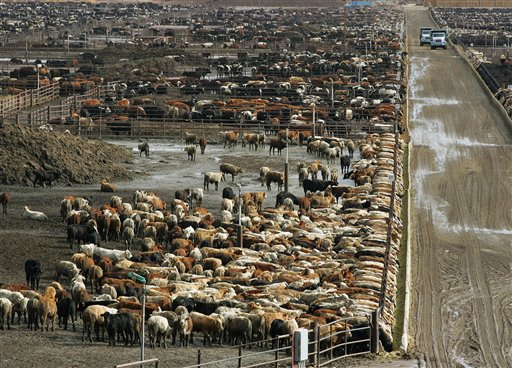
What do Stalinism, objectivism, authoritarian capitalism, and global corporatism all have in common ? They are in my opinion fundamentalist-materialist cults that value the inanimate over the living, the concrete over the abstract and have effectively reduced the vast majority of the human race to livestock, or wild beasts to be hunted down, captured, contained, broken, or in the alternative, simply slaughtered and destroyed.

I have been told that it has always been thus, and perhaps in terms of humanity’s historical failings this is true. There is however no historical precedent for the establishment of a global value system through electronic multi-sensory media. Even the best efforts of the Catholic Church, Protestant missionaries and Islamic holy-warriors do not equal the technology and level of sophistication in the application of “industrial psychology.”

The message remains the same though, as it has been throughout history: “Obey or suffer.” Individual disobedience or even mere failure to “produce” in spite of the individual’s best efforts will result in stigmatization, marginalization, a degrading dependency on the state and, as state support for the economically disengaged is cut back and removed, starvation, homelessness and imprisonment; even the fact of homelessness is defined as a criminal offense by more local jurisdictions with each passing year.

The fact is that life is cheap; the idealistic visions of humanitarians are swept aside by those advocates of “austerity” and “tough choices,” whose calculations in service of usury on a global scale will determine the level of human suffering in each nation up to and including death by starvation, disease, and the inevitable outcome of manufactured scarcity, war.

The blurry and dim imagery of the concretes of suffering fades from vision in the glare of the deadly abstractions; political ideologies, religions, money that does not exist anywhere other than in the record keeping of the money lenders remains in clear focus. The conclusion returns stark, glaring and obvious: human life is a commodity, the value of which is consistently decreasing. The devaluation of an individual human life to a unit of production and consumption, which therefore can be discarded if determined to have no economic value, is all that is required for the machinery of mass exterminations and genocide to be set in motion.

Arguing about wages, prices, social systems and ways of arranging economies, even in cases where “progress” is made, will be useless. The dominance of the fundamentalist-materialist cults, as well as the authoritarian religions that create legitimacy for them in the eyes of the masses (and even Stalin, the ultimate fundamentalist-materialist, allowed for the return of religion as an adjunct of the state when he realized its value) will continue to crush and compress human life, until the perverted and inverted values themselves are overthrown, shattered, burned and buried.

When will the biocentric (life centered) ethos replace the thanatocentric (death centered) ethos as the dominant culture’s value system? I cannot answer even the “if” of this question, let alone the question itself. The fact that the power to collect interest on nonexistent money and the lifestyles that such usury on a global scale supports is presented, and apparently accepted, as an immutable law of nature rather than as an imposition of culture’s order on the true nature of humanity seems by way of this very acceptance to be a “natural law.” Images of vultures waiting for starving children to crawl to their deaths and mothers weeping over infants at the bottoms of pits do not move the master manipulators of numbers. If anything, only the fact that the die-offs are not more extensive is cause for lamentation.

Do we care anymore? I’m not speaking of our little “jobs” and “futures,” and relative degree of comfort/discomfort in oppression that seems to be everyone’s primary concern. I’m demanding of myself, of you and above all of those who have declared themselves to be “leaders;” what is it that matters to you? Do you feel anything at all? Can we set aside all calculations save for those needed to ease human suffering? The primary demand of all protests, occupations, strikes, boycotts and further actions of increasing effect and extremity will be “Life First!”

The life of one human being hanging on the edge of death, in suffering, is too high a price to pay, for all the glorious achievements of the fundamentalist-materialist cults, their leaders and their adherents. The cult of power, authority, war, and property as a weapon of coercion has, for all its trillions of dollars and stockpiled weapons of mass destruction, a single and fatal vulnerability; to function it depends on obedience. For obedience to be guaranteed, the “obey or suffer” directive must be enforceable. This directive is only enforceable if the doctrine of fundamentalist-materialism enjoys continued acceptance as a “fact of life,” rather than the monstrous fraud that it is.

*The term “docile bodies” is a chapter title in Michel Foucault’s “Discipline and Punish: The Birth of the Prison” 1977, Random House, NY, NY.


Jodorowsky’s new film ENDLESS POETRY (Poesía Sin Fin)

jodorowsky_endless_poetry_poster

By Satori Films

Source: Kickstarter

Alejandro Jodorowsky, father of the midnight movie, wants to exchange your money into Poetic Money to make his latest film.

About this project

I was trying not to prepare anything. I didn’t want to prepare what I was going to say to you. Why? Because I am searching for my inner truth, I want to know what will I say. In two more days I will be 86 years old… it’s a lot. Why, at 86 years of age, am I fighting to make a picture? Why? Nothing is that important for me. Is it so important for a person who can die one day to the other, to make a picture? Because when you are 86 years old, every morning you awake and you say “I am still alive”. You are happy to be alive but you are maybe at the end of something. Why make a picture? What is a picture? Some pictures are only fun and show. It’s necessary, because in the world we are all nervous about everything that’s happening, no? They even say we are destroying the planet. So we need to go, to see a picture, to forget ourselves. Perhaps this is necessary, but for me a picture is not that. For me a picture is for remembering your self, not for forgetting yourself. But what does it mean to remember your self? What can we remember? For me, movies are really an art. And what is art? It is the search for your inner beauty. That is art. I don’t want to make a picture in order to make money. But if money comes, I open the pocket in order to make more pictures. But that’s not the finality. It’s not the finality to being admired by others. It’s not the finality to lie and invent things you’ve never lived.

In order to say something you need to know the thing you’re speaking of. It needs to be an experience, what you show on the screen. What will I show in this picture? What are human beings, art, museums and movie theatres showing to us? Are we those anti-heroes? Those people who have no dignity? We are slaves? We are liars? Thieves? What are we now? I don’t want to show that kind of person. I don’t know how to make pictures of everyone fighting one another, to have money, to steal money Why ?! I don’t want to speak about “love” either; about this “love” that isn’t real, that’s a fairytale. Love is something great, incredible, “sublime”… I don’t know how you say “sublime” in English… The most beautiful thing. Marpa was a saint in Tibet and he said “ Life, everything, is an illusion”. One day his son died, his young son died and he was crying and crying and crying and the disciples asked Marpa “Why are you crying? Your son is an illusion.” “Yes, my son is an illusion. But he is the most beautiful illusion.” Movies are an illusion but need to be the most beautiful illusion. I know what it’s like to scream because one of your sons died. It’s terrible. It’s terrible And in that moment you ask yourself, “ Why am I doing art, movies? Why?!” and then you say I am making movies and art in order to heal my soul. I need to open! Open ! open ! myself, in order to fin myself. To remember what the human being is. The beautifulness of the human being. The beautifulness of you. I need to show how beautiful the human being is. Now.

In Chile, in the forties, I was 24 years old… it was a fantastic moment. The war was all over the planet, and in Chile : no war. Because we are far and separate of the world: no television, mountains, ocean, peace! It was so peaceful. It was beautiful. And then a miracle happened : Poetry came to the country. Great poets started to write marvelous, marvelous poems; two of them have the Nobel Prize, Pablo Neruda and Gabriela Mistral – our father and our mother.

And then, everything was poetry. We were living our adolescence in this situation: poetry everywhere. And we started to search for the “poetical act”. For how it was to live with beautifulness. How it was to live in the mind: free! In heart : in union with world. In the sex: in full creativity.

How to make poetical action in order to discover the beautifulness of Life. There it was. In that time, the poetry was there. The human being was there. We had love, we had artists, we discovered all kinds of art.

And that suddenly disappeared. When I was 24 I left this paradise, and went to Europe where the world is illusion or disillusion, you don’t know.

But now I want to show what a spiritual paradise is: a young person, searching for the beautifulness of poetry. That is all that I want. I want to express… how to say it in English?… How I am obliged to this past… because I knew how it was to live in poetry. I knew that. And I want to show the world that it’s possible. It’s possible to remember your self. It’s possible to open your mind. It’s possible to open your heart. It’s possible to open your creativity. To live with less, but to live well. Well. That is what I want. Poetry without end. Endless Poetry. That is what I will do.


ENDLESS POETRY(Poesía Sin Fin) Official site: http://www.poesiasinfin.com/

After a 23 yearlong absence, the director of cult classics El Topo (1969) and Holy Mountain (1973) made his comeback in film direction in 2013 with The Dance of Reality. The film was based on the first part of Alejandro Jodorowsky’s homonymous autobiographical book, depicting his childhood years in Tocopilla, Chile. His new film ENDLESS POETRY (Poesía Sin Fin) will be based on the latter half of the same book, depicting the author’s youth in lively Santiago de Chile.

Our world is suffering from a devastating absence of poetry. Naïvely we sometimes hope to reconnect with it through film. But the greed-riddled industry, having colonized this magnificent art form, has done everything to strip it of its poetic power. With this film, Jodorowsky directs his energy more than ever into creating a film that can serve as a vehicle for awaking consciousness. It is our duty to enable all efforts to fight the powers that insist on lowering cinema to just a product in a commercial market. This film will bring forth an example of film’s poetic power.

ENDLESS POETRY (Poesía Sin Fin) flashes back to those decisive years in Alejandro Jodorowsky’s youth; years that defined the principle that would reign over his entire life: Poetry. The director’s life has been a constant effort to expand his imagination and push back against his own limits in order to apprehend and harness the potential for liberation that lies within each and every one of us. His career has been an open invitation to follow him in his efforts.

ENDLESS POETRY (Poesía Sin Fin) will be carried out as an offering both to film and to the general audience, who are infinitely more profound, intelligent and sensitive than the Hollywood industry would like to admit.

ENDLESS POETRY (Poesía Sin Fin) explores the magic reality underlying our surrounding world. The film seeks to inspire and encourage us all to dare to find our true selves. It is an invitation to Life.

Synopsis

Leaving his childhood and his native Tocopilla behind, the adolescent Alejandro Jodorowsky follows his parents to Santiago de Chile. Between his lack of self-confidence and the family pressure he is under, Alejandro struggles to express his desires and find his own path. But the flourishing capital, filled with artists and poets offers the perfect setting for him to grow out of his cage. Thinking he’d fit in well, Alejandro’s cousin Ricardo takes the young boy to the home of Veronica and Carmen Cereceda, where puppeteers, dancers, sculptors and painters all live and create together. There, defying all of his old limitations, Alejandro takes the first step on his path to becoming a poet in the Chilean artistic epicenter of the 1940s. Alongside rising poets like Enrique Linh, Nicanor Parra and in the arms of his first love, Stella Diaz, Alejandro’s poetic destiny takes form and a new world unravels … changing his life forever.

Production Schedule and Budget

The film will be shot in Santiago de Chile from July to August 2015 for eight weeks. Its post-production such as editing, music tracks, visual effects and so forth will take place in Paris and Tokyo with completion slated for the end of February 2016. The total buget will be about three million dollars.

Why Kickstarter?

Alejandro Jodorowsky says; « The necessity for expression is more important than the type of film you want to make. I make a film when I have something I need to express. I don’t think about investors, industries or commercialisation. I just need to express myself.

In order to realize Jodorowsky’s new film production, we need the support of micro producers across the world who understand his vision of cinema.

Jodorowsky’s Poetic Money

Jodorowsky thinks that all money should be transformed into poetry. And so that is what he will do with this Kickstarter project. No matter what level you pledge at, Jodorowsky will exchange your pledge into his brand new Poetic Money (DINERO POÉTICO) and send it back to you. This money can’t be spent on any material goods — only on the poetry of the universe.

The exchange rate is 1US$=1DP.

(In the case of $10,000 or more pledge, it is 0.5US$=1DP)

There are 3 bill denominations: 1DP, 10DP and 100DP. Each bill has an original money-related poem written by Jodorowsky printed on it in Spanish. There are two versions of each DP bill, each version of the bill presenting a different poem. There are 6 kinds of bills in total.

Jodorowsky wants to fill the world with poetry. So when you pledge, please mumble a poem in your heart. If you have a twitter account, please tweet a poem with #EndlessPoetryMyPoem. Your poem will be on the official site of ENDLESS POETRY (Poesía Sin Fin).

Jodorowsky’s Poems About Money and Wealth

 <1 Dinero Poético>

1 dinero poético – A
Money is like the Buddha; you can’t obtain it unless you work for it. If you keep it from flowing, it disappears.

1 dinero poético – B
To those who use it to make the flower of the world blossom, money gives its light. Those who glorify themselves, mistaking wealth for the soul, money destroys.

<10 Dinero Poético>

10 dinero poético – A
In pursuance of wealth I throw a spear through the Goddess and bathe in her blood.

10 dinero poético – B
Just as gold does not cease to shine when clouds cover the sun, the soul, beneath flesh and bone, continues to glow with its own light.

<100 Dinero Poético>

100 dinero poético – A
There is no difference between money and consciousness.
There is no difference between consciousness and death.
There is no difference between death and wealth.

100 dinero poético – B
Money is like blood: it gives life if it flows.
Money is like the Christ: it blesses you if you share it.
Money is like a woman: it offers itself to you if you cherish it.

Read more and/or back the project at Jodorowsky’s Kickstarter Page.