Crisis in Consciousness: Change and the Individual

By Graham Peebles

Source: Dissident Voice

Our society is besieged by a series of interconnected crises. Millions of people around the world know this and are crying out for change, for a different way of living, for justice, peace and freedom.

Political leaders, Prime Ministers, Presidents and the like, are apparently incapable of responding to these demands; they do not understand the depth of the anguish or the complex interconnected nature of the problems. Instead of presenting new possibilities and working for peace and social harmony, they do all they can to maintain the divisive status quo and act in accordance with the past. But life is not static, it cannot be contained within any ideology – religious, political/economic or social – all must change to accommodate the new. And ‘the new’ is now flooding our world, stimulating change, demanding response and accommodation.

The world and the individual are one; for substantive change to occur this basic fact must be acknowledged; responsibility for the world rests firmly with each and every one of us. If we are to heal the planet and create harmony in the world change is imperative, but it must first of all take place within the individual. Over the last 40 years or so a gentle, yet profound shift in attitudes has indeed been taking place within large numbers of people; the increased level of social-political participation and in many nations revolt against historical injustice and suppression testify to this development. Whilst this is extremely positive, urgent and fundamental change is required if the many issues facing humanity are to be overcome and a new way of living set in motion.

What are the crises facing humanity: The environmental catastrophe and war conventional and nuclear – global poverty, inequality, terrorism, the displacement of people, and, festering beneath all of these, the socio-economic systems under which we all live. These issues, and they are but the most pressing, are the effects of certain ideals and conditioned ways of thinking; they are the results of the underlying crisis, what we might term the Crisis in Consciousness, or the Crisis of Love. Not sentimental, emotional love, but love as a unifying force for liberation and change. Love as the Sword of Cleavage, as the exposer of all that is false, unjust and corrupt in our world.

‘Society’, large or small, is a reflection of the consciousness of those who constitute that society; it is formed by the values, relationships and behaviour consistently and predominantly expressed by the people within it. Such expressions are to a large degree the result of socio-psychological conditioning, poured into the minds of everyone from birth by parents and peers, friends and educators, the media and political propaganda. This conditioning pollutes the mind, distorts behaviour and creates a false sense of self. It colours every relationship and forms the corrupt foundations upon which our lives are set. From this polluted centre, filled as it is with selfishness, competition, nationalism and religious ideologies, action proceeds and the divisive pollution of the mind is externalized. Where there is division conflict follows, violent conflict or psychological conflict, community antagonism or regional disputes.

For lasting change to take place, for peace and justice to flower, we must do all we can to break free of this inhibiting conditioning and in so doing cease to add to the collective pollution. The instrument of release in this battle is awareness: Observation and awareness are synonymous. In choiceless observation there is awareness – awareness of the values, motives and ideals conditioning behaviour. In the light of such awareness, unconscious patterns are revealed, and through a process of non-engagement can, over time, be negated and allowed to fall away.

Realizing unity

Through competition, fear and ‘ism’s of all kinds we have divided life up; separated ourselves from the natural environment and from one another. The prevailing economic system encourages such divisions; individuals are forced to compete with one another, as are cities, regions and nations. Competition feeds notions of separation and nationalism, ‘America First’ and Brexit being two loud examples of countries, or certain factions within these countries, following a policy which they mistakenly believe to be in their nation’s interest, meaning their economic interest. Such divisions work against the natural order of things by strengthening the illusion of separation.

The natural environment is an integrated whole, humanity is One and an essential part of that whole; the realization of unity in human affairs, however, is dependent upon social justice, and this is impossible within the constraints of the current economic model, which is inherently unjust. Neo-Liberalism is a major source of the psychological and sociological conditioning which is polluting the mind and society; creative alternatives that challenge the orthodoxy, which proclaims ‘there is no alternative’, must be cultivated and explored.

New criteria need to be established for any alternative economic model; the acknowledgment that human need is universal and should be universally met, and that nobody ‘deserves’ to live a life of suffering and hardship simply because of their place and family of birth. Sharing is a key principle of the time; it must be placed at the heart of our lives and of any new socio-economic structures. Not just sharing of the natural ‘God-given’ resources of the world, but of space, ideas, knowledge and skills, all should be distributed based on need, not bought and sold based on wealth and power. The recognition that humanity is one is crucial in bringing about the needed transformation in consciousness; sharing flows quite naturally from the acknowledgment of this fact and by its expression encourages a shift in attitudes away from the individual towards the group, thus strengthening social cohesion and unity.

Sharing, justice and freedom are vibrant expressions of Love and the Crisis in Consciousness is itself the consequence of a Lack of Love. Like virtually every aspect of life, love has been perverted, distorted and trivialized. Love is not desire, it is not dependent on anything or anyone for its being: Love is the nature of life itself. Remove the psychological clutter and Love will shine forth, bringing clarity and lasting change, within the individual and by extension society.

The Four Pillars of Disaster Shamanism

By Gary Z McGee

Source: The Mind Unleashed

“We need shamans, and if society doesn’t provide them, the universe will.” ~Joe Lewels

In the article The Archetypal Path to Getting Your Shit Together, I wrote about the power of archetypes. A Disaster Shaman is an example of using an archetype to make the world a better place; to become the change we want to see in the world.

The Disaster Shaman recipe combines aspects of The Shadow with aspects of The Hero and then mixes in a little Trickster tomfoolery. The combination of these archetypes creates a particular flavor of nontraditional shamanism that spearheads healthy Cosmic Law through the heart of unhealthy lawfulness.

A Disaster Shaman is a force of nature first, a person second; sowing radical revolution in order to reap progressive evolution. Healthy balance is primary. Even if it comes at the expense of comfort and security. Disaster Shamanism (otherwise known as Apocalyptic Shamanism) is the interdependent shamanic response to apocalyptic times.

The primary tasks of a Disaster Shaman are as follows:

–Heal disaster situations through shamanic cosmology and ecopsychology.

–Listen to Universal Laws to discern the difference between healthy and unhealthy.

–Live moderately so that others may moderately live.

–Diagnose and heal Nature Deprivation.

–Transform weaponry into livingry.

–Bring “water” to the Wasteland.

The sub archetypes of the Disaster Shaman archetype are The New Hero, The Fifth Horseman of the Apocalypse, The Sacred Clown, and The New Oracle. The four pillars of Disaster Shamanism subsume these sub archetypes. Let’s break them down…

Hero-expiation (New Hero or Cosmic Hero):

“Our sole responsibility is to produce something smarter than we are; any problems beyond that are not ours to solve.” ~Ray Kurzweil

The average person is not heroic (courageous). Likewise, the average hero is not prestigious (provident). A New Hero, as opposed to a typical hero, is a hero with prestige. A New Hero has gone Meta with the concept of heroism itself.

The New Hero sub archetype is the first pillar of Disaster Shamanism. New heroism is gained through hero-expiation. Hero-expiation is the voluntary, wise, honorable, moral, and compassionate distribution of power so that power doesn’t get to the point that it corrupts.

It is through the wise distribution of power that a typical hero becomes a New-hero (cosmic hero, next-level hero) with skill, power, honor, and prestige, as opposed to just a typical hero with only skill and power.

Hero expiation is all about getting power over power. Whether one’s own power or the overreaching power of others. It’s about turning the tables on entrenched power by “counting coup” on it.

A Disaster Shaman as New Hero is a social leveling mechanism par excellence. They count coup on power through strategic humiliation (shaming) so that power never has the chance to become absolute.

When a New Hero comes to town, fear-filled blue pills are swapped with wisdom-filled red pills. The Disaster Shaman has come to set the record straight. To recondition the culture that has been conditioned into believing in competition over cooperation and narrow-minded one-upmanship over open-minded compassion. They teach that competition has always been secondary to cooperation; otherwise we wouldn’t have survived as a species (Darwin).

Eco-consciousness (Fifth Horseman of the Apocalypse):

“Extreme positions are not succeeded by moderate ones, but by contrary extreme positions.” ~Friedrich Nietzsche

Eco-consciousness is about uncontrolled order overcoming controlled chaos. Whether the culture (tribe) has become too obese, too greedy, too violent or some other unhealthy excess, the Disaster Shaman arrives to set the record straight; to plant a seed of overt moderation within the covert immoderation.

The Fifth Horseman is the one that cleans up after the original Four Horsemen (the Four Horsemen is a metaphor for anyone caught up (aware or not) in any kind of unsustainable, unhealthy, violent, immoral, or mass-destructive social system). The Fifth Horseman of the Apocalypse is an archetype representing rebirth and renewal in the face of conquest, war, famine, and death.

The Fifth Horseman is ruthless with her healing powers. Her name is Providence, Phoenix-like, she rises up from the ashes of war & decay to spread self-actualized love, open-mindedness, and progressive sustainability by digging up the decay and unsustainable residue of past and present civilizations and then using it all as compost in cultivating and growing a healthier more balanced future.

In that capacity she has devoted herself to planting gardens of eco-centric heroism in the humus of war, hate, close-mindedness and greed, and anything else left behind by the original four horsemen. She is dedicated to, as Buckminster Fuller said, transforming weaponry into livingry.

She subsumes the original four horsemen by teaching them that the new definition of right & wrong must be derived from the universal dictation of healthy & unhealthy rather than the human opinion of good & evil.

The Fifth Horseman is the Goddess of Recompense. She is the Verdant Force. She is the soft hammer of evolution. She has come to blur the false boundaries that have been erected between nature and the human soul.

She is Gaia. She is Lady Justice. She is the return of the Sacred Feminine. She is all of us, men and women, realizing that we are nature first and humans second, that we are soul first and ego second. She is weighing the worth of the human world with the Scales of Justice. With or without us, she will not fail to bring water to the wasteland.

High humor (Sacred Clown):

“What is a tragedy but a misunderstood comedy.” ~Shakespeare

Most of us are familiar with the prototypical clowns: red-nosed clowns, court jesters, and Tarot fools. But sacred clowns take clowning to a whole other level.

Almost all types of sacred clowns combine trickster spirit with shamanic wisdom to create a kind of sacred tomfoolery that keeps the zeitgeist in check. Their methods are unconventional and typically antithetical to the status quo, but extremely effective. They indirectly re-enforce societal customs by directly enforcing their own powerful sense of humor into the social dynamic.

The main function of a sacred clown is to deflate the ego of power by reminding those in power of their own fallibility, while also reminding those who are not in power that power has the potential to become corrupt if it’s not balanced with other forces, namely with humor. But sacred clowns don’t out-rightly derive things. They’re not comedians, per se. Though they can be. They are more like personified trickster gods, poking holes in things that people take too seriously.

Through acts of satire and showy displays of blasphemy, sacred clowns create a cultural dissonance born from their Crazy Wisdom, from which serious anxiety is free to collapse on itself into sincere laughter.

The high humor of Sacred Clowns leads to a higher courage and the audacity to speak truth to power. And they do so with silver-tongued proficiency. There exists no perceived construct of power that’s above their enlightened rebellion. No idol too golden. No high horse too high. No pedestal too revered. No “wizard” too disguised. No God too godly. No title too contrived.

Nothing is immune to the exactness of a Sacred Clown’s rebellion. It’s all merely procrastinating compost. It’s all just well-arranged armor waiting to rust. It’s all an illusion within a delusion. And the Sacred Clown has the enlightened sense of humor to reveal that absolute fact.

Lest we write our lives off to unhealthy stagnation and devolving inertia, we must become something that has the power to perpetually overcome itself. The sacred clown has this power. Paraphrasing William Blake, “If the fool (Sacred Clown) would persist in his folly, he would become wise (New Oracle).”

Self-overcoming (New Oracle):

“To attain knowledge, add things every day. To attain wisdom, remove things every day.” ~Lao Tzu

A Disaster Shaman is a New Oracle who has come to inform the old oracles that they have failed. The self-centered “culture” has been declared a wasteland, and the unhealthy surroundings dubbed unworthy for healthy humans attempting to evolve into a more robust species.

The New Oracle teaches this, above all: Pain should not be avoided at the expense of love. Love should be embraced at the risk of pain.

As such, a master with high humor is needed to resolve the disaster of the self; to usher in an eco-centric, as opposed to an ego-centric, perspective. This master lies dormant inside us all. It can only be found by having the out-of-mind experience of no-mind, in the courageous throes of self-overcoming. There, in the stillness, the master is meditating. The master is connected to the source of all things, his thousand-petalled lotus spinning like a galaxy above his head.

He is radiating inside of you, bursting with wisdom and nth-degree-questions. She pirouettes like Shakti. He foxtrots like Shiva. He/she is the all-dancing, all-laughing oracle of the primordial self, interconnected with all things. And it can only be found there in the silence, between inhale and exhale, between being and non-being, between mind and no-mind, between finitude and infinity.

After disaster, but just before mastery, the Disaster Shaman as New Oracle persistently self-actualizes toward enlightenment.

There, above thought, is the source of human creativity: the place where artists, poets, musicians, and even scientists have discovered the secrets of the universe. Like Leonard Cohen said, “You lose your grip, and then you slip into the masterpiece.”

The mind of Everything holds the heart of Nothingness; the void of Nothingness holds the core of Everything. The masterpiece is the working, self-overcoming, canvas of the New Oracle’s life. The New Oracle is forever in the process of seizing the moment in order to seize the day in order to seize the life.

In the end, the Disaster Shaman is a healthy response to our unhealthy times. Wielding the courage of the New Hero, brandishing the mettle of the Fifth Horseman, harnessing the humor of the Sacred Clown, and channeling the wisdom of the New Oracle, the Disaster Shaman is determined to tonalize an otherwise atonal world.

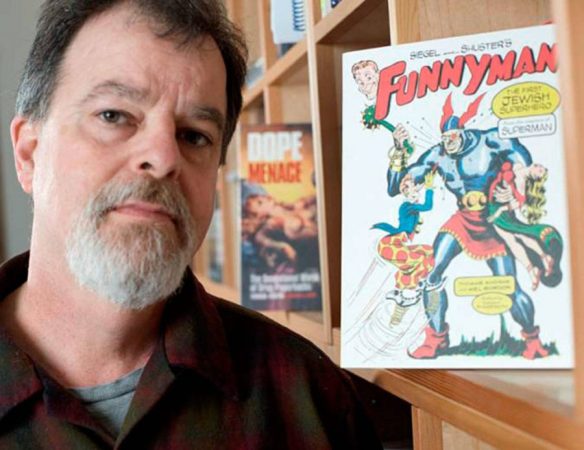
An Interview with the Late Counterculture Publisher Adam Parfrey

By Tamra Lucid

Source: Reality Sandwich

The following interview was originally published on Newtopia Magazine. 

Adam Parfrey has left the building. On May 10, the writer, publisher, and journalist passed away at the age of 61. He was a great curator. His curio shops, Feral House and Process, showcased the most fascinating underground culture and lost history for decades. Finding one of his creations at a Tower Records changed many a life. He found, encouraged and presented a treasure trove of writers on a spectrum of subjects from the absurd to the profound. As Isis Aquarian said, so much would have been lost if not for his efforts. Not just books, but people. Many an odd ball and rogue scholar found a home under Feral House’s wing.

Adam was working on his memoir. What a loss that we won’t have that. There’s no one to compare him to in publishing. He broke new ground, pissed off all the right people, and even managed to keep his business and his community intact as Amazon grew enormous and Tower Records disappeared. And that was just the tip of his iceberg.

I’ll miss his sardonic wit, the hearts he’d place on certain posts (a conversation in itself), his readiness to answer my questions about all sorts of shit having to do with publishing and culture in general, and that feeling that a giant was still standing in the world of independent creativity, a creative force who impacted so many lives, and who gave confidence, inspiration, education and opportunity to many.

Here’s an interview I did with the man a few years ago.


Tamra Lucid: So let me get this straight, you went to Santa Monica High School in the early seventies?

Adam Parfrey: Yes, dear old Samohi. I lived near the Ventura County Line, and the school bus rides were an hour each way. On the way into Santa Monica, the bus picked up a girl with special needs who seemed to always choose to sit next to me. She was an epileptic, and all too often she would have a seizure in which her arms were flailing into my face. Fellow students on the bus shouted at me to stick a pencil into this poor girl’s mouth. I knew nothing about what to do, but it didn’t seem wise to me to stick writing utensils into her mouth.

Then attended UCLA (where you were co-editor of the Arts Section of The Daily Bruin?)  So what was it like? 

This was 1976, and I learned a great deal about writing doing reviews and features. At this time I received a small stipend, too. This was a time when it was quite cheap to attend school. One of my biggest memories of working on this paper was the time when Iranian students were protesting The Shah, and for reasons unknown they decided to not allow us to leave the building while chanting “DOWN WITH THE SHAH!” The good thing about all this was that I was able to purchase from the protesters the earliest Khomeini propaganda that included great political cartoons of Jimmy Carter as Satan himself.

Were you an already macabre fish out of water or did the surfer stoner good vibes inspire you to counter them? Or did you simply party away all the mellow until only the feral remained?

Though I loved living near the beach, and did a lot of fishing, clamming, and body surfing, I was very pale, dark-haired and looked too goth prior to the time that goth even existed. As such, I did not fit the surfer archetype at all. I also didn’t much care for the “Locals Only” xenophobia.

When you were 21 you toured with what you called a “second rate Shakespearean company.” What roles did you play?

This group was called The New Shakespeare Co., and it was run by a Weimar-period German woman named Margit Roma and her man friend. She spoke about Max Reinhardt to me a great deal. We traveled around the country, particularly the deep South, and we were particularly coveted visitors by the girls at women-only Christian colleges down in Georgia and Tennessee. Sometimes we’d crash at locals’ homes. One woman in Arizona imagined that I looked like Elvis Presley, and as such wanted me to fulfill her Elvis fetish. The group was racially mixed, and as a result we were booted from some cafes and motels in some towns in Mississippi and Alabama. It gave me an understanding why so many honkies are particularly venomous about our mulatto President.

I joined this group to see the country, and we did, but mainly from the point of view of the cheapest hotels at the perimeter of various towns. I was hired after Margit Roma saw me in a touring college production of A Midsummer Nights Dream playing Oberon. It was all strange fun.

The hilarious Encyclopaedia of Hell: An Invasion Manual for Demons Concerning the Planet Earth and the Human Race Which Infests It compels me to ask if you were a fan of the original National Lampoon.

That magazine was a great thing for a while in the ‘70s….

How is the evolution (devolution?) of publishing and book selling from brick and mortar to ebooks impacting Feral?

Our office is now in our house, and we try not to have too many expenses so that there are lesser consequences to selling fewer books, as it happens these days. Several chains that sold a lot of Feral House books are now out of business… Tower Books, Virgin Megastore, Borders… also a lot of independents. People have so many distractions today in the form of reading material that I’m amazed that we’re still able to keep going. But we do.

You co-wrote and published Ritual America in 2012, accompanying the stops on your book tour with a slide show.  The book reveals the American fetish for secret societies and shows how even the most apparently innocent can turn out to have dark secrets.  What was the most surprising fact for you personally that you uncovered?

What surprised me the most was that at least half the entire country belonged to some secret society or another from the late nineteenth century through the early twentieth century, how they were literally everywhere and possessed a major role in the structure of the nuclear family.

This year the film you co-produced The Source documentary, directed by Jodi Wille and Maria Demopoulos, played SXSW and other important film festivals. Besides the hot hippie chicks, what drew you to this quirky story of a judo champion who had once robbed a bank who turned into an organic foods pioneer and guru to a small tribe, many of whom still revere him?  What have you learned about the rapidly changing world of documentary filmmaking?

Jodi and I had great interest in “cults” and communes, and how society treated and often mischaracterized them. I was working on a book about The Process Church of the Final Judgment, and one day while browsing Amoeba Records I discovered a student video about The Source Family and showed it to Jodi, who on her own contacted the group, and as a result had a long-lasting connection to many ex-members. First was the book, and then Jodi and Maria’s film, which is really extraordinary. They did a great job with it.

With the white witch of Los Angeles, the glamorous Maja D’Aoust you co-authored the Secret Source in 2004, a revised edition was released this year.  The book shows how the ideas behind the fad of positive thinking unleashed by The Secret are just the latest in a long line of positive thinkers that ultimately reach back to some of the most profound, esoteric, and ancient roots of spiritual culture. It passes what I guess is the Adam acid test: does it muckrake?

There were a few things I discovered and revealed about people involved with The Secret, but the primary reason for the book was unveiling the occult beliefs in American and world history.

But the tone is sincere and frankly metaphysical. Is this the inner Adam?  Or did you adopt neutrality while traveling through yet another intriguing frontier?

It would have been easiest for me to fall back on a skeptical point of view, and disparage all metaphysical ideas as utter hogwash, but that wouldn’t have been true to my personal experiences. For example, before I took Ibogaine I would have never believed that plants had a certain intelligence and connection to human experience. Now I cannot deny that it happens. Now I see Skepticism, the kind with the capital S, as another belief system that provides comfort to many by empowering believers with the illusion that they know all. Why reduce the mystery of the Universe to ideas that can be encompassed in a 6th grade Science class. BTW, I love Science, and have subscriptions to Science magazines.

In 2012 you published Psychic Blues: Confessions of a Conflicted Medium, a book by a three-decade veteran magician from the Magic Castle about his career as a cold reader pretending to be a psychic. It reminds me of the popular documentary Kumare, because both pose the question can someone pretending to have spiritual insight to scam people actually do some good despite themselves?  As the author himself says, no doubt sometimes something is happening, but when you try to make a buck off it consistently it turns into pure entertainment. The Fox Sisters could have told him that a hundred years ago!

Actually the Fox Sisters found their way into Ritual America.  It intrigued me that the author of Psychic Blues didn’t reduce psychic beliefs to a total Nightmare Alley situation, but I’m also interested in the ways of those who conduct those gypsy scams, too.

Still, I’d be surprised if you hadn’t had any uncanny experiences yourself?

I have.

In 1995 in an interview in Cyberpsychos you said you believed you might be on some sort of blacklist. While magazines like Conde Nast would call you for ideas, they wouldn’t entertain the idea of simply publishing your writing. So are you blacker now more than ever?

For a couple years after Apocalypse Culture was first released, it sold well and had certain notoriety, but for some time no one wrote about it or reviewed it. Some of this, I think, had to do with an article called “Aesthetic Terrorism” which tried to draw the blinds on the scammery of Fine Art. It even named names, and you just don’t do that because a lot of people in that world controlled magazines and newspapers. I didn’t say the right things or kiss the right ass to receive media glory.

Has almost two decades of the world wide web changed the way blacklists work?

Absolutely. Prior to the web fewer people and fewer publications controlled a great deal more. Now it’s all everywhere, and even the New York Times does feature articles on Feral House publications, like the other day with a piece on Psychic Blues.

You commissioned and published Snitch Culture: How Citizens are Turned into the Eyes and Ears of the State, before Bush won the 2000 election, before 9/11.  So you’re probably not surprised by how much more privacy and liberty have eroded under Bush and Obama?

We tend to forget what happened under the Clinton Administration, like the so-called Crime Bill, which later ushered in Bush’s Patriot Act. Both Democrats as well as Republicans are interested in building up the police state.

In 2002 you edited Extreme Islam: Anti-American Propaganda of Muslim Fundamentalism.  You took strong stands when you published 50 Reasons Not to Vote for Bush in 2004, and then 35 Articles of Impeachment and the Case for Prosecuting George W. Bush.  It was a courageous choice since you were potentially inviting trouble, again.

Disliking George W. wasn’t a particularly courageous choice. Difficult not to speak out when this douchebag was our figurehead.

Last year you were involved in an interesting problem regarding the Process Media book The Urban Homestead: Your Guide to Self-Sufficient Living in the Heart of the City, published three months before the Dervaes family, one of a handful of urban farming pioneers, decided to trademark “urban homestead.”  On Valentine’s Day you received the cease and desist letter that had been popping up in mail boxes across the nation as the Dervaes tried to sew up their control of the phrase.  Then mentions of the book began disappearing from Facebook, from Process Media’s own page!  Facebook told you they were banning the links until they heard otherwise from the owners of the trademark.  You warned the Dervaes you’d take them to court if they didn’t back down, but they didn’t back down.  Of course, I want to know what’s happened since, but also how did you feel about Facebook deciding to vanish your important book and what it says about the potential and actual pitfalls of digital culture?

The great Electronic Frontier Foundation (EFF) has taken up our cause with Urban Homestead and the patent/trademark office. Hopefully this govt. organization will see that they gave a private party the ability to abuse rights to a generic common term. Thousands of backyard gardeners support our cause here, and even have their own Facebook page.

Five years ago you left Los Angeles for Port Townsend, Washington, like Gertrude Stein leaving Paris for her farmhouse, instead of salons you now entertain stayovers. I know you visit often, but what made you give up on your hometown? And what do you love best about your new hometown?

It may sound strange, but in LA I felt bombarded by issues of traffic and electromagnetic radiation, and felt better getting out to the country, where I can more easily grow food and keep a big dog and chickens. I like to get out of Port Townsend in winters particularly. I do love LA too. My past is all there, and so are many of my friends.

What new projects are you working on that you’re excited about?

I’m glad to say that my excitement level of projects that I’m working on have not receded at all.  One book coming soon is called “Dying for the Truth”… It’s primarily from the Mexican blog called blogdelnarco.com … But the book has other images and information that has not yet appeared on the blog.  The book is called “Dying for the Truth” since the journalists and citizens involved in it have been threatened and killed as a result of revealing the gruesome stark truth of what’s going on just South of the border and throughout Mexico itself.  It’s going to be particularly difficult to publish due to the insanity of the situation down there, the stacking of bodies and limbs and the bizarre dark aesthetic of the murderers. It may be the most gruesome book that’s ever been published. But we need to examine why much of Mexico and its citizens are dying.  We’re also excited about forthcoming films with scripts that I co-wrote. One is a feature film based on Lords of Chaos, and the other is a thriller of sorts based on the weirder aspects of the JFK assassination cover-up called “Dallas in Wonderland.”

You’ve seen society from so many unique and often ignored perspectives through so many changes from the hippie optimism that flourished when you were a kid to today’s rampant pessimism. Looking to the future of our country and our world what is your biggest fear and what is your biggest hope?

This a complex issue. I’m not a fan of mass movements per se; they seem to bury unorthodox thought, but I do see a need for hive-like beliefs if the human race wishes to carry on in the future. What are seven, eight, nine, ten billion humans going to do when the land and water is totally poisoned and exhausted? It may not be pretty.

The Greatest Spiritual Event of Our Time, According to Rudolf Steiner

By Paul Levy

Source: Reality Sandwich

Almost a hundred years ago, as if peering into a crystal ball and predicting the future, spiritual teacher and clairvoyant Rudolf Steiner[1] prophesied that the most momentous event of modern times was what he referred to as the incarnation of the etheric[2] Christ. By the “etheric Christ,”[3] Steiner is referring to a modern-day version of Christ’s resurrection body, which can be conceived of as being a creative, holy and whole-making spirit that is inspiring human evolution as it operates upon the body of humanity through the collective unconscious of our species. Involving a radically new understanding of a timeless spiritual event, the etheric Christ, instead of incarnating in full-bodied physical form, is approaching via the realm of spirit—as close as this immaterial spirit can get to the threshold of the third-dimensional physical world without incarnating in materialized form. To quote Steiner, “Christ’s life will be felt in the souls of men more and more as a direct personal experience from the twentieth century onwards.”[4]

A spiritual event of the highest order, Steiner felt that the incarnation of the etheric Christ is “the most sublime human experience possible”[5] and “the greatest turning point in human evolution.”[6] In his talks, Steiner refers to the etheric Christ as “Christ in the form of an Angel.”[7] Christ himself can be seen as the primordial revelation of the archetype of the Angel (who, after all, are messengers), what is known as the “Angel Christos.” The Angel Christos is a nonlocal, atemporal spirit, existing outside of space and time, that is simultaneously immersed in, infused with—and expressing itself through—events in our world. Christ as an angel reveals itself for those who have eyes to see and ears to hear as it weaves itself, not only through the warp and woof of the flow of events comprising history, but through our souls as well.

To quote Steiner, “in the future we are not to look on the physical plane for the most important events but outside it, just as we shall have to look for Christ on His return as etheric form in the spiritual world.”[8] The most important spiritual events of any age often remain hidden from the eyes of those who are entranced in a materialistic conception of the world. It greatly behooves us to not sleep through, but rather, to consciously bear witness to what has been up until now taking place mostly unconsciously, subtly hidden beneath the mundane consciousness of our species. If this epochal spiritual event, to quote Steiner, “were to pass unnoticed, humanity would forfeit its most important possibility for evolution, thus sinking into darkness and eventual death.”[9]If the deeper spiritual process of the incarnation of the etheric Christ—“Christ in the form of an Angel”—is not understood, this potentially liberating process transforms into its opposite (into the demonic).

Steiner felt that the advent of the etheric Christ—the Parousia (the Second Coming)—was the greatest mystery of our time. He was of the opinion that the incarnation of the etheric Christ was the deeper spiritual process that is in-forming and giving shape to the current multi-faceted crises (and opportunities) that humanity presently faces. This is to say that the seemingly never-ending wars and conflicts that are taking place all over the globe are the shadows cast by spiritual events from a higher-dimension that are animating earthly happenings. One of the main reasons that these multiple crises are so dangerous is because their deeper spiritual source remains unrecognized.

The veil that formerly concealed the spiritual world from what we call “the real world” has fallen away, now making it possible to bear witness to how physical events are an outer, external reflection of a parallel archetypal process taking place on a spiritual plane. It is as if a spiritual dimension envelops, contains and is expressing itself through material reality. The seemingly mundane physical world and the spiritual world are revealing themselves to be indistinguishable, which is to say that life itself is resuming its revelatory function. More and more of us are beginning to recognize this; our realization is not separate from the increasing emergence of the etheric Christ. Consciousness of the restored unity between matter and spirit is not merely an awareness of this original unity, but is the very act that completes and perfects this unity.

The higher order of light encoded within the etheric Christ is bringing to light the darkness which is seemingly opposed to it, which further helps its light nature to be seen. The true radiance of the light can only be seen and appreciated in contrast to the depth of darkness it illumines. It is as if the revelation of something is through its opposite—just as darkness is known through light, light is known through darkness. A fundamental spiritual principle of creation itself appears to be that when one force—e.g., light—begins to emerge in the universe a counterforce, opposed to the first, arises at that same moment.

Just as shadows belong to light, these light and dark powers are interrelated, reciprocally co-arising, inseparably contained within and expressions of a single deeper unifying process. These opposites belong together precisely insofar as they oppose each other; their seeming antagonism is an expression of their essential oneness. The brightest light and darkest shadow mysteriously evoke each other, as if—behind the scenes—they are secretly related. In essence, spirit is incarnating, and it is revealing itself through the very darkness that it is making visible.

Commenting on the other—and less recognized—half of the Second Coming, Steiner chillingly said, “before the Etheric Christ can be properly understood by people, humanity must have passed through the encounter with the Beast.”[10] By “the Beast” he means the apocalyptic beast,[11] the radically evil. The Beast is the guardian of the threshold through which we must pass in order to meet the lighter, celestial and heavenly part of our nature.

As soon as I read Steiner’s prophecy I felt the truth of his words. I recognized how what Steiner was saying mapped onto—and created context for—what is happening in our current world-gone-crazy. The ever-increasing darkness that has descended like a plague onto humanity and is compelling us to race towards our own self-destruction is hard to face, let alone fathom. The evil of our time has become so gigantic that it has virtually outstripped the symbol and become autonomous, un-representable, beyond comprehension, practically unspeakable.

I also recognized the truth of what Steiner was saying based on my own inner experience. I have noticed that as I get closer to connecting with the light within myself, the forces of darkness seem to become more active and threatening. It is as if there is something in me—and in everyone, which is to say this situation isn’t personal—that desperately doesn’t want us to recognize and step into our light. This internal process is taking place within the subjectivity of countless individual human psyches, which is then reflexively being collectively acted out—in my language, “dreamed up”—en masse in, as and through the outside world. The dialectical tensions of the cosmos (the macrocosm)—the conflict between the opposites of dark and light—are mirrored both in the external collective body politic as well as within the psyche of each individual (the microcosm). It greatly serves us to recognize this.

In his prophecy, Steiner is pointing out that our encounter with the Beast is initiatory, a portal that—potentially—introduces us to the Christ figure. To quote Steiner, “Through the experience of evil it will be possible for the Christ to appear again.”[12] It is noteworthy that the opposites are appearing together: coinciding with the peak of evil is an inner development which makes it possible for the etheric Christ—who is always present and available[13]—to be seen and felt as a guiding presence that can thereby become progressively more embodied in humans, both individually and collectively as a whole species. In the extreme of one of the opposites is the seed for the birth of the other.[14]

This is a Kabbalistic idea – for example, in the Zohar, the key Kabbalistic text, it says, “There is no light except that which issues forth from darkness…and no true good except it proceed from evil.”[15] As I deepen my familiarity with Steiner’s work, it definitely dovetails with the insights of the Kabbalah, which is considered to be one of the most profound spiritual and intellectual movements in human history. Evil, according to both Steiner and the Kabbalah, though by definition diametrically opposed to the good, is—paradoxically—a catalyst for bringing the power of goodness to the fore.

Steiner felt that because Christ was destined to appear in the etheric body, “a kind of mystery of Golgotha is to be experienced anew.”[16] What Steiner means by the “mystery of Golgotha” is Christ’s crucifixion, his descent into the underworld and subsequent resurrection. As a result of the first mystery of Golgotha over two thousand years ago—what Steiner considers an act of divine grace bestowed on humanity from above—Christ has been establishing himself in the unconscious dark depths of humanity’s soul. The “Christ-impulse,” in Steiner’s words, “was to penetrate to the dark depths of man’s inner being … to the deepest part of man’s nature.”[17]

Like an iteration of a deeper fractal, this archetypal, timeless mystery now “is to be experienced anew” in a modern-day version. In no other world than the physical world can we learn the true nature of the mystery of Golgotha. To quote Steiner, “Not in vain has man been placed in the physical world; for it is here we must acquire that which leads us to an understanding of the Christ-Impulse!”[18]

Unlike the first mystery of Golgotha, however, in the culmination of this renewed mystery, humanity becomes engaged as active participants, playing a decisive role in the cosmic drama. This too is a Kabbalistic insight: humanity co-partners with the divine so as to complete the creative act of God’s Incarnation. Instead of the Incarnation being through one man, however, in our current day it is taking place through all of humanity. The modern-day coming of the Messiah is through the transformed and awakened consciousness of humanity as a whole. In a very real sense, we are the very Messiah we have been waiting for. “By a strange paradox,” according to Steiner, it is “through the forces of evil” that “mankind is led to a renewed experience of the Mystery of Golgotha.”[19]

The mystery and drama of the Christ event is now located and consummated in humanity, who become its living carrier. The events that were formulated in dogma are now brought within the range of direct psychological experience and become an essential aspect of the process of individuation. Whether we know it or not, we have become drafted and are being assimilated into a divinely-sponsored process. Not an effortful, intentional straining after imitation, this becomes an involuntary and spontaneous personal experience of the reality symbolized by the sacred legend.

The brightest, most radiant and luminous light simultaneously casts and calls forth the darkest shadows. Through this process of Christ manifesting in the etheric realm, humanity is exposed to evil in a way never before experienced, such that—in potential—we may be able to find the good and the holy in a more real and tangible way than was previously possible. Humanity’s highest virtues and potentialities are activated and called forth when confronted by evil.

It is an archetypal idea that ascending towards the light always necessitates a confrontation with and descent into the darkness; the Kabbalah calls this “a descent on behalf of the ascent.” There are certain points in time when humans—individually and/or collectively—are pulled down, submerged into darker powers, brought below a certain level against their will. This shamanic descent can be envisioned as a test for humanity, so that we may learn, through our own efforts, how to lift ourselves up. But we raise ourselves not without God’s help, however, who, paradoxically, is the very sponsor of our descent in the first place.

Seen symbolically, the process of descent—as universally exemplified in the myth of the hero—reveals that only in the region of danger can we find the alchemical “Treasure Hard to Attain.” Speaking of when someone goes through what he refers to as “the Descent into Hell,” Steiner says, “When this has been experienced, it is as though the black curtain has been rent asunder and he looks into the spiritual world.”[20]

The mystery of humanity’s higher nature is inseparable from the mystery of evil. No realization of the light would ever occur without first getting to know its opposite. Whoever wants to support the sacred must be able to protect it and we can only do so when we know the forces that oppose it. The question is not whether we believe in evil, but whether or not we are able to recognize and discern, in the actual events of life, that dimension of experience that the ancients called evil. Speaking about the evolutionary stage of modern humanity, Steiner said, “now we have to come to terms with evil.”[21] It is beyond debate that in our current age we are called to deal with evil—only those who choose to stay asleep, or are overly identified with the light (and hence, project out and dissociate from their own darkness) are blind to this.

It is of the utmost importance to recognize evil, which involves developing our capability to perceive differences, i.e., to cultivate discernment. Evil has an intense desire to remain incognito, below the radar, as its power to wreak havoc is dependent on not being recognized. If we don’t recognize evil, however, we will surely succumb to it, thereby unconsciously acting it out. We are offered a choice—to come to terms with evil or continue to avoid it (which ineluctably makes us complicit in it). Recognizing and confronting evil means getting to know its operations within ourselves without fully succumbing to it.

Recognizing the evil within us is a moment of great peril, as we don’t want to fall hopelessly into paralyzing despair at seeing the shocking depth of our own darkness. Another danger is to unconsciously identify with the evil we are seeing, thinking we are that. The key is to see these impersonal darker forces within us, recognize that we share them in common with all humanity, and then “distinguish ourselves” from them. This is to see these darker forces as paradoxically both belonging to ourselves while being other than who we are. Becoming conscious of these darker forces takes away their power (which is dependent on not being seen), liberating us from being under their thrall. It is a genuine spiritual event when we confront these darker forces in and through ourselves as if we are meeting a wholly other being.

Without being exposed to and challenged by evil we remain helpless to overcome it. The Beast is a higher-dimensional and supersensible being (beyond our five senses) that reveals itself in and through historical events in our world as well as within the inner landscapes of our psyche. A human body and soul can unwittingly (or consciously) become the vessel for acting out these powerful, darker, destructive archetypal powers in ways that further extend these forces into the world at large. In modern times the centralized, power-based state is the incorporated agency of these darker forces on a collective scale. Any of us, often with the best intentions, can unwittingly become an instrument of evil through our acting out of these darker unconscious impulses.

Encountering, recognizing and experiencing the depth of evil within ourselves helps us to develop the inner capacity to stand free of it, and in so doing, become acquainted with the part of ourselves that is beyond evil’s reach, thus enabling us to establish ourselves as free, sovereign and independent beings. Realizing this, we thereby become inoculated from being one of its carriers. Paradoxically, it is only by knowing the Beast in ourselves that we become truly human. It is to our advantage to know that our worst adversary resides in our own heart, rather than falling for the all-to-common delusion of thinking that our enemy is outside of ourselves.

Withdrawing our shadow projections from the outside world enables us to not only own and come to terms with the darkness within ourselves, but also enables us to withdraw our projections from an outward historical figure and instead discover the living Christ within. This is to recognize that Christ—symbolic of the wholeness of our true nature—has always lived in us, rather than being an external figure separate and different from ourselves. We ourselves bear Christ—the most precious treasure, “The Pearl of Great Price”—within us.

Seeing the etheric Christ necessitates the human acquisition of a newly awakened faculty of perception which enables us to recognize that a spiritual realm permeates—and is revealing itself—through the seemingly mundane physical world. The etheric Christ has an infinitude of ways, a multiplicity of guises in which it can appear. Just like a symbol in a dream, the form of the vision is custom-tailored for each soul, dependent on our state of evolution. As we each see the etheric Christ in the unique form appropriate to our soul, we rise up, lift ourselves—grow and ascend upwards, evolutionarily speaking—towards Christ in his etheric body. To quote Steiner, “those who raise themselves—with Full ego-consciousness—to the etheric vision of Christ in His etheric body, will be ‘God-filled’ or blessed. For this, however, the materialistic mind must be thoroughly overcome.”[22]

Speaking of the power of the etheric Christ, Steiner said, “When this power has permeated the soul, it drives away the soul’s darkness.”[23] As we stabilize our vision of the etheric Christ, we recognize that, as if looking in a mirror, we are seeing our own reflection. Christ himself (in his etheric form) says in the apocryphal Acts of John, “A mirror am I to thee that perceivest me … behold thyself in me who speak.”[24] On the one hand this mirror reflects back our own temporal, limited and subjective consciousness, while on the other hand simultaneously reflecting back the transcendental aspect of ourselves that is already whole, healed and awake. These co-joined reflections invite us to cultivate the ability to differentiate them, and in so doing effects the requisite transformation of consciousness that feeds our individuation.

In these encounters with the etheric Christ, we are not witness to an external, material, objective event that comes from outside of ourselves, but our soul is itself the medium in which the engagement takes place. In its subjective experience of the etheric Christ, it is its own image of itself that the soul rediscovers and meets in its act of reflection. The soul is itself reflected through and reciprocally affected by the vision of the etheric Christ. Inseparable parts of one quantum system, the etheric Christ’s radiance doesn’t shine separate from humanity; its luminous clarity is our own. Humanity invariably becomes transformed when it encounters the etheric Christ, due to our consciousness becoming aware of an essential aspect of itself that was heretofore hidden and relegated to the unconscious.

The part of Steiner that was envisioning the operations of the etheric Christ was the etheric Christ himself seeing through Steiner’s eyes; the same is true for us. When we see the etheric Christ, we begin to assimilate and become the thing we are seeing. In our apperception, the etheric Christ inside of us recognizes itself, which enables us to step into who we’ve always been. Humanity is the vessel through which the etheric Christ—the spirit of Christ—takes on human form and incarnates itself.

We find ourselves playing a key role in a cosmic drama. We are not just passive witnesses, but active participants in a momentous, world-transforming spiritual event. In Steiner’s words, “The human being is not a mere spectator that stands over against the world … he is the active co-creator of the world process.”[25] Steiner’s statement is completely in alignment with the realizations of quantum physics, which points out that we are participating—whether we know it or not—in the creation of our experience of both the world and ourselves. What Steiner is describing in terms of the incarnation of the etheric Christ and the emergence of the apocalyptic Beast is in some mysterious way related to—and reflecting—the current stage of our collective psycho-spiritual development.

The worst illness is the one which goes unrecognized, as it therefore cannot be treated. According to Steiner, awareness of the covert operations of these darker forces is the only means whereby their aims may be counteracted.[26] The etheric Christ’s light can help us to break through our massive inner resistance against seeing to what an overwhelming extent the forces of illness and death have insinuated themselves into our organism and corrupted our soul. The same light that kindles consciousness—i.e., the etheric Christ—also illuminates the deadening and rigidifying forces in humanity’s being. If we can consciously experience the powerlessness that has become allied with the deadening forces in our soul, this sense of our powerlessness—like hitting bottom—can lead us to an experience of the etheric Christ, which itself is the revivifying light of awareness which enabled us to become aware of our powerlessness in the first place. Consciously seeing the withered soul of our time—intellectualized and materialized to death—is a crucial step which initiates the process of resuscitating—and resurrecting—the soul, bringing it to life again.

As if pouring the very essence of his being into the existential abyss, Christ concealed his light by incorporating himself in humanity’s deadened life forces, as if the higher self clothed itself in the evil qualities of humanity. To quote a student of Steiner, Jesaiah Ben-Aharon, “The Christ is seen through the metamorphosed forces of death, and is experienced through the mystery of man’s evil.”[27] The life-enhancing etheric Christ is made out of the devitalizing forces of death that have seemingly imprisoned and obscured the eternal Christ within us. Christ’s “resurrection body” is created and forged through the descent into hell. The very fabric of the darkness are the celestial threads out of which the etheric Christ is woven.[28]

Through his descent into the depths of the underworld, Christ merged and united himself completely with the core of humanity’s evil—becoming one with it—thereby initiating an alchemical process of transformation deep within the universe itself. Steiner’s description of the incarnation of the etheric Christ implies a progressive transmutation of the underlying etheric substructure of our world, i.e., a change in the energetic fabric of space-time itself.[29] In dying livinglyinto the abyss, Christ freely offered his life-giving heart to darkness’s infinite void. The result of Christ’s sacrifice is that his eternal being germinates and grows for humanity from within the core of all evil.

Through his descent into the hell realms, a mutual interpenetration between the lower and higher selves of the universe has taken place. Light has taken on darkness, which has a double meaning: to encounter darkness, as well as to become it. Light has transformed itself into darkness so as to know and illumine the darkness from the inside as well as to reveal itself. Evil—which on one level is obscuring the light—has encoded within itself its very opposite, i.e., it has become the revelation of the very light it seems to be concealing.[30]If we don’t recognize this, however, the darkness will continue to manifest destructively and eventually destroy us.

Being the most problematic element in the life of our species, evil demands our deepest sobriety and most earnest reflection. It behooves us to become conscious of the ways we are unknowingly colluding with darker forces. The etheric Christ illumines not only the existence of evil as a reality in the depth of the soul, but its light also reflects our complicity in this evil to the degree that we turn a blind-eye towards it. Individual self-reflection, which returns us to the deeper, darker ground of our light-filled nature, is the beginning of the cure for the blindness which reigns today. We tend to think of illumination as “seeing the light,” but seeing the darkness is also an important form of illumination.

We fervently avoid investigating whether God might have placed some unrecognized purpose in evil that is crucial for us to know. If we become conscious of the evil within us, in our expansion of consciousness, that evil is promoting our spiritual development. We have then, through our realization, alchemically transmuted evil into a catalyst for our evolution. To quote Steiner, “The task of evil is to promote the ascent of the human being.”[31] Once we realize our collusion with evil—making an unconscious part of us conscious, evil—with our co-operation—has fulfilled its mission of promoting our ascent.

This is once again in alignment with the Kabbalah, which conceives of evil as an essential component of the deity, woven into the very fabric of creation. Evil, according to both Steiner and the Kabbalah, co-emerges with the possibility of humanity’s freedom, as if God could not create true freedom for humanity without providing a choice for evil. To quote Steiner, “In order for human beings to attain to full use of their powers of freedom, it is absolutely necessary that they descend to the low levels in their world conception as well as in their life.”[32] From both Steiner’s and the Kabbalistic point of view, evil is created by and for freedom, and it is only through the conscious exercise of freedom of choice—which evil itself challenges us to develop—by which it can be overcome. To quote Steiner, “This is the great question of the dividing of the ways: either to go down or to go up.”[33]

The question naturally arises: if, as Steiner and the Kabbalah profess, freedom is actualized only through the existence of evil, is evil an expression of a higher intelligence, an aspect of the divine plan designed to bring about a higher form of good that couldn’t be actualized without its existence? In other words, is evil against God, or on a deeper level, serving God?

Answering this question involves a new way of translating our experience to ourselves. This way of seeing can only be attained if we are not stuck in a fixed, polarized viewpoint, caught in binary, dualistic thinking. The price of admission to this new perspective is being open to how the opposites—e.g., good and evil—are not opposed to each other in the way that we’ve been imagining if we’ve been imagining them as being separate. Seeing this involves a deeper integration within ourselves in which we are able to carry—and hold together without splitting—the seeming opposites in a new way. This expansion of our consciousness not only supports the incarnation of the etheric Christ, it is the incarnation itself.

How are we to live in such close proximity to evil? Steiner’s prophecy—expressed in the language of Christianity—is suggesting that a complete spiritual renewal is urgently needed. And as Steiner indicates, no spiritual transformation is possible without coming to terms with the Beast, i.e., with the inescapable factor of evil encountered both within ourselves and in the outside world. No old formulas or techniques can fit the bill; the answer of how to deal with such darkness is only to be found in the depths of the individual human heart.

The main aim of the Beast is to close, harden and seal the human heart with its negative energies. There is no greater protection against the Beast—as well as no better way to invite the approach of the etheric Christ—than to assiduously strive to cultivate a good heart over-flowingly filled with compassion. Genuine compassion is unconditioned; by its nature it is meant to be shared with all beings throughout the whole universe, most especially with the Beast within ourselves. Compassion is the only thing in the world that can vanquish the seemingly infinite black hole of evil, as compassion—due to its boundless nature—has no limits, which means the more we give compassion, the more we have to give. The etheric Christ is all about compassion, which is its true name.

~

A pioneer in the field of spiritual emergence, Paul Levy is a wounded healer in private practice, assisting others who are also awakening to the dreamlike nature of reality. He is the author of The Quantum Revelation: A Radical Synthesis of Science and Spirituality (SelectBooks, May 2018), Awakened by Darkness: When Evil Becomes Your Father (Awaken in the Dream Publishing, 2015), Dispelling Wetiko: Breaking the Curse of Evil (North Atlantic Books, 2013) and The Madness of George W. Bush: A Reflection of Our Collective Psychosis (Authorhouse, 2006). He is the founder of the “Awakening in the Dream Community” in Portland, Oregon. An artist, he is deeply steeped in the work of C. G. Jung, and has been a Tibetan Buddhist practitioner for over thirty years. He was the coordinator for the Portland PadmaSambhava Buddhist Center for over twenty years. Please visit Paul’s website www.awakeninthedream.com. You can contact Paul at paul@awakeninthedream.com; he looks forward to your reflections.

 

[1] Steiner lived from 1861–1925. This prediction was made in 1924, but wasn’t made known till 1991. The word clairvoyantliterally means “clear-seeing;” a clairvoyant is a “clear-seer.”

[2] The word “etheric” derives from the word “ether,” which is a word that was once widely used in physics (during Steiner’s lifetime) to refer to the medium of space itself. The word etheric thus implied a presence co-extensive with space and is thus something that completely pervades and is fully present in and as the material forms of the world. There is nowhere where space is not, which is to say it is omnipresent and everywhere. As if a higher-dimensional substance-less substance, space is the one element in which all of the other elements in the universe exist and take on their being. The ether’s presence was therefore conceived of as not being explicit like that of material forms, but like space is more hidden and implicit, in that it doesn’t assume any specific form but instead provides the underlying basis and nonphysical context for physical form to arise in the first place.

[3] Other noteworthy examples of the manifestation of the etheric Christ are Paul’s encounter with Christ in his etheric form on the way to Damascus, and the Gnostic document Pistis Sophia (in which Christ appeared to some of his disciples, including Mary Magdalene, in his transfigured, resurrection body, giving them teachings for eleven years).

[4] Rudolf Steiner. Christ at the time of the Mystery of Golgotha and Christ in the twentieth century. 2 May 1913, London. GA 152. In: Occult Science & Occult Development. Rudolf Steiner Press, London 1966.

[5] Rudolf Steiner, The Reappearance of Christ in the Etheric, 43.

[6] Ibid, 91.

[7] Rudolf Steiner. Christ at the time of the Mystery of Golgotha and Christ in the twentieth century. 2 May 1913, London. GA 152. In: Occult Science & Occult Development.

[8] Lecture at Stuttgart on 6 March 1910. In: The Reappearance of Christ in the Etheric.

[9] Rudolf Steiner, The Reappearance of Christ in the Etheric, 45.

[10] From a lecture to the priests of the Christian Community, September 1924, cited by Harold Giersch: Rudolf Steiner uber die Wiederkunft Christi [Concerning the reappearance of Christ], Dornach 1991, p. 110.

[11] Steiner said that an incarnation of the Beast will first arise in 1933, which is when Hitler came to power.

[12] Rudolf Steiner: From Symptom to Reality in Modern History, lecture 4, Rudolf Steiner Press 1976, p. 112.

[13] Speaking about what Paul saw during his Damascus Experience (where Paul had a conversion experience after seeing the etheric Christ), Steiner said, “that Christ is in the Earth-atmosphere and that he is always there!” Rudolf Steiner, The Christ Impulse and Development of the Ego-Consciousness (London: Anthroposophical Publishing Co., 1926, reprinted by Kessinger), 48. In this statement Steiner is making an equivalence between the etheric Christ and the element space.

[14] The yin/yang symbol represents this pictorially.

[15] Zohar II, 184a; Sperling and Simon, The Zohar, Vol. IV, p. 125.

[16] Rudolf Steiner: From Symptom to Reality in Modern History, lecture 4, Rudolf Steiner Press 1976, p. 112.

[17] Steiner, The Christ Impulse and Development of the Ego-Consciousness, 42.

[18] Ibid., 50.

[19] Rudolf Steiner: From Symptom to Reality in Modern History, lecture 4, Rudolf Steiner Press 1976, p. 112.

[20] Quoted from The Essential Steiner, Robert A. McDermott, ed. (San Francisco: Harper & Row, 1984), 264.

[21] GA (which stands for Gesamtausgabe, the collected edition of Rudolf Steiner’s work in the original German), 178, 18/11/17.

[22] Steiner, The Christ Impulse and Development of the Ego-Consciousness, 48.

[23] GA 118, 27/01/10.

[24] M. R. James, ed., The New Testament Apocrypha(Berkeley, CA: Apocryphile Press, 2004), 253-254.

[25] From Steiner’s doctoral dissertation Truth and Science(1892).

[26] GA 178, 13/11/17.

[27] Jesaiah Ben-Aharon, The New Experience of the Supersensible (East Sussex, UK: Temple Lodge Publishing, 2007), 46.

[28] The darkening death forces within us continually persecutes the Christ in us, continually creating opaqueness, deadening and ossification. This process is symbolized in Paul’s Damascus experience when he encountered the etheric Christ and had a conversion experience (symbolized by changing his name from Saul to Paul). To quote from Acts 8:4, “Saul, Saul, why persecutest me?”

[29] Steiner’s notion of the coming of the etheric Christ has striking similarities to V. I. Vernadsky and Teilhard de Chadin’s concept of the noosphere (the mental-etheric envelope that embraces and pervades the living biosphere of our planet, the growth of which supports and catalyzes the evolution of human consciousness).

[30] In medical terminology, evil can be conceived of as being a “cosmic carcinoma.” If seen as a disease, encoded within evil is its own medicine (what I call “participatory medicine,” in that, in true quantum style, how the seeming pathology actually manifests depends upon how we engage with it). Containing not just its own cure, this malevolent disease actually bears hidden within it life-enhancing gifts beyond measure. How this disease manifests—in its cursed or blessed aspect—depends upon if we recognize what it is revealing to us.

[31] GA 95, 29/08/06.

[32] GA 204, 02/04/21.

[33] Steiner, The Christ Impulse and Development of the Ego-Consciousness, 63.

Disarming the Weapons of Mass Distraction

By Madeleine Bunting

Source: Rise Up Times

“Are you paying attention?” The phrase still resonates with a particular sharpness in my mind. It takes me straight back to my boarding school, aged thirteen, when my eyes would drift out the window to the woods beyond the classroom. The voice was that of the math teacher, the very dedicated but dull Miss Ploughman, whose furrowed grimace I can still picture.

We’re taught early that attention is a currency—we “pay” attention—and much of the discipline of the classroom is aimed at marshaling the attention of children, with very mixed results. We all have a history here, of how we did or did not learn to pay attention and all the praise or blame that came with that. It used to be that such patterns of childhood experience faded into irrelevance. As we reached adulthood, how we paid attention, and to what, was a personal matter and akin to breathing—as if it were automatic.

Today, though, as we grapple with a pervasive new digital culture, attention has become an issue of pressing social concern. Technology provides us with new tools to grab people’s attention. These innovations are dismantling traditional boundaries of private and public, home and office, work and leisure. Emails and tweets can reach us almost anywhere, anytime. There are no cracks left in which the mind can idle, rest, and recuperate. A taxi ad offers free wifi so that you can remain “productive” on a cab journey.

Even those spare moments of time in our day—waiting for a bus, standing in a queue at the supermarket—can now be “harvested,” says the writer Tim Wu in his book The Attention Merchants. In this quest to pursue “those slivers of our unharvested awareness,” digital technology has provided consumer capitalism with its most powerful tools yet. And our attention fuels it. As Matthew Crawford notes in The World Beyond Your Head, “when some people treat the minds of other people as a resource, this is not ‘creating wealth,’ it is transferring it.”

There’s a whiff of panic around the subject: the story that our attention spans are now shorter than a goldfish’s attracted millions of readers on the web; it’s still frequently cited, despite its questionable veracity. Rates of diagnosis attention deficit hyperactivity disorder in children have soared, creating an $11 billion global market for pharmaceutical companies. Every glance of our eyes is now tracked for commercial gain as ever more ingenious ways are devised to capture our attention, if only momentarily. Our eyeballs are now described as capitalism’s most valuable real estate. Both our attention and its deficits are turned into lucrative markets.

There is also a domestic economy of attention; within every family, some get it and some give it. We’re all born needing the attention of others—our parents’, especially—and from the outset, our social skills are honed to attract the attention we need for our care. Attention is woven into all forms of human encounter from the most brief and transitory to the most intimate. It also becomes deeply political: who pays attention to whom?

Social psychologists have researched how the powerful tend to tune out the less powerful. One study with college students showed that even in five minutes of friendly chat, wealthier students showed fewer signs of engagement when in conversation with their less wealthy counterparts: less eye contact, fewer nods, and more checking the time, doodling, and fidgeting. Discrimination of race and gender, too, plays out through attention. Anyone who’s spent any time in an organization will be aware of how attention is at the heart of office politics. A suggestion is ignored in a meeting, but is then seized upon as a brilliant solution when repeated by another person.

What is political is also ethical. Matthew Crawford argues that this is the essential characteristic of urban living: a basic recognition of others.

And then there’s an even more fundamental dimension to the politics of attention. At a primary level, all interactions in public space require a very minimal form of attention, an awareness of the presence and movement of others. Without it, we would bump into each other, frequently.

I had a vivid demonstration of this point on a recent commute: I live in East London and regularly use the narrow canal paths for cycling. It was the canal rush hour—lots of walkers with dogs, families with children, joggers as well as cyclists heading home. We were all sharing the towpath with the usual mixture of give and take, slowing to allow passing, swerving around and between each other. Only this time, a woman was walking down the center of the path with her eyes glued to her phone, impervious to all around her. This went well beyond a moment of distraction. Everyone had to duck and weave to avoid her. She’d abandoned the unspoken contract that avoiding collision is a mutual obligation.

This scene is now a daily occurrence for many of us, in shopping centers, station concourses, or on busy streets. Attention is the essential lubricant of urban life, and without it, we’re denying our co-existence in that moment and place. The novelist and philosopher, Iris Murdoch, writes that the most basic requirement for being good is that a person “must know certain things about his surroundings, most obviously the existence of other people and their claims.”

Attention is what draws us out of ourselves to experience and engage in the world. The word is often accompanied by a verb—attention needs to be grabbed, captured, mobilized, attracted, or galvanized. Reflected in such language is an acknowledgement of how attention is the essential precursor to action. The founding father of psychology William James provided what is still one of the best working definitions:

It is the taking possession by the mind, in clear and vivid form, of one out of what seem several simultaneously possible objects or trains of thought. Focalization, concentration, of consciousness are of its essence. It implies withdrawal from some things in order to deal effectively with others.

Attention is a limited resource and has to be allocated: to pay attention to one thing requires us to withdraw it from others. There are two well-known dimensions to attention, explains Willem Kuyken, a professor of psychology at Oxford. The first is “alerting”— an automatic form of attention, hardwired into our brains, that warns us of threats to our survival. Think of when you’re driving a car in a busy city: you’re aware of the movement of other cars, pedestrians, cyclists, and road signs, while advertising tries to grab any spare morsel of your attention. Notice how quickly you can swerve or brake when you spot a car suddenly emerging from a side street. There’s no time for a complicated cognitive process of decision making. This attention is beyond voluntary control.

The second form of attention is known as “executive”—the process by which our brain selects what to foreground and focus on, so that there can be other information in the background—such as music when you’re cooking—but one can still accomplish a complex task. Crucially, our capacity for executive attention is limited. Contrary to what some people claim, none of us can multitask complex activities effectively. The next time you write an email while talking on the phone, notice how many typing mistakes you make or how much you remember from the call. Executive attention can be trained, and needs to be for any complex activity. This was the point James made when he wrote: “there is no such thing as voluntary attention sustained for more than a few seconds at a time… what is called sustained voluntary attention is a repetition of successive efforts which bring back the topic to the mind.”

Attention is a complex interaction between memory and perception, in which we continually select what to notice, thus finding the material which correlates in some way with past experience. In this way, patterns develop in the mind. We are always making meaning from the overwhelming raw data. As James put it, “my experience is what I agree to attend to. Only those items which I notice shape my mind—without selective interest, experience is an utter chaos.”

And we are constantly engaged in organizing that chaos, as we interpret our experience. This is clear in the famous Gorilla Experiment in which viewers were told to watch a video of two teams of students passing a ball between them. They had to count the number of passes made by the team in white shirts and ignore those of the team in black shirts. The experiment is deceptively complex because it involves three forms of attention: first, scanning the whole group; second, ignoring the black T-shirt team to keep focus on the white T-shirt team (a form of inhibiting attention); and third, remembering to count. In the middle of the experiment, someone in a gorilla suit ambles through the group. Afterward, half the viewers when asked hadn’t spotted the gorilla and couldn’t even believe it had been there. We can be blind not only to the obvious, but to our blindness.

There is another point in this experiment which is less often emphasized. Ignoring something—such as the black T-shirt team in this experiment—requires a form of attention. It costs us attention to ignore something. Many of us live and work in environments that require us to ignore a huge amount of information—that flashing advert, a bouncing icon or pop-up.

In another famous psychology experiment, Walter Mischel’s Marshmallow Test, four-year-olds had a choice of eating a marshmallow immediately or two in fifteen minutes. While filmed, each child was put in a room alone in front of the plate with a marshmallow. They squirmed and fidgeted, poked the marshmallow and stared at the ceiling. A third of the children couldn’t resist the marshmallow and gobbled it up, a third nibbled cautiously, but the last third figured out how to distract themselves. They looked under the table, sang… did anything but look at the sweet. It’s a demonstration of the capacity to reallocate attention. In a follow-up study some years later, those who’d been able to wait for the second marshmallow had better life outcomes, such as academic achievement and health. One New Zealand study of 1,000 children found that this form of self-regulation was a more reliable predictor of future success and wellbeing than even a good IQ or comfortable economic status.

What, then, are the implications of how digital technologies are transforming our patterns of attention? In the current political anxiety about social mobility and inequality, more weight needs to be put on this most crucial and basic skill: sustaining attention.

*

I learned to concentrate as a child. Being a bookworm helped. I’d be completely absorbed in my reading as the noise of my busy family swirled around me. It was good training for working in newsrooms; when I started as a journalist, they were very noisy places with the clatter of keyboards, telephones ringing and fascinating conversations on every side. What has proved much harder to block out is email and text messages.

The digital tech companies know a lot about this widespread habit; many of them have built a business model around it. They’ve drawn on the work of the psychologist B.F. Skinner who identified back in the Thirties how, in animal behavior, an action can be encouraged with a positive consequence and discouraged by a negative one. In one experiment, he gave a pigeon a food pellet whenever it pecked at a button and the result, as predicted, was that the pigeon kept pecking. Subsequent research established that the most effective way to keep the pigeon pecking was “variable-ratio reinforcement.” Give the pigeon a food pellet sometimes, and you have it well and truly hooked.

We’re just like the pigeon pecking at the button when we check our email or phone. It’s a humiliating thought. Variable reinforcement ensures that the customer will keep coming back. It’s the principle behind one of the most lucrative US industries: slot machines, which generate more profit than baseball, films, and theme parks combined. Gambling was once tightly restricted for its addictive potential, but most of us now have the attentional equivalent of a slot machine in our pocket, beside our plate at mealtimes, and by our pillow at night. Even during a meal out, a play at the theater, a film, or a tennis match. Almost nothing is now experienced uninterrupted.

Anxiety about the exponential rise of our gadget addiction and how it is fragmenting our attention is sometimes dismissed as a Luddite reaction to a technological revolution. But that misses the point. The problem is not the technology per se, but the commercial imperatives that drive the new technologies and, unrestrained, colonize our attention by fundamentally changing our experience of time and space, saturating both in information.

In much public space, wherever your eye lands—from the back of the toilet door, to the handrail on the escalator, or the hotel key card—an ad is trying to grab your attention, and does so by triggering the oldest instincts of the human mind: fear, sex, and food. Public places become dominated by people trying to sell you something. In his tirade against this commercialization, Crawford cites advertisements on the backs of school report cards and on debit machines where you swipe your card. Before you enter your PIN, that gap of a few seconds is now used to show adverts. He describes silence and ad-free experience as “luxury goods” that only the wealthy can afford. Crawford has invented the concept of the “attentional commons,” free public spaces that allow us to choose where to place our attention. He draws the analogy with environmental goods that belong to all of us, such as clean air or clean water.

Some legal theorists are beginning to conceive of our own attention as a human right. One former Google employee warned that “there are a thousand people on the other side of the screen whose job it is to break down the self-regulation you have.” They use the insights into human behavior derived from social psychology—the need for approval, the need to reciprocate others’ gestures, the fear of missing out. Your attention ceases to be your own, pulled and pushed by algorithms. Attention is referred to as the real currency of the future.

*

In 2013, I embarked on a risky experiment in attention: I left my job. In the previous two years, it had crept up on me. I could no longer read beyond a few paragraphs. My eyes would glaze over and, even more disastrously for someone who had spent their career writing, I seemed unable to string together my thoughts, let alone write anything longer than a few sentences. When I try to explain the impact, I can only offer a metaphor: it felt like my imagination and use of language were vacuum packed, like a slab of meat coated in plastic. I had lost the ability to turn ideas around, see them from different perspectives. I could no longer draw connections between disparate ideas.

At the time, I was working in media strategy. It was a culture of back-to-back meetings from 8:30 AM to 6 PM, and there were plenty of advantages to be gained from continuing late into the evening if you had the stamina. Commitment was measured by emails with a pertinent weblink. Meetings were sometimes as brief as thirty minutes and frequently ran through lunch. Meanwhile, everyone was sneaking time to battle with the constant emails, eyes flickering to their phone screens in every conversation. The result was a kind of crazy fog, a mishmash of inconclusive discussions.

At first, it was exhilarating, like being on those crazy rides in a theme park. By the end, the effect was disastrous. I was almost continuously ill, battling migraines and unidentifiable viruses. When I finally made the drastic decision to leave, my income collapsed to a fraction of its previous level and my family’s lifestyle had to change accordingly. I had no idea what I was going to do; I had lost all faith in my ability to write. I told friends I would have to return the advance I’d received to write a book. I had to try to get back to the skills of reflection and focus that had once been ingrained in me.

The first step was to teach myself to read again. I sometimes went to a café, leaving my phone and computer behind. I had to slow down the racing incoherence of my mind so that it could settle on the text and its gradual development of an argument or narrative thread. The turning point in my recovery was a five weeks’ research trip to the Scottish Outer Hebrides. On the journey north of Glasgow, my mobile phone lost its Internet connection. I had cut myself loose with only the occasional text or call to family back home. Somewhere on the long Atlantic beaches of these wild and dramatic islands, I rediscovered my ability to write.

I attribute that in part to a stunning exhibition I came across in the small harbor town of Lochboisdale, on the island of South Uist. Vija Celmins is an acclaimed Latvian-American artist whose work is famous for its astonishing patience. She can take a year or more to make a woodcut that portrays in minute detail the surface of the sea. A postcard of her work now sits above my desk, a reminder of the power of slow thinking.

Just as we’ve had a slow eating movement, we need a slow thinking campaign. Its manifesto could be the German poet Rainer Maria Rilke’s beautiful “Letters to a Young Poet”:

To let every impression and the germ of every feeling come to completion inside, in the dark, in the unsayable, the unconscious, in what is unattainable to one’s own intellect, and to wait with deep humility and patience for the hour when a new clarity is delivered.

Many great thinkers attest that they have their best insights in moments of relaxation, the proverbial brainwave in the bath. We actually need what we most fear: boredom.

When I left my job (and I was lucky that I could), friends and colleagues were bewildered. Why give up a good job? But I felt that here was an experiment worth trying. Crawford frames it well as “intellectual biodiversity.” At a time of crisis, we need people thinking in different ways. If we all jump to the tune of Facebook or Instagram and allow ourselves to be primed by Twitter, the danger is that we lose the “trained powers of concentration” that allow us, in Crawford’s words, “to recognize that independence of thought and feeling is a fragile thing, and requires certain conditions.”

I also took to heart the insights of the historian Timothy Snyder, who concluded from his studies of twentieth-century European totalitarianism that the way to fend off tyranny is to read books, make an effort to separate yourself from the Internet, and “be kind to our language… Think up your own way of speaking.” Dropping out and going offline enabled me to get back to reading, voraciously, and to writing; beyond that, it’s too early to announce the results of my experiment with attention. As Rilke said, “These things cannot be measured by time, a year has no meaning, and ten years are nothing.”

*

A recent column in The New Yorker cheekily suggests that all the fuss about the impact of digital technologies on our attention is nothing more than writers’ worrying about their own working habits. Is all this anxiety about our fragmenting minds a moral panic akin to those that swept Victorian Britain about sexual behavior? Patterns of attention are changing, but perhaps it doesn’t much matter?

My teenage children read much less than I did. One son used to play chess online with a friend, text on his phone, and do his homework all at the same time. I was horrified, but he got a place at Oxford. At his interview, he met a third-year history undergraduate who told him he hadn’t yet read any books in his time at university. But my kids are considerably more knowledgeable about a vast range of subjects than I was at their age. There’s a small voice suggesting that the forms of attention I was brought up with could be a thing of the past; the sustained concentration required to read a whole book will become an obscure niche hobby.

And yet, I’m haunted by a reflection: the magnificent illuminations of the eighth-century Book of Kells has intricate patterning that no one has ever been able to copy, such is the fineness of the tight spirals. Lines are a millimeter apart. They indicate a steadiness of hand and mind—a capability most of us have long since lost. Could we be trading in capacities for focus in exchange for a breadth of reference? Some might argue that’s not a bad trade. But we would lose depth: artist Paul Klee wrote that he would spend a day in silent contemplation of something before he painted it. Paul Cézanne was similarly known for his trance like attention on his subject. Madame Cézanne recollected how her husband would gaze at the landscape, and told her, “The landscape thinks itself in me, and I am its consciousness.” The philosopher Maurice Merleau-Ponty describes a contemplative attention in which one steps outside of oneself and immerses oneself in the object of attention.

It’s not just artists who require such depth of attention. Nearly two decades ago, a doctor teaching medical students at Yale was frustrated at their inability to distinguish between types of skin lesions. Their gaze seemed restless and careless. He took his students to an art gallery and told them to look at a picture for fifteen minutes. The program is now used in dozens of US medical schools.

Some argue that losing the capacity for deep attention presages catastrophe. It is the building block of “intimacy, wisdom, and cultural progress,” argues Maggie Jackson in her book Distracted, in which she warns that “as our attentional skills are squandered, we are plunging into a culture of mistrust, skimming, and a dehumanizing merging between man and machine.” Significantly, her research began with a curiosity about why so many Americans were deeply dissatisfied with life. She argues that losing the capacity for deep attention makes it harder to make sense of experience and to find meaning—from which comes wonder and fulfillment. She fears a new “dark age” in which we forget what makes us truly happy.

Strikingly, the epicenter of this wave of anxiety over our attention is the US. All the authors I’ve cited are American. It’s been argued that this debate represents an existential crisis for America because it exposes the flawed nature of its greatest ideal, individual freedom. The commonly accepted notion is that to be free is to make choices, and no one can challenge that expression of autonomy. But if our choices are actually engineered by thousands of very clever, well-paid digital developers, are we free? The former Google employee Tristan Harris confessed in an article in 2016 that technology “gives people the illusion of free choice while architecting the menu so that [tech giants] win, no matter what you choose.”

Despite my children’s multitasking, I maintain that vital human capacities—depth of insight, emotional connection, and creativity—are at risk. I’m intrigued as to what the resistance might look like. There are stirrings of protest with the recent establishment of initiatives such as the Time Well Spent movement, founded by tech industry insiders who have become alarmed at the efforts invested in keeping people hooked. But collective action is elusive; the emphasis is repeatedly on the individual to develop the necessary self-regulation, but if that is precisely what is being eroded, we could be caught in a self-reinforcing loop.

One of the most interesting responses to our distraction epidemic is mindfulness. Its popularity is evidence that people are trying to find a way to protect and nourish their minds. Jon Kabat-Zinn, who pioneered the development of secular mindfulness, draws an analogy with jogging: just as keeping your body fit is now well understood, people will come to realize the importance of looking after their minds.

I’ve meditated regularly for twenty years, but curious as to how this is becoming mainstream, I went to an event in the heart of high-tech Shoreditch in London. In a hipster workspaces with funky architecture, excellent coffee, and an impressive range of beards, a soft-spoken retired Oxford professor of psychology, Mark Williams, was talking about how multitasking has a switching cost in focus and concentration. Our unique human ability to remember the past and to think ahead brings a cost; we lose the present. To counter this, he advocated a daily practice of mindfulness: bringing attention back to the body—the physical sensations of the breath, the hands, the feet. Williams explained how fear and anxiety inhibit creativity. In time, the practice of mindfulness enables you to acknowledge fear calmly and even to investigate it with curiosity. You learn to place your attention in the moment, noticing details such as the sunlight or the taste of the coffee.

On a recent retreat, I was beside a river early one morning and a rower passed. I watched the boat slip by and enjoyed the beauty in a radically new way. The moment was sufficient; there was nothing I wanted to add or take away—no thought of how I wanted to do this every day, or how I wanted to learn to row, or how I wished I was in the boat. Nothing but the pleasure of witnessing it. The busy-ness of the mind had stilled. Mindfulness can be a remarkable bid to reclaim our attention and to claim real freedom, the freedom from our habitual reactivity that makes us easy prey for manipulation.

But I worry that the integrity of mindfulness is fragile, vulnerable both to commercialization by employers who see it as a form of mental performance enhancement and to consumer commodification, rather than contributing to the formation of ethical character. Mindfulness as a meditation practice originates in Buddhism, and without that tradition’s ethics, there is a high risk of it being hijacked and misrepresented.

Back in the Sixties, the countercultural psychologist Timothy Leary rebelled against the conformity of the new mass media age and called for, in Crawford’s words, an “attentional revolution.” Leary urged people to take control of the media they consumed as a crucial act of self-determination; pay attention to where you place your attention, he declared. The social critic Herbert Marcuse believed Leary was fighting the struggle for the ultimate form of freedom, which Marcuse defined as the ability “to live without anxiety.” These were radical prophets whose words have an uncanny resonance today. Distraction has become a commercial and political strategy, and it amounts to a form of emotional violence that cripples people, leaving them unable to gather their thoughts and overwhelmed by a sense of inadequacy. It’s a powerful form of oppression dressed up in the language of individual choice.

The stakes could hardly be higher, as William James knew a century ago: “The faculty of voluntarily bringing back a wandering attention, over and over again, is the very root of judgment, character, and will.” And what are we humans without these three?

How To Recognize When Your Society Is Suffering A Dramatic Decline


By Brandon Smith

Source: Alt-Market.com

When historians and analysts look at the factors surrounding the collapse of a society, they often focus on the larger events and indicators — the moments of infamy. However, I think it’s important to consider the reality that large scale societal decline is built upon a mixture of elements, prominent as well as small. Collapse is a process, not a singular event. It happens over time, not overnight. It is a spectrum of moments and terrible choices, set in motion in most cases by people in positions of power, but helped along by useful idiots among the masses. The decline of a nation or civilization requires the complicity of a host of saboteurs.

So, instead of focusing on the top down approach, which is rather common, let’s start from the foundations of our culture to better understand why there is clear and definable destabilization.

Declining Moral Compass

There is always a conflict between personal gain and personal conscience — this is the nature of being human. But in a stable society, these two things tend to balance out. Not so during societal decline, as personal gain (and even personal comfort and gratification) tends to greatly outweigh the checks and balances of moral principles.

People often mistake the term “morality” to be a religious creation, but this is not what I am necessarily referring to. The concepts of “good” and “evil” are archetypal — that is to say they are psychologically inherent in most human beings from the moment of birth. This is not a matter of faith, but a matter of fact, observed by those in the field of psychology and anthropology over the course of a century of study.  How we relate to these concepts can be affected by our environment and upbringing, but for the most part, our moral compass is psychologically ingrained. It is up to us to either follow it or not follow it.

Watching how people handle this choice is a bit of hobby of mine, and I do take notes. You can learn a lot about the state of your environment by observing what people around you tend to do when faced with the conflict of personal gain versus personal conscience. It is saddening to admit that even though I live in rural America, where you are more likely to find self-reliance and cultural stability, I can still see a faltering nation bleeding through.

I have seen supposedly good people act dishonestly in business agreements. I have seen local institutions scam hardworking citizens. I have seen a court system rife with bias and a “good old boy” attitude of favoritism. I have seen local companies pretend to be benevolent contributors to the community while at the same time running constant frauds and rackets. I have even seen a few people within the liberty movement itself put the movement at risk with their own avarice, gluttony, narcissism and sociopathy.

Again, it is important to make a note of such people and institutions, for as the system continues its downward spiral it is these people that will present the greatest threat to the innocent.

As Carl Jung notes in his book The Undiscovered Self, there is always a contingent of latent sociopaths and psychopaths within any culture; usually about 10% of the population. In normal times, they, at least most of them, are forced into moral acclimation by the rest of the populace. But in times of decline, they seem to leak out of the woodwork like a slimy fungus. During heightened collapse, they no longer have to pretend to be upstanding and they show their true colors.

Most dangerous is when latent sociopaths or full blown sociopaths assume roles of leadership or power during the worst of times. With everyone distracted by their own plight, these people can become a cancer, infecting everything with their narcissistic pursuits and causing destruction in their wake.

Disinterest In Rewarding Conscience

During wider cultural collapse, it can become “fashionable” to see acts of principle as something to be scoffed at or ridiculed or to even see them as threats to the status quo. The concept of “going along to get along” takes precedence over doing what is right even when it is hard; this attitude is not relegated to the less honest people within society.

As a system collapses, a fog of apathy can result. Good people can become passive, scrambling to their individual corner of the world and hoping evil times will simply pass them by. The phrase “I just want to put all this behind me” is spoken regularly; but as we ignore the trespasses of terrible men and women, we also enable them. How? Because by doing nothing we allow them to continue their criminality, and we subject future persons and generations to victimization.

When doing the right thing is treated as laughable or “crazy” by what seems like a majority in the midst of widespread corruption, you are truly in the middle of a great decline.

In Christian circles, the idea of “the remnant” is sometimes spoken of. In Christian terms, this usually represents a minority of true believers surviving a tumultuous and immoral era. I see “the remnant” not so much as a contingent of Christians alone, but as a contingent of people that continue to maintain their principles and conscience when faced with unprecedented adversity. In the worst of times, these people remain stalwart, even if they are ridiculed for it.

Disinterest In Independent Effort

It is said that in this world there are two kinds of people — leaders and followers.  I’m not so sure about that, but I can see why this philosophy is promoted; it helps evil people in power stay in power by encouraging passive acceptance.

I would say that there are in fact two kinds of people in this world — people who want to control others and the people that just want to be left alone. In life sometimes we are both leaders and followers; we just have to be sure that when we lead we lead by example and not by force, and when we follow, we follow someone worth a damn.

In any case, passivity is not a solution to determining our roles in society. In most situations, independent action is required by every person to make the world a better place. Yet, in an era of systemic crisis, it is usually independent effort that is the first thing to go out the window. Millions upon millions of people wait around for someone, anyone, to tell them what they should be doing and how they should be doing it. In this way, society finds itself in stasis, frozen in a position of inaction.  Poisonous collectivism wins through mass aggression, but also through mass passivity.

In fact, when individualists do take action they can be admonished for it during times of societal breakdown, even if their actions have the potential to solve a problem. The idea that one man or woman (or a small group of people) could do anything about anything is sneered at as “fantasy” or “delusion.”  But mass movements of citizens working towards a practical goal are rare, and even more rare is when these movements are not controlled or manipulated to benefit the established order. It is not mass movements that change the world for the better, but individual people and small organizations of the dedicated, acting without permission and without administration.

It is these individuals and small groups that, over time and through relentless effort, inspire a majority to do what is necessary and right. It is these people that inspire others to finally take leadership in their own lives.

Individual Self-Isolation

I write often on the plight of the individual and individual rights within society, and I continue to see the factor of the individual as the most important element in any culture. A culture based on protecting and nurturing individualism and voluntarism is the only culture, in my view, that will ever be successful at avoiding full spectrum collapse. That said, the downside to overt individualism is the danger of self isolation. That is to say, when true individuals only concern themselves with their personal circumstances and ignore the circumstances of the rest of the world, they eventually set themselves up to be crushed by that world.

Organization on a voluntary basis is not only healthy but vital in the longevity of a society. The more people turn in on themselves and only care about their own general conditions, the easier it is for evil people to do evil things unnoticed. Also, self isolation in the wake of collapse sets individuals up for failure, as no one is capable of surviving without at least some help from a wider pool of knowledge and talents.

In a system based on corruption, the establishment will encourage self isolation as a means to control the populace. Or, they will offer a false choice, between self isolation versus mindless collectivism. The truth is there is always a middle ground. Voluntary organization and individualism are not mutually exclusive. I call this the “difference between community and collectivism.” A community does not supplant the individual, while a collective requires the complete erasure of individual pursuits and thought.

If you find yourself surrounded by people who refuse any organization, even practical and voluntary organization in the face of instability, then your society may be in the latter stages of a collapse.

Disaster Denial

Even as a crisis or collapse unfolds, if a society actually reels or reacts to it and takes note of the problem, there is hope for that society. If, however, that society willfully ignores the danger and denies it exists when presented with overwhelming evidence, then that society will likely suffer complete disintegration and will probably have to start all over from scratch — hopefully with a set of principles and ideals based on conscience and honor.

The strength of a culture can be measured by its willingness to self reflect. Its survival can be determined by its willingness to accept its flaws when they arise and its willingness to repair the damage done. Self-aware societies are difficult to corrupt or control. Only in denial can people be easily manipulated and enslaved.

If you cannot accept the reality of the abyss, you cannot move to avoid it or prepare yourself to survive the fall. I see this issue as perhaps the single most important element in the fight to save the portions of our society worth saving. Educating people on the blatant facts behind our own national decline can dissolve the wall of denial, and perhaps we will find when disaster strikes that there are far more awake and aware individuals ready to act than we originally thought.

Zig Zag Zen: An Interview with Author Allan Badiner

The Intersection of Psychedelic Spirituality and Buddhist Practice

By Jennifer Bleyer

Source: MAPS

Buddhism and psychedelic use have been linked since at least the 1950s, when influential thinkers and writers such as Allen Ginsberg, Jack Kerouac, and Alan Watts experimented with both as avenues toward understanding the mind. The tacitly acknowledged connection took a leap forward in 2002 with the publication of Zig Zag Zen: Buddhism and Psychedelics, a collection of essays, interviews, articles edited by Allan Badiner, which examines the two realms and their similarities and differences. A new edition of Zig Zag Zen was published in 2015. Badiner, a contributing editor of Tricycle, is a longtime supporter of MAPS.—Jennifer Bleyer


How did you become involved in Buddhism?

I’d never had any interest or belief in any religion, but when I was in my early 30s, I spent a year traveling in India, and right before returning home I took some advice to enroll in a Buddhist meditation retreat in Sri Lanka. I hated it. My bones ached, the only food was stewed greens, the venue was overrun with bugs, and the bed was a blanket over wood boards. Suddenly, when the ten-day retreat was almost over, I felt free of any pain and almost ecstatic— and not just because I was leaving. The bugs were my relatives. I slept like a baby. I was overtaken by a subtle but persistent wave of ecstasy, and felt a diminished sense of separation from others.

And how were you exposed to psychedelics?

After that I trip I returned to California, and the meditative glow eventually faded. But I had been “bitten” by the Buddhist bug. I took classes with a senior Buddhist monk, studied Pali, the original language of the Buddha, and earned a Masters degree at the College of Buddhist Studies, a small Theraveda university in Los Angeles—all because I was trying to understand how to return to the blissful state I had experienced on the retreat. I was writing a column called “Mind and Spirit” for the LA Weekly while working on my Buddhist studies, and had a plan to interview Terence McKenna. He accused me of being an “armchair Buddhist” and challenged me to try sacred plants, such as psilocybin mushrooms. We became friends, and I visited him at his home in Hawaii where he treated me to yagé, or ayahuasca, the so-called vine of the soul. Sometime later, I experienced MDMA and got to know Alexander Shulgin. I regularly enjoyed Friday night dinners at the Shulgin home, where the Bay Area psychedelic community gathered. So, indeed, I became formally and viscerally connected to both Buddhism and psychedelics.

How do you describe the relationship between Buddhism and psychedelics?

Both share an interest in the primacy of mind and present moment awareness, and while they are very different in character, the 1950s Beat Generation and the 1960s cultural revolution were both heavily influenced by Eastern wisdom traditions, including Buddhism, as well as LSD, psilocybin, and peyote. I think their relationship manifests in the human pursuit of evolution. Many people seek the compassionate wisdom of the Buddhist philosophy, also known as the Dharma, as well as the psychic reset and transformational power that certain plant substances offer. A kind of practical magic results when the “Zig” zags into Zen—when a time-tested philosophy and ethical system meets plant-assisted changes in consciousness.

Your book identified the complementary natures of Buddhism and psychedelics as facilitators of the “liberation of the mind.” How has it been received in the Buddhist community?

It was fascinating to me that, with only one exception, every American Buddhist teacher I interviewed had personally experienced psychedelics prior to getting into Buddhism. One of the most revered and respected teachers, Jack Kornfield, went so far as to say that were it not for LSD, he would never have been able to grasp the Dharma. It should be noted that Zig Zag Zen also presents the thinking of teachers who are clearly not fans of psychedelics. I was secretly hoping for Zig Zag Zen to ruffle a lot of Buddhist feathers, envisioning that the controversy would drive sales. When the book was released, the Buddhist community in general was like, “Buddhism, psychedelics, ok…so?” The anti-Zig Zag Zen rallies and Buddhist book boycotts I was imagining never materialized. (laughs)

You said in a recent interview with Tricycle that “psychedelic use is an issue for many contemporary Buddhists.” Why is that?

Anyone who becomes seriously focused on spiritual development has to at least consider the issue of psychedelic use. Everyone knows someone who, after taking acid or magic mushrooms, or attending a peyote sweat lodge, experienced themselves as changed forever for the better. In the mid-20th century, famous Buddhist writers like Alan Watts and Ram Dass popularized psychedelics, even as Buddhist centers were filled with young people who had experienced psychedelics and were eager to find more practical and gentle routes to the same “destination.” Added to the question of psychedelic use is the realization that we live in a critical time ecologically. The sixth great extinction is underway. Who would have thought that we would live to see the extinction of elephants, or tigers, or orangutans? Coastal cities are experiencing unremitting flooding, and the end of ice caps is a planetary inevitability. Recognizing the interbeing of people and planet is the fundamental awakening of our time. Buddhists are enlightened by the extent of their compassion—for themselves, for other people, for all living beings, and for the planet itself.

Isn’t there a Buddhist rule about not using intoxicants?

Buddhist precepts are not hard rules or commandments but guiding principles meant to facilitate progress on the path. Buddhists refrain from killing, taking what is not given, sexual misconduct, and incorrect speech. According to Robert Thurman, the chair of Buddhist studies at Columbia University, the Buddhist fifth precept, which is interpreted by some as prohibiting all substance use, specifically refers to grain alcohol, which was a problem even in the Buddha’s day as it’s likely to lead to carelessness, and to the user violating the other four precepts. Obviously, one can misuse many substances to the point of intoxication, but it is not correct to say generally that psychedelics are intoxicants.

How did you get involved with MAPS?

I met Rick Doblin through mutual friends when he was a college student, and he had just attended a psychedelic conference at Esalen Institute, my neighbor in Big Sur. He was very excited about the emergence of a psychedelic culture consisting of scientists, physicians, caregivers, and psychiatrists. He had personally experienced the healing power of psychedelics and told me that he was dedicating his life to making these materials legal and respected for their helpful effects. I promptly told him he was hallucinating, so to speak, and that he should get a job, maybe in academia. These were the Reagan years. Attitudes about cannabis and psychedelics in the ’80s were harshly negative. It is a profound testament to the power of psychedelics and of Rick’s formidable persistence that now the government is approving clinical testing of psychedelic drugs for medical use. Rick’s dream is coming true. The physical, mental, and emotional healing possible with psychedelics makes this pursuit a moral imperative. Rick does not consider himself a Buddhist, but he is definitely in the business of relieving suffering—and that is the primary goal of Buddhism.

Why are you so passionate about MAPS’ work?

Well, having entered on the ground floor, I’ve watched MAPS grow from the moment Rick spoke about his vision in my driveway, to its emergence as an amazing organization making epic and sorely needed change. It is poised to open the first non-profit pharmaceutical company, turning psychedelics and cannabis into prescription medicines; educating therapists in to practice psychedelic-assisted therapy; building a network of clinics, and educating the public about the risks and benefits of these substances. As the psychologist, Ralph Metzner, a contributor to Zig Zag Zen, points out: “Two of the most beneficent potential areas for application of psychedelic technologies are in the treatment of addictions and in the psycho-spiritual preparation for the final transition.” I feel totally aligned with this vision.

Ultimately, what do you hope to achieve through your support of MAPS?

I hope to play a role in helping MAPS raise the funds required for the Phase 3 trials of MDMA as a treatment for PTSD—the critical step to becoming a prescription medicine. Like everyone, I see so many people suffering around me. I have confidence that psychedelics can be a serious medicine, as well as a powerful tool for personal self-development. The Anthropocene—the age of human-driven change to the Earth’s natural systems—has ushered in a new urgency for shamanic and psychedelic tools. The clock is ticking. We need all the help available to foment an evolution in our relationships with our neighbors, neighboring nations, and the planet.

Why We’re Underestimating American Collapse

The Strange New Pathologies of the World’s First Rich Failed State

By Umair Haque

Source: Information Clearing House

You might say, having read some of my recent essays, “Umair! Don’t worry! Everything will be fine! It’s not that bad!” I would look at you politely, and then say gently, “To tell you the truth, I don’t think we’re taking collapse nearly seriously enough.”

Why? When we take a hard look at US collapse, we see a number of social pathologies on the rise. Not just any kind. Not even troubling, worrying, and dangerous ones. But strange and bizarre ones. Unique ones. Singular and gruesomely weird ones I’ve never really seen before, and outside of a dystopia written by Dickens and Orwell, nor have you, and neither has history. They suggest that whatever “numbers” we use to represent decline — shrinking real incomes, inequality, and so on —we are in fact grossly underestimating what pundits call the “human toll”, but which sensible human beings like you and I should simply think of as the overwhelming despair, rage, and anxiety of living in a collapsing society.

Let me give you just five examples of what I’ll call the social pathologies of collapse — strange, weird, and gruesome new diseases, not just ones we don’t usually see in healthy societies, but ones that we have never really seen before in any modern society.

America has had 11 school shootings in the last 23 days. That’s one every other day, more or less. That statistic is alarming enough — but it is just a number. Perspective asks us for comparison. So let me put that another way. America has had 11 school shootings in the last 23 days, which is more than anywhere else in the world, even Afghanistan or Iraq. In fact, the phenomenon of regular school shootings appears to be a unique feature of American collapse — it just doesn’t happen in any other country — and that is what I mean by “social pathologies of collapse”: a new, bizarre, terrible disease striking society.

Why are American kids killing each other? Why doesn’t their society care enough to intervene? Well, probably because those kids have given up on life — and their elders have given up on them. Or maybe you’re right — and it’s not that simple. Still, what do the kids who aren’t killing each other do? Well, a lot of them are busy killing themselves.

So there is of course also an “opioid epidemic”. We use that phrase too casually, but it much more troubling than it appears on first glance. Here is what is really curious about it. In many countries in the world — most of Asia and Africa — one can buy all the opioids one wants from any local pharmacy, without a prescription. You might suppose then that opioid abuse as a mass epidemic would be a global phenomenon. Yet we don’t see opioid epidemics anywhere but America — especially not ones so vicious and widespread they shrink life expectancy. So the “opioid epidemic” — mass self-medication with the hardest of hard drugs — is again a social pathology of collapse: unique to American life. It is not quite captured in the numbers, but only through comparison — and when we see it in global perspective, we get a sense of just how singularly troubled American life really is.

Why would people abuse opioids en masse unlike anywhere else in the world? They must be living genuinely traumatic and desperate lives, in which there is little healthcare, so they have to self-medicate the terror away. But what is so desperate about them? Well, consider another example: the “nomadic retirees”. They live in their cars. They go from place to place, season after season, chasing whatever low-wage work they can find — spring, an Amazon warehouse, Christmas, Walmart.

Now, you might say — “well, poor people have always chased seasonal work!” But that is not really the point: absolute powerlessness and complete indignity is. In no other country I can see do retirees who should have been able to save up enough to live on now living in their cars in order to find work just to go on eating before they die — not even in desperately poor ones, where at least families live together, share resources, and care for one another. This is another pathology of collapse that is unique to America — utter powerlessness to live with dignity. Numbers don’t capture it — but comparisons paint a bleak picture.

How did America’s elderly end up cheated of dignity? After all, even desperately poor countries have “informal social support systems” — otherwise known as families and communities. But in America, there is the catastrophic collapse of social bonds. Extreme capitalism has blown apart American society so totally that people cannot even care for one another as much as they do in places like Pakistan and Nigeria. Social bonds, relationships themselves, have become unaffordable luxuries, more so than even in poor countries: this is yet another social pathology unique to American collapse.

Yet those once poor countries are making great strides. Costa Ricans now have higher life expectancy than Americans — because they have public healthcare. American life expectancy is falling, unlike nearly anywhere else in the world, save the UK — because it doesn’t.

And that is my last pathology: it is one of the soul, not one of the limbs, like the others above. Americans appear to be quite happy simply watching one another die, in all the ways above. They just don’t appear to be too disturbed, moved, or even affected by the four pathologies above: their kids killing each other, their social bonds collapsing, being powerless to live with dignity,or having to numb the pain of it all away.

If these pathologies happened in any other rich country — even in most poor ones — people would be aghast, shocked, and stunned, and certainly moved to make them not happen. But in America, they are, well, not even resigned. They are indifferent, mostly.

So my last pathology is a predatory society. A predatory society doesn’t just mean oligarchs ripping people off financially. In a truer way, it means people nodding and smiling and going about their everyday business as their neighbours, friends, and colleagues die early deaths in shallow graves. The predator in American society isn’t just its super-rich — but an invisible and insatiable force: the normalization of what in the rest of the world would be seen as shameful, historic, generational moral failures, if not crimes, becoming mere mundane everyday affairs not to be too worried by or troubled about.

Perhaps that sounds strong to you. Is it?

Now that I’ve given you a few examples — there are many more — of the social pathologies of collapse, let me share with you the three points that they raise for me.

These social pathologies are something like strange and gruesome new strains of disease infecting the body social. America has always been a pioneer — only today, it is host not just to problems not just rarely seen in healthy societies — it is pioneering novel social pathologies have never been seen in the modern world outside present-day America, period. What does that tell us?

American collapse is much more severe than we suppose it is. We are underestimating its magnitude, not overestimating it. American intellectuals, media, and thought doesn’t put any of its problems in global or historical perspective — but when they are seen that way, America’s problems are revealed to be not just the everyday nuisances of a declining nation, but something more like a body suddenly attacked by unimagined diseases.

Seen accurately. American collapse is a catastrophe of human possibility without modern parallel . And because the mess that America has made of itself, then, is so especially unique, so singular, so perversely special — the treatment will have to be novel, too. The uniqueness of these social pathologies tell us that American collapse is not like a reversion to any mean, or the downswing of a trend. It is something outside the norm. Something beyond the data. Past the statistics. It is like the meteor that hit the dinosaurs: an outlier beyond outliers, an event at the extreme of the extremes. That is why our narratives, frames, and theories cannot really capture it — much less explain it. We need a whole new language — and a new way of seeing — to even begin to make sense of it.

But that is America’s task, not the world’s. The world’s task is this. Should the world follow the American model — extreme capitalism, no public investment, cruelty as a way of life, the perversion of everyday virtue — then these new social pathologies will follow, too. They are new diseases of the body social that have emerged from the diet of junk food — junk media, junk science, junk culture, junk punditry, junk economics, people treating one another and their society like junk — that America has fed upon for too long.