The Ukrainian Solidarity Network: The Highest Stage of White Western Social Imperialism

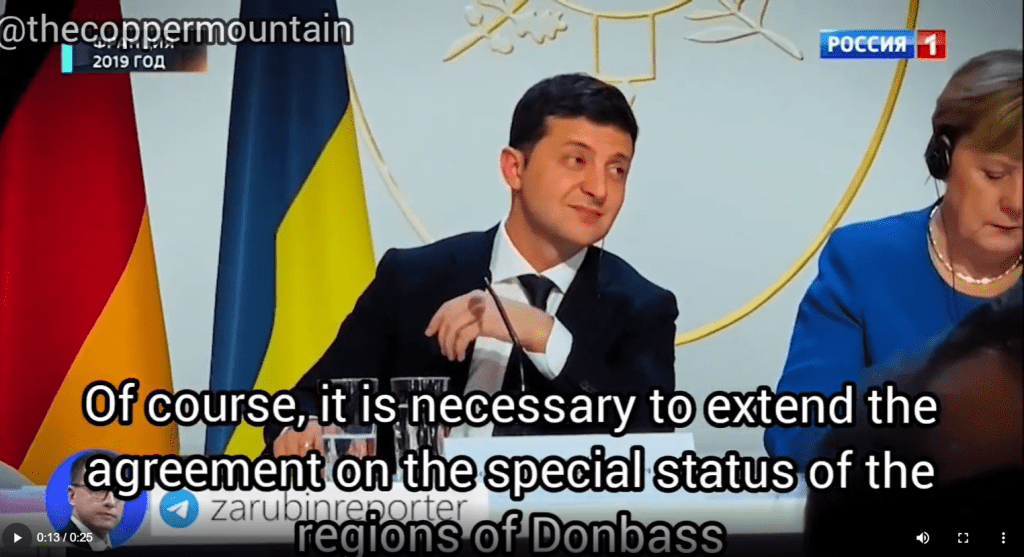
Volodomyr Zelensky smirks at December 2019 meeting in Paris as Vladimir Putin discusses the Minsk Agreement (Image: Telegram Zarubin Reporter)

By Ajamu Baraka

Source: Black Agenda Report

The Ukraine conflict was caused by the U.S. backed right wing coup in 2014 and the duplicity of Europeans who claimed to be working for peace. Anyone who supports these actions but claims leftist credentials must be challenged. 

“It is urgent to end this war as soon as possible. This can only be achieved through the success of Ukraine’s resistance to Russia’s invasion. Ukraine is fighting a legitimate war of self-defense, indeed a war for its survival as a nation. Calling for “peace” in the abstract is meaningless in these circumstances.”(Ukrainian Solidarity Network )

“Social-imperialists,’ that is, socialists in words and imperialists in deeds ( V.I. Lenin) 

“The Western social-imperialist left that is still addicted to its material privileges and illusions of being a part of something called the “West” has a choice that it must make: either you abandon privilege and whiteness and join as class combatants against your bourgeoisie, or you will be considered part of the enemy.” (A.Baraka, The Western Imperial Left’s Collaboration with the Western Bourgeoisie )

The clear implication from this statement issued by the newly formed Ukrainian Solidarity Network is that military victory is the only solution for resolving the conflict in Ukraine. The fact that many of the individuals supporting this network self-identify as leftists, represents a new, perhaps higher form of collaboration with Western and U.S. imperialism that may have ever developed since the end of the second imperialist war in 1945.  I issued an excerpt of my statement in response to the emergence of this network that caused a stir. Here is my statement in full.  

One of the most positive things to emerge from the Collective West’s war in Ukraine is that it helped to expose elements of the U.S. left that have always had a soft, sentimental spot for the West. The arrogance of these Westerners who signed on to this call for more war (see below) is reflected in the fact that they don’t even feel compelled to explain how their morally superior commitment to Ukrainian self-determination against “Putin’s” war is reconciled with the various statements from former German Chancellor Angela Merkel, former French President Francois Hollande and before them, former Ukrainian president Petro Poroshenko revealing that the Minsk agreement was just a delaying tactic to prepare for war. 

We ask the Network as we have been asking Zelensky and Biden, the co-coordinators of the White Lives Matter More Movement, how this phase of the conflict that started in 2014 became Putin’s war? Do we just dismiss as Kremlin propaganda that the Russian Federation felt threatened by what appeared to be the de-facto incorporation of Ukraine into NATO as the Ukrainian army was built into the most formidable fighting force in Europe outside of Russia?

Did the Russians not have any legitimate security concerns with NATO missiles facing them from Romania and Poland, a mere six minutes away from Moscow, and that Ukraine was also making a pitch for “defensive” missiles in Ukraine? And how does the Network characterize the conflict in Eastern Ukraine that started in 2014 and produced over 14,000 deaths when the Ukrainian coup government attacked its own citizens, if the current conflict started in February 2022? What happened to the fascist issue in Ukraine that was written about for years but with even more urgency after the coup in 2014? Did the Kremlin plant those stories in the Western press? 

We understand that these are questions that the organizers of the Ukrainian Network will never answer because they do not have to.  As Westerners they can just postulate an assertion and it is accepted. The Network and the Western bourgeoisie declare that the war in Ukraine is Putin’s war and it becomes objective truth – because that is what the West can do and can get away with. It’s called power – white power perhaps? 

The Ukrainian Solidarity Network is the ultimate expression of social imperialism that has become so normalized in the U.S. and Western Europe that it is no longer even recognized. An example from the statement makes the argument that Ukraine has the “right to determine the means and objectives of its own struggle.” That is a recognized left position. But the social imperialists of the West do not extend that principle and right to nations in the global South. In fact, we ask the signers of this call to explain when the coup government of Ukraine became the representatives of the Ukrainian nation and recognized the sovereign will of the people? 

Therefore, it is not a mere coincidence that the main signatories of this Network statement pledging undying support to Ukraine and its project, are also some of the same “left” forces in the forefront of giving left legitimacy to the charge leveled by Western imperialism that the struggling socialist oriented national liberationist states like Venezuela, Nicaragua, Bolivia are nothing more than “authoritarian” states more interested in power than socialist construction. Some of those forces also cheered on the NATO attack against Libya, passionately defended Western intervention in Syria and have been silent on Western plans to violently invade Haiti. 

For the contemporary neocons in the leadership of the Ukrainian network, their commitment to abstract principles, and certainty that they know more than everyone else, objectively place them in the same ideological camp with Obama, Biden, NATO strategists, the Zelensky clown, and Boris Johnson. But they will argue that their positions are different, since they represent something they call the left. 

For a number of individuals who signed on to this pro-Western, pro-war letter, they are in a familiar place. However, I suspect a few of the individuals on that list were probably confused or not paying attention, not thinking about who they would be affiliated with when they signed on.

That of course, is not the case for some of the key supporters of this initiative. Individuals like the Green Party’s Howie Hawkins, Eric Draitser of Counterpunch, and Bill Fletcher who normally I would not name specifically but because these individuals and the tendency they represent embody the worst of the arrogant, Western left that in so many cases (not all) objectively provides ideological cover ( rightism with left phraseology) for the imperialist program of Western capital –  they should not be allowed continued left respectability without challenge.

These individuals certainly have not hesitated in offering criticisms of those of us who never wavered from our strategic priority to defeat our primary enemy – the Western white supremacist colonial/capitalist patriarchy. For us everything else represents secondary contradictions at this specific historical moment. And is why we reject the arguments these forces advance about fighting dual imperialisms as anti-dialectical nonsense and a political cover.  

History has demonstrated that it would be a complete disaster if the “collective West” secured a military victory in its proxy war with Russia. For the U.S. empire it would validate their doctrine of “Full spectrum dominance” and the wisdom of their commitment to a military-first strategy to support that doctrine. It would mean that war with China was a certainty.

The commitment to global hegemony by the Western colonial/capitalist elite by any means necessary is why the U.S./EU/NATO Axis of Domination represents an existential threat to the vast majority of humanity. A “left” position on Ukraine should at best be to support a negotiated settlement to end the war before the Dr. Strangeloves making policy in the U.S. create the circumstances that will lead to a nuclear confrontation with either Russia or China. 

The position of support for more war guided by the white-boy fantasy of military victory in Ukraine is madness. For Africans/Black folks, we ask, what self-respecting African would consciously place themselves on the same side with NATO, Europe, and the U.S. settler-state in any conflict? The fact that some continue to end up on the same side with our enemies only affirms that they have made a choice, and that choice is to collaborate with our enemies – which sadly, also makes them the enemy.
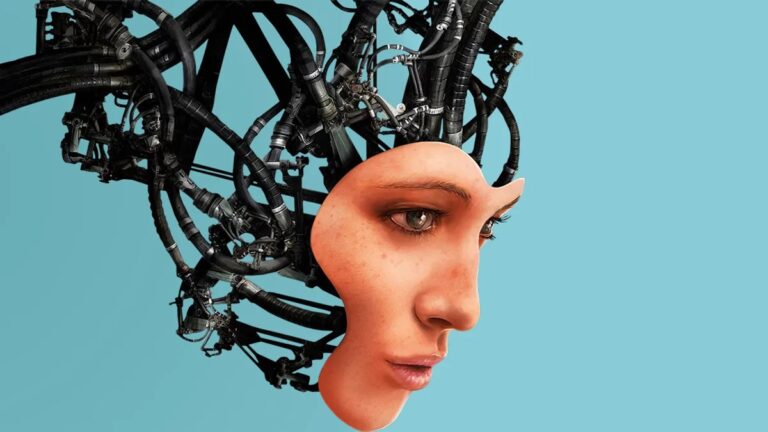
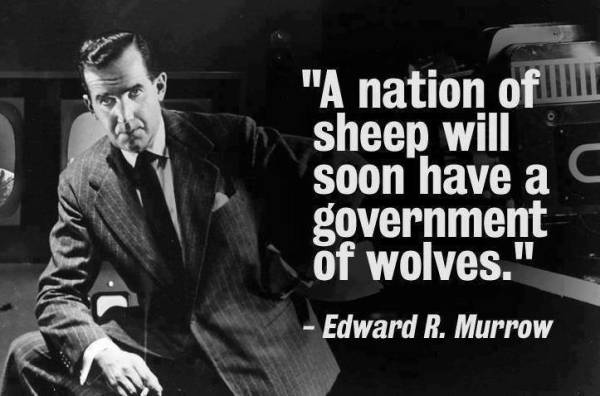
The Digitization Of Humanity Shows Why The Globalist Agenda Is Evil

By Brandon Smith

Source: Alt-Market.us

In recent weeks I’ve been seeing an interesting narrative fallacy being sold to the general public when it comes to the designs of globalists. The mainstream media and others are now openly suggesting that it’s actually okay to be opposed to certain aspects of groups like the World Economic Forum. They give you permission to be concerned, just don’t dare call it conspiracy.

This propaganda is a deviation from the abject denials we’re accustomed to hearing in the Liberty Movement for the past decade or more. We have all been confronted with the usual cognitive dissonance – The claims that globalist groups “just sit around talking about boring economic issues” and nothing they do has any bearing on global politics or your everyday life. In some cases we were even told that these groups of elites “don’t exist”.

Now, the media is admitting that yes, perhaps the globalists do have more than just a little influence over governments, social policies and economic outcomes. But, what the mainstream doesn’t like is the assertion that globalists have nefarious or authoritarian intentions. That’s just crazy tinfoil hat talk, right?

The reason for the narrative shift is obvious. Far too many people witnessed the true globalist agenda in action during the pandemic lockdowns and now they see the conspiracy for what it is. The globalists, in turn, seem to have been shocked to discover many millions of people in opposition to the mandates and the refusals to comply were clearly far greater than they expected. They are still trying to push their brand of covid fear, but the cat is out of the bag now.

They failed to get what they wanted in the west, which was a perpetual Chinese-style medical tyranny with vaccine passports as the norm. So, the globalist strategy has changed and they are seeking to adapt. They admit to a certain level of influence, but they pretend as if they are benevolent or indifferent.

The response to this lie is relatively straightforward. I could point out how Klaus Schwab of the WEF savored the thrill of the initial pandemic outbreak and declared that covid was the perfect “opportunity” to initiate what the WEF calls the “Great Reset.”

I could also point out that Klaus Schwab’s vision of the Reset, what he calls the “4th Industrial Revolution”, is a veritable nightmare world in which Artificial Intelligence runs everything, society is condensed into digital enclaves called “smart cities” and people are oppressed by carbon taxation. I could point out that the WEF actively supports the concept of the “Shared Economy” in which you will “own nothing, have no privacy” and you will supposedly be happy about it, but only because you won’t have any other choice.

What I really want to talk about, however, is the process by which the elites hope to achieve their dystopian epoch, as well as the globalist mindset which lends itself to the horrors of technocracy. The common naive assumption among skeptics of conspiracy is that the globalists are regular human beings with the same drives and limited desires as the rest of us. They might have some power, but world events are still random and certainly not controlled.

This is a fallacy. The globalists are not like us. They are not human. Or, I should say, they despise humanity and seek to do away with it. And, because of this, they have entirely different aspirations compared to the majority of us which include aspirations of dominance.

What we are dealing with here are not normal people with conscience, ethics or empathy. Their behavior is much more akin to higher functioning psychopaths and sociopaths rather than the everyday person on the street. We saw this on full display during the covid lockdowns and the vicious attempts to enforce vaccine passports; their actions betray their long game.

Take a look at comments by New Zealand’s prime minister and WEF attendee, Jacinda Ardern, from a year ago. She admits to the deliberate tactic of creating a two-tier class system within her own country based on vaccination status. There is no remorse or guilt in her demeanor, she is proud of taking such authoritarian actions despite numerous studies that prove the mandates are ineffective.

Beyond the covid response, though, I suggest people who deny globalist conspiracy take a deeper dive into the philosophical roots of organizations like the WEF. Their entire ideology can be summed up in a couple words – Futurism and godhood.

Futurism is an ideological movement which believes that all “new” innovations, social or technological, should supplant the previous existing systems for the sake of progress. They believe that all old ways of thinking, including notions of principles, heritage, religious belief systems, codes of conduct, etc. are crutches holding humanity back from greatness.

But what is the greatness the futurists seek? As mentioned above, they want godhood. An era in which the natural world and human will is enslaved by the hands of a select few. Case in point – The following presentation from 2018 by WEF “guru” Yuval Harari on the future of humanity as the globalists see it:

Harari’s conclusions are rooted in elitist biases and ignore numerous psychological and social realities, but we can set those aside for a moment and examine his basic premise that humanity as we know it will no longer exist in the next century because of “digital evolution” and “human hacking.”

The foundation of the WEF vision is built on the idea that data is the new Holy Grail, the new conquest. This is something I have written about extensively in the past (check out my article ‘Artificial Intelligence: A Secular Look At The Digital Antichrist’) but it is good to see it expressed with such arrogance by someone like Harari because it is undeniable evidence – The globalists think they are going to build a completely centralized economy and society based on human data rather than production. In other words, YOU become the product. The average citizen, your thoughts and your behaviors, become the stock in trade.

Globalists also believe that data is most valuable because it can be exploited to control people’s behaviors, to hack the body and mind in order to create human puppets, or create super-beings. They dream of becoming little gods with omnipotent knowledge. Yuval even proudly proclaims that intelligent design will no longer be the realm of God in heaven, but of the new digitized man.

While Harari pays lip service to “democracy” vs “digital dictatorship”, he goes on to assert that centralization may become the defacto system of governance. He says this not because he fears dictatorship, but because that has always been the WEF’s intent. The globalist argues that governments cannot be trusted to hold a monopoly on the digital wellspring and that someone needs to step in to regulate data; but “who would do this?”, he asks.

He already knows the answer. The UN, a globalist edifice, has consistently said it should be the governing body that takes control of AI and data regulation through UNESCO. That is to say, Harari is playing coy, he knows that the people who will step in to control the data are people just like him.

At no point in Harari’s speech does he suggest that that any of these developments should be obstructed or stopped. At no point does he offer the idea that the digitization of humanity is wrong and that there are other better ways of living. He actually mocks the concept of “going back” to old ways; only the future and the Tabula Rasa (blank slate) hold promise for the globalists, everything else is an impediment to their designs.

But here’s the thing, what the globalists are trying to accomplish is a fantasy. People are not algorithms, despite how much Harari would like them to be. People have habits, yes, but they are also unpredictable and are prone to sudden awakenings and epiphanies in the moment of crisis.

Psychopaths tend to be robotic people, acting impulsively but also very predictably. They lack imagination, intuition and foresight, and so it’s not surprising that organizations of psychopaths like the WEF would place such an obsessive value on AI, algorithms and a cold technocratic evolution. They don’t view their data Shangri-La as humanity’s future; they see it as THEIR future – The future of the non-humans, or the anti-humans as it were.

Who will produce all the goods, services and necessities required in this brave new world? Well, all of us peons, of course. Sure, the globalists will offer grand promises of a robot driven production economy in which people no longer need to engage in menial labor, but this will be another lie. They’ll still need people to plant the crops, maintain infrastructure, take care of manufacturing, do their fighting for them, etc., they’ll just need less of us.

At bottom, an economy built on data is an economy dependent on illusion.

Data is vaporous and oftentimes meaningless because it is subject to the biases of the interpreter. Algorithms can also be programmed to the biases of the engineers. There is nothing inherently objective about data – it is all dependent on the intentions of the people analyzing it.

For example, to use Harari’s anecdote of an algorithm that “knows you are gay” before you do; any twisted group of people could simply write code for an algorithm that tells the majority of easily manipulated kids that they are gay, even when they are not. And, if you are gullible enough to believe the algorithm is infallible, then you could be led to believe that numerous falsehoods are true and be convinced to behave against your nature. You have allowed a biased digital phantom to dictate your identity, and have made yourself “hackable.”

In the meantime, the elitists entertain delusions of surpassing their mortal limitations by “hacking” the human body, as well as reading the minds of the masses and predicting the future based on data trends. This is an obsession which ignores the unpredictable wages of the human soul, that very element of conscience and of imagination which psychopaths lack. It’s something that cannot be hacked.

The legitimacy of the data based system and the hacking of humanity that the WEF aspires to is less important than what the masses can be convinced of. If the average person can be persuaded to implant their cell phone in their skull in the near future, then yes, humanity might become hackable in a rudimentary way.

The algorithms then supplant conscience, empathy and principles.  And, without these things all morality becomes relative by default.  Evil becomes good, and good becomes evil. 

By the same token, if humanity can be persuaded to set down their cell phones and live a less tech focused life, then the digital empire of the globalists comes crashing down quite easily. There is no system the elites can impose that would make their digital consciousness a reality without the consent of the public at large.

Without a vast global framework in which people willingly embrace the algorithms rather than their own experience and intuitions, the globalist religion of total centralization dies. The first step is to accept that the conspiracy does indeed exist. The second step is to accept that the conspiracy is malicious and destructive. The third step is to refuse to comply, by whatever means necessary.

Don’t Trust the Government with Your Privacy, Property or Your Freedoms

By John & Nisha Whitehead

Source: The Rutherford Institute

How do you trust a government that continuously sidesteps the Constitution and undermines our rights? You can’t.

When you consider all the ways “we the people” are being bullied, beaten, bamboozled, targeted, tracked, repressed, robbed, impoverished, imprisoned and killed by the government, one can only conclude that you shouldn’t trust the government with your privacy, your property, your life, or your freedoms.

Consider for yourself.

Don’t trust the government with your privacy, digital or otherwise. In the two decades since 9/11, the military-security industrial complex has operated under a permanent state of emergency that, in turn, has given rise to a digital prison that grows more confining and inescapable by the day. Wall-to wall surveillance, monitored by AI software and fed to a growing network of fusion centers, render the twin concepts of privacy and anonymity almost void. By conspiring with corporations, the Department of Homeland Security “fueled a massive influx of money into surveillance and policing in our cities, under a banner of emergency response and counterterrorism.” For instance, all across the country, police are installing Flock Safety license plate readers as part of a public-private partnership program between police and the surveillance industry. These cameras, which upload data in real time to fusion crime centers, signal a turning point in the transition from a police state to a police-driven surveillance state.

Don’t trust the government with your property. In yet another effort to legitimize warrantless searches, police are employing “hit-and-hold” tactics in which police enter a home, carry out an initial sweep of the property, handcuff the occupants, then wait for official search warrants to be secured and applied retroactively. In the meantime, police have managed to bypass the Fourth Amendment. The rationale, to prevent possible destruction of evidence, is the same one used to deadly effect with no-knock raids. If government agents can invade your home, break down your doors, kill your dog, damage your furnishings and terrorize your family, your property is no longer private and secure—it belongs to the government. Hard-working Americans are having their bank accounts, homes, cars electronics and cash seized by police under the assumption that they have allegedly been associated with some criminal scheme.

Don’t trust the government with your finances. The U.S. government—and that includes the current administration—is spending money it doesn’t have on programs it can’t afford, and “we the taxpayers” are being forced to foot the bill for the government’s fiscal insanity. The national debt is $31.3 trillion and growing, and we’re paying more than $300 billion in interest every year on that public debt, yet there seems to be no end in sight when it comes to the government’s fiscal insanity. According to Forbes, Congress has raised, extended or revised the definition of the debt limit 78 times since 1960 in order to allow the government to essentially fund its existence with a credit card.

Don’t trust the government with your health. For all intents and purposes, “we the people” have become lab rats in the government’s secret experiments, which include MKULTRA and the U.S. military’s secret race-based testing of mustard gas on more than 60,000 enlisted men. Indeed, you don’t have to dig very deep or go very back in the nation’s history to uncover numerous cases in which the government deliberately conducted secret experiments on an unsuspecting populace—citizens and noncitizens alike—making healthy people sick by spraying them with chemicals, injecting them with infectious diseases and exposing them to airborne toxins. Unfortunately, the public has become so easily distracted by the political spectacle out of Washington, DC, that they are altogether oblivious to the grisly experiments, barbaric behavior and inhumane conditions that have become synonymous with the U.S. government, which has meted out untold horrors against humans and animals alike.

Don’t trust the government with your life: At a time when growing numbers of unarmed people have been shot and killed for just standing a certain way, or moving a certain way, or holding something—anything—that police could misinterpret to be a gun, or igniting some trigger-centric fear in a police officer’s mind that has nothing to do with an actual threat to their safety, even the most benign encounters with police can have fatal consequences. The number of Americans killed by police continues to grow, with the majority of those killed as a result of police encounters having been suspected of a non-violent offense or no crime at all, or during a traffic violation. According a report by Mapping Police Violence, police killed more people in 2022 than any other year within the past decade. In 98% of those killings, police were not charged with a crime.

Don’t trust the government with your freedoms. For years now, the government has been playing a cat-and-mouse game with the American people, letting us enjoy just enough freedom to think we are free but not enough to actually allow us to live as a free people. Freedom no longer means what it once did. This holds true whether you’re talking about the right to criticize the government in word or deed, the right to be free from government surveillance, the right to not have your person or your property subjected to warrantless searches by government agents, the right to due process, the right to be safe from militarized police invading your home, the right to be innocent until proven guilty and every other right that once reinforced the founders’ belief that this would be “a government of the people, by the people and for the people.” On paper, we may be technically free, but in reality, we are only as free as a government official may allow.

Whatever else it may be—a danger, a menace, a threat—the U.S. government is certainly not looking out for our best interests, nor is it in any way a friend to freedom.

Remember the purpose of a good government is to protect the lives and liberties of its people.

Unfortunately, what we have been saddled with is, in almost every regard, the exact opposite of an institution dedicated to protecting the lives and liberties of its people.

As I make clear in my book Battlefield America: The War on the American People and in its fictional counterpart The Erik Blair Diaries, “we the people” should have learned early on that a government that repeatedly lies, cheats, steals, spies, kills, maims, enslaves, breaks the laws, overreaches its authority, and abuses its power at almost every turn can’t be trusted.

ABOUT JOHN W. WHITEHEAD

Constitutional attorney and author John W. Whitehead is founder and president of The Rutherford Institute. His most recent books are the best-selling Battlefield America: The War on the American People, the award-winning A Government of Wolves: The Emerging American Police State, and a debut dystopian fiction novel, The Erik Blair Diaries. Whitehead can be contacted at staff@rutherford.org. Nisha Whitehead is the Executive Director of The Rutherford Institute. Information about The Rutherford Institute is available at www.rutherford.org.

3 QUESTIONS YOU’RE NOT SUPPOSED TO ASK ABOUT LIFE IN A SICK SOCIETY

By Dylan Charles

Source: Waking Times

In a society this controlling, it’s no wonder so many people can’t let go of their grip on false realities, and pressure others to conform to their point of view. In my work as a self-mastery coach I help people see what false realities they’ve made for themselves, and help them let go of their grip on useless beliefs.  ~Dylan Charles

“It is no measure of health to be well adjusted to a profoundly sick society.” ~J. Krishnamurti

Society is directed by a never-ending mainstream narrative which is always evolving, and always reaching new dramatic peaks in sensationalism and hype. They fill your mind with topics they select, they keep your attention on these topics, and they invite and encourage you to argue amongst each other about these topics. In this way our collective attention is permanently commandeered, preventing us from diving too deeply into matters which have more than a superficial impact on day-today life.

Free-thinking is the ability and willingness to explore of ideas and areas of the mind which are yet undiscovered or are off-limits. It is a vanishing art that is deliberately being stamped out by a control system which demands conformity, acquiescence and obedience of body, mind, and spirit.

For your consideration, here are three questions you’re not supposed to ask about life in our profoundly sick society.

1. Who owns the money supply, and the world’s debt?

Pretty much the entire world is in financial debt, an insidious form of slavery which enables the exploitation of human beings and of all things in nature. It’s maddening when you think about it. The United States alone supposedly owes some $20 trillion, while the world at large owes a shocking $215 trillion?

But to whom, precisely?

Money is just a medium of exchange which facilitates transactions between people. In and of itself it has no intrinsic value as we could just as easily use sea shells instead of dollar bills and still be able to get things done. But today’s money is the property of private third-parties who rent it out to national governments, who then use the labor of their citizens as collateral against these loans. This is a highly refined form of slavery, which has already put future unborn generations of human beings in debt.

But who, exactly does the human race owe? Who are our debt-slave masters?

2. Who owns your body?

Ownership means having the explicit right to use, control and dispose of something in the manner of your choosing. The one thing you are born with that you take with you to your death is your own body, but do you own it? If not you, then who does own your body?

If this question were already settled in our society then there wouldn’t be ever-increasing pressure on those who choose to refuse vaccines. Children battling cancer and other serious illnesses wouldn’t be forced to take chemo and radiation under penalty of law and under threat of being taken from their parents. Water wouldn’t be fluoridated without our consent. Natural medicines wouldn’t be outlawed under threat of fines and prison time.

We are rapidly approaching a time when people will be required by law to take psychotropic medications as citizens were in Aldous Huxley’s dystopian classic, Brave New World.

Do you own your body, or does it belong to the state?

3.  Why is the exploration of consciousness restricted and illegal?

The most effective prisons are not material, but are constructed inside the mind. Perception, opinion and understanding are all dynamic concepts, not at all static. These can all change in the blink of an eye just because a new idea or experience resonates with you in a special way. Our evolution depends on our ability to expand the frontiers of what’s possible, and when the mind is held in confinement by an entrenched system and powerful cultural paradigm, progress, even happiness, is stunted.

In this societal trap you are given free rein to debase your consciousness and your spirit with alcohol, dangerous drugs, pharmaceuticals, television, pornography, theatrical violence, and then some, yet many natural medicines which elevate consciousness and provide a window into the soul are illegal.

“This is the way freedom is hijacked—not all at once, out in the open, but stealthily, little by little, behind closed doors, and with our own agreement. How will we be able to resist when so many of us have already willingly handed over the keys to our own consciousness to the state and accepted without protest that it is OK to be told what we may and may not do, what we may and may not explore, even what we may and may not experience, with this most precious, sapient, unique, and individual part of ourselves?

If we are willing to accept that then we can be persuaded to accept anything.” ~Graham Hancock

Why Orwell matters

His defence of freedom flies in the face of all that is woke and regressive today.

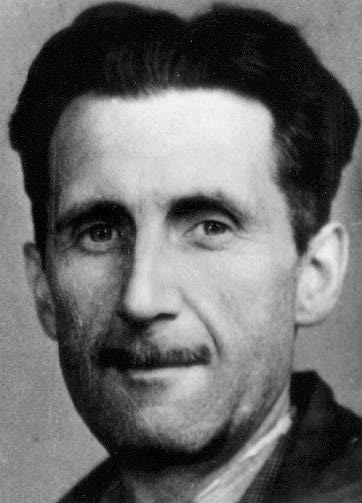
George Orwell aka Eric Blair (25 June 1903 – 21 January 1950)

By Bruno Waterfield

Source: Spike Online

Most people think that George Orwell was writing about, and against, totalitarianism – especially when they encounter him through the prism of his great dystopian novel, Nineteen Eighty-Four.

This view of Orwell is not wrong, but it can miss something. For Orwell was concerned above all about the particular threat posed by totalitarianism to words and language. He was concerned about the threat it posed to our ability to think and speak freely and truthfully. About the threat it posed to our freedom.

He saw, clearly and vividly, that to lose control of words is to lose control of meaning. That is what frightened him about the totalitarianism of Nazi Germany and Stalinist Russia – these regimes wanted to control the very linguistic substance of thought itself.

And that is why Orwell continues to speak to us so powerfully today. Because words, language and meaning are under threat once more.

Totalitarianism in Orwell’s time

The totalitarian regimes of Nazi Germany and Stalin’s Soviet Union represented something new and frightening for Orwell. Authoritarian dictatorships, in which power was wielded unaccountably and arbitrarily, had existed before, of course. But what made the totalitarian regimes of the 20th century different was the extent to which they demanded every individual’s complete subservience to the state. They sought to abolish the very basis of individual freedom and autonomy. They wanted to use dictatorial powers to socially engineer the human soul itself, changing and shaping how people think and behave.

Totalitarian regimes set about breaking up clubs, trade unions and other voluntary associations. They were effectively dismantling those areas of social and political life in which people were able to freely and spontaneously associate. The spaces, that is, in which local and national culture develops free of the state and officialdom. These cultural spaces were always tremendously important to Orwell. As he put it in his 1941 essay, ‘England Your England’: ‘All the culture that is most truly native centres round things which even when they are communal are not official – the pub, the football match, the back garden, the fireside and the “nice cup of tea”.’

Totalitarianism may have reached its horrifying zenith in Nazi Germany and Stalin’s USSR. But Orwell was worried about its effect in the West, too. He was concerned about the Sovietisation of Europe through the increasingly prominent and powerful Stalinist Communist Parties. He was also worried about what he saw as Britain’s leftwing ‘Europeanised intelligentsia’, which, like the Communist Parties of Western Europe, seemed to worship state power, particularly in the supranational form of the USSR. And he was concerned above all about the emergence of the totalitarian mindset, and the attempt to re-engineer the deep structures of mind and feeling that lie at the heart of autonomy and liberty.

Orwell could see this mindset flourishing among Britain’s intellectual elite, from the eugenics and top-down socialism of Fabians, like Sidney and Beatrice Webb and HG Wells, to the broader technocratic impulses of the intelligentsia in general. They wanted to remake people ‘for their own good’, or for the benefit of the race or state power. They therefore saw it as desirable to force people to conform to certain prescribed behaviours and attitudes. This threatened the everyday freedom of people who wanted, as Orwell put it, ‘the liberty to have a home of your own, to do what you like in your spare time, to choose your own amusements instead of having them chosen for you from above’.

In the aftermath of the Second World War, this new intellectual elite started to gain ascendancy. It was effectively a clerisy – a cultural and ruling elite defined by its academic achievements. It had been forged through higher education and academia rather than through traditional forms of privilege and wealth, such as public schools.

Orwell was naturally predisposed against this emergent clerisy. He may have attended Eton, but that’s where Orwell’s education stopped. He was not part of the clerisy’s world. He was not an academic writer, nor did he position himself as such. On the contrary, he saw himself as a popular writer, addressing a broad, non-university-educated audience.

Moreover, Orwell’s antipathy towards this new elite type was long-standing. He had bristled against the rigidity and pomposity of imperial officialdom as a minor colonial police official in Burma between 1922 and 1927. And he had always battled against the top-down socialist great and good, and much of academia, too, who were often very much hand in glove with the Stalinised left.

The hostility was mutual. Indeed, it accounts for the disdain that many academics and their fellow travellers continue to display towards Orwell today.

The importance of words

Nowadays we are all too familiar with this university-educated ruling caste, and its desire to control words and meaning. Just think, for example, of the way in which our cultural and educational elites have turned ‘fascism’ from a historically specific phenomenon into a pejorative that has lost all meaning, to be used to describe anything from Brexit to Boris Johnson’s Tory government – a process Orwell saw beginning with the Stalinist practice of calling Spanish democratic revolutionaries ‘Trotsky-fascists’ (which he documented in Homage to Catalonia (1938)).

Or think of the way in which our cultural and educational elites have transformed the very meanings of the words ‘man’ and ‘woman’, divesting them of any connection to biological reality. Orwell would not have been surprised by this development. In Nineteen Eighty-Four, he shows how the totalitarian state and its intellectuals will try to suppress real facts, and even natural laws, if they diverge from their worldview. Through exerting power over ideas, they seek to shape reality. ‘Power is in tearing human minds to pieces and putting them together in new shapes of your own choosing’, says O’Brien, the sinister party intellectual. ‘We control matter because we control the mind. Reality is inside the skull… You must get rid of these 19th-century ideas about the laws of nature.’

In Nineteen Eighty-Four, the totalitarian regime tries to subject history to similar manipulation. As anti-hero Winston Smith tells his lover, Julia:

‘Every record has been destroyed or falsified, every book has been rewritten, every picture has been repainted, every statue and street and building has been renamed, every date has been altered. And that process is continuing day by day and minute by minute. History has stopped. Nothing exists except an endless present in which the Party is always right.’

As Orwell wrote elsewhere, ‘the historian believes that the past cannot be altered and that a correct knowledge of history is valuable as a matter of course. From the totalitarian point of view history is something to be created rather than learned.’

This totalitarian approach to history is dominant today, from the New York Times’ 1619 Project to statue-toppling. History is something to be erased or conjured up or reshaped as a moral lesson for today. It is used to demonstrate the rectitude of the contemporary establishment.

But it is language that is central to Orwell’s analysis of this form of intellectual manipulation and thought-control. Take ‘Ingsoc’, the philosophy that the regime follows and enforces through the linguistic system of Newspeak. Newspeak is more than mere censorship. It is an attempt to make certain ideas – freedom, autonomy and so on – actually unthinkable or impossible. It is an attempt to eliminate the very possibility of dissent (or ‘thoughtcrime’).

As Syme, who is working on a Newspeak dictionary, tells Winston Smith:

‘The whole aim… is to narrow the range of thought. In the end we shall make thoughtcrime literally impossible, because there will be no words in which to express it. Every year fewer and fewer words, and the range of consciousness always a little smaller… Has it ever occurred to you, Winston, that by the year 2050, at the very latest, not a single human being will be alive who could understand such a conversation as we are having now?’

The parallels between Orwell’s nightmarish vision of totalitarianism and the totalitarian mindset of today, in which language is policed and controlled, should not be overstated. In the dystopia of Nineteen Eighty-Four, the project of eliminating freedom and dissent, as in Nazi Germany or Stalinist Russia, was backed up by a brutal, murderous secret police. There is little of that in our societies today – people are not forcibly silenced or disappeared.

However, they are cancelled, pushed out of their jobs, and sometimes even arrested by the police for what amounts to thoughtcrime. And many more people simply self-censor out of fear of saying the ‘wrong’ thing. Orwell’s concern that words could be erased or their meaning altered, and thought controlled, is not being realised in an openly dictatorial manner. No, it’s being achieved through a creeping cultural and intellectual conformism.

The intellectual turn against freedom

But then that was always Orwell’s worry – that intellectuals giving up on freedom would allow a Big Brother Britain to flourish. As he saw it in The Prevention of Literature (1946), the biggest danger to freedom of speech and thought came not from the threat of dictatorship (which was receding by then) but from intellectuals giving up on freedom, or worse, seeing it as an obstacle to the realisation of their worldview.

Interestingly, his concerns about an intellectual betrayal of freedom were reinforced by a 1944 meeting of the anti-censorship organisation, English PEN. Attending an event to mark the 300th anniversary of Milton’s Areopagitica, Milton’s famous 1644 speech making the case for the ‘Liberty of Unlicenc’d Printing’, Orwell noted that many of the left-wing intellectuals present were unwilling to criticise Soviet Russia or wartime censorship. Indeed, they had become profoundly indifferent or hostile to the question of political liberty and press freedom.

‘In England, the immediate enemies of truthfulness, and hence of freedom of thought, are the press lords, the film magnates, and the bureaucrats’, Orwell wrote, ‘but that on a long view the weakening of the desire for liberty among the intellectuals themselves is the most serious symptom of all’.

Orwell was concerned by the increasing popularity among influential left-wing intellectuals of ‘the much more tenable and dangerous proposition that freedom is undesirable and that intellectual honesty is a form of anti-social selfishness’. The exercise of freedom of speech and thought, the willingness to speak truth to power, was even then becoming seen as something to be frowned upon, a selfish, even elitist act.

An individual speaking freely and honestly, wrote Orwell, is ‘accused of either wanting to shut himself up in an ivory tower, or of making an exhibitionist display of his own personality, or of resisting the inevitable current of history in an attempt to cling to unjustified privilege’.

These are insights which have stood the test of time. Just think of the imprecations against those who challenge the consensus. They are dismissed as ‘contrarians’ and accused of selfishly upsetting people.

And worst of all, think of the way free speech is damned as the right of the privileged. This is possibly one of the greatest lies of our age. Free speech does not support privilege. We all have the capacity to speak, write, think and argue. We might not, as individuals or small groups, have the platforms of a press baron or the BBC. But it is only through our freedom to speak freely that we can challenge those with greater power.

Orwell’s legacy

Orwell is everywhere today. He is taught in schools and his ideas and phrases are part of our common culture. But his value and importance to us lies in his defence of freedom, especially the freedom to speak and write.

His outstanding 1946 essay, ‘Politics and the English Language’, can actually be read as a freedom manual. It is a guide on how to use words and language to fight back.

Of course, it is attacked today as an expression of privilege and of bigotry. Author and commentator Will Self cited ‘Politics and the English Language’ in a 2014 BBC Radio 4 show as proof that Orwell was an ‘authoritarian elitist’. He said: ‘Reading Orwell at his most lucid you can have the distinct impression he’s saying these things, in precisely this way, because he knows that you – and you alone – are exactly the sort of person who’s sufficiently intelligent to comprehend the very essence of what he’s trying to communicate. It’s this the mediocrity-loving English masses respond to – the talented dog-whistler calling them to chow down on a big bowl of conformity.’

Lionel Trilling, another writer and thinker, made a similar point to Self, but in a far more insightful, enlightening way. ‘[Orwell] liberates us’, he wrote in 1952:

‘He tells us that we can understand our political and social life merely by looking around us, he frees us from the need for the inside dope. He implies that our job is not to be intellectual, certainly not to be intellectual in this fashion or that, but merely to be intelligent according to our lights – he restores the old sense of the democracy of the mind, releasing us from the belief that the mind can work only in a technical, professional way and that it must work competitively. He has the effect of making us believe that we may become full members of the society of thinking men. That is why he is a figure for us.’

Orwell should be a figure for us, too – in our battle to restore the democracy of the mind and resist the totalitarian mindset of today. But this will require having the courage of our convictions and our words, as he so often did himself. As he put it in The Prevention of Literature, ‘To write in plain vigorous language one has to think fearlessly’. That Orwell did precisely that was a testament to his belief in the public just as much as his belief in himself. He sets an example and a challenge to us all.

De-Dollarization Accelerates: The Beginning of the End for US Dollar Hegemony in Southeast Asia?

By Timothy Alexander Guzman

Source: Silent Crow News

The US is facing major moves by the global community to de-dollarize their economies.  The reserve status of the US dollar will eventually come to an end, maybe not anytime soon, but sometime in the future as it is facing numerous challenges not only from major powers such as Russia and China who are actively trying to rid themselves of the toxic currency, but also countries with smaller economies who are based in the Southeast Asian region which includes Singapore, Malaysia, Indonesia, Cambodia, Thailand, and Laos.  The globalist think tank, the Carnegie Endowment for International Peace (CEIP) published an article on August 22nd, 2022, on the US dollar’s waning influence in Southeast Asia titled ‘Southeast Asia’s Growing Interest in Non-dollar Financial Channels—and the Renminbi’s Potential Role’ stated what was taking place between China and several Southeast Asian countries:

China’s central bank—announced the launch of a new emergency liquidity arrangement that can be funded using renminbi and tapped by participating central banks during times of market stress. Three of the five participating central banks are Singapore’s, Malaysia’s, and Indonesia’s, which each recently renewed agreements with the PBOC implicitly aimed at reducing dollar usage in cross-border payments. This follows policymakers in ThailandLaosCambodia, and Myanmar all announcing efforts to reduce dollar usage, as well as comments by Indonesia’s central bank head that consumers across five of Southeast Asia’s largest economies will soon be able to make intra-regional cross-border payments via linkages that avoid using the dollar as an intermediary, as is currently often the case

Interestingly, The CEIP listed several reasons why Southeast Asian countries want to dramatically reduce the use of US dollars are as follows:

Several factors are behind the various efforts aimed at reducing dollar usage in Southeast Asia. To begin with, many officials are concerned about the potential economic impacts of U.S. monetary policy tightening on the region given its high usage of the dollar; accordingly, some are seeking to reduce usage of the dollar in intra-regional trade payments as a means of curbing dollar reliance more broadly. Recent sanctions may also be spurring demand for alternative financial channels—for example, Myanmar’s military government is actively exploring how to circumvent EU and U.S. sanctions to transact with Russia

According to an article published by almayadeen.net ‘Bank Indonesia calls against payments in US Dollars’ who translated the report by an Indonesian news portal called Tempo.net on what Nugroho Joko Prastowo of the Solo Bank Indonesia Representative Office said regarding Indonesian businesses using national currencies to reduce its reliance on the US dollar:

Bank Indonesia has urged importers and exporters to use national currencies in international payments in order to reduce Indonesian financial markets’ reliance on the US dollar, according to Tempo.co, an Indonesian news portal.  “About 90% of export-import payments are conducted in US dollars, while the share of Indonesian direct exports to the US is estimated at only 10%, and US imports account for 5%”

The report also mentioned that “China, Japan, Thailand, and Malaysia have already agreed to use the two-way payment mechanism, with Singapore and the Philippines planning to join the system, according to the economist.”  

Another article published by the globaltimes.cn on December 15th, 2021, ‘GT Exclusive: Myanmar accepts yuan as official settlement currency for border trade with China’ said that Myanmar’s usage of Chinese yuan will help break the US dollar dominance in the long term:

The yuan was included in the list of Myanmar’s official settlement currencies in January 2019. The move at that time was more symbolic, as all contracts and trade were still not settled in the Chinese currency.  Zhou said that the move, in the long term, will help break the monopoly of the US dollar in Myanmar’s foreign currency reserves.  The US has been abusing the dollar’s dominant status to impose arbitrary sanctions on other countries, and the yuan’s further expansion in Myanmar’s trade settlements may provide a shield against such a potential weapon, analysts said

Cambodia is on Board Dumping US Dollars

Why Cambodia with a population of close to 17 million people and a much smaller economic impact on the world’s economy is willing to drop US dollars is an important development.  The Diplomat, a current-affairs magazine based on analysis and commentaries from various authors on developments throughout Asia and the rest of the world published an article by Luke Hunt on the case of Cambodia’s attempt to stop using US dollars titled ‘Cambodia Reduces its Dependency on the US Dollar’ lays out the mood of the Cambodian government.  “Ever since United Nations peacekeepers arrived in war-torn Cambodia to oversee elections held in 1993, the U.S. dollar has been a mainstay of the local economy with a dual currency system providing steady exchange rates in a volatile place” but there is a monumental shift taking place when the National Bank of Cambodia (NBC) announced that it “would phase-out small-denominated U.S. dollar bills – $1, $2, and $5 notes – following negotiations with banks and micro-finance institutions (MFIs).”  Naturally it’s a step to reduce the dependency of the US dollar according to the NBC “Cambodia has to encourage the use of its riel, more. So, allowing the circulation of small U.S. bills is an obstacle in urging the use of the riel.”

There are several reasons for Cambodia’s move, one of them is to allow the use of digital currencies to “give the central bank more control over the Cambodian economy and bolster the local riel currency, which for decades suffered from a lack of confidence due to negative sentiment stemming from a 30-year war” in addition it will allow the central bank “control over monetary policy and interest rate settings and reduced costs in handling the sheer volume of $1 dollar notes circulating through the economy.”  Hunt mentions the dark period of Cambodian history with the US-backed Pol Pot and the Khmer Rouge who destroyed Cambodia and it’s traditions and started a new revolution with a new culture that would begin on Year Zero, therefore everything before would be deemed irrelevant, “It’s a far cry from the late 1970s, when Khmer Rouge rule abandoned money, banks were abolished, and the NBC blown-up as Pol Pot tried to create a utopian, agrarian society that led to the deaths of an estimated 1.7 million Cambodians.”  One of the darkest times in world history indeed.  It is a positive development that the NBC is encouraging the use of the Cambodian Riel for its economy, so the future seems promising.  NBC Governor Chea Chanto spoke at the 40th Anniversary of the re-establishment of the Riel “he said demand for the currency had increased by an average of 16 percent a year for the last 20 years amid annual average growth rates of 7.8 percent and inflation at around 2.5 percent.”  Chanto said that “I firmly believe all ministries, institutions, companies, enterprises, and those who actively participate in the process of developing the banking system promote the use of the riel, which is our national currency.” According to an unidentified analyst “It’s also a matter of sovereignty and pride. It’s their country and they are entitled to have their own currency like anywhere else.”

Transitioning from the US dollar to the Cambodian Riel won’t be an easy task according to Michael Finn of the Khmer Times who authored ‘De-dollarisation: Views from Asia, US and Europe’ claims that “Any reduction in the use of the dollar needs to be handled carefully, according to foreign chambers of commerce in Cambodia. They say the central bank is unlikely to fully phase-out the US currency and any sudden moves to end reliance on the dollar would be bad for business.”  European Chamber of Commerce Advocacy Manager Noe Schellinck said that “To a certain extent, the dollarisation now can be ascribed to the success of the Cambodian economy, with a great influx of Foreign Direct Investment, compared to the historic context of when the dollarization came about.” But the Indonesian Chamber of Commerce President Dalton Wong disagrees with Schellinck’s assessment:

De-dollarisation is not a bad thing as it is a re-balancing of the fiscal and monetary policy tools. It is certainly not a complete displacement and substitution of the US dollar in favour of the Khmer Riel in trade and investment, which some observers and analysts seem to mischievously suggest, which is not so helpful. In fact, promoting a greater use of the Khmer riel will give greater monetary policy tools to the Cambodian author 

The collapse of the US dollar is becoming a reality as China and Russia continue to buy gold and trade with their own currencies at an accelerated pace with many more countries around the world who are also racing to de-dollarize their economies.  As we already know, several countries in Southeast Asia will soon make its move to rid itself of the toxic currency, but there are also other countries who are also making moves including India, Iran, South Africa, Syria, and Venezuela who are all motivated to drop the US dollar.  One of the main reasons for these countries to move forward by eliminating the use of US dollar is because Washington uses its currency status as a weapon to impose harsh sanctions on countries they deem as enemies.  

African countries are also starting to look for alternatives to the US dollar including Ghana according to a report published by Reuters on November 24th, 2022, ‘Ghana plans to buy oil with gold instead of U.S. dollars’ said that “Ghana’s government is working on a new policy to buy oil products with gold rather than U.S. dollar reserves” Ghana’s reason slightly differs from other countries since “The move is meant to tackle dwindling foreign currency reserves coupled with demand for dollars by oil importers, which is weakening the local cedi and increasing living costs.”  This means that the US dollar is causing inflation.  The move is expected to take place in the first quarter of 2023 as Ghana’s Vice-President Mahamudu Bawumia said that the new policy “will fundamentally change our balance of payments and significantly reduce the persistent depreciation of our currency” as he explained that “using gold would prevent the exchange rate from directly impacting fuel or utility prices as domestic sellers would no longer need foreign exchange to import oil products.”  Libya was one of the first countries in Africa to propose the idea of creating an alternative currency to bypass the US dollar called the African Dinar which would have been gold-backed but the Obama regime supported a violent coup to overthrow its president who suggested the idea, Muammar Ghaddafi who was tortured and then killed in the process making Libya a hotbed for terrorism and at the same time, re-creating the centuries-old industry of slavery.   

The bottom line is that US dollar’s dominance in the global market will come to an end sometime in the foreseeable future.  No one has a crystal ball of when it will happen, but it is certain.  The world will experience an alternative economic reality that will change the dynamics of the US and its Western powers dominating the World’s economy with an outdated and flawed currency that will eventually have the same value as toilet paper.  

An Inconvenient Revolution

By Charles Hugh Smith

Source: Of Two Minds

Convenience isn’t just about small appliances. It’s also about ruling nations. Let’s start with the semantics of ruling nations. Some labels might be viewed as somewhat inflammatory (Kleptocracy, anyone?), so let’s stick with the neutral Ruling Order.

Some things have been extraordinarily convenient for the Ruling Order. Take the life and death of one Jeffrey Epstein, an intel “asset” who assembled a veritable goldmine of dirt on an astounding collection of bigwigs, and then became, well, inconvenient.

Very conveniently, the security camera in his cell failed, the guards dozed off and he hung himself in this fortuitous interlude. This was the acme of convenience.

Extending the Surveillance State into Big Tech’s planetary-wide social media networks was also convenient, and a bargain to boot. Instead of all that expensive stuff the Communist State in China had to pay for, America’s Ruling Order just put the squeeze on Big Tech and saved a bundle.

The Surveillance State assumes that any revolt / revolution can either be nipped in the bud by identifying foreign influences / domestic extremists, or crushed by foreknowledge of the storming of the barricades.

In conventional times, these are pretty safe assumptions. But the times are no longer conventional, and so the Ruling Order is in effect investing its treasure and confidence in fighting the last war.

It’s convenient if rebelling citizens organize themselves in visible networks and concentrate into groups that can be crushed by force. It’s inconvenient if the revolution is not neatly organized and crushable but an invisible revolution of not showing up.

In other words, a revolution of getting fed up and opting out, of finding some other way to live rather than spending 10 years paying down the student loans and another 30 years paying down the mortgage and the last few years of one’s life watching the tides of financial excess erode the sand castles of pensions and retirement.

There’s a consequential asymmetry to the inconvenience caused by people getting fed up and opting out. The average worker not showing up is consequential but not catastrophic. But when the managerial class thins out, and those doing the dirty work thin out, there are no replacements, and the system breaks down.

Few are willing to make the beds, empty the bedpans and work in slaughterhouses. When those willing to do the work nobody else wants to do quit, the system collapses. Those with higher expectations will not volunteer to do the dirty work, and many are unable to do the work even if they are willing. It’s too hard and too physically punishing. (Says a guy who’s carried stupid amounts of lumber up hillsides where no forklift could go.)

Despite what many of us may think, the majority of workers lack the experience and tools to manage complex operations. (Those of us who try soon reach our limits.) Many lack a deep enough knowledge to fix major breakdowns. When the critical operational and managerial people retire, quit, or find some other way to live, the system breaks down.

All the surveillance and all the force that the Ruling Order depends on to maintain its dominance is useless when people get fed up and quit supporting the system with their labor and their borrowing / spending. All the surveillance and facial recognition software is worthless, all the monitoring of kitten and puppy photos on social media, all the tracking of foreign influence–none of it matters any more.

It’s inconvenient when those whose sacrifices are essential to the system get fed up and find some other way to live. Yet this is the inevitable consequence of a system hopelessly corrupted by fraud, inequality and unfairness, a system rigged to benefit the few at the expense of the many. People eventually get fed up and opt out.

They don’t throw themselves on the gears of an odious system, they simply stop greasing the gears with their time, effort, experience, debt and money. It doesn’t take many opting out to trigger decay and collapse. The Pareto Distribution applies. The system can adjust to the first 4% opting out, but those consequential few trigger the decay of the commitment of the next 20%, and the system cannot survive when the 20% find some other way to live. The 80% can still be willing to grease the gears but that’s no longer enough to maintain the coherence of the system.

The asymmetry of decay and collapse is inconvenient.

The Democrats Are Now the War Party

The Democratic Party has become the party of permanent war, fueling massive military spending which is hollowing out the country from the inside and flirting with nuclear war.

By Chris Hedges

Source: ScheerPost.com

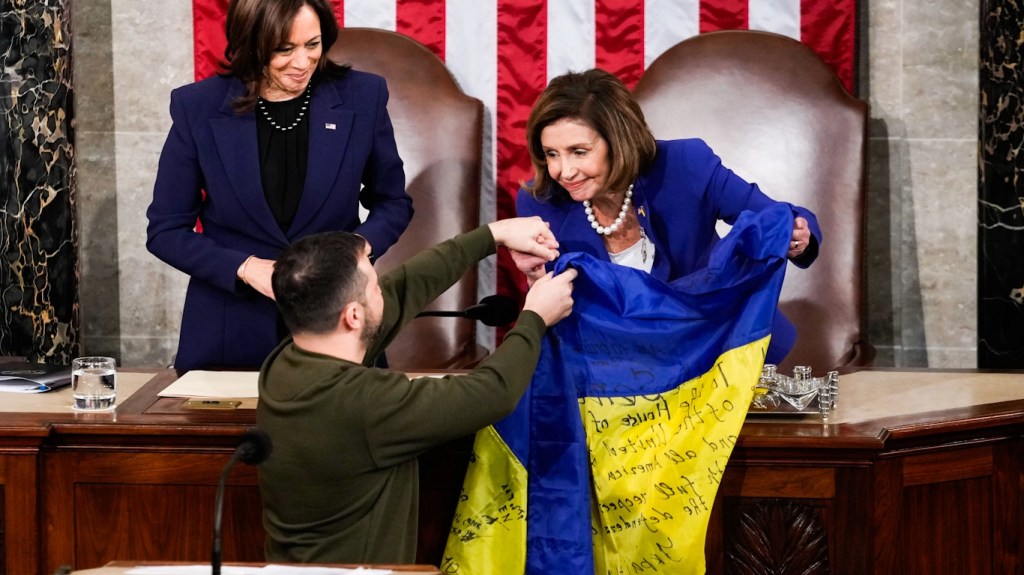
The Democrats position themselves as the party of virtue, cloaking their support for the war industry in moral language stretching back to Korea and Vietnam, when President Ngo Dinh Diem was as lionized as Ukrainian President Volodymyr Zelensky. All the wars they support and fund are “good” wars. All the enemies they fight, the latest being Russia’s Vladimir Putin and China’s Xi Jinping, are incarnations of evil. The photo of a beaming House Speaker Nancy Pelosi and Vice President Kamala Harris holding up a signed Ukrainian battle flag behind Zelensky as he addressed Congress was another example of the Democratic Party’s abject subservience to the war machine.

The Democrats, especially with the presidency of Bill Clinton, became shills not only for corporate America but for the weapons manufacturers and the Pentagon. No weapons system is too costly. No war, no matter how disastrous, goes unfunded. No military budget is too big, including the $858 billion in military spending allocated for the current fiscal year, an increase of $45 billion above what the Biden administration requested. 

The historian Arnold Toynbee cited unchecked militarism as the fatal disease of empires, arguing that they ultimately commit suicide. 

There once was a wing of the Democratic Party that questioned and stood up to the war industry: Senators J. William Fulbright, George McGovern, Gene McCarthy, Mike Gravel, William Proxmire and House member Dennis Kucinich. But that opposition evaporated along with the antiwar movement. When 30 members of the party’s progressive caucus recently issued a call for Biden to negotiate with Putin, they were forced by the party leadership and a warmongering media to back down and rescind their letter. Not that any of them, with the exception of Alexandria Ocasio-Cortez, have voted against the billions of dollars in weaponry sent to Ukraine or the bloated military budget. Rashida Tlaib voted present. 

The opposition to the perpetual funding of the war in Ukraine has come primarily from Republicans, 11 in the Senate and 57 in the House, several, such as Marjorie Taylor Greene, unhinged conspiracy theorists. Only nine Republicans in the House joined the Democrats in supporting the $1.7 trillion spending bill needed to prevent the government from shutting down, which included approval of $847 billion for the military — the total is boosted to $858 billion when factoring in accounts that don’t fall under the Armed Services committees’ jurisdiction. In the Senate, 29 Republicans opposed the spending bill. The Democrats, including nearly all 100 members of the House Congressional Progressive Caucus, lined up dutifully for endless war. 

This lust for war is dangerous, pushing us into a potential war with Russia and, perhaps later, with China — each a nuclear power. It is also economically ruinous. The monopolization of capital by the military has driven U.S. debt to over $30 trillion, $6 trillion more than the U.S. GDP of $24 trillion. Servicing this debt costs $300 billion a year. We spend more on the military than the next nine countries, including China and Russia, combined. Congress is also on track to provide an extra $21.7 billion to the Pentagon — above the already expanded annual budget — to resupply Ukraine.

“But those contracts are just the leading edge of what is shaping up to be a big new defense buildup,” The New York Times reported. “Military spending next year is on track to reach its highest level in inflation-adjusted terms since the peaks in the costs of the Iraq and Afghanistan wars between 2008 and 2011, and the second highest in inflation-adjusted terms since World War II — a level that is more than the budgets for the next 10 largest cabinet agencies combined.”

The Democratic Party, which, under the Clinton administration aggressively courted corporate donors, has surrendered its willingness to challenge, however tepidly, the war industry. 

“As soon as the Democratic Party made a determination, it could have been 35 or 40 years ago, that they were going to take corporate contributions, that wiped out any distinction between the two parties,” Dennis Kucinich said when I interviewed him on my show for The Real News Network. “Because in Washington, he or she who pays the piper plays the tune. That’s what’s happened. There isn’t that much of a difference in terms of the two parties when it comes to war.”

In his 1970 book “The Pentagon Propaganda Machine,” Fulbright describes how the Pentagon and the arms industry pour millions into shaping public opinion through public relations campaigns, Defense Department films, control over Hollywood and domination of the commercial media. Military analysts on cable news are universally former military and intelligence officials who sit on boards or work as consultants to defense industries, a fact they rarely disclose to the public. Barry R. McCaffrey, a retired four-star army general and military analyst for NBC News, was also an employee of Defense Solutions, a military sales and project management firm. He, like most of these shills for war, personally profited from the sales of the weapons systems and expansion of the wars in Iraq and Afghanistan.

On the eve of every congressional vote on the Pentagon budget, lobbyists from businesses tied to the war industry meet with Congress members and their staff to push them to vote for the budget to protect jobs in their district or state. This pressure, coupled with the mantra amplified by the media that opposition to profligate war funding is unpatriotic, keeps elected officials in bondage. These politicians also depend on the lavish donations from the weapons manufacturers to fund their campaigns.

Seymour Melman, in his book “Pentagon Capitalism,” documented the way militarized societies destroy their domestic economies. Billions are spent on the research and development of weapons systems while renewable energy technologies languish. Universities are flooded with military-related grants while they struggle to find money for environmental studies and the humanities. Bridges, roads, levees, rail, ports, electric grids, sewage treatment plants and drinking water infrastructures are structurally deficient and antiquated. Schools are in disrepair and lack sufficient teachers and staff. Unable to stem the COVID-19 pandemic, the for-profit health care industry forces families, including those with insurance, into bankruptcy. Domestic manufacturing, especially with the offshoring of jobs to China, Vietnam, Mexico and other nations, collapses. Families are drowning in personal debt, with 63 percent of Americans living paycheck to paycheck. The poor, the mentally ill, the sick and the unemployed are abandoned. 

Melman, who coined the term “permanent war economy,” noted that since the end of the Second World War, the federal government has spent more than half its discretionary budget on past, current and future military operations. It is the largest single sustaining activity of the government. The military-industrial establishment is nothing more than gilded corporate welfare. Military systems are sold before they are produced. Military industries are permitted to charge the federal government for huge cost overruns. Massive profits are guaranteed. For example, this November, the Army awarded Raytheon Technologies alone more than $2 billion in contracts, on top of over $190 million awarded in August, to deliver missile systems to expand or replenish weapons sent to Ukraine. Despite a depressed market for most other businesses, stock prices of Lockheed and Northrop Grumman have risen by more than 36 and 50 percent this year. 

Tech giants, including Amazon, which supplies surveillance and facial recognition software to the police and FBI, have been absorbed into the permanent war economy. Amazon, Google, Microsoft and Oracle were awarded multibillion-dollar cloud computing contracts for the Joint Warfighting Cloud Capability and are eligible to receive $9 billion in Pentagon contracts to provide the military with “globally available cloud services across all security domains and classification levels, from the strategic level to the tactical edge,” through mid-2028.

Foreign aid is given to countries such as Israel, with more than $150 billion in bilateral assistance since its founding in 1948, or Egypt, which has received over $80 billion since 1978 — aid that requires foreign governments to buy weapons systems from the U.S. The U.S. public funds the research, development and building of weapons systems and purchases them for foreign governments. Such a  circular system mocks the idea of a free-market economy. These weapons soon become obsolete and are replaced by updated and usually more costly weapons systems. It is, in economic terms, a dead end. It sustains nothing but the permanent war economy.

“The truth of the matter is that we’re in a heavily militarized society driven by greed, lust for profit, and wars are being created just to keep fueling that,” Kucinich told me.

In 2014, the U.S. backed a coup in Ukraine that installed a government that included neo-Nazis and was antagonistic to Russia. The coup triggered a civil war when the ethnic Russians in eastern Ukraine, the Donbass, sought to secede from the country, resulting in over 14,000 people dead and nearly 150,000 displaced, before Russia invaded in February. The Russian invasion of Ukraine, according to Jacques Baud, a former NATO security advisor who also worked for Swiss intelligence, was instigated by the escalation of Ukraine’s war on the Donbass. It also followed the Biden administration’s rejection of proposals sent by the Kremlin in late 2021, which might have averted Russia’s invasion the following year. 

This invasion has led to widespread U.S. and E.U. sanctions on Russia, which have boomeranged onto Europe. Inflation ravages Europe with the sharp curtailment of shipments of Russian oil and gas. Industry, especially in Germany, is crippled.  In most of Europe, it is a winter of shortages, spiraling prices and misery. 

“This whole thing is blowing up in the face of the West,” Kucinich warned. “We forced Russia to pivot to Asia, as well as Brazil, India, China, South Africa and Saudi Arabia. There’s a whole new world being formed. The catalyst of it is the misjudgment that occurred about Ukraine and the effort to try to control Ukraine in 2014 that most people aren’t aware of.”

By not opposing a Democratic Party whose primary business is war, liberals become the sterile, defeated dreamers in Fyodor Dostoevsky’s “Notes from the Underground.” 

A former convict, Dostoevsky did not fear evil. He feared a society that no longer had the moral fortitude to confront evil. And war, to steal a line from my latest book, is the greatest evil.