
Wonder Woman Is a Hero Only The Military-Industrial Complex Could Create

By Jonathan Cooke

Source: TruePublica

For a while I have been pondering whether to write a review of the newly released Wonder Woman, to peel back the layers of comic-book fun to reveal below the film’s disturbing and not-so-covert political and militaristic messages.

There is usually a noisy crowd who deride any such review with shouts of “Lighten up, it’s only a movie!” – as though popular culture is neither popular nor culture, the soundtrack to our lives that slowly shapes our assumptions and our values, and does so at a level we rarely examine critically.

My argument is that this much-praised Gal Gadot vehicle – seemingly about a peace-loving superhero, Wonder Woman, from the DC Comics stable – is actually carefully purposed propaganda, designed to force-feed aggressive western military intervention, dressed up as humanitarianism, to unsuspecting audiences.

In short, this is straight-up propaganda for the military-industrial complex. It would have looked and sounded identical had it been scripted by a joint team from the Pentagon and the Israel Defense Forces.

My reticence to review the film has lifted after reading the latest investigations of Tom Secker and Matthew Alford into the manifold ways the U.S. military and security services interfere in Hollywood, based on a release of 4,000 pages of documents under Freedom of Information requests.

In their new book National Security Cinema, the pair argue that the Pentagon, CIA and National Security Agency have meddled in the production of at least 800 major Hollywood movies and 1,000 TV titles. That is likely to be only the tip of the iceberg, as they concede:

“It is impossible to know exactly how widespread this military censorship of entertainment is because many files are still being withheld.”

They write that their book “details how U.S. government involvement also includes script rewrites on some of the biggest and most popular films, including James Bond, the Transformers franchise, and movies from the Marvel and DC cinematic universes.”

The need for Pentagon toys

This isn’t just about minor adjustments, but wholesale collusion between film-makers and the military: “If there are characters, action or dialogue that the DoD [Department of Defense] don’t approve of then the film-maker has to make changes to accommodate the military’s demands. If they refuse then the Pentagon packs up its toys and goes home. To obtain full cooperation the producers have to sign contracts — Production Assistance Agreements — which lock them into using a military-approved version of the script.”

The fact that script-writers, producers and directors on these mega-budget pictures know their film may never make it into production if it does not get a thumbs-up from the Pentagon inevitably influences the choice of subjects, the political and military premises of selected films, and the story lines.

One movie, Countermeasures, was ditched after the military objected to a script that “included references to the Iran-Contra scandal … Similarly Fields of Fire and Top Gun 2 were never made because they couldn’t obtain military support, again due to politically controversial aspects of the scripts.”

One can imagine just how stringent the conditions imposed by the Pentagon must be, if it felt compelled to reject a movie like Top Gun 2, the sequel to the “flyboys with toys” killing fest that starred a young Tom Cruise.

The two authors add: “The documents also record the pro-active nature of the military’s operations in Hollywood and that they are finding ways to get involved during the earliest stages of development, ‘when characters and storylines are most easily shaped to the Army’s benefit’.”

Bad apples, not bad institutions

In addition, film-makers are pressured into changing scripts that suggest institutional or systemic problems in the U.S. security agencies.

The two authors observe that producer Jerry Bruckheimer has admitted that the script of the film Enemy of the State was changed under pressure from the NSA so that the wrongdoings at the heart of the film would be the responsibility of a single individual, not the agency itself.

“This idea of using cinema to pin the blame for problems on isolated rogue agents or bad apples, thus avoiding any notion of systemic, institutional or criminal responsibility, is right out of the CIA/DOD’s playbook,” they observe.

So not only are movies critical of U.S. and western politics and militarism almost certain to be off-limits for a big-budget production, but that void is certain to be filled by film proposals the studio is confident will win approval from the Pentagon, CIA and NSA.

And this is, of course, on top of the fact that the Hollywood money-men are themselves part of a larger globalized financial elite that depends on the proceeds of the homeland security industry, arms manufacturers and war profiteers. These financiers are certain to prefer funding films that support a neoliberal worldview at home and a neoconservative policy of warmongering abroad.

As Secker and Alford conclude: “In societies already eager to use our hard power overseas, the shaping of our popular culture to promote a pro-war mindset must be taken seriously.

Gal Gadot and the IDF

All of this is the context for deciphering the egregious propaganda in favor of western military violence, and the portrayal of peace-seeking as “appeasement”, that is Wonder Woman.

There has been plenty of guffawing at Middle East countries, including Lebanon, for seeking to ban Wonder Woman because it stars Gal Gadot, an Israeli beauty queen turned actress.

In fact, it is understandable that the Lebanese might object to a film heavily promoting Gadot as the world’s savior, given that she served in the Israeli army, one that brutally occupied parts of their country for two decades, until 2000, and continues to maintain a belligerent occupation of the Palestinians.

But there is also an undeniable irony to Gadot playing an Amazonian goddess who opposes the militarism of men, and cannot bear to see the suffering of children in war, when in real life she publicly cheered on the Israeli army’s massive bombardment in 2014 of the imprisoned population of Gaza, which led to the killing of some 500 Palestinian children there.

But more importantly, it is not just that Gadot, a former IDF soldier, is now the face of Wonder Woman; it is that the film’s superhero character too almost perfectly embodies the shared militaristic values of the IDF and the Pentagon. If there is one film whose script suggests it was jointly engineered by the Pentagon and Israeli army, it is Wonder Woman.

Hillary Clinton as Wonder Woman?

The film is set near the end of the First World War, a cataclysmic confrontation between two colonial powers, Britain and Germany, each trying to assert its dominance in Europe. The film-makers blur their focus sufficiently to gloss over the problem that there were no good guys in that “war to end all wars”. Instead in true Hollywood fashion, the First World War is presented simply as a prelude (or prequel) to the Second World War and the rise of the Nazis.

The Germans are murderous villains, while the British are the flawed – until Gadot shows them the error of their ways – defenders of humanity. In fact, the film prefers to cast the anti-German side as “Allies”, the humane members of the world community, represented by the U.S. – Chris Pine is the male lead and Gadot’s love interest – and a ragtag support group that includes a Scot, a native American, and a generic Arab, presumably symbolizing “moderate” Arab states like Saudi Arabia, Egypt and Jordan.

The British leadership is trying to find ways to make peace and bring the war to an end, but is stymied by an evil presence. A German super-general, Erich Ludendorff (Danny Huston), believes he can win the war decisively by developing a horrifying gas that will wipe out men, women and children, forcing the British to surrender on his terms. To demonstrate his power, he tests the gas on innocent villagers on the front lines in Belgium.

All of this might sound disconcertingly familiar to anyone who has been following the western media-scripted coverage that has for several years now been trying to promote more aggressive “humanitarian intervention” in Syria – and before that, in Libya and Iraq.

Is Ludendorff supposed to be Bashar Assad, the evil Syrian president who – as long as we discount the dissenting voices of some experts – has twice used the chemical weapon sarin against innocent civilians?

Are the British leaders, seeking a peace deal with the Germans, supposed to be those “appeasers” in the West who have stood in the way of “intervention” in Syria, blocking no-fly zones and bombing runs that could bring down the Syrian government?

And in an even more disturbing, if now outdated, parallel, given the film’s insistent identity politics, is Wonder Woman – the Amazonian who brings peace through overpowering military violence – a stand-in for Hillary Clinton? When the movie was in production, the filmmakers must have assumed it would be released as Clinton was enjoying her early months in office as the first female U.S. president.

The use of Wonder Woman to justify Clinton’s well-documented blood lust–the woman who laughed as “our rebels” murderously sodomized Libya’s Col Gaddafi, saying: “We came, we saw, he died” – would have proved timely had the U.S. election turned out differently.

War is Peace, Ignorance is Strength

Those who have not seen the film, and take it seriously as entertainment, may wish to skip this section, which includes a significant spoiler.

The source of man’s evil in Wonder Woman is the only surviving Greek god, Ares, who is hiding somewhere in the human world. Wonder Woman believes she can end all war and human suffering only if she can locate Ares and kill him – before he kills her.

No one in the human world, of course, believes Wonder Woman, and foolishly they dismiss her ideas as lunacy. And for a while Wonder Woman makes a terrible mistake in thinking the German Ludendorff (Saddam / Gaddafi / Assad) is Ares. It is late in the film that she discovers she has been on the wrong scent.

Humankind’s ultimate enemy is not Ludendorff, but the kindly Sir Patrick Morgan (David Thewlis), the British leader who has spent the entire film counseling for negotiations and peace with the Germans.

The ultimate evil, the wolves in sheep’s clothing, Wonder Woman finds, are  those among us who preach fraternity, compassion and turning the other cheek. They make possible the killing of the innocents.

Those who appear to care, those who seem to offer a route out of bloodshed and war – those who defeat the aims and threaten the profits of the military-industrial complex – are in truth nothing more than appeasers. Their efforts are certain, even intended, to lead to greater suffering.

Militarism, superior firepower, and an absolute belief in the justness of one’s cause, as Wonder Woman is reminded by her Amazonian tutors during her childhood Krav Maga training (Gadot was herself an Israeli army combat trainer) are the way to save mankind from the evildoers.

There is no time to delay, to stand back, to question or to negotiate. Wonder Woman is outraged by the dithering of the men around her. She wants to be at the front line as soon as possible, to kick ass.

“War is peace, freedom is slavery, ignorance is strength” – and all of it is good for business, the film Wonder Woman concludes in truly Orwellian fashion.

A veneer of identity politics

Of course, this story – like all effective propaganda – is supposed to work its magic at a subconscious level, where it cannot be interrogated by our reason and our critical faculties. But even so, a few critics – themselves enthusiastic liberal interventionists – seem to have intuited the movie’s message.

Perhaps not surprisingly, a reviewer with the clearest sense of how the film panders to the pro-war sentiments and identity politics of many liberals is the film critic of the conservative Washington Free Beacon.

Sonny Bunch applauds the way the film “highlights the need for the strong to intervene on behalf of the weak and the oppressed, and treats as villains quislings who sue for a peace that will bring only more destruction.

But he also understands how the film has been crafted to make its war-mongering more palatable to liberals. Wonder Woman, he writes, proves “you could slap an identity politics veneer on just about any neoconservative policy and progressives would lap it up. … Liberal interventionism is back, baby!”

Drooling from liberals

And sure enough, the community of largely liberal film reviewers has mostly drooled over Wonder Woman. Despite dire acting from Gadot, preposterous dialogue and a risible screenplay, the film has racked up an astounding 92 percent approval rating from critics on the review aggregator website Rotten Tomatoes.

Here is a brief selection of their assessments:

Dana Stevens, of Slate: “This is a movie about battling evil that pauses to ask what evil is and whether it’s necessary to understand its nature in order to defeat it.”

Mick LaSalle, of the San Francisco Chronicle: “What lingers … is the feeling of hope that the movie brings, that it someday might be possible for female rationality to defeat male brutality.”

Richard Brody, of the New Yorker: Wonder Woman is “an entry in the genre of wisdom literature that shares hard-won insights and long-pondered paradoxes of the past with a sincere intimacy.”

A. O. Scott, of the New York Times: “Her sacred duty is to bring peace to the world. Accomplishing it requires a lot of killing, but that’s always the superhero paradox. … Unlike most of her male counterparts, its heroine is not trying to exorcise inner demons or work out messiah issues. She wants to function freely in the world, to help out when needed and to be respected for her abilities. No wonder she encounters so much resistance.”

The paradoxes of power

Wonder Woman grapples with the paradoxes of military power every American interventionist and Israeli patriot understands. To save the “beautiful children”, she must sometimes rush to intervene and kill with extreme prejudice, even if the other side’s children are among those who are sacrificed.

Wonder Woman wants to “function freely”: she must enjoy the right to go wherever her interests take her. She cannot be shackled by borders in her quest for justice. She is there to “help out” others in trouble, even if she alone gets to decide who needs help and what counts as trouble. And she needs “respect”, and is prepared to force others to accord it to her, through her superior strength if need be.

She will face “much resistance” because others are jealous of her power and her freedoms. They are the evildoers, and they must and will be defeated.

Is it any surprise that in the Hollywood-Pentagon-IDF world of Wonder Woman, the values of a female superhero sound exactly like those of the military men who run the West’s wars?

Now roll on “Wonder Woman 2: Time to Intervene (Humanely)”.
Why War? Building on the legacy of Einstein, Freud and Gandhi

By Robert J. Burrowes

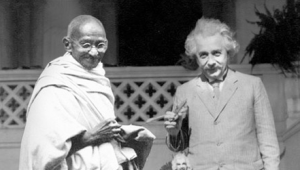
In 1932, Sigmund Freud and Albert Einstein conducted a correspondence subsequently published under the title ‘Why War?’ See ‘Why War: Einstein and Freud’s Little-Known Correspondence on Violence, Peace, and Human Nature’. In many ways, this dialogue between two giants of the 20th century is symbolic of the effort made by many humans to understand that perplexing and incredibly damaging feature of human experience: the institution of war.

In a recent article, the founder of peace research, Professor Johan Galtung, reminded us of the legacy of Freud and Einstein in this regard and reflected on their dialogue, noting some shortcomings including their failure to ‘unpack conflict’. See ‘Freud-Einstein on Peace’.

Of course, Freud and Einstein weren’t the first to consider the question ‘Why War?’ and their dialogue was preceded by a long sequence of individuals and even some organizations, such as the Women’s International League for Peace and Freedom and War Resisters’ International, who sought to understand, prevent and/or halt particular wars, or even to understand and end the institution itself, as exemplified by the Kellogg-Briand Pact in 1928 outlawing war. Moreover, given the failure of earlier initiatives, many individuals and organizations since Freud and Einstein have set out to understand, prevent and/or halt wars and these efforts have taken divergent forms.

Notable among these, Mohandas K. Gandhi was concerned to develop a mode of action to deal with many manifestations of violence and he dramatically developed, and shared, an understanding of how to apply nonviolence, which he labeled satyagraha (holding firmly to the truth), in overcoming large-scale violence and exploitation. He successfully applied his strategic understanding of nonviolence to the Indian independence struggle against British colonial rule. But while Gandhi was happy to acknowledge his debt to those who had gone before, he was not shy in proclaiming the importance of finding new ways forward: ‘If we are to make progress, we must not repeat history but make new history. We must add to the inheritance left by our ancestors.’

My own journey to understand human violence was caused by the death of my two uncles, Bob and Tom, in World War II, ten years before I was born. My childhood in the 1950s and 1960s is dotted with memories of my uncles, stimulated through such events as attending memorial services at the Shrine of Remembrance where their war service was outlined. See ‘My Brothers’ on my father’s website.

But by the early 1960s, courtesy of newspaper articles and photos, I had become aware of exploitation and starvation in Africa and elsewhere, and as a young university student in the early 1970s I was reading literature about environmental destruction. It wasn’t just war that was problematic; violence took many other forms too.

‘Why are human beings violent?’ I kept asking. Because I thought that this question must have been answered somewhere, I kept reading, including the work of Freud and Karl Marx as an undergraduate, but also the thoughts of many other scholars, such as Frantz Fanon, as well as anarchists, feminists and those writing from other perspectives which offered explanations of violence, whether direct, structural or otherwise.

By the early 1980s I had started to read Gandhi and I had begun to understand nonviolence, as Gandhi practised and explained it, with a depth that seemed to elude the activists I knew and even the scholars in the field that I read.

Separately from this, I was starting to gain a sense that the human mind was not something that could be understood well by viewing it primarily as an organ of thinking and that much of the literature and certainly most of the practitioners in the field of psychology and related fields, especially psychiatry, had failed to understand the emotional depth and complexity of the human mind and the implications of this for dealing with conflict and violence. In this sense, it was clear to me, few had understood, let alone been able to develop, Freud’s legacy. This is because the fundamental problem is about feeling (and, in relation to violence, particularly suppressed fear and anger). Let me explain why.

Violence is something that is usually identified as physical: it involves actions like hitting, punching and using weapons such as a gun. This is one of the types of violence, and probably the one now most often lamented, that is inflicted on indigenous peoples, women and people of colour, among others.

Separately from this, Gandhi also identified exploitation as violence and Galtung elaborated this concept with his notion of ‘structural violence’. Other forms of violence have been identified and they take many forms such as financial violence, cultural violence and ecological violence. But violence can be more subtle than any of these and, hence, much less visible. I have given two of these forms of violence the labels ‘invisible violence’ and ‘utterly invisible violence’. Tragically, ‘invisible violence’ and ‘utterly invisible violence’ are inflicted on us mercilessly from the day we are born. And, as a result, we are all terrorized.

So what are ‘invisible’ and ‘utterly invisible’ violence?

In essence, ‘invisible’ violence is the ‘little things’ we do every day, partly because we are just ‘too busy’. For example, when we do not allow time to listen to, and value, a child’s thoughts and feelings, the child learns to not listen to themSelf thus destroying their internal communication system.

When we do not let a child say what they want (or ignore them when they do), the child develops communication and behavioural dysfunctionalities as they keep trying to meet their own needs (which, as a basic survival strategy, they are genetically programmed to do). When we blame, condemn, insult, mock, embarrass, shame, humiliate, taunt, goad, guilt-trip, deceive, lie to, bribe, blackmail, moralize with and/or judge a child, we both undermine their sense of Self-worth and teach them to blame, condemn, insult, mock, embarrass, shame, humiliate, taunt, goad, guilt-trip, deceive, lie, bribe, blackmail, moralize and/or judge.

The fundamental outcome of being bombarded throughout their childhood by this ‘invisible’ violence is that the child is utterly overwhelmed by feelings of fear, pain, anger and sadness (among many others). However, parents, teachers and other adults also actively interfere with the expression of these feelings and the behavioural responses that are naturally generated by them and it is this ‘utterly invisible’ violence that explains why the dysfunctional behavioural outcomes actually occur.

For example, by ignoring a child when they express their feelings, by comforting, reassuring or distracting a child when they express their feelings, by laughing at or ridiculing their feelings, by terrorizing a child into not expressing their feelings (e.g. by screaming at them when they cry or get angry), and/or by violently controlling a behaviour that is generated by their feelings (e.g. by hitting them, restraining them or locking them into a room), the child has no choice but to unconsciously suppress their awareness of these feelings.

However, once a child has been terrorized into suppressing their awareness of their feelings (rather than being allowed to have their feelings and to act on them) the child has also unconsciously suppressed their awareness of the reality that caused these feelings. This has many outcomes that are disastrous for the individual, for society and for nature because the individual will now easily suppress their awareness of the feelings that would tell them how to act most functionally in any given circumstance and they will progressively acquire a phenomenal variety of dysfunctional behaviours, including many that are violent towards themselves, others and/or the Earth.

Moreover, this emotional (or psychological) damage will lead to a unique combination of violent behaviours in each case. And some of these individuals will gravitate to working in one of the social roles that specifically requires, or justifies, the use of ‘legitimized violence’, such as the violence carried out by police, prosecuting lawyers, magistrates and judges, as well as that inflicted by the military. Others, of course, will operate outside the realm of legitimized violence and be labelled as ‘criminals’.

But, you might be wondering, what is the link between what happens in childhood and war?

The answer is simply that perpetrators of violence, and those who collaborate with them, are created during childhood. And these perpetrators and collaborators are all terrified, self-hating and powerless – for much greater detail of the precise psychological characteristics of perpetrators of violence and their collaborators, see ‘Why Violence?’  and ‘Fearless Psychology and Fearful Psychology: Principles and Practice’ – and they go on to perform all of the key roles in creating, maintaining, equipping, staffing and legitimizing the institutions of war and in conducting it.

If it weren’t for the violence to which we are all mercilessly subjected throughout childhood, there would be no interest in violence or war of any kind. If we were raised without violence, we would be naturally peaceful and cooperative, content to spend our time seeking to achieve our own unique evolutionary potential and to nurture the journey of others as well as life itself, rather than just become another cog in someone else’s military (or other bureaucratic or corporate) machine.

If any of the above resonates with you, then I invite you to make ‘My Promise to Children’.

In addition, if further reducing the violence in our world appeals to you, then you are also welcome to consider participating in ‘The Flame Tree Project to Save Life on Earth’,  signing the online pledge of ‘The People’s Charter to Create a Nonviolent World’ and/or considering using the strategic framework on one or the other of these two websites for your campaign to end violence or war in one context or another: Nonviolent Campaign Strategy and Nonviolent Defense/Liberation Strategy.

A child is not born to make war. But if you inflict enough violence on a child, and destroy their capacity to become their own unique and powerful self, they will be terrorised into perceiving violence and war as their society wants them to be perceived. And violence and war, and the institutions that maintain them, will flourish.

If we want to end war, we must halt the adult war against children as a priority.


Biodata: Robert J. Burrowes has a lifetime commitment to understanding
and ending human violence. He has done extensive research since 1966 in
an effort to understand why human beings are violent and has been a
nonviolent activist since 1981. He is the author of ‘Why Violence?
His email address is flametree@riseup.net
and his website is at http://robertjburrowes.wordpress.com


Robert J. Burrowes
P.O. Box 68
Daylesford
Victoria 3460
Australia
Email: flametree@riseup.net

Websites:
Nonviolence Charter
Flame Tree Project to Save Life on Earth
‘Why Violence?’
Nonviolent Campaign Strategy
Nonviolent Defense/Liberation Strategy
Anita: Songs of Nonviolence
Robert Burrowes
Global Nonviolence Network

Now Just Five Men Own Almost as Much Wealth as Half the World’s Population

By Paul Buchheit

Source: CommonDreams

Last year it was 8 men, then down to 6, and now almost 5.

While Americans fixate on Trump, the super-rich are absconding with our wealth, and the plague of inequality continues to grow. An analysis of 2016 data found that the poorest five deciles of the world population own about $410 billion in total wealth. As of 06/08/17, the world’s richest five men owned over $400 billion in wealth. Thus, on average, each man owns nearly as much as 750 million people.

Why Do We Let a Few People Shift Great Portions of the World’s Wealth to Themselves? 

Most of the super-super-rich are Americans. We the American people created the Internet, developed and funded Artificial Intelligence, and built a massive transportation infrastructure, yet we let just a few individuals take almost all the credit, along with hundreds of billions of dollars.

Defenders of the out-of-control wealth gap insist that all is OK, because, after all, America is a ‘meritocracy’ in which the super-wealthy have ‘earned’ all they have. They heed the words of Warren Buffett: “The genius of the American economy, our emphasis on a meritocracy and a market system and a rule of law has enabled generation after generation to live better than their parents did.”

But it’s not a meritocracy. Children are no longer living better than their parents did. In the eight years since the recession the Wilshire Total Market valuation has more than TRIPLED, rising from a little over $8 trillion to nearly $25 trillion. The great majority of it has gone to the very richest Americans. In 2016 alone, the richest 1% effectively shifted nearly $4 trillion in wealth away from the rest of the nation to themselves, with nearly half of the wealth transfer ($1.94 trillion) coming from the nation’s poorest 90%—the middle and lower classes. That’s over $17,000 in housing and savings per lower-to-middle-class household lost to the super-rich.

A meritocracy? Bill Gates, Mark Zuckerberg, and Jeff Bezos have done little that wouldn’t have happened anyway. ALL modern U.S. technology started with—and to a great extent continues with—our tax dollars and our research institutes and our subsidies to corporations.

Why Do We Let Unqualified Rich People Tell Us How To Live? Especially Bill Gates! 

In 1975, at the age of 20, Bill Gates founded Microsoft with high school buddy Paul Allen. At the time Gary Kildall’s CP/M operating system was the industry standard. Even Gates’ company used it. But Kildall was an innovator, not a businessman, and when IBM came calling for an OS for the new IBM PC, his delays drove the big mainframe company to Gates. Even though the newly established Microsoft company couldn’t fill IBM’s needs, Gates and Allen saw an opportunity, and so they hurriedly bought the rights to another local company’s OS — which was based on Kildall’s CP/M system. Kildall wanted to sue, but intellectual property law for software had not yet been established. Kildall was a maker who got taken.

So Bill Gates took from others to become the richest man in the world. And now, because of his great wealth and the meritocracy myth, MANY PEOPLE LOOK TO HIM FOR SOLUTIONS IN VITAL AREAS OF HUMAN NEED, such as education and global food production.

—Gates on Education: He has promoted galvanic skin response monitors to measure the biological reactions of students, and the videotaping of teachers to evaluate their performances. About schools he said, “The best results have come in cities where the mayor is in charge of the school system. So you have one executive, and the school board isn’t as powerful.”

—Gates on Africa: With investments in or deals with MonsantoCargill, and Merck, Gates has demonstrated his preference for corporate control over poor countries deemed unable to help themselves. But no problem—according to Gates, “By 2035, there will be almost no poor countries left in the world.”

Warren Buffett: Demanding To Be Taxed at a Higher Rate (As Long As His Own Company Doesn’t Have To Pay) 

Warren Buffett has advocated for higher taxes on the rich and a reasonable estate tax. But his company Berkshire Hathaway has used “hypothetical amounts” to ‘pay’ its taxes while actually deferring $77 billion in real taxes.

Jeff Bezos: $50 Billion in Less Than Two Years, and Fighting Taxes All the Way 

Since the end of 2015 Jeff Bezos has accumulated enough wealth to cover the entire $50 billion U.S. housing budget, which serves five million Americans. Bezos, who has profited greatly from the Internet and the infrastructure built up over many years by many people with many of our tax dollars, has used tax havens and high-priced lobbyists to avoid the taxes owed by his company.

Mark Zuckerberg (6th Richest in World, 4th Richest in America) 

While Zuckerberg was developing his version of social networking at Harvard, Columbia University students Adam Goldberg and Wayne Ting built a system called Campus Network, which was much more sophisticated than the early versions of Facebook. But Zuckerberg had the Harvard name and better financial support. It was also alleged that Zuckerberg hacked into competitors’ computers to compromise user data.

Now with his billions he has created a ‘charitable’ foundation, which in reality is a tax-exempt limited liability company, leaving him free to make political donations or sell his holdings, all without paying taxes.

Everything has fallen into place for young Zuckerberg. Nothing left to do but run for president.

The False Promise of Philanthropy 

Many super-rich individuals have pledged the majority of their fortunes to philanthropic causes. That’s very generous, if they keep their promises. But that’s not really the point.

American billionaires all made their money because of the research and innovation and infrastructure that make up the foundation of our modern technologies. They have taken credit, along with their massive fortunes, for successes that derive from society rather than from a few individuals. It should not be any one person’s decision about the proper use of that wealth. Instead a significant portion of annual national wealth gains should be promised to education, housing, health research, and infrastructure. That is what Americans and their parents and grandparents have earned after a half-century of hard work and productivity.

Fake Everything — Confronting Our Ideological Hegemony

By Janet Phelan

Source: Activist Post

The recent invocation of “fake news”—notably being levied by those on both sides of the political fence—points to more than allegations of conspiratorial efforts to sway the opinions of John Q Public. What we are seeing emerge is a challenge to the very protoplasm in which we live.

News is history, present tense. As such, accurate news is foundational to understanding the world we live in and the forces that mold it. It only takes a brief immersion into the recording of recent historical events to realize that the history books do not provide a faithful and truthful record.

According to many history books, JFK was felled by a lone assassin, a disgruntled ex-military and Communist sympathizer named Lee Harvey Oswald.

Less than 25% of the American people believe this today.  A multiplicity of theories have sprung up in the wake of the Kennedy assassination; what can be agreed upon is that this event remains an open sore in the American psyche, unresolved and possibly unresolvable.

Foreknowledge surrounding the attack on Pearl Harbor, 9/11, the genesis of why we went to war in Iraq and, most currently, dispute as to who launched gas attacks in Syria (which seem to be impelling us towards war against Assad)—these pivotal events remain in dispute, while facile news reports, bleeding into the history books, provide inadequate answers to troubling questions as we march on towards an increasingly dim future.

If we cannot trust news and history, what can we trust?

Very little, as it turns out….

FAKE LAWS

The US’s legal system is nearly bullet proof, we are told. The separation of powers between the three branches of government ensures an independent judiciary, pivotal to the foundational promise of freedom and justice for all. I have harped enough in these pages over the years as to the weaponization of our legal system, which can be and is levied against targeted groups.

The reality is that there is no law, in terms of its equal application. And if there is no equal application, then what we have is not law but the naked exercise of power. The recent revelations that judges are laundering under the table bribes is only further evidence that we are living in a state of legal nullity.

FAKE HUMAN RIGHTS

Our much revered Constitutional protections are reflected in a number of international human rights treaties, most of which the US has refused to sign or ratify. On the rare occasion of US ratification, such as with the Convention Against Torture, we can see where the US has resorted to schizophrenic babble in her efforts to justify her behavior. Senator Tom Cotton’s recent declaration that “waterboarding is not torture,” which echoes previous assertions by President Bush, should have alerted us that the US intends to honor no international accords. Certainly not where human rights are involved.

The international human rights community has increasingly accommodated US imperatives here, morphing from an original mandate to political support of the oppression that it is tasked with addressing.

For example, let’s take a look at Front Line Defenders, an international Dublin based NGO whose website declares that “The mission of Front Line Defenders is to protect, defend, support, and act for and with human rights defenders whose lives and health are at risk because of their peaceful and legitimate activities.”

A review of FLD’s 230 open cases reads like a carefully vetted political tract. Third World journalists and human rights defenders in China, the Russian Federation and Iran top the list. There is not one single case involving a First World individual. Not one from the US, not one from Western Europe.

Perhaps such individuals have never seen the need to contact FDL, you wonder. The answer is a resounding NO. FDL refuses its services to Western journalists and human rights defenders.

FDL’s financial statements provide a clue to its political decision making of which human rights defenders it will assist and which it will throw to the lions. FDL admits to having received 2,535,982 Euros in government sponsorship in 2016, up from 2,351,474 in 2015. Public donations accounted for a mere 38,900 of last year’s income, which totaled 4,688,641 Euros. Its state sponsors include Norway, Ireland, Switzerland, Germany and the European Instrument for Democracy and Human Rights. Its corporate sponsors include George Soros’s Open Society Foundation and the Ford Foundation, among others.

Article19, the international press freedom NGO, also appears to be toeing the line in terms of trumpeting the causes of vetted Third World journalists. Article19 has admitted to getting funding from the US State Department and while it maintains offices in the Americas, it notably excludes US journalists at risk from its services or reports.

You may still not believe that Western journalists and human rights defenders may currently be at risk. These NGOs have done a very good job in keeping up that perception.

FAKE FOOD

We are not only living in a state of falseness. We are also eating it. The supermarket food is not only GMO-laden. It is also laced with carcinogens and Alzheimer’s inducing agents. This report from the venerable National Institutes of Health is ten years old but deserves to be revisited.

In the intervening decade, the push to contaminate otherwise healthy food, such as yogurt, with cancer inducing fake sugars, has only increased.

And if you thought that your brain was immune to chemical attack, this report should stop you in your tracks. As the so called age related diseases of dementia and Alzheimer’s are now occurring in younger populations, one might want to start asking why the push to chemicalize our bodies, our brains, our environment and our futures.

FAKE MEDICINE

That would be not only vaccines. Many so called beneficial medicines are now found to cause severe illness. Drug induced liver diseases, drug induced renal diseases, drug induced neurological and auto immune diseases—one wonders sometimes if the cure is worse than the illness. The pervasiveness of medically induced medical conditions has led Dr. Josh Axe to declare that “Conventional Medicine is the Leading Cause of Death.”

FAKE RELIGION

Somewhere in the Old Testament, between the Garden of Eden and Moses coming down from the mountain with those venerable tablets, a certain perception of man’s place in the universe got launched. Genesis declared the following: “And God said, Let us make man in our image, after our likeness: and let them have dominion over the fish of the sea, and over the fowl of the air, and over the cattle, and over all the earth, and over every creeping thing that creepeth upon the earth.” Man appears to have taken this to heart.

Dominionism. Manifest Destiny. The White Man’s Burden. Colonialism. Wars for Oil and Wars of Eugenics. All these speak to a mindset wherein man is allowed, no, entitled to assert his mastery over the earth and, if he has enough brute strength, over his fellows. The world view of humans living with, living among, not in ascendency over but in cooperation with, has largely fallen to the Biblical imperative of asserting control over and manipulation of an increasingly beleaguered planet.

Recent research points to the possibility of an entirely different reality than what we have assumed. In as yet unpublished research by Ana Willem, she writes that

The crux of the notion or argument pointing towards existence as a holographic reality, or that points to the Universe (or more correctly, Multiverse as per the work of Richard Amoroso and Elizabeth Rauscher in their book ‘The Holographic Anthropic Multiverse’) being a holographic reality, hinges on the physical and mathematical co-existence of different dimensions in which information or energy is shared or actedon in a way that it is transformed.

Willem goes on to write that

The point of departure for my work is the Mayan Calendar, and more specifically the ‘base’ Tzolkin calendar which is created using the numbers 13 and 20 to create a 260 day calendar grid. The calendar is assembled in a grid using the number 13 as the count of columns, and the number 20 as the count of rows. It is created by starting at the top-left cell of the grid, and counting to 13 as you move down the first column. When you hit the 14th row of the first column, you start counting over again at 1 as you continue to move first down, and then to the next column, and then down again, until you have counted to thirteen 20 times, and the 260 day grid is filled.

According to her,

Part of my work studies the various ways in which the Matrixes I am discovering diverge from the work on Toroidal Vortexes of Rothko and Powell. In addition, I found that the spliced grid created a numerical topology in which the inherent ‘scale’ of a given numerical matrix creates sections of coherent waves that cycle in between the harmonic topologies representing infinity and zero, changing polarity at each crest, and then cycling back. They occur only in specific sections of the spliced the matrix, and interweave like a family of related sine-like waves through one another in a way that resembles highways or streams. This is one way that the matrices I am studying are different than the ones being researched by Powell and Rothko. Much like the topologies being studied by Rothko and Powell, and being made into actual machines/products by Daniel Nunes), the phenomenology of what I have discovered acts very much like a machine.

The million dollar question, asserts Willem, is “what it means or how it specifically relates to the idea of a Holographic Anthropic Multiverse is not yet answered.”

If we are to survive this century, we will need to do more than drain the swamp. We will need to reassess not only the circumstances which bespeak profound efforts at deception by our leaders. We will also need to reassess our place in the universe, with humility and frankness. Our continued trumpeting that God is on our side, that we are in fact formed in His image—and by implication, His representative on this earth, has pushed us to the brink of apocalypse. If we are to survive ourselves, we must first recognize who we are—and who we are not.


Janet Phelan is an investigative journalist whose articles have appeared in the Los Angeles Times, The San Bernardino County Sentinel, The Santa Monica Daily Press, The Long Beach Press Telegram, Oui Magazine and other regional and national publications. Janet specializes in issues pertaining to legal corruption and addresses the heated subject of adult conservatorship, revealing shocking information about the relationships between courts and shady financial consultants. She also covers issues relating to international bioweapons treaties. Her poetry has been published in Gambit, Libera, Applezaba Review, Nausea One and other magazines. Her first book, The Hitler Poems, was published in 2005. She is also the author of a tell-all book EXILE, (also available as an ebook). She currently resides abroad.


Are We (Collectively) Depressed?

By Charles Hugh Smith

Source: Of Two Minds

We need to encourage honesty above optimism. Once we can speak honestly, there is a foundation for optimism.

Psychoanalysis teaches that one cause of depression is repressed anger.

The rising tide of collective anger is visible in many places: road rage, violent street clashes between groups seething for a fight, the destruction of friendships for holding the “incorrect” ideological views, and so on. I Think We Can Safely Say The American Culture War Has Been Taken As Far As It Can Go.

A coarsening of the entire social order is increasingly visible: The Age of Rudeness.

This raises a larger question: are we as a society becoming depressed as we repress our righteous anger and our sense of powerlessness as economic and social inequality rises?

Depression is a complex phenomenon, but it typically includes a loss of hope and vitality, absence of goals, the reinforcement of negative internal dialogs, and anhedonia, the loss of the joy of living (joie de vivre).

Depressive thoughts (and the emotions they generate) tend to be self-reinforcing, and this is why it’s so difficult to break out of depression once in its grip.

One part of the healing process is to expose the sources of anger that we are repressing. As psychiatrist Karen Horney explained in her 1950 masterwork, Neurosis and Human Growth: The Struggle Towards Self-Realization, anger at ourselves sometimes arises from our failure to live up to the many “shoulds” we’ve internalized, and the idealized track we’ve laid out for ourselves and our lives.

The recent article, The American Dream Is Killing Us does a good job of explaining how our failure to obtain the expected rewards of “doing all the right things” (getting a college degree, working hard, etc.) breeds resentment and despair.

Since we did the “right things,” the system “should” deliver the financial rewards and security we expected. This systemic failure to deliver the promised rewards is eroding social mobility and the social contract while generating frustration, anger, etc.

We are increasingly angry at the system, but we reserve some anger for ourselves, because the mass-media trumpets how well the economy is doing and how some people are doing extremely well. Naturally, we wonder, why them and not us? The failure is thus internalized.

One response to this sense that the system no longer works as advertised is to seek the relative comfort of echo chambers–places we can go to hear confirmation that this systemic stagnation is the opposing political party’s fault.

We don’t just self-sort ourselves into political “tribes” online–we congregate in increasingly segregated communities and states: The Simple Reason Why A Second American Civil War May Be Inevitable.

Americans are moving to communities that align more with their politics. Liberals are moving to liberal areas, and conservatives are moving to conservative communities. It’s been going on for decades. When Jimmy Carter was elected in 1976, 26.8% of Americans lived in landslide counties; that is counties where the president won or lost by 20% of the vote.

By 2004, 48.3% of the population lived in these counties. This trend continues to worsen. As Americans move to their preferred geographic bubbles, they face less exposure to opposing viewpoints, and their own opinions become more extreme. This trend is at the heart of why politics have become so polarizing in America.

We’re self-sorting at every level. Because of this, Americans are only going to grow more extreme in their beliefs, and see people on the other side of the political spectrum as more alien.”

Part of the American Exceptionalism we hear so much about is a can-do optimism: set your mind to it and everything is possible.

The failure to prosper as anticipated is generating a range of negative emotions that are “un-American”: complaining that you didn’t get a high-paying secure job despite having a college degree (or advanced degree) sounds like sour-grapes: the message is you didn’t work hard enough, you didn’t get the right diploma, etc.

It can’t be the system that’s failed, right? I discuss this in my book Why Our Status Quo Failed and Is Beyond Reform: the top 10% who are benefiting mightily dominate politics and the media, and their assumption is: the system is working great for me, so it must be working for everyone. That’s the implicit narrative parroted by status quo mouthpieces.

The inability to express our despair and anger generates depression. Some people will redouble their efforts, others will seek to lay the blame on “the other” (some external group) and others will give up. What few people will do is look at the sources of systemic injustice.

Perhaps we need a national dialog about declining expectations, rising inequality and the failure of the status quo that avoids the blame-game and the internalization trap (i.e. it’s your own fault you’re not well-off).

We need ways to express our resentment, anger, despair, etc. that are directed at the source, the complex system we inhabit, not “the other.” We need to encourage honesty above optimism. Once we can speak honestly, there is a foundation for optimism.


A Nonviolent Strategy to Defeat Genocide

Rohingya protesters gather in front of a United Nations regional office building to call for an end to the ongoing unrest and violence in Myanmar’s Rakhine State in Bangkok on June 11, 2012. AFP PHOTO/ Nicolas ASFOURI


By Robert J. Burrowes

It is a tragic measure of the depravity of human existence that genocide is a continuing and prevalent manifestation of violence in the international system, despite the effort following World War II to abolish it through negotiation, and then adoption and ratification of the 1948 ‘Genocide Convention‘.

According to the Genocide Convention, genocide is any act committed with the intent to destroy, in whole or in part, a national, ethnic, racial or religious group by killing members of the group, causing serious bodily or mental harm to members of the group, deliberately inflicting on the group conditions of life calculated to bring about its physical destruction in whole or in part, imposing measures intended to prevent births within the group and/or forcibly transferring children of the group to another group.

While this definition is contested because, for example, it excludes killing of political groups, and words such as ‘democide’ (the murder or intentionally reckless and depraved disregard for the life of any person or people by their government,) and ‘politicide’ (the murder of any person or people because of their political or ideological beliefs) have been suggested as complementary terms, in fact atrocities that have been characterized as ‘genocide’ by various authors include mass killings, mass deportations, politicides, democides, withholding of food and/or other necessities of life, death by deliberate exposure to invasive infectious disease agents or combinations of these. See ‘Genocides in history‘.

While genocide and attempts at genocide were prevalent enough both before World War II (just ask the world’s indigenous peoples) and then during World War II itself, which is why the issue attracted serious international attention in the war’s aftermath, it cannot be claimed that the outlawing of genocide did much to end the practice, as the record clearly demonstrates.

Moreover, given that the United Nations and national governments, out of supposed ‘deference’ to ‘state sovereignty’, have been notoriously unwilling and slow to meaningfully respond to genocides, as was the case in Rwanda in 1994 and has been the case with the Rohingya in Myanmar (Burma) for four decades – as carefully documented in ‘The Slow-Burning Genocide of Myanmar’s Rohingya‘ – there is little evidence to suggest that major actors in the international system have any significant commitment to ending the practice, either in individual cases or in general. For example, as official bodies of the world watch, solicit reports and debate whether or not the Rohingya are actually victims of genocide, this minority Muslim population clearly suffers from what many organizations and any decent human being have long labeled as such. For a sample of the vast literature on this subject, see ‘The 8 Stages of Genocide Against Burma’s Rohingya‘ and ‘Countdown to Annihilation: Genocide in Myanmar‘.

Of course, it is not difficult to understand institutional inaction. Despite its fine rhetoric and even legal provisions, the United Nations, acting in response to the political and corporate elites that control it, routinely fails to act to prevent or halt wars (despite a UN Charter and treaties, such as the Kellogg-Briand Pact, that empower and require it to do so), routinely fails to defend refugees, routinely fails to act decisively on issues (such as nuclear weapons and the climate catastrophe) that constitute global imperatives for human survival, and turns the other way when peoples under military occupation (such as those of Tibet, West Papua, Western Sahara and Palestine) seek their support.

Why then should those under genocidal assault expect supportive action from the UN or international community in general? The factors which drive these manifestations of violence serve a diverse range of geopolitical interests in each case, and are usually highly profitable into the bargain. What hope justice or even decency in such circumstances?

Moreover, the deep psychological imperatives that drive the phenomenal violence in the international system are readily nominated: in essence, phenomenal fear, self-hatred and powerlessness. These psychological characteristics, together with the others that drive the behaviour of perpetrators of violence, have been identified and explained – see ‘Why Violence?‘ and ‘Fearless Psychology and Fearful Psychology: Principles and Practice‘ – but it is the way these (unconsciously and deeply-suppressed) emotions are projected that is critical to understanding the violent (and insane) behavioural outcomes in our world. For brief explanations see, for example, ‘Understanding Self-Hatred in World Affairs‘ and ‘The Global Elite is Insane‘.

Given the deep psychological imperatives that drive the violence of global geopolitics and corporate exploitation (as well as national, subnational and individual acts of violence), we cannot expect a compassionate and effective institutional response to genocide in the prevailing institutional order, as the record demonstrates. So, is there anything a targeted population can do to resist a genocidal assault?

Fortunately, there is a great deal that a targeted population can do. The most effective response is to develop and implement a comprehensive nonviolent strategy to either prevent a genocidal assault in the first place or to halt it once it has begun. This is done most effectively by using a sound strategic framework that guides the comprehensive planning of the strategy. Obviously, there is no point designing a strategy that is incomplete or cannot be successful.

A sound strategic framework enables us to think and plan strategically so that once our strategy has been elaborated, it can be widely shared and clearly understood by everyone involved. It also means that nonviolent actions can then be implemented because they are known to have strategic utility and that precise utility is understood in advance.

There is little point taking action at random, especially if our opponent is powerful and committed (even if that ‘commitment’ is insane which, as briefly noted above, is invariably the case). There is a simple diagram presenting a 12-point strategic framework illustrated here in the form of the ‘Nonviolent Strategy Wheel‘.

In order to think strategically about nonviolently defending against a genocidal assault, a clearly defined political purpose is needed; that is, a simple summary statement of ‘what you want’. In general terms, this might be stated thus: To defend the [nominated group] against the genocidal assault and establish the conditions for the group to live in peace, free of violence and exploitation.

Once the political purpose has been defined, the two strategic aims (‘how you get what you want’) of the strategy acquire their meaning. These two strategic aims (which are always the same whatever the political purpose) are as follows: 1. To increase support for the struggle to defeat the genocidal assault by developing a network of groups who can assist you. 2. To alter the will and undermine the power of those groups inciting, facilitating, organizing and conducting the genocide.

While the two strategic aims are always the same, they are achieved via a series of intermediate strategic goals which are always specific to each struggle. I have identified a generalized set of 48 strategic goals that would be appropriate in the context of ending any genocide here. These strategic goals can be readily modified to the circumstances of each particular instance of genocide.

Many of these strategic goals would usually be tackled by action groups working in solidarity with the affected population campaigning in third-party countries. Of course, individual activist groups would usually accept responsibility for focusing their work on achieving just one or a few of the strategic goals (which is why any single campaign within the overall strategy is readily manageable).

As I hope is apparent, the two strategic aims are achieved via a series of intermediate strategic goals.

Not all of the strategic goals will need to be achieved for the strategy to be successful but each goal is focused in such a way that its achievement will functionally undermine the power of those conducting the genocide.

It is the responsibility of the struggle’s strategic leadership to ensure that each of the strategic goals, which should be identified and prioritized according to their precise understanding of the circumstances in the country where the genocide is occurring, is being addressed (or to prioritize if resource limitations require this).

I wish to emphasize that I have only briefly discussed two aspects of a comprehensive strategy for ending a genocide: its political purpose and its two strategic aims (with its many subsidiary strategic goals). For the strategy to be effective, all twelve components of the strategy should be planned (and then implemented). See Nonviolent Defense/Liberation Strategy.

This will require, for example, that tactics that will achieve the strategic goals must be carefully chosen and implemented bearing in mind the vital distinction between the political objective and strategic goal of any such tactic. See ‘The Political Objective and Strategic Goal of Nonviolent Actions‘.

It is not difficult to nonviolently defend a targeted population against genocide. Vitally, however, it requires a leadership that can develop a sound strategy so that people are mobilized and deployed effectively.


Biodata: Robert J. Burrowes has a lifetime commitment to understanding
and ending human violence. He has done extensive research since 1966 in
an effort to understand why human beings are violent and has been a
nonviolent activist since 1981. He is the author of ‘Why Violence?
His email address is flametree@riseup.net
and his website is at http://robertjburrowes.wordpress.com


Robert J. Burrowes
P.O. Box 68
Daylesford
Victoria 3460
Australia
Email: flametree@riseup.net

Websites:
Nonviolence Charter
Flame Tree Project to Save Life on Earth
‘Why Violence?’
Nonviolent Campaign Strategy
Nonviolent Defense/Liberation Strategy
Anita: Songs of Nonviolence
Robert Burrowes
Global Nonviolence Network

How Fear of Russia Misleads Americans

NSA whistleblower Thomas Drake sees grave dangers in the U.S. government and media exaggerating foreign threats as a means to mislead and control the American public, reports Dennis J Bernstein.

By Dennis J Bernstein

Source: Consortium News

Russia has been made “the go-to scapegoat” for distracting Americans from the serious problems afflicting the U.S. government, says Thomas Drake, a former senior executive at the National Security Agency who blew the whistle on multi-billion-dollar waste and violations of the rights of citizens through secret mass surveillance programs after 9/11.

As retaliation, the Obama Administration indicted Drake in 2010 as the first whistleblower since Daniel Ellsberg charged with espionage, carrying a possible 35-year prison term. However, in 2011, the government’s case against him collapsed and he went free in a plea deal. He became the recipient of the 2011 Ridenhour Truth-Telling Prize.

I sat down with Thomas Drake on June 3, 2017, at the home of ConsortiumNews editor Robert Parry in Arlington, Virginia, on the occasion of the awarding of the 2016 Gary Webb Freedom of the Press Award to Oliver Stone.

Dennis Bernstein: I want to ask you about a story. ConsortiumNews has offered quite a different perspective on the relationship between the U.S. government and Russia [questioning the allegations about] Trump collaborating with Putin. What’s your take on this story? Do you think that ConsortiumNews is onto something in terms of really questioning that whole line?

Thomas Drake: Yes. This hyperbolic narrative that is posited almost to the point of hysteria. They would say that Russians are behind everything. “It’s all the Russians’ fault and you can blame Russia.” It’s just pure political pretension and there is a significant amount of propaganda behind it.

It’s intended to distract. It’s intended to keep people from really looking at some of the deeper truths of our own government and so it is very convenient for the political elites, on both sides of what has become the Democratic/Republican divide, which in fact is not a divide; it’s two sides of the same coin, with slightly different narrative – to project all the blame on Russia and particularly the hyper-conflation of the littlest thing that would appear to be that Trump is ruining the country or Trump is the worst thing that has ever happened. Just really taking this
way, way beyond the pale.

And ConsortiumNews — having written for ConsortiumNews going back several years now as a result of my case and mass domestic surveillance and government abuse of power — is one of the few – it’s surreal for me to say this right now – it’s one of the few alternative media outlets who have the courage to stand up to the elite narrative and get behind this hyper-partisan politicization of blaming it all on external entities.

And, in this case, Russia has become the go-to scapegoat, frankly. And it’s easy to simply focus on that as your excuse without having to concern yourself with the deeper trends in terms of the darker history of American politics.

And Gary Webb – I am quite familiar with his case. Remember he had his own profession turn on him because they wanted to curry favor with power and they wanted to have access to power. So it was full access press and power is an aphrodisiac. Henry Kissinger said that. …

DB: Access press, as in, if you don’t say the right thing […] they can toss you into prison.

TD: Yep, precisely. And so you’re willing to overlook what may be done under the cover or blanket of government, the government structure. And so ConsortiumNews is one of the few. …

I was sort of the pre-Snowden Snowden. …

DB: He cites you for opening that door….

TD: Well, he has said there wouldn’t have been him without me. And he has cited a number of people who have preceded him, right? And I was there at the foundation, at this extraordinary willful violation of, in secret, of what I call the subversion of the Constitution. Really, it was a silent coup against the Constitution….

DB: What are the multiple dangers of the way in which information is used now, and slanted to support policy as opposed to inform?

TD: Well, it’s self-interest. It’s largely self-interest driven. You have, what I have sometimes called Gov-Corp, which is a combination of government and corporations and it’s an extraordinarily pathological relationship because they feed on each other. One protects the other and when you have the government corrupting itself to serve very powerful interests at the expense of public interests, guess what? Something has to give and what gives is public transparency. What gives is accountability. What gives is responsible power. What gives is the promise. What gives is “we the people”, right?

Power just… generally at least, power is about the people and it’s pathological, and so unfortunately the checks and balances that have in the past – Ellsberg is eyewitness to this — he’s certainly a key person by simply standing up with his colleague Edgar Russo, standing up to power in terms of the bright and shiny light called Vietnam, right? He clearly brought into the public purview what was really going on with Vietnam and, ultimately, as we know, I was a very young teen growing up in the ’70s. He was already in his early 40s at the time. That, yeah, the government can use power… and that, yeah, power does tend to corrupt. Lord Acton was right.

So, what became known as the imperial presidency of Nixon, this era makes that era look like a hyper type of person, especially post-9/11. It’s just extremely concerning. It’s what I would call the devolution of democracy and constitutional rights following 9/11 and Ellsberg has said and I have said, what was actually unlawful and unconstitutional has been made legal from his time.

And the old, what became the infamous statement made by Nixon, “You know, if the President says it’s okay, it’s not illegal.” I heard almost those exact same words when I confronted the lead attorney in the Office of General Counsel. That was the first week in October 2001. I had already found out about the massive domestic surveillance program that had been unleashed. And I confronted him and he said, “This is great. The White House has approved the program. It’s all legal.” …. The hairs on the back of my neck were like…. I’m having major flashbacks… Wait a minute, just because the White House approves it, it makes it okay? I mean, history is not kind. He says,” Yep, we’re the executive agent – all approved. Yes. Don’t ask any more questions.”

So, because the White House approved it, then it’s okay to violate the Constitution. All those checks were put in place as a result of the … president resigning, the standing committees and intelligence House and the Senate, the Foreign Intelligence Surveillance Act and a whole lot of others, right? So that was the check and balance, right? Nah, just, hey 9/11, the failure of the government to provide the common defense. 3,000 people murdered that day. It should never have happened. It really should never have happened. And so we are going to use that as sort of a reverse false flag. We’re going to use that as an excuse, because, “Hey, after all, the Constitution is not a suicide pact… you know, we don’t know where the enemy is.”

So just this weird, everything is existential now. We now know how the enemy is because of 9/11. And so it’s weird for me, having been brought up as a very young lad during the Cold War and remembering alarms going off and they’d turn off the lights and block the hall and face your lockers, right? The air raid sign drills and fears of the nuclear winter. It’s like these people want a World War 2.0.

We have far more in common with the Russians than we don’t. We have far in common than our own disputes. I assume there are some differences, right? I recognize, I am well aware, in terms of historical notes, but hey we have far more in common than we have difference.

DB: I guess what we all have in common is the state of the Earth at this point.

TD: The state of the Earth? We are the third rock from the sun. I mean, this is our home. The world is a much smaller place, in part because of technology and in part because we find out that, yeah, we really are dependent on each other.

And yet there is this addiction to conflict. There is this addiction to have threats. There is this addiction to divide. And this is not pretty. I mean, human history, the dark side of human history, and if the 20th century is not an optic lesson, then I don’t know what is….. I could go back to any of the others, in terms of written history that we know of, right? And yet here we are. And so, to me it is a sign of an empire….

The U.S. is an empire… and it is a sign of an empire that is losing it. And so, just like the Roman Empire, I mean, if you go back to the rise and fall of the Roman Empire, you know…. Those who don’t learn the lessons of the past are doomed to repeat them.

DB: Well, and the beat goes on. We’re going to let you join the party.

TD: The beat does go on. Yeah.

DB: But as we speak, there’s a major bombing, frightening bombing in Iran today.

TD: I did not know that. Wow.

DB: After the President of the United States is in Saudi Arabia. When is the last time you heard of a major suicide bomb in Iran?

TD: Not in Iran, no.

DB: So, here we go and who knows what comes next, who know what that’s going to bring in that part of the world. We thank you for all of your courage and all the suffering you did for all of us so we could know more. Thank you very much.

TD: Yeah. No. I have really become a warrior for peace. That’s what I have become. Ultimately it’s about who we are as human beings and who we are for each other and after all it is us, right? And in terms of U.S. culture and background, I think Pogo was right. We have met the enemy and the enemy is us. We are our own worst enemies.

It’s just that, for some of us, it’s critical to hold power accountable. We recognize we don’t govern ourselves very well. If you put people over others, yeah, bad things happen. But bad things tend to happen. And it’s that whole control, power. It’s all about — psychopathy is an area of study that I increasingly have as an issue, because of this idea that people gaining pleasure from the distress of others. So, it’s a disease. It really is. And some of us, at great sacrifice, weren’t going to just sit idly by and watch it all happen.

I care deeply about who we are as human beings. And I’ve spent a lot of time in front of college students and high school students and civic auditoriums and small group settings and churches and college campuses talking about these things. These are things that matter.https://consortiumnews.com/2017/06/20/how-fear-of-russia-misleads-americans/

Escaping the iron cage of hopelessness

By Edward Curtin

Source: Intrepid Report

“Specialists without spirit, sensualists without heart; this nullity imagines that it has attained a level of civilization never before achieved”—Max Weber, The Protestant Ethic and the Spirit of Capitalism

“In this frightful round of unchecked means, nobody knows any longer where they are going, purposes are forgotten, and ends are overtaken. Human beings have set off at astronomically high speeds toward nowhere.”—Jacques Ellul, Presence in the Modern World

In a previous article, I argued that those who think science can solve our major social problems—in particular, world destruction with nuclear weapons and the poisoning of the earth’s ecology and atmosphere—were delusional and in the grip of the myth of science and technology. These problems were created by science when it became untethered from any sense of limits in its embrace of instrumental rationality. Once it became wedded to usefulness and the efficiency of technical means, it lost its original aim: the search for truth. (Obviously this doesn’t include all scientists.) In embracing means as ends, it produced an endless loop of means justifying means that has resulted in what Weber called an “iron cage.” Concomitantly, the ideology of pure objectivity and impartial innocence was joined to elite state power and the capitalist profit motive where it was supported and instantaneously and completely applied to technical applications, including nuclear, biological, chemical and “conventional” weapons; bio-engineering; GMO foods and people; eugenics and cloning; and chemical/oil production, etc. It is indisputable that if our planet is incinerated or slowly destroyed through toxic pollution that modern science with its Faustian “prohibition to prohibit” will stand indicted, if anyone is left to make the case.

Albert Camus warned us long ago:

And even though we do it in diverse ways, we extol one thing and one alone: a future world in which reason will reign supreme. In our madness, we push back the eternal limits, and at once dark Furies swoop down upon us to destroy. Nemesis, goddess of moderation, not of vengeance, is watching. She chastises, ruthlessly, all those who go beyond the limit.

Ostensibly rational, the illogical logic of modern science has resulted in a mystifying double-bind that denies human freedom and leads to widespread despair and hopelessness. Many people feel trapped by this deterministic ethos, while others fail to see that the cause of our problems can’t be their solutions.

In this essay, I will explore the possibility of a path out of the seeming impossibility of escaping the cul-de-sac of our spiritually disinherited and disenchanted condition.

Max Weber argued that modern rational capitalism was informed by a religious impetus of inner-directed worldly asceticism derived from Protestant Christianity. In essence, modern capitalism was a religion. Likewise, modern mainstream science, despite the discoveries of quantum physics, rests upon a materialistic presupposition that is a self-contradictory act of faith that it denies to others. Committed to determinism, this materialistic scientific world view offers no basis for its truth claim since what is determined cannot be disputed when it wasn’t freely chosen. To espouse a position that was predetermined is to choose nothing. In essence, such science is also a religion that, like capitalism, serves no end but its own regeneration.

Is it any wonder that so many people feel trapped on an endless merry-go-round that contradicts their felt experience and their hopes for a better world? They look around and see a mad world of war and lies and science run amok. The physical scientists tell them that everything started with a bang and will end with a bang or a whimper of one sort or another and that’s how it goes since when did people so puny think they were anything but specks in a vast cosmos of meaningless gas that will devour them in a few billion years, give or take a year or so. The psych folks tell them they are the products of their brain chemicals and neurotransmitters and must submit “freely” to chemical treatment if they know what’s good for them and want to be happy. The social scientists insist that all knowledge is socially conditioned and relative and therefore everything they think and feel is also relative and so they are lost souls forever wandering in a world of relativity where true wisdom is impossible and the difference between right and wrong is a relative choice that has no basis in any “reality.” And of course the power elites and media play with their minds in endless games of mind control as they insist the only real truth comes through screens that they control. Mind and body warped, so many people stumble through their days like the living dead in search of some exit from their pain and confusion.

Or to say it differently. Science—both physical and social—has resulted in the systemization of doubt and the embrace of the relativity of thought and knowledge. The modern predicament is such that whereas in former times people felt that their knowledge was fact or truth and that it was grounded in a physically palpable reality, we have been exposed to systematic doubt and the suspicion has grown that all the various standpoints are limited and “relative.” While not consciously espoused by the majority of people, this doubting worldview permeates social life as a vague insecurity and uncertainty. It may be left to intellectuals to circulate such relativizing ideas, but they have become part of the cultural air we breathe. For people today in a scientifically based society, faced with the relativizing of all knowledge and every eternal verity, the question of how to understand their deaths, and thus their lives, has become acutely problematic. Uncertainty has undermined people’s wills as they have forgotten they are free.

The question that modernity forces us to ask is this: once knowledge is seen to be relative; old cosmologies are transformed by science; symbol systems and religions are seen as the products of humans’ own creativity; reality is understood to be socially constructed; once these developments take place consciously and unconsciously, how then can people understand their lives and deaths and find the confidence to live in peace and harmony with the earth and all living creatures?

Tolstoy put it this way:

Science is meaningless because it gives no answer to our question, the only question important for us: ‘What shall we do and how shall we live?’

In order to make our way out of this maze, we might contemplate the underlying presupposition that “everything is relative.” That, of course is an absurd position. Everything can’t be relative when the statement “everything is relative” is an absolute statement. Joined to that, one can muse on the self-contradiction of materialistic determinism and perhaps glimpse an escape from the iron cage, the prison, the closed room, the garbage pail, or the no-exit—so many terms that our best writers have used to describe the modern condition.

Rudolf Steiner did that as follows in The Philosophy of Freedom:

Materialism can never offer a satisfactory explanation of the world. For every attempt at an explanation must begin with the formation of thoughts about the phenomena of the world. Materialism, thus, begins with the thought of Matter or material processes. But, in doing so, it is ipso facto confronted by two different sets of facts, viz., the material world and the thought about it. The materialist seeks to make these latter intelligible by regarding them as purely material processes. He believe that thinking takes place in the brain, much in the same way that digestion takes place in the animal organs. Just as he ascribes mechanical, chemical, and organic processes to Nature, so he credits her in certain circumstances with the capacity to think. He overlooks that, in doing so, he is merely shifting the problem from one place to another. Instead of to himself he ascribes the power of thought to Matter. And thus he is back again at his starting-point. How does Matter come to think of its own nature?

But these are intellectual exercises and are therefore probably not very helpful to the average person.

Tolstoy maintained that for the modern person death had no meaning because civilization was based on progress—an ‘infinite’ progress—which according to its own internal logic should never come to an end.

On this road of progressiveness everything is provisional and indefinite and so individual death seems like a failure and meaningless because it marks an end. But what then, asked Tolstoy, is the meaning to our lives? Are they meaningless means to meaningless ends?

Materialistic science can only answer in the affirmative. A negative affirmative. But for most people this doesn’t satisfy. They sense the truth that we live by faith—scientists do, religious believers do, atheists do, agnostics do, everyone does—faith is the water we swim in; it is our element. It is what impels us to get out of bed in the morning. But getting out of bed in the morning is a choice, a judgment. It is not inevitable. We do it in faith that the day will be meaningful and worth meeting. We encounter others in good faith and hope they do the same with us. This awareness of the faith dimension of life is a daily human experience that points beyond itself and is a source of hope, even when confusion reigns. While modern science and philosophy have largely attempted to treat all things, including people, as objects to be controlled by subjects, most people encounter others in daily life not as Its, as in Buber’s I-It, but as Thous, as in I-Thou.

Where have I come from? Why am I here? Where am I going? These are life’s basic questions that science answers with nowhere, no reason, and nowhere in that order. Such answers are attestations of a faith in nothing, what is usually called nihilism.

The psychiatrist R.D. Laing maintained that the key to a sane world is for people to truly regain experiencing their experience and not to make-believe. He felt that most people had become estranged from the roots of their being. He put it thus:

The condition of alienation, of being asleep, of being unconscious, of being out of one’s mind, is the condition of the normal man. Society highly values its normal man. It educates children to lose themselves and to become absurd, and thus to be normal. Normal men have killed perhaps 100,000,000 of their fellow normal men in the last fifty years. Our behavior is a function of our experience. We act according to the way we see things. If our experience is destroyed, our behavior will be destructive. If our experience is destroyed, we have lost our own selves. . . . There is everything to suggest that man experienced God. Faith was never a matter of believing. He existed, but of trusting, in the presence that was experienced and known to exist as a self-validating datum. It seems likely that far more people in our time experience neither the presence of God, nor the presence of his absence, but the absence of his presence. . . . The fountain has not played itself out, the frame still shines, the river still flows, the spring still bubbles forth, the light has not faded. But between us and IT, there is a veil which is more like fifty feet of solid concrete. Deus absconditus. Or we have absconded.

So what can we do to break through this mystification of experience that has resulted in a double-bind that has trapped us?

I say nothing, at first. We are so busy doing and thinking our doing is the solution to our problems. We must stop the world we know by first not doing and by simply being in the presence of Being. We must develop a contemplative discipline of allowing the awareness of our egocentric thinking to reveal to us the arrogance of our confused belief that we can coerce others and the natural world to do our bidding and that every problem has a solution. The grotesqueness of nuclear weapons is the physical manifestation of that willfulness. For the magician, the applied scientist, and the technologist all wish to conquer reality with techniques from the outside rather than being open to the truths that Reality (that we are in and is us and that goes by different names—Being, the Tao, Logos—all names for the unnameable) might reveal to us.

“To ‘know’ reality,” writes Alan Watts, “you cannot stand outside it and define it; you must enter into it, be it, feel it.” So the first thing we must “do” is to do nothing so we may heal our divided minds; otherwise we are spinning in a vicious circle, “like everything else which the divided mind attempts.”

This seems self-evident to me and “doing” this should be our first “act” of dissent—our break-out (by breaking in)—from the reigning consensus that underlies the violent and sick condition of the world today. James Douglass, author of the ground-breaking book, JFK and the Unspeakable, says this perfectly in Lightning East to West: Jesus, Gandhi, and the Nuclear Age:

What we know ‘out there’ as the most resistant evil reality to be transformed, is in reality “in here” in its primary being. The precise nature of that correspondence, or identity, between inner and outer worlds is the mystery which Jung was attempting to describe with his theory of Synchronicity, whereby outer events can be increasingly recognized as unifying correlations of a profoundly traveled inner way. Once we begin to see this profound interpenetration of inner and outer worlds in a oneness of reality, the insoluble enigma of the world of evil gives way to the edge of the unifying mystery of Oneness, or of Love, a mystery that we cannot fully understand but which we can in fact move into with our lives and participate in to the extent of experiencing an ever-more-united world in Reality.

I think if we can see the big picture by “doing nothing,” we will have taken a major step toward a solution, or at the least an insight into how we can act to resist the evil that is occurring in the world.

“Seeing through” is to diagnose—dia, through + gignoskein, to know, perceive—which can allow us to see through to the roots of world problems. Without a deep comprehension of the causes of these problems, and how so many of our solutions have failed because they are based on false premises, we will get nowhere.

“The way one sees through the situation changes the situation,” writes Laing. Then, “as soon as we convey in any way . . . what we see or think we see, some change is occurring even in the most rigid situation.”

I think we can agree that we are in a “most rigid situation” as the nuclear weapons await discharge, countries and people are destroyed by U. S. war-making, the environment is poisoned, elite capitalist crooks line their pockets at the expense of everyone else, etc. Many of us convey this again and again, seemingly to no avail. Perhaps this is because we are missing the forest for the trees in our understandable haste to remedy it all. I suspect this is so and scatter these thoughts like breadcrumbs in the hope they may suggest a way home. “Conveying” my thought experiments in the hope “some” change occurs in the process. First, in me.

The word spiritual has acquired a bad name with its embrace by New-Agers et al. with its association with magic and out of the world mumbo-jumbo. So I use it reservedly. But if we look to those so many hold in such high regard for their fight against violence and injustice—e.g. Gandhi and Martin Luther King Jr., to name but two—it is apparent that their “truth-force” and “non-violent resistance” were rooted in a spiritual understanding of the human condition. We don’t need to get caught up in words, for they have a way of missing the truth. Gandhi said God was truth and truth was God. King equated God with love. Truth, God, Love—do the words matter? Did not these men grasp the deepest dimensions of our problems? Didn’t they understand the root causes of hate and violence? Didn’t they see the Tao? Didn’t they see that the way we conceive existence through our deterministic and instrumental sciences is a reflection of our violent world? Didn’t they realize that we can’t force change on anyone from the outside without doing violence and that the only way forward is to move the world through love and truthful resistance? Didn’t they tell us that freedom is our birthright and is indivisible, and when you deny existential freedom you are lost in despair?

Despite the question marks, these are rhetorical questions. Don’t our deepest experiences confirm their truth?

Let me end with James Douglass’s words, for it seems to me they ring true, despite being far outside the reigning scientific paradigm and “common sense.”

Is there a spiritual reality, inconceivable to us today, which corresponds in history to the physical reality which Einstein discovered and which led to the atomic bomb? Einstein discovered a law of physical change: the way to convert a single particle of matter into enormous physical energy. Might there not be, as Gandhi suggested, an equally incredible and undiscovered law of spiritual change, whereby a single person or small community of persons could be converted into an enormous spiritual energy capable of transforming a society and a world? I believe that there is, that there must be, a spiritual reality corresponding to E=mc2 because, from the standpoint of creative harmony, the universe is incomplete without it, and because, from the standpoint of moral freedom, humankind is sentenced to extinction without it. I believe that the human imperative of our end-time is that we discover the spiritual equation corresponding to Einstein’s physical equation, and that we then begin to experiment seriously in its world-transforming reality while there is time.

We must experiment in truth, for time is running out.


Edward Curtin is a writer whose work has appeared widely. He teaches sociology at Massachusetts College of Liberal Arts. His website is edwardcurtin.com.