We Need a Social Economy, Not a Hyper-Financialized Plantation Economy

CI3_9XrWEAASBTL

By Charles Hugh Smith

Source: Of Two Minds

The key to broadly distributing capital and reversing inequality is to nurture the source of social capital: the community economy.


We all know what a hyper-financialized economy looks like–we live in one:central banks create credit/money out of thin air and distribute it to the already-wealthy, who use the nearly free money to buy back corporate shares, enriching themselves while creating zero jobs. Or they use the central-bank money to outbid mere savers to scoop up income-producing assets: farmland, rental properties, cartels, etc.

The only possible output of a hyper-financialized economy is rapidly increasing wealth and income inequality–precisely what we see now.

What we need is a social economy, an economy that recognizes purposes and values beyond maximizing private gains by any means necessary, which is the sole goal of hyper-financialized economies.

Given the dominance of profit-maximizing markets and the state, we naturally assume these are the economy. But there is a third sector, the community economy, which is comprised of everything that isn’t directly controlled by profit-maximizing companies or the state.

What differentiates the community economy from the profit-maximizing market and the state?

1. The community economy allows for priorities and goals other than maximizing profit. Making a profit is necessary to sustain the enterprise, but it is not the sole goal of the enterprise.

2. The community economy is not funded by the state.

3. The community economy is locally owned and operated; it is not controlled by distant corporate hierarchies. The money circulating in the community stays in the community.

4. The community economy is not dominated by moral hazard; the community must live with the consequences of the actions of its residents, organizations and enterprises.

The community economy includes small-scale enterprises, local farmer’s markets, community organizations, social enterprises and faith-based institutions. Its structure is decentralized and self-organizing; it is not a formal hierarchy, though leaders naturally emerge within civic and business groups.

Few Americans have worked on a plantation. I am likely one of the few who has lived and worked in a classic plantation town (Lanai City, circa 1970; I picked pineapples along with my high school classmates as a summer job).

In my analysis, the current financial system is akin to a Plantation Economy:highly centralized and hierarchical, devoted to maximizing profits for distant owners, a finance-fueled machine for extracting wealth from local economies.

I call this the Neocolonial-Financialization Model:

The E.U., Neofeudalism and the Neocolonial-Financialization Model (May 24, 2012)

Wal-Mart and the Plantation Economy (August 24, 2010)

Colonizing the Plantation of the Mind (August 25, 2010)

Greece and the Endgame of the Neocolonial Model of Exploitation (February 19, 2015)

We can differentiate the community economy by comparing it to a hyper-financialized Plantation Economy. In a Plantation Economy, a once-diverse landscape of decentralized, locally owned small enterprises is displaced by corporations that are dependent on the state for their profits via direct subsidies, tax breaks, or a cartel/monopoly enforced by the state. (Think Big Pharma, Big Defense, the Higher Education Cartel, etc.)

The corporate Plantation’s low wages leave many of its workers’ families dependent on state aid to survive, and so it prospers on the backs of taxpayers who subsidize its low wages and the externalization of costs.

The current system rewards those with access to cheap capital and the power of the state. The community economy has neither.

The Plantation Economy institutionalizes poverty, parasitic finance, externalized costs, moral hazard (since the corporate/state overseers do not live in the community being cannibalized) and centralized wealth and political power.These are the only possible outputs of the hyper-financialized Plantation Economy.

Once the Plantation Economy has displaced the community economy, opportunities for work and starting small enterprises shrivel, and residents become dependent on state social welfare for their survival. By eliminating the need to be a productive member of the community, the welfare state destroys positive social roles and the inter-connected layers of the community economy between the state and the individual.

When the individual receives social welfare from the state, that individual has no compelling need to contribute to the community or participate in any way other than as a consumer of corporate goods and services. State social welfare guts the community economy by removing financial incentives to participate or contribute.

Why is the community economy so important? The community economy is first and foremost the engine of social capital, which is the source of opportunity and widely distributed wealth.

Social capital is the sum of all the connections and relationships that enable productive collaboration, commerce, exchange and cooperation. (I cover all eight kinds of capital in my book.)

Corporations offer a limited version of social capital–for example, meeting a manager in another department at a company picnic–but most of this capital vanishes once an individual leaves the company (or is “right-sized” into unemployment). This social capital is only superficially embedded in a place and community, as corporations routinely move operations in pursuit of their core purpose: expanding profits.

Corporations cannot replace communities for the simple reason each organization has different purposes and goals. The sole purpose and goal of a corporation is to expand capital and profits, for if it fails to do so, it falters and expires.

The purpose of a community is to preserve and protect a specific locale by nurturing social solidarity: the sense of sharing a purpose with others, of belonging to a community that is capable of concerted, collective action on the behalf of its members and its locale.

Political scientist Robert Putnam has described this structure as a web of horizontal social networks. Unlike corporations and the state, community economies are horizontal networks, i.e. networks of peers connected by overlapping memberships and interests.

It is not accidental that the current system of hierarchical corporations, banks and the state increases inequality and erodes the community economy: the only possible output of low social capital is rising inequality.

Putnam identified a correlation between the inequalities enforced by oppressive elites (slavery being the most extreme example) fearful of the potential of egalitarian (horizontal) networks to organize resistance to their exploitation.

Areas with low social capital are characterized by limited social mobility and rising economic inequality. In other words, the only way to lessen economic inequality is to nurture the horizontal peer-to-peer community economy that creates social capital.

This makes sense, as communities stripped of social capital offer limited access to the other forms of capital needed to launch local enterprises and construct ladders of social mobility.

A vibrant community economy provides members with an infrastructure of opportunity, i.e. multiple pathways to building capital, gaining knowledge and connecting with others.

The key to broadly distributing capital and reversing inequality is to nurture the source of social capital: the community economy.


It’s a $cam! The American Way of War in the Twenty-First Century

war-is-money

By Tom Engelhardt

Source: TomDispatch.com

Let’s begin with the $12 billion in shrink-wrapped $100 bills, Iraqi oil money held in the U.S.  The Bush administration began flying it into Baghdad on C-130s soon after U.S. troops entered that city in April 2003.  Essentially dumped into the void that had once been the Iraqi state, at least $1.2 to $1.6 billion of it was stolen and ended up years later in a mysterious bunker in Lebanon.  And that’s just what happened as the starting gun went off.

It’s never ended.  In 2011, the final report of the congressionally mandated Commission on Wartime Contracting estimated that somewhere between $31 billion and $60 billion taxpayer dollars had been lost to fraud and waste in the American “reconstruction” of Iraq and Afghanistan.  In Iraq, for instance, there was that $75 million police academy, initially hailed “as crucial to U.S. efforts to prepare Iraqis to take control of the country’s security.”  It was, however, so poorly constructed that it proved a health hazard.  In 2006, “feces and urine rained from the ceilings in [its] student barracks” and that was only the beginning of its problems.

When the bad press started, Parsons Corporation, the private contractor that built it, agreed to fix it for nothing more than the princely sum already paid.  A year later, a New York Timesreporter visited and found that “the ceilings are still stained with excrement, parts of the structures are crumbling, and sections of the buildings are unusable because the toilets are filthy and nonfunctioning.”  This seems to have been par for the course.  Typically enough, the Khan Bani Saad Correctional Facility, a $40 million prison Parsons also contracted to build, was never even finished.

And these were hardly isolated cases or problems specific to Iraq.  Consider, for instance, those police stations in Afghanistan believed to be crucial to “standing up” a new security force in that country.  Despite the money poured into them and endless cost overruns, many were either never completed or never built, leaving new Afghan police recruits camping out.  And the police were hardly alone.  Take the $3.4 million unfinished teacher-training center in Sheberghan, Afghanistan, that an Iraqi company was contracted to build (using, of course, American dollars) and from which it walked away, money in hand.

And why stick to buildings, when there were those Iraqi roads to nowhere paid for by American dollars? At least one of them did at least prove useful to insurgent groups moving their guerrillas around (like the $37 million bridge the U.S. Army Corps of Engineers built between Afghanistan and Tajikistan that helped facilitate the region’s booming drug trade in opium and heroin).  In Afghanistan, Highway 1 between the capital Kabul and the southern city of Kandahar, unofficially dubbed the “highway to nowhere,” was so poorly constructed that it began crumbling in its first Afghan winter.

And don’t think that this was an aberration.  The U.S. Agency for International Development (USAID) hired an American nonprofit, International Relief and Development (IRD), to oversee an ambitious road-building program meant to gain the support of rural villagers.  Almost $300 million later, it could point to “less than 100 miles of gravel road completed.” Each mile of road had, by then, cost U.S. taxpayers $2.8 million, instead of the expected $290,000, while a quarter of the road-building funds reportedly went directly to IRD for administrative and staff costs.  Needless to say, as the road program failed, USAID hired IRD to oversee other non-transportation projects.

In these years, the cost of reconstruction never stopped growing.  In 2011, McClatchy Newsreported that “U.S. government funding for at least 15 large-scale programs and projects grew from just over $1 billion to nearly $3 billion despite the government’s questions about their effectiveness or cost.”

The Gas Station to Nowhere

So much construction and reconstruction — and so many failures.  There was the chicken-processing plant built in Iraq for $2.58 million that, except in a few Potemkin-Village-like moments, never plucked a chicken and sent it to market.  There was the sparkling new, 64,000-square-foot, state-of-the-art, $25 million headquarters for the U.S. military in Helmand Province, Afghanistan, that doubled in cost as it was being built and that three generals tried to stop.  They were overruled because Congress had already allotted the money for it, so why not spend it, even though it would never be used?  And don’t forget the $20 million that went into constructing roads and utilities for the base that was to hold it, or the$8.4 billion that went into Afghan opium-poppy-suppression and anti-drug programs and resulted in… bumper poppy crops and record opium yields, or the aid funds that somehow made their way directly into the hands of the Taliban (reputedly its second-largest funding source after those poppies).

There were the billions of dollars in aid that no one could account for, and a significant percentage of the 465,000 small arms (rifles, machine guns, grenade launchers, and the like) that the U.S. shipped to Afghanistan and simply lost track of.  Most recently, there was the Task Force for Business Stability Operations, an $800-million Pentagon project to help jump-start the Afghan economy.  It was shut down only six months ago and yet, in response to requests from the Special Inspector General for Afghanistan Reconstruction, the Pentagon swears that there are “no Defense Department personnel who can answer questions about” what the task force did with its money.  As ProPublica’s Megan McCloskey writes, “The Pentagon’s claims are particularly surprising since Joseph Catalino, the former acting director of the task force who was with the program for two years, is still employed by the Pentagon as Senior Advisor for Special Operations and Combating Terrorism.”

Still, from that pile of unaccountable taxpayer dollars, one nearly $43 million chunk did prove traceable to a single project: the building of a compressed natural gas station.  (The cost of constructing a similar gas station in neighboring Pakistan: $300,000.)  Located in an area that seems to have had no infrastructure for delivering natural gas and no cars converted for the use of such fuel, it represented the only example on record in those years of a gas station to nowhere.

All of this just scratches the surface when it comes to the piles of money that were poured into an increasingly privatized version of the American way of war and, in the form ofovercharges and abuses of every sort, often simply disappeared into the pockets of the warrior corporations that entered America’s war zones.  In a sense, a surprising amount of the money that the Pentagon and U.S. civilian agencies “invested” in Iraq and Afghanistan never left the United States, since it went directly into the coffers of those companies.

Clearly, Washington had gone to war like a drunk on a bender, while the domestic infrastructure began to fray.  At $109 billion by 2014, the American reconstruction program in Afghanistan was already, in today’s dollars, larger than the Marshall Plan (which helped put all of devastated Western Europe back on its feet after World War II) and still the country was a shambles. In Iraq, a mere $60 billion was squandered on the failed rebuilding of the country.  Keep in mind that none of this takes into account the staggering billions spent by the Pentagon in both countries to build strings of bases, ranging in size from American towns (with all the amenities of home) to tiny outposts.  There would be 505 of them in Iraq and at least 550 in Afghanistan.  Most were, in the end, abandoned, dismantled, or sometimes simply looted.  And don’t forget the vast quantities of fuel imported into Afghanistan to run the U.S. military machine in those years, some of which was siphoned off by American soldiers, to the tune of at least $15 million, and sold to local Afghans on the sly.

In other words, in the post-9/11 years, “reconstruction” and “war” have really been euphemisms for what, in other countries, we would recognize as a massive system of corruption.

And let’s not forget another kind of “reconstruction” then underway. In both countries, the U.S. was creating enormous militaries and police forces essentially from scratch to the tune of at least $25 billion in Iraq and $65 billion in Afghanistan.  What’s striking about both of these security forces, once constructed, is how similar they turned out to be to those police academies, the unfinished schools, and that natural gas station.  It can’t be purely coincidental that both of the forces Americans proudly “stood up” have turned out to be the definition of corrupt: that is, they were filled not just with genuine recruits but with serried ranks of “ghost personnel.”

In June 2014, after whole divisions of the Iraqi army collapsed and fled before modest numbers of Islamic State militants, abandoning much of their weaponry and equipment, it became clear that they had been significantly smaller in reality than on paper.  And no wonder, as that army had enlisted 50,000 “ghost soldiers” (who existed only on paper and whose salaries were lining the pockets of commanders and others).  In Afghanistan, the U.S. is still evidently helping to pay for similarly stunning numbers of phantom personnel, though no specific figures are available.  (In 2009, an estimated more than 25% of the police force consisted of such ghosts.)  As John Sopko, the U.S. inspector general for Afghanistan,warned last June: “We are paying a lot of money for ghosts in Afghanistan… whether they are ghost teachers, ghost doctors or ghost policeman or ghost soldiers.”

And lest you imagine that the U.S. military has learned its lesson, rest assured that it’s still quite capable of producing nonexistent proxy forces.  Take the Pentagon-CIA program to train thousands of carefully vetted “moderate” Syrian rebels, equip them, arm them, and put them in the field to fight the Islamic State.  Congress ponied up $500 million for it, $384 million of which was spent before that project was shut down as an abject failure.  By then, less than 200 American-backed rebels had been trained and even less put into the field in Syria — and they were almost instantly kidnapped or killed, or they simply handed over their equipment to the al-Qaeda-linked al-Nusra Front.  At one point, according to the congressional testimony of the top American commander in the Middle East, only four or five American-produced rebels were left “in the field.”  The cost-per-rebel sent into Syria, by the way, is now estimated at approximately $2 million.

A final footnote: the general who oversaw this program is, according to the New York Times, still a “rising star” in the Pentagon and in line for a promotion.

Profli-gate

You’ve just revisited the privatized, twenty-first-century version of the American way of war, which proved to be a smorgasbord of scandal, mismanagement, and corruption as far as the eye could see.  In the tradition of Watergate, perhaps the whole system could be dubbed Profli-gate, since American war making across the Greater Middle East has represented perhaps the most profligate and least effective use of funds in the history of modern warfare.  In fact, here’s a word not usually associated with the U.S. military: the war system of this era seems to function remarkably like a monumental scam, a swindle, a fraud.

The evidence is in: the U.S. military can win battles, but not a war, not even against minimally armed minority insurgencies; it can “stand up” foreign militaries, but only if they are filled with phantom feet and if the forces themselves are as hollow as tombs; it can pour funds into the reconstruction of countries, a process guaranteed to leave them more prostrate than before; it can bomb, missile, and drone-kill significant numbers of terrorists and other enemies, even as their terror outfits and insurgent movements continue to grow stronger under the shadow of American air power.  Fourteen years and five failed states later in the Greater Middle East, all of that seems irrefutable.

And here’s something else irrefutable: amid the defeats, corruption, and disappointments, there lurks a kind of success.  After all, every disaster in which the U.S. military takes part only brings more bounty to the Pentagon.  Domestically, every failure results in calls for yet more military interventions around the world.  As a result, the military is so much bigger and better funded than it was on September 10, 2001.  The commanders who led our forces into such failures have repeatedly been rewarded and much of the top brass, civilian and military, though they should have retired in shame, have taken ever more golden parachutes into the lucrative worlds of defense contractors, lobbyists, and consultancies.

All of this couldn’t be more obvious, though it’s seldom said.  In short, there turns out to be much good fortune in the disaster business, a fact which gives the whole process the look of a classic swindle in which the patsies lose their shirts but the scam artists make out like bandits.

Add in one more thing: these days, the only part of the state held in great esteem by conservatives and the present batch of Republican presidential candidates is the U.S. military.  All of them, with the exception of Rand Paul, swear that on entering the Oval Office they will let that military loose, sending in more troops, or special ops forces, or air power, and funding the various services even more lavishly; all of this despite overwhelming evidence that the U.S. military is incapable of spending a dollar responsibly or effectively monitoring what it’s done with the taxpayer funds in its possession.  (If you don’t believe me, forget everything in this piece and just check out the finances of the most expensive weapons system in history, the F-35 Lightning II, which should really be redubbed the F-35 Overrun for its madly spiraling costs.)

But no matter. If a system works (particularly for those in it), why change it?  And by the way, in case you’re looking for a genuine steal, I have a fabulous gas station in Afghanistan to sell you…


Tom Engelhardt is a co-founder of the American Empire Project and the author of The United States of Fear as well as a history of the Cold War, The End of Victory Culture. He is a fellow of the Nation Institute and runs TomDispatch.com. His latest book is Shadow Government: Surveillance, Secret Wars, and a Global Security State in a Single-Superpower World.

Time Is Running Out For Pax Americana’s Apologists

aa-American-Empire-statue-of-liberty-and-military

By Rostisla Ischenko

Source: Dissident Voice

The paradox of the current global crisis is that for the last five years, all relatively responsible and independent nations have made tremendous efforts to save the United States from the financial, economic, military, and political disaster that looms ahead. And this is all despite Washington’s equally systematic moves to destabilize the world order, rightly known as the Pax Americana (“American peace”).

Since policy is not a zero-sum game; i.e., one participant’s loss does not necessarily entail a gain for another, this paradox has a logical explanation. A crisis erupts within any system when there is a discrepancy between its internal structure and the sum total of available resources (that is, those resources will eventually prove inadequate for the system to function normally and in the usual way).

There are at least three basic options for addressing this situation:

  1. Through reform, in which the system’s internal structure evolves in such a way as to better correspond to the available resources.
  2. Through the system’s collapse, in which the same result is achieved via revolution.
  3. Through preservation, in which the inputs threatening the system are eliminated by force, and the relationships within the system are carefully preserved on an inequitable relationship basis (whether between classes, social strata, castes, or nations).

The preservation method was attempted by the Ming and Qing dynasties in China, as well as the Tokugawa Shogunate in Japan. It was utilized successfully (in the 19th century) prior to the era of capitalist globalization. But neither of those Eastern civilizations (although fairly robust internally) survived their collision with the technologically more advanced (and hence more militarily and politically powerful) European civilization. Japan found its answer on the path of modernization (reform) back in the second half of the 19th century, China spent a century immersed in the quagmire of semi-colonial dependence and bloody civil wars, until the new leadership of Deng Xiaoping was able to articulate its own vision of modernizing reforms.

This point leads us to the conclusion that a system can be preserved only if it is safeguarded from any unwanted external influences; i.e., if it controls the globalized world.

The contradiction between the concept of escaping the crisis, which has been adopted by the US elite, and the alternative concept – proposed by Russia and backed by China, then by the BRICS nations and now a large part of the world – lay in the fact that the politicians in Washington were working from the premise that they are able to fully control the globalized world and guide its development in the direction they wish. Therefore, faced with dwindling resources to sustain the mechanisms that perpetuate their global hegemony, they tried to resolve the problem by forcefully suppressing potential opponents in order to reallocate global resources in their favor.

If successful, the United States would be able to re-enact the events of the late 1980s – early 1990s, when the collapse of the Soviet Union and the global socialist system under its control allowed the West to escape its crisis. At this new stage, it has become a question of no longer simply reallocating resources in favor of the West as a collective whole, but solely in favor of the United States. This move offered the system a respite that could be used to create a regime for preserving inequitable relationships, during which the American elite’s definitive control over the resources of power, raw materials, finance, and industrial resources safeguarded them from the danger of the system’s internal implosion, while the elimination of alternative power centers shielded the system from external breaches, rendering it eternal (at least for a historically foreseeable period of time).

The alternative approach postulated that the system’s total resources might be depleted before the United States can manage to generate the mechanisms to perpetuate its global hegemony. In turn, this will lead to strain (and overstrain) on the forces that ensure the imperial suppression of those nations existing on the global periphery, all in the interests of the Washington-based center, which will later bring about the inevitable collapse of the system.

Two hundred, or even one hundred years ago, politicians would have acted on the principle of “what is falling, that one should also push” and prepared to divvy up the legacy of yet another crumbling empire. However, the globalization of not only the world’s industry and trade (that was achieved by the end of the 19th century), but also global finance, caused the collapse of the American empire through a policy that was extremely dangerous and costly for the whole world. To put it bluntly, the United States could bury civilization under its own wreckage.

Consequently, the Russian-Chinese approach has made a point of offering Washington a compromise option that endorses the gradual, evolutionary erosion of American hegemony, plus the incremental reform of international financial, economic, military, and political relations on the basis of the existing system of international law.

America’s elite have been offered a “soft landing” that would preserve much of their influence and assets, while gradually adapting the system to better correspond to the present facts of life (bringing it into line with the available reserve of resources), taking into account the interests of humanity, and not only of its “top echelon” as exemplified by the “300 families” who are actually dwindling to no more than thirty.

In the end, it is always better to negotiate than to build a new world upon the ashes of the old. Especially since there has been a global precedent for similar agreements.

Up until 2015, America’s elite (or at least the ones who determine US policy) had been assured that they possessed sufficient financial, economic, military, and political strength to cripple the rest of the world, while still preserving Washington’s hegemony by depriving everyone, including (at the final stage) even the American people of any real political sovereignty or economic rights. European bureaucrats were important allies for that elite; i.e., the cosmopolitan, comprador-bourgeoisie sector of the EU elite, whose welfare hinged on the further integration of transatlantic (i.e., under US control) EU entities (in which the premise of Atlantic solidarity has become geopolitical dogma) and NATO, although this is in conflict with the interests of the EU member states.

However, the crisis in Ukraine, which has dragged on much longer than originally planned, Russia’s impressive surge of military and political energy as it moved to resolve the Syrian crisis (something for which the US did not have an appropriate response) and, most important, the progressive creation of alternative financial and economic entities that call into question the dollar’s position as the de facto world currency, have forced a sector of America’s elite that is amenable to compromise to rouse itself (over the last 15 years that elite has been effectively excluded from participation in any strategic decisions).

The latest statements by Kerry and Obama which seesaw from a willingness to consider a mutually acceptable compromise on all contentious issues (even Kiev was given instructions “to implement Minsk“) to a determination to continue the policy of confrontation – are evidence of the escalating battle being fought within the Washington establishment.

It is impossible to predict the outcome of this struggle – too many high-status politicians and influential families have tied their futures to an agenda that preserves imperial domination for that to be renounced painlessly. In reality, multibillion-dollar positions and entire political dynasties are at stake.

However, we can say with absolute certainty that there is a certain window of opportunity during which any decision can be made. And a window of opportunity is closing that would allow the US to make a soft landing with a few trade-offs. The Washington elite cannot escape the fact that they are up against far more serious problems than those of 10-15 years ago. Right now the big question is about how they are going to land, and although that landing will already be harder than it would have been and will come with costs, the situation is not yet a disaster.

But the US needs to think fast. Their resources are shrinking much faster than the authors of the plan for imperial preservation had expected. To their loss of control over the BRICS countries can be added the incipient, but still fairly rapid loss of control over EU policy as well as the onset of geopolitical maneuvering among the monarchies of the Middle East. The financial and economic entities created and set in motion by the BRICS nations are developing in accordance with their own logic, and Moscow and Beijing are not able to delay their development overlong while waiting for the US to suddenly discover a capacity to negotiate.

The point of no return will pass once and for all sometime in 2016, and America’s elite will no longer be able to choose between the provisions of compromise and collapse. The only thing that they will then be able to do is to slam the door loudly, trying to drag the rest of the world after them into the abyss.

Rostislav Ischenko is the President of Centre for System Analysis and Forecasting (Kiev) currently living in Moscow. Read other articles by Rostisla.

Tomgram: Frida Berrigan, A Mother Thinks the Unthinkable

Children-of-Men-1024x550

By Tom Engelhardt and Frida Berrigan

Source: TomDispatch.com

Frida Berrigan’s piece today speaks to me very personally. At 71, I have two children and a grandchild in this world, and I feel some responsibility for the sorry planet I’m leaving them. TomDispatch began as a no-name listserv, springing from a post-9/11 foreboding that, though I had been mobilized and active in the Vietnam War era, what was coming would be the worst years of my life, politically speaking. As those repetitive ceremonies in which we celebrated ourselves and our country as the greatest victims, survivors, and dominators on the planet spread, as they refused to end, as the urge for revenge of some all-encompassing sort grew and was encouraged by the Bush administration, as I began to grasp where its top officials were thinking about taking us (to hell and back, to quote a movie title of my childhood), I had the urge to do something.

I had done good work as a book editor over the years, but this was different.  It was a powerful feeling that I couldn’t just leave what seemed to be a degrading country or world to my children without lifting a hand, without trying to do something.  I had no idea what, but from that feeling, thanks to happenstance, dumb luck, and obsession, TomDispatch stumbled into existence.  And because I was then indeed doing something, I felt, amid the gloom, a certain hope.

So I’ve never looked back.  But, of course, one small critical website that attempts to offer ways to reframe what’s happening on our increasingly embattled planet hardly represents a world-saving act, nor did I ever think that such an act could be mine — or really any individual’s.  What this has meant, though, is that, 14 years later, when with utter exuberance my grandson “races” me down a city block pulling me by the hand, I feel just the sort of pleasure (at one remove since I’m no longer the parent) that TomDispatch regular Berrigan describes so movingly with her own daughter.  And every time I’m with him, just as she describes, there are those other moments, the ones when I suddenly remember what’s happening on this planet, the ones when I look at him and feel overcome by sadness verging on grief at the potentially devastated world that may be his inheritance, my “gift” to him.  Those are indeed fears “too big to name.”  Still, Berrigan does a remarkable job of bringing to consciousness a new sensibility that, however seldom mentioned, must be increasingly common currency on this planet. Tom

Parenting on the Brink
Wrestling With Fears Too Big to Name
By Frida Berrigan

Madeline is in the swing, her face the picture of delight. “Mo, mo,” she cries and kicks her legs to show me that she wants me to push her higher and faster. I push, and push, and push with both hands. There is no thought in my head except for her joy. I’m completely present in this moment. It’s perfection. Madeline embodies the eternal now and she carries me with her, pulling me out of my worries and fears and plans.

But not forever: after a few minutes, my mind and eyes wander. I take in the whole busy playground, crowded with toddlers plunging headlong into adventure and their attendant adults shouting exhortations to be careful, offering snacks, or lost in the tiny offices they carry in their hands. It’s a gorgeous day. Sunny and blue and not too hot, a hint of fall in the breeze. And then my eye is caught by a much younger mom across the playground trying to convince her toddler that it’s time to go.

When Madeline graduates from high school, I will be 57. Jeez, I think, that mom will still be younger than I am now when her kid walks across that stage. If I live to be 85, Madeline will be 46 and maybe by then I’ll have some grandkids.  In fact, I’m suddenly convinced of it.  Between Madeline and her three-year-old brother Seamus and their eight-year-old sister Rosena, I will definitely live to see grandkids.  I reassure myself for the millionth time that having kids in my late thirties was totally fine.

And then another thought comes to mind, the sort of thought that haunts the parents of this moment: When I’m 85, it will be 2059, and what will that look like? When my grandkids are my age now, it could be almost a new century. And what will our planet look like then? And I feel that little chill that must be increasingly commonplace among other parents of 2015.

And then I’m gone. You wouldn’t know it to look at me.  After all, I’m still pushing the swing, still cooing and chatting with my buoyant 18-month-old daughter, but my mind is racing, my heart is pounding. This playground will not be here. This tranquil, stable, forever place wasn’t built to last 100 years, not on a planet like this one at this moment anyway.

I look around and I know. None of this — the municipal complex, the school across the street, the supermarket up the road — is built for 100 years, especially not this hundred years. It won’t last. And I can’t imagine a better future version of this either. What comes to mind instead are apocalyptic images, cheesy ones cribbed from The Walking Dead, that zombie series on AMC; The Day After, a 1980s made-for-TV dramatization of a nuclear attack on the United States; Cormac McCarthy’s haunting novel The Road; Brad Pitt’s grim but ultimately hopeful World War Z; and The Water Knife, a novel set in the western United States in an almost waterless near future.

They all rush into my head and bump up against the grainy black-and-white documentary footage of Hiroshima in 1945 that I saw way too young and will never forget. This place, this playground, empty, rusted, submerged in water, burned beyond recognition, covered in vines, overrun by trees. Empty. Gone.

Then, of course, Madeline brings me back to our glorious present. She wants to get out of the swing and hit the slides. She’s fearless, emphatic, and purposeful. She deserves a future.  Her small body goes up those steps and down the slide over and over and over again. And the rush of that slide is new every time. She shouts and laughs at the bottom and races to do it again. Now. Again. Now. This is reality. But my fears are real, too. The future is terrifying. To have a child is to plant a flag in the future and that is no small responsibility.

We Have Nothing to Fear but…

We mothers hear a lot these days about how to protect our children. We hear dos and don’ts from mommy magazines, from our own mothers, our pediatricians, each other, from lactation experts and the baby formula industry, from the Centers for Disease Control and the Food and Drug Administration, from Doctor Bob Sears, from sociologists and psychiatrists and child development specialists. We are afraid for our kids who need to be protected from a world of dangers, including strangers, bumblebees, and electrical outlets.

Such threats are discussed, dissected, and deconstructed constantly in the media and ever-newer ones are raised, fears you never even thought about until the nightly news or some other media outlet brought them up. But hanging over all these humdrum, everyday worries is a far bigger fear that we never talk about and that you won’t read about in that mommy magazine or see in any advice column.  And yet, it’s right there, staring us in the face every single day, constant, existential, too big to name.

We can’t say it, but we are increasingly afraid of the future, of tomorrow, afraid for our children in ways that, in themselves, are frightening to bring up. It’s as diffuse as “anything can happen” and as specific as we are running out of ______ [fill in the blank: clean water, fossil fuels, space for people, arable land, cheap food stuffs, you name it]. Even if the supply of whatever you chose to think about isn’t yet dwindling in our world, you know that it will one of these days. Whatever it is, that necessity of everyday life will be gone (or too expensive for ordinary people) by ______ [2020, 2057, 2106].

It’s paralyzing to look at Madeline and think such thoughts, to imagine an ever-hotter planet, ever-less comfortable as a home not just for that vague construct “humanity,” but for my three very specific children, not to speak of those grandchildren of my dreams and fantasies.

It’s something that’s so natural to push away. Who wouldn’t prefer not to think about it?  And at least here, in our world, on some level we can still do that.

For those of us who are white and western and relatively financially stable, it’s still possible to believe we’re insulated from disaster — or almost possible anyway. We can hold on to the comfort that our children are unlikely to be gunned down or beaten to death by police, for example. We can watch the news and feel sadness for the mass exodus out of Syria and all those who are dying along the way, but those feelings are tinged with relief in knowing that we will not be refugees ourselves.

But for how long? What if?

They say: enjoy your kids while they’re young; pretty soon they’ll be teenagers. Haha, right? Actually, I’m excited about each stage of my kids’ lives, but Madeline won’t be a teenager until 2027. According to climate scientists and environmentalists, that may already be “past the point of no return.” If warming continues without a major shift, there will be no refreezing those melting ice shelves, no holding back the rising seas, no scrubbing smog-clogged air, no button we can press to bring water back to parched landscapes.

These are things I know. This is a future I, unfortunately, can imagine. These are the reasons I try to do all the right things: walk, eat mostly vegetarian, grow some of our own food, conserve, reuse, reduce, recycle. We had solar panels installed on our roof. We only have one car. We’re trying, but I know just as well that such lifestyle choices can’t turn this around.

It will take everyone doing such things — and far more than that. It will require governments to come to their senses and oil companies to restrain the urge to get every last drop of fossil fuel out of the ground.  It will take what Naomi Klein calls a “Marshall Plan for the Earth.” In her groundbreaking and hopeful book, This Changes Everything, she writes,

“I am convinced that climate change represents a historic opportunity on an even greater scale [than the New Deal]. As part of the project of getting our emissions down to the levels many scientists recommend, we once again have the chance to advance policies that dramatically improve lives, close the gap between rich and poor, create huge numbers of good jobs, and reinvigorate democracy from the ground up.”

Which brings me to fear and how it paralyzes. I don’t want to be paralyzed in the face of catastrophic climate change or any other looming calamity. I want to be motivated and spurred to action not by an apocalyptic vision of our local playground engulfed in flames or submerged under several feet of water, but by the potential for the brighter future than is surely within our grasp — within my grasp today and Madeline’s in some future that she truly deserves.

Preparing for the Unthinkable 

Growing up, I heard this a lot: “Don’t be so First World, Frida.”

That’s what Phil Berrigan — former priest, brazenly nonviolent activist, tireless organizer for peace and justice — would tell me, his eldest daughter. If I was flippant or tweenish, that’s what he would always say. “Don’t be so First World.” It was his rejoinder when I asked for spending money or permission to go to the movies. What he meant was: regulate your wants, consider others, be comfortable being alone, put yourself second, listen, be in solidarity, choose the harder path.

My father’s admonishment sounds a discordant note amid today’s morass of parenting messages with their emphasis on success and ease and happiness. But it prepared me for much of what I encountered along the road to adulthood and it resonates deeply as I parent three children whose futures I cannot imagine. Not really. Will they have clean water, a home, a democracy, a playground for their children? Will they be able to buy food — or even grow it? Will they be able to afford transportation? I don’t know.

What I can do is prepare them to distinguish needs from wants, to share generously and build community, to stand up for what they believe and not stand by while others are abused. When, as with Madeline at that playground, the unspoken overwhelms me, I wonder whether I shouldn’t sooner or later start teaching them how the world works and basic skills that will serve them well in an uncertain future: what electricity is and how to start a fire, how to navigate by the stars, how to feed themselves by hunting and gathering, how to build a shelter or find and purify water, or construct a bicycle out of parts they come across on the road to perdition.

The only problem is that, like most of my peers and friends, I actually don’t know how to do any of that (except maybe for the bicycle building), so I better get started. I should also be planting nut trees in our backyard and working for global nuclear disarmament. I can help New London (a water’s edge community) be prepared and more resilient in the face of rising sea levels and be active in our local Green Party.

I know that there’s no simple solution, no easy or individual fix to what’s coming down the road. I know as well that there is no future except the one we are making right now, this second, again and again and again. And in our world, I call that hope, not despair. Perhaps you could just as easily call it folly.  Call it what you will.  I don’t have a label for my parenting style. I’m not a helicopter mom or a tiger mom. But like a lot of other people right now, whether they know it or not, realize it or not, I am parenting on the brink of catastrophe. I’m terrified for my children, but I am not paralyzed and I know I am not alone, which makes me, despite everything, hopeful, not for myself, but for Madeline.


Frida Berrigan, a TomDispatch regular, writes the Little Insurrections blog for WagingNonviolence.org, is the author of It Runs In The Family: On Being Raised By Radicals and Growing Into Rebellious Motherhood, and lives in New London, Connecticut.


The Santa Claus Syndrome

origins-of-santa-claus-01By Ethan Indigo Smith

Source: ZenGardner.com

The Santa Clause: Lying is OK, so long as everyone else is doing it.

The Santa Claus Syndrome is the effect of societal complicity in, and/or complacency to, lies and the belief that’s ok.

Take a moment to imagine yourself an outsider and visitor to a new culture. Imagine if you will an annual global celebration so fantastic that people excitedly await it all year long. Imagine the celebration correlates the winter solstice. Imagine the celebration is so spectacular and grandiose that it spurs the sales of products worldwide and some businesses exist solely because of it. Imagine that nearly all businesses profit from it and promote it. Imagine that the main part of the celebration, for most people, aside from sparkling decorations and elaborate gift giving, is openly lying to young children!

Most everyone celebrates the holiday, but those who do not celebrate it are expected to go along with the tradition of broadly lying to children and accepting the excessive materialism out of consideration for cultural tradition.

Conjuring, Consumerism and Conditioning

Although some call Christmas today a ‘Pagan’ holiday, in reality it is nothing of the kind. The pagans I know want nothing to do with it.
Christmas is a children’s consumption holiday. They look forward to it the most. Well, children and the profiting corporations, of course. Children receive countless presents, rewarded for accepting as truth impossible fictions about a fat man from the North Pole, an omnipotence external being who “sees you when you’re sleeping”, who judges children, and who withholds or grants material incentives accordingly.

It is better to give than to receive, they are told.

Celebration and happiness is in the receiving, they observe.

Reward is earned by modelling behavior and suspending critical thinking, they learn.

Generally speaking, telling children fiction as fact is counter-productive to their developing minds. But children do of course eventually inquire of their parents and strangers alike about the phenomenon of the holiday and the fat man. For a period of time after that first enquiry, many children are lied to further – to prolong the “magic”. Finally, they get their answer and find that majority of adults are in on the lie. Even institutions like schools lie, and local and national news. And now they will lie, too. And it’s all okay… so long as everyone else is doing it.

And that, kids, is the magic of Christmas!

Other celebration rituals involve cutting down young trees for indoor decorations, wrapping gifts in paper from other trees and putting them under the dying, decorated tree on the last night of the celebration and saying the fat man did it. The children are told the fat man traverses the world on an inadequately sized sled powered by flying reindeer (the lead one featuring an inexplicable glowing nose) and stops by the homes of children, entering through chimneys yet staying crispy clean, having cookies at each house as he drops off plastic weapons and impossibly thin dolls.

And the fat man, old Santa Claus, he isn’t just generous, he’s mysterious. He doesn’t simply give because it’s better than receiving. He and his elf workers in the North Pole watch all the children of Earth all year long. He decides which children receive the promise of abundance based on who’s been naughty and nice.

Sounds a bit like the other Big Guy, who decides who receives the promise of abundance in the ‘afterlife’, based on who’s been naughty and nice.

First Lies

The Santa Claus story is an unnecessary social conjuration of a blatantly un-sacred holiday. Those of us who grew up in in ‘Christmas’ homes were all influenced by it in one way or another; even the ‘not Christmas’ kids were openly encouraged to withhold the truth from the ‘Christmas’ kids – to prolong the magic.
Abstract and nuanced, it is the first load of garbage young humans in Christian-influenced societies have to mentally digest. For many kids, it is the first time they come to doubt their parents on a point of truth, and the first time they are knowingly lied to if their suspicions are deflected. Then, once entrusted with continuing the Santa Claus myth with younger children, it is the first time they learn that the caveat to the long held ‘no lying’ rule is … ‘so long as everyone else is doing it’.

Just play along kids, and you’ll still get the gifts.

Amid all the Christmas hoopla, which starts to build in stores as early as October, children are normally so occupied with shiny lights and the prospect of gifts that there really is no impetus to question it. Eventually, despite the enticements on offer, the lie is realized of course, for some kids much sooner than others, and the specifics and nuances come undone as a natural function of their maturing minds.

Tradition or Parody?

Regardless of any magical intention, the blunt reality is that parents, teachers, strangers, radio hosts, and local weathermen are deceiving children in perfect synchronization, steering them into immense emotional and material attachment to a collective (unnecessary) illusory figure that withholds from the ‘naughty’ and rewards the ‘nice’.

The holiday in its current formation gives us all practice at complicity, passing on cultural fictions because they were passed onto us, and because that’s what adults do. It is effectively a child-friendly celebration of the doctrines — It’s better to receive than to give, and you’re expected to lie so long as everyone else is doing it — proudly brought to you by your favorite sugary drink, Coca-Cola.

The worst part of the celebration of this vile conjuration is not the lie itself, but the results of it. Lying to kids in this way creates a parody of genuine human tradition, substituting meaningful ritual with an illusory commercial mockery. But that’s only stage one of the Santa Claus Syndrome…

Learning the Santa Clause is the the first test of adulthood. Left unresolved, the experience can manifest to varying degrees, in a number of ways.

The Santa Claus Syndrome

The Santa Clause: Lying is OK, so long as everyone else is doing it.

If you don’t question what you’ve been told, accept incomplete information, and don’t proceed with your natural impulse, you quite likely have the Santa Claus Syndrome to some degree. Quite simply, it makes people ignore serious issues.

The Santa Claus Syndrome manifests in a number of stages:

Stage One:
It manifests as insistence on celebrating lies posing as tradition, elaborate intent on the deception of youth including distraction with sparkling decoration and gifts, and instilling ‘the Santa Clause’ in children.

Beyond that, ;the Santa Clause’ teaches us to conform to widely-accepted untruths.

Stage Two:
Stage two is the acceptance of adult lies, servitude to authority and unquestioning belief in whatever the ‘proper authority’ states. The childhood belief in Santa Claus and trust of authority leads to an adulthood belief that the government, corporate and religious institutions they trust do not lie.

Just like a kid sees the local weather reporter tracking Santa’s flight path, an adult with stage two Santa Claus Syndrome will see as real other fictions in the news and media (such as chemically treated food is just as healthy as organic, or nuclear is a safe energy system).

Stage Three:
Telling adult lies. Stage Three Santa Claus Syndrome is also indicated by people who continue adult likes, such as nuclear is safe… or cannabis has no medicinal value… or insert any number of lies here _____ that many people perpetuate on behalf of our corrupted institutions.

Stage Four:
In Stage Four, one has all the symptoms of stages One through Three. Further, those in Stage Four are likely to lash out at those who question the status quo or expose lies (and forcing change) in anyway. Stage Four can involved the conjuration of adult lies, instituting great and broad fictions for trifle and temporary gains, often as a way to psychologically rationalize not just with others but themselves, to believe what they are doing – and who they are – is ok.

Trading why for what

It is no coincidence that around the time when young children begin to ask the eternal why, a series of ‘whys’ in regard to every subject, they are taught ‘the Santa Clause’, which teaches them, teaches us, to replace the endless series of why into an endless series of what. Where the Santa Claus fiction is concerned, knowing is less important than obtaining. It is the first true test of our ‘adulthood’; once you are entrusted with the truth of the lie, adults check that you repeat the lie to those younger than you; those who aren’t to know.

Then in adulthood, we are exposed to big and sometimes seriously dark and disturbing lies. And adult lies – lies told by authorities – are often backed up by the local news reporters and retailers, just like Santa Claus. And just like the children we were, and the children we raise, we adults too stop asking why in exchange for what.

The materialistic enticement of ‘the Santa Clause’ has contributed to a culture where understanding is inhibited, and truth undervalued. We teach our children not to tell the truth so as not to make the babies cry. We reward materialistic impulses, confusing gratification with what is right and wrong. But worst of all, we teach little people to accept that we are lied to, and to contribute to broadly accepted lies — as long as we have bright shiny things.

Evidence of the Santa Clause Syndrome is everywhere in our society. Many personal and societal problems can be theoretically traced to it, but also many institutions can be rationally broken down as disturbingly negative or outright useless when considering it. Most evidently, Santa Claus Syndrome does not promote individuation, but conformity – at a very impressionable stage of childhood development.

Santa Claus is Dead

Christmas today doesn’t celebrate the humanity nor the amazing world around us – in other words, anything real – and that is a direct reflection of our sick society. Although I risk being accused of some ridiculous thinking here, I believe we need to heal and re-create our culture through sacred, nutritious traditions grounded in love, simplicity and gratitude.

In contrast, the fiction of Santa doesn’t encourage a sense of gratitude in children. Children “earn” gifts from Santa Claus by adhering to social norms – naughty or nice – and any innate sense of gratitude a child may feel for this annual abundance is intentionally misdirected at a magical, fictional patriarch, until a comprehensive deception is finally realized. Sadly, that realization is where, for most kids, their broader sense of magic is hindered a learned distrust of their developing senses.

Arguably the most underestimated and psychologically disturbing rites of passage for children in Christian-based cultures today, ‘the Santa Clause’ is another failing institutionalization, much like the religions that spawned it. And so, many of us are now facing the decision to keep perpetuating ‘the Santa Clause’ within our family circles, or begin the process of transforming this ritualized nonsense into a genuinely sacred, annual celebration of peace, renewal and gratitude.

This year Santa is dead to me. There will be no false idol. This year, children will learn the truth if they come around here. And with that, healing from the Santa Clause Syndrome can begin.

This holiday season, be sure to not tell your kids a pack of lies and cater only to their material desires – no matter the tradition.

Let’s create a new holiday.

Peace on Earth… only for real.

Merry Christmas!


The Deep State: The Unelected Shadow Government Is Here to Stay

deep_state_2_0

By John W. Whitehead

Source: The Rutherford Institute

Behind the ostensible government sits enthroned an invisible government, owing no allegiance and acknowledging no responsibility to the people.” ― Theodore Roosevelt

America’s next president will inherit more than a bitterly divided nation teetering on the brink of financial catastrophe when he or she assumes office. He will also inherit a shadow government, one that is fully operational and staffed by unelected officials who are, in essence, running the country.

To be precise, however, the future president will actually inherit not one but two shadow governments.

The first shadow government, referred to as COG or continuity of government, is made up of unelected individuals who have been appointed to run the government in the event of a “catastrophe.”

The second shadow government, referred to as the Deep State, is comprised of unelected government bureaucrats, corporations, contractors, paper-pushers, and button-pushers who are actually calling the shots behind the scenes right now.

The first shadow government, COG, is a phantom menace waiting for the right circumstances—a terrorist attack, a natural disaster, an economic meltdown—to bring it out of the shadows, where it operates even now. When and if COG takes over, the police state will transition to martial law.

Yet as I point out in my book Battlefield America: The War on the American People, it is the second shadow government, the Deep State, which poses the greater threat to our freedoms. This permanent, corporatized, militarized, entrenched bureaucracy is unaffected by elections, unaltered by populist movements, and beyond the reach of the law.

This is the hidden face of the police state.

These two shadow governments, which make a mockery of representative government and the “reassurance ritual” of voting, have been a long time in the making. Yet they have been so shrouded in secrecy, well hidden from the eyes and ears of the American people, that they exist and function in contravention to the principles of democratic government.

As the following makes clear, these shadow governments, which operate beyond the reach of the Constitution and with no real accountability to the citizenry, are the reason why “we the people” have no control over our government.

The COG shadow government plan was devised during the Cold War as a means of ensuring that a nuclear strike didn’t paralyze the federal government.

COG initially called for three teams consisting of a cabinet member, an executive chief of staff and military and intelligence officials to practice evacuating and directing a counter nuclear strike against the Soviet Union from a variety of high-tech, mobile command vehicles. If the president and vice president were both killed, one of these teams would take control, with the ranking cabinet official serving as president.

This all changed after the attacks of September 11, 2001, when it became clear that there would be no warning against a terrorist attack. Instead of waiting until an attack occurred to mobilize part-time bureaucrats and activate evacuation schemes, George W. Bush opted to change COG and establish a full-time, permanent shadow government, stationed outside the capital, run by permanently appointed (not elected) executive officials.

COG has since taken on a power—and a budget—of its own.

Incredibly, under the Obama administration, the plans for the shadow government have expanded and grown far more elaborate and costly than many realize. It is what investigative journalist William M. Arkin refers to as “the latest manifestation of an obsession with government survival.”

In much the same way that the nation was taken hostage after 9/11 by color-coded terror alerts and “See Something, Say Something” campaigns that transformed us into a fearful, watchful nation of suspects, the government’s efforts to prepare us for a so-called national disaster have, in turn, left us a constant state of near-emergency and acclimated us to the sight of militarized police, military drills on American soil, privatized prisons, the specter of internment camps, and the erosion of constitutional rights, especially as they pertain to so-called “extremists,” domestic or otherwise.

Study the COG plans carefully, however, and you’ll find that the concern isn’t so much about protecting our government as it is about protecting the nation’s governmental elite.

As Arkin reports: “Countless billions have been spent on this endeavor over the years, a secret orgy of preparedness going on behind the scenes, one that ensures Washington can defend itself, take care of its own, and survive no matter what.”

To this end, the government has invested heavily in the “architecture of fear”: massive underground bunkers—the size of small cities—which are sprinkled throughout the country for the government elite to escape to “in case of an imminent nuclear strike so that they can set up a kind of Administration-in-exile, directing every order of business from retaliation to recovery.”

These bunkers, strategically located around the nation’s capital and in key states, represent a who’s who on the shadow government’s payroll, with every department and agency represented, from the Department of Education and the Trademark Office to the Small Business Administration and the National Archives.

No sector has been overlooked: military, surveillance, counterintelligence, scientific, political, judicial, corporate contractors, as well as computer programmers, engineers, fire fighters, craftsmen, security guards, branch chiefs, financial managers, supply officers, secretaries and stenographers, all of whom have been entrusted with special ID cards allowing them clearance into the doomsday survival sites. They’ve even included individuals tasked with patent and trademark processing. They even have contingency plans to save priceless works of art.

The Federal Relocation Arc near Washington DC will reportedly serve as the emergency bunker for “every Cabinet department (and every government organization deemed essential).” Site R, a 700,000-foot facility inside Raven Rock Mountain near Camp David, will serve as a backup Pentagon. Peters Mountain near Charlottesville, Va., is the likely site for the nation’s domestic spies to hide out. Congress will retire to a subterranean facility near the posh Greenbrier resortin West Virginia, which served as an internment facility for Japanese, Italian and German diplomats during World War II. And a 600,000-square-foot complex inside Virginia’s Mount Weather is expected to be the primary relocation site for the White House, the Supreme Court and much of the executive branch.

Built into the side of a mountain, Mount Weather, near Bluemont, Va., is staffed 24 hours a day, seven days a week. This self-contained facility contains, among other things, a hospital, crematorium, dining and recreation areas, sleeping quarters, reservoirs of drinking and cooling water, an emergency power plant, a radio/television studio and a full-time police and fire department.

There is also an Office of the Presidency at Mount Weather, which regularly receives top-secret national security information from all the federal departments and agencies. This facility was largely unknown to everyone, including Congress, until it came to light in the mid-1970s. Military personnel connected to the bunker have refused to reveal any information about it, even before congressional committees. In fact, Congress has no oversight, budgetary or otherwise, on Mount Weather, and the specifics of the facility remain top-secret.

These facilities reinforce a troubling government mindset that treats the American people as relatively insignificant and expendable. Because you know who’s not on the list of key-individuals-to-be-saved-in-the-eventuality-of-a-disaster? You and me and every other American citizen who is viewed as a mere economic unit to be tallied, bought and sold by those in power.

Not to worry, however. The government hasn’t completely forgotten about us.

In the event of a “national emergency”—loosely defined as “any incident, regardless of location, that results in extraordinary levels of mass casualties, damage, or disruption severely affecting the U.S. population, infrastructure, environment, economy, or government functions”—the executive branch and its unelected appointees will be given unchecked executive, legislative and judicial power.

In such an event, the Constitution will effectively be suspended, thereby ushering in martial law.

However, writing for Radar magazine, Christopher Ketcham suggests that the government won’t have completely forgotten about the rest of us. In fact, Ketcham believes that the government also has plans to imprison hundreds of thousands of “potentially suspect” Americans in detention camps.

Ketcham describes a program created by the Department of Homeland Security that relies on a database of Americans who might be considered potential threats in the event of a national emergency. Referred to by the code name Main Core, this database reportedly contains the names of millions of Americans who, “often for the slightest and most trivial reason, are considered unfriendly, and who, in a time of panic, might be incarcerated. The database can identify and locate perceived ‘enemies of the state’ almost instantaneously.”

Sounds unnervingly like the objectives of the government’s new Domestic Terrorism Czar and the Strong Cities network, which will be working to identify and target potential extremists, doesn’t it?

Under Ketcham’s scenario, if a terrorist attack occurs, the president will declare a national emergency, activating COG procedures and throwing the country into martial law with the shadow government at the helm. The administration will then round up the “dangerous” Americans listed in Main Core and place them in one of the many internment camps or private prisons built for just such an eventuality.

For all intents and purposes, the nation is one national “emergency” away from having a full-fledged, unelected, authoritarian state emerge from the shadows. All it will take is the right event—another terrorist attack, perhaps, or a natural disaster—for such a regime to emerge from the shadows.

As unnerving as that prospect may be, however, it is the second shadow government, what former congressional staffer Mike Lofgren refers to as “the Deep State, which operates according to its own compass heading regardless of who is formally in power,” that poses the greater threat right now.

Consider this: how is it that partisan gridlock has seemingly jammed up the gears (and funding sources) in Washington, yet the government has been unhindered in its ability to wage endless wars abroad, in the process turning America into a battlefield and its citizens into enemy combatants?

The credit for such relentless, entrenched, profit-driven governance, according to Lofgren, goes to “another government concealed behind the one that is visible at either end of Pennsylvania Avenue, a hybrid entity of public and private institutions ruling the country according to consistent patterns in season and out, connected to, but only intermittently controlled by, the visible state whose leaders we choose.”

This “state within a state” hides “mostly in plain sight, and its operators mainly act in the light of day,” says Lofgren, and yet the “Deep State does not consist of the entire government.”

Rather, Lofgren continues:

It is a hybrid of national security and law enforcement agencies: the Department of Defense, the Department of State, the Department of Homeland Security, the Central Intelligence Agency and the Justice Department. I also include the Department of the Treasury because of its jurisdiction over financial flows, its enforcement of international sanctions and its organic symbiosis with Wall Street.

All these agencies are coordinated by the Executive Office of the President via the National Security Council. Certain key areas of the judiciary belong to the Deep State, such as the Foreign Intelligence Surveillance Court, whose actions are mysterious even to most members of Congress. Also included are a handful of vital federal trial courts, such as the Eastern District of Virginia and the Southern District of Manhattan, where sensitive proceedings in national security cases are conducted.

The final government component (and possibly last in precedence among the formal branches of government established by the Constitution) is a kind of rump Congress consisting of the congressional leadership and some (but not all) of the members of the defense and intelligence committees. The rest of Congress, normally so fractious and partisan, is mostly only intermittently aware of the Deep State and when required usually submits to a few well-chosen words from the State’s emissaries.

In an expose titled “Top Secret America,” The Washington Post revealed the private side of this shadow government, made up of 854,000 contract personnel with top-secret clearances, “a number greater than that of top-secret-cleared civilian employees of the government.”

Reporting on the Post’s findings, Lofgren points out:

These contractors now set the political and social tone of Washington, just as they are increasingly setting the direction of the country, but they are doing it quietly, their doings unrecorded in the Congressional Record or the Federal Register, and are rarely subject to congressional hearings…

The Deep State not only holds the nation’s capital in thrall, but it also controls Wall Street (“which supplies the cash that keeps the political machine quiescent and operating as a diversionary marionette theater”) and Silicon Valley.

As Lofgren concludes:

[T]he Deep State is so heavily entrenched, so well protected by surveillance, firepower, money and its ability to co-opt resistance that it is almost impervious to change… If there is anything the Deep State requires it is silent, uninterrupted cash flow and the confidence that things will go on as they have in the past. It is even willing to tolerate a degree of gridlock: Partisan mud wrestling over cultural issues may be a useful distraction from its agenda.

Remember this the next time you find yourselves mesmerized by the antics of the 2016 presidential candidates or drawn into a politicized debate over the machinations of Congress, the president or the judiciary: it’s all intended to distract you from the fact that you have no authority and no rights in the face of the shadow governments.


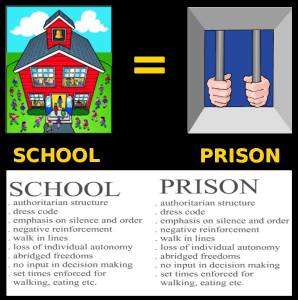
There is No Pipeline, Schools are Prisons

school_is_prison_by_twarrior-d4atw5g

By Ryan Calhoun

Source: Center for a Stateless Society

We are told there is a pipeline in the United States that travels from our school system to our criminal justice system. Correct as the data corroborating the pipeline’s existence may be, it is a flawed way of conceptualizing the issue. There is no pipeline out of schools and into prisons, because schools and prisons in this country are not conceptually separable.

Every child is mandated to receive an education with the threat of reprisal by the judicial system if they fail to. Children are thus coerced into attending a learning center, almost none of which adequately meet the educational needs of children. Some opt for public school “alternatives” like homeschooling or private schools, but the model of education is still generally the same and attendance is vigorously enforced. Through forced schooling, children are largely deprived of the ability to engage with the world and learn by means of play. They must cease the process of seeking fulfillment of genuine desires and begin one of alienation from their natural curiosity.

The consequences are shockingly apparent in a case out of Columbia, South Carolina where a police officer at a public high school physically manhandled a young black girl. The scene: A female student sits passively in her chair while the officer demands she stand. The lead-up to the incident is irrelevant. Insubordination to authority in schools is an inevitability for any child with a mind and drive of her own. For having such a mind and drive of her own (“resisting” in law enforcement-speak) the student was grabbed by the neck, slammed to the ground and dragged across the classroom, all while still partially connected to her desk.

Once again, this is not abnormal behavior. Disobedience is something youth do well and often. The response to disobedience, insubordination, and general independent-streaks at any school usually boils down to authoritative command and punishment. Physical assault on children is not legal in all schools, but it is in 19 states. Each year, over 800 children are assaulted legally and as a matter of policy at their schools. In South Carolina, it is legal to handcuff students for simply being loud.

In addition to the female assault victim in the South Carolina incident, the classmate who filmed the shocking video was also later arrested and held on bail. She was kidnapped for filming what was, by any reasonable standard, child abuse. Why was this allowed to happen? Her charge was “Disturbing school.” Please allow this to fully register. Non-violent, peaceful actions by children are construed as attacks on the supposed civility of school.

This officer’s assault is not an aberration; it is how schools treat students. They have no freedom to leave. Anyone who escapes is treated as a fugitive. They are permitted to go home, but this does not change the striking similarities between prisons and schools. It is now regular for schools to have guards — some are cops hired out and some are the schools’ own security staff. Students are filed along corridors and into rooms in such a way as to surveil and control their flow of activity.

People of color are far more likely to find themselves physically assaulted by staff in schools. They are more likely to receive punishment than their white counterparts for the same behavior, and as a result, they begin to recognize the system’s perception of them as marked criminals. Eventually, many are sent to even more coercive penal environments, where the violence and authoritarianism from the administration only escalates. Many students are lucky enough to avoid the transition from educational to criminal detention centers. But far too many either aren’t able to successfully navigate the educational-police state, or have the deck stacked against them from the outset. Their fate is a sad and unnecessary one.

There is no pipeline from school to prison. Some are just forced to stay in class.

Citations to this article:

Insurrection and Utopia, Part 1: “We are Eating From a Trashcan; This Trashcan is Ideology.”

AsoskW4CMAAPEf9

By Dr. Bones

Source: Gods and Radicals

It all started innocently enough. A friend asked me a question on facebook:

“How can you advocate anarchic revolution when your political vision is so far in the minority?”

The underlying premise was a good one: In a country of 300+ million, how can you call for the upheaval of society, the breaking of societal and political bonds, when so few would readily identify as Anarchists/Socialists/Communists/Leftists/Anti-Capitalists/What-have-you? It’s a question often thrown at the Left and unfortunately many haven’t fully wrapped their heads around it.

In a way it’s a watermark. For an ideology or political vision to go from outright dismissal and laughter to being asked to provide real world examples of what would be done if it came to pass is a sign of growth; it is a signal, an omen, that the winds are beginning to blow in our favor and many want to know what might lie ahead. It’s one thing to talk about “from each according to their ability, to each according to their need” but it’s quite another to discuss how restaurants would be run democratically and without profit or what exactly people might “do” on a day to day level in a classless, stateless society.

Still, the question is not an easy one. We could argue that it is the one question that has always plagued and nagged the Left: “Well that’s all good and well, but how do you plan to achieve this? How does such a world become born?” Staunch Marxists rely on a religious belief in the inevitable procession of history, Syndicalists will rail about the need for increased unionization, firebrand Neo-Bolsheviks plot to simply take power and liquidate class enemies, while the newly minted faux-left “Democratic Socialists” will hem-and-haw about passing enough laws to magically change the balance of power.

All of these options present difficult problems. History has been shown to be anything but inevitable (every year since 1914 has been “Late Capitalism”), a worker-owned McDonalds is still a site of exploitation, nobody ever bothers to explain just where all these people ready to kill for the Revolution are to come from, and the ludicrous doctrine of the Sandernistas that the wealthy and powerful will simply submit to higher taxes and the rule of law is so preposterous it’s only response should be derisive laughter.

So, where are we? Where do we go from here? How are we to change the world?

I start first with a question: Whose world?

You Can’t Teach an Old Carrion-Eater New Tricks

Society, technology, language, and culture all bear the birth marks and forms of the ideological underpinnings of the system they emerged from. Marx notes:

The ideas of the ruling class are in every epoch the ruling ideas, i.e. the class which is the ruling material force of society, is at the same time its ruling intellectual force. The class which has the means of material production at its disposal, has control at the same time over the means of mental production, so that thereby, generally speaking, the ideas of those who lack the means of mental production are subject to it. The ruling ideas are nothing more than the ideal expression of the dominant material relationships, the dominant material relationships grasped as ideas; hence of the relationships which make the one class the ruling one, therefore, the ideas of its dominance.

The Ruling Class, whether Capitalist or State Socialist, informs and projects its will and vision onto the rest of society by the sheer nature of being the dominant force in that society. Of course we can see this politically, but Marx notes this extends also into ideas, culture, anything that could be identified as a byproduct of human interaction and thinking.

The iron steel resolve and blatant disregard of human life so typical of the fearsome Bolshevik Commissar was not so much traits born as traits cultivated; ideals taken within the individual and digested. These cultivated traits came directly from the ideological call for early revolutionary Bolsheviks to identify themselves as “hards,” to be tough, to be ruthless and uncompromising in their goals; when they took state power it become propagated on a cultural level. This meme, this political trait, spiraled out and became a creature, a position, a symbolic figure to be adored/feared all onto its own. It transcended its existence as a mere “idea” or feeling about how party members should behave.

Uber, the trendy internet-based taxi service, could have just as easily manifested into the world as a collectively owned, worker-managed co-op. The internet platform itself is not that revolutionary, the people and tools to create the business were there all along and yet….it did not. Instead Uber emerged and was formed through an ideological lens that made sense to the Ruling Class and by a CEO who’s practically a poster boy for modern capitalism:

“Let’s consider how Kalanick treated his Uber taxi drivers in New York. When he was trying to convince them to break the law to boost Uber’s footprint in the city, Kalanick offered yellow cab drivers free iPhones and promised to “take care of” any legal problems they encountered with the TLC. A few short months later, when the service was forced to close, those same drivers received a message to come to Uber HQ. Reports the Verge ‘Multiple drivers said Uber called them into headquarters, claiming they needed to come by in order to get paid and would get a cash bonus for showing up. When the cabbies came in, Uber surprised them by asking for the device back, informing them that taxi service was no longer available in New York.’”

This is how Uber is evolving, this is how the entire concept other companies will build off is evolving: through actions committed under the dictate and logic of a particular ideology. Taken as gospel or rejected as too harsh new companies will only differ themselves in shades from this first “business plan” and mold their own social and economic arrangements within this ideological parameter. Even the technologies, once thought to be “pure” of politics develop along political lines.

“In an even stronger sense, many technologies can be said to possess inherent political qualities, whereby a given technical system by itself requires or at least strongly encourages specific patterns of human relationships. Winner (1985, 29–37) suggests that a nuclear weapon by its very existence demands the introduction of a centralized, rigidly hierarchical chain of command to regulate who may come anywhere near it, under what conditions, and for what purposes. It would simply be insane to do otherwise. More mundanely, in the daily infrastructures of our large-scale economies — from railroads and oil refineries to cash crops and microchips — centralization and hierarchical management are vastly more efficient for operation, production, and maintenance. Thus the creation and maintenance of certain social conditions can happen in the technological system’s immediate operating environment as well as in society at large.”

What’s interesting is the feedback loop this creates: technology is warped and shaped by the society(and thus dominant ideology), while at the same time the society becomes molded by the technology.

“As technologies are being built and put into use, significant alterations in patterns of human activity and human institutions are already taking place … the construction of a technical system that involves human beings as operating parts brings a reconstruction of social roles and relationships. Often this is a result of the new system’s own operating requirements: it simply will not work unless human behavior changes to suit its form and process. Hence, the very act of using the kinds of machines, techniques and systems available to us generates patterns of activities and expectations that soon become “second nature.”…

Winner gives several examples of technologies employed with intention to dominate, including post-1848 Parisian thoroughfares built to disable urban guerrillas, pneumatic iron molders introduced to break skilled workers’ unions in Chicago, and a segregationist policy of low highway overpasses in 1950s Long Island, which deliberately made rich, white Jones Beach inaccessible by bus, effectively closing it off to the poor. In all these cases, although the design was politically intentional, we can see that the technical arrangements determine social results in a way that logically and temporally precedes their actual deployment. There are predictable social consequences to deploying a given technology or set of technologies.”

In effect we our trapped in a web: We exist in a world not only molded and shaped by a Hierarchical and Capitalist mentality, but the very tools we use including our social selves maintain and reinforce this artifice. The ideology molds the world which molds the people which molds the technology which molds the world which molds the people, etc, etc, etc. As Slajov Zizek points out even those who wish to rebel against the system seem doomed(as if by design?) to remain within it:

“If, today, one follows a direct call to act, this act will not be performed in an empty space — it will be an act WITHIN the hegemonic ideological coordinates: those who ‘really want to do something to help people’ get involved in (undoubtedly honorable) exploits like Medecins sans frontiere, Greenpeace, feminist and anti-racist campaigns, which are all not only tolerated, but even supported by the media, even if they seemingly enter the economic territory (say, denouncing and boycotting companies which do not respect ecological conditions or which use child labor) — they are tolerated and supported as long as they do not get too close to a certain limit. This kind of activity provides the perfect example of interpassivity: of doing things not to achieve something, but to PREVENT from something really happening, really changing.”

Even if State power is seized, if the old masters are cast out, the very throne itself acts like a cursed object and corrupts those that sought to destroy it. People who fought for the worker’s emancipation end up crushing strikes, Greens end up debating just how much depleted uranium to bury underground and how much to fire out of tanks, anti-austerity Leftists end up dispatching riot police to break up protests, the list goes on and on throughout history. The simple truth is you can take the most noble pauper and make him a king, and he may be a great king, but he must still maintain certain conditions(however unjust) by simply being king. The more he becomes attached to this position the more “pragmatism” takes over, excusing acts once thought unthinkable in the name keeping the current conditions going if only to “continue to do good things.” Hugo Chavez and Castro can speak all day of “people’s liberation” but the fact is people aren’t liberated if simply holding a different opinion is so threatening to your revolution they have to be jailed. And thus the throne lives on. While the Kings may change shape or party color the throne of the State and Capital continue to exist, continue to propagate exploitative and domineering cultural memes, social conditions, and technological apparatus.

But there is hope, even on the hinterlands of the oh-so-popular activism of today, in that seemingly bizarre behavior the State displays when people, protests, and organizations are met with overwhelming force.  Why can millions march up and down streets freely “as long as they do not get close to a certain limit” of behavior? What is this Hedge, this boundary we must cross? What is this line so jealously guarded?

Push it to the Limit

Remember the Cuban Missile crises? Where the big bad Soviet Union brought us within an inch to war, ready to point nuclear warheads stationed in Cuba right at us? And how it was only through tough diplomacy and American bravado that we got them to turn around? No? Good, because it didn’t happen like that at all. The Soviets, arming an ally after a recent American-backed invasion, made the deal, not us: Remove the missiles stationed in Turkey(a country that shared a border with the USSR) pointed at Moscow and they would do the same. Kennedy liked the deal and took it. This brought horror to the Military-Industrial establishment; they saw it as backing down to the Soviets. Remember that ideology bit? They didn’t see it as two individuals avoiding nuclear war; their ideological lens would not permit them to. They instead saw it in a hierarchical, dominating dialectic: we had been submissive towards another power. But the Soviets didn’t see it that way, and neither did much of the world, and therein lay the true danger: a new way of thinking, a shift in vision had been displayed and put into practice. And this would not stand.

Others have covered just how against the grain Kennedy went, and how often those who went against him howled for war. I leave the fact that one of those two combatants is dead under your feet for you to play with and ponder. I could mention that right when Nobel Laureate Martin Luther King started talking about “economic justice” and planned on occupying DC until the Vietnam war was ended he too ended up dead. Interestingly enough his family won a wrongful death suit(full court transcripts available) alleging the government killed him. But I’ll instead stick with “accepted” facts like the long history of COINTELPRO, an FBI program specializing in infiltrating, discrediting, and disrupting domestic political organizations. And this wasn’t a kids games either.

“Infiltration: Agents and informers did not merely spy on political activists. Their main purpose was to discredit and disrupt. Their very presence served to undermine trust and scare off potential supporters. The FBI and police exploited this fear to smear genuine activists as agents.

Psychological warfare: The FBI and police used myriad “dirty tricks” to undermine progressive movements. They planted false media stories and published bogus leaflets and other publications in the name of targeted groups. They forged correspondence, sent anonymous letters, and made anonymous telephone calls. They spread misinformation about meetings and events, set up pseudo movement groups run by government agents, and manipulated or strong-armed parents, employers, landlords, school officials and others to cause trouble for activists. They used bad-jacketing to create suspicion about targeted activists, sometimes with lethal consequences.

Legal harassment: The FBI and police abused the legal system to harass dissidents and make them appear to be criminals. Officers of the law gave perjured testimony and presented fabricated evidence as a pretext for false arrests and wrongful imprisonment. They discriminatorily enforced tax laws and other government regulations and used conspicuous surveillance, “investigative” interviews, and grand jury subpoenas in an effort to intimidate activists and silence their supporters.

Illegal force: The FBI conspired with local police departments to threaten dissidents; to conduct illegal break-ins in order to search dissident homes; and to commit vandalism, assaults, beatings and assassinations. The object was to frighten or eliminate dissidents and disrupt their movements….

The FBI also conspired with the police departments of many U.S. cities (San Diego, Los Angeles, San Francisco, Oakland, Philadelphia, Chicago) to encourage repeated raids on Black Panther homes—often with little or no evidence of violations of federal, state, or local laws—which resulted directly in the police killing many members of the Black Panther Party…In order to eliminate black militant leaders whom they considered dangerous, the FBI is believed to have worked with local police departments to target specific individuals, accuse them of crimes they did not commit, suppress exculpatory evidence and falsely incarcerate them.”

Anyone who thinks this has ended is sorely mistaken. Really, really mistaken.

“Participants were tasked to “identify those who were ‘problem-solvers’ and those who were ‘problem-causers,’ and the rest of the population whom would be the target of the information operations to move their Center of Gravity toward that set of viewpoints and values which was the ‘desired end-state’ of the military’s strategy.”

Let me translate that for you: “We are actively studying political movements, identifying people whom might actually change things and are using propaganda techniques to change the conversations they have as well as they views they hold to better suit the military’s domestic strategy.” Let that one sink in.

Truth be told we may never fully know how deep the rabbit hole goes. But there is a unifying factor here: the State clamps down hard whenever the ongoing narrative, the ideology itself is shown not to be the only one. They’re afraid of ideas, because these things are what sparks action. The greatest threat to the system isn’t just learning things aren’t what they appear to be, but beginning to imagine a world where things are different. If something is outside the “parameters of acceptance” for the dominant ideology it presupposes that there are limitations to the system; if there are limitations to the system it can become old, worn out, made useless, and ultimately replaced.

So the Ruling Class will violently defend it’s doctrines at all costs. Can we beat such an invincible enemy, an enemy whose literally shaped us all our lives?  How can we achieve that? Can we ever free ourselves and stop eating out of the trashcan of Capitalist Ideology?

Follow me down a rabbit hole of our own making, lets…article6


Dr. Bones is an 8 year practitioner of the Southern occult tradition known as Conjure, Rootwork, and Hoodoo. A skilled card reader and Spiritworker, Dr. Bones has undertaken all aspects of the work, both benevolent and malefic. Politically he holds the Anarchist line that “Individuality can only flourish where equality of access to the conditions of existence is the social reality. This equality of access is Communism.” He resides in the insane State of Florida with his loving wife, a herd of cats, and a house full of spirits.
He can be reached through facebook and at drbones@gmail.com