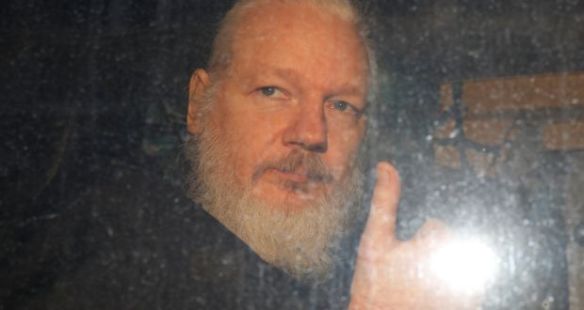
What Julian Assange’s Arrest Tells Us About Our World

By Arjun Walla

Source: Collective Evolution

John Kiriakou, a CIA-anti-torture whistle-blower recently tweeted, “a fair trial in the Eastern District of Virginia, under Judge Leonie Brinkema, is utterly impossible. They don’t call the EDVA the ‘Espionage Court for nothing.’”

And it’s true. Julian Assange was just arrested and dragged out of the Ecuadorian Embassy in relation to an extradition warrant from the US that was issued in December of 2017 for conspiracy with Chelsea Manning in early 2010. To expect that he will receive a fair trial is a bit of a dream.

The New York Times is reporting:

“The United States has charged WikiLeaks founder Julian Assange of conspiring to hack a computer as part of the 2010 release of reams of secret American documents, according to an indictment unsealed Thursday, putting him just one flight away from being in American custody after years of seclusion in the Ecuadorean embassy in London.”

Regardless of what the headlines are reading, the world knows why the hunt for Julian Assange has been ongoing for so long, and it’s because he leaked secrets and exposed those who keep them. He exposed the lies, corruption and deceit that represents the backbone of the Western military alliance and the American empire. He exposed, in the words of John F. Hylan, former Mayor of New York City, the “real menace of Republic”, the “invisible government, which like a giant octopus sprawls its slimy legs over our cities, states and nation.” He exposes the ones “who virtually run the United States government for their own selfish purposes.” (source)(source)

JFK warned the citizenry about “an announced need for increased security” that would be “seized upon by those anxious to expand its meaning to the very limits of official censorship and concealment.” Today, this is known as “national security,” and it’s a term used to justify unethical and enormous amounts of secrecy that do not protect the public, but protect those in power and their corporate, financial and political interests.

This is exactly what is being pinned on Julian Assange. And it’s done so under the guise of “national security.” As public relations professional Edward Bernays, who had many political clients, wrote:

The conscious and intelligent manipulation of the organized habits and opinions of the masses is an important element in the democratic society. Those who manipulate this unseen mechanism of society constitute an invisible government which is the true ruling power of our country. We are governed, our minds molded, our tastes formed, our ideas suggested, largely by men we have never heard of.  (Propaganda, 1928)

Transparency Doesn’t Favor The Powerful

Transparency is what Julian Assange was all about, and the American empire, more so the global empire, has been desperate to keep its secrets and prosecute anyone or anything that threatens this transparency. That’s what this is all about. And they proved this with Chelsea Manning.

It’s not just people like Assange who are being demonized and hunted, it’s alternative media as well. The war on ‘fake news’ that has been happening for the last little while has had alternative media outlets presenting credible information and sources deemed as ‘fake.’ Any media outlet who even questions a controversial issue has been made out to be ‘wrong’ or ‘fake.’

Fake news watchdog NewsGuard aims to hold independent media accountable for their stories. Funded by Clinton donors and big pharma, with ties to the CFR, NewsGuard seems to have a clear agenda in favour of mainstream media. You can read more about that here.

The current vaccine discussion is another great example. Those who are currently concerned with vaccine safety are being completely shut down and silenced. Meanwhile, those who support vaccinations do not even address the concerns that are being made by people raising concerns, and instead are resorting to finger pointing, ridicule and name calling. The latest example would be the world’s leading expert on aluminum toxicology, professor Christopher Exley, who has been completely shut down with regards to his research efforts. You can read more about that here.

The mainstream media has so much control over the minds of the masses that they can actually convince a large chunk of the citizenry that this war on ‘fake news’ is completely justified, and the arrest of Julian Assange is completely justified, but is it truly? Are we asking the right questions? Or simply believing what we are told?

Again, national security is not being threatened here, what’s being threatened, and has been threatened here as a result of Julian Assange and multiple alternative media networks, is the ability for the global elite to control human consciousness. Quite simply, exposing the truth is a huge threat to the global elite and their heightened national security state that rivals what George Orwell wrote in 1984, the stripping of our rights and freedoms, and the justification to impose more measures on the populace under the guise of national security.

Truth Is The Culprit

Truth and free press threaten the ability of the global elite to create problems and at the same time propose the solution. Some of the biggest leaks WikiLeaks has made were detailing the connection between supposed terrorist organizations like Al-Qaeda and ISIS to the western military alliance, more specifically the US government. We saw arms deals and the funding/support of terrorist organizations that the US claimed to be fighting against. This is a great example of funding and creating a problem in order to justify heightened national security measures back home, to protect people from ‘the war on terror’ and justify their infiltration of another country for ulterior motives.

Look at William Binney, he’s a former high ranking intelligence official with the National Security Agency (NSA), and is one of the highest placed intelligence officials to ever blow the whistle on insider NSA ‘knowings.’ He made headlines when he resigned in 2001 after 9/11, having worked more than thirty years for the agency. He was a leading code-breaker against the Soviet Union during the Cold War, and was repelled by the United States’ massive surveillance programs.

Binney hasn’t stopped, one of the highest-level whistleblowers to ever come out of the NSA. He is now saying:

“At least 80% of fibre optic cables globally go via the US, this is no accident and allows the US to view all communication coming in. At least 80% of all audio calls, not just metadata, are recorded and stored in the US. The NSA lies about what it stores. The ultimate goal of the NSA is total population control.” (source)

Again, this is exactly why the hunt for Julian Assange has gone on like it has, as well as the crackdown on non mainstream journalism.

One final thing to address, those that feel this is all part of ‘the plan’ within the Q community, while it may be possible that his extradition could lead to his ultimate exoneration, the evidence does not yet seem to point to that. We should still be open, question and ultimately still discuss how this is an opportunity for us to wake up to truth.

The Takeaway

We’re at a point where anything the global elite, Shadow Government or Deep State does to silence anything that threatens their interest, will simply wake up more and more people as to what’s really going on. It’s exactly like 9/11, that tragic event woke up millions and millions of people around the world to deception they otherwise knew nothing about. Every move they make, like extraditing Julian Assange, simply makes it more obvious that they are trying to block the truth, and protect their own interests.

Below is a video from CE founder Joe Martino going in a little deeper and explaining what we can expect from all of this now.

Does it really make sense that we’re taking journalists, that we’re taking people and putting them in jail for bringing forward a story that is important for humanity to see, does this really make sense? – Joe Martino


Related Video:


Assange arrest: The turning point is here—don’t let them win

Will we wait until they come for us because our homes are built atop resources they wish to plunder, because we shared information online they found objectionable, because we dared to question why madmen are in control of our country and much of the world?

By Whitney Webb

Source: Intrepid Report

LONDON—Yesterday morning, the London-based branch of Empire made good on its threat and boldly moved to begin dismantling the vestiges of democracy and press freedom that still remain, vestiges that have allowed people throughout the Western world to pretend that their government and politicians still respect their rights and the rule of law.

Julian Assange, the man who has helped expose a litany of crimes and the in-your-face corruption of the world’s most powerful people and governments, was pulled from the embassy of the country where he not only holds citizenship but had been granted asylum. The dangerous precedents Assange’s arrest has set—not just for journalism, but also for national sovereignty and international law—are staggering.

With Assange now in U.K. custody, his fate will mirror our own, as Assange’s fate and that of journalists around the world, as well as the public itself, are increasingly intertwined. After all, those who are after Assange and seek to rob him of his freedom—the U.S. Empire, the “deep state,” the shadow government, the global elite, etc.—are after our freedom as well.

If we remain silent as they jail, extradite, torture or even kill this man, we may expect a similar fate for ourselves. It will not come tomorrow. It will not come next week. It could be years away. But make no mistake, the global empire, whose core is the U.S. government, will now be empowered to charge and imprison anyone it deems a threat to its operations.

Those operations, including those that Assange helped to expose, often involve the mass murder of innocent civilians—untold numbers of children among them—in order to loot the resources of other sovereign nations. They also often involve the installation of puppet governments by either covert (e.g., election “meddling”) or overt (e.g., regime-change wars) means.

Those responsible for the most egregious violations of international law, for war crimes, for the slaughter of innocent life, are not imprisoned, degraded or tortured—they are rewarded and promoted. As we have seen today—and in recent weeks, particularly following Chelsea Manning’s imprisonment—those who seek to expose these crimes are the ones who are threatened, tortured and punished.

Like it or not, we are all already a part of this war

The world has known for years that Assange would meet this fate. Little was done. Now, the turning point is here. Will we continue to escape into the false realities of television, cinema, video games, and whatever we use to distract us and numb our pain while the actual world in which we live devolves into a technocratic, imperial dictatorship? Will we continue to ignore the obvious threats to our lives and our children’s lives because confronting these threats is uncomfortable and often difficult?

Will we wait until they come for us because our homes are built atop resources they wish to plunder, because we shared information online they found objectionable, because we dared to question why madmen are in control of our country and much of the world?

Such an eventuality may seem laughable to some, but those days are not far away and are already here for many people around the world, even in the West. Assange’s arrest is the first shot of a war to which all of us, like it or not, have already been drafted because it is a war for the very world in which we live—a war for our society, our planet, our livelihood, our right to self-determination. You can try to escape to the ends of the Earth, thousands of miles away from “the West” (as I myself did), only to find that there is no country anywhere in the world that is not currently under siege.

Never before in history has the global oligarchy been more powerful. The concentration of power and wealth in the hands of the few is unprecedented, worse even than in the Gilded Age or the final days of the Roman Empire. These people do not plan to cede any of this power to you. They do not want you to have control over your own lives. To them, we are already slaves. And those who are silent, especially now, are sending a signal to the elites that they embrace that servitude.

The revolution will not be televised and the war will not be won on social media

For too long, actions in defense of Assange, and more broadly in protest of Empire, have been focused in the virtual realm—that is, on the Internet and social media. While the Internet and social media are important tools for sharing information, their use for that end is being suppressed like never before and it will not be long before social media is entirely censored and devoid of dissent. If we wait until that day comes, and put all our eggs in the social media basket, we will have shot ourselves in the foot and it could well be a fatal blow.

We can no longer run from the world, escape into our remaining comforts—particularly those online—while the world burns. Assange may be the first journalist to be arrested and extradited under these circumstances, but he will not be the last. What we do now will determine how far they go.

The U.S. and its allies are prepping for several wars, many of them against countries much larger than Iraq, and such wars could make Iraq and Afghanistan look like skirmishes by comparison. The people behind Assange’s arrest and perpetual imperial wars do not care about your tweets or Facebook posts. They want your focus to remain on the virtual world and away from the real one over which they are consolidating their control.

Now is the time to resist. Now is the time to insist. Now is the time to take to the streets, to talk to your neighbors, family and co-workers of the dangers facing us all. Your voice and your actions matter. The longer we wait, the worse things will become. The turning point is here. Don’t let them win.


Whitney Webb is a MintPress News journalist based in Chile. She has contributed to several independent media outlets including Global Research, EcoWatch, the Ron Paul Institute and 21st Century Wire, among others. She has made several radio and television appearances and is the 2019 winner of the Serena Shim Award for Uncompromised Integrity in Journalism.

Big Government and Big Tech versus the Internet and everyone

By Thomas L. Knapp

Source: Intrepid Report

Governments around the world began trying to bring the Internet under control as soon as they realized the danger to their power represented by unfettered public access to, and exchange of, information. From attempts to suppress strong encryption technology to the Communications Decency Act in the US and China’s “Great Firewall,” such efforts have generally proven ineffectual. But things are changing, and not for the better.

The European Parliament recently passed a “Copyright Directive” which, if implemented, will force Internet platforms to actively monitor user content instead of putting the burden of proving copyright infringement on those claiming such infringement. The directive also includes a “link tax” under which publishers will charge aggregation platforms for traditionally “fair use” excerpts.

The US government’s Committee on Foreign Investment is attempting to force the sale of Grindr, a gay dating app, over “national security” concerns. Grindr is owned by a Chinese company, Beijing Kunlun. CFIUS’s supposed fear is that the Chinese government will use information the app gathers to surveil or even blackmail users in sensitive political and military jobs.

Those are just two current examples of many.

Big Governments and Big Tech are engaged in a long-term mating dance.

Big Governments want to regulate Big Tech because that’s what governments do, and because, as with Willie Sutton and banks, Big Tech is where the Big Tax Money is.

Big Tech wants to be regulated by Big Governments because regulation makes it more difficult and expensive for new competitors to enter the market. Facebook doesn’t want someone else to make it the next MySpace. Google doesn’t want a fresh new face to send it the way of Yahoo.

It’s a mating dance with multiple suitors on all sides.

The US doesn’t like Grindr or Huawei, because FREEDUMB.

The Chinese don’t want uncensored Google or Twitter, because ORDER.

The EU is at least honest about being sexually indiscriminate: It freely admits that it just wants to rigorously screw everyone, everything, everywhere.

Big Tech wants to operate in all of these markets and it’s willing to buy every potential Big Government as many drinks as it takes to get them all into the sack.

Everybody wins, I guess. Except the public.

Governments and would-be monopolists are fragmenting what once advertised itself as a Global Information Superhighway into hundreds of gated streets.

Those streets are lined by neatly manicured lawns per the homeowners’ association’s rigorously enforced rules, and herbicide is sprayed on those lawns to kill off the values that made the Internet the social successor to the printing press and the economic successor to the Industrial Revolution.

As Stewart Brand wrote, “Information Wants To Be Free. Information also wants to be expensive. … That tension will not go away.”

Big Tech and Big Government are both coming down, increasingly effectively, on the side of “expensive” and on the side of Ford’s Model T philosophy (“you can have any color you want as long as it’s black”).

They’re killing the Internet. They’re killing the future. They’re killing us.


Thomas L. Knapp (Twitter: @thomaslknapp) is director and senior news analyst at the William Lloyd Garrison Center for Libertarian Advocacy Journalism. He lives and works in north central Florida.

Did the NY Times Violate Its Own Code of Ethics to Feature Child of Venezuelan Coup Plotter?

After the New York Times was slammed for obscuring comedian Joanna Hausmann’s family ties to the Guaido shadow regime, her coup-plotting father appeared online to defend her with a stream of insults.

By Anya Parampil

Source: The Grayzone

When the New York Times approached me seeking permission to use video I recorded of the Washington DC “Hands Off Venezuela” protest on March 16, I hoped that somebody at the paper was seeking to atone for the Gray Lady’s demonstrably one-sided coverage of the US coup attempt against the internationally recognized Maduro government. Maybe, just maybe, the editors had had a rare bout of self-reflection and decided to produce something that gave voice to the many Americans who rejected the Trump administration’s brazen regime change operation against Venezuela.

But on April 1, I woke up to learn that my footage had been used to demonize the protesters as useful idiots by a YouTube comedian born to one of the family dynasties of Venezuela’s opposition.

The comedian in question was Joanna Hausmann, and her appearance in the supposed newspaper of record was far from funny. How could the paper justify selecting Hausmann as an authoritative voice on the situation in Venezuela when she was so closely connected to central players in the Trump administration’s coup attempt? The answer is that it couldn’t, so it simply neglected to mention her glaring conflict of interest.

I took a deep dive into Hausmann’s family history in a March 10th article for MintPress, highlighting the role Joanna’s father, Ricardo Hausmann, played in the neoliberalization of Venezuela’s economy throughout the 1980s and ’90s as an academic and eventual member of the repressive Carlos Andrés Pérez administration.

The piece was inspired by Joanna Hausmann’s Youtube harangue, “What’s Happening in Venezuela.” Despite promising “a video dedicated to ‘just the facts,’” Hausmann failed to mention that her father was serving as a top advisor to Venezuelan opposition leader Juan Guaidó while she argued in support of his self-declared “presidency.”

Ricardo Hausmann’s function within the coup government crystalized shortly following the release of Joanna’s Youtube explainer, when Guaidó selected the Harvard professor to represent his shadow regime at the Inter-American Development Bank. The Times took no issue with the fact Hausmann’s family stood to benefit from the same coup she was urging viewers to support, and like Joanna herself, neglected to disclose this ostensibly relevant information.

The Times appeared to have underestimated the intelligence of its viewers, and was subsequently bombarded with criticism for its decision to obscure Hausmann’s background.

One reader who described himself as “a Venezuelan, [who agrees] with everything [Hausmann] has to say,” complained in the comments section of the Hausmann video that the omission amounted to “an ethical error,” arguing “it should be noted that her father has a lot to gain politically and professionally should regime change happen.” The comment forced a response from the segment’s executive producer, Adam Ellick, who claimed that, while the Times was “aware of her father’s biography before publication,” it opted not to acknowledge it because “Ms. Hausmann is an independent adult woman who has built a popular following on her own.”

Ellick’s response failed to satisfy the commenter, who emphasized that “the issue here isn’t one of independence, it’s one of shared outcomes.” According to Ellick’s logic, it would be journalistically ethical to ignore Ivanka Trump’s relation to the President on the basis she is “an independent adult woman” with a fashion line of her own. Does the Times actually think we are stupid?

The backlash against Joanna’s NYT debut grew so intense, it eventually compelled her father to respond to the controversy. Following the video’s release, I tweeted criticism of the paper for its failure to disclose that “Hausmann is the daughter of Guaidó advisor Ricardo Hausmann,” linking to my article which explained that he “was instrumental in neoliberalizing and destroying Venezuela’s economy in the 90s and wants to do it again.”

The factual statement apparently outraged Professor Hausmann, who charged that my “tweet surely deserves at least an honorary mention among the year’s most sexist comments,” adding, “since Joanna is my daughter, she is not entitled to her own opinion. She must be speaking on behalf of some male figure that tells her what to say. Seriously?”

Yes, seriously! Joanna does not appear to have her “own opinion” — she has precisely the same opinion as her father, who happens to be participating in the very coup for which she was advocating. Yet even if we accept the notion that Joanna formed opinions independent from her father’s influence, the Times still had an ethical obligation to disclose her family ties – especially considering that Professor Hausmann is not her only relative actively working to achieve regime change in Caracas.

Joanna’s mother, Ana Julia Jatar, has worked for the US-funded Súmate organization, which in 2004 tried and failed to oust President Hugo Chávez via popular referendum. As I reported for MintPress, Jatar hails from a political family herself.

Jatar’s father, Braulio Jatar Dotti, was once described by an independent Chilean news site “as having been ‘in charge of eliminating the leftist groups’ in Venezuela” in the 1960s, as the government sought to violently repress the armed Revolutionary Left Movement. Jatar Dotti even published a manual called, “Disabling the Extreme Left” in 1963. With her grandfather’s history in mind, it’s no wonder that Joanna now spends her time attacking the US left for organizing to oppose war on Venezuela. Apparently, the family that attacks the left and fails to overthrow governments together stays together.

While it is important to understand the full extent to which regime change and resentment of “the left” runs through Joanna Hausmann’s veins, her father’s participation in the current coup alone should have disqualified her to pose as a neutral voice on Venezuela. The Times’ decision to ignore her background is not only offensive to viewers, but may have also violated the paper’s own ethics code. According to that code, “staff members must be sensitive that perfectly proper political activity by their spouses, family or companions may nevertheless create conflicts of interest or the appearance of conflict.” The Hausmann scandal undeniably created such a scenario for the paper.

Joanna has largely kept quiet amid the deluge of criticism, and is quick to block those who question her. (She blocked me on Twitter after I noted her father’s prominent role in the Guaidó shadow regime.) Why a grown woman professing her total independence needed her father to come to her defense should be a mystery, as RT Español reporter Helena Villar observed.

One Twitter user named Vanessa Salas, who describes herself as “a personal friend” of Joanna, recommended that I “get to know” the comedian before making “unfounded statements.” Salas insistedthat her pal was “SMART, THOUGHTFUL, and FEARLESS.” Indeed, Joanna Hausmann was so fearless that she had to rely on her friends, family, and an army of trolls to deflect from her wanton journalistic malpractice.

Joanna did eventually muster up one non-answer to critics. When a Twitter user named @unnaband asked why she neglected to mention that her “father was personally appointed by the very opposition leader” she promoted in her video, the Youtube comedian hit back: “I am proud of my dad.”

He is surely proud of her too. And among the Times editors who presided over her ethically dubious video rant, there appears to be no shame.


Related Video:

The Making of a Monster: We’re All Lab Rats in the Government’s Secret Experiments

By John W. Whitehead

Source: The Rutherford Institute

“But these weren’t the kind of monsters that had tentacles and rotting skin, the kind a seven-year-old might be able to wrap his mind around—they were monsters with human faces, in crisp uniforms, marching in lockstep, so banal you don’t recognize them for what they are until it’s too late.” — Ransom Riggs, Miss Peregrine’s Home for Peculiar Children

The U.S. government, in its pursuit of so-called monsters, has itself become a monster.

This is not a new development, nor is it a revelation.

This is a government that has in recent decades unleashed untold horrors upon the world—including its own citizenry—in the name of global conquest, the acquisition of greater wealth, scientific experimentation, and technological advances, all packaged in the guise of the greater good.

Mind you, there is no greater good when the government is involved. There is only greater greed for money and power.

Unfortunately, the public has become so easily distracted by the political spectacle coming out of Washington, DC, that they are altogether oblivious to the grisly experiments, barbaric behavior and inhumane conditions that have become synonymous with the U.S. government.

These horrors are being meted out against humans and animals alike.

It’s heartbreaking enough when you hear about police shooting family dogs that pose no threat—beloved pets that are “guilty” of little more than barking, or wagging a tag, or racing towards them in greeting—at an alarming rate somewhere in the vicinity of 500 dogs a day.

What I’m about to share goes beyond heartbreaking to horrifying.

For instance, did you know that the U.S. government has been buying hundreds of dogs and cats from “Asian meat markets” as part of a gruesome experiment into food-borne illnesses? The cannibalistic experiments involve killing cats and dogs purchased from Colombia, Brazil, Vietnam, China and Ethiopia, and then feeding the dead remains to laboratory kittens, bred in government laboratories for the express purpose of being infected with a disease and then killed.

It gets more gruesome.

The Department of Veterans Affairs has been removing parts of dogs’ brains to see how it affects their breathing; applying electrodes to dogs’ spinal cords (before and after severing them) to see how it impacts their cough reflexes; and implanting pacemakers in dogs’ hearts and then inducing them to have heart attacks (before draining their blood). All of the laboratory dogs are killed during the course of these experiments.

It’s not just animals that are being treated like lab rats by government agencies.

“We the people” have also become the police state’s guinea pigs: to be caged, branded, experimented upon without our knowledge or consent, and then conveniently discarded and left to suffer from the after-effects.

Back in 2017, FEMA “inadvertently” exposed nearly 10,000 firefighters, paramedics and other responders to a deadly form of ricin during simulated bioterrorism response sessions. In 2015, it was discovered that an Army lab had been “mistakenly” shipping deadly anthrax to labs and defense contractors for a decade.

While these particular incidents have been dismissed as “accidents,” you don’t have to dig very deep or go very back in the nation’s history to uncover numerous cases in which the government deliberately conducted secret experiments on an unsuspecting populace—citizens and noncitizens alike—making healthy people sick by spraying them with chemicals, injecting them with infectious diseases and exposing them to airborne toxins.

At the time, the government reasoned that it was legitimate to experiment on people who did not have full rights in society such as prisoners, mental patients, and poor blacks.

In Alabama, for example, 600 black men with syphilis were allowed to suffer without proper medical treatment in order to study the natural progression of untreated syphilis. In California, older prisoners had testicles from livestock and from recently executed convicts implanted in them to test their virility. In Connecticut, mental patients were injected with hepatitis.

In Maryland, sleeping prisoners had a pandemic flu virus sprayed up their noses. In Georgia, two dozen “volunteering” prison inmates had gonorrhea bacteria pumped directly into their urinary tracts through the penis. In Michigan, male patients at an insane asylum were exposed to the flu after first being injected with an experimental flu vaccine. In Minnesota, 11 public service employee “volunteers” were injected with malaria, then starved for five days.

In New York, dying patients had cancer cells introduced into their systems. In Ohio, over 100 inmates were injected with live cancer cells. Also in New York, prisoners at a reformatory prison were also split into two groups to determine how a deadly stomach virus was spread: the first group was made to swallow an unfiltered stool suspension, while the second group merely breathed in germs sprayed into the air. And in Staten Island, children with mental retardation were given hepatitis orally and by injection to see if they could then be cured.

As the Associated Press reports, “The late 1940s and 1950s saw huge growth in the U.S. pharmaceutical and health care industries, accompanied by a boom in prisoner experiments funded by both the government and corporations. By the 1960s, at least half the states allowed prisoners to be used as medical guinea pigs … because they were cheaper than chimpanzees.”

Moreover, “Some of these studies, mostly from the 1940s to the ’60s, apparently were never covered by news media. Others were reported at the time, but the focus was on the promise of enduring new cures, while glossing over how test subjects were treated.”

Media blackouts, propaganda, spin. Sound familiar?

How many government incursions into our freedoms have been blacked out, buried under “entertainment” news headlines, or spun in such a way as to suggest that anyone voicing a word of caution is paranoid or conspiratorial?

Unfortunately, these incidents are just the tip of the iceberg when it comes to the atrocities the government has inflicted on an unsuspecting populace in the name of secret experimentation.

For instance, there was the U.S. military’s secret race-based testing of mustard gas on more than 60,000 enlisted men. As NPR reports, “All of the World War II experiments with mustard gas were done in secret and weren’t recorded on the subjects’ official military records. Most do not have proof of what they went through. They received no follow-up health care or monitoring of any kind. And they were sworn to secrecy about the tests under threat of dishonorable discharge and military prison time, leaving some unable to receive adequate medical treatment for their injuries, because they couldn’t tell doctors what happened to them.”

And then there was the CIA’s MKULTRA program in which hundreds of unsuspecting American civilians and military personnel were dosed with LSD, some having the hallucinogenic drug slipped into their drinks at the beach, in city bars, at restaurants. As Time reports, “before the documentation and other facts of the program were made public, those who talked of it were frequently dismissed as being psychotic.”

Now one might argue that this is all ancient history and that the government today is different from the government of yesteryear, but has the U.S. government really changed?

Has the government become any more humane, any more respectful of the rights of the citizenry?

Has it become any more transparent or willing to abide by the rule of law? Has it become any more truthful about its activities? Has it become any more cognizant of its appointed role as a guardian of our rights?

Or has the government simply hunkered down and hidden its nefarious acts and dastardly experiments under layers of secrecy, legalism and obfuscations? Has it not become wilier, more slippery, more difficult to pin down?

Having mastered the Orwellian art of Doublespeak and followed the Huxleyan blueprint for distraction and diversion, are we not dealing with a government that is simply craftier and more conniving that it used to be?

Consider this: after revelations about the government’s experiments spanning the 20th century spawned outrage, the government began looking for human guinea pigs in other countries, where “clinical trials could be done more cheaply and with fewer rules.”

In Guatemala, prisoners and patients at a mental hospital were infected with syphilis, “apparently to test whether penicillin could prevent some sexually transmitted disease.” In Uganda, U.S.-funded doctors “failed to give the AIDS drug AZT to all the HIV-infected pregnant women in a study… even though it would have protected their newborns.” Meanwhile, in Nigeria, children with meningitis were used to test an antibiotic named Trovan. Eleven children died and many others were left disabled.

The more things change, the more they stay the same.

Case in point: back in 2016, it was announced that scientists working for the Department of Homeland Security would begin releasing various gasses and particles on crowded subway platforms as part of an experiment aimed at testing bioterror airflow in New York subways.

The government insisted that the gases released into the subways by the DHS were nontoxic and did not pose a health risk. It’s in our best interests, they said, to understand how quickly a chemical or biological terrorist attack might spread. And look how cool the technology is—said the government cheerleaders—that scientists can use something called DNATrax to track the movement of microscopic substances in air and food. (Imagine the kinds of surveillance that could be carried out by the government using trackable airborne microscopic substances you breathe in or ingest.)

Mind you, this is the same government that in 1949 sprayed bacteria into the Pentagon’s air handling system, then the world’s largest office building. In 1950, special ops forces sprayed bacteria from Navy ships off the coast of Norfolk and San Francisco, in the latter case exposing all of the city’s 800,000 residents.

In 1953, government operatives staged “mock” anthrax attacks on St. Louis, Minneapolis, and Winnipeg using generators placed on top of cars. Local governments were reportedly told that “‘invisible smokescreen[s]’ were being deployed to mask the city on enemy radar.” Later experiments covered territory as wide-ranging as Ohio to Texas and Michigan to Kansas.

In 1965, the government’s experiments in bioterror took aim at Washington’s National Airport, followed by a 1966 experiment in which army scientists exposed a million subway NYC passengers to airborne bacteria that causes food poisoning.

And this is the same government that has taken every bit of technology sold to us as being in our best interests—GPS devices, surveillance, nonlethal weapons, etc.—and used it against us, to track, control and trap us.

So, no, I don’t think the government’s ethics have changed much over the years. It’s just taken its nefarious programs undercover.

The question remains: why is the government doing this? The answer is always the same: money, power and total domination.

It’s the same answer no matter which totalitarian regime is in power.

The mindset driving these programs has, appropriately, been likened to that of Nazi doctors experimenting on Jews. As the Holocaust Museum recounts, Nazi physicians “conducted painful and often deadly experiments on thousands of concentration camp prisoners without their consent.”

The Nazi’s unethical experiments ran the gamut from freezing experiments using prisoners to find an effective treatment for hypothermia, tests to determine the maximum altitude for parachuting out of a plane, injecting prisoners with malaria, typhus, tuberculosis, typhoid fever, yellow fever, and infectious hepatitis, exposing prisoners to phosgene and mustard gas, and mass sterilization experiments.

The horrors being meted out against the American people can be traced back, in a direct line, to the horrors meted out in Nazi laboratories. In fact, following the second World War, the U.S. government recruited many of Hitler’s employees, adopted his protocols, embraced his mindset about law and order and experimentation, and implemented his tactics in incremental steps.

Sounds far-fetched, you say? Read on. It’s all documented.

As historian Robert Gellately recounts, the Nazi police state was initially so admired for its efficiency and order by the world powers of the day that Herbert Hoover, then-head of the FBI, actually sent one of his right-hand men, Edmund Patrick Coffey, to Berlin in January 1938 at the invitation of Germany’s secret police, the Gestapo.

The FBI was so impressed with the Nazi regime that, according to the New York Times, in the decades after World War II, the FBI, along with other government agencies, aggressively recruited at least a thousand Nazis, including some of Hitler’s highest henchmen.

All told, thousands of Nazi collaborators—including the head of a Nazi concentration camp, among others—were given secret visas and brought to America by way of Project Paperclip. Subsequently, they were hired on as spies, informants and scientific advisers, and then camouflaged to ensure that their true identities and ties to Hitler’s holocaust machine would remain unknown. All the while, thousands of Jewish refugees were refused entry visas to the U.S. on the grounds that it could threaten national security.

Adding further insult to injury, American taxpayers have been paying to keep these ex-Nazis on the U.S. government’s payroll ever since. And in true Gestapo fashion, anyone who has dared to blow the whistle on the FBI’s illicit Nazi ties has found himself spied upon, intimidated, harassed and labeled a threat to national security.

As if the government’s covert, taxpayer-funded employment of Nazis after World War II wasn’t bad enough, U.S. government agencies—the FBI, CIA and the military—have since fully embraced many of the Nazi’s well-honed policing tactics, and have used them repeatedly against American citizens.

It’s certainly easy to denounce the full-frontal horrors carried out by the scientific and medical community within a despotic regime such as Nazi Germany, but what do you do when it’s your own government that claims to be a champion of human rights all the while allowing its agents to engage in the foulest, bases and most despicable acts of torture, abuse and experimentation?

When all is said and done, this is not a government that has our best interests at heart.

This is not a government that values us.

Perhaps the answer lies in The Third Man, Carol Reed’s influential 1949 film starring Joseph Cotten and Orson Welles. In the film, set in a post-WW II Vienna, rogue war profiteer Harry Lime has come to view human carnage with a callous indifference, unconcerned that the diluted penicillin he’s been trafficking underground has resulted in the tortured deaths of young children.

Challenged by his old friend Holly Martins to consider the consequences of his actions, Lime responds, “In these days, old man, nobody thinks in terms of human beings. Governments don’t, so why should we?

“Have you ever seen any of your victims?” asks Martins.

“Victims?” responds Limes, as he looks down from the top of a Ferris wheel onto a populace reduced to mere dots on the ground. “Look down there. Tell me. Would you really feel any pity if one of those dots stopped moving forever? If I offered you twenty thousand pounds for every dot that stopped, would you really, old man, tell me to keep my money, or would you calculate how many dots you could afford to spare? Free of income tax, old man. Free of income tax — the only way you can save money nowadays.”

As I make clear in my book Battlefield America: The War on the American People, this is how the U.S. government sees us, too, when it looks down upon us from its lofty perch.

To the powers-that-be, the rest of us are insignificant specks, faceless dots on the ground.

To the architects of the American police state, we are not worthy or vested with inherent rights. This is how the government can justify treating us like economic units to be bought and sold and traded, or caged rats to be experimented upon and discarded when we’ve outgrown our usefulness.

To those who call the shots in the halls of government, “we the people” are merely the means to an end.

“We the people”—who think, who reason, who take a stand, who resist, who demand to be treated with dignity and care, who believe in freedom and justice for all—have become obsolete, undervalued citizens of a totalitarian state that, in the words of Rod Serling, “has patterned itself after every dictator who has ever planted the ripping imprint of a boot on the pages of history since the beginning of time. It has refinements, technological advances, and a more sophisticated approach to the destruction of human freedom.”

In this sense, we are all Romney Wordsworth, the condemned man in Serling’s Twilight Zone episode “The Obsolete Man.”

The Obsolete Man” speaks to the dangers of a government that views people as expendable once they have outgrown their usefulness to the State. Yet—and here’s the kicker—this is where the government through its monstrous inhumanity also becomes obsolete. As Serling noted in his original script for “The Obsolete Man,” “Any state, any entity, any ideology which fails to recognize the worth, the dignity, the rights of Man…that state is obsolete.

How do you defeat a monster? You start by recognizing the monster for what it is.

Poor Folks

By Peter Van Buren

Source: We Meant Well

A guy on Facebook I don’t know wrote a version of what has become a kind of set-piece article in today’s America. Here’s a portion:

Losing The War of Attrition or How To Turn Any Normal Person Into A Broken, Angry Radical

You are one of the millions who are employed at minimum wage. Or you are one of the millions who are euphemistically called underemployed, or you are one of the millions with no job and no prospects. You are retired- how did that happen?- or disabled- why did that happen?- and trying to survive on Social Security.

You reach a point when you realize that getting ahead is no longer possible. After that you reach a point when you realize that holding on to what you have is no longer possible. Then you reach a point when you realize that replacing what has been lost or depleted is no longer possible.

I wrote a book about this five years ago called The Ghosts of Tom Joad. No one read it. Publishers in the process of turning me down mocked me for writing about “poor people” and seemed surprised there were poor people in America who weren’t black and living in ghettos. Well, hell, then Trump happened. Because people watching a way of life — a middle class existence where the rich have more but we had some — fall away are easy targets for demagogues. Always have been. Because before we dismissed things as whataboutism we used to study them as lessons from history. Other people’s’ mistakes. History shows very clearly this economic game we’re playing ends with everyone but a small handful at the top losing badly.

I concluded five years ago the game was already decided. Our society was already then like those photos of railroad tracks, where in the distance it seems like the two rails come together in a single point. That point is essentially feudalism, where a tiny minority owns almost everything and everyone else lives off whatever scraps they let us have. Like in the Middle Ages, where everyone farmed for the king as serfs. It’s worse than slavery, because slaves at least know they’re slaves and have the possibility, however small, of freedom. Maybe for their kids if not for themselves.

We are not at the singularity, but we are inexorably headed toward it. Five additional years of data has only made that clearer; five years ago we spoke of the 1%. That number no longer matters. The new figure is .1%, an even smaller group who owns even more.

And no, none of this is new Because Trump. Since 1980, the incomes of the very rich (the .1%) have grown faster than the economy, for about a 400% cumulative increase in wealth. The upper middle class (the 9.9%) has kept pace with the economy, while the other 90% of us, the middle class and the poor have fallen behind.

By the way, it is these numbers which sent Barack Obama and Hillary Clinton during the 2008 campaign to both use $250,000 as the upper limit of the middle class. They sounded misguided, but it was sort of true. They just were still lumping what we’re calling here the “Upper Middle Class” and the “Middle Class” together. Just words. At present in the U.S. we have three-and-a-half classes: The .1%%, the 9.9%, everyone else hanging on, plus some people way at the bottom with basically nothing.

But bad news for the 9.9% Since the they the most (the most the .1% does not yet have) they have the most to lose. At their peak, in the mid-1980s, people in this group held 35% of the nation’s wealth. Three decades later that had fallen 12%, exactly as much as the wealth of the 0.1% rose. And do understand the people at the top are constructing walls and throwing nails off the back of the truck to make sure no one can catch up with them. The goal of .1% is to eliminate the competition, the 9.9% below them. They’ll only effectively have it all when the ratio is down to two classes, the .1% and the 99.9%

We are kept in place via shiny objects (500 channels, more movies and Apple watches and drugs!) and curated divisions. The ever-increasingly sharp lines between say blacks and whites are a perfect tool. Keep the groups fighting left and right and they’ll never notice the real discrimination is up and down. Some groups just found down earlier and harder, but as long as a poor white man in south Kentucky thinks he has nothing in common with a poor black man in the South Bronx they will never work together, never even see the massive economic forces consuming both equally. Forces are even now hard at work to tell us the Republican party is for whites, POC head Democrat, and any third party is a Russian shill in place to hurt the candidate you favor.

Whether your housing is subsidized via a mortgage and that tax deduction or Section 8, you’re still on the spectrum of depending on the people really in charge to allow you a place to live. I do not see a way out of this, only maybe steps that can slow it down or cause it to speed up.

Very short version summary: People like you and I fell through the cracks; we weren’t supposed to end up here but the .1% hadn’t worked out the details so they got as much as they do now and we basically ended up with bigger crumbs than we should have, especially me lucking into a “career” with no real skills.

Our own kids may do OK with what we leave for them, but only if your son is a medical doctor will he have a decent shot at our lifestyle and only because of the “cartelization” of the profession by the AMA. The rest of our kids are unlikely to have any shot at what we ended up with.

Sorry, I’m not a more cheerful guy but these conclusions are based on a fair amount of honest study.

It’s really very simple

By Dmitry Orlov

Source: Club Orlov

There are times when a loud cry of “The emperor has no clothes!” can be most copacetic. And so, let me point out something quite simple, yet very important.

The old world order, to which we became accustomed over the course of the 1990s and the 2000s, its crises and its problems detailed in numerous authoritative publications on both sides of the Atlantic—it is no more. It is not out sick and it is not on vacation. It is deceased. It has passed on, gone to meet its maker, bought the farm, kicked the bucket and joined the choir invisible. It is an ex-world order.

If we rewind back to the early 1980s, we can easily remember how the USSR was still running half of Europe and exerting major influence on a sizable chunk of the world. World socialist revolution was still sputtering along, with pro-Soviet regimes coming in to power here and there in different parts of the globe, the chorus of their leaders’ official pronouncements sounding more or less in unison. The leaders made their pilgrimages to Moscow as if it were Mecca, and they sent their promising young people there to learn how to do things the Soviet way. Soviet technology continued to make impressive advances: in the mid-1980s the Soviets launched into orbit a miracle of technology—the space station Mir, while Vega space probes were being dispatched to study Venus.

But alongside all of this business-as-usual the rules and principles according which the “red” half of the globe operated were already in an advanced state of decay, and a completely different system was starting to emerge both at the center and along the periphery. Seven years later the USSR collapsed and the world order was transformed, but many people simply couldn’t believe in the reality of this change. In the early 1990s many political scientists were self-assuredly claiming that what is happening is the realization of a clever Kremlin plan to modernize the Soviet system and that, after a quick rebranding, it will again start taking over the world. People like to talk about what they think they can understand, never mind whether it still exists.

And what do we see today? The realm that self-identifies itself as “The West” is still claiming to be leading economically, technologically, and to be dominant militarily, but it has suffered a moral defeat, and, strictly as a consequence of this moral defeat, a profound ideological defeat as well.

It’s simple.

1. How can they talk of the inviolability of private property while confiscating the savings of depositors in Cypriot banks?

2. How can they talk of safeguarding the territorial integrity of countries while destroying, in turn, Yugoslavia, Iraq, Libya, Syria and Ukraine?

3. How can they talk of free enterprise and then sign contracts to build ships but refuse to deliver them because of pressure from Washington, as happened with Mistral ships which Russia ordered from France?

4. How can they talk of democracy and then use naked threats against the premier of Greece—the birthplace of European democracy—forcing him to ignore the unprofitable results of the Greek national referendum?

5. How can they talk about fighting racism while in the US they are constantly shooting mass quantities of unarmed Negros, all the while forbidding people to call them Negros.

6. How can they accuse the Serbs of genocide while refusing to acknowledge what they did to supposedly “independent” Kosovo, which has been turned into a European criminal enclave specializing in the production and distribution of narcotics?

7. How can they claim to oppose extremism and terrorism while training, arming and financing ISIS and the Ukrainian Neo-nazis?

8. How can they talk about justice while the US maintains the largest prison population in the history of the world and has executed many people subsequently discovered to have been innocent?

9. How can they talk about freedom of religion after the US federal government exterminated the Branch Davidians in Waco, Texas, and then imprisoned the survivors, even though the government’s allegations against the sect have subsequently been proven to be false?

10. How can they accuse others of corruption after the colossal financial embarrassment of 2008, in the run-up to which obvious financial bubbles that were ready to bust were assigned the highest ratings?

What has happened is the worst thing that could have possibly happened: in full view of the entire world, “Western values” have been demonstrated to be null and void.

If you think that these are just some specific examples of difficulties or mistakes that could potentially be overcome in some dim and foggy future, then you are wrong: this is all of the “Western values” worth mentioning, and they have all been invalidated by observation. Note the past tense: they already have been invalidated. Are there any “Western values” left intact? Oh yes, just one: the rights of sexual minorities. But it is not possible to maintain Western civilization on the strength of gay marriage alone.

Is it any wonder then that the rest of the world is trying to put as much distance between itself and the morally bankrupt “West” as it possibly can, as quickly as it can? China is working on developing its own model, Russia is striving for self-sufficiency and independence from Western imports and finance, and even Latin America, once considered the backyard of the US, is increasingly going its own separate way.

The ranks of the fools who are still buying the West’s story are shrinking, while the ranks of the rebels are growing. There is the truth-teller Edward Snowden, who was forced to flee to Moscow to avoid persecution back home. There are European parliamentarians who recently broke ranks and visited Crimea. There are French and German military men who are volunteering to defend Eastern Ukraine against Western attack. There are the many European businessmen who came to the Economics Forum in St. Petersburg to sign trade deals with Russia, never mind what their politicians think of that.

On the other side, the rapidly emerging new world order was recently on display in Ufa, capital of the majority-Moslem Republic of Bashkortostan in Southern Urals, Russian Federation. Leaders of more than half the world’s population came there to sign deals, integrate their economies, and coordinate security arrangements. India and Pakistan set their differences aside and walked in through the door at the same time; Iran is next. “The West” was not represented there.

Now that all Western values (other than the rights of sexual minorities) have been shown to be cynical exercises in hypocrisy, there is no path back. You see, it is a matter of reputation, and a reputation is something that one can lose exactly once. There is a path forward, but it is very frightening. There is the loss of control: Western institutions can no longer control the situation throughout much of the world, including, in due course, on their own territory. There is the abandonment of the Western narrative: Western pontificators, pundits and “thought leaders” will find that their talking points have been snatched away and will be reduced to either babbling apologetically or lapsing into embarrassed silence. Finally, there is the loss of identity: it is not possible, for the non-delusional, to identify with something (“The West”) that no longer exists.

But the most frightening thing of all is this: behind a morally bankrupt civilization there are morally bankrupt people—lots and lots of them. Their own children, who will be forced to make their way in the world—however it turns out to be—will be as disrespectful of them as they were of their own vaunted civilizational values.

The ‘Hidden Mechanisms’ That Help Those Born Rich to Excel in Elite Jobs

When two sociologists interviewed highly paid architects, TV producers, actors, and accountants, they encountered work cultures that favor the already affluent.

By Joe Pinsker

Source: The Atlantic

Over the past five years, the sociologists Daniel Laurison and Sam Friedman have uncovered a striking, consistent pattern in data about England’s workforce: Not only are people born into working-class families far less likely than those born wealthy to get an elite job—but they also, on average, earn 16 percent less in the same fields of work.

Laurison and Friedman dug further into the data, but statistical analyses could only get them so far. So they immersed themselves in the cultures of modern workplaces, speaking with workers—around 175 in all—in four prestigious professional settings: a TV-broadcasting company, a multinational accounting firm, an architecture firm, and the world of self-employed actors.

The result of this research is Laurison and Friedman’s new book, The Class Ceiling: Why It Pays to Be Privileged, which shows how the customs of elite workplaces can favor those who grew up wealthier. The authors describe a series of “hidden mechanisms”—such as unwritten codes of office behavior and informal systems of professional advancement—that benefit the already affluent while disadvantaging those with working-class backgrounds.

In January, shortly before the book’s U.K. release, I interviewed Laurison, a professor at Swarthmore College, who told me that while England’s class politics do differ from those of the U.S., his and Friedman’s findings about “money, connections, and culture” broadly apply to Americans as well. This conversation has been edited for length and clarity.

Joe Pinsker: In the book, you write about a financial cushion available to certain college graduates that you refer to as “the bank of mom and dad.” How does this work, and what are its consequences for who gets a chance at certain jobs?

Daniel Laurison: I think the image that we have—or the ideology, if you want to be political about it—is once you’re 18 or so, you make your own way and your class origin is not an important part of how your career goes from there. But what my co-author Sam and I found was, that’s not at all true.

In the book, we talked about people pursuing acting, which is a very contingent, hard path to pursue. Most people, when they start, aren’t making most of their money from acting, and so people who are able to rely on their parents to help them are much more able to pursue acting fully, because they don’t have to worry about maintaining a regular, full-time job just to eat and live.

That’s the starkest example in the book, but there are lots of other ways that having money from your parents can make a difference in your career. In the U.K., if you work in London, you’re likely to earn a lot more, and you’re more likely to be at the center of your field. And living in London is very expensive. So a lot of people who are living in London got some help from their parents to make a down payment on a house or some help with the rent, which was the case in fields other than acting, too. And the other place I think parents’ help makes a big difference is in who can take unpaid or very low-paid internships, which are the entry points for lots of high-status, high-paid careers.

Pinsker: And once people get these sorts of jobs, you write about the importance of “sponsorship”—basically, when some senior employee informally takes someone younger under their wing and helps them advance through the company. What did you notice about how those systems of sponsorship worked?

Laurison: I think that a lot of people, on some level what they think they’re doing when they sponsor young co-workers is spotting talent—they called it “talent-mapping” in the accounting firm we studied. But a lot of people we talked to were also able to reflect and say, “Part of why I was excited about that person, probably, is because they reminded me of a younger version of myself.” The word we use in sociology is homophily—people like people who are like themselves.

One of the big ideas of the book, for me, is it’s really hard for any given individual in any given situation to fully parse what’s actual talent or intelligence or merit, and what’s, Gosh, that person reminds me of me, or I feel an affinity for them because we can talk about skiing or our trips to the Bahamas. Part of it is also that what your criteria are for a good worker often comes from what you think makes you a good worker.

Pinsker: In the workplaces you studied, who tended to lose out in these systems of sponsorship?

Laurison: In three of the four fields we studied, it was poor and working-class people, and also women and people of color. There are lots of axes along which homophily can cloud senior people’s judgment about who’s meritorious.

Pinsker: You also talk a lot about the unwritten codes of behavior that can shape who advances and who doesn’t at certain workplaces. What’s an example of how that played out?

Laurison: Probably the best example of this is the television-production firm we studied. The name that we gave to the culture there was “studied informality”—nobody wore suits and ties, nobody even wore standard business casual. People were wearing sneakers and all kinds of casual, fashionable clothes. There was a sort of “right” way to do it and a “wrong” way to do it: A number of people talked about this one man—who was black and from a working-class background—who just stood out. He worked there for a while and eventually left. He wore tracksuits, and the ways he chose to be casual and fashionable were not the ways that everybody else did.

There were all kinds of things, like who puts their feet up on the table and when they do it, when they swear—things that don’t seem like what you might expect from a place full of high-prestige, powerful television producers. But that was in some ways, I think, more off-putting and harder to navigate for some of our working-class respondents than hearing “just wear a suit and tie every day” might have been. The rules weren’t obvious, but everybody else seemed to know them.

Pinsker: And trying to figure that out comes at an emotional and psychological cost, no?

Laurison: For a lot of people from poor and working-class or lower-middle-class backgrounds, being in these environments felt like you had to put on a performance all day. They didn’t feel at home and comfortable in their work environment—even people who had been quite successful, who had gotten toward the top of their occupations.

Part of that is because folks are comfortable in the culture, the class, the location, the people who they grew up with. And working in an occupation or professional culture that is radically different in some ways than what your family knows and does is challenging. But one way to address this is to change workplace cultures to be closer to what poor and working-class people—and women, racial and ethnic minorities, and other historically excluded groups—bring rather than just trying to teach those “others” how to adapt.

Pinsker: In the book, it was jarring to see over and over how invisible all of these processes tend to be, and how this obscures the way that people actually get and then excel in elite jobs. Some people you talked to clearly downplayed the help they’d gotten—what do you think was behind that?

Laurison: In both the U.S. and the U.K., there’s a really strong, widely shared implicit belief—in the U.S., it’s the American dream—that success and worth are nearly identical, that if you are really rich, you must be really smart and hardworking, and if you are poor, you must have messed up in some really big way. People want to believe that they got where they are because they’re smart and talented. And that’s often true to some extent, but it’s also true that there’s any number of people who are probably equally smart and talented who are not in their positions, because of the barriers that are erected. It’s hard to sit with the idea that maybe somebody else deserves to be where they are more than they do, and I think almost everybody wants to be able to tell a story of making it on their own.

A lot of the book is about the barriers that exist, but you can take that argument too far. I wouldn’t say that most of the really successful people we interviewed were bad at their jobs. But I think, for a lot of people, examining the ways that privileges you have are unearned is the same thing as saying “You are bad” or “You don’t deserve anything,” because we’ve got this deep connection between ideas of worth and ideas of success.

Pinsker: Having finished a research project like this, what do you think needs to change about the way these workplaces function? Do you think there are things that companies could do better?

Laurison: On one level, as long as access to education and jobs is unequal in terms of race, in terms of class, you’re not going to have equal representation of all the parts of society in many prestigious or exclusive occupations. So in a way, it’s about much bigger questions than a single company can deal with.

At the same time, I think there really are things that companies can do. You can affirmatively try to hire the people who don’t look like the people who are already there in terms of their race, gender, class origin, and other statuses. And you can try to think about what expectations or cultures at your firm are not really about the outcomes your firm needs to pay the most attention to.

To give an example from my own work, I know that in colleges and universities, students from poor and working-class backgrounds are much less likely to feel comfortable going to office hours than everybody else. So I require everybody, of any class background, to come talk to me, in an effort to make office hours open to everybody. I think there are analogies in other fields—there are unwritten rules where we can figure out what the norms are and then be explicit about them.

But still, there’s this larger question of how much inequality there is in the first place. If it wasn’t possible for somebody to make 10 times, 15 times what someone else does at the same organization, then it would matter a lot less how far people got in different organizations in terms of their earnings. And the broader context of the book is that part of what legitimizes big inequalities is the belief that outcomes are meritocratic.