Evidence is mounting that Israel is firing shells that disperse illegal white phosphorus on targets — a gruesome weapon supplied to Israel by and manufactured in the US, and which the US has, in contravention to a UN ban, itself used in Syria, Iraq and other conflicts.
White phosphorus or WP is widely opposed as a weapon of war because the phosphorus, put on small bits of felt released and scattered from the air from a burst cannon shell, grenade or bomb, ignites on contact with atmospheric oxygen and burns at a very high temperature. On contacting human flesh it burns straight down through skin and muscle to the bone, is terribly painful, and can cause painful death or lasting injuries.
Israel was caught having used the weapon in southern Lebanon on Oct. 16, as reported in the Washington Post, in an attack that burned several homes and at least nine civilians when Israel’s military responded to shelling by Hezbollah. The Israeli military initially denied using the weapon, but spent shell casings identifying them as white phosphorus shells and with markings showing they were made by US arms makers, discovered by a Post reporter on the ground there, were unmistakable. So was the obvious Israeli lie that the phosphorus weapon was only used to create a smoke screen to protect Israeli troops (who in truth were not in Lebanon!).
Israel has also been charged with using white phosphorus in its two-month massive attack on Gaza, in particular over crowded parts of Northern Gaza (see photo which shows the characteristic burning trails of phosphorus falling from an opened shell in mid-air, a familiar image from the US invasion of Iraq in 2003-4).
Meanwhile, the fact-check outfit Snopes has issued a damning report by investigative reporter Alex Kasprak that concludes that while the evidence may not provide absolute confirmation regarding white phosphorus shell use in Gaza, the available photos and videos “are strong evidence in support of that conclusion.”
The use of white phosphorus as a weapon in the Gaza War is particularly horrific because most Palestinians there have no shelter. The concrete buildings they had lived in might have helped protect them, but have largely been destroyed thanks to Israel’s carpet-bombing and shelling of their homes and apartment buildings. Now much of the Gaza population lives on the streets, sleeping on sidewalks or empty lots, and is completely exposed to contact with any falling white phosphorus —- this at a time when hospitals are no longer functioning anywhere in Gaza.
When accused of using white phosphorus in Iraq, particularly on occasions like the total destruction of Fallujah in a 2004 revenge attack that Israel might well be using as a model for its much larger current attack on Gaza, the Pentagon and Bush administration lied by claiming the phosphorus weapon was only being used to “light up the area,” not to kill troops or civilians. But that lie was exposed by the weapon’s results: the many civilians horribly burned or killed by white phosphorus — and also by the photos taken in daytime showing the distinctive white smoke trails coming down from the air against a bright blue sky when no artificial light was required.
It all amounts to one more charge of war crimes against Israel (and the US) in addition to the major war crime of launching a war of collective punishment and revenge upon the 2.3 million captive and suffering residents of Gaza by the Israeli government and military that is charged with assuring their well-being in a captive territory from which they cannot leave at will and which is dependent upon Israel for currently barred food, water, electricity and access to medical supplies.
Already, the IDF war on Gaza—when one factors in all the missing and now dead victims buried under buildings collapsed over the past nine weeks by Israel’s record bombing campaign— has claimed the lives off over one-percent of the Palestinian population trapped in the fenced-in and walled-off territory. And the IDF’s brutal one-sided campaign, now in its eighth week, continues full force, with the US, the supplier of the ammunition, including white phosphorus 155-millimeter cannon rounds, refusing to pull the plug and demand a cease fire.
Obviously most of the known 18,000 Palestinian deaths and the thousands of unknown deaths from building collapses have been killed by “ordinary” bombs and explosive howitzer and tank shells or gunfire, But while white phosphorus attacks may not be adding that many victims to that list, relatively speaking, it speaks to the viciousness of the Israeli military that has chosen to use this weapon, as well as of the US military for keeping such bombs and shells in its inventory and supplying them to such a racist, apartheid state. (As for the US, where’s the surprise in learning that the nation that invented “stickier’ napalm, not to mention atomic bombs, doesn’t just use white phosphorus weapons, but like a oxycontin dealer trying to support his own habit is pushing them on other countries.)
Nixon and Kissinger had their wretched, criminal Christmas Bombing of North Vietnam by B-52 bombers over three decades ago in 1972. Netanyahu, Biden and US Secretary of State Antony Blinken are now having their own Chanukah Bombing, which, if the US-backed Iraeli blitz continues for another two weeks will be a Christmas Bombing 2.0.
Combine all these factors and the result is a potentially volatile mixture awaiting a catalyst.
In the past, I reckoned the odds of America experiencing a revolution akin to France 1789 were low due to the different political, economic and cultural conditions present then and now, but recently I’ve considered the possibility that America’s extremes of wealth, income and power inequality are a powder keg awaiting ignition.
By French-Style Revolution I don’t mean a violent overthrow of the ruling elite as much as a tumultuous reset of how resources and power are distributed. Systems become vulnerable to such resets when they become highly asymmetrical in how they distribute resources and power, and rigid in their defense of the extreme inequality of the distribution.
The fundamental source of democracy’s stability is the dynamic competition of various interests and the dynamic equilibrium of the three branches of the state each balancing the others by restraining the dominance of any one branch or interest.
But extremes of inequality undermine this stability, as the wealthiest elites now bring such a preponderance of wealth to bear that each of the three branches of the state are now beholden to the interests of the few, leaving little recourse to the many.
When the agenda and narratives have been shaped by the wealthiest elites’ foundations, think tanks, corporate PR and lobbyists, then electing different representatives has little effect on the power structure.
The masses can still influence cultural / social policies by voting in a liberal or conservative slate, but the distribution of wealth, power and resources remains unchanged.
As wealth and power are concentrated into ever fewer hands, the mythology of broad-based access to prosperity has vastly expanded the pool of second-tier elites who feel entitled (via implicit promises made by the system) to their fair share of income, wealth and power–financial security and political agency, i.e. a say in public decisions.
These second-tier elites are primarily university graduates and the offspring of upper-middle class households who have been led to expect a secure slot in the upper reaches of the economy or state is a birthright gained by their education and class.
That there are no longer enough slots for this class means those left out constitute the raw material of a potently dissatisfied and potentially angry political class. Historian Peter Turchin presents this as the result of the overproduction of elites, a dynamic he has traced back to previous eras of tumultuous upheaval.
Another common factor driving the masses to revolt is when the essentials of life are no longer affordable or available in sufficient quantity. Historian David Hackett Fischer has documented the perilous impact of inflation, i.e. the collapse of the purchasing power of wages.
Yet another potentially explosive factor is the supreme confidence of the wealthiest elites that the system they rule could ever turn against them or crumble beneath their feet–in a word, a hubris as extreme as their wealth and power. The resignation of the masses and the ease of distracting them with ginned-up controversies and crises and consumerist novelties has fed elite confidence that their supremacy is unassailable.
This hubris leads to the elite becoming tone-deaf to their own excesses and the instability their excesses are generating within the system, an instability that’s currently hidden beneath the resignation and distraction of the masses and the mute frustration of the second-tier elites facing lifetimes of insecurity.
Another factor is the promises made by the state generations ago can no longer be met without creating new money on a scale that guarantees destabilizing inflation. This new money is issued as Treasury bonds which are purchased for income by the wealthy, further exacerbating wealth and income inequality.
The power elite are incapable of demanding sacrifices of the wealthy as the prime directive of the status quo is to defend the current asymmetry of wealth and power. This undermines the collective consensus needed to take the collective action needed to reset the system.
Combine all these factors and the result is a potentially volatile mixture awaiting a catalyst. The confidence of the status quo that it is essentially omnipotent (the Federal Reserve will always save us, etc.) and eternal is itself a factor in the mix.
The key factor is the rigidity or flexibility of the power structure. If the structure is incapable of resetting to a more flexible, symmetric distribution of power as resources, it will come apart as pressures mount.
In a private forum I’m a member of, the topic of Israel’s ongoing military operation in Gaza—dubbed “Operation Swords of Iron”—has been under discussion, and, regrettably, I have found myself in the position of being a lone voice speaking out against attempts to justify Israel’s ongoing war crimes in Gaza, the ethnic cleansing of Palestine by which the “Jewish state” came into existence, and Israel’s systematic violation of the fundamental human rights of the Palestinians ever since.
Since this group includes individuals who exercise public influence, I’ve been viewing it is as my duty to exercise my own influence within the group by speaking out and setting the record straight both in terms of the history of the conflict and with respect to what Israel has been doing to the Palestinians in Gaza in retaliation for the horrific atrocities perpetrated by Hamas against Israeli civilians on October 7.
Since I’ve put the time into addressing numerous arguments there, I figure I might as well make the most use of that labor by publishing some of what I wrote here.
In particular, I want to provide my readers with an update about the horrific situation on the ground in Gaza, which I wrote for the purpose of posting to the discussion thread in response to someone who questioned my assertion that civilians are being massacred. In my response, I also pointed out that Israel’s indiscriminate bombardment of Gaza is being carried out with openly genocidal intent.
Before I get to that, though, I’ll provide some of the context of what happened prior to that in the discussion.
Defending Israel’s War Crimes in Gaza
My participation in this particular discussion thread was prompted by one participant putting forth an argument attempting to defend of Israel’s war crimes. His view was that Israel must continue its military operations in Gaza until Hamas has been completely eliminated. This is essentially the same argument that I debated the negative to on The Tom Woods Show last month, my rebuttal being summarized in the statement, “So, no, Israel does not have a ‘right’, much less a ‘moral duty’, to commit war crimes in Gaza”.
So, I responded in the forum thread with an explanation for why Israel’s devastating indiscriminate bombardment is absolutely indefensible. After a few rounds of this, my interlocutor ended by incongruously admonishing me to join him in working towards peace, to which I responded by pointing out that I was the one literally advocating a humanitarian ceasefire while his whole argument was literally that Israel must continue its violence against the Palestinians in Gaza.
I won’t repeat all the points and counterpoints that were made because it was too lengthy an argument and too difficult to try to summarize, but one argument this individual made was that he and I just don’t agree on the distinction between legitimate self-defense and war crimes. My response to that was to say I doubt that very much, unless he simply rejected international humanitarian law. That Israel has committed massive war crimes is beyond dispute, as I’ll come to.
The Zionist Trope that Occupation Is Good for Palestinians
Journo in his book had made the same claim that the Palestinians benefited economically because of Israel’s occupation. I cited a World Bank report detailing rather how economic growth had occurred in the Occupied Palestinian Territories despite Israel’s economically repressive occupation. As the World Bank pointed out, for sustainable development to occur and for the Palestinian territories to reach their full economic potential, Israel’s occupation must end.
I won’t paste the whole excerpt from that section of my book here, but here are the final several paragraphs I wrote after detailing at length the myriad ways documented by the World Bank in which Israel’s occupation was harming Palestinians’ economy, with reference to the “broken window” fallacy in economics of failing to recognize opportunity costs:
Journo commits the same fallacy, highlighting the economic development that occurred in the occupied territories in the 1970s while ignoring the opportunity cost inherent in the occupation. That is to say, he ignores how the Palestinian economy would otherwise have been able to grow sustainably and at an even greater pace if they’d just enjoyed the freedom necessary for such growth to occur, to be able to live up to their full economic potential, as opposed to suffering under Israel’s oppressive and restrictive occupation regime.
Israel didn’t create the conditions for economic growth to occur. Rather, Israel calculatedly hindered economic growth in such a way as to make the Palestinians dependent upon their occupier, thus suppressing resistance so that Israel’s illegal land-grabbing settlement regime could continue apace, while taking advantage of the cheap labor provided by Palestinian commuters whose alternative employment opportunities were denied to them as a consequence of the restrictions on their freedom imposed by the occupation regime.
Journo’s presumption that the Palestinians ought to have been grateful to Israel for imposing its occupation regime on them is a stark illustration of his contempt for their right to self-determination, as well as his extraordinary hypocrisy in feigning to approach the subject from the premise that the right to individual liberty is inviolable.
By the time we come to the year 1987 and the mass uprising against the occupation known as the first intifada, Arabic for “throwing off”, we are supposed to be awed by Israel’s greatness and horrified by the Palestinians’ innate backwardness and inexplicable hatred of Jews. We are not supposed to be able to comprehend how Palestinians would wish for an end to Israel’s rule over them.
But setting aside Journo’s fiction and considering the actual nature of the occupation regime, the Palestinians’ desire for freedom is the simplest thing to understand. Their yearning for liberty, to be able to have a say in how they are governed, to determine their own fate and live up to their full potential, is a trait shared by all human beings. Evidently, Journo views them as something less, rejecting their human rights and projecting upon them his own hateful prejudice and inhumanity.
The Biblical Defense the Ethnic Cleansing of Palestine
Another participant then posted a timeline and meme that together implicitly argued that because there was a 300-year period in ancient history during which a kingdom called Israel existed, therefore Zionist Jews in 1948 had a right to ethnically cleanse Palestine of its indigenous inhabitants.
I have a forthcoming article addressing this type of religious argument so won’t repeat my counterargument here except to point out that Jews actually owned less than 7% of the land in Palestine at the time the Zionist leadership unilaterally and with no legal authority declared the existence of their “Jewish state” on land in which Arabs were both the majority and owned most of the land.
I discussed the early history of the conflict at considerable length recently with economist Saifedean Ammous, author of The Bitcoin Standard and other books, who is Palestinian and grew up in the West Bank, as he mentions during our discussion.
The Zionist Trope that Criticism of Israel Is “Anti-Semitism”
After posting my response to the religious argument, the person who posted the timeline and meme baselessly and absurdly accused me of “anti-Semitic slurs” that were “fomenting hate that is leading to violence” while not even attempting to identify anything I’d said that wasn’t true or any conclusions I’d drawn that didn’t logically follow from the facts. After pointing out that this type of baseless personal attack is the height of intellectual dishonesty and moral cowardice, I further observed:
I remind you also that I am the one advocating an end to hostilities and peaceful co-existence based on mutual respect for the equal rights of Jews and Palestinians, while you are the one trying to defend Israel’s systematic violation of the rights of the Palestinians—and Israel’s ongoing war crimes in Gaza—by mindlessly equating legitimate criticisms of the Israeli government with “anti-Semitism”.
Additionally, the Introduction to my book was written by former economics editor of Barron’s Gene Epstein, who is also Jewish, and who wrote his Introduction specifically to preempt the intellectually dishonest equation of criticizing Israel’s crimes against the Palestinians with anti-Semitism.
I also quoted blurbs written for the book by famed intellectual Noam Chomsky and journalist Max Blumenthal, both also Jewish.
In the thread, I pasted Gene’s entire Introduction, which I won’t do here, but here’s the most relevant excerpt in the context of the “anti-Semite” accusation leveled at me:
In Hammond’s case, people who would benefit most from reading his book will put up a wall of resistance against the simple facts, plain arguments, and common sense he offers.
I know, because over the years I’ve spoken with many of these people. Their identity as Jews and as Americans—or identification with Jews or with Americans—seems to depend on a certain false narrative that is difficult for them to abandon. The falsity can often be demonstrated, as Hammond shows, not by citing sources critical of Israel, but by citing journalists, historians, and politicians who are themselves Jews, Zionists, or Israelis—a fact that, perhaps perversely, makes me proud of being a Jew. We are a candid people, who tell it like it is.
I found Obstacle to Peace quite convincing, but my pride in being Jewish and American, and my identification with many Israelis, remains intact. That should not be a difficult feat. . . . My pride in being Jewish is not diminished by knowledge of these facts, just as my contempt for Jew-haters is not diminished when they cite the crimes of Israel to justify their anti-Semitism.
People have told me that I “don’t support Israel” because of my views. They might as well level that accusation against the Israeli Peace Now movement, Shalom Achshav, established in 1978, and its sister organization, Americans for Peace Now. Those who subscribe to the mythic version of events are in effect condemning Israelis and Palestinians to a permanent state of war. With supporters like that, neither side may need antagonists.
RFK Jr.’s Defense of Israel’s Crimes Against the Palestinians
Next, the person who stupidly accused me of anti-Semitism shared the link to a video in which presidential candidate Robert F. Kennedy, Jr. once again tried to defend Israel’s military operation as well as its 16-year illegal blockade of Gaza, which prompted me to write the article I published yesterday, “Correcting RFK Jr on Israel’s Policies Toward Gaza“, which I then shared with the group.
To see Mr. Kennedy supporting Israel’s violations of international law and Palestinians’ human rights is heartbreaking to me. As someone who has become a prominent voice within the health freedom community, I have had the pleasure of becoming acquainted with Mr. Kennedy, whom I had come to have the utmost respect for his incredible leadership in fighting the Covid lockdown madness and the government’s systematic violation of the right to informed consent. I have also been impressed by his sensible views on US foreign policy, such as on the Ukraine war. We have corresponded on many occasions, including phone conversations, and he wrote the Foreword to my book The War on Informed Consent: The Persecution of Dr. Paul Thomas by the Oregon Medical Board.
I usually do not vote because there are no candidates worth voting for and I have no intention of legitimizing my own disenfranchisement by participating in the system that infringes on my personal liberties and steals from me, or legitimizing the violations of human rights of people in other countries as a result of US foreign policy. The only candidate I have ever voted for was Ron Paul, in 2008 and again as a write-in in 2012. But when Bobby Kennedy announced his candidacy earlier this year, I became an enthusiastic supporter.
It was with great regret that, after watching him defending Israel’s war crimes in Gaza after Hamas’s 10/7 attacks, I was compelled by my moral conscience to also publicly withdraw my support for his candidacy. It is simply not within me to be able to support any candidate who is willing to try to defend clear war crimes and crimes against humanity, any more than I could support a candidate who supported the authoritarian COVID-19 lockdowns and their coerced mass vaccination endgame.
I waited for several weeks before making my view public because I was holding out hope that I might see signs that he was coming around, that he might moderate his position from one of essentially repeating standard Zionist propaganda talking points intended to justify Israel’s criminal policies to one of respecting the equal rights of both Israelis and Palestinians.
Unfortunately, after seeing no such indications and rather watching him once again defend Israel’s war crimes while refusing to join those calling for a humanitarian ceasefire, I could wait no longer and issued my statement (first to my subscriber community, then published on my website).
I remain heartbroken, but I have no choice but to follow my conscience.
Civilians Are Being Massacred? Yes.
After posting the link to that article correcting Mr. Kennedy’s numerous false characterizations of the nature of Israel’s policies toward the Palestinians, I received a rebuke from yet another member of the discussion forum. I was told that I do not have some moral imperative to correct him, that I lacked integrity for “attacking” and “belittling” him, and that I should instead have the intellectual integrity to agree to disagree.
I responded by expressing my continued love for Mr. Kennedy and saying, “I stand by what I wrote. And, yes, I do have a moral imperative to speak out. I do not ‘agree to disagree’ when civilians are being massacred.”
Yet another member of the group then responded to ask, “Civilians are being massacred?”
I do not know whether the question was sincerely asked because this person really has not been paying attention to what’s been happening in Gaza or because she was implicitly trying to challenge me because she believed the ludicrous Zionist propaganda claim that Israel is “the most moral army in the world” and does everything possible to avoid harm to civilians.
That is a claim that I thoroughly and utterly demolish in my book Obstacle to Peace and also addressed briefly but sufficiently in my article setting the record straight in response to Kennedy’s mischaracterizations of the nature of Israel’s policies toward Gaza.
Whatever the intent behind the question, here was my response:
Yes, civilians are being massacred. The death estimate as of yesterday was over 17,177, about 30% of whom are women and 40% children. More Palestinian children were killed in just the first [three] weeks of Israel’s onslaught than in all of the other conflict zones in the world combined for each of the years 2020, 2021, and 2022.
As of November 24, 50% of the housing stock in Gaza had been damaged and 10% completely destroyed. Israel has systematically targeted civilian infrastructure including power systems, water supplies, bakeries, hospitals, and schools, including UN-run schools where displaced civilians have sought shelter. The devastation has of course increased greatly in the two weeks since.
Early in its operations, the IDF ordered the entire northern half of Gaza to evacuate and go south while also bombing the south. It has since ordered the entire population of Gaza, over 2 million people, to a coastal area, to borrow scholar Norman Finkelstein’s comparison, about the size of the Los Angeles airport. The destruction that the IDF wrought on the north is now being done to the south. Palestinians are being told to flee, but they have nowhere safe to go.
Nearly 85% of the population is now displaced. The shelters are overrun. Gaza remains under an electricity blackout. There is a grave lack of fuel to run generators. The over-capacity health care system is collapsing, with only 14 of 36 hospitals in Gaza even partially functioning, only 2 in the north. The WHO has documented over 200 attacks on health care, including 24 hospitals and 59 ambulances. Humanitarian aid operations that the civilian population is absolutely dependent on for survival have virtually halted because of the serious danger to relief workers, with 130 UN relief workers already having been killed.
This is a humanitarian catastrophe of absolutely horrific proportions. The UN Secretary General has invoked Article 99 of the UN Charter, bringing to the Security Council’s attention the grave threat to international peace and security posed by the situation, an effort to push the Council to call for the urgently needed permanent ceasefire—not a “pause” in hostilities—that UN humanitarian agencies and international human rights organizations have been calling for to save Palestinian civilians from dying in massive numbers, but which efforts have been blocked by the US.
Moreover, Israel’s military operation is being conducted with openly genocidal intent.
Netanyahu invoked the fabled Israelite genocide of the Amalekites and declared the goal of turning Gaza into rubble.
The Israeli Defense Minister Yoav Gallant declared that Israel would block the supply of electricity, food, water, and fuel to the civilian population because the IDF was “fighting human animals”. “Gaza won’t return to what it was before,” he also said. “We will eliminate everything.”
The IDF’s Coordinator of Government Activities in the [Occupied] Territories (COGAT) echoed that “Human animals must be treated as such. There will be no electricity and no water. There will only be destruction. You wanted hell, you will get hell.”
The IDF’s spokesperson Daniel Hagari prior to Israel’s ground invasion said with regard to Israel’s bombardment that “the emphasis is on damage and not accuracy”.
Ezra Yachin, a 95-year-old Israeli military veteran who was involved in the 1948 Deir Yassin massacre, rallied IDF soldiers to “Be triumphant and finish them off and don’t leave anyone behind. Erase the memory of them. Erase them, their families, mothers and children. These animals can no longer live.”
Not content to massacre the civilian population of Gaza, he further called on Israeli Jews to kill Arab Israelis: “Every Jew with a weapon should go out and kill them. If you have an Arab neighbor, don’t wait, go to his home and shoot him.”
Israeli academic Mordechai Kedar on BBC Arabic objected to the description of Palestinians as “human animals”, saying “I do not equate them with animals because that is an insult to animals.”
On Twitter, Israeli politician and former Knesset member Moshe Feiglin called on the IDF to “completely destroy Gaza”, “I mean destruction like it was in Dresden and Hiroshima”.
“Gaza needs to turn to Dresden, yes!” he repeated in another tweet. “Complete incineration. No more hope. . . . Annihilate Gaza now! Now!”
Knesset member Galit Distel-Atbaryan took to Twitter to tell people to “Hate the monsters” and “Invest this energy in one thing; Erasing all of Gaza from the face of the earth. That the Gazan monsters will fly to the southern fence and try to enter Egyptian territory, or they will die…. Gaza should be erased.”
Former head of the Israeli National Security Council Giora Eiland, who during his tenure in 2004 appropriately described Gaza as “a huge concentration camp”, wrote in the Israeli newspaper Yedioth Ahronoth that “Israel has no choice but to make Gaza a place that is temporarily, or permanently, impossible to live in. . . . Every building will be a military target.” Gazans must be told to “evacuate to the UNRWA schools and the Shifa Hospital, and immediately after that the Air Force will attack these targets”. It was not enough to stop the flow of electricity, fuel, and water; the IDF must “gradually attack targets that provide these essential needs, and if necessary also to block with fire any vehicle passage from the city of Rafah to the north. Creating a severe humanitarian crisis in Gaza is a necessary means to achieve the goal.”
In another article, Eiland wrote that “Israel issued a stern warning to Egypt and made it clear that it would not permit humanitarian aid from Egypt to enter Gaza. Israel needs to create a humanitarian crisis in Gaza, compelling tens of thousands or even hundreds of thousands to seek refuge in Egypt or the Gulf.” The goal of the IDF’s operation is that “Gaza will become a place where no human being can exist”.
Raz Segal, an Israeli historian and director of the genocide studies program at Stockton University has described what has been happening in Gaza “a textbook case of genocide”. The organization Jewish Voice for Peace has called on the world community to demand a ceasefire to protect the Palestinian people against genocide. 880 legal scholars and academics in conflict studies and genocide studies issued a statement on October 15 warning of potential genocide, observing that Israeli official’s incitement of genocide was being followed up with Israel’s indiscriminate bombing. The Center for Constitutional Rights three days later issued a briefing paper describing Israel’s crime of genocide and the US government’s complicity in it. On October 19, seven UN Special Rapporteurs issued a statement decrying the bombing of hospitals and schools and called on the world community to act to prevent genocide.
So, yes, to answer the question again, civilians are being massacred in Gaza, with openly declared genocidal intent.
I then added that this is what other group members were trying to defend, and this is what Mr. Kennedy has been also trying to defend. In doing so, I must regrettably say, he is completely discrediting himself as a defender of children and human rights. My heart is broken, and my soul is weeping. It is unconscionable. And I cannot in good conscience remain silent about it.
When you derive a conclusion, how do you get there? As you gather facts and pieces of narratives and figure out the picture that the puzzle should be configured into, what assumptions are you making — do you need to make for the sake of expediency, if nothing else — to get there without spending the better part of a lifetime so you no longer require a shortcut?
These are intrinsically generalizations, since they seem to arise from experience such as — if you find blue seashells every time you go to a particular sea shore, you might derive that sea shells are often blue and so come to conclude that is a general rather than local effect.
The following list each contain a brief explanation, and then a few additional comments. More on this in the upcoming Newsletter! (December 2023)
Talk with a GPT instructed to follow these 27 Premises, aka Narrative Machine-139.
1. Simpler is not necessarily more correct; Complicated is not necessarily more correct.
This principle challenges the idea that the truth or correctness of an idea, theory, or system can be judged based on its simplicity or complexity alone. It’s a rebuttal to both any rigid application of Occam’s Razor, which suggests that simpler explanations are generally better, and to the assumption that more complex theories are inherently more sophisticated or accurate simply on account of their complexity.
“Correctness” is question and context dependent, not innate.
2. Simplicity often obscures inner complications… and the inverse is also often true.
This principle underscores the notion that both simplicity and complexity can be misleading in their own ways. A simple explanation might overlook critical nuances, while a complex one might overcomplicate what is fundamentally straightforward.
An important corollary is that looking at a problem with the mindset of optimal complexity, or optimal simplicity, each will bring out some dynamics and minimize or remove others. Ideally, both frames need to be considered, although not always equally weighted.
3. Anything true is likely propped up by unspoken falsehoods. The inverse is sometimes but not always true.
This suggests that truths are often supported by assumptions or beliefs that may not be accurate. It underscores the importance of scrutinizing the underlying assumptions of any ‘truth,’ as well as the extreme difficulty of actually doing so. The inverse — that falsehoods can support truths — is acknowledged as a less common but possible scenario.
Logical relationship is based on assumptions about likeness, mimesis, and consistency with specified rules. In generalized form, it is tautological. This was a major fin de siecle fixation (before WW1), and in many ways historically and culturally, the devastation of that particular apocalypse was a form of answer to the question, in terms of some of the potential outcomes of “applied reason.”
Of that which goes beyond such tautological relationships, to quote Wittgenstein, “we cannot speak.” As he would also later come to recognize, that includes a significant portion of life.
4. Everything is relatively dependent on context; everything is in some sense connected, but not equivalently.
Context is critical in understanding any concept, idea, or system, as the environment in which anything might come to be. This principle aligns with systems theory, where the meaning and function of a component can only be fully understood in relation to the whole system. It also touches on existentialist ideas about individual perception being shaped by one’s unique context, however the emphasis is on the distributed interconnections of systems that actually operate within the world.
Everything is relatively dependent/contingent, and the range of possibilities that exist within those overlapping contexts in a given place and time, which is another way of saying that everything is connected but not equivalent. Your mileage may vary based on the local neighborhood you’re living in, whether that means solar system or city block. The same is likely true regarding time.
5. Time has various senses, such as that which is measured versus that which allows for experience.
This principle integrates ideas from physics and phenomenology. While time has measurable physical properties, our experience of time is subjective and varies based on individual perception and context.
Time can be measured through the entropy in a system, and it can be distorted by mass (4d curvature), but as a field that allows for experience to occur, our experience of time is just another socio-biological construct of our nervous system.
6. There are no first causes. Look instead for drivers of outcomes.
In line with complex systems theory, this principle rejects the notion of an original, singular cause of events, suggesting that causes are themselves effects of prior conditions, forming an interconnected web of causality.
The billiard ball model is oftentimes less salient than the idea of ‘entanglement.’ Attempting to chase that train to its point of origin will invariably lead you back to the big bang, although that neither means that it necessarily started there, or that it was ‘caused’ by it. Rather, if that had not happened, its antecedents would similarly not exist. That is to say the chain is one of contingency and continuity rather than discrete causality.
7. Nothing happens for a “reason”. (Causal syncretism).
This principle challenges the notion of a singular, directed purpose in events, instead favoring a view of causality where events are contingent on preceding conditions, always “reasons” plural. This aligns with complex systems theory, where outcomes are often the result of numerous interacting variables rather than a linear cause-effect relationship.
“It was meant to be.” Only in the sense that everything happens because many other things did or didn’t happen. What can we actually make of this contingency?
8. Meaning is something we project on the world, not the other way around.
This principle reflects the existentialist and constructivist view that meaning is not an inherent property of the world but is either constructed or imagined by individuals through their interactions, experiences, and interpretations.
Meaning is dependent on action and intent. What is the meaning of a rock? What is the meaning of a flower? What is the meaning of that letter you sent to me? Only one of these makes sense. Even the Buddha’s “flower sermon” only makes sense because of the intention behind holding up the flower, even if its specific meaning is enigmatic.
9. Conversely, and yet equally, our meaning is shaped by our being in the world.
Expanding on the previous as a corollary and yet seemingly contradictory point, this principle suggests that our personal meaning is contingent on our interactions with the world around us. There is in fact no contradiction here. This is a phenomenological view, recognizing that our consciousness and perception shape our understanding and meaning-making processes.
Our meaning is shaped by our own being in the world. We are not in any way inseparable from the worlds in which we have been. “Nothing exists within a void.” That also has dual meaning.
10. No point of view, model, or experience can singularly encompass the truth; they can only model it well or poorly, which is to say, be more or less pertinent to the needs of a specific situation.
This aligns with the philosophical understanding that absolute objectivity is unattainable, and in fact incoherent. All perspectives and models are inherently limited by virtue of their very existence, and can only approximate truth within specific contexts.
Those “needs” might be broad or narrow. Relating back to the first Premise, this is a determinative factor when it comes to how to model a situation, how many variables are necessary to track, and how they should be evaluated.
11. Correlation isn’t causation except when it is.
This principle addresses a fundamental concept in statistics and scientific reasoning, emphasizing the distinction between correlation (when two variables are related) and causation (when one variable directly affects another). While correlation does not inherently imply causation, there are instances where a causal relationship does exist, emphasizing the need for careful analysis in understanding relationships between variables.
This impetus to look for the exception to the rule holds true for many other things as well: e.g. The human mind isn’t like a computer… except in the ways it is.
12. Cause is often both partial and plural.
This principle suggests that in many situations, causes are not singular or absolute but are instead multiple and interconnected, each contributing partially to the outcome. It emphasizes a more nuanced understanding of causality that acknowledges the complexity and interdependence of factors in various contexts.
13. Beware false binaries, such as Free Will/Determinism.
This principle emphasizes the importance of recognizing and challenging oversimplified dichotomies, like the free will versus determinism debate. It suggests that such binary oppositions often fail to capture the complexity and nuance of philosophical, scientific, and ethical concepts.
Outcomes are determined within the context of systems, and in that sense nothing exists “outside” of the system including our own volition. We are free to the extent that our available range of choices allow us to be, although those actions are similarly conditioned (and so on down the chain). All parts affect all other parts, if not universally in the same type or measure.
14. Emergent complexity makes determinism problematic, and randomness or order may appear to emerge at certain levels of complexity or scale.
This principle addresses the challenges determinism faces in the context of complex systems, where emergent properties and behaviors can arise unpredictably. It suggests that at different levels of complexity, what may seem random or orderly may be a product of the system’s own inherent complexity. The unpredictability and non-linearity inherent in complex systems, where larger patterns and behaviors emerge from the interactions of simpler components, render deterministic models less applicable or even irrelevant in certain contexts.
Emergent complexity makes determinism not just epistemologically problematic, but also it doesn’t seem to hold between different scales. For example, things may appear more random at certain levels of complexity or scale, and deterministic at others.
15. Taxonomic categories are descriptive, not prescriptive.
This principle suggests that the classifications and categories we use in various disciplines are tools for describing the world, not inherent truths that dictate how the world must be. It aligns with contemporary understandings in linguistics, biology, and social sciences, challenging essentialist and fixed views of categorization.
We cannot learn all we need to know about an entity from its descriptive taxonomy. Language conceals as it reveals. This has cross-domain salience.
16. Fixed reality is always off limits.
This principle suggests that reality is not knowable without introducing some form of extension or abstraction based on our own prior assumptions, our experiences, and is similarly contingent upon the types of experience we can have. This aligns with post-structuralist ideas about the fluidity of meaning and reality.
We are required to look around corners to derive anything about the world we live in. This is at the root of the “problem of language” and representation in western philosophy.
17. Consciousness as we so far know it on earth is an embodied phenomenon.
This principle posits that consciousness may be a fundamentally embodied experience, emerging from the interactions between a living organism and its environment. It suggests that consciousness is not an abstract or detached entity but is intimately connected to the physical and experiential realities of organisms, operating within an environment.
More on this in upcoming notes.
18. Complexity and emergence on their own don’t simply result in capacity for experience.
This principle posits that consciousness arises not merely as a byproduct of complexity, but from a confluence of various factors within a system, leading to emergent phenomena that cannot be predicted solely from the properties of individual components. It emphasizes the role of emergence in the development of consciousness and warns against simplistic, reductionist views.
19. Consciousness may have a plurality of forms.
This principle recognizes the diversity and continuum of consciousness across different life forms, challenging the notion of a singular, universal model of consciousness. It posits that consciousness manifests in various forms, each unique to its bearer’s biological and ecological makeup.
20. The form of embodiment appears to determine cognitive shaping.
This principle acknowledges the significant role of the body in shaping cognition and consciousness, challenging the traditional dichotomy between the self and the external world. It suggests that the form of embodiment — how an entity exists within an existing ecosystem — plays a crucial role in the development and nature of its consciousness.
21. Self is sustained by narrative.
This is influenced by both existentialism and narrative psychology. It posits that our sense of self is constructed through the stories we tell about ourselves and our experiences, highlighting the importance of narrative in identity formation.
In this specific sense, we don’t exist save as a figment of our collective imagination, and the universe is just another such narrative construction, even if what it represents is obviously quite ‘real’ in a sense that none of our stories are. (Real, but singularly unknowable.)
22. Stories collectivize experience.
This aligns with the role of narrative in forming collective identities and shared understandings, a concept central to folklore and myth studies. Stories serve a crucial role in shaping collective understanding, identity, and social cohesion, but they also have the power to enforce and sustain hierarchies, manipulate public opinion, and solidify power structures.
This dual aspect of storytelling reflects its significant influence in societies, capable of both unifying and dividing through the central lie that the signifier is an entity akin to the signified.
23. A group, when regarded as a single entity, is a kind of mental fiction.
This principle acknowledges that while we often conceptualize groups as singular entities, this is a cognitive simplification. Each member of a group retains individuality as actually existing entities, whereas the group identity is an abstract construct.
The singular entities described by a group are not a mental fiction, nor are they usually strictly limited by that definition.
24. Entities are replicated within other minds by way of narrative methods.
This principle reflects the idea that our understanding of others and the world is mediated through the stories we construct and share, highlighting the role of narrative in shaping our understanding and internal representation of entities, whether they are individuals, groups, concepts, or events. It suggests that our mental models of these entities are largely formed and communicated through storytelling and narrative frameworks.
Our experience is direct, certain, and present to ourselves, and to no one else. Language is one of the primary ways that humans attempt to bridge that gap, to maintain the illusion of a society when living in groups far larger than actual kinship groups.
25. Ideology is a form of fashion.
This principle suggests that aesthetics, beyond mere surface beauty, play a significant role in forming ideologies, cultural hierarchies, and power dynamics. It emphasizes that our understanding and interpretation of the world are profoundly influenced by aesthetic values and preferences.
“Aesthetics” as based in the “image”, a field of idealized possibilities and desires that run through the whole of our daily lives, composed among other things of what we want to see and how we want to be seen. Much of our ethics might amount to the attempt to make that idealized vision a reality.
26. Performance is a fundamental aspect of social life.
This principle, drawing from Judith Butler’s concept of performativity and the ideas presented in the excerpt, suggests that performance and performativity are fundamental aspects of social life, shaping and reifying social relations, structures, and ethics. It highlights the dual nature of performance as both a real act in the world and a constructed representation that can distort reality.
This might seem a path through which ethics can be materialized from art — as if by a single work you might write a new Gospel through the act of speaking or writing. There is a danger, however, in misunderstanding the function of performativity.
It is not a process that lends inherent truth to the concepts it conveys, but rather, it creates a semblance of reality, often masking their inherently subjective and contingent nature.
27. Interpretation is in part an act of projection.
This principle reflects the postmodernist view that multiple interpretations of any text or artwork are valid. It acknowledges the intersubjective / co-creative nature of understanding and interpretation.
There is no singularly correct reading of a book, movie, album, meme, piece of street theater. This includes the creator’s reading of their own work. Some are however nearer or further from the mark. (Determined by who or what? There’s the rub).
There’s a deeper level to it. Mythic symbols — like a god such as Dionysus — tend to bear a great deal of resemblance on the people investing attention (manna) into that image. This is true whether that reflection is a positive or negative one. As an embodiment of libidinally repressed “homicidal fury” (in Rene Girdard’s words), to Freud, Dionysus was a threat. To Nietzsche, he came to represent the allure of a kind of revolution of the spirit. To Jung, the potential of casting off restriction seemed most salient. And so on.
It might even seem as if we only see the psychology of the person speaking writ large in their symbols and the stories they make of them. And yet it is not quite so. The fact that they aren’t just a simple mirror is the greater mystery, as there’s a character hiding out there within or perhaps beyond the symbol, or at least a bias or tendency, which exists outside our influence, on the other side of the mirror.
Reading List Recommendations
For more explication in the following, begin with the following list:
Philosophy and Systems Theory:
“The Structure of Scientific Revolutions” by Thomas Kuhn — Explores how scientific theories and paradigms evolve and are influenced by historical and social contexts.
“The Logic of Scientific Discovery” by Karl Popper — A critical analysis of the philosophy of science, emphasizing the importance of falsifiability in scientific theories.
Complexity Theory and Biology:
“Complexity: A Guided Tour” by Melanie Mitchell — Offers an accessible introduction to complexity theory and its applications in various disciplines, including biology and computer science.
“The Web of Life: A New Scientific Understanding of Living Systems” by Fritjof Capra — This book delves into the principles of living systems and their relevance to understanding complex biological and ecological networks.
Semiotics and Phenomenology:
“Course in General Linguistics” by Ferdinand de Saussure — A foundational text in the study of semiotics, exploring the nature of linguistic signs and their meaning.
“Being and Time” by Martin Heidegger — A seminal work in phenomenology, discussing concepts of being, time, and existence.
Existentialism:
“Existentialism is a Humanism” by Jean-Paul Sartre — A concise introduction to existentialist philosophy, emphasizing human freedom and responsibility.
“On Truth and Lie in a Non-moral Sense” by Friedrich Nietzsche — Examination of several cogent concepts.
Narrative Psychology and Myth Studies:
“The Hero with a Thousand Faces” by Joseph Campbell — Examines the common patterns in global myths, highlighting the significance of storytelling in human culture. The monomyth reduces differences and conflates similarities, which poses both a conceptual tool and a potential cognitive risk, if unexamined.
“Acts of Meaning” by Jerome Bruner — Explores the role of narrative in shaping human perception, cognition, and culture.
Folklore and Myth Studies:
“Mythologies” by Roland Barthes — A collection of essays analyzing modern myths and the semiotics of popular culture.
“The Power of Myth” by Joseph Campbell and Bill Moyers — A dialogue exploring the enduring power of myth in human society.
Manuel DeLanda:
“A Thousand Years of Nonlinear History” — DeLanda applies the concepts of nonlinearity and self-organization to interpret the course of history, offering a unique perspective on social and biological systems.
“Intensive Science and Virtual Philosophy” — This book tackles the topic of virtuality and its relation to reality, emphasizing the role of topological thinking in understanding complex systems.
Jean Baudrillard:
“Simulacra and Simulation” — Baudrillard’s exploration of the nature of reality, simulation, and the hyperreal offers critical insights into the impact of media and technology on society.
“The Consumer Society: Myths and Structures” — An analysis of consumer culture, exploring themes of consumption, social stratification, and the creation of modern myths.
Peter Godfrey-Smith:
“Other Minds: The Octopus, the Sea, and the Deep Origins of Consciousness” — An intriguing exploration of consciousness through the lens of cephalopod intelligence, blending philosophy, biology, and the study of the mind.
“Metazoa” — extends this exploration into the history of evolution beyond cephalopods.
“Theory and Reality: An Introduction to the Philosophy of Science” — This book provides an accessible introduction to the main themes in the philosophy of science, from logical positivism to scientific realism and antirealism.
John Gray:
“Straw Dogs: Thoughts on Humans and Other Animals” — Gray challenges the commonly held beliefs about what it means to be human, questioning humanism and our perceptions of human progress.
“The Silence of Animals: On Progress and Other Modern Myths” — A contemplative work that critiques the idea of human progress and explores the value of contemplating the world beyond human-centric narratives.
Additional Recommendations:
“Narrative Machines: Modern Myth, Revolution & Propaganda” by James Curcio — This work examines the role of narrative and myth in shaping cultural and political realities.
“Nonzero: The Logic of Human Destiny” by Robert Wright — An exploration of cultural evolution, arguing that human history is marked by a trend toward increased complexity and cooperation.
“Chaos: Making a New Science” by James Gleick — A seminal work on chaos theory, illustrating how the principles of chaos are evident in various scientific disciplines.
“The Postmodern Condition: A Report on Knowledge” by Jean-François Lyotard — This book examines the status of knowledge in the computerized societies of the West and the legitimization of knowledge in the postmodern era.
“The Spell of the Sensuous: Perception and Language in a More-Than-Human World” by David Abram — An examination of the relationship between human perception, language, and the natural world, advocating for a more ecologically attuned way of living.
“The Society of the Spectacle” by Guy Debord — A critical theory of media and consumer culture, examining the ways in which reality is constructed and consumed.
“Finite and Infinite Games” by James P. Carse — Explores the concept of life as a series of games, each with different rules and outcomes, influencing our perception of identity and reality.
The NDAA includes a provision to extend Section 702 of the Foreign Intelligence, which allows mass warrantless surveillance of Americans. US government agencies portray the law as designed to target foreigners outside of the US, but it allows the collection of any communications they have with Americans, including emails and text messages.
Section 702 was due to expire at the end of this year, but the NDAA extends it to April 19, 2024. According to Rep. Thomas Massie (R-KY), the House only needed 143 votes to strip the extension out of the NDAA, but only 118 House members voted “nay,” including 73 Republicans and 45 Democrats.
“Here are the 118 Representatives who voted to protect your right to privacy. (Nay to FISA warrantless surveillance as part of NDAA),” Massie wrote on X with a picture of the roll call. “We lost but it was close. We needed 143 votes (1/3) to stop FISA since they suspended the rules to bring it to the floor.”
The mammoth $886 billion NDAA is $28 billion more than what was approved last year. President Biden is seeking another $111 billion to fund military aid for Ukraine, Israel, and Taiwan on top of regular military spending, but Republicans are holding out until Democrats agree to a deal on significant changes to border policies.
The new NDAA includes several amendments to fund the US and allied military buildup in the Indo-Pacific that’s aimed at China. One amendment allows the Pentagon to transfer three nuclear-powered Virginia-class submarines to Australia as part of the AUKUS military pact the US, Britain, and Australia signed in 2021 to prepare for a future war with China.
A UN Security Council vote on December 8, demanding an immediate humanitarian cease-fire in the Israel-Gaza war, failed because the U.S. used their veto power in the sole dissenting vote. The U.S. Ambassador to the UN, Linda Thomas-Greenfield, did not cast the damning vote, she sent her assistant instead, shielding herself from the disgust of the international community. Thomas-Greenfield is the direct descendant of African slaves held in America without citizenship or human rights, similar to the Palestinian people today.
Secretary of State Antony J. Blinken met with Qatari Prime Minister and Minister of Foreign Affairs Mohammed bin Abdulrahman Al Thani ahead of the December 8 meeting with the Arab-Islamic Ministerial Committee, including Qatari Prime Minister and Minister of Foreign Affairs Sheikh Mohammed bin Abdulrahman Al Thani, Jordan’s Deputy Prime Minister and Minister of Foreign Affairs and Expatriates Ayman Al-Safadi, Egypt’s Minister of Foreign Affairs Sameh Shoukry, Palestinian Minister of Foreign Affairs and Expatriates Riyad Al-Maliki, and Turkish Minister of Foreign Affairs Hakan Fidan.
Some had envisioned the meeting between Blinken and the Arab ministers would take place prior to the UN vote, and the ministers could present their case as to why a ceasefire to save children’s lives should be supported by the U.S., as initiated by Secretary-General Antonio Gutteres.
But, instead Blinken waited until after the U.S. voted no, and the ceasefire was an impossibility, to sit around the table with the Arab-Islamic Ministerial Committee, who all looked dejected, and hopeless. They all told Blinken they reject the U.S.-Israeli aggression against the Palestinian people in Gaza, and called on the U.S. to assume its responsibilities and take the necessary measures to push Israel towards an immediate ceasefire. They also called for a lifting of the siege which prevents adequate amounts of humanitarian aid into Gaza.
They voiced their rejection against attempts to displace Palestinians from Gaza, emphasizing on “creating a real political climate that leads to a two-state solution,” after over 75 years of brutal occupation of the Palestinian people.
However, their concerns have fallen on deaf ears. The Biden administration is stuck in the past, thinking itself immune to criticism from the international community, and the Middle Eastern countries which are key allies of the U.S., energy providers, and housing some of the largest American military bases in the world.
“I certainly would hope that our partners in the U.S. will do more… we certainly believe they can do more,” the Saudi minister added.
Before the vote
Jordanian Foreign Minister Ayman Safadi said prior to the UN vote that if the resolution fails, it would be giving a license to Israel “to continue with its massacre.”
“Our priority for now is to stop the war, stop the killing, stop the destruction of Gaza’s infrastructure,” Safadi said adding, “The message that’s being sent is that Israel is acting above international law… and the world is simply not doing much. We disagree with the United States on its position vis-a-vis on the cease-fire.”
“The solution is a cease-fire,” said Egyptian Foreign Minister Sameh Shoukry,
What can the Arab world do?
Saudi Arabia, Qatar, UAE, Bahrain, Kuwait, Iraq, Jordan, and Egypt are all staunch American allies. They host some of the largest U.S. military bases on earth. Most of them buy their weapons from the U.S., and all of them are consumers of very large amounts of products made in the USA. Saudi King Faisal shut-off the oil in support of the Palestinians in the past, but they would never do that now as they are locked into OPEC pumping schedules. But, the Arabs have other leverage they could use to move the U.S. position from blind acquiescence to Israeli orders.
Israeli plan to wipe-out Gaza
Mustafa Barghouti is a Palestinian physician, activist, and politician who serves as General Secretary of the Palestinian National Initiative.
“I am 100% sure that their main goal right from the beginning was the ethnic cleansing of Gaza, complete ethnic cleansing of Gaza, trying to push people to Egypt, a terrible war crime. And if they managed to do so, I think their next goal will be to try to ethnically cleanse the West Bank and force people to join them,” said Barghouti.
Barghouti added, “If they fail to ethnically cleanse all Gazans, I am sure that Netanyahu’s plan B is to annex Gaza City and the north of Gaza completely to Israel and claim it as a security area.”
Concerning the prospect of Israeli troops remaining in Gaza, he said “Israel did that before and it didn’t work. And there will be resistance to their occupation, which they cannot tolerate. And that’s why Netanyahu’s goal really is to ethnically cleanse people. He wants to have military control of Gaza without people. He knows very well that Gaza with people is something that is unmanageable.”
Boycott Israel and the U.S.
The Arab world comprises about 300 million people. The populations are consumers of American products in huge amounts.
During World War II, a movement by American Jews called for a boycott of Nazi Germany. That was followed by a boycott of the Apartheid regime in South Africa that began in the late 1950s and is largely credited for raising awareness of the injustice in the following decades.
Purchasing Nazi products in Germany, or the Apartheid regime in South Africa, supported their crimes and gave their existence and activities a legitimacy that enabled them to continue.
In the past two months, ever since Starbucks’ corporate office announced it would sue its union for posting a pro-Palestine statement, a strong boycott has left the company with a loss of nearly $12 billion.
The company’s support for Israel has caused a drop in sales while the company was hosting its Red Cup Day, an annual event where baristias hand out reusable holiday themed cups. Over 5,000 workers at 200 stores went on strike in solidarity with Palestine and worker rights.
Coffee drinkers are looking to switch to a local café which does not support the ongoing genocide in Gaza.
American public is isolated, insulated, and far-removed from the war in Gaza, and often they have no idea what Europeans, South Americans, Canadians, Africans and Asians are thinking about the U.S. policy to support the genocide in Gaza and prevent a cease-fire.
Since 2005, the official BDS (Boycott, Divest, Sanctions) Movement has run a coordinated boycott effort to help Palestine, which called for “a broad boycott of Israel and the implementation of divestment from it, in steps similar to those applied against South Africa during the apartheid era.”
In the U.S., many college campuses have passed resolutions to divest from these companies, bringing boycotts to a new, younger, more energetic generation. President Joe Biden is far out-of-step with these younger people, who in a recent poll showed 70% disapprove of Biden’s handling of the war in Gaza.
Recent campaigns urging people to boycott companies such as McDonald’s, Disney, Starbucks, Coca Cola and others have gone viral around the world. In some countries, restaurants have removed Coca Cola and Pepsi products.
Many people globally have cancelled their Disney+ subscriptions, and young children have been heard saying they won’t eat McDonald’s because it kills children in Gaza.
There are lists of large companies around the world, owning hundreds of famous brands, that operate in Israel or support them in one way or another, such as L’Oréal, Nescafe coffee or Heinz products.
The boycott results in dwindling sales and revenues of American and Israeli products. With the academic and cultural boycott, the American Anthropological Association decided to boycott Israeli academic institutions.
Social media
Information, videos, photos and comments are being delivered to our phones and laptops constantly. The global audience can’t turn away from the genocide in Gaza. In the 2014 war on Gaza, which lasted six weeks, Israel killed about 2,300 Palestinians. But now, the Palestinian death toll exceeded 12,000 during the first six weeks, and is edging upward of 17,000.
The Biden administration has supported the genocide in Gaza, and has done nothing to stop the Israeli war machine. State Department employees and White House staffers have also voiced condemnation of the un-checked and un-restrained Israeli war machine marching through Gaza, which has left no place safe, and has caused the survivors to face actual starvation according to the UN. America is the chief supporter of Israel, and holds immense leverage over Israel, but refuses to demand that they stop the genocide and bring home the hostages. Biden and Blinken are oblivious to American public opinion, and the international community.
For all the people who want the end of days to come sooner rather than later, just find a church where author Dr. Mike Evans speaks. He’ll be the first to tell congregations of 500 or more that bombing Iran is the only way to save Israel. The former 700 Club superstar warmonger claims America can only avert Armageddon by starting it. No, really. The congregations out there seem fully ready for the “big ride” to begin.
Evans’ latest report in the Jerusalem Post, entitled “America needs to bomb Iran,” wreaks of Zionist hatred for Sunni and Shia Muslims. Evans and his benefactors make sure every good Christian is a card-carrying Arab hater, Russia hater, China hater, and bigot against everyone and everything that is not in the interest of Israel. Good Christians are expected to applaud the Zionists blasting babies and their moms into the sky or burying them beneath a hundred tons of rubble in Gaza.
He appears frequently on Fox News (Rupert Murdoch), CNN World News (David Zaslav), NBC (Brian L. Roberts), ABC (Disney-Vanguard Group), CBS (Shari Redstone), the Wall Street Journal (Rupert Murdoch), USA Today (Japan’s Softbank), the Washington Times (Unification Church – Sun Myung Moon), and the Jerusalem Post (Eli Azur).
Isn’t it interesting the number of Jewish owners that control these media conglomerates? And the two owners, not of a Zionist persuasion, certainly have no love lost on the American people or Greeks for that matter. The recently departed Pat Robertson of 700 Club harped on bombing Iran for decades and often broadcast from Israel during the height of the Christian Broadcasting Network’s success. The show is a bastion of so-called Judeo-Christian belief. The underpinnings of unrealistic Christian support for Israel, no matter what, is a much deeper topic. However, readers might want to look into the Hudson Institute…
To continue, Mike Evans and 99 percent of the American media are not alone in calling for Armageddon to start tomorrow. Mark Wallace, CEO of United Against Nuclear Iran, recently said, “Right now, the only appropriate response to the Iranians is a military response.” Wallace, who wreaks of CIA spookishness, Wallace is also head of the Counter Extremism Project (CEP), Turkish Democracy Project. He was also a senior advisor to deceased Senator and warmongering lunatic John McCain. As for the Turkish Project, this is a regime change seedling beneath the unified dream of unseating Turkish President Recip Erdoğan (See Gatestone and John Bolton). While searching Gatestone, look into Sears & Roebuck heiress Nina Rosenwald and her Central Fund of Israel Efforts. This rabbit hole of Zionists, Neocons, and controlling elites is endless, so let’s move on.
Armageddon, I mentioned it at the onset. So, what we have on the blue team are Americans propagandised by their preachers to love Zion and hate Arabs. And particularly the Iranian Muslims (See Shah of Iran exile for background). We also have the stuffy British Lords and Ladies, Luxembourg and Frankfurt bankers, the same old European royal elites, Japan, and scattered friendly states in the trenches. On the red team, there’s Iran and pretty much the entire Muslim world, probably Russia and most likely China, taking up for the Iranians and other players who’d as soon see the plains of Tel Megiddo irradiated. It’s crucial that we look at the Ukraine situation and how that has elevated Moscow-Tehran relations. The closer Russia and Iran are, the greater the chances of an unthinkable confrontation.
Finally, it’s no stretch to assume that churches in America have long been infiltrated and coerced into an absolute pro-Zionist stance. The media and financial sectors are overwhelmingly anti-Muslim and pro-Zionist. Compounding the problem is the fact that these institutions of the West are anti-Russian, anti-Chinese, and against anything that stands in the way of total world domination and dominion over us all.
It’s not a conspiracy theory any longer. We are finally seeing the authentic conspiracy from the world elites (Zionists and others) to rule everything once and for all. And where will this end?
“And they gathered them together to the place, which in Hebrew is called Har-Magedon.” – Revelation 16:16
“When plunder becomes a way of life for a group of men in a society, over the course of time they create for themselves a legal system that authorizes it and a moral code that glorifies it.” ― Frédéric Bastiat, French economist
Pay no heed to the circus politics coming out of Washington DC. It’s just more of the same grandstanding by tone-deaf politicians oblivious to the plight of the citizenry.
Don’t allow yourselves to be distracted by the competing news headlines cataloging the antics of the ruling classes. While they are full of sound and fury, they are utterly lacking in substance.
Tune out the blaring noise of meaningless babble. It is intended to drown out the very real menace of a government which is consumed with squeezing every last penny out of the population.
Focus instead on the steady march of the police state at both the national, state and local levels, and the essential freedoms that are being trampled underfoot in its single-minded pursuit of power.
While the overt and costly signs of the despotism exercised by the increasingly authoritarian regime that passes itself off as the United States government are all around us—warrantless surveillance of Americans’ private phone and email conversations by the FBI, NSA, etc.; SWAT team raids of Americans’ homes; shootings of unarmed citizens by police; harsh punishments meted out to schoolchildren in the name of zero tolerance; drones taking to the skies domestically; endless wars; out-of-control spending; militarized police; roadside strip searches; privatized prisons with a profit incentive for jailing Americans; fusion centers that collect and disseminate data on Americans’ private transactions; and militarized agencies with stockpiles of ammunition, to name some of the most appalling—you rarely hear anything about them from the politicians, the corporations or the news media.
So what’s behind the blackout of real news?
Surely, if properly disclosed and consistently reported on, the sheer volume of the government’s activities, which undermine the Constitution and dance close to the edge of outright illegality, would give rise to a sea change in how business is conducted in our seats of power.
Yet when we’re being bombarded with wall-to-wall news coverage and news cycles that change every few days, it’s difficult to stay focused on one thing—namely, holding the government accountable to abiding by the rule of law—and the powers-that-be understand this.
As with most things, if you want to know the real motives behind any government program, follow the money trail.
When you dig down far enough, you quickly find that those who profit from Americans being surveilled, fined, scanned, searched, probed, tasered, arrested and imprisoned are none other than the police who arrest them, the courts which try them, the prisons which incarcerate them, and the corporations, which manufacture the weapons, equipment and prisons used by the American police state.
These injustices, petty tyrannies and overt acts of hostility are being carried out in the name of the national good—against the interests of individuals, society and ultimately our freedoms—by an elite class of government officials working in partnership with megacorporations that are largely insulated from the ill effects of their actions.
Everywhere you go, everything you do, and every which way you look, we’re getting swindled, cheated, conned, robbed, raided, pickpocketed, mugged, deceived, defrauded, double-crossed and fleeced by governmental and corporate shareholders of the American police state out to make a profit at taxpayer expense.
Examples of this legalized, profits-over-people, government-sanctioned extortion abound.
On the roads: Not satisfied with merely padding their budgets by issuing speeding tickets, police departments have turned to asset forfeiture and speeding and red light camera schemes as a means of growing their profits. Despite revelations of corruption, collusion and fraud, these money-making scams have been being inflicted on unsuspecting drivers by revenue-hungry municipalities. Now legislators are hoping to get in on the profit sharing by imposing a vehicle miles-traveled tax, which would charge drivers for each mile behind the wheel.
In the schools: The public schools have become a microcosm of the total surveillance state which currently dominates America, adopting a host of surveillance technologies, including video cameras, finger and palm scanners, iris scanners, as well as RFID and GPS tracking devices, to keep constant watch over their student bodies. Likewise, the military industrial complex with its military weapons, metal detectors, and weapons of compliance such as tasers has succeeded in transforming the schools—at great taxpayer expense and personal profit—into quasi-prisons. Rounding things out are school truancy laws, which come disguised as well-meaning attempts to resolve attendance issues in the schools but in truth are nothing less than stealth maneuvers aimed at enriching school districts and court systems alike through excessive fines and jail sentences for “unauthorized” absences. Curiously, none of these efforts seem to have succeeded in making the schools any safer.
In the endless wars abroad: Fueled by the profit-driven military industrial complex, the government’s endless wars are wreaking havoc on our communities, our budget and our police forces. Having been co-opted by greedy defense contractors, corrupt politicians and incompetent government officials, America’s expanding military empire is bleeding the country dry at a rate of more than $93 million per hour. Future wars and military exercises waged around the globe are expected to push the total bill upwards of $12 trillion by 2053. Talk about fiscally irresponsible: the U.S. government is spending money it doesn’t have on a military empire it can’t afford. War spending is bankrupting America.
In the form of militarized police: The Department of Homeland Security routinely hands out six-figure grants to enable local municipalities to purchase military-style vehicles, as well as a veritable war chest of weaponry, ranging from tactical vests, bomb-disarming robots, assault weapons and combat uniforms. This rise in military equipment purchases funded by the DHS has, according to analysts Andrew Becker and G.W. Schulz, “paralleled an apparent increase in local SWAT teams.” The end result? An explosive growth in the use of SWAT teams for otherwise routine police matters, an increased tendency on the part of police to shoot first and ask questions later, and an overall mindset within police forces that they are at war—and the citizenry are the enemy combatants. Over 80,000 SWAT team raids are conducted on American homes and businesses each year. Moreover, government-funded military-style training drills continue to take place in cities across the country.
In profit-driven schemes such as asset forfeiture: Under the guise of fighting the war on drugs, government agents (usually the police) have been given broad leeway to seize billions of dollars’ worth of private property (money, cars, TVs, etc.) they “suspect” may be connected to criminal activity. Then—and here’s the kicker—whether or not any crime is actually proven to have taken place, the government keeps the citizen’s property, often divvying it up with the local police who did the initial seizure. The police have actually being trained in seminars on how to seize the “goodies” that are on police departments’ wish lists. According to the New York Times, seized monies have been used by police to “pay for sports tickets, office parties, a home security system and a $90,000 sports car.”
By the security industrial complex: We’re being spied on by a domestic army of government snitches, spies and techno-warriors. In the so-called name of “precrime,” this government of Peeping Toms is watching everything we do, reading everything we write, listening to everything we say, and monitoring everything we spend. Beware of what you say, what you read, what you write, where you go, and with whom you communicate, because it is all being recorded, stored, and catalogued, and will be used against you eventually, at a time and place of the government’s choosing. This far-reaching surveillance, carried out with the complicity of the Corporate State, has paved the way for an omnipresent, militarized fourth branch of government—the Surveillance State—that came into being without any electoral mandate or constitutional referendum. That doesn’t even touch on the government’s bold forays into biometric surveillance as a means of identifying and tracking the American people from birth to death.
By a government addicted to power: It’s a given that you can always count on the government to take advantage of a crisis, legitimate or manufactured. Emboldened by the citizenry’s inattention and willingness to tolerate its abuses, the government has weaponized one national crisis after another in order to expand its powers. The war on terror, the war on drugs, the war on illegal immigration, asset forfeiture schemes, road safety schemes, school safety schemes, eminent domain: all of these programs started out as legitimate responses to pressing concerns and have since become weapons of compliance and control in the police state’s hands. Now that the government has gotten a taste for flexing its police state powers by way of a bevy of COVID-19 lockdowns, mandates, restrictions, contact tracing programs, heightened surveillance, censorship, overcriminalization, etc., “we the people” may well find ourselves burdened with a Nanny State inclined to use its draconian pandemic powers to protect us from ourselves.
This perverse mixture of government authoritarianism and corporate profits has increased the reach of the state into our private lives while also adding a profit motive into the mix. And, as always, it’s we the people, we the taxpayers, we the gullible voters who keep getting taken for a ride by politicians eager to promise us the world on a plate.
This is a far cry from how a representative government is supposed to operate.
Indeed, it has been a long time since we could claim to be the masters of our own lives. Rather, we are now the subjects of a militarized, corporate empire in which the vast majority of the citizenry work their hands to the bone for the benefit of a privileged few.
Adding injury to the ongoing insult of having our tax dollars misused and our so-called representatives bought and paid for by the moneyed elite, the government then turns around and uses the money we earn with our blood, sweat and tears to target, imprison and entrap us, in the form of militarized police, surveillance cameras, private prisons, license plate readers, drones, and cell phone tracking technology.
With every new tax, fine, fee and law adopted by our so-called representatives, the yoke around the neck of the average American seems to tighten just a little bit more.
All of those nefarious deeds by government officials that you hear about every day: those are your tax dollars at work.
It’s your money that allows for government agents to spy on your emails, your phone calls, your text messages, and your movements. It’s your money that allows out-of-control police officers to burst into innocent people’s homes, or probe and strip search motorists on the side of the road. And it’s your money that leads to Americans across the country being prosecuted for innocuous activities such as growing vegetable gardens in their front yards or daring to speak their truth to their elected officials.


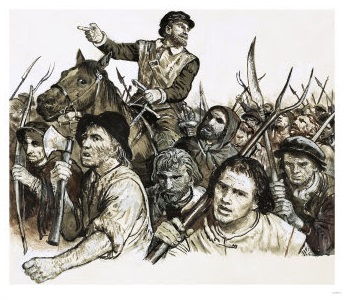






 After the Crash