Processing Distortion with Peter B. Collins: Big Data Shows Only 5% of FBI Domestic Terrorism Cases Are Untainted

TerronoiaUSA

By Peter B. Collins

Source: Boiling Frogs

Peter B. Collins Presents Attorney Stephen Downs

As a retired lawyer, Steve Downs volunteered to represent a local Muslim who was entrapped in an FBI sting. From that, he learned of other similar cases, and he co-founded Project Salam. Their new report, Inventing Terrorists: The Lawfare of Preemptive Prosecution, analyzes about 400 domestic terrorism prosecutions since 2001 and finds that 72% of the cases involved preemptive investigations that included paid informants and provocateurs who often supplied the idea and the means for plots that were then exposed to fawning media outlets. Another 22% of the cases involved minor, non-terrorist crimes that were manipulated and amplified by the FBI. The numbers show a clear pattern of abuse, mostly of Muslim suspects.

*Stephen Downs spent most of his career as an attorney for New York State’s judicial oversight commission. You can read the report and browse the database here

Listen to the Preview Clip Here

http://www.boilingfrogspost.com/wp-content/uploads/PD.clip.0039.Downs.mp3

Immortal Words from George Carlin

George Carlin in 2004.

Six years ago today George Carlin, one of the great American comedian/social critics, died of heart failure. It’s often assumed that people mellow with age but Carlin’s life and career is proof that the opposite can be true. Throughout much of the 60s, Carlin’s brand of comedy was good but rather mainstream and not outstanding. During the 70s, he reinvented himself, becoming one of the top counterculture comedians of the era. Carlin continued to make occasional appearances in mainstream film and television (eg. “Outrageous Fortune” and the Bill and Ted films), but from around the late 90s to 2008, his counterculture sensibilities came back with a vengeance. At the time, his later material didn’t seem to resonate with audiences as much as his material from the 70s. It was even more edgy, dark, and pessimistic, probably too much for the aging boomer demographic that previously made up the majority of his fanbase. However, for younger audiences discovering Carlin through the internet his words reflected the reality of the world as effects of increasingly corrupt political and economic systems could no longer be kept hidden by corporate media.

The following clip exemplifies what many people around the world love most about George Carlin and will forever remember him for:

Transcript

But there’s a reason… there’s a reason. There’s a reason for this, there’s a reason education SUCKS, and it’s the same reason it will never, ever, EVER be fixed.

It’s never going to get any better, don’t look for it, be happy with what you’ve got.

Because the owners, the owners of this country don’t want that. I’m talking about the real owners now, the BIG owners! The Wealthy… the REAL owners! The big wealthy business interests that control things and make all the important decisions.

Forget the politicians. They are irrelevant. The politicians are put there to give you the idea that you have freedom of choice. You don’t. You have no choice! You have OWNERS! They OWN YOU. They own everything. They own all the important land. They own and control the corporations. They’ve long since bought, and paid for the Senate, the Congress, the state houses, the city halls, they got the judges in their back pockets and they own all the big media companies, so they control just about all of the news and information you get to hear. They got you by the balls.

They spend billions of dollars every year lobbying, lobbying, to get what they want. Well, we know what they want. They want more for themselves and less for everybody else, but I’ll tell you what they don’t want:

They don’t want a population of citizens capable of critical thinking. They don’t want well informed, well educated people capable of critical thinking. They’re not interested in that. That doesn’t help them. Thats against their interests.

Thats right. They don’t want people who are smart enough to sit around a kitchen table and think about how badly they’re getting fucked by a system that threw them overboard 30 fucking years ago. They don’t want that!

You know what they want? They want obedient workers. Obedient workers, people who are just smart enough to run the machines and do the paperwork. And just dumb enough to passively accept all these increasingly shitty jobs with the lower pay, the longer hours, the reduced benefits, the end of overtime and vanishing pension that disappears the minute you go to collect it, and now they’re coming for your Social Security money. They want your retirement money. They want it back so they can give it to their criminal friends on Wall Street, and you know something? They’ll get it. They’ll get it all from you sooner or later cause they own this fucking place! It’s a big club, and you ain’t in it! You, and I, are not in the big club.

By the way, it’s the same big club they use to beat you over the head with all day long when they tell you what to believe. All day long beating you over the head with their media telling you what to believe, what to think and what to buy. The table has tilted folks. The game is rigged and nobody seems to notice. Nobody seems to care! Good honest hard-working people; white collar, blue collar it doesn’t matter what color shirt you have on. Good honest hard-working people continue, these are people of modest means, continue to elect these rich cock suckers who don’t give a fuck about you….they don’t give a fuck about you… they don’t give a FUCK about you.

They don’t care about you at all… at all… AT ALL. And nobody seems to notice. Nobody seems to care. Thats what the owners count on. The fact that Americans will probably remain willfully ignorant of the big red, white and blue dick thats being jammed up their assholes everyday, because the owners of this country know the truth.

It’s called the American Dream because you have to be asleep to believe it.


Saturday Matinee: Documentary Double Feature

MV5BMTQxMjMzMTczM15BMl5BanBnXkFtZTcwNzg5MzUyMQ@@._V1_SY317_CR4,0,214,317_AL_MV5BMTM4Nzk5Mzk4N15BMl5BanBnXkFtZTcwNTk5OTgyMQ@@._V1_SY317_CR5,0,214,317_AL_

Today I’m featuring two classic political documentaries, both more than a decade old (from 2003) yet still equally topical and among the best films on their respective subject matters.

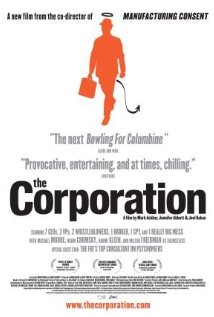
The first is Mark Achbar and Jennifer Abbott’s “The Corporation”, a comprehensive and well-researched film exploring the history of corporations, how they operate and how they’ve come to attain so much political power. Related topics they cover include the 1933 attempted corporate coup exposed by General Smedley Butler, the Fox news coverup of the dangers of Monsanto’s Bovine Growth Hormone, and the mass protests in Bolivia sparked by the attempted privatization of their water supply in 2000.

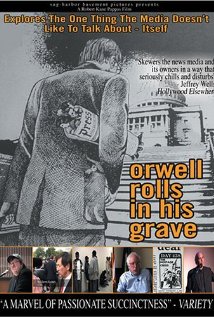
“Orwell Rolls in His Grave” directed by Robert Kane Pappas is possibly the best dissection of contemporary mass media propaganda yet, with a focus on corporate media consolidation and the role of corporate media in the controversial US presidential election of 2000. The film features interviews with Mark Crispin Miller, Bernie Sanders and Danny Schechter among others.

Podcast Roundup

6/8: Hosts Mickey Huff and Peter Phillips discuss the ongoing situation in the Ukraine with Dr. Michael Parenti, Prof. Michel Chossudovsky, and former Congresswomen and Green Party Presidential candidate Cynthia McKinney on “the Project Censored Show”. All of them are contributors to a new book by Clarity Press edited by Stephen Lendman, “Flashpoint Ukraine: How the US Drive for Hegemony Risks WWIII.”

https://s3.amazonaws.com/Pcradiodos/Project+Censored+060614.mp3

6/9: On “the Progressive Commentary Hour”, host Gary Null interviews Dr. Andrew Wakefield, a gastroenterologist and academician specializing in inflammatory bowel disease and the measles-mumps-rubella vaccine or MMR. They discuss how the US government uses corporations and universities to support policies, silence top scientists, jeopardize public health and protect corporate profits.

http://s36.podbean.com/pb/3f11f4e516587793b6f2d38475623afc/5398ccbc/data1/blogs18/371244/uploads/ProgressiveCommentaryHour_060914.mp3

6/10: On “the Higherside Chats”, Adam Gorightly and Vyzygoth joins host Greg Carlwood for a freewheeling but illuminating conversation about the suppressed history of the United States hidden beneath lies and disinformation most have been led to believe.

http://thehighersidechats.com/wp-content/uploads/2014/06/112-Vyzygoth.mp3

6/12: KMO talks with Vincent Horn of Buddhist Geeks on the lastest C-Realm podcast. They discuss the use of mindfulness techniques in technological society and its connection to DIY, Quanitifed Self and Maker movements. KMO wraps up with commentary on the nature of individualism and community.

http://www.c-realm.com/wp-content/uploads/418_Adaptive_Comtemplation.mp3


Individual Wealth in Perspective

billionairehousing

By James Hall

Source: Negotium

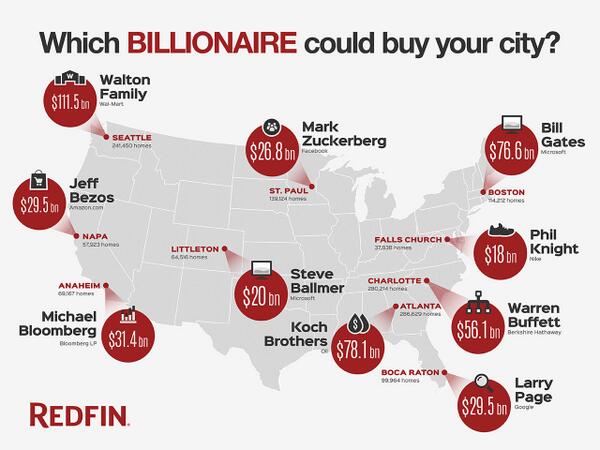
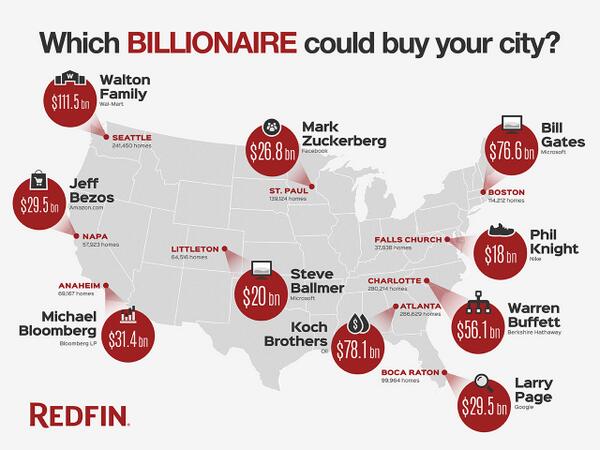
A quaint comparison of what money can buy in today’s market has Bill Gates being able to afford every home in Boston. His $76.6 billion reported by the Washington Post or the $78.4 billion by Forbes seems a pittance when put up against John D. Rockefeller’s peak wealth of $318.3 billion (based on 2007 US dollar). According to your resident commissars over at MSNBC, “The median net worth of American households hasn’t changed much over the past decades, it’s about $20,000.” So if Gates decided to purchase all the Beantown houses, whom would he pay for the bricks and mortar? Certainly, most Americans may think of “their home is their castle”, but few actually own a debt free deed to their grand estate. No wonder the banks and financial institutions, are so fond of placing liens on real property.

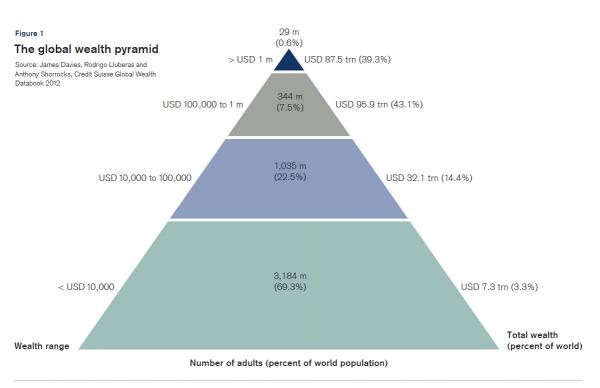
The proportional context of looking at individual wealth within the relative value of global wealth is examined in the essay; It’s A “0.6%” World: Who Owns What Of The $223 Trillion In Global Wealth, seems trite. Zerohedge concludes, “The bottom line: 29 million, or 0.6% of those with any actual assets under their name, own $87.4 trillion, or 39.3% of all global assets.”

CSwealth

Here are the stunning facts:

“In 2012, 3.2 billion individuals – more than two-thirds of the global adult population – have wealth below USD 10,000, and a further one billion (23% of the adult population) are placed in the USD 10,000–100,000 range.

The average wealth holding is modest in the base and middle segments of the pyramid, total wealth amounts to USD 39 trillion, underlining the potential for new consumer trends products and for the development of financial services targeted at this often neglected segment.

The remaining 373 million adults (8% of the world) have assets exceeding USD 100,000.

And then the top of the pyramid: 29 million US dollar millionaires, a group which contains less than 1% of the world’s adult population, collectively owns nearly 40% of global household wealth.

Some 84,500 individuals are worth more than USD 50 million, and 29,000 are worth over USD 100 million.”

After absorbing this macro economic analysis, it should ease the pain that the stewardship of world wealth is in such trustworthy hands. No need to burden the masses with the weight of building wealth, when that formula for getting to the top of the financial pyramid, has room for only the few. The expert obelisk creators never meant for wealth sharing and the tools to construct one’s own prosperity are not included in your capital accumulation education. The liability of mortgage and property tax obligations to retain your edifice requires regular payments to maintain the privilege of possession. Ownership is only a conditional wealth asset.

Investopedia says 3 Simple Steps To Building Wealth are:

“You need to make it. This means that before you can begin to save or invest, you need to have a long-term source of income that’s sufficient enough to have some left over after you’ve covered your necessities.

You need to save it. Once you have an income that’s enough to cover your basics, you need to develop a proactive savings plan.

You need to invest it. Once you’ve set aside a monthly savings goal, you need to invest it prudently.”

Ordinary consumers do not build great fortunes. The elementary prescription for “getting ahead” is severely limited in thinking for a world that frequently conducts business as a blood sport. However, many of the enterprises that carve out a market for their products or services have a distinct edge over the unconnected entrepreneur. Namely, government directed and controlled startups or collaborated ventures frequently become the commercial giants of the economy. Here lays the confusion when defining wealth as an accounting device of personal ownership of assets.

In addition, governments are often in the privatization and sale of state assets. The Economists reports that the “IMF estimate that non-financial government assets average 75% of GDP in advanced economies. In most countries, these are worth more than financial assets (stakes in listed firms, sovereign-wealth and securities holdings and the like).”

Liquid cash flow and high worth individuals, especially with inside track contacts, are able to cherry pick sweet heart deals. Such opportunities, usually transfers treasure, but infrequently are engines of new wealth creation. The only guarantee is that money, made or lost depending upon the accounting needs of the vulture predator, is never an option for the normal hard working taxpayer.

Unless people accept the reality that creating and growing wealth is a noble objective that involves the widespread commerce participation of a merchant class, the outrageous disparity of the top down wealth stream will widen even more, as the top tier inclusion narrows to fewer mega-billionaires.

Global business encourages transnational conglomerates with commercially identifiable names and logos. When entire economies prevail under a business plan that eliminates any rival competition, and achieves sole market dominance, the prospects to advance the individual wealth ledger of the average person diminishes.

An opportunistic society can only exist when independent business flourishes. Government bureaucrats and corporate technocrats oppose an unambiguous free market economy. As the map of the über-billionaires illustrates, their checkbook could swallow up entire cities. However, digesting, let alone growing communities into quality environments for future generations, takes an active involvement in the wealth building process that rewards contributing players.

Without a widespread populace practicing mutually beneficial business transactions, the capacity to achieve the skills necessary to compete successfully, will never develop. Instead of making money, saving money and investing money, learn the aptitude of business as a lifelong endeavor.

The poor will always be scraping the bottom, until they learn how to advance their abilities for the betterment of their own families. The alternative to greater concentration of wealth is to initiate a viable substitute to the financial stranglehold that furthers the appetites of egomaniacs like the character, Bretton James in the movie Money Never Sleeps. In the end, the true individual wealth that anyone can attain is the sincerity and moral substance of his or her own character. Money may not snooze from making more cash, but is only a means to elevate living a life worth lived.

In such a quest, the super rich may have a net worth equivalent to one’s property, but they can never afford the essence of your family or measure of your community.


Deep Anger

rage-super-rage

By Darren Fleet with Stefanie Krasnow

Source: Adbusters

In a better world, there’d be no reason to write this. In that world, plastic bags would be outlawed, rednecks would voluntarily stop driving those obnoxious Ford F-350s and the yogis in yuppie neighborhoods would stop believing that a hybrid SUV could save the planet. But that’s not the world we live in.

In this world, when push comes to shove, most of us are too comfortable to care, too polite to speak out. With so much at stake we need to rediscover something we lost along the way: our anger.

I’ve been around a while now and all I can say is that everything has gotten worse. Deforestation. Species extinction. Overfishing. Melting glaciers. CO2 through the roof. We won a few symbolic victories here and there, but the big picture is total loss. And that’s why this isn’t your standard a-better-world-is-possible-peace-and-love-we’re-all-in-this-together-be-the-change-you-want-to-see circle jerk that has become the cachet of an entire generation of professional activists.

I’m a child of the “awareness generation,” the one who grew up learning to reduce, reuse and recycle. I remember first learning about global warming and climate change in high school in the 90s. Back then it was called the Greenhouse Gas Effect. Most of my early environmental knowledge came from classroom videos about acid rain, slash-and-burn logging in the Amazon and the hole in the ozone layer. There was also the slogan “think globally, act locally” plastered across my Social Studies 11 class wall. Those of us who cared two cents about anything believed in that mantra religiously, even though by that point almost everything around us—the school supplies, the clothes on our backs, even the food in our stomachs—came from across an ocean.

At the same time that we were learning to be more conscientious about our market choices, the global bazaar was pried open by the WTO, NAFTA and GATT trade regimes, effectively eliminating any possibility we had to make truly environmental choices. Before we were even old enough to know about our carbon footprint, it was already ten times that of a kid in the developing world. Meanwhile, our history books were full of inspirational Gandhi, MLK and Mandela quotes, all driving home the point that change, even revolution, was sentimental, nice, easy, positive. The first time the cops threatened to arrest us at an environmental protest, we shit our pants. Turns out positivity has its limits. And that’s exactly how we got into this mess.

There’s nothing worse than interorganizational bitching, especially among environmental campaigners and NGOs. We’re like a bunch of abused children taking out our frustrations on each other when we should be unified and directing our focus elsewhere. But since we don’t have the collective gumption to stand up to the man, we squabble among ourselves; it’s the only way to release the impotent rage we all feel. Even so, I have this to say: every time I see one of my environmental heroes jump on the corporate bandwagon to say some stupid-ass shit about how there are no sides in the climate struggle—how pessimism is an affront to the imagination—my heart breaks.

Recently, best-selling environmental author, TED talker, anthropologist and National Geographic explorer-in-residence Wade Davis went down that road. In an interview with a Vancouver newspaper he reflected proudly on his days as an energy company consultant, saying, “In all these resource conflicts, there are no enemies, only solutions.” This kind of well mannered sweetness, in the face of such a violent problem, is our greatest problem.

So if we’re going to get serious about disrupting an increasingly apocalyptic horizon, we’ve got to challenge the feel-good Hallmark sentiments that inundated my generation. We have to say fuck the TED talks, with their sincere but vacuous optimism. Fuck the positivity gurus claiming the world is not dying, it’s only changing. And fuck environmentalists willing to play nice with Big Oil and Big Energy, saying things like: “you’re not going to stop the tar sands. It’s naive to think you can,” as Davis recently proclaimed. This type of thinking sounds a lot like those fearful souls who thought apartheid was too entrenched to defeat, that Big Tobacco was too rich to take on, that austerity was too fixed to shake—that there’s nothing you, or I, or we can do in the face of a multi-trillion dollar industry. Truth is, nothing on this Earth is inevitable.

Last year, I watched in amazement as a group of radical First Nations scholars brought down the house in Vancouver at an academic conference called Global Power Shifts. Rather than reply with academia’s standard response when confronted with a social issue—“that’s problematic”—they had the guts to take a stand. One in particular, Dr. Glen Coulthard of the Yellowknife Dene, delivered a paper saying that folks on the front-lines of land, climate and environmental battles in Canada are tired of being told not be angry; that given the ongoing process of colonization, theft and exploitation, anger is not only the natural response, but the only moral response.

What he hinted at was a resurgent anger. Deep Anger. The type of anger that overturns tables, defends the weak from the strong, would rather die than live on its knees. Most mainstream environmentalists don’t like this kind of language. It means you have to do more than sign a petition. It means you can’t count miniscule corporate concessions as victories. It means you have to let yourself unravel a bit.

In our culture, anger is seen as impolite, brutish, violent and indulgent. It’s politically incorrect. It makes people squeamish. We’re afraid of anger like we’re afraid of obsessive passion and overt eroticism. Anger is dark and dirty, but Deep Anger is a form of empathy, care, even love.

Psychologists explain that anger is a natural and appropriate response to violating behavior, to situations where our boundaries have been crossed. Not having a say in whether or not ecocide is going to happen—and being asked to participate in a calm and nice debate about whether or not the tar sands should expand or not—is a violation of our boundaries. Yet somehow, we’re expected to smile and keep our imaginations open as if positivity were the goal of the movement.

The great irony is that, despite our civilization’s claim to reason, there is a deep irrationality, a fatal blind spot blocking out emotion and sanity. We’re so deeply in denial about what is happening to our planet that we’re risking our own extinction.

Unless humanity breaks through the denial, unless we start to get angry—fuckin’ angry—then we won’t ever be able to accept the challenge at hand. We won’t ever be able to rise up and face our planetary reality … we won’t ever be able to fight … and we won’t be able to win.

Inequality Has Been Eliminated

etc_stack15__01__630x420

By Chad Hill

Source: the Hipcrime Vocab

Have you heard? Inequality has been eliminated.

What? You didn’t know that? Well, certain “professional” economists have proved it is true.
You may wonder, when you drive around your town, why formerly occupied strip malls lie abandoned, and the only local businesses are Cash-For-Gold, Payday Loans, Dollar Stores, and tattoo parlours. You may ignore the people standing near freeway exits with signs begging for work or money (these have exploded where I live), or the people rolling around shopping carts with all their worldly possessions, or the people living in their cars. It’s all an illusion. Detroit? Chicago? Merely a mirage.

You may wonder at all the empty, shuttered factories, or the fact that the Wal-Mart Super Store is the town’s biggest employer, or that “help wanted” signs seem to appear only in the local Arby’s or Home Depot (or my favorite “owner operators wanted”). You may puzzle at the foreclosed homes stripped of copper and being overgrown with weeds that litter towns from coast to coast. The entire neighborhoods that lie empty and abanadoned? Another mirage, silly. The crumbling roads and local governments “tightening their belts?” Not happening.

Not happening. Nope, none of it.

You may have heard stories about people thirty or forty years ago with high-school educations being able to get jobs that supported families, allowed them to buy a house and save money. You may have heard about people able to save up enough to go to college by just working a summer job. You may have heard of people twenty or thirty years ago with full-time jobs that had benefits such as paid vacations and health care, which are now being stripped away job by job. You may have heard about something called a “union.”

False. All false. The world is getting more equal every day thanks to globalized corporate capitalism. The economists told me so.

You may even know people who have lost their job and are unable to find another one because employers discriminate against the unemployed. You may know someone with huge debt burdens because the cost to train workers is borne entirely by the workers themselves, and you have to go tens of thousands of dollars into debt just to get a job at all. Or you may know someone who was foreclosed upon, or drowning in debt due to an unforeseen circumstance or medical emergency. You might know people who’ve had to take jobs with much lower pay and benefits than the ones they had before. You may know people working brutally long hours, or denied extra work time so that they don’t qualify for health care benefits. You may know people who have used food stamps to feed themselves or their families, even though they work full time jobs. You may know older people who have to work because they can’t afford to retire.

They all deserve it. All of them. They’re all lazy. Laziness has exploded since 2008, don’t you know. Everyone gets exactly what they deserve. It’s never been  better time to be a worker under capitalism.

You may look on the outrageous fortunes spend by the rich and conclude that they are reaping more and more benefits by breaking wages and shipping jobs overseas. Don’t you believe it! Their riches are making everyone better off. Just look at Bill Gates! He gives money to poor people in Africa. And Steve Jobs. He invented the iPod in his basement, or something. Soaring CEO salaries are great. The bailouts were all paid back. And the soaring stock market prices will make everyone rich! Don’t worry about the costs for food, housing, education and transport. The “free market” will take care of it all and unleash abundance, but only if the “job creators” don’t have to pay taxes. Those trust fund kids getting unpaid internships and getting jobs downtown – that’s just a natural part of capitalism, it has nothing to do with inequality. The fact that entire cities are unaffordable for people making less than six figures? College and health care costs? Forget about it. Nothing to do with inequality, which, by the way, has been going down, not up. Besides, even if it were going up, inequality doesn’t matter, what matters is that life is getting better even for people even at the bottom. They love being in debt and working for minimum wage! And besides, the life for the average person is getting better and better the more riches the wealthy and powerful accumulate. After all we have smart phones. SMART PHONES!!!

All those people protesting around the world? They just don’t understand capitalism.

You may even have read books and articles asserting that we are a “winner-take-all” economy, a “servant economy,” or something like that. Not true! Those books and articles were all written by “leftists” and “liberals” who don’t understand science and statistics. Articles like this are just sensationalism by liberals who hate our freedom:

76% of Americans are living paycheck-to-paycheck (CNN)

The Middle Class Is Steadily Eroding. Just Ask the Business Community (NYT)

The Financial Vulnerability of Americans (House of Debt)

Employment Down, Profits Up: The Aftermath of the Financial Crisis in 1 Graph (The Atlantic)

‘Happy Days’ no more: Middle-class families squeezed as expenses soar, wages stall (Wall Street Journal)

A Dozen Facts about America’s Struggling Lower-Middle-Class (Brookings)

America’s Sinking Middle Class (NYT)

Why So Little Media Coverage of How the Rich Are Becoming Richer and the Middle Class Wages are Being Squeezed? (Naked Capitalism)

RIP, the middle class: 1946-2013 (Salon)

Yep, Being a Young, American Adult Is a Financial Nightmare (The Atlantic)

Ripping Off Young America: The College-Loan Scandal (Rolling Stone)

Median CEO Pay Just Topped $10M for the First Time (Slate)

Upgrade or Die (George Packer)

San Francisco’s Income Inequality Rivals that of Developing Nations (Vanity Fair)

Gap Between Rich And Poor In Manhattan “Rivals Sub-Saharan Africa” (Gothamist)

How did the economists come to this conclusion, you ask? Well, Piketty made a few spreadsheet errors. And thanks to that, the professional economist caste can breathe a sigh of relief that all of the things I named above don’t exist, and happily go back to their blackboards and spreadsheets in their corporate-funded free-market think-tank cubicles and university offices.

Because inequality is entirely dependent upon r being greater than g. That is, the rate of return to capital (yes, let’s just argue about what constitutes “capital,” that will make this whole thing go away), must be greater than g, the rate of growth of the economy. Because, heaven knows, it’s not like workers could ever get paid less than the growth of the economy, right?

Right?

Read the full article here: http://hipcrime.blogspot.com/2014/06/inequality-has-been-eliminated.html

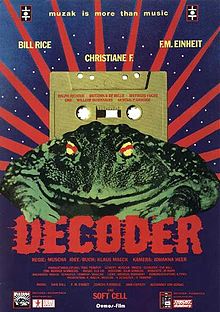
Saturday Matinee: Decoder

Decoder_1984_poster.jpeg

William S. Burroughs and industrial music all-stars in dystopian 80s cult film ‘Decoder’

By Ron Kretsch

Source: Dangerous Minds

If your life needs a little-seen dystopian ‘80s German film about Industrial music sparking revolutionary change in a society of fast food and cultivated complacency—and I believe it does—then your life needs Decoder. Largely illuminated in lurid reds and TV-tube blues, the 1984 film starred Einstürzende Neubauten’s then-percussionist F.M. Einheit as a sonic experimenter who discovers that playing back recordings of disturbances in public spaces can create actual disturbances among the public, a concept developed by William Burroughs in the “Electronic Revolution” essay found in some editions of the collection The Job. (In fact, Burroughs briefly appears in the film, as does Throbbing Gristle/Psychic TV’s Genesis P-Orridge.)

Einheit uses this esoteric knowledge to cultivate increasingly widespread defiance and mayhem, attracting the attention of a Muzak corporate hit-man (I love the conceit that Muzak would have an assassin in its employ) whose task is complicated by his crush on F.M.’s peep-show dancer/amateur herpetologist girlfriend, played by Christiane F. The film’s themes and inspirations are illuminated by its writer Klaus Maeck in this interview from Jack Sargeant’s Naked Lens: Beat Cinema, excerpted here from the film’s web site.

I wanted to realize Burroughs’ ideas and the techniques which he described in the ‘Electronic Revolution’, and in The Revised Boy Scout Manual and in The Job. These were my favorite books … And I loved Johnny Rotten for his revolution in show business (and I still do). I was convinced that the only valuable political work must use the enemy’s techniques. From the ‘Foreword’ of the Decoder Handbook: “It’s all about subliminal manipulation, through words, pictures and sound. It is the task of the pirates to understand these techniques and use them in their own interest. To spread information is the task of all media. Media is power. And nowadays (1984!) the biggest revolution happen at the market for electronic media. To spread information is also your task. And we should learn in time to use our video and tape recorders as Weapons. The fun will come by itself.”

Being in the music business and participating in the punk and new wave explosion I became more interested in music. Muzak was one thing I found. Subliminal music to influence people’s moods, to make them function better, or buy more. So my conclusion was similar to that of ‘bands’ like Throbbing Gristle; by turning around the motivation, by cutting up the sounds, by distorting them etc. one should be able to provoke different reactions. Make people puke instead of feeling well, make people disobey instead of following, provoke riots.

Though it deals thoughtfully with provocative ideas, the film is laden with Euro art-film pretense that feels like fit matter for a “Sprockets” gag. Early on there’s a montage of video games cut with military stock footage, and another that alternates gore and erotica while Soft Cell’s “Seedy Films” plays.

But as strange as it can be, Decoder still holds a coherent, if dreamy, narrative, filled with captivating imagery and a gorgeous soundtrack composed by Einheit, P-Orridge, and Soft Cell’s Dave Ball. You can watch it in its entirety right here. I’ll throw the trainspotters a bone: Burroughs’ cameo is in the scene that starts at about 37:30, and P-Orridge’s appearance is at about 49:00.