WikiLeaks Cables Reveal U.S. Gov’t Planned To “Retaliate and Cause Pain” On Countries Refusing GMOs

monsanto

By Arjun Walia

Source: Collective Evolution

Studies that link Genetically Modified (GM) food to multiple human health ailments are not the only thing that has millions of people questioning the production of GM food. The fact that previously classified secret government documents show how the Bush administration developed ways to retaliate against countries that were refusing to use GM seeds is another. If documents regarding our food are required to be concealed from the public domain, something is not right, and it’s great to have an organization like WikiLeaks shed some light into the world that’s been hidden from us for so many years.

Targeting Certain Countries

The cables reveal that the State Department was lobbying all over the world for Monsanto, and other major biotech corporations. They reveal that American diplomats requested funding to send lobbyists for the biotech industry to meet with politicians and agricultural officials in “target countries.” These included countries in Africa, Latin America and some European countries.

A non-profit consumer protection group called Food & Water Watch published a report showing the details of the partnership between the federal government and a number of biotech companies who have pushed their GMO products on multiple countries for a number of years.

“The United States has aggressively pursued foreign policies in food and agriculture that benefit the largest seed companies. The U.S. State department has launched a concerted strategy to promote agricultural biotechnology, often over the opposition of the public and government, to the near exclusion of other more sustainable, more appropriate agricultural policy alternatives. The U.S. State department has also lobbied foreign governments to adopt pro-agricultural biotechnology politics and laws, operated a rigorous public relations campaign to improve the image of biotechnology and challenged common sense biotechnology safeguards and rules – even including opposing laws requiring the labeling of genetically engineered (GE) foods.” (source) 

HERE is one cable (out of many) from Morocco.

HERE Is a 2008 cable that summarizes a French documentary called “The World According to Monsanto which attacks the U.S. biotech industry and the fact that Monsanto and the U.S. Government constantly swap employees and positions, below is a excerpt from the cable:

Corporations Dictate Government Policy

“The film argues that Monsanto exerted undue influence on the USG. Former Secretary of Agriculture Dan Glickman is interviewed saying he had felt that he was under pressure and that more tests should have been conducted on biotech products before they were approved. Jeffrey Smith, Director, Institute for Responsible Technology, who is interviewed says that a number of Bush Administration officers were close to Monsanto, either having obtained campaign contributions from the company or having worked directly for it: John Ashcroft, Secretary of Justice, received contributions from Monsanto when he was re-elected, as did Tommy Thompson, Secretary of Health; Ann Veneman, Secretary of Agriculture, was director of Calgene which belonged to Monsanto; and Donald Rumsfeld, Secretary of Defense, was CEO of Searle, a Monsanto subsidiary; and Justice Clarence Thomas was a former lawyer for Monsanto.”

This is one example (out of many) that clearly show how giant corporations pretty much dictate government policy. When it comes to these food corporations, they are responsible for forcing independent agriculturists to go out of business, controlling the world’s seed supply and forcing farmers to become dependent on their seed. Monsanto and corporations like them have created this seed, and have prevented farmers from seed saving and sharing, which results in a dependence on Monsanto’s patented GMO seeds.

“The state department sent annual cables to ‘encourage the use of agricultural biotechnology,’ encouraging every diplomatic post worldwide to ‘pursue an active biotech agenda’ that promotes agricultural biotechnology, encourages the export of biotech crops and foods and advocated for pro-biotech policies and laws.” (source)

“The US Department of State is selling seeds instead of democracy. This report provides a chilling snapshot of how a handful of giant biotechnology companies are unduly influencing US foreign policy and undermining our diplomatic efforts to promote security, international development and transparency worldwide. This report is a call to action for Americans because public policy should not be for sale to the highest bidder.” – Wenonah Hauter, Food & Water Watch Executive (source)

One of the most revealing cables is from 2007, with regards to French efforts to ban a Monsanto GM corn variety. HERE is a cable that shows Craig Stapleton, former ambassador to France under the Bush administration, asking Washington to punish the EU countries that did not support the use of GM crops:

“Country team Paris recommends that we calibrate a target retaliation list that causes some pain across the EU since this is a collective responsibility, but that also focuses in part on the worst culprits. Moving to retaliation will make clear that the current path has real costs to EU interests and could help strengthen European pro-biotech voices.” (see source in above paragraph)

The U.S. government was not only working for the biotech industry, they were also threatening other governments who did not comply. Think about that for a moment. Over the years the United States government and Monsanto have collectively pushed their GMO agenda upon the rest of the world. Why? Do you really think it is to help feed the world? This could easily be done if we came together and pooled our resources. The entire planet could easily be fed organic food, and it could be done for free.

The World’s Resistance To GMOs

The past two years alone has seen millions of people from across the globe gather to show their opposition towards Monsanto and similar corporations. The “March Against Monsanto” is clear evidence of this. The people of the world are starting to see through the veil that’s been blinding the masses for years, and our food industry is one small, but large and important area where the veil is being lifted.

Activism and awareness has contributed to the banning of GMO products and the pesticides that go with them in multiple countries across the planet, it’s time for North America to follow suit.

Related CE articles:

New Study Links GMOs To Cancer, Liver/Kidney Damage & Severe Hormonal Disruption.

10 Scientific Studies Proving That GMOs Can Be Harmful To Human Health

For more CE articles on this subject please click HERE


Sources:

http://wikileaks.org/cable/2010/01/10RABAT14.html

http://www.cablegatesearch.net/cable.php?id=08PARIS614&q=monsanto

http://www.cablegatesearch.net/cable.php?id=07PARIS4723&q=france%20gm

http://rt.com/usa/wikileaks-monsanto-cables-report-273/

http://www.foodandwaterwatch.org/reports/biotech-ambassadors/


Five Questions We’re Asking About the Ebola Scare

Viral-Hemorrhagic-Fever-Erupts-in-Guinea-Caused-by-the-Ebola-Virus-650x433

By Aaron Dykes and Melissa Melton

Source: Truthstream Media

Now that the Ebola situation has hit the 24/7 mainstream media zoo, serious questions are being raised as to why now.

After all, people were dying of Ebola in the hundreds in West Africa before this week. Aid workers and doctors were getting infected before. These things are not new, but the sudden media focus raises lots of questions.

To start…

Why are they shipping Ebola-infected patients onto American soil for the first time?

As many have pointed out, this move seems particularly…ill-advised. The U.S. Centers for Disease Control and Prevention cautioned people not to fly to the affected areas, but our State Department is going to go out of its way to put together heavily publicized, special containment tents inside planes to fly two Americans here while the media in lockstep makes a huge play-by-play deal?

It isn’t exactly level 4 containment all the way, either, as Underground Medic‘s Lizzie Bennett pointed out yesterday: the one guy arrived at the hospital and just got out of the ambulance and walked on in.

Why is Obama amending executive orders about quarantining people infected with Ebola when he already had that power?

The president just amended a G.W. Bush-era executive order 13295 which allows “apprehension, detention, or conditional release of individuals to prevent the introduction, transmission, or spread of suspected communicable diseases.”

Section 1, subjection b has now been replaced with the following:

“(b)  Severe acute respiratory syndromes, which are diseases that are associated with fever and signs and symptoms of pneumonia or other respiratory illness, are capable of being transmitted from person to person, and that either are causing, or have the potential to cause, a pandemic, or, upon infection, are highly likely to cause mortality or serious morbidity if not properly controlled.  This subsection does not apply to influenza.”

Sure sounds like Ebola, doesn’t it?

But in reality, those quarantine powers were already in place. It even says so on this CDC map of U.S. quarantine stations fact sheet the agency released in August 2013.

cdcfactsheetquarantine

Ebola definitely counts under the category “viral hemorrhagic fevers”.

So why make a big deal amending an executive order when the power to detain people who have, or are suspected to have Ebola, already exists?

The CDC also just released a brand new, timely webpage “Infection Prevention and Control Recommendations for Hospitalized Patients with Known or Suspected Ebola Hemorrhagic Fever in U.S. Hospitals” as if it just completely slipped the agency’s mind to disseminate information to medical professionals on how to deal with Ebola before now. Come on. The page does, however, mention guidance for exposure to “contaminated air,” which is odd considering the CDC director has gone out of his way to say that there’s no way an Ebola outbreak could ever happen in the U.S. 

What exactly have Ft. Detrick biowarfare researchers been doing in the Ebola hot zone in West Africa all this time?

Independent investigative reporter Jon Rappaport asked this very same question the day before yesterday, but it seems like a good one. He had several other questions, and they are all good ones:

What exactly have they been doing?

Exactly what diagnostic tests have they been performing on citizens of Sierra Leone?

Why do we have reports that the government of Sierra Leone has recently told Tulane researchers to stop this testing?

Have Tulane researchers and their associates attempted any experimental treatments (e.g., injecting monoclonal antibodies) using citizens of the region? If so, what adverse events have occurred?

The research program, occurring in Sierra Leone, the Republic of Guinea, and Liberia—said to be the epicenter of the 2014 Ebola outbreak—has the announced purpose, among others, of detecting the future use of fever-viruses as bioweapons.

Is this purely defensive research? Or as we have seen in the past, is this research being covertly used to develop offensive bioweapons?

The same day, Navy Times published an article talking about how U.S. biowarfare scientists have been highly interested in Ebola since at least the late 1970s for engineering bioweapons: “mainly because Ebola and its fellow viruses have high mortality rates…and its stable nature in aerosol make it attractive as a potential biological weapon.”

But the article goes on to say that scientists from the U.S. Army Medical Research Institute of Infectious Diseases (USAMRIID) have been working on a vaccine since then, a purely defensive measure. Of course, they can’t come out and say they’re working on offensive weapons. The Biological Weapons Convention went into effect in 1975, supposedly putting an end to the government’s biological weapons program.

Why does the U.S. government own a patent on a novel strain of Ebola that those same Ft. Detrick researchers quietly admitted in a CDC journal article last month may actually be the cause of the current Sierra Leone outbreak, not Ebola Zaire as widely reported?

This one gets tricky.

There are five types of Ebola virus and the newest strain is named Bundibugyo, or Ebobun for short. The U.S. government actually holds a patent on this strain — US 20120251502 A1, for “Human Ebola Virus Species and Compositions and Methods Thereof” related to the Bundibugyo version of the virus.

Last month, the same Ft. Detrick researchers who have been over in the Ebola hot zone published an article in the CDC’s Emerging Infectious Diseases where they discuss the human testing that has been going on over there and down near the bottom of the article, they quietly admit, “Ebolavirus infections in Sierra Leone might be the result of Bundibugyo virus or an ebolavirus genetic variant and not EBOV.”

The kicker?

The Ebobun version of Ebola, which is apparently been found to be “genetically distinct,” as it differs by more than 30% at the genome level from all other known ebolavirus species, apparently has a much lower death rate than the Zaire version the media keeps talking about.

Not that Ebola in any form isn’t dangerous. It’s deadly, period. But Ebobun had a 36% mortality rate at the initial outbreak in 2007, versus 70-90% on average for Zaire.

Additionally, because it is much more unique, researchers have suggested that if a vaccine or treatment is created for Ebola and the Ebobun strain is not taken into account, the resulting treatment or vaccine obviously might not work on it.

Regardless, all the mainstream media seems interested in driving home on repeat these days is that this outbreak is the Zaire strain which has a 90% mortality rate and no cure. Well…even that isn’t entirely true…

A NOVA presentation from 1995 clearly shows survivors and discusses how a nurse named Nicole was given blood transfusions from an infected patient who survived, to build up antibodies. A review sums it up:

After one week, Nicole began to recover. Spurred by this result, the Zairian doctors transfused an additional eight patients. Seven of the eight patients survived, but the Western doctors remain unconvinced. Because the experiment was completely uncontrolled, they argue that we will never know that the transfusion saved the lives of those patients.

That was 20 years ago. Current news stories even discuss how the doctor who was flown here infected with Ebola was given a unit of blood from a 14-year-old who survived Ebola. The female patient flown in was also reportedly given an experimental serum no one seems to elaborate much on.

On top of that, articles from 2008 show a vaccine was highly effective in monkeys and even used experimentally in a human patient with success. Where did those vaccines go? Why aren’t they widely available six years later?

And finally, as with any crisis, who stands to gain from this, and what is it they are ultimately after?

Just asking.

One company Tekmira, who has been performing Phase I clinical trials for an Ebola drug it has been working on in otherwise healthy adult patients has seen its stock skyrocket over the last two weeks, even though its experiments in humans have now been halted due to safety concerns.

Tekmira apparently has a $140 million contract with none other than the USAMRIID to work on this drug, along with a multi-million contract with biotech giant Monsanto for the same technology. The drug was granted FDA fast track status back in March. As the company’s site says, however, the drug is apparently for the Zaire strain of the virus.

So has Tekmira taken the Ebobun strain into account?

In addition, now Reuters is reporting that Ebola vaccines have been fast tracked as well, with human experiments starting as early as next month. Wow, that was fast. Will those vaccines take Ebobun into account?

The last time a vaccine was fast tracked in such a manner, it was for the purposefully overblown swine flu “pandemic” — a created “campaign of panic” basically designed to sell vaccines and grant more emergency powers.

As Aaron Dykes reported in 2010:

Wolfgang Wodarg, head of health at the Council of Europe, claims that the threshold for alert was deliberately lowered at the WHO, allowing a “pandemic” to be declared despite the mildness of the ‘swine flu.’ That designation would force a demand for the vaccine, which was subsequently purchased by governments or health facilities and pushed on the public through a full-scale fear campaign in the media…

Wodarg is focusing on the motives for profit, as well as the ties between the World Health Organization (WHO), the pharmaceutical-industrial complex and research scientists, a nexus which Canada Free Press points out is eerily similar to the Climategate revelations that CRU research scientists fudged data to “hide the decline” in proxy temperatures in order to support global warming claims.

Wodarg made several disconcerting statements to the media, including:

“Never before the search for traces of a virus was carried out so broadly and intensively, besides, many cases of death that happen to coincide with seropositive H1N1 lab-findings were simply attributed to “swine-flu” and used to foster fear.”

“A group of people in the WHO is associated very closely with the pharmaceutical industry.”

“The great campaign of panic we have seen provided a golden opportunity for representatives from labs who knew they would hit the jackpot in the case of a pandemic being declared.”

In fact, that’s what CBS investigative reporter Sharyl Attkisson was set to expose, but her bosses refused to air her story. The mainstream media completely shut her down. Fear sells. The truth, by contrast, doesn’t.

“With the CDC keeping the true Swine Flu stats secret, it meant that many in the public took and gave their children an experimental vaccine that may not have been necessary,” Attkisson said. Read this piece on her 2009 interview with Jon Rappaport for more on how the CDC stopped counting cases of swine flu altogether and hyped the public into a panic that ultimately led to millions of people receiving potentially dangerous, fast-tracked vaccinations.

That’s right. Countries the world over reported many deaths and disabilities suffered in the wake of the fast-tracked H1N1 vaccine, a vaccine people scrambled to get after the hysteria over swine flu was over hyped everywhere, from government agencies to the mainstream media.

But hey, a lot of people in the military-medical-media industrial complex made a lot of money.

Much worse than mere greed, though, is the possibility of martial law and a forced mass vaccination scenario — a scenario where the military is “forced” to step in to contain “bio-threats” (regardless of whether or not those threats are real or made up). For more on that, see DARPA’s “Blue Angel” project.

Talking about something scary isn’t automatically scaremongering — but if the powers that shouldn’t be are scaremongering, we should talk about it.

(Meanwhile, headlines about ‘Ebola fear going viral’ are already screaming at people to be afraid…very very afraid.)


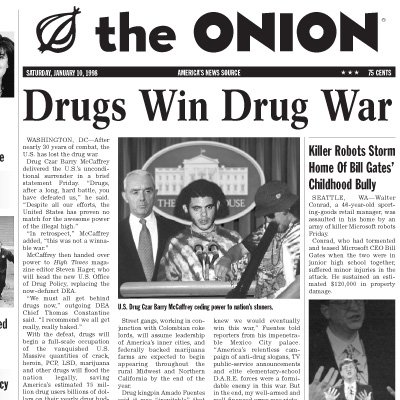
Why We Can’t Wage War on Drugs

drugs-win-war-on-drugs

The war on drugs was always a war against an idea. But ideas have a shelf-life, too, and this one has lost its potency

By Mike Jay

Source: Aeon Magazine

When the US President Richard Nixon announced his ‘war on drugs’ in 1971, there was no need to define the enemy. He meant, as everybody knew, the type of stuff you couldn’t buy in a drugstore. Drugs were trafficked exclusively on ‘the street’, within a subculture that was immediately identifiable (and never going to vote for Nixon anyway). His declaration of war was for the benefit of the majority of voters who saw these drugs, and the people who used them, as a threat to their way of life. If any further clarification was needed, the drugs Nixon had in his sights were the kind that were illegal.

Today, such certainties seem quaint and distant. This May, the UN office on drugs and crime announced that at least 348 ‘legal highs’ are being traded on the global market, a number that dwarfs the total of illegal drugs. This loosely defined cohort of substances is no longer being passed surreptitiously among an underground network of ‘drug users’ but sold to anybody on the internet, at street markets and petrol stations. It is hardly a surprise these days when someone from any stratum of society – police chiefs, corporate executives, royalty – turns out to be a drug user. The war on drugs has conspicuously failed on its own terms: it has not reduced the prevalence of drugs in society, or the harms they cause, or the criminal economy they feed. But it has also, at a deeper level, become incoherent. What is a drug these days?

Consider, for example, the category of stimulants, into which the majority of ‘legal highs’ are bundled. In Nixon’s day there was, on the popular radar at least, only ‘speed’: amphetamine, manufactured by biker gangs for hippies and junkies. This unambiguously criminal trade still thrives, mostly in the more potent form of methamphetamine: the world knows its face from the US TV series Breaking Bad, though it is at least as prevalent these days in Prague, Bangkok or Cape Town. But there are now many stimulants whose provenance is far more ambiguous.

Pharmaceuticals such as modafinil and Adderall have become the stay-awake drugs of choice for students, shiftworkers and the jet-lagged: they can be bought without prescription via the internet, host to a vast and vigorously expanding grey zone between medical and illicit supply. Traditional stimulant plants such as khat or coca leaf remain legal and socially normalised in their places of origin, though they are banned as ‘drugs’ elsewhere. La hoja de coca no es droga! (the coca leaf is not a drug) has become the slogan behind which Andean coca-growers rally, as the UN attempts to eradicate their crops in an effort to block the global supply of cocaine. Meanwhile, caffeine has become the indispensable stimulant of modern life, freely available in concentrated forms such as double espressos and energy shots, and indeed sold legally at 100 per cent purity on the internet, with deadly consequences. ‘Legal’ and ‘illegal’ are no longer adequate terms for making sense of this hyperactive global market.

The unfortunate term ‘legal highs’ reflects this confusion. It has become a cliché to note its imprecision: most of the substances it designates are not strictly legal to sell, while at the same time it never seems to include the obvious candidates – alcohol, caffeine and nicotine. The phrase hasn’t quite outgrown its apologetic inverted commas, yet viable alternatives are thin on the ground: ‘novel psychoactive substance’ (NPS), the clunky circumlocution that is preferred in drug-policy circles, is unlikely to enter common parlance. ‘Legal highs’, for all its inaccuracies, points to a zone beyond the linguistic reach of the war on drugs, that fervid state of mind in which any separation between ‘drugs’ and ‘illegal’ seems like a contradiction in terms. Then again, if that conceptual link breaks down, what does become of the old idea of drugs? When the whiff of criminality finally disperses, what are we left with?

I said ‘old idea’, but the word ‘drug’, at least in the sense that has been familiar throughout our lifetimes, turns out to be a recent coinage, peculiar to the 20th century. The word itself is, of course, centuries old: as a general term for any medication or chemical remedy, it dates back to the 14th century. But its more specific sense – as in ‘drug addict’, ‘drug control’ or ‘drug culture’ – can be dated quite precisely to the years around 1900. And on examination, it proves to be a curious hybrid, bridging two quite separate meanings.

The first is psychoactivity. A ‘drug’ is a substance that acts on the mind, changing the way we think or feel. But this descriptive meaning also carries a strong suggestion of judgment, less easily defined but unmistakably negative. ‘Drug’, in this sense, is a label to be avoided. Thus, according to the industries that produce and promote them, alcohol and tobacco are not drugs; cannabis advocates insist it is not a drug but a herb; and LSD enthusiasts say that it is not a drug but a sacrament. Indigenous users of coca, betel nut or ayahuasca are appalled at the suggestion these substances might be drugs. A cup of tea is psychoactive, but we would only call it a drug if we wished to make a point. An indeterminate white powder bought off the internet, on the other hand, might be legal, but it is undoubtedly still a drug.

Before the 20th century, it would have been difficult to express this idea. Many of today’s ‘drugs’, such as cannabis, cocaine and morphine, were sold in any high-street pharmacy. ‘Heroin’, for instance, emerged in 1898 as Bayer Pharmaceuticals’ new brand of over-the-counter cough medicine. Did the authorities simply turn a blind eye to the dangers that these substances posed? They did not: opium was classified as a poison because of its overdose risk, and cannabis was known to cause mental disturbance in some users. Yet these properties did not confer any exceptional status. And why should they? Even today, there are still plenty of prescription medicines that are toxic, habit-forming or that have deliriant side-effects. What made the drug-drugs special? In the 20th century, they came to be defined by their illegality, but of course they could not have been created by it. Only once certain hostile perceptions about drugs were in place could it make sense to ban them. What caused the perceptions?

We might start with the temperance movement. In the 19th century, alcohol was being recognised as a causal factor in all sorts of social ills, and so temperance campaigns promoted sobriety as the path to personal health, moral virtue and social respectability. Progressive social reformers joined forces with doctors and religious authorities to condemn the habitual intoxication of previous generations. Other intoxicating drugs might not have presented such a widespread problem, but they all got swept up in the same mixture of medical, moral and social opprobrium.

By the late 19th century, consumer groups were campaigning against the heavy doses of opiates and cocaine concealed in patent medicines

Global trade, meanwhile, made imported drugs such as opium and cocaine cheap and abundant; industry refined them into newly potent forms, which an energetic and largely unregulated business sector advertised and distributed to a booming consumer market. At the same time, the hypodermic syringe was transforming medical practice. It allowed doctors – and, increasingly, the general public – to inject large quantities of pure and potentially dangerous opiates such as morphine. This brought a breakthrough in pain relief, but also new risks such as abscesses and blood poisoning and, for some patients, compulsive and self-destructive overuse.

By the late 19th century, consumer groups were campaigning against the heavy doses of opiates and cocaine concealed in patent medicines, and doctors were diagnosing addiction as a medical pathology with serious social consequences. The first uses of ‘drug’ in its modern sense date from this era: in its earliest occurrences, it stood as an abbreviation of phrases such as ‘addictive drug’ or ‘dangerous drug’. Doctors advised governments and the public that injections of powerful narcotics should be confined to professionals. Use without medical supervision was classified as ‘abuse’.

Largely couched in medical terms as it was, the whole notion of ‘drugs’ carried moral and cultural implications from the start. Within the temperance debate, intoxication was an evil in itself and abstinence a corresponding virtue. Also, a good many of the substances that caused concern in the West were associated with immigrant communities: opium in the Chinese districts of San Francisco or London’s docklands, cocaine among the black communities of the southern US. In the racially charged debates of the day, these substances were presented as the ‘degenerate habits’ of ‘inferior races’, a ‘plague’ or ‘contagion’ that might infect the wider population. Such ideas might no longer be explicit, but the drug concept certainly carries a murky sense of the foreign and alien even now. That’s why it rarely applies to the psychoactive substances that we see as part of normal life, whether caffeine in the west, coca in the Andes, or ayahuasca in the Amazon.

During the first years of the 20th century, opium, morphine and cocaine became less socially acceptable, rather as tobacco has in our era. Their use was now viewed through the prism of medical harm, and their users correspondingly started to seem feckless or morally weak. The drugs themselves became, in a sense, ‘legal highs’: not technically prohibited but retreating into the shadows, available only under the counter or from those in the know. And then, once their sale was formally banned in the years around the Great War, ‘drugs’ became a term with legal weight: a specified list of substances that were not merely medically dangerous or culturally foreign, but confined to the criminal classes.

The banning of drugs occasioned strikingly little public debate, certainly compared with the prohibition of alcohol in the US. Then again, the ‘drug problem’ was pretty marginal at that point, and confined to subcultures (ethnic, bohemian, criminal) without a public voice. The only organised resistance to this new language of condemnation came from the pharmaceutical industry, concerned that its legitimate trade was being tarnished by unfortunate associations. What’s now the American Pharmacists Association, pressured by its major corporate sponsors such as Johnson & Johnson, complained about the casual use of terms such as ‘drug evil’, ‘drug fiend’ and ‘drug habit’, and lobbied newspapers to specify the drugs in question as ‘narcotics’ or ‘opiates’.

But ‘drugs’ was too vague and too useful to replace with more precise terms. It conveyed not simply particular chemicals, but a moral position on the use of them by certain people and for certain purposes. This position was eventually enshrined in the legal frameworks that emerged to prohibit them. The 1961 UN Single Convention on Narcotic Drugs, the founding document of the international drug laws, is unique among UN conventions in using the word ‘evil’ to describe the problem it seeks to address.

Legislators celebrated the 1961 Convention as the culmination of a 50-year battle to prohibit drugs, a battle that had begun at the Hague Opium Conference of 1911. Yet with hindsight, 1961 was the moment at which the consensus around the evils of drugs began to fracture. An adventurous postwar generation, the first to be raised as truly global consumers, was awakening to the realisation that alcohol was not the world’s only intoxicant. An international underground was beginning to spread news of hashish-smoking in Morocco and LSD synthesised in Swiss laboratories, as well as Benzedrine pills that propelled truck drivers through the night, and hallucinogenic mushrooms in Mexican mountain villages. For many, the resounding denunciations of drugs as dangerous, foreign and criminal no longer rang quite true. Within a booming youth culture, controlled substances were becoming the talismans of a new morality, an entire view of life that valorised pleasure, experiment and self-discovery.

In a sense, Nixon’s war on drugs was lost before it was even announced. It could have succeeded only by uniting an already polarised society in the belief that drugs were a genuine threat to civilisation, and that there was a genuine possibility of returning to a world without them. These propositions grew ever harder to sell over the intervening decades, as drug use became increasingly normal, while the vast sums of money spent trying to control it not only failed to reduce it, but actually created a global criminal market on a scale that Nixon could never have imagined.

psychiatric diagnoses such as low self-esteem and social anxiety open the door to new ‘feel-good’ drugs designed to enhance confidence and happiness

The problem is not just one of unintended consequences. As the war on drugs has dragged on, the medical, moral and cultural certainties that interlocked so tightly to create the very concept of ‘drugs’ have been drifting out of focus. In medical terms, the category rested on a clear distinction between sanctioned ‘use’ and criminal ‘abuse’. Yet today’s consumers are in practice free to make this distinction themselves. The arrival of online pharmacies means we can all take our chances with the prescription drugs of our choice: generic, pirated, off-label, out of date or semi-legitimately dispensed by doctors and pharmacists on the other side of the world. As a result, the line between pharmaceutical and illicit drugs is blurring. Recent studies in the US have found opiate users moving from prescription drugs such as OxyContin and Vicodin to street heroin and back again, depending on price and availability. As new ‘legal highs’ with opiate-like effects come on-stream, any such line may eventually become impossible to draw.

Within the pharmaceutical industry as a whole, other pressures and trends are conspiring to soften the distinction between recreation and medicine, ‘feeling good’ and ‘feeling better’. Smart drugs and nootropics promise to make us feel ‘better than well’; the broadening of psychiatric diagnoses to encompass conditions such as low self-esteem and social anxiety opens the door to new ‘feel-good’ drugs designed to enhance confidence and happiness. Pop-science catchphrases such as ‘serotonin-booster’ might apply equally to antidepressants or to MDMA. At the cutting edge of brain research, neural network studies are pointing the way towards implants for deep-brain stimulation or brain-embedded fibre-optic cables: a brave new world in which moods and perceptions might be controlled electronically and drugs, good or bad, would be redundant.

At the same time, the cultural landscape in which ‘drugs’ were defined is receding from view. Nixon launched his war on drugs in a country where even cannabis was a profoundly alien substance to almost everybody over the age of 30; today, most Westerners below retirement age recognise drugs, for better or worse, as part of the culture in which they grew up. We have long been comfortable global consumers, seeking out the novel and exotic in everything from food to travel, music to spirituality; our appetite for intoxicants participates in this pursuit of novel sensations, and is explicitly linked to it by corporate advertising that uses the visual lexicon of mind-expanding drugs to sell us everything from energy drinks to smartphones. ‘Drugs’, in its original sense, drew on a reflexive distaste for the culturally alien. This distaste has itself become alien to the inhabitants of the 21st century.

As drugs have swirled into this kaleidoscope of lifestyle and consumer choices, the identity of the ‘drug user’ has slipped out of view. A unitary class of ‘drugs’ depended for its coherence on an identifiable class of users, clearly recognised as deviant. But drug use has long ceased to function as a reliable indicator of class, ethnicity, age, political views or any criminality beyond itself. Plenty of drug users self-identify with confidence these days and, if conspicuous drug ‘scenes’ are easily located, the majority of drug use nevertheless takes place outside them. Buying and selling, the point of greatest visibility and risk for the user, has been rendered virtual: the shady street deals of the past can now be conducted online via PayPal or bitcoin, the incriminating package delivered through the letterbox in an innocuous Jiffy bag.

Though its medical and cultural underpinnings might be shifting, the category of drugs is still firmly defined by the law. At their margins, the drug laws could be starting to reflect the reality of what we might call a post-drug world, but it seems unlikely that they will drive the process. When the drug laws were first passed a century ago, they reflected a cultural shift that had already taken place; we can expect them to be dismantled only after the landscape of a post-drug world is plain for all to see. But even now, it is not hard to discern in outline. Alcohol prohibition, when it eventually collapsed, was superseded by a patchwork of regulatory controls – licensing, insurance, tax – that either existed already or were devised on the basis of pragmatic policy goals.

We can envisage a similar patchwork for a day – however close or distant – when drugs are removed from the ambit of criminal law. In so far as any drug presents medical risks, it requires regulation to minimise them, and a well-established spectrum, from labelling to licensing to prescription, already exists for this purpose. In so far as they constitute a luxury market, we might expect them to be taxed. As with alcohol, in some jurisdictions they might remain illegal by broad popular consent. The prohibition of drugs, including alcohol, was an emergency measure that overrode the logic of pragmatism. The alternative is not another leap in the dark, but a return to the routine regulatory calculus.

But what lies beyond the idea of ‘drugs’ itself? The simple answer is that there is nothing to replace. Behind the term lies a disparate group of chemicals whose varied effects – stimulant, narcotic, psychedelic, euphoriant – offer a more accurate language of description. Value-laden terms, both positive and negative, would doubtless emerge to complement them. A post-drug world would require not a new language but the recovery of an older one. The category of ‘drugs’ was an attempt, characteristic of its historical moment, to separate out good chemicals from bad ones. But as we have known since antiquity, good and evil, virtue and vice are not inherent in a plant or a molecule. Pedanius Dioscorides, the great classical authority on medicine, maintained that no substance is intrinsically good: it all depends on the dose at which it is administered, the use to which it is put, and the intentions behind that use. The Greek term pharmakon could mean both a medicine and a poison: there was no such thing as a harmless remedy, since anything with the power to heal also had the power to harm. All drugs, psychoactive or otherwise, are a technology, a prosthetic that extends our physical and mental reach. Like so many of the other technologies that are transforming our world, their benefits and dangers must ultimately be understood as extensions of ourselves.

James Tracy Answers Questions About Conspiracy Theories

conspiracy-theory-definition

By Jaime Ortega

Source: The Daily Journalist

James Tracy teaches courses at Florida Atlantic University examining the relationship between commercial and alternative news media and socio-political issues and events.

1. There is a certain danger in the way conspiracy theories have eroded social media, especially on such platforms as YouTube.  Do people distrust mainstream television, radio, and print media?

First of all, we have to seriously think about what we mean by “conspiracy theories” before delving into such a discussion. What are the term’s origins?  How and why is it used?  Without nailing these things down at the outset any discussion of such communicative and sociopolitical dynamics tends toward the nonsensical and comes to eventually become absorbed in the discourse it is seeking the examine or critique.

A cursory look at reportage and commentary in major US news media from the late 1800s through the 1950s indicates that the term “conspiracy theory” is used sporadically in stories on criminal and court proceedings.  In the late 1960s, however, there is a major spike in usage of the term, specifically in items discussing criticism of the Warren Commission Report—President Lyndon Johnson’s commission mandated to investigate the assassination of President John F. Kennedy.  On January 4, 1967 the Central Intelligence Agency issued a memorandum that became known as Document 1035-960.  The communique was directed at the Agency’s foreign bureaus recommending the deployment of the term by “media assets” to counter critics of the Warren Commission.  The main strategy involved suggestion that such individuals and their inquiries were flawed by slipshod methods and ulterior motives.  The then-foremost Warren Commission critic and JFK assassination researcher Mark Lane was even referenced in the document.

This document was indicative of an apparent strategy via press and public relations maneuvers to undermine New Orleans District Attorney Jim Garrison’s then-fledgling investigation of the assassination.  1035-960 explained quite rightly that the CIA had a substantial investment in the credibility of the Warren Report.  Press reportage of Garrison’s ongoing probe revealed a heavy bias from the very outlets that had been long-compromised by Agency-friendly owners, editors, and reporters.  These included NBC and CBS networks, in addition to Time and Newsweek magazines, where the disparaging coverage of Garrison and his inquiry reached truly farcical proportions.

Though he was repeatedly and vociferously decried as a “conspiracy theorist,” a corrupt and opportunistic politician, and even mentally deranged by such outlets, Garrison has been vindicated by the historical record.  For example, we now know, through copious records released as a result of the John F. Kennedy Assassination Records Review Board, that the CIA was intimately involved in the assassination and cover-up, as were other US government agencies.  Yet the same news media that denounced Garrison almost fifty years ago still tout the legitimacy of the Warren Commission Report.

Since the Garrison episode, but in an especially pronounced fashion over the past twenty years, the conspiracy theory label is routinely mobilized by major corporate media to denigrate honest and intelligent individuals who bring forth important questions on vital events and issues.  Keep in mind that most major media still have often strong ties to the US intelligence and military communities.  With this in mind, a rational citizenry has an obligation to scrutinize what is reported and analyzed in corporate media, and balance their observations and conclusions by considering reportage of foreign and independent alternative media. In this regard the Internet provides a wealth of opportunity.  One needs only exercise the fundamental principles of logic to locate and assess quality information and research.

At the end of the day what we have in the “Conspiracy theory/ist” label is a psychological warfare weapon that has from the perspective of its creators been overwhelmingly effective.  Here is a set of words that is used to threaten, discipline and punish the intellectual class—mainly journalists and academics—who might question or otherwise refuse to tow the party line.  Using the term to designate pedestrian skeptics and researchers is redundant.  After all, as Orwell said, “The proles don’t count.”

Thus, unless we forthrightly interrogate the phrase and its unfortunate history we will be prone to the same confusion and misdirection that its originators
intended.

2. We did a poll here at The Daily Journalist a few weeks back, and the results indicated that 60% of people believed there was US government involvement in the Boston Marathon bombings, in addition to the events of September 11.  When people suspect their own government is involved on these attacks in US soil, what comes to mind?

It is cause for optimism because the US government was almost without question involved in the Boston Marathon bombing and the events of September 11, 2001.  Major media were also complicit in wide-scale public acceptance of the official narrative put forth concerning each incident.

For example, with the Boston bombing the New York Times played a key role in persuading the nation’s professional class and intelligentsia that a terror drill using actors, complete with a multitude of gaffes and outright blunders, was genuine.  In reality there were no severed limbs, no deaths, no injuries from shrapnel—only pyrotechnics and actors responding on cue. This is not only my view, but also that of multiple independent researchers and even former CIA officer Robert David Steele.

The Federal Bureau of Investigation is well-known for entrapping and otherwise orchestrating such events to justify its own existence.  With the Boston bombing there were numerous federal, state and local agencies involved in an exercise that had been taking place in the city annually over the past few years with a similar scenario.  A plan for what would become the Boston Marathon bombing was authored by Director of Boston’s Emergency Medical Services Richard Serino in 2008.  Serino was tapped by President Obama in 2009 to become Deputy Administrator of the Federal Emergency Management Agency and there are photos of him directing the aftermath of the April 15, 2013 “bombing.”

The public is being asked to believe that two Chechen immigrants expertly devised extremely sophisticated and deadly explosives with consumer fireworks, scrap metal and pressure cookers.  No such refractory ordnance was found at the scene because no thorough forensic investigation ever took place.  The entire affair was a photo shoot and an opportunity for federal authorities to gauge public response to a military-style lockdown in a major metropolitan region.

With such a transparently phony event being proffered as “real” one needs to ask what the other 40% in your poll are actually thinking.  One can fool some of the people some of the time, and there’s still a significant portion of the population—including those who are highly educated, who can’t imagine it’s own government could be so corrupt.   This is a testament to the continued effectiveness of our educational and media apparatuses, each of which emphasize an unhistorical worldview and unquestioning deference to authority figures.

3. Modern media seems to have commercialized and sold its soul to sponsors, and media giants that profit from investments.  Is modern day news a fictional representation of reality?  Are journalists allowed to do their job of investigating serious cases?  Is there an agenda to not report on stories with higher impact?

If a news media outlet gets most of its revenue from advertising it is to a significant degree compromised.  If its main revenue source is advertising and its owned by a transnational corporate conglomerate, “compromised” is not sufficiently powerful enough of a term to describe the given outlet’s probable journalistic vulnerabilities.  It should be barred from tying the term “journalism” to any of its information-related activities.

When we use the term, “transnational corporate conglomerate,” which is often used to denote companies like News Corp and Viacom, we should include the US and British governments, each of which are in the practice of imperial expansion while either subsidizing or forthrightly funding news media.  All such powerful entities understand the importance of concealing, disseminating, and using information to shape public opinion in ways that will be favorable to its corporate and policy interests.  Walter Lippmann describes how this dynamic played out in World War One.  Such powerful corporations and governments shouldn’t even be involved in journalism, unless of course they describe what they are doing in honest and appropriate terms, which is often, as your question suggests, entertainment and public relations masquerading as journalism.

The best journalism today is being produced by independent writers and news media.  At present there is a renaissance taking place in this regard because of the internet.  Corporate news media don’t want to invest the money in true journalism because for them it’s a net loss anyway they figure.  If major outlets fund investigative journalistic ventures and there’s little impact on readership (and thus advertising/revenue) then there’s no return on investment.  On the other hand, if such investigative work is genuine and worthwhile, it’s often delving into areas that reveal how political or economic power operate, which can bring complaints or retaliation from influential entities.  Real investigative journalism from mainstream outlets has been subdued for decades because of this very dynamic.

4. It’s hard not to distrust the government in some cases.  Take for example, the assassination of John F. Kennedy or CIA involvement in the Watergate scandal, to name a few.  Has the government have to change its ways for people not to believe in conspiracies?

The US government doesn’t have to care a great deal about what the public thinks so long as it has major news media that’s committed to producing a steady stream of non-journalism and infotainment to distract the people from considering the things that really impact on their lives.  Events such as 9/11 and the Boston Marathon bombing aren’t questioned by such media because those media are more or less part of the operations.  As was the case almost 50 years ago with figures such as Mark Lane and Jim Garrison, those asking serious questions and conducting potentially meaningful research are dismissed within the parameters of permissible dissent as “conspiracy theorists,” at least long enough for a majority of the public to stop caring and forget.

What is somewhat new is how the government and psychiatry are now involved in psychologizing the practice or tendency of asking questions about or interrogating disputed events.  In other words, certain interests want to deem “conspiracy theorizing” as mental illness, or otherwise associate it with aberrant and perhaps violent behavior.  In other words, ponder ideas that certain forces deem beyond question and one runs the risk of being institutionalized, losing their job, and so on.

We saw this take place in the case of upstate New York school teacher Adam Heller, who, under the direction of the FBI, was involuntarily institutionalized and later fired from his tenured teaching position simply because of private exchanges where he discussed his views on the Sandy Hook massacre and probable government involvement in weather modification.  We have to keep in mind that the punitive use of psychiatry to punish thought crimes was common practice in the darkest days of the Soviet Union.  Now it’s emerging here.  In this way, government is changing its ways in order to force its own versions of reality on the public.

5. Looking at this from a logical perspective, overall, is it harder to trust the government over the conspiracy theorist?

The US government is responsible for devising and publicizing some of the most outrageous conspiracy theories in modern history while it accuses independent journalists and authors of being conspiracy theorists.  The major political assassinations of the 1960s (JFK, RFK, MLK) were all government operations, and “patsies” were produced with untenable scenarios accompanying the overall events.  The Gulf of Tonkin incident, the Oklahoma City bombing, 9/11, and the Boston Marathon bombing were all “false flag” terror events that were intentionally misrepresented to the American public.  One need look no further than the plans for Operation Northwoods, or the attack on the USS Liberty, to develop a distinct understanding of how certain forces within government regard the public and those who fight their wars.

6. Conspiracy theories through the use of social media could cause irreparable effects on the future of mainstream news media because they report on stories, where journalists might not have done a good job or gone deep enough reporting.  When there is distrust, what follows next for the future and credibility of most media outlets, particularly if people believe media such as YouTube?

Again, we need to be precise.  YouTube is a medium with a multitude of “channels,” information, interpretations, and perspectives.  Some are potentially reliable and others may be dubious. This is, again, where education and, more specifically, the ability to employ logic and reasoning come to the fore.  How can we distinguish between good information and analysis versus that which is unhelpful or even purposefully misleading.

Many researchers who use YouTube or blogs are sincere in what they are seeking to do, which is relate ideas and information to broader public.

They may not be professionally-trained journalists, yet they are also subject to often profuse commentary and criticism from peers in a given research community examining a particular issue or event.  This process of scrutiny frequently yields fruitful exchanges where new information and insights are collectively revealed.  The participants may not have gone to graduate school to study politics or the media, and yet many of these exchanges are much more intense than that which takes place between a journalist and her editor as they vet a potential story.  There’s something going on there.  Of course, this assumes that those involved are serious in their participation, which is usually the case.  This depends on the quality and sincerity of participants.  The comments sections of many mainstream online news outlets can be bereft of serious exchanges.

In my view, certain YouTube channels or blogs are successful and worth checking out as forms of citizen journalism because they have something of substance along the lines described above to offer.

Mainstream commercial journalism has been challenged by counter forces since at least the early 1990s.  An initial challenge came from Hollywood in Oliver Stone’s JFK film.  That project incensed many establishment journalists and their institutions because it contested their fundamental investment and propagation of the flawed “lone gunman/magic bullet” explanation of the event ensconced in the Warren Report.

If truth be told, Stone’s screenplay is among the most accurate renderings of the Garrison investigation and the events surrounding the murder itself.  This is because it was based on key works by Colonel L. Fletcher Prouty, journalist Jim Marrs, and Garrison himself.  JFK was in retrospect the initial last rights of mainstream journalism proper, which sold its soul to protect John Kennedy’s executioners.  The advent of the internet and Gary Webb’s brilliant exposé of the role played by the CIA in the crack cocaine epidemic vis-à-vis Webb’s excoriation by his own journalistic peers confirmed corporate journalism’s absolute demise.

7. Do conspiracy theorists have a solid opinion of the problems they observe when interpreting raw data, or is such data made to create propaganda to feed their belief systems?

There is sometimes an undue amount of paranoia among some conspiracy researchers that can contribute to flawed observations and analysis.  Again, this is where one must use careful discretion to interpret between worthwhile information and evaluation versus misguided and poorly-conceived study.

Because conspiracy research communities have no institutional bearings or specific research theories and traditions, as do academic schools of thought that take the shape of “disciplines” or “fields” with often considerable organizational and financial resources, there is a tendency toward infighting and fractiousness.  This is much more so the case than in academe where such disagreements, in the rare event they are exhibited, are often subsumed in other actions that enforce ideological conformity.  These include the refusal by scholarly organizations and their publications to entertain countervailing analyses and, ultimately, the denial of employment, promotion, tenure, and meaningful professional relationships.  Compulsory toleration of peers is entirely absent given the voluntary nature of conspiracy research collectives.  At the same time, a critical sense that comes with researching government conspiracies, combined with known attempts by government to “cognitively infiltrate” such research communities, can sometimes lead to unwarranted suspicion of colleagues or public figures and their motives.

8. Since the rise of conspiracies is higher than ever before, and un-education accompanies this, how do you think it will affect the government’s relationship with its citizens, particularly if government credibility vanished?  Could there be a future uprising of people who will oppose the government?

As my above responses suggest, I am unconvinced that interest or acceptance of “conspiracy theories” has any correlation with a lack of intelligence or education.  In fact, some recent research suggests that entertaining conspiratorial explanations of reality—meaning that one does not take what their political leaders offer as explanations of policies or events—is likely indicative of a higher intelligence and simply good citizenship.

I’m not sure if there is any more credibility left for the government to lose, at least among those inclined to rebel in the first place.  I think it’s important for us to keep in mind that the government is regarded by some as paternal or maternal protectors.  President Franklin Roosevelt was emblematic of the welfare state—a savior of the common man—even though he further established the banking sector’s control over the country and laid the groundwork for the present technocracy.  Since the Roosevelt administration and the aggressive expansion of the government in the post-World War Two era we have largely had a government by cult of personality.  For example, Barack Obama is the equivalent of a rock star, nevermind his family’s ties to the intelligence community and otherwise opaque background.  Like other recent presidents, his personality and charisma supersede public realization of the actual policies and trade deals he is enacting on the behalf of his sponsors—mostly powerful, anti-democratic interests.

As this response is written, the United States is arguably being undermined by the Obama administration’s politicization and exploitation of the nation’s immigration policies.  The notion that such maneuvers will ultimately change the overall constitution of the American polity is subsumed by Obama’s simple rejoinder, “Let’s give these people a break.”  Enough of the population is trusting enough of Obama to dismiss his critics.  Many of those who know better are too afraid of either being called “racists” or “conspiracy theorists.”  And so it goes.

Beyond Propaganda: Discourse of War and Doublethink. “When the Lie Becomes the Truth”

aa-Dees-mass-media-matrix1

By Jean-Claude Paye and Tülay Umay

Source: Global Research

Since the attacks of September 11, we are witnessing a transformation of the way the media report the news. They lock us in the unreal. They base truth not on the coherence of a presentation, but on its shocking character. Thus, the observer remains petrified and cannot establish a relation to reality.

The media are lying to us, but at the same time, they show us that they are lying. It is no longer a matter of changing our perception of facts in order to get our support, but to lock us in the spectacle of the omnipotence of power. Showing the annihilation of reason is based on images that serve to replace facts. Information no longer focuses on the ability to perceive and represent a thing, but the need to experience it, or rather to experience oneself through it.

From Bin Laden to Merah, through the “tyrant” Bashar al-Assad, media discourse has become the permanent production of fetishes, ordering surrender to what is “given to see.” The injunction does not aim, as propaganda, to convince. It simply directs the subject to give flesh to the image of the “war of civilizations”. The discursive device of “War of Good against Evil,” updating the Orwellian doublethink process must become a new reality that de-structures our entire existence, of everyday life in global political relations.

Such an approch has become ubiquitous, especially regarding the war in Syria. It consists of cancelling a statement at the same time as it is pronounced, while maintaining what has been previously given to see and hear. The individual must have the ability to accept opposing elements, without raising the existing contradiction. Language is thus reduced to communication and cannot fulfill its function of representation. The deconstruction of the faculty to symbolize prevents any protection vis-à-vis the real to which we are in submission.

Enunciating a Statement And its Opposite at the Same Time

In the reports on the conflict in Syria, the double think procedure is omnipresent. Stating at the same time a thing and its opposite produces a decay of consciousness. It is no longer possible to perceive and analyze reality. Unable to put emotion at a distance, we cannot but feel the real and thus be submitted to it.

Opponents of the regime of Bashar al-Assad are dubbed “freedom fighters” and Islamic fundamentalist enemies of democracy at the same time. It is the same with regard to the use of chemical weapons by belligerents. The media, in the absence of evidence, express certainty as to the Syrian regime’s responsability, although they mention the use of such weapons by the “rebels”. In particular, they relayed the statements of magistrate Carla Del Ponte, a member of the UN independent commission of inquiry into violence in Syria, who said, on May 5, 2013 on Swiss television, “According to the testimonies we have gathered, the rebels have used chemical weapons, making use of sarin gas.” This magistrate, who is also the former prosecutor of the International Criminal Tribunal for the former Yugoslavia can hardly be called indulgent toward the “regime of Bashar Assad.” “Our investigations should be further developed, verified and confirmed through new evidence, but according to what we have established so far, it is the opponents who used sarin,” she added. [1]

The White House, for its part, did not want to consider this evidence and has always expressed an opposite position. Thus, as regards the August 21 Ghouta massacre, it released a statement explaining that there is “little doubt” of the use by Syria of chemical weapons against its opposition. The statement added that the Syrian agreement to allow the UN inspectors in the area is “too late to be credible.”

Reduction of qualitative to quantitative.

Following the use, August 21, 2013, of chemical weapons in the suburbs of Damascus, Kerry reiterated the “strong certainty” of the United States concerning the liability of the Syrian regime. A U.S. intelligence report, released by the White House and said to rely on “multiple” sources, also said that the Syrian government used nerve gas in the attack, the use of which by the rebels is “highly unlikely”. [2]

The individual is placed outside the differentiating power of language. That which is qualitative, that which is certain, is reduced to that which is quantitative, to the “different degrees of certainty” expressed previously by Obama or the “high certainty” pronounced by J. Kerry. The “very little doubt”, as to the liability of the Syrian regime, also mirrors the “highly unlikely” responsibility attributed to opponents. Quality is thereby restricted to a quantitative difference. Quality, that which is, becomes at the same time, that which is not or at least that which may not be, because it no longer expresses a certainty, but a certain amount or degree of certainty or doubt. The opposites, “certainty” and “doubt” become equivalent. The qualitative difference is reduced to a quantitative gap. There is no longer any quality other than that of measurement.

This reduction of qualitative to quantitative has otherwise already invaded our daily lives. We no longer refer to the poor but to the “less fortunate”. Similarly, we no longer encounter invalids, but “less able persons”. The least skilled jobs are now given names that deny de-qualification. Thus, a cleaning woman becomes a ” housekeeper”, the cashier disappears in favour of the “sales assistant” and garbage Collector are now called « sanitation worker ».

The separating power of language is annihilated. Words are turned into verbal phrases that build a homogenized world. We are in a world in which everyone is advantaged. No more are there qualitative differences between human beings, but only quantitative differences. The vision of a world of perfect homogeneity where only equals exist, no longer differing other than quantitatively, was already foreseen by George Orwell in Animal Farm: « All are equal, but some would be more so than others » « [3].

Absolute Certainty in the Absence of Evidence.

The word, which describes and differentiates things, is replaced by an image, by that which is everything at the same time as being nothing. Instead of a word referring to an object, degrees of certainty concern only the feelings of the speaker. These verbal phrases are not intended to designate objective things, but to place the person who receives the message in the perspective of the speaker, to lock them in the warped meaning created by the latter.

Expressed certainty can detach itself from facts and present itself as purely subjective. It does not refer to an observation, but refers to a condition posing as objective through a quantization operation.

The certainty of U.S. and French authorities also distinguishes itself in that it is built on equivocal data, on the invocation of evidence of liability of the Syrian regime, although they recall the impossibility of knowing who struck and how chemical weapons were used. It is no longer possible to construct an objective certainty, because the observation of facts is defused and leaves room for the stupefaction of the observer. Expressed certainty no longer separates true from false, since the ability to judge is suspended.

Precisely, subjective and objective certainty is undifferentiated. It is not a matter of believing what is stated, but of believing the authority who speaks, no matter what he says. Statements of Presidents Obama and Holland are immediately given as absolute certainty, ie: they occupy the place that Descartes gives to God “as a principle guaranteeing the objective truth of subjective experience…” [4]. The matter of going through the steps of objective verification, through the judgment of existence, does not arise to the extent that certainty is set free from all spatial and temporal constraints. It is posited in the absence of limits, in the absence of what psychoanalysis calls the “Third Person”, the place of the Other. [5]

Removal of the “Third Person”

Absolute certainty, posing as the be all and end all, installs a denial of reality, that which escapes us. It does not recognize loss. Constituting “we” is no longer possible because it can only be formed from that which is missing. The monad, for its part, lacks nothing because it is fused with state power. Fetishes fabricated by “the news” fill the void of reality, occupy the place of that which is missing and operate a denial of the third party.

Absolute certainty is opposed to the establishment of a symbolic order integrating the “third person” [6], the domain of language. The proper function of language is to signify that which is real, knowing that the word is not reality itself, but that by which it is represented. Jacques Lacan expresses this necessity with his aphorism “the thing must be lost in order to be represented”. [7]

On the contrary, absolute certainty attaches words to things and does not take into account their relationships. In the absence of a ’third person’, it prevents any real articulation with the symbolic. This absence of linkage is the formation of a social psychosis wherein that which is stated by power becomes reality. The deficiency also allows the emergence of a perverse structure that reverses the speech act and prevents identifying the reality of the psychosis.

Enrolling us in psychosis, the discourse of French and American authorities originates in perverse denial. It constitutes a coup against language “coup because disavowal is situated at the logical basis of language” [8]. Denial of reality is realized by a commodification of words and a procedure of cleavage. The cynical coup is this: “pervert that by which law is articulated, make language the reasonable discourse of unreason” [9] as with “humanitarian war” or “counter-terrorism”.

Counter-terrorism legislation is presented as rational actions to dismantle the law in favour of the fabrication of images. U.S. law is particularly rich in these pictorial constructions, such as the “lone wolf”, a lone terrorist related to an international movement, the “enemy combatant” or “unlawful belligerent” that exist, because they are designated as such by the U.S. President. The enemy combatant, as illegal belligerent, may be a U.S. citizen who has never been on a battlefield and whose “military action” amounts to an act of protest against a military engagement. Deviation from that which is stated by the powers that be is no longer possible. Similarly, any protection against its real threat is removed. The reality manifests itself without dissimilation and can henceforth petrify us.

The suppression of the Third Person reducing the individual to a monad, no longer having an Other outside of state power, allows authority, especially as regards discourse on the war in Syria, to produce a new reality. Evidence of the guilt of the Syrian regime exists, because authority says so.

A “disturbing strangeness”.

The absence of a “third person” settles us in transparency, in a never-never land beyond language. It removes the relationship between interior and exterior. The expression of the omnipotence of the U.S. President, his will to break free from the constraints of language and of any judicial order, reveals our condition, its reduction to “naked life.” There then occurs “a special kind of scary” Freud calls Unheimliche [10], a term which has no equivalent in French and which can as well be translated as “disturbing strangeness” and as “disturbing familiarity.”

It would be, as defined by Schelling, something that should have remained hidden and which has reappeared. Unveiled, worldly things appear in their raw presence as Real. Where the individual believed himself at home, he suddenly feels driven from his home and becomes strangely foreign to himself. The inside of our condition, our annihilation is thrown out and appears to us as a plaything of the U.S. executive branch. The staging of our division, “disturbing strangeness”, becoming that which is most familiar to us, suppresses intimateness by replacing it.

Freud suggests a dissociation of the ego. The latter is then pulverised and can no longer display the Real, the threat that petrifies it. Freud speaks of the formation of a stranger “I” that can turn itself into moral conscience and treat the other part as an object [11].

This mechanism reappears as the return of the repressed archaic, that which is intended to hide the distress of the nursing child. The “disturbing strangeness”, produced by Obama’s speech is of the same order. It instrumentalises what happened in Iraq in order to prevent us from forgetting our impotence. Thus, it reinforces “the permanent return of the same” constitutive of a sense of “disturbing strangeness” or disturbing familiarity. The process of repetition presents itself as an inexorable process, like a power that we cannot confront.

Jacques Lacan confirms this reading. Echoing the work of Freud on the “disturbing strangeness”, he shows that anxiety arises when the subject is facing the “lack of lack” that is to say, an all-powerful otherness that invades the self to the point of destroying every faculty of desire. [12]

In fact, the two translations, the first highlighting the strangeness, the second its familiar character, make each highlight one aspect of this particular anxiety that one can also deal with thanks to the notion of transparency. Interior and exterior confusing themselves, the individual is at once struck by the strangeness of seeing his impotence, by his interior deprivation exhibited outside himself and by the colonization of his intimacy by the spectacle, become familiar, of the enjoyment of the other.

Denial and Splitting of the Ego.

Dissociation is an archaic defense attempt when faced with a power with which one cannot cope. This disintegration of the Ego allows the return of a “déjà vu”. The Superego calls one to see oneself as an infant, as one who does not speak, thus causing a feeling of “disturbing strangeness”.

Faced with the imperative need to believe in the responsibility of Bashar Assad, the individual must suspend contrary information and treat it as if it did not exist. He proceeds to a denial of all that is different, then couched in the regressive position, that of the umbilical union with the mother, a stage preceding language, before the appearance of the function of the father. [13]

The denial of the contradiction between a thing and its opposite, the responsibility of the Syrian government and the use of chemical weapons by the rebels, is the act of denying the reality of perception seen as dangerous because the individual would then have to face the omniscience displayed by the powers that be. To contain the anxiety produced by the “disturbing strangeness”, the subject is forced to juxtapose two opposing and parallel ways of reasoning. The individual then has two incompatible unlinked visions. The denial of the opposition between these two elements removes any confliction; because there coexists within oneself two opposing statements that are juxtaposed without influencing each other. This denial rests on what psychoanalysis calls the “splitting of the ego.”

The cleavage gives one the opportunity to live on two different levels, placing side by side, on the one hand, “knowledge”, the use of sarin gas by the rebels, and on the other hand a dodging of confrontation with a suspension of information. This is to prevent any struggle, any symbolism in order to enjoy the full omnipotence of the powers that be. In the absence of a perceived lack in what one is told, one finds oneself beneath the conflict in an annulment of any judgment.

Orwell has also highlighted this procedure in his definition of “doublethink.” It consists in the following: “to hold simultaneously two opinions which cancel each other out, knowing them to be contradictory and believing in both of them,” while being able to forget, « whatever it was necessary to forget, then to draw it back into memory again at the moment when it was needed ». Then one must forget, ie: “consciously to induce unconsciousness, and then, once again, to become unconscious of the act of hypnosis you have just performed. ” [14]

Cleavage is recurrent in the speech surrounding the war in Syria. Things here are regularly affirmed, at the same time as that which contradicts them without a relationship being established between the different enunciations. Contrary to statements by Carla Del Ponte, Washington would first have arrived, “with varying degrees of certainty,” at the conclusion that the Syrian government forces had used sarin gas against their own people. However, Barack Obama, at the same time, said the United States didn’t know ” how [these weapons] were used, when they were used or who used them” [15]. The operation places the subject in fragmentation, unable to react to the nonsense of what is said and shown. One cannot cope with a certainty that is claimed in the absence of evidence.

The logical reversal of language building becomes a manifestation of the power of the U.S. executive. It exhibits a capacity to overcome any language organisation and thus all symbolic order. The absurdity reclaimed by the statement is as a coup against the logical basis of language. It henceforth has a petrification effect on people and captivates them in psychosis.

Notes

[1] « Les rebelles syriens ont utilisé du gaz sarin, selon Carla Del Ponte », Le Monde.fr avec Reuters, le 6 mai 2013.

[2] « Syrie : les États-Unis ont la “forte certitude” que Damas a eu recours à des armes chimiques », Le Monde.fr, le 30 août 2013.

[3] « All are equal but some than others », Georges Orwell, in Animal Farm.

[4] Charles-Éric de Saint Germain, L’Avènement de la vérité Hegel, Kierkegaard, Heidegger, L’Harmattan 2003, p. 37.

[5]Dominique Temple, “Lacan et la réciprocité”, 2008, http://dominique.temple.free.fr/reciprocite.php?page=reciprocite_2&id_article=202

[6] Le « Tiers » est ce qui défusionne l’enfant de la mère, lui donnant ainsi accès au champ du langage et de la parole. Il permet l’assujettissement du sujet à un ordre symbolique.

[7] Jacques Lacan, « Fonction et champ de la parole et du langage en psychanalyse » – in : Écrits 1, Le Seuil, Paris, 1966.

[8] Houriya Abdellouahed, « La tactilité d’une parole. Le pervers et la substance », in Cliniques méditerranéennes N° 72,  Érès , p.5, http://www.cairn.info/revue-cliniques-mediterraneennes-2005-2.htm

[9] Op. Cit., p. 8.

[10] Unheimliche est un adjectif substantivé, formé à partir de deux termes : le préfixe Un, exprimant la privation et l’adjectif heimlich (familier). La traduction « l’inquiétante étrangeté », d’abord proposée par Marie Bonaparte, ne tient compte ni de la familiarité signifié par heimlich, ni de la négation marquée par le Un. Aussi d’autres traductions ont été proposées telle que « l’inquiétante familiarité ». Lire les remarques préliminaires de François Stirn à la traduction de Une inquiétante étrangeté, par Marie Bonaparte et E. Marty, Profil Textes Philosophiques, Philosophie, octobre 2008, www.esparedes.pt/escola/images/freud_etrangete.pdf

[11] Le partage en deux éléments séparés a pour conséquence « que l’un participe au savoir, aux sentiments et aux expériences de l’autre, de l’unification à une autre personne, de sorte que l’on ne sait plus à quoi s’en tenir quant au moi propre, ou qu’on met le moi étranger à la place du Moi propre —donc dédoublement du Moi, division du Moi, permutation du Moi— et enfin, le retour permanent du même », S. Freud, « Inquiétante étrangeté et clivage », in L’Inquiétante étrangeté et autres essais, Gallimard 1988, p. 236.

[12] Régine Detambel, « Sigmund Freud, L’inquiétante étrangeté  autres essais, http://www.detambel.com/f/index.php?sp=liv&livre_id=656

[13] « Inquiétante étrangeté et clivage », http://theses.univ-lyon2.fr/documents/getpart.php?id=lyon2.2002.ravit_m&part=66598

[14] « Retenir simultanément deux opinions qui s’annulent alors qu’on les sait contradictoires et croire à toutes deux… Oublier tout ce qu’il est nécessaire d’oublier, puis le rappeler à sa mémoire quand on en a besoin, pour l’oublier plus rapidement encore. Surtout, appliquer le même processus au processus lui-même. Là, était l’ultime subtilité. Persuader consciemment l’inconscient, puis devenir ensuite inconscient de l’acte d’hypnose que l’on vient de perpétrer. La compréhension même du mot « double pensée » impliquait l’emploi de la double pensée. »,  George Orwell, 1984, première partie, chapitre III, Gallimard Folio 1980, p.55

[15] « Les rebelles syriens ont utilisé du gaz sarin, selon Carla Del Ponte », Op. Cit.


This article was first published on our French language website www.mondialisation.ca

Article in French :

Discours de la guerre et double pensée. L’exemple de la Syrie. Mondialisation.ca, 29 of June of 2014

The Stealing of America by the Cops, the Courts, the Corporations and Congress

edward_r_murrow_a_nation_of_sheep_will_soon_have_a_government_of_wolves__2013-06-24

By John W. Whitehead

Source: The Rutherford Institute

“What the government is good at is collecting taxes, taking away your freedoms and killing people. It’s not good at much else.” —Author Tom Clancy

Call it what you will—taxes, penalties, fees, fines, regulations, tariffs, tickets, permits, surcharges, tolls, asset forfeitures, foreclosures, etc.—but the only word that truly describes the constant bilking of the American taxpayer by the government and its corporate partners is theft.

We’re operating in a topsy-turvy Sherwood Forest where instead of Robin Hood and his merry band of thieves stealing from the rich to feed the poor, you’ve got the government and its merry band of corporate thieves stealing from the poor to fatten the wallets of the rich. In this way, the poor get poorer and the rich get richer. All the while, the American Dream of peace, prosperity, and liberty has turned into a nightmare of endless wars, debilitating debt, and outright tyranny.

What Americans don’t seem to comprehend is that if the government can arbitrarily take away your property, without your having much say about it, you have no true rights. You’re nothing more than a serf or a slave.

In this way, the police state with all of its trappings—from surveillance cameras, militarized police, SWAT team raids, truancy and zero tolerance policies, asset forfeiture laws, privatized prisons and red light cameras to Sting Ray guns, fusion centers, drones, black boxes, hollow-point bullets, detention centers, speed traps and abundance of laws criminalizing otherwise legitimate conduct—is little more than a front for a high-dollar covert operation aimed at laundering as much money as possible through government agencies and into the bank accounts of corporations.

The rationalizations for the American police state are many. There’s the so-called threat of terrorism, the ongoing Drug War, the influx of illegal immigrants, the threat of civil unrest in the face of economic collapse, etc. However, these rationalizations are merely excuses for the growth of a government behemoth, one which works hand in hand with corporations to profit from a society kept under lockdown and in fear at all times.

Indeed, as I point out in my book A Government of Wolves: The Emerging American Police State, the real motivating factor behind erecting a police state is not to protect the people, but to further enrich the powerful. Consider the following costly line items, all part of the government’s so-called quest to keep us safe and fight terrorism while entrenching the police state, enriching the elite, and further shredding our constitutional rights:

$4.2 billion for militarized police. Almost 13,000 agencies in all 50 states and four U.S. territories participate in a military “recycling” program which allows the Defense Department to transfer surplus military hardware to local and state police. In 2012 alone, $546 million worth of military equipment was distributed to law enforcement agencies throughout the country.

$34 billion for police departments to add to their arsenals of weapons and equipment. Since President Obama took office, police departments across the country “have received tens of thousands of machine guns; nearly 200,000 ammunition magazines; thousands of pieces of camouflage and night-vision equipment; and hundreds of silencers, armored cars and aircraft.” While police departments like to frame the acquisition of military surplus as a money-saving method, in a twisted sort of double jeopardy, the taxpayer ends up footing a bigger bill. First, taxpayers are forced to pay millions of dollars for equipment which the Defense Department purchases from megacorporations only to abandon after a few years. Then taxpayers find themselves footing the bill to maintain the costly equipment once it has been acquired by the local police.

$6 billion in assets seized by the federal government in one year alone. Relying on the topsy-turvy legal theory that one’s property can not only be guilty of a crime but is also guilty until proven innocent, government agencies have eagerly cashed in on the civil asset forfeiture revenue scheme, which allows police to seize private property they “suspect” may be connected to criminal activity. Then whether or not any crime is actually proven to have taken place, the cops keeps the citizen’s property. Eighty percent of these asset forfeiture cases result in no charge against the property owner. Some states are actually considering expanding the use of asset forfeiture laws to include petty misdemeanors. This would mean that property could be seized in cases of minor crimes such as harassment, possession of small amounts of marijuana, and trespassing in a public park after dark.

$11,000 per hour for a SWAT team raid on a government dissident. The raid was carried out against Terry Porter, a Maryland resident who runs a welding business, is married with three kids, is outspoken about his views of the government, and has been labeled a prepper because he has an underground bunker and food supplies in case things turn apocalyptic. The raiding team included “150 Maryland State Police, FBI, State Fire Marshal’s bomb squad and County SWAT teams, complete with two police helicopters, two Bearcat ‘special response’ vehicles, mobile command posts, snipers, police dogs, bomb disposal truck, bomb sniffing robots and a huge excavator. They even brought in food trucks.”

$3.8 billion requested by the Obama administration to send more immigration judges to the southern border, build additional detention camps and add border patrol agents. Border Patrol agents are already allowed to search people’s homes, intimately probe their bodies, and rifle through their belongings, all without a warrant. As one journalist put it, “The surveillance apparatus is in your face. The high-powered cameras are pointed at you; the drones are above you; you’re stopped regularly at checkpoints and interrogated.” For example, an American citizen entering the U.S. from Mexico was subjected to a full-body cavity search in which she was subjected to a variety of invasive procedures, including an observed bowel movement and a CT scan, all because a drug dog jumped on her when she was going through border security. Physicians found no drugs hidden in her body.

$61 billion for the Department of Homeland Security, one of the most notoriously bloated government agencies ever created. The third largest federal agency behind the Departments of Veterans Affairs and Defense, the DHS—with its 240,000 full-time workers and sub-agencies—has been aptly dubbed a “runaway train.”

$80 billion spent on incarceration by the states and the federal government in 2010. While providing security, housing, food, medical care, etc., for six million Americans is a hardship for cash-strapped states, it’s a gold mine to profit-hungry corporations such as Corrections Corp of America and GEO Group, the leaders in the partnership corrections industry. Thus, with an eye toward increasing its bottom line, CCA has floated a proposal to prison officials in 48 states offering to buy and manage public prisons at a substantial cost savings to the states. In exchange, the prisons would have to contain at least 1,000 beds and states would have to maintain a 90% occupancy rate for at least 20 years. This has led to the phenomenon of overcriminalization of everyday activities, in which mundane activities such as growing vegetables in your yard or collecting rainwater on your property are criminalized, resulting in jail sentences for individuals who might otherwise have never seen the inside of a jail cell.

$6.4 billion a year for the Bureau of Prisons and $30,000 a year to house an inmate. There are over 3,000 people in America serving life sentences for non-violent crimes. These include theft of a jacket, siphoning gasoline from a truck, stealing tools, and attempting to cash a stolen check. Most of the non-violent offenses which triggered life sentences were drug crimes involving trace amounts of heroin and cocaine. One person imprisoned for life was merely a go-between for an undercover officer buying ten dollars’ worth of marijuana. California has more money devoted to its prison system than its system of education. State spending on incarceration is the fastest growing budget item besides Medicaid.

93 cents an hour for forced, prison labor in service to for-profit corporations such as Starbucks, Microsoft, Walmart, and Victoria’s Secret. What this forced labor scheme has created, indirectly or not, is a financial incentive for both the corporations and government agencies to keep the prisons full to capacity. A good portion of the 2 million prisoners in public facilities are forced to work for corporations, making products on the cheap, undermining free laborers, and increasing the bottom line for many of America’s most popular brands. “Prison labor reportedly produces 100 percent of military helmets, shirts, pants, tents, bags, canteens, and a variety of other equipment. Prison labor makes circuit boards for IBM, Texas Instruments, and Dell. Many McDonald’s uniforms are sewn by inmates. Other corporations—Microsoft, Victoria’s Secret, Boeing, Motorola, Compaq, Revlon, and Kmart—also benefit from prison labor.”

$2.6 million pocketed by Pennsylvania judges who were paid to jail youths and send them to private prison facilities. The judges, paid off by the Mid Atlantic Youth Service Corporation, which specializes in private prisons for juvenile offenders, had more than 5,000 kids come through their courtrooms and sent many of them to prison for petty crimes such as stealing DVDs from Wal-Mart and trespassing in vacant buildings.

$1.4 billion per year reportedly lost to truancy by California school districts, which receive government funding based on student attendance. The so-called “solution” to student absences from school has proven to be a financial windfall for cash-strapped schools, enabling them to rake in millions, fine parents up to $500 for each unexcused absence, with the potential for jail time, and has given rise to a whole new track in the criminal justice system devoted to creating new revenue streams for communities. For example, Eileen DiNino, a woman serving a two-day jail sentence for her children’s truancy violations, died while in custody. She is one of hundreds of people jailed in Pennsylvania over their inability to pay fines related to truancy, which include a variety of arbitrary fees meant to rack up money for the courts. For example, “[DiNino’s] bill included a laundry list of routine fees: $8 for a “judicial computer project”; $60 for Berks constables; $40 for “summary costs” for several court offices; and $10 for postage.” So even if one is charged with a $20 fine, they may end up finding themselves on the hook for $150 in court fees.

$84.9 million collected in one year by the District of Columbia as a result of tickets issued by speeding and traffic light cameras stationed around the city. Multiply that income hundreds of times over to account for the growing number of localities latching onto these revenue-generating, photo-enforced camera schemes, and you’ll understand why community governments and police agencies are lining up in droves to install them, despite reports of wide scale corruption by the companies operating the cameras. Although nine states have banned the cameras, they’re in 24 states already and rising.

$1.4 billion for fusion centers. These fusion centers, which represent the combined surveillance and intelligence efforts of federal, state and local law enforcement, have proven to be exercises in incompetence, often producing irrelevant, useless or inappropriate intelligence, while spending millions of dollars on “flat-screen televisions, sport utility vehicles, hidden cameras and other gadgets.”

In sum, the American police state is a multi-billion dollar boondoggle, meant to keep the property and the resources of the American people flowing into corrupt government agencies and their corporate partners. For those with any accounting ability, it’s clear that the total sum of the expenses being charged to the American taxpayer’s account by the government add up to only one thing: the loss of our freedoms. It’s time to seriously consider a plan to begin de-funding this beast and keeping our resources where they belong: in our communities, working for us.

The Awakening – Clash of Civilizations

By Zen Gardner

Source: ZenGardner.com

Despite the furious efforts of the world’s Machiavellian destroyers, humanity is waking up. We’re seeing significant progress in exposing the ongoing brutal Gaza extermination, the mass revelation of chemtrails and other neo-scientific incursions, the disastrous effects of EMFs of every source, GMO food manipulation, tectronic surveillance and monitoring, and the front and center clearly induced global war and the militarization of society.

We’re in the thick of it now.

Don’t let these events and seeming contests of ideology throw you. There’s nothing level about this playing field, and the mass narrative is strong propaganda. Don’t even listen to it. Rely on your heart and alternative sources. Their only weapon is our consent by yielding to their lies. Disinformation serves several purposes, the most insidious of which is to introduce doubt to your heartfelt conviction regarding the reality of what is obviously before you. Keeping the mass mind at bay is imperative to their program.

Why? If we woke up to the truth we’d stop our participation and/or rise up and overthrow them. And they know that.

Major Signs of Awakening

As mentioned above, there are many manifestations that the Truth is flooding in to human consciousness. What we collectively do with this information is one thing; what we individually do with it is the key. We either activate, or we don’t. The more who do, the greater the mass awakening. With or without the masses, the awakening is coming to pass anyway, come what may. That’s the wonderfully exciting reality. What the naysayers and foot draggers do with it is their business, and their demise if they choose wrongly to ignore what is more obvious by the minute.

That Israelis are sitting on a hill sipping drinks in their beach chairs cheering the slaughter of civilian Palestinians should send shivers up anyone’s spine. That a captive population is being mercilessly annihilated on any pretext should shock even the most hard of hearing soul. Yet the mainstream media pounds its narrative of who the poor defenseless “good guys” are versus the obvious genocide and territory grab by an invading army.

Why not? The US has been doing this for decades, as have the Israelis. The conditioning runs deep. Literally mindfucked Amerikans are cheering just as avidly as is a swath of other similarly infected Canadians and Europeans and other mentally and spiritually disturbed Zionists around the world. The rest of the world sees it for what it is. A targeted slaughter and annihilation of something that’s in the way of another globalist maneuver for psychopaths to get what they want. And when it comes to the rabid Zionists everyone stands back.  The puppet powers and similarly cowed populace don’t dare touch them. Zionist fingers are in every facet of today’s societal and governmental fabric. The world is afraid to confront them.

Yet the truth of this masqueraded massacre is for all to see. The onus is on humanity. And the alternative is becoming crystal clear.

Financial, Governmental and Mad Scientific Schemes are Increasingly Obvious

Besides the obviously engineered take down of the Middle East and now Ukraine, there are many other fronts this hurricane of Truth is eroding in the human psyche. The geoengineering of our climate, oceans and soil are also becoming painfully, for them, clear. As long as real information is available hungry souls will find it and be forced to process it.

We also clearly see the central banking system, the FED, and our manipulated financial structure being exposed. Sitting helplessly watching no longer becomes an option. Pulling out of their system is a given eventuality, and it’s happening, as it becomes more evident by the day that major governmental powers are run by bought-off crooks and stooges.

The geoengineering chemtrail scam, poisoning humanity from it’s skies for whatever pretense, is taking a serious beating as communication and committed activism exposing this global affront wears away the veneer of outright lies and denial of such an obvious phenomenon. Take a look at the recent results of  sincere, concerned determination to bring this issue to the forefront of public awareness:

Our EMF Bombardment

Another insidious attack on our health and freedom is the electromagnetic assault on humanity, all in the guise of convenience, “conservation” and safety of course. Never mind the horrific surveillance invasion of our planet, the very presence of so many electromagnetic rays from so many man-made sources permeating our existence is one of the greatest threats to us, altering our genetic and physical make up and even influencing our thoughts and inherent impulses.

Besides France banning wi-fi in schools and Russia’s cellphone for youngsters prohibition, here’s just one example of the growing backlash under way:

Brazilian Courts order lower electromagnetic pollution

The Brazilian Judiciary determined to reduce the level of electromagnetic pollution generated by power lines to standard adopted by Swiss law (1.0 microtesla).

Two associations of residents in São Paulo — the largest city of Brazil — proposed the action. The plaintiff has pleaded to not be exposed to electromagnetic fields incompatible with the human health.

The electromagnetic fields generated by power lines that cross these areas is 10 times greater than the level determined by the court. The judgment of the Court of State of São Paulo (Tribunal de Justiça de São Paulo) has determined that the concessionaire of electric power reduces the electromagnetic field generated by power lines that pass through these neighborhoods. (Source)

GMO Rejection

The public outcry against genetically modified foods and the resultant use of the killer chemical glysophate has been front and center for quite a while. While the Monsanto dynasty and its network of affiliate chemical and distribution companies and ongoing governmental bribes and planted personnel continues its campaign, the rise against such infected food tyranny has been proportionally greater.

You just don’t mess with conscious people’s health. Period. And there are more of us by the minute.

Russia, China and a host of other nations are refusing to import GMO products. That this is so front and center in the public mind, whatever their entrained reflexive minds tell them, highlights this issue. Even more so in Amerika, whether to have these tampered with foods even labelled is appearing at their ballot boxes is keeping this subject front and center.

That’s pretty tough to ignore, even for the most brain dead, Brave New World “Epsilon” cretin out there.

The awakened civilization rolls on.

The List Continues

If you need further encouragement, get involved. You’ll see signs of it everywhere. Major inroads of Truth are being made by the minute as these disgusting forces continue to attempt to forge their desired goal of a subservient, complacent and even happily servile work force. Damn them, and do it with gusto.

Don’t be deceived, it’s all a wicked charade. A ploy, a scam: a counterfeit civilization they’re trying to construct that true conscious humanity is dissolving by the hour.

Disconnect – disobey – and de-enlist. Break your unconscious and conscious agreements. The parasites will shrivel up and disappear.

The time is now. It’s ours for the taking. And receiving.

Much love always, keep on, Zen

The Political Dimension of Breakdown

detroit_07101

Source: The Hipcrime Vocab

This article claims that scientists have discovered an energy-efficient way to make biofuels. This brings up an often-overlooked point that there is nothing we can do under our current techno-industrial regime that requires fossil fuels. Anything we can do currently with fossil fuels we can theoretically do without them – power cars, generate electricity, make plastics, and so forth. There are substitutes – for example, ethanol and biodiesel in place of gas, corn for plastics, solar panels for electricity, and the like. We simply cannot do them on the scale we do now, because we would be limited by the earth’s solar budget. Fossil fuels were essentially “free” energy in so far as the EROI was so high because the sunlight that had created them occurred over the course of millions of years a long time ago. But to say that the techno-industrial system will cease to function with decreasing quality fossil fuels or net energy is simply not correct. It will simply decrease in scale. But that’s a different problem.

That’s also why the price issue never made sense to me. The argument is that the lower EROI of unconventional oil will cause the price of fuel to rise and the industrial economy to crash. So oil gets more expensive. So? Lots of things get more expensive, and the economy adapts. Oil was probably a lot cheaper fifty years ago than today. Well, we had an exploitative capitalist economy then, and we have one now. Nothing’s really changed. When something gets more expensive, it simply means that less people have access to it. Yes, the economy contracts, but so what? If it contracts slowly enough, no one will notice thanks to creeping normalcy.

Two recent stories about Detroit should illustrate this point. One is that thousands of people have been cut off from running water for delinquent bills. What has not been shut off, however, is water to the golf courses, businesses and sports fields, even though their bills are also delinquent:

Welcome to Detroit’s water war – in which upward of 150,000 customers, late on bills that have increased 119 percent in the last decade, are now threatened with shut-offs. Local activists estimate this could impact nearly half of Detroit’s mostly poor and black population – between 200,000 and 300,000 people.

“There are people who can’t cook, can’t clean, people coming off surgery who can’t wash. This is an affront to human dignity,” Charity said in an interview with Kate Levy. To make matters worse, children risk being taken by welfare authorities from any home without running water.

Denying water to thousands, as a sweltering summer approaches, might be bad enough in itself. But these shut-offs are no mere exercise in cost-recovery.

The official rationale for the water shut-downs – the Detroit Water Department’s need to recoup millions – collapses on inspection. Detroit’s high-end golf club, the Red Wing’s hockey arena, the Ford football stadium, and more than half of the city’s commercial and industrial users are also owing – a sum totalling $30 million. But no contractors have showed up on their doorstep.

http://www.theguardian.com/environment/true-north/2014/jun/25/detroits-water-war-a-tap-shut-off-that-could-impact-300000-people

Second, this story points out that while services and pensions are slashed for working people, billionaires are still enjoying taxpayer-funded subsidies:

As U.S. states and cities grapple with budget and pension shortfalls, many are betting big on an unproven formula: Slash public employee pension benefits and public services while diverting the savings into lucrative subsidies for professional sports teams.

Detroit on Monday made itself the most prominent example of this trend. Officials in the financially devastated city announced that current and future municipal retirees had blessed a plan that will slash their pension benefits. On the same day, the billionaire owners of the Detroit Red Wings, the Ilitch family, unveiled details of an already approved taxpayer-financed stadium for the professional hockey team.

http://www.ibtimes.com/detroit-other-cash-strapped-us-cities-states-slashing-pension-benefits-while-subsidizing-1635660

There’s some idea that things will fall apart for everyone. They won’t. Things will keep chugging along for the rich and powerful in their air-conditioned sports luxury boxes and their golf courses and their gated communities; it’s just the people on the outside who won’t have access to jobs, adequate shelter, health care, decent food, or running water. Industrial society, however, will keep chugging along, even with $200.00 a barrel oil, because the pain and suffering can just be pushed down to those lower on the socioeconomic totem pole. We’ve already seen this with jobs – the workforce participation rate is down to what it was in the late 1970’s and this is rationalized as “the new normal.” No doubt not having access to healthcare and running water will be also rationalized as “the new normal” at some point in the not-to-distant future. There are still plentiful high-paying jobs for those with the “right” skills, and those skills mainly consist of having the right parents or knowing (or sucking up to) the right people. And if you’re not on the inside, it will be rationalized as “your own fault.”

People overlook the political dimension of collapse. Too often peak oil was used as an excuse for doing nothing. “What’s the use when it will all collapse anyway?” the argument went. “The economy will collapse and we’ll all be even anyway,” they thought. The slate will be wiped clean. The dollar will collapse and we’ll all be on an even footing once again trading with gold nuggets or something.

But the stories from Detroit show that even in a collapse situation, the elites will keep resources – water, oil, money, etc. – flowing to themselves even as they deprive them from the rest of us. Politics will appropriate the remaining resources, however scarce, and keep them flowing to the elites. Technology and industry may be deprived from us, but it will not be deprived from them, because there will always be some way to power industrial civilization within the earth’s solar budget for a certain ever-shrinking segment of the population. In that sense, collapse will never happen. For a certain segment of people, though, it has happened already. Just ask Detroit.

If we use collapse as some sort of excuse to not fight back politically, we will be left without, but rest assured, the elites will not. Not only will it not happen, but we will be as lambs to the slaughter.

BONUS: Who Bled Detroit Dry? (Vice):

The Water and Sewage Department has claimed some residents could pony up if they really wanted to but were simply mooching off the city.

This was a view shared by the surly cabdriver who gave me a lift into town from the airport. The city is “going to shit” he said before making the sinking sound of a bomb landing with his lips. The citizens of Detroit are, by and large, slovenly idiots—the kind of people who keep going back to the convenient store for cans of beer instead of buying the whole six-pack, he explained. The cabby had lived in the city for 35 years after immigrating from Iraq, but, he told me, these days “Detroit is worse than Baghdad.”

And certain statistics back him up. Baghdad actually has both a lower unemployment rate and a lower murder rate than Detroit.