Detroit Cronies Sucking Money out of City to build Red Wings’ Stadium

Source: Collapse.com and Reason

Though I am usually not a fan of infographics/datagraphics, Reason just published the below graphic which details the horrible deal that the city of Detroit is getting by building this new arena. We see these kinds of deals being struck all around the country as politicians think that any sports team will be a boom to the local economy. What really ends up happening is that the owners of the teams get richer at the expense of the taxpayer.

These programs rarely net a positive result to the local economy. Most economists recognize research that has been done that shows that teams and new arenas do not increase entertainment spending in the region but just divert it from elsewhere that it would be spent. Ultimately, Detroit, a city that is dying already, stands to lose jobs and lose money on this investment and it just might be the straw that breaks the Detroit camel’s back.

Detroit Redwings Stadium Infographic

Sources

The Risky Economics of Sports Stadiums

Pro Sports Stadiums Don’t Bolster Local Economies, Scholars Say

General information about the Stadium proposal

Debunking the Economic Case for Sports Stadiums

The Stealing of America by the Cops, the Courts, the Corporations and Congress

edward_r_murrow_a_nation_of_sheep_will_soon_have_a_government_of_wolves__2013-06-24

By John W. Whitehead

Source: The Rutherford Institute

“What the government is good at is collecting taxes, taking away your freedoms and killing people. It’s not good at much else.” —Author Tom Clancy

Call it what you will—taxes, penalties, fees, fines, regulations, tariffs, tickets, permits, surcharges, tolls, asset forfeitures, foreclosures, etc.—but the only word that truly describes the constant bilking of the American taxpayer by the government and its corporate partners is theft.

We’re operating in a topsy-turvy Sherwood Forest where instead of Robin Hood and his merry band of thieves stealing from the rich to feed the poor, you’ve got the government and its merry band of corporate thieves stealing from the poor to fatten the wallets of the rich. In this way, the poor get poorer and the rich get richer. All the while, the American Dream of peace, prosperity, and liberty has turned into a nightmare of endless wars, debilitating debt, and outright tyranny.

What Americans don’t seem to comprehend is that if the government can arbitrarily take away your property, without your having much say about it, you have no true rights. You’re nothing more than a serf or a slave.

In this way, the police state with all of its trappings—from surveillance cameras, militarized police, SWAT team raids, truancy and zero tolerance policies, asset forfeiture laws, privatized prisons and red light cameras to Sting Ray guns, fusion centers, drones, black boxes, hollow-point bullets, detention centers, speed traps and abundance of laws criminalizing otherwise legitimate conduct—is little more than a front for a high-dollar covert operation aimed at laundering as much money as possible through government agencies and into the bank accounts of corporations.

The rationalizations for the American police state are many. There’s the so-called threat of terrorism, the ongoing Drug War, the influx of illegal immigrants, the threat of civil unrest in the face of economic collapse, etc. However, these rationalizations are merely excuses for the growth of a government behemoth, one which works hand in hand with corporations to profit from a society kept under lockdown and in fear at all times.

Indeed, as I point out in my book A Government of Wolves: The Emerging American Police State, the real motivating factor behind erecting a police state is not to protect the people, but to further enrich the powerful. Consider the following costly line items, all part of the government’s so-called quest to keep us safe and fight terrorism while entrenching the police state, enriching the elite, and further shredding our constitutional rights:

$4.2 billion for militarized police. Almost 13,000 agencies in all 50 states and four U.S. territories participate in a military “recycling” program which allows the Defense Department to transfer surplus military hardware to local and state police. In 2012 alone, $546 million worth of military equipment was distributed to law enforcement agencies throughout the country.

$34 billion for police departments to add to their arsenals of weapons and equipment. Since President Obama took office, police departments across the country “have received tens of thousands of machine guns; nearly 200,000 ammunition magazines; thousands of pieces of camouflage and night-vision equipment; and hundreds of silencers, armored cars and aircraft.” While police departments like to frame the acquisition of military surplus as a money-saving method, in a twisted sort of double jeopardy, the taxpayer ends up footing a bigger bill. First, taxpayers are forced to pay millions of dollars for equipment which the Defense Department purchases from megacorporations only to abandon after a few years. Then taxpayers find themselves footing the bill to maintain the costly equipment once it has been acquired by the local police.

$6 billion in assets seized by the federal government in one year alone. Relying on the topsy-turvy legal theory that one’s property can not only be guilty of a crime but is also guilty until proven innocent, government agencies have eagerly cashed in on the civil asset forfeiture revenue scheme, which allows police to seize private property they “suspect” may be connected to criminal activity. Then whether or not any crime is actually proven to have taken place, the cops keeps the citizen’s property. Eighty percent of these asset forfeiture cases result in no charge against the property owner. Some states are actually considering expanding the use of asset forfeiture laws to include petty misdemeanors. This would mean that property could be seized in cases of minor crimes such as harassment, possession of small amounts of marijuana, and trespassing in a public park after dark.

$11,000 per hour for a SWAT team raid on a government dissident. The raid was carried out against Terry Porter, a Maryland resident who runs a welding business, is married with three kids, is outspoken about his views of the government, and has been labeled a prepper because he has an underground bunker and food supplies in case things turn apocalyptic. The raiding team included “150 Maryland State Police, FBI, State Fire Marshal’s bomb squad and County SWAT teams, complete with two police helicopters, two Bearcat ‘special response’ vehicles, mobile command posts, snipers, police dogs, bomb disposal truck, bomb sniffing robots and a huge excavator. They even brought in food trucks.”

$3.8 billion requested by the Obama administration to send more immigration judges to the southern border, build additional detention camps and add border patrol agents. Border Patrol agents are already allowed to search people’s homes, intimately probe their bodies, and rifle through their belongings, all without a warrant. As one journalist put it, “The surveillance apparatus is in your face. The high-powered cameras are pointed at you; the drones are above you; you’re stopped regularly at checkpoints and interrogated.” For example, an American citizen entering the U.S. from Mexico was subjected to a full-body cavity search in which she was subjected to a variety of invasive procedures, including an observed bowel movement and a CT scan, all because a drug dog jumped on her when she was going through border security. Physicians found no drugs hidden in her body.

$61 billion for the Department of Homeland Security, one of the most notoriously bloated government agencies ever created. The third largest federal agency behind the Departments of Veterans Affairs and Defense, the DHS—with its 240,000 full-time workers and sub-agencies—has been aptly dubbed a “runaway train.”

$80 billion spent on incarceration by the states and the federal government in 2010. While providing security, housing, food, medical care, etc., for six million Americans is a hardship for cash-strapped states, it’s a gold mine to profit-hungry corporations such as Corrections Corp of America and GEO Group, the leaders in the partnership corrections industry. Thus, with an eye toward increasing its bottom line, CCA has floated a proposal to prison officials in 48 states offering to buy and manage public prisons at a substantial cost savings to the states. In exchange, the prisons would have to contain at least 1,000 beds and states would have to maintain a 90% occupancy rate for at least 20 years. This has led to the phenomenon of overcriminalization of everyday activities, in which mundane activities such as growing vegetables in your yard or collecting rainwater on your property are criminalized, resulting in jail sentences for individuals who might otherwise have never seen the inside of a jail cell.

$6.4 billion a year for the Bureau of Prisons and $30,000 a year to house an inmate. There are over 3,000 people in America serving life sentences for non-violent crimes. These include theft of a jacket, siphoning gasoline from a truck, stealing tools, and attempting to cash a stolen check. Most of the non-violent offenses which triggered life sentences were drug crimes involving trace amounts of heroin and cocaine. One person imprisoned for life was merely a go-between for an undercover officer buying ten dollars’ worth of marijuana. California has more money devoted to its prison system than its system of education. State spending on incarceration is the fastest growing budget item besides Medicaid.

93 cents an hour for forced, prison labor in service to for-profit corporations such as Starbucks, Microsoft, Walmart, and Victoria’s Secret. What this forced labor scheme has created, indirectly or not, is a financial incentive for both the corporations and government agencies to keep the prisons full to capacity. A good portion of the 2 million prisoners in public facilities are forced to work for corporations, making products on the cheap, undermining free laborers, and increasing the bottom line for many of America’s most popular brands. “Prison labor reportedly produces 100 percent of military helmets, shirts, pants, tents, bags, canteens, and a variety of other equipment. Prison labor makes circuit boards for IBM, Texas Instruments, and Dell. Many McDonald’s uniforms are sewn by inmates. Other corporations—Microsoft, Victoria’s Secret, Boeing, Motorola, Compaq, Revlon, and Kmart—also benefit from prison labor.”

$2.6 million pocketed by Pennsylvania judges who were paid to jail youths and send them to private prison facilities. The judges, paid off by the Mid Atlantic Youth Service Corporation, which specializes in private prisons for juvenile offenders, had more than 5,000 kids come through their courtrooms and sent many of them to prison for petty crimes such as stealing DVDs from Wal-Mart and trespassing in vacant buildings.

$1.4 billion per year reportedly lost to truancy by California school districts, which receive government funding based on student attendance. The so-called “solution” to student absences from school has proven to be a financial windfall for cash-strapped schools, enabling them to rake in millions, fine parents up to $500 for each unexcused absence, with the potential for jail time, and has given rise to a whole new track in the criminal justice system devoted to creating new revenue streams for communities. For example, Eileen DiNino, a woman serving a two-day jail sentence for her children’s truancy violations, died while in custody. She is one of hundreds of people jailed in Pennsylvania over their inability to pay fines related to truancy, which include a variety of arbitrary fees meant to rack up money for the courts. For example, “[DiNino’s] bill included a laundry list of routine fees: $8 for a “judicial computer project”; $60 for Berks constables; $40 for “summary costs” for several court offices; and $10 for postage.” So even if one is charged with a $20 fine, they may end up finding themselves on the hook for $150 in court fees.

$84.9 million collected in one year by the District of Columbia as a result of tickets issued by speeding and traffic light cameras stationed around the city. Multiply that income hundreds of times over to account for the growing number of localities latching onto these revenue-generating, photo-enforced camera schemes, and you’ll understand why community governments and police agencies are lining up in droves to install them, despite reports of wide scale corruption by the companies operating the cameras. Although nine states have banned the cameras, they’re in 24 states already and rising.

$1.4 billion for fusion centers. These fusion centers, which represent the combined surveillance and intelligence efforts of federal, state and local law enforcement, have proven to be exercises in incompetence, often producing irrelevant, useless or inappropriate intelligence, while spending millions of dollars on “flat-screen televisions, sport utility vehicles, hidden cameras and other gadgets.”

In sum, the American police state is a multi-billion dollar boondoggle, meant to keep the property and the resources of the American people flowing into corrupt government agencies and their corporate partners. For those with any accounting ability, it’s clear that the total sum of the expenses being charged to the American taxpayer’s account by the government add up to only one thing: the loss of our freedoms. It’s time to seriously consider a plan to begin de-funding this beast and keeping our resources where they belong: in our communities, working for us.

The Political Dimension of Breakdown

detroit_07101

Source: The Hipcrime Vocab

This article claims that scientists have discovered an energy-efficient way to make biofuels. This brings up an often-overlooked point that there is nothing we can do under our current techno-industrial regime that requires fossil fuels. Anything we can do currently with fossil fuels we can theoretically do without them – power cars, generate electricity, make plastics, and so forth. There are substitutes – for example, ethanol and biodiesel in place of gas, corn for plastics, solar panels for electricity, and the like. We simply cannot do them on the scale we do now, because we would be limited by the earth’s solar budget. Fossil fuels were essentially “free” energy in so far as the EROI was so high because the sunlight that had created them occurred over the course of millions of years a long time ago. But to say that the techno-industrial system will cease to function with decreasing quality fossil fuels or net energy is simply not correct. It will simply decrease in scale. But that’s a different problem.

That’s also why the price issue never made sense to me. The argument is that the lower EROI of unconventional oil will cause the price of fuel to rise and the industrial economy to crash. So oil gets more expensive. So? Lots of things get more expensive, and the economy adapts. Oil was probably a lot cheaper fifty years ago than today. Well, we had an exploitative capitalist economy then, and we have one now. Nothing’s really changed. When something gets more expensive, it simply means that less people have access to it. Yes, the economy contracts, but so what? If it contracts slowly enough, no one will notice thanks to creeping normalcy.

Two recent stories about Detroit should illustrate this point. One is that thousands of people have been cut off from running water for delinquent bills. What has not been shut off, however, is water to the golf courses, businesses and sports fields, even though their bills are also delinquent:

Welcome to Detroit’s water war – in which upward of 150,000 customers, late on bills that have increased 119 percent in the last decade, are now threatened with shut-offs. Local activists estimate this could impact nearly half of Detroit’s mostly poor and black population – between 200,000 and 300,000 people.

“There are people who can’t cook, can’t clean, people coming off surgery who can’t wash. This is an affront to human dignity,” Charity said in an interview with Kate Levy. To make matters worse, children risk being taken by welfare authorities from any home without running water.

Denying water to thousands, as a sweltering summer approaches, might be bad enough in itself. But these shut-offs are no mere exercise in cost-recovery.

The official rationale for the water shut-downs – the Detroit Water Department’s need to recoup millions – collapses on inspection. Detroit’s high-end golf club, the Red Wing’s hockey arena, the Ford football stadium, and more than half of the city’s commercial and industrial users are also owing – a sum totalling $30 million. But no contractors have showed up on their doorstep.

http://www.theguardian.com/environment/true-north/2014/jun/25/detroits-water-war-a-tap-shut-off-that-could-impact-300000-people

Second, this story points out that while services and pensions are slashed for working people, billionaires are still enjoying taxpayer-funded subsidies:

As U.S. states and cities grapple with budget and pension shortfalls, many are betting big on an unproven formula: Slash public employee pension benefits and public services while diverting the savings into lucrative subsidies for professional sports teams.

Detroit on Monday made itself the most prominent example of this trend. Officials in the financially devastated city announced that current and future municipal retirees had blessed a plan that will slash their pension benefits. On the same day, the billionaire owners of the Detroit Red Wings, the Ilitch family, unveiled details of an already approved taxpayer-financed stadium for the professional hockey team.

http://www.ibtimes.com/detroit-other-cash-strapped-us-cities-states-slashing-pension-benefits-while-subsidizing-1635660

There’s some idea that things will fall apart for everyone. They won’t. Things will keep chugging along for the rich and powerful in their air-conditioned sports luxury boxes and their golf courses and their gated communities; it’s just the people on the outside who won’t have access to jobs, adequate shelter, health care, decent food, or running water. Industrial society, however, will keep chugging along, even with $200.00 a barrel oil, because the pain and suffering can just be pushed down to those lower on the socioeconomic totem pole. We’ve already seen this with jobs – the workforce participation rate is down to what it was in the late 1970’s and this is rationalized as “the new normal.” No doubt not having access to healthcare and running water will be also rationalized as “the new normal” at some point in the not-to-distant future. There are still plentiful high-paying jobs for those with the “right” skills, and those skills mainly consist of having the right parents or knowing (or sucking up to) the right people. And if you’re not on the inside, it will be rationalized as “your own fault.”

People overlook the political dimension of collapse. Too often peak oil was used as an excuse for doing nothing. “What’s the use when it will all collapse anyway?” the argument went. “The economy will collapse and we’ll all be even anyway,” they thought. The slate will be wiped clean. The dollar will collapse and we’ll all be on an even footing once again trading with gold nuggets or something.

But the stories from Detroit show that even in a collapse situation, the elites will keep resources – water, oil, money, etc. – flowing to themselves even as they deprive them from the rest of us. Politics will appropriate the remaining resources, however scarce, and keep them flowing to the elites. Technology and industry may be deprived from us, but it will not be deprived from them, because there will always be some way to power industrial civilization within the earth’s solar budget for a certain ever-shrinking segment of the population. In that sense, collapse will never happen. For a certain segment of people, though, it has happened already. Just ask Detroit.

If we use collapse as some sort of excuse to not fight back politically, we will be left without, but rest assured, the elites will not. Not only will it not happen, but we will be as lambs to the slaughter.

BONUS: Who Bled Detroit Dry? (Vice):

The Water and Sewage Department has claimed some residents could pony up if they really wanted to but were simply mooching off the city.

This was a view shared by the surly cabdriver who gave me a lift into town from the airport. The city is “going to shit” he said before making the sinking sound of a bomb landing with his lips. The citizens of Detroit are, by and large, slovenly idiots—the kind of people who keep going back to the convenient store for cans of beer instead of buying the whole six-pack, he explained. The cabby had lived in the city for 35 years after immigrating from Iraq, but, he told me, these days “Detroit is worse than Baghdad.”

And certain statistics back him up. Baghdad actually has both a lower unemployment rate and a lower murder rate than Detroit.

Podcast Roundup

7/12: Host Douglas Lain has a freewheeling discussion with Steven Michalkow connecting an odd episode of Columbo with psychoanalysis, theology, philosophy, surrealism, “The Prisoner” TV series and beyond:


http://dietsoap.podOmatic.com/enclosure/2014-04-11T10_19_14-07_00.mp3

7/13: On Expanding Minds, author Mitch Horowitz discusses the history of positive thinking, William James and the modern skeptic movement among other related topics:


http://expandingmind.podbean.com/mf/web/in3m76/ExpandingMind_071314.mp3

7/14: Paul Molloy and Mark Thornton of the Von Mises Institute discuss potential pitfalls of the recent minimum wage increase in Seattle:


http://library.mises.org//media/Interviews/Minimum%20Wage%20and%20Unintended%20Consequences.mp3

7/14: On The Progressive Commentary Hour retired US Army Colonel Larry Wilkerson discusses parallels between the build up to war with Syria and build up to the invasion of Iraq followed by Dr. Douglas Hall, Executive Director of National Priorities Project, who discusses the backwards priorities of the federal budget.


http://s50.podbean.com/pb/41fd9bbc863f4b9cc489a55a2783e998/53c5c21e/data2/blogs18/371244/uploads/PCH_Madhi_070714.mp3

7/15: Guillermo Jimenez and Danny Benavides tackle the immigration issue and the escalating “humanitarian crisis” along the US-Mexico border on Traces of Reality Radio:


http://tracesofreality.com/wp-content/uploads/2014/07/Traces-of-Reality-Radio-2014.07.11-Danny-Benavides.mp3

7/15: On the Project Censored Show, Mickey Huff is joined by Ken Walden of “What the World Could Be” to discuss public banking for the 99%:


http://s39.podbean.com/pb/c913d2484774a3f6ad1f69a136e87968/53c5c81f/data1/blogs18/405745/uploads/ProjectCensored071414.mp3

The “Makers” and “Takers” — Not Who You Think

corporate_welfare_medium

By Kevin Carson

Source: Center for a Stateless Society

The old “53% vs. 47%” meme that got so much attention in the 2012 election resurfaced this week when it came out that Colorado gubernatorial candidate Bob Beauprez apparently first coined it at a 2010 Rotary Club speech. The 47% who pay no income tax, he said back then, are “dependent on the largesse of government” and “perfectly happy that someone else is paying the bill.” The talking point got traction with the Tea Party and was soon picked up by politicians like Paul Ryan (who warned we were approaching “a net majority of takers vs. makers”) and Mitt Romney.

Of course this is pure buncombe.  It presupposes that high taxable incomes result primarily from being “makers,” when the truth is just the opposite. The higher your income, in fact, the more likely you’re a taker who’s — all together now! — dependent on government.

It’s possible to get moderately wealthy — say, an income that qualifies you for the “top 1%,” which is somewhere under $400,000, or assets in the low millions — through genuine entrepreneurship. Even at this level, of course, it’s more likely you have an income heavily inflated by membership in a licensing cartel, or help manage a highly authoritarian, statist corporation where your “productivity” — and bonuses — are defined by how effectively you shaft the people whose skills, relationships and other human capital are actually responsible for the organization’s productivity. But it’s at least possible to get this rich by being a maker of sorts, by being more adept than others at anticipating and meeting real human needs.

But you don’t get to be super-rich — to the tune of hundreds of millions or billions of dollars — by making stuff. You get that filthy rich only through crime of one sort or another (even if it’s technically perfectly legal in this society). You get the really big-time money not by making stuff or doing stuff, but by controlling the conditions under which other people are allowed to make stuff and do stuff. You get super-rich by getting into a position where you can fence off opportunities to produce, enclosing those natural opportunities as a source of rent. You do it by collecting tolls and tribute from those who actually make stuff, as a condition of not preventing them from doing so. In other words you get super-rich by being a parasite and extorting protection money from productive members of society, with the help of government.

So don’t be fooled by the fact that some of us aren’t paying any income taxes. We pay lots of taxes — to rich takers who live off our largesse. The portion of your rent or mortgage that results from the enormous tracts of vacant and unimproved land held out of use through artificial property rights is a tax to the landlord. The 95% of the price of drugs under patent, or Bill Gates’s software, is a tax you pay to the owners of “intellectual property” monopolies. So is the portion of the price you pay for manufactured goods, over and above actual materials and labor, that results from embedded rents on patents and enormous brand-name markups on (for example) Nike sneakers over and above the few bucks a pair the sweatshops contract to make them for. So is the estimated 20% oligopoly price markup for industries where a few corporations control half or more of output. If by chance you do pay federal income tax, half of it goes to support the current military establishment or pay off debt from past wars — wars fought for the sake of giant corporations.

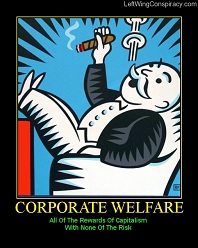
The “takers,” in short, are the people Romney spoke to at $1000/plate fundraisers, who pay Hillary Clinton several hundred grand for a speech reassuring them Wall Street’s not to blame. The entire Fortune 500, the entire billionaire plutocracy, depends on largesse from us makers — and they can only do it with government help.

What Would Afghan Spending Buy at Home?

By Russ Baker

Source: WhoWhatWhy

Most of the stories headlining how President Obama plans to cut troops in Afghanistan as part of his planned exit from that country have not bothered to provide numbers on U.S. military spending there.

A few have, but almost in passing. For example, CNN doesn’t indicate the current levels of spending, but notes that

Tony Blinken, Obama’s deputy national security adviser, told CNN that the United States will spend about $20 billion on the continued military presence in Afghanistan after 2014.

In other words, $20 billion is what the U.S. will spend after it has effectively “withdrawn.”

Too bad news organizations don’t routinely give us a sense of what we are spending, or what else we might get for the same monies directed toward other purposes.

But here’s one thing to consider: $20 billion is about one-third to one-half of what the United States Department of Education spends on elementary, secondary and vocational education, and comparable to what it spends on higher education.

When President Obama released his Fiscal Year 2013 budget, Education Secretary Arne Duncan “announced that high-quality education is absolutely critical to rebuilding our economy.” Maybe so, but domestic spending is constantly under assault—and the lawmakers who reflexively support any and all military allocations are often the same ones complaining about “big government” and “wasteful” spending.

Here are a few other comparative statistics: (numbers vary, of course, from year to year)

-$20 billion is what the U.S. government budgeted for 2013 to subsidize often-struggling farmers

-It’s four-fifths of what we spend for science, space and technology

-It’s more than twice the budget of the Environmental Protection Agency

-It’s a third of what we spend on veterans’ hospital and medical care—on the people who fight in all wars combined

-It’s about a third of what we spend on administration of justice

-It’s five times what’s budgeted for energy conservation in 2014 and 2015

-It’s about 8 times what we spend on national parks—which have suffered continued cuts in recent years, resulting in reduced services and closures

If it’s not achieving something of clear benefit to Americans, why does the spending continue at such levels? Here’s another thing to consider, a graphic on Afghanistan we’ve run in the past to considerable interest:

11

Sources for Budget Data:

OMB Historical Budget Tables

Department of Interior 2014 Budget Highlights

It’s Time to Start Believing Again – Why Basic Income Could and Should be the Next Global Political Movement

Source: Thought Infection

Things change slowly and then all at once. 

If there is one great consistency about change in the 21st century, it is that things seem to change almost imperceptibly right up until they become inevitable. Many good examples of this effect can be found in the world of technology such as the rise of the internetthe fall of film-cameras, or the explosive growth of the green energy industry. In all of these cases the exponential nature of technological advances led many to discount major changes that eventually disrupted entire industries. While this effect is best understood in the world of technology I think this kind of change can also be seen in social and political spheres.

Political movements must by necessity start with only a minority of individuals working very hard for very many years to push forward on an issue. For a very long time it can appear that little or no progress is being made, but below the surface opinions and minds are slowly shifting. This slow progression continues in the background, almost imperceptibly until some sort of tipping point is reached and a sudden shift in the public and political sentiment can occur. A good example of this effect would be the momentous shift away from a deep and vitriolic hatred of gays only a few decades ago towards increasing acceptance today.

In addition to the energy provided by a small group of dedicated individuals, flashpoint social or political change also requires the maneuvering room in order for rapid revolutionary change to happen. The room for new ideas to maneuver can be created by a collapse of incumbent ideology, or in the case of the greatest shifts it often comes from a wider, systemic loss of faith in the system. When people become embittered with things as they are they will inevitably start looking to those offering alternative views.

A person without belief is a power vacuum. 

I think we are currently stand at time when conditions are set for the next global political movement to take hold. We are seeing clear symptoms of a systemic erosion of faith in the political and economic systems as they stand today.

Economic hardship and unemployment has become endemic across large parts of the developed world. Those who do work find themselves squeezed between longer working hours, higher on the job demands, increasing costs of living, and loss of both job security and benefits.

Times feel tough, and people are starting to ask why they are tough. Did we have some sort of disaster? Are our crops failing, or our industries falling apart? What happened that is making institutions like education and health too expensive to support?

Thomas Piketty, in his recent book provides strong evidence that the economic pathology of the current geopolitical situation may simply be the symptoms of a larger economic disease. When capital out-competes labour, it inevitably leads to increasing wealth disparity and the associated economic problems that we see today. People can see that the economic gains that our collective hard-work creates is going disproportionately into the hands of the wealthy. People can see that the game is rigged against them, and they don’t really want to play any more.

At the same time as economic realities are being thrust upon workers around the world, people are also increasingly detached from mainstream politics. Little real change has happened despite perpetual political promises to deliver such. Political detachment combined with economic hardship is a dangerous mix, and is credited with leading to the rise of extreme political groups like the Golden Dawn in Greece and other far-right parties in the UK and France. The rise of more extremist politics is also apparent in the increasingly polarized and broken political landscape of the United States.

The disengagement of the public from the political sphere is particularly strong for those who are also disproportionately affected by the economic slow-down, the youth. It is an unappreciated fact that there are actually more millenials in the United States than there are baby boomers. Whatever politician figures out how to engage the millenial generation politically is going to run the world.

From my perspective, there seems to be a clear build-up of political tension across the globe. While we can argue about specific economic and political maladies that have led us to this point, I think the simple fact is that people are losing faith in the system as a whole. As people lose faith, governments become more detached and fearful of their citizens, leading more people to lose faith in the system, and thus a vicious cycle of political breakdown is perpetuated.

So how do we stop this?

The answer is surprisingly simple – We need to believe again.

People need to believe that the world will be better for their children than it was for them. This is the magic that drives people to get up in the morning and go to school and work, to put in the long hours of hard work, to make discoveries, to invent new technologies, and improve the world. The economy will flourish only as long as people truly believe they can better their own life, and that of their children.

Without faith in the global economic and political system, we have nothing. 

Believe it or not, there just might be one simple medicine which (while it would not solve all of our problems) could go a long way to solving the twin problems of political and economic break down.

Basic income.

There is a long list of reasons that basic income makes for sensible economic policy, which I will not go through here. Suffice it to say that basic income would (1) give workers the leverage to demand more from work, (2) give individuals and innovators the means to do their thing, (3) give corporations more incentive to automate their production, and (4) generally support the consumption economy. (Some worry that such a basic income might lead to less incentive to work, but I say that if you need to use starvation as a threat to get people to work for you, then your business is not profitable enough.)

Perhaps most importantly, basic income would be the solution to restore the faith of the common individual in the current system of global capitalism. By institutionalizing the social contract in the form of a cash dividend for everyone, basic income would finally enshrine the promise that a rich and successful society must first deliver a minimal living standard to everyone.

Serious realistic types might rush to play down the importance of belief in the political system. Who cares whether the rabble believes in what the government and politicians do, as long as it is functional? But these people are completely missing the central truth of the matter here. Belief is the only power in the world that matters. My dollar is only worth what we collectively agree it to be worth, and the same goes for our societies. If we fail to create societies which inspire belief, then we are lost. If we do not find a way fill that vacuum left by eroding belief, then someone else will.

It is time for something that we can believe in, it is time for basic income. 

Inequality Has Been Eliminated

etc_stack15__01__630x420

By Chad Hill

Source: the Hipcrime Vocab

Have you heard? Inequality has been eliminated.

What? You didn’t know that? Well, certain “professional” economists have proved it is true.
You may wonder, when you drive around your town, why formerly occupied strip malls lie abandoned, and the only local businesses are Cash-For-Gold, Payday Loans, Dollar Stores, and tattoo parlours. You may ignore the people standing near freeway exits with signs begging for work or money (these have exploded where I live), or the people rolling around shopping carts with all their worldly possessions, or the people living in their cars. It’s all an illusion. Detroit? Chicago? Merely a mirage.

You may wonder at all the empty, shuttered factories, or the fact that the Wal-Mart Super Store is the town’s biggest employer, or that “help wanted” signs seem to appear only in the local Arby’s or Home Depot (or my favorite “owner operators wanted”). You may puzzle at the foreclosed homes stripped of copper and being overgrown with weeds that litter towns from coast to coast. The entire neighborhoods that lie empty and abanadoned? Another mirage, silly. The crumbling roads and local governments “tightening their belts?” Not happening.

Not happening. Nope, none of it.

You may have heard stories about people thirty or forty years ago with high-school educations being able to get jobs that supported families, allowed them to buy a house and save money. You may have heard about people able to save up enough to go to college by just working a summer job. You may have heard of people twenty or thirty years ago with full-time jobs that had benefits such as paid vacations and health care, which are now being stripped away job by job. You may have heard about something called a “union.”

False. All false. The world is getting more equal every day thanks to globalized corporate capitalism. The economists told me so.

You may even know people who have lost their job and are unable to find another one because employers discriminate against the unemployed. You may know someone with huge debt burdens because the cost to train workers is borne entirely by the workers themselves, and you have to go tens of thousands of dollars into debt just to get a job at all. Or you may know someone who was foreclosed upon, or drowning in debt due to an unforeseen circumstance or medical emergency. You might know people who’ve had to take jobs with much lower pay and benefits than the ones they had before. You may know people working brutally long hours, or denied extra work time so that they don’t qualify for health care benefits. You may know people who have used food stamps to feed themselves or their families, even though they work full time jobs. You may know older people who have to work because they can’t afford to retire.

They all deserve it. All of them. They’re all lazy. Laziness has exploded since 2008, don’t you know. Everyone gets exactly what they deserve. It’s never been  better time to be a worker under capitalism.

You may look on the outrageous fortunes spend by the rich and conclude that they are reaping more and more benefits by breaking wages and shipping jobs overseas. Don’t you believe it! Their riches are making everyone better off. Just look at Bill Gates! He gives money to poor people in Africa. And Steve Jobs. He invented the iPod in his basement, or something. Soaring CEO salaries are great. The bailouts were all paid back. And the soaring stock market prices will make everyone rich! Don’t worry about the costs for food, housing, education and transport. The “free market” will take care of it all and unleash abundance, but only if the “job creators” don’t have to pay taxes. Those trust fund kids getting unpaid internships and getting jobs downtown – that’s just a natural part of capitalism, it has nothing to do with inequality. The fact that entire cities are unaffordable for people making less than six figures? College and health care costs? Forget about it. Nothing to do with inequality, which, by the way, has been going down, not up. Besides, even if it were going up, inequality doesn’t matter, what matters is that life is getting better even for people even at the bottom. They love being in debt and working for minimum wage! And besides, the life for the average person is getting better and better the more riches the wealthy and powerful accumulate. After all we have smart phones. SMART PHONES!!!

All those people protesting around the world? They just don’t understand capitalism.

You may even have read books and articles asserting that we are a “winner-take-all” economy, a “servant economy,” or something like that. Not true! Those books and articles were all written by “leftists” and “liberals” who don’t understand science and statistics. Articles like this are just sensationalism by liberals who hate our freedom:

76% of Americans are living paycheck-to-paycheck (CNN)

The Middle Class Is Steadily Eroding. Just Ask the Business Community (NYT)

The Financial Vulnerability of Americans (House of Debt)

Employment Down, Profits Up: The Aftermath of the Financial Crisis in 1 Graph (The Atlantic)

‘Happy Days’ no more: Middle-class families squeezed as expenses soar, wages stall (Wall Street Journal)

A Dozen Facts about America’s Struggling Lower-Middle-Class (Brookings)

America’s Sinking Middle Class (NYT)

Why So Little Media Coverage of How the Rich Are Becoming Richer and the Middle Class Wages are Being Squeezed? (Naked Capitalism)

RIP, the middle class: 1946-2013 (Salon)

Yep, Being a Young, American Adult Is a Financial Nightmare (The Atlantic)

Ripping Off Young America: The College-Loan Scandal (Rolling Stone)

Median CEO Pay Just Topped $10M for the First Time (Slate)

Upgrade or Die (George Packer)

San Francisco’s Income Inequality Rivals that of Developing Nations (Vanity Fair)

Gap Between Rich And Poor In Manhattan “Rivals Sub-Saharan Africa” (Gothamist)

How did the economists come to this conclusion, you ask? Well, Piketty made a few spreadsheet errors. And thanks to that, the professional economist caste can breathe a sigh of relief that all of the things I named above don’t exist, and happily go back to their blackboards and spreadsheets in their corporate-funded free-market think-tank cubicles and university offices.

Because inequality is entirely dependent upon r being greater than g. That is, the rate of return to capital (yes, let’s just argue about what constitutes “capital,” that will make this whole thing go away), must be greater than g, the rate of growth of the economy. Because, heaven knows, it’s not like workers could ever get paid less than the growth of the economy, right?

Right?

Read the full article here: http://hipcrime.blogspot.com/2014/06/inequality-has-been-eliminated.html