Brexit Is What Happens When the Pie Is Shrinking

brexit-uk-leaving-eu

By Charles Hugh Smith

Source: Of Two Minds

This process of withdrawal into the relative safety of internally cohesive groups and group identities is intrinsically messy in globalized, multicultural societies.

A great many narratives are drifting around the Brexit pool: a return to sovereignty, class war, “controlled demolition,” nothing-but-another-political-Kabuki- spectacle, end of the European Union, etc.

I think it boils down to something much simpler: the pie is shrinking, and the illusion that it’s about to start growing has been shattered. For many communities in the developed world, the pie started shrinking in the 1970s, and has been shrinking (despite the narrative of “45 years of strong growth”) since then.

Labor’s share of the GDP has been declining for 45 years. Occasional blips higher during debt-fueled bubbles quickly fade when the bubble du jour pops, and the decline of labor’s share of the economy resumes its trendline decline.

wages-GDP5-16a

Since 2008, the only group who feels the pie is growing is the class that has benefited from the unparalleled expansion of debt and leverage, financialization, globalization and central planning–roughly 20% of the work force, with the top 5% gathering most of the gains in income and wealth, and the top .1% gathering most of the increase in wealth. (See chart below)

For seven long years, the citizenry has been told the economy is expanding and therefore they’re “doing better.” But this narrative is not supported by their actual lived experience. Inflation is woefully under-reported by official statistics, and the rosy “rising employment” narrative is based largely on part-time jobs in hospitality and food services (bartenders, waiters, etc.) that are highly contingent on the spending of the top 10%.

While supporters of the status quo are quick to deride supporters of Brexit, the cold reality is the economic pie is shrinking, and Brexit is a direct result of that reality.

A shrinking economic pie generates widespread insecurity that pressures every status quo arrangement as people circle the wagons in an attempt to protect their remaining slice of the pie from others’ claims for a larger piece of the dwindling pie.

The general media line is that the Brexit vote arose out of anger with the status quo’s inequalities and asymmetries of wealth and power. While this is largely self-evident, it isn’t the most fundamental dynamic at work. I see Brexit as a reflection of our naturally-selected defensive response to insecurity and instability: circle the wagons.

By circle the wagons, I mean our tendency to withdraw into an internally cohesive group with defined membership and boundaries.

The largest such political group is the nation-state, and so it is natural for people with strong national identities to circle the wagons around their national identity.

We can also expect people to circle the wagons around ethnic, religious, localized and economic-social class identities. (Some people might feel more kinship with other fans of Manchester United than they do with any religion, ethnicity or state.)

As people identify themselves as members of the class that has not benefited from neoliberal/globalized crony capitalism, the ruling Elites become the “other,” i.e. “foreigners” with whom we have little contact, people who “aren’t like us”– in effect, an “enemy class” that is inherently opposed to our self-interests.

This process of withdrawal into the relative safety of internally cohesive groups and group identities is intrinsically messy in globalized, multicultural societies. No wonder populations are dividing into camps of increasingly angry people with little interest in compromise. Our instinct is to seek clear delineations of “us” and “them” and to seek the relative comfort of “us,” which in a multicultural nation, can contain quite a mixed bag of people who nonetheless feel a shared identity.

Much to the chagrin of political parties whose success is based solely on “identity politics,” the emerging group identities are not conforming to the political classes’ conventional fault lines. “Us” for many people includes everyone who isn’t a protected insider of the status quo, and “the enemy” is any protected insider of the status quo.

That includes virtually the entire political class, the entire class of state nomenklatura/technocrats, the entire banking sector and the wealthy class that’s benefited so handsomely from the globalized, debt-leverage bubbles and state / central bank support that characterize this era of neoliberal/globalized crony capitalism.

wage-inequality3-16a

wealth-distribution10-15a

A Radically Beneficial World: Automation, Technology and Creating Jobs for All is now available as an Audible audio book.


This Is Our Neoliberal Nightmare: Hillary Clinton, Donald Trump, and Why the Market and the Wealthy Win Every Time

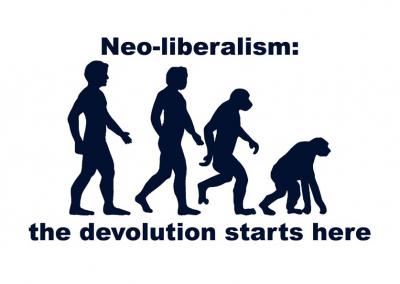
neo_liberalism_devolution_via_permanentculturenow.com_

The rage driving our politics stems from cruelty of capitalism. So why do we vote for those who worship the market?

By Anis Shivani

Source: AlterNet

Over the last fifteen years, editors often asked me not to mention the word “neoliberalism,” because I was told readers wouldn’t comprehend the “jargon.” This has begun to change recently, as the terminology has come into wider usage, though it remains shrouded in great mystery.

People throw the term around loosely, as they do with “fascism,” with the same confounding results. Imagine living under fascism or communism, or earlier, classical liberalism, and not being allowed to acknowledge that particular frame of reference to understand economic and social issues. Imagine living under Stalin and never using the communist framework but focusing only on personality clashes between his lieutenants, or likewise for Hitler or Mussolini or Mao or Franco and their ideological systems! But this curious silence, this looking away from ideology, is exactly what has been happening for a quarter century, since neoliberalism, already under way since the early 1970s, got turbocharged by the Democratic party under the Democratic Leadership Council (DLC) and Bill Clinton. We live under an ideology that has not been widely named or defined!

Absent the neoliberal framework, we simply cannot grasp what is good or bad for citizens under Cruz versus Trump, or Clinton versus Sanders, or Clinton versus Trump, away from the distraction of personalities. To what extent does each of them agree or disagree with neoliberalism? Are there important differences? How much is Sanders a deviation? Can we still rely on conventional distinctions like liberal versus conservative, or Democrat versus Republican, to understand what is going on? How do we grasp movements like the Tea Party, Occupy, and now the Trump and Sanders insurgencies?

Neoliberalism has been more successful than most past ideologies in redefining subjectivity, in making people alter their sense of themselves, their personhood, their identities, their hopes and expectations and dreams and idealizations. Classical liberalism was successful too, for two and a half centuries, in people’s self-definition, although communism and fascism succeeded less well in realizing the “new man.”

It cannot be emphasized enough that neoliberalism is not classical liberalism, or a return to a purer version of it, as is commonly misunderstood; it is a new thing, because the market, for one thing, is not at all free and untethered and dynamic in the sense that classical liberalism idealized it. Neoliberalism presumes a strong state, working only for the benefit of the wealthy, and as such it has little pretence to neutrality and universality, unlike the classical liberal state.

I would go so far as to say that neoliberalism is the final completion of capitalism’s long-nascent project, in that the desire to transform everything—every object, every living thing, every fact on the planet—in its image had not been realized to the same extent by any preceding ideology. Neoliberalism happens to be the ideology—unlike the three major forerunners in the last 250 years—that has the fortune of coinciding with technological change on a scale that makes its complete penetration into every realm of being a possibility for the first time in human history.

From the early 1930s, when the Great Depression threatened the classical liberal consensus (the idea that markets were self-regulating, and the state should play no more than a night-watchman role), until the early 1970s, when global instability including currency chaos unraveled it, the democratic world lived under the Keynesian paradigm: markets were understood to be inherently unstable, and the interventionist hand of government, in the form of countercyclical policy, was necessary to make capitalism work, otherwise the economy had a tendency to get out of whack and crash.

It’s an interesting question if it was the stagflation of the 1970s, following the unhitching of the United States from the gold standard and the arrival of the oil embargo, that brought on the neoliberal revolution, with Milton Friedman discrediting fiscal policy and advocating a by-the-numbers monetarist policy, or if it was neoliberalism itself, in the form of Friedmanite ideas that the Nixon administration was already pursuing, that made stagflation and the end of Keynesianism inevitable.

It should be said that neoliberalism thrives on prompting crisis after crisis, and has proven more adept than previous ideologies at exploiting these crises to its benefit, which then makes the situation worse, so that each succeeding crisis only erodes the power of the working class and makes the wealthy wealthier. There is a certain self-fulfilling aura to neoliberalism, couched in the jargon of economic orthodoxy, that has remained immune from political criticism, because of the dogma that was perpetuated—by Margaret Thatcher and her acolytes—that There Is No Alternative (TINA).

Neoliberalism is excused for the crises it repeatedly brings on—one can think of a regular cycle of debt and speculation-fueled emergencies in the last forty years, such as the developing country debt overhang of the 1970s, the savings and loan crisis of the 1980s, the Asian currency crisis of the 1990s, and the subprime mortgage crisis of the 2000s—better than any ideology I know of. This is partly because its very existence as ruling ideology is not even noted by the population at large, which continues to derive some residual benefits from the welfare state inaugurated by Keynesianism but has been led to believe by neoliberal ideologues to think of their reliance on government as worthy of provoking guilt, shame, and melancholy, rather than something to which they have legitimate claim.

It is not surprising to find neoliberal multiculturalists—comfortably established in the academy—likewise demonizing, or othering, not Muslims, Mexicans, or African Americans, but working-class whites (the quintessential Trump proletariat) who have a difficult time accepting the fluidity of self-definition that goes well with neoliberalism, something that we might call the market capitalization of the self.

George W. Bush’s useful function was to introduce necessary crisis into a system that had grown too stable for its own good; he injected desirable panic, which served as fuel to the fire of the neoliberal revolution. Trump is an apostate—at least until now—in desiring chaos on terms that do not sound neoliberal, which is unacceptable; hence Jeb Bush’s characterization of him as the “candidate of chaos.” Neoliberalism loves chaos, that has been its modus operandi since the early 1970s, but only the kind of chaos it can direct and control.

To go back to origins, the Great Depression only ended conclusively with the onset of the second world war, after which Keynesianism had the upper hand for thirty-five years. But just as the global institutions of Keynesianism, specifically the IMF and the World Bank, were being founded at the New Hampshire resort of Bretton Woods in 1944, the founders of the neoliberal revolution, namely Friedrich Hayek, Ludwig von Mises, Milton Friedman, and others were forming the Mount Pelerin Society (MPS) at the eponymous Swiss resort in 1947, creating the ideology which eventually defeated Keynesianism and gained the upper hand during the 1970s.

So what exactly is neoliberalism, and how is it different from classical liberalism, whose final manifestation came under Keynesianism?

Neoliberalism believes that markets are self-sufficient unto themselves, that they do not need regulation, and that they are the best guarantors of human welfare. Everything that promotes the market, i.e., privatization, deregulation, mobility of finance and capital, abandonment of government-provided social welfare, and the reconception of human beings as human capital, needs to be encouraged, while everything that supposedly diminishes the market, i.e., government services, regulation, restrictions on finance and capital, and conceptualization of human beings in transcendent terms, is to be discouraged.

When Hillary Clinton frequently retorts—in response to demands for reregulation of finance, for instance—that we have to abide by “the rule of law,” this reflects a particular understanding of the law, the law as embodying the sense of the market, the law after it has undergone a revolution of reinterpretation in purely economic terms. In this revolution of the law persons have no status compared to corporations, nation-states are on their way out, and everything in turn dissolves before the abstraction called the market.

One way to sum up neoliberalism is to say that everything—everything—is to be made over in the image of the market, including the state, civil society, and of course human beings. Democracy becomes reinterpreted as the market, and politics succumbs to neoliberal economic theory, so we are speaking of the end of democratic politics as we have known it for two and a half centuries. As the market becomes an abstraction, so does democracy, but the real playing field is somewhere else, in the realm of actual economic exchange—which isnot, however, the market. We may say that all exchange takes place on the neoliberal surface.

Neoliberalism is often described—and this creates a lot of confusion—as “market fundamentalism,” and while this may be true for neoliberal’s self-promotion and self-presentation, i.e., the market as the ultimate and only myth, as were the gods of the past, I would argue that in neoliberalism there is no such thing as the market as we have understood it from previous ideologies.

The neoliberal state—actually, to utter the word state seems insufficient here, I would claim that a new entity is being created, which is not the state as we have known it, but an existence that incorporates potentially all the states in the world and is something that exceeds their sum—is all-powerful, it seeks to leave no space for individual self-conception in the way that classical liberalism, and even communism and fascism to some degree, were willing to allow.

There are competing understandings of neoliberal globalization, when it comes to the question of whether the state is strong or weak compared to the primary agent of globalization, i.e., the corporation, but I am taking this logic further, I am suggesting that the issue is not how strong the state is in the service of neoliberalism, but whether there is anything left over beyond the new definition of the state. Another way to say it is that the state has become the market, the market has become the state, and therefore both have ceased to exist in the form we have classically understood them.

Of course the word hasn’t gotten around to the people yet, hence all the confusion about whether Hillary Clinton is more neoliberal than Barack Obama, or whether Donald Trump will be less neoliberal than Hillary Clinton. The project of neoliberalism—i.e., the redefinition of the state, the institutions of society, and the self—has come so far along that neoliberalism is almost beyond the need of individual entities to make or break its case. Its penetration has gone too deep, and none of the democratic figureheads that come forward can fundamentally question its efficacy.

I said almost. The reason why Bernie Sanders, self-declared democratic socialist, is so threatening to neoliberalism is that he has articulated a conception of the state, civil society, and the self that is not founded in the efficacy and rationality of the market. He does not believe—unlike Hillary Clinton—that the market can tackle climate change or income inequality or unfair health and education outcomes or racial injustice, all of which Clinton propagates. Clinton’s impending “victory” (whatever machinations were involved in engineering it) will only strengthen neoliberalism, as the force that couldn’t be defeated even when the movement was as large and transcendent as Sanders’s. Although Sanders doesn’t specify “neoliberalism” as the antagonist, his entire discourse presumes it.

Likewise, while Trump supporters want to take their rebellion in a fascist direction, their discomfort with the logic of the market is as pervasive as the Sanders camp, and is an advance, I believe, over the debt and unemployment melancholy of the Tea Party, the shame that was associated with that movement’s loss of identity as bourgeois capitalists in an age of neoliberal globalization. The Trump supporters, I believe, are no longer driven by shame, as was true of the Tea Party, and as has been true of the various dissenting movements within the Republican party, evangelical or otherwise, in the recent past. Rather, they have taken the shackles off and are ready for a no-holds barred “politically incorrect” fight with all others: they want to be “winners,” even at the cost of exterminating others, and that is not the neoliberal way, which doesn’t acknowledge that there can be winners and losers in the neoliberal hyperspace.

In the current election campaign, Hillary Clinton has been the most perfect embodiment of neoliberalism among all the candidates, she is almost its all-time ideal avatar, and I believe this explains, even if not articulated this way, the widespread discomfort among the populace toward her ascendancy. People can perceive that her ideology is founded on a conception of human beings striving relentlessly to become human capital (as her opening campaign commercialso overtly depicted), which means that those who fail to come within the purview of neoliberalism should be rigorously ostracized, punished, and excluded.

This is the dark side of neoliberalism’s ideological arm (a multiculturalism founded on human beings as capital), which is why this project has become increasingly associated with suppression of free speech and intolerance of those who refuse to go along with the kind of identity politics neoliberalism promotes.

And this explains why the 1990s saw the simultaneous and absolutely parallel rise, under the Clintons, of both neoliberal globalization and various regimes of neoliberal disciplining, such as the shaming and exclusion of former welfare recipients (every able-bodied person should be able to find work, therefore under TANF welfare was converted to a performance management system designed to enroll everyone in the workforce, even if it meant below-subsistence wages or the loss of parental responsibilities, all of it couched in the jargon of marketplace incentives).

The actual cost to the state of the AFDC program was minimal, but its symbolism was incalculable. The end of welfare went hand in hand with the disciplinary “crime bill” pushed by the Clintons, leading to an epidemic of mass incarceration. Neoliberalism, unlike classical liberalism, does not permit a fluidity of self-expression as an occasional participant in the market, and posits prison as the only available alternative for anyone not willing to conceive of themselves as being present fully and always in the market.

I believe that the generation of people—in their forties or older—supporting Hillary have already internalized neoliberal subjectivity, which they like to frame as realism or pragmatism, refusing for instance to accept that free college or health care are even theoretical possibilities. After all, they have maintained a measure of success in the past three or four decades after conceptualizing themselves as marketplace agents. Just as the Tea Party supporters found it intolerable that government should help irresponsible homeowners by bailing them out of unsustainable debt, the Clinton supporters hold essentially the same set of beliefs toward those who dare to think of themselves outside the discipline of the market.

I spoke of the myth of the market, as something that has no existence in reality, because none of the elements that would have to exist for a market to work are actually in place; this is even more true for neoliberalism than it was for the self-conscious annihilation of the market by communism, because at least in that system the market, surreptitiously, as in various Eastern European countries, kept making an appearance. But when the market takes neoliberal shape, i.e., the classical conceptions of the buyer and seller as free agents are gone, then radical inequality is the natural outcome. And inequality in the last four decades, as statistics for the U.S. and everywhere neoliberalism has made inroads prove beyond a doubt, has exploded, thereby invalidating neoliberalism’s greatest claim to legitimacy, that it brings about a general increase in welfare. So neoliberalism, to the extent that the inequality discourse has made itself manifest recently, must insist all the more vocally on forms of social recognition, what Clinton, for example, likes to call the “fall of barriers.”

Neoliberalism likes to focus on public debt—in the Clinton years debt reduction became a mania, though George W. Bush promptly spent all the accumulated surpluses on tax cuts for the wealthy and on wars of choice—rather than inequality, because the only way to address inequality is through a different understanding of public debt; inequality can only be addressed through higher taxation, which has by now been excluded from the realm of acceptable discourse—except when Sanders, Trump, or Jeremy Corbyn in England go off script.

So to recapitulate neoliberalism’s comprehensive success, let us note that we have gone from a liberal, Keynesian, welfare state to a neoliberal, market-compliant, disciplinary state.

Neoliberalism expects—and education at every level has been redesigned to promote this—that economic decision-making will be applied to all areas of life (parenthood, intimacy, sexuality, and identity in any of its forms), and that those who do not do so will be subject to discipline. Everyone must invest in their own future, and not pose a burden to the state or anyone else, otherwise they will be refused recognition as human beings.

This supposed economic “rationality” (though it is the greatest form of irrationality) applies to civil society as much as the state, so that none of the ideals of classical liberalism, or previous ideologies rooted in humanism, are valid any longer, the only value is the iteration of the market (as myth, not reality); in other words, neoliberalism, unlike the elevation of the individual in classical liberalism or the state in fascism or the collectivity in communism, has erected something, the market, that has no real existence, as the only god to serve! And it is just like a god, with an ethereal, unchallengeable, irrefutable, ubiquitous presence. Whatever in state policy does not serve market-conformity is to be banned and banished from memory (the secular scriptures are to be rewritten), which explains neoliberalism’s radical narrowing of public discourse, including the severance of identity politics from any class foundation.

Neoliberalism will continue to perpetuate reduced opportunity, because one of its characteristics—as in any system that wants to thrive on the world stage—is to constantly refine the field upon which the human subject can operate.

As such, those displaced workers who have suffered the most from the erosion of the old industries in the former manufacturing centers of the world are not even factors to contend with, they are invisible and cannot be part of the policy equation. To the extent that their actual presence is reckoned with, the economy can be said to have crashed; but the problem doesn’t arise because of the management of unemployment or underemployment statistics, unlike a housing crash which is palpable and cannot escape statistical definition.

The danger for neoliberalism—as is clear from the support of millions of displaced human beings for Trump—is that with each crisis neoliberalism sheds more workers, makes individuals and firms more “disciplined,” narrows the scope of opportunity even further. At times, the disciplining of the non-neoliberal other—as with the killing of Michael Brown or Eric Garner—explodes to surface consciousness in an unsavory way, so an expert manager like Clinton or Obama is required to tamp down the emotions of such unruly entities as Black Lives Matter which arise in response. If climate change, according to Clinton and her cohort, can and should have market solutions, then surely racial disparity, or police violence, should also have market solutions and no others; it is here that neoliberal multiculturalism, operating in the academy, is so insidious, because at the elite level it functions to validate market discourse, it does not step outside it.

The present breakdown of both major political parties can be explained by the frustration that has built up in the body politic over the past decade, because after the crash there was no sustained intellectual movement to question the myth of the market. The substitution of economic justice with identity politics is something Ralph Nader, Howard Dean, and now Bernie Sanders have contested in a humane manner, while the same process is at work, admittedly in an inhumane way, in the Trump phenomenon.

Thus, also, Hillary Clinton’s animus against free college education; that form of expansion of opportunity, which was a reality from the 1950s to the 1980s, cannot be allowed to return, human beings are supposed to invest in their own future earnings potential, they are not entitled to a transcendent experience without barriers manifesting in discipline and self-correction. Education, like everything else, including one’s own health, becomes an expensive consumer good, not a right, no longer an experience that might lead to a consciousness beyond the market but something that should be fully encapsulated by the market. If one is a capable market player, education as we have classically understood it becomes redundant.

Unlike the interregnum between 1945-1973, the rising tide—no matter the befuddlements Arthur Laffer and his fellow Reaganite ideologues proffered—does not lift all boats today, it is outside the logic of neoliberalism that it do so, so the idea of reforming neoliberalism, or what is often called “globalization with a human face,” is a rhetorical distraction. All of the policy innovations—interpreted as “socialism” by the Tea Partiers—offered by Barack Obama fall within the purview of neoliberalism, above all the Affordable Care Act, whose genesis was hatched in neoliberal think tanks decades ago.

It is important to note that neoliberal economic restructuring necessarily means social restructuring, i.e., a movement toward disciplinarity and away from liberalism; the disciplinarity can take a Bushian, Clintonian, or Trumpian form, but these are manifestations of the same tendency.

When wage growth is decoupled from economic growth (as it has been since Friedman and others inaugurated the revolution in the early 1970s), this means that the human subject is ripe for discipline. Furthermore, wage fairness cannot be rationally discussed (hence the obfuscation surrounding the $15 minimum wage orchestrated by Clinton and others) because the concept of the market has been disembedded from society; the market as abstraction, not a concrete reality, makes any notion of reform or restructuring impossible. Like the minimum wage, something like free child care also remains outside the bounds of discourse, because public policy cannot accommodate discussions that do not take the self-regulating market as unassailable myth.

What neoliberalism can accommodate is relentless tax cuts (Trump has already offered his huge tax cut plan, as Bush did as his first order of business), which only exacerbate the problem, leading to increasing concentrations of wealth. It has to be said, though, that Ted Cruz more comfortably fit the neoliberal paradigm, with his familiar calls for lower taxes along with reduced regulation and further limits on social welfare, whereas Trump shows, for now, some elements of apostasy. If neoliberalism were to get a Cruz, it would have no problem working with him, or rather, Cruz would have had no problem executing neoliberalism, beyond the surface dissimilarities from Hillary Clinton.

As Sanders has consistently noted, economic inequality leads to political inequality, which means that democracy, after a certain point, becomes only theoretical (viz. Citizens United and the electoral influence of such powerful entities as the Koch brothers). Both processes—economic inequality and political inequality—have accelerated after each downturn in the forty-five-year history of neoliberalism, therefore a downturn is always exciting, and even preordained, for a Bush, a Trump, or a Clinton. Again, economic inequality and political polarity (polarity is simply a manifestation of democracy having become dysfunctional) strongly correlate, and both have come to a head in this election.

Neoliberalism’s task, from this point on, is to mask and manage the increasing inequalities that are likely to befall humanity, especially as the planet reaches a crisis point in its health. In a way, George W. Bush threw a wrench—he was a perverted Keynesian in a way, believing in war to prime the pump, or inflating unsustainable bubbles, or spending exorbitantly on grandiose gestures—into the process of neoliberal globalization that was going very smoothly indeed under Bill Clinton and would likely have flourished under Al Gore as well. With Hillary Clinton, the movement will be toward further privatization of social welfare, “reforming” it along market principles, as has been true of every neoliberal avatar, whether it was Bill Clinton’s incentives to work in the performance management makeover of welfare, George Bush’s proposed private social security accounts, Mitt Romney’s proposed private health care accounts, or the school vouchers that tempt all of them from time to time.

What remains to be seen is the extent to which the millennial generation might be capable of thinking outside the neoliberal paradigm, i.e., they don’t just want more of what neoliberal promises to give them yet fails to deliver, but want things that neoliberalism does not or cannot promise. On this rests the near-term future of the neoliberal project.

Beyond Sanders himself, the key question is the ability of the millennial generation to conceive of themselves outside the neoliberal subjectivity they have been pushed to internalize. They have been encouraged to think of themselves as capital producers, turning their intellectuality into social media popularity for the benefit of capital, in the service of the same abstract market that has no place, no role, no definition beyond the fallen liberal calculus. Does the millennial generation believe, even about its most intimate core, that everything has been privatized?

I am not necessarily making a pessimistic prediction. I am merely outlining the strength of an opponent that has refused to be named for forty-five years, although it has been the ruling ideology that long! In defining neoliberalism, I have sought to distance myself from the distraction of personalities, and tried to expose the dark side of our politics which we can only see when we name and understand the ideology as such. We are up against a system that is so strong that it has survived, for the most part, the last crash, as citizens couldn’t get their heads around the idea of nationalizing banks or health care.

It is existentially imperative to ponder what happens beyond Sanders, because neoliberalism has its end-game in sight, letting inequality continue to escalate past the crash point (meaning the point where the economy works for most people), past any tolerable degradation of the planet (which is being reconceptualized in the shape of the market).

What, indeed, does happen beyond Sanders, because as we have seen Hillary Clinton is one of the founders of neoliberal globalization, one of its central historical figures (having accelerated the warehousing of the poor, the attack on trade unions, and the end of welfare and of regulatory prowess), while Trump is an authoritarian figure whose conceptions of the state and of human beings within the state are inconsistent with the surface frictionlessness neoliberalism desires? To go back to Hillary Clinton’s opening campaign commercial, to what extent will Americans continue to believe that the self must be entrepreneurially leveraged toward maximum market gains, molded into mobile human capital ever ready to serve the highest bidder?

As to whether a non-neoliberal globalization is possible and what that might look like on the international stage after a quarter-century of Clinton, Bush, and Obama—which is essentially the frustration Trump is tapping into—I’ll take that up in a follow-up essay, which will further clarify the differences between Sanders versus Clinton, and Trump versus Clinton.

I would suggest that it is not that globalization causes or has caused neoliberalism, but that neoliberalism has pushed a certain form of globalization that suits its interests. This is a crucial distinction, on which everything else hinges. The neoliberal market doesn’t actually exist; at the moment it is pure abstraction; what is actually filling up economic and political space can only be discussed when we step away from this abstraction, as Sanders has so ably done, and as the Occupy and Black Lives Matter movements tentatively set in motion.

 

Anis Shivani is the author of several books of fiction, poetry, and criticism, including, most recently, My Tranquil War and Other Poems. His novel Karachi Raj (HarperCollins/Fourth Estate) was released this summer. His next book is the poetry collection Whatever Speaks on Behalf of Hashish, out in October.

Wasserman Schultz Has a Change of Heart, but Too Little, Too Late

debbie-wasserman-schultz

Just follow the money on this one.

By Bill Moyers and Michael Winship

Source: Alternet

Return with us now to the saga of Debbie Wasserman Schultz and the soul of the Democratic Party.

First, a quick recap: Rep. Wasserman Schultz (D-FL), chair of the Democratic National Committee, also has been an advocate for the payday loan industry. The website Think Progress even described her as the “top Democratic ally” of “predatory payday lenders.” You know — the bottom-feeding bloodsuckers of the working poor. Yes, them.

Low-income workers living from paycheck to paycheck, especially women and minorities, are the payday lenders’ prime targets — easy pickings because they’re often desperate. Twelve million Americans reportedly borrow nearly $50 billion a year through payday loans, at rates that can soar above 300 percent, sometimes even beyond 500 percent. Bethany McLean at The Atlantic recently reported that the government’s Consumer Financial Protection Bureau (CFPB) studied millions of payday loans and found that “67 percent went to borrowers with seven or more transactions a year and that a majority of those borrowers paid more in fees than the amount of their initial loan.”

Yet when the CFPB was drawing up new rules to make it harder for payday predators to feast on the poor, Rep. Wasserman Schultz co-sponsored a bill to delay those new rules by two years. How, you ask, could the head of the party’s national committee embrace such an appalling exploitation of working people?

Just follow the money. Last year, the payday loan industry spent $3.5 million lobbying; and as we wrote two weeks ago, in Wasserman Schultz’s home state, since 2009, payday lenders have bought protection from Democrats and Republicans alike by contributing $2.5 million or so to candidates from both parties, including her. That’s how “Representative” Wasserman Schultz, among others, wound up representing the predators instead of the poor.

That position became a major issue in her campaign for reelection to the House this year — she has a primary opponent for the first time since she entered Congress — and was even threatening the prospect of her continuing as DNC chair and presiding over the Democratic National Convention next month in Philadelphia. More than 40,000 have signed a petition calling for her removal from that post.

She had become a symbol of the failure of Democratic elites to understand that there is an uprising in the land. Millions of Americans are rebelling against the leadership of both parties. They are fed up with inside-the-Beltway politicians who pay only lip service to the deep needs of everyday people and the country; fed up with incumbents who ask for their votes, are given them in good faith, and then return to Washington to do the bidding of the donor class and its lobbyists.

Donald Trump gets it. He has roiled and humiliated and conquered an out-of-touch Republican establishment in Washington that also ignored the popular uprising against corporate domination and crony capitalism, and now GOP titans such as Senate Majority Leader Mitch McConnell and Speaker of the House Paul Ryan, spear carriers for Big Money, are being hauled around the talk-show circuit in Trump’s tumbrel, eating crow and swearing fealty to the misogynistic, bigoted and pathologically lying brute who bestrides their party.

Democratic insiders like Wasserman Schultz, however, continued to whistle past the graveyard, believing that the well-funded and well-connected Clinton machine — and general fear of a Trump regime — were enough to carry them to victory in November, despite the grass-roots disgust with a party that reeks of rot from the top. Once the champions of people who came home from work with hands dirty from toil and sweat, too many establishment Democrats went over to the dark side, taking up the cause of the well-manicured executives (think: Goldman Sachs) who write the checks and the mercenaries who deliver them (for a substantial cut, of course).

The lust for loot, which now defines the Democratic establishment, became pronounced in the Bill Clinton years, when the Clinton-friendly Democratic Leadership Council (DLC) abandoned its liberal roots and embraced “market-based solutions” that led to deregulation, tax breaks, and subsidies for the 1 percent. Seeking to fill coffers emptied by the loss of support from a declining labor movement, Democrats rushed into the arms of big business and crony capitalists.

Another case in point (and, alas, there are many): the Democratic governor of Connecticut, Dan Malloy, who seems to treat his state’s corporate residents far better than the 1 in 10 of his citizens who live at or below the poverty line.

At International Business Times last week, investigative reporter David Sirota analyzed the proposed merger of Cigna and Anthem Blue Cross Blue Shield, a deal that would create the biggest health insurance company in the country. Cigna is based in Connecticut and Katharine Wade, the state’s insurance commissioner, appointed by Governor Malloy, is a former Cigna lobbyist with deep family ties to the company.

Sirota reported, “Malloy’s decision to appoint Wade to such a powerful regulatory post on the eve of the merger was not made in a vacuum,” Sirota reported. “It came after employees of Cigna, its lobbying firm Robinson & Cole and Anthem delivered more than $1.3 million to national and state political groups affiliated with Malloy, including the Democratic Governors Association (DGA), the Connecticut Democratic Party, Malloy’s own gubernatorial campaign and a political action committee supporting Connecticut Democrats [our italics].

“Since Malloy’s first successful run for governor in the 2010 election cycle, donors from the insurance companies and the lobbying firm have given more than $2 million to Malloy-linked groups, according to the figures compiled by PoliticalMoneyLine and the National Institute on Money In State Politics. Almost half that cash has come in since 2015, the year the merger was announced.”

Sirota now reports that since his investigation first was published, the state has “formally denied open records requests for information about their meetings with Cigna and Anthem, and declared that ‘any’ documents about the health insurance companies’ proposed merger that haven’t already been made public will be kept secret.” His FOIA request was turned down “one day after Anthem requested [state insurance commissioner] Wade approve an average 26 percent increase in health insurance premiums for individual plans.” So much for transparency.

And while we’re in Connecticut, let’s also take a look at what Malloy is doing for the world’s biggest hedge fund — Bridgewater Associates, based in his state, with an estimated worth of $150 billion. The founder of the firm, Ray Dalio, is the richest man in Connecticut, by one estimate weighing in at $14.3 billion.

Dalio made $1.4 billion in 2015 alone, according to Institutional Investor’s Alpha magazine. That same year, his top two executives pulled in $250 million each. Yet as part of Connecticut’s campaign to keep companies from leaving the state, Malloy is taking $22 million of the public’s money and giving it to Dalio to stay put.

You might think a Democratic governor would have thrown down the gauntlet and told Bridgewater’s top three, “Get outta here! You guys made almost $2 billion among yourselves. Shake your piggy bank or look under your sofa cushions for the $22 million; we’re not milking the public for it.”

But no, Malloy and his fellow Democrats buckled. Buckled to the one-tenth of the one-tenth of the one-hundredth percent of the rich. Ordinary taxpayers will now ante up.

So given all of that, guess who’s the chairman of the platform committee for the upcoming Democratic National Convention? Right: Dan Malloy, governor of Connecticut, subsidizer of billionaires. Guess who named him? Right again: Wasserman Schultz, “top Democratic ally” of “predatory payday lenders.” We’re not making this up.

Not only will Malloy be presiding over the priorities of the Democratic platform at the convention next month, he doubtless will be making the rounds with Wasserman Schultz and other party elites as they genuflect before the corporate sponsors and lobbyists she has invited to pay for the lavish fun-and-games that will surround the coronation. Many of those corporate sponsors and lobbyists have actively lobbied against progressive policies like health-care reform and a Wall Street cleanup and even contributed large sums to Republicans. Yes, we know, shocking.

So take the planks in the platform and the platitudes and promises in the speeches with a grain of salt. It’s all about the money.

Except when it’s not. Except for those moments when ordinary people rise up and declare: “Not this time!”

Which brings us back to predatory lenders and their buddy, Debbie Wasserman Schultz.

Look around: There’s an uprising in the land, remember, and it isn’t going away after Hillary Clinton, now the presumptive nominee, is crowned. This year even Wasserman Schultz couldn’t ignore the decibel level of an aroused public. Unaccustomed to a challenge in the Democratic “wealth primary” where money usually favors incumbents, she now finds herself called to account by an articulate opponent who champions working people, Tim Canova. Across the country tens of thousands of consumer advocates — and tens of thousands of other progressives angry at her perceived favoritism toward Hillary Clinton — have been demanding that Wasserman Schultz resign as the party’s chair or be dumped before the convention opens Philadelphia.

So last week the previously tone-deaf Wasserman Schultz perked up, did an about-face and announced she will go along with the proposed new rules on payday lending after all. At first blush, that’s good; the rules are a step in the right direction. But all that lobbying cash must have had some effect, because the new rules only go so far. A New York Times editorial calls them “a lame response” to predatory loans and says the final version of the new regulations “will need stronger, more explicit consumer protections for the new regulatory system to be effective.”

Nick Bourke, director of small-dollar loans for the Pew Charitable Trusts, is a man who closely follows these things and got to the heart of the matter: Not only do the proposed new rules “fall short,” they will allow payday lenders to lock out attempts at lower-cost bank loans.

His judgment is stark: “As drafted, the CFPB rule would allow lenders to continue to make high-cost loans, such as a line of credit with a 15-percent transaction fee and 299-percent interest rate, or a $1,250 loan on which the borrower would repay a total of $3,700 in fees, interest and principal,” Bourke wrote. “These and many other high-cost payday installment loans are already on the market in most states, and they will thrive if the regulation takes effect without change.”

Nonetheless, the new rules were improvement enough for Allied Progress, an organization that has taken on Wasserman Schultz in Florida’s late August primary, to declare victory. And they were enough for Wasserman Schultz to do a 180-degree turn which she clearly hopes will not too dramatically reveal her hypocrisy. “It is clear to me,” she said, “that the CFPB strikes the right balance and I look forward to working with my constituents and consumer groups as the CFPB works toward a final rule.”

All well and good, but if she survives her primary to return to Washington, be sure to keep the lights on in those rooms where the final version of the rules are negotiated. A powerful member of Congress with support from a Democrat in the White House could seriously weaken a law or a rule when the outcome is decided behind closed doors and money whispers in the ear of a politician supplicant: “I’m still here. Remember. Or else.”

But the times, they really may be a-changing, as the saga of Wasserman Schultz reveals. You can be deaf to the public’s shouts for only so long. The insurgency of popular discontent that has upended politics this year will continue no matter the results in November. For much too long now it’s been clear that money doesn’t just rule democracy, it is democracy.

Until we prove it isn’t.

A Universal Basic Income Is The Bipartisan Solution To Poverty We’ve Been Waiting For

 Molly Crabapple Basic Income Banner

What if the government simply paid everyone enough so that no one was poor? It’s an insane idea that’s gaining an unlikely alliance of supporters.

By Ben Schiller

Source: FastCoexist.com

There’s a simple way to end poverty: the government just gives everyone enough money, so nobody is poor. No ifs, buts, conditions, or tests. Everyone gets the minimum they need to survive, even if they already have plenty.

This, in essence, is “universal minimum income” or “guaranteed basic income”—where, instead of multiple income assistance programs, we have just one: a single payment to all citizens, regardless of background, gender, or race. It’s a policy idea that sounds crazy at first, but actually begins to make sense when you consider some recent trends.

The first is that work isn’t what it used to be. Many people now struggle through a 50-hour week and still don’t have enough to live on. There are many reasons for this—including the heartlessness of employers and the weakness of unions—but it’s a fact. Work no longer pays. The wages of most American workers have stagnated or declined since the 1970s. About 25% of workers (including 40% of those in restaurants and food service) now need public assistance to top up what they earn.

The second: it’s likely to get worse. Robots already do many menial tasks. In the future, they’ll do more sophisticated jobs as well. A study last year from Carl Frey and Michael Osborne at Oxford University found that 47% of jobs are at risk of computerization over the next two decades. That includes positions in transport and logistics, office and administration, sales and construction, and even law, financial services and medicine. Of course, it’s possible that people who lose their jobs will find others. But it’s also feasible we’re approaching an era when there will simply be less to do.

The third is that traditional welfare is both not what it used to be and not very efficient. The value of welfare for families with children is now well below what it was in the 1990s, for example. The move towards means-testing, workfare—which was signed into law by Bill Clinton in 1996—and other forms of conditionality have killed the universal benefit. And not just in the U.S. It’s now rare anywhere in the world that people get a check without having to do something in return. Whatever the rights and wrongs of this, that makes the income assistance system more complicated and expensive to manage. Up to up to 10% of the income assistance budget now goes to administrating its distribution.

For these reasons and others, the idea of a basic income for everyone is becoming increasingly popular. There has been a flurry of reports and papers about it recently, and, unusually, the idea has advocates across the political spectrum.

The libertarian right likes basic income because it hates bureaucracy and thinks people should be responsible for themselves. Rather than giving out food stamps and health care (which are in-kind services), it thinks people should get cash, because cash is fungible and you do what you like with it.

The left likes basic income because it thinks society is unequal and basic income is redistributive. It evens up the playing field for people who haven’t had good opportunities in life by establishing a floor under the poorest. The “precariat” goes from being perpetually insecure to knowing it has something to live on. That, in turn, should raise well-being and produce more productive citizens.

The technology elite, like Netscape’s Marc Andreessen, also likes the idea. “As a VC, I like the fact that a lot of the political establishment is ignoring or dismissing this idea,” Albert Wenger, of Union Square Ventures, told a TED audience recently, “because what we see in startups is that the most powerful innovative ideas are ones truly dismissed by the incumbents.” A minimum income would allow us to “embrace automation rather than be afraid of it” and let more of us participate in the era of “digital abundance,” he says.

The exact details of basic income still need to be worked out, but it might work something like this: Instead of welfare payments, subsidies for health care, and tax credits for the working poor, we would take that money and use it to cover a single payment that would give someone the chance to live reasonably. Switzerland recently held an (unsuccessful) is planning to hold a referendum on a basic income this year, though no date is set. The proposed amount is $2,800 per month.

But would it actually work? The evidence from actual experiments is limited, though it’s more positive than not. A pilot in the 1970s in Manitoba, Canada, showed that a “Mincome” not only ended poverty but also reduced hospital visits and raised high-school completion rates. There seemed to be a community-affirming effect, which showed itself in people making use of free public services more responsibly.

Meanwhile, there were eight “negative income tax” trials in the U.S. in the ’70s, where people received payments and the government clawed back most of it in taxes based on your other income. The results for those trials was more mixed. They reduced poverty, but people also worked slightly less than normal. To some, this is the major drawback of basic income: it could make people lazier than they would otherwise be. That would certainly be a problem, though it’s questionable whether, in the future, there will be as much employment anyway. The age of robots and artificial intelligence seems likely to hollow out many jobs, perhaps changing how we view notions of laziness and productivity altogether.

Experiments outside the U.S. have been more encouraging. One in Namibia cut poverty from 76% to 37%, increased non-subsidized incomes, raised education and health standards, and cut crime levels. Another involving 6,000 people in India paid people $7 month—about a third of subsistence levels. It, too, proved successful.

“The important thing is to create a floor on which people can start building some security. If the economic situation allows, you can gradually increase the income to where it meets subsistence,” says Guy Standing, a professor of development studies at the School of Oriental and African Studies, in London, who was involved with the pilot. “Even that modest amount had incredible effects on people’s savings, economic status, health, in children going to school, in the acquisition of items like school shoes, so people felt in control of their lives. The amount of work people were doing increased as well.”

Given the gridlock in Congress, it’s unlikely we’ll see basic income here for a while. Though the idea has supporters in both left and right-leaning think-tanks, it’s doubtful actual politicians could agree to redesign much of the federal government if they can’t agree on much else. But the idea could take off in poorer countries that have more of a blank slate and suffer from less polarization. Perhaps we’ll re-import the concept one day once the developing world has perfected it?

Is the US Economy Heading for Recession?

How Do You Know When Your Society Is In The Midst Of Collapse?

boot

By Brandon Smith

Source: Activist Post

As economic turmoil worldwide becomes increasingly apparent, I have been receiving messages from readers expressing some concerns on the public “perception” of collapse. That is to say, there are questions on the average person’s concept of collapse versus the reality of collapse. This is a vital issue that I have discussed briefly in the past, but it deserves a more in-depth analysis.

What is collapse? How do we define it? And, are some of the notions of collapse in the public consciousness completely wrong?

It’s funny, because skeptics opposed to the idea of a U.S. collapse in particular will most often retort with a question they think I cannot or will not answer – “So, Mr. Smith, when specifically is this supposed collapse going to take place? What day and time?”

My response has always been – “We’re in the middle of a collapse right now; you really can’t see it right in front of your sneering face?”

The reason these people are incapable of grasping this kind of answer is in large part due to the popular mainstream conceptions of systemic collapse. These are conceptions that are for the most part delusional and not in line with the facts. The public idea of collapse comes predominantly from Hollywood, and not from personal experience. For the masses (and some preppers, unfortunately), a collapse is an “event” that happens visibly and usually swiftly. You wake up one morning and behold; the television and phones don’t work anymore and zombies are at your doorstep! Yes, it’s childish and cartoonish, but anything less than a Walking Dead/Mad Max scenario and many people act as if all other threats are benign.

This is the driving reason why many Americans are absolutely oblivious to the economic instability that is rampant and blatant within our system the past few months. They might see the same signals that alternative analysts see, but these signals do not register in their brains as dangers.

Look at it this way; say you told a person their whole life that a tiger is a 10-foot tall behemoth with four heads that breathes fire while urinating flesh-rending acid. Say you make movies and TV shows about it and they never have any experience to the contrary. When they finally come across a real tiger, they might try to pet the damn thing instead of running in terror or searching for a means of defense.

To use another vicious animal analogy, when I encounter skeptics with false assumptions of what a collapse actually is, I am often reminded of that woman in Anchorage, Alaska who jumped an enclosure fence at the zoo to get a closer picture of Binky the polar bear. These people have been made so inept when it comes to identifying threats that they will continue arguing with you as the animal takes a football-sized bite out of their meaty thigh.

So what is the root of the problem beyond Hollywood fantasies? Well, the problem is that social and economic collapse is not a singular event, it is a PROCESS. Collapse is a series of events that sometimes span years. Each event increases in volatility over the last event, but as time goes on these events tend to condition the masses. The public develops a normalcy bias towards crisis (like the old “frog in a boiling pot” analogy). They lose all sense of what a healthy system looks like.

It is not uncommon for a society to wade through almost a decade or more of violent decline before finally acknowledging the system is imploding on a fundamental level. It is also not uncommon for societies to endure years of abuse by corrupt governments before either organizing effectively to rebel, or caving in and submitting to totalitarianism.

But how does one recognize a failing system? How does a person know if they are in the middle of a collapse rather than on the “verge” of collapse? Here are some signals I have derived from research of various breakdowns in modern nations and why they indicate we are experiencing collapse right now…

The Criminals Openly Admit To Their Crimes

The surest way to know if your society is in the midst of disintegration is to see if the criminals who created the instability in the first place are openly discussing a collapse scenario or warning that one is imminent.

A year ago, central bankers presented little more than a chorus of recovery propaganda. Today, not so much. The Royal Bank of Scotland is now warning investors to “sell everything” ahead of a “cataclysmic” year in markets.

The Federal Reserve’s Richard Fisher has admitted that the Fed “frontloaded” (manipulated) stock markets into a bubble and that payment is about to come due in the form of severe economic volatility (up to 20% crash in equities).

The Bank for International Settlements, the central bank of central banks, has a track record of warning the public about collapse conditions – right before they happen, leaving little or no time for people to prepare. They have followed their habit by warning in September and December that a Fed rate hike would “shatter” the uneasy calm in markets.

The former Chief Economist of the BIS now says the economy is in worse shape than it was in 2008 and is headed for a larger fall.

What happened between last year and this year and why are these internationalists suddenly so forthcoming about our economic reality? The fact that central bankers are the cause of our current collapse leads me to believe that such admissions are designed to deflect guilt. If they put out a few warnings now, they can then later claim they are prognosticators rather than culprits, and that they were trying to “help us.” Beyond that, the reality is that our situation was just as dire in 2014/2015 as it is today; the difference is that now we are about to enter a new phase in the ongoing collapse, a much more detrimental phase, but still a phase of a breakdown that has been progressing since at least 2008.

The Fundamentals Break Through The Manipulation Barrier

Governments and central banks do not have the capacity to artificially create demand for goods or a supply of well-paying jobs in a crashing economy. What they can do, though, is hide the visible problems in supply and demand with false numbers.

I examined such false economic statistics in great detail last year in a six-part series titled “One Last Look At The Real Economy Before It Implodes.” I will not cover them all again here. I would only point out that recently the fundamentals of supply and demand have begun to break through the deceit of manipulated numbers, and this is a sign that the collapse is about to move from one stage to the next.

With global shipping and trucking freight in steep decline, with retail inventories in stasis and current oil consumption falling to levels not seen since 1997 despite a larger population, the mainstream can no longer deny that consumer demand is crumbling. If demand is falling dramatically, then the financial system is in the middle of falling dramatically; there is simply no way around this truth.

Stocks And Commodities Become Violently Erratic

Let’s be clear, if stock markets represent anything at all, they are merely lagging indicators of economic instability.  Stock markets are NOT predictive indicators of anything useful.  Therefore, any person who does nothing but track equities each day is going to be completely oblivious to the bigger picture behind the economy until it is too late.  They will be so mesmerized by the green numbers and red numbers and lines on minute-to-minute graphs that they will lose all sense of reality.

Violent swings in stocks are a sign of a financial system that is at the middle or end of the collapse process, not the beginning.

It is also important to note that extreme shifts in stocks and commodity values to the upside are just as much a signal of instability as shifts to the downside.  For instance, if you witnessed the recent 9% explosion in oil markets and thought to yourself “Ah, the markets are being stabilized again and nothing is different this time…”, then you are an idiot.

Of course, the next day oil markets lost almost all of the gains they made the day before.  And this is how markets behave when they are about to die; they expand and implode chaotically each day on nothing more that meaningless news headlines rather than hard data.  This heart attack in equities inevitably trends downwards as the weeks and months pass.  Keep in mind, equities are down nearly 10% from their recent highs, and oil is down approximately 50% in the past six months.  Every time there is a dead cat bounce in stocks skeptics come out of the woodwork to call alternative analysts “doomers”, yet they are nowhere to be found when markets come crashing back down.  They are not looking at the overall trend because their short attention spans hinder them.  Again, extreme swings in markets, whether up or down, are a sign of progressing collapse.

Deterioration Of Cultural Values, Heritage And Identity

I have written extensively over the years about the Cloward-Piven strategy; a strategy used by collectivists to destabilize social systems by dumping overt numbers of foreign immigrants into the population without demand for integration. This process has been obvious in the U.S. and Europe for quite some time, but only now is it peaking to the point that collapse is seen as an inevitable result by the public. Europe is worse off than the U.S. in this regard as millions upon millions of Muslim immigrants are injected into the EU’s already dying body; immigrants that intend to transplant their culture from their own failed societies rather than adopting the values and principles of the societies that have invited them in.

Natural-born Americans and legal immigrants with aspiration of integration appear to be fighting back against the Cloward-Piven strategy with some success by holding onto traditional American values despite being labeled “barbarians” and “racists.” Illegal immigration, though, is still completely unchecked.

In the EU, the long campaign of cultural Marxism has made natural-born Europeans perhaps the most self-hating people on the planet as well as the most passive and weak. Organized opposition to massive immigration programs in the EU should have taken place years ago. Now it is far too late, and the European system is finishing a social implosion which should have already been obvious to average citizens.

Open Discussion Of Totalitarian Measures

When corrupt leadership moves from quiet totalitarianism to more open totalitarianism, your society is in the FINAL stages of collapse, not the beginning of a collapse. The U.S. in particular has been slowly strangled with subversive legal directives and political policies ever since the so called “War on Terror” began. However, there are now multiple signals of a much deeper and open tyranny in the works.

A few recent examples stand out, including Barack Obama’s insistence that the office of the president has the legal authority to issues executive orders that affect constitutional protections such as the 2nd Amendment. As many liberty movement activists are aware, there is absolutely no constitutional precedent for the use of executive orders and such powers are not mentioned anywhere in the document. They were simply created out of thin air to be used by the federal government and sometimes state governments to supersede normal checks and balances.

While numerous presidents have issued executive orders, including some that were outright tyrannical, like Franklin Delano Roosevelt’s unconstitutional internment of Japanese Americans into concentration camps, George W. Bush and Barack Obama have been the most subversive in their bypassing of the Constitution. Obama, in particular, has tried to hide the number of executive actions he has taken by issuing hundreds of “presidential memorandums,” which are basically the same dirty play by another name.

These actions have been progressively setting the stage for the removal of checks and balances entirely in the name of crisis management. They are so broad in their nature and vague in their definitions and applications that they could be interpreted by federal authorities to mean just about anything in any given situation.

If executive actions are not scary enough, corrupt politicians are now becoming blunt in their demands for dominance. Two Republican Senators, Mitch McConnel and Lindsay Graham, are calling for unlimited AUMF-style (authorization of use of military force) war powers to be given to the president. Such powers would allow the president to project U.S. military forces anywhere in the world for any reason without review or time limits. This includes the use of military forces on U.S. soil.

The rationale for this is, of course, the threat of ISIS. The same group of terrorists the U.S. government helped to create.

And finally, if you want perhaps the most nonchalant admission of future tyranny in recent days, check out former General Wesley Clark’s call for “disloyal” Americans to be placed in internment camps through the duration of the war on terror, a war that could ostensibly go on forever.

One could argue that all of these measures are meant only to deter “Islamic extremism.” I would point out that government officials could have stemmed that tide at any time by enforcing existing immigration laws, or, by stopping all immigration for a period of years until the problem is handled. Instead, they have allowed open borders to remain, and have even imported potential terrorists while focusing Department of Homeland Security efforts more on evil white guys with guns.

If we accept the violation of the constitutional rights of any group of citizens, if we allow the concept of “thought crime” to become commonplace, then we leave the door open to the violation of our own rights someday. And that is how tyrants trick populations through incremental collapse; by applying despotism to a claimed dangerous minority, then expanding it to everyone else.

America is sitting near the end of the spectrum in terms of economic collapse and in the middle of the spectrum in terms of social collapse.  While more violent events are certainly gestating and are likely to be triggered in the near term, we should not overlook the reality that collapse is happening in stages all around us.  This process gives us at least some time.  All is not lost yet, and the steps we take to organize and prepare today will affect how the collapse process unfolds tomorrow. People who continue to ignore the outright evidence of collapse based on false assumptions of what collapse should look like are only preventing themselves from taking proper action until it is too late. Make no mistake, our system is dying. We cannot allow our false perceptions of this death to cloud the reality of it, or our response to it.


You can read more from Brandon Smith at his site Alt-Market.com. If you would like to support the publishing of articles like the one you have just read, visit our donations page here.  We greatly appreciate your patronage. You can contact Brandon Smith at: brandon@alt-market.com

Thomas Frank on How Democrats Went From Being the ‘Party of the People’ to the Party of Rich Elites

download

Democrats have gone from the party of the New Deal to a party that is defending mass inequality.

By Tobita Chow

Source: In These Times

The Democratic Party was once the party of the New Deal and the ally of organized labor. But by the time of Bill Clinton’s presidency, it had become the enemy of New Deal programs like welfare and Social Security and the champion of free trade deals. What explains this apparent reversal? Thomas Frank—best known for his analysis of the Republican Party base in What’s the Matter with Kansas?attempts to answer this question in his latest book, Listen Liberal: Or, What Ever Happened to the Party of the People?

According to Frank, popular explanations which blame corporate lobby groups and the growing power of money in politics are insufficient. Frank instead points to a decision by Democratic Party elites in the 1970s to marginalize labor unions and transform from the party of the working class to the party of the professional class. In so doing, the Democratic Party radically changed the way it understood social problems and how to solve them, trading in the principle of solidarity for the principle of competitive individualism and meritocracy. The end result is that the party which created the New Deal and helped create the middle class has now become “the party of mass inequality.” In These Times spoke with Frank recently about the book via telephone.

The book is about how the Democratic Party turned its back on working people and now pursues policies that actually increase inequality. What are the policies or ideological commitments in the Democratic Party that make you think this?

The first piece of evidence is what’s happened since the financial crisis. This is the great story of our time. Inequality has actually gotten worse since then, which is a remarkable thing. This is under a Democratic president who we were assured (or warned) was the most liberal or radical president we would ever see.  Yet inequality has gotten worse, and the gains since the financial crisis, since the recovery began, have gone entirely to the top 10 percent of the income distribution.

This is not only because of those evil Republicans, but because Obama played it the way he wanted to. Even when he had a majority in both houses of Congress and could choose whoever he wanted to be in his administration, he consistently made policies that favored the top 10 percent over everybody else. He helped out Wall Street in an enormous way when they were entirely at his mercy.

He could have done anything he wanted with them, in the way that Franklin Roosevelt did in the ‘30s. But he chose not to.

Why is that? This is supposed to be the Democratic Party, the party that’s interested in working people, average Americans. Why would they react to a financial crisis in this way? Once you start digging into this story, it goes very deep. You find that there was a transition in the Democratic Party in the ‘70s, 80’s and ‘90s where they convinced themselves that they needed to abandon working people in order to serve a different constituency: a constituency essentially of white-collar professionals.

That’s the most important group in their coalition. That’s who they won over in the ’70s, ’80s and ’90s. That’s who they serve, and that’s where they draw from. The leaders of the Democratic Party are always from this particular stratum of society.

A lot of progressives that I talk to are pretty familiar with the idea that the Democratic Party is no longer protecting the interests of workers, but it’s pretty common for us to blame it on mainly the power of money in politics. But you start the book in chapter one by arguing there’s actually something much deeper going on. Can you say something about that?

Money in politics is a big part of the story, but social class goes deeper than that. The Democrats have basically made their commitment [to white-collar professionals] already before money and politics became such a big deal. It worked out well for them because of money in politics. So when they chose essentially the top 10 percent of the income distribution as their most important constituents, that is the story of money.

It wasn’t apparent at the time in the ‘70s and ‘80s when they made that choice. But over the years, it has become clear that that was a smart choice in terms of their ability to raise money. Organized labor, of course, is no slouch in terms of money. They have a lot of clout in dollar terms. However, they contribute and contribute to the Democrats and they almost never get their way—they don’t get, say, the Employee Free Choice Act, or Bill Clinton passes NAFTA. They do have a lot of money, but their money doesn’t count.

All of this happened because of the civil war within the Democratic Party. They fought with each other all the time in the ‘70s and the ‘80s. One side hadn’t completely captured the party until Bill Clinton came along in the ‘90s. That was a moment of victory for them.

Bill Clinton’s presidency is what progressives usually cite as the time when things went bad. But there’s a trend that goes back to the ’70s, right?

Historians always cite the ’68 election as the turning point. The party was torn apart by the controversy over the Vietnam war, protesters were in the streets in Chicago and the Democratic candidate Hubert Humphrey went on to lose. Democrats thought this was terrible, and it was. So they set up a commission to reorganize the party, the McGovern Commission.

The McGovern Commission basically set up our modern system of primaries. Before the commission, we didn’t have these long primary contests in state after state after state. Primaries are a good thing, as were most things the McGovern Commission did.

But they also removed organized labor from its structural position of power in the Democratic Party. There was a lot of resentment towards labor during the Vietnam War. A lot of unions took President Johnson’s side on Vietnam. There was also this sense—which I think was correct at the time—that labor was a dinosaur, that it was out of touch and undemocratic and very white.

There were a lot of reasonable objections to organized labor at the time. The problem is, when you get rid of labor in your party, you also get rid of issues that matter to working people. That’s the basic mistake that Democrats made in the ’70s. Of course, labor still is a big part of the Democratic coalition—it gives them their money, it helps out at election time in a huge way. But unions no longer have the presence in party councils that they used to. That disappeared.

One of the most shocking quotes in the book is from Alfred Kahn, an advisor to Jimmy Carter, who said, “I’d love the Teamsters to be worse off. I’d love the automobile workers to be worse off.” He then basically says that unionized workers are exploiting other workers.

Isn’t that amazing? He’s describing a situation in the 1970s. There was all this controversy in the 1970s about labor versus management—this was the last decade where those fights were front and center in our national politics. And he’s coming down squarely on the side of management in those fights.

And remember, Kahn was a very important figure in the Carter administration. The way that he describes unions is incorrect—he’s actually describing professionals. Professionals are a protected class that you can’t do anything about—they’re protected by the laws of every state that dictate who can practice in these fields. It’s funny that he projects that onto organized labor and holds them responsible for the sins of another group.

This is a Democrat in an administration that is actually not very liberal. This is the administration that carried out the first of the big deregulations. This is the administration that had the great big capital gains tax cuts, that carried out the austerity plan that saw the Federal Reserve jack its interest rates sky high. They clubbed the economy to the ground in order to stop “wage inflation,” in which workers, if they have enough power, can keep demanding higher wages. It was incredible.

What’s the content of the ideology of the professional class and how does it hurt working people? What are their guiding principles?

The first commandment of the professional class is the idea of meritocracy, which allows people to think that those on top are there because they deserve to be. With the professional class, it’s always associated with education. They deserve to be there because they worked really hard and went to a good college and to a good graduate school. They’re high achievers. Democrats are really given to credentialism in a way that Republicans aren’t.

If you look at the last few Democratic presidents, Bill Clinton and Obama, and Hillary Clinton as well, their lives are a tale of educational achievement. This is what opened up the doors of the world to them. It’s a party of who people who have gotten where they are by dint of educational accomplishment.

This produces a set of related ideas. When the Democrats, the party of the professionals, look at the economic problems of working-class people, they always see an educational problem, because they look at working class people and say, “Those people didn’t do what I did”: go and get advanced degrees, go to the right college, get the high SAT scores and study STEM or whatever.

There’s another interesting part of this ideology: this endless search for consensus. Washington is a city of professionals with advanced degrees, and Democrats look around them there and say, “We’re all intelligent people. We all went to good schools. We know what the problems are and we know what the answers are, and politics just get in the way.”

This is a very typical way of thinking for the professional class: reaching for consensus, because politics is this ugly thing that you don’t really need. You see this in Obama’s endless efforts to negotiate a grand bargain with Republicans because everybody in Washington knows the answers to the problems—we just have to get together, sit down and make an agreement. The same with Obamacare: He spent so many months trying to get Republicans to sign on, even just one or two, so that he could say it was bipartisan. It was an act of consensus. And the Republicans really played him, because they knew that’s what he’d do.

To go back to your point about education: At one point you quote Arne Duncan, who was Obama’s secretary of education, saying that the only way to end poverty is through education. Why can’t that work?

The big overarching problem of our time is inequality. If you look at historical charts of productivity and wage growth, these two things went hand in hand for decades after World War II, which we think of as a prosperous, middle-class time when even people with a high school degree, blue-collar workers, could lead a middle class life. And then everything went wrong in the 1970s. Productivity continued to go up and wage growth stopped. Wage growth has basically been flat ever since then. But productivity goes up by leaps and bounds all the time. We have all of these wonderful technological advances. Workers are more productive than ever but they haven’t benefited from it. That’s the core problem of inequality.

Now, if the problem was that workers weren’t educated enough, weren’t smart enough, productivity would not be going up. But that productivity line is still going up. So we can see that education is not the issue.

It’s important that people get an education, of course. I spent 25 years of my life getting an education. It’s basic to me. It’s a fundamental human right that people should have the right to pursue whatever they want to the maximum extent of their individual potential. But the idea that this is what is holding them back is simply incorrect as a matter of fact. What’s holding them back is that they don’t have the power to demand higher wages.

If we talk about the problem as one of education rather than power, then the blame goes back to these workers. They just didn’t go out and work hard and do their homework and get a gold star from their teacher. If you take the education explanation for inequality, ultimately you’re blaming the victims themselves.

Unfortunately, that is the Democratic view. That’s why Democrats have essentially become the party of mass inequality. They don’t really have a problem with it.

So really, the solution would have to be solidarity and organized power.

That was an essential point that I try to make in Listen Liberal: that there is no solidarity in a meritocracy. A meritocracy really is every man for himself.

Don’t get me wrong. People at the top of the meritocracy, professionals, obviously have enormous respect for one another. That is the nature of professional meritocracy. They have enormous respect for the people at the top, but they feel very little solidarity for people beneath them who don’t rise in the meritocracy.

Look at the white-collar workplace. If some professional gets fired, the other professionals don’t rally around and go on strike or protest or something like that. They just don’t do that. They feel no solidarity because everything goes back to you and whether or not you’ve made the grade. If somebody gets fired, they must’ve deserved it somehow.

I have my own personal experience. Look at academia over the last 20 years. They’re cranking out these Ph.D.s in the humanities who can’t get jobs on tenure track and instead have to work as adjuncts for very low pay, no benefits. One of the fascinating parts about this is that, with a few exceptions, the people who do have tenure-track jobs and are at the top of their fields, do very little about what’s happened to their colleagues who work as adjuncts. Essentially this is the Uberizing of higher education. The professionals who are in a position of authority have done almost nothing about it. There are academics here and there who feel bad about what’s happened to adjuncts and do say things about it, but by and large, overall, there is no solidarity in that meritocracy. They just don’t care.

Do you think there’s a connection between the fact that the Democratic Party has turned against workers and the rise of Donald Trump?

Yes. Because if you look at the polling, Trump is winning the votes of a lot of people who used to be Democrats. These white, working-class people are his main base of support. As a group, these people were once Democrats all over the country. These are Franklin Roosevelt’s people. These are the people that the Democrats essentially decided to turn their backs on back in the 1970s. They call them the legatees of the New Deal. They were done with these guys, and now look what’s happened—they’ve gone with Donald Trump. That’s frightening and horrifying.

But Trump talks about their issues in a way that they find compelling, especially the trade issue. When he talks about trade, they believe him. Ironically, he’s saying the same things that Hillary Clinton and Bernie Sanders are saying about trade, but for whatever reason people find him more believable on this subject than they do Hillary Clinton.

Do you think that the rise of the Bernie campaign could herald a new era in the history of the Democratic Party?

I hope so. Both Trump and Bernie are turning their respective parties upside down. What Bernie is doing is very impressive. I interviewed him a few years ago and have always admired him. I think he’s a great man. To think that he could beat a Clinton in a Democratic primary anywhere in this country, let alone many primaries, was unthinkable a short time ago. And he’s done it without any Wall Street or big-business backing. That is extraordinary. It shows the kind of desperation that’s out there.

He has shown the way, and whether he gets the nomination or not (he probably won’t), there’ll be another Bernie four years from now. And there’ll also be another Trump. The Republican Party is being turned on its head much more violently than the Democrats. Hillary will probably get the nomination. I live in Washington, D.C., and I spend time around Hillary-style Democrats. They really think that they’ve got this thing in the bag. And I don’t just mean her versus Bernie. I mean the Democratic Party winning the presidency for the rest of our lives. From here to eternity. They can choose whoever they want. They could nominate anybody and they would win. They think they’re in charge.

One of your villains from the ’70s is Frederick Dutton, who wrote a book about how the Democratic Party needed to realign itself. You have a quote from him saying, “Every major realignment in U.S. political history has been accompanied by the coming of a large new group into the electorate.” You’re very critical of how he uses that idea in the ‘70s. But if you look at the newer voters attached to the Bernie campaign, it looks like the Democratic Party is experiencing something like that now.

Yes, in both cases you’re talking about a generational shift. That’s what he meant in 1971. He was talking about the counterculture and the “Now Generation” and the idea that they would come into the electorate and demand a different kind of politics—specifically his kind of politics.

Everybody always sees this new group that’s coming in as supporting what they want. That’s what he thought. I have a certain amount of contempt for that. Many years ago I wrote a book about the counterculture and how it was used for this purpose—specifically by the advertising industry. But Bernie’s doing the same thing. He’s using it for his own purposes.

Millenials’ take on the world is fascinating. Just a few years ago, people thought of them as very different. But now they’re coming out of college with enormous student debt, and they’re discovering that the job market is casualized and Uberized. The work that they do is completely casual. The idea of having a middle-class lifestyle in that situation is completely off the table for them.

Every time I think about these people, it burns me up. It makes me so angry what we’ve done to them as a society. It really gives the lie to Democratic Party platitudes about the world an education will open up for you. That path just doesn’t work anymore. Millenials can see that in their own lives very plainly.

So I’m very excited that they’re pro-Bernie. They really are the future.


Tobita Chow is chair of The People’s Lobby, an independent political organization based in Chicago, and co-author of “The Movement We Need,” a pamphlet on analysis and strategy for the progressive movement. He has been involved in faith-based community organizing on the South Side of Chicago since 2009, and is a leader in the “Moral Mondays Illinois” campaign against state budget cuts. He is an MDiv student at the Lutheran School of Theology at Chicago.

$1,400,000,000,000: Oxfam Exposes the Great Offshore Tax Scam of US Companies

Screen-Shot-2016-04-01-at-3.34.42-PM

By Andrea Germanos

Source: AntiMedia

Using an “opaque and secretive network” of subsidiaries in tax havens, top American corporations have stashed $1.4 trillion offshore, a new report from Oxfam shows.

With “a range of tricks, tools, and loopholes,” for tax avoidance, the 50 largest U.S. companies, including well-known names like Goldman Sachs, Verizon Communications, Apple, Coca-Cola, IBM, and Chevron, raked in $4 trillion in profits globally between 2008 and 2014, are contributing to inequality, the anti-poverty group said.

The report, Broken at the Top (pdf), states that such tax dodging is one of the “profit-making strategies of many multinational corporations.”

As noted in the report,

  • From 2008 – 2014 the 50 largest U.S. companies collectively received $27 in federal loans, loan guarantees and bailouts for every $1 they paid in federal taxes.
  • From 2008 – 2014 these 50 companies spent approximately $2.6 billion on lobbying while receiving nearly $11.2 trillion in federal loans, loan guarantees and bailouts.

Explaining part of their strategy to lower their overall tax rate, the report states: “As a group, U.S. multinationals report that 43 % of their foreign earnings come from five tax haven jurisdictions, yet these countries accounted for only 4 % of the companies’ foreign workforces and just 7 % of their foreign investment.”

Take Bermuda, for example. The report states that U.S. companies reported $80 billion of profits in 2012 in the archipelago—but that’s more than the companies’ reported profits in Japan, China, Germany, and France combined. In other words, it “clearly does not reflect the real economic activity taking place in Bermuda.”

A point highlighted by the report: “We should not lose sight of why tax dodging matters to average people.”

It notes: “Fair tax systems are vital to finance well-functioning and efficient states and to enable governments to fulfill their obligations to uphold citizens’ rights to essential services such as healthcare, education, and social protection for low income families.”

Look no farther than Flint, Michigan—a city facing “falling tax revenues and budget cuts” that took the purported cost-reducing strategies of installing an emergency manager and switching the water system to the Flint River from the Detroit water system, which lead to thousands of children being exposed to lead contamination.

As the report was released in the wake of the Panama Papers, a massive leak that exposed how the world’s rich and powerful use tax havens to hide their wealth, Robbie Silverman, Senior Tax Advisor at Oxfam, said, “Yet again we have evidence of a massive systematic abuse of the global tax system.”

“When corporations don’t pay their fair share of taxes governments are forced to cut back on essential services or levy higher taxes on the rest of us. It’s time governments stopped pandering to big business and started working for the good of their citizens.

“We can’t go on with a situation where the rich and powerful are not paying their fair share of tax, leaving the rest of us to foot the bill. Governments across the globe must come together now to end the era of tax havens,” Silverman said.