
The Nature of American Denial

409004_2544867183443_1306665339_32089606_585965628_n

By SARTRE

Source: Waking Times

At the core of self delusion is the inability and/or the unwillingness of facing reality. While psychological disorders can often explain abnormal behavior in individuals, the exegesis for deviant social attitudes and accompanying conduct is reserved for society. Or so we are told! But does this make sense to you? As long as you accept that reality does exist and that it can be understood, it follows that we have the right, the ability and the obligation to comprehend it and adjust our actions accordingly.

Most Americans view, of their own personal identity, is inculcated by the political culture. Delmar England, in his provocative work – Mind and Matters, The World in a Mirror – offers this valuable insights into our mutual and shared condition: “In human affairs, as surely as effect is preceded by action, action is preceded by belief, and belief is preceded by thought and conclusions.”

Applying this standard to politics Mr England depicts government is this fashion:

“For all the sidestepping, dance arounds, word games, and confused rhetoric, the term government is easily defined; not by subjective agreement, but by reference to objective reality and the actual entities involved. First, we know that there is no such thing as an infinite entity and that the term, government, necessarily denotes a relationship. The actual entities involved are human individuals. The base options of relationships between individuals are non-initiation of force and non-coercion, or initiation of force and coercion. It makes no difference how many different subjective labels are put upon the situation, the objective fact remains that at the root of it all, these are the only two options. The former is in recognition of the individual as a self-owned entity. The latter is based on the idea of an individual being the property of an “infinite entity”; which is the “justification” for rule by the individuals who hide behind the abstracts and exercise their will to dominate and control all others.”

“The subjective and arbitrary labels arbitrarily associated with government such as democracy, socialism, communism, etc. are purely for the purpose of self-delusion. Although form of implementation may vary and some versions start closer to ultimate self-destruction than other versions, the common and identifying objective content of each and every one is initiation of force and coercion. Millions may volunteer for such an anti-social system and play self-deluding word games for the sake of preferred self-image, but all the pretense in the world and “definitions by agreement” will not erase the truth about government, nor prevent the certain violent consequences of initiation of force and coercion.”

No doubt, this is a correct assessment. Virtually every society and country operates with the implied and universal acceptance that government is natural and ordained. The individual accepts force and coercion as a substitute for avoiding the risk and responsibility of personal Freedom. MindMatters concludes with this point:

“Rather than freedom being the highest value sought by most, it is their deepest and most abiding fear. So much so that they can’t even envision it.”

American denial has caused an epidemic dysfunctional confusion. The delusion that our own self identify is equivalent with the “collective will” of society; which, in turn is synonymous with the government and its policies, is a sociopathic sickness. The antisocial behavior of the STATE demonstrates all the characteristics of a profile of a sociopath. Apply the top five to the demeanor of government: Glibness/Superficial Charm – Manipulative and Conning – Grandiose Sense of SelfPathological Lying – Lack of Remorse, Shame or Guilt. We are all taught what we should believe about government; but only the fool, the liar or the delusional accepts that our – self-owned entity – benefits from the force and coercion that the State demands upon us.

Robert L. Kocher has compiled a body of works far too numerous, on this topic to cite sufficiently. We urge you to review and absorb the wisdom in his insights. Most of the lessons detail the last administration, but are completely relevant to the current regime. One essay, especially compliments the Delmar England conclusion. Mr Kocher writes in American Mental Health and Politics:

“If some of us are appalled, frightened, and even driven half crazy by the maddeningly and complacently silly or psychotic levels of denial, by the superficiality, by the abysmal immaturity, by the primitive level of personality structure, by the too-easily employed distorted rationalizations, by the lack of contact with basic reality that we deal with in our daily lives, hear in our college faculties, and see on TV and in high political office, we can nevertheless know that the reality of our perceptions is validated by mental health figures as well as those patients being seen in therapist’s offices.”

Currently, the national mood is absorbed in the illusion that Americans are at risk and that they are in danger from terrorists abroad. While reality demonstrates that enemies of America are plentiful, the disconnect that their veridical hatred is focused upon the U.S. Government and its policies, is concealed. Vast numbers of Americans feed their denial that they are the target of madmen; while they seek comfort in the fallacy that support for the WAR Party will make them safe. The force and coercion that the government imposes upon you, under the pretext that it is necessary and protective, diminishes your safety as it destroys your Liberty. The utter fraud of national security policy, seeks only to preserve the government, no matter how much harm it inflicts upon citizens.

So why do so many misguided flag-waving zealots rally to a jingoistic cause? Kocher provides the answer: “We now live in a society where many people no longer want or value freedom. Personal freedom and the responsibility that goes with it are abrasive intrusions or demands upon a crippled self-absorbed internal state.”

“American Denial” prevents the admission that U.S. policies only benefit the government. Their own personal delusional perceptions are interchangeable with a phony litmus test, judged by their support for State illusions. The thought of exercising the Freedom to think, criticize, condemn and resist is far too disconcerting to the sheeple. They view their own self worth as an adjunct of an abstract deception; while, the true motives of the government are to control society and all individuals, using force and coercion. Both England and Kocher have it right. The association between an individual and an infinite entity denotes a relationship; and the reluctance or unwillingness to exercise freedom and responsibility, allows the government to implement force and coercion.

“Eternal Vigilance” is no longer enough to preserve Liberty. Sound mental health, appreciation for your own self worth, trust in the integrity of reality and the courage to do battle with the forces that seek to delude your own dignity are all necessary to win this struggle. America is NOT the Government. When policies are dishonest they must be opposed. When officials are depraved they need to be removed. And when your neighbor demands your allegiance to a corrupt government, it is your duty to confront his delusion.

We can no longer afford to be silent in the face of “American Denial”.


About the Author

SARTRE is the mind behind BATR. org (Breaking All The Rules), which documents the steady decline of American exceptionalism.
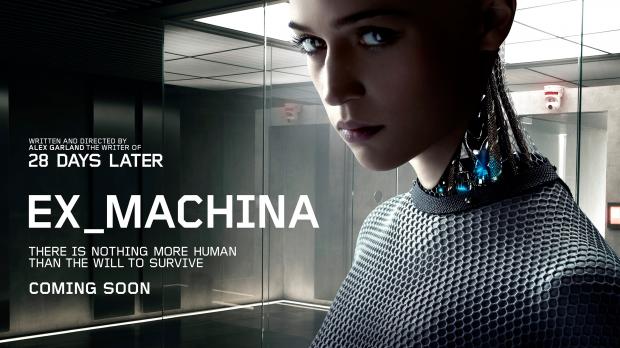

Ex Machina, et al, and the Metaphysics of Computer Consciousness

ex_machina_2015_movie-wide

By Steven Harp

Source: Reality Sandwich

( ex machina from the phrase “deus ex machina” meaning “god from the machine”)

It seems unquestioned in the world today that science is on the verge of creating consciousness with computers. In a Promethean rapture inspired by its enormous technological success, science aspires now to seize control of fundamental powers at the very heart of the universe.

With the advent of modern science the reality of human consciousness has come to be regarded as physical alone.  A caricature of consciousness has been compounded from such disparate elements as digital code, speculative evolutionary psychology, and a “neuro-phrenology” derived from colorized brain imaging. This caricature from scientists and engineers has gone into public circulation with the help of the media and it has become an acceptable counterfeit currency. And with cinematic virtuosity it has been made plausible by representations in the movies.

In the movie, Ex Machina we see another recycling of the classic Frankenstein story: Life is created from nonliving materials. A lone genius in an isolated laboratory, using the mysterious powers of science, creates new life. In the original Frankenstein story we have a dead body made alive by electricity. In Ex Machina we have a non-living “wetware” circuit given a mechanical body and made conscious by electricity.

This takes the story to a whole new level. Here the scientist is creating the very roots of being. To create consciousness-itself is equivalent to creating de novo cosmic absolutes such as space, matter, or light. It would be equivalent to creating a spectrum of color, a scale of tones, entire ranges of emotion, thought, pain, pleasure, and the entire dictionary of the contents of consciousness, all from the dark and silent abyss of nothingness.

How can something with neither mass nor dimension arise from that which has mass and dimension? How can that which has subjectivity and intentionality arise from that which has objectivity and has no intentionality?  This is the magisterial conundrum and is recognized as the greatest mystery in science.  No one, neither philosopher nor scientist, has a clue to the answer. It has famously been labeled the “hard problem of consciousness” by David Chalmers.

In both cases we see technology extrapolated to the creation our most fundamental being in which man becomes the maker of his most central essence, of what he is himself. The creation becomes the creator, the hand that draws itself.

This year alone has seen 8 major movies featuring synthetic or digital consciousness: Transcendence, Her, ChappieEx Machina, Lucy, Extant, Tomorrowland, and Terminator again.  One has to ask, is there something more than a good story line here?

The claim that technology will give birth to consciousness itself within a computer is entirely based on implicit assumptions about the nature of consciousness and reality. The often made assumption that the brain is like a computer and that nerve impulses are like digital code has no direct experimental foundation and is based on superficial resemblances only. There is no real scientific basis for the claim that the digital processing of symbols should somehow be accompanied by inner experience, that is, by consciousness, awareness, qualia, feeling, sentience, etc. 

A computer simulation of brain function is not going to produce consciousness any more than a computer simulation of kidney function is going to produce urine. There is no magic in computation. No amount of digital processing alone is ever going to produce a color. Without consciousness a computer program is a flow of electrons as meaningless and non-referential as those flowing in a wall.

Despite the flagrant and unbridgeable abyss between mind and matter it is the modern claim that if one can set up the right connections and run some electricity through it, a` la Frankenstein, consciousness will arrive on schedule from nonexistence. When undressed from the bewitching technical language this seems to be an equivalent in science of the Immaculate Conception. Or, in the current philosophical language we would call it the Immaculate Emergence. But perhaps Particle Parthenogenesis would be more accurate.

“We are on the edge of change comparable to the rise of human life on earth.” -Vernon Vinge

For materialists the arrival of artificial intelligence and machine consciousness is inevitable and only a matter of time. We have two main schools of thought developing on how to meet the coming technological tsunami – those who fear it and those who embrace it. We have on the fear side the notion that we are headed toward a near future where artificial intelligence or machine consciousness presents a danger to mankind (à la Stephen Hawking, Elon Musk, Nick Bostrom, etc.)

How this danger will manifest is the great unknown. There are countless possibilities. An embryonic AI lurking in the internet could suddenly cross the threshold into self-awareness and seize control of the world’s nuclear arsenals and missiles and demand surrender.  Or, a self-aware internet could lay low and send out brain wave controlling vibrations through WIFI and the background hum of our electrical circuitry to enslave humankind in order to advance technology sufficiently to develop the body or bodies necessary for a now paralyzed internet consciousness. This may have already happened.

And for those who embrace the change we have the Kurzwellians’ vision of the very technological replacement of humanity. This scenario will begin when computers begin to learn and thus redesign themselves. At this point the computer, or computer network, or robot would be capable of designing computers or robots better than itself. Repetitions of this cycle would result in an intelligence explosion resulting in a superintelligence which may be beyond human comprehension. This has been called the technological singularity and could begin as early as 2040, although the date keeps getting pushed further into the future.

In this process consciousness will transcend the hazards and horrors of warm-blooded protoplasmic existence. The machine descendants of man will transcend our obsolete and obscene modules of flesh. They shall put away the sweaty, smelly, hairy, warty, fatty, itchy, scarred, flawed, urinating, shitting, hurting, needy, conflicted, misshapen sac of meat and gristle and the gravity-enslaved earthly existence to become ascended silicon masters and rule like gods in a heavenly cyberspace and perhaps even reconfigure the universe itself. “We shall be as gods!” is a not so hidden background thought.

Consciousness will emerge like a butterfly from its earthbound caterpillar stage and fly freely in the new digital noosphere of a virtual reality (à la Kurzweil, Moravec, Fredkin).  The mortal human self will be subsumed like mitochondria in a giant computational eukaryote.  Our evolutionary period will expire like the dinosaurs’ and we will become a symbiont in the superior host technology. We have been upgraded by Google! All hail Google! Superintelligence is all! Praise Intelligence!

For artificial intelligence enthusiasts this will be good news for mankind. Maintaining mortal human flesh is a logistical nightmare. It requires very specific atmospheric conditions, it requires a very limited temperature range, it requires a vast range of chemical and energy inputs, it requires specific social and sexual connections, it even requires entertainment. Not meeting even one of these requirements could result in the entire operating system crashing and all the data lost (you).  Our wetware obviously makes for an inferior product when compared to a silicon based circuitry which could just as well exist in the vacuum of space with just a single source of electricity.

We shall put aside our earthly raiment of mortal skin and bone and be arrayed in the finest of indestructible metals, plastics, and silicons. We shall be free at last of nature and its’ inconveniences.  All the wealth and riches of the imagination will be at the tip of our cursor.  A million movie channels will be available and we will have an unbreakable silicon heart. We can even have our heart amputated like an infected appendix.  After all it is only pixels!  It is the next stage of evolution! Rejoice in the in the wonderful future of technology! Praise Evolution!

The notion that mind can be uploaded into a computer (Transcendence, Her, Chappie), if not completely loco, is radical in the extreme. But given the hubris of technological success and the realism of movie depictions, it has been made believable and in mainstream scientific circles it is near heresy to doubt the materialist premise of consciousness synthesis from raw physical materials. 

However there is a curiosity in the movie, Ex Machina, that perhaps reveals a crack in the technological juggernaut.  In the movie, Nathan, the techno-wizard internet mogul, has just created the most extraordinary technology in the history of science, a technology that would revolutionize the world and beyond. With Promethean daring he has just robbed the very cradle of consciousness and created Ava, a conscious robot that passes every Turing test.  It would seem that he would be in a state of elation and brimming with fulfillment.  Instead he is getting drunk at every opportunity. Alcohol is featured in almost every scene in which he appears.  One must ask the question, what has gone wrong with Nathan?    

Is this just an iniquitous twist of character?  Or could he be plain old lonely? Or is it a metaphysical crisis?  He lives like a hermit in a remote and isolated Northern region, but he has a retinue of very lovely synthetic ladies waiting for him in closets. And he has a beautiful and near mindless female companion and assistant that likes to dance. And then, he has the mysterious and unknown otherness of Ava. That should be adequate companionship.

But he has just synthesized consciousness. He has dramatically and inescapably demonstrated that life and consciousness are a merely physical phenomena that have no more meaning than electricity passing through a copper wire. He has shown that he himself is not much more than the ionic exchanges occurring through a polarized lipid membrane in a cranial bone flask.  And when the switch is turned off he dissolves into nothingness.

Our lone genius clearly has grounds for a metaphysical crisis.  He has experimentally proven a deeper isolation:  That is the isolation that the vision of materialism prescribes for man – as a spark of consciousness in a meaningless void. There is no wider mystery in being alive… he is all there is… a pathetic lonely little god… isolated in time as well as space with a separation that he cannot mitigate, even with the agreeable companionship of his ersatz bitches.

It is more than ironic that our synthesizer of new consciousness is intent on anaesthetizing his own.  But is this not also modern man? Alcohol is the universal drug of the world today. Nathan here is materialist everyman rather than the oversensitive genius. Modern man closes the door on his personal consciousness while aspiring to extend consciousness through external technological means. It seems modern man shares the same metaphysical disturbance as our techno-wizard, Nathan.

The materialist everyman has fixated on a physical literalism that excludes the meaningfulness inherent within every conscious experience. He has radically reduced the ontological range of life. Life has been stripped of inner meaning. He is abandoned to a complete separation and isolation in both time and space.

He has embraced the lawful Stalinesque reality of materialism as a total explanation for consciousness. He has embraced the scientific fundamentalism of consilience. And total explanations produce repressive states, both political and personal. However, modern man, like an eviscerated organism continues to live… even though partially.

The Frankenstein of today is more than an out-of-control technology. Our Frankenstein monster is the story that science has authority over all other interpretations of life and has replaced them with a grim and desolate paradigm about the nature of the universe and our place in it. Technology has come to shape the imagery by which the world is depicted and to affirm the underlying metaphysics of materialism. We have shaped our reality and now it shapes us. It is only natural then that Ava, the beautiful and sexy creature in Ex Machina kills her creator, Nathan. But modern man cannot kill his own soul so he must anaesthesize it.

But, exercising our imagination, let us suppose that consciousness, rather than being proven physically dependent is proven physically independent. Materialism, irrespective of technological successes, would be shown wrong and suggest that we have been living in the dark ages of a materialist ideology. And it would reveal the present day metaphysics of consciousness at the heart of a dysfunctional civilization.

The Asshole Factory

index

Our economy doesn’t make stuff anymore. So what does it make?

By Umair Haque

Source: Medium

My good friend Mara has not one but two graduate degrees. From fine, storied universities. Surprise, surprise: the only “job” she was able to find was at a retail store.

Hey—it’s only minimum wage, but at least she’s working, right? And at a major-league, blue-chip company, An American icon; an institution; a name every man, woman, and child in this country knows; an historic company that rings of the American Dream the world over, besides. Surely, if nothing else, it’s a start.

Perhaps you’re right. Maybe it isn’t the start she always dreamed of…but at least it is one. If so…then awaits her at the finish?

What is Mara’s job like? Her sales figures are monitored…by the microsecond. By hidden cameras and mics. They listen to her every word; they capture her every movement; that track and stalk her as if she were an animal; or a prisoner; or both. She’s jacked into a headset that literally barks algorithmic, programmed “orders” at her, parroting her own “performance” back to her, telling her how she compares with quotas calculated…down to the second…for all the hundreds of items in the store…which recites “influence and manipulation techniques” to her…to use on unsuspecting customers…that sound suspiciously like psychological warfare. It’s as if the NSA was following you around……and it was stuck in your head…telling you what an inadequate failure you were…psychologically waterboarding you…all day long…every day for the rest of your life.

Mara’s boss sits in the back. Monitoring all twelve, or fifteen, or twenty people that work in the store. On a set of screens. Half camera displays, half spreadsheets; numbers blinking in real-time. Glued to it like a zombie. Chewing slowly with her mouth open. Jacked into a headset. A drone-pilot… piloting a fleet of human drones…pressure-selling disposable mass-made shit…as if it were luxury yachts…through robo-programmed info-warfare…like zombies…to other zombies…who look stunned…like they just got laser blasted, cluster-bombed, shock-and-awed…

WTF?

It’s bananas. The whole scene is like a maximum-security mental asylum designed by sadomasochists in a sci-fi movie. If Jeffrey Dahmer, Rasputin, and Michael Bay designed a “store” together, they couldn’t do any better. Her “job” will begin to drive her crazy—paranoid, depressed, deluded—in a matter of years if she continues doing it. No human psyche can bear that kind of relentless, systematic abuse.

Now. Note what all the technology and bureaucracy that wonderful, noble company has invested hundreds of millions in doesn’t ask her to do. Learn. Think. Reflect. Teach. Inspire. Lead. Connect. Imagine. Create. Grow. Dream. Actually…serve customers. Heaven forbid. It just beats her over the head, over and over again, three times a minute, every twenty seconds, with how much she hasn’t sold; hasn’t made; hasn’t produced. For her shitty .0003% commission. According to the quota that’s been set for her. By her boss. For his boss. For their boss. And so on all the way up the food chain.

See my point? Mara’s job isn’t to benefit customers. It isn’t to educate, understand, listen to, or even to chat with them. It isn’t to stop them from buying what they don’t want; to help them find what they might need; to match them with the right stuff. Nope. It’s merely to push more and more and more and more shit at them…faster, meaner, and dumber than any sane person would think is humanly possible…using advanced military technology and techniques… programmed to abuse her…so she can wage advanced psychological warfare…on her customers. And they were just suckers, gaping maws, fools, marks. And be yelled at…by a robot…if she doesn’t.

Really? This is the best our economy can do? To take the stuff of 21st century warfare and use them them to…rack up the profit? To turn a bright young woman with two grad degrees…into a Superprofitable Human Weapon of Mass Consumption…a half-crazed algorithmically-programmed asshole…a human drone…so even bigger, actually crazy assholes…can get super-rich…by slinging entire supertankers full of junk…at people getting poorer at four thousand percent interest a year…by using drones and bots to wage psy-warfare against them…so they’re conned into buying too much?

The economy doesn’t make stuff anymore. That much you know. So what does it make?

It makes assholes.

The Great Enterprise of this age is the Asshole Industry.

And that’s not just a tragedy. It is something approaching the moral equivalent of a crime. For it demolishes human potential in precisely the same way as locking someone innocent up, and throwing away the key.

Consider Mara again. Who in Christ’s name would design such an inhuman system? Whose sick joke of an idea is a “store” like that? What do you even call it? Because it’s surely not a “store”.

Only a monstrous asshole of the highest order could assemble such a demonically vampiric bullshit machine to prey on…everyone. Customers, managers, workers alike. Such a carefully sophisticated engine of human misery; of finessed cruelty; all to rake in a few extra pennies an hour, at the expense of dignity, intelligence, creativity, commitment, fairness, craft, service, sovereignty…sanity.

The store is an Asshole Factory.

Allow me to explain.

What happens to Mara when she’s “doing her job”? Think about it for a second. She turns into precisely the kind of asshole that the heartless dweebs who thought up this infernal torture-machine no doubt already are. Not because she wants to. But because she has to.

That’s exactly what the store was designed to do. Turn everyone into the same kind of asshole as the assholes that made it, run it, and benefit from it…want everyone to be.

The store is an Asshole Factory.

Our world is now full of Asshole Factories. That’s what the stores, offices, industrial parks, skyscrapers, malls, low-rise blocks, gleaming headquarters, whimsically designed corporate campuses, really are.

It’s the grand endeavor of today. We don’t make stuff anymore. We make assholes. The Great Enterprise of this age is the Asshole Industry.

Consider, for a moment, my tiny hypothesis.

Have you noticed, lately, that people seem to be more, well, assholish…than before? That everywhere you go, people seem to be meaner, nastier, dumber, angrier, more brutish?

Why?

It is the last and greatest industry left in an economy that has been impoverished, emptied, hollowed out, drained.

The Great Enterprise of the Age of Stagnation is the wholesale manufacture not of great, world-shaking, ground-breaking ideas, inventions, concerns…but of bigger and bigger assholes.

The chain-store; the mall; the hypermarket. The corporation; the firm; the partnership. B-school; law school; med school. The boardroom; the backroom; the trading floor.

These are, by and large, Asshole Factories. They don’t make people. Capable of great things. Who create and build and touch and soar. They make assholes.

They are designed to disinfect us of our fragility. To cleanse us of our flaws. To disinfect us of weakness. Love, grace, mercy, longing, forgiveness, passion, truth, nobility, dreams. Their objective is to stamp all that out; to eradicate it; to erase it. To replace it with calculation, ruthlessness, self-concern; gluttony; cruelty; anxiety, despair. By using the most sophisticated technology ever made to subjugate, oppress, and goad us into being little torturers ourselves.

And in so doing, they emotionally sterilize us. They psychically traumatize us. They intellectually castrate us. They socially neuter us. They cheat us of greatness. That is how they turn us into assholes.

They are designed to deprive us into depriving everyone else of the lives we could and have, at our highest and truest and noblest.

The assholes haven’t just taken our incomes, our savings, our careers, our educations. They’ve taken something far more precious; something priceless. It is our lives—the full, true lives we should be living—that have been taken from us. And in the gaping void where the lives we should be living are, the assholes have deftly inserted carbon copies of…themselves.

When you think about it that way…is it any wonder that society seems to be stuck? That the economy seems headed into oblivion? That life for so pretty much anyone under the age of 35 and/or worth less than $20 million or so appears to be going…nowhere?

Remember my friend Mara? She’s probably being piloted like a drone…yelled at by a bot…three times a minute…into waging advanced techniques of psycho-war…designed to traumatize prisoners…over and over and over again…right this very second…

Until she’s cleansed. Perfect. Flawless. Pure. Another gleaming, brand-new asshole, rolling proudly off the assembly line of the Asshole Factory.

We’re obedient constructivists. Pragmatists. Rationalists. So you probably want to know: what can we do about it?

It’s pretty simple.

Don’t be an asshole. Remember the Asshole Factories? Here’s a secret: they’re churning out assholes by the millions. And so should you bravely decide to be an asshole, what you’ll really be is just another interchangeable, forgettable, rapidly depreciating commodity.

So who should you be?

Be yourself. The person you were meant to be. Whether you believe in heaven or the inferno, freedom or fate, the simple fact is: each and every one of us was put here to be something greater than Just Another Asshole stealing pennies from his neighbors to pay off Even Bigger Assholes.

So let me say it again. Don’t be an asshole. Be yourself. The miracle of being that you were meant to be. A person that, consumed with passion, seared with happiness, aglow with meaning, brings forth all that is great, noble, and true in the world, and so, with love, mercy, and wisdom, lifts every life that you meet into the light.

Thank you and goodbye.

Wu Wei, Flow States and the Art of Being a Lazy Fuck

hammock

By Mr. Furious

Source: Disinformation

“…It is when we act freely, for the sake of the action itself rather than for ulterior motives, that we learn to become more than what we were.”

“The psychic entropy peculiar to the human condition involves seeing more to do than one can actually accomplish and feeling able to accomplish more than what conditions allow.”

― Mihaly Csikszentmihalyi, Flow: The Psychology of Optimal Experience

I visibly waffled on several occasions when attempting to begin this article. Literally. I sat down on the couch with my laptop, ready to begin the process of typing this stupid, god-forsaken thing, and I physically shuddered. Each time. And, each time, Missus Furious would gaze at me cock-eyed and ask what the fuck my problem was.

“Nothing,” I’d mumble. “Nothing at all.”

“Ok?” She’d say, skeptically. “But why do you keep doing that?”

“Doing what?”

“Having seizures or whatever it is you’re doing over there. Are you alright?”

“I don’t know what you’re talking about.”

“YOU KEEP SHAKING.”

At that point I just shrugged and shook my head as if she were crazy.

This is what it’s like living with someone as mercilessly moronic as myself.

Anyhow, I did have several episodes of trembling. For a couple of reasons.

• • •

One: The thought of having to type Mihaly Csikszentmihaly’s name a half-dozen or so times made me ill. This sounds like such a minor inconvenience that I must be making it up. But I’m not. You’re reading the work of the type of person who, when trying to watch Rey Mysterio highlights on youtube and an ad pops up, and the button in the corner of the ad says “you can skip this ad in 13 seconds,” I usually just close up the entire browser, get off the computer and go make peanut butter sandwiches or something, instead of waiting the 13 seconds.

Two: There are enough subtleties and nuances to both Csikszentmihalyi’s ideas and my own arguments, that I’m worried a fair number of potential readers are going to miss them. And, as a writer, I feel that if people misunderstand and/or don’t fully comprehend what is going on, it’s my fault, not the reader’s. So I spend an inordinate and irrational amount of time in the midsts of a neurotic episode because I’m convinced I’m not a good enough writer (or thinker) to make some of my ideas clear.

Regardless of how I feel—and regardless of my concerns—here I am. And since I’ve already buried the lede this far, let me just come out and tell you what my thesis is for the rest of the article: that so-called “flow” states are much more easily accessed—and most commonly experienced—when one is being a lazy fuck.

• • •

First off, even though Csikszentmihalyi’s concept of Flow is one of the most popular and discussed ideas produced by psychology in the past 50 years or so, not everybody’s familiar with it. So we have to at least touch on what Flow is. Csikszentmihalyi himself describes the experience of flow as consisting of 6 components, which are:

  1. Intense and focused concentration on the present moment
  2. Merging of action and awareness
  3. A loss of reflective self-consciousness
  4. A sense of personal control or agency over the situation or activity
  5. A distortion of temporal experience, one’s subjective experience of time is altered
  6. Experience of the activity as intrinsically rewarding, also referred to as autotelic experience

All of which sounds incredibly reasonable and probably accurate. My issue is really with how Csikszentmihalyi argues we induce flow states, mostly because Csikszentmihalyi spends a good portion of the his book on the topic—inconceivably entitled Flow: The Psychology of Optimal Experiencediscussing his belief that Flow experiences must be stimulated by activities that provide just the right amount of challenge, i.e. not challenging to the point of making one frustrated, but not so devoid of challenge that one finds the activity boring.

Again, this assertion sounds rather reasonable. And it is. But Csikszentmihalyi then expounds on that idea to insist that one cannot be in a passive or lazy mind if one hopes to initiate states of Flow.

He states:

Contrary to what we usually believe, moments like these, the best moments in our lives, are not the passive, receptive, relaxing times—although such experiences can also be enjoyable, if we have worked hard to attain them. The best moments usually occur when a person’s body or mind is stretched to its limits in a voluntary effort to accomplish something difficult and worthwhile.” (emphasis mine)

He gives, as support to this idea, the example of a European woman who is a scholar and business magnate. She constantly travels, owns a number of homes around the world, is ceaselessly attending business meetings or conferences or concerts. She is so busy and opposed to leisure time that she expects her chauffeur to attend the local art museums in whatever town she finds herself in and give her a run-down of sorts on how the art museum was. To me she sounds insufferable and her life sounds exhausting. The importance of discussing this concept of Flow, as even Csikszentmihalyi admits, is that Flow states are supposed to make us happy. The inability to sit still and enjoy life for being life doesn’t sound like happiness to me. It sounds like distraction.

Either way, the philosopher and author Ed Slingerland agrees. In his book, Trying Not to Try, he takes the concept of Flow and expands and—in my opinion—improves on Csikszentmihalyi’s ideas. Slingerland makes the connection between Flow states and the Chinese philosophical concept of Wu Wei. Wu Wei is typically translated (with numerous, but less influential, exceptions) as “non-action,” “non-doing,” or “actionless action.” There is not really an English equivalent. Anyhow, Slingerland makes a rather convincing argument that Flow states are essentially states of Wu Wei.

This is important, because—even though I disagree with a number of assertions in Slingerland’s book—Slingerland is able to recognize that it’s not effort that is necessary to initiate episodes of Flow, it is a lack of effort that activates such states. Hence the title his book, Trying Not to Try.

Slingerland, though, still has his own aversion to coming out and saying that it’s a certain kind of laziness that induces Flow/Wu Wei states. Most writers who attempt to expound on the concept of Wu Wei exhibit this bizarre anxiety.

• • •

I’ve already written a bit about the virtues of laziness, and I want to emphasize that there’s a big difference between boredom and laziness, two concepts which I think a lot of people conflate. I also want to reiterate a major point from that initial essay of mine, which is: that a healthy laziness (as opposed to an unhealthy laziness, which does exist) is merely the spontaneous act of doing whatever seems most enjoyable to a person at a given moment. For example, a few people I know insist that I’m not lazy because I work 50-plus hours each week and yet I still find time to write and work-out and such things. But I genuinely enjoy writing and exercise. And typically when I am engaging in such activities, I am doing so at times when they’re so enjoyable that they are not taking much actual effort to complete. My 50 hours of work each week are really the only parts of my life that take any kind of effort — well, that and when my wife puts me to work doing some kind of tedious work around the house (for me, although many people like DIY projects). The opposite of laziness is “working hard.” But I think work only becomes hard when we’re not interested in doing it. I have to work hard at work because there are literally thousands of other things I’d rather spend my life doing.

This is my definition of laziness: the doing of things that are enjoyable at times when they are enjoyable. There were times when I was in school that writing was not enjoyable and was full of effort. Even in my series of essays for Disinfo, I believe a keen (or maybe not so keen in some instances) eye can spot those essays that weren’t all that enjoyable to write. They’re full of real effort. I’m the rare writer who believes that one should only write when inspired, and the fact that so many writers force themselves to write is why I find so many novels so unreadable.

All of which is sort of besides the point. The main idea here is that a healthy laziness is being spontaneous and doing enjoyable things at times when they are enjoyable. Sometimes activities we find to be enjoyable aren’t going to be enjoyable (for any of a myriad of reasons) and we shouldn’t do those usually enjoyable things at those times.

If we follow this advice, I believe we will find ourselves to be more often in states of Flow/Wu Wei. I know this is true for me when I write when I feel like writing, when I work-out when I feel like working out, when I socialize when I feel like socializing. I have Flow/Wu Wei watering my garden in cool summer evenings. I have felt it drinking green tea under a full moon while sitting on a rocking chair in my backyard. I have felt it on long walks after work with Missus Furious. I have even felt it lying on the couch and staring at the ceiling while daydreaming about being interviewed by Charlie Rose or about being able to eventually, one day, do a one-armed pull-up. And so on.

Most of those activities don’t meet Csikszentmihalyi’s requirement that flow states must present some kind of challenge, nor did I have to work hard to attain any of those states, contrary to his assertions. Believe me, for example, when I say that it literally takes no effort to imagine one’s self explaining pretentiously to Charlie Rose why one’s novel about drunk college kids puking on each other is really an analog for certain aspects of Taoist philosophy.

What those activities did meet, though, were my requirements: activities should be done when they feel enjoyable to do so.

• • •

Both Csikszentmihalyi and Slingerland recognized that Flow/Wu Wei states are instigated when we are doing things for their own sake. When we sew because we like the act of sewing, not because we’re all that interested in making a beautiful dress. When we cook because we enjoy the process of cooking, not because we’re all that interested in the resulting meal. When we play basketball not because we really want to win, but because playing basketball is fun.

The results of such activities may be rewarding too. Creating a beautiful dress, eating a tasty meal, and winning a basketball game certainly feel good. But there’s a difference, say, between Michael Jordan, who played basketball to feed his own ego, and a person who plays basketball because the activity of playing basketball is enjoyable in and of itself, regardless of outcome. Primarily, Michael Jordan’s efforts were effortful, whereas the other person’s was actually an act of spontaneity, or laziness, as I define it. And if you need proof that one form of playing basketball is superior to the other, all you need to do is look at Jordan or, say, Kobe Bryant, and observe how happy or fulfilled those two are, despite their numerous championships and accomplishments in the sport of basketball.

What Slingerland and Csikszentmihalyi neglect, though, is that the only way to do something for its own sake is to not give a shit about it, at least in the traditional ways we give a shit about things. What I’m talking about is being apathetic about results. If we don’t care about winning the basketball game, then our attention is focused only the joys of playing the game itself. If we’re not concerned about results, then we can focus on the joys of the process, which is where we can be lazy and in which we make ourselves available to Flow/Wu-Wei.

Note: It is inherent in the word “Flow” that a process is occurring. A river cannot flow, for example, once it has reached its end result of entering the ocean or of having been dried up. One can flow making a hamburger or eating a hamburger, but one cannot flow when the hamburger is simply sitting on the plate after the process of having been made, or when it is done being consumed. One can flow playing a game of basketball, but not when one has finished playing and has “won” or “lost” the game. One can flow when sewing a dress, but not when the dress is completed. If this is true for sewing and cooking and playing basketball, how much truer is it for the act (the process) of living life itself?

For if we work too hard, place too much effort in a search for results, instead of simply living life for life’s sake, we close ourselves off from opportunities for experiencing Flow/Wu Wei. And when we spend our lives struggling, striving, working, being effortful for some sort of ultimately meaningless result, we miss all that is enjoyable and worth experiencing… except when we’re in the mood to be effortful.

I’ll end this thing with a long-ish quote from Chuang Tzu via Slingerland that sums all of this up–even though Slingerland doesn’t seem to realize the depth and profundity of just what Chuang Tzu was saying, for Slingerland doesn’t quite recognize the connection between “spontaneity” and “laziness.”

Per Chuang Tzu:

When people are asleep, their spirits wander off; when they are awake, their bodies are like an open door, so that everything they touch becomes an entanglement. Day after day they use their minds to stir up trouble; they become boastful, sneaky, secretive. They are consumed with anxiety over trivial matters but remain arrogantly oblivious to the things truly worth fearing. Their words fly from their mouths like crossbow bolts, so sure are they that they know right from wrong. They cling to their positions as though they had sworn an oath, so sure are they of victory. Their gradual decline is like autumn fading into winter—this is how they dwindle day by day. They drown in what they do—you cannot make them turn back. They begin to suffocate, as though sealed up in a box—this is how they decline into senility. And as their minds approach death, nothing can cause them to turn back toward the light.

– See more at: http://disinfo.com/2015/05/wu-wei-flow-states-art-lazy-fuck/#sthash.g96cFrtS.dpuf

They Live, We Sleep: A Dictatorship Disguised as a Democracy

leadtheylive1

By John W. Whitehead

Source: The Rutherford Institute

“You see them on the street. You watch them on TV. You might even vote for one this fall. You think they’re people just like you. You’re wrong. Dead wrong.”—They Live

We’re living in two worlds, you and I.

There’s the world we see (or are made to see) and then there’s the one we sense (and occasionally catch a glimpse of), the latter of which is a far cry from the propaganda-driven reality manufactured by the government and its corporate sponsors, including the media.

Indeed, what most Americans perceive as life in America—privileged, progressive and free—is a far cry from reality, where economic inequality is growing, real agendas and real power are buried beneath layers of Orwellian doublespeak and corporate obfuscation, and “freedom,” such that it is, is meted out in small, legalistic doses by militarized police armed to the teeth.

All is not as it seems.

This is the premise of John Carpenter’s film They Live (1988), in which two migrant workers discover that the world’s population is actually being controlled and exploited by aliens working in partnership with an oligarchic elite. All the while, the populace—blissfully unaware of the real agenda at work in their lives—has been lulled into complacency, indoctrinated into compliance, bombarded with media distractions, and hypnotized by subliminal messages beamed out of television and various electronic devices, billboards and the like.

It is only when homeless drifter John Nada (played to the hilt by the late Roddy Piper) discovers a pair of doctored sunglasses—Hoffman lenses—that Nada sees what lies beneath the elite’s fabricated reality: control and bondage.

When viewed through the lens of truth, the elite, who appear human until stripped of their disguises, are shown to be monsters who have enslaved the citizenry in order to prey on them. Likewise, billboards blare out hidden, authoritative messages: a bikini-clad woman in one ad is actually ordering viewers to “MARRY AND REPRODUCE.” Magazine racks scream “CONSUME” and “OBEY.” A wad of dollar bills in a vendor’s hand proclaims, “THIS IS YOUR GOD.”

When viewed through Nada’s Hoffman lenses, some of the other hidden messages being drummed into the people’s subconscious include: NO INDEPENDENT THOUGHT, CONFORM, SUBMIT, STAY ASLEEP, BUY, WATCH TV, NO IMAGINATION, and DO NOT QUESTION AUTHORITY.

This indoctrination campaign engineered by the elite in They Live is painfully familiar to anyone who has studied the decline of American culture. A citizenry that does not think for themselves, obeys without question, is submissive, does not challenge authority, does not think outside the box, and is content to sit back and be entertained is a citizenry that can be easily controlled.

In this way, the subtle message of They Live provides an apt analogy of our own distorted vision of life in the American police state, what philosopher Slavoj Žižek refers to as dictatorship in democracy, “the invisible order which sustains your apparent freedom.”

We’re being fed a series of carefully contrived fictions that bear no resemblance to reality. The powers-that-be want us to feel threatened by forces beyond our control (terrorists, shooters, bombers). They want us afraid and dependent on the government and its militarized armies for our safety and well-being. They want us distrustful of each other, divided by our prejudices, and at each other’s throats. Most of all, they want us to continue to march in lockstep with their dictates.

Tune out the government’s attempts to distract, divert and befuddle us and tune into what’s really going on in this country, and you’ll run headlong into an unmistakable, unpalatable truth: the moneyed elite who rule us view us as expendable resources to be used, abused and discarded.

In fact, a 2014 study conducted by Princeton and Northwestern University concluded that the U.S. government does not represent the majority of American citizens. Instead, the study found that the government is ruled by the rich and powerful, or the so-called “economic elite.” Moreover, the researchers concluded that policies enacted by this governmental elite nearly always favor special interests and lobbying groups.

In other words, we are being ruled by an oligarchy disguised as a democracy, and arguably on our way towards fascism—a form of government where private corporate interests rule, money calls the shots, and the people are seen as mere subjects to be controlled.

Consider this: it is estimated that the 2016 presidential election could cost as much as $5 billion, more than double what was spent getting Obama re-elected in 2012.

Not only do you have to be rich—or beholden to the rich—to get elected these days, but getting elected is also a surefire way to get rich. As CBS News reports, “Once in office, members of Congress enjoy access to connections and information they can use to increase their wealth, in ways that are unparalleled in the private sector. And once politicians leave office, their connections allow them to profit even further.”

In denouncing this blatant corruption of America’s political system, former president Jimmy Carter blasted the process of getting elected—to the White House, governor’s mansion, Congress or state legislatures—as “unlimited political bribery… a subversion of our political system as a payoff to major contributors, who want and expect, and sometimes get, favors for themselves after the election is over.”

Rest assured that when and if fascism finally takes hold in America, the basic forms of government will remain. As I point out in my book Battlefield America: The War on the American People, fascism will appear to be friendly. The legislators will be in session. There will be elections, and the news media will continue to cover the entertainment and political trivia. Consent of the governed, however, will no longer apply. Actual control will have finally passed to the oligarchic elite controlling the government behind the scenes.

By creating the illusion that it preserves democratic traditions, fascism creeps slowly until it consumes the political system. And in times of “crisis,” expediency is upheld as the central principle—that is, in order to keep us safe and secure, the government must militarize the police, strip us of basic constitutional rights, criminalize virtually every form of behavior, and build enough private prisons to house all of us nonviolent criminals.

Clearly, we are now ruled by an oligarchic elite of governmental and corporate interests. We have moved into “corporatism” (favored by Benito Mussolini), which is a halfway point on the road to full-blown fascism.

Vast sectors of the economy, government and politics are managed by private business concerns, otherwise referred to as “privatization” by various government politicians. Just study modern government policies. “Every industry is regulated. Every profession is classified and organized,” writes economic analyst Jeffrey Tucker. “Every good or service is taxed. Endless debt accumulation is preserved. Immense doesn’t begin to describe the bureaucracy. Military preparedness never stops, and war with some evil foreign foe, remains a daily prospect.”

In other words, the government in America today does whatever it wants.

Corporatism is where the few moneyed interests—not elected by the citizenry—rule over the many. In this way, it is not a democracy or a republican form of government, which is what the American government was established to be. It is a top-down form of government and one which has a terrifying history typified by the developments that occurred in totalitarian regimes of the past: police states where everyone is watched and spied on, rounded up for minor infractions by government agents, placed under police control, and placed in detention (a.k.a. concentration) camps.

For the final hammer of fascism to fall, it will require the most crucial ingredient: the majority of the people will have to agree that it’s not only expedient but necessary. But why would a people agree to such an oppressive regime? The answer is the same in every age: fear.

Fear makes people stupid.

Fear is the method most often used by politicians to increase the power of government. And, as most social commentators recognize, an atmosphere of fear permeates modern America: fear of terrorism, fear of the police, fear of our neighbors and so on.

The propaganda of fear has been used quite effectively by those who want to gain control, and it is working on the American populace.

Despite the fact that we are 17,600 times more likely to die from heart disease than from a terrorist attack; 11,000 times more likely to die from an airplane accident than from a terrorist plot involving an airplane; 1,048 times more likely to die from a car accident than a terrorist attack, and 8 times more likely to be killed by a police officer than by a terrorist, we have handed over control of our lives to government officials who treat us as a means to an end—the source of money and power.

We have allowed ourselves to become fearful, controlled, pacified zombies.

In this regard, we’re not so different from the oppressed citizens in They Live. Most everyone keeps their heads down these days while staring zombie-like into an electronic screen, even when they’re crossing the street. Families sit in restaurants with their heads down, separated by their screen devices and unaware of what’s going on around them. Young people especially seem dominated by the devices they hold in their hands, oblivious to the fact that they can simply push a button, turn the thing off and walk away.

Indeed, there is no larger group activity than that connected with those who watch screens—that is, television, lap tops, personal computers, cell phones and so on. In fact, a Nielsen study reports that American screen viewing is at an all-time high. For example, the average American watches approximately 151 hours of television per month.

The question, of course, is what effect does such screen consumption have on one’s mind?

Psychologically it is similar to drug addiction. Researchers found that “almost immediately after turning on the TV, subjects reported feeling more relaxed, and because this occurs so quickly and the tension returns so rapidly after the TV is turned off, people are conditioned to associate TV viewing with a lack of tension.” Research also shows that regardless of the programming, viewers’ brain waves slow down, thus transforming them into a more passive, nonresistant state.

Historically, television has been used by those in authority to quiet discontent and pacify disruptive people. “Faced with severe overcrowding and limited budgets for rehabilitation and counseling, more and more prison officials are using TV to keep inmates quiet,” according to Newsweek.

Given that the majority of what Americans watch on television is provided through channels controlled by six mega corporations, what we watch is now controlled by a corporate elite and, if that elite needs to foster a particular viewpoint or pacify its viewers, it can do so on a large scale.

If we’re watching, we’re not doing.

The powers-that-be understand this. As television journalist Edward R. Murrow warned in a 1958 speech:

We are currently wealthy, fat, comfortable and complacent. We have currently a built-in allergy to unpleasant or disturbing information. Our mass media reflect this. But unless we get up off our fat surpluses and recognize that television in the main is being used to distract, delude, amuse, and insulate us, then television and those who finance it, those who look at it, and those who work at it, may see a totally different picture too late.

This brings me back to They Live, in which the real zombies are not the aliens calling the shots but the populace who are content to remain controlled.

When all is said and done, the world of They Live is not so different from our own. As one of the characters points out, “The poor and the underclass are growing. Racial justice and human rights are nonexistent. They have created a repressive society and we are their unwitting accomplices. Their intention to rule rests with the annihilation of consciousness. We have been lulled into a trance. They have made us indifferent to ourselves, to others. We are focused only on our own gain.”

We, too, are focused only on our own pleasures, prejudices and gains. Our poor and underclasses are also growing. Racial injustice is growing. Human rights is nearly nonexistent. We too have been lulled into a trance, indifferent to others.

Oblivious to what lies ahead, we’ve been manipulated into believing that if we continue to consume, obey, and have faith, things will work out. But that’s never been true of emerging regimes. And by the time we feel the hammer coming down upon us, it will be too late.

Coincidence, Chaos, & Archetypes in Our Science-Fictional World

4153262_orig

By Eric Wargo

Source: The Nightshirt

You don’t have to be a hardheaded materialist skeptic or an atheist to be troubled by the idea of synchronicity. The fundamental mystery—or really, outrage—of synchronicities is they seem arranged, stage managed, in a way that is impossible without imagining an active higher intelligence taking interest in guiding us and arranging the events of the wider world to produce unmistakeably uncanny outcomes. Even if we believe in God, many people aren’t comfortable living in a world of miracles and signs.

This was the problem faced by Philip K. Dick, whose Christianity couldn’t countenance fully divine meddling in his psyche and life. The story had to be more complex and also more rational. Hence, he tended to think that the synchronicities he experienced in 1974 reflected his own enlarged self haunting him from an orthogonal dimension of time, perpendicular to the four spacetime dimensions we ordinarily experience.

My last post sparked an interesting discussion in the comments about the apparent role of coincidence in synchronicities if they are really, as I argued, cases of misrecognized precognition or premonition. For instance, even if Jung’s famous scarab arriving at the window of his office was a purely random event that his patient had dreamed about the night before, there is still a coincidental element to it: Why a scarab, which has an archetypal meaning connected to the patient’s therapeutic situation, as opposed to some other insect?

Here’s where I think we really need to take seriously the revised picture of time that Dick grappled with through his 8-year frenetic journaling in his Exegesis: What is the connection between the archetypal world and the multidimensional nature of time? In a Eureka moment (not unlike the hundreds recorded by the manic Dick), I think I figured it out: Archetypes are an illusory effect produced by our failure to recognize self-confirmatory actions (feedback loops) made possible by the looping nature of time. Temporal feedback loops amplify the personal significance of symbolic formations, which (because we fail to recognize psi) appear as somehow objective or external to us.

For reasons I discussed in my Psi of Regret post, most information from the future should be negated by one’s own and others’ willed actions; but in a minority of cases, a self-confirming feedback effect could arise which would actually intensify or amplify the significance of the stimulating event in the future. This would happen specifically when that event involves a minor random coincidence (which are myriad) and/or fulfills some kind of unconscious thought or desire we had harbored.

Through this time-loop mechanism, minor coincidences, when they resonate with our own personal meanings and priorities, can be the nuclei of major significant moments (synchronicities) as well as meta-symbols (archetypes). Small coincidences, in other words, may be like grains of sand around which time’s oyster builds Platonic-Jungian pearls.

Bootstrapping Ourselves Toward Meaning

The idea of information from the future reaching us in the present should be unproblematic to parapsychologists and Forteans, yet we still tend to think of it somehow as a very special case. But if we grant the experimental results of Daryl Bem and Dean Radin and the observations of J.W. Dunne and others, then information must indeed be constantly rippling backwards in the time stream; this would have to produce all the paradoxical effects familiar from time travel stories in science fiction: doubling or multiplication or intensification of information (not unlike what happens in the interesting 2004 sci-fi film Primer), as well as self-cancelling effects such as I discussed in the context of Dune Messiah, and perhaps even wholesale self-negation (the famous grandfather paradox). If I am right about the future not being etched in stone (or glass, as in the Minkowski glass football)—that is, as subject to free will—then precognitive material cannot be about what is definitely going to happen but about what is probabilistic, and much of that information will be rendered inaccurate by our willed actions, and thus we would have no way of knowing it (i.e., because it didn’t come true or wasn’t close enough to how events unfolded to be discernible). It wouldn’t even be information, just noise.

However, in special circumstances, for instance when there is a slight perceived (and random) coincidence, such as between a specific genus of insect and the theme of therapeutic rebirth, it could instead have the effect of entraining our actions to the signal, in turn amplifying the felt significance of the signal into the past, generating a precognitive or premonitory experience which in turn feeds forward to intensify the uncanniness of the stimulating event, in turn boosting the signal into the past, and so on … The result would be an informatic/emotional time-loop feedback effect centered on what emerges as a truly uncanny, meaningful, and even decisive coincidence (the ’synchronicity’) that could even alter the course of a person’s life in a significant fashion going forward.

Within Jung’s larger and less radical paradigm of “individuation,” the unconscious is ever seeking out opportunities to progress and develop and change toward wholeness, and its capitalization on significant coincidences provides a way for the individual to bootstrap him/herself toward integration. The unconscious has no sense of time, so it doesn’t recognize this operation of atemporal time-looping—that is, the artificiality of the apparent coincidence (i.e., the fact that the person him/herself created the apparent coincidence through his/her actions and attributed it to objective external reality). The tendency of ‘synchronistic’ events to have a recursive, fractal, or self-similar quality, in some way being ‘about’ the whole notion of synchronicity or coincidence, reflects the tendency of the coincidence-receptive person to be attuned to coincidences in the first place. It is, quite literally, self-fulfilling prophecy.

Jung and Plato Must Die (that Psi May Live)

Thus the kinds of events that spark an emotional ripple into the past will be ones that support the ‘prophetic enjoyment’ I mentioned in the last post: Synchronicities are self-confirming effects produced by misrecognized precognition within an overall attitude of receptivity to mystery, magic, and meaningful coincidence. Belief in synchronicity produces synchronicity, which further reinforces the belief. In a larger sense, this mechanism may underlie the “law of attraction” in all its forms. It really is just like the “strange attractor” in Chaos Theory (and which is also identical to what Lacan and Žižek call the “symptom”).

What this suggests—and this is my Eureka—is that “archetypes” as such—as well as the Platonic world of “forms” that Dick suggested was the “fifth dimension” (printing out archetypes on the paper of history as on an IBM Selectric typewriter)—are really an illusory or anamorphic effect produced by not seeing or recognizing these self-confirmatory time loops, these informational/emotional eddies in the spacetime continuum, and failing to see our own role in feeding them through our perceptions and actions. We ourselves make meaning, including the intensified meaningful nuclei in the collective unconscious that so fascinated Jung and that formed the centerpiece of Platonic metaphysics.

At times, Dick came close to saying this: He suggested that synchronicities occur because we in the future are time traveling, cultivating our own development; that our own enlarged consciousess has the power to “stage manage” not because it is a white-bearded deity sitting up in a cloud reaching down and playing with us like chess pieces, but because of the nature of time itself. Coincidences may be the product of time tampering, our own time tampering in the future.

Where I’m departing from this notion is in emphasizing misrecognition and the role of the unconscious: Instead of our future (conscious) selves meddling in the past, our unconscious minds are constantly receiving and reacting to future information without knowing it comes from the future; through our actions, we thus sometimes confirm this information, particularly when it resonates with our priorities and unconscious beliefs about meaning or our own significance in the bigger cosmic picture. That sort of information will act as an ‘attractor’ in the Chaos Theory sense and give rise to the illusion of BIG coincidences and the meta-symbols that are necessary (in Jungian thinking) to make sense of them.

We live in a world that curves and bifurcates and loops back on itself, and these loopings and crossings and doublings and cancellations exert a shaping force on our lives and larger events via what we call psi, but we (a) think linearly and do not believe in time travel, (b) generally disbelieve in psi, and (c) fail to include the knower in the known even when we do believe in those possibilities. Consciously being open to coincidence and ‘larger meaning’ but failing to recognize our own role in creating significant moments, we inevitably imagine a Higher Knower who recognizes and certifies these eternal forms or archetypes, stage-managing these amazing occurrences as signals or signposts for us. But this is a mistake.

I’m suggesting we kill both Jung and Plato here in one stroke … maybe even God. Not only synchronicities but also archetypes and Ideal Forms are illusions caused by our failure to recognize the truly science-fictional way that informational-emotional time loops may intensify the potency of confluent events and symbols in our lives, and the role we ourselves play in the process.

We live in a science-fictional universe. To move forward, we need to recognize that fact.

Real Rewilding

6ae1ed82e41b1b306efe339273279b5f-565x403

By Glenn Aparicio Parry

Source: Reality Sandwich

In an attempt to circumvent enmity toward genetically modified foods, Danish scientists are proposing what they claim is a precision breeding technique called “rewilding.” It is named rewilding because it mixes current genes from a plant with ancient genes of the same plant (old genes that were either lost or bred out somewhere along the way). The name sounds harmless, even restorative, and would likely be labelled non-GMO in the US because the genes are modified from the same plant. It could even be labelled “organic” if the introduced gene is determined not to be “foreign.” Like most genetic experiments, it is difficult to know the efficacy of this technique or if it ever will be successfully introduced. The outcome of the initiative notwithstanding, I find the name “rewilding” troubling. It reminds me of other similarly deceptive euphemisms, such as “tax relief” for millionaires. Who could be against “tax relief?” It sounds like a laxative, something we need to make it through the day.

Rewilding is exactly what we need—but not through genetic breeding. We need to rewild by reconnecting with what is wild in Nature and within ourselves if we are to save humanity and many of the other species with which we share this planet. Rewilding is a biological imperative.

So, how do we do this? One important way is to use our mind and our thoughts differently, in ways that reconnect us with our wild roots. These ancient ways of instinctual and intuitive thinking are not obsolete, just suppressed, and their recovery could help promote emotional and spiritual healing. We all need a sense of belonging, especially now. But modern abstract thinking has produced the opposite result—separating us from our “environment.” This fosters alienation, depression, and if untreated, violence.

Of course, abstract thinking has its benefits, and is largely responsible for much of high level science. But we would be wrong to assume that modern rationality is the most advanced form of thought. In my view, it has actually degenerated from its roots in ancient Greece. It is true that the Greeks prized rational thinking as the pinnacle of thought, but they also considered it to be the most beautiful form of thought. The key is in the word. “Rational” comes from “ratio,” or a relationship between things. In the right proportions (what the ancient Greeks called divine proportion or the sacred ratio) the relationship between things is beautiful. It is possible to think harmonious and beautiful thoughts that are inspired by and connect us to living nature, and this is what we should aspire to do.

Original Thinking = The Best of Old and New Thought

I find it curious that genetic rewilding seeks to bring modern and ancient genes together because I often support the idea of bringing old and new together, particularly old and new ideas. If an idea is wise, it is timeless. It can be brought back as needed, even if it has fallen out of favor for so long it is forgotten and its reintroduction is misperceived as brand new. The holistic health movement is a prime example of this phenomenon. It is only after we stopped treating people as whole that we rediscovered a need to do so. I recently saw a newspaper story proclaiming “new hospitals” that have fresh air, sunlight, and gardens for the patients to walk in. The concept is actually very old, used in the sanatoriums of the Middle Ages, where people were very much treated as whole (holy), even if the technologies were not as proficient.

I am not necessarily opposed to bringing old and new genes together providing it is something that genuinely helps the plant and if the plant wants it. That’s right. You read correctly. We should ask the plant first. I am opposed to human beings playing with the DNA of other species as if those species have no rights, as if all of nature is here merely to serve us. This is a fundamental flaw in modern Western thinking.

Of course, mainstream science would scoff at the idea of communicating with plants, but this is a self-imposed limitation. As the visionary physicist David Bohm noted, “The strength of science is that it is based in lived experience. The weakness is that it only admits certain kinds of experiences as legitimate.”

In antiquity, we possessed the ability to communicate with plants, as did Goethe, living in the late 18th and early 19th centuries, and Clive Backster (albeit through the medium of a lie detector) living in the 20th century. Contemporary Indigenous peoples (and other people who have reindigenized to the land) are still able to communicate with plants. In my opinion, all of us do this to some extent, even those who think they can’t. And why shouldn’t we be able to talk with plants? After all, plants and animals are so radically interconnected that we are in a literal conspiracy; we conspire, or breathe together, taking in what the other breathes out in a sacred circle of life.

As Paula Underwood, an Oneida elder observed, the development of one ability often disables another. Our capacities to study about nature have closed off the capacity we once had to speak directly with nature. It is also possible that our abilities to experiment upon the natural world only emerged out of necessity after we had lost our ability to listen. This would explain Frances Bacon’s frustrated cry to “put Nature on a rack and torture her” to learn her secrets.

My chief complaint about genetic engineering is that it tinkers with what ought to be left alone. We do this largely because we believe that knowledge must be obtained through trial and error, but this is one of the greatest fallacies of modern mind. We are so certain that trial and error is the only way to obtain knowledge that we have trouble imagining any other way. But there is another way.

Many intact Indigenous cultures have comprehensive knowledge of plant medicine. Ask them how they know this, and they will tell you that they learned (or their ancestors learned) by directly communicating with the spirit of the plants. The rishis of India were said to have written the Vedic texts in the same way. How else could the Native peoples of the Amazon have received the recipe for making ayahuasca? It is necessary to blend two plants together to make the brew, and one of them contains the monooxidase inhibitor necessary for transforming the DMT molecule in the other to be psychoactive. It boggles the mind to predict the odds of coming upon this by trial and error. I choose instead to believe the Indigenous peoples.

Real rewilding opens the possibility of connection, even communion, with other species. We humans have the instinctual capacity to do this. Of course, instinct has become a pejorative word, something we supposedly transcended in favor of free will. But this is misguided. Instinct serves a vital purpose, connecting us with the rest of creation. Ultimately, humans cannot thrive, or even survive, if the water, air, soil, other plants and animals we share this Earth with are not respected and protected.

Humans have free will, but that does not mean we should act in our selfish interest experimenting on the rest of nature willy-nilly. Our task is to first rewild and learn what nature wants to happen, and then use our free will to align with that sacred purpose.

America’s Mania for Positive Thinking and Denial of Reality Will Be Our Downfall

tomorrowland-trailer-poster-2015-movie-george-clooney

The ridiculous positivism, the belief that we are headed toward some glorious future, defies reality.

By Chris Hedges

Source: Alternet

The naive belief that history is linear, that moral progress accompanies technical progress, is a form of collective self-delusion. It cripples our capacity for radical action and lulls us into a false sense of security. Those who cling to the myth of human progress, who believe that the world inevitably moves toward a higher material and moral state, are held captive by power. Only those who accept the very real possibility of dystopia, of the rise of a ruthless corporate totalitarianism, buttressed by the most terrifying security and surveillance apparatus in human history, are likely to carry out the self-sacrifice necessary for revolt.

The yearning for positivism that pervades our corporate culture ignores human nature and human history. But to challenge it, to state the obvious fact that things are getting worse, and may soon get much worse, is to be tossed out of the circle of magical thinking that defines American and much of Western culture. The left is as infected with this mania for hope as the right. It is a mania that obscures reality even as global capitalism disintegrates and the ecosystem unravels, potentially dooming us all.

The 19th century theorist Louis-Auguste Blanqui, unlike nearly all of his contemporaries, dismissed the belief, central to Karl Marx, that human history is a linear progression toward equality and greater morality. He warned that this absurd positivism is the lie perpetrated by oppressors: “All atrocities of the victor, the long series of his attacks are coldly transformed into constant, inevitable evolution, like that of nature. … But the sequence of human things is not inevitable like that of the universe. It can be changed at any moment.” He foresaw that scientific and technological advancement, rather than being a harbinger of progress, could be “a terrible weapon in the hands of Capital against Work and Thought.” And in a day when few others did so, he decried the despoiling of the natural world. “The axe fells, nobody replants. There is no concern for the future’s ill health.”

“Humanity,” Blanqui wrote, “is never stationary. It advances or goes backwards. Its progressive march leads it to equality. Its regressive march goes back through every stage of privilege to human slavery, the final word of the right to property.” Further, he wrote, “I am not amongst those who claim that progress can be taken for granted, that humanity cannot go backwards.”

Blanqui understood that history has long periods of cultural barrenness and brutal repression. The fall of the Roman Empire, for example, led to misery throughout Europe during the Dark Ages, roughly from the sixth through the 13th centuries. There was a loss of technical knowledge (one prominent example being how to build and maintain aqueducts), and a cultural and intellectual impoverishment led to a vast historical amnesia that blotted out the greatest thinkers and artists of the classical world. None of this loss was regained until the 14th century when Europe saw the beginning of the Renaissance, a development made possible largely by the cultural flourishing of Islam, which through translating Aristotle into Arabic and other intellectual accomplishments kept alive the knowledge and wisdom of the past. The Dark Ages were marked by arbitrary rule, incessant wars, insecurity, anarchy and terror. And I see nothing to prevent the rise of a new Dark Age if we do not abolish the corporate state. Indeed, the longer the corporate state holds power the more likely a new Dark Age becomes. To trust in some mythical force called progress to save us is to become passive before corporate power. The people alone can defy these forces. And fate and history do not ensure our victory.

Blanqui tasted history’s tragic reverses. He took part in a series of French revolts, including an attempted armed insurrection in May 1839, the 1848 uprising and the Paris Commune—a socialist uprising that controlled France’s capital from March 18 until May 28 in 1871. Workers in cities such as Marseilles and Lyon attempted but failed to organize similar communes before the Paris Commune was militarily crushed.

The blundering history of the human race is always given coherence by power elites and their courtiers in the press and academia who endow it with a meaning and coherence it lacks. They need to manufacture national myths to hide the greed, violence and stupidity that characterize the march of most human societies. For the United States, refusal to confront the crisis of climate change and our endless and costly wars in the Middle East are but two examples of the follies that propel us toward catastrophe.

Wisdom is not knowledge. Knowledge deals with the particular and the actual. Knowledge is the domain of science and technology. Wisdom is about transcendence. Wisdom allows us to see and accept reality, no matter how bleak that reality may be. It is only through wisdom that we are able to cope with the messiness and absurdity of life. Wisdom is about detachment. Once wisdom is achieved, the idea of moral progress is obliterated. Wisdom throughout the ages is a constant. Did Shakespeare supersede Sophocles? Is Homer inferior to Dante? Does the Book of Ecclesiastes not have the same deep powers of observation about life that Samuel Beckett offers? Systems of power fear and seek to silence those who achieve wisdom, which is what the war by corporate forces against the humanities and art is about. Wisdom, because it sees through the facade, is a threat to power. It exposes the lies and ideologies that power uses to maintain its privilege and its warped ideology of progress.

Knowledge does not lead to wisdom. Knowledge is more often a tool for repression. Knowledge, through the careful selection and manipulation of facts, gives a false unity to reality. It creates a fictitious collective memory and narrative. It manufactures abstract concepts of honor, glory, heroism, duty and destiny that buttress the power of the state, feed the disease of nationalism and call for blind obedience in the name of patriotism. It allows human beings to explain the advances and reverses in human achievement and morality, as well as the process of birth and decay in the natural world, as parts of a vast movement forward in time. The collective enthusiasm for manufactured national and personal narratives, which is a form of self-exaltation, blots out reality. The myths we create that foster a fictitious hope and false sense of superiority are celebrations of ourselves. They mock wisdom. And they keep us passive.

Wisdom connects us with forces that cannot be measured empirically and that are outside the confines of the rational world. To be wise is to pay homage to beauty, truth, grief, the brevity of life, our own mortality, love and the absurdity and mystery of existence. It is, in short, to honor the sacred. Those who remain trapped in the dogmas perpetuated by technology and knowledge, who believe in the inevitability of human progress, are idiot savants.

“Self-awareness is as much a disability as a power,” the philosopher John Gray writes. “The most accomplished pianist is not the one who is most aware of her movements when she plays. The best craftsman may not know how he works. Very often we are at our most skillful when we are least self-aware. That may be why many cultures have sought to disrupt or diminish self-conscious awareness. In Japan, archers are taught that they will hit the target only when they no longer think of it—or themselves.”

Artists and philosophers, who expose the mercurial undercurrents of the subconscious, allow us to face an unvarnished truth. Works of art and philosophy informed by the intuitive, unarticulated meanderings of the human psyche transcend those constructed by the plodding conscious mind. The freeing potency of visceral memories does not arrive through the intellect. These memories are impervious to rational control. And they alone lead to wisdom.

Those with power have always manipulated reality and created ideologies defined as progress to justify systems of exploitation. Monarchs and religious authorities did this in the Middle Ages. Today this is done by the high priests of modernity—the technocrats, scholars, scientists, politicians, journalists and economists. They deform reality. They foster the myth of preordained inevitability and pure rationality. But such knowledge—which dominates our universities—is anti-thought. It precludes all alternatives. It is used to end discussion. It is designed to give to the forces of science or the free market or globalization a veneer of rational discourse, to persuade us to place our faith in these forces and trust our fate to them. These forces, the experts assure us, are as unalterable as nature. They will lead us forward. To question them is heresy.

The Austrian writer Stefan Zweig, in his 1942 novella “Chess Story,” chronicles the arcane specializations that have created technocrats unable to question the systems they serve, as well as a society that foolishly reveres them. Mirko Czentovic, the world chess champion, represents the technocrat. His mental energy is invested solely in the 64 squares of the chessboard. Apart from the game, he is a dolt, a monomaniac like all monomaniacs, who “burrow like termites into their own particular material to construct, in miniature, a strange and utterly individual image of the world.” When Czentovic “senses an educated person he crawls into his shell. That way no one will ever be able to boast of having heard him say something stupid or of having plumbed the depths of his seemingly boundless ignorance.”

An Austrian lawyer known as Dr. B, whom the Gestapo had held for many months in solitary confinement, challenges Czentovic to a game of chess. During his confinement, the lawyer’s only reading material was a chess manual, which he memorized. He reconstructed games in his head. Forced by his captivity to replicate the single-minded obsession of the technocrat Czentovic, Dr. B too became trapped inside a specialized world, and, unlike Czentovic, he became insane temporarily as he focused on a tiny, specialized piece of human activity. When he challenges the chess champion, his insanity returns.

Zweig, who mourned for the broad liberal culture of educated Europe swallowed up by fascism and modern bureaucracy, warns of the absurdity and danger of a planet run by technocrats. For him, the rise of the Industrial Age and the industrial man and woman is a terrifying metamorphosis in the relationship of human beings to the world. As specialists and bureaucrats, human beings become tools, able to make systems of exploitation and even terror function efficiently without the slightest sense of personal responsibility or understanding. They retreat into the arcane language of all specialists, to mask what they are doing and give to their work a sanitized, clinical veneer.

This is Hannah Arendt’s central point in “Eichmann in Jerusalem.” Technocratic human beings are spiritually dead. They are capable of anything, no matter how heinous, because they do not reflect upon or question the ultimate goal. “The longer one listened to him,” Arendt writes of the Nazi Adolf Eichmann on trial, “the more obvious it became that his inability to speak was closely connected with an inability to think, namely, to think from the standpoint of somebody else. No communication was possible with him, not because he lied but because he was surrounded by the most reliable of all safeguards against the words and presence of others, and hence against reality as such.”

Zweig, horrified by a world run by technocrats, committed suicide with his wife in 1942. He knew that from then on, the Czentovics would be exalted in the service of state and corporate monstrosities.

Resistance, as Alexander Berkman points out, is first about learning to speak differently and abandoning the vocabulary of the “rational” technocrats who rule. Once we discover new words and ideas through which to perceive and explain reality, we free ourselves from neoliberal capitalism, which functions, as Walter Benjamin knew, like a state religion. Resistance will take place outside the boundaries of popular culture and academia, where the deadening weight of the dominant ideology curtails creativity and independent thought.

As global capitalism disintegrates, the heresy our corporate masters fear is gaining currency. But that heresy will not be effective until it is divorced from the mania for hope that is an essential part of corporate indoctrination. The ridiculous positivism, the belief that we are headed toward some glorious future, defies reality. Hope, in this sense, is a form of disempowerment.

There is nothing inevitable about human existence except birth and death. There are no forces, whether divine or technical, that will guarantee us a better future. When we give up false hopes, when we see human nature and history for what they are, when we accept that progress is not preordained, then we can act with an urgency and passion that comprehends the grim possibilities ahead.

Chris Hedges, a Pulitzer Prize-winning reporter, writes a regular column for Truthdig every Monday. Hedges’ most recent book is “Empire of Illusion: The End of Literacy and the Triumph of Spectacle.”