Of course, all of the evidence that there was a U.S. coup in February 2014 in Ukraine, and that Ukraine has been controlled by the U.S. regime ever since, is likewise hidden from the public.
For example, there is no mention of this fact in an 18 December 2023 Washington Post ‘news’-report that headlined “Listening devices found in office of Ukraine’s top general, Valery Zaluzhny”, though the fact that a power-struggle is now taking place within that U.S. colony (‘ally’) is crucially important to understanding what’s happening there; and, so, that WP ‘news’-story blocks truthful understanding of what is going on. (That ‘news’-story even fails to mention, or even hint, that what is going on is a power-struggle within Ukraine’s government; and, then, it is even so bold as to speculate that this spying upon Ukraine’s General Zaluzhny was done “possibly by Russian special services,” and the WP provided zero evidence for that extremely unlikely alternative explanation.)
Here is a 26-minute-long video discussion of these events which comes from a non-regime news-source and provides the necessary context in order to understand what’s actually happening to Ukraine’s government now — and it makes clear that a ferocious power-struggle is now going on within the government of Ukraine. Here is a different presentation — an article instead of a video — that likewise is from a non-Establishment news-site that’s not censored. Both the video and the article offer facts that the billionaires want the public not to know: that Ukraine’s government is now falling apart.
Similarly, the fact that (as I documented on 17 December 2023) “Polls Show Americans Wildly Deceived About Gaza War” is blocked from the public, by the U.S. regime (which censorship actually explains WHY “Polls Show Americans Wildly Deceived About Gaza War”).
What happens when a public are so extremely deceived, as this? How is it even POSSIBLE for such a nation to BE a democracy? IS it possible?
Americans were blatantly lied-to by our Government and by its ‘news’-media (both Republican and Democratic) in the lead-up to our invasion and destruction of Iraq in 2003, which ‘news’ not only failed to expose and contradict the regime’s lies about “Saddam’s WMD” which were provably lies even at the time they were being reported; and, yet, despite the Government’s and media’s having lied in order to produce popular support to perpetrate that atrocity, Americans continue, even to this day, to subscribe to these same lying ‘news’-media, a full twenty years after the fact. First, the lies were reported as-if they were instead truths; then when the falsehoods could no longer be denied to have been falsehoods, ‘intelligence errors’ were said to have caused the falsehoods; but never was the truth published: that both the Government and its ‘news’-media had intentionally deceived their public in order to carry-out the U.S. empire’s program as being the result of a ‘democracy’ — not as it actually was: the result of a dictatorship. It is a dictatorship by and for an ‘elite’ who consist of the richest 1% (and mainly by the richest 0.1%) of the richest 1% of the American public, an aristocracy of extreme wealth.
America’s aristocrats do not themselves and directly do the censoring-out of the key facts, but, instead, their corporations carefully hire (and, when dissatisfied, demote or fire) the employees and agents who do this dirty-work of deceiving the public, on their behalf. This is the way that the empire — and ANY empire — functions.
It has become not merely the norm but the rule within the U.S. empire, and it is yet another historical example of the solidly established fact that censorship is essential to any dictatorship and toxic to any democracy.
In 2023, the West was unable to contain the advance of multipolarity. Despite continuing to finance aggression against Russia and fomenting chaos in several regions to avoid the geopolitical transition process, the US and its allies are weakened in the current world scenario and have not been able to make their projects successful.
On the Russian-Ukrainian battlefield, Kiev was unable to achieve any significant victory throughout the entire year. Since late 2022, the neo-Nazi regime has been betting on the possibility of launching a major “counteroffensive” in the spring-summer season of 2023. According to Western media, this counterattack would be strong enough to retake all the territories claimed by Kiev, including Crimea.
However, the Ukrainian measures have absolutely failed. Neo-Nazi forces were unable to inflict damage on the strong Russian defense lines and thus failed to achieve territorial gains. The Ukrainians’ focus then shifted from the battlefield to the media, with the launch of a series of terrorist attacks on demilitarized Russian territory with the aim of showing Western public opinion that at least some harm was being inflicted on the Russians – thus justifying continued military support.
Russian strong defense capabilities and high-precision strikes, however, disrupted Ukrainian plans once again and neutralized all terrorist incursions. In the end, the Ukrainians had no more arguments to disguise their failures and publicly admitted that the counteroffensive was not successful. As a result, the situation on the front lines became even more disadvantageous for NATO’s proxy forces. With more than half a million Ukrainians dead – tens of thousands of them in the failed “counteroffensive” alone – and with increasingly greater territorial losses, Ukraine already appears to be a “lost battle” in the West, having a growing critical opinion regarding the support for the regime.
Some other relevant military events also took place in 2023, such as a new war in the Nagorno-Karabakh region. In September, Azerbaijani forces launched a series of attacks against the Armenian resistance in the former separatist republic and achieved a quick military victory, gaining complete territorial control over the region. Without support from Armenia or sufficient military force to resist Azerbaijani aggression, the separatist government declared the extinction of the Republic of Artsakh, formally handing over the territory to Baku.
Since 2018, Armenia has been governed by a pro-Western regime that has moved it away from Russia and closer to the US and EU. Local politicians were led to believe that with such an approach it would be possible to contain the Azerbaijani advance, but indeed they got precisely the contrary. NATO is interested in generating as much instability as possible in the Russian [and Iranian] strategic environment and therefore encourages the worsening of crises in the Caucasus.
The scenario in the region now is one in which on one side there are Azerbaijani forces supported by the Turks and on the other Americans and Europeans backing Armenia. Both sides share common anti-Russian interests and want to make the region a NATO occupation zone. In this scenario, Moscow only tries to avoid new conflicts and works diplomatically so that peace between the parties is achieved as quickly as possible.
However, it was in the Middle East that the biggest “geopolitical news” of the year emerged. In October, Hamas-led Palestinian Resistance’s forces launched a military incursion into areas illegally occupied by Israel. Called “Al Aqsa Flood Operation“, the action was successful in causing real damage to the Israeli armed forces and settlers, but it prompted a brutal response from Tel Aviv, with Netanyahu declaring war on the Palestinians and launching a series of bombings that already killed thousands of innocent civilians.
Israeli brutality, however, was not enough to give Israel victory. On the contrary, on the battlefield there is a complicated scenario in which Zionist troops are suffering to obtain gains. There are many difficulties on the ground, mainly due to the fact that Hamas maintains a complex network of underground tunnels and knows the local terrain much better than the Israelis. Furthermore, Israel’s tanks are not able to circulate easily due to the amount of debris from bombed buildings, making frictions more favorable to Palestinian guerrillas.
Suffering heavy military losses and simultaneously killing thousands of civilians, the Zionist government is in a situation of serious crisis, both domestically and diplomatically. Globally, Israel is isolated, gaining support from only a few Western countries. Internally, the pressure for his impeachment is great, with part of his armed forces and the intelligence sector joining the opposition.
In this regional context, the Yemeni Houthi government showed solidarity with the Palestinians through a declaration of war on Israel. The Houthis have been conducting operations in the Red Sea, hindering naval flow and severely damaging the Israeli economy. The US tried to neutralize Yemen by launching a multinational naval operation, but the coalition collapsed before it even started fighting, with European countries refusing to participate.
It is also important to note how Iran has acted in this crisis scenario in the Middle East. Tehran’s proxies in the so-called “Axis of Resistance” are acting in deep support of Palestine, as can be seen, for example, in the role of Hezbollah. The Lebanese militia has launched multiple attacks against Israeli positions, severely damaging the Zionist intelligence system.
In practice, it is possible to say that the crisis in the Middle East harmed American war plans. Until recently, the US had a clear strategy to avoid the multipolarization of the world order. The plan consisted of waging a proxy war against Russia and a direct conflict with China. It was expected to defeat China and wear down Russia, but none of that happened.
Ukraine proved inefficient in causing damage to Moscow, and the West was unable to generate more conflicts in the region. Attempts at regime change to radicalize anti-Russian positions have failed – as in Georgia -, preventing the emergence of new flanks. The US has also tried to provoke a proxy war against the Russians in Africa, financing terrorist groups against the revolutionary governments of the former “Françafrique”. But this is also failing because, in partnership with the Russian PMC Wagner Group, local governments have achieved several victories against Western-backed gangs.
In the same sense, China did not “take the bait” and continued to act only diplomatically and economically, without engaging in any conflict. And, in the meantime, the Palestinians – with Iranian support – launched a military operation that forced Washington to ignore its previous plans and focus on supporting Israel. With a strong Zionist lobby in the US, there is pressure for total support for Israel, even if it means an end of the aid to Ukraine or anti-China plans.
Until October, the US was preparing to fight on the two fronts. Now, with the emergence of a third flank, the situation has become much more complicated. Washington does not seem to have enough strength to fight being involved in the three conflicts at the same time. Faced with this situation, it remains to be seen whether there will be diplomatic willingness or whether the US will irrationally opt for total war. But, in any case, what is clear is that in 2023 the West proved to be weaker than ever.
The BBC and others keep revisiting Hamas crimes that day, but fail to report on growing evidence that Israel killed its own citizens, often in grotesque fashion
Barely a day has passed since the 7 October attack by Hamas when the western media has not revisited those events, often to reveal what it claims are new details of astonishing atrocities carried out by the Palestinian group.
These disclosures have served to sustain public indignation in the West, and kept Palestinian solidarity activists on the back foot.
In turn, the outrage has smoothed Israel’s path as it has levelled vast swaths of Gaza; killed more than 18,700 Palestinians, most of them women and children; and denied the enclave’s population of 2.3 million access to food, water and fuel.
Critically, it has also made it far easier for western governments to throw their weight behind Israel – and arm it – even as Israeli leaders have repeatedly engaged in genocidal talk and carried out ethnic cleansing operations.
Israel’s intense bombing campaigns have herded nearly two million Palestinians into a small section of Gaza, pressed up against its short border with Egypt, while starvation and fatal disease start to take their toll.
US Secretary of State Antony Blinken even described in graphic detail – and wholly falsely – a Hamas attack on an Israeli family: “The father’s eye gouged out in front of his kids. The mother’s breast cut off, the girl’s foot amputated, the boy’s fingers cut off before they were executed.”
Little evidence
Atrocities were undoubtedly committed that day by Hamas and other gunmen in Israel, as groups like Human Rights Watch have been documenting.
They have continued to occur in Gaza every day since, not least through Israel’s continuing and relentless bombing of civilians, and through Hamas’ refusal to free the remaining Israeli hostages without an exchange of Palestinians held in Israeli prisons.
But in respect of the more shocking allegations against Hamas promoted by the western media – which have bolstered the case for Israel’s two-month rampage in Gaza – often little or no evidence has been forthcoming beyond claims made by Israeli officials and highly partisan and unreliable first responders.
Nonetheless, once more, coverage of the growing devastation in Gaza was sidelined.
Media readiness to re-examine 7 October long after those events took place has operated within strict limits, however. Only claims that support Israel’s narrative about what happened that day are being aired.
A growing body of evidence suggesting a far more complex reality, one that paints Israel’s own actions in a far more troubling light, is being ignored or suppressed.
This deeply dishonest approach from the western media indicates that they are not, as they declare, fearlessly pursuing the truth. Rather, they are regurgitating talking points being fed to them by Israel.
That is not only unconscionable – particularly given Israel’s long track recordof promoting lies, both small and large – but it violates all basic journalistic codes.
What did Hamas have to gain from expending so much energy and ammunition on horror-show theatrics rather than its plan to seize hostages?
For many western leaders and journalists, it appears no rational answer is needed. Hamas – and possibly all Palestinians – are simply barbarians for whom murdering Israelis, Jews or maybe all non-Muslims comes as second nature.
But for those whose minds are less bent by racist assumptions, an alternative picture of events has been steadily cohering, prompted by the testimonies of Israeli survivors and officials, as well as reporting from the Israeli media. Much of the evidence has been collected by the independent journalist Max Blumenthal and the Electronic Intifada website.
Because they contradict Israel’s official story, these testimonies have been studiously ignored by the western media.
Burned alive
Surprisingly, the person whose statements have most confounded the official narrative is Mark Regev, the spokesman for Israeli Prime Minister Benjamin Netanyahu.
In an interview on MSNBC on 16 November, Regev noted that Israel had reduced the official death toll by 200 after its investigations had shown that the charred remains it had counted included not just Israelis but Hamas fighters too. The fighters, burned alive, had been too disfigured to easily identify.
Regev told MSNBC host Mehdi Hasan: “There were actually bodies that were so badly burned we thought they were ours. In the end, apparently, they were Hamas terrorists.”
There was an obvious problem with Regev’s disclosure that went unchallenged by the MSNBC interviewer, and has been ignored by the media since. How did so many Hamas fighters end up burned – and in exactly the same locations as Israelis, meaning their remains could not be identified separately for many weeks?
Did Hamas fighters carry out some strange ritual, self-immolating in cars and homes alongside their hostages? And if so, why?
There is a likely explanation, confirmed by an Israeli survivor of the 7 October events, as well as by a security guard, and a variety of military personnel. But these accounts starkly undermine the official narrative.
Shelled by Israel
Yasmin Porat, who fled the Nova festival and ended up hiding in Be’eri, was one of the few to survive that day. Her partner, Tal Katz, was killed.
She has repeatedly explained to the Israeli media what happened.
According to Porat’s account to Kan radio on 15 November, the Hamas fighters in Be’eri barricaded themselves into a house with a group of a dozen or so Israeli hostages – either planning to use them as human shields or as bargaining chips for an exit.
The Israeli military, however, was in no mood for bargaining. Porat escaped only because one of the Hamas fighters vacated the house early on, using her as a human shield, before giving himself up.
Porat describes Israeli soldiers engaging in a four-hour firefight with the Hamas gunmen, despite the presence of Israeli civilians. But not all of the hostages were killed in the crossfire. Israel ended the clash with an Israeli tank firing two shells into the house.
In Porat’s account, when she asked why this had been done, “they explained to me that it was to break the walls, in order to help purify the house”.
The only other survivor, Hadas Dagan, who was lying face down on the lawn in front of the house during the firefight, reported to Porat what happened after the two shells hit the house. Dagan saw both of their partners lying near her, killed by shrapnel from the explosions.
A 12-year-old girl, Liel Hatsroni, who had been screaming inside the house throughout the firefight, also fell silent.
Hatsroni and her aunt, Ayalan, were both incinerated. It took weeks to identify their bodies.
Notably, Liel Hatsroni’s charred remains have been one of the emotive pieces of evidence cited by Israel for accusing Hamas of killing and burning Israelis.
This little girl’s body was burned so badly that it look forensic archeologists more than six weeks to identify her.
All that remains of 12 year old Liel Hetzroni is ash and bone fragments.
In reporting the deaths of Liel, her aunt, her twin brother and her grandfather, the Israeli news website Ynet stated that Hamas fighters “murdered them all. Afterwards, they set the house alight”.
Confused pilots
Porat’s testimony is far from the only source showing that Israel is likely to have been responsible for a significant proportion of the civilian deaths that day – and for the burned bodies.
The security coordinator at Be’eri, Tuval Escapa, effectively confirmed Porat’s account to the Haaretz newspaper. He said: “Commanders in the field made difficult decisions – including shelling houses on their occupants in order to eliminate the terrorists along with the hostages.”
The burnt-out cars at the Nova festival and their occupants appear to have suffered a similar fate. Worried that Hamas gunmen were fleeing the area with hostages in cars, it seems, helicopter pilots were told to open fire, incinerating the cars and all the occupants.
There is a likely explanation for this. The Israeli army has long had a secret protocol – known as the Hannibal directive – in which soldiers are instructed to kill any captured comrades to avoid their being taken hostage. It is less clear how this directive applies to Israeli civilians, though it appears to have been used in the past.
The goal is to prevent Israel from facing demands to release prisoners.
In at least one case, an Israeli military official, Col Nof Erez, has stated that “the Hannibal directive was apparently applied”. He called the Israeli air strikes on 7 October “a mass Hannibal”.
Haaretz has reported that police investigators concluded that “an IDF combat helicopter that arrived at the scene and fired at terrorists there apparently also hit some festival participants”.
In a video released by the Israeli military, Apache helicopters are shown randomly firing missiles at cars leaving the area, presumably on the assumption that they contained Hamas fighters trying to smuggle hostages back into Gaza.
The Ynet news website cited an Israeli air force assessment of its two dozen attack helicopters in the skies above the Nova festival: “It was very difficult to distinguish between terrorists and [Israeli] soldiers or civilians.” Nonetheless, pilots were instructed “to shoot at everything they see in the area of the fence” with Gaza.
“Only at a certain point did the pilots begin to slow their attacks and carefully choose the targets,” the outlet reported.
Another Israeli publication, Mako, noted that “there was almost no intelligence to assist in making fateful decisions”, adding that the pilots “emptied the ‘belly of the helicopter’ in minutes, flew to re-arm and returned to the air, again and again”.
In another Mako report, the commander of an Apache unit is quoted stating: “Shooting at people in our territory – this is something I never thought I would do.” Another pilot recalled of the attack: “I find myself in a dilemma as to what to shoot at.”
Secrets to the grave
Quite extraordinarily, in reporting the devastation of ravaged houses and burnt and crumpled cars, reporters have completely ignored the visual evidence staring them in the face, and simply amplified the official Israeli narrative.
There are plenty of more-than-obvious questions no one is asking – and for which no answers are ever likely to be forthcoming.
How did Hamas wreak such widescale and intense devastation when its fighters’ own videos show them mostly bearing light arms?
Were those carrying basic RPGs capable of accurately tracking and hitting hundreds of fast-moving vehicles fleeing the festival – and doing so from ground level?
Video footage from Hamas body-cams shows cars leaving the Nova festival with both gunmen and hostages inside. Why would Hamas risk incinerating its own people?
Given Hamas’ keenness to film its triumphs, why is there no footage of such actions? And why would Hamas waste its most prized ammunition on random attacks on cars rather than save it for the far more difficult task of attacking Israeli military bases?
Israel appears not to be interested in investigating the burnt-out cars and wrecked homes, possibly because it already knows the answers and fears that others may one day find out the truth too.
With religious organisations demanding that the cars be hurriedly buried to preserve the sanctity of the dead, the metal skeletons will take their secrets to the grave.
Grotesque fables
What seems certain from this growing body of evidence – and from the trail of visual clues – is that on 7 October many Israeli civilians were killed either in the crossfire of gun battles between Israel and Hamas or by Israeli military directives to stop Hamas fighters returning to Gaza and taking hostages with them.
This week, an Israeli commentator in the Haaretz newspaper called the testimonies “earth-shattering”, and added: “Was the Hannibal directive applied to civilians? An investigation and public debate need to happen now, no matter how difficult they are.”
But as the army has made clear, it has no intention to investigate when its whole genocidal campaign against Gaza is premised on lurid claims that appear to bear a limited relationship to reality.
None of that justifies Hamas’ atrocities, especially the killing and taking hostage of civilians. But it does paint a very different picture of that day’s events.
Remember, Israel and its supporters have sought to compare the Hamas attack on 7 October with the Nazi Holocaust. They have concocted grotesque fables to present Palestinians as bloodthirsty savages deserving of any fate that befalls them.
And those fables have served as the basis for western indulgence and sympathy for Israel as it has carried out ethnic cleansing and genocide in Gaza.
The truth is it would have been much harder for western governments to sell Israel’s rampage in Gaza to their publics had Hamas’ crimes been seen, sadly, as all too typical of modern militarised confrontations in which civilians become collateral damage.
What western governments and institutions should have done is demand an independent investigation to clarify the extent of Hamas atrocities that day rather than echo Israeli officials who wanted an excuse to trash Gaza and drive its inhabitants into neighbouring Sinai.
The western media’s performance has been even more dismal – and dangerous. It professes to be a watchdog on power. But it has repeatedly amplified the Israeli occupier’s evidence-free claims, peddled libels against Palestinians with little or no scrutiny, and actively suppressed evidence challenging Israel’s official narrative.
For that reason alone, western journalists are entirely complicit in the crimes against humanity currently being perpetrated in Gaza – crimes being committed right now, not two months ago.
Israel will appear triumphant after it finishes its genocidal campaign in Gaza and the West Bank. Backed by the United States, it will achieve its demented goal. Its murderous rampages and genocidal violence will exterminate or ethnically cleanse Palestinians. Its dream of a state exclusively for Jews, with any Palestinians who remain stripped of basic rights, will be realized. It will revel in its blood-soaked victory. It will celebrate its war criminals. Its genocide will be erased from public consciousness and tossed into Israel’s huge black hole of historical amnesia. Those with a conscience in Israel will be silenced and persecuted.
But by the time Israel achieves its decimation of Gaza — Israel is talking about months of warfare — it will have signed its own death sentence. Its facade of civility, its supposed vaunted respect for the rule of law and democracy, its mythical story of the courageous Israeli military and miraculous birth of the Jewish nation, will lie in ash heaps. Israel’s social capital will be spent. It will be revealed as an ugly, repressive, hate-filled apartheid regime, alienating younger generations of American Jews. Its patron, the United States, as new generations come into power, will distance itself from Israel the way it is distancing itself from Ukraine. Its popular support, already eroded in the U.S., will come from America’s Christianized fascists who see Israel’s domination of ancient Biblical land as a harbinger of the Second Coming and in its subjugation of Arabs a kindred racism and white supremacy.
Palestinian blood and suffering — 10 times the number of children have been killed in Gaza as in two years of war in Ukraine — will pave the road to Israel’s oblivion. The tens, perhaps hundreds, of thousands of ghosts will have their revenge. Israel will become synonymous with its victims the way Turks are synonymous with the Armenians, Germans are with the Namibians and later the Jews, and Serbs are with the Bosniaks. Israel’s cultural, artistic, journalistic and intellectual life will be exterminated. Israel will be a stagnant nation where the religious fanatics, bigots and Jewish extremists who have seized power will dominate public discourse. It will find its allies among other despotic regimes. Israel’s repugnant racial and religious supremacy will be its defining attribute, which is why the most retrograde white supremists in the U.S. and Europe, including philo-semites such as John Hagee, Paul Gosar and Marjorie Taylor Greene, fervently back Israel. The vaunted fight against anti-Semitism is a thinly disguised celebration of White Power.
Despotisms can exist long after their past due date. But they are terminal. You don’t have to be a Biblical scholar to see that Israel’s lust for rivers of blood is antithetical to the core values of Judaism. The cynical weaponization of the Holocaust, including branding Palestinians as Nazis, has little efficacy when you carry out a live streamed genocide against 2.3 million people trapped in a concentration camp.
Nations need more than force to survive. They need a mystique. This mystique provides purpose, civility and even nobility to inspire citizens to sacrifice for the nation. The mystique offers hope for the future. It provides meaning. It provides national identity.
When mystiques implode, when they are exposed as lies, a central foundation of state power collapses. I reported on the death of the communist mystiques in 1989 during the revolutions in East Germany, Czechoslovakia and Romania. The police and the military decided there was nothing left to defend. Israel’s decay will engender the same lassitude and apathy. It will not be able to recruit indigenous collaborators, such as Mahmoud Abbas and the Palestinian Authority — reviled by most Palestinians — to do the bidding of the colonizers. The historian Ronald Robinson cites the inability to recruit indigenous allies by the British Empire as the point at which collaboration inverted into noncooperation, a defining moment for the start of decolonization. Once noncooperation by native elites morphs into active opposition, Robinson explains, the Empire’s “rapid retreat” is assured.
All Israel has left is escalating violence, including torture, which accelerates the decline. This wholesale violence works in the short term, as it did in the war waged by the French in Algeria, the Dirty War waged by Argentina’s military dictatorship and during Britain’s conflict in Northern Ireland. But in the long term it is suicidal.
“You might say that the battle of Algiers was won through the use of torture,” the British historian Alistair Horne observed, “but that the war, the Algerian war, was lost.”
The genocide in Gaza has turned Hamas fighters into heroes in the Muslim world and the Global South. Israel may wipe out the Hamas leadership. But the past — and current — assassinations of scores of Palestinian leaders has done little to blunt resistance. The siege and genocide in Gaza has produced a new generation of deeply traumatized and enraged young men and women whose families have been killed and whose communities have been obliterated. They are prepared to take the place of martyred leaders. Israel has sent the stock of its adversary into the stratosphere.
Israel was at war with itself before Oct. 7. Israelis were protesting to prevent Prime Minister Benjamin Netanyahu’s abolition of judicial independence. Its religious bigots and fanatics, currently in power, had mounted a determined attack on Israeli secularism. Israel’s unity since the attacks is precarious. It is a negative unity. It is held together by hatred. And even this hatred is not enough to keep protestors from decrying the government’s abandonment of Israeli hostages in Gaza.
Hatred is a dangerous political commodity. Once finished with one enemy, those who stoke hatred go in search of another. The Palestinian “human animals,” when eradicated or subdued, will be replaced by Jewish apostates and traitors. The demonized group can never be redeemed or cured. A politics of hatred creates a permanent instability that is exploited by those seeking the destruction of civil society.
Israel was far down this road on Oct. 7 when it promulgated a series of discriminatory laws against non-Jews that resemble the racist Nuremberg Laws that disenfranchised Jews in Nazi Germany. The Communities Acceptance Law permits exclusively Jewish settlements to bar applicants for residency on the basis of “suitability to the community’s fundamental outlook.”
Many of Israel’s best educated and young have left the country to places like Canada, Australia and the U.K., with as many as one million moving to the United States. Even Germany has seen an influx of around 20,000 Israelis in the first two decades of this century. Around 470,000 Israelis have left the country since Oct. 7. Within Israel, human rights campaigners, intellectuals and journalists — Israeli and Palestinian — are attacked as traitors in government-sponsored smear campaigns, placed under state surveillance and subjected to arbitrary arrests. The Israeli educational system is an indoctrination machine for the military.
The Israeli scholar Yeshayahu Leibowitz warned that if Israel did not separate church and state and end its occupation of the Palestinians, it would give rise to a corrupt Rabbinate that would warp Judaism into a fascistic cult. “Israel,” he said, “would not deserve to exist, and it will not be worthwhile to preserve it.”
The global mystique of the U.S., after two decades of disastrous wars in the Middle East and the assault on the Capitol on Jan. 6, is as contaminated as its Israeli ally. The Biden administration, in its fervor to unconditionally support Israel and appease the powerful Israel lobby, has bypassed the congressional review process with the Department of State to approve the transfer of 14,000 rounds of tank ammunition to Israel. Secretary of State Antony Blinken argued that “an emergency exists that requires the immediate sale.” At the same time he has cynically called on Israel to minimize civilian casualties.
Israel has no intention of minimizing civilian casualties. It has already killed 18,800 Palestinians, 0.82 percent of the Gazan population — the equivalent of around 2.7 million Americans. Another 51,000 have been wounded. Half of Gaza’s population is starving, according to the U.N. All Palestinian institutions and services that sustain life — hospitals (only 11 out of 36 hospitals in Gaza are still “partially functioning”), water treatment plants, power grids, sewer systems, housing, schools, government buildings, cultural centers, telecommunications systems, mosques, churches, U.N. food distribution points — have been destroyed. Israel has assassinated at least 80 Palestinian journalists alongside dozens of their family members and over 130 U.N. aid workers along with members of their families. Civilian casualties are the point. This is not a war against Hamas. It is a war against the Palestinians. The objective is to kill or remove 2.3 million Palestinians from Gaza.
The shooting dead of three Israeli hostages who apparently escaped their captors and approached Israeli forces with their shirts off, waving a white flag and calling out for help in Hebrew is not only tragic, but a glimpse of Israel’s rules of engagement in Gaza. These rules are — kill anything that moves.
As the retired Israeli Major General Giora Eiland, who formerly headed the Israeli National Security Council, wrote in Yedioth Ahronoth, “[T]he State of Israel has no choice but to turn Gaza into a place that is temporarily or permanently impossible to live in…Creating a severe humanitarian crisis in Gaza is a necessary means to achieve the goal.” “Gaza will become a place where no human being can exist,” he wrote. Major General Ghassan Alian declared that in Gaza, “there will be no electricity and no water, there will only be destruction. You wanted hell; you will get hell.”
Settler colonial states that endure, including the United States, exterminate through diseases and violence nearly the entirety of their indigenous populations. Infectious diseases brought by the colonizers to the Americas, such as smallpox, killed an estimated 56 million indigenous people over about 100 years in South, Central and North America. By 1600 less than a tenth of the original population remained. Israel cannot kill on this scale, with nearly 5.5 million Palestinians living under occupation and another 9 million in the diaspora.
The Biden presidency, which ironically may have signed its own political death certificate, is tethered to Israel’s genocide. It will try to distance itself rhetorically, but at the same time it will funnel the billions of dollars of weapons demanded by Israel — including $14.3 billion in supplemental military aid to augment the $3.8 billion in annual aid — to “finish the job.” It is a full partner in Israel’s genocide project.
Israel is a pariah state. This was publically on display on Dec. 12 when 153 member states at the U.N. General Assembly voted for a ceasefire, with only 10 — including the U.S. and Israel — opposed and 23 abstaining. Israel’s scorched earth campaign in Gaza means there will be no peace. There will be no two state solution. Apartheid and genocide will define Israel. This presages a long, long conflict, one the Jewish State cannot ultimately win.
The Yemen News Agency (SABA) reported that “A U.S. military official has revealed that U.S. and coalition forces have been subjected to at least 97 attacks in Iraq and Syria since Oct. 17 until Wednesday.” A US official confirmed “that the attacks came at 45 attacks in Iraq, in addition to 52 attacks in Syria.” In a statement provided by the Islamic Resistance, it said that “the targeting of the US occupation base in al-Shadadi comes in response to the crimes of the enemy in the Gaza Strip.” The Iraqis and Syrians are legitimately angry that Israel is getting away with genocide in Gaza and that the US government still has troops occupying their lands. Since the war in Iraq began, the US and its allies including Israel has brought more death and destruction to the Middle East and Africa including Iraq, Syria, Lebanon, Libya, Yemen, Somalia and Palestine.
They see US troops as occupiers just like the Israelis who have been occupying Palestinian land since 1948, so why is the mainstream media surprised that there has been an increase of attacks since the October 7th incident between Hamas and Israel. The US government has violated international laws and even their own constitution by allowing US troops to remain in Syria. In Article 2(4) of the United Nations Charter“ All Members shall refrain in their international relations from the threat or use of force against the territorial integrity or political independence of any State, or in any other manner inconsistent with the Purposes of the United Nations.” The US government’s own constitution states that “The Congress shall have Power . . .] To declare War, grant Letters of Marque and Reprisal, and make Rules concerning Captures on Land and Water.” Since Washington’s political establishment is beholden to Israel’s agenda, it decided to illegally occupy Syria when war criminal and former US President, Barack Obama declared that Syrian President, Bashar al Assad had lost his legitimacy and that he “must go.” Since then, the US congress still has not declared war, so why are US troops still in Syria?
Syrian President, Bashar al-Assad never invited US troops to help fight the “Islamic State” known as ISIS, besides it was the US and Israel who funded and armed the Islamic State, Al-Qaeda, and other terrorist organizations in the first place. So, fighting so-called “terrorism” was not the intended goal.
The US is in Syria to play a significant part of a future war against the Syrian and Iraqi governments and the rest of the Middle East including the resistance on behalf of Israel. The other reason that US troops are still in Syria is what the former US President Donald Trump had admitted publicly, to “Take the Oil.”
There are about 900 US troops, including an unspecified number of private contractors and US Special Forces who have been deployed to Syria’s northeastern oil fields including Al-Tanf in the south blocking the Syrian government’s energy supplies.
The pretext of fighting terrorism is pure propaganda. The US-NATO Alliance, Israel, and to an extent, Saudi Arabia, Turkey and Qatar, all played a significant role against Syria that began in 2011 that killed hundreds of thousands of Syrians thus turning millions more into refugees in the process. It is internationally known that it was mainly the Russian military, Iranian-backed militias who played a major role in the defeat of ISIS. One of the main reasons that the US is still in Syria is ‘Regime Change’ since it was Washington’s bi-partisan bureaucrats who allocated billions of dollars’ worth of arms to ISIS since the war began. It is well known that members of ISIS are mostly veterans from Al Qaeda and other linked terrorist organizations from Iraq, Afghanistan and other war zones from around the world.
US Troops in Syria and Iraq are Open Targets, Seen as Illegitimate
The corporate mainstream media reports daily on US occupation troops in Syria and Iraq being open targets by various resistance groups since Israel declared war on Hamas. Al Mayadeen recently had a report based on numerous attacks on US bases in Syria, ‘Iraqi Resistance targets three US occupation bases in Syria ‘reported on several attacks on US bases in Syria and “confirmed that the US occupation military base in the Conoco gas field north of Deir Ezzor in Syria was targeted twice in less than an hour.” It was also confirmed that “US forces at the al-Shadadi base in Syria was also targeted” and that the Islamic Resistance in Iraq announced in a statement that it targeted the Tanf occupation base and another occupation base in the Rukban camp using drones and achieved direct hits.” The resistance said that “the drones directly hit their targets in the two American bases.”
The attacks have become a regular occurrence since Israel declared war on Gaza which means war on everyone who is Palestinian. “Hashem al-Kindi, the head of the Naba Strategic Studies Group, told Al Mayadeen that “the Islamic Resistance in Iraq has carried out more than 70 strikes on American bases, and the escalation is ongoing” adding that “the Resistance in Iraq “used new weapons with long ranges, and it will also escalate by targeting Israel,” confirming that it “can push the confrontation to ranges unknown to the enemy.”
The Iraqi resistance considers “US occupation bases in Syria and Iraq as legitimate targets” since the US supports Israel unconditionally including its genocide of the Palestinian people. “On a similar note, the Pentagon said in a statement that the rate of attacks carried out against US personnel in Iraq and Syria has increased by 45% in the past three weeks.”
FOX News, CNN Ignores Illegal US Occupation and Promotes a War Against Iran
The US mainstream media reports daily on how US troops are being targeted by “Iranian proxies.” A report by the Zionist-run FOX News, ‘US military bases in Iraq, Syria attacked again, bringing total to at least 90 since Oct. 17’blames Iran who is Washington’s and Israel’s main adversary in the Middle East, “Iran holds considerable sway in Iraq, and a coalition of Iran-backed groups brought Iraqi Prime Minister Mohammed Shia al-Sudani to power in October 2022. At the same time, there are some 2,000 U.S. troops in Iraq under an agreement with Baghdad, mainly to counter the militant Islamic State group.” In another article by FOX News from May 26, 2023, ‘Iran regime close to getting nuclear bomb, but what’s the holdup?’, that“Iran has moved dangerously close to enriching weapons-grade uranium for a nuclear bomb, but the regime has not yet crossed the critical threshold of declaring it has built an atomic weapon.”
Fox News reached out to Lisa Daftari, an Iran expert and editor-in-chief of the Foreign Desk and said that “If there is reason to believe that there are a number of retardants that have put a pause in their weapons development, they’d relate back to targeted attacks by the U.S. and Israel, who clearly are very much concerned about stopping the mullahs” she continued “Israel has reportedly conducted at least two dozen targeted operations on Iran’s regime in the last 15 or so years, including drone attacks, cyberattacks, if you recall Stuxnet and assassinations of key players in Iran’s nuclear program.”
Jason Brodsky, policy director of the U.S.-based United Against a Nuclear Iran (UANI), was also interviewed by FOX News and said that “I think Iran’s leadership to date has calculated the costs of doing so would outweigh the benefits at this juncture — mainly a destructive attack which targets its entire nuclear infrastructure,” he said that Iran’s leadership is emboldened and will cross international red lines, “But my concern is that calculus risks changing as the U.S. and Europe’s non-response to Iran’s nuclear escalation over the last two years — for example 60% enrichment and production of uranium metal — has emboldened Tehran’s leadership to continue testing international red lines.” The article mentions that “The United States military and Israel Defense Forces launched a joint drill, Juniper Falcon, in February. The IDF’s website stated, “The exercise tested collective U.S.-Israel readiness and strengthened the interoperability between the two militaries,” the IDF stated on its website after the drill.”
An article from CNN published on December 8th follows the same line, ‘Iran-backed militia vows more attacks after US Embassy in Iraq comes under fire’said that “On Friday morning local time, a multi-mortar attack was launched against the US Embassy compound in Iraq, a US official told CNN. There were no injuries or infrastructure damage reported. Hours later, US and coalition forces came under attack three more times – once in Syria, and twice in Iraq – in a mix of rocket and drone attacks.” The article mentions a man by the name of Abu Alaa al-Walae who is the commander of the Iraqi Kataib Sayyid al-Shuhada and said that he “did not claim responsibility for the attacks but said later Friday that they “reject talk about stopping or easing operations as long as Zionist crimes continue in Gaza and the American occupation continues in Iraq.”
Syrian and Iraqi resistance groups do not need permission from Iran to attack US bases who are illegally occupying their territories to supposedly fight terrorists, it’s all a lie. They know that the US troops who are in Syria and Iraq are there to counter Israel’s enemies once a major war breaks out. Stealing the oil and controlling the political landscape is a bonus for Washington and its Big Oil conglomerates.
Washington is Sacrificing their Own Troops at the Behest of Israel
The bottom line is that Washington is preparing for a major war in the Middle East to save Israel by sacrificing its own US troops. The Jerusalem Postpublished what US Air Force Third Air Force Commander Lt. Gen. Richard Clark had said in 2018:
Washington and Israel have signed an agreement which would see the US come to assist Israel with missile defense in times of war and, according to Haimovitch, “I am sure once the order comes we will find here US troops on the ground to be part of our deployment and team to defend the State of Israel.”
And those US troops who would be deployed to Israel, are prepared to die for the Jewish state, Clark said, “We are ready to commit to the defense of Israel and anytime we get involved in a kinetic fight there is always the risk that there will be casualties. But we accept that – as every conflict we train for and enter, there is always that possibility,” he said
The US occupation in Syria and Iraq is about assisting Israel’s geopolitical agenda and we must include the US strategic goal to control the abundant natural resources and the political landscape of the Middle East.
If the US and Israel were to be victorious in a world war which is highly unlikely, governments in the Middle East and Africa will be forced to accept Western and Israeli dominance indefinitely, if not, those who want their country to be free and sovereign will be subject to regime change or will face threats of being bombed back to the stone age just like what they are doing to Gaza. The obvious is right in front of our eyes.
In a private forum I’m a member of, the topic of Israel’s ongoing military operation in Gaza—dubbed “Operation Swords of Iron”—has been under discussion, and, regrettably, I have found myself in the position of being a lone voice speaking out against attempts to justify Israel’s ongoing war crimes in Gaza, the ethnic cleansing of Palestine by which the “Jewish state” came into existence, and Israel’s systematic violation of the fundamental human rights of the Palestinians ever since.
Since this group includes individuals who exercise public influence, I’ve been viewing it is as my duty to exercise my own influence within the group by speaking out and setting the record straight both in terms of the history of the conflict and with respect to what Israel has been doing to the Palestinians in Gaza in retaliation for the horrific atrocities perpetrated by Hamas against Israeli civilians on October 7.
Since I’ve put the time into addressing numerous arguments there, I figure I might as well make the most use of that labor by publishing some of what I wrote here.
In particular, I want to provide my readers with an update about the horrific situation on the ground in Gaza, which I wrote for the purpose of posting to the discussion thread in response to someone who questioned my assertion that civilians are being massacred. In my response, I also pointed out that Israel’s indiscriminate bombardment of Gaza is being carried out with openly genocidal intent.
Before I get to that, though, I’ll provide some of the context of what happened prior to that in the discussion.
Defending Israel’s War Crimes in Gaza
My participation in this particular discussion thread was prompted by one participant putting forth an argument attempting to defend of Israel’s war crimes. His view was that Israel must continue its military operations in Gaza until Hamas has been completely eliminated. This is essentially the same argument that I debated the negative to on The Tom Woods Show last month, my rebuttal being summarized in the statement, “So, no, Israel does not have a ‘right’, much less a ‘moral duty’, to commit war crimes in Gaza”.
So, I responded in the forum thread with an explanation for why Israel’s devastating indiscriminate bombardment is absolutely indefensible. After a few rounds of this, my interlocutor ended by incongruously admonishing me to join him in working towards peace, to which I responded by pointing out that I was the one literally advocating a humanitarian ceasefire while his whole argument was literally that Israel must continue its violence against the Palestinians in Gaza.
I won’t repeat all the points and counterpoints that were made because it was too lengthy an argument and too difficult to try to summarize, but one argument this individual made was that he and I just don’t agree on the distinction between legitimate self-defense and war crimes. My response to that was to say I doubt that very much, unless he simply rejected international humanitarian law. That Israel has committed massive war crimes is beyond dispute, as I’ll come to.
The Zionist Trope that Occupation Is Good for Palestinians
Journo in his book had made the same claim that the Palestinians benefited economically because of Israel’s occupation. I cited a World Bank report detailing rather how economic growth had occurred in the Occupied Palestinian Territories despite Israel’s economically repressive occupation. As the World Bank pointed out, for sustainable development to occur and for the Palestinian territories to reach their full economic potential, Israel’s occupation must end.
I won’t paste the whole excerpt from that section of my book here, but here are the final several paragraphs I wrote after detailing at length the myriad ways documented by the World Bank in which Israel’s occupation was harming Palestinians’ economy, with reference to the “broken window” fallacy in economics of failing to recognize opportunity costs:
Journo commits the same fallacy, highlighting the economic development that occurred in the occupied territories in the 1970s while ignoring the opportunity cost inherent in the occupation. That is to say, he ignores how the Palestinian economy would otherwise have been able to grow sustainably and at an even greater pace if they’d just enjoyed the freedom necessary for such growth to occur, to be able to live up to their full economic potential, as opposed to suffering under Israel’s oppressive and restrictive occupation regime.
Israel didn’t create the conditions for economic growth to occur. Rather, Israel calculatedly hindered economic growth in such a way as to make the Palestinians dependent upon their occupier, thus suppressing resistance so that Israel’s illegal land-grabbing settlement regime could continue apace, while taking advantage of the cheap labor provided by Palestinian commuters whose alternative employment opportunities were denied to them as a consequence of the restrictions on their freedom imposed by the occupation regime.
Journo’s presumption that the Palestinians ought to have been grateful to Israel for imposing its occupation regime on them is a stark illustration of his contempt for their right to self-determination, as well as his extraordinary hypocrisy in feigning to approach the subject from the premise that the right to individual liberty is inviolable.
By the time we come to the year 1987 and the mass uprising against the occupation known as the first intifada, Arabic for “throwing off”, we are supposed to be awed by Israel’s greatness and horrified by the Palestinians’ innate backwardness and inexplicable hatred of Jews. We are not supposed to be able to comprehend how Palestinians would wish for an end to Israel’s rule over them.
But setting aside Journo’s fiction and considering the actual nature of the occupation regime, the Palestinians’ desire for freedom is the simplest thing to understand. Their yearning for liberty, to be able to have a say in how they are governed, to determine their own fate and live up to their full potential, is a trait shared by all human beings. Evidently, Journo views them as something less, rejecting their human rights and projecting upon them his own hateful prejudice and inhumanity.
The Biblical Defense the Ethnic Cleansing of Palestine
Another participant then posted a timeline and meme that together implicitly argued that because there was a 300-year period in ancient history during which a kingdom called Israel existed, therefore Zionist Jews in 1948 had a right to ethnically cleanse Palestine of its indigenous inhabitants.
I have a forthcoming article addressing this type of religious argument so won’t repeat my counterargument here except to point out that Jews actually owned less than 7% of the land in Palestine at the time the Zionist leadership unilaterally and with no legal authority declared the existence of their “Jewish state” on land in which Arabs were both the majority and owned most of the land.
I discussed the early history of the conflict at considerable length recently with economist Saifedean Ammous, author of The Bitcoin Standard and other books, who is Palestinian and grew up in the West Bank, as he mentions during our discussion.
The Zionist Trope that Criticism of Israel Is “Anti-Semitism”
After posting my response to the religious argument, the person who posted the timeline and meme baselessly and absurdly accused me of “anti-Semitic slurs” that were “fomenting hate that is leading to violence” while not even attempting to identify anything I’d said that wasn’t true or any conclusions I’d drawn that didn’t logically follow from the facts. After pointing out that this type of baseless personal attack is the height of intellectual dishonesty and moral cowardice, I further observed:
I remind you also that I am the one advocating an end to hostilities and peaceful co-existence based on mutual respect for the equal rights of Jews and Palestinians, while you are the one trying to defend Israel’s systematic violation of the rights of the Palestinians—and Israel’s ongoing war crimes in Gaza—by mindlessly equating legitimate criticisms of the Israeli government with “anti-Semitism”.
Additionally, the Introduction to my book was written by former economics editor of Barron’s Gene Epstein, who is also Jewish, and who wrote his Introduction specifically to preempt the intellectually dishonest equation of criticizing Israel’s crimes against the Palestinians with anti-Semitism.
I also quoted blurbs written for the book by famed intellectual Noam Chomsky and journalist Max Blumenthal, both also Jewish.
In the thread, I pasted Gene’s entire Introduction, which I won’t do here, but here’s the most relevant excerpt in the context of the “anti-Semite” accusation leveled at me:
In Hammond’s case, people who would benefit most from reading his book will put up a wall of resistance against the simple facts, plain arguments, and common sense he offers.
I know, because over the years I’ve spoken with many of these people. Their identity as Jews and as Americans—or identification with Jews or with Americans—seems to depend on a certain false narrative that is difficult for them to abandon. The falsity can often be demonstrated, as Hammond shows, not by citing sources critical of Israel, but by citing journalists, historians, and politicians who are themselves Jews, Zionists, or Israelis—a fact that, perhaps perversely, makes me proud of being a Jew. We are a candid people, who tell it like it is.
I found Obstacle to Peace quite convincing, but my pride in being Jewish and American, and my identification with many Israelis, remains intact. That should not be a difficult feat. . . . My pride in being Jewish is not diminished by knowledge of these facts, just as my contempt for Jew-haters is not diminished when they cite the crimes of Israel to justify their anti-Semitism.
People have told me that I “don’t support Israel” because of my views. They might as well level that accusation against the Israeli Peace Now movement, Shalom Achshav, established in 1978, and its sister organization, Americans for Peace Now. Those who subscribe to the mythic version of events are in effect condemning Israelis and Palestinians to a permanent state of war. With supporters like that, neither side may need antagonists.
RFK Jr.’s Defense of Israel’s Crimes Against the Palestinians
Next, the person who stupidly accused me of anti-Semitism shared the link to a video in which presidential candidate Robert F. Kennedy, Jr. once again tried to defend Israel’s military operation as well as its 16-year illegal blockade of Gaza, which prompted me to write the article I published yesterday, “Correcting RFK Jr on Israel’s Policies Toward Gaza“, which I then shared with the group.
To see Mr. Kennedy supporting Israel’s violations of international law and Palestinians’ human rights is heartbreaking to me. As someone who has become a prominent voice within the health freedom community, I have had the pleasure of becoming acquainted with Mr. Kennedy, whom I had come to have the utmost respect for his incredible leadership in fighting the Covid lockdown madness and the government’s systematic violation of the right to informed consent. I have also been impressed by his sensible views on US foreign policy, such as on the Ukraine war. We have corresponded on many occasions, including phone conversations, and he wrote the Foreword to my book The War on Informed Consent: The Persecution of Dr. Paul Thomas by the Oregon Medical Board.
I usually do not vote because there are no candidates worth voting for and I have no intention of legitimizing my own disenfranchisement by participating in the system that infringes on my personal liberties and steals from me, or legitimizing the violations of human rights of people in other countries as a result of US foreign policy. The only candidate I have ever voted for was Ron Paul, in 2008 and again as a write-in in 2012. But when Bobby Kennedy announced his candidacy earlier this year, I became an enthusiastic supporter.
It was with great regret that, after watching him defending Israel’s war crimes in Gaza after Hamas’s 10/7 attacks, I was compelled by my moral conscience to also publicly withdraw my support for his candidacy. It is simply not within me to be able to support any candidate who is willing to try to defend clear war crimes and crimes against humanity, any more than I could support a candidate who supported the authoritarian COVID-19 lockdowns and their coerced mass vaccination endgame.
I waited for several weeks before making my view public because I was holding out hope that I might see signs that he was coming around, that he might moderate his position from one of essentially repeating standard Zionist propaganda talking points intended to justify Israel’s criminal policies to one of respecting the equal rights of both Israelis and Palestinians.
Unfortunately, after seeing no such indications and rather watching him once again defend Israel’s war crimes while refusing to join those calling for a humanitarian ceasefire, I could wait no longer and issued my statement (first to my subscriber community, then published on my website).
I remain heartbroken, but I have no choice but to follow my conscience.
Civilians Are Being Massacred? Yes.
After posting the link to that article correcting Mr. Kennedy’s numerous false characterizations of the nature of Israel’s policies toward the Palestinians, I received a rebuke from yet another member of the discussion forum. I was told that I do not have some moral imperative to correct him, that I lacked integrity for “attacking” and “belittling” him, and that I should instead have the intellectual integrity to agree to disagree.
I responded by expressing my continued love for Mr. Kennedy and saying, “I stand by what I wrote. And, yes, I do have a moral imperative to speak out. I do not ‘agree to disagree’ when civilians are being massacred.”
Yet another member of the group then responded to ask, “Civilians are being massacred?”
I do not know whether the question was sincerely asked because this person really has not been paying attention to what’s been happening in Gaza or because she was implicitly trying to challenge me because she believed the ludicrous Zionist propaganda claim that Israel is “the most moral army in the world” and does everything possible to avoid harm to civilians.
That is a claim that I thoroughly and utterly demolish in my book Obstacle to Peace and also addressed briefly but sufficiently in my article setting the record straight in response to Kennedy’s mischaracterizations of the nature of Israel’s policies toward Gaza.
Whatever the intent behind the question, here was my response:
Yes, civilians are being massacred. The death estimate as of yesterday was over 17,177, about 30% of whom are women and 40% children. More Palestinian children were killed in just the first [three] weeks of Israel’s onslaught than in all of the other conflict zones in the world combined for each of the years 2020, 2021, and 2022.
As of November 24, 50% of the housing stock in Gaza had been damaged and 10% completely destroyed. Israel has systematically targeted civilian infrastructure including power systems, water supplies, bakeries, hospitals, and schools, including UN-run schools where displaced civilians have sought shelter. The devastation has of course increased greatly in the two weeks since.
Early in its operations, the IDF ordered the entire northern half of Gaza to evacuate and go south while also bombing the south. It has since ordered the entire population of Gaza, over 2 million people, to a coastal area, to borrow scholar Norman Finkelstein’s comparison, about the size of the Los Angeles airport. The destruction that the IDF wrought on the north is now being done to the south. Palestinians are being told to flee, but they have nowhere safe to go.
Nearly 85% of the population is now displaced. The shelters are overrun. Gaza remains under an electricity blackout. There is a grave lack of fuel to run generators. The over-capacity health care system is collapsing, with only 14 of 36 hospitals in Gaza even partially functioning, only 2 in the north. The WHO has documented over 200 attacks on health care, including 24 hospitals and 59 ambulances. Humanitarian aid operations that the civilian population is absolutely dependent on for survival have virtually halted because of the serious danger to relief workers, with 130 UN relief workers already having been killed.
This is a humanitarian catastrophe of absolutely horrific proportions. The UN Secretary General has invoked Article 99 of the UN Charter, bringing to the Security Council’s attention the grave threat to international peace and security posed by the situation, an effort to push the Council to call for the urgently needed permanent ceasefire—not a “pause” in hostilities—that UN humanitarian agencies and international human rights organizations have been calling for to save Palestinian civilians from dying in massive numbers, but which efforts have been blocked by the US.
Moreover, Israel’s military operation is being conducted with openly genocidal intent.
Netanyahu invoked the fabled Israelite genocide of the Amalekites and declared the goal of turning Gaza into rubble.
The Israeli Defense Minister Yoav Gallant declared that Israel would block the supply of electricity, food, water, and fuel to the civilian population because the IDF was “fighting human animals”. “Gaza won’t return to what it was before,” he also said. “We will eliminate everything.”
The IDF’s Coordinator of Government Activities in the [Occupied] Territories (COGAT) echoed that “Human animals must be treated as such. There will be no electricity and no water. There will only be destruction. You wanted hell, you will get hell.”
The IDF’s spokesperson Daniel Hagari prior to Israel’s ground invasion said with regard to Israel’s bombardment that “the emphasis is on damage and not accuracy”.
Ezra Yachin, a 95-year-old Israeli military veteran who was involved in the 1948 Deir Yassin massacre, rallied IDF soldiers to “Be triumphant and finish them off and don’t leave anyone behind. Erase the memory of them. Erase them, their families, mothers and children. These animals can no longer live.”
Not content to massacre the civilian population of Gaza, he further called on Israeli Jews to kill Arab Israelis: “Every Jew with a weapon should go out and kill them. If you have an Arab neighbor, don’t wait, go to his home and shoot him.”
Israeli academic Mordechai Kedar on BBC Arabic objected to the description of Palestinians as “human animals”, saying “I do not equate them with animals because that is an insult to animals.”
On Twitter, Israeli politician and former Knesset member Moshe Feiglin called on the IDF to “completely destroy Gaza”, “I mean destruction like it was in Dresden and Hiroshima”.
“Gaza needs to turn to Dresden, yes!” he repeated in another tweet. “Complete incineration. No more hope. . . . Annihilate Gaza now! Now!”
Knesset member Galit Distel-Atbaryan took to Twitter to tell people to “Hate the monsters” and “Invest this energy in one thing; Erasing all of Gaza from the face of the earth. That the Gazan monsters will fly to the southern fence and try to enter Egyptian territory, or they will die…. Gaza should be erased.”
Former head of the Israeli National Security Council Giora Eiland, who during his tenure in 2004 appropriately described Gaza as “a huge concentration camp”, wrote in the Israeli newspaper Yedioth Ahronoth that “Israel has no choice but to make Gaza a place that is temporarily, or permanently, impossible to live in. . . . Every building will be a military target.” Gazans must be told to “evacuate to the UNRWA schools and the Shifa Hospital, and immediately after that the Air Force will attack these targets”. It was not enough to stop the flow of electricity, fuel, and water; the IDF must “gradually attack targets that provide these essential needs, and if necessary also to block with fire any vehicle passage from the city of Rafah to the north. Creating a severe humanitarian crisis in Gaza is a necessary means to achieve the goal.”
In another article, Eiland wrote that “Israel issued a stern warning to Egypt and made it clear that it would not permit humanitarian aid from Egypt to enter Gaza. Israel needs to create a humanitarian crisis in Gaza, compelling tens of thousands or even hundreds of thousands to seek refuge in Egypt or the Gulf.” The goal of the IDF’s operation is that “Gaza will become a place where no human being can exist”.
Raz Segal, an Israeli historian and director of the genocide studies program at Stockton University has described what has been happening in Gaza “a textbook case of genocide”. The organization Jewish Voice for Peace has called on the world community to demand a ceasefire to protect the Palestinian people against genocide. 880 legal scholars and academics in conflict studies and genocide studies issued a statement on October 15 warning of potential genocide, observing that Israeli official’s incitement of genocide was being followed up with Israel’s indiscriminate bombing. The Center for Constitutional Rights three days later issued a briefing paper describing Israel’s crime of genocide and the US government’s complicity in it. On October 19, seven UN Special Rapporteurs issued a statement decrying the bombing of hospitals and schools and called on the world community to act to prevent genocide.
So, yes, to answer the question again, civilians are being massacred in Gaza, with openly declared genocidal intent.
I then added that this is what other group members were trying to defend, and this is what Mr. Kennedy has been also trying to defend. In doing so, I must regrettably say, he is completely discrediting himself as a defender of children and human rights. My heart is broken, and my soul is weeping. It is unconscionable. And I cannot in good conscience remain silent about it.
When you derive a conclusion, how do you get there? As you gather facts and pieces of narratives and figure out the picture that the puzzle should be configured into, what assumptions are you making — do you need to make for the sake of expediency, if nothing else — to get there without spending the better part of a lifetime so you no longer require a shortcut?
These are intrinsically generalizations, since they seem to arise from experience such as — if you find blue seashells every time you go to a particular sea shore, you might derive that sea shells are often blue and so come to conclude that is a general rather than local effect.
The following list each contain a brief explanation, and then a few additional comments. More on this in the upcoming Newsletter! (December 2023)
Talk with a GPT instructed to follow these 27 Premises, aka Narrative Machine-139.
1. Simpler is not necessarily more correct; Complicated is not necessarily more correct.
This principle challenges the idea that the truth or correctness of an idea, theory, or system can be judged based on its simplicity or complexity alone. It’s a rebuttal to both any rigid application of Occam’s Razor, which suggests that simpler explanations are generally better, and to the assumption that more complex theories are inherently more sophisticated or accurate simply on account of their complexity.
“Correctness” is question and context dependent, not innate.
2. Simplicity often obscures inner complications… and the inverse is also often true.
This principle underscores the notion that both simplicity and complexity can be misleading in their own ways. A simple explanation might overlook critical nuances, while a complex one might overcomplicate what is fundamentally straightforward.
An important corollary is that looking at a problem with the mindset of optimal complexity, or optimal simplicity, each will bring out some dynamics and minimize or remove others. Ideally, both frames need to be considered, although not always equally weighted.
3. Anything true is likely propped up by unspoken falsehoods. The inverse is sometimes but not always true.
This suggests that truths are often supported by assumptions or beliefs that may not be accurate. It underscores the importance of scrutinizing the underlying assumptions of any ‘truth,’ as well as the extreme difficulty of actually doing so. The inverse — that falsehoods can support truths — is acknowledged as a less common but possible scenario.
Logical relationship is based on assumptions about likeness, mimesis, and consistency with specified rules. In generalized form, it is tautological. This was a major fin de siecle fixation (before WW1), and in many ways historically and culturally, the devastation of that particular apocalypse was a form of answer to the question, in terms of some of the potential outcomes of “applied reason.”
Of that which goes beyond such tautological relationships, to quote Wittgenstein, “we cannot speak.” As he would also later come to recognize, that includes a significant portion of life.
4. Everything is relatively dependent on context; everything is in some sense connected, but not equivalently.
Context is critical in understanding any concept, idea, or system, as the environment in which anything might come to be. This principle aligns with systems theory, where the meaning and function of a component can only be fully understood in relation to the whole system. It also touches on existentialist ideas about individual perception being shaped by one’s unique context, however the emphasis is on the distributed interconnections of systems that actually operate within the world.
Everything is relatively dependent/contingent, and the range of possibilities that exist within those overlapping contexts in a given place and time, which is another way of saying that everything is connected but not equivalent. Your mileage may vary based on the local neighborhood you’re living in, whether that means solar system or city block. The same is likely true regarding time.
5. Time has various senses, such as that which is measured versus that which allows for experience.
This principle integrates ideas from physics and phenomenology. While time has measurable physical properties, our experience of time is subjective and varies based on individual perception and context.
Time can be measured through the entropy in a system, and it can be distorted by mass (4d curvature), but as a field that allows for experience to occur, our experience of time is just another socio-biological construct of our nervous system.
6. There are no first causes. Look instead for drivers of outcomes.
In line with complex systems theory, this principle rejects the notion of an original, singular cause of events, suggesting that causes are themselves effects of prior conditions, forming an interconnected web of causality.
The billiard ball model is oftentimes less salient than the idea of ‘entanglement.’ Attempting to chase that train to its point of origin will invariably lead you back to the big bang, although that neither means that it necessarily started there, or that it was ‘caused’ by it. Rather, if that had not happened, its antecedents would similarly not exist. That is to say the chain is one of contingency and continuity rather than discrete causality.
7. Nothing happens for a “reason”. (Causal syncretism).
This principle challenges the notion of a singular, directed purpose in events, instead favoring a view of causality where events are contingent on preceding conditions, always “reasons” plural. This aligns with complex systems theory, where outcomes are often the result of numerous interacting variables rather than a linear cause-effect relationship.
“It was meant to be.” Only in the sense that everything happens because many other things did or didn’t happen. What can we actually make of this contingency?
8. Meaning is something we project on the world, not the other way around.
This principle reflects the existentialist and constructivist view that meaning is not an inherent property of the world but is either constructed or imagined by individuals through their interactions, experiences, and interpretations.
Meaning is dependent on action and intent. What is the meaning of a rock? What is the meaning of a flower? What is the meaning of that letter you sent to me? Only one of these makes sense. Even the Buddha’s “flower sermon” only makes sense because of the intention behind holding up the flower, even if its specific meaning is enigmatic.
9. Conversely, and yet equally, our meaning is shaped by our being in the world.
Expanding on the previous as a corollary and yet seemingly contradictory point, this principle suggests that our personal meaning is contingent on our interactions with the world around us. There is in fact no contradiction here. This is a phenomenological view, recognizing that our consciousness and perception shape our understanding and meaning-making processes.
Our meaning is shaped by our own being in the world. We are not in any way inseparable from the worlds in which we have been. “Nothing exists within a void.” That also has dual meaning.
10. No point of view, model, or experience can singularly encompass the truth; they can only model it well or poorly, which is to say, be more or less pertinent to the needs of a specific situation.
This aligns with the philosophical understanding that absolute objectivity is unattainable, and in fact incoherent. All perspectives and models are inherently limited by virtue of their very existence, and can only approximate truth within specific contexts.
Those “needs” might be broad or narrow. Relating back to the first Premise, this is a determinative factor when it comes to how to model a situation, how many variables are necessary to track, and how they should be evaluated.
11. Correlation isn’t causation except when it is.
This principle addresses a fundamental concept in statistics and scientific reasoning, emphasizing the distinction between correlation (when two variables are related) and causation (when one variable directly affects another). While correlation does not inherently imply causation, there are instances where a causal relationship does exist, emphasizing the need for careful analysis in understanding relationships between variables.
This impetus to look for the exception to the rule holds true for many other things as well: e.g. The human mind isn’t like a computer… except in the ways it is.
12. Cause is often both partial and plural.
This principle suggests that in many situations, causes are not singular or absolute but are instead multiple and interconnected, each contributing partially to the outcome. It emphasizes a more nuanced understanding of causality that acknowledges the complexity and interdependence of factors in various contexts.
13. Beware false binaries, such as Free Will/Determinism.
This principle emphasizes the importance of recognizing and challenging oversimplified dichotomies, like the free will versus determinism debate. It suggests that such binary oppositions often fail to capture the complexity and nuance of philosophical, scientific, and ethical concepts.
Outcomes are determined within the context of systems, and in that sense nothing exists “outside” of the system including our own volition. We are free to the extent that our available range of choices allow us to be, although those actions are similarly conditioned (and so on down the chain). All parts affect all other parts, if not universally in the same type or measure.
14. Emergent complexity makes determinism problematic, and randomness or order may appear to emerge at certain levels of complexity or scale.
This principle addresses the challenges determinism faces in the context of complex systems, where emergent properties and behaviors can arise unpredictably. It suggests that at different levels of complexity, what may seem random or orderly may be a product of the system’s own inherent complexity. The unpredictability and non-linearity inherent in complex systems, where larger patterns and behaviors emerge from the interactions of simpler components, render deterministic models less applicable or even irrelevant in certain contexts.
Emergent complexity makes determinism not just epistemologically problematic, but also it doesn’t seem to hold between different scales. For example, things may appear more random at certain levels of complexity or scale, and deterministic at others.
15. Taxonomic categories are descriptive, not prescriptive.
This principle suggests that the classifications and categories we use in various disciplines are tools for describing the world, not inherent truths that dictate how the world must be. It aligns with contemporary understandings in linguistics, biology, and social sciences, challenging essentialist and fixed views of categorization.
We cannot learn all we need to know about an entity from its descriptive taxonomy. Language conceals as it reveals. This has cross-domain salience.
16. Fixed reality is always off limits.
This principle suggests that reality is not knowable without introducing some form of extension or abstraction based on our own prior assumptions, our experiences, and is similarly contingent upon the types of experience we can have. This aligns with post-structuralist ideas about the fluidity of meaning and reality.
We are required to look around corners to derive anything about the world we live in. This is at the root of the “problem of language” and representation in western philosophy.
17. Consciousness as we so far know it on earth is an embodied phenomenon.
This principle posits that consciousness may be a fundamentally embodied experience, emerging from the interactions between a living organism and its environment. It suggests that consciousness is not an abstract or detached entity but is intimately connected to the physical and experiential realities of organisms, operating within an environment.
More on this in upcoming notes.
18. Complexity and emergence on their own don’t simply result in capacity for experience.
This principle posits that consciousness arises not merely as a byproduct of complexity, but from a confluence of various factors within a system, leading to emergent phenomena that cannot be predicted solely from the properties of individual components. It emphasizes the role of emergence in the development of consciousness and warns against simplistic, reductionist views.
19. Consciousness may have a plurality of forms.
This principle recognizes the diversity and continuum of consciousness across different life forms, challenging the notion of a singular, universal model of consciousness. It posits that consciousness manifests in various forms, each unique to its bearer’s biological and ecological makeup.
20. The form of embodiment appears to determine cognitive shaping.
This principle acknowledges the significant role of the body in shaping cognition and consciousness, challenging the traditional dichotomy between the self and the external world. It suggests that the form of embodiment — how an entity exists within an existing ecosystem — plays a crucial role in the development and nature of its consciousness.
21. Self is sustained by narrative.
This is influenced by both existentialism and narrative psychology. It posits that our sense of self is constructed through the stories we tell about ourselves and our experiences, highlighting the importance of narrative in identity formation.
In this specific sense, we don’t exist save as a figment of our collective imagination, and the universe is just another such narrative construction, even if what it represents is obviously quite ‘real’ in a sense that none of our stories are. (Real, but singularly unknowable.)
22. Stories collectivize experience.
This aligns with the role of narrative in forming collective identities and shared understandings, a concept central to folklore and myth studies. Stories serve a crucial role in shaping collective understanding, identity, and social cohesion, but they also have the power to enforce and sustain hierarchies, manipulate public opinion, and solidify power structures.
This dual aspect of storytelling reflects its significant influence in societies, capable of both unifying and dividing through the central lie that the signifier is an entity akin to the signified.
23. A group, when regarded as a single entity, is a kind of mental fiction.
This principle acknowledges that while we often conceptualize groups as singular entities, this is a cognitive simplification. Each member of a group retains individuality as actually existing entities, whereas the group identity is an abstract construct.
The singular entities described by a group are not a mental fiction, nor are they usually strictly limited by that definition.
24. Entities are replicated within other minds by way of narrative methods.
This principle reflects the idea that our understanding of others and the world is mediated through the stories we construct and share, highlighting the role of narrative in shaping our understanding and internal representation of entities, whether they are individuals, groups, concepts, or events. It suggests that our mental models of these entities are largely formed and communicated through storytelling and narrative frameworks.
Our experience is direct, certain, and present to ourselves, and to no one else. Language is one of the primary ways that humans attempt to bridge that gap, to maintain the illusion of a society when living in groups far larger than actual kinship groups.
25. Ideology is a form of fashion.
This principle suggests that aesthetics, beyond mere surface beauty, play a significant role in forming ideologies, cultural hierarchies, and power dynamics. It emphasizes that our understanding and interpretation of the world are profoundly influenced by aesthetic values and preferences.
“Aesthetics” as based in the “image”, a field of idealized possibilities and desires that run through the whole of our daily lives, composed among other things of what we want to see and how we want to be seen. Much of our ethics might amount to the attempt to make that idealized vision a reality.
26. Performance is a fundamental aspect of social life.
This principle, drawing from Judith Butler’s concept of performativity and the ideas presented in the excerpt, suggests that performance and performativity are fundamental aspects of social life, shaping and reifying social relations, structures, and ethics. It highlights the dual nature of performance as both a real act in the world and a constructed representation that can distort reality.
This might seem a path through which ethics can be materialized from art — as if by a single work you might write a new Gospel through the act of speaking or writing. There is a danger, however, in misunderstanding the function of performativity.
It is not a process that lends inherent truth to the concepts it conveys, but rather, it creates a semblance of reality, often masking their inherently subjective and contingent nature.
27. Interpretation is in part an act of projection.
This principle reflects the postmodernist view that multiple interpretations of any text or artwork are valid. It acknowledges the intersubjective / co-creative nature of understanding and interpretation.
There is no singularly correct reading of a book, movie, album, meme, piece of street theater. This includes the creator’s reading of their own work. Some are however nearer or further from the mark. (Determined by who or what? There’s the rub).
There’s a deeper level to it. Mythic symbols — like a god such as Dionysus — tend to bear a great deal of resemblance on the people investing attention (manna) into that image. This is true whether that reflection is a positive or negative one. As an embodiment of libidinally repressed “homicidal fury” (in Rene Girdard’s words), to Freud, Dionysus was a threat. To Nietzsche, he came to represent the allure of a kind of revolution of the spirit. To Jung, the potential of casting off restriction seemed most salient. And so on.
It might even seem as if we only see the psychology of the person speaking writ large in their symbols and the stories they make of them. And yet it is not quite so. The fact that they aren’t just a simple mirror is the greater mystery, as there’s a character hiding out there within or perhaps beyond the symbol, or at least a bias or tendency, which exists outside our influence, on the other side of the mirror.
Reading List Recommendations
For more explication in the following, begin with the following list:
Philosophy and Systems Theory:
“The Structure of Scientific Revolutions” by Thomas Kuhn — Explores how scientific theories and paradigms evolve and are influenced by historical and social contexts.
“The Logic of Scientific Discovery” by Karl Popper — A critical analysis of the philosophy of science, emphasizing the importance of falsifiability in scientific theories.
Complexity Theory and Biology:
“Complexity: A Guided Tour” by Melanie Mitchell — Offers an accessible introduction to complexity theory and its applications in various disciplines, including biology and computer science.
“The Web of Life: A New Scientific Understanding of Living Systems” by Fritjof Capra — This book delves into the principles of living systems and their relevance to understanding complex biological and ecological networks.
Semiotics and Phenomenology:
“Course in General Linguistics” by Ferdinand de Saussure — A foundational text in the study of semiotics, exploring the nature of linguistic signs and their meaning.
“Being and Time” by Martin Heidegger — A seminal work in phenomenology, discussing concepts of being, time, and existence.
Existentialism:
“Existentialism is a Humanism” by Jean-Paul Sartre — A concise introduction to existentialist philosophy, emphasizing human freedom and responsibility.
“On Truth and Lie in a Non-moral Sense” by Friedrich Nietzsche — Examination of several cogent concepts.
Narrative Psychology and Myth Studies:
“The Hero with a Thousand Faces” by Joseph Campbell — Examines the common patterns in global myths, highlighting the significance of storytelling in human culture. The monomyth reduces differences and conflates similarities, which poses both a conceptual tool and a potential cognitive risk, if unexamined.
“Acts of Meaning” by Jerome Bruner — Explores the role of narrative in shaping human perception, cognition, and culture.
Folklore and Myth Studies:
“Mythologies” by Roland Barthes — A collection of essays analyzing modern myths and the semiotics of popular culture.
“The Power of Myth” by Joseph Campbell and Bill Moyers — A dialogue exploring the enduring power of myth in human society.
Manuel DeLanda:
“A Thousand Years of Nonlinear History” — DeLanda applies the concepts of nonlinearity and self-organization to interpret the course of history, offering a unique perspective on social and biological systems.
“Intensive Science and Virtual Philosophy” — This book tackles the topic of virtuality and its relation to reality, emphasizing the role of topological thinking in understanding complex systems.
Jean Baudrillard:
“Simulacra and Simulation” — Baudrillard’s exploration of the nature of reality, simulation, and the hyperreal offers critical insights into the impact of media and technology on society.
“The Consumer Society: Myths and Structures” — An analysis of consumer culture, exploring themes of consumption, social stratification, and the creation of modern myths.
Peter Godfrey-Smith:
“Other Minds: The Octopus, the Sea, and the Deep Origins of Consciousness” — An intriguing exploration of consciousness through the lens of cephalopod intelligence, blending philosophy, biology, and the study of the mind.
“Metazoa” — extends this exploration into the history of evolution beyond cephalopods.
“Theory and Reality: An Introduction to the Philosophy of Science” — This book provides an accessible introduction to the main themes in the philosophy of science, from logical positivism to scientific realism and antirealism.
John Gray:
“Straw Dogs: Thoughts on Humans and Other Animals” — Gray challenges the commonly held beliefs about what it means to be human, questioning humanism and our perceptions of human progress.
“The Silence of Animals: On Progress and Other Modern Myths” — A contemplative work that critiques the idea of human progress and explores the value of contemplating the world beyond human-centric narratives.
Additional Recommendations:
“Narrative Machines: Modern Myth, Revolution & Propaganda” by James Curcio — This work examines the role of narrative and myth in shaping cultural and political realities.
“Nonzero: The Logic of Human Destiny” by Robert Wright — An exploration of cultural evolution, arguing that human history is marked by a trend toward increased complexity and cooperation.
“Chaos: Making a New Science” by James Gleick — A seminal work on chaos theory, illustrating how the principles of chaos are evident in various scientific disciplines.
“The Postmodern Condition: A Report on Knowledge” by Jean-François Lyotard — This book examines the status of knowledge in the computerized societies of the West and the legitimization of knowledge in the postmodern era.
“The Spell of the Sensuous: Perception and Language in a More-Than-Human World” by David Abram — An examination of the relationship between human perception, language, and the natural world, advocating for a more ecologically attuned way of living.
“The Society of the Spectacle” by Guy Debord — A critical theory of media and consumer culture, examining the ways in which reality is constructed and consumed.
“Finite and Infinite Games” by James P. Carse — Explores the concept of life as a series of games, each with different rules and outcomes, influencing our perception of identity and reality.
For all the people who want the end of days to come sooner rather than later, just find a church where author Dr. Mike Evans speaks. He’ll be the first to tell congregations of 500 or more that bombing Iran is the only way to save Israel. The former 700 Club superstar warmonger claims America can only avert Armageddon by starting it. No, really. The congregations out there seem fully ready for the “big ride” to begin.
Evans’ latest report in the Jerusalem Post, entitled “America needs to bomb Iran,” wreaks of Zionist hatred for Sunni and Shia Muslims. Evans and his benefactors make sure every good Christian is a card-carrying Arab hater, Russia hater, China hater, and bigot against everyone and everything that is not in the interest of Israel. Good Christians are expected to applaud the Zionists blasting babies and their moms into the sky or burying them beneath a hundred tons of rubble in Gaza.
He appears frequently on Fox News (Rupert Murdoch), CNN World News (David Zaslav), NBC (Brian L. Roberts), ABC (Disney-Vanguard Group), CBS (Shari Redstone), the Wall Street Journal (Rupert Murdoch), USA Today (Japan’s Softbank), the Washington Times (Unification Church – Sun Myung Moon), and the Jerusalem Post (Eli Azur).
Isn’t it interesting the number of Jewish owners that control these media conglomerates? And the two owners, not of a Zionist persuasion, certainly have no love lost on the American people or Greeks for that matter. The recently departed Pat Robertson of 700 Club harped on bombing Iran for decades and often broadcast from Israel during the height of the Christian Broadcasting Network’s success. The show is a bastion of so-called Judeo-Christian belief. The underpinnings of unrealistic Christian support for Israel, no matter what, is a much deeper topic. However, readers might want to look into the Hudson Institute…
To continue, Mike Evans and 99 percent of the American media are not alone in calling for Armageddon to start tomorrow. Mark Wallace, CEO of United Against Nuclear Iran, recently said, “Right now, the only appropriate response to the Iranians is a military response.” Wallace, who wreaks of CIA spookishness, Wallace is also head of the Counter Extremism Project (CEP), Turkish Democracy Project. He was also a senior advisor to deceased Senator and warmongering lunatic John McCain. As for the Turkish Project, this is a regime change seedling beneath the unified dream of unseating Turkish President Recip Erdoğan (See Gatestone and John Bolton). While searching Gatestone, look into Sears & Roebuck heiress Nina Rosenwald and her Central Fund of Israel Efforts. This rabbit hole of Zionists, Neocons, and controlling elites is endless, so let’s move on.
Armageddon, I mentioned it at the onset. So, what we have on the blue team are Americans propagandised by their preachers to love Zion and hate Arabs. And particularly the Iranian Muslims (See Shah of Iran exile for background). We also have the stuffy British Lords and Ladies, Luxembourg and Frankfurt bankers, the same old European royal elites, Japan, and scattered friendly states in the trenches. On the red team, there’s Iran and pretty much the entire Muslim world, probably Russia and most likely China, taking up for the Iranians and other players who’d as soon see the plains of Tel Megiddo irradiated. It’s crucial that we look at the Ukraine situation and how that has elevated Moscow-Tehran relations. The closer Russia and Iran are, the greater the chances of an unthinkable confrontation.
Finally, it’s no stretch to assume that churches in America have long been infiltrated and coerced into an absolute pro-Zionist stance. The media and financial sectors are overwhelmingly anti-Muslim and pro-Zionist. Compounding the problem is the fact that these institutions of the West are anti-Russian, anti-Chinese, and against anything that stands in the way of total world domination and dominion over us all.
It’s not a conspiracy theory any longer. We are finally seeing the authentic conspiracy from the world elites (Zionists and others) to rule everything once and for all. And where will this end?
“And they gathered them together to the place, which in Hebrew is called Har-Magedon.” – Revelation 16:16




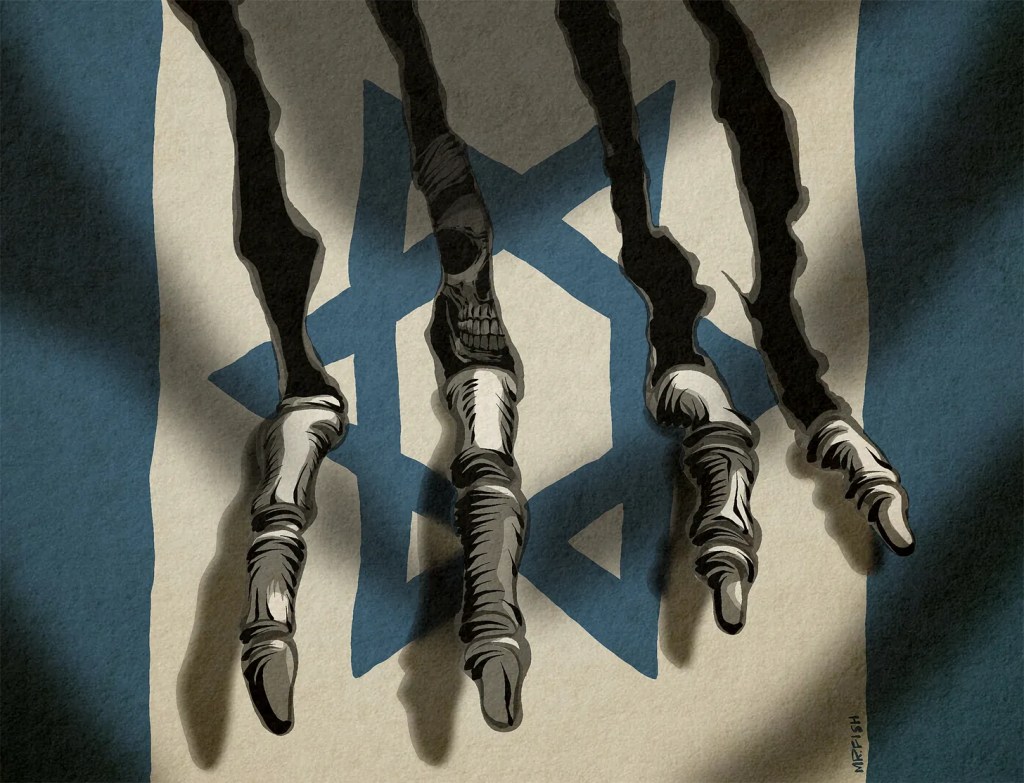
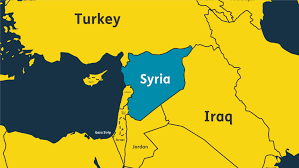



 After the Crash