They Live, We Sleep: A Dictatorship Disguised as a Democracy

leadtheylive1

By John W. Whitehead

Source: The Rutherford Institute

“You see them on the street. You watch them on TV. You might even vote for one this fall. You think they’re people just like you. You’re wrong. Dead wrong.”—They Live

We’re living in two worlds, you and I.

There’s the world we see (or are made to see) and then there’s the one we sense (and occasionally catch a glimpse of), the latter of which is a far cry from the propaganda-driven reality manufactured by the government and its corporate sponsors, including the media.

Indeed, what most Americans perceive as life in America—privileged, progressive and free—is a far cry from reality, where economic inequality is growing, real agendas and real power are buried beneath layers of Orwellian doublespeak and corporate obfuscation, and “freedom,” such that it is, is meted out in small, legalistic doses by militarized police armed to the teeth.

All is not as it seems.

This is the premise of John Carpenter’s film They Live (1988), in which two migrant workers discover that the world’s population is actually being controlled and exploited by aliens working in partnership with an oligarchic elite. All the while, the populace—blissfully unaware of the real agenda at work in their lives—has been lulled into complacency, indoctrinated into compliance, bombarded with media distractions, and hypnotized by subliminal messages beamed out of television and various electronic devices, billboards and the like.

It is only when homeless drifter John Nada (played to the hilt by the late Roddy Piper) discovers a pair of doctored sunglasses—Hoffman lenses—that Nada sees what lies beneath the elite’s fabricated reality: control and bondage.

When viewed through the lens of truth, the elite, who appear human until stripped of their disguises, are shown to be monsters who have enslaved the citizenry in order to prey on them. Likewise, billboards blare out hidden, authoritative messages: a bikini-clad woman in one ad is actually ordering viewers to “MARRY AND REPRODUCE.” Magazine racks scream “CONSUME” and “OBEY.” A wad of dollar bills in a vendor’s hand proclaims, “THIS IS YOUR GOD.”

When viewed through Nada’s Hoffman lenses, some of the other hidden messages being drummed into the people’s subconscious include: NO INDEPENDENT THOUGHT, CONFORM, SUBMIT, STAY ASLEEP, BUY, WATCH TV, NO IMAGINATION, and DO NOT QUESTION AUTHORITY.

This indoctrination campaign engineered by the elite in They Live is painfully familiar to anyone who has studied the decline of American culture. A citizenry that does not think for themselves, obeys without question, is submissive, does not challenge authority, does not think outside the box, and is content to sit back and be entertained is a citizenry that can be easily controlled.

In this way, the subtle message of They Live provides an apt analogy of our own distorted vision of life in the American police state, what philosopher Slavoj Žižek refers to as dictatorship in democracy, “the invisible order which sustains your apparent freedom.”

We’re being fed a series of carefully contrived fictions that bear no resemblance to reality. The powers-that-be want us to feel threatened by forces beyond our control (terrorists, shooters, bombers). They want us afraid and dependent on the government and its militarized armies for our safety and well-being. They want us distrustful of each other, divided by our prejudices, and at each other’s throats. Most of all, they want us to continue to march in lockstep with their dictates.

Tune out the government’s attempts to distract, divert and befuddle us and tune into what’s really going on in this country, and you’ll run headlong into an unmistakable, unpalatable truth: the moneyed elite who rule us view us as expendable resources to be used, abused and discarded.

In fact, a 2014 study conducted by Princeton and Northwestern University concluded that the U.S. government does not represent the majority of American citizens. Instead, the study found that the government is ruled by the rich and powerful, or the so-called “economic elite.” Moreover, the researchers concluded that policies enacted by this governmental elite nearly always favor special interests and lobbying groups.

In other words, we are being ruled by an oligarchy disguised as a democracy, and arguably on our way towards fascism—a form of government where private corporate interests rule, money calls the shots, and the people are seen as mere subjects to be controlled.

Consider this: it is estimated that the 2016 presidential election could cost as much as $5 billion, more than double what was spent getting Obama re-elected in 2012.

Not only do you have to be rich—or beholden to the rich—to get elected these days, but getting elected is also a surefire way to get rich. As CBS News reports, “Once in office, members of Congress enjoy access to connections and information they can use to increase their wealth, in ways that are unparalleled in the private sector. And once politicians leave office, their connections allow them to profit even further.”

In denouncing this blatant corruption of America’s political system, former president Jimmy Carter blasted the process of getting elected—to the White House, governor’s mansion, Congress or state legislatures—as “unlimited political bribery… a subversion of our political system as a payoff to major contributors, who want and expect, and sometimes get, favors for themselves after the election is over.”

Rest assured that when and if fascism finally takes hold in America, the basic forms of government will remain. As I point out in my book Battlefield America: The War on the American People, fascism will appear to be friendly. The legislators will be in session. There will be elections, and the news media will continue to cover the entertainment and political trivia. Consent of the governed, however, will no longer apply. Actual control will have finally passed to the oligarchic elite controlling the government behind the scenes.

By creating the illusion that it preserves democratic traditions, fascism creeps slowly until it consumes the political system. And in times of “crisis,” expediency is upheld as the central principle—that is, in order to keep us safe and secure, the government must militarize the police, strip us of basic constitutional rights, criminalize virtually every form of behavior, and build enough private prisons to house all of us nonviolent criminals.

Clearly, we are now ruled by an oligarchic elite of governmental and corporate interests. We have moved into “corporatism” (favored by Benito Mussolini), which is a halfway point on the road to full-blown fascism.

Vast sectors of the economy, government and politics are managed by private business concerns, otherwise referred to as “privatization” by various government politicians. Just study modern government policies. “Every industry is regulated. Every profession is classified and organized,” writes economic analyst Jeffrey Tucker. “Every good or service is taxed. Endless debt accumulation is preserved. Immense doesn’t begin to describe the bureaucracy. Military preparedness never stops, and war with some evil foreign foe, remains a daily prospect.”

In other words, the government in America today does whatever it wants.

Corporatism is where the few moneyed interests—not elected by the citizenry—rule over the many. In this way, it is not a democracy or a republican form of government, which is what the American government was established to be. It is a top-down form of government and one which has a terrifying history typified by the developments that occurred in totalitarian regimes of the past: police states where everyone is watched and spied on, rounded up for minor infractions by government agents, placed under police control, and placed in detention (a.k.a. concentration) camps.

For the final hammer of fascism to fall, it will require the most crucial ingredient: the majority of the people will have to agree that it’s not only expedient but necessary. But why would a people agree to such an oppressive regime? The answer is the same in every age: fear.

Fear makes people stupid.

Fear is the method most often used by politicians to increase the power of government. And, as most social commentators recognize, an atmosphere of fear permeates modern America: fear of terrorism, fear of the police, fear of our neighbors and so on.

The propaganda of fear has been used quite effectively by those who want to gain control, and it is working on the American populace.

Despite the fact that we are 17,600 times more likely to die from heart disease than from a terrorist attack; 11,000 times more likely to die from an airplane accident than from a terrorist plot involving an airplane; 1,048 times more likely to die from a car accident than a terrorist attack, and 8 times more likely to be killed by a police officer than by a terrorist, we have handed over control of our lives to government officials who treat us as a means to an end—the source of money and power.

We have allowed ourselves to become fearful, controlled, pacified zombies.

In this regard, we’re not so different from the oppressed citizens in They Live. Most everyone keeps their heads down these days while staring zombie-like into an electronic screen, even when they’re crossing the street. Families sit in restaurants with their heads down, separated by their screen devices and unaware of what’s going on around them. Young people especially seem dominated by the devices they hold in their hands, oblivious to the fact that they can simply push a button, turn the thing off and walk away.

Indeed, there is no larger group activity than that connected with those who watch screens—that is, television, lap tops, personal computers, cell phones and so on. In fact, a Nielsen study reports that American screen viewing is at an all-time high. For example, the average American watches approximately 151 hours of television per month.

The question, of course, is what effect does such screen consumption have on one’s mind?

Psychologically it is similar to drug addiction. Researchers found that “almost immediately after turning on the TV, subjects reported feeling more relaxed, and because this occurs so quickly and the tension returns so rapidly after the TV is turned off, people are conditioned to associate TV viewing with a lack of tension.” Research also shows that regardless of the programming, viewers’ brain waves slow down, thus transforming them into a more passive, nonresistant state.

Historically, television has been used by those in authority to quiet discontent and pacify disruptive people. “Faced with severe overcrowding and limited budgets for rehabilitation and counseling, more and more prison officials are using TV to keep inmates quiet,” according to Newsweek.

Given that the majority of what Americans watch on television is provided through channels controlled by six mega corporations, what we watch is now controlled by a corporate elite and, if that elite needs to foster a particular viewpoint or pacify its viewers, it can do so on a large scale.

If we’re watching, we’re not doing.

The powers-that-be understand this. As television journalist Edward R. Murrow warned in a 1958 speech:

We are currently wealthy, fat, comfortable and complacent. We have currently a built-in allergy to unpleasant or disturbing information. Our mass media reflect this. But unless we get up off our fat surpluses and recognize that television in the main is being used to distract, delude, amuse, and insulate us, then television and those who finance it, those who look at it, and those who work at it, may see a totally different picture too late.

This brings me back to They Live, in which the real zombies are not the aliens calling the shots but the populace who are content to remain controlled.

When all is said and done, the world of They Live is not so different from our own. As one of the characters points out, “The poor and the underclass are growing. Racial justice and human rights are nonexistent. They have created a repressive society and we are their unwitting accomplices. Their intention to rule rests with the annihilation of consciousness. We have been lulled into a trance. They have made us indifferent to ourselves, to others. We are focused only on our own gain.”

We, too, are focused only on our own pleasures, prejudices and gains. Our poor and underclasses are also growing. Racial injustice is growing. Human rights is nearly nonexistent. We too have been lulled into a trance, indifferent to others.

Oblivious to what lies ahead, we’ve been manipulated into believing that if we continue to consume, obey, and have faith, things will work out. But that’s never been true of emerging regimes. And by the time we feel the hammer coming down upon us, it will be too late.

What?!? Private prisons suing states for millions if they don’t stay full

national-occupy-day-in-support-of-prisoners-022012-by-kevin-rashid-johnson-web

By Terry Shropshire

Source: rollingout.com

The prison-industrial complex is so out of control that private prisons have the sheer audacity to order states to keep beds full or face their wrath with stiff financial penalties, according to reports. Private prisons in some states have language in their contracts that state if they fall below a certain percentage of capacity that the states must pay the private prisons millions of dollars, lest they face a lawsuit for millions more.

And guess what? The private prisons, which are holding cash-starved states hostage, are getting away with it, says advocacy group, In the Public Interest.

In the Public Interest has reviewed more than 60 contracts between private prison companies and state and local governments across the country, and found language mentioning “quotas” for prisoners in nearly two-thirds of those contracts reviewed. Those quotas can range from a mandatory occupancy of, for example, 70 percent occupancy in California to up to 100 percent in some prisons in Arizona.

It is very interesting and telling that so few major national news organization are willing to report on the monstrous, ravenous and criminal system that is devouring hundreds of thousands of black and brown boys. Even those who do not subscribe to conspiracy theories have looked askance at this shocking report.

Welcome to the greatest manifestation of modern-day slavery, ladies and gentlemen.

One of those private prisons, The Corrections Corporation of America, made an offer last year to the governors of 48 states to operate their prisons on 20-year contracts, according to In the Public Interest.

What makes these deals so odious and unscrupulous? Take a look:

1) The offer included a demand that those prisons remain 90 percent full for the duration of the operating agreement. You know what that means: if there are not enough prisoners then there will be an unspoken push for police to arrest more people and to have the courts send more to prison for petty, frivolous and nonviolent crimes. There will also be a “nudge” for judges to hand down longer or maximum sentences to satisfy this “quota.”

2) Private prison companies have also backed measures such as “three-strike” laws to maintain high prison occupancy.

3) When the crime rate drops so low that the occupancy requirements can’t be met, taxpayers are left footing the bill for unused facilities.

The report found that 41 of 62 contracts reviewed contained occupancy requirements, with the highest occupancy rates found in Arizona, Oklahoma and Virginia.

In Colorado, Democratic Gov. John Hinklooper agreed to close down five state-run prisons and instead send inmates to CCA’s three corrections facilities. That cost taxpayers at least $2 million to maintain the unused facilities.

It is getting more difficult to rationalize the societal cost of keeping prisons full just to satisfy private investors who treat prisoners as commodity and cattle .

Neoliberalism Is Changing Our World Without Our Even Noticing

neo_liberalism_devolution_via_permanentculturenow.com_

Wendy Brown charts the ‘stealth revolution’ that’s transforming every aspect of society — and now has democracy in its sights.

By Hans Rollmann

Source: PopMatters

‘Neoliberalism’ is a much confused and maligned term these days. Progressive activists deploy it derisively as a general sort of derogatory label; learned professors write articles on the topic without really saying anything more penetrating. It’s as over-used an idiom as globalization (or as capitalism and socialism were 70 years ago). Even Anti-Flag take up the subject in their 2012 track “The Neoliberal Anthem”: “Strap in and watch the world decay!” they proclaim. Blunt, but not inaccurate.

Yet for all its confounded usages, what exactly does it signify?

In a 2013 review essay in the Los Angeles Review of Books that is more useful – if less straightforward – than Anti-Flag, Michael W. Clune described neoliberalism as “an economic doctrine that favors privatization, deregulation, and unfettered free markets over public institutions and government.” (”What Was Neoliberalism?”, 26 February 2013)

But it’s much more than that. Now, in Undoing the Demos: Neoliberalism’s Stealth Revolution, political theorist Wendy Brown contributes a truly useful text on an over-wrought topic, and one which focuses not only on the economic manifestations of neoliberalism, but on its broader effects on our political and social thinking. “Neoliberalism is a distinctive mode of reason, of the production of subjects, a ‘conduct of conduct,’ and a ‘scheme of valuation,’” she writes. It’s a mode of thinking, and the manner in which it emerges can be infinitely varied. We must be alert to neoliberalism’s “inconstancy and plasticity”, she warns, and its ability to reconfigure itself in new guises. Neoliberalism “takes diverse shapes and spawns diverse content and normative details, even different idioms. It is globally ubiquitous, yet disunified and nonidentical with itself in space and over time.” It’s a slippery beast, in other words – hard to define and even harder to see when it’s happening.

Brown’s work is an important and vital contribution at this time insofar as it takes aim at the beating heart of neoliberalism: its insinuation in the very institutions and identities which were hitherto used to limit its spread; institutions which, it was once hoped, would sustain deeper and more profound values implicit to democratic society and human sociality.

Brown is less interested than other scholars in the grim economics of neoliberalism: what she focuses on is its implicit threat to democracy. She opens her book by charting the emergence and contestation between ‘homo politicus’ and ‘homo oeconomicus’; between the human who uses politics to shape their world, and the human who is driven by self-interest and sees the world as always already shaped by economics. French philosopher Michel Foucault discussed this dichotomy in his 1978-79 College de France lectures on the Birth of Biopolitics, and Brown analyzes what Foucault saw – and failed to see – about this early emergence of neoliberal rationality.

In a superb if lamentably short section on gender she also discusses the question: “Does homo economicus have a gender? Does human capital? Is there a femina domestica invisibly striating or supplementing these figures…?” Her point is that “liberalism’s old gender problem is intensified by neoliberalism”, or that neoliberalism impacts women with particular vehemence.

Having discussed Foucault’s early charting of neoliberal political rationality, and expanded on his ideas in light of neoliberalism’s trajectory in the past 30 years, Brown analyzes some modern examples of neoliberalism’s diverse expressions. She looks at how it has insinuated itself in governance – in the notion of building consensus, rather than appreciating contestation; in the depoliticization of government; in the valorization of benchmarking and best practices. All of these deliver destructive blows against democratic political will, against the notion that humans can determine their own destiny and ought to shape their own reality. Instead of making their own decisions, governments appoint ‘external consultants’ to tell them what they should be doing; instead of inventing new ideas and ways of doing things, governments survey ‘best practices’ and see what everyone else is doing. It represents, in many ways, the triumph of mediocrity.

Neoliberal rationality infects law and legal reason, as well. Brown offers an in-depth analysis of the Citizens United case, which protected the right of corporations and the wealthy to dominate democratic elections in the US with their overwhelming power of capital. She also offers one of the best and most thorough analyses of how neoliberal rationality is destroying higher education: the post-WWII dream of an educated and equal society has been twisted into an economistic view, which holds that universities exist only to enhance capital; and that the purpose of an education is not to become better able to contribute to the broader political community, but rather to enhance one’s own ability to generate further capital.

Brown’s book is theoretical yet accessible; it’s an important and vital interjection which reveals and casts bare the neoliberal rationality that increasingly governs our world.

Dismantling Neoliberal Rationality

There’s an implicit warning in Brown’s text, which she addresses briefly but is worth some additional reflection. Audre Lorde famously cautioned against using the master’s tools to dismantle the master’s house, and increasingly this is precisely the direction in which efforts to limit the ravages of neoliberal thinking have turned, using economistic arguments in an effort to preserve institutions and principles that are premised on other-than-economistic values. Some examples serve to illustrate this.

In the ‘80s and ‘90s, public-private partnerships (P3’s) emerged as a neoliberal strategy transferring control and responsibility for public infrastructure – roads, bridges, hospitals, schools – into private hands. The basic argument held that the private sector, not beholden to political interests but rather to principles of efficiency and maximization of cost and utility, would prove more efficient custodians of public infrastructure. This neoliberal argument piggybacked nicely onto the drive to lower taxes. In an environment where lower taxes resulted in reduced state budgets, maximizing cost and efficiency would ensure public dollars stretched as far as possible.

This argument was received sympathetically by a public which had been worked up (by conservative pundits and politicians) into a collective sense of outrage over personal tax obligations and a sense of diminishing consumer power. It struck an affective chord, even though it was not based on any solid research. Yet P3’s became a dominant and accepted approach to building and maintaining public infrastructure and services.

In the past decade, efforts to fight back against public-private partnerships have achieved some limited success and have taken as their point of departure the fact that these partnerships are in fact not very efficient or effective. The private sector, it turns out, is often even more inefficient and ineffective than the public sector, given that it is driven by values such as greed and profit as opposed to public accountability. Analyses of several P3 projects have revealed massive cost over-runs, invariably subsidized by taxpayers to a cost far in excess of what it would have cost the state to produce the infrastructure on its own. (”The Problem with Public-Private Partnerships”, by Toby Sanger and Corina Crawley, CCPA, 1 April 2009) Contractual stipulations often guarantee corporate profits at public expense, requiring the state to assume all the risk, using public funds to rescue projects when private partners fail or walk away, and in some cases even using public funds to top-up corporate profits that fail to meet agreed-upon projections. (”Ontario Auditor breaks new ground with review of public private partnerships methodology”, by Keith Reynolds, Policy Note, 5 January 2015)

All this is true, and revealing the truly ineffective and inefficient nature of P3s has been critical to turning them back in many cases. However, there’s a problem with this. These campaigns against P3s adopt the same economistic principles as were used to promote the notion of P3s in the first place: namely, that efficiency, cost maximization and capital enhancement ought to be the driving principles of the demos, or public state. The implicit argument is that P3s are wrong not because they transfer public ownership into private hands, but because they do so inefficiently and at the expense of the taxpayer. Granted, there is often a reference to P3s being ‘unaccountable’ to the public, but this is rarely interrogated or explored as deeply as it should be. In fact, it ought to lie at the core of public resistance to P3s. Public-private partnerships are wrong simply because the state ought never to allow public goods to fall under private control, even if it might save more money. Economization ought never to hold sway over the values, principles and political power of the public.

Similarly, neoliberal logic has infected other efforts to fight back against neoliberal initiatives. Labour unions – a common target of neoliberalism—are increasingly defended on the basis that they benefit the economy (through ensuring consistent and safe workplace practices as well as strong wages to bolster consumer spending in the community), rather than on the simpler basis that workers deserve the right to control their working conditions. Efforts to reduce tuition fees for out-of-province/state or international students are often predicated on the notion that their economic contribution to the local economy exceeds the value of their fiscal contribution to the university through tuition fees. Nowhere – or rarely – is the argument presented that post-secondary ought to be a public good and universal right in and of itself.

The danger, in other words, is that efforts to resist neoliberalism are increasingly being expressed in such a way that they serve to entrench and legitimize neoliberal values – economization, efficiency, capital enhancement—rather than questioning or challenging the desirability and social and political consequences of those values in the first place.

Brown acknowledges the urgency of the problem. It’s quite possible, she observes, for neoliberal economic policy to be paused or reversed but for “the deleterious effects of neoliberal reason on democracy” to survive, undermining the potential for substantive, entrenched change. Without tackling neoliberal reason, neoliberal economics and governance will inevitably emerge again. It is the ongoing sense of surrender to the inevitability of economics; of the bottom line; of finance as key determiner of what is politically possible, that dooms the political potential of democracy. Although only emerging at the end of the book, this is one of the key lessons it offers: that efforts to resist or reverse the ravages of neoliberal economics are fatally flawed when “NGOs, nonprofits, schools, neighborhood organizations, and even social movements that understand themselves as opposing neoliberal economic policies may nonetheless be organized by neoliberal rationality.”

Fascism’s Forbidden Face

Brown comes close to a forbidden truth in closing. She notes, with great delicacy and hesitation, the similarities between neoliberal rationality and fascism. “This is not to say that neoliberalism is fascism or that we live in fascist times,” comes the inevitable caveat. But what if it is an emerging form of fascism?

One of the troubling trends that’s emerged in recent decades and needs to be challenged more forcefully is the notion that it’s intellectually taboo, inaccurate or excessive to call something ‘fascist’, or to draw analogies to fascist states like Nazi Germany. An example of this taboo is ‘Godwin’s Law’ – the notion that referring to Hitler (or by extension, fascism broadly) destroys the credibility of your argument. It’s a trendy term, but intellectually dangerous. The fact is, fascism was – and is – very real, and the notion that no one should talk about fascism as seriously emerging in the present day is very much a product of our neoliberal era.

In fact we do need to talk about it. The skepticism with which the term ‘fascism’ is treated; the dismissal of arguments which make reference to Nazis, all collaborate in erasing and masking the very real resemblances that exist between historical fascism and contemporary forms of governance like neoliberalism. In its demand for self-sacrifice to the heartless whole – a demand iterated, for instance, in the sacrifice of millions of homeowners and mortgage defaulters in order to save the banks during the subprime mortgage crisis – neoliberal rationality resembles the demand for citizen self-sacrifice that characterized fascism.

George Orwell (in his remarkable book review of Adolf Hitler’s Mein Kampf) warned against underrating the emotional appeal of fascism. While socialism and even capitalism offered a vision of the good life – fewer working-hours, health and education, leisure and pleasure – people appear inevitably lured by the attraction of struggle and self-sacrifice. “Whereas Socialism, and even capitalism in a more grudging way, have said to people ‘I offer you a good time,’ Hitler has said to them ‘I offer you struggle, danger and death,’ and as a result a whole nation flings itself at his feet,” he wrote. The same could easily be said of neoliberalism: people have a remarkable knack of voting for economic tough-guys who promise to make life harder on individuals and communities in order to ‘save the economy’, whatever that’s supposed to mean.

Brown’s book is essential reading not only for academics but for anyone concerned with our collective political future, and with the defense of democratic politics. Her book ends on a grim note: “Despair” is the title of its final section. Brown has eloquently elucidated the problem, and made a profound contribution to understanding the complex nature of neoliberal rationality and its threat to democracy.

So what is the solution? Brown doesn’t have one, but notes there is no alternative but to keep struggling to find an alternative. We have reached a state of “civilizational despair”, she writes; modernism is dead and with it the hope and belief that we can create a better world. How do we counter this despair, and re-inject hope and alternatives into the world? Such a task “is incalculably difficult, bears no immediate reward, and carries no guarantee of success. Yet what, apart from this work, could afford the slightest hope for a just, sustainable, and habitable future?”


Hans Rollmann is a writer and editor based in Eastern Canada. He’s a columnist, writer and opinions editor with the online news magazine TheIndependent.ca as well as editor of Landwash, a journal of literary and creative arts published out of Newfoundland and Labrador. His work has appeared in a range of other publications both print and online, from Briarpatch Magazine to Feral Feminisms. In addition to a background in radio-broadcasting, union organizing and archaeology, he’s currently completing a PhD in Gender, Feminist & Women’s Studies in Toronto. He can be reached by email at hansnf@gmail.com or @hansnf on Twitter.


The Prison Industry in the United States: Big Business or a New Form of Slavery?

national-occupy-day-in-support-of-prisoners-022012-by-kevin-rashid-johnson-web

By Vicky Pelaez

Source: Global Research

Human rights organizations, as well as political and social ones, are condemning what they are calling a new form of inhumane exploitation in the United States, where they say a prison population of up to 2 million – mostly Black and Hispanic – are working for various industries for a pittance. For the tycoons who have invested in the prison industry, it has been like finding a pot of gold. They don’t have to worry about strikes or paying unemployment insurance, vacations or comp time. All of their workers are full-time, and never arrive late or are absent because of family problems; moreover, if they don’t like the pay of 25 cents an hour and refuse to work, they are locked up in isolation cells.

There are approximately 2 million inmates in state, federal and private prisons throughout the country. According to California Prison Focus, “no other society in human history has imprisoned so many of its own citizens.” The figures show that the United States has locked up more people than any other country: a half million more than China, which has a population five times greater than the U.S. Statistics reveal that the United States holds 25% of the world’s prison population, but only 5% of the world’s people. From less than 300,000 inmates in 1972, the jail population grew to 2 million by the year 2000. In 1990 it was one million. Ten years ago there were only five private prisons in the country, with a population of 2,000 inmates; now, there are 100, with 62,000 inmates. It is expected that by the coming decade, the number will hit 360,000, according to reports.

What has happened over the last 10 years? Why are there so many prisoners?

“The private contracting of prisoners for work fosters incentives to lock people up. Prisons depend on this income. Corporate stockholders who make money off prisoners’ work lobby for longer sentences, in order to expand their workforce. The system feeds itself,” says a study by the Progressive Labor Party, which accuses the prison industry of being “an imitation of Nazi Germany with respect to forced slave labor and concentration camps.”

The prison industry complex is one of the fastest-growing industries in the United States and its investors are on Wall Street. “This multimillion-dollar industry has its own trade exhibitions, conventions, websites, and mail-order/Internet catalogs. It also has direct advertising campaigns, architecture companies, construction companies, investment houses on Wall Street, plumbing supply companies, food supply companies, armed security, and padded cells in a large variety of colors.”

According to the Left Business Observer, the federal prison industry produces 100% of all military helmets, ammunition belts, bullet-proof vests, ID tags, shirts, pants, tents, bags, and canteens. Along with war supplies, prison workers supply 98% of the entire market for equipment assembly services; 93% of paints and paintbrushes; 92% of stove assembly; 46% of body armor; 36% of home appliances; 30% of headphones/microphones/speakers; and 21% of office furniture. Airplane parts, medical supplies, and much more: prisoners are even raising seeing-eye dogs for blind people.

CRIME GOES DOWN, JAIL POPULATION GOES UP

According to reports by human rights organizations, these are the factors that increase the profit potential for those who invest in the prison industry complex:

. Jailing persons convicted of non-violent crimes, and long prison sentences for possession of microscopic quantities of illegal drugs. Federal law stipulates five years’ imprisonment without possibility of parole for possession of 5 grams of crack or 3.5 ounces of heroin, and 10 years for possession of less than 2 ounces of rock-cocaine or crack. A sentence of 5 years for cocaine powder requires possession of 500 grams – 100 times more than the quantity of rock cocaine for the same sentence. Most of those who use cocaine powder are white, middle-class or rich people, while mostly Blacks and Latinos use rock cocaine. In Texas, a person may be sentenced for up to two years’ imprisonment for possessing 4 ounces of marijuana. Here in New York, the 1973 Nelson Rockefeller anti-drug law provides for a mandatory prison sentence of 15 years to life for possession of 4 ounces of any illegal drug.

.The passage in 13 states of the “three strikes” laws (life in prison after being convicted of three felonies), made it necessary to build 20 new federal prisons. One of the most disturbing cases resulting from this measure was that of a prisoner who for stealing a car and two bicycles received three 25-year sentences.

. Longer sentences.

. The passage of laws that require minimum sentencing, without regard for circumstances.

. A large expansion of work by prisoners creating profits that motivate the incarceration of more people for longer periods of time.

. More punishment of prisoners, so as to lengthen their sentences.

HISTORY OF PRISON LABOR IN THE UNITED STATES

Prison labor has its roots in slavery. After the 1861-1865 Civil War, a system of “hiring out prisoners” was introduced in order to continue the slavery tradition. Freed slaves were charged with not carrying out their sharecropping commitments (cultivating someone else’s land in exchange for part of the harvest) or petty thievery – which were almost never proven – and were then “hired out” for cotton picking, working in mines and building railroads. From 1870 until 1910 in the state of Georgia, 88% of hired-out convicts were Black. In Alabama, 93% of “hired-out” miners were Black. In Mississippi, a huge prison farm similar to the old slave plantations replaced the system of hiring out convicts. The notorious Parchman plantation existed until 1972.

During the post-Civil War period, Jim Crow racial segregation laws were imposed on every state, with legal segregation in schools, housing, marriages and many other aspects of daily life. “Today, a new set of markedly racist laws is imposing slave labor and sweatshops on the criminal justice system, now known as the prison industry complex,” comments the Left Business Observer.

Who is investing? At least 37 states have legalized the contracting of prison labor by private corporations that mount their operations inside state prisons. The list of such companies contains the cream of U.S. corporate society: IBM, Boeing, Motorola, Microsoft, AT&T, Wireless, Texas Instrument, Dell, Compaq, Honeywell, Hewlett-Packard, Nortel, Lucent Technologies, 3Com, Intel, Northern Telecom, TWA, Nordstrom’s, Revlon, Macy’s, Pierre Cardin, Target Stores, and many more. All of these businesses are excited about the economic boom generation by prison labor. Just between 1980 and 1994, profits went up from $392 million to $1.31 billion. Inmates in state penitentiaries generally receive the minimum wage for their work, but not all; in Colorado, they get about $2 per hour, well under the minimum. And in privately-run prisons, they receive as little as 17 cents per hour for a maximum of six hours a day, the equivalent of $20 per month. The highest-paying private prison is CCA in Tennessee, where prisoners receive 50 cents per hour for what they call “highly skilled positions.” At those rates, it is no surprise that inmates find the pay in federal prisons to be very generous. There, they can earn $1.25 an hour and work eight hours a day, and sometimes overtime. They can send home $200-$300 per month.

Thanks to prison labor, the United States is once again an attractive location for investment in work that was designed for Third World labor markets. A company that operated a maquiladora (assembly plant in Mexico near the border) closed down its operations there and relocated to San Quentin State Prison in California. In Texas, a factory fired its 150 workers and contracted the services of prisoner-workers from the private Lockhart Texas prison, where circuit boards are assembled for companies like IBM and Compaq.

[Former] Oregon State Representative Kevin Mannix recently urged Nike to cut its production in Indonesia and bring it to his state, telling the shoe manufacturer that “there won’t be any transportation costs; we’re offering you competitive prison labor (here).”

PRIVATE PRISONS

The prison privatization boom began in the 1980s, under the governments of Ronald Reagan and Bush Sr., but reached its height in 1990 under William Clinton, when Wall Street stocks were selling like hotcakes. Clinton’s program for cutting the federal workforce resulted in the Justice Departments contracting of private prison corporations for the incarceration of undocumented workers and high-security inmates.

Private prisons are the biggest business in the prison industry complex. About 18 corporations guard 10,000 prisoners in 27 states. The two largest are Correctional Corporation of America (CCA) and Wackenhut, which together control 75%. Private prisons receive a guaranteed amount of money for each prisoner, independent of what it costs to maintain each one. According to Russell Boraas, a private prison administrator in Virginia, “the secret to low operating costs is having a minimal number of guards for the maximum number of prisoners.” The CCA has an ultra-modern prison in Lawrenceville, Virginia, where five guards on dayshift and two at night watch over 750 prisoners. In these prisons, inmates may get their sentences reduced for “good behavior,” but for any infraction, they get 30 days added – which means more profits for CCA. According to a study of New Mexico prisons, it was found that CCA inmates lost “good behavior time” at a rate eight times higher than those in state prisons.

IMPORTING AND EXPORTING INMATES

Profits are so good that now there is a new business: importing inmates with long sentences, meaning the worst criminals. When a federal judge ruled that overcrowding in Texas prisons was cruel and unusual punishment, the CCA signed contracts with sheriffs in poor counties to build and run new jails and share the profits. According to a December 1998 Atlantic Monthly magazine article, this program was backed by investors from Merrill-Lynch, Shearson-Lehman, American Express and Allstate, and the operation was scattered all over rural Texas. That state’s governor, Ann Richards, followed the example of Mario Cuomo in New York and built so many state prisons that the market became flooded, cutting into private prison profits.

After a law signed by Clinton in 1996 – ending court supervision and decisions – caused overcrowding and violent, unsafe conditions in federal prisons, private prison corporations in Texas began to contact other states whose prisons were overcrowded, offering “rent-a-cell” services in the CCA prisons located in small towns in Texas. The commission for a rent-a-cell salesman is $2.50 to $5.50 per day per bed. The county gets $1.50 for each prisoner.

STATISTICS

Ninety-seven percent of 125,000 federal inmates have been convicted of non-violent crimes. It is believed that more than half of the 623,000 inmates in municipal or county jails are innocent of the crimes they are accused of. Of these, the majority are awaiting trial. Two-thirds of the one million state prisoners have committed non-violent offenses. Sixteen percent of the country’s 2 million prisoners suffer from mental illness.

Gates Foundation’s Seed Agenda in Africa ‘Another Form of Colonialism,’ Warns Protesters

Screen-Shot-2015-03-24-at-8.27.09-AM

‘This neoliberal agenda of deregulation and privatization poses a serious threat to food sovereignty and the ability of food producers and consumers to define their own food systems and policies,’ says campaigners

By Lauren McCauley

Source: CommonDreams.org

Food sovereignty activists are shining a light on a closed-door meeting between the Bill and Melinda Gates Foundation (BMGF) and the United States Agency for International Development (USAID), which are meeting in London on Monday with representatives of the biotechnology industry to discuss how to privatize the seed and agricultural markets of Africa.

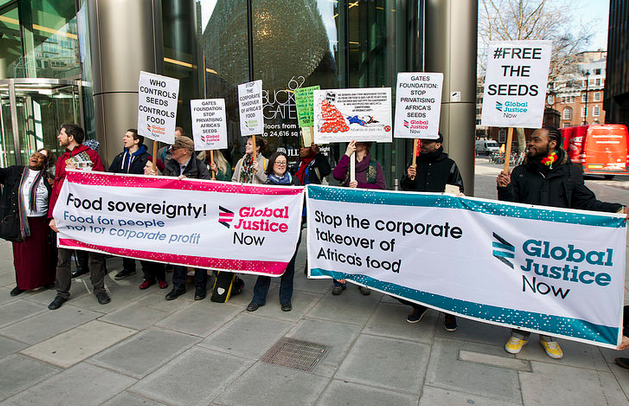
Early Monday, protesters picketed outside the Gates Foundation’s London offices holding signs that called on the foundation to “free the seeds.” Some demonstrators handed out packets of open-pollinated seeds, which served as symbol of the “alternative to the corporate model promoted by USAID and BMGF.” Others smashed a piñata, which they said represented the “commercial control of seed systems;” thousands of the seeds which filled the pinata spilled across the office steps. A similar protest is expected later Monday in Seattle, Washington, where BMGF is headquartered.

The meeting was convened to discuss a report put forth by Monitor-Deloitte, which was commissioned by BMGF and USAID to develop models for the commercialization of seed production in Africa, especially “early generation seed,” and to identify ways in which the African governmental sectors could facilitate private involvement in African seed systems. The study was conducted in Ethiopia, Ghana, Nigeria, Tanzania and Zambia on maize, rice, sorghum, cowpea, common beans, cassava and sweet potato.

However, food sovereignty activists are sounding the alarm over the secret meeting. Heidi Chow, food sovereignty campaigner with Global Justice Now, which organized Monday’s protest, warned that the agenda being promoted by these stakeholders will only increase corporate control over seeds.

“This is not ‘aid’ – it’s another form of colonialism,” said Chow. “We need to ensure that the control of seeds and other agricultural resources stay firmly in the hands of small farmers who feed the majority of the population in Africa, rather than allowing big agribusiness to dominate even more aspects of the food system.”

In a blog post, Chow further explained:

For generations, small farmers have been able to save and swap seeds. This vital practice enables farmers to keep a wide range of seeds which helps maintain biodiversity and helps them to adapt to climate change and protect from plant disease. However, this system of seed saving is under threat by corporations who want to take more control over seeds. Big seed companies are keen to grow their market share of commercial seeds in Africa and alongside philanthropic organizations like the Gates Foundation and aid donors, they are discussing new ways to increase their market penetration of commercial seeds and displacing farmers own seed systems.

Corporate-produced hybrid seeds often produce higher yields when first planted, but the second generation seeds will produce low yields and unpredictable crop traits, making them unsuitable for saving and storing. This means that instead of saving seeds from their own crops, farmers who use hybrid seeds become completely dependent on the seed companies that sell them.

Further, many of the seeds produced by these biotechnology giants are sold alongside chemical fertilizer and pesticides, manufactured by the very same companies, the use of which often leads to widespread environmental destruction and other health problems.

As others noted, while the meeting attendees included representatives from the World Bank and Syngenta, the world’s third biggest seed and biotechnology company, no farmers or farming organizations were represented at the talks.

“Seeds are vital for our food system and our small farmers have always been able to save and swap seeds freely,” Ali-Masmadi Jehu-Appiah, chair of Food Sovereignty Ghana, said in a press statement. “Now our seed systems are increasingly under threat by corporations who are looking to take more control over seeds in their pursuit of profit. This meeting will push this corporate agenda to hand more control away from our small farmers and into the hands of big seed companies.”

Reporting on the Monitor-Deloitte study, Ian Fitzpatrick, a food sovereignty researcher for Global Justice Now, said that documents circulated ahead of the meeting revealed a neo-liberal agenda “laid bare.”

Fitzpatrick writes:

The report recommends that in countries where demand for patented seeds is weaker (i.e. where farmers are using their own seed saving networks), public-private partnerships should be developed so that private companies are protected from ‘investment risk’. It also recommends that that NGOs and aid donors should encourage governments to introduce intellectual property rights for seed breeders and help to persuade farmers to buy commercial, patented seeds rather than relying on their own traditional varieties.

Finally, in line with the broader neoliberal agenda of agribusiness companies across the world, the report suggests that governments should remove regulations (like export restrictions) so that the seed sector is opened up to the global market.

“This neoliberal agenda of deregulation and privatization, currently promoted in almost every sphere of human activity—from food production to health and education—poses a serious threat to food sovereignty and the ability of food producers and consumers to define their own food systems and policies,” Fitzpatrick adds.

AGRA Watch, a program of the grassroots group Community Alliance for Global Justice, notes that the BMGF-USAID commercial seed agenda further “extends U.S. foreign policy into Africa on behalf of corporate interests.”

Phil Bereano, food sovereignty campaigner with AGRA Watch and an Emeritus Professor at the University of Washington added: “This is an extension of what the Gates Foundation has been doing for several years—working with the US government and agribusiness giants like Monsanto to corporatize Africa’s genetic riches for the benefit of outsiders. Don’t Bill and Melinda realize that such colonialism is no longer in fashion? It’s time to support African farmers’ self-determination.”

New Analysis Shatters Narrative of Charter School Success

Common_Core_585x585

In Minnesota, ‘new information is fueling critics who say the charter school experiment has failed to deliver.’

By Deirdre Fulton

Source: CommonDreams.org

Public schools are outperforming charter schools in Minnesota, in some cases “dramatically,” according to a new analysis by the state’s Star-Tribune newspaper.

In addition, many charter schools fail to adequately support minority students, close examination of the data revealed.

Journalist Charlene Briner, the Minnesota Department of Education looked at 128 of the state’s 157 charter schools and found “that the gulf between the academic success of its white and minority students widened at nearly two-thirds of those schools last year. Slightly more than half of charter schools students were proficient in reading, dramatically worse than traditional public schools, where 72 percent were proficient.”

Between 2011 and 2014, McGuire reported, 20 charter schools failed to meet the state’s expectations for academic growth each year, “signaling that some of Minnesota’s most vulnerable students had stagnated academically.”

Charlene Briner, the Minnesota Department of Education’s chief of staff, told the newspaper that she was troubled by the information, “which runs counter to ‘the public narrative’ that charter schools are generally superior to public schools.”

“Minnesota is the birthplace of the charter school movement and a handful of schools have received national acclaim for their accomplishments, particularly when it comes to making strong academic gains with low-income students of color,” the Star-Tribune claims. “But the new information is fueling critics who say the charter school experiment has failed to deliver on teaching innovation.”

Education analyst Diane Ravitch notes: “Minnesota was the home of the charter movement, which began with high expectations as a progressive experiment but has turned into a favorite mechanism in many states to promote privatization of public education and to generate profits for charter corporations like Imagine, Charter Schools USA, and K12. Today, charter advocates claim that their privately managed charters will ‘save low-income students from failing public schools,’ but the Minnesota experience suggests that charters face the same challenges as public schools, which is magnified by high teacher turnover in charter schools.”

The findings back up a report (pdf) put out last fall by the Institute on Metropolitan Opportunity at the University of Minnesota Law School, which examined the success and failures of the charter school system in Chicago, Illinois.

That study concluded:

Sadly the charters schools, which on average score lower that the Chicago public schools, have not improved the Chicago school system, but perhaps made it even weaker. Further charters, which are even more likely to be single race schools than the already hyper segregated Chicago school system, have not increased interracial contact, an often-stated goal of charter systems. Finally, the fact that Chicago charters use expulsion far more often that public schools deserves further study. In the end it is unlikely that the Chicago charter school experience provides a model for improving urban education in other big city school districts.

Meanwhile, in Philadelphia, the School Reform Commission plans to vote on no fewer than 39 charter school applications at a special meeting starting Wednesday afternoon. There will be opportunity for final statement by applicants and public commenting by just 39 speakers who registered in advance.

Earlier this month, a pro-charter, non-profit organization offered the cash-strapped city school district up to $35 million to help defray the costs of enrolling an additional 15,000 students in new charter schools.

The Calling: How Cronyism Worsens Income Inequality (and Freed Markets Reduce It)

cronyism-out-of-control

By Steven Horwitz

Source: Future of Freedom Foundation

I recently gave an introductory Public Choice talk sponsored by Students for Liberty at the University of Ottawa. The next speaker was my friend Anne Rathbone Bradley, who was Skyping in from Washington. Anne gave a terrific talk about cronyism and rent-seeking that nicely complemented many of the points I’d made. But one of the side issues she raised really stuck with me, and I want to expand on it.

Anne connected cronyism (I hesitate to call it “crony capitalism”), rent-seeking, and income inequality in a way I hadn’t quite thought about before. The key to the connection is to realize some important truths about the political process.

The first truth is that cronyism is no accident. It is no accident that the U.S. economy has increasingly become one in which your connections to political power matter more for your ability to increase your wealth than does producing a product or service that consumers wish to buy. We are becoming what Ayn Rand deftly termed an “aristocracy of pull.”

The ability of some to get wealthier through political connections does trouble many on the political left, but they often argue that with better elected officials, or more ethical businesspeople, or limits on campaign contributions, we could dramatically reduce this sort of cronyism. What their argument misses is that as long as government gives out goodies, private-sector actors will find ways to get their hands on them. If you really want to take the money out of politics, you need to make it harder for politicians to hand out money.

For libertarians, the state is always little more than a dispenser of privileges to special interests. This is not an accident of who is elected or who is wealthy. Government privileges provide an easy path to profit for those who can capture them — and with none of the hard work of actually competing in the market. This is why many people, including those in the private sector, like the state.

The second important truth is that these political privileges are much more likely to be captured by those who already have financial and political power. Despite the fantasy believed by so many that government regulation and other interventions are all about constraining the rich and powerful in the name of the masses, in fact a great deal of government regulation is driven by the desires of those same rich and powerful to become more so. The more power we give to government, the more power we are giving to those with the money and connections to access political power. In other words, expanding the state gives more power and privilege to the powerful and privileged.

The last truth is that when private-sector actors seek to use political privileges to enhance their profits, they often do so by blocking smaller competitors’ access to the market, or by raising their costs of competing. When Walmart supports a higher minimum wage, it thereby favors raising the costs for their small mom-and-pop rivals. When taxicab companies defend their monopoly privileges, they intend to shut firms like Uber and Lyft out of the market altogether. When entrenched hairdressers demand that hair braiders be licensed, the established practitioners mean to raise their competitors’ costs or shut them out altogether.

When we put all three of these truths together, we get a story about the way in which those who already have wealth and power can and do make use of the state to block the upward mobility of their poorer, less-powerful potential competitors. Small-business owners, Uber and Lyft drivers, and African-American women who want to open hair-braiding businesses are trying to grab on to the bottom rungs of the income ladder and work their way up. These are the very people — start-up entrepreneurs and the working poor — that those critical of the market claim to care about.

In a world where government has all of these powers to intervene in markets, rent-seeking and cronyism are inevitable. Regulation will ensure that those who know the right people can tilt the regulatory playing field in their favor. The result will be a worsening of the income inequality that concerns so many. The rich will get richer through rent-seeking and cronyism, and they will do so at the expense of the poor and relatively powerless. If rent-seeking and cronyism worsen income inequality, and the source of rent-seeking and cronyism is the state’s ability to intervene, then a pretty good case can be made that freed markets will give us a world with less income inequality than the status quo.

Libertarians are right to point out that inequalities of income are not inherently bad. If the existing pattern of incomes were the result of a truly freed market (like in the famous, if simplified, Wilt Chamberlain example in Robert Nozick’s Anarchy, State, and Utopia), there would be no reason for worry. This is especially true because in a freed market, dynamic change would ensure that the same people do not occupy the same rungs on the ladder from year to year.

However, if inequalities are instead the result of a mixed economy in which those who already have wealth and power can enhance it at the expense of those with less — not to mention the consumers who lose out on the benefits of greater competition and lower prices, then libertarians are right to object and look for solutions. Of course, asking for more state action to combat state-driven inequalities is unlikely to work and very likely to make matters worse.

Thus, we can ground our arguments against government intervention in the market in our desire to reduce inequalities that are not the result of voluntary exchanges that benefit both parties.

Finally, this whole argument gives libertarians another reason to love the sharing economy of Uber, Lyft, AirBnB, and the rest. Not only are such companies providing important competition for established firms and thereby lowering prices and bringing better services and more options to consumers, they are also part of the fight against the unearned privileges of the rich and powerful and the fight against politically driven, and therefore unjustified, increases in income inequality.

Classical liberalism needs to reassert its long-standing commitment to progressive goals, even as it rejects the means preferred by most so-called progressives today. We have an opportunity to bring new allies to our cause by recognizing the interrelationships among rent-seeking, cronyism, the sharing economy, small businesspeople, and income inequality. Let’s not overlook it.

Cynicism, Recession, and the Resurgence of Cyberpunk

books

By Marshall Sandoval

Source: PopMatters

Human nature might be augmented and highly channeled by technology, but human nature stays the same. And that tech might actually amplify all the worst things about us too.

Cyberpunk has seen a recent resurgence in video games. Seemingly every game developer working today has a William Gibson book tucked under their arm or follows @swiftonsecurity (a satirical Twitter account that imagines a Taylor Swift consumed with cyber security). Cyberpunk video games are pervasive, including cyberpunk game jam projects on itch.io, Twine games, indie titles, and major AAA releases. All of these projects embrace cyberpunk themes and aesthetics. Observers credit the current trend to a number of cyclical and cultural factors. After talking to the indie developers behind a number of exciting cyberpunk titles at the center of this resurgence, I believe that the creators of these games are overwhelmingly inspired by the headlines in today’s newspapers.

It seems like no coincidence that these games have all appeared in a short time period following the economic recession. On the most basic level of analysis, it seems that these games may be providing a sense of escape from recent economic events. Last Life developer Sam Farmer notes, “I’m gonna go back to my film school class on Sci-Fi and Fantasy and say that it’s escapism. Horror, in general, and escapism, in particular, is often more popular in times of economic downturn, when you want to be somewhere else.”

Garrett Cooper’s Black Ice is an action game which casts the player as a hacker taking down corporate servers. Promoting the game, he’s found that cyberpunk narratives may be popular for reflecting reality as much as for providing an escape. He says, “I’ve talked to people about my game. I say, ‘All the corporations are evil.’ So they’re like, ‘Oh. So you’re talking about real life?’ I’m like, ‘No. Not exactly.’ That’s what people feel. The fantasy of being the one guy that can take something technological and turn it against the corporation.”

Games writer Austin Walker is an academic and cyberpunk superfan who sees the same throughline in these games and the literary roots of the genre. Walker says, “A key to traditional cyberpunk again and again is that there is economic inequality. We are positioning ourselves somewhere on that scale of how we feel about this stuff. Cyberpunk stories do that too. Usually they position the hero at the bottom of that; they’re usually in or near poverty.” In a time of extreme real-world inequality, cyberpunk stories locate players in a fantasy of rising up to subvert the system and taking down greedy corporations.

David Pittman’s indie project Neon Struct deals with a fictional near-future surveillance state. The game was heavily influenced by the recent leaks about actual domestic surveillance in the present day in the United States. Pittman says, “Edward Snowden’s release of NSA documents in 2013 was an essential part of the inception of Neon Struct (formerly Die Augen der Welt, or ‘The Eyes of the World’). I have strong feelings about the abuse of surveillance by the U.S. government, and I’ve known for close to a year that I wanted to make a game about it.” He’s quick to add, “Despite my own interest and leaning in the real world debate over mass surveillance, I am developing a way to introduce the story, which does not require the player character to actually leak any classified information. I don’t want to assume that the player shares my biases.” Nonetheless, it’s clear that the forthcoming project was informed by recent events.

Other examples of indie games providing commentary on and gaining inspiration from world events abound. Brigador is an isometric cyberpunk shooter with an extremely stylish trailer, and developer Jack Monahan lists a surprising influence. Monahan says, “While I’m not sure if the author would agree with the genre classification {of cyberpunk}, my brother and I both read and enjoyed (and were worried by) a book called Cities Under Siege: The New Military Urbanism by Stephen Graham. Like William Gibson said, the future caught up to all of his writing, more or less. We basically are living in a dystopic future”. Notably, Monahan made these statements before the recent military-style urban clashes in Ferguson, Missouri. The aforementioned Last Life is shaped by real world advances in medicine and philosophical debates about transhumanism. Matt Conn is seeking to expand LGBT representation in the games space with the cyberpunk RPG R.O.M. He says, “Because I did GaymerX and prior to that I did a startup that was very successful and then crashed. Seeing how all that happened, I feel like I have an interesting perspective of the tech scene and the LGBT rights scene.” These varied examples show the differing events influencing today’s cyberpunk boom.

As strongly as these games are influenced by the socio-political climate, it is reductionist to say this is the only thing bringing cyberpunk back into prominence. Again, Austin Walker says, “It’s tempting to just say, ‘Oh that’s happening again. We’re getting concerned again about things like privatization and inequality.’ I think that’s part of it. I don’t know if I’d be comfortable saying, ‘This is the one reason why’”. Many developers also noted the power of nostalgia as a reason for the influx of cyberpunk games. Alex Preston a developer behind Hyper Light Drifter says, “I think my generation is coming into its own, creatively, and we have a fondness for these themes and ideas. A lot of us grew up with books, films, and games that touched on these themes, and it bleeds through in our creative work. I think nostalgia is a powerful force.”

Likewise, Brendan Chung, creator of ‘90s-influenced hacker game Quadrilateral Cowboy has noticed the cyclical nature of cyberpunk themes. He says, “My guess is that the people who grew up fiddling with old PC tech are now at an age where they now have the skillset and financial means to make their own games. Now that we can make games, we’re making things that harken back to one of the things that got us interested in games in the first place.” Nostalgia for ‘80s and ‘90s cyberpunk is another likely force bringing these kinds of games back to the games market.

Additionally, I kept hearing indie developers suggest their own outlook about the state of the world today is extremely bleak. Conn says, “On a more philosophical note, this is a way of writing about the future we kind of want to see. Even if it’s dystopian or dark. I think that for a lot of us, it’s very scary going into the future.” A similarly grim outlook is shared by Monahan. He says, “I think the dystopic elements of cyberpunk point to a certain cynicism that things aren’t going to get any better. Human nature might be augmented and highly channeled by technology, but human nature stays the same. And that tech might actually amplify all the worst things about us too.” Monahan also sees this cynicism in the nostalgia that drives the cyberpunk resurgence. He adds, “So much great work from the ‘80s was in a similar vein. I think of Snake Plissken’s deadpan response to news that the president’s plane has gone down: ‘President of what?’. There’s a disillusionment from the classic era of cyberpunk that makes a revival now seem fairly natural, I think.” Natural or not, the revival is in full force, and it’s becoming a strong and subversive undercurrent in the indie games space.