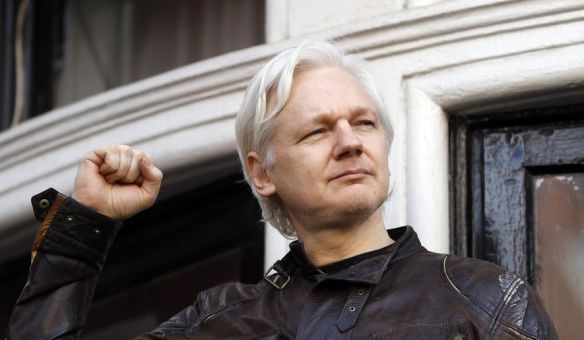
More Police Raids As War On Journalism Escalates Worldwide

By Caitlin Johnstone

Source: CaitlinJohnstone.com

The Australian Federal Police have conducted two raids on journalists and seized documents in purportedly unrelated incidents in the span of just two days.

Yesterday the AFP raided the home of News Corp Australia journalist Annika Smethurst, seeking information related to her investigative report last year which exposed the fact that the Australian government has been discussing the possibility of giving itself unprecedented powers to spy on its own citizens. Today they raided the Sydney headquarters of the Australian Broadcasting Corp, seizing information related to a 2017 investigative report on possible war crimes committed by Australian forces in Afghanistan.

In a third, also ostensibly unrelated incident, another Australian reporter disclosed yesterday that the Department of Home Affairs has initiated an investigation of his reporting on a story about asylum seeker boats which could lead to an AFP criminal case, saying he’s being pressured to disclose his source.

“Why has AFP suddenly decided to carry out these two raids after the election?” tweeted Australian Sky News political editor David Speers during the Sydney raid. “Did new evidence really just emerge in both the Annika Smethurst and ABC stories?!”

Why indeed?

“If these raids unconnected, as AFP reportedly said, it’s an extraordinary coincidence,” tweeted The Conversation chief political correspondent Michelle Grattan. “AFP needs to explain ASAP the timing so long after the stories. It can’t be that inefficient! Must be some explanation – which makes the ‘unconnected’ claim even more odd.”

Odd indeed.

It is true that the AFP has formally denied that there was any connection between the two raids, and it is in fact difficult to imagine how the two could be connected apart from their sharing a common theme of exposing malfeasance that the government wanted kept secret. If it is true that they are unconnected, then what changed? What in the world could have changed to spark this sudden escalation of the Australian government’s assault on the free press?

Well, if as I suggested recently you don’t think in terms of separate, individual nations, it’s not hard to think of at least one thing that’s changed.

“The criminalization and crack down on national security journalism is spreading like a virus,” WikiLeaks tweeted today in response to the ABC raid. “The Assange precedent is already having effect. Journalists must unite and remember that courage is also contagious.”

“The arrest and espionage charges against Assange was just the beginning, as many in the media, even those who hate Assange, feared,”  tweeted Consortium News editor-in-chief Joe Lauria in response to the News Corp raid. “The home of a mainstream Australian journalist was raided Wed. morning by police because of a story she worked on.”

“Shameful news from Australia as the police raid journalists’ offices and homes,” tweeted legendary Australian journalist John Pilger. “One warrant allows them to ‘add, copy, delete or alter’ computer files at the ABC. The assault on Julian Assange was a clear warning to all of us: it was only the beginning.”

If you think about it, it would have been far less disturbing than the alternative if there were a connection between the two raids, because the alternative is vastly more sinister: that the Australian government’s attitude toward the free press has changed. And that it has perhaps done so, as Australia has been doing for decades, in alignment with the behavior of the rest of the US-centralized empire.

In an article for Consortium News titled “After Assange’s Espionage Act Indictment, Police Move Against More Journalists for Publishing Classified Material”, Joe Lauria reminds us that Australia is not the first nation within the western power alliance to see such an escalation since the paradigm-shifting imprisonment of Julian Assange in the UK.

“Police in Paris arrested two journalists who were covering Yellow Vest protests on April 20,” Lauria writes.  “One of the journalists, Alexis Kraland, said he was taken into custody after refusing to be searched and to turn his camera over to police at Gare du Nord train station. The largest journalism union in France demanded an explanation from police.”

“And on May 10 in San Francisco, police using sledgehammers to break down the door, raided the home of Bryan Carmody, a freelance journalist, to get him, while handcuffed, to reveal his source who leaked him a police report into the sudden death the city’s elected public defender,” Lauria added. “Police took away computers, cameras, mobile phones and notes.”

So we’re seeing a pattern already. You can choose to ignore it or dismiss it with a pleasant story, or you can acknowledge that we appear to be in the midst of a rapidly escalating shutdown of the free press in the western world.

There does not necessarily have to be any centrally-planned conspiracy behind this trend; it can simply be the natural result of an ailing empire seeing that it’s going to need a lot more war, lies and deception in order to keep from collapsing, and responding accordingly. Once the Assange line was crossed, it could simply have served as a precedent for the other governments within the empire to begin doing things they’d already wanted to do anyway.

https://twitter.com/AssangeMrs/status/1136169465026994176

Julian Assange is the dot of a question mark at the end of a historically important question which we are all being asked right now. That question reads as follows: Does humanity wish to create a society that is based on truth and holds power to account, or does it want the exact opposite?

So far, the general consensus answer to that question has been going somewhere along the lines of “We’re actually fine with a headlong plunge into Orwellian dystopia, thanks.” But as the implications of that answer become clearer and clearer, we may yet see some stirrings in the other direction before it is too late.

“Truth ultimately is all we have:” Julian Assange appeals for public supporta

By Oscar Grenfell

Source: WSWS.org

In his first publicly-released comments to supporters since his arrest, WikiLeaks founder and publisher Julian Assange has detailed the repressive conditions he faces in Britain’s Belmarsh prison and called for a campaign against his threatened extradition to the United States.

“I am defenceless and am counting on you and others of good character to save my life,” Assange wrote, adding, “Truth ultimately is all we have.”

Assange’s comments were made in a letter addressed to independent British journalist Gordon Dimmack, who decided to make it public following last Thursday’s announcement by the US Justice Department of additional charges against Assange under the Espionage Act. The WSWS is republishing the letter, with Dimmack’s permission, in full below.

Assange explained that since he was convicted on trumped-up bail charges shortly after his arrest on April 11, he has been “isolated from all ability to prepare to defend myself, no laptop, no internet, no computer, no library so far, but even if I do get access it will be just for half an hour with everyone else once a week.”

The WikiLeaks founder stated that he is allowed “Just two visits a month and it takes weeks to get someone on the call list.”

All of his calls, except those to his lawyers, are monitored and limited to a maximum of ten minutes. There is a window of just 30 minutes per day for phone calls to be made “in which all prisoners compete for the phone.” Assange receives only a few pounds of phone credit per week and is not allowed to receive inbound calls.

The WikiLeaks founder declared that, despite these onerous conditions, he is “unbroken albeit literally surrounded by murderers. But the days when I could read and speak and organise to defend myself, my ideals and my people are over until I am free. Everyone else must take my place.”

The WikiLeaks founder stated that he faced “A superpower” that has “been preparing for 9 years with hundreds of people and untold millions spent” on the case against him.

He warned that “The US government or rather those regrettable elements in it that hate truth liberty and justice want to cheat their way into my extradition and death rather than letting the public hear the truth for which I have won the highest awards in journalism and have been nominated seven times for the Nobel Peace Prize.”

The unveiling of the US charges is a vindication of Assange’s warnings, in the letter and over the past nine years, that he faces a politically-motivated US prosecution for his role in WikiLeaks’ exposures of war crimes, mass surveillance operations and global diplomatic conspiracies.

The 17 counts against Assange carry a combined maximum prison sentence of 175 years. They are an unprecedented attempt to criminalise investigative journalism, and abolish the free press protections of the US Constitution’s First Amendment.

The charges centre on WikiLeaks’ receipt and publication of classified US government documents. These core journalistic practices are presented as criminal activities which “risked serious harm to United States national security to the benefit of our adversaries.”

The documents covered include the Afghan war logs, which exposed the extrajudicial killing of civilians by US-led forces, and other violations of international law.

Assange’s letter further exposes the ongoing political conspiracy against him, which included his illegal expulsion from Ecuador’s London embassy and detention by the British authorities.

The WikiLeaks founder was convicted, within hours of his arrest, on the British charges. The judge dismissed the fact that the offenses were effectively resolved years ago as a result of Assange’s forfeiture of bail monies, his years of arbitrary detention in the small embassy building and his United Nations-upheld status as a political refugee.

Despite the minor character of the bail conviction, Assange has been held in virtual isolation in a maximum security prison. This is a clear attempt to hinder his defence against the Trump administration’s extradition request, and the revived Swedish investigation into allegations of sexual misconduct, which is aimed at blackening his name and creating an alternate route for him to be dispatched to a US prison.

Assange’s call for a campaign in his defence coincides with growing opposition to his persecution and to the Espionage Act charges against him.

In a Tweet shared almost 5,000 times, investigative journalist John Pilger warned that “The war on Julian #Assange is now a war on all. Eighteen absurd charges including espionage send a burning message to every journalist, every publisher… Modern fascism is breaking cover.”

The American Civil Liberties Union branded the charges “an extraordinary escalation of the Trump administration’s attacks on journalism, establishing a dangerous precedent that can be used to target all news organizations that hold the government accountable by publishing its secrets.”

The Freedom of the Press Foundation described them as “the most significant and terrifying threat to the First Amendment in the 21st century.”

In Australia, there are mounting calls for the government to fulfil its obligations to Assange as an Australian citizen and journalist. Former Labor politician Bob Carr yesterday cynically warned that Foreign Minister Marise Payne “needs to protect herself from the charge that she’s failed in her duty to protect the life of an Australian citizen”

Greg Barns, an Australian-based advisor to Assange, declared “Australia does have a role to play here and our view is that the Australian government needs to intervene.” He said the US prosecution of the WikiLeaks founder was aimed at applying US domestic law extraterritorially. This meant that “anyone who publishes information the US deems to be classified anywhere in the world” could be targeted by the US government.

Over the past 18 months, the WSWS and the Socialist Equality Parties (SEP) around the world have played a prominent role in the struggle against the stepped-up persecution of Assange.

The SEP (Australia) has held a series of rallies, demanding that the Australian government secure Assange’s release from Britain and return to Australia, with a guarantee against extradition to the US.

The events, addressed by SEP national secretary James Cogan, and well-known fighters for civil liberties, including Pilger, Consortium News editor-in-chief Joe Lauria and Professor Stuart Rees, have been attended by hundreds of workers, students and young people.

The SEP (Britain) held a powerful public meeting in London on May 12, which brought together 150 defenders of Assange, and featured speakers from around the world. It was streamed live on Dimmack’s YouTube page to an audience of thousands.

On May 18, the Sozialistische Gleichheitspartei held a rally in Berlin, attended by 300 people, under the banner “freedom for Julian Assange.”

Over the coming weeks, the WSWS and the SEP’s will intensify the struggle against Assange’s extradition to the US, and for his complete freedom. We appeal to all supporters of civil liberties to join us in this crucial fight, which is the spearhead of the defence of democratic rights and against imperialist war.

Assange’s next hearing is set for Thursday May 30 at Westminster Magistrates Court in London. We urge all readers of the WSWS in the UK to attend.

Below is the full text of Assange’s letter to Gordon Dimmack:

I have been isolated from all ability to prepare to defend myself, no laptop, no internet, no computer, no library so far, but even if I do get access it will be just for half an hour with everyone else once a week. Just two visits a month and it takes weeks to get someone on the call list and the Catch-22 in getting their details to be security screened. Then all calls except lawyer are recorded and are a maximum 10 minutes and in a limited 30 minutes each day in which all prisoners compete for the phone. And credit? Just a few pounds a week and no one can call in.

A superpower that has been preparing for 9 years with hundreds of people and untold millions spent on the case. I am defenceless and am counting on you and others of good character to save my life

I am unbroken albeit literally surrounded by murderers. But the days when I could read and speak and organise to defend myself, my ideals and my people are over until I am free. Everyone else must take my place.

The US government or rather those regrettable elements in it that hate truth liberty and justice want to cheat their way into my extradition and death rather than letting the public hear the truth for which I have won the highest awards in journalism and have been nominated seven times for the Nobel Peace Prize.

Truth ultimately is all we have.


Related Video

Are “Conspiracy Theories” Tearing Society Apart Or Saving Us From Destruction?

By Brandon Smith

Source: Activist Post

The phrase “conspiracy theory” is often used by establishment agencies, the mainstream media and useful idiots as a tool to dismiss legitimate evidence or viewpoints that disagree with their predetermined version of events. This method of propaganda was not always as widespread as it is today. The phrase was not “created” by the CIA, but it was in fact weaponized by them in the 1960s after the assassination of John F. Kennedy with the express purpose of shutting down rational debate.

CIA memo 1035-960, circulated within the CIA in 1967 and exposed through a freedom of information act request by The New York Times in 1976, outlines strategies the agency would use to shut down critics of the Warren Commission Report. Specifically, they suggested the accusation of “conspiracy” with negative connotations attached, predominantly in mainstream books and articles. This was indeed done through the CIA’s many puppets in the media, and the concept of “conspiracy theory” as a pejorative was born.

Through the use of straw man arguments, red herring fallacies and sophistry, the incredible scale of evidence (exposed by investigators like New Orleans District Attorney Jim Garrison) suggesting the Warren Commission was either corrupt or ignorant in its findings was buried in a flurry of hatchet jobs and hit pieces. And this was the goal, of course; to attack the messenger and silence the truth without having to go through the ugly process of directly confronting the truth.

Until recently, this strategy was highly effective. Attacking a person as a “conspiracy theorist” was the only tool critics really needed to keep a piece of evidence or a concrete viewpoint from going viral. Conspiracy theory is equated to insanity, or stupidity, or buffoonery. Everyone knows a conspiracy theorist is not to be taken seriously, so why waste time listening to what they have to say in the first place?

It should come as no surprise that conspiracy REALITY is not something these people want entertained by the public. Conspiracies are a fact of history. Governments lie, all the time, and they have been caught doing it. The media lies, constantly, and has been caught doing it. Yet, we are supposed to ignore this and assume that anyone daring to stand contrary to government and media claims is some kind of lunatic?

In the past 5-10 years, however, things have been changing. Suddenly, anti-establishment views and investigations of corruption are bulldozing the mainstream scripted narrative, and the elites and the media are bewildered. They can see they are losing control of popular thought and they are disturbed, to say the least. A steady stream of articles and essays have been flooding the MSM recently lamenting the rise of “conspiracy culture” and warning of the “death of democracy” if this is allowed to continue.

They seem specifically angered by the idea that their “journalistic” and “professional” status no longer matters to most people. Not long ago, anyone wearing a suit, a uniform, a lab coat, a journalist’s badge or collecting a government paycheck was supposed to be immediately taken seriously as a designated “expert”. As Noam Chomsky describes them in his book Manufacturing Consent, they were the professional class, the top 10% or less of individuals with “all the answers”. These were the people the establishment sought to indoctrinate most of all, because these were the community leaders that many in the public listened to without question.

Now there is a growing movement of people who could not care less about what kind of degree someone’s parents purchased for them from an Ivy League university. They don’t care about establishment designations and fake accolades and titles and credentials. What they care about are facts and evidence. What they care about are the arguments a person puts forth, rather than how important they purport to be. This is causing some consternation among the elites.

A key figure and gatekeeper in the propaganda war against the alternative media and conspiracy reality is Cass Sunstein, former “Information Czar” in the Obama Administration. Sunstein has written numerous books and articles lamenting the growing influence of the alternative media, including his book Conspiracy Theories And Dangerous Ideas.

The main thrust of Sunstein’s position is that conspiracy theories isolate the populace into small groups of like-minded people perpetuating each other’s “misguided” views. He also suggests that these groups represent a concrete threat to the stability of government and of society by spreading wrong (or perhaps inconvenient) information and civil unrest. In other words, a few decades ago all information was centralized and filtered by the corporate media and government, and now the Internet is decentralizing information flow thereby allowing people to think differently and break from the majority narrative, which is unacceptable by Sunstein’s standards.

Sunstein sees the creation of a public hive mind as the best outcome for social order. He suggests in his book Nudge the concept of “Libertarian Paternalism” (which is neither libertarian nor paternal). He advocates for the control of society through subversive means of influence (nudging) while allowing people to continue believing that their choices are actually their own.

But how would Sunstein go about executing this influence? His solution to the threat of the alternative media was first made clear in his paper titled “Conspiracy Theories”, published in 2008. In it, he argues in favor of government interference or control of alternative media or “conspiracy theory” sources. His primary tactic was the infiltration of alternative media forums and sites by government agents or private actors paid by the government to disrupt discussion, derail activism and sow seeds of doubt or chaos. Effectively, Sunstein wanted the covert destruction of the liberty media by paid agitators.

So, the same man who accuses the alternative media of conspiracy mongering and the destruction of the Western world is actively seeking to foment a conspiracy to undermine that movement. Is this irony, or hypocrisy or both?  Doesn’t this mean that Sunstein is a part of one of the very conspiracies he criticizes people like me for being concerned about?

Sunstein and his elitist ilk want the power to erase or sabotage the alternative media. In fact, there are probably a few of their agents provocateurs attacking this article in the comments below right now. They would prefer that the government eventually take full control of the Internet and dictate the terms of media participation directly. This gives rise to one of the most important questions that the establishment does not want to answer – Who gets to decide what is and what is not “dangerous conspiracy theory”?

If pressed, the elites will ultimately suggest that they are the best qualified. Sunstein describes the general public in his books as essentially lazy, unintelligent, impulsive and not to be trusted to make good decisions. He does not seem to include himself and his globalist comrades as being prone to the same weaknesses. They are apparently wise and benevolent enough to make the best decisions for all of us. Imagine that…

This elitism bias and Sunstein’s overall methodology for biting at the ankles of the liberty media is being carried over into a new wave of propaganda in the past couple of years, primarily coming from (though not limited to) the political left.

Sunstein’s gatekeeping has spawned a cancerous growth of copycats in progressive academics. This is going on everywhere, but one particular example I found recently was on Vox, a leftist rag which shamelessly flaunts its political bias and actively slanders conservatives.  Vox‘s article “Conspiracy Theories Are Getting More Absurd And Harder To Refute” promotes a new book which regurgitates Sunstein’s propaganda model. The article takes special time to reassert the old disinformation narrative by stating that:

Democracy requires a minimum amount of mutual trust among citizens, and conspiracism destroys it.

Are you getting the sense yet that there is a repetitive message coming from these people that they want you to embrace? Is there ANYTHING true about the statement above?  The fundamental root of their argument is that conspiracy theories (viewpoints outside the mainstream) must be treated as existential threats to society. In other words, some ideas are so dangerous that they must be controlled or outlawed. The basis of this argument, though, is entirely fraudulent.

First, leftists incessantly refer to our society as a “democracy”, I think because they believe if they tell the lie enough it will become reality by default.  The US was never intended to be a “democracy”, but a Republic, and with good reason. Democracy requires blind and often misplaced faith in the system. A Republic requires constant vigilance and healthy skepticism. In a Republic, we are not supposed to simply “trust” that our leaders are going to do the right thing. We are supposed to put them under a microscope, uncover criminality and corruption, and generally make them uncomfortable at all times. It is our civic duty to become “conspiracy theorists”.

The establishment prefers a democracy because in a democracy 51% of the population can dictate the individual liberties of the other 49%, and they are rightly convinced that they can influence the thinking and decisions of the larger half. Also, in a democracy, society revolves around moral relativism and the ever arbitrary “greater good for the greater number”, instead of governing according to individual liberty, inherent moral compass and human conscience.

The Vox article goes on to make the claim that while there are some correct conspiracy theories, they have all come from the left side of the political spectrum (which they call “progressive conspiracy theories”). They then assert that there are no verifiable conspiracy theories coming from the political right. This is madness.

When Cass Sunstein describes the tribalist isolation and conspiracy delusions of certain groups, he was clearly trying to mislabel conservative activists and the alternative media, but the REAL conspiracy nutbags have actually been on the left this whole time.

A lot of young leftist millennials, professional (I say this with the utmost sarcasm) mainstream media personalities and celebrities foolishly bought into the Russiagate conspiracy theory; a theory based on ZERO concrete evidence and a garbage heap of empty conjecture. For example, how many sessions of Real Time With Bill Maher or Late Night With Stephen Colbert was the Russiagate fantasy propped up as verified fact by a screeching flock of leftist parrots, blanketed in the protective peanut-brained imbecility of the audiences in their Los Angeles and New York echo chambers?

Even today, after the long-anticipated Mueller Report led to no indictments, leftists continue to cling desperately like hemorrhoids to the anus that is Russiagate.

Leftists have to this point justified much of their schizophrenic and sometimes violent and criminal behavior on the lie that Donald Trump is a usurper put into office by Russian manipulation of US elections. Now isn’t this the epitome of a conspiracy theory that is destructive to society?

Not all conspiracy theories are started by the alternative media. Many are started by the establishment itself, and these are indeed designed to cause the destabilization of the nation.

At the same time, the fabricated Russiagate conspiracy has been very effective at leading the left away from the very real conspiracy of Trump’s saturation of his cabinet with banking elites and globalist think tank ghouls like John Bolton, Steven Mnuchin or Wilber Ross. Weren’t these the same elites that Trump was going to “drain from the swamp”? Why hasn’t the left talking about that for the past two years?

The article also makes no mention of the DNC rigging of the Democratic primaries in favor of Hillary Clinton and against Bernie Sanders. This was a conspiracy conservatives had to help expose, while the left sat idle and ignored it, hyperfocusing on their hatred of Trump while propping up Hillary Clinton, a repeat criminal offender. But, hey, conservative conspiracies are always wrong and leftist conspiracies are often correct according to Vox and friends…

And what about the verified fact of mass digital surveillance by government on the public?  This was a conspiracy that conservative groups had been warning about for years.  We were called kooks, because why would the government care about what the average person did in their day-to-day life?  Our fears were verified by the exposure of classified data by people like Edward Snowden and Julian Assange (who is now facing extradition and prosecution for nothing more than publishing truths on the Internet).  Both the political left and political right are aggressively hostile to both these men, and are seeking to bury them.

My question is, what is really more dangerous?  Conspiracy theories, or the actual conspiracies governments and elitists execute against the people?

The message here is not ambiguous at all. To summarize, the establishment wants control of Internet media, by hook or by crook, in the name of protecting people from themselves and from ideas they consider unsettling to the world order. The political left is all on board with this as long as their conspiracy theories are treated with legitimacy; and they will be, because their conspiracy theories are the establishment’s conspiracy theories.

The only theories that are being threatened with subjugation are those of conservatives and the alternative media that are contrary to centralization and government power. Not because our theories are dangerous to the fabric of society, but because our theories are dangerous to the people who want to dictate the fabric of society. Our activism and journalism represents decentralized thought which could choke the engine of the globalist agenda. We aren’t tearing down the Western world, we’re the only thing keeping it alive.


You can read more from Brandon Smith at his site Alt-Market. If you would like to support the work that Alt-Market does while also receiving content on advanced tactics for defeating the globalist agenda, subscribe to our exclusive newsletter The Wild Bunch Dispatch.  Learn more about it HERE.

CODEPINK Denounces Illegal Entry and Arrest at DC Venezuelan Embassy and Vows to Keep Fighting to Protect the Embassy

By Medea Benjamin and Ariel Gold

Source: Code Pink

Thursday, May 16, Washington D.C. — At 9:30 AM in the morning, D.C. police officers illegally entered the Venezuelan embassy in Washington D.C. in the Georgetown neighborhood and arrested four activists lawfully living in the building since April 10, as guests of the legitimate Venezuelan government. The four activists are Margaret Flowers and Kevin Zeese (with the group Popular Resistance), Adrienne Pine (an academic) and David Paul (a CODEPINK member). They are part of the Embassy Protection Collective that has been living in the embassy since April 10.

“They are charged with ‘interference with certain protective functions.’ It is notable that they were not charged with trespassing, which makes it perfectly clear that the US government does not want to be in the position of having to explain who is lawfully in charge of these premises,” says the Embassy Protection Collective’s attorney Mara Verheyden Hilliard. “What we are seeing today is the most extraordinary violation of the Vienna Convention. The fact that the State Department has broken into a protected diplomatic mission to arrest the peace activists inside is something that will have repercussions the world over.”

“We denounce these arrests, as the people inside were there with our permission, and we consider it a violation of the Vienna Conventions,” says Deputy Foreign Minister Carlos Ron. “We do not authorize any of the coup leaders to enter our embassy in Washington DC. We call on the US government to respect the Vienna Conventions and sign a Protecting Power Agreement with us that would ensure the integrity of both our Embassy in Washington DC and the US Embassy in Caracas.” The US has been negotiating with Switzerland to take charge of its Caracas Embassy and Venezuela has been negotiating with Turkey to take charge of its DC Embassy. These critical negotiations will be broken, however, if the US illegally hands over the Venezuelan Embassy to the forces of opposition leader Juan Guaido.

On April 10, members of the Embassy Protection Collective, including activists from CODEPINK, Popular Resistance and the ANSWER Coalition, moved into the Venezuelan embassy in the Georgetown neighborhood of Washington, D.C. to serve as an interim embassy protection force to prevent the Trump administration from allowing representatives of non-elected opposition leader Juan Guiado from taking over the building as part of a repeatedly attempted and failed coup.

From April 10-April 30, members of the Embassy Protection Collective were able to come and go freely from the building, with up to 50 activists sleeping there. On April 30, a group of Guaidó supporters —coinciding with Guaidó’s failed call for an uprising inside Venezuela — descended on the embassy, determined to oust the activists and seize the building. They blared sirens, horns, and megaphones and surrounded the perimeter of the building with tents, refusing to allow food, medicine, supplies, or people to enter. Multiple peace activists were physically assaulted and arrested in attempts to approach the building with food. On May 8, Potomac Electric Power Company (Pepco), assisted by the Secret Service, cut electricity despite all utility bills being paid in full.

The Collective maintains that the arrests are illegal under Articles 22 and 45 of the 1961 Vienna Conventions on Diplomatic Relations, in which diplomatic premises are “inviolable” and agents of the receiving State may not enter them, except with the consent of the head of the mission. The Trump Administration has not only allowed illegal seizures of diplomatic premises belonging to Venezuela, but has actively facilitated it by giving the Military Attache building and the New York City Consulate to the opposition.

“This struggle is far from over. We will continue to fight to stop this embassy from being handed over by the Guaidó supporters,” says CODEPINK Codirector Medea Benjamin. “The Embassy Protection Collective recognizes that turning over the embassy over to Guaidó would place the U.S. embassy in Caracas in jeopardy. We will continue to use all methods at our disposal to keep the Venezuelan Embassy in Washington D.C. empty until a diplomatic solution — a Protecting Power Agreement — can be worked out between the U.S. and the Venezuelan governments.”

A Protecting Power Agreement would allow third countries to take charge of both the Venezuela and US Embassies. Such an agreement could lead to further negotiations to avoid a military conflict that would be catastrophic for Venezuela, the United States, and for the region. It could lead to a catastrophic loss of lives and mass migration from the chaos and conflict of war, exacerbating the existing humanitarian crisis stoked by U.S. economic sanctions. It could cost the United States trillions of dollars and become a quagmire similar to the U.S. intervention in Iraq and Afghanistan.


Related Article:

Who’s behind the pro-Guaido mob that besieged Venezuela’s embassy in Washington?


Decriminalizing the Drug War?

Calculating the Damage from a Century of Drug Prohibition

By Alfred W. McCoy

Source: TomDispatch.com

We live in a time of change, when people are questioning old assumptions and seeking new directions. In the ongoing debate over health care, social justice, and border security, there is, however, one overlooked issue that should be at the top of everyone’s agenda, from Democratic Socialists to libertarian Republicans: America’s longest war. No, not the one in Afghanistan. I mean the drug war.

For more than a century, the U.S. has worked through the U.N. (and its predecessor, the League of Nations) to build a harsh global drug prohibition regime — grounded in draconian laws, enforced by pervasive policing, and punished with mass incarceration. For the past half-century, the U.S. has also waged its own “war on drugs” that has complicated its foreign policy, compromised its electoral democracy, and contributed to social inequality. Perhaps the time has finally come to assess the damage that drug war has caused and consider alternatives.

Even though I first made my mark with a 1972 book that the CIA tried to suppress on the heroin trade in Southeast Asia, it’s taken me most of my life to grasp all the complex ways this country’s drug war, from Afghanistan to Colombia, the Mexican border to inner-city Chicago, has shaped American society. Last summer, a French director doing a documentary interviewed me for seven hours about the history of illicit narcotics. As we moved from the seventeenth century to the present and from Asia to America, I found myself trying to answer the same relentless question: What had 50 years of observation actually drilled into me, beyond some random facts, about the character of the illicit traffic in drugs?

At the broadest level, the past half-century turns out to have taught me that drugs aren’t just drugs, drug dealers aren’t just “pushers,” and drug users aren’t just “junkies” (that is, outcasts of no consequence). Illicit drugs are major global commodities that continue to influence U.S. politics, both national and international. And our drug wars create profitable covert netherworlds in which those very drugs flourish and become even more profitable. Indeed, the U.N. once estimated that the transnational traffic, which supplied drugs to 4.2% of the world’s adult population, was a $400 billion industry, the equivalent of 8% of global trade.

In ways that few seem to understand, illicit drugs have had a profound influence on modern America, shaping our international politics, national elections, and domestic social relations. Yet a feeling that illicit drugs belong to a marginalized demimonde has made U.S. drug policy the sole property of law enforcement and not health care, education, or urban development.

During this process of reflection, I’ve returned to three conversations I had back in 1971 when I was a 26-year-old graduate student researching that first book of mine, The Politics of Heroin: CIA Complicity in the Global Drug Trade. In the course of an 18-month odyssey around the globe, I met three men, deeply involved in the drug wars, whose words I was then too young to fully absorb.

The first was Lucien Conein, a “legendary” CIA operative whose covert career ranged from parachuting into North Vietnam in 1945 to train communist guerrillas with Ho Chi Minh to organizing the CIA coup that killed South Vietnamese President Ngo Dinh Diem in 1963. In the course of our interview at his modest home near CIA headquarters in Langley, Virginia, he laid out just how the Agency’s operatives, like so many Corsican gangsters, practiced the “clandestine arts” of conducting complex operations beyond the bounds of civil society and how such “arts” were, in fact, the heart and soul of both covert operations and the drug trade.

Second came Colonel Roger Trinquier, whose life in a French drug netherworld extended from commanding paratroopers in the opium-growing highlands of Vietnam during the First Indochina War of the early 1950s to serving as deputy to General Jacques Massu in his campaign of murder and torture in the Battle of Algiers in 1957. During an interview in his elegant Paris apartment, Trinquier explained how he helped fund his own paratroop operations through Indochina’s illicit opium traffic. Emerging from that interview, I felt almost overwhelmed by the aura of Nietzschean omnipotence that Trinquier had clearly gained from his many years in this shadowy realm of drugs and death.

My last mentor on the subject of drugs was Tom Tripodi, a covert operativewho had trained Cuban exiles in Florida for the CIA’s 1961 Bay of Pigs invasion and then, in the late 1970s, penetrated mafia networks in Sicily for the U.S. Drug Enforcement Administration. In 1971, he appeared at my front door in New Haven, Connecticut, identified himself as a senior agent for the Treasury Department’s Bureau of Narcotics, and insisted that the Bureau was worried about my future book. Rather tentatively, I showed him just a few draft pages of my manuscript for The Politics of Heroin and he promptly offered to help me make it as accurate as possible. During later visits, I would hand him chapters and he would sit in a rocking chair, shirt sleeves rolled up, revolver in his shoulder holster, scribbling corrections and telling remarkable stories about the drug trade — like the time his Bureau found that French intelligence was protecting the Corsican syndicates smuggling heroin into New York City. Far more important, though, through him I grasped how ad hoc alliances between criminal traffickers and the CIA regularly helped both the Agency and the drug trade prosper.

Looking back, I can now see how those veteran operatives were each describing to me a clandestine political domain, a covert netherworld in which government agents, military men, and drug traders were freed from the shackles of civil society and empowered to form secret armies, overthrow governments, and even, perhaps, kill a foreign president.

At its core, this netherworld was then and remains today an invisible political realm inhabited by criminal actors and practitioners of Conein’s “clandestine arts.” Offering some sense of the scale of this social milieu, in 1997 the United Nations reported that transnational crime syndicates had 3.3 million members worldwide who trafficked in drugs, arms, humans, and endangered species. Meanwhile, during the Cold War, all the major powers — Britain, France, the Soviet Union, and the United States — deployed expanded clandestine services worldwide, making covert operations a central facet of geopolitical power. The end of the Cold War has in no way changed this reality.

For over a century now, states and empires have used their expanding powers for moral prohibition campaigns that have periodically transformed alcohol, gambling, tobacco, and, above all, drugs into an illicit commerce that generates sufficient cash to sustain covert netherworlds.

Drugs and U.S. Foreign Policy

The influence of illicit drugs on U.S. foreign policy was evident between 1979 and 2019 in the abysmal failure of its never-ending wars in Afghanistan. Over a period of 40 years, two U.S. interventions there fostered all the conditions for just such a covert netherworld. While mobilizing Islamic fundamentalists to fight the Soviet occupation of that country in the 1980s, the CIA tolerated opium trafficking by its Afghan mujahedeen allies, while arming them for a guerrilla war that would ravage the countryside, destroying conventional agriculture and herding.

In the decade after superpower intervention ended in 1989, a devastating civil war and then Taliban rule only increased the country’s dependence upon drugs, raising opium production from 250 tons in 1979 to 4,600 tons by 1999. This 20-fold increase transformed Afghanistan from a diverse agricultural economy into a country with the world’s first opium monocrop — that is, a land thoroughly dependent on illicit drugs for exports, employment, and taxes. Demonstrating that dependence, in 2000 when the Taliban banned opium in a bid for diplomatic recognition and cut production to just 185 tons, the rural economy imploded and their regime collapsed as the first U.S. bombs fell in October 2001.

To say the least, the U.S. invasion and occupation of 2001-2002 failed to effectively deal with the drug situation in the country. As a start, to capture the Taliban-controlled capital, Kabul, the CIA had mobilized Northern Alliance leaders who had long dominated the drug trade in northeast Afghanistan, as well as Pashtun warlords active as drug smugglers in the southeastern part of the country. In the process, they created a post-war politics ideal for the expansion of opium cultivation.

Even though output surged in the first three years of the U.S. occupation, Washington remained uninterested, resisting anything that might weaken military operations against the Taliban guerrillas. Testifying to this policy’s failure, the U.N.’s Afghanistan Opium Survey 2007 reported that the harvest that year reached a record 8,200 tons, generating 53% of the country’s gross domestic product, while accounting for 93% of the world’s illicit narcotics supply.

When a single commodity represents over half of a nation’s economy, everyone — officials, rebels, merchants, and traffickers — is directly or indirectly implicated. In 2016, the New York Times reported that both Taliban rebels and provincial officials opposing them were locked in a struggle for control of the lucrative drug traffic in Helmand Province, the source of nearly half the country’s opium. A year later, the harvest reached a record 9,000 tons, which, according to the U.S. command, provided 60% of the Taliban’s funding. Desperate to cut that funding, American commanders dispatched F-22 fighters and B-52 bombers to destroy the insurgency’s heroin laboratories in Helmand — doing inconsequential damage to a handful of crude labs and revealing the impotence of even the most powerful weaponry against the social power of the covert drug netherworld.

With unchecked opium production sustaining Taliban resistance for the past 17 years and capable of doing so for another 17, the only U.S. exit strategy now seems to be restoring those rebels to power in a coalition government — a policy tantamount to conceding defeat in its longest military intervention and least successful drug war.

High Priests of Prohibition

For the past half-century, the ever-failing U.S. drug war has found a compliant handmaiden at the U.N., whose dubious role when it comes to drug policy stands in stark contrast to its positive work on issues like climate change and peace-keeping.

In 1997, the director of U.N. drug control, Dr. Pino Arlacchi, proclaimed a 10-year program to eradicate all illicit opium and coca cultivation from the face of the planet, starting in Afghanistan. A decade later, his successor, Antonio Maria Costa, glossing over that failure, announced in the U.N.’s World Drug Report 2007 that “drug control is working and the world drug problem is being contained.” While U.N. leaders were making such grandiloquent promises about drug prohibition, the world’s illicit opium production was, in fact, rising 10-fold from just 1,200 tons in 1971, the year the U.S. drug war officially started, to a record 10,500 tons by 2017.

This gap between triumphal rhetoric and dismal reality cries out for an explanation. That 10-fold increase in illicit opium supply is the result of a market dynamic I’ve termed “the stimulus of prohibition.” At the most basic level, prohibition is the necessary precondition for the global narcotics trade, creating both local drug lords and transnational syndicates that control this vast commerce. Prohibition, of course, guarantees the existence and well-being of such criminal syndicates which, to evade interdiction, constantly shift and build up their smuggling routes, hierarchies, and mechanisms, encouraging a worldwide proliferation of trafficking and consumption, while ensuring that the drug netherworld will only grow.

In seeking to prohibit addictive drugs, U.S. and U.N. drug warriors act as if mobilizing for forceful repression could actually reduce drug trafficking, thanks to the imagined inelasticity of, or limits on, the global narcotics supply. In practice, however, when suppression reduces the opium supply from one area (Burma or Thailand), the global price just rises, spurring traders and growers to sell off stocks, old growers to plant more, and new areas (Colombia) to enter production. In addition, such repression usually only increases consumption. If drug seizures, for instance, raise the street price, then addicted consumers will maintain their habit by cutting other expenses (food, rent) or raising their income by dealing drugs to new users and so expanding the trade.

Instead of reducing the traffic, the drug war has actually helped stimulate that 10-fold increase in global opium production and a parallel surge in U.S. heroin users from just 68,000 in 1970 to 886,000 in 2017.

By attacking supply and failing to treat demand, the U.N.-U.S. drug war has been pursuing a “solution” to drugs that defies the immutable law of supply and demand. As a result, Washington’s drug war has, in the past 50 years, gone from defeat to debacle.

The Domestic Influence of Illicit Drugs

That drug war has, however, incredible staying power. It has persisted despite decades of failure because of an underlying partisan logic. In 1973, while President Richard Nixon was still fighting his drug war in Turkey and Thailand, New York’s Republican governor, Nelson Rockefeller, enacted the notorious “Rockefeller Drug Laws.” Those included mandatory penalties of 15 years to life for the possession of just four ounces of narcotics.

As the police swept inner-city streets for low-level offenders, annual prison sentences in New York State for drug crimes surged from only 470 in 1970 to a peak of 8,500 in 1999, with African-Americans representing 90% of those incarcerated. By then, New York’s state prisons held a previously unimaginable 73,000 people. During the 1980s, President Ronald Reagan, a conservative Republican, dusted off Rockefeller’s anti-drug campaign for intensified domestic enforcement, calling for a “national crusade” against drugs and winning draconian federal penalties for personal drug use and small-scale dealing.

For the previous 50 years, the U.S. prison population had remained remarkably stable at just 110 prisoners per 100,000 people. The new drug war, however, doubled those prisoners from 370,000 in 1981 to 713,000 in 1989. Driven by Reagan-era drug laws and parallel state legislation, prison inmates soared to 2.3 million by 2008, raising the country’s incarceration rate to an extraordinary 751 prisoners per 100,000 population. And 51% of those in federal penitentiaries were there for drug offenses.

Such mass incarceration has led as well to significant disenfranchisement, starting a trend that would, by 2012, deny the vote to nearly six million people, including 8% of all African-American voting-age adults, a liberal constituency that had gone overwhelmingly Democratic for more than half a century. In addition, this carceral regime concentrated its prison populations, including guards and other prison workers, in conservative rural districts of the country, creating something akin to latter-day “rotten boroughs” for the Republican Party.

Take, for example, New York’s 21st Congressional District, which covers the Adirondacks and the state’s heavily forested northern panhandle. It’s home to 14 state prisons, including some 16,000 inmates, 5,000 employees, and their 8,000 family members — making them collectively the district’s largest employer and a defining political presence. Add in the 13,000 or so troops in nearby Fort Drum and you have a reliably conservative bloc of 26,000 voters (and 16,000 non-voters), or the largest political force in a district where only 240,000 residents actually vote. Not surprisingly, the incumbent Republican congresswoman survived the 2018 blue wave to win handily with 56% of the vote. (So never say that the drug war had no effect.)

So successful were Reagan Republicans in framing this partisan drug policy as a moral imperative that two of his liberal Democratic successors, Bill Clinton and Barack Obama, avoided any serious reform of it. Instead of systemic change, Obama offered clemency to about 1,700 convicts, an insignificant handful among the hundreds of thousands still locked up for non-violent drug offenses.

While partisan paralysis at the federal level has blocked change, the separate states, forced to bear the rising costs of incarceration, have slowly begun reducing prison populations. In a November 2018 ballot measure, for instance, Florida — where the 2000 presidential election was decided by just 537 ballots — voted to restore electoral rights to the state’s 1.4 million felons, including 400,000 African-Americans. No sooner did that plebiscite pass, however, than Florida’s Republican legislators desperately tried to claw backthat defeat by requiring that the same felons pay fines and court costs before returning to the electoral rolls.

Not only does the drug war influence U.S. politics in all sorts of negative ways but it has reshaped American society — and not for the better, either. The surprising role of illicit drug distribution in ordering life inside some of the country’s major cities has been illuminated in a careful study by a University of Chicago researcher who gained access to the financial records of a drug gang inside Chicago’s impoverished Southside housing projects.  He found that, in 2005, the Black Gangster Disciple Nation, known as GD, had about 120 bosses who employed 5,300 young men, largely as street dealers, and had another 20,000 members aspiring to those very jobs. While the boss of each of the gang’s hundred crews earned about $100,000 annually, his three officers made just $7.00 an hour, his 50 street dealers only $3.30 an hour, and their hundreds of other members served as unpaid apprentices, vying for entry-level slots when street dealers were killed, a fate which one in four regularly suffered.

So what does all this mean? In an impoverished inner city with very limited job opportunities, this drug gang provided high-mortality employment on a par with the minimum wage (then $5.15 a hour) that their peers in more affluent neighborhoods earned from much safer work at McDonald’s. Moreover, with some 25,000 members in Southside Chicago, GD was providing social order for young men in the volatile 16-to-30 age cohort — minimizing random violence, reducing petty crime, and helping Chicago maintain its gloss as a world-class business center. Until there is sufficient education and employment in the nation’s cities, the illicit drug market will continue to fill the void with work that carries a high cost in violence, addiction, imprisonment, and more generally blighted lives.

The End of Drug Prohibition

As the global prohibition effort enters its second century, we are witnessing two countervailing trends. The very idea of a prohibition regime has reached a crescendo of dead-end violence not just in Afghanistan but recently in Southeast Asia, demonstrating the failure of the drug war’s repression strategy. In 2003, Thai Prime Minister Thaksin Shinawatra launched a campaign against methamphetamine abuse that prompted his police to carry out 2,275 extrajudicial killings in just three months. Carrying that coercive logic to its ultimate conclusion, on his first day as Philippine president in 2016, Rodrigo Duterte ordered an attack on drug trafficking that has since yielded 1.3 million surrenders by dealers and users, 86,000 arrests, and some 20,000 bodies dumped on city streets across the country. Yet drug use remains deeply rooted in the slums of both Bangkok and Manila.

On the other side of history’s ledger, the harm-reduction movement led by medical practitioners and community activists worldwide is slowly working to unravel the global prohibition regime. With a 1996 ballot measure, California voters, for instance, started a trend by legalizing medical marijuana sales. By 2018, Oklahoma had become the 30th state to legalize medical cannabis. Following initiatives by Colorado and Washington in 2012, eight more states to date have decriminalized the recreational use of cannabis, long the most widespread of all illicit drugs.

Hit by a surge of heroin abuse during the 1980s, Portugal’s government first reacted with repression that, as everywhere else on the planet, did little to stanch rising drug abuse, crime, and infection. Gradually, a network of medical professionals across the country adopted harm-reduction measures that would provide a striking record of proven success. After two decades of this ad hoc trial, in 2001 Portugal decriminalized the possession of all illegal drugs, replacing incarceration with counseling and producing a sustained drop in HIV and hepatitis infections.

Projecting this experience into the future, it seems likely that harm-reduction measures will be adopted progressively at local and national levels around the globe, while various endless and unsuccessful wars on drugs are curtailed or abandoned. Perhaps someday a caucus of Republican legislators in some oak-paneled Washington conference room and a choir of U.N. bureaucrats in their glass-towered Vienna headquarters will remain the only apostles preaching the discredited gospel of drug prohibition.

Assange and the Unforgivable Sin of Disemboweling Official Narratives

By Charles Hugh Smith

Source: Of Two Minds

The entire global status quo is on the cusp of the S-Curve decline phase.

There is really only one unforgivable sin in the political realm, and that’s destroying the official narrative by revealing the facts of the matter. This is why whistleblowers who make public the secret machinery of the elaborately artful lies underpinning all official narratives are hounded to the ends of the Earth.

Employees of state entities such as Ellsberg, Manning and Snowden are bound by vows of secrecy and threatened by the promise of severe punishment. Outsiders such as Assange are even further beyond the pale because they can’t be accused of being traitors, as they never took the vows of secrecy required by the Deep State.

The single most damaging revelation to all the elaborate lies that make up official narratives is the truth revealed in official emails, documents and conversations. This is why virtually every document and correspondence is now “classified,” so anyone releasing even a mundane scrap can be sentenced to rot in federal prison.

In a recent C-SPAN interview, author Nomi Prins explained the incredible difficulty of accessing papers in presidential libraries now due to virtually everything being classified. Freedom of Information Act (FOIA) applications must be filed, and researchers must wait years to gain access to routine correspondence that was freely available to all a decade or so ago.

Official paranoia has a 100% correlation with the amount of damage done to official narratives by any leaks of the facts of the matter. What are they so afraid of? Here’s the dynamic in play: the more fragile the narrative, the greater the dependence on half-truths and lies, the greater the official urgency to crush all whistleblowers and maintain a Stasi-like vigilance against any murmurs of dissent or doubt.

If the entire contraption wasn’t so vulnerable to exposure and so dependent on lies, why the infinite paranoia? This paranoia extends past the present system of lies into the past, as exposing the lies in decades past calls into question the official narratives of today.

Any doubt is extremely dangerous, as if even a single thread is pulled loose, the entire fabric of ginned-up statistics, false assurances, half-truths and outright lies unravels. Once the Pentagon Papers revealed the facts of the war in Vietnam, support for the official narrative collapsed essentially overnight.

In the immortal words of Jean-Claude Juncker, when it becomes serious you have to lie, and it’s now serious all the time.

The entire global status quo is on the cusp of the S-Curve decline phase. Hence the vulnerability to disruption of its official narratives and the panicky paranoia of its handlers.


Freedom Rider: The “Resistance” Is Silent on Julian Assange

By Margaret Kimberly

Source: Black Agenda Report

Liberals are just as much true believers in imperialism as the right wing they claim to oppose.

“Attacking the person who revealed war crimes is compliance in the service of the state.”

Ever since Donald Trump was elected president we have heard a lot about people who call themselves the “resistance.” That word has very significant meaning and should not be used frivolously. The enslaved Haitian people resisted the French 200 years ago. Harriet Tubman resisted and so did Tecumseh. Brave people all over the world have resisted colonial invasion, occupation, and racist violence.

But resistance for the anti-Trump group doesn’t amount to very much. They are united in dislike of Donald Trump, but only some of the time. They call him a fascist, but they mute themselves when his fascism supports the bipartisan imperialist consensus.

The so-called resistance have been conspicuously silent ever since Julian Assange was arrested after Ecuador withdrew his asylum from its London embassy. Under the guise of defending the press, this same group became hysterical when Trump had a stupid argument with a CNN reporter.They are enraged when he refers to the media as “enemies of the people.” But when publisher and journalist Julian Assange was snatched up by the U.S. and its vassal states they either said nothing or condemned a man whose actions are the very embodiment of resistance.

“This same group became hysterical when Trump had a stupid argument with a CNN reporter.”

Julian Assange now sits in a London prison awaiting extradition hearings. The United States government convened a grand jury in 2017 which handed down a secret indictment against him. He is charged with conspiracy to commit computer intrusionin relation to Chelsea Manning’s 2010 revelation of United States war crimes in Iraq. The Collateral Murder video shows army soldiers killing civilians, returning for a “double tap” killing of first responders, and laughing about their massacre. Anyone who revealed these horrors is a hero and should be supported without any ifs, ands or buts.

The United Kingdom played its usual role of partner in crime for the U.S. Fellow puppet state Australia refused to protect its citizen. Ecuador made off with a cool $4 billion in IMF loans. There is so much corruption to oppose but one wouldn’t know that with all the cheering on behalf of the surveillance state.

“Anyone who revealed these horrors is a hero.”

This resistance is little more than a collective hissy fit from dead ender Democrats who insist on following a party that can’t even reliably stay in office.  They have spent the last three years railing against Trump but bite their tongues when he commits an act that reeks of fascist ideology.

The kindest thing that can be said is that they have been hypnotized by a combination of Democratic Party and corporate media lies. It is very difficult to determine the truth in a culture saturated with all the deformities of an imperial state in panic mode. One has to act as a detective and know which web sites to read or whom to follow on social media in order to learn anything outside of the confines of state propaganda. Ever since election night in November 2016 the public have been subjected to a relentless campaign meant to deflect righteous anger away from the Democrats while furthering imperialist goals at the same time.

Julian Assange has become the poster child for the big lie. His leaks of Democratic National Committee emails are blamed for Hillary Clinton’s defeat. But there was no computer hack of the DNC at all. Assange received leaked materials from an insider and used Wikileaks to publish it.

“His leaks of Democratic National Committee emails are blamed for Hillary Clinton’s defeat.”

But that is only a partial explanation. The reality is far worse. Liberals are just as much true believers in imperialism as the right wing they claim to oppose.They are nothing if not consistent. When the Trump administration announced the coup attempt against the Venezuelan government the resistance didn’t resist at all.

Instead they repeated talking points from the New York Timesand National Public Radio which labeled the elected Venezuelan president a brutal dictator. They didn’t question the United States claim of a right to undo the will of people in another country. Some gave wishy washy criticism of military intervention but none of them questioned an intervention which is fascist by any definition.

“Liberals are just as much true believers in imperialism as the right wing they claim to oppose.”

These people will never defend Julian Assange. According to their world view he doesn’t deserve to be defended. He revealed government secrets, which runs counter to their support of the imperialist state, and they think he deprived them of a second Clinton presidency.

Now we know who is for real and who is a phony. Chelsea Manning sits in jail for a second time because she refused to testify before the grand jury which indicted Assange. There are people all over the world occupying Venezuelan embassies and consulates in order to protect them from the would be usurpers. That is resistance. Attacking the person who revealed war crimes is compliance in the service of the state. Perhaps this group needs a new name. They should be honest and call themselves the conformists. That would be truth in advertising.


Margaret Kimberley’s Freedom Rider column appears weekly in BAR, and is widely reprinted elsewhere. She maintains a frequently updated blog as well at http://freedomrider.blogspot.com . Ms. Kimberley lives in New York City, and can be reached via e-Mail at Margaret.Kimberley(at)BlackAgendaReport.com.     

A Land Uncharted: the Persecution of Julian Assange

Drawing by Nathaniel St. Clair

By Kenn Orphan

Source: CounterPunch

“The freedom of the press is not safe. It’s over. And I think our republic is in its last days, because unauthorized disclosures of this kind are the lifeblood of a republic.”

– Daniel Ellsberg

The persecution and arrest of Julian Assange is the first and most definitive step toward full blown global fascism. The symbolism of a gravely ill journalist being manhandled by uniformed henchmen is the exact imagery it needed to send a chilling message to whistleblowers and the press. The assault and eventual dismantling of what remains of a free press has always been that first step, and it is what lies on the horizon barring mass dissent. For decades the mainstream media has acquiesced to the demands of the corporate world of high finance that now owns them outright and the military and surveillance state that informs their narrative. To be sure, many of them must be trembling at the events that unfolded in London.

That so many prominent American liberals are cheering this on is hardly surprising. History is replete with examples of how the privileged bourgeoisie are the first to capitulate to fascism. It happened in the 1930’s in Germany, Spain and Italy. It happened in the 1970’s in Argentina and Chile. It is happening now across the supposedly “democratic” western world. The animus they possess for Assange is not over his personal ethics, politics or affiliations, which are indeed open for criticism and debate. Like any human being, he is flawed. It is rooted in sore feelings over Wikileaks exposure of the machinations of the corrupt Democratic Party and their Wall Street favoured war hawk, Hillary Clinton. None of what Wikileaks revealed was untrue, but they blame the failure of their deeply flawed candidate on it nonetheless. They care little about the war crimes the platform helped expose through the courage of Chelsea Manning or the threat his persecution represents to press freedom itself.

That the fascist despot Trump has disavowed Wikileaks is hardly surprising either. After all, he may have used the leaks to his benefit, but the man who has relentlessly demonized the press will undoubtedly use this moment to his benefit again. Wikileaks as an organization isn’t perfect and, like any other media outlet, it is not beyond criticism. But nearly every major news outlet has used and published its material, without appreciation or gratitude, because it provided an unprecedented glimpse into the nefarious activities and guiding principles of the ruling elite. The veil had been finally lifted. But with the arrest of Julian Assange this makes all of those news outlets vulnerable to state or corporate repression and censure.

With the Trump administration chomping at the bit to launch a war against Iran and Venezuela, this must come as welcome news to them. After all, it was Wikileaks that exposed the war crimes of the Bush administration in Iraq, not the corporate media. So they can be assured little reporting, aside from a few courageous citizen journalists or those embedded with the troops who parrot Pentagon talking points, will be done to expose the Empire’s war crimes now.

Indeed, Trump has been given a green light with this one event to continue and expand the American Empire, moribund as it is, without reproach. And like a bloated corpse, it will undoubtedly infect and defile everything it touches. More brutal violations of the global south, more coups against democratically elected governments, and bolder acts of authoritarian cruelty at home. He has made no pretense of this. His minions, Pompeo and Bolton, are working tirelessly constructing the next war. And in the past several weeks he has purged his administration of monsters he deemed “too weak” when it comes to crackdowns against immigrants and asylum seekers. A classic tactic of all tyrants. He has anointed the rabid white supremacist, Stephen Miller, in this 21st century pogrom and has also toyed with the idea of making the military in charge of internment camps for migrants. Only a fool would not find such a thing chilling to the bone.

Indeed fascist leaders around the world, along with the military/surveillance establishment and their neoliberal enablers, are celebrating the silencing of Assange. After all, Wikileaks has represented a major thorn in their sides for a decade. From Netanyahu to Duterte to Bolsonaro to Modi and even Putin, all will be emboldened to expand their own attacks on press freedom. All of them will feel empowered to be even more unrestrained in their brutality.

We are on the eve of a sweeping, global, fascist tyranny. Thanks to the continued proliferation of nuclear arms, endless corporate and military assaults on the life sustaining biosphere, catastrophic climate change and the systematic dismantling of democracy, it is a land uncharted. Journalists, especially those who are independent of the corporate stranglehold, are being routinely and relentlessly persecuted and even murdered around the world. They are a bulwark against fascism we dare not lose. But the arrest of Assange is representative of a free press now under constant threat of annihilation. And it will without a doubt grow even more difficult for them to navigate through the mendacity of a ruthless ruling order that has become utterly unrestrained.

Kenn Orphan is an artist, sociologist, radical nature lover and weary, but committed activist. He can be reached at kennorphan.com.