
TEMPLATE FOR A TRANSFORMATION OF HUMAN SOCIETY

By Julian Rose

Source: Waking Times

There are many thousands of groups that have formed themselves around the need to stand against the globalist attack on life on earth. There are thousands more presenting alternative vision/suggestions for a better future. And there are a small number who are doing both; declaring that one must commit to stopping the worst while simultaneously nurturing into life a new template for human and ecological emancipation.

It is the latter action which I subscribe to, because it strikes me that we have no choice other than to fight-off the most immediate threats to our fundamental life values; yet equally have no choice other than to recognise the obvious shortcomings of the day to day way of life that constitutes the accepted norm of most post industrial societies today.

Given this state of affairs, one finds oneself committed to taking a deeper look into both the causal factors behind the degradation of human values and what will form the key ingredients of a new society. That which emerges out of the darkness and leads the way beyond repetitions of the divisive trends destroying humanity’s integrity.

Quite recently I came across the term ‘Truth Movement’ and discovered that it stands for a broadly connected body of individuals all having a similar goal: the defeat of the globalists. This seemed to hark back to the term ‘truthers’ as applied to those ready to expose the 9/11 fraud.

What, I asked myself, would this ‘Truth Movement’ do if it were to actually succeed in fulfilling its ambition?

What would ensure that such a movement did not implode once faced by the responsibility for building a future purged of the ‘rotten apple’ factors that so often bring-down otherwise promising movements and visions?

By ‘rotten apple’ factor, I mean the tendency for jealousy, excessive ego, lack of importance given to trust, power complexes, political ambition and – I would add – the group psychology of demanding ‘consensus’ in decision making, thereby pulling down individual aspirations and ending-up with abdication to the lowest common denominator as the only way ‘to keep the peace’.

Within socio-economic structures which largely reject the notion of ‘leadership by the wise’, a palpable void opens-up when important/controversial decisions have to be taken which require more than a superficial five sense appraisal of the way forward.

When our Truth Movement is confronted by the need to decide the composition of ‘the new template for the new society’ it is to usher into reality, many different convictions are likely to be put forward.

For example: an end to racial discrimination; the common ownership of land; the dissolution of the banking industry and widespread redistribution of wealth; no more ‘government’; the rise of ‘rule by the people’; free green energy for all; organic food and farming being adopted as the prime means of food production.

So as to bring the dilemma presented by this situation to life in a ‘real time’ way, I’m going to paint my envisioned picture of how events might unfold.

As ideas pour in, a committee is established to find a pragmatic way to turn these ideals into political reality. A reality which reflects the broad banner heading ‘Truth Movement’, whose idealistic rhetoric has finally garnered enough support to overcome the long dominant globalist control system.

On this committee are the leading proponents of the various ideals deemed most essential for laying the foundation of the promised New Society.

However, the daunting task of turning this pool of individual potential into a unified body of pragmatic ground-breakers,  leads to the realisation that some critically important ingredients have been neglected. Internal frictions start to come to the surface causing fractures in the once seeming unity.

Disagreements eventually come to a head and in a highly revealing and heated exchange, it emerges that the deeper significance of the word ‘truth’ has never been explored or even debated. Never understood as primarily a spiritual value, an inner commitment to the evolution of higher values, not just to outer changes in the functioning of society.

In an attempt to prevent the situation deteriorating into chaos, a respected analyst is brought to the table to put a few fundamental questions to the committee leaders:

How aligned are you in your personal lives with what you call upon others to do in order to solve the crisis in values you see around you?

How truthful are you to yourselves and to others, if you don’t consider it important to lead by example – but nevertheless expect others to live the changes you claim must be brought-about?

How committed are you to raising your own levels of consciousness? To gaining a higher level of awareness concerning your own ambitions and shortcomings?

Are you actually committed to ‘a path of truth’ in your own lives? To following disciplines that quieten the ego and develop your relationship with the deeper spiritual values that are, in practice, the only real expression of truth?

How determined are you not to be a hypocrite? To avoid turning-out like the very politicians you so readily condemn?

As leaders of ‘the truth movement’ can you honestly say that you are committed to uphold the highest standards of responsibility, integrity and trust in your dealings with others?

What specific qualities are necessary in order to lead your supporters wisely, honestly and effectively?

Faced by this penetrating examination, the room became strangely quiet.

Being asked to address an inner commitment to truth, as opposed to its relatively surface oriented outer manifestation, has led to the need for a traumatic reappraisal of ‘the order of values’. And has called for a new level of consciousness to be put at the very top of the agenda of what is most essential for the building of the new society.

I tell this tale so as to highlight the task which stands in front of all of us, as ‘activists’ and campaigners for a better world. For should the neo-liberal control system collapse or even be finally defeated, we will find ourselves at the forefront of a global situation in which the great majority are subjected to an uncharted sense of insecurity and loss of direction.

A life of slavery to task masters carries with it a kind of insurance policy of not having to deal with – or be responsible to – the wider world or one’s own inner quest for liberation.

Suddenly, or relatively suddenly, being placed in a position where the expectation of the majority is for those most vocal in exposing the wrong – to now step forward and establish ‘the right’- presents a formidable challenge.

At the centre of this challenge is a burning question which we should all be addressing now rather than waiting until the hour of need is thrust upon us.

The question centres around a very fundamental precept: is the decision making process – essential to establishing the new desired template – to be based on ‘leadership by the wise’ or by ‘group consensus’?

By a ‘committee of the wise and the good’ or by a continuation of ‘democratic representative governance’ and quasi-consensus decision making?

To put it a little more bluntly: a benign, wise dictatorship or an elected common denominator form of governance which has no base in wisdom or vision and which is very easily exploited by the power hungry?

Within the constitution of the British Isles and many other countries, there exists something called Natural Law/Common Law, which goes back a long way.

It states that there is only one indomitable law and that is the law of God. God’s law. A form of decree based upon universal truth and justice, founded upon the supreme wisdom of our Creator.

In a world overcome by rank injustice, the complete absence of truth, and no sign of wisdom, Common/Natural Law shines out as the light at the end of a very dark tunnel.

The emergence of an earthly law that reflects universal law can only be brought forward by a committee of the wise and true. Indeed, God’s laws can be described as emanating from ‘the Supreme Benign Dictator.’

At the most basic level, they are reflected in the laws of nature and the predilection for an ever expanding biodiversity of plant, animal and insect life.

At the human level, they represent the (age old) quest for truth, love and full emancipation of the soul of man. Even when individuals do not consciously know it,  this is what all are longing for – and now is the time to go public about it.

We have passed the point of no return for ‘democracy’ or anything resembling it, so we may choose to call what will really open our minds and hearts: a ‘Veritocracy’.

Veritocracy from ‘veritas’ the Latin for truth. ‘Way of Truth’.

Going face to face with a cult regime based on darkness and division, demands a steadfast commitment to the opposite. Truth, as the unrestrained manifestation of the call of our souls.

This is the one force that will disintegrate the forces of darkness and disempower the globalist control system, once and for all.

It is the one force that can unite all of humanity and provide the dynamic foundation for true leadership and true trusteeship of the planet.

Let us commit now. Let us be properly prepared to lead the world beyond ruination and into rebirth.
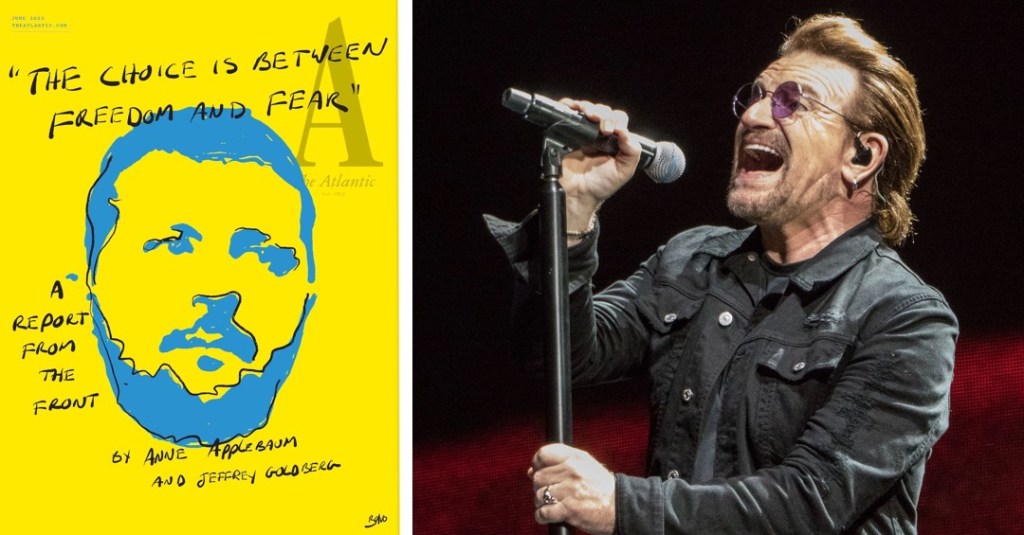
Bono Is Doing Illustrations For The Atlantic Now, Because Everything’s Fake And Stupid

By Caitlin Johnstone

Source: CaitlinJohnstone.com

So U2 singer Bono is literally just doing illustrations for the imperialist propaganda rag The Atlantic now, because that’s the sort of thing that happens in a dystopian civilization during the death throes of a globe-spanning empire.

A Washington Post article titled “Bono likes to sketch Atlantic covers, so the magazine hired him” reports that “Bono is into Atlantic cover fanfic — so much so that he was invited to illustrate the magazine’s June cover featuring Ukrainian President Volodymyr Zelensky.” 

Bono’s latest contribution to the mountain of cringe-inducing Zelensky moments we’ve been seeing for the past year provides a cover image for an article by lifelong war propagandists Anne Applebaum and Jeffrey Goldberg. The article endorses a Ukrainian offensive to recapture Crimea, which experts largely agree would be the move most likely to trigger a nuclear war in this conflict.

Here’s a paragraph from Applebaum and Goldberg’s article, just to give you a taste of the infantile “Good Guys vs Bad Guys” framing that western liberals are being fed by mass media war propagandists these days:

“Sometimes, the war is described as a battle between autocracy and democracy, or between dictatorship and freedom. In truth, the differences between the two opponents are not merely ideological, but also sociological. Ukraine’s struggle against Russia pits a heterarchy against a hierarchy. An open, networked, flexible society—one that is both stronger at the grassroots level and more deeply integrated with Washington, Brussels, and Silicon Valley than anyone realized—is fighting a very large, very corrupt, top-down state. On one side, farmers defend their land and 20‑something engineers build eyes in the sky, using tools that would be familiar to 20‑something engineers anywhere else. On the other side, commanders send waves of poorly armed conscripts to be slaughtered—just as Stalin once sent shtrafbats, penal battalions, against the Nazis—under the leadership of a dictator obsessed with ancient bones. ‘The choice,’ Zelensky told us, ‘is between freedom and fear.’”

Many westerners felt their first stirrings of youthful rebellious passions while listening to U2 songs like “Sunday Bloody Sunday” and “Pride (In the Name of Love)”, but nowadays Bono’s voice is heard saying that he has “grown very fond” of war criminal George W Bush, praising capitalism at the World Economic Forum, teaming up with warmonger Lindsey Graham to promote US empire narratives about Syria, and  singing “Stand by Ukraine” in support of US empire narratives in a Kyiv subway. And just when it looks like he can’t become any more of a tool of the empire, he gets hired by one of the world’s worst militarist smut rags to draw a cover image of Zelensky.

Because that’s just how things go in a highly controlled society where mainstream culture is designed to serve the powerful. A society where the minds of the public are continually being shaped by mass-scale psychological manipulation to ensure that they keep thinking, speaking, working, consuming and voting in ways which serve the rich and powerful. Everything that gets elevated to the top of mainstream attention facilitates this agenda (or is at least harmless to it), and as soon as it becomes potentially threatening to this agenda it is either corrected or marginalized away from mainstream attention.

This dynamic can cause some truly jaw-dropping flotsam and jetsam to surface in the roilings of our cultural waters, like Simpsons characters waving Ukrainian flags, or an opera about a drone operator sponsored by General Dynamics.

Here’s Responsible Statecraft’s Connor Echols on that last one:

This fall, DC denizens will be treated to the world premiere of “Grounded,” an opera following an Air Force ace named Jess whose unexpected pregnancy forces her to leave behind her beloved F-16 and join the “chair force.”

Throughout the show, the “hot shot” pilot wrestles with the mental impact of firing rockets from a drone in Afghanistan from a trailer in Las Vegas. “As Jess tracks terrorists by day and rocks her daughter to sleep by night, the boundary between her worlds becomes dangerously permeable,” an ad tells us.

The production is brought to you by presenting sponsor General Dynamics, one of the world’s largest weapons companies (and, wouldn’t you know it, the maker of Jess’s favorite plane). Playwright George Brant wrote the libretto, which will be brought to life by mezzo-soprano Emily D’Angelo and Tony-winning composer Jeanine Tesori.

You’ll also see things like “humanitarian intervention” champion Samantha Power enthusiastically tweeting about the collaboration between the Sesame Street franchise and the CIA cutout USAID in Iraq:

You see things like this all the time under the shadow of the US empire, and individually they don’t look like much, but once you start noticing them you come to recognize them as symptoms of the profoundly diseased civilization that we are living in. One where our heart strings are pulled in the most obnoxious ways imaginable to get us to support capitalism, empire and oligarchy, where we are manipulated into espousing values systems which benefit powerful sociopaths under the cover of noble-sounding causes. Where we are trained like rats to support systems that are driving our species toward extinction because our rulers gave lip service to humanitarianism and waved a rainbow flag.

This is what dystopia looks like. Like a bunch of thought-controlled automatons mindlessly marching toward ecocide and omnicide to a beat played out by screens who tell them every day and in every way that there is no higher purpose than this. Like military industrial complex-funded feminist rock operas about drone operators and Cookie Monster helping Samantha Power psychologically colonize Iraqi children. Like Bono coming home from singing a heartfelt number about the assassination of Martin Luther King Jr to illustrate a cover for a war propaganda piece in The Atlantic.

It’s like they’re pouring concrete over our hearts. Sewing blindfolds over our souls. Numbing us, distracting us, sedating us, so that the local riff raff won’t interfere in the workings of the imperial machine. They’re killing off something beautiful and sacred in humanity, and they’re doing it to roll out some of the ugliest visions this planet has ever seen.

THE BATTLE AGAINST BEWITCHMENT: UPSETTING SETTLED MINDS

By Gary Z McGee

Source: Waking Times

“Philosophical thinking that doesn’t do violence to one’s settled mind is no philosophical thinking at all.” ~Rebecca Goldstein

Comfort zones are a curious thing. So warm and secure. So safe and reassuring. So satisfying and certain. Beliefs have a similar effect on us. Especially the core beliefs that we take for granted. But beliefs are comfort zones with reinforced invulnerability; or, at least, the illusion of it.

Such reinforcements are like prison bars that most of us are not even aware of. We’re so completely indoctrinated, so utterly pre-programmed, that we don’t even know that we don’t know that we’ve been conditioned to blindly believe in something simply because enough people convinced us it was true.

The problem with reinforced comfort zones is that there is no growth. A regular comfort zone, you can stretch. A reinforced comfort zone, you’re usually not even aware it needs to be stretched. A regular comfort zone allows for trial and error, it allows for questioning, and so there is at least potential for self-improvement and self-overcoming. But a reinforced comfort zone does not allow for trial and error. It doesn’t allow for “blasphemous” questioning, because it is taken for granted as already perfect or “simply the way it is.”

Regular comfort zones can be healthy, giving us a safe haven, a place where we can heal and lick our wounds. But reinforced comfort zones are unnecessary safety nets based upon fear (of God, the Unknown, Death) placation, and self-pity. It’s a place where cognitive dissonance rules and any notion of attempting to think outside the box is met with: You simply need to have faith in the “box”.

The Battle Against Bewitchment:

Philosophy is a battle against the bewitchment of our intelligence by means of language.” ~Ludwig Wittgenstein

Self-Inflicted Philosophy is at the forefront of the battle against bewitchment. Self-inflicted philosophy is about upsetting settled minds. It’s about toppling the reinforced comfort zones of blind belief. It’s about flattening the “box” that everyone talks a big game about thinking outside of but when it really comes down to it, they cling to the “box” out of fear of the unknown or out of faith in what they believe they know.

Foremost, self-inflicted philosophy is about questioning the self to the nth degree through self-interrogation. But you can only get so far in such questioning before you are met with the reinforced comfort zone of a blind belief. So, self-inflicted philosophy is also about questioning the layer-upon-layer of cultural, political, and religious indoctrination that led to that reinforced comfort zone to begin with.

When you don the cloak of a self-inflicted philosopher, no belief, no matter how true it may seem, is off the hook for being questioned with ruthless skepticism and unwavering circumspection. In the battle against bewitchment, the destruction of a belief, no matter how powerful, is mere collateral damage to the Occam’s razor of universal truth. Hell, even “universal truth” is not beyond questioning.

When you don the cloak of a self-inflicted philosopher, the concept of belief is nixed from your interpretation of the universe. There is no place for belief here, only thought, only deep inquiry, only imaginative curiosity. You replace all usage of “belief” or “believe” with “thought” or “think”. You don’t believe that you certainly exist, you “think” that you “probably” exist. But you could be wrong. So you remain circumspect, for even your interpretation of your own existence could be an illusion, no matter how “true” it may feel.

There will be those who will say, “You are merely believing that you don’t believe.” But that is patently false, because you are not “believing” in non-belief, you are “thinking/inquiring/imagining” through non-belief, with the understanding, the flexibility that your thinking “could” be wrong. And that’s the rub: it is much easier to alter a thought than a belief. It is almost impossible to alter a belief. You are more likely to question a thought than you are a belief. And so, rather than get trapped in a reinforced comfort zone, you stay ahead of the curve by thinking rather than believing, and then by questioning what you think so that you don’t accidentally begin to believe it.

In the spirit of upsetting settled minds, you don’t believe in having an unsettled mind, you think that having an unsettled mind is more productive, more progressive, and more open-minded than having a settled mind (an unquestioning belief). You realize that belief in general is counterproductive, because you understand that the human mind is a delusion-generator rather than a truth-generator. It pumps out delusions like a spider pumps out webs. But, unlike the spider, it tends to get caught in them. Thereby, you understand that the only window to truth is through a questioning, circumspect, and a skeptical mindset, rather than through an unquestioning, dogmatic, and certain mindset.

The only solution to a delusion-generator is a question-generator. Luckily, the human brain is both. As a self-inflicted philosopher, you don’t believe that this is certainly true; rather, you think that this is probably true. And you’re willing to question everything to “prove” it. Indeed, you’ve transformed Descartes’ “I think therefore I am” into I think, therefore I question.

Tapping into the question-generator:

“It is far better to grasp the universe as it really is than to persist in delusion, however satisfying and reassuring.” ~Carl Sagan

The problem with the human brain is that is never knows when it has been duped by a delusion, so it is almost always better to not believe anything just in case it’s a delusion. A kind of reverse Pascal’s Wager. It’s almost always better to, as Aristotle suggested, “entertain a thought without accepting it.” Just take it all into consideration and let it pass through the sieve of probability. Then, whatever doesn’t insult your soul, think about it, dissect it, inquire about it. Be curious about it. Just don’t make the mistake of believing it.

You are more likely to grasp the universe “as it really is” by questioning it than by believing it. You don’t believe the universe is certainly a certain way; rather, you think the universe may be a certain way, but you’re willing to question further so as to get you closer to the way the universe “really is”. If you cling to a particular belief of how the universe is, then you block yourself from ever getting closer to the universe “as it really is.” Better to simply not have a belief in the first place. Better to simply think and keep the motor running on the question-generator so as to keep the delusion-generator in check.

The opposite of belief is neither disbelief nor doubt, but clarity of a thought. Without beliefs reinforcing the comfort zone, you are liberated to stretch it. You are clear enough to think outside it, you are courageous enough to question it. When the reinforcements fall away, the comfort zone becomes a sacred rather than stagnant place. It is free to grow through self-improvement rather than remain stuck in self-reassurance. Indeed, without beliefs cluttering the mindset, you’re finally able to drop the “set” and move into “mind.”

Free of the “mindset” of a settled mind, you move into the mindfulness of a questioning mind. You become a walking, talking, question-generator, able to consistently counter-balance the delusion-generator of the human condition. You’re ahead of the curve, surfing Aslam’s Infinite Circle on the surfboard of Occam’s razor. In absolute awe over the beautiful unfolding of an ultimately unknowable universe. On the edge of your own curiosity, questioning all “answers” countering all beliefs, elusive of all delusions. You’re a self-inflicted philosopher, and not even God is safe from your ruthless inquiry.

Earth’s Ultimate War: A Battle to Control the Noosphere

By Phil Butler

Source: New Eastern Outlook

You feel it, don’t you? There’s something deeply wrong with our world. And I don’t refer to the planet’s geosphere. I mean, there’s something deadly wrong with society overall, and the ways in which we interact and react. Something is coming, and many understand what it is.

“We are like people under [a] sentence of death, waiting for the date to be set. We sense that something is about to happen. We know that things cannot go on as they are. History has reached an impasse. We are now on a collision course. Something is about to give.” – Reverend Billy Graham

A few years ago, I wrote a report on NEO entitled “Vladimir Putin’s Third Way: As Seen Through the Nooscope.” The piece covered Mr. Putin’s “Third Way” of governance, and a stunning invention by his now chief of staff Anton Vaino. The invention, the Nooscope was reportedly a device capable of measuring the noosphere, or the highest stage of biospheric development, that of humankind’s rational activities. And through the measurement of humanity’s activities, along with the use of advanced artificial intelligence (AI), the Russian leadership seemed to be seeking a new order not simply of which countries have a say so, but a system that could elevate humanity to its next logical level.

At first, the western academic and journalistic communities exhibited acute curiosity mixed with tongue in cheek skepticism such as is always leveled at Russian ideas. Then, of course, a maze of misinterpretations and distractive propaganda campaigns buried Putin’s ideas, and the probability that our collective conscious and energy can be measured for good. Sure, Google, Amazon, and a hundred other entities powered by Big and Minute data operate such measurements for profit, day in and day out. But those pesky Russians using advanced thinking and algorithms to fix humanity’s woes! This kind of idea had to be branded ridiculous propaganda. But is it?

Let’s remember that it was Plato who predicted that Noocracy was humanity’s future political system. The philosopher also claimed that Democracy (“the authority of the crowd”) and other forms of governance would eventually be replaced by a system such as that Vladimir Putin has suggested. So-called “Russia experts” scoff at the noosphere as a part of Russian Cosmism. However, a Rand Corporation report in 2020 acknowledge the developing noosphere, and made recommendations for the United States to considered adapting U.S. grand strategy to the information age—noopolitik, which favors the use of “soft power”—as a successor to realpolitik, with its emphasis on “hard power.” So, the bastardization of Mr. Putin’s “Third Way” concepts by the likes of the Brookings Institute and authors Clifford G. Gaddy and Barry W. Ickes (2009),

The theories of Pierre Teilhard de Chardin and Édouard Le Roy, who were the practical co-founders of the noosphere, in the early 1900s dealt with a noosphere wrapping Earth as a progression of the teleological character of evolution. Or, for lack of a better description, a result of an overarching “goal-directed evolution.”

Another report I completed that was never published deals with what I believe Putin has been working on. His “Third Way” and nooscope experiments having been put on hold by a new Cold War these days, is for purpose, I believe. There are those in the west who would welcome a new and more successful way of governance. And, there are those who are terrified that the Nooscope/Noosphere project will put an end to their engine of power. The latter group are certainly not attempting to halt the development of the noosphere, but they are trying to ensure it is the west that harnesses it for their purposes. This is one reason you see the western tech giants “all in” to try and censor the opposing side. Anyone who disagrees with the liberal order now, is an enemy of “the state.” As evidence, consider, that NASA and Cisco are currently collaborating on something called the Planetary Skin Insitute, a cousin or competitor to the Nooscope.

Putin’s “Third Way,” what an intriguing and potentially game changing thing! After having written about Russia’s emergence for a decade now, I continually recall what a speech V.V. Putin wrote an editorial for a German newspaper concerning his much-maligned Lisbon to Vladivostok proposed unified market. The quote below is from Putin’s editorial:

“We propose the creation of a harmonious economic community stretching from Lisbon to Vladivostok. In the future, we could even consider a free trade zone or even more advanced forms of economic integration. The result would be a unified continental market with a capacity worth trillions of euros.”

This was 2010, and the notion scared the hell out of everybody at the World Economic Forum, including the janitor. It was at about this time that the hierarchy decided that Putin and Russia as the boy from Leningrad envisioned it, must go. And here we are, witnessing a proxy war with one purpose, to tear a deep crevice in between Europe and Asia. The situation is a bit like the space race back in the late 1950s and early 1960s. Washington and the old gang in London cannot have the Russians controlling this evolved human potential. If anyone is going to take advantage of this noosphere, it’s going to be the same elites who dumbed our schoolchildren down to iPhone troglodytes.

Read the chapter Getting Back on Track Through Noopolitik, in the Rand report. It’s not a recommendation for the planet, but one for the deep state that currently has a former US president on trial to keep him out of office. You see, the liberal order is already manipulating the noosphere through owned media, academia, and government. To these people the sphere of human consciousness hugging our globe needs to be seeded with the “right” ideas. They seek to transform us, to evolve earth into the same slave planet it’s always been, only more efficient. It’s evil. A modern version of the worst parts of the Bible. The Matrix movie or 1984, take your pick.

We have to stop them. Or, wait until Jesus comes back.

Being a Radical Has Led Me to Sometimes Live a Double Life

Is that a good thing?

By Mickey Z.

Source: Dissident Voice

Throughout the 2000s, you’d find me regularly riding NYC’s subways during the very early morning hours — specifically from Queens into Manhattan — to work with personal training clients in gyms. In fact, right up to the plandemic, I was still training a couple of clients in their homes.

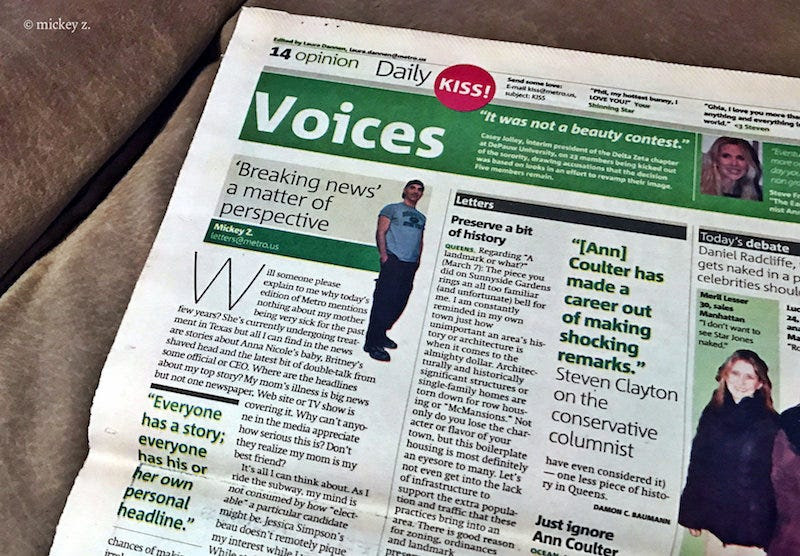
On those subway rides, I’d sometimes grab a copy of Metro — one of NYC’s free newspapers delivering a daily dose of corporate media propaganda. However, there was a brief period of time when Metro would allow some subversive voices into the mix. That included yours truly.

From about 2004 to 2007, Metro went through a phase of paying edgy freelancers so I jumped in with both feet. This even included an author photo shoot!

Thus, for a couple of years, my decidedly non-mainstream perspective — and my decidedly non-mainstream photo (wearing a “dumpster diving team” t-shirt, no less) — were on display for millions of New Yorkers to peruse during their morning ride to work or school (see image up top).

As someone who can remember when newspaper columnists held sway in my hometown, let me tell you, it was pretty cool to be jammed into a crowded subway car next to someone reading my latest article.

I’ll never know how many New Yorkers read my Metro columns. To the best of my knowledge, none of my affluent clients saw my column or photo (probably because none of them would ever ride the subway).

Over the years, I did make a select few clients aware of my double life (a couple have even bought my books and attended my talks). But, since many of them were wealthy and mainstream, I typically chose not to divulge anything about my radical writing.

As a result, I sometimes found myself making up elaborate fabrications to account for why I wouldn’t be around for a day or two when, for example, I just so happened to be heading up to MIT to lecture on US foreign policy in 2003.

Yep, this high school grad addressed a huge audience there on the topic of Henry Kissinger and the 1973 Chilean coup on a Monday night… and by Wednesday morning, was back in the gym — working with dumbbells (insert rimshot here).

Looking back now, I ponder my strategy of keeping a big part of myself a secret in the name of maintaining personal trainer income. Why was I so sure that wealthy capitalists would shun me and maybe fire me as their trainer if they encountered my radical mindset?

Perhaps a better question: What did it do to me emotionally to hide something that’s always been very important to me?

I contemplate questions like this now because, well… it’s never too late. I may not have affluent gym clients anymore. But, in Covid-era NYC, I have plenty of others around whom I could start speaking far more openly.

After all, it’s not like I can’t point to cases from the 2000s when my double life was exposed and things went well.

For example, I trained three high-powered lawyers at their high-powered law firm’s gym. This arrangement required me to check in with the doorman — or was he a concierge? (It’s funny to me that I might insult a concierge by calling him a doorman.) Anyway, doormen display one of three basic behavior patterns towards personal trainers.

The first and most common is indifference (we’re used to that). Secondly, they relate to us as fellow blue-collar common people saddled with the same fate: serving the well-heeled. Lastly, in a futile attempt to align themselves with a winner, some doormen openly look down their noses at us.

This was definitely the case at the law firm until a certain concierge saw my handsome face staring back at him from the pages of Metro.

The guy was completely flabbergasted when he read a little something of mine called “Re-Examining Rumsfeld’s Ratio” (which talked about, among other things, the United States unselfconsciously using “Apache” helicopters to quell “ethnic cleansing”).

A political junkie, the concierge now saw me as an “expert” and fell all over himself to shake my hand and introduce himself.

My new best friend could not get enough of me and it became the new norm for him to quiz me about current events before and after my training sessions.

One morning, as I was passing through the lobby, he called me over and pulled out a legal pad. Believe it or not, he had written a page or two of notes to remember all the things he wanted to ask me!

Yeah, just another tricky day in the life of a muscular militant… 

In 2001-2, I worked evenings in a corporate gym (cue the shame and self-loathing) in midtown Manhattan. One night, I was wearing a Yankees t-shirt with the name “Justice” emblazoned on the back (for former Yank David Justice).

A woman named Mary, probably in her late 60s, asked me if I was a Yankee fan. I told her my real reason for wearing the shirt was all about the word “justice.” She smiled and declared that justice was a “noble idea.”

I braced myself for the inevitable “we need to show those towel heads some justice,” (remember, this was early post-9/11 NYC) but instead, Mary told me — albeit in a stage whisper — she was soon going to DC to march against the impending US invasion of Iraq.

After this confession, Mary looked genuinely nervous. Her facial expression seemed to ask: Have I gone too far? In my best French Resistance voice, I reassured her: “Don’t worry, I’m with you.”

After that, we’d talk each and every time she’d come to work out. The corporation eventually phased out its gym facility but just before my last day, I saw Mary and complimented her on how hard she’d been training.

She leaned close to me and whispered: “When the revolution comes, I’ll be ready.”

As for me, my next revolution is to be even more open and transparent about my “controversial” stances. No more hiding.

After all, “a truthful witness saves lives.”

Steiner and the Blood Demons

Blood Demons original title artwork by Michael Cox – see his art on Instagram here

By Jason Happenstall

Source: Beyond the Wasteland

Is the human race under spiritual attack? And did the esoteric philosopher and clairvoyant Rudolf Steiner warn about it over a century ago when he said a ‘vaccine’ would be the delivery system for the defeat of humanity?

For many, the overly-authoritarian response by governments worldwide to Covid-19 pointed to some deeper, more sinister, driving force. But it hasn’t just been the governments that seemed to be acting strange. Over the last two years we’ve witnessed people across a broad spectrum of society meekly submit to draconian attacks on their freedoms, many even fiercely defending the assault. In the same way, we’ve seen politicians and parties who once ran on platforms of personal freedom and economic autonomy almost overnight turn into overbearing control freaks, intent on micromanaging every aspect of our lives. How has this happened?

Recently, the term ‘mass formation psychosis’ has been on everybody’s lips. It’s defined as a psychological phenomenon whereby a mass of people voluntarily go through a process of deindividuation and a herd mentality forms. Due to their contagious nature, the thoughtforms affecting these deindividuated people, catalysed by the positive feedback loops of news programmes, social media and peer interaction, spread like wildfire throughout the population. In the past, this used to be called mob psychology, or more plainly, the madness of crowds.

Psychology: from Science to the Occult

Someone for whom the events of the past couple of years would not have been so surprising was the Austrian esoteric philosopher and mystic Rudolf Steiner, who died almost a century ago. Throughout the course of his life Steiner wrote numerous books and delivered thousands of lectures on his theories, contributing greatly to diverse spheres from architecture to education, and agriculture to beekeeping. His highly unique – and sometimes controversial – insights and methods led to the founding of the spiritual movement known as Anthroposophy, which emphasises the existence of a boundless potential for human beings.

Unlike some esoteric thinkers, Steiner saw the great importance of materialistic science, but argued that it was vital to see it as only a single aspect of reality which should ideally be combined with what he called ‘spiritual science’ – gained by mystical experience – in order to present the full picture. After all, breakthroughs often occur when scientists receive insights from beyond the material realm, as in the famous case of James Watson, credited with the discovery of the double helix shape of DNA which came to him in a dream featuring two intertwined serpents. Similarly, Dmitri Mendeleev, created the period table after a dream of “… a table where all the elements fell into place as required.” These cases go to show that not all scientific discoveries are the result of logical deduction and experimentation.

In fact, Steiner, who had been on the receiving end of mystical insights since childhood, honed his clairvoyant skills to such an extent that the information he received from non-conventional sources became more than the occasional flash of insight, His quest became the establishment of methods for obtaining objective extrasensory perception – a task he considered of paramount importance for he believed an epic battle was being fought in the spiritual realm that would have disastrous consequences for humankind unless it was addressed head-on.

Spirits of Darkness

His clearest warnings about the future fate of humanity came in a series of lectures delivered towards the end of his life in Dornach, Switzerland; these lectures are reproduced in the book The Fall of the Spirits of Darkness. Although Steiner’s detractors say his prose can be leaden, his lectures meandering, and his concepts difficult to grasp, he is remarkably clear and straightforward when it comes to the fate that awaits humanity if our obsession with scientific materialism is allowed to reign free without being pulled back into balance by the counterbalancing forces of spirituality.

This is most clearly illustrated in the final two lectures in the series – 13 and 14 – which are respectively titled The Fallen Spirits’ Influence in the World and Into the Future. Steiner posits that an unseen battle took place in the early 19th century which certain ‘spirits of darkness’ lost. These spirits were duly ejected from their heavenly realms and cast down into a more material plane of existence i.e. here. He is remarkably precise about when this occurred: autumn 1879.

These newly arrived spirits joined those who were already here – the ones that have been existing alongside and influencing humanity since the mythological times associated with the Fall. Given that it takes time for these malign spirits to work their way through human societies, it wasn’t until 1914 when their malign influence manifested in human society in the form of the First World War – a disastrous event the cause of which still puzzles secular historians.

Lucifer and Ahriman – the Leaders of the Pack

The spirits Ahriman and Lucifer have been hacking humanity for thousands of years, says Steiner, with Lucifer being the ‘light bringer’ intent on making us more spiritual and granting us more free will, and Ahriman doing the opposite and making us more materialistic and easier to control. In simplistic terms, Lucifer is an ascending influence, which Ahriman is a descending one.

Why should they want to do this? Well, we just don’t know – it’s difficult for our human minds to figure out what makes angels and demons tick. But whenever there’s one of those periodic battles in the spirit world, Steiner said, it tends to result in a new batch of reinforcements being thrown down into the material realm to join forces with those already here.

Steiner told us that Ahriman – a demon first identified by the Zoroastrians in ancient Persia – has the upper hand right now. He had a personal beef with Ahriman and had seen his face in vision – in fact he was still carving a likeness of it out of wood at the time of his death. Ahriman’s main aim seems to be to drag humankind into a purely materialistic state devoid of any form of spirituality, removing even the impulse to connect with our souls. The method of attack would be through science and technology, and by taking possession of the minds of powerful and influential people in order to push through this agenda. These controlled people could be scientists, politicians, religious leaders, or anyone with any influence. Thus, demonic forces would work through these people, and the people themselves, blinded by all-too-human failings such as greed or a lust for power, would lack the basic awareness to recognise what was occurring.

A New Religion for a New Age

The background to this power grab was the rise of atheism and the worship of science and progress. Now, we have a situation in which a purely materialist perspective is presented as the only explanation for all creation. Atheism has, for some, become a de facto religion, while the rich traditions of native spirituality have been side-lined and crushed under its heel. People, animals and in fact all life is regarded in the same cold manner; merely receptacles of proteins and genetic code that can be exploited. The endgame of this play is presented as a bleak, monochrome world expunged of spirit and light, where humans – their minds and spirits broken – are herded together and monitored like lab animals.

We can see how this scenario is being expedited. The CEOs of tech corporations are viewed almost as saints or Bodhisattvas, dangling the carrot of eternal life in the form of uploading the ‘data’ contained within our brains onto microchips. At the same time, politicians, corporate scientists, civil servants and economists are regarded as technocratic engineers tasked with ensuring the smooth functioning of the juggernaut of the material economy. Free will? The implicit assumption is that this will be unnecessary once the AI powered algorithms – which know us better than we do – reach escape velocity. At this stage, human life would have no intrinsic value, and the shells of our former selves would be occupied by the demonic army that Steiner warned us was waiting for its moment.

In the Blood

Some people say that Rudolf Steiner predicted a vaccine would appear which would be the delivery system for the final defeat of humankind. In light of the clandestine efforts made over the last two years to inject almost everybody on the planet with a gene editing treatment, his prescience seems remarkable – but how true is it? Amazingly, Steiner was remarkably clear (by his own standards) about the physical process by which this takeover would occur. He states in his final lecture in The Fall of the Spirits of Darkness that the spiritual world where entities such as angels, demons and archangels dwell is within the human blood. He meant this quite literally, saying:

“Both the Archangels and the Angels had their dwelling place in the blood, as it were. Truly, the blood is not something merely for chemists to analyse; it is also the dwelling place of entities from higher worlds.”

To that end, he speculated that the delivery mechanism will be in the form of a vaccine, injected directly into our bodies.

“Today [in 1917] bodies are vaccinated against one thing and another; in future, children will be vaccinated with a substance which it will certainly be possible to produce, and this will make them immune so that they do not develop foolish inclinations connected with spiritual life – ‘foolish’ here, of course, in the eyes of the materialists.”

This ‘vaccine’, he goes on to say, would block off any communication from the spirit world, meaning no messages or impulses would be able to get through from the ‘spirits of light’ whose aim is always to help humanity progress and fulfil our destiny. Positive impulses which were once transmitted to us would be permanently locked out by the vaccine, and instead the hapless victims would only be able to receive the impulses coming to them from disruptive sources, which we can imagine today might include the media, the education system and even established religion. There would be great confusion, he says, and Ahrimanic forces will turn people’s thoughts upside down and inside out. Everything that once was good and sensible will appear evil and crazy, while everything that was once considered insane and evil will be presented as sensible and good.

Squid Games: From Wetiko to The Matrix

Does this all sound implausible, the ramblings of a long-dead mystic? Many will no doubt say that it does, and that there are more earthly and plausible explanations for the psychic epidemic which has gripped the world. Perhaps Steiner was speaking metaphorically after all, some may reason. Nevertheless, the phenomenon to which Steiner alluded bears striking similarities to the Native American concept of the demonic force they call wetiko. The author Paul Levy has written extensively about this, defining it as “a contagious psychospiritual disease of the soul, a parasite of the mind that is currently being acted out en masse on the world stage via a collective psychosis of titanic proportions.”

Listening to a recent Legalise Freedom podcast entitled Covid-19: War on Humanity, Emma Farrell, a plant healer who uses shamanic techniques to access inner realms, made the observation that she and others in the same field had seen a veritable horde of spiritual parasitic entities attached to people over the last two years – as if a floodgate had been opened and they had poured through it. These entities, she says, come in all shapes and sizes but there are two very common and recognisable ones, one of which is squid-like. These squid-like beings, she says, attach themselves to unprotected people and harvest their spiritual energy by causing division and discord among us.

This struck me as interesting as we’ve seen this squid archetype move into human consciousness over the past few years, not least becoming apparent through popular culture. Many people have reported having dreams of octopus or squid-like creatures, and artists such as Peter Yankowski have painted pictures of these visions. Indeed, the villainous machines that control humans and harvest their energies in the Matrix movies look like robotic squids, while one of the top Netflix series of 2021 was Squid Game, a grim and violent survival thriller that posits human nature as intrinsically barbaric. What’s more, the resurgence in popularity of H.P. Lovecraft’s supernatural tales of horrors from the deep adds another tentacled layer to this rugose cake.

And let’s not forget when Goldman Sachs, one of the world’s largest investment banks, was memorable described by Rolling Stone journalist Matta Taibbi as a “great vampire squid wrapped around the face of humanity, relentlessly jamming its blood funnel into anything that smells like money.” The description is apt, after all, what is the purpose of an investment bank other than to turn every aspect of the sacred world into a monetised asset that can be traded, exploited and leveraged?

The Path Back to Sanity

Could this manifestation of a squid/octopus archetype into human consciousness be what Steiner was warning us about? Are there really spiritual entities within our blood that could account for billionaire technocrats’ obsession with injecting substances into us that are said to contain nanoparticles we know very little about? And how does this sit with the psychospiritual disease of wetiko outlined by Paul Levy, and the concept of ‘mass formation psychosis’ being talked about in the alternative media?

Perhaps the truth lies somewhere in the nexus of these concepts, with the implicit suggestion that we should not rest in our deep enquiry into the manner of the affliction that is currently so prevalent across the world. Only by doing so can we hope to find the necessary tools and weapons to fight back against it.

Or maybe the Ahrimanic demons that Steiner warned us about, the wetiko mind parasites Paul Levy writes of, and the tentacled entities that have squirmed into our collective consciousness via popular culture are all playing on the same team. If so, what does our team look like? And how do we win this game? Perhaps the fight is a necessary one at this juncture in human development, and that by defeating these ‘spirits of darkness’ we can progress to a higher level.

Whatever the case, referring back to the old adage alluded to earlier, people it’s said, might go mad in crowds, but the path back to sanity happens one person at a time.

Saturday Matinee: Enter the Void

Enter the Void and the Inhuman Condition

By Matt Cipolla

Source: RogerEbert.com

“I know it is coming, and I do not fear it, because I believe there is nothing on the other side of death to fear … I was perfectly content before I was born, and I think of death as the same state.” — Roger Ebert

Inaccessible as mortality itself and as jolting as a bullet to the back, Gaspar Noé’s “Enter the Void,” which made its Cannes debut ten years ago this month, is a science fiction movie, but it isn’t worried about what exists outside our world. It isn’t concerned with aliens or spaceships. It’s about what we’re all obsessed with—pretending to live, refusing to die, and latching onto any ersatz empathy just for the sake of hope. It isn’t an optimistic film in its depiction of the afterlife, but that’s entirely the point—and that’s what makes it sort of beautiful.

Writer/director Gaspar Noé has been a staple of the New French Extremity movement since the turn of the millennium. His debut feature, “I Stand Alone” (1998), was a cauldron of rage centered on a man so seething the audience had to strain to see his humanity. “Irreversible” (2002) existed in the same narrative universe but was thematically adjacent more than anything else. They were neck-deep in social nihilism, drowning in the worst of human nature. But while they were each an hour-and-a-half of vitriol, “Enter the Void” acts as the answer to that: a nearly three-hour dissociation of living, dying, and repeating, all from an atheistic view.

Noé has regularly disagreed with the concept of a higher power and life after death. This isn’t too surprising given how antitheist his films are, and while “Enter the Void” is much more spiritual than his other films, it’s also much more accepting of death. That may sound depressing in theory, but Noé is so comfortable in his beliefs that there’s little room for depression. Here, death is not sad. It’s nothing to fear, or hate, or cry about. It simply is.

“Death is an extraordinary experience,” Noé told the Irish Times. “I believe that. No one can really tell you what it is like because once you’ve experienced death, you are done. But it only happens just once in your life. By its nature it is extraordinary. If you are suffering or in pain, death is the best thing that can happen. I’m annoyed by a culture in which death is always considered something bad.”

“Enter the Void” revels in death right away by treating it like a breath of fresh air in a world hogtied by plastic. First, the film dives into its opening credits, an assault of flashing words and staccato techno music. It’s hypnotic, sure, but it also feels like a game of chicken between the viewer and a case of epilepsy. Just as we adjust to the anarchy, it dies. Cut to black.

Now we’re in a first-person point of view. We are Oscar (Nathaniel Brown), an American drug dealer and addict living in Tokyo. We talk with our sister Linda (Paz de la Huerta) on a balcony overlooking a world of neon and, after she leaves, smoke some DMT. Then a phone call interrupts the trip: it’s Victor (Olly Alexander), an acquaintance asking for some more drugs. But he can’t pick them up, so we need to bring them to him.

We oblige just as there’s a knock on the door—is it the police? No, it’s just Alex (Cyril Roy), a friend who’s lent us his copy of The Tibetan Book of the Dead. We head over to Victor and discuss the afterlife and reincarnation, and despite being in one of the most populous cities in the world, it never feels like we’re in more than a bubble. We’re itching to pop out of it.

We part ways with Alex and eventually find Victor in a bar. He’s crying. “I’m so sorry,” he says—and then the police swarm in. We run into the bathroom, try to flush the drugs, and pop!—the police shoot us through the door. We keel over. We die. Slowly, oh so slowly. And as we finally leave our body, we take the perspective of our spirit as it floats around the city, reliving our past memories and seeing our death’s aftermath. The first-person perspective becomes third person when replaying memories, and an over-the-shoulder framing motif carries an uncanny degree of separation from our own body. It’s a piggyback ride with our eyes on our back, right by the angel wings that never come to be.

Over the course of the journey, we remember that Linda’s and our parents died in a car crash while we were small kids. Foster care put her in a different home and, in accordance with a childhood pact we made to never leave each other, we started selling drugs to help Linda to move to Tokyo. But we got more and more into drugs. We needed more and more until more was never enough. Just maybe if we can find a second life, we can get just that: more.

Noé may find death to be happy if anything, but that’s something Oscar can’t bring himself to believe. His fatal flaw is what keeps him from passing on.

Truthfully, “Enter the Void”’s climax is Oscar’s death, only 25 minutes into the 161-minute film. It would be the inciting incident in most films, but here it caps off the part that’s grounded to reality. The film then dives into science fiction and becomes unstuck in time for its remaining 136 minutes, and as our protagonist searches for reincarnation, Noé approaches his arc with the detachment often seen in the sci-fi work of Tarkovsky and Kubrick. The idea of living, dying, and repeating until breaking the cycle is fundamentally spiritual (and specifically Buddhist), but it’s also a genre staple. From “2001: A Space Odyssey” to “Solaris” to “Under the Skin,” the concept is divorced from theism. It’s a form of atheistic spiritualism that Noé treats as sci-fi, like a drug-fueled melodrama as told by “2001”’s star child. 

In a September 2010 interview with Den of Geek, Noé said that he partly based the film’s premise on a theory that our brains contain limited amounts of DMT, which are unleashed during death. This was later echoed in a September 2018 article from the BBC that documented the reported similarities between DMT trips and near-death experiences. Combined with the languid pacing and psychedelic aesthetics, “Enter the Void”’s internalized sense of humanity feels just as elusive as the unknown encounters of “2001” or the personified dreams of “Solaris.”

As we do stumble out of the film, it ends with a rebirth. Could it be Oscar’s eventual reincarnation or could it just be a stoner’s dream that he had while dying? Was he trying to assign some sort of meaning to his life or was it actually there? If there was no latent purpose, is it better or worse for his life to reset? What if there is a latent purpose? Would the real damnation be an end to all emotions and the end of all life?

Whether Oscar’s life had meaning doesn’t matter because he couldn’t give himself to the possibility of it not. In the world of “Enter the Void,” it’s as good to cease to exist than it is to live and suffer.

____________________

Watch Enter the Void on tubi here: https://tubitv.com/movies/100000089/enter-the-void?start=true&tracking=google-feed&utm_source=google-feed

How Does Degrowth Apply to Our Minds?

By Erin Remblance

Source: resilience

As an Australian, it troubles me that if the whole world lived like us, we would need 4.5 planet Earths. Thanks to over-consuming nations like mine, worldwide we are living as if we have 1.75 planet Earths, a figure that has increased from 1 (that is, living within our means) since 1970. What this boils down to is that those of us in the global north are taking from both countries in the global south and future generations to fuel our lifestyles today. The ‘Earth Overshoot’ research is supported by the work of the late Earth System Scientist, Professor Will Steffen, who brought to our attention The Great Acceleration, whereby “[a]fter 1950 we can see that major Earth System changes became directly linked to changes largely related to the global economic system.” Steffen is referring to our growth-based economies, and while three percent economic growth each year might sound small, it means that within 24 years we will be consuming twice as many resources as today, and within 100 years 19 times as many. As economist Kenneth Boulding said: “[a]nyone who believes that exponential growth can go on forever in a finite world is either a madman or an economist.”

For this reason, I am a big proponent of degrowth in over-consuming nations in order to fit back within planetary boundaries. For anyone not familiar with the term, degrowth is a planned, democratic reduction in material and energy use in high-income nations while improving the well-being of people in those nations. It is more than this though. While very often the focus of degrowth is on how life can be better in a smaller economy, Federico Demaria and Serge Latouche argue that “[t]he point of degrowth is to escape from a society that is absorbed by the fetishism of growth…. It implies decolonization of the imaginary and the implementation of other possible worlds”. In this respect, the former definition of degrowth applies only to over-consuming nations, while the latter definition applies to all nations, and to all people. It is this second definition of degrowth to which this essay relates.

The concept of degrowth is powerful because it is clear that we need systemic change to avoid ecological collapse: business as usual with a “green tinge” isn’t going to be enough. It is also true that individual change drives cultural change which can be the key to unlocking political change leading to fundamental change. On this point, I find it fascinating to consider how “growth has entered our minds and souls”, and how an awareness of these “mental infrastructures of growth” might free us from growthism and help unlock the cultural changes that will bring about the necessary systemic changes.

With this in mind, here are a couple of points to consider in relation to how growth may be enshrined in the psychological structure of our collective minds, largely based on the work of Harald Welzer:

  • Our dreams for the future are centred around it being better than today, in the sense of ‘more’ (e.g., a bigger house, a larger salary, more travel).
  • We see ourselves as something to continually develop and optimise, our lives are seen as a process of creating biographies or filling curriculum vitae.
  • While we used to see paid labour as drudgery and something we did until we had met our needs, now we view it as noble, esteemed even, to be sought out and with no end. Sadly, this cultural 180° turnaround becomes a regret of many as they are dying.
  • Similarly, society views ‘hard-work’ as virtuous and thus ‘hard-work’ entitles those who undertake it to whatever their heart desires without limit or consideration of the harm caused, their purchases being the fruits of their labour.
  • We typically live by the rhythms of the industrial workday via a standardised worldwide time regime, unaware that there is a natural rhythm of time (for example, consider that in 2023 there will be 13 moons but only 12 calendar months or that, on the whole, our pace of work is unchanged by the seasons).
  • It is a collective belief that we should be able to own parcels of land, excluding others from that land. An example of this is that home (and correspondingly land) ownership in Australia is described as the ‘Great Australian Dream’, a term derived from the ‘American Dream’ of the same nature.

In various ways, these – and probably many more aspects of our modern day lives – relate back to the surpluses created by industrialisation (enabling the future to have more than today, a concept that is “historically quite recent”), the enclosure of the commons (the very foundation of growth-dependent capitalism) and the subsequent imperative to work to have our needs met (rather than simply being able to directly meet our needs). Our ability to recognise and unpick these ‘mental infrastructures’ – that is, the worldview that influences all of our actions – will be key to throwing off the shackles of growth and unlocking a culture of sufficiency, whereby we recognise when we have ‘enough’ in a material sense and from then on meet our “nonmaterial needs nonmaterially”, increasing our sense of wellbeing and contentment.

The work of Antonio Gramsci on cultural hegemony is relevant in unlocking a culture of sufficiency. Michael Mezz describes Gramsci’s theory on how the ruling class maintains power via a cultural form of dominance:

“…the ruling class creates an ideology in which its own values become common sense for the rest of society and Gramsci argued that the role of the state is to maintain institutions such as media and the education system that educate the masses on the cultural ideology of the ruling class. The goal of that education being that the working class develop a sense of freedom and a good life that serves the purposes of the people in power. In other words, the working class starts to value things like innovation and productivity and economic growth that doesn’t actually serve them.”

Gramsci tells us that the way to overcome cultural hegemony is by creating a new culture that is not based on the values of the ruling class. A counter-culture, if you like.

So, what are the counter-hegemonic narratives that we can begin to embrace? What would a mind and soul not infiltrated by growth look like? There is much to learn from indigenous cultures on this topic. As Jeff Sparrow highlights in his book, Crimes Against Nature, First Nation Australians found paid labour to be antithetical to their egalitarian lifestyles:

“Today, we take the wages system for granted. It appears normal, almost eternal, since we can barely conceive of an alternative. It did not seem normal to pre-colonial people. In Australia, as elsewhere in the world, they found capitalist practices utterly horrifying…. Indigenous people, accustomed to an egalitarian ethos and to work carried out for the collective good, saw the authority exerted by employers as tyranny. As late as 1888, a churchman complained of the difficulty he had in persuading Indigenous people that one man was innately better than another, that a certain individual, by virtue of his possessions, mandated obedience from his fellows…. Indigenous people did not despise wage labour primarily because of the effort that it entailed. Rather, they thought the work demanded by capitalists stripped life of its humanity.”

Furthermore, First Nations people lived with the rhythms of nature, not the industrial workday, and there was no private land ownership, they had the wisdom to know that “… you are undone if you once forget that the fruits of the earth belong to us all, and the earth itself to nobody” (Jean-Jacques Rousseau).

There are many examples of counter-hegemonic narratives arising more recently too. The following list is skewed more towards examples from the global North because the global North represents the vast majority of the over-consumption and is therefore where cultural change is most needed. Such examples include:

  • Those people, like the Futuresteaders and others who practice voluntary simplicity and frugal abundance, who appreciate the simple things in life, and find happiness in what they have rather than what they want. Seeking only ‘enough’ and not ‘more’ represents an affront to the dominant culture of dreams of the future being materially greater than today. This point is relevant only to those whose needs are already met. Of course, those who are living in conditions of deprivation should have access to ‘more’, until they too have ‘enough’.
  • People who choose to spend their time doing work that is traditionally undervalued and lacking in both career trajectory and pay increases, but is socially valuable, forgoing future surpluses (think of the stay-at-home parents, childcare workers, teachers, nurses, carers, small farmers, those who work part-time voluntarily, and those who volunteer their time to worthy but under-funded causes).
  • The move towards minimalism which seeks to value time and non-material items over ‘the grind’ and the accumulation of things as a reward for hard work. The Tiny House Movement shows us that it is possible to enjoy living with less, including the freedom of a smaller mortgage.
  • The tang ping (lying flat) movement in China and quiet quitting in the U.S.A. are taking back our right to be humans, not simply workers who devote more time than they would like to paid labour.
  • Anyone advocating for job guarantees, enabling anyone who wants to work to do so. Job guarantees seek to remove the artificial scarcity of employment we see today, where the threat of joblessness looms ever large and we constantly need to better ourselves so that we can compete for work. Those who advocate for a Universal Basic Income – an unconditional liveable wage for all – are fighting to remove the need for waged employment at all.
  • People organising for the community rather than the individual are prioritising others over their own interests, giving up the opportunity to build their own CVs in favour of the greater good, and there are some wonderful examples of such union building herehere and here.
  • The move towards a 4-day work week challenges the dominant narrative that more time at work is better.
  • The Nap Ministry and the related manifesto Rest Is Resistance empowers us to value rest over productivity.
  • The many activists calling out the harm caused by the carbon-intensive lifestyles revered by the dominant culture, such as Greta Thunberg (who beautifully articulated in her book, The Climate Book, that “we all have a responsibility to find quick ways of making that [extremely high-emitting] lifestyle socially unacceptable”), activists who block private jets, people promoting going flight free, and those seeking to reduce the dominance of cars on our streets. For these people, simply having the means to live a materially intensive lifestyle – regardless of the hard work involved in acquiring those means – isn’t enough to justify the harm it causes.
  • The locals of the Greek Island Ikaria, who do things in their own time, not that of the industrial workday. This fascinating paper describes “people arriving to appointments in ‘Ikarian time’, that is, a ‘few hours late’ or shopkeepers telling bewildered tourists that ‘the shop will open when it is time to open’”.
  • Co-operative housingcommunity land trusts and Vienna’s enviable form of social housing show us that there are other ways of providing a community’s housing and land needs that don’t rely on private ownership.

There are, of course, many other wonderful counter-culture examples beyond this short list – this is merely scratching the surface – but the point is that we need to advance these, and those of the same theme, until they become the leading narrative.

Unpicking the dominant, growth-based worldview will mean closely analysing the stories we have been told (and who those stories might serve), and bravely and courageously assessing whether all of this growth really does bring us ‘the good life’. We will likely find that we can achieve ‘a good life’ (that is, harmony with ourselves, our community, and the physical world) by living simpler but more meaningful lives. Perhaps we will even come to realise the very wise words of English writer, Alan Watts: “the meaning of life is just to be alive. It is so plain and so obvious and so simple. And yet, everybody rushes around in a great panic as if it were necessary to achieve something beyond themselves”. The way that growth manifests in our minds, our thoughts, our dreams, and our souls is important to consider because if we can create a culture of sufficiency, we will have found the key to systemic change and avoiding ecological catastrophe. I’m sure we can all agree that this is a worthy task indeed.