“The One Big Union,” they called it, an organization that would represent every worker laboring for “The Man.” Unlike the “skilled labor” guilds of the earlier American Federation of Labor, it would take in everyone, including the the extreme exertion “unskilled” jobs — farm labor, lumberjacks, longshoremen and miners. It would be a union whose work actions and strikes were meant to not just exercise some control over their work days, their wages and their safety It would struggle to gain outright ownership of the industries where the workers toiled.
The One Big Union would rattle “ownership” in America’s rapacious “gilded age” and threaten capitalism itself if it succeeded.
“The Wobblies” is a classic labor documentary from 1979, a film that gets back to the core meaning of the film genre — “to document,” to have history recounted by those who actually lived it. Filmmakers Deborah Shaffer and Stewart Bird interviewed the dying out members and eyewitnesses to the actions and struggles of the Industrial Workers of the World, “The Wobblies,” and let these old men and women speak of the idealism, desperation and determination that drove America’s most radical labor movement, which came to life in 1905 and then disappeared, after 20 years of strife, scapegoating and bloody attacks from America’s defenders of the status quo.
The newly-restored film is a reminder of the varied styles and formats of documentaries before PBS an Ken Burns codified and formalized these films into academics and “experts” and actors reading letters or performing speeches of the figures represented.
What that looks and sounds like is a tapestry of testimonials, on and off camera, recreating an era of child labor and the murderously callous reign of America’s first oligarchs — Rockefeller and Ford, Carnegie and J.P. Morgan.
“I can hire one half of the working class to kill the other half,” financier Jay Gould sneered.
And so he could. In an era where workplace safety was deemed an unnecessary bother, when giant lumber companies could strip America’s forests with a remote workforce they could underfeed and house under deplorable conditions, when mining disasters were a simple “cost of doing business” worth no one’s attention, when hired cops and militia could be relied on to mow down longshoremen striking for an eight hour day, capitalists and capitalism were literally killing much of America, and getting anybody to care was a near impossible struggle.
“The Wobblies” uses archival silent films, still photographs, posters and performed recitations to recreate the labor ferment that boiled over from the late 1800s into the early 20th century. Interviews then hammer home what the Wobblies — their nickname may have come from Asian workers’ inability to say “I.W.W.” — represented, an impatience with the pace of reform and change.
“Work, good wages and respect” was their credo, witnesses recount.
“Free speech” battles erupted as the right to organize and protest was assaulted from Minot, North Dakota and Butte, Montana to Everett, Washington and Lawrence, Massachusetts, site of an early Wobbly unionizing success.
A hostile press and a political system bent towards the whims of the celebrated robber barons, who would quickly call for and receive lethal assistance in attacking and imprisoning labor organizers and shooting strikers was what the Wobblies were up against.
“Shakedowns” from railroaders hired to transport farm workers and lumbermen from site to work site via boxcar were common, abuse on the job and across industries was common. The Wobblies vowed that they wouldn’t just take a punch waiting for a passive public and blind-eyed government to act. They’d punch back.
The lack of experts interviewed here leaves the film with an implicit, sympathetic bias, but also deprives it of academically underscored proof of the context all this struggle took place in. World War I and the first “Red Scare,” the birth of the Soviet Union,” took place just as as the Wobblies were on the rise. A refusal to condemn or support the war, or to call off strikes during the conflict, added to heated pushback, attacks and image tarring by the press and government.
The “bomb throwers” label slapped on every labor movement since the Haymarket Square Riot was unjustly attached to the Wobblies from their birth and on into the age of animated film.
Clips from Ford-sponsored silent cinema cartoons depicting IWW organizers as rats and even an early Walt Disney (he hated unions) effort, “Alice’s Egg Plant” remind us how quick conservatives were to tie labor to the brand new boogeyman — communism — and smear workers’ rights organizations with that.
“The Wobblies” is a bracing, enthusiastic film, with many an old Wobbly recalling mottos, chants and even songs.
One remembrance ends with words he recalled his sympathetic father passing on to him. A worthy cause with worthy goals, the old Wobbly remembers his old man saying. “But it’s just a dream. It’ll never happen.”
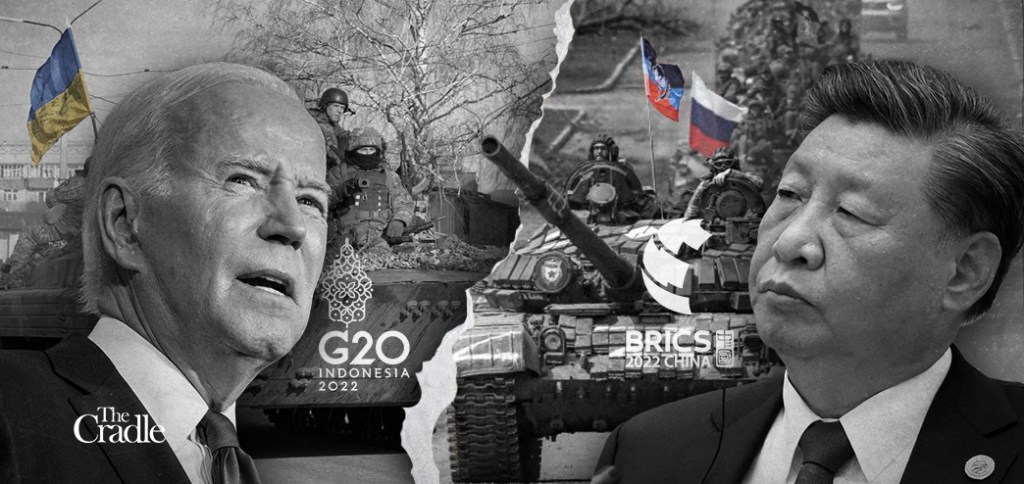
The redeeming quality of a tense G20 held in Bali – otherwise managed by laudable Indonesian graciousness – was to sharply define which way the geopolitical winds are blowing.
That was encapsulated in the Summit’s two highlights: the much anticipated China-US presidential meeting – representing the most important bilateral relationship of the 21st century – and the final G20 statement.
The 3-hour, 30-minute-long face-to-face meeting between Chinese President Xi Jinping and his US counterpart Joe Biden – requested by the White House – took place at the Chinese delegation’s residence in Bali, and not at the G20 venue at the luxury Apurva Kempinski in Nusa Dua.
The Chinese Ministry of Foreign Affairs concisely outlined what really mattered. Specifically, Xi told Biden that Taiwan independence is simply out of the question. Xi also expressed hope that NATO, the EU, and the US will engage in “comprehensive dialogue” with Russia. Instead of confrontation, the Chinese president chose to highlight the layers of common interest and cooperation.
Biden, according to the Chinese, made several points. The US does not seek a New Cold War; does not support “Taiwan independence;” does not support “two Chinas” or “one China, one Taiwan”; does not seek “decoupling” from China; and does not want to contain Beijing.
However, the recent record shows Xi has few reasons to take Biden at face value.
The final G20 statement was an even fuzzier matter: the result of arduous compromise.
As much as the G20 is self-described as “the premier forum for global economic cooperation,” engaged to “address the world’s major economic challenges,” the G7 inside the G20 in Bali had the summit de facto hijacked by war. “War” gets almost double the number of mentions in the statement compared to “food” after all.
The collective west, including the Japanese vassal state, was bent on including the war in Ukraine and its “economic impacts” – especially the food and energy crisis – in the statement. Yet without offering even a shade of context, related to NATO expansion. What mattered was to blame Russia – for everything.
The Global South effect
It was up to this year’s G20 host Indonesia – and the next host, India – to exercise trademark Asian politeness and consensus building. Jakarta and New Delhi worked extremely hard to find wording that would be acceptable to both Moscow and Beijing. Call it the Global South effect.
Still, China wanted changes in the wording. This was opposed by western states, while Russia did not review the last-minute wording because Foreign Minister Sergey Lavrov had already departed.
On point 3 out of 52, the statement “expresses its deepest regret over the aggression of the Russian Federation against Ukraine and demands the complete and unconditional withdrawal of armed forces from the territory of Ukraine.”
“Russian aggression” is the standard NATO mantra – not shared by virtually the whole Global South.
The statement draws a direct correlation between the war and a non-contextualized “aggravation of pressing problems in the global economy – slowing economic growth, rising inflation, disruption of supply chains, worsening energy, and food security, increased risks to financial stability.”
As for this passage, it could not be more self-evident: “The use or threat of use of nuclear weapons is inadmissible. The peaceful resolution of conflicts, efforts to address crises, as well as diplomacy and dialogue, are vital. Today’s era must not be of war.”
This is ironic given that NATO and its public relations department, the EU, “represented” by the unelected eurocrats of the European Commission, don’t do “diplomacy and dialogue.”
Fixated with war
Instead the US, which controls NATO, has been weaponizing Ukraine, since March, by a whopping $91.3 billion, including the latest presidential request, this month, of $37.7 billion. That happens to be 33 percent more than Russia’s total (italics mine) military spending for 2022.
Extra evidence of the Bali Summit being hijacked by “war” was provided by the emergency meeting, called by the US, to debate what ended up being a Ukrainian S-300 missile falling on a Polish farm, and not the start of WWIII like some tabloids hysterically suggested.
Tellingly, there was absolutely no one from the Global South in the meeting – the sole Asian nation being the Japanese vassal, part of the G7.
Compounding the picture, we had the sinister Davos master Klaus Schwab once again impersonating a Bond villain at the B20 business forum, selling his Great Reset agenda of “rebuilding the world” through pandemics, famines, climate change, cyber attacks, and – of course – wars.
As if this was not ominous enough, Davos and its World Economic Forum are now ordering Africa – completely excluded from the G20 – to pay $2.8 trillion to “meet its obligations” under the Paris Agreement to minimize greenhouse gas emissions.
The demise of the G20 as we know it
The serious fracture between Global North and Global South, so evident in Bali, had already been suggested in Phnom Penh, as Cambodia hosted the East Asia Summit this past weekend.
The 10 members of ASEAN had made it very clear they remain unwilling to follow the US and the G7 in their collective demonization of Russia and in many aspects China.
The Southeast Asians are also not exactly excited by the US-concocted IPEF (Indo-Pacific Economic Framework), which will be irrelevant in terms of slowing down China’s extensive trade and connectivity across Southeast Asia.
And it gets worse. The self-described “leader of the free world” is shunning the extremely important APEC (Asia-Pacific Economic Cooperation) summit in Bangkok at the end of this week.
For very sensitive and sophisticated Asian cultures, this is seen as an affront. APEC, established way back in 1990s to promote trade across the Pacific Rim, is about serious Asia-Pacific business, not Americanized “Indo-Pacific” militarization.
The snub follows Biden’s latest blunder when he erroneously addressed Cambodia’s Hun Sen as “prime minister of Colombia” at the summit in Phnom Penh.
Lining up to join BRICS
It is safe to say that the G20 may have plunged into an irretrievable path toward irrelevancy. Even before the current Southeast Asian summit wave – in Phnom Penh, Bali and Bangkok – Lavrov had already signaled what comes next when he noted that “over a dozen countries” have applied to join BRICS (Brazil, Russia, India, China, South Africa).
Iran, Argentina, and Algeria have formally applied: Iran, alongside Russia, India, and China, is already part of the Eurasian Quad that really matters.
Turkey, Saudi Arabia, Egypt, and Afghanistan are extremely interested in becoming members. Indonesia just applied, in Bali. And then there’s the next wave: Kazakhstan, UAE, Thailand (possibly applying this weekend in Bangkok), Nigeria, Senegal, and Nicaragua.
It’s crucial to note that all of the above sent their Finance Ministers to a BRICS Expansion dialogue in May. A short but serious appraisal of the candidates reveals an astonishing unity in diversity.
Lavrov himself noted that it will take time for the current five BRICS to analyze the immense geopolitical and geoeconomic implications of expanding to the point of virtually reaching the size of the G20 – and without the collective west.
What unites the candidates above all is the possession of massive natural resources: oil and gas, precious metals, rare earths, rare minerals, coal, solar power, timber, agricultural land, fisheries, and fresh water. That’s the imperative when it comes to designing a new resource-based reserve currency to bypass the US dollar.
Let’s assume that it may take up to 2025 to have this new BRICS+ configuration up and running. That would represent roughly 45 percent of confirmed global oil reserves and over 60 percent of confirmed global gas reserves (and that will balloon if gas republic Turkmenistan later joins the group).
The combined GDP – in today’s figures – would be roughly $29.35 trillion; much larger than the US ($23 trillion) and at least double the EU ($14.5 trillion, and falling).
As it stands, BRICS account for 40 percent of the global population and 25 percent of GDP. BRICS+ would congregate 4.257 billion people: over 50 percent of the total global population as it stands.
BRI embraces BRICS+
BRICS+ will be striving towards interconnection with a maze of institutions: the most important are the Shanghai Cooperation Organization (SCO), itself featuring a list of players itching to become full members; strategic OPEC+, de facto led by Russia and Saudi Arabia; and the Belt and Road Initiative (BRI), China’s overarching trade and foreign policy framework for the 21st century. It is worth pointing out that early all crucial Asian players have joined the BRI.
Then there are the close links of BRICS with a plethora of regional trade blocs: ASEAN, Mercosur, GCC (Gulf Cooperation Council), Eurasia Economic Union (EAEU), Arab Trade Zone, African Continental Free Trade Area, ALBA, SAARC, and last but not least the Regional Comprehensive Economic Partnership (RCEP), the largest trade deal on the planet, which includes a majority of BRI partners.
BRICS+ and BRI is a match everywhere you look at it – from West Asia and Central Asia to the Southeast Asians (especially Indonesia and Thailand). The multiplier effect will be key – as BRI members will be inevitably attracting more candidates for BRICS+.
This will inevitably lead to a second wave of BRICS+ hopefuls including, most certainly, Azerbaijan, Mongolia, three more Central Asians (Uzbekistan, Tajikistan, and gas republic Turkmenistan), Pakistan, Vietnam, and Sri Lanka, and in Latin America, a hefty contingent featuring Chile, Cuba, Ecuador, Peru, Uruguay, Bolivia, and Venezuela.
Meanwhile, the role of the BRICS’s New Development Bank (NDB) as well as the China-led Asia Infrastructure Investment Bank (AIIB) will be enhanced – coordinating infrastructure loans across the spectrum, as BRICS+ will be increasingly shunning dictates imposed by the US-dominated IMF and the World Bank.
All of the above barely sketches the width and depth of the geopolitical and geoeconomic realignments further on down the road – affecting every nook and cranny of global trade and supply chain networks. The G7’s obsession in isolating and/or containing the top Eurasian players is turning on itself in the framework of the G20. In the end, it’s the G7 that may be isolated by the BRICS+ irresistible force.
We have pretty much burned our bridges at this point. Unless you’re prepared to mindfuck yourself, and gaslight yourself, and confess, and convert, there’s no going back to “normal” society (which we couldn’t go back to anyway, on account of how it doesn’t exist anymore) — CJ Hopkins
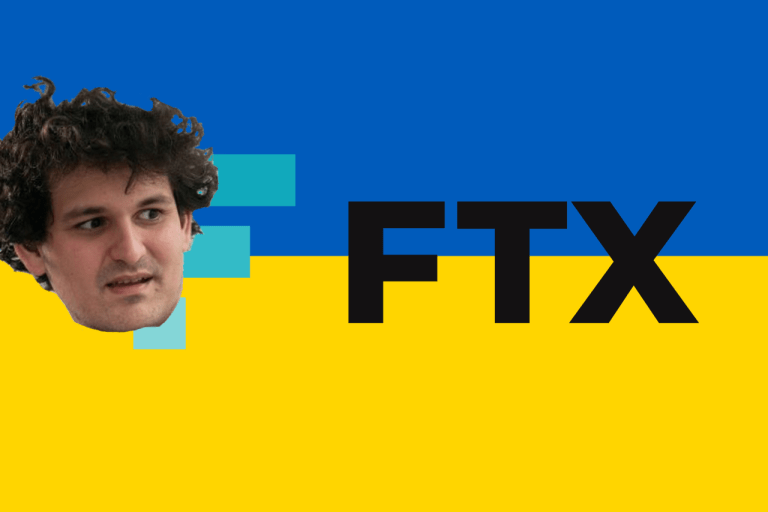
Thirty-seven billion more dollars for Ukraine? (That’s thirty-seven thousand millions of dollars, by the way.) Bringing the total this year to a click-or-two over ninety billion (ninety-thousand millions), on top of whatever Sam Bankman-Fried’s FTX company funneled through that sad-sack international money laundromat — soon to be the darkest backwater of a European failed state since Field Marshal Melchior von Hatzfeldt of Westphalia left Bohemia a corpse-strewn wasteland after the Battle of Jankau (1645).
It really doesn’t matter how much more money we pound down that rat-hole, you understand, because by the time various parties — the weapons-makers, Volodymyr Zelensky, sundry members of the US House of Representatives, The Biden family, the World Economic Forum — are finished creaming off their fair shares, poor Ukraine won’t have enough cash-on-hand to replace six fuse-boxes in Zaporizhzhia.
Against this backdrop, the USA enters a holiday season near-death spiral as unspooling scandals battle a collapsing economy for supremacy of the alt news sites. Case-in-point: the aforementioned FTX monkey business, a metastasizing tumor of the body politic. This complex fraud will smolder for a few weeks before it explodes into an extinction-grade event for the Democratic Party. The usual suspects among the mainstream media are trying to ignore it for the moment, but the shreds of this exploding money-borg are already sticking to guilty parties far and wide across the political landscape.
FTX commander-in-chief Sam Bankman-Fried remains at large after steering the crypto-currency trading platform into a bankruptcy so hideously tangled that the assigned liquidator in court proceedings, one John Ray III, who oversaw the Enron aftermath years ago, was boggled by what he’s found so far (and it’s early in the game): Namely, a company run by a handful of twenty-something drug freaks with no idea what they were doing, no record-keeping, and a slime trail of misappropriated investor’s funds leading to Kiev and Geneva through various crooked American political action committees, and the halls of Congress — with echos in ballot harvesting shenanigans which shaped the outcome of this month’s US elections.
Mr. Bankman-Fried is still scheduled as a main speaker for Accenture’s Nov. 30 DealBook Conference in New York ($2,499 for a ticket), along with Ukrainian President Volodymyr Zelensky and US Treasury Secretary Janet Yellen. Odds on him showing up? Or even being alive elsewhere on this planet then?
The extended family Bankman-Fried is the quintessence of Woke aristocracy. Dad Joe Bankman and mom Barbara Fried are both law professors at Stanford. She also acted as a money-bundler for the Democratic Party and ran two non-profit “voter registration” orgs (against the IRS laws which only permit non-partisan organized voter registration). Brother Gabe Bankman-Fried headed a non-profit named Guarding Against Pandemics (funded by Sam), which lobbies Congress to construct new platforms for medical tyranny. Aunt Linda Fried is Dean of the Columbia U’s Public Health school, and is associated with Johns Hopkins, which ran the October 2019 Event 201 pandemic drill (sponsored by the Gates Foundation) months before the Covid-19 outbreak.
Sam’s girlfriend, Caroline Ellison, ran the Alameda Investments arm of the FTX empire (that is, FTX’s own money laundromat). Her dad, Glenn Ellison is chair of MIT’s Econ School. His former colleague on the MIT Econ faculty, Gary Gensler, who specialized in blockchains there, is now head of the Securities and Exchange Commission, an agency that Sam Bankman Fried was attempting to rope into a regulation scheme to eliminate FTX’s crypto-currency competitors. Caroline’s mom, Sara Fisher Ellison is an MIT econ prof specializing in the pharmaceutical industry (fancy that!). Caroline Ellison is currently on-the-run.
The sum total of all this professional and academic accomplishment is also the quintessence of Woke-Jacobin turpitude in service to a political faction that seeks maximum moneygrubbing while acting to overthrow every norm of behavior in the conduct of elections, and perhaps in American life generally. That’s some accomplishment. It’s also a lesson in why the managerial elite of our country are no longer trustworthy. They have gotten away with crimes against the nation for years, which has only made them bolder and more reckless.
Wait for the FTX bankruptcy to unwind, along with all the political ramifications it entails, not to mention the financial afterburn in the whole crypto market, very likely extending into and befouling the rest of the banking system. This is going to be a clusterfuck for the ages, and will propel the USA into a depression with no visible horizon.
The Ukrainian government mysteriously disappeared online records of its fundraising arrangement with the FTX crypto scam just days before the scandal erupted. The initiative claims to have raised $60 million for Ukraine, but where did the money go?
The demise of FTX, the fifth-biggest cryptocurrency exchange by trade volume in 2022, and the second-largest by holdings, has sent a wave of chaos through global financial markets.
As the turbulence grows, the government of Ukraine is conducting an ongoing cleanup and whitewashing operation to rid any and all references to a high-level cryptocurrency fundraising arrangement it struck with FTX from the web. Eerily, it seems to have commenced just days before the scandal erupted.
Online records unearthed by The Grayzone claim tens of millions were raised by FTX for the Ukrainian government, and put to a variety of belligerent uses. But with the company now exposed as a Potemkin village lacking underlying assets, and major question marks hanging over whether its operations were from day one fraudulent top to bottom, where does that leave the supposedly successful donation scheme? Were those sums truly raised, and if so, to what purposes were they actually put?
FTX’s destruction resulted from a mass sell-off of the company’s native bitcoin token, FTT, by the rival exchange, Binance. Its value plummeted, prompting a three-day “run” on billions of dollars worth of cryptocurrency, which in turn created – or exposed – a “liquidity crisis” within FTX, as it did not have the available assets required to redeem client withdrawals. FTX filed for bankruptcy on November 11th.
FTX founder and top Democrat Party donor Sam Bankman-Fried now faces criminal investigations in the Bahamas, where the exchange was headquartered, and calls for official investigations into the largely unregulated cryptocurrency industry are reverberating across the globe.
The sudden death of FTX has been compared to the 2008 disintegration of Lehman Brothers that precipitated the financial crisis.
Massive customer holdings have apparently gone missing thanks to a secret “back door” in the FTX bookkeeping system that allowed Bankman-Fried to make changes to the company’s financial records without any accountability. This connivance may have been used to hide at least $10 billion in client funds Bankman-Fried transferred from exchange to another company he founded, digital asset trader Alameda Research.
While mainstream media pores over the details of Bankman-Fried’s gargantuan crypto scam, not one single major outlet has investigated or even acknowledged FTX’s relationship with the government of Ukraine.
Were client holdings unaccountably and illegally funneled into the West’s proxy war? Or did the supposed aid FTX sent to Kiev find its way into the hands of Ukrainian scammers, corrupt warlords and illicit actors?
The corporate media’s failure to explore these questions appears all the more perverse given Bankman-Fried’s flamboyant promotion of his intimate financial relationship with the government of Ukrainian President Volodymyr Zelensky.
FTX pledges to “turn bitcoin into bullets, bandages and other war materiel” for Ukraine
The partnership between FTX and the Ukrainian government was first publicized on March 14th when the leading cryptocurrency website CoinDesk announced Kiev had launched a dedicated webpage for cryptocurrency donations dubbed Aid for Ukraine.
Under its auspices, FTX pledged to “convert crypto contributions to Ukraine’s war effort into fiat for deposit” at the National Bank of Kiev, allowing the embattled government to “turn bitcoin into bullets, bandages and other war materiel.” CoinDesk stated the initiative “deepens an unprecedented tie-up between public and private sector forces in crypto.”
Oleksandr Bornyakov, an official at Ukraine’s Ministry of Digital Transformation, hinted to CoinDesk about an “upcoming NFT collection” auction to “give the next boost to the crypto fundraising process.”
(Bornyakov’s Ministry of Digital Transformation played a key role in the successful, Zelensky-led campaign to cancel The Grayzone’s Max Blumenthal and Aaron Mate’s appearance at Web Summit, a major international gathering of the tech industry in Lisbon, Portugal).
In a press release accompanying the announcement of the FTX partnership with Ukraine, Bankman-Fried explained that, “at the onset of the conflict in Ukraine, FTX felt the need to provide assistance in any way it could.” He promised that the arrangement provided “the ability to deliver aid and resources to the people who need it most.”
Kiev disappears Aid for Ukraine site days before FTX scandal goes public
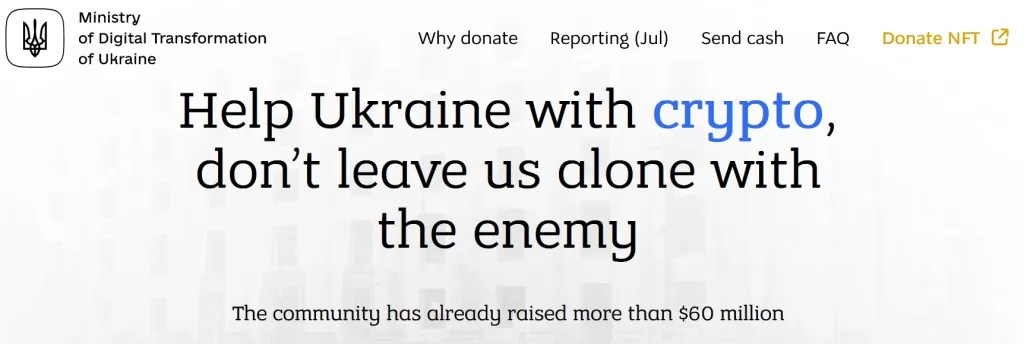
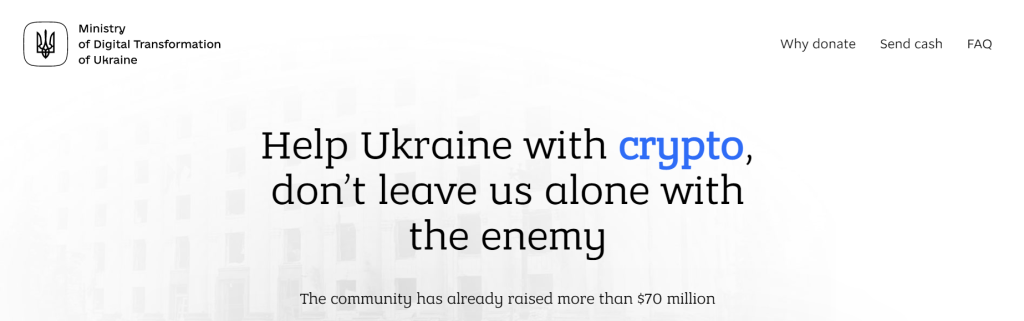
The Aid for Ukraine webpage has now been deleted, but can still be accessed via the Internet Archive. Until very recently, it encouraged visitors to “help Ukraine with crypto” and pleaded, “don’t leave us alone with the enemy.”
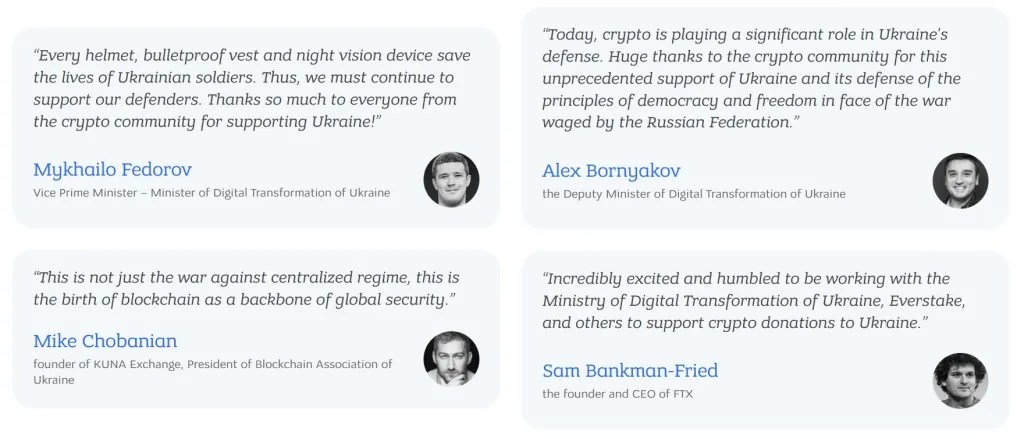
The site featured promotional quotes from an assortment of Ukrainian government officials and bitcoin bros – among them, FTX’s founder.
Mykhailo Fedorov, Ukraine’s deputy Prime Minister, and Minister of Digital Transformation of Ukraine, thanked “the crypto community” for funding the purchase of helmets, bulletproof vests, and night vision devices. For his part, Bankman-Fried declared himself “incredibly excited and humbled” to “support crypto donations to Ukraine.”
The last available Internet Archive capture of Aid for Ukraine” took place on the afternoon of October 26th. Throughout the webpage’s existence, the Internet Archive captured multiple snapshots of it weekly. This clearly indicates the page was purged by Kiev in late October, several days before the FTX crisis initially broke out.
Once it was deleted, the Ukrainian government created a standalone websiteon November 1st to promote the endeavor. The page was identical, and quotes from Bankman-Fried, and references to FTX’s involvement and its logo, remained in place until the morning of November 15th.
Was the original webpage’s dumping and erasure, and the shift to a totally new interface, at that time merely a spooky coincidence, or were the Ukrainians warned of what was coming? What did Kiev know, and when did it know it?
Bankman-Fried channeled millions to Biden through “stealth” PAC
Though FTX has been accused of serving as a money laundering vehicle for the US Democratic Party, concrete evidence supporting this claim has yet to materialize. But given Bankman-Fried’s background as one of the most prolific donors to the Democrats, and the role he played as a nexus between party power-brokers and the cryptocurrency sphere, the allegations are understandable.
Bankman-Fried is the son of Stanford law professor Barbara Friedman, founder of a shadowy Super PAC called Mind the Gap which quietly channeled millions to Democratic party candidates, primarily from nameless Silicon Valley investors.
The organization has no website or social media footprint, and its founders do not advertise their involvement publicly. Chosen through complex data analysis, beneficiaries of the Super PAC often have no idea themselves who or what has donated to their campaigns.
“The raison d’être is stealth,” an individual “with ties to the organization” told Vox back in 2020.
Bankman-Fried establishment of FTX in April 2019 – the same month Joe Biden announced his 2020 Presidential run – has added to the intrigue surrounding the scandal. Once vast sums started flowing into and through the FTX exchange, its founder channeled profits into Biden’s campaign coffers. Oddly, Bankman-Fried had no prior history of political giving.
Throughout the 2020 campaign, Bankman-Fried gifted over $5 million to Biden and groups supporting him. This reportedly helped fuel a potentially decisive “nine-figure, eleventh-hour blitz of TV advertising” targeting swing states, and made the crypto bro the second-largest donor to the president, right behind Michael Bloomberg.
Bankman-Fried claimed this wellspring of generosity was “motivated less by specific issues than by the Biden team’s ‘generic stability and decision-making process.’” Such an apparent lack of enthusiasm for the President stands at odds with the staggering sums he has pumped into Democratic party coffers ever since.
In 2022 alone, Bankman-Fried lavished almost $40 million on Democratic candidates, campaigns, and PACs. The giving spree made him the second-largest individual donor to Democratic causes, behind liberal venture capitalist George Soros.
More recently, Bankman-Fried pledged to donate a staggering $1 billion between this year and 2024 to ensure a Democratic victory in the next presidential vote. On October 14th, however, he completely backtracked, branding the investment a “dumb” move. Something scandalous was brewing behind the scenes.
One week later, the Texas State Securities Board announced it was investigating FTX on suspicion of selling unregistered securities. The development went largely unnoticed by the media. To the extent it generated any interest at all, it was framed as just one of several examples of financial authorities scrutinizing crypto players.
What happened to the $60 million raised by Aid for Ukraine?
If FTX was indeed laundering funds for the proxy war in Ukraine, the slightest indication that regulators were investigating its operations would have triggered alarm bells throughout Washington – and by extension, Kiev. This may be why the Ukrainian government switched the Aid for Ukraine webpage with a dedicated website, and scrubbed the original entirely from the internet just days after the announcement.
Also curious are the Internet Archive captures of the Aid for Ukraine website that show records of funds purportedly flowing to Kiev via Bitcoin had not been updated since July. At the time, the webpage reported that over $60 million had been raised by the “community.” This figure is reflected on the updated standalone Aid for Ukraine fundraising site.
A breakdown of spending on the new Aid for Ukraine website states Kiev had spent a total of $54,573,622 in cryptocurrency donations by July 7th on a wide variety of equipment, vehicles, drones, “lethal equipment” and other resources. One of the biggest single expenditures was $5,250,519 on a “worldwide anti-war media campaign,” the details of which would only “be published after our victory” due to “security reasons.”
Ukrainian government officials and private sector actors involved in the operation of Aid for Ukraine have scoffed at suggestions of impropriety regarding its use, but have only raised further questions with their denials.
Oleksandr Bornyakov of Ukraine’s Ministry of Digital Transformation declared that Aid for Ukraine simply used FTX to “convert donations into fiat in March.” The CEO of Everstake, the “validator” company that in theory guaranteed crypto funds donated via Aid for Ukraine reached Kiev’s Ministry of Defense, also thanked “every crypto holder for donating…in those early day [sic], when every cent and every minute was crucial.”
Taken in tandem, these comments suggest Aid for Ukraine was set up purely to receive donations in the initial stages of the war, and the $60 million figure represents sums received and converted in the weeks immediately following the launch of the initiative. This interpretation is reinforced by an Everstake staffer’s presentation at a cryptocurrency conference at Web Summit on November 1st, on the subject of “raising [over] $60m in crypto for Ukraine.”
Our Segment Lead @jane_everstake is getting ready to speak at a #FILLisbon panel about @_AidForUkraine and raising >$60m in crypto for Ukraine. The panel kicks off in just 15 min, at 11.30 Lisbon time. Don’t miss it if you’re there! pic.twitter.com/wTnC9Qfqvx
But an Internet Archive capture of Aid for Ukraine on April 1st adds to the confusion, showing that two-and-a-half-weeks after the initiative launched, the webpage was updated to claim “over $70 million” had been raised from crypto donors. This was revised down to “over $60 million” five days later.
More strangely, Aid for Ukraine records show that from the time of the initiative’s launch to April 14th, a total of $45,103,538 was spent. This means just $9,470,084 was spent between April 14 and July 7th, a period in which the war developed into a “bloody war of attrition” according to The Guardian.
This leaves a gap of at least $5.5 million in the money Aid for Ukraine claimed to have raised in its initial weeks, and the funds it says it distributed in Ukraine.
The disparity was confirmed in a tweet by the official Aid for Ukraine Twitter account, posted on the evening of November 15th, which stated that “out of $60 million received, $54 million have already been spent on Ukraine’s humanitarian and military needs.”
7/11 Here is a tweet from Deputy Minister of Digital Transformation of Ukraine @abornyakov refuting those rumors:https://t.co/vUsGNkkjh5
This implies that no further funds of any size were received after early April, and the total has remained static ever since, despite the resource being open for donations. Which would be highly unusual.
The government of Ukraine, FTX, and Everstake all now have serious questions to answer. Namely, why the funds purportedly raised appear to have decreased in a span of a few days, why no donations have been received since then on the Aid for Ukraine webpage or its new website, how much has been donated since the alleged initial influx, and where did the rest of the money go?
Ukraine: a black hole for Western aid
Stories of potential financial impropriety by Ukrainian officials and the country’s military are invariably ignored or outright buried by the Western media. An August exposé by the Kyiv Independent documented wide-ranging abuses by the leadership of a wing of the International Legion, including sexual harassment, looting, threatening soldiers at gunpoint and sending them unprepared on reckless missions. Though the Kyiv Independent often influences Western media’s coverage of the Ukraine conflict, this story was completely ignored in mainstream quarters.
That same month, CBS broadcast an investigative feature revealing that only 30 percent of Western arm shipments to Ukraine ever reach the frontline. Due to intense backlash from the Pentagon and other powerful sources, CBS temporarily pulled its own documentary and an accompanying promotional trailer and article from the web. The feature has since been “updated” to claim that “the situation has significantly improved” since filming, and “a much larger quantity now gets where it’s supposed to go.”
When it comes to Ukraine, Democrats at the highest levels are also immensely skilled at burying embarrassing stories. In December 2015, Joe Biden coerced Kiev’s then-leader Petro Poroshenko into firing prosecutor general Viktor Shokin as a condition for the US underwriting a $1 billion IMF loan to Ukraine.
“I’m going to be leaving here in six hours. If [Shokin] is not fired, you’re not getting the money,” Biden threatened.
With Shokin’s firing, the experienced lawyer’s ongoing probe into the energy giant Burisma ended as well. Which meant that Burisma’s most famous board member, Hunter Biden, the son of then-US Vice President’s son, eluded official scrutiny.
Now, a politically connected crypto-billionaire who used a secret financial “back door” to fleece customers of ungodly sums of money has become the latest character in the saga of shady US aid to Ukraine. And though the collapse of his FTX firm is front page news, mainstream outlets are studiously avoiding the Ukraine angle.
From its founding in 2017, the one-man company rose to a “partner organisation” of the WEF and second largest donor to Biden and the Democrats’ mid-term election. It has now gone bust.
Sam Bankman-Fried during the Bitcoin 2021 conference. (Cointelegraph, CC BY 3.0, Wikimedia Commons)
NOTE: This is is what I think of as a signpost article — it points you to something the mainstream media is deliberately not giving the prominence it needs, but I have no personal expertise or inside knowledge to give you. I am just giving you a start to get going. Several readers will have a much better understanding than I, and I encourage you to give your thoughts in comments below.
The FTX story seems truly remarkable. From being founded only in 2017 it rose to be a “partner organisation” of the World Economic Forum and the second largest donor to U.S. President Joe Biden and the Democrats’ mid-term election campaign. It has now gone completely bust, taking every penny of its depositors’ money with it.
That is some trajectory.
The World Economic Forum has deleted its FTX page, but the Wayback machine has it:
I suppose it is inevitable that dodgy chancers would create derivatives markets for gambling on crypto, but I confess I had not given the matter much thought. It goes without saying that in those five years the founder of FTX had managed to take a huge personal fortune out of the company before it went bust.
FTX was a one-man company belonging to Sam Bankman-Fried. The board consisted of him, an employee and the company lawyer. Over $20 billion of investors’ funds from FTX were funneled to a fund management company, Alameda Research, also owned by Sam Bankman-Fried.
Bankman-Fried donated $37 million to the Democrats for the 2022 elections. Every penny of that originated with duped FTX investors. That is in addition to the $5 million given to the Biden 2020 campaign. FTX, of course, crashed instantly after those mid-term elections, which is interesting timing.
The BBC and The Guardian were constantly bombarding us with the term “democracy denier” in their coverage of the U.S. elections, strangely not in reference to presidential candidate Hillary Clinton’s ludicrous claims that Russian interference was the cause of her loss in 2016.
I view as a joke any notion that the U.S. is a democracy. Democracy is about giving citizens a choice of political direction. The 2022 elections saw a simply incredible expenditure on campaigning of $ 9.7 billion. Yes, nearly $10 billion. This is not democracy. It is a huge exercise in corporate control from which the ordinary citizen is frozen out.
Despite an aggressive tribalism which has stalemated the political system for decades, the difference in policy platform between Democrats and Republicans is highly marginal, with no alternative on offer to rampant and uninhibited commercial exploitation of the population by the super-wealthy.
The Democrats are marginally more keen on attacking other countries; the Republicans are marginally more against measures to curb carbon emissions. Vaunted differences on immigration and welfare turn out to be very small indeed, with very little changing when the White House does.
American elections are simply about the super-rich funneling in vast donations, expecting to benefit when their team gets its nose in the trough, or often donating to both sides to benefit either way.
I am not sure what the connection to democracy is supposed to be.
One simple fact illustrates the true nature of the bribery fest. By far the majority of the funds channeled through Political Action Committees, or PACs, are given to incumbents who face no serious threat to re-election anyway.
The PACs are interested in bribing those in power, not changing those in power. They are simply lobby groups with an opportunity for legal bribery. To illustrate that, the largest donating PACs are:
National Association of Realtors National Beer Wholesalers Association American Israel Public Affairs Committee Credit Union National Association Blue Cross/Blue Shield American Crystal Sugar
It is worth noting that Bankman-Fried donated 10 times as much as the largest PAC donation. This brought access — he and his brother had meetings inside the White House on March 7, April 22 and May 12.
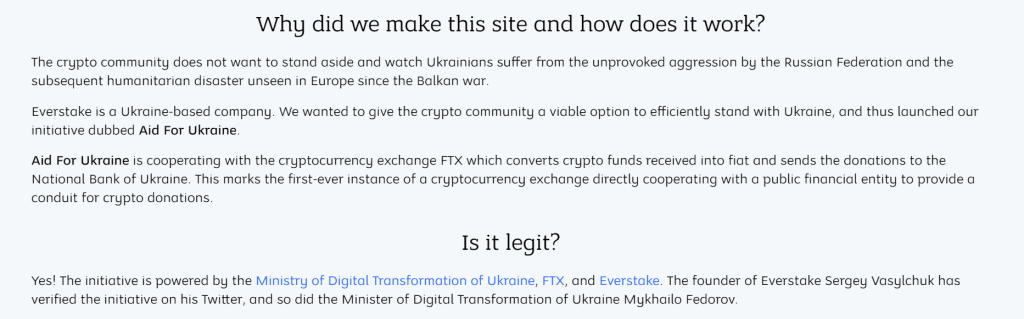
It is perhaps unsurprising therefore that FTX was involved in Ukraine, offering to exchange cryptocurrency for fiat and send it to Ukraine in an official partnership with the Ukrainian government. This from their press release
“Aid For Ukraine is cooperating with the cryptocurrency exchange FTX which converts crypto funds received into fiat and sends the donations to the National Bank of Ukraine. This marks the first-ever instance of a cryptocurrency exchange directly cooperating with a public financial entity to provide a conduit for crypto donations. Earlier this month, FTX already converted $1 million worth of SOL and transferred it to the National Bank of Ukraine.”
The collapse of the Bankman Fried scam was allegedly caused by hackers stealing what should have been a comparatively small portion of the assets of FTX, had they not been hived off elsewhere. Doubtless we will shortly hear from state salaried conspiracy theorists that this was Russia/Guccifer/an ISP address traced by Bellingcat to inside the Kremlin. What we really have here is an Allen Stanford for 2022, with added political connections. We would do well to heed the advice of crypto developer Nikolai Mushegian, who had as his Twitter profile: “Larpers who self-style as CEOs or CTOs or VCs are a bigger problem than the establishment. They can’t build anything and will sell you out in 2 seconds.” His final tweet was posted on Oct. 28:
The next day he drowned in the sea off a beach in Puerto Rico, where he lived. He was fully clothed including a jacket. The police are not treating it as homicide so presumably their theory is suicide by wading out to sea.
States of course have a massive incentive to destroy non-fiat currencies, or convert them into a new category of regulation. I am interested in the current discussion on smart state digital currencies where the state can track, control and block any transaction and know in real time exactly where each citizen or entity is spending or keeping every penny.
It occurs to me this is the wrong way round. The state belongs to its citizens, not the citizens to the state. We should be able to track online every single penny of public money in real time and see how it is spent. Imagine being able to follow every penny of the billions the Tories spent on fraudulent PPE contracts, for example.
The only people whose personal currency should be able to be tracked are those who hold, or have held, positions of power in the state. Their wealth and dealings should be available in great detail to public view. As for the rest of us, our money is ours and we are entitled to privacy.
Prussian Major General Carl von Clausewitz famously drew on his own experience in the Napoleonic Wars to examine war as a political phenomenon. In his 1832 book “On War” he provided a frequently quoted pithy summary of war versus peace, writing in terms of politico-military strategy that “War is a mere continuation of politics by other means.” In other words, war-making is a tool provided to statesmen to achieve a nation’s political objectives when all else fails.
One can reject the ultimate amorality of Clausewitz’s thinking about war while also recognizing that some nations have historically speaking exploited war-making as a tool for physical expansion and the appropriation of foreigners’ resources. As far back as the Roman Republic, the country’s elected leaders doubled as heads of its consular armies, which were expected to go out each spring to expand the imperium. More recently, Britain notably engaged in almost constant colonial wars over the course of centuries to establish what was to become history’s largest empire.
America’s dominant neocons characteristically believe they have inherited the mantle of empire and of the war powers that go hand-in-hand with that attribute, but they have avoided other aspects of the transition in turning the United States into a nation made and empowered by war. First of all, what comes out the other end after one has initiated hostilities with another country is unpredictable. Starting with Korea and continuing with Vietnam, Afghanistan, Iraq as well as other minor operations in Latin America, Africa and Asia, American war-making has brought nothing but grief on those on the receiving end with little positive to show for the death, destruction and accumulated debt. Also forgotten in the rush to use force is the raison d’etre to have a federal national government at all, which is to bring tangible benefit to the American people. There has been none of that since 9/11 and even before, while Washington’s hard-line stance on what has become a proxy war against Russia over Ukraine promises more pain – perhaps disastrously so – and no real gain.
If one has any doubt that going to war has become the principal function of both Democrats and Republicans in Washington, it is only necessary to consider several stories that have appeared in the past several weeks. The first comes from the Republican side, and it includes a possibly positive development. House Minority leader Republican Kevin McCarthy warned two weeks ago that the GOP will not necessarily continue to write a “blank check” for Ukraine if they obtain the House majority in next month’s election, reflecting his party’s growing skepticism about unlimited financial support for the corrupt regime in place in Kiev. McCarthy explained “I think people are gonna be sitting in a recession and they’re not going to write a blank check to Ukraine. They just won’t do it. … It’s not a free blank check.”
America’s uncritical support for Ukraine, which has been a contrivance by the White House and media since the fighting started, has led to a growing number of Republicans, particularly some of those aligned with Donald Trump’s “America First” approach, to challenge the need for massive federal spending abroad at a time of record-high inflation at home. Since Russia launched its invasion in February, Congress has approved tens of billions in emergency security and humanitarian assistance for Ukraine, while the Biden administration has shipped billions more worth of weapons and equipment from military inventories, all done with only limited or even no oversight of where the money and weapons are winding up.
But, unfortunately, the GOP is far from unified on its approach to Ukraine-Russia. Congressman Liz Cheney demonstrated that her apple did not fall far from her father’s tree, taking some time off from trying to hang Donald Trump to denounce what she refers to as the “Putin wing of the Republican Party.” She put it this way: “You know, the Republican Party is the party of Reagan, the party that essentially won the Cold War. And you look now at what I think is really a growing Putin wing of the Republican Party.”
Cheney criticized Fox News for “running propaganda” on the issue and in particular called out Fox host Tucker Carlson as “the biggest propagandist for Putin on that network… You really have to ask yourself, whose side is Fox on in this battle? And how could it be that you have a wing of the Republican Party that thinks that America would be standing with Putin as he conducts that brutal invasion of Ukraine?”
Cheney notably did not address the issue of how the war developed in the first place because the US and UK preferred saber rattling to diplomacy with Moscow. Or why the United States feels compelled to tip-toe to the brink of a possible nuclear war over a foreign policy issue that is of no real national interest to the American people. And where did she make her comments? At the McCain Institute in Arizona. Yes, that’s a legacy of Senator John McCain another Republican who never saw a war he couldn’t enthusiastically support.
Both President Joe Biden and Speaker of the House Nancy Pelosi have confirmed that the US is in with Ukraine until “victory” is obtained, whatever that is supposed to mean, while other Administration officials have indicated that the actual purpose of the fighting is to weaken Russia and remove President Putin. White House press secretary Karine Jean-Pierre glibly spouted the party line when asked about McCarthy’s comments. She thanked congressional leaders for bipartisan work to “support Ukraine to defend itself from Russia’s war crimes and atrocities,” adding that “We will continue to work with Congress and continue to monitor those conversations on these efforts and support Ukraine as long as it takes. We are going to keep that promise that we’re making to the brave Ukrainians who are fighting every day, to fight for their freedom and their democracy.”
Perhaps more bizarre than Cheney’s comments is the tale of a letter that was prepared by thirty Democratic Party progressives urging US support for negotiations to end the fighting in Ukraine. The letter was prepared in June but not released until last week before being quickly retracted under pressure on the following day. Pramila Jayapal, who heads the Congressional Progressive Caucus, said it was retracted because it “was being conflated with [the] comments” made by McCarthy over his warning about budget cutting for Ukraine. Jayapal referred to the letter as a “distraction,” but what she really meant was that her group had no desire to make common cause with the Republicans over any issue, including war and peace in an escalating conflict that is manifestly pointless.
A clueless Jayapal also took pains to contradict the message put out by her own group, emphasizing that there has been no opposition to the administration’s Ukraine policy from Democrats in Congress. She said Democrats “have strongly and unanimously supported and voted for every package of military, strategic, and economic assistance to the Ukrainian people.” She doubled down on the White House message, affirming that the war in Ukraine will only end with diplomacy after “a Ukrainian victory.”
So basically, anyone talking sense about Ukraine in Washington is being shut down by forces within the political parties themselves working together with a compliant national media that is mis-representing everything that is taking place on the ground. It is a formula for tragedy as the Biden administration has shown no sign of seeking diplomacy with Russia to end the conflict despite the president’s recent surprising warning that the world is now facing the highest risk of nuclear “Armageddon,” which he, of course, blames on Putin. Given all of that, in my humble opinion a government that is unable or unwilling to take reasonable steps to protect its own citizens while also avoiding a possible nuclear catastrophe that could end up engulfing the entire world is fundamentally evil and has lost all legitimacy. It should recognize that fact before submitting its resignation.
It’s certainly possible to be disgusted, but being disabused of the fantasy that the system is self-correcting is the healthier perspective.
I used to be disgusted, now I’m disabused: beneath all the self-serving narratives, fad-memes and over-simplifications regurgitated as serious analysis, these are the core dynamics I see:
1. Imperial corruption of democracy and open markets. I described this in Regardless of Who’s Elected, Imperial Corruption Rules the Nation: the dynamic adaptive churn of unfettered representative democracy and open markets are anathema to insiders, vested interests and elites, each of which has gained asymmetric power by subverting democracy and markets to serve their private interests rather than the public interest / common good–phrases that are meaningless to insiders, vested interests and elites except as simulacra used for PR.
2. The Deep State, the unelected and unaccountable Administrative State. I’ve been discussing the Deep State before it entered common use–for example:
The Administrative State has existed in some form in every nation-state / empire, but the U.S. Deep State only gained its vast global powers in World War II and the Cold War, where the lesson learned was the public may choose unwisely (for example, choosing appeasement over preparation) and so the really important decisions needed to preserve the nation cannot be left to parochial politicos in elected office–those decisions must be in the hands of those who know what has to be done.
Democracy is the rubber stamp for doing what’s necessary. Beyond that, it’s a potentially fatal hindrance. That’s the mindset of the Deep State, and if you and I were in upper-echelon positions in the Administrative State, we’d agree with this mindset when things get serious.
This mindset is a self-reinforcing group-think feedback loop: those who believe the public should set policy are weeded out, either by self-selection or via being sent to bureaucratic Siberia.
We’re protecting you. That’s all you need to know.
This opens the door to functionaries who came to do good but stayed to do well, i.e. those with the right credentials and connections to enter the Power Circle to “serve the public” but soon become insiders maximizing their own private gains. That’s the problem with the Administrative State: it’s ultimately unaccountable, not just to the public or elected officials but to itself.
3. Vested interests block adaptions that threaten their share of the spoils. Any advance that increases efficiency and productivity and furthers the public good is squelched, suppressed or co-opted by vested interests who rightly fear their share of the spoils might be diminished by advances that obsolete their particular cartel, monopoly or other embedded skim, scam, fraud, embezzlement or simply unproductive dead weight.
The status quo is thus locked into a death spiral as gatekeepers, insiders, vested interests and sold to the highest bidder politicos will protect vested interests even as the engines flood and the ship begins its long descent into the void.
How do otherwise smart people become so blind to what’s going on? They believe the status quo is so wealthy, so powerful, so clever, etc., that it will overcome any obstacles or crises because it’s always done so in the past, and so it is permanent, immutable, forever, and our supping at the trough of free money couldn’t possibly weaken such an enduring Leviathan.
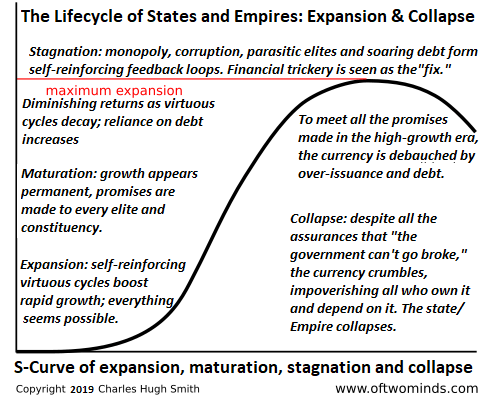
This is the fatal fantasy of every empire. We’re too successful to fail and collapse. But oddly enough, faith in the permanence of success leads to the very collapse that’s deemed “impossible.”
4. Concentrations of wealth, power, capital and production fatally distort the economy and the social order. When “competition” has been reduced to two telecoms, two healthcare insurers, two pork processors, etc., the system has been stripped of adaptability and resilience.
When 10,000 small farmers each have 100 chickens, the stock of 1 million chickens is spread over a wide geography and entrepreneurial network of suppliers, wholesalers, etc. Bird flu may spread widely but it’s far more difficult to wipe out 10,000 small farms’ poultry compared to the ease of bird flu spreading in one giant factory that concentrates 1 million chickens in one facility. Supply chains stripped of network resilience are equally fragile and prone to disruption and collapse.
Concentrating any form of capital, production and power renders the system vulnerable to collapse due to the inherent weaknesses generated by replacing complex networks with vertical-integration under the control of a few cartels, monopolies, autocrats, gatekeepers or regulators–the latter two being easily influenced by political pressure and/or private gain.
It’s certainly possible to be disgusted, but being disabused of the fantasy that the system is self-correcting is the healthier perspective. Everything is forever until systemic weaknesses reveal themselves, typically at the most inopportune junctures.
So it turns out the US intelligence cartel has been working intimately with online platforms to regulate the “cognitive infrastructure” of the population. This is according to a new investigative report by The Intercept, based on documents obtained through leaks and an ongoing lawsuit, on the “retooling” of the Department of Homeland Security from an agency focused on counterterrorism to one increasingly focused on fighting “misinformation, disinformation, and malinformation” online.
While the DHS’s hotly controversial “Disinformation Governance Board” was shut down in response to public outcry, the Intercept report reveals what authors Lee Fang and Ken Klippenstein describe as “an expansive effort by the agency to influence tech platforms” in order to “curb speech it considers dangerous”:
According to a draft copy of DHS’s Quadrennial Homeland Security Review, DHS’s capstone report outlining the department’s strategy and priorities in the coming years, the department plans to target “inaccurate information” on a wide range of topics, including “the origins of the COVID-19 pandemic and the efficacy of COVID-19 vaccines, racial justice, U.S. withdrawal from Afghanistan, and the nature of U.S. support to Ukraine.”
Docs show Facebook and Twitter closely collaborating w/ Dept of Homeland Security, FBI to police “disinfo.” Plans to expand censorship on topics like withdrawal from Afghanistan, origins of COVID, info that undermines trust in financial institutions. https://t.co/Zb3zmI1dQF
The report reveals pervasive efforts on the part of the DHS and its Cybersecurity and Infrastructure Security Agency (CISA), along with the FBI, to push massive online platforms like Facebook, Instagram and Twitter to censor content in order to suppress “threats” as broad as fomenting distrust in the US government and US financial institutions.
“There is also a formalized process for government officials to directly flag content on Facebook or Instagram and request that it be throttled or suppressed through a special Facebook portal that requires a government or law enforcement email to use,” The Intercept reports.
“Emails between DHS officials, Twitter, and the Center for Internet Security outline the process for such takedown requests during the period leading up to November 2020,” says The Intercept. “Meeting notes show that the tech platforms would be called upon to ‘process reports and provide timely responses, to include the removal of reported misinformation from the platform where possible.’”
While these government agencies contend that they are not technically forcing these tech platforms to remove content, The Intercept argues that its investigation shows “CISA’s goal is to make platforms more responsive to their suggestions,” while critics argue that “suggestions” from immensely powerful institutions will never be taken as mere suggestions.
“When the government suggests things, it’s not too hard to pull off the velvet glove, and you get the mail fist,” Michigan State University’s Adam Candeub tells The Intercept. “And I would consider such actions, especially when it’s bureaucratized, as essentially state action and government collusion with the platforms.”
This is absolutely wild. The government is secretly transforming "national security" agencies into a new Narrative Police.
“If a foreign government sent these messages,” said the former ACLU president, “there is no doubt we would call it censorship.”
The current CISA chief is seen justifying this aggressive government thought policing by creepily referring to the means people use to gather information and form thoughts about the world as “our cognitive infrastructure”:
Jen Easterly, Biden’s appointed director of CISA, swiftly made it clear that she would continue to shift resources in the agency to combat the spread of dangerous forms of information on social media. “One could argue we’re in the business of critical infrastructure, and the most critical infrastructure is our cognitive infrastructure, so building that resilience to misinformation and disinformation, I think, is incredibly important,” said Easterly, speaking at a conference in November 2021.
Another CISA official is seen suggesting the agency launder its manipulations through third party nonprofits “to avoid the appearance of government propaganda”:
To accomplish these broad goals, the report said, CISA should invest in external research to evaluate the “efficacy of interventions,” specifically with research looking at how alleged disinformation can be countered and how quickly messages spread. Geoff Hale, the director of the Election Security Initiative at CISA, recommended the use of third-party information-sharing nonprofits as a “clearing house for trust information to avoid the appearance of government propaganda.”
But as a former ACLU president tells The Intercept, if this were happening in any government the US doesn’t like there’d be no qualms about calling it what it is:
“If a foreign authoritarian government sent these messages,” noted Nadine Strossen, the former president of the American Civil Liberties Union, “there is no doubt we would call it censorship.”
Indeed, this report is just another example of the way western powers are behaving more and more like the autocracies they claim to despise, all in the name of preserving the values the west purports to uphold. As The Intercept reminds us, this business of the US government assigning itself the responsibility of regulating America’s “cognitive infrastructure” originated with the “allegation that Russian agents had seeded disinformation on Facebook that tipped the 2016 election toward Donald Trump.” To this day that agenda continues to expand into things like plots to censor speech about the war in Ukraine.
[Thread]
Hundreds of former agents of a notorious Israeli spying organization are now working in key positions at the world’s biggest tech/comms corporations, including Google, Facebook and Microsoft.
Other examples of this trend coming out at the same time include Alan MacLeod’s new report with Mintpress News that hundreds of former agents from the notorious Israeli spying organization Unit 8200 are now working in positions of influence at major tech companies like Google, Facebook, Microsoft and Amazon (just the latest in MacLeod’s ongoing documentation of the way intelligence insiders have been increasingly populating the ranks of Silicon Valley platforms), and the revelation that The Grayzone’s Max Blumenthal and Aaron Maté were barred from participating in a Web Summit conference due to pressure from the Ukrainian government.
We’re told we need to defeat Russia in Ukraine in order to preserve western values of freedom and democracy, and in order to facilitate that aim we’re getting less and less free speech. Less and less free thought. Less and less free press. Less and less democracy.
I keep thinking of the (fictional) story where during World War II Winston Churchill is advised to cut funding for the arts to boost military funding, and he responds, “Then what are we fighting for?” If we need to sacrifice everything we claim to value in order to fight for those values, what are we fighting for?
Dissent is becoming less and less tolerated. Public discourse is being more and more aggressively disrupted by the powerful. We’re being shaped into the exact sort of homogeneous, power-serving, tyrannized, propagandized population that our leaders criticize other nations for having.
Any journalists or press freedom advocates out there care about a US gov’t ally, Ukraine, pressuring a media conference to cancel two journalists? https://t.co/sPwaQAIiTV
If the powerful are becoming more tyrannical in order to fight tyranny, what’s probably actually happening is that they are just tyrants making up excuses to do the thing they’ve always wanted to do.
As westerners in “liberal democracies” we are told that our society holds free speech, free thought and accountability for the powerful as sacrosanct.
Our leaders are showing us that this is a lie.
The problem with “western values” is that the west doesn’t value them.
In reality, those who best exemplify “western values” as advertised are the ones who are being most aggressively silenced and marginalized by western powers. The real journalists. The dissidents. The skeptics. The free thinkers. The peace activists. Those who refuse to bow down to their rulers.
Our ongoing descent into tyranny in the name of opposing tyrants calls forth a very simple question: if defeating autocracy requires becoming an autocracy, what’s the point of defeating autocracy?







 After the Crash