Building Bridges: Top 10 Issues That 99% Can Agree On

building_bridges

On a recent episode of PBS Newshour, Jeffrey Brown hosted a roundtable discussion exploring the dangers of polarized politics for American Governance. The guests were Eric Liu, Steven Hayward and Beverly Gage. Most of the discussion was an analysis of the recent government shutdown from a typical left vs. right perspective, but I thought their view of reactions of average citizens was interesting:

JEFFREY BROWN: And so, Eric Liu, let me ask you, because I know you’re very — you’re trying to engage people in the act of citizenship. What do you see the effect of all of this? Are they more engaged? Are they just more disgusted and turned off?

ERIC LIU: Well, I don’t think those are mutually exclusive. There is disgust.

(LAUGHTER)

ERIC LIU: But, because of the disgust, there’s actually more engagement.

And that’s true on both the left and the right. Look, I think the reality is, when Steven was speaking a moment ago about the kind of encroachment of ever-growing and ever-larger government, we can have reasonable debates in this country about what the proper size and scope of government ought to be, but we ought to regard those debates not as “on/off, yes/no, my way or we shut the whole thing down” kind of debates.

…so people from both left and right watching these last two weeks are ready for something different.

They’re ready to actually hear each other and see one another and not the caricatures of one another, and try to figure out, well, where is it that we can manage to agree on the role of government, and where we can’t agree, how can we recognize that to be a citizen isn’t just a single-shot sudden death game. It’s infinite repeat play, and you’re going to win some, and I’m going to win some.

JEFFREY BROWN: All right, let me ask Steven Hayward to respond to this.

Do you see the result of this as people ready to work together or more divisions that ever more polarizes?

STEVEN HAYWARD: Well, I think there’s two things to think about here.

One is, is we have divided government once again. The voters, God bless them, have a lot of cognitive dissonance. Right? In the last week, what you saw is people say, I don’t like Obamacare, but I don’t want the government shut down. I don’t want it to be a matter of a budget fight the way it’s become. And that’s why Republicans lost this proximate battle.

But if you look at some of the poll numbers right now, I think they ought to be very worrying for everybody, but I think more worrying ultimately for liberals, for this reason. You have seen record high numbers of people who now say — I think 65 percent in one poll — that government is a threat to their rights.

You have seen a long-term trend going back really to the 1960s of the number of people saying they have confidence that the federal government will do the right thing down in 15 percent, 20 percent, when it used to be in the ’50s up around 60 to 70 percent. And to the extent that if you’re liberal and that you believe in political solutions to our social problems or government engagement with our problems, you want the public to have confidence in the federal government’s capacities.

And so it seems to me that, as much as this might have been a train wreck for Republicans, the long-term effect of this might not necessarily play out that way.

JEFFREY BROWN: Well, Beverly, when you look back at political — what could be called political crises of the past, what does it — what happens in terms of public response to those?

BEVERLY GAGE: Well, I think to some degree, Steven’s quite right, in that I would kind of like to subscribe to Eric’s view that we’re going to have a much more serious conversation, a much more bipartisan conversation.

But I think it’s equally possible that you’re actually going to see people throw their hands up and say, oh, it’s all such a mess. I don’t really want to make sense of it. I don’t want to deal with it. And, in that way, it sort of serves an anti-government message, and in some ways, even serves sort of the Tea Party message in ways that maybe were intended and maybe weren’t.

But I think there’s also a danger for the Republican Party in all of this, which is to say that these divisions that we’re seeing right now within the Republican Party between moderates and Tea Party conservatives and also between a sort of establishment business class, which is very, very alarmed about what’s happening, and this more right-wing part of the party, that actually may in fact spell destruction for the Republican Party.

Those are divisions that have been there for a long time. They have often been papered over. But when you’re on the brink of financial catastrophe in the way that we were, we may not see them be papered over, and we may in fact see some sort of political realignment coming out of this.

You can read the complete transcript here: http://www.pbs.org/newshour/bb/politics/july-dec13/governing_10-17.html

All three guests made good points, though the views of conservatives and liberals are typically generalized in such discussions and I think issues of most concern to citizens on a grassroots level are often not the ones being debated enough in Washington D.C. There definitely needs to be more political discussion between left and right not just within government but among the general public. Increased communication and education is the best defense against “divide and conquer” tactics but of course this is easier said than done because politics has become a taboo subject for many, mainly due to fear of getting into heated arguments. But perhaps this fear is unwarranted because there’s many issues that the left and right can agree on (though motives and priorities may differ). These are just some of the more topical examples:

  1. End the Wars – As demonstrated by widespread negative reaction to war threats against Syria, people are perhaps becoming more aware of political trickery thus becoming harder to persuade. Also, as living standards drop for more people, the connection between costly foreign policy and the nation’s declining economy and infrastructure has never been more obvious.
  2. Stop the Surveillance State – Privacy is a universal human need. Mass spying on citizens is illegal and unethical whether online or through drones and informants.
  3. End Unjust Trade Agreements – Agreements such as NAFTA and the Trans-Pacific Partnership (TPP) hurt working people and endangers health and safety, the environment, and national sovereignty.
  4. End the Fed – We’ve endured 100 years of a “Federal” Reserve run by private bankers and all we have to show for it is a debt of tens of trillions of dollars. It will never be paid off as long as we continue to use interest-bearing federal reserve notes as currency.
  5. Create Affordable Health Care – It can be argued that Obamacare is an incremental improvement but everyone knows it’s not enough and is far more beneficial for greedy insurance companies than the poor.
  6. End the Drug War – We can all agree the Drug War is a colossal failure (when it comes to the stated purpose of reducing drug addiction). It has only increased incarceration rates while enriching the prison-industrial complex and drug cartels. We need to adopt policies that have proven to be effective such as legalization, decriminalization and harm-reduction.
  7. Stop GMOs – GMOs are unnecessary, physically and economically harmful to farmers, may have potentially catastrophic effects on the ecosystem, and only serves to increase profits for companies like Monsanto.
  8. End Obscene Economic Inequality – Complete economic equality might not be possible, but when economic inequality reaches absurd and unsustainable levels as they have today, obviously something needs to change.
  9. Protect Internet Freedom – Legislation such as the NDAA, SOPA and PIPA indicate that government and corporations are threatened by the internet. Attacks against internet freedom are attacks against freedom of speech, freedom of information and cognitive liberty.
  10. Ignore Corporate News – Another point of agreement between right and left is the corporate news media’s increasing irrelevancy and bias. Today it is not so much a liberal or conservative bias as it is a neoliberal and neoconservative bias.

Podcast News Updates

the-5th-horseman

There’s been another string of relevant news podcasts in the past few days so it’s time for another roundup post.

Last week Rob Kall of OpEdnews.cominterviewed Peter Ludlow a professor of linguistics and philosophy, on topics including systemic evil, whistleblowers and hacktivism:

https://itunes.apple.com/us/podcast/rob-kall-bottom-up-radio-show/id359765013

On Friday, Abby Martin of Breaking the Set did an excellent job deconstructing the corporatocracy on Coast to Coast AM with John Wells:

http://www.mediaroots.org/abby-martin-deconstructs-the-corporatocracy-on-coast-to-coast-am/

On Monday Nellie Bailey and Glen Ford of Black Agenda Report covered a wide range of important topics including an update on the corporate plan for Detroit (an American apartheid), the struggle to raise the minimum wage in Seattle, and Dave Swanson’s (of WarIsACrime.org) analysis of the multitude of lies in Obama’s recent UN speech : Listen to Black Agenda Radio on the Progressive Radio Network, with Glen Ford and Nellie Bailey – Week of 9/30/13.

From Traces of Reality there were two great consecutive shows. On 9/30 host Guillermo Jimenez interviewed Kevin Gallagher, director of Free Barrett Brown.  Brown is the journalist who faces a 105 year sentence, the bulk of which is related to charges associated with pasting a link in a chat room. On the 10/1 episode, Guillermo is joined by Vice President of The Future of Freedom Foundation, Sheldon Richman. They cover topics including the “government shutdown”, the national debt, taxation, private property, the “social contract,” and the fallacy of the “consent of the governed.”:

9/30

10/1

Does the Government Only Label Bad Guys As Terrorists?

Perhaps, if one’s definition of a “bad guy” is so broad it becomes meaningless.

Among the findings in this must-read article recently posted at Washington’s Blog, Does the Government Only Label Bad Guys As Terrorists?, the following characteristics could get you labeled as a terrorist by the  government:

As you can see the list is pretty long, but sure to get longer as the government becomes even more corrupt, ineffectual, and fearful of revolt. Having such a loose definition of “terrorist” will do nothing to make anyone any safer (except perhaps the wealthy elite). In fact, it will only discourage dissent and encourage obedience to the corporate state which ultimately endangers the health of society.

fusion-center

Channel Surfing

A compilation of some of the best non-corporate alternative news clips from the past few days.

9/17 On Episode 237 of Breaking the Set,  Abby Martin and guests commemorate the second Occupy Wall Street anniversary.

9/18 At the WeAreChange channel, Luke Rudkowski interviews Everett Stern, a former employee of HSBC who blew the whistle on the company’s criminal schemes.

9/19 Ben Swann of Reality Check takes a look at three of the biggest current controversies surrounding Monsanto (one of the world’s most hated corporations).

9/19 Global Research TV’s James Corbett reports on inconsistencies and video manipulation that calls into question the official narrative of the Syrian chemical weapons attack.

9/19 Secular Talk gives a blistering critique of John McCain’s recent Pravda op-ed.

Joy Camp and WeAreChange.org introduce the iPhone 5nSa.

Post the Wrong Link, Get 105 Years in Jail

NSA-Seal--43798

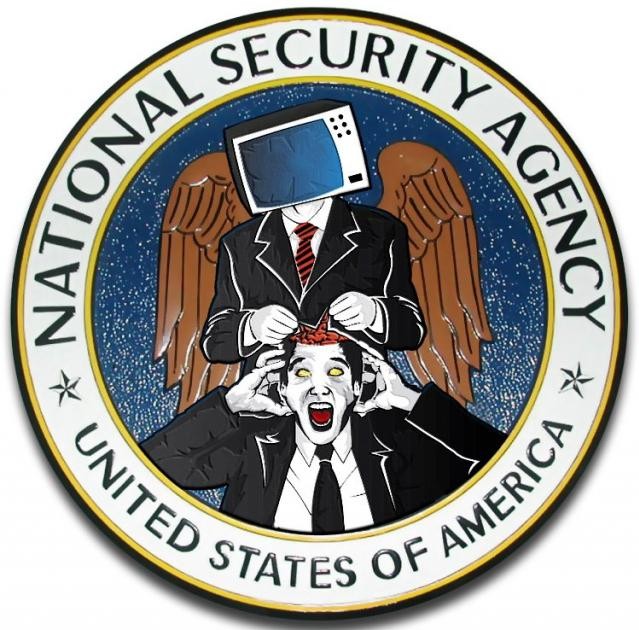
What kind of link does the government think warrants such punishment? Documents revealing the secrets-sharing relationship between government and private security companies, apparently. That was what Barrett Brown linked to, and was the root cause of his 105 year sentence. Brown is an author and activist journalist best known for his “spokesperson” role for the hacker collective “Anonymous”. He was also a close friend and associate of fellow journalist Michael Hastings, who was working on a story with Brown shortly before his death in a suspicious car explosion. In his last published article, Hastings wrote:

Transparency supporters, whistleblowers, and investigative reporters, especially those writers who have aggressively pursued the connections between the corporate defense industry and federal and local authorities involved in domestic surveillance, have been viciously attacked by the Obama administration and its allies in the FBI and DOJ.

…Barrett Brown, another investigative journalist who has written for Vanity Fair, among others [sic] publications, exposed the connections between the private contracting firm HB Gary (a government contracting firm that, incidentally, proposed a plan to spy on and ruin the reputation of the Guardian’s [Glenn] Greenwald) and who is currently sitting in a Texas prison on trumped up FBI charges regarding his legitimate reportorial inquiry into the political collective known sometimes as Anonymous.

…Perhaps more information will soon be forthcoming.

Christian Stork of WhoWhatWhy wrote a great piece on the connections between Michael Hastings, Barrett Brown, and Edward Snowden here: http://whowhatwhy.com/2013/08/07/connections-between-michael-hastings-edward-snowden-and-barrett-brown-the-war-with-the-security-state/

In 2010, Brown formed his own online collective called Project PM to investigate documents uncovered by Anonymous, Wikileaks and others. Among the documents they analyzed were ones involving the security company Stratfor Global Intelligence revealing close relationships between them, several other security contractors and several agencies of the government (including the NSA).

A recent article by Alfredo Lopez of OpEdNews.com covers the important details about the case and why it matters for all of us who believe in freedom of speech and freedom of information. The following excerpts outline why Barrett Brown’s case may also be of concern for everyone who uses the internet:

To make this personal, do you use links? Or, a less absurd question, are you sure the links you post don’t include criminal information? Today, there are an estimated 4500 federal criminal statutes and that means that, at some point in your life, you’ve probably violated federal law without knowing it. The same is true of the people who posted the material you are linking to. As ridiculous as it may seem, based on the Brown prosecution, you could be charged with a crime without having any involvement in it by linking to material posted by people who have no idea they committed a crime.

For example, here’s the link to the Stratfor files. While it indicates that these linked documents have now been cleansed of credit card information, I can’t be sure of that. Nor do I know that other information the government considers illegal (or may in the future) isn’t in there. I haven’t read all the documents. But based on what prosecutors are saying, if these files do contain information they eventually consider illegal, I could be charged with spreading it.

On the one hand, they attack privacy, which makes the Internet useful for us. Now they’re attacking links, the protocol that makes the Internet…well, the Internet. That’s something we can’t afford to lose

For those who might want to do something about this, there’s a website of people trying to organize a campaign in his support.

Read the entire article here: http://www.opednews.com/articles/When-Posting-a-Website-Lin-by-Alfredo-Lopez-Information_Internet_Internet_Internet-130918-548.html

At Traces of Reality Radio, host Guillermo Jimenez recently interviewed Christian Stork, author of the WhoWhatWhy article about the connections between Hastings, Brown and Snowden. They discuss Brown’s work and how he became a target of the FBI, how Project PM exposed HB Gary and Romas/COIN, the State Department and their use of “persona management software” and social media “sock puppets,” among other topics:

Show link: http://tracesofreality.com/2013/09/17/tor-radio-09172013-christian-stork-on-barrett-brown-project-pm-and-the-hidden-world-of-intelligence-contractors/

NSA Paid Big Data Millions to Spy on Us

Video

No wonder they’re after the whistleblowers. Each new leak further proves government/corporate criminality and lies with documented evidence. It wouldn’t be too much of a stretch to imagine NSA agents working for tech companies, just like how the CIA infiltrated news media in the Operation Mockingbird campaign.

Via The Guardian:

The disclosure that taxpayers’ money was used to cover the companies’ compliance costs raises new questions over the relationship between Silicon Valley and the NSA. Since the existence of the program was first revealed by the Guardian and the Washington Post on June 6, the companies have repeatedly denied all knowledge of it and insisted they only hand over user data in response to specific legal requests from the authorities.

Read the full story here: http://www.theguardian.com/world/2013/aug/23/nsa-prism-costs-tech-companies-paid

To be fair Obama, like all modern presidents, are just the salespeople for institutions committing such crimes against American citizens and the world.

Hastings Suspected Car Tampering

“Just because you’re paranoid don’t mean they’re not after you.”

-Kurt Cobain (paraphrasing  Joseph Heller)

Via: La Weekly:

He came to believe his Mercedes was being tampered with. “Nothing I could say could console him,” Thigpen says.

One night in June, he came to Thigpen’s apartment after midnight and urgently asked to borrow her Volvo. He said he was afraid to drive his own car. She declined, telling him her car was having mechanical problems.

“He was scared, and he wanted to leave town,” she says.

The next day, around 11:15 a.m., she got a call from her landlord, who told her Hastings had died early that morning. His car had crashed into a palm tree at 75 mph and exploded in a ball of fire.

Read the full story here: http://www.laweekly.com/2013-08-22/news/michael-hastings-crash/