The Secret Global Court – Why Corporate Criminals and Corrupt Politicians Desperately Want the TPP

profits-over-people

By Michael Krieger

Source: Liberty Blitzkrieg

Obama needs to ensure he gets well compensated after leaving office for a job well done protecting, defending and further enriching the global oligarch class. This is precisely why he’s so adamant about passing the TPP during the upcoming lame duck session of Congress, when he knows “representatives” who no longer face reelection can be coerced or bribed into voting for this monumental public betrayal.

The Trans-Pacific Partnership (TPP) ins’t really a free trade deal, it’s a way for global oligarchs to consolidate, grow and protect their enormous wealth. The investor-state dispute settlement system (ISDS) is perhaps the most nefarious and objectionable aspect of the deal, with this shadowy court system being used to accomplish the following for the super rich and powerful:

1) Eliminate sovereign risk from their investments.

2) Earn money by scouring the world for potential ISDS “opportunities” and then speculating on them.

3) Escape prosecution from criminality on a global basis.

The whole thing is absolutely disgusting and epitomizes all that is wrong and unethical about the world today. As such, stopping the TPP from passage is probably the most important near-term challenge ahead for all of us who want to make the world a better place (or at least prevent it from getting much, much worse).

Before getting into today’s article, I want to commend Chris Hamby and BuzzFeed for publishing this extremely timely and important work. We can only hope that it will inform millions of Americans sufficiently to create the needed pushback to prevent the TPP from ever becoming law.

So without further ado, let’s get on with it. What follows are excerpts from Part 1 of a four part investigative series. My snippets don’t do this work the justice it deserves; as such, I strongly encourage you to read the entire piece and share it with everyone you know.

Now, from the blockbuster piece, The Court That Rules the World:

Imagine a private, global super court that empowers corporations to bend countries to their will.

Say a nation tries to prosecute a corrupt CEO or ban dangerous pollution. Imagine that a company could turn to this super court and sue the whole country for daring to interfere with its profits, demanding hundreds of millions or even billions of dollars as retribution.

Imagine that this court is so powerful that nations often must heed its rulings as if they came from their own supreme courts, with no meaningful way to appeal. That it operates unconstrained by precedent or any significant public oversight, often keeping its proceedings and sometimes even its decisions secret. That the people who decide its cases are largely elite Western corporate attorneys who have a vested interest in expanding the court’s authority because they profit from it directly, arguing cases one day and then sitting in judgment another. That some of them half-jokingly refer to themselves as “The Club” or “The Mafia.”

And imagine that the penalties this court has imposed have been so crushing — and its decisions so unpredictable — that some nations dare not risk a trial, responding to the mere threat of a lawsuit by offering vast concessions, such as rolling back their own laws or even wiping away the punishments of convicted criminals.

This system is already in place, operating behind closed doors in office buildings and conference rooms in cities around the world. Known as investor-state dispute settlement, or ISDS, it is written into a vast network of treaties that govern international trade and investment, including NAFTA and the Trans-Pacific Partnership, which Congress must soon decide whether to ratify.

The BuzzFeed News investigation explores four different aspects of ISDS. In coming days, it will show how the mere threat of an ISDS case can intimidate a nation into gutting its own laws, how some financial firms have transformed what was intended to be a system of justice into an engine of profit, and how America is surprisingly vulnerable to suits from foreign companies.

The series starts today with perhaps the least known and most jarring revelation: Companies and executives accused or even convicted of crimes have escaped punishment by turning to this special forum. Based on exclusive reporting from the Middle East, Central America, and Asia, BuzzFeed News has found the following:

  • A Dubai real estate mogul and former business partner of Donald Trump was sentenced to prison for collaborating on a deal that would swindle the Egyptian people out of millions of dollars — but then he turned to ISDS and got his prison sentence wiped away.
  • In El Salvador, a court found that a factory had poisoned a village — including dozens of children — with lead, failing for years to take government-ordered steps to prevent the toxic metal from seeping out. But the factory owners’ lawyers used ISDS to help the company dodge a criminal conviction and the responsibility for cleaning up the area and providing needed medical care.
  • Two financiers convicted of embezzling more than $300 million from an Indonesian bank used an ISDS finding to fend off Interpol, shield their assets, and effectively nullify their punishment.

When the US Congress votes on whether to give final approval to the sprawling Trans-Pacific Partnership, which President Barack Obama staunchly supports, it will be deciding on a massive expansion of ISDS. Donald Trump and Hillary Clinton oppose the overall treaty, but they have focused mainly on what they say would be the loss of American jobs. Clinton’s running mate, Tim Kaine, has voiced concern about ISDS in particular, and Sen. Elizabeth Warren has lambasted it. Last year, members of both houses of Congress tried to keep it out of the Pacific trade deal. They failed.

I wonder why they failed. Perhaps the following will provide some insight: New Report from Princeton and Northwestern Proves It: The U.S. is an Oligarchy 

ISDS is basically binding arbitration on a global scale, designed to settle disputes between countries and foreign companies that do business within their borders. Different treaties can mandate slightly different rules, but the system is broadly the same. When companies sue, their cases are usually heard in front of a tribunal of three arbitrators, often private attorneys. The business appoints one arbitrator and the country another, then both sides usually decide on the third together.

“It works,” said Charles Brower, a longtime ISDS arbitrator. “Like any system of law, there will be disappointments; you’re dealing with human systems. But this system fundamentally produces as good justice as the federal courts of the United States.”

I mean, it takes some nerve to make a statement like that.

But over the last two decades, ISDS has morphed from a rarely used last resort, designed for egregious cases of state theft or blatant discrimination, into a powerful tool that corporations brandish ever more frequently, often against broad public policies that they claim crimp profits.

Because the system is so secretive, it is not possible to know the total number of ISDS cases, but lawyers in the field say it is skyrocketing. Indeed, of the almost 700 publicly known cases across the last half century, more than a tenth were filed just last year.

Bull market in oligarch thievery continues unabated:

Driving this expansion are the lawyers themselves. They have devised new and creative ways to deploy ISDS, and in the process bill millions to both the businesses and the governments they represent. At posh locales around the globe, members of The Club meet to swap strategies and drum up potential clients, some of which are household names, such as ExxonMobil or Eli Lilly, but many more of which are much lower profile. In specialty publications, the lawyers suggest novel ways to use ISDS as leverage against governments. It’s a sort of sophisticated, international version of the plaintiff’s attorney TV ad or billboard: Has your business been harmed by an increase in mining royalties in Mali? Our experienced team of lawyers may be able to help.

In a little-noticed 2014 dissent, US Chief Justice John Roberts warned that ISDS arbitration panels hold the alarming power to review a nation’s laws and “effectively annul the authoritative acts of its legislature, executive, and judiciary.” ISDS arbitrators, he continued, “can meet literally anywhere in the world” and “sit in judgment” on a nation’s “sovereign acts.”

Some entrepreneurial lawyers scout for ways to make money from ISDS. Selvyn Seidel, an attorney who represented clients in ISDS suits, now runs a specialty firm, one that finds investors willing to fund promising suits for a cut of the eventual award. Some lawyers, he said, monitor governments around the world in search of proposed laws and regulations that might spark objections from foreign companies. “You know it’s coming down the road,” he said, “so, in that year before it’s actually changed, you can line up the right claimants and the right law firms to bring a number of cases.”

Can you believe this? Outside of technology, pretty much all the big money being made these days is from purely parasitic, extractive activities.

Opposition to ISDS is spreading across the political spectrum, with groups on the left and right attacking the system. Around the world, a growing number of countries are pushing for reforms or pulling out entirely. But most of the alarm has been focused on the potential use of ISDS by corporations to roll back public-interest laws, such as those banning the use of hazardous chemicals or raising the minimum wage. The system’s usefulness as a shield for the criminal and the corrupt has remained virtually unknown.

This is why Obama will try to pass it when the fewest members of government can be held accountable.

Most of the 35-plus cases are still ongoing. But in at least eight of the cases, bringing an ISDS claim got results for the accused wrongdoers, including a multimillion-dollar award, a dropped criminal investigation, and dropped criminal charges. In another, the tribunal has directed the government to halt a criminal case while the arbitration is pending.

One lawyer who regularly represents governments said he’s seen evidence of corporate criminality that he “couldn’t believe.” Speaking on the condition that he not be named because he’s currently handling ISDS cases, he said, “You have a lot of scuzzy sort-of thieves for whom this is a way to hit the jackpot.

Now here’s an example of ISDS abuse from Egypt.

But, though Mubarak was gone, he had left behind a gift for investors like Sajwani: one of the world’s largest networks of investment treaties — twice the size of the United States’ — that allowed foreign businesses to file ISDS claims against Egypt. Within a week of Sajwani’s conviction over the Red Sea deal, Damac invoked one of these treaties and sued Egypt before the international arbitration arm of the World Bank.

This argument — that the government at the time gave its blessing, so the sweetheart deal couldn’t be criminal — became the template for other businesses facing similar accusations.

By filing an ISDS claim, Sajwani took his case out of the Egyptian court system and placed it in the hands of three private lawyers convening in Paris. For the arbitrator he was entitled to choose, Sajwani appointed a prominent American lawyer who had often represented businesses in ISDS cases. And to press his case, Sajwani hired some of the world’s best ISDS attorneys.

For Egypt, the potential losses were big and would come as the country struggled to revive its floundering economy.

It decided to settle.

But the key benefit for Sajwani, according to all three: In exchange for dropping his ISDS case, Egypt would wipe away his five-year prison sentence and close out the probes of the other deals. The man who had been convicted of collaborating on a deal that would bilk the Egyptian people out of millions of dollars was now free and clear.

“Damac, followed by multiple other cases filed, made them say, ‘You know what, no; there should be another way,’” said Girgis Abd el-Shahid, a lawyer who represents corporate clients and assisted with Sajwani’s arbitration claim. “I believe that, after Damac, Egypt learned its lesson.”

Virtually across the board, the government began trying to settle.

In one case, an Egyptian court had declared a foreign company’s purchase of a factory corrupt and nullified the deal, court records show. But after the company filed an ISDS claim, the government agreed to pay $54 million in a settlement — roughly twice the price the company had paid for the factory just a few years earlier, according to news reports and documents reviewed by BuzzFeed News. A lawyer for the company said that his client had not been found guilty of a crime and that the company had made “significant investments” in the factory after acquiring it.

In another case, a second Dubai developer was under investigation — until he threatened an ISDS claim, according to the Cairo lawyer Hani Sarie-Eldin, who has represented the company. Instead of a criminal trial, the government opted for a settlement, and the mogul’s company went forward with its project, Sarie-Eldin said.

Meanwhile, the government has changed its laws, stripping public-interest lawyers and average citizens of the right to file court challenges to dubious public contracts, such as the sale of public land to a developer like Sajwani.

Heba Khalil, a researcher at an Egyptian human rights organization, recently recalled the chaotic but hopeful days after the fall of Mubarak. “No one knew what Egypt would be like,” she said. “International investors were kind of scared that the kind of deals that they did with the Mubarak regime wouldn’t be possible anymore.”

Then came the ISDS claims. “I think the impact of international arbitration,” Khalil said, was that Egyptians “started knowing that, ‘Oops, if we try to expose corruption, then those investors will take us to court internationally, and we will lose the case. Which means we had better just shut up and let the wrongs of Mubarak continue the way they are.’”

Here’s an example from El Salvador.

Not long after the battery factory set up shop on the edge of Sitio del Niño in 1998, people began noticing clouds of ash floating over from their new neighbor, descending on fields where children played soccer and seeping into their homes at night. It burned people’s throats and sent them into coughing fits.

Eventually, people started connecting the ash with the persistent headaches, dizziness, extreme fatigue, and constant bone and joint pain that children in particular were suffering. In 2004, a committee of local citizens began petitioning leaders for help, writing the town’s mayor, national government ministries, and eventually even other nations’ embassies and international aid organizations. For years, their efforts came to naught.

Then lead started showing up at potentially dangerous levels in the blood of the town’s children. Testing in 2006 and 2007 found that dozens of children, some as young as 3, had been contaminated.

In the midst of the trial, the prosecution agreed to settle. Prosecutors declined to comment on the role ISDS played, but the settlement document lays out the terms. The company agreed to pay for a limited cleanup of only the factory site, far short of the much more expansive cleanup the government has said is needed, and to establish a medical clinic in the village, albeit one that would provide only basic care and be funded for only three years. The company would also pay for some of the costs associated with the prosecution and make small donations to the community. And it agreed to drop its threat and not pursue an ISDS case.

Ultimately, the court concluded that the factory had contaminated the village. But that same court acquitted the three lower-level managers, so, it reasoned, it had no choice but to exonerate the company, too.

A force that helped persuade the judges, said Girón, the company’s lawyer, was the ISDS threat and its potential to slam the government with huge compensatory damages.

The failure to hold the factory accountable is an open wound for the impoverished residents of Sitio del Niño — a village whose very name, “Place of the Child,” is now a cruel joke. For six years, their community has been designated an “environmental emergency” by the government, which has warned them not to eat anything grown in the town’s contaminated soil. But many of them have no other option.

When NAFTA, the North American Free Trade Agreement, took effect in 1994, some lawyers at top firms took notice of ISDS for the first time. One heralded “a new territory” where some pioneering attorneys had ventured and “prepared maps showing a vast continent beyond.” What they saw was the opportunity to expand and reshape ISDS to their benefit, and the previously dormant system changed forever.

“A whole industry grew up,” said Muthucumaraswamy Sornarajah, an international lawyer and ISDS arbitrator who argued that the system is now being misused. Large law firms, he said, see ISDS “as a lucrative area of practice, so what happens is they think up new ways of bringing cases before the arbitration tribunals.”

A key service offered by the ISDS legal industry goes by various euphemisms: “corporate structuring,” “re-domiciling,” “nationality planning.” Critics have a different term: “treaty shopping.” It amounts to helping businesses figure out which countries’ treaties afford the most leeway for bringing ISDS claims, then setting up a holding company there — sometimes little more than some space in an office building — from which to launch attacks.

ISDS lawyers also grow the market for their services by advocating for new treaties, and some of the most outspoken are beneficiaries of the revolving door between the US government and top law firms.

Now meet a particularly nefarious cretin, Daniel Price.

Daniel M. Price negotiated the section of NAFTA containing ISDS when he was a lawyer at the Office of the US Trade Representative. He later served as a top international trade official in the George W. Bush White House.

In between these government stints, he worked as a private lawyer helping clients in ISDS cases. Twice he used the treaty he himself had helped negotiate to help US-based businesses pursue claims against Mexico.

He founded and chaired the unit handling ISDS claims at Sidley Austin, a leading global law firm. Today, he promotes his services as an arbitrator and, along with a powerhouse team that includes other former government lawyers, sells international expertise on ISDS and related matters.

Price, who at first agreed to an interview but later stopped responding to messages, is only one of a number of private lawyers who have exerted outsize influence on American policy on ISDS.

Yes, America. This is your government.

Finally, companies can gain advantages by bringing an ISDS suit, even if they don’t expect to win the case. Krzysztof Pelc, an associate professor at McGill University, found that there has been a proliferation of frivolous cases primarily intended not to win compensation but rather to bully the government — and other nations that want to avoid a similar suit — into dropping public-interest regulations. These new cases, Pelc found, represent a fundamental transformation of ISDS: The system was designed to deal primarily with theft by autocrats, but, in the majority of cases today, businesses are suing democracies for enacting regulations.

Finally, here’s the third example of how ISDS allows powerful people convicted of crimes to escape justice.

The British financial guru Rafat Ali Rizvi had a big problem: In Indonesia, where he’d plied his trade, he and a business partner had been convicted of embezzling more than $300 million from one of the country’s banks. The government there had to bail out the bank — sparking enraged protests that police tried to quell with tear gas and water cannons — and Indonesian authorities were pursuing him and the money they said he’d stashed in accounts around the world.

Ensconced overseas, Rizvi was beyond the reach of the Indonesian authorities. But the conviction came with an Interpol “red notice,” meaning he risked extradition if he traveled abroad. Some of his bank accounts were frozen. And with this stain on his record, he was largely cut off from the world of global finance he’d played in for years.

Rizvi’s topflight criminal lawyer had threatened to sue Interpol if the agency didn’t delete the alert, but so far it hadn’t worked. What Rizvi needed was an entirely different type of lawyer. Someone like George Burn.

Burn had spent years representing businesses in corporate disputes, but, like many of his colleagues, he was drawn to ISDS as the system began to flourish in the 1990s. Now, he said, ISDS cases make up the majority of his work as a London-based partner at the U.S. firm Vinson & Elkins.

The strategy he crafted for Rizvi epitomizes the ingenuity of elite ISDS lawyers and the willingness of arbitrators — many of whom are also attorneys who argue ISDS cases — to expand their own authority. It is a stark example of how canny and audacious lawyers can work the system, crafting a win even when they technically lose. The only real losers: a nation of taxpayers.

As usual.

First, Burn needed to find a treaty that would apply to this case. His team discovered an obscure agreement among predominantly Islamic nations, including Indonesia, where the case was unfolding, and Saudi Arabia, where al-Warraq was a citizen. There was no record of anyone using that pact to file an ISDS claim before, but Burn audaciously forged ahead.

In fact, an official present at the creation of that treaty 30 years earlier told the tribunal that the agreement was not supposed to allow ISDS cases at all. The arbitrators waved off this objection as “irrelevant.”

The key argument that Burn planned to make was that the criminal trial in Jakarta had violated al-Warraq’s right to fair treatment as a foreign investor. This protection is now commonplace in investment treaties and trade deals, and it has become one of the most controversial aspects of ISDS.

Guaranteeing foreign businesses “fair and equitable treatment” sounds like common sense. But many treaties don’t say what exactly that means, so arbitrators have found that governments have acted unfairly even when they regulated the price of water or merely complied with European Union law. Critics argue that such judgments have transformed a system that was supposed to uphold the rule of law into one that places foreign businesses above the law, able to get out of obeying almost any statute or regulation, no matter how worthwhile, that cuts into profits.

Many scholars and activists say the “fair and equitable treatment” provision, which is included in the Trans-Pacific Partnership now being considered by Congress, is the most widely abused element of treaties containing ISDS. Numbers from the UN’s trade and development body show that arbitrators find violations of this controversial provision far more than any other.

As it happened, though, the treaty Burn had invoked didn’t include that clause. But the agreement did have another common and often controversial clause, which requires a government to treat foreign businesses covered under one treaty at least as well as businesses covered under any of its other treaties.

So Burn plucked the fair-treatment provision from another agreement and applied it to the Islamic nations pact. In effect, he constructed his own super-treaty.

And the ISDS arbitrators allowed it, giving themselves the authority to rule on the actual merits of the case.

Martha took that crucial finding and presented it to his former employer. He argued that, unless Interpol dropped its red alerts against Rizvi and al-Warraq, the international cops themselves would be violating international law. Interpol obliged, deleting the red notices.

“Unprecedented Concessions by Interpol,” trumpeted a press release put out on behalf of Martha’s firm. The international cops also had agreed to delete information about the two convicts from its files and to send letters to certain risk profiling and due diligence agencies, as well as the roughly 190 Interpol member countries, according to the release.

“As a result, Mr. Rizvi and Mr. Al-Warraq will be able to travel and conduct business without restriction,” the release boasted. “Such results have never been obtained before from INTERPOL.” Reached by BuzzFeed News, Martha at first agreed to an interview but didn’t respond to subsequent messages.

So gross.

Now the legal team is trying to use the ISDS decision to block Indonesia from seizing the men’s foreign bank accounts. Initially, Indonesian authorities had won a small victory when a Hong Kong court granted them access to a $4 million account. But that’s been put in doubt…

If all of this enraged you as much as it did me, please share this post as widely as possible and consider sending a message to Chris (chris.hamby@buzzfeed.com) thanking him for his work. Also, do whatever you possibly can to push back against Obama’s plan to pass this monstrosity after the election.

Finally, if all that wasn’t enough for you, I suggest reading the following article written by David Dayen a few days ago titled: The Big Problem With The Trans-Pacific Partnership’s Super Court That We’re Not Talking About.

Related Article: The Most Brazen Corporate Power Grab in American History by Chris Hedges


An Open Letter to the People of Brazil

dilma-jpg_1718483346

By Robert J. Burrowes

As I read of the latest coup in Brazil, once again removing a democratically elected leader from power, my anger surged. Not again! However, as I see and read about the ongoing massive protests, as well as calls by prominent community leaders to mobilize in defense of your country’s democracy, I feel great hope for Brazil. Having been a nonviolent activist for many years, I would like to support Brazilian activists to develop a nonviolent strategy that will increase your chances of success.

On 31 August 2016, the Brazilian elite executed a political coup to remove your democratically elected president Dilma Rousseff from office in a desperate attempt to halt corruption investigations in which they are clearly implicated. See ‘Democracy Is Dead in Brazil‘ and ‘The Real Reason Brazil’s Democratically Elected Dilma Rousseff Was Impeached‘.

Behind the scenes, of course, the United States elite was heavily involved. With vast quantities of highly profitable fossil fuels, mineral and forest resources, as well as fresh water at stake, the US elite (and its allied elites) is not going to stand aside while Brazil
and BRICS endeavour to create a more just world for at least some of its human inhabitants. See ‘Impeachment of Dilma Rousseff: Brazil’s Parliamentary Coup and the “Progressive Media”‘.

Despite what has happened and as your ongoing street protests demonstrate, you know that you do not have to accept this outcome. You also know that you do not have to wait until the 2018 election to register your disapproval of this coup.

In fact, you can reverse this coup and restore the president you first elected in 2010 to finish her current term so that her party can face your judgment in 2018. And this is what Joao Pedro Stedile, a founder and leader of the Landless Workers’ Movement in Brazil has called on you to do. See ‘MST: Social Movements Must Rise up Against Coup Govt in Brazil‘.

If you do this, you will also have widespread support among your solidarity allies around the world as indicated in this letter: ‘Noam Chomsky, Oliver Stone Sign Letter Against Brazil’s Coup‘.

Given my own support for your right to elect any president of your choice (and to remove them if necessary at a subsequent election), I invite you to consider planning and implementing a nonviolent strategy to remove the coupmakers in your country and restore the president that you elected.

If you are interested in doing so, I have outlined a strategy for removing coupmakers on the website Nonviolent Defense/Liberation Strategy which is a straightforward presentation of the more detailed explanation offered in the book ‘The Strategy of Nonviolent Defense: A Gandhian Approach‘.

If you want an idea of the twelve components of strategy that you will need to plan, you can see them on the Nonviolent Strategy Wheel. If you want a taste of how this strategy works (at the tactical level), you will get it by reading ‘The Political Objective and Strategic Goal of Nonviolent Actions‘.

Vitally, the strategic goals need to include mobilizing people in strategically focused ways and causing the police and military to withdraw their support for the coupmakers. It will usefully include causing key local and foreign corporations to withdraw their support too. This would usually include corporations involved in the weapons industry, the mainstream media, banks and the resource extraction of fossil fuels, strategic minerals, forest products and fresh water. To make it clear, I have listed a provisional set of strategic goals that you might consider modifying as appropriate below.

Of course, as suggested above, you will need a comprehensive strategy and it might take some time to plan and then fully implement.

However, if you do plan and implement a comprehensive strategy, you have every chance of reversing this coup with minimal loss of life. For example, the article ‘Nonviolent Action: Minimizing the Risk of Violent Repression‘ identifies 20 things that you can do to minimize the risk that your mobilizations will be violently repressed. This article was written after a careful study, throughout history, of nonviolent mobilizations that were met with extreme violence.

Suggested Strategic Goals in a Nonviolent Strategy to Liberate Brazil

Strategic goals that would usually be appropriate for resisting a political or military coup include those listed below although, it should be noted, the list would be considerably longer as individual organizations should be specified separately.

Of course, individual groups resisting the coup would usually accept responsibility for focusing their work on achieving just one or two of the strategic goals. It is the responsibility of the struggle’s strategic leadership to ensure that each of the strategic goals, which should be identified and prioritized according to your precise understanding of the circumstances in Brazil, is being addressed.

(1) To cause the women in [women’s organizations WO1, WO2, WO…] in
Brazil to join the liberation strategy by participating in [your
nominated nonviolent action(s)/campaign(s) and/or constructive program
activities]. For example, simple nonviolent actions would be to wear a
national symbol (such as a badge of your national flag or ribbons in the
national colors), to boycott all corporate media outlets supporting the
coup and/or to withdraw all funds from banks supporting the coup. For
this item and many items hereafter, see the list of possible actions you
can take here: ‘198 Tactics of Nonviolent Action’.
https://nonviolentliberationstrategy.wordpress.com/strategywheel/tactics-and-peacekeeping/198-tactics-of-nonviolent-action/

(2) To cause the workers in [trade unions or labor organizations T1, T2,
T…] in Brazil to join the liberation strategy by participating in [your
nominated nonviolent action(s)/campaign(s) and/or constructive program
activities]. For example, this might include withdrawing their labor
from an elite-controlled or foreign-owned bank/corporation operating in
Brazil.

(3) To cause the small farmers and farmworkers in [organizations F1, F2,
F…] in Brazil to join the liberation strategy by participating in
[your nominated nonviolent action(s)/campaign(s) and/or constructive
program activities].

(4) To cause the members of [religious denominations R1, R2, R…] in
Brazil to join the liberation strategy by participating in [your
nominated nonviolent action(s)/campaign(s) and/or constructive program
activities].

(5) To cause the members of [ethnic communities EC1, EC2, EC…] in Brazil
to join the liberation strategy by participating in [your nominated
nonviolent action(s)/campaign(s) and/or constructive program
activities].

(6) To cause the activists, artists, musicians, intellectuals and other
key social groups in [organizations O1, O2, O…] in Brazil to join the
liberation strategy by participating in [your nominated nonviolent
action(s)/campaign(s) and/or constructive program activities].

(7) To cause the students in [student organizations S1, S2, S…] in
Brazil to join the liberation strategy by participating in [your
nominated nonviolent action(s)/campaign(s) and/or constructive program
activities].

(8) To cause the soldiers in [military units M1, M2, M…] to refuse to
obey orders from the coupmakers to arrest, assault, torture and shoot
nonviolent activists and the other citizens of Brazil.

(9) To cause the police in [police units P1, P2, P…] to refuse to obey
orders from the coupmakers to arrest, assault, torture and shoot
nonviolent activists and the other citizens of Brazil.

(10) To cause businesspeople who conduct small businesses in
[organizations SB1, SB2, SB…] in Brazil to refuse to cooperate with the
coupmakers by participating in [your nominated nonviolent
action(s)/campaign(s) and/or constructive program activities].

(11) To cause businesspeople who operate multinational franchises in
[organizations MF1, MF2, MF…] in Brazil to refuse to cooperate with the
coupmakers by participating in [your nominated nonviolent
action(s)/campaign(s) and/or constructive program activities].

(12) To cause businesspeople who manage local branches of large
multinational corporations in [organizations MNC1, MNC2, MNC…] in Brazil
to refuse to cooperate with the coupmakers by participating in [your
nominated nonviolent action(s)/campaign(s) and/or constructive program
activities].

(13) To cause large farmers and ranchers in [organizations FO1, FO2,
FO…] in Brazil to refuse to cooperate with the coupmakers by
participating in [your nominated nonviolent action(s)/campaign(s) and/or
constructive program activities].

(14) To cause the foreign managers and technical workers [working for
resource extraction corporations X1, X2, X…] who are from [the United
States and other relevant countries where the elite supports the
coupmakers in Brazil] to withdraw from Brazil.

(15) To cause the workers [in trade union or labor organizations T4, T5,
T…] in [the United States and other relevant countries where the elite
supports the coupmakers in Brazil] to interrupt the supply of military
weapons to Brazil.

(16) To cause the workers in [trade unions or labor organizations T7,
T8, T…] in [the United States and other relevant countries where the
elite supports the coupmakers in Brazil] to interrupt the transport of
[military personnel/military weapons] to Brazil.

(17) To cause the workers in [trade unions or labor organizations T10,
T11, T…] in [the United States and other relevant countries where the
elite supports the coupmakers in Brazil] to support your liberation
struggle by refusing to handle [a particular resource] extracted and
exported from Brazil.

(18) To cause the workers [in trade unions or labor organizations T13,
T14, T…] working in [the United States and other relevant countries
where the elite supports the coupmakers in Brazil] to support your
liberation struggle by participating in [your nominated nonviolent
action(s)/campaign(s) and/or constructive program activities].

(19) To cause the women in [women’s organizations WO4, WO5, WO…] in [the
United States and other relevant countries where the elite supports the
coupmakers in Brazil] to support your liberation struggle by
participating in [your nominated nonviolent action(s)/campaign(s) and/or
constructive program activities].

(20) To cause the members of [religious denominations R4,R5, R…] in [the
United States and other relevant countries where the elite supports the
coupmakers in Brazil] to support your liberation struggle by
participating in [your nominated nonviolent action(s)/campaign(s) and/or
constructive program activities].

(21) To cause the solidarity activists in [activist organizations A1,
A2, A…] in [the United States and other relevant countries where the
elite supports the coupmakers in Brazil] to support your liberation
struggle by participating in [your nominated nonviolent
action(s)/campaign(s) and/or constructive program activities].

(22) To cause the members of [your exile communities E1, E2, E…] in [the
United States and other relevant countries where the elite supports the
coupmakers in Brazil] to support your liberation struggle by
participating in [your nominated nonviolent action(s)/campaign(s) and/or
constructive program activities].

(23) To cause the students in [students organizations S4, S5, S…] in
[the United States and other relevant countries where the elite supports
the coupmakers in Brazil] to support your liberation struggle by
participating in [your nominated nonviolent action(s)/campaign(s) and/or
constructive program activities].

In the struggle to make this world the place of peace, justice and environmental sustainability that it could be, the people of Brazil have been playing an inspirational role. You do not need to let this coup be more than a temporary setback. You also have solidarity allies around the world and many of us are willing to assist you, if you decide to let us play a role too.

For the liberation of Brazil,

Robert

Biodata: Robert J. Burrowes has a lifetime commitment to understanding
and ending human violence. He has done extensive research since 1966 in
an effort to understand why human beings are violent and has been a
nonviolent activist since 1981. He is the author of ‘Why Violence?‘ His email address is flametree@riseup.net and his website is here.

Websites:
http://thepeoplesnonviolencecharter.wordpress.com (Nonviolence Charter)
http://tinyurl.com/flametree (Flame Tree Project to Save Life on Earth)
http://tinyurl.com/whyviolence (‘Why Violence?’)
https://nonviolentstrategy.wordpress.com/ (Nonviolent Campaign Strategy)
https://nonviolentliberationstrategy.wordpress.com/ (Nonviolent Defense/Liberation Strategy)
http://anitamckone.wordpress.com (Anita: Songs of Nonviolence)
http://robertjburrowes.wordpress.com (Robert)
https://globalnonviolencenetwork.wordpress.com/ (Global Nonviolence Network)

America the Epicenter of Pure Evil

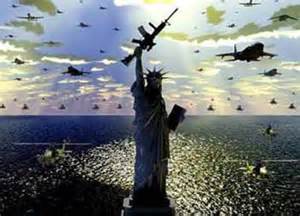
aa-American-Empire-statue-of-liberty-and-military

By Stephen Lendman

Source: SteveLendmanBlog

No nation in world history harmed more people grievously over a longer duration than America – never beautiful, no bastion of democratic values, no advocate of world peace and stability.

Bipartisan lunatics run things, a criminal cabal, humanity’s greatest threat. The domestic and geopolitical agendas of each new administration is worse than its predecessors.

Elections when held are farcical. Duopoly power always wins, monied interests alone served, ordinary people increasingly harmed – full-blown tyranny and nuclear war perhaps following the next major state-sponsored false flag.

Americans have no say on how they’re governed, democracy a mirage. None whatever exists. Scoundrel media and self-serving politicians pretend otherwise – most people either unaware of how they’re ill-served or too indifferent to try changing things, going along with what harms them.

Intelligent people I know are too preoccupied in their daily lives to realize and get involved against the grave danger facing humanity.

The likelihood of a Hillary presidency should terrify everyone – a war goddess, the greatest threat to world peace of any leader in US history if she succeeds Obama.

Yet media scoundrels serve as her press agents. Polls show her ahead. US voters are so out-of-touch, uninformed and indifferent, they support what demands opposition.

I tremble at what’s coming with her in charge. Things may never be the same again. How many more wars will be waged?

How many victims will die or be gravely harmed with her as president? Will the remnants of social justice be entirely discarded? Will police state ruthlessness be harsher than ever? Is unthinkable nuclear war likely?

Is Orwell’s dystopian nightmare on steroids our future? Will Americans ever awaken to the clear and present danger they face? Will they revolt or remain dismissive?


Stephen Lendman lives in Chicago. He can be reached at lendmanstephen@sbcglobal.net.

His new book as editor and contributor is titled “Flashpoint in Ukraine: How the US Drive for Hegemony Risks WW III.” http://www.claritypress.com/LendmanIII.html

Visit his blog site at sjlendman.blogspot.com. 

America, the World’s Most Dangerous Dictatorship

american-imperialism-39-638

By Gordon Duff

Source: New Eastern Outlook

Though Russia doesn’t consider herself a superpower, other than the US, and just perhaps China, Russia is as close as we come. A very real problem is that Russia has a very poor understanding of America, how politics work, what Americans think and, more than anything else, Russia still thinks America is a democracy.

You see, at the same time America was tearing the Soviet Union apart, the same thing was being done to America. Neither nation survived, it wasn’t just the Soviet Union that fell to the New World Order, it was America as well. Let me explain as succinctly as possible.

During the Clinton years, powerful Nazi inspired elements in America plotted what has been the successful overthrow of America’s constitution. The movement was led by rogue “industrialist” John Mellon Scaife and lawyers Antonio Scalia and Newt Gingrich. Financing them all was the Rothschild owned and controlled Federal Reserve Corporation.

A secret society hidden in plain sight was set up called the Federalist Society. This Nazi controlled group, backed by the powerful Israel lobby, moved into every law school in America, recruiting top candidates based on skill sets needed.

This program was devised by the CIA and recruited thousands of budding sociopathic personality types, recruiting them into the Federalist Society and channeling them into top law firms or government agencies.

Adding to these recruits were senior lawyers with ties to organized and corporate crime, thousands of them in a major CIA operation.

There, they were pushed forward and after a decade ran the US Department of Justice, nearly every court in the nation, controlled the law schools, controlled the American Bar Association, the FBI and had put over 150 of their members into the Congress of the United States.

They also controlled every regulatory agency, environment, banking and finance, food and drug safety, you can see where this is going.

They also controlled 5 justices of the Supreme Court of the United States.

During the Clinton Administration, they managed to temporarily get control of the US House of Representatives through the help of the Contract with America and Newt Gingrich, financed by Zionist “black propaganda” moneyman Rupert Murdoch. In payment for this, “Newt” gave Murdoch an American broadcast network, Fox, though illegal. You see, non-Americans can’t control networks, or couldn’t. That’s ok, Gingrich eventually gave Murdoch illegal American citizenship as well.

Murdoch only had to publish Newt’s useless books and give his wife, and Newt traded them in with regularity, a highly paid “do nothing job” as a bribe.

Where things really paid off was 2000. During the Clinton administration, Scaife hired lawyer Ken Starr to investigate Clinton and get himself nominated as Special Prosecutor. Scaife paid Starr by naming him President of Pepperdine University, which Scaife controlled, for those who care about facts.

Clinton backer George Soros hired a former CIA agent named Steve Kangas to get dirt on Scaife. Kangas amassed enough evidence on Scaife and his deal with Starr to send them both to the electric chair. Scaife, Scalia and the Federalists had Kangas kidnapped and murdered in order to save Ken Starr who had been promised a seat on the US Supreme Court. Look into it.

The deal really came to life in 2000. The CIA and Diebold Corporation had contracted with a computer guru named Michael Connell who developed software that would simply flip votes done on electronic voting machines. Targeted would be the states of Ohio, Florida and Virginia only, piling up votes in key precincts just enough to guarantee control of the Electoral College.

Without this it is impossible for the Republican Party to get a president elected without staging an international incident such as the kidnapping of US diplomats in Tehran. We aren’t going to say the Ayatollah was an MI6 agent and was sent to Iran for exactly this purpose, even though it is true and we can prove it.

In 2000, even with millions of votes flipped, exit polls support Bush losing by 5 million votes, the election couldn’t be saved. Here, the Federalists stepped in and had their 5 Supreme Court justices step in and overthrow both the areas of equal protection and states’ rights of the US Constitution to place Bush in office.

2000 was important. This was a presidential election that also took place on a census year. You see, the census is a rationale for redistricting the US House of Representatives using State legislatures, which were largely taken over by the Federalist Society. Bribes and payoffs at state level are hard to control and organized crime easily got control of enough states to allow redistricting.

Here, the CIA developed a program for designing odd shaped congressional districts that would pile union workers and minorities into bizarre and often discontiguous shapes, taking districts away from democrats by joining them together and creating new republican only districts, often with almost no people living in them.

Additionally, problem representatives like Ohio’s Dennis Kucinich were eliminated entirely, their districts were simply erased, all of this, and it is called gerrymandering, is illegal.

By 2004 there were no more free elections for the House of Representatives, giving this house free rein to investigate anyone, any time and to quell any investigation as well, such as 9/11.

By 2005, by a 5/4 vote, the Supreme Court in the Citizens United case overturned for all time limitations on foreign and corporate spending on American elections, citing an end to democracy in America.

Mike Connell, GOP “guru” died in a mysterious plane crash in Ohio just before testifying about his role in CIA “vote flipping.”

This is as short and sweet as it could be put. For those who fail to understand the Federalist Society and the hold organized crime through the Republican Party has gained over American government, the new Cold War and the threat of a hot war as well is a total surprise.

For those who pay attention, we saw it coming all along.

Hillary and the Clinton Foundation: Exemplars of America’s Political Rot

Clinton

By Eric Draitser

Source: CounterPunch

Hillary Clinton may be enjoying a comfortable lead in national polls, but she is far from enjoying a comfortable night’s sleep given the ever-widening maelstrom of scandals engulfing her presidential bid.  And while Clinton delights in bloviating about a decades-long “vast, right wing conspiracy” against her, the fact is that it’s the Clinton political machine’s long and storied track record of criminality, duplicity, and corruption that haunts her like Lincoln’s ghost silently skulking through White House bedrooms.

The latest in a string of embarrassing scandals is centered on the powerful Clinton Foundation, and the obvious impropriety of its acceptance of large donations from foreign governments (and wealthy individuals connected to them), especially those governments universally recognized as oppressive dictatorships whose foreign policy orientation places them squarely in the US orbit.

Of particular note are the Gulf monarchies such as Saudi Arabia and Qatar whose massive donations belie the fact that their oppression of women runs contradictory to Clinton’s self-styled ‘feminism’ and belief “that the rights of women and girls is the unfinished business of the 21st Century.”  Is collaborating with feudal monarchies whose subjugation of women is the stuff of infamy really Clinton’s idea of feminism?  Or, is it rather that Clinton merely uses issues such as women’s rights as a dog whistle for loyal liberals while groveling before the high councilors of the imperial priesthood?

What the Clinton Foundation hullabaloo really demonstrates is that Clinton’s will to power is single-minded, entirely simpatico with the corruption of the military-industrial-financial-surveillance complex; that she is a handmaiden for, and member of, the ruling establishment; that Clinton represents the marriage of all the worst aspects of the political class.  In short, Clinton is more than just corrupt, she is corruption personified.

Clinton’s Dirty Dealing and Even Dirtier Laundry

In a hilariously pig-headed, but rather telling, statement, former President Bill Clinton responded to allegations of impropriety with the Clinton Foundation by saying, “We’re trying to do good things…If there’s something wrong with creating jobs and saving lives, I don’t know what it is. The people who gave the money knew exactly what they were doing. I have nothing to say about it except that I’m really proud.”

Leaving aside the fact that such an arrogant comment demonstrates Bill Clinton’s complete contempt for ethics and the basic standards of proper conduct, the salient point is that the argument from the Clintons is that the foundation is inherently good, that it helps people around the world, and that, as such, it can’t possibly be corrupt and unethical.  Where there’s smoke, there’s fire – except when it comes to the Clintons who stand proudly enveloped in billowing clouds of smoke swearing up and down that not only is there no fire, but anyone who mentions the existence of flames is both a sexist and Trump-loving Putin stooge.

But indeed there is a fire, and it is raging on the American political scene.  And nowhere is the heat more palpable than in the deserts of the Middle East where wealthy benefactors write massive checks for access to America’s 21st Century Queen of Mean (apologies to Leona Helmsley).

Consider the 2011 sale of $29 billion worth of advanced fighter jets to Saudi Arabia, a gargantuan deal that made the feudal monarchy into an overnight air power.  Were there any doubts as to the uses of the hardware, look no further than the humanitarian nightmare that is Yemen, a country under relentless air war carried out by the Saudis.  And, lo and behold, the Saudis had been major contributors to the Clinton Foundation in the years leading up to the sale. And it should be equally unsurprising that just weeks before the deal was finalized, Boeing, the manufacturer of the F-15 jets that were the centerpiece of the massive arms deal, donated $900,000 to the Foundation.

Of course, according to Bubba and Hil, it’s all conspiracy theory to suggest that the Clinton Foundation is essentially a pay-for-play scheme in which large sums of money translate into access to the uppermost echelons of state power in the US.  As the International Business Times noted:

The Saudi deal was one of dozens of arms sales approved by Hillary Clinton’s State Department that placed weapons in the hands of governments that had also donated money to the Clinton family philanthropic empire…Under Clinton’s leadership, the State Department approved $165 billion worth of commercial arms sales to 20 nations whose governments have given money to the Clinton Foundation…That figure — derived from the three full fiscal years of Clinton’s term as Secretary of State (from October 2010 to September 2012) — represented nearly double the value of American arms sales made to the those countries and approved by the State Department during the same period of President George W. Bush’s second term.

The Clinton-led State Department also authorized $151 billion of separate Pentagon-brokered deals for 16 of the countries that donated to the Clinton Foundation, resulting in a 143 percent increase in completed sales to those nations over the same time frame during the Bush administration. These extra sales were part of a broad increase in American military exports that accompanied Obama’s arrival in the White House. The 143 percent increase in U.S. arms sales to Clinton Foundation donors compares to an 80 percent increase in such sales to all countries over the same time period.

Additionally, as Glenn Greenwald explained earlier this year,

The Saudi regime by itself has donated between $10 million and $25 million to the Clinton Foundation, with donations coming as late as 2014, as she prepared her presidential run. A group called “Friends of Saudi Arabia,” co-founded “by a Saudi Prince,” gave an additional amount between $1 million and $5 million. The Clinton Foundation says that between $1 million and $5 million was also donated by “the State of Qatar,” the United Arab Emirates, and the government of Brunei. “The State of Kuwait” has donated between $5 million and $10 million.

The sheer dollar amounts are staggering.  Perhaps then it comes as no surprise just why nearly every single influential figure in the military-industrial-financial-surveillance complex – from General John Allen to death squad coordinator extraordinaire John Negroponte, from neocon tapeworms such as Max Boot, Robert Kagan, and Eliot Cohen to billionaire barbarocrats like the Koch Brothers, George Soros, and Warren Buffett – is backing Hillary Clinton.  Not only is she good for Empire, she’s good for business.  And ultimately, that’s what this is all about, isn’t it?

But of course, Hillary’s devotion to the oil oligarchs of Saudi Arabia and the Gulf goes much deeper than simply an exchange of money for weapons.  In fact, Hillary is deeply committed to the Saudi royal family’s foreign policy outlook and tactics, in particular the weaponization of terrorism as a means of achieving strategic objectives.

Libya provides perhaps the paragon of Clintonian-Saudi strategy: regime change by terrorism.  Using terror groups linked to Al Qaeda and backed by Saudi Arabia, Clinton’s State Department and the Obama Administration managed to topple the government of Muammar Gaddafi, thereby throwing the former “jewel of Africa” into turmoil and political, economic, and social devastation.   To be fair, it was not the Saudis alone involved in fomenting war in Libya, as Hillary’s brothers-from-other-mothers in Qatar and the United Arab Emirates were also directly involved in sowing the seeds of the current chaos in the country.

And of course, this strategic partnership between Clinton and the Gangsters of the Gulf extends far beyond Libya.  In Syria, Clinton’s stated policies of regime change and war are aligned with those of Riyadh, Doha, and Abu Dhabi.  And, of course, it was during Clinton’s tenure at the State Department that US intelligence was involved in funneling weapons and fighters into Syria in hopes of doing to Syria what had already been done to Libya.

Huma Abedin: Clinton’s Woman in Riyadh

Just in case all the political and financial ties between Clinton and the Gulf monarchies wasn’t enough to make people stop being #WithHer, perhaps the role of her closest adviser might do the trick.  Huma Abedin, Clinton’s campaign chief of staff, has long-standing ties to Saudi Arabia, the country where Huma spent her childhood from the age of two.  As a Vanity Fair exposé revealed earlier this year:

When Abedin was two years old, the family moved to Jidda, Saudi Arabia, where, with the backing of Abdullah Omar Nasseef, then the president of King Abdulaziz University, her father founded the Institute of Muslim Minority Affairs, a think tank, and became the first editor of its Journal of Muslim Minority Affairs…After [Abedin’s father] Syed died, in 1993, his wife succeeded him as director of the institute and editor of the Journal, positions she still holds… Abdullah Omar Nasseef, the man who set up the Abedins in Jidda…is a high-ranking insider in the Saudi government and sits on the king’s Shura Council, there are claims that Nasseef once had ties to Osama bin Laden and al-Qaeda—a charge that he has denied through a spokesman—and that he remains a “major” figure in the Muslim Brotherhood. In his early years as the patron of the Abedins’ journal, Nasseef was the secretary-general of the Muslim World League, which Andrew McCarthy, the former assistant U.S. attorney who prosecuted the “Blind Sheik,” Omar Abdel Rahman, in the wake of the 1993 World Trade Center bombing, claims “has long been the Muslim Brotherhood’s principal vehicle for the international propagation of Islamic supremacist ideology.”

Consider the implications of this information: Clinton’s closest adviser comes from a family connected at the highest levels with the Saudi royal family as well as the Muslim Brotherhood.  While right wing pundits portray the Muslim Brotherhood as some sort of straightforward international terror organization, the reality is much more complex as the Brotherhood is more an international political movement whose tentacles stretch into nearly every corner of the Muslim world. Its vast reserves of cash and political influence, backed by Gulf monarchies such as Qatar, allows the Brotherhood to peddle influence throughout the West, while also being connected to more radical salafist elements.  An obvious two-for-one for Clinton.

In effect then, Abedin represents a bridge connecting Hillary with both the ruling elites in Riyadh, as well as influential clerics, businesspeople, and political leaders throughout the Middle East. Perhaps then it makes sense why Abedin, in contravention of every standard of ethics, was employed by Teneo Holdings – a pro-Clinton consultancy founded by former Clinton aide Doug Band – while also working for the State Department.  Such ethical violations are as instinctive for Hillary as breathing, or calling children superpredators.

Trump, Assange, Putin, and Clinton’s Sleight of Hand

Despite being embroiled in multiple scandals, any one of which being enough to sink the campaign of most other candidates, Clinton and her army of fawning corporate media sycophants, have attempted to deflect attention away from her own misdeeds, corruption, and nefarious ties by instead portraying everyone who opposes them as puppets, stooges, and useful idiots.

Let’s begin with Republican nominee and gasbag deluxe, Donald Trump, who Clinton trolls have attempted to portray as a stooge of Russian President Putin.   While it’s indeed quite likely that the Kremlin sees Trump as far less of a threat to Russia’s interests than Clinton – just look at Clinton’s roster of neocon psychopath supporters to see that Putin has a point – the notion that Trump is somehow a creation of Putin, or at the very least is working for him is utterly absurd.

And the “evidence”? Trump’s connections with wealthy Russian oligarchs.  I suppose those who have made their homes under rocks these last 25 years might not know this, but nearly every billionaire investor has gone to Russia in that time, forged ties with influential Russians, and attempted to make money by stripping clean the bones of what was once the Soviet Union.  Sorry Naomi Klein, I guess the Clintonistas expect no one to have read Shock Doctrine which details the sort of disaster capitalism run amok that took place in Russia in the 1990s.

And then, of course, there’s that great confabulator Julian Assange who has also been smeared as a Putin puppet by the #ImWithHer media somnambulists.  I guess the lords of corporate capital didn’t like the fact that Assange and WikiLeaks have managed to expose countless dirty deeds by Clinton’s Tammany Hall of the 21stCentury.  From using the DNC as a political appendage of the Clinton campaign (as revealed by the WikiLeaks dump of DNC emails) to his recent promise to make public the “most interesting and serious” dirt on Hillary, Assange has become a thorn in the side – or thumb in the eye, as it were – for Hillary.

And what would a rundown of the specters haunting Clinton’s dreams be without mention of the rabid bear of Russia, big bad Vlad?  Clinton recently referred to Putin as the “grand godfather of this global brand of extreme nationalism.”  Leaving aside the asinine phraseology, Clinton’s attacks on Putin reveal the weakness of the Democratic nominee, the hollowness of her arguments, and the unmitigated gall of a hypocrite for whom casting stones in glass houses is second nature.

For, at the very moment that she takes rhetorical swipes at Putin, Clinton herself is implicated in a worldwide network of extremism that promotes terrorism, rains death and destruction on millions of innocent civilians, and moves the world closer to global conflict.  If Putin represents the éminence grise of a “global brand of extreme nationalism,” then Clinton is the fairy godmother of global extremism and terror.  It’s a good thing she has access to the best personal grooming products Goldman Sachs money can buy as it is not easy to wash decades-worth of blood off your hands.

And so, the quadrennial danse macabre that is the US presidential election has turned into an embarrassing sideshow of dull-witted infantilism.  But amid the idiocy there is wanton criminality and corruption to be exposed before the world.  For while Trump is undoubtedly the bearded lady of America’s freak show, Hillary is the carnival barker.

She knows the ring toss and other games are rigged, but she coaxes the feeble-minded to play nonetheless.  She knows the carnies are drunk and reckless, but she urges the children to pay for another ride anyway.  She understands that her job is to sell a rigged game, and to call security when someone challenges her lies. And, unfortunately, whether you want it or not, the Hillary Roadshow is coming to a town, or country, near you.

Eric Draitser is the founder of StopImperialism.org and host of CounterPunch Radio. He is an independent geopolitical analyst based in New York City. You can reach him at ericdraitser@gmail.com.

How Can a CEO Feel Good About Being Vile?

Heather-Bresch-800x430

Is a big raise enough to make CEOs feel good about being so vile?

By Jim Hightower

Source: OpEdNews.com

Corporate price gouging is never nice. But gouging people on the price of medicines they rely on to stay alive is worse than not nice — it’s predaceously evil.

And if you think corporate morality can’t go lower than that, how about gouging people on the price of a life-saving medicine in order to jack up the personal pay of a drug maker’s CEO? That’s the bottom level of grotesque immorality where Heather Bresch dwells. She is chief executive of Mylan, a pharmaceutical profiteer that markets the EpiPen medical device, which literally is a lifesaver for people who suffer deadly anaphylaxis allergy attacks.

These allergy attacks kill nearly 200 people a year in the U.S. alone. Within seconds, something as common as peanuts or a bee sting can cause severe rash, swelling of the airways, drops in blood pressure, shock, and if not treated right away, death. So, naturally, we would want to increase access to the life-saving medicine that prevents these attacks, right?

Increasing that access is hard to do at today’s price. For years, a two-shot packet of EpiPens cost under $100, but Mylan bought the rights to the injectable drug in 2007, gained monopoly control of the market, and in 2012 suddenly began sticking dependent patients again and again with drastic price hikes. Now, the two-pack averages more than $600, with some paying above $900!

Drug makers routinely claim they must charge high prices to recoup their cost of developing their products — but Mylan didn’t develop the EpiPen, taxpayers did. The original research was initiated by the Pentagon back in 1973. Today, the device and the medicine in it cost Mylan only a few dollars to produce, and the product itself is essentially unchanged from when Mylan bought it. So the company’s only real contribution to the EpiPen has been to raise its price by more than 600 percent — a shameful act of sheer profiteering that rips off hundreds of thousands of users and endangers the lives of those families who simply can’t afford it.

Mylan’s CEO, the one responsible for this price gouge, regards herself as a self-made corporate success story — a woman who came out of hard-scrabble West Virginia and scrambled to the top of the food chain at Mylan. “There is a work ethic and grit about [West Virginia] that allows me to help make a difference,” Bresch told the New York Times.

Well, yes, grit, hard work — and having the advantage of being the daughter of the state’s former governor and current US Senator, Joe Manchin III. Take the MBA degree she got from West Virginia University, an academic credential bestowed on her 10 years after she left the school, having completed only about half of the coursework required to get a degree. The state university later conceded that Bresch was awarded this business degree… well, because her father was governor at the time, overseeing the school’s budget. It’s this sort of ethical “grit” that Mylan’s chief exec has employed to pick the pockets of thousands of vulnerable customers who rely on EpiPen.

Heather’s greed has sparked a furious public backlash, leading to congressional investigations. But, again, her “grit” might pay off, for she has bought off several top allergy-patient advocacy groups who are not backing the people. Why? Because she’s been dispensing millions of dollars to them in PR grants, making them “allies” in her blatant price-gouging scheme.

One thing that has risen higher than EpiPen’s price: CEO Heather Bresch’s paycheck. It’s up by 671 percent since 2007, and last year alone she pocketed $18.9 million! But I wonder — is that enough to make her feel good about being so vile? Of Course, Congress and the courts will do nothing to deter her and the other Big Pharma gougers — but surely the lowest level of Dante’s Inferno has rooms reserved for all of them.


Jim Hightower is an American populist, spreading his message of democratic hope via national radio commentaries, columns, books, his award-winning monthly newsletter (The Hightower Lowdown) and barnstorming tours all across America.


BREAKING: Benghazi Documents FINALLY Found – Hidden In Hillary’s Deleted Email File

Screen-Shot-2016-08-27-at-6.36.34-AM

By Melissa Davis

Source: US Herald

Democrat nominee Hillary Clinton may have thought she could breathe a sigh of relief when FBI Director James Comey did not recommend charges be filed against her in connection with her unprecedented secret server set-up, but she hadn’t counted on federal judges, who are not quite as forgiving.

U.S. District Court Judge William P. Dimitrouleas has ordered the State Department to search 14,900 newly found Clinton emails to determine if any are responsive to requests in a Judicial Watch Freedom of Information Act (FOIA) lawsuit filed last year.

The FOIA requests sought all communications between then-Secretary of State Hillary Clinton and the Obama White House related to the 2012 terror attack on the U.S. Consulate in Benghazi from the day it took place – the anniversary of 9/11 – through the following week.

This week, the State Department was forced to admit in court filings it had “received positive hits” for Benghazi-related documents among the nearly 15,000 Clinton emails uncovered by the FBI during its more than year-long investigation into Mrs. Clinton’s unauthorized use of a private server housed at her home during her tenure as President Obama’s first Secretary of State.

Judge Dimitrouleas gave the Department until September 13 to review the emails, in addition to other communications, and turn over responsive records, but Clinton’s former department claimed it cannot comply with the order by the deadline due to the large number of emails to be reviewed, estimating that it will take until well after the November 8 election.

In a potentially devastating development it was learned that not only did Clinton withhold emails from State when she left the position, contrary to federal law and regulation, but utilized software to degrade the digital data to the extent that it cannot be retrieved.

The use of “bleach bit” technology could, conceivably, lead to allegations of obstruction of justice and evidence of intent.

Why Ajamu Baraka? Why Vice President? And Why the Green Party?

Ajamu-Baraka-final

What does the Green Party nomination of longtime Black Agenda Report contributing editor Ajamu Baraka for Vice President mean for the Green Party and the 2016 presidential election?  Is he just a black face on the ticket, or is it really time to begin organizing in black and brown communities outside the matrix of the bankrupt black and brown misleadership class?

By Bruce A. Dixon

Source: Black Agenda Report

In Houston on the first Saturday of August, the Green Party nominated Jill Stein, a Massachusetts physician, and Ajamu Baraka, a longtime human rights activists as its presidential and vice presidential candidates for 2016.  Stein’s nomination was a foregone conclusion, having been the Green candidate in 2012 and the only one of several aspirants to raise money, hire staff and campaign across the country full time for more than a year.

Ajamu Baraka followed a different road to the nomination, having been an interested observer but with no organizational connection to the Green Party till now.  Ajamu Baraka was the founding executive director of the US Human Rights Network, which still seeks to have the framework of internationally recognized human rights law applied to the victims of social and economic injustice in the US.  This is a truly radical concept because the supreme law in the US is the Constitution, which chiefly guarantees property rights and the rights of corporations but not necessarily the rights of human beings to a quality education, the vote, decent housing, health care, renumerative jobs and the right to organize, or to a safe and clean environment, none of which are mentioned.
Ajamu Baraka was among the first to demand, in the wake of the Katrina disaster, that the 300,000 or so persons uprooted, the majority of them African American, be classified as “internally displaced” under international law, a status which would have guaranteed them the right to return to the cities and towns from which they were displaced and dispersed to the four corners of the US.  Since the 1980s Baraka has been a consistent and principled critic of imperial US foreign policy over the years in Africa, Asia, Central and South America and the Middle East.  He’s served in and led fact-finding delegations to Central America, Cuba, Israel-Palestine, Colombia and other places.  In the wake of the 2010 hunger strike waged by Georgia prisoners, Baraka led an unprecedented civilian inspection team into two state prisons where they were able to interview staff and prisoners alike.

I should say here that I count both Jill and Ajamu as comrades and personal friends, that I was on Jill’s campaign staff for several months and that Ajamu Baraka has more than 50 articles published at Black Agenda Report.
So why Ajamu Baraka?

It’s not a simple matter of putting a black face on the ticket.  Greens have run black candidates in local and national races before without managing to make a significant dent in traditional black allegiances to the Democratic party.

Stein chose Baraka because one of her campaign’s objectives is to strengthen state and local Green parties.  As a result of his more than four decades of work in the movement, Baraka has longstanding personal ties with and has been mentor to many of the activists involved in the Black Lives Matter movement around the country.  If anyone can carry the message to these forces that now is the time for organizing alternative centers of struggle for political power, centers of struggle outside the two capitalist parties and outside the nonprofit industrial complex, that someone is Ajamu Baraka.

African American voters have long been the rock upon which the Democratic party’s voting coalition rests.  But since blacks vote Democratic mainly out of fear of the Republicans, they are a captive constituency whose votes are counted but whose demands are ignored.  Jill and the Greens know it will take more than running good black or brown candidates to make its black, Latin and working class captive constituencies climb out of the Democrats’ trunk.  Realistically that won’t much happen this election.  The candidacies of Greens like Joshua Harris in Baltimore and Ashley Flash Gordon in Travis County TX are signs that something new and unprecedented is peeking over the horizon, something that will challenge the vacuity and lack of vision of the black political class.  It’s not a challenge mature enough to accomplish a string of local electoral victories across the country.  But it’s real, it’s gaining ground, building experience and it’s not going away.

The present black political class and the leadership model that supports it have been in place pretty much since the days of Booker T. Washington twelve decades ago.  They won’t be displaced this election cycle, but their political bankruptcy is every bit as real and obvious as that of their white counterparts.

Why Vice President?

A frequently asked question is why Greens run candidates for president every year, but haven’t elected or even run candidates in many states for state reps and state senators, for county commissioners and members of congress.  The answer is really simple.

The two capitalist parties protect themselves against competitors with a briar patch, a minefield of provisions and conditions expressly designed to make it all but impossible for parties not financed by the one percent to appear on the ballot.  In many states, candidates who are not Democrats or Republicans are prohibited from appearing on the ballot until after their parties have scored one percent, two percent or five percent, depending on the state, in a statewide election.

This legal requirement in states like Georgia that Greens must score tens or hundreds of thousands of votes in statewide races before being allowed to run in local races is one more of the deliberate obstacles Democrats and Republicans have erected to competition from third parties at the ballot box.  And it’s why Ajamu Baraka is running for vice president and Jill Stein for president much of the country were Greens are not allowed to run for local office.

Why the Green Party?

For the last fifty years, Republicans have deliberately made themselves the party of white racists and nativists.  There’s simply in the Republican party or African Americans except a shorter line.  Democrats talk a different game, but are responsible to the same one percenters who fund Republicans, so once in office, Democrats govern pretty much like Republicans.  In fact Democratic presidents and governors frequently enact the oppressive policies we won’t allow Republicans to enact.

NAFTA came up twice during the first Bush presidency and failed.  It took a Democrat, a President Clinton to rally enough right wing Democrats to ally with Republicans to get it into law.  Ending public aid was also something no Republican could do, but Democrats only need  the support of the black and poor when they’re candidates, not so much when they’re governing.  The 2008 Bush bailout went before a Democratic Congress and it failed.  Barack Obama had to suspend his campaign for a week and come to DC and work the phones to flip the Congressional Black Caucus and enough other Democrats to pass the Bush bailout, which he quadrupled down on once in the White House.  Again it was a blow no Republican could have struck, though many wanted to.

Barack Obama used stimulus money to fund what he called “Race To The Top”, a drive to privatize public education that resulted in the closing and privatization of thousands of public schools, and pushed hundreds of thousands of qualified experienced public school educators out of the classroom.  This too was something no Republican could have accomplished, much as they wanted to.  There are many, many similar examples of Democrats accomplishing the right wing goals Republicans can only talk about on the state and local levels.
Republicans like Donald Trump talk about how they’d like to do mass deportations.  But our First Black President has deported two million people, more than any other three presidents combined, after promising Latino voters “a road to citizenship” in both his campaigns.

The only reason to vote for Democrats is our fear of Republicans, and as Jill Stein says, this politics of fear has delivered to us everything we were afraid of.  People voted Democratic to end the war in Iraq but we got more war in the Middle East and Africa.  People voted Democrat to raise the minimum wage and see millions of new jobs created.  But the minimum wage has barely risen and the only reason official unemployment figures are down is that his policies have pushed millions of people out of the formal workforce into increasingly precarious economic situations.

At the end of the reign of our first black president, a Democrat when blacks have been the rock and mainstay of Democratic voting coalitions for two generations, forty percent of black children are growing up in poverty.  Isn’t it time for some new questions?

Why must “progressives” ride to Hillary’s rescue if we don’t get progress?

Trump is a bumbling clown and a bogeyman.  He’s raising a fraction of the money Romney raised, four years ago.  Hillary Clinton has a billion dollars to campaign with and most of the corporate media. If she can’t beat this fool with all the resources available to her, why is it up to us?  Why?  Hillary ought to be, and ought to have been helping us, not the other way around.

I don’t expect the Greens to win the presidential election.  But the US system is almost 250 years old, one of the most elderly on the planet.  Its creaks and cracks are highly visible and aren’t going away.  Isn’t it time to start imagining and building what comes next, what comes after capitalism, what comes after genocide and ecocide, what comes after patriarchy and white supremacy?

Isn’t it time to start being the change we want to see?

That won’t happen inside the Democratic party.  It’s been tried again and again.  It’s time to build something different.  So why not the Green Party?
Bruce A. Dixon is managing editor at Black Agenda Report and a member of the state committee of the Georgia Green Party.  He lives and works near Marietta GA and can be reached via email at bruce.dixon(at)blackagendareport.com.