Our Vanishing World: Oceans

By Robert J. Burrowes

As the human onslaught against life on Earth accelerates, no part of the biosphere is left pristine. The simple act of consuming more than we actually need drives the world’s governments and corporations to endlessly destroy more and more of the Earth to extract the resources necessary to satisfy our insatiable desires. In fact, an initiative of the World Economic Forum has just reported that ‘For the first time in history, more than 100 billion tonnes of materials are entering the global economy every year’ – see ‘The Circularity Gap Report 2020’ – which means that, on average, every person on Earth uses more than 13 tonnes of materials each year extracted from the Earth.

As I have explained elsewhere, however, the psychological damage we have all suffered, which leaves us with unmet but critically important emotional needs (and, in many cases, the sense that our lives are meaningless), cannot be rectified by material consumption. Despite this, most of us will spend our lives engaged in a futile attempt to fill the aching void in our psyche by consuming and accumulating, at staggering cost to the Earth. Identifying when we have ‘enough’ is a capacity that most modern humans have never acquired for reasons that can be easily explained. See ‘Love Denied: The Psychology of Materialism, Violence and War’.

Hence, our world continues to vanish, as has been extensively documented. For a summary, see ‘Human Extinction Now Imminent and Inevitable? A Report on the State of Planet Earth’.

And nowhere is this more evident than in the planet’s oceans, which are being systematically destroyed and where life is being progressively extinguished.

In fact, our destruction of the oceans is now so advanced that the fish, mammals (including seals, whales, manatees, sea otters and polar bears), crustaceans (including crabs, lobsters, crayfish, shrimps, prawns, krill and barnacles), coral reefs (made up of coral polyps, marine invertebrate animals that live in colonies) and the millions of species that live in and around them (including sponges, mollusks, sea anemones, seahorses, sea turtles as well as crustaceans and an enormous variety of fish), plants (such as algae, seaweed and seagrass), microscopic organisms (residing in the ocean and on the ocean floor), invertebrates (such as sea urchins and sea slugs), birds (including better known ones such as penguins, auks, murres, razorbills, puffins, tubenoses – such as the albatross and petrels – pelicans and gulls and a great many species that are less well known), and the other lifeforms that live in and on the ocean are vanishing rapidly.

Starkly illustrating the catastrophic nature of what is taking place, one recent incident alone killed 100 million Pacific cod. See ‘Ocean heat waves like the Pacific’s deadly “Blob” could become the new normal’. But, tragically, such incidents are no longer unusual and, of course, they generate cascading impacts. See, for example, ‘Fish all gone!… Millions of small sea birds died since 2015’.

‘How can we destroy the oceans?’ you might ask. Unfortunately, far too easily when you consider the range of assaults to which they are being subjected.

So let me give you a brief 18-point outline of what we are doing that is destroying the oceans – where life on Earth originated and which remains the planet’s main life support system by dominating the processes that keep our planet habitable such as regulating the climate by absorbing excess carbon dioxide and heat – while also giving you some idea of the impacts of this on the creatures that live in and on the oceans.

As a result of human activities that generate carbon emissions, we are dumping ever-increasing amounts of carbon dioxide into the oceans which have absorbed 20–30% of total anthropogenic emissions in the last two decades. This is causing the oceans to warm, acidify and lose oxygen, among several other adverse outcomes. See ‘The Ocean and Cryosphere in a Changing Climate: A Special Report of the Intergovernmental Panel on Climate Change’. p. 450. These adverse changes, in turn, generate a range of ‘downstream’ negative impacts. However, there are other human activities unrelated to carbon emissions that are destroying the oceans too.

So here is the summary.


  1. The oceans are warming.

In relation to warming, the oceans have been heating up for several decades and, since 2005, the increase has been unchecked. Moreover, it is occurring at all ocean depths, including in the deep ocean (below 2,000 metres). In addition, the rate of warming has been increasing and the rate of ocean uptake of atmospheric CO2 has continued to strengthen in the last two decades in response to the increasing concentration of CO2 in the atmosphere. This is causing the upper ocean to stratify making the surface ocean less dense over time, compared to the deeper ocean, and inhibiting the exchange between surface and deep waters.

As one result of this ocean warming, the range of some species has expanded and, in the case of tropical species that have expanded into higher latitudes, it has led to increased grazing on some coral reefs, rocky reefs, seagrass meadows and epipelagic (near-surface) ecosystems, leading to altered ecosystem structure.

Ocean warming has also contributed to changes in the biogeography of organisms ranging from phytoplankton to marine mammals, consequently changing community composition, and in some cases, altering interactions between organisms. The net outcome is an adverse impact on marine organisms and fisheries with serious implications for human communities and food production.

Ocean warming is also manifesting in a range of diverse and unpredicted ways with one of the more catastrophic aberrations, touched on above, being the occurrence of ‘blobs’: huge patches of unusually warm ocean water that can be millions of square kilometres in size. These ‘marine heatwaves’ wreak havoc, sometimes killing millions of ocean creatures in a single incident (including by disturbing food chains), forcing others to relocate, and perhaps generating unusual blooms of toxic algae. See ‘Ocean heat waves like the Pacific’s deadly “Blob” could become the new normal’.

Among its other impacts, the warming oceans mean there is more available energy that can be converted into cyclonic winds. Research on this subject indicates that there has been ‘an increase in intense hurricane activity over the past 40 years’. See ‘Hurricanes and Climate Change’ and Changes in Tropical Cyclone Number, Duration, and Intensity in a Warming Environment. These events cause landslides, collapses in fisheries, and damage to reefs and shallow-water habitats. When they impact on coastal communities, they kill people and destroy properties, among other outcomes. See ‘The state of our oceans – The damaging effects of ocean pollution’.

Warming oceans also cause coral bleaching. This is because corals have algae that live in their tissues and these algae provide the coral with essential nutrients and give them their color. The warming oceans cause this relationship to become stressed, forcing the algae out of the coral. As a result, the coral becomes white, loses its main food source, and becomes more vulnerable to disease. See ‘Coral Bleaching’.

Warmer ocean water causes sea level rise too because warmer water has a greater volume than colder water. Of course, sea level rise also occurs because of the additional water from melting land ice and a devastating level of rise from this cause is already ‘locked in’ because of past emissions. See ‘Sea Level Rise!’

Ocean warming and increased stratification disturb ocean nutrient cycles and this is having a regionally variable (but usually adverse) impact on many species too.

And finally, ocean warming – most likely from ice loss in the Arctic – is weakening the Atlantic Meridional Overturning Circulation (AMOC) which is one of the key drivers of global ocean circulation; it includes the Gulf Stream that transports warm and salty tropical waters north to the western coasts of Europe where the warm water releases heat to the atmosphere, playing a key role in the warming of western Europe and thus its functional habitability. Once the tropical water reaches the south and east of Greenland, it cools before sinking to the base of the North Atlantic Ocean because it is saltier and thus denser than the surrounding fresh water. The water is then pushed south along the abyss of the Atlantic Ocean completing what has been, from a human viewpoint, a perpetual cycle. See Arctic sea-ice decline weakens the Atlantic Meridional Overturning Circulation and Global Ocean Circulation Appears To Be Collapsing Due To A Warming Planet’. How much longer it will be so appears to defy reliable scientific assessment. But as it breaks down, the adverse outcomes multiply rapidly.

In fact, ocean circulation generally is being impacted by the warming climate, as established by a recently concluded study:

Ocean circulation plays a vital role in regulating the weather and climate and supporting marine life…. Here, we show for the first time, independent satellite observational evidence demonstrating that the large-scale ocean gyres are moving poleward during the past four decades. Further analysis based on climate models and various other data sets reveal that the poleward shifting of the ocean gyre circulation is most likely to be a consequence of global warming, which so far has not been well recognized by the public and the scientific community…. Such changes have had disastrous consequences…. See Poleward shift of the major ocean gyres detected in a warming climate.


  1. The oceans are becoming more acidic.

In response to the increasing carbon uptake the oceans are also becoming more acidic. This has probably been the case for three-quarters of the near-surface open ocean since prior to 1950 and it is very likely that over 95% of the near surface open ocean has now been affected. See ‘The Ocean and Cryosphere in a Changing Climate: A Special Report of the Intergovernmental Panel on Climate Change’. p. 450.

In a stark warning issued by the International Programme on the State of the Ocean (IPSO) in 2013, scientists had already noted that the oceans are becoming more acidic at the fastest rate in 300m years. Why? Because of carbon dioxide emissions from burning fossil fuels. ‘This [acidification] is unprecedented in the Earth’s known history. We are entering an unknown territory of marine ecosystem change, and exposing organisms to intolerable evolutionary pressure. The next mass extinction may have already begun.’ See ‘Rate of ocean acidification due to carbon emissions is at highest for 300m years’.

In its latest report, issued in 2018, IPSO declared the following: ‘The ocean, by its breadth and depth, occupies more than 97% of the living space on Earth. It dominates the processes that keep our planet habitable…. But this protection comes at a cost as the ocean is now becoming more acidic…. For too long we have mistaken the immensity of the ocean for inviolability, but those days are gone, and we stand at a critical juncture. Cutting emissions, while essential, will not alone solve the environmental problems we face.’ See ‘Eight urgent fundamental and simultaneous steps needed to restore ocean health, and the consequences for humanity and the planet of inaction or delay’.


  1. The oceans are deoxygenating.

Oxygen in the air or water is of paramount importance to most living organisms. Unfortunately, as a recent report documents in considerable detail (and which confirms earlier research), oxygen levels are currently declining across the ocean (and not just in the more widely known ocean ‘dead zones’: see below). See ‘Ocean deoxygenation: Everyone’s problem. Causes, impacts, consequences and solutions’.

Deoxygenation of the ocean is the result of two overlying causes – eutrophication (the process by which a body of water becomes overly enriched with minerals and nutrients thus inducing excessive growth of algae which absorb the oxygen at the expense of the water body) as a result of nutrient run-off from land and deposition of nitrogen from the burning of fossil fuels, as well as the heating of ocean waters as another outcome of burning fossil fuels, primarily causing a change in ventilation with the overlying atmosphere so that the oceans hold less soluble oxygen (and which is compounded by reduced ocean mixing and changes in currents and wind patterns). Ocean deoxygenation is but the latest consequence of our activities on the ocean to be recognized and is yet another ‘major stressor’ on marine systems.

Eutrophication has been identified as a problem in 900 separate areas of the ocean, with 700 of these suffering hypoxia (low oxygen) as a result. But because ocean warming lowers oxygen directly, it is now impacting vast areas of the ocean as well. As a result, ‘the ocean has now become a source of oxygen for the atmosphere even though its oxygen inventory is only about 0.6% of that of the atmosphere’. Moreover, different analyses have concluded that global ocean oxygen content has decreased by 1-2 % since the middle of the 20th century. Given existing trends in the factors driving this change, the rate of loss must accelerate.

Obviously, the future intensification and expansion of low oxygen zones will have further adverse ecosystem and biogeochemical consequences, particularly in combination with, and sometimes synergistically with, other threats. For example, ‘ocean warming accompanied by deoxygenation will drive habitat contraction and fragmentation in regions where oxygen levels decline below metabolic requirements’.


  1. The oceans are being contaminated with nuclear radiation.

Despite an extensive and ongoing coverup by the Japanese government and nuclear corporations as well as the International Atomic Energy Agency (IAEA), vast amounts of radioactive waste are being dumped into the biosphere from the TEPCO nuclear power plant at Fukushima in Japan including by discharge into the Pacific Ocean. This is killing an incalculable number of fish and other marine organisms and indefinitely contaminating expanding areas of that ocean. See ‘Fukushima: A Nuclear War without a War: The Unspoken Crisis of Worldwide Nuclear Radiation’, ‘2019 Annual Report – Fukushima 8th Anniversary’, ‘Eight years after triple nuclear meltdown, Fukushima No. 1’s water woes show no signs of ebbing’ and ‘Fukushima’s Three Nuclear Meltdowns Are “Under Control” – That’s a Lie’.

In addition, one critical legacy of the US military’s 67 secretive and lethal nuclear weapons tests on the Marshall Islands between 1946 and 1958 is the ‘eternally’ radioactive garbage left behind and now leaking into the Pacific Ocean. See ‘The Pentagon’s Disastrous Radioactive Waste Dump in the Drowning Marshall Islands is Leaking into the Pacific Ocean’.

And, of course, there are up to 70 ‘still functional’ nuclear weapons as well as nine nuclear reactors lying on the ocean floor as a result of accidents involving nuclear warships and submarines. These are leaking an unknown amount of radiation into the oceans. See ‘Naval Nuclear Accidents: The Secret Story’, ‘A Nuclear Needle in a Haystack: The Cold War’s Missing Atom Bombs’ and, for one specific example (the former Soviet submarine Komsomolets), see ‘Soviet nuclear submarine emitting radiation “100,000 times normal level” into sea, scientists find’.


  1. The oceans are being contaminated as a result of offshore oil and gas drilling, as well as oil spills.

The complex but far-from-perfect technologies and the many environmental challenges associated with oil and gas drilling in the ocean have ensured the near-routine occurrence of often disastrous accidents which invariably lead to fossil fuels and other contaminants being discharged into the ocean, sometimes on a vast scale.

The classic case, of course, was the BP-leased Deepwater Horizon rig which had drilled a well to 35,055 feet (10 kilometers) while operating in 4,130 feet (1 kilometer) of water. The oil rig exploded and sank in the Gulf of Mexico on 20 April 2010 releasing 5 million barrels of oil into the ocean making it the worst environmental disaster in US history. It caused extensive damage to the ocean, corals and beaches and killed millions of fish, birds and marine mammals in and on the ocean. Despite a ‘clean up’, only one quarter of the oil was ever removed from the ocean. See ‘The Dangers of Offshore Drilling’.

The simple reality is that despite the industry’s safety claims, oil rig fires are commonplace. See ‘Why Is Offshore Drilling So Dangerous?’

And so are oil spills into the ocean for other reasons, including from tankers – see ‘Top 10 Worst Oil Spills’ – as the Exxon Valdez disaster in 1989 demonstrated all too graphically. See ‘The Complete Story of the Exxon Valdez Oil Spill’.

Often enough as well, oil is discharged into the ocean as a result of military activities and war. During the Gulf War in 1991, for example, vast quantities of oil were released into the Persian Gulf as a military tactic. See ‘The World’s Largest Oil Spill: The Gulf War Kuwait, 1991’ and Gulf War Oil Disaster: A Brief History’.


  1. The oceans are being damaged by deep sea mining.

Recent technological advances spurred by growing demand for minerals used in consumer electronics has led to increased interest in deep sea mining as the next frontier in resource extraction. Hailed as the new ‘global gold rush’, deep sea mining entails extracting minerals from deposits in the deep sea (approximately 400 to 6,000 meters below sea level) for use in emerging and high technology, among other sectors. Predictably, deep sea mining shares many features with past resource scrambles, including a general disregard for environmental and social impacts, and the marginalization of indigenous peoples and their rights. See ‘Broadening Common Heritage: Addressing Gaps in the Deep Sea Mining Regulatory Regime’ and ‘Deep-sea mining possibly as damaging as land mining, lawyers say’.

Beyond these adverse impacts, however, recent research makes it increasingly clear that deep sea mining poses a grave threat to vital seabed functions, including those played by hydrothermal vents and cold seeps, for example, which support remarkable biodiversity and sequester disproportionate amounts of carbon. Moreover, recent scientific breakthroughs have further revealed that most of the excess heat resulting from increased atmospheric concentrations of greenhouse gases has been absorbed by the deep ocean, thereby significantly limiting the climate catastrophe’s impacts on the ocean’s surface and on land. See ‘Deep sea ecology: hydrothermal vents and cold seeps’ and ‘Broadening Common Heritage: Addressing Gaps in the Deep Sea Mining Regulatory Regime’.

In essence, deep sea mining threatens the ‘common heritage’ the seabed provides through its substantial contributions to biodiversity, climate regulation and heat storage.


  1. The oceans are being polluted with industrial (including chemical) and farming wastes including pesticides and fertilizers which are generating ‘dead zones’, regions of the oceans that are devoid of life.

Despite the existence of the ‘Convention on the Prevention of Marine Pollution by Dumping of Wastes and other Matter’ (otherwise known as the London Dumping Convention, 1972), an international treaty ‘that created a global system to protect the marine environment from pollution caused by ocean dumping’ – and certainly including radioactive wastes, fossil fuels, some toxic wastes, biological and chemical warfare agents, and persistent synthetic materials such as plastic – and supposedly ‘ensures that the few materials that are permitted for ocean disposal are carefully evaluated to make sure that they will not pose a danger to human health or the environment’ – see ‘1972 Prevention of Marine Pollution by Dumping of Wastes and Other Matter (London Convention)’ – the Convention must be one of the least comprehensive and most violated in international law. In any case, there is no evidence that it has any restraining impact on the actions of states or corporations as the evidence above and below demonstrates.

For example, a vast runoff of industrial wastes (including heavy metals), agricultural poisons, fossil fuels and other wastes is discharged into the ocean, adversely impacting life at all ocean depths – see ‘Staggering level of toxic chemicals found in creatures at the bottom of the sea, scientists say’ – and, as noted above, generating ocean ‘dead zones’ (of which there are many hundred): regions that have too little oxygen to support marine organisms. See ‘Ocean Dead Zones Are Getting Worse Globally Due to Climate Change’ and ‘Ocean “dead zones” are spreading – and that spells disaster for fish’.


  1. The oceans are being polluted by nitrogen.

While nitrogen is vital to the health of the ocean, like everything else that makes up the ocean, it must be in balance, not fluctuating beyond very narrow parameters. See ‘Understanding nitrogen’s role in the ocean’.

But it is now well past the point when this state has been the case.

This is because nitrogen is one important element of the industrial and agricultural pollution just mentioned. It is the nitrogen component in the runoffs of these wastes (such as fertilizers and sewage) into the ocean that causes harmful algal blooms, eutrophication and ocean dead zones (hypoxia) while making marine life more vulnerable to disease, reducing biodiversity in shallow estuarine waters, degrading ocean ecosystems and contributing to global warming. ‘Algal blooms deplete dissolved oxygen, causing marine wildlife to suffer and become more vulnerable to toxins and disease. Nitrogen in the blooms also produces nitrous oxide (N20), a greenhouse gas far more potent than carbon dioxide. This contributes to global warming, which further degrades oceans by increasing acidity in the water as the oceans absorb more and more carbon.’ See ‘Stop Nitrogen Pollution of Oceans – Green Algal Slime Busters’.


  1. The oceans are being polluted with discharges from warships, commercial shipping and cruise ships: bilge water, ballast water, sewage, graywater and general rubbish.

Despite the 1973 International Convention for the Prevention of Pollution from Ships, known as the MARPOL Convention, which has been routinely added to over subsequent years and gives the impression of being comprehensive, there is obviously little interest in abiding by the terms of the Convention and little evidence that most ship crews do so. Moreover, given that many provisions of the Convention focus on minimizing discharges within 12 nautical miles of land, that leaves a great deal of ocean into which such discharges can be done legally even if disposal of plastics beyond the 12 mile limit remains illegal.

In addition, while the MARPOL Convention was theoretically designed to minimize releases by both operational and accidental causes, laws do not prevent accidents as the long list of oil tanker accidents, touched on above, such as that of the Odyssey in 1988, the Exxon Valdez in 1989 and the Haven in 1991, resulting in massive oil discharges into the ocean reminds us. See, for example, ‘Top 10 Worst Oil Spills’.

But the law is violated deliberately in any case. Bilge water – a filthy, oily mess of fresh water, seawater, chemicals, oil, sludge, and other fluids from a ship – is found at the very bottom of the ship where the two sides of the hull meet. Seawater is pumped into large ships to cool their engines and as the water moves through the cooling system it picks up loose oil and waste from the engine and this, together with oil drips from the pipes and machinery fittings, ends up in the bilge well of the ship. See ‘What is Bilge Water?’

However, despite the MARPOL Convention, across the world many oceangoing vessels break these international laws and empty their untreated bilge water into the ocean. For example, in 2016 Princess Cruises, one of 10 brands owned by Carnival Corporation, the world’s largest cruise holiday company, was fined £32million for bypassing oil treatment systems on their vessels, deliberately and illegally dumping thousands of gallons of oil and waste off the UK coast. See ‘Cruise line fined £32m for using “magic pipe” to dump oily waste into UK waters’.

And while we are on cruise ships, of which there are more than 300 carrying half a million passengers annually – see ‘2018 Worldwide Cruise Line Passenger Capacity’ – the glossy advertising brochures do not tell you the extraordinary downside of this holiday/travel option which, among many other problems, are an ecological nightmare for our oceans. Altogether, the 16 major cruise lines generate over one billion gallons of sewage each year, much of it raw or poorly treated and simply discharged into the ocean. And apart from the carbon emissions (with one cruise ship producing 13 million cars worth of CO2 each day) and the oily bilge water, grey water and various other pollutants are a concern both while at sea and docked in port. See ‘16 Things Cruise Lines Never Tell You’.

And while some shipwrecks are a source of fascination for scuba divers and treasure hunters, the vast bulk of the estimated 3 million shipwrecks, particularly more recent ones, are just more junk (or even sources of contamination) in the ocean. See ‘How Many Shipwrecks Are There?’


  1. The oceans are being used as a vast rubbish dump, resulting in such phenomena as the Great Pacific Garbage Patch.

We are making the oceans a rubbish dump for vast quantities of pollutants and contaminants, ranging from plastic, microplastics, microbeads and microfibers to toxic and radioactive wastes.

In relation to plastic, a major scientific study involving 24 expeditions conducted between 2007 and 2013, which was designed to estimate ‘the total number of plastic particles and their weight floating in the world’s oceans’ the team of scientists estimated that there was ‘a minimum of 5.25 trillion particles weighing 268,940 tons’. See ‘Plastic Pollution in the World’s Oceans: More than 5 Trillion Plastic Pieces Weighing over 250,000 Tons Afloat at Sea’ and ‘Full scale of plastic in the world’s oceans revealed for first time’.

Since then, of course, the problem has become progressively worse with vast quantities of plastic (entangled in other garbage) forming into floating garbage patches that are vast in size. See ‘Plastic Garbage Patch Bigger Than Mexico Found in Pacific’ and ‘Plastic Chokes the Seas’.

Furthermore, a recent UN report documenting marine debris – that is, rubbish in the ocean – noted the increasing number of marine species impacted by debris through ingestion and entanglement and provided further information on the types of impacts occurring, particularly with respect to microplastics and their physical and chemical effects. The report paid particular attention to ‘persistent, bio-accumulative and toxic substances’ (PBTs), noting the recent studies of the presence of toxic chemicals derived from plastics in marine taxa in a separate appendix. See ‘Marine Debris: Understanding, Preventing and Mitigating the Significant Adverse Impacts on Marine and Coastal Biodiversity’.

Another article highlights the now ubiquitous nature of the ocean garbage problem: There is rubbish everywhere, literally. See ‘How an Uninhabited Island Got the World’s Highest Density of Trash’.

‘Does it matter?’ you might ask. According to a UN report, it matters a great deal: marine debris is harming an increasing number of species, now more than 800, and previous research places the cost of pollution caused by marine debris at $13 billion annually. See ‘New UN report finds marine debris harming more than 800 species, costing countries millions’.


  1. The oceans are being overfished and illegally fished.

Apart from the destruction wrought by aquaculture, considered in the next section, the world’s oceans are being plundered mercilessly for remaining fish stocks. In 2017, a report from the United Nations Conference on Trade and Development (UNCTAD) noted that ‘The international community is harvesting fish at unsustainable biological levels. The Mediterranean Sea is about 70 per cent exploited; the Black Sea 90 per cent.’ Of course, the fact that the fishing industry is subsidized to the tune of $US35billion annually (more than one-fifth of the annual fish market of $US150billion) adds enormous additional incentive to fish the world’s oceans. Needless to say, these subsidies facilitate ‘a race to the bottom’ as fishing fleets compete to harvest increasing amounts of fish ‘at a time when seafood is already a scarce resource’. See ‘Next month’s ocean conference eyes cutting $35 billion in fisheries subsidies – UN trade officials’.

Unfortunately too, despite supposed ambitions to end illegal, unreported and unregulated (IUU) fishing methods, the annual value of fish caught these ways is estimated at $US23billion. See ‘More Plastic than Fish or How Politicians Help Ocean Destruction’.

In essence, with a global fishing fleet of 4.6 million vessels, massive government subsidies to encourage over-fishing, virtually nothing done to prevent illegal and unregulated fishing, and almost half the human population relying on fish for an adequate diet, the increasing biological unsustainability of fishing is destined, particularly when considered in conjunction with other threats mentioned above and below, to wreak ongoing havoc on fish populations (as well as species caught incidentally as ‘bycatch’) until the oceans are emptied of fish.

Moreover, given the ever-neglected synergistic impacts of the many threats discussed in this article, as well as the inevitably increasing number of incidents – such as the ‘blob’ that suddenly killed 100 million Pacific cod mentioned above – this can now happen very quickly.

Of course, it is not just fish that are being taken from the ocean. Many other species are heavily impacted too.

Whales have been hunted mercilessly for a very long time with the total number in the ocean reduced from about 5 million 500 years ago to about 1 million now. This has caused enormous damage to the ocean but also the biosphere as a whole given the prodigious capacity of whales to sequester carbon, for example. See ‘How Whales Sequester Tonnes of CO2: Our Secret Weapon against Climate Change’. Apart from the ongoing hunting – see ‘Iceland is killing fin whales for Japanese pet treats’ – whales are now killed by many other human activities ranging from entanglement in discarded fishing gear and consumption of plastic – see ‘Plastic Waste Kills Six-Ton Whale’ – to seismic airguns which are a probable cause of beach strandings – see ‘337 Dead Whales In Chile Is Worst Case Of Mass Deaths So Far’ – as explained below.

And sea otters – which play a vital role in maintaining the health of the ocean’s kelp forests by eating the sea urchins that eat the kelp – have also been mercilessly slaughtered in vast numbers for their fur pelts in the past. More recently, however, they are being hunted by killer whales which have changed their diet to include otters because their main food source, the great whale, has been almost entirely wiped out by commercial hunting. See ‘Sea Otters as Habitat Protectors’.


  1. The oceans are being subjected to destructive fishing practices, such as bottom trawling, blast fishing, cyanide fishing, ghost fishing and aquaculture.

Some fishing methods are so destructive that they cause harm to the ocean environments where fish are caught. ‘Bottom trawling’ is one such practice: it involves fishing boats dragging large, heavy nets along the ocean floor and it is practiced on a huge scale all around the world. Blast fishing involves the use of explosives and cyanide fishing uses poison.

Damage to the surrounding ocean – including corals, sponges, and other organisms living on the seabed – is inevitable ‘collateral damage’ to these types of fishing. See ‘The state of our oceans – The damaging effects of ocean pollution’.

But if you think the above fishing practices are bad, consider ‘ghost fishing’: the damage done by the (at least) 640,000 tonnes of fishing gear that is lost or abandoned in the oceans each year. Official estimates indicate that ‘ghost gear’ makes up 10% of waste in the oceans. Moreover, while it has an enormous adverse impact on ocean life, derelict gear also detrimentally alters seabed and marine environments. See ‘Our oceans are haunted: How “ghost fishing” is devastating our marine environments’ and ‘Ghost Fishing? 640,000 Tonnes of Fishing Gear Dumped in Oceans Every Year’.

And if the existing overfishing and illegal fishing are not doing enough damage to Earth’s oceans, every year 80 million tons – almost half of annual seafood consumption – is produced by ‘aquaculture’: an industry that builds floating cages for salmon, artificial ponds for prawns on the coasts, and tanks for seafood in factory buildings – that is, aquatic factory farms. Of course, aquaculture is not the solution to overfishing: it is worsening the problem. ‘Trawler fleets sweep up vast quantities of wild fish and grind them into fishmeal and fish oil to feed farmed fish. Far from being “sustainable”, this is an incredibly inefficient and wasteful process: it takes up to five kilos of edible fish such as anchovies, mackerels or sardines, for example, to produce a single kilo of salmon.’

Moreover, as traditional stocks of species used to make fishmeal and fish oil collapse, the industry becomes less discriminating in its selection of targeted species and frequently includes juveniles as well as rare and endangered species, including turtles, stingrays and sharks. Predictably investigators researching the problem ‘did not have to dig deep to uncover shocking evidence of how this industry is trashing the oceans, but the full scale of its impacts is concealed from public view’. See ‘Fishing for Catastrophe: How global aquaculture supply chains are leading to the destruction of wild fish stocks and depriving people of food in India, Vietnam and The Gambia’, ‘Stop plundering the oceans for industrial aquaculture!’ and ‘Until the Seas Run Dry: How industrial aquaculture is plundering the oceans’.

Another problem with aquaculture is the way in which disease and parasites can spread among the intensively-farmed fish with, for example, the sea louse causing enormous problems among farmed salmon in Scotland, Norway, and Canada reducing the amount of fish produced by tens of thousands of tons per year and causing increasingly drastic – that is, inhumane and environmentally harmful – responses to be attempted. See ‘Salmon farming in crisis: “We are seeing a chemical arms race in the seas”’.

But disease and parasites can spread from the intensively farmed fish to wild populations too and, for example, this is causing populations of wild salmon and trout to decrease. See ‘The state of our oceans – The damaging effects of ocean pollution’.


  1. The oceans are being damaged by sand mining.

The largest mining endeavour on Earth, accounting for 85% of all mineral extraction, is sand mining. See ‘The Hidden Environmental Toll of Mining the World’s Sand’. However, one study has suggested that existing figures ‘grossly underestimate global sand extraction and use’ because official statistics widely under-report sand use and typically ‘do not include nonconstruction purposes such as hydraulic fracturing and beach nourishment’. See ‘Global Patterns and Trends for Non‐Metallic Minerals used for Construction’ and ‘The world is facing a global sand crisis’.

More problematically than inaccurate official statistics, however, is that sand mining, of all mining activity, is ‘the least regulated, and quite possibly the most corrupt and environmentally destructive.’ See ‘The Hidden Environmental Toll of Mining the World’s Sand’.

Why is sand mined? Sand is mainly used for the concrete that goes into building but it is also a key ingredient for roads, glass and electronics. In addition, massive amounts of sand are mined for land reclamation projects, shale gas extraction and beach renourishment programs. See ‘A looming tragedy of the sand commons’ and ‘The world is facing a global sand crisis’.

Of course, not all of this sand comes from the oceans but plenty of it does. Moreover: ‘As land quarries and riverbeds become tapped out, sand miners are turning to the seas, where thousands of ships now vacuum up huge amounts of the stuff from the ocean floor.’ See ‘The Deadly Global War for Sand’.

For example, Britain now gets up to a quarter of its sand from sand banks off East Anglia in the North Sea, dredging up to 10 million tons from a region where there has been concern that the loss of sediment accelerates rampant coastal erosion, as well as damaging sea-bed communities such as crabs and starfish. See ‘A new sand and gravel map for the UK Continental Shelf to support sustainable planning’ and ‘The Hidden Environmental Toll of Mining the World’s Sand’.

But much of the sand dredged from the ocean is used for land reclamation projects, particularly in Asia. Most notoriously, Singapore has created an extra 50 square miles of land, expanding its area by 20 percent. How? It imported more than half-a-billion tons of sand, most of it from Indonesia, where at least 24 small islands have reportedly been removed from the map. But countries like the Philippines, Malaysia and China are also reclaiming vast quantities of sand, usually to expand or build coastal cities and, in China’s case, to dump on reefs and make islands to consolidate its territorial claims to the South China Sea. See ‘The Hidden Environmental Toll of Mining the World’s Sand’.

Does this cause much damage to the ocean floor? According to a United Nations Environment Program report: ‘Dredging and extraction… from the benthic (sea bottom) zone destroys organisms, habitats and ecosystems and deeply affects the composition of biodiversity, usually leading to a net decline in faunal biomass and abundance’. See ‘Sand, rarer than one thinks’.


  1. The oceans are being damaged by port and harbour dredging.

There is growing economic and social demand for the development of coastal regions all over the world. Virtually all of these activities, such as coastal construction, land reclamation, beach reclamation and port construction/maintenance, involve dredging: the ‘excavation, transportation and disposal of soft-bottom material’ such as sand and debris from the bottom of ports, harbors, and marinas usually so that facilities are kept deep enough for ships to use. Dredging is also carried out where a river or ocean currents drop lots of sediment onto the seabed, to improve water drainage from a river so that flood risk is reduced and to remove sediments on the seabed if they are contaminated with environmental pollutants.

But, of course, all of this comes at a cost to the local ecology. Notably, in many cases, dredging has contributed to the loss of coral reef habitats. This can occur directly, due to the removal or burial of reefs, or indirectly, as a consequence of stress to corals caused by elevated turbidity and sedimentation. Dredging can also affect surrounding areas in a number of ways including turbid plumes, sedimentation and the release of contaminants. See ‘Environmental impacts of dredging and other sediment disturbances on corals: A review’.

Dredging does not only adversely impact coral reefs, however. Dredging also kicks up a lot of debris into the water disturbing the resident plants and animals. And when the collected sediment is dumped at sea, it again disturbs the resident organisms.


  1. The oceans are being damaged by the increasing spread of invasive species.

Invasive species are those animals or plants from another region of the world that arrive in a new environment where they do not belong. They can be introduced to an area by ship ballast water, accidental release, ocean temperature rises allowing them to migrate, attachment to ship hulls or floating plastic, and most often, by people. Invasive species usually do not have natural predators in their new environment which means their populations can increase rapidly. They often compete with indigenous species for local resources, can permanently alter habitats, destroy biodiversity and lead to the extinction of plants and animals. See ‘What is an invasive species?’

The lionfish is an excellent example. A carnivorous fish native to the Indo-Pacific, it is now an invasive species in the Atlantic, notably the U.S. southeast and Caribbean coastal waters. Because the lionfish is a top predator, it has the capacity to harm reef ecosystems by competing for food and space with overfished native stocks such as snapper and grouper. Scientists fear that lionfish will also kill off species, such as algae-eating parrotfish, that will allow seaweed to overtake the reefs. The lionfish population is continuing to grow – a mature female releases roughly two million eggs a year – and to expand its range. With no known predators, this invasive species is causing enormous damage in its new home. See ‘What is a lionfish?’

You can read more examples of invasive species in the article ‘5 Invasive Species You Should Know’.


  1. The oceans are being damaged by the live trade in fish and coral for the aquarium industry.

Because it is difficult to breed marine fish in aquariums, they must be captured from the wild. The tropical seas around Indonesia, the Philippines, Sri Lanka, the Maldives, and the central Pacific Islands including Hawaii are particularly popular as sources for these fish but there are other sources too. Because ornamental fish are in high demand and can have a very high market value, they are being caught in ever larger numbers threatening the sustainability of the fishery and the habitat in which they are caught. For example, the Yellow Tang, which cannot be bred in captivity, is one of Hawaii’s most targeted fish with fishers taking somewhere between 2 and 10 million Yellow Tangs every year. As a result, its population has plunged in recent years. See ‘The state of our oceans – The damaging effects of ocean pollution’ and ‘The Hawaii Legislature wants to stop the aquarium fish trade. The governor has other ideas’.

Not content with reef fish alone, however, since 1990 the aquarium trade has seen a shift in consumer preference from fish-only aquariums to miniature reef ecosystems. As a result, the most recent estimates suggest that the trade targets over 150 species of stony corals, hundreds of species of non-coral invertebrates, and at least 1,472 reef fish species from 50 families.

Hence, with about 1,800 species of fish traded internationally for some 2,000,000 (private and public) aquariums worldwide – see ‘Revealing the Appetite of the Marine Aquarium Fish Trade: The Volume and Biodiversity of Fish Imported into the United States’ – and the industry worth about $5billion annually – see ‘The Hawaii Legislature wants to stop the aquarium fish trade. The governor has other ideas’ – the trade in fish and coral is now a major global enterprise.

Little, if any of it, however, is sustainable. Even worse, virtually all of the saltwater fish that are captured for aquariums are caught illegally using cyanide. This also kills non-targeted fish and coral (at the rate of one square meter per fish captured) as collateral damage. As the coral on the reef is progressively killed, reef fish, crustaceans, plants, and other animals no longer have food, shelter, and breeding grounds and these impacts ripple up the food chain affecting thousands of species. Given that reef habitats provide food for tens of millions of people and contribute to the livelihoods, through commercial fishing and tourism, of many more, capturing fish using cyanide is utterly destructive. See ‘The Horrific Way Fish Are Caught for Your Aquarium – With Cyanide’.


  1. The oceans are being damaged by the increasing level of noise pollution.

Several studies have revealed the nature and extent of the damage caused to ocean life by human activities that generate noise in the oceans. And there have been calls by scientists to protect marine life from such noise. See, for example, ‘Marine Life Needs Protection from Noise Pollution’.

The main noises are generated by nuclear explosions, ship-shock trials (explosions used by the Navy to test the structural integrity of their ships), seismic airgun arrays, military sonars, supertankers, warships, merchant vessels (of which there are now more than 53,000 in the world: see ‘Number of ships in the world merchant fleet’), fishing vessels and pleasure craft (such as speed boats and jet skis). For example, seismic airgun surveys to discover oil and gas deposits are loud enough ‘to penetrate hundreds of kilometers into the ocean floor, even after going through thousands of meters of ocean’. See ‘A Review of the Impacts of Seismic Airgun Surveys on Marine Life’.

The damage these noises cause to marine mammals include disruption of feeding and breeding habitats – see ‘Fin whale (Balaenoptera physalus) population identity in the western Mediterranean Sea’ – hearing loss – see ‘Marine seismic surveys and ocean noise: time for coordinated and prudent planning’ – physiological changes such as stress responses to trauma and a weakened immune system; behavioral alterations such as avoidance responses; a change in vocalizations or through masking (obliterating sounds of interest); interference with communications, particularly among species, such as humpback and fin whales, that communicate over distances of at least tens of kilometers; and through impacts on prey. Seismic airguns are a probable cause of whale strandings (‘beachings’) and deaths as well. See ‘A Review of the Impacts of Seismic Airgun Surveys on Marine Life’.

But studies of fish, turtles and invertebrates such as squid also reveal a range of adverse impacts to anthropogenic noise including seismic air guns. Fish have exhibited damaged ears, decreased egg viability, increased embryonic mortality and damage to brain cells. Turtles have exhibited behavioural change and hearing loss with squid suffering internal injuries with organs and ears badly damaged. See ‘A Review of the Impacts of Seismic Airgun Surveys on Marine Life’.


  1. The oceans are being damaged by wildfires.

Just because the oceans cannot burn, it does not mean that they are not adversely impacted by wildfires. Apart from the people and wildlife they kill, wildfires leave vast amounts of charred plants and ash behind which subsequent rains wash into creeks and rivers where it flows into coastal lakes, estuaries, and seagrass and seaweed beds with a range of adverse impacts on the ocean and life that occupies these areas. For a fuller explanation in one recent context, see ‘Australia’s Marine Animals Are the Fires’ Unseen Victims’.


Summary

As can be seen from the evidence presented above, the oceans are under siege on a vast range of fronts. They are being stripped of everything of value to humans (ranging from its many creatures, such as fish and whales, to products such as sand, oil and minerals) while having a monumental range and quantity of garbage and pollutants (ranging from household to radioactive waste) dumped into them.

Is anything being done? Not really. There are some tokenistic efforts to tackle the plastics problem by cleaning the occasional beach and ongoing calls to limit certain forms of resource exploitation or waste dumping but all international laws in relation to this are largely ignored with impunity. Other efforts have less than marginal impact. Of course, there is also plenty of talk, including that which will take place at the forthcoming UN Ocean Conference in June 2020 when powerful corporate interests will again ensure that nothing profound happens.

So while there is considerable but still utterly inadequate attention given to the climate catastrophe and some activists draw attention to other threats to human survival (such as the nuclear threat, the biodiversity crisis, the dangers of electromagnetic radiation and especially 5G, geoengineering, and destruction of the rainforests), the ongoing threat to the biosphere as a whole, including the oceans, attract only marginal attention and, sometimes, tokenistic responses.

And because human beings are so psychologically dysfunctional and, so far at least, incapable of responding strategically to our multifaceted crisis, the urge to consume and accumulate will continue to overwhelm serious efforts to avert our own extinction.


Saving the Earth’s Oceans

If you wish to fight powerfully to save Earth’s biosphere, including the oceans, consider joining those participating in ‘The Flame Tree Project to Save Life on Earth’ which outlines a simple program to systematically reduce your consumption and increase your self-reliance over a period of years.

Given the fear-driven violence in our world which also generates the addiction of most people in industrialized countries to the over-consumption that is destroying Earth’s biosphere – see ‘Love Denied: The Psychology of Materialism, Violence and War’ – consider addressing this directly starting with yourself – see ‘Putting Feelings First’ – and by reviewing your relationship with children. See ‘My Promise to Children’ and ‘Nisteling: The Art of Deep Listening’. For fuller explanations, see ‘Why Violence?’ and ‘Fearless Psychology and Fearful Psychology: Principles and Practice’.

If you wish to campaign strategically to defend the oceans then consider joining those working to halt the climate catastrophe, end military activities of all kinds including war, and halt all forms of resource extraction from the oceans as well. See Nonviolent Campaign Strategy which already includes a comprehensive list of the strategic goals necessary to achieve two of these outcomes in ‘Strategic Aims’.

In those cases where corrupt or even electorally unresponsive governments are leading the destruction of the oceans – by supporting, sponsoring and/or engaging in environmentally destructive practices – it might be necessary to remove these governments as part of the effort. See Nonviolent Defense/Liberation Strategy.

You might also consider joining the global network of people resisting violence in all contexts, including against the biosphere, by signing the online pledge of ‘The People’s Charter to Create a Nonviolent World’.

Or, if none of the above options appeal or they seem too complicated, consider committing to:

The Earth Pledge

Out of love for the Earth and all of its creatures, and my respect for their needs, from this day onwards I pledge that:

  1. I will listen deeply to children (see explanation above)
  2. I will not travel by plane
  3. I will not travel by car
  4. I will not eat meat and fish
  5. I will only eat organically/biodynamically grown food
  6. I will minimize the amount of fresh water I use, including by minimizing my ownership and use of electronic devices
  7. I will not buy rainforest timber
  8. I will not buy or use single-use plastic, such as bags, bottles, containers, cups and straws
  9. I will not use banks, superannuation (pension) funds or insurance companies that provide any service to corporations involved in fossil fuels, nuclear power and/or weapons
  10. I will not accept employment from, or invest in, any organization that supports or participates in the exploitation of fellow human beings or profits from killing and/or destruction of the biosphere
  11. I will not get news from the corporate media (mainstream newspapers, television, radio, Google, Facebook, Twitter…)
  12. I will make the effort to learn a skill, such as food gardening or sewing, that makes me more self-reliant
  13. I will gently encourage my family and friends to consider signing this pledge.

Do all these options sound unpalatable? Prefer something requiring less commitment? You can, if you like, do as most sources suggest: nothing (or its many tokenistic equivalents). I admit that the options I offer are for those powerful enough to comprehend and act on the truth. Why? Because there is so little time left and I have no interest in deceiving people or treating them as unintelligent and powerless. See ‘Human Extinction by 2026? A Last Ditch Strategy to Fight for Human Survival’.


Conclusion

Every person on Earth depends directly on the ocean. It covers 71% of the Earth’s surface and contains about 97% of the Earth’s water. It generates 50 percent of the oxygen we need and is home to up to 80 percent of all life.

Yet human activity is destroying it. You can make choices that make a difference. Or leave it to others.


Biodata: Robert J. Burrowes has a lifetime commitment to understanding and ending human violence. He has done extensive research since 1966 in an effort to understand why human beings are violent and has been a nonviolent activist since 1981. He is the author of ‘Why Violence?’ His email address is flametree@riseup.net and his website is here.

The Economic Cataclysm Ahead

By Charles Hugh Smith

Source: Of Two Minds

The economic storm hasn’t passed; the false calm is only the eye of the financial hurricane.

To understand the economic cataclysm ahead, do the math. Those expecting the Covid-19 pandemic to leave the U.S. economy untouched are implicitly making these preposterously unlikely claims:

1. China will resume full pre-pandemic production and shipping within the next two weeks.

2. Chinese consumers will resume borrowing and spending at pre-pandemic rates in a few weeks.

3. Every factory and every worker in China will resume full pre-pandemic production without any permanent closures or disruptions.

4. Corporate America’s just-in-time inventories will magically expand to cover weeks or months of supply chain disruption.

5. Not a single one of the thousands of people who flew direct from Wuhan to the U.S. in January is an asymptomatic carrier of the coronavirus who escaped detection at the airport.

6. Not a single one of the thousands of people who flew from China to the U.S. in February is an asymptomatic carrier of the coronavirus.

7. Not a single one of the thousands of people who are in self-quarantine broke the quarantine to go to Safeway for milk and eggs.

8. Not a single person who came down with Covid-19 after arriving in the U.S. feared being deported so they did not go to a hospital and are therefore unknown to authorities.

9. Even though U.S. officials have only tested a relative handful of the thousands of people who came from Covid-19 hotspots in China, they caught every single asymptomatic carrier.

10. Not a single asymptomatic carrier caught a flight from China to Southeast Asia and then promptly boarded a flight for the U.S.

I could go on but you get the picture: an extremely contagious pathogen that is spread by carriers who don’t know they have the virus to people who then infect others in a rapidly expanding circle has been completely controlled by U.S. authorities who haven’t tested or even tracked tens of thousands of potential carriers in the U.S.

These same authorities are quick to claim the risk of Covid-19 spreading in the U.S. is low even as the 14 infected people they put on a plane ended up infecting 25 passengers on the flight. These same authorities tried to transfer quarantined people to a rundown facility in Costa Mesa CA that was not suitable for quarantine, forcing the city to file a lawsuit to stop the transfer.

Do these actions instill unwavering confidence in the official U.S. response? You must be joking.

Do the math, people. The coronavirus is already in the U.S. but authorities have no way to track it due to its spread by asymptomatic carriers. People who don’t even know they have the virus are flying to intermediate airports outside China and then catching flights to the U.S.

None of the known characteristics of the virus support the confidence being projected by authorities. The tests are not reliable, few are being tested, carriers can’t be detected because they don’t have any symptoms, the virus is highly contagious, thousands of potential carriers continue to arrive in the U.S., etc. etc. etc.

The network of global travel remains intact. Removing a few nodes (Wuhan, etc.) does not reduce the entire network’s connectedness that enables the rapid and invisible spread of the virus.

Second, what authorities call over-reaction is simply prudent risk management. As I noted yesterday in How Many Cases of Covid-19 Will It Take For You to Decide Not to Frequent Public Places?, when an abstract pandemic becomes real, shelves are emptied and streets are deserted.

It doesn’t take thousands of cases to trigger a dramatic reduction in the willingness to mix with crowds of strangers. A relative handful of cases is enough to be consequential.

Many of the new jobs created in the U.S. economy over the past decade are in the food and beverage services sector, the sector that is immediately impacted when people decide to lower their risk by staying home rather than going out to crowded restaurants, theaters, bars, etc.

Many of these establishments are hanging on by a thread due to soaring rents, taxes, fees, healthcare and wages. Many of the employees are also hanging on by a thread, only making rent if they collect big tips.

Central banks can borrow money into existence but they can’t replace lost income. A significant percentage of America’s food and beverage establishments are financially precarious, and their exhausted owners are burned out by the stresses of keeping their business afloat as costs continue rising. The initial financial hit as people reduce their public exposure will be more than enough to cause many to close their doors forever.

As small businesses fold, local tax revenues crater, triggering fiscal crises in local government budgets dependent on ever-higher tax and fee revenues.

A significant percentage of America’s borrowers are financially precarious, one paycheck or unexpected expense away from defaulting on student loans, subprime auto loans, credit card payments, etc.

A significant percentage of America’s corporations are financially precarious, dependent on expanding debt and rising cash flow to service their expanding debt load. Any hit to their revenues will trigger defaults that will then unleash second-order effects in the global financial system.

The global economy is so dependent on speculative euphoria, leverage and debt that any external shock will tip it over the cliff. The U.S. economy is far more precarious than advertised as well.

The economic storm hasn’t passed; the false calm is only the eye of the financial hurricane.

‘What More Do You Need to Know?’ Health Insurance Stocks Drive Wall Street Rebound on Biden Super Tuesday Wins

“Biden is the preferred candidate for the financial markets.”

By Eoin Higgins

Source: CommonDreams

Health insurance industry stocks surged Wednesday morning in the wake of former Vice President Joe Biden’s strong showing in the Democratic presidential primary’s Super Tuesday contests, opening up 600 points after traders appeared to bet the candidate’s resurgence would box out any chance of single-payer universal healthcare.

“What more do you need to know,” tweeted journalist Jack Mirkinson of the market’s spike.

Sanders has made Medicare for All a centerpiece of his campaign. The healthcare industry has poured millions in ad buys against Sanders after the Vermont senator won primaries in Iowa, New Hampshire, and Nevada.

“The industry has long seen Biden as their white knight,” said Dr. Adam Gaffney, the president of Physicians for a National Health Program and an outspoken Medicare for All advocate.

Biden on Tuesday won at least nine of the 14 states up for grabs to Sanders’ four. At press time, Maine was yet to be called, with Sanders and Biden locked in a razor-thin contest.

The market surge came after a rough week for the stock market, which at the end of February saw its biggest decline since the 2008 financial crisis after fears of the economic cost of a worldwide coronvirus pandemic increased.

Business commentators also made the connection between Sanders’ victories in the early primary states, particularly in Nevada, and the market’s poor performance last week.

On Fox Business February 28, billionaire Steve Forbes remarked that the weeklong drop was not only about fears of the coronavirus.

“There’s the political side,” Forbes said of the reason for the poor performance. “In the last week, week-and-a-half, the possibility of Bernie Sanders becoming president of the United States has increased, exponentially.”

According to the Washington Post:

Stocks of healthcare companies roared in response to Biden’s performance. Cigna was up more than 10 percent in morning trading, while UnitedHealth Group rose nearly 12 percent. Humana jumped 1.25 percent and Anthem soared nearly 14 percent.

Investor Ed Yardeni told the Post that Wednesday’s spike was a correction to earlier fears of what he called “Bernie Sanders’ socialist program.”

“The market’s sell-off last week on Sanders’ primary victories and rebound on Monday after Biden’s big win in South Carolina and this morning after Super Tuesday suggest that domestic U.S. politics may matter as much as the global health crisis on investors,” said Yardeni.

As Common Dreams reported, the results—which saw billionaire Michael Bloomberg and Sen. Elizabeth Warren (D-Mass.) coming in far behind the two frontrunners—transformed a once-crowded primary into a two-man race. Though Biden put up a good showing, exit polls from the contests showed a majority of Democratic voters backing the elimination of private insurance in favor of a government-run system guaranteeing healthcare for all.

The Dem Establishment Successfully Cinched a Biden Super Tuesday Victory

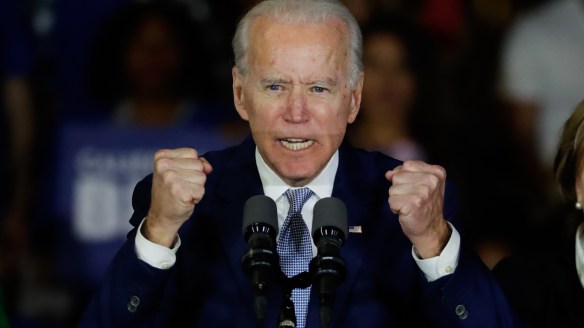
Democratic presidential candidate former Vice President Joe Biden speaks at a primary election night campaign rally Tuesday, March 3, 2020, in Los Angeles. (AP Photo/Chris Carlson)

Super Tuesday has raised the stakes and set the stage for a battle for the Democratic Party’s soul; one that will decide if it stays the course with neoliberalism with Biden or moves towards a progressive social-democratic model with Sanders.

By Alan Macleod

Source: Mint Press News

Former Vice-President Joe Biden built on his victory in South Carolina last week to emerge as the only credible “stop Bernie” candidate after Super Tuesday – where voters in 14 states decided on their nominations for president. While results are still not official, it is clear that the former Delaware senator won the popular vote in at least nine states yesterday, including in Texas, Massachusetts and North Carolina, amassing at least 433 delegates. Sanders has currently secured 388, although that number is likely to rise after all of California is counted.

In one of the most remarkable and drastic political turnarounds in American history, Biden – thought of by many as a yesterday’s man – secured a stunning upset victory after a series of key endorsements. His campaign had been flagging, virtually out of money and without organization or many activists on the ground. As of Monday, he had spent just $1.5 million on TV ads in Super Tuesday states, with aides admitting to CNN their goal was merely to “remain competitive;” a remarkable admission for a presidential campaign.

But facing a Sanders nomination, the establishment wing of the party went into overdrive to find a viable alternative to the Vermont senator. Both Pete Buttigieg and Amy Klobuchar dropped out and immediately endorsed him, as did other figures like former Texas congressman Beto O’Rourke. In a matter of mere hours, the Democratic Party higher-ups managed to coalesce around him in a way the Republicans were unable to in 2016 to stop Trump, proving to the world that the party is certainly not incompetent and can organize and carry out operations with military precision when they perceive it is in their interest to do so.

While the establishment pooled its resources (and delegates) in favor of Biden, Massachusetts senator Elizabeth Warren has refrained from dropping out, let alone endorsing Sanders, thus splitting the progressive vote. Warren finished a distant third in her home state and secured only 28 delegates yesterday. In a defeatist message, her campaign managers said they would hold a meeting to “assess the path forward.”

Biden declared victory in Los Angeles last night, presenting himself as an opponent of the wealthy and a champion of the people: “Let’s get something straight. Wall Street didn’t build this country. You built this country. The middle class built this country. And unions built the middle class,” he told the crowd. But his speech was upstaged by anti-dairy industry protestors who stormed the stage. Earlier in the speech he also confused his wife for his sister.

https://twitter.com/Breaking911/status/1235044512918941698

While it is clear that he will now be the establishment’s candidate for better or worse, the former vice-president has a long history of making egregious errors in speaking. Earlier this week at a rally he tried and failed to recite the preamble of the Declaration of Independence. “We hold these truths to be self evident. All men and women created by the…you know, the thing” he stuttered. And while he promises the working-class “cures for cancer, Alzheimer’s and diabetes” under his presidency, he also told his billionaire backers that he believes they are being “demonized” and that “nothing would change” about America if he were chosen. “I need you very badly,” he told a group of extremely wealthy donors last year.

His policy history and positions, too, might be cause for concern for many voters in the presidential election. These include advocating for cuts to social services, fighting against abortion rights, and supporting NAFTA, the PATRIOT Act and the attacks on Iraq and Libya. And while he retains strong support among Southern black voters, he helped write the 1994 Crime Bill and the Anti-Drug Abuse Bill that exploded the prison population, and fought for segregation and against integration. President Trump has already nicknamed him “Handsy Joe” in reference to his inappropriate touching of women and girls.

While Sanders supporters will be disappointed with the results, other candidates had even worse nights. Chief among them was Michael Bloomberg, who spent more than half a billion dollars on his campaign, picking up just 12 delegates, a third of them in American Samoa. Given his poor performance, that works out to nearly $50 million per delegate. The former Mayor of New York dropped out today, endorsing Biden for the nomination. If he is willing to financially aid Biden anything like how he lavishly spent on himself, Sanders will be fighting a seriously uphill battle.

“It really is a class war we’re up against,” said author and progressive journalist Naomi Klein, who has been traveling with the Sanders team.

The vast majority of this campaign are working class people who are daring to hope for the barest decent things in life. It is this amazing process of raising people’s expectations…What we’re seeing with this establishment pushback, this is not against Bernie Sanders, it is against them. It is against people saying ‘I have a right to healthcare. I have a right to a living wage,’ and it is really sad to see.”

Biden has strong support among the wealthy, the elderly and among Southern black voters. But if he is to win outright and beat Trump in November, he will need to address the age gap in voting. Even in Alabama, where he fared worst, Sanders still comfortably won the vote of those under 30. While there is much work to be done, yesterday was a good day for the establishment wing of the Democratic Party.

Next week will see six more states as well as the Democrats Abroad primaries decided. But Super Tuesday has raised the stakes and set the stage for a battle for the Democratic Party’s soul; one that will decide if it stays the course with neoliberalism with Biden or moves towards a progressive social-democratic model with Sanders.

The Looming Financial Nightmare: So Much for Living the American Dream

By John W. Whitehead

Source: The Rutherford Institute

“When plunder becomes a way of life for a group of men in a society, over the course of time they create for themselves a legal system that authorizes it and a moral code that glorifies it.” ― Frédéric Bastiat, French economist

Let’s talk numbers, shall we?

The national debt (the amount the federal government has borrowed over the years and must pay back) is $23 trillion and growing.

The amount this country owes is now greater than its gross national product (all the products and services produced in one year by labor and property supplied by the citizens). We’re paying more than $270 billion just in interest on that public debt annually. And the top two foreign countries who “own” our debt are China and Japan.

The national deficit (the difference between what the government spends and the revenue it takes in) is projected to surpass $1 trillion every year for the next 10 years.

The United States spends more on foreign aid than any other nation ($50 billion in 2017 alone). More than 150 countries around the world receive U.S. taxpayer-funded assistance, with most of the funds going to the Middle East, Africa and Asia.

Meanwhile, almost 60% of Americans are so financially strapped that they don’t have even $500 in savings and nothing whatsoever put away for retirement, and yet they are being forced to pay for government programs that do little to enhance or advance their lives.

Folks, if you haven’t figured it out yet, we’re not living the American dream.

We’re living a financial nightmare.

The U.S. government—and that includes the current administration—is spending money it doesn’t have on programs it can’t afford, and “we the taxpayers” are the ones who will pay for it.

As financial analyst Kristin Tate explains, “When the government has its debt bill come due, all of us will be on the hook.” It’s happened before: during the European debt crisis, Cypress seized private funds from its citizens’ bank accounts to cover its debts, with those who had been careful to save their pennies forced to relinquish between 40% to 60% of their assets.

Could it happen here? Could the government actually seize private funds for its own gain?

Look around you. It’s already happening.

In the eyes of the government, “we the people, the voters, the consumers, and the taxpayers” are little more than pocketbooks waiting to be picked.

Consider: The government can seize your home and your car (which you’ve bought and paid for) over nonpayment of taxes. Government agents can freeze and seize your bank accounts and other valuables if they merely “suspect” wrongdoing. And the IRS insists on getting the first cut of your salary to pay for government programs over which you have no say.

We have no real say in how the government runs, or how our taxpayer funds are used, but we’re being forced to pay through the nose, anyhow.

We have no real say, but that doesn’t prevent the government from fleecing us at every turn and forcing us to pay for endless wars that do more to fund the military industrial complex than protect us, pork barrel projects that produce little to nothing, and a police state that serves only to imprison us within its walls.

If you have no choice, no voice, and no real options when it comes to the government’s claims on your property and your money, you’re not free.

It wasn’t always this way, of course.

Early Americans went to war over the inalienable rights described by philosopher John Locke as the natural rights of life, liberty and property.

It didn’t take long, however—a hundred years, in fact—before the American government was laying claim to the citizenry’s property by levying taxes to pay for the Civil War. As the New York Times reports, “Widespread resistance led to its repeal in 1872.”

Determined to claim some of the citizenry’s wealth for its own uses, the government reinstituted the income tax in 1894. Charles Pollock challenged the tax as unconstitutional, and the U.S. Supreme Court ruled in his favor. Pollock’s victory was relatively short-lived. Members of Congress—united in their determination to tax the American people’s income—worked together to adopt a constitutional amendment to overrule the Pollock decision.

On the eve of World War I, in 1913, Congress instituted a permanent income tax by way of the 16th Amendment to the Constitution and the Revenue Act of 1913. Under the Revenue Act, individuals with income exceeding $3,000 could be taxed starting at 1% up to 7% for incomes exceeding $500,000.

It’s all gone downhill from there.

Unsurprisingly, the government has used its tax powers to advance its own imperialistic agendas and the courts have repeatedly upheld the government’s power to penalize or jail those who refused to pay their taxes.

Irwin A. Schiff was one of the nation’s most vocal tax protesters. He spent a good portion of his life arguing that the income tax was unconstitutional, and he put his wallet where his conscience was: Schiff stopped paying federal taxes in 1974.

Schiff paid the price for his resistance, too: he served three separate prison terms (more than 10 years in all) over his refusal to pay taxes. He died at the age of 87 serving a 14-year prison term. As constitutional activist Robert L. Schulz noted in Schiff’s obituary, “In a society where there is so much fear of government, and in particular of the I.R.S., [Schiff] was probably the most influential educator regarding the illegal and unconstitutional operation and enforcement of the Internal Revenue Code. It’s very hard to speak to power, but he did, and he paid a very heavy price.”

It’s still hard to speak to power, and those who do are still paying a very heavy price.

All the while the government continues to do whatever it likes—levy taxes, rack up debt, spend outrageously and irresponsibly—with little thought for the plight of its citizens.

To top it all off, all of those wars the U.S. is so eager to fight abroad are being waged with borrowed funds. As The Atlantic reports, “For 15 years now, the United States has been putting these wars on a credit card… U.S. leaders are essentially bankrolling the wars with debt, in the form of purchases of U.S. Treasury bonds by U.S.-based entities like pension funds and state and local governments, and by countries like China and Japan.”

If Americans managed their personal finances the way the government mismanages the nation’s finances, we’d all be in debtors’ prison by now.

Still, the government remains unrepentant, unfazed and undeterred in its money grabs.

While we’re struggling to get by, and making tough decisions about how to spend what little money actually makes it into our pockets after the federal, state and local governments take their share (this doesn’t include the stealth taxes imposed through tolls, fines and other fiscal penalties), the police state is spending our hard-earned tax dollars to further entrench its powers and entrap its citizens.

For instance, American taxpayers have been forced to shell out more than $5.6 trillion since 9/11 for the military industrial complex’s costly, endless so-called “war on terrorism.”

That translates to roughly $23,000 per taxpayer to wage wars abroad, occupy foreign countries, provide financial aid to foreign allies, and fill the pockets of defense contractors and grease the hands of corrupt foreign dignitaries.

Mind you, that staggering $6 trillion is only a portion of what the Pentagon spends on America’s military empire.

That price tag keeps growing, too.

In this way, the military industrial complex will get even richer, and the American taxpayer will be forced to shell out even more funds for programs that do little to enhance our lives, ensure our happiness and well-being, or secure our freedoms.

As Dwight D. Eisenhower warned in a 1953 speech:

Every gun that is made, every warship launched, every rocket fired signifies, in the final sense, a theft from those who hunger and are not fed, those who are cold and are not clothed. This world in arms is not spending money alone. It is spending the sweat of its laborers, the genius of its scientists, the hopes of its children. The cost of one modern heavy bomber is this: a modern brick school in more than 30 cities. It is two electric power plants, each serving a town of 60,000 population. It is two fine, fully equipped hospitals. It is some fifty miles of concrete pavement. We pay for a single fighter plane with a half million bushels of wheat. We pay for a single destroyer with new homes that could have housed more than 8,000 people. This is, I repeat, the best way of life to be found on the road the world has been taking. This is not a way of life at all, in any true sense. Under the cloud of threatening war, it is humanity hanging from a cross of iron. […] Is there no other way the world may live?

This is still no way of life.

Yet it’s not just the government’s endless wars that are bleeding us dry.

We’re also being forced to shell out money for surveillance systems to track our movements, money to further militarize our already militarized police, money to allow the government to raid our homes and bank accounts, money to fund schools where our kids learn nothing about freedom and everything about how to comply, and on and on.

Are you getting the picture yet?

The government isn’t taking our money to make our lives better. Just take a look at the nation’s failing infrastructure, and you’ll see how little is being spent on programs that advance the common good.

We’re being robbed blind so the governmental elite can get richer.

This is nothing less than financial tyranny.

“We the people” have become the new, permanent underclass in America.

It’s tempting to say that there’s little we can do about it, except that’s not quite accurate.

There are a few things we can do (demand transparency, reject cronyism and graft, insist on fair pricing and honest accounting methods, call a halt to incentive-driven government programs that prioritize profits over people), but it will require that “we the people” stop playing politics and stand united against the politicians and corporate interests who have turned our government and economy into a pay-to-play exercise in fascism.

We’ve become so invested in identity politics that label us based on our political leanings that we’ve lost sight of the one label that unites us: we’re all Americans.

The powers-that-be want to pit us against one another. They want us to adopt an “us versus them” mindset that keeps us powerless and divided.

Trust me, the only “us versus them” that matters anymore is “we the people” against the police state.

We’re all in the same boat, folks, and there’s only one real life preserver: that’s the Constitution and the Bill of Rights.

The Constitution starts with those three powerful words: “We the people.”

The message is this: there is power in our numbers.

That remains our greatest strength in the face of a governmental elite that continues to ride roughshod over the populace. It remains our greatest defense against a government that has claimed for itself unlimited power over the purse (taxpayer funds) and the sword (military might).

This holds true whether you’re talking about health care, war spending, or the American police state.

While we’re on the subject, do me a favor and don’t let yourself be fooled into believing that the next crop of political saviors will be any different from their predecessors. They all talk big when they’re running for office, and when they get elected, they spend big at our expense.

As I make clear in my book Battlefield America: The War on the American People, this is how the middle classes, who fuel the nation’s economy and fund the government’s programs, get screwed repeatedly.

George Harrison, who would have been 77 this year, summed up this outrageous state of affairs in his song Taxman:

If you drive a car, I’ll tax the street,

If you try to sit, I’ll tax your seat.

If you get too cold I’ll tax the heat,

If you take a walk, I’ll tax your feet.

Don’t ask me what I want it for

If you don’t want to pay some more

‘Cause I’m the taxman, yeah, I’m the taxman.

Now my advice for those who die

Declare the pennies on your eyes

‘Cause I’m the taxman, yeah, I’m the taxman

And you’re working for no one but me.

Data governance and the new frontiers of resistance

The 21st century corporation is using algorithmic-based intelligence to accumulate data on a massive scale. Social movements need to grasp this change quickly.

By Anita Gurumurthy and Nandini Chami

Source: ROAR

Four centuries after the East India Company set the trend for corporate resource extraction, most of the world is now in the grip of unbridled corporate power. But corporate power is on the cusp of achieving “quantum supremacy” and social movements in the digital age need to understand this in order to shift gears in their struggles. The quantum shift here comes from “network-data” power; the ingredients that make up capitalism’s digital age recipe.

Contemporary capitalism is characterized by the accumulation of data-as-capital. Big Tech, as digital companies are collectively known, use the “platform” business model. This model provides a framework for interactions in the marketplace by connecting its many “nodes” — consumers, advertisers, service providers, producers, suppliers and even objects — that comprise the platform ecosystem, constantly harvesting their data and using algorithms to optimize interactions among them as a means to maximize profit.

The platform model emerged as a business proposition in the early 2000s when internet companies offering digital communication services began extracting user data from networked social interactions to generate valuable information for targeted advertising. It is estimated that by 2025, over 30 percent of global economic activity will be mediated by platform companies, an indication of the growing “platformization” of the real economy. In every economic sector, from agriculture to predictive manufacturing, retail commerce and even paid care work, the platform model is now an essential infrastructural layer.

Control over data-based intelligence gives platform owners a unique vantage point — the power to shape the nature of interactions among member nodes. Practices such as Amazon’s segmenting and hyper-targeting of consumers through price manipulation, Uber’s panoptic disciplining of its partner drivers, and TripAdvisor’s popularity ranking algorithm of listed properties, restaurants and hotels are all examples of how such platforms mediate economic transactions. The accumulation of data that feeds algorithmic optimization enables more intensified data extraction, in a self-propelling cycle that culminates in the platform’s totalizing control of entire economic ecosystems.

Amazon for instance, is no longer an online book store, and was perhaps never intended to be. With intimate knowledge about how the market works, Amazon is a market leader in anticipatory logistics and business analytics, providing both fulfillment and on-demand cloud-based computing services to third parties. Not only has it displaced traditional container-freight stations in port cities, it has begun to look increasingly like a shipping company. The dynamics of an intelligence economy have led to large swathes of economic activity being controlled by a handful of platform monopolies.

Studies suggest that in a matter of a couple of decades, platform monopolies have overtaken oil, automobile and financial corporations in market capitalization. Today, platform-based business models account for seven of the world’s top eight companies ranked by market capitalization. The pan-global platform corporation, with its DNA of data-based intelligence, has replaced the trans-national industrial corporation as the Leviathan of our times.

Enter the intelligent corporation

As the dominant form of economic organization in the capitalist world order, the corporation has always wielded power, not just in the market but also in political and socio-cultural realms. The rise of the “intelligent corporation” defined by the political economy of data capital has produced qualitative shifts in the exercise of corporate power, including the following.

From dominating the market to becoming the market

Like its predecessor, the intelligent corporation also aims at complete market domination. In platform-based capitalism, local business models based on intimate contextual knowledge are completely displaced by the data-based intermediation of marketplace and social transactions. It is by eliminating these disparate pockets of capital accumulation that platform owners maximize their profits.

The intelligent corporation also goes a step further, moving beyond “dominating the market” to “becoming the market.” Integrating across business lines, these companies both operate a platform and promote their own goods and services on it. This places them in direct competition with the businesses that use their infrastructure, and creates a conflict of interest. For example, Amazon uses its product marketplace data to consolidate its private labels, launching high-demand products at prices that undercut third-party sellers.

In this new strategy for acquiring market power, long-term market monopolization is privileged over the ability to break-even in the short run. The ecosystem that a platform seeks to capture has room only for one winner with the wherewithal to forgo immediate profits and invest in business integration — through aggressive acquisition — and systematic data-layer development. Other competitors are destined to fall by the wayside.

From cheap labor to freedom from labor

In the capitalist economy, the key contradiction is between capital and labor. Capital is in a perennial quest for freedom from labor through labor-substituting technological advances and territories to shift production to reduce labor costs. In the intelligence economy, capital seems to have come very close to realizing its primordial pursuit.

Using 360° surveillance, the intelligent corporation creates a self-optimizing ecosystem, manipulating each node, expanding its captive network, accumulating data capital and entrenching its dominance. It is able to achieve a global operational footprint with few assets and a minuscule employee base. Think Uber. Uber drivers are not considered to be employees in most places where the company runs its business. With a god’s eye view of the city and its roads, the customers and the driver, Uber takes over city transport, often without owning a single taxi. Passing off the liability to the driver, who must take a high-interest loan to acquire a vehicle to become Uber’s coveted “partner,” the corporation extracts from the driver more than just labor time.

In traditional labor-intensive manufacturing and services sectors, data capital is slowly but surely affecting far-reaching transformation. Projections show that automation based on artificial intelligence (AI) will eventually displace labor. It is estimated that over 40 percent of the global workforce will lose their jobs in AI-led disruption of manufacturing over the next 15–25 years. A limited number of high-paying jobs may open up for individuals with advanced skills in the development of data and AI technologies. But most of the labor force will end up in low-paid, personalized service work.

For countries in the Global South, the challenge will be especially pernicious. As rising wages erode the comparative advantage of labor in these economies, the shift to AI technology is likely to trigger a re-shoring trend whereby factories are relocated to richer countries that offer more sophisticated infrastructural support for deployment of AI systems. According to the World Bank, over two-thirds of the workforce in developing countries are likely to lose jobs. It is not clear how these changes will shift gender-based segmentation and gender hierarchies in labor markets. However, going by current trends, women seem to be the first to lose their jobs in this transition, with a reversal of both pay and status gains.

Planetary-scale time-space enclosure

Capturing previously non-commodified time and place has always been a central strategy of capitalist expansion. In the intelligence economy, we are witnessing a new phase of such “primitive accumulation” – through “data dispossession.” The expropriation of data from everyday social exchanges through the platform business model is comparable to the expropriation of natural resources for capitalist production in a previous age. The pervasive data extraction by platform companies has transformed data-mined social interaction into a factor of production, just as invaluable a resource as land for the creation of goods and services. The centralization of wealth and power today, derives from an unprecedented quality and scale of dispossession.

The dynamic of data dispossession is self-propelling. It is now well understood that platforms aggressively pursue a strategy of locking-in users, offering instant gratification in exchange for data and making it costly for them to leave a platform. The Chinese “super-platforms” WeChat and Meituan-Dianping combine news, entertainment, restaurant reviews, food delivery and ride-hailing, along with cross-cutting applications such as payment systems and digital wallets, demonstrating a “stickiness” that is almost addictive.

When participation in the platform on the platform owner’s terms becomes de facto the only choice for economic actors, data extractivism is normalized. Similar to the predatory practices of historical colonialism, the platform tactics of the intelligent corporation function as a neo-colonial project. The difference is that this time around, rather than European companies, the US and Chinese platform companies are in the driving seat.

A profoundly unsustainable exploitation of the natural world accompanies the rapid inroads of the intelligent corporation. Take the case of the vast ecological footprint of the online food-delivery sector. According to a 2018 study published in the science journal Resources, Conservation and Recycling, door-to-door fast-food delivery in China accounted for a nearly eightfold jump in packaging waste between 2015 and 2017, from 0.2 to 1.5 million tonnes. This has coincided with the exponential growth of the sector in the country, where the number of customers using food-delivery platforms has gone up from zero in 2009 to 406 million by the end of 2018! The intelligence economy is a veritable resource guzzler whose network data devices are expected to be consuming about one-fifth of global electricity by 2030 just to keep going.

The loss of self-determination for individuals and communities in these new intelligence-based modes of production reflects an asymmetry in power that was previously impossible. This is the route through which the brand-new corporation colonizes bodies and nature, takes control of production and social reproduction, and intensifies accumulation on a global scale.

The “deep corporate” and the death of the social contract

It is no secret that in the digital era, the deep state has had a makeover. Edward Snowden’s revelations and witness testimonies from China’s Uighur-dominated Xinjiang have exposed the dark workings of the contemporary military–industrial complex, the unholy nexus between Big Tech and the state. Trade justice activists have constantly pointed to the “hidden hand” of Silicon Valley and Chinese corporations using their governments to bat for their interests, reducing policy decisions to executive fiats for entrenching their power.

But what is only recently coming to light is the rise of the “deep corporate” — the extension of the Kraken-like tentacles of intelligent corporations into the heart of public life. The subsuming of social life by platform capitalism has distorted the political space thanks to the echo chambers of the automated public sphere. The contagion of mispropaganda and informational warfare in political campaigning has become impossible to contain in a public sphere determined by algorithmic filters. In this scenario, deliberative democracy itself is under the threat of extinction.

The social credit system being developed by China in partnership with eight tech companies takes the “corporatization” of governance to a whole new level. Access to benefits and citizens’ guaranteed rights are now predicated on behavioral scoring on the basis of online purchase history, financial transactions and social media connections on the partnering platforms. With the archetypal “good consumer” becoming the deserving citizen, citizenship is thus dislocated from political claims. The “deep corporate” acquires the formal authority to mediate the social contract.

Living with the intelligent corporation

We are living through a phase in capitalism that is marked by extreme market concentration, unprecedented inequality in wealth and the declining share of labor in global income; a state of affairs that has led even the IMF to express caution. It is no coincidence that this period of intensified economic injustice has coincided with the rise of platform capitalism and its real-world vehicle, the intelligent corporation.

What does living with the intelligent corporation mean?

What is new about this phase of capitalism that has spawned the intelligence economy is a deeply qualitative shift. Datafication and data capital transform the way capitalist “accumulation by dispossession” happens. “Intelligencification” makes plausible a planetary-scale colonization and commodification of everyday life by the new corporation in ways previously impossible. Both nature and caring bodies are trapped in a planetary enclosure insofar as everything and everybody can be turned into data.

It also feeds off and emboldens the financialization apparatus that runs the neoliberal economy. Through the perverse confluence of data and finance, the intelligent corporation universalizes and naturalizes its authority, destroying the marketplace of things and ideas.

Through data extractivism, the intelligent corporation ravages sociality, taking the ideological project of neoliberalism all the way to the expropriation of the political. This is a deep take-over, an “ontological encroachment” of human subjectivity.

Where does all this leave us?

As UNCTAD has highlighted, the pace of concentration of market power is extremely worrying. Consider this: Amazon’s profits-to-sales ratio increased from 10 percent in 2005 to 23 percent in 2015, while that of Alibaba increased in just four years from 10 percent in 2011 to 32 percent in 2015.

Policymakers across the world are struggling to reform their legacy laws to rein in the intelligent corporation. Even the domestic governments of powerful US and Chinese platform corporations are struggling to contain their excesses. The US Federal Trade Commission (FTC) is currently investigating Amazon and Facebook for abuse of market dominance while the US Justice Department is probing Google. The state of California is facing massive resistance from Uber and Lyft to its new regulation for labor rights of “gig” workers, with the two companies currently leading a $60 billion ballot initiative to extricate themselves from employer’s liability. In November 2019, the state administration for market regulation in China had to hold a meeting with Alibaba and other online retail platforms about their strong-arming of third-party vendors, in violation of existing regulations to curb anti-competitive conduct.

The loopholes of pre-digital taxation laws based on a physical presence in a given country have been effectively exploited by platform companies to escape tax liability, through profit shifting to low-tax jurisdictions. Similarly, when faced with liability for unfair market practices in overseas markets, it is very easy for platform companies to shift liability to their parent company outside the jurisdiction. For instance, Uber in South Africa resorted to the defense that its partner drivers were employees of the parent company headquartered in the Netherlands and not the South African subsidiary, in order to evade its liabilities under existing labor laws. The lack of binding international regulations governing cross-border data flows has also aided rampant data extractivism,

More recently, in the wake of malpractice lawsuits brought against Big Tech by their own employees; exposes about founding CEOs who have enjoyed a godly status; and public disenchantment with multiple revelations of clandestine data mining and algorithmic gaming, the early sheen seems to be wearing off. Google’s parent company Alphabet can no longer use its “Do the right thing” motto without irony. Facebook has been forced to switch to the “too big to fail” defense from the “protector and defender of the freedoms of the global community” line. Alibaba may not be able to proclaim its commitment to the development of small and medium enterprises in Africa for much longer. The façade has crumbled. And this rupture in the discursive hegemony of the intelligent corporation in which we are currently situated is the right moment to mount a collective challenge.

So, resist we must, so that the wealth of data and of networks can be appropriated and used to create a just and humane society. This means taking the intelligent corporation by the horns, and forging a movement that is able to grapple with the ethical–political boundaries of digital intelligence.

Taming the Leviathan and reclaiming the planet

Given the enormous economic and political clout of the modern corporation in the age of data, unshackling people and the planet from corporate power is an urgent task. Struggles against the extreme unfairness of the global trade and intellectual property regime by transnational social movements have shown the necessary connection between the agenda for development justice and the dismantling of corporate power.

Building alliances among movements has become a vital strategy in halting TNCs’ inexorable plunder. The trade justice movement against corporate globalization, the environment movement’s quest for sustainable development, feminist struggles to reclaim the body and the sphere of social reproduction from capital and workers’ struggle against the intensified squeeze on labor and the dismantling of social protection in neoliberal globalization are inspiring examples in this regard. Transnational civil society has painstakingly built alliances and solidarities across these movements to expose corporate excess, bringing pressure on the UN for a global binding treaty on TNCs’ human rights obligations in the face of near-insurmountable odds.

In the digital age, as corporate power assumes indomitable proportions — with tech CEOs carving out data dominions that they rule over — current frameworks of power analysis and action may not go very far. A concerted and coherent strategy is urgently needed in order to enable a more equitable distribution of the gains of data-based intelligence. The Digital Justice Manifesto released in November 2019 by the Just Net Coalition — through a process of strategic and sustained dialogue between digital rights, trade justice, feminist, environmental, labor and human rights groups and activists — outlines such a roadmap. As the Manifesto underlines, we need immediate action along three broad fronts to reclaim digital power from the intelligent corporation:

(a) Wrestling back ownership of our personal and collective data and intelligence by instituting an economic rights framework for data resources.

(b) Governing critical platform infrastructures as public utilities.

(c) Enforcing a local-to-global governance model for digital and data infrastructure that supports local economies and democratic self-determination of collectivities, preventing the enclosure of entire market and social ecosystems by a centralized intelligence. In other words, the governance of tech infrastructure must enable the flourishing of disparate local economies and make room for multiple platform models to function — co-operatives, social enterprises, public etc. — challenging the totalizing impetus of global intelligence capitalism.

Neoliberal globalization and financialization have led to profoundly unequal societies. The impunity of the TNC has been central to this dynamic. Social movements have placed several creative proposals to counter this: mandating charter renewal every five years overturning the principle of corporations’ perpetual legal existence; taxing stock trade on the basis of the holding period to contain excessive financial speculation; placing a cap on the individual assets of founders/CEOs and so on.

“Intelligencification” demands a new frontier for resistance. The power of the intelligent corporation must be contained through tactics small and big in political and cultural realms. A new wisdom about the governance of data must be explored for a truly emancipatory future for all.

Subcomandante Bloomberg

By CJ Hopkins

Source: Consent Factory, Inc.

Break out the pussyhats and vuvuzelas, folks, because the neoliberal Resistance is back, and this time they’re not playing around. No more impeachments and investigations. It’s time to go mano-a-mano with Trump, and they’ve finally got just the bad hombre to do it. No, not Bernie Sanders, you commies. A battle-hardened Resistance fighter. El Caballo Pequeño! El Jefe Mínimo! Subcomandante Michael Bloomberg!

Yes, that’s right, Michael Bloomberg, multi-billionaire Republicrat oligarch, has mobilized a guerilla army of overpaid PR professionals, Wall Street sociopaths, liberal racists, and anti-outdoor-smoking fanatics, and is steamrolling toward the Democratic convention to buy a brokered nomination and save America from “Putinism.” He’s had it with you sugary-soft-drink-drinking, chain-smoking, gun-toting, Oxy-gobbling, Hitler-loving, Putinist peasants and your infatuation with Donald Trump. So he’s decided to transform the entire country into a sterile, upscale, fascist themepark where you can rent a studio for $3,000 a month and the cops keep “the darkies” in their place, like he successfully did to New York City.

Although his campaign seemed to come out of nowhere (and sort of resembles a desperate attempt to prevent a Bernie Sanders nomination), the Resistance have been planning this corporatist Tet Offensive for quite some time. Apparently, Subcomandante Bloomberg and his inner circle of sub-subcomandantes have been hiding out deep in the mountainous jungles of Manhattan’s affluent Upper East Side (or in the Hamptons, or London, or in one of El Jefe’s other multi-million-dollar homes) since Trump and the Russians invaded the country, waiting for the perfect moment to start inundating the American people with television commercials and social media posts informing them of his “electability.”

Clearly, that moment has now arrived.

Bloomberg has spent over $400 million on TV, radio, and digital ads, and it isn’t even Super Tuesday yet. He bought the Democratic National Committee and had them change the rules so he could join the debates (which, based on his poor performance in Las Vegas, might not have been the most brilliant strategy). He has been buying politicians, community organizers, journalists, pundits, his opponents’ campaign staff, Instagram and Facebook influencers, and everyone else he can possibly buy to support his campaign to buy the presidency … which is totally legal, and the American way, and is our only hope of overthrowing the Putin-Nazi Occupation Government and regaining our God-given capitalist freedom!

Sure, to some folks, it looks … well, unseemly (not to mention decidedly undemocratic), this Wall Street oligarch attempting to bribe and bully his way into the White House, but, given the stakes, what choice do we have? As the corporate media and intelligence agencies have been telling us for the last three years, the country is under occupation by an evil conspiracy of Russian-backed Nazis personally controlled by Vladimir Putin! More or less any moment now, Putin is going to order Trump to nullify the U.S. Constitution, declare martial law, appoint himself Führer, and start rounding up and murdering the Jews … or investigating Hunter Biden, or the spooks who have been trying to force him out of office.

This Putin-Nazism cannot continue! Trump must be deposed, no matter the cost. As Robert Reich put it in this piece in The Guardian:

“If the only way we can get rid of the sociopathic tyrant named Trump is with an oligarch named Bloomberg, we will have to choose the oligarch.”

There you have it, folks. We’ll have to choose Bloomberg, or else his golf buddy, Literal Hitler, will destroy the fabric of democracy, or whatever.

Another op-ed in The Washington PostIt Might Be Time to Take Bloomberg Seriously, wondered, if it comes down to Bloomberg versus Bernie:

“Do you choose socialism or capitalism? An ideologue or an executive? Are you really going to ask Americans to trade one extreme for the other, or do you want to offer them a certified, electable moderate?”

Vox, in its “Case for Michael Bloomberg — Mike Bloomberg and His Billions Are What Democrats Need to Beat Trump,” observes that, sure, Bloomberg has drawbacks, like his history of racist remarks and policies, abusing women, oppressing the poor, and just generally being an arrogant little authoritarian corporatist creep, but hey, he’s apologized for all that stuff, and he’ll probably never do it again.

Plus, according to this piece in …uh, Bloomberg Opinion (which “does not necessarily reflect the views and opinions of Bloomberg LP and its owners”), The 2020 Election Is a Choice Between Democracy and Putinism! At the end of the day, once the dust has settled:

“It will come down to rule of law. In November, Americans will decide whether they will fight for the foundation of liberal democracy and democratic capitalism or whether they will accede to Putinism.”

You’ll be hearing variations of this message over and over, and over again, as we approach election day in November … that is, assuming Bloomberg and the rest of the Resistance can buy, bribe, badger, and bamboozle enough Democratic voters into nominating him. First, they need to deal with Bernie Sanders and his swarm of kill-crazy commie terrorists (who rumor has it are also being remotely controlled by Vladimir Putin). To do this, all they will need to do is deny Sanders a first ballot win in Milwaukee, which shouldn’t be too hard to accomplish. Sure, a brokered convention will be ugly, but, as Robert Reich said, they’ll have to do it, or else … well, you know, end of democracy.

Yes, I’m aware that Subcomandante Bloomberg blew his first debate (prompting Twitter pundits to pronounce him DOA) and that millions of “progressive” Democrats hate him, and that the corporate media are running a lot of “Bloomberg’s Nasty Past” pieces now (in order to maintain the appearance of journalism), but, make no mistake, if he secures the nomination, they’ll be lining up to “reluctantly” endorse him, because the alternative will be Russian Hitler!

Look, it’s easy to get distracted by the day-to-day ups and downs of the horse race (which is the primary purpose of the horse race, after all) and forget that we are in the middle of a global capitalist War on Populism … a war that GloboCap intends to win. Sure, they will survive another four years of Trump (or even four years of Sanders if they have to), but, at some point, in order to restore “normality,” or “democratic capitalism,” or whatever, they are probably going to need to stop dicking around and install a bona fide global capitalist oligarch in the Oval Office. They are going to need to do this in order to crush the hopes of the populist insurgency that erupted in the Spring of 2016, and led to the rise of Donald Trump, Bernie Sanders, Jeremy Corbyn, the Brexit, the ongoing protests in France, the downfall of Angela Merkel, etc.

Another Obama is not going to cut it … people aren’t buying that con anymore. No, if the empire is going to reestablish control, it is going to need to take its liberal mask off, and shove a blatant corporatist oligarch like Bloomberg down the public’s throat in order to remind everyone who’s boss. It may not be Michael Bloomberg this time, but it is going to be someone like Bloomberg eventually. Someone powerful, and extremely unpleasant, who will be sold to us as the only one who can save the world from the “Nazis” and the “Russians” … which will necessitate taking some very extreme measures, like the ones we took during the War on Terror. You remember the measures we took back then, don’t you?

Or what, you think that GloboCap has been manufacturing all this mass hysteria over “Russian election interference” and “Nazi terrorism” for their own amusement? Yeah, that’s probably all it is. It’s probably not a prelude to anything.

Puppet Pete Says Revolution And The Status Quo Aren’t Mutually Exclusive

By Caitlin Johnstone

Source: CaitlinJohnstone.com

The world’s first laboratory-grown presidential candidate Pete Buttigieg met with boos and chants of “Wall Street Pete” at a recent Democratic Party event in New Hampshire for taking a dig at the revolution-minded rhetoric favored by Bernie Sanders and his supporters.

“We cannot risk dividing Americans’ future further, saying that you must either be for a revolution or you must be for the status quo,” Buttigieg said. “Let’s make room for everybody in this movement.”

This is a talking point that the tightly scripted and focus group-tested Buttigieg has been repeatedly regurgitating all month, so it’s worth taking a look at.

https://twitter.com/CANCEL_SAM/status/1226342356242378757

Claiming that it isn’t necessary to choose between revolution and the status quo is claiming that you can change the status quo without any kind of revolution. You are saying that the establishment which has created and reinforced the status quo can now suddenly, for some strange and mysterious reason, be counted upon to change it. That the status quo will change the status quo.

Anyone who has paid attention to US politics for more than a few years already knows that this is objectively false. From administration to administration, regardless of who sits in the Oval Office or who controls the House or the Senate, the status quo has been adamantly enforced along a rigid trajectory toward ever-increasing military expansionism, exploitative neoliberal economic policies, income and wealth inequality, police militarization, mass-scale imprisonment, Orwellian surveillance programs and increasing restrictions on journalism and free speech.

Change is not going to come from those institutions, it’s going to come from the people using the power of their numbers to force important changes that those institutions do not want to make. And Pete Buttigieg knows this. And so do the spooks and oligarchs who are backing him.

It is very appropriate that a military intelligence officer with ties to the CIA, who is beloved by intelligence/defense agency insiders and who appears to have been groomed by national security mandarins from the very beginning of his career, should be actively working to kill a revolutionary zeitgeist. After all, backing counter-revolutionaries is a favorite CIA activity.

https://twitter.com/KaeySonPoint/status/1226368369533865985

Progressives already got suckered into forfeiting their revolutionary spirit in exchange for flowery prose and empty rhetoric the last time they elected Pete Buttigieg for president, back when Pete Buttigieg was named Barack Obama. It was literally the exact same script they’re trying to recycle with Puppet Pete: a plucky young underdog with a knack for sparkly verbiage overcomes the frontrunner in Iowa in a stunning upset, then rides the momentum from that initial victory on to the Democratic nomination.

And now we’re seeing the Democratic Party officially award Buttigieg the largest delegate count in Iowa, after a massive scandal and despite countless unresolved discrepancies in the numbers, and establishment narrative managers are now preparing their heartwarming David-and-Goliath stories about the small town mayor knocking out the big bad socialist frontrunner for a second consecutive time in New Hampshire in defiance of the odds and polling expectations. If that falls through they’ve got Nevada, where shit really started to get crazy in 2016, and where they’re preparing to implement a brand new caucus app which they keep trying to say is not an app but a “tool” made for iPads (which is the thing that an app is).

All this to install a man who has managed to pack an astonishing amount of corruption and scandal into a relatively brief, small-scale political career.

That’s what not choosing between revolution and the status quo looks like. It looks like continuing the status quo.

Which is why it’s so dumb when Buttigieg says “Let’s make room for everybody in this movement.” Movement? What movement? You don’t get to call it a “movement” when its entire agenda is to prevent any movement. Use a different word. “Let’s make room for everybody in this inertia,” or “Let’s make room for everybody in this stasis” or something.

As I’ve said many times before, I’m interested in this presidential election not because I am under the delusion that presidential elections tend to change things, but because the attempts to manipulate it, and the public’s response to those manipulations, could shake something loose that actually might. If enough people in the world’s most powerful nation wake up to the fact that they don’t have the kind of political system they were taught about in school, if they realize that everything they’ve been told about how their government operates is a lie, if they realize their lives have been made so unnecessarily difficult by a ruling oligarchic class with a vested interest in keeping them impoverished and distracted, well, then we’re looking at an actual transformative force.

Then we’re looking at the possibility of a real revolution. Not a violent revolution; those always result in a continuation of the same ills under a different system, and there’s nothing revolutionary about that.

I’m talking about a real revolution. One where people begin to open their eyes to the reality that their entire understanding of what’s going on in the world has been the result of mass psychological manipulation throughout their entire lives at the hands of the school system, the billionaire-controlled news media, and the political establishment. One where people open their eyes so wide to the power of narrative control that they become impossible to propagandize. One where people begin weaving their own narratives. Their own understandings of the world. Built not for the benefit of the powerful, but for the benefit of the people.

We’re seeing a lot of movement already in 2020, and it’s just getting started. I see the potential for a lot of light to reach a lot of new areas between the cracks which open up in that movement. And I see the guardians of the status quo having a harder and harder time maintaining the state of stasis. Their increasingly ham-fisted manipulations, such as installing a jarringly phony puppet like Pete Buttigieg, say a lot about their desperation.

Find ways of forcing them to overextend themselves and overplay their hand. Let’s show everyone what they’re hiding behind the puppet theater.