On the Unasked Question of Morality in Police Shootings of Black Bodies

15713475938_299bf78d0b

By Dr. Jason Michael Williams

Source: The Hampton Institute

In the past year much has happened regarding police shootings of Black bodies, and the majority of these shootings go unpunished. They go unpunished due to defensive statements such as, “I followed procedure” or “I feared for my life”. Nevertheless, these two quintessential defense statements are disproportionately applied to instances where Blacks are killed by police, yet as a society the United States does or says very little to contextualize the impact such defensive statements have on our collective consciousness and morality. However, it should be noted that this silence is deliberate, historical, and quintessentially American. Thus, morality, to many on the margins, is nonexistent at the foundation of the criminal justice system and many of the laws that govern society specifically laws that disproportionately target the poor.

There is a social-historical pathology attached to the ways in which the American public responds to the killing of Black bodies. Just as police officers claim fear today, so did white mobs during Jim Crow. Black men were hunted and killed countless times out of so-called fear due to often false allegations of rape, murder, and a myriad of other unreasonable accusations. Black women were often murdered for trivial reasons too. Nevertheless, these false and unreasonable accusations were justifiable to the American public whose barbarity knew no measures when directed at Black bodies. This pathology exists today, in the hearts and minds of many mainstreamers who dare utter “#AllLivesMatter”, as if to suppose that the murdering of Black bodies is somehow contemporary. Some mainstreamers have considered #BlackLivesMatter as a form of reverse racism. Thus arguing that the statement is somehow exclusive to other people who are killed, but this is, of course, a testament to the lack of critical thinking and historical intelligence writ large in America.

In modern society, this pathology is played out most vividly via the tumultuous relationship between Blacks and police officers. There had been countless murders of Black citizens by police, and yet many of them have been legally justified-that is, these cases have gone through the investigative processes of so-called fact-finding and rendered permissible. However, every so often, there are cases that wreck the consciousness of even the greatest conformers to the social order. For example, the case of Eric Garner, to many Americans of all colors was a prima facie case of wrongdoing, and yet the officer involved in Mr. Garner’s death faced no punishment. Another case in Cleveland where two Black bodies were shot 137 times by police officers has too failed to accomplish moral justice. Cleveland police officer, Michael Brelo cried as he heard his verdict of not-guilty. Brelo was accused of firing 49 shots of which 15 were shot while on the hood of the victims’ car. In clear opposition to an increasingly irritated public regarding police brutality, Judge John P. O’Donnell uttered, “I will not sacrifice him to a public frustrated by historical mistreatment at the hands of other officers.” If the judge were truly neutral to the concerns of the irritated public, such a reckless and defining statement would not have been made.

Nevertheless, the Judge’s rationale coexists with the feelings of many throughout the country. Whether one is scrolling through social media commentary, internet articles or watching mainstream media, the mainstream narrative is quite clear: Black lives don’t matter! And the insistence of this reality is cemented each time a Black is immorally murdered by the state. These ceremonial constants have caused many people throughout the nation to lose faith in the American justice system, including mainstreamers. Although Judge O’Donnell in the Cleveland case believed that the evidence was not solid to convict Officer Brelo, like the Garner case, many feel discontent. This discontentment is the proper manifestation of people realizing that justice in America isn’t always the moral outcome, a concept that a true justice system would strive to achieve. In fact, when “fact-finding” exist within an adversarial system easily corrupted by extralegal factors (race, gender, wealth, power, etc.), justice will undoubtedly fail those who aren’t privy to the game. Thus, American justice isn’t always about siding with moral rights, but rather it often swings on the side of barbarity and injustice as it falsely masquerades as one of the world’s most advanced and civilized systems.

The countless cases of police officers walking free from killing American citizens who happen to be Black is a testament to the limitations of American justice. Black lives don’t matter. As a result, demonstrators of late have continued to take to the streets against the immorality of American justice. They have continued to expose lady justice for the two-faced symbolism that she represents, as the global community pays witness. For these courageous individuals, the legality of justice and the majoritarian trickery invested in trying fact does not seem to fit within a moralistic frame. To these people, lives were unjustly lost, and police officers can get away with murder for simply stating what White men were able to hide behind since slavery: Fear of a Black body.

The Black lives matter movement at best should force the public to question the purpose of the criminal justice system seriously, and whether or not the processes that are currently embraced serve the interest of justice. The subjective citizenship of Black Americans should be the next topic of discussion. For instance, are Blacks to be treated as human beings, citizens, and, therefore, worthy of the right to live, breathe, and seek justice? These are key discussions that must begin to happen if justice is to be taken seriously in America. This conversation should also be raw, wide-reaching, and aided by both historical and contemporary facts. Certain acts of “justice” should be studied as violence. For example, the deliberate mass incarceration of minorities and poor people is, in fact, violence. Mass incarceration breaks up families (much like how slavery did), predisposes people to crime, destroys communities (politically, economically, and ecologically) thus pushing these spaces further beyond the margins, and render most to a life of poverty and outcast. The effects of so-called justice seem to perpetuate further inequality. In a real democracy, the state would not engage in such violence.

Furthermore, the creation of immoral laws like the war on drugs that create the contexts for Michael Browns are inhumane and violent. Such laws are neither safe for its targets (predominantly Black and Brown although now increasingly White) nor police officers. Also, the over policing of the poor is violent and extremely telling for a nation that considers itself a democracy. Over policing is violent, repressive, and undemocratic, as it mandates surveillance for the bottom and liberty for those at the top. While many people advocate for community policing in America’s ghettos, such arguments should be met with extreme caution, as community policing furthers the paternalistic mindset that the poor must be governed. Meanwhile, there are zero discussions regarding the need for community policing or surveillance programs on Wall Street or within other corporate spaces that are obviously privileged against the criminal justice system. These basic statements are more than enough for a conversation to be had on the purpose of the criminal justice system. Who does it serve? Who is most affected by it? What are the collateral consequences? Is a system of violence capable of delivering justice? Is the system morally bankrupt? Does there need to be a revolution regarding the criminal justice system?

The Root of Support for the Drug War

war-on-drugs

By Laurence M. Vance

Source: The Future of Freedom Foundation

Although many states have legalized the use of marijuana for medical purposes, some states have decriminalized the possession of certain amounts of marijuana, and four states (Alaska, Colorado, Oregon, and Washington) have legalized the recreational use of marijuana, bipartisan support for the drug war throughout the United States continues unabated and unquestioned.

Why?

Why do so many Americans think that the property of other Americans should be confiscated, and that some of their fellow Americans should be fined, arrested, put on probation, subject to no-knock SWAT team raids, be treated as criminals, or locked in a cage for growing, manufacturing, processing, buying, selling, distributing, “trafficking in,” using, or possessing some substance the government doesn’t approve of?

Why do so many Americans support a war on drugs that

  • unnecessarily makes criminals out of otherwise law-abiding Americans, clogs the judicial system with noncrimes, and expands the prison population with nonviolent offenders;
  • violates the Constitution, the principle of federalism, and increases the size and scope of government;
  • has utterly failed to prevent drug use, reduce drug abuse, or end drug overdoses;
  • fosters violence, corrupts law enforcement, and militarizes the police;
  • hinders legitimate pain management, hampers the treatment of debilitating diseases, and turns doctors into criminals;
  • destroys personal and financial privacy, and negates personal responsibility and accountability;
  • has been unsuccessful in keeping drugs out of the hands of addicts, teenagers, and convicts;
  • assaults individual liberty, private property, and the free market; or
  • wastes billions of taxpayer dollars and has financial and human costs that far exceed any of its supposed benefits?

I see a number of reasons that Americans in general support a government war on the mind-altering and mood-altering substances we refer to as drugs.

For some the reason is history. As far as many Americans are concerned, drugs have always been illegal and should therefore always remain so. It is simply unthinkable that it should be any other way. Yet, for the first half of our nation’s history there were no prohibitions against anyone’s possessing or using any drug.

For some the reason is society. The use of marijuana — for medical reasons or not — is still viewed negatively. And of course the use of other drugs such as cocaine, LSD, and heroin is disparaged even more. There is almost universal support for the drug war among all facets of society: engineers, teachers, preachers, physicians, clerks, accountants, secretaries, and housewives. But, of course, it doesn’t follow that because a majority of society supports something the power of government should be used against those who don’t.

For some the reason is political. The war on drugs enjoys widespread bipartisan support. Liberals, conservatives, Democrats, Republicans, moderates, populists, progressives, centrists, Tea Partiers — they all generally support government prohibition of certain drugs. The drug war is never an issue in any congressional primary or general election. As long as their party or their political group supports the drug war, most Americans will follow suit. The decision to use drugs should be an ethical, religious, medical, or moral decision, not a political decision.

For some the reason is religion. Support for the drug war can be found across the religious spectrum, encompassing Christians and Jews, Protestants and Catholics, liberals and conservatives, fundamentalists and progressives, and Trinitarians and Unitarians. Yet, there is no ethical precept in any religion that should lead anyone to believe that it is the job of government to prohibit, prevent, regulate, restrict, or otherwise control any substance that any adult desires to ingest of his own free will.

For some the reason is morality. Because, some assert, it is immoral to alter one’s mind or mood with illegal drugs, the government should ban the use of these substances. Do drug warriors likewise believe that it is immoral to alter one’s mind or mood with alcohol? If not, then they are woefully inconsistent in their proscription; if so, then they are woefully inconsistent in their prescription.

Dangers and vices

For some the reason is safety. Because it can be dangerous to use illicit drugs, some think the government should ban them. Yet there is no question that smoking marijuana is less dangerous than drinking alcohol. Alcohol abuse is a factor in many drownings; home, pedestrian, car, and boating accidents; and fires. How many drug warriors propose that the government ban alcohol? There are plenty of things that are much more dangerous than using illicit drugs: skydiving, bungee jumping, coal mining, boxing, mountain climbing, cliff diving, drag racing — even crossing the street at a busy intersection. According to the Journal of Forensic Sciences, there are more than 28,000 chainsaw-related injuries annually in the United States. Shouldn’t governments across the country declare war on chainsaws?

For some the reason is vice. Using drugs is said to be a vice like gambling, profanity, drunkenness, using pornography, and prostitution. But as only the latter is actually banned outright by the government, arguments for government action against select drugs are extremely weak. And what about the vices of pride, envy, wrath, sloth, avarice, gluttony, and lust? Why don’t drug warriors advocate government action against them? Vices in 2014 are still as the 19th-century political philosopher Lysander Spooner explained:

Vices are those acts by which a man harms himself or his property. Crimes are those acts by which one man harms the person or property of another. Vices are simply the errors which a man makes in his search after his own happiness. Unlike crimes, they imply no malice toward others, and no interference with their persons or property.

For some the reason is health. The use of mind-altering and mood-altering substances is said to be unhealthy. The federal government classifies marijuana as a Schedule I drug with “no currently accepted medical use in treatment in the United States.” But even if drugs such as marijuana don’t provide benefits for certain diseases and medical conditions, they are certainly not nearly as deadly as the drugs administered by physicians that kill thousands of Americans every year, the drugs that cause thousands of hospital patients every year to have adverse reactions, and nonsteroidal anti-inflammatory drugs such as aspirin that kill thousands every year. The most unhealthy drug is alcohol, which is a contributing factor in many cases of cancer, mental illness, fetal abnormalities, and cirrhosis of the liver. Alcohol abuse is one of the leading causes of premature deaths in the United States. There is no question that smoking marijuana is less dangerous than smoking tobacco. Common sense would dictate that it is tobacco that should be banned, not marijuana. And of course, the greatest health threat Americans face is obesity, not illegal drugs.

For some the reason is addiction. Certain drugs should be illegal, we are told, because they are addictive. The federal government says that marijuana “has a high potential for abuse.” But is that because it is addictive or because some people just want to get high? Legal drugs prescribed by physicians are certainly just as addictive as any drugs that are illegal. And of course, pornography, smoking, gambling, sex, shopping, and eating can be addictive. Drug warriors are very selective about which addictive behaviors deserve government action.

For some the reason is irrationality. Although every bad thing that could be said about drugs could also be said about alcohol, some drug warriors hold the irrational belief that drugs are just different from alcohol. Why? Because they just are.

For all, the reason is government. I believe the root of support for the drug war is simply this: trust in government. Unnecessary, irrational, and naive trust in government.

What’s so disturbing is that nowhere does the Constitution authorize the federal government to intrude itself into the personal eating, drinking, or smoking habits of Americans or concern itself with the nature and quantity of any substance Americans want to ingest. The Constitution is supposed to be the foundation of American government. The federal government is not supposed to have the authority to do anything unless it is included in the limited, enumerated powers granted to it in the Constitution. Yet some of the ardent enthusiasts of the Constitution are some of the most rabid drug warriors.

The war on drugs is a war on individual liberty, private property, limited government, the Constitution, American taxpayers, personal responsibility, the free market, and a free society that has ruined more lives than drugs themselves.

Every facet of government that contributes in some way to the monstrous evil that is the war on drugs should be dismembered, root and branch, and cast to the four winds.

This article was originally published in the January 2015 edition of Future of Freedom.

DEA Literally Steals $16,000 From 22-Year-Old for No Reason

Jenski06c

By Cassius Methyl

Source: Antimedia

Joseph Rivers was a 22-year-old aspiring music video producer from outside of Detroit who managed to painstakingly save $16,000 for a music venture.

He was on an Amtrak train moving to Los Angeles to pursue his dream when his life’s savings were stolen from him.

According to the Albuquerque Journal, “A DEA agent boarded the train at the Albuquerque Amtrak station and began asking various passengers, including Rivers, where they were going and why. When Rivers replied that he was headed to LA to make a music video, the agent asked to search his bags. Rivers complied.”

His $16,000 was in a bank envelope found by DEA agents. He tried to explain that he had problems withdrawing money from out of state banks in the past and that he was moving to Los Angeles. The feds did not believe him.

Joseph called his mother to corroborate his story. The feds didn’t believe her either.

He was charged with no crime, nothing on him was ‘suspicious’, but the DEA took his money and never gave it back.

All of the sudden Joseph Rivers’ progress in life was crushed by the state.

“We don’t have to prove that the person is guilty,” an Albuquerque DEA agent said. “It’s that the money is presumed to be guilty.”

So far this year, DEA agents have stolen over 38 million dollars in cash and goods from people assumed to be guilty.

In 2014, they collected $3.9 billion in civil asset seizures. Only $679 million of the money and assets were deemed “criminal”.

Be careful where you take your cash. You could get robbed by some people on the street, or federal agents in an unmarked vehicle. The only difference is you can’t defend yourself from a federal agent without being killed or incarcerated.


So how should we “really” refer to these United States of America?

Print

By Dave Lefcourt

Source: OpEdNews.com

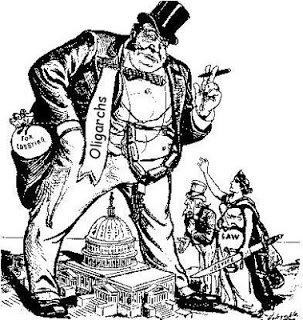
So how should we really refer to these United States of America? A banana republic? How about an oligarchic plutocracy? They both fit quite admirably with what we’ve become. Actually I prefer the more vernacular US of BS. Sure it’s crude, base, coarse and of course “politically incorrect” but take a close look at America.

In almost every area one can think of it’s pretty much the same. Truth and honesty is what we’re indoctrinated with, yet in reality we’re a country imbued with dishonesty and lying. Hell, even with little kids nowadays it’s the parents always yammering “good job” here and “good job” there. My god, leave the little tyke alone. He, she will get it together without the constant praising fearing without it he’ll somehow become a failure.

Think about it; from the way we conduct war to being held personally accountable, the “American Dream” to our “color blindness” on race, from “official” Washington to the “independent” MSM, and how it’s all dispensed to the people, it’s all the same BS.

We go to war to bring “freedom and democracy” to the people we invade and occupy. That’s how “dubya” Bush put it to the American people. We commit torture but call it “enhanced interrogation techniques”. We kill innocents in those wars but refer to it as “collateral damage”; come on.

This didn’t all begin with our latest wars against “terrorists”. In Viet Nam, it was the Viet Cong and the North Vietnamese Communists and every VC we killed were the “enemy” including women and children. “Winning” that war was calculated based on the number of “enemy” reported killed. Read Nick Turse’s, “Kill Anything That Moves” where “My Lai” wasn’t an aberration-as the Army said it was-but an everyday occurrence. Terrorists are just the latest manifestation of a contrived, mortal “enemy” we’re told we must fight.

Now everyone we kill are all called “terrorists”, insurgents, al Qaeda, Taliban, ISIS. But of course our killing with drones and missile strikes isn’t “terrorism” it’s what; winning the “hearts and minds”?

Go back further to our wars and “diplomacy” with our own indigenous people. It was all part of what we were taught in our schools called, “Manifest Destiny”. Well that was manifested with every treaty “official” Washington brokered with the true natives of this country being broken. The indigenous know it and now live with the circumstances that was forcibly thrust upon them. Plundering, confiscating the land and what’s now called genocide was really what it was about. You know, “from sea to shining sea”.

As far as who is held to account for their actions today, it’s mostly the poor, black or brown, those profiled, harassed, rousted and often killed but rarely are the police held accountable for their actions.

In the Ferguson police killing of Michael Brown, the grand jury exonerated officer Darren Wilson even though one of those testifying had earlier admitted to prosecutor Bob McCulloch to not being at the scene-which he later publicly stated she “clearly wasn’t present at the scene”- yet he let the panel hear her false testimony and they subsequently voted to acquit Wilson. As for McCulloch I believe he remains as the prosecutor in Ferguson.

We’re supposed to be “color blind” when it comes to race and ethnicity and enforcing the law, yet it’s not just Ferguson where the injustice is occurring it’s a country wide phenomenon. Our largest minorities are those disproportionately incarcerated. Justice? What justice? And for whom?

The “American Dream…a hoax. “Work hard, get an education, get a good job, get married and own a big house”. Maybe that’s true for a handful but the reality for most college students is debt for life. There’s over a $trillion in college student debt with outrageous interest rates tacked on. Too many are working as bartenders and wait staff. They can’t find jobs in their area of study as outsourcing of jobs has become endemic.

As “Americans” we embrace “capitalism” and despise “socialism”. Yet when the financial “masters of the universe” and the big banks brought the financial system to its knees with its fraudulent excesses in 2008, they were “bailed” out by the FED and the US Treasury-and unlike college students now get $billions in FED loans at near zero interest rates. It was government “socialism” that came to the rescue keeping the vultures afloat but sold as a “bailout” to the public. As far as “accountability” for the fraud they committed, other than a few millions in fines-and always with the stipulation they admit no wrongdoing as part of the settlement- that were miniscule and insignificant compared to the billions they made with their financial scheming, it was simply a financial bump in the road. And most significantly none went to jail. How’s that for equal justice under the law!

Our “defense” industry, Lockheed Martin, Boeing, Raytheon, General Dynamics, Northrop Grumman -the big five of the lot- are considered as “independent” corporations but they’re all pretty much owned by the Defense Department-formerly known as the “War Department” until changed after WWII-as the bulk of their earnings is from government spending called innocently as “fiscal” policy. Well that fiscal policy goes to the tune of a $trillion each year when all expenditures are considered i.e. armaments, over a 1000 military bases, wars and occupations, homeland security, NGO’s directly funded by the government, the NSA, CIA, independent contractors, NASA, the VA et al. All against “enemies” not really a threat but conjured up as so to the public to make them fearful so “official” Washington can justify the bloated, unnecessary expenditures.

Every other 1st world post industrialized country has public health insurance for all, in essence a single payer, Medicare type system run by the government. Accept for those 65 and older on Medicare in this country we now have “Obama” care, the Affordable Care Act system still leaves millions without health insurance. But it sure increased the “benefits” to the private health care behemoths, essentially a monopoly with no competition- whereby they divide the country into distinct areas so they don’t compete with each other, akin to the mafia, that is inefficient, has excessive overhead costs but sold as the best health system in the world while in actuality its 37th in the world in delivering health care. So to an imagined “good ole boy” who remarks, “We ain’t got no stinkin socialized medicine in this country. What are ya some kinda commie or somethin?” Ah, but I digress.

And lastly- there’s no way to elaborate on all the BS befouling America in such a short piece; just substitute your own; the crock is endless – there’s the corporate MSM. What may have been a time of an independent free press, naturally skeptical of government with investigative journalism unearthing official wrongdoing has descended into what can best be described as the “ministry of propaganda”, a compliant, complicit, enabling organ of the state.

It “informs” us alright but mostly with lies, distortions and misinformation rather than keeping the public informed with the truth as it really is, not some fictionalized version to keep it in good stead with “official” Washington.

But that corporate MSM fits in quite nicely with this pieces hypothesis, the US of BS.

And an increasingly dangerous one at that not only to others in the world but also for Americans.

But don’t tell that to most Americans, we’re still “the land of the free and the home of the brave” .

Yeah, BS to the very end.

About the Author:

Retired. The author of “DECEIT AND EXCESS IN AMERICA, HOW THE MONEYED INTERESTS HAVE STOLEN AMERICA AND HOW WE CAN GET IT BACK”, Authorhouse, 2009

Columbians Tired of US Planes Dumping Tons of Monsanto’s Roundup on Them to Fight the Drug War

monsanto-columbian-drug-war

By Matt Agorist

Source: Free Thought Project

For over two decades now, US planes have been dumping tons of pesticides over Columbian coca fields. America’s immoral and asinine policy of the War on Drugs has perpetuated the aerial spraying of Monsanto’s Roundup over rural areas of Columbia since 1994.

Originally the Columbian government wholeheartedly supported the ridiculous notion of mass killing all vegetation in attempt to cull the drug trade. However, it is no longer a secret that the health effects of long-term exposure to glyphosate are less than desirable.

Just last month, the World Health Organization was forced to admit that glyphosate is “probably carcinogenic to humans.”

The recent acceptance by the mainstream that Monsanto’s Roundup causes a slew of negative health effects has sparked fear and infighting among the Columbian government.

According to the AFP,

Health Minister Alejandro Gaviria said last week that Colombia should “immediately suspend” spraying — a move vehemently opposed by Defense Minister Juan Carlos Pinzon, who said it would “give criminals the upper hand.”

The row erupted just as US Deputy Secretary of State Antony Blinken paid a visit to Colombia, which the United States sees as one of its closest allies in the region.

The politicians who are fear-mongering about stopping the program are likely scared of losing the hundreds of millions in funds received annually from the US to combat the cultivation of this plant.

Daniel Mejia, the head of Colombia’s Center for Research on Security and Drugs explained why they are worried about the program. “We carried out a study that showed fumigating caused dermatological and respiratory problems and provoked miscarriages,” he said.

Even if dumping massive amount of carcinogenic pesticides from airplanes was a good idea, it’s not effective. According to the United Nations Office on Drugs and Crime, this program has aided Colombia in reducing its coca fields from more than 140,000 hectares (346,000 acres) in 2001 to 48,000 hectares in 2013. However, they conveniently left out the increase seen last year. The amount of land under coca cultivation in Colombia jumped 39 percent in 2014 to 112,000 hectares (about 27,000 acres), according to the Office of National Drug Control Policy.

Cocaine trafficking in Latin American region has caused a slew violence and turmoil, including the Columbian civil war. However, this turmoil is a direct result of prohibition spearheaded by the United States.

Columbia never had a cocaine trafficking problem until the US-funded war on drugs began its destructive path across South America.

During the 1980s, Peru, Bolivia and Colombia were responsible for 65%, 25% and 10% of the world’s coca production respectively. By 2000, however, the US “war on drugs” in neighboring Andean countries had turned Colombia into the world’s largest cocaine producer by far, representing 90% of the total, according to a report from the from the Woodrow Wilson International Center for Scholars.

The coca plant is one of the most beneficial and astonishingly resilient plants in the world. Resistant to drought and disease, coca needs no irrigation and the alkaloids it contains provide a myriad of medicinal uses. From its analgesic effects to digestive aid, coca’s positive influence in medicine is vast.

The plant has played an important role in history dating back to the Pre-Inca period.

According to a study published by Harvard University in 1975, (Nutritional Value of Coca Leaf (Duke, Aulick, Plowman 1975)) chewing 100 grams of coca is enough to satisfy the nutritional needs of an adult for 24 hours. Thanks to the calcium, proteins, vitamins A and E, and other nutrients it contains, the plant offers even better possibilities to the field of human nutrition than it does to that of medicine, where it is commonly used today.

However, the state cares not about the benefit of such a plant, only that it can be turned into a white powdery substance and snorted to stimulate long and often nonsensical conversations. Instead of cultivating the plant for its benefits, the immoral war on drugs drops carcinogens from airplanes to stop its growth.

The president of Columbia, Juan Manuel Santos, is avoiding any stance on the aerial spraying program whatsoever. According to the AFP, his staff said the final authority on the matter is the National Narcotics Council, which falls under the Justice Ministry. In the meantime, however, the spraying continues.

Legalizing Marijuana Now More Popular Than All Political Candidates

yes-we-cannabis-marijuana-poster

By John Vibes

Source: TheAntiMedia.org

It is no secret that Americans are losing faith in the US political system. With the potential of a choice between a Clinton and a Bush in 2016, it is likely that even more people will stop participating.

Now that there have been states where people have been allowed to vote for the legalization of marijuana, that topic has actually become more popular than the candidates themselves.

According to a Quinnipiac University poll conducted in March, in the key swing states of Ohio, Pennsylvania and Florida, marijuana is far more popular than all the major political candidates. The survey found that over 80% of people in all states supported medical marijuana, with over 50% also supporting full legalized recreational marijuana.

Meanwhile, all of the major political candidates have the approval of less than 50% of the people polled.

In some ways marijuana policy is the perfect issue for a presidential campaign. It has far reaching consequences that both parties have reason to engage,” John Hudak of the Brookings Institution told the Washington Post, in response to the poll.

Prohibition of any kind should be opposed for the reasons I have laid out in the past. However, marijuana is of specific immediate importance because of its ability to heal sick people and create environmentally friendly industrial products. It is also one of the safest drugs known to our species.

A recent Gallup poll found that major political parties in the United States are seeing their lowest popularity levels in recent memory.

Both the Democrats and the Republicans fall well below 50% in terms of approval, with 39% viewing the Democratic party favorable and 37% viewing the Republican party favorable.


John Vibes is an author, researcher and investigative journalist who takes a special interest in the counter culture and the drug war. In addition to his writing and activist work he organizes a number of large events including the Free Your Mind Conference, which features top caliber speakers and whistle-blowers from all over the world. You can contact him and stay connected to his work at his Facebook page. You can find his 65 chapter Book entitled “Alchemy of the Timeless Renaissance” at bookpatch.com.


How America Became an Oligarchy

OLIGARCHY

By Ellen Brown

Source: Counterpunch

“The politicians are put there to give you the idea that you have freedom of choice. You don’t. . . . You have owners.”

— George Carlin, The American Dream

According to a new study from Princeton University, American democracy no longer exists. Using data from over 1,800 policy initiatives from 1981 to 2002, researchers Martin Gilens and Benjamin Page concluded that rich, well-connected individuals on the political scene now steer the direction of the country, regardless of – or even against – the will of the majority of voters. America’s political system has transformed from a democracy into an oligarchy, where power is wielded by wealthy elites.

“Making the world safe for democracy” was President Woodrow Wilson’s rationale for World War I, and it has been used to justify American military intervention ever since. Can we justify sending troops into other countries to spread a political system we cannot maintain at home?

The Magna Carta, considered the first Bill of Rights in the Western world, established the rights of nobles as against the king. But the doctrine that “all men are created equal” – that all people have “certain inalienable rights,” including “life, liberty and the pursuit of happiness” – is an American original. And those rights, supposedly insured by the Bill of Rights, have the right to vote at their core. We have the right to vote but the voters’ collective will no longer prevails.

In Greece, the left-wing populist Syriza Party came out of nowhere to take the presidential election by storm; and in Spain, the populist Podemos Party appears poised to do the same. But for over a century, no third-party candidate has had any chance of winning a US presidential election. We have a two-party winner-take-all system, in which our choice is between two candidates, both of whom necessarily cater to big money. It takes big money just to put on the mass media campaigns required to win an election involving 240 million people of voting age.

In state and local elections, third party candidates have sometimes won. In a modest-sized city, candidates can actually influence the vote by going door to door, passing out flyers and bumper stickers, giving local presentations, and getting on local radio and TV. But in a national election, those efforts are easily trumped by the mass media. And local governments too are beholden to big money.

When governments of any size need to borrow money, the megabanks in a position to supply it can generally dictate the terms. Even in Greece, where the populist Syriza Party managed to prevail in January, the anti-austerity platform of the new government is being throttled by the moneylenders who have the government in a chokehold.

How did we lose our democracy? Were the Founding Fathers remiss in leaving something out of the Constitution? Or have we simply gotten too big to be governed by majority vote?

Democracy’s Rise and Fall

The stages of the capture of democracy by big money are traced in a paper called “The Collapse of Democratic Nation States” by theologian and environmentalist Dr. John Cobb. Going back several centuries, he points to the rise of private banking, which usurped the power to create money from governments:

The influence of money was greatly enhanced by the emergence of private banking. The banks are able to create money and so to lend amounts far in excess of their actual wealth. This control of money-creation . . . has given banks overwhelming control over human affairs. In the United States, Wall Street makes most of the truly important decisions that are directly attributed to Washington.

Today the vast majority of the money supply in Western countries is created by private bankers. That tradition goes back to the 17th century, when the privately-owned Bank of England, the mother of all central banks, negotiated the right to print England’s money after Parliament stripped that power from the Crown. When King William needed money to fight a war, he had to borrow. The government as borrower then became servant of the lender.

In America, however, the colonists defied the Bank of England and issued their own paper scrip; and they thrived. When King George forbade that practice, the colonists rebelled.

They won the Revolution but lost the power to create their own money supply, when they opted for gold rather than paper money as their official means of exchange. Gold was in limited supply and was controlled by the bankers, who surreptitiously expanded the money supply by issuing multiple banknotes against a limited supply of gold.

This was the system euphemistically called “fractional reserve” banking, meaning only a fraction of the gold necessary to back the banks’ privately-issued notes was actually held in their vaults. These notes were lent at interest, putting citizens and the government in debt to bankers who created the notes with a printing press. It was something the government could have done itself debt-free, and the American colonies had done with great success until England went to war to stop them.

President Abraham Lincoln revived the colonists’ paper money system when he issued the Treasury notes called “Greenbacks” that helped the Union win the Civil War. But Lincoln was assassinated, and the Greenback issues were discontinued.

In every presidential election between 1872 and 1896, there was a third national party running on a platform of financial reform. Typically organized under the auspices of labor or farmer organizations, these were parties of the people rather than the banks. They included the Populist Party, the Greenback and Greenback Labor Parties, the Labor Reform Party, the Antimonopolist Party, and the Union Labor Party. They advocated expanding the national currency to meet the needs of trade, reform of the banking system, and democratic control of the financial system.

The Populist movement of the 1890s represented the last serious challenge to the bankers’ monopoly over the right to create the nation’s money. According to monetary historian Murray Rothbard, politics after the turn of the century became a struggle between two competing banking giants, the Morgans and the Rockefellers. The parties sometimes changed hands, but the puppeteers pulling the strings were always one of these two big-money players.

In All the Presidents’ Bankers, Nomi Prins names six banking giants and associated banking families that have dominated politics for over a century. No popular third party candidates have a real chance of prevailing, because they have to compete with two entrenched parties funded by these massively powerful Wall Street banks.

Democracy Succumbs to Globalization

In an earlier era, notes Dr. Cobb, wealthy landowners were able to control democracies by restricting government participation to the propertied class. When those restrictions were removed, big money controlled elections by other means:

First, running for office became expensive, so that those who seek office require wealthy sponsors to whom they are then beholden. Second, the great majority of voters have little independent knowledge of those for whom they vote or of the issues to be dealt with. Their judgments are, accordingly, dependent on what they learn from the mass media. These media, in turn, are controlled by moneyed interests.

Control of the media and financial leverage over elected officials then enabled those other curbs on democracy we know today, including high barriers to ballot placement for third parties and their elimination from presidential debates, vote suppression, registration restrictions, identification laws, voter roll purges, gerrymandering, computer voting, and secrecy in government.

The final blow to democracy, says Dr. Cobb, was “globalization” – an expanding global market that overrides national interests:

[T]oday’s global economy is fully transnational. The money power is not much interested in boundaries between states and generally works to reduce their influence on markets and investments. . . . Thus transnational corporations inherently work to undermine nation states, whether they are democratic or not.

The most glaring example today is the secret twelve-country trade agreement called the Trans-Pacific Partnership. If it goes through, the TPP will dramatically expand the power of multinational corporations to use closed-door tribunals to challenge and supersede domestic laws, including environmental, labor, health and other protections.

Looking at Alternatives

Some critics ask whether our system of making decisions by a mass popular vote easily manipulated by the paid-for media is the most effective way of governing on behalf of the people. In an interesting Ted Talk, political scientist Eric Li makes a compelling case for the system of “meritocracy” that has been quite successful in China.

In America Beyond Capitalism, Prof. Gar Alperovitz argues that the US is simply too big to operate as a democracy at the national level. Excluding Canada and Australia, which have large empty landmasses, the United States is larger geographically than all the other advanced industrial countries of the OECD (Organization for Economic Cooperation and Development) combined. He proposes what he calls “The Pluralist Commonwealth”: a system anchored in the reconstruction of communities and the democratization of wealth. It involves plural forms of cooperative and common ownership beginning with decentralization and moving to higher levels of regional and national coordination when necessary.

Dr. Alperovitz is co-founder of an initiative called The Next System Project, aimed at defining the issues in a national political debate as a first step to realizing the possible. He quotes Prof. Donald Livingston, who asked in 2002:

What value is there in continuing to prop up a union of this monstrous size? . . . [T]here are ample resources in the American federal tradition to justify states’ and local communities’ recalling, out of their own sovereignty, powers they have allowed the central government to usurp.

Taking Back Our Power

If governments are recalling their sovereign powers, they might start with the power to create money, which was usurped by private interests while the people were asleep at the wheel. State and local governments are not allowed to print their own currencies; but they can own banks, and all depository banks create money when they make loans, as the Bank of England recently acknowledged.

The federal government could take back the power to create the national money supply by issuing its own Treasury notes as Abraham Lincoln did. Alternatively, it could issue some very large denomination coins as authorized in the Constitution; or it could nationalize the central bank and use quantitative easing to fund infrastructure, education, job creation, and social services, responding to the needs of the people rather than the banks.

The freedom to vote carries little weight without economic freedom – the freedom to work and to have food, shelter, education, medical care and a decent retirement. President Franklin Roosevelt maintained that we need an Economic Bill of Rights. If our elected representatives were not beholden to the moneylenders, they might be able both to pass such a bill and to come up with the money to fund it.

Ellen Brown is an attorney, founder of the Public Banking Institute, and author of twelve books including the best-selling Web of Debt. Her latest book, The Public Bank Solution, explores successful public banking models historically and globally. Her 300+ blog articles are at EllenBrown.com. Listen to “It’s Our Money with Ellen Brown” on PRN.fm.


MAY DAY – The International Labor Day

crane13

Source: The Anarchist International

May 1st, International Workers’ Day, commemorates the historic struggle of working people throughout the world, and is recognized in most countries. The United States of America and Canada are among the exceptions. This despite the fact that the holiday began in the 1880s in the USA, linked to the battle for the eight-hour day, and the Chicago anarchists.

The struggle for the eight-hour day began in the 1860s. In 1884, the Federation of Organized Trades and Labor Unions of the United States and Canada, organized in 1881 (and changing its name in 1886 to American Federation of Labor ) passed a resolution which asserted that “eight hours shall constitute a legal day’s work from and after May 1, 1886, and that we recommend to labor organizations throughout this district that they so direct their laws as to conform to this resolution”. The following year the Federation repeated the declaration that an eight-hour system was to go into effect on May 1, 1886. With workers being forced to work ten, twelve, and fourteen hours a day, support for the eight-hour movement grew rapidly. In the months prior to May 1, 1886, thousands of workers, organized and unorganized, members of the organization Knights of Labor and of the federation, were drawn into the struggle. Chicago was the main center of the agitation for a shorter day. The anarchists were in the forefront of the Central Labor Union of Chicago, which consisted of 22 unions in 1886, among them the seven largest in the city.

During the Railroad strikes of 1877, the workers had been violently attacked by the police and the United States Army. A similar tactic of state terrorism was prepared by the bureaucracy to fight the eight-hour movement. The police and National Guard were increased in size and received new and powerful weapons financed by local business leaders. Chicago’s Commercial Club purchased a $2000 machine gun for the Illinois National Guard to be used against strikers. Nevertheless, by May 1st, the movement had already won gains for many Chicago workers. But on May 3, 1886, police fired into a crowd of strikers at the McCormick Harvester Machine Company, killing at least one striker, seriously wounding five or six others, and injuring an undetermined number. Anarchists called for a mass meeting the next day in Haymarket Square to protest the brutality.

The meeting proceeded without incident, and by the time the last speaker was on the platform, the rainy gathering was already breaking up, with only about two hundred people remaining. It was then a police column of 180 men marched into the square and ordered the meeting to disperse. At the end of the meeting a bomb was thrown at the police, killing one instantly, six others died later. About seventy police officers were wounded. Police responded by firing into the crowd. How many civilians were wounded or killed from police bullits never was ascertained exactly. Although it was never determined who threw the bomb, the incident was used as an excuse to attack anarchists and the labor movement in general. Police ransacked the homes and offices of suspected radicals, and hundreds were arrested without charge. A reign of police terror swept over Chicago. Staging “raids” in the working-class districts, the police rounded up all known anarchists and other socialists. “Make the raids first and look up the law afterward!” publicly counseled the state’s attorney.

Anarchists in particular were harassed, and eight of Chicago’s most active were charged with conspiracy to murder in connection with the Haymarket bombing. A kangaroo court found all eight guilty, despite a lack of evidence connecting any of them to the bomb-thrower, and they were sentenced to die. In October 9, 1886, the weekly journal Knights of Labor published in Chicago, carried on page 1 the following announcement: “Next week we begin the publication of the lives of the anarchists advertised in another column.”

The advertisement, carried on page 14, read: The story of the anarchists, told by themselves; Parsons, Spies, Fielden, Schwab, Fischer, Lingg, Engle, Neebe. The only true history of the men who claim that they are condemned to suffer death for exercising the right of Free Speech: Their association with Labor, Socialistic and Anarchistic Societies, their views as to the aims and objects of these organizations, and how they expect to accomplish them; also their connection with the Chicago Haymarket Affair. Each man is the author of his own story, which will appear only in the “Knights of Labor” during the next three months, – the great labor paper of the United States, a 16-page weekly paper, containing all the latest foreign and domestic labor news of the day, stories, household hints, etc. A co-operative paper owned and controlled by members of the Knights of Labor, and furnished for the small sum of $1.00 per annum. Adress all communications to Knights of Labor Publishing Company, 163 Washington St., Chicago, Ill. Later this journal and the paper Alarm published the autobiographies of the Haymarket men.

Albert Parsons, August Spies, Adolf Fischer and George Engel were hanged on November 11, 1887. Louis Lingg committed suicide in prison. The authorities turned over the bodies to friends for burial, and one of the largest funeral processions in Chicago history was held. It was estimated that between 150,000 to 500,000 persons lined the route taken by the funeral cortege of the Haymarket martyrs. A monument to the executed men was unveiled June 25, 1893 at Waldheim Cemetery in Chicago. The remaining three, Samuel Fielden, Oscar Neebe and Michael Schwab, were finally pardoned in 1893.

On June 26, 1893, the governor of Illinois, John Peter Altgeld, issued the pardon message in which he made it clear that he was not granting the pardon because he believed that the men had suffered enough, but because they were innocent of the crime for which they had been tried, and that they and the hanged men had been the victims of hysteria, packed juries and a biased judge. He noted that the defendants were not proven guilty because the state “has never discovered who it was that threw the bomb which killed the policeman, and the evidence does not show any connection whatsoever between the defendants and the man who threw it.”

International Workers’ Day is the commemoration of the Haymarket Event in Chicago in 1886. In 1889, the first congress of the Second International, meeting in Paris for the centennial of the French Revolution and the Exposition Universelle (1889), following an initiative from the American Federation of Labor, called for international demonstrations on the 1890 anniversary of the Chicago protests. These were so successful that May Day was formally recognized as an annual event at the International’s second congress in 1891.

It is not surprising that the state, business leaders, mainstream union officials, and the media would want to hide the true history of May Day. In its attempt to erase the history and significance of May Day, the United States government declared May 1st to be “Law Day”, and gave the workers instead Labor Day, the first Monday of September – a holiday devoid of any historical significance.

Nevertheless, rather than suppressing the labor and anarchist movements, the events of 1886 and the execution of the Chicago anarchists, spokesmen of the movement for the eight-hour day, mobilized many generations of radicals. Emma Goldman, a young immigrant at the time, later pointed to the Haymarket affair as her political birth. Instead of disappearing, the anarchist movement only grew in the wake of Haymarket.

As workers, we must recognize and commemorate May Day not only for it’s historical significance, but also as a time to organize around issues of vital importance of today for the working-class broadly defined, i.e. the grassroots – the people seen as a class in contrast to the superiors in income and/or rank – economically and/or political/administrative.

The May Day Manifestos of the International Workers of the World affiliated to the Anarchist International, from the latest years are published on its Webpage, click here!