Emanuel running scared; White House, Hillary camps alarmed

obama-eman

By Wayne Madsen

Source: Intrepid Report

President Obama and putative Democratic presidential candidate Hillary Clinton held a previously unscheduled and unannounced 90-minute luncheon meeting at the White House on December 7. Although the White House termed the meeting “personal,” WMR learned that chief on their agenda was the political scandal in Chicago surrounding former Obama chief of staff and former Clinton administration White House aide Rahm Emanuel. Obama and Clinton fear that an indictment of Emanuel for covering up the shooting death by Chicago police of an unarmed black teen in order to skate to re-election as mayor could upset Chicago and Illinois politics and harm Clinton’s current lead in the polls.

Emanuel, who was re-elected mayor of Chicago last month after defeating his Hispanic challenger, Jesus “Chuy” Garcia, in the April run-off primary, is mired in a major scandal arising from his covering up of the existence of a Chicago Police Department tape showing Chicago police officer Jason Van Dyke pumping sixteen rounds into Laquan McDonald, a 17-year old African-American, in 2014.

On December 7, just as Obama and Clinton were secretly meeting at White House, the U.S. Justice Department announced it was conducting a criminal probe of the Chicago Police Department. At the same time, Emanuel, who has had a tortured relationship with the press, called a news conference to announce that he would support the federal probe of the police. Last week, after publicly supporting his police superintendent, Garry McCarthy, an import from the New York Police Department, Emanuel suddenly asked for his resignation.

At the news conference, Emanuel, who is normally brash and ill-tempered with the media and others, looked like a deer caught in the headlights. After having rejected a federal probe of his police department, Emanuel reversed himself and said he welcomed it. Mrs. Clinton publicly stated she had faith in Emanuel. Clinton said she was “confident that he’s [Emanuel] going to do everything he can to get to the bottom” of the emerging scandal.

Illinois Republican Governor Bruce Rauner, a longtime friend of Emanuel, like Mrs. Clinton, expressed “shock” after seeing the video of McDonald’s shooting but refrained from criticizing the mayor. However, Rauner, whose wife Diana Mendley Rauner, like Emanuel, is Jewish and a strong supporter of Zionist causes, did criticize Obama for not ordering a federal investigation of the Chicago police earlier. The Obama White House is said to have been livid over Rauner’s criticism and believes it would not have been made without a “wink and a nod” from Emanuel’s backers.

Rauner’s chief operating officer is former Republican Governor of Hawaii Linda Lingle, another supporter of Zionist causes who is helping to deflect criticism away from Emanuel. Emanuel also has a powerful ally in Obama’s Cabinet, Commerce Secretary Penny Pritzker, the founder of PSP Capital Partners and Pritzker Realty Group and an heir to the Hyatt Hotel fortune and a financial backer of Emanuel.

Emanuel has also appointed as a senior adviser to his Task Force for Police Accountability former Massachusetts Governor Deval Patrick, an African-American and a close friend of Obama. Emanuel hopes to avoid any potential indictment for covering up the McDonald shooting by using Patrick, the head of the Department of Justice’s civil rights division under President Bill Clinton, to use his connections with Attorney General Loretta Lynch, also an African-American, and her senior staff to intercede on his behalf.

Emanuel and his political supporters have every reason to be worried. Emanuel stands accused of covering up the existence of the police dash cam video showing that Van Dyke shot McDonald without provocation from the teen. On April 15, 2015, the Chicago City Council, with Emanuel’s obvious blessing, offered to pay the McDonald family $5 million in a settlement. The offer came just a week after Emanuel defeated Garcia and a campaign in which Emanuel convinced the city’s African-American voters that he was a better choice than Garcia, a Cook County Commissioner.

On May 26, 2015, a freelance journalist filed a Freedom of Information Act request for the police dash cam video showing the shooting of McDonald. The city denied the request citing an ongoing investigation of the incident. In November, a judge ordered the city to release the explosive tape that enraged the city’s African-American residents and prompted Cook County State’s Attorney Anita Alvarez to charge Van Dyke with first degree murder.

However, it was known to Alvarez, McCarthy, and Emanuel what was on the 2014 video and Emanuel stands accused in the court of public opinion and by a number of newspapers of covering up the tape’s existence in order to glide on to re-election. It is certain that if the tape were made public earlier, Garcia would have garnered the support of a majority of Chicago’s African-Americans and defeated Emanuel in the April Democratic primary. Emanuel, the scion of a hard line Zionist family—his father, a former Irgun terrorist from Israel once stated that Arab women were only suited to be cleaning ladies in the White House—harbors his own presidential ambitions in 2020 or 2024. That is why Emanuel, former U.S. Attorney for Northern Illinois Patrick Fitzgerald, and U.S. Judge James Zagel arranged for former Democratic Governor and Emanuel’s predecessor in Illinois’s 5th Congressional District, Rod Blagojevich, to receive a 14-year federal prison sentence for corruption. Blagojevich, who insists he is innocent, is not slated for release until 2025.

Emanuel has called on all his Zionist friends to bail him out of his current political morass. With several quarters calling for his resignation, Emanuel is being hit with the age-old political scandal question arising from the Watergate affair: “What did he [Emanuel] know and when did he know it?”

Emanuel even has his own version of the Richard Nixon’s secretary Rose Mary Woods’s infamous 18 1/2 minute gap in an Oval Office audio tape. The manager of a Burger King testified before a grand jury that Chicago police erased 86 minutes from his restaurant’s security video tape that showed the shooting of McDonald. The FBI confiscated the Burger King’s video recorder and then stated that there was no evidence that the videotape had been altered. When it comes to mishandling and tampering with evidence of a crime, from the Kennedy assassination in Dallas to the crash of TWA flight 800 off Long Island and 9/11, the FBI has no peers. And when it comes to whether to believe a Burger King manager and the FBI, the Burger King manager wins any veracity contest hands down.

In addition to McCarthy, Emanuel fired Scott Ando, the chief administrator of the so-called “Independent” Police Review Authority and replaced him with a former assistant attorney flunky for Fitzgerald in the U.S. Attorney’s Office, Sharon Fairley. Fairley’s “independence” is dubious since she served as Emanuel’s general counsel and deputy inspector general during the cover-up of the McDonald shooting. Police confiscated the Burger King tape which was subsequently turned over to the FBI.

As for as the U.S. Attorney for Northern Illinois, Zachary Fardon, Emanuel has little to be concerned with. Fardon replaced Fitzgerald in 2013 and formerly assisted him in prosecuting and convicting former GOP Governor George Ryan after the governor commuted the death sentences of Illinois’s death row inmates after citing police and prosecutorial misconduct in their trials. Fardon’s assistant U.S. Attorney is Gary Shapiro, another pal of Emanuel.

By going after corrupt law enforcement officers and prosecutors, Ryan painted a target on his back. Ryan went to prison because he went after Fitzgerald’s and Fardon’s corrupt cronies. Blagojevich followed Ryan into prison after threatening to expose Obama’s and Emanuel’s political and personal cronyism in Chicago.

Emanuel created a number of enemies on his way up the political ladder. His enemies include Chicago public school teachers, public employee unions, the African-American community, the Hispanic community, former Democratic Governor Pat Quinn—defeated by Emanuel’s pal Rauner—and the Assyrian Chaldean Christian community in the 5th district. During his campaign for Congress, Emanuel had the Assyrians convinced that he, like them, was of Assyrian Christian descent. Emanuel never mentioned that he was a Zionist Jew who served in the Israeli Army during Operation Desert Storm. Now that Emanuel’s political blood is in the water, his enemies are coalescing and are ready to pounce on the political circle of wagons Emanuel believes he has formed around himself in Chicago, Springfield, and Washington, DC. Emanuel, who has been a “divide and conqueror” for all of his political life—he once called progressive and liberal Democrats “fucking retarded”—now stands to be politically “drawn and quartered” by enemies who are uniting in the common goal of seeing Emanuel “perp walked” off to prison.

Mainstream Media Just Destroyed a National Security Level Crime Scene on LIVE TV

apartment-terrorist-redlands-msnbc

By William N. Grigg

Source: The Free Thought Project

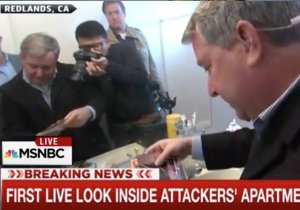
If the San Bernardino shooting were not being treated as an episode of Homeland Security Theater, why would the FBI – the lead investigative agency in what has been described as an ISIS-linked act of mass terrorism – allow an MSNBC News crew to contaminate a crime scene? Why would a reporter be allowed to handle evidence with un-gloved hands – picking up licenses, identification cards, and other credentials, credit cards, and riffling through copies of the Koran?

NBC Anchor Andrea Mitchell explained that the landlord of the apartment rented by Sayed Farook and his wife, Tashfeen Malik, had allowed “the media to enter … en masse” and examine what was still an active crime scene. If, as several media reports have suggested, the couple had received repeated, mysterious visits to their home by yet-unidentified co-conspirators, the mere presence of multiple news crews might be sufficient to destroy forensic evidence. Any investigator with even a modicum of knowledge and experience will recognize that allowing reporters to handle evidence with bare hands will adulterate fingerprints and DNA traces that could be useful in identifying additional suspects.

Although the couple’s landlord had reportedly been told on December 3 that the police had finished examining the apartment, and FBI Director James B. Comey made a similar statement this afternoon (December 4), the San Bernardino Sheriff’s Office still considered the site an active crime scene.

“That is not a cleared crime scene,” a spokesman for the San Bernardino Sheriff’s Office shortly after the landlord used a crowbar to break the plywood seal to let the media – and, apparently, several bystanders, including a woman with a dog and another carrying a newborn child — into the apartment.

“The most important aspect of evidence collection and preservation is protecting the crime scene,” explains George Schiro, a forensic scientist with the Louisiana State Police Crime Laboratory. “This is to keep the pertinent evidence uncontaminated until it can be recorded and collected. The successful prosecution of a case can hinge on the state of the physical evidence at the time it is collected. The protection of the scene begins with the arrival of the first police officer at the scene and ends when the scene is released from police custody.”

The personal effects that were pawed by dozens of curious reporters were not the only potential source of valuable clues as to potential accomplices in the deadly shooting.

“Particular attention should be paid to the floor since this is the most common repository of evidence and it poses the greatest potential for contamination,” Schiro advises. This is why “the arrival of additional personnel can cause problems in protecting the scene”; non-essential people “should never be allowed into a secured crime scene unless they can add something (other than contamination) to the crime scene investigation.”
In addition to the apartment’s floors, the curtilage – “driveways, surrounding yards, pathways, etc.” – could likewise provide valuable evidence, assuming that it isn’t trampled out of existence by an eager herd of media personnel and curiosity seekers.

Aaron Elswick, a neighbor of Farook and his wife, claims that he had noticed “suspicious activity” at their apartment, and had been told by another neighbor that the couple had received “quite a few packages within a short amount of time, and they were actually doing a lot of work out in the garage.”

According to the SBSO, once again, the apartment had not been “released” from police custody at the time of the “media tour.” The reported cache of pipe bombs and ammunition had been removed. Instead, the visitors saw “what would have looked like a relatively normal cluttered household, notwithstanding a shredded front door that had been ripped from its hinges and cast aside as law enforcement officers broke in,” summarized the New York Times. “There were signs throughout the home of the residents’ Muslim faith: The sticker pasted on a chest of drawers (`Praise be to Allah Who relieved me from suffering and gave me relief’). And there were the books: `The Characteristics of the Prophet Muhammad’ in a linen closet and `Common Mistakes Regarding Prayer’ on the bedside table.”

To that segment of the media propagating the narrative that America’s Muslim population teems with latent suicide terrorists, those items – which are similar to those found in the home of at least one of the people killed in Tuesday’s mass shooting – are more incriminating than firearms.

Rather than seeking to learn the truth and tell it without fear or favor, the Legacy Media’s role in this affair is to promote public suspicion that will result in the expansion of government power at the expense of individual liberty – whether in the form of expanded surveillance of Muslim houses of worship, or new restrictions on the right to armed self-defense.

Interestingly, a dialectical synthesis of those views can be found in a bill sponsored by California Senator Diane Feinstein (D-California) shortly before the shooting that would have prevented people listed on the federal “no-fly” list from buying firearms. In an interview shortly after the shooting, Barack Obama lamented the failure of that bill to pass the Senate. Republican presidential contender Jeb Bush has expressed qualified support for that measure – if it were narrowed down to apply only to people subject to “an active investigation” on the part of the FBI.

It isn’t difficult to imagine a “bipartisan” push to promote such a “compromise” approach: Republican national security hawks might approve of expanded scrutiny of, and limitations on the personal liberties of, people who display symptoms of “incipient radicalization,” such as regular mosque attendance; anti-gun Democrats would favor new “common-sense” restrictions on gun ownership, while seeking to expand the “radicalization” profile to include other indicators, such as participation in anti-abortion protests. The corporate media, for its part, would frame the discussion in terms that would eventually lead to less freedom for everybody, rather than subjecting such proposals to intellectually rigorous scrutiny. That’s why the state-centered media cannot be considered trustworthy.

Why the Drug War Has Been a Forty-Year Lynching

nixon-war-on-drugs-quote

By Bob Fitrakis and Harvey Wasserman

Source: FreePress.org

The Drug War has been a forty-year lynching….
…the corporate/GOP response to the peace and civil rights movements.

It’s used the Drug Enforcement Administration and other policing operations as a high-tech Ku Klux Klan, meant to gut America’s communities of youth and color.

It has never been about suppressing drugs. Quite the opposite.

And now that it may be winding down, the focus on suppressing minority votes will shift even stronger to electronic election theft.

The Drug War was officially born June 17, 1971, (http://www.drugpolicy.org/new-solutions-drug-policy/brief-history-drug-war) when Richard Nixon pronounced drugs to be “Public Enemy Number One.” In a nation wracked by poverty, racial tension, injustice, civil strife, ecological disaster, corporate domination, a hated Vietnam War and much more, drugs seemed an odd choice.
In fact, the Drug War’s primary target was black and young voters.

It was the second, secret leg of Nixon’s “Southern Strategy” meant to bring the former Confederacy into the Republican Party.

Part One was about the white vote.

America’s original party of race and slavery (https://zinnedproject.org/materials/a-peoples-history-of-the-united-states-updated-and-expanded-edition/)was Andrew Jackson’s Democrats (born 1828).

After the Civil War the Party’s terror wing, the KKK, made sure former slaves and their descendants “stayed in their place.”

A century of lynchings (at least 3200 of them) (http://www.yale.edu/ynhti/curriculum/units/1979/2/79.02.04.x.html)efficiently suppressed the southern black community.

In the 1930s Franklin Roosevelt’s New Deal social programs began to attract black voters to the Democratic Party. John Kennedy and Lyndon Johnson’s support for civil and voting rights legislation, plus the 24th Amendment ending the poll tax, sealed the deal. Today blacks, who once largely supported the Party of Lincoln,  vote 90% or more Democrat (http://blackdemographics.com/culture/black-politics/).

But the Democrats’ lean to civil rights angered southern whites. Though overt racist language was no longer acceptable in the 1970s, Nixon’s Republicans clearly signaled an open door to the former Confederacy (https://www.thenation.com/article/why-todays-gop-crackup-is-the-final-unraveling-of-nixons-southern-strategy/).

But recruiting angry southern whites would not be enough for the Republicans to take the south. In many southern states more than 40% of potential voters were black. If they were allowed to vote, and if their votes were actually counted, all the reconstructed Democrat Party would need to hold the south would be a sliver of moderate white support.

That’s where the Drug War came in.

Reliable exact national arrest numbers from 1970 through 1979 are hard to come by.

But according to Michelle Alexander’s superb, transformative The New Jim Crow, and according to research by Marc Mauer and Ryan King of the Sentencing Project, more than 31,000,000 Americans were arrested for drugs between 1980 and 2007 (http://newjimcrow.com).

Further federal uniform crime report statistics compiled by www.freepress.org indicate that, between 2008 and 2014, another 9,166,000 were arrested for drug possession.
Taken together, than means well over 40,000,000 American citizens have been arrested for drugs in the four decades since Nixon’s announcement.
It is a staggering number: more than 10% of the entire United States, nearly four times the current population of Ohio, far in excess of more than 100 countries worldwide.
A number that has gutted the African-American community.  A national terror campaign far beyond the reach of even the old KKK.
Justice Department statistics indicate than half of those arrests have been for simple possession of marijuana.
According to US Bureau of Justice statistics, between 1980 and 2013, while blacks were 12% of the population, blacks constituted 30% of those arrested for drug law violations and nearly 40% of those incarcerated in all U.S. prisons.  Thus some 20,000,000 African-American men have been sent to prison for non-violent “crimes” in the past forty years.
If the Hispanic population is added in, as much as 60% of drug arrests are of racial or ethnic minorities.
On the 40th anniversary of the Drug War in 2010, the Associated Press used public records to calculate that the taxpayer cost of arresting and imprisoning all these human beings has been in excess of $1,000,000,000.
Sending them all to college would have been far cheaper.  It also would have allowed them to enhance and transform their communities.
Instead, they were taken from their families.  Their children were robbed of their parents.  They were assaulted by the prison culture, stripped of their right to vote and stopped from leading the kind of lives that might have moved the nation in a very different direction.
Nixon also hated hippies and the peace movement. So in addition to disenfranchising 20,000,000 African-Americans, the Drug War has imprisoned additional millions of young white and Hispanic pot smokers.
Thus the DEA has been the ultra-violent vanguard of the corporate culture war.
In 1983 Ronald Reagan took the Drug War to a new level.  Using profits from his illegal arms sales to Iran, he illegally funded the Contra thugs who were fighting Nicaragua’s duly elected Sandinista government.
The Contras were drug dealers who shipped large quantities of cocaine into the US—-primarily in the Los Angeles area—-where it was mostly converted to crack.
That served a double function for the GOP.
First, it decimated the inner city.
Then Reagan’s “Just Say No” assault—-based on the drugs his Contra allies were injecting into our body politic—-imposed penalties on crack far more severe than those aimed at the powdered cocaine used in the white community.
In 1970 the US prison population was roughly 300,000 people.  Today it’s more than 2.2 million, the largest in world history by both absolute number and percentage of the general population.  There are more people in prison in the US than in China, which has five times the population (http://www.bjs.gov/index.cfm?ty=tp&tid=11).

According to the Sentencing Project, one in seventeen white males has been incarcerated, one in six Latinos, and one in three blacks.
By all accounts the Drug War has had little impact on drug consumption in the US, except to make it more profitable for drug dealers (http://www.bjs.gov/index.cfm?ty=tp&tid=11).  It’s spawned a multi-billion-dollar industry in prison construction, policing, prison guards, lawyers, judges and more, all of them invested in prolonging the drug war despite its negative impacts on public health.

For them, the stream of ruined lives of non-violent offenders is just another form of cash flow.
Like the Klan since the Civil War, the Drug War has accomplished its primary political goal of suppressing the black vote and assaulting the African-American community.
It’s shifted control of the South from the Democrats back to the Republican Party. By slashing voter eligibility and suppressing black turnout, the Drug War crusade has helped the GOP take full control of both houses of the US Congress and a majority of state governments across the US.
But the repressive impacts hit everyone, and ultimately enhance the power of the corporate state.
Toward that end, the southern corporate Democrat Bill Clinton’s two terms as a Drug Warrior further broadened the official attack on grassroots America. Clinton was determined to make sure nobody appeared tougher on “crime.”  He escalated the decimation of our democracy far beyond mere party politics, deepening the assault on the black community, and the basic rights of all Americans for the benefit of his Wall Street funders.  Obama has been barely marginally better.
In political terms, the Nixon-Reagan GOP remains the Drug War’s prime beneficiary. Today’s Republicans are poised to continue dominating our electoral process through the use of rigged electronic registration rolls and voting machines. That’s a core reality we all must face.
But no matter which party controls the White House or Congress, by prosecuting a behavior engaged in by tens of millions of Americans, the Drug War lets the corporate state arrest (and seize assets from) virtually anyone it wants at any time. It has empowered a de facto corporate police state beyond public control.

Regardless of race, we all suffer from the fear, repression and random assaults of a drug-fueled repressive police force with no real accountability.
In the interim, the Drug War is not now and never has been about drugs.
Legalizing pot is just the beginning of our recovery process.
Until we end the Drug War as a whole, America will never know democracy, peace or justice.
____________________
THE SIXTH JIM CROW: ELECTRONIC ELECTION THEFT & THE 2016 SELECTION will be released by Bob Fitrakis & Harvey Wasserman by January, 2016. Their CITIZEN KASICH will follow soon thereafter. Bob’s FITRAKIS FILES are at www.freepress.org; Harvey’s ORGANIC SPIRAL OF US HISTORY will appear in 2016.

Related video:

Neoliberalism, Austerity, and Authoritarianism

pnac-criminals-2-1

By Riad Azar

Source: New Politics

Ask anyone what neoliberalism means and they’ll tell you it’s an economic system that corresponds to a particular economic philosophy. But any real-world economic system has a corresponding political system to promote and sustain it. Milton Friedman, who has become known as the father of neoliberal thinking, claims in his text Capitalism and Freedom that “the role of the government … is t o do something that the market cannot do for itself, namely, to determine, arbitrate, and enforce the rules of the game.”* While neoliberalism’s advocates like to claim that the political system that corresponds to their economic preference is a democratic, minimal state, in practice, the neoliberal state has demonstrated quite the opposite tendency.

This essay will begin by sketching out the core tenets of neoliberal theory, tracing its history from the classical liberal tradition of the Enlightenment. I will then present some hypotheses on how relations between the neoliberal state and society operate, contrasting the state theories of Ralph Miliband and Nicos Poulantzas to create a framework that shows how the neoliberal state is a product and enforcer of anti-democratic practices. I will argue that the implementation of neoliberal economic policy, and the subsequent evolution of the neoliberal state, has historically been completed through anti-democratic methods. Further, in an effort to produce social relations that are more favorable to the accumulation of capital, austerity is employed as a tool to move further toward a market society, creating a larger, more interventionist state and promoting authoritarianism.

Neoliberalism in Theory

The term neoliberal is often convoluted, confused, and misinterpreted, especially in the American context where the center-left Democratic Party has traditionally held the title of liberal. The original liberals, or classical liberals as they are usually called, were those Enlightenment-era thinkers of Western European origin who desired to limit the authority of the feudal state and defended individual rights by restricting the power of the state, the crown, the nobility, and the church. The “neo” prefix serves as a romantic symbol, an attempt at establishing a (sometimes forced) common ground with historical figures like Adam Smith and the classical liberals, who challenged the tendencies of the monarchy to interfere in the economy for its own gain, producing inefficiency. Neoliberal economic thinkers are famously known for deriding government intervention in the economy, precisely because they trace their foundation to a period when markets were seen not just as a source of better economic outcomes, but as a weapon to challenge concentrated political power.

This revamping of liberalism appeared in the twentieth century at a time when its proponents believed they were facing a similar struggle against the expanded state apparatuses of Europe—communist, social-democratic, and fascist. Friedrich Hayek, whose text The Road to Serfdom, published in 1944, is arguably the most celebrated of the neoliberal canon, sought to show how government interference in the economy forms the basis of fascist and other totalitarian regimes, contrary to the then widely accepted notion that it was capitalist crisis that had produced fascism in Europe. For Hayek, the strong state, whether in the form of fascism, Soviet communism, or the creeping socialism of the British Labour Party, was to be eschewed.

If neoliberalism springs from a desire to combat the growing power and influence of the state, how is it that neoliberalism has produced not only a very robust state apparatus, but, as I will argue, an authoritarian one? The answer is that neoliberalism in practice has been quite different from its theory.

The Necessities of the State
in Neoliberal Theory

As David Harvey points out in A Brief History of Neoliberalism, the neoliberals’ economic ideals suffer from inevitable contradictions that require a state structure to regulate them. The first of these contradictions revolves around the role of law to ensure the individual’s superiority over the collective in the form of private ownership rights and intellectual property rights (patents and copyrights). A judicial system is necessary to designate and regulate the interaction between private actors on the market. While intimations of the regulatory state can be seen in this formulation, it is hardly anything controversial. Only the most extreme of laissez-faire economic thinkers would not acknowledge the requirement of a state structure that creates the space for and regulates contracts.

The second contradiction derives from the elites’ historical ambivalence regarding democracy and mass participation. If the people were free to make decisions about their lives democratically, surely the first thing they would do is interfere with the property rights of the elite, posing an existential threat to the neoliberal experiment. Whether these popular aspirations take the form of drives towards unionization, progressive taxation, or pushing for social policies that require the redistribution of resources, the minimal state cannot be so minimal that it is unable to respond to and crush the democratic demands of citizens. After all, as pointed out in the first contradiction, the neoliberal state exists in theory to guarantee the rights of the individual over the demands of a majority. Therefore, a system must be put in place that protects against the “wrong” decisions of a public that is supposed to buy, sell, act, and choose freely.

Two Levels of Authoritarianism

Any method that seeks to subvert the democratic demands of citizens, whether through force, coercion, or social engineering, is authoritarian. I argue here that the neoliberal state is authoritarian in two distinct but related forms. First, the historical imposition of neoliberalism on nation-states is the result of anti-democratic forces. Second, the maintenance of neoliberalism requires a market society achieved through a transformation in civil society. For this transformation to take place, welfare states must be slimmed down by austerity policies in order to turn over to the market potentially lucrative sectors of the social economy (in health care, education, social security, and so on). Public resources must become privatized; the public good must be produced by private initiative. Neoliberal economic policy can only function with a state that encourages its growth by actively shaping society in its own image, and austerity is the tool to push for that transformation. While the subversion of democracy is clearly authoritarian, the drive towards a market society and the social engineering necessary to maintain that society are further expressions of the de facto authoritarianism of neoliberalism and the neoliberal state.

Austerity traditionally has been defined as the economic policies surrounding deficit cutting. When public debt runs too high, according to the theory, the accounts must be balanced by cutting spending and raising taxes. It is important to look past the theory to see the results of austerity in practice and understand austerity as a social-historical force. To do this, one must define austerity from the perspective of its victims. Pablo Iglesias, leader of the Podemos party in Spain, in his February 17 appearance on the Democracy Now! show, did just that by arguing that austerity is when people are forced out of their homes, when social services do not work, when public schools lack resources, when countries do not have sovereignty and become the colonies of financial powers. He closes by saying that austerity is the end of democracy, because without democratic control of the economy, there is no democracy.

The State and Society

The nature of how the state affects society has been a contentious topic within left traditions. Most notably, the debate between Ralph Miliband and Nicos Poulantzas that took place in the pages of the New Left Review in the early 1970s refreshed the study of the state. Miliband, in his The State in Capitalist Society, stressed an instrumentalist position, arguing that the reproduction of capitalism in society is due to the socialization of the ruling class in the tradition of capitalist dogma. As a large proportion of those who dominate the state and control its levers come from an elite education (he was writing from the perspective of British politics in the mid-twentieth century), it’s no surprise that they believe their theories to be correct and just, while the state they run serves the interests of capital. The writings of Poulantzas, in particular Political Power and Social Classes, argued a structuralist position strongly influenced by the thought of Louis Althusser. He claimed that the relation between the ruling class and the state was an objective relation, meaning that the coincidence of bourgeois ideology with the ideology of the state was a matter of how the system itself is organized. Their two state theories, the former arguing that the state is an instrument of the ruling class and the latter arguing that the state is the objective result of the capitalist system, shed light on the differences in conceptualizing not only the capitalist state, but how the state relates to and is legitimized by society. Is the market society a result of policies implemented by individuals in power who are trained in a particular neoliberal tradition, or an objective outcome of capitalist social relations that are the superstructural product of a system?

What could arguably be the genius of neoliberalism is the way in which it takes these two approaches to state theory and blends them. On the one hand, for Miliband, the neoliberal state is the extension of ruling-class free-market ideology, propagated by government bureaucrats, military officials, and technocrats who can speak no other language than that of the privileged status of capital and who hold the belief that they are serving the greater good. On the other hand, as Poulantzas suggested, neoliberalism needs to ensure its own survival by bending civil society, political institutions, and democracy to its will.

A state that so blatantly puts the rights and needs of one small class of citizens over others cannot be installed without a struggle. And further analysis shows us that once neoliberal regimes come into power, a certain degree of social engineering and coercion are necessary in order to guarantee the submission of the population and ensure the smooth accumulation of capital. In what follows, I would like to lay out how neoliberal austerity regimes were installed, and also draw on hypotheses of how they are maintained. However, as each socio-political system is unique in its history, culture, norms, and traditions, the manifestation and maintenance of the neoliberal state differs depending on whether we are talking about core countries or peripheral ones, to use the terminology of World Systems Theory. The common denominator is the empowering of elites over the masses with the assistance of international forces through military action or financial coercion—a globalized dialectic of ruling classes.

Peripheral Neoliberal States

In the periphery, those countries that have been dominated by colonial and neocolonial developed countries, economic and political trends beginning in the 1970s show that neoliberalism has been installed by the use of force. The Latin American experience demonstrates how neoliberalism was established through military operations and coups d’état. In Chile, the democratically elected president Salvador Allende was overthrown and the U.S.-backed dictatorship of Augusto Pinochet proceeded to crush labor unions and popular movements, privatizing a chunk of the public sector. When Pinochet stepped down, initiating a transition to democracy, he left behind the constitution that he had signed and put in place after the coup. Demands to chip away at this “constitution of the dictatorship,” as it is referred to in Chile, are present in Chilean social movements, most recently the student movements seeking to reform the deeply unequal private higher education system. The reforms that were the bedrock of a reactionary counter-revolution in the country were brought about through force, violence, and physical coercion as seen in the torture and systematic repression of the regime’s opponents.

The maintenance of such a regime could only be guaranteed through the dissolution of civil society to ensure that all avenues of dissent were illegal. Political representation in the National Congress was impossible because it was dissolved as civil liberties were proscribed. Organizations of a civil society, including unions, political parties, and groups set up by the Catholic Church to tend to the needs of the families of the disappeared, were treated as opposition organizations and were forbidden. It is estimated that tens of thousands of Chileans were tortured, while up to 200,000 were exiled, shocking the population into submission through fear. The laws regulating dissent were so strict that when the plebiscite was held to transition to democracy, special arrangements needed to be made to allow political groups the ability to organize and campaign, an attempt to reinvigorate a minimal civic culture in the country.

While Chile was the first and one of the main examples of the growth of neoliberalism, it has been far from unique. Economic “shock therapy” has become central to U.S. foreign policy, from Argentina in 1976 to the reintegration of post-communist states into the global capitalist economy. A quick comparison between countries listed as “not-free” by Freedom House and those that employ free-market neoliberal policies stresses this point. From Kazakhstan and Azerbaijan in Central Asia, to the crisis-ridden state of Mexico, and the neoliberal reforms of dictators in the Middle East and North Africa, the notion that capitalism and democracy form a symbiotic relationship and support each other has been debunked. The dissolution of civil society goes hand in hand with the imposition of a neoliberal state through violence, in order to ensure that threats to the state’s activities remain unchallenged.

Core Neoliberal States

In core countries, meanwhile, austerity and authoritarianism follow a different pattern. There, neoliberal political systems have been created through financial coercion and are held hostage by financial interests due to the economic “necessities” created by bankruptcies and budget deficits. The test in this case is New York City, where the consequences of the depression of 1974-75 run deep. Kim Moody, in From Welfare State to Real Estate, traces the political and economic alliance that took advantage of social pressures from deindustrialization, white flight, and global economic crisis to implement the reforms that would give rise to a complete transformation of the city’s social fabric. His analysis shows how a united business elite was able to thwart the democratic interests of the city’s working classes by using the budget, the deficit, and financial coercion to rein in what they saw as an unsustainable welfare state. A crisis regime was put in place representing a business class unified in its desire to reshape the social democratic polity of New York City, using the city government to achieve this transformation. What began as a move by bankers to shut the city out of the bond market evolved by 1975 into the establishment of the Emergency Financial Control Board, which set its sights on imposing tuition on the City University of New York system, increasing the fares for mass transit, and limiting welfare payments. It’s a story that has become all too familiar in the twenty-first century and a tactic that is being replayed in other cities, states, and nations.

Given the history of uninterrupted constitutional rule in the United States, the installation of neoliberalism requires the engineering of society through the transformation of institutions. By giving the market the freedom to determine when wages will be lowered, when jobs will be shed, and when communities will be destroyed, while simultaneously dismantling social welfare programs to increase the market’s authority, a social crisis is produced that requires a police force to maintain order. This relationship has inspired the work of sociologist Loïc Wacquant for two decades. Combining a Marxist materialist approach to observe the socio-economic conditions that have influenced the growth of the American penal system with a Durkheimian symbolic perspective, which stresses how the prison serves as a symbol of disciplining power, his work Punishing the Poor argues that the expansion of correctional facilities should be seen as correlated with the rise of the neoliberal state. He notes how “welfare reform” corresponded with the expansion of the imprisoned population, signaling a shift in how contemporary neoliberal society treats the most vulnerable among us. This means that not only do prisons and jails serve as the place to physically keep those who have been convicted of criminal behavior, but they also serve as an alternative source of labor-power harvesting. The Thirteenth Amendment to the U.S. Constitution explicitly allows penal labor, and while this has historically been organized by state-run corporations such as UNICOR, recent legislation allows the private sector to tap into the penal labor pool. Meant as an alternative to outsourcing, this practice is referred to as “smart-sourcing” (see http://www.unicor.gov/services/contact_helpdesk/).

The consequences of neoliberal reform and the penal society in the United States are related in more ways than one. While prisons are filled with those who have been affected by the welfare-to-workfare policies and war-on-drugs-era sentencing laws of the 1980s and 1990s, prisons are also an example of the process of privatizing government institutions and insuring that those institutions create profit for private investors, making the neoliberal state an agent in this wealth redistribution. The process of regulatory capture, where special interests are able to control the agencies that are supposed to be regulating them in the public interest, illustrates this point. While the market dictates the scope of what is possible for state institutions that are beholden to government funding, the market also creates the conditions, during periods of financial crisis, that lead to the bankrupting of state institutions through austerity measures and the privatization of these public assets.

Europe has also been subjected to the establishment of neoliberalism through financial coercion; however, the European case presents us with an instance of unprecedented democratic subversion on behalf of international capital. This is not to say that the establishment of neoliberalism has been imposed from the outside with no domestic encouragement, but rather that Europe presents us with a particular case of an alliance between the bourgeoisie of individual European nation-states and their counterparts in international institutions such as the European Union (EU) and the European Central Bank (ECB). The rise of the political party Syriza in Greece and the election of Alexis Tsipras as prime minister, while nurturing a cautious hope, has also shown the extent to which the democratic aspirations of the citizens of Greece are sabotaged for the benefit of financial interests represented by the European Commission, the ECB, and the International Monetary Fund. The sovereignty of European countries is being attacked by advocates of neoliberalism under the guise of EU and ECB policy. In Italy, the technocratic government of Mario Monti was appointed without an election following the resignation of Silvio Berlusconi. Meanwhile in Ireland, the ECB held the democratically elected government in a stranglehold by attaching a series of austerity conditions to any bailout agreement. In practice, democratic demands must be made within the tight parameters that have been established by bankers, making a mockery of democracy itself.

The manifestation and maintenance of neoliberalism in Europe can be understood through the changing notions of citizenship in European countries. While at one time the citizenry was the sole constituency, a new group has evolved that claims dominance over the nation-state: creditors. According to the German political economist Wolfgang Streeck, in his work Buying Time: The Crisis of Democratic Capitalism, the growth of creditors has placed a strain on the state, allowing unelected and anti-democratic authorities to regulate how the state handles its relations with its citizens, and defining the nature of state-society relations. The introduction of this “constituency” of opposing interests into the political equation holds the polity of Europe within a loop. On the one hand, the government is supposed to be representative of the people, while on the other, international forces are recognized as citizens and therefore claim a voice in how the government conducts its business. While the neoliberal state was imposed through financial coercion, it is maintained through the creation of new political constituencies.

Conclusion

By blending the state theories of Miliband and Poulantzas, we are able to see the neoliberal state in a multidimensional form. It is not solely the result of the decisions of those in power, but also a complex system that constructs its own acquiescence. The neoliberal state is a qualitatively distinct form of the capitalist state. Its authoritarianism is present not only in its unquestioned defense of the interests of capital, but also in the way that it actively seeks to shape society to be more favorable to its goals. Peripheral countries have borne the burden of this violence as their position within the world system is secondary and practically dispensable. Core countries require a much more skilled intervention through the introduction of reforms and the transformation of institutions to solidify obedience in the form of the market society. Austerity, understood as a social-historical force, is the tool of the neoliberal state to subvert democracy and promote authoritarianism.

 

To France from a Post-9/11 America: Lessons We Learned Too Late

us-imperialism-nepal-south-asia-revolution

By John W. Whitehead

Source: The Rutherford Institute

“They that can give up essential liberty to obtain a little temporary safety deserve neither liberty nor safety.” ― Benjamin Franklin

“Voice or no voice, the people can always be brought to the bidding of the leaders. All you have to do is tell them they are being attacked and denounce the pacifists for lack of patriotism and exposing the country to danger. It works the same in any country.”—Hermann Goering, German military commander and Hitler’s designated successor

For those who remember when the first towers fell on 9/11, there is an unnerving feeling of déjà vu about the Paris attacks.

Once again, there is that same sense of shock. The same shocking images of carnage and grief dominating the news. The same disbelief that anyone could be so hateful, so monstrous, so evil as to do this to another human being. The same outpourings of support and unity from around the world. The same shared fear that this could easily have happened to us or our loved ones.

Now the drums of war are sounding. French fighter jets have carried out a series of “symbolic” air strikes on Syrian targets. France’s borders have been closed, Paris has been locked down and military personnel are patrolling its streets.

What remains to be seen is whether France, standing where the United States did 14 years ago, will follow in America’s footsteps as she grapples with the best way to shore up her defenses, where to draw the delicate line in balancing security with liberty, and what it means to secure justice for those whose lives were taken.

Here are some of the lessons we in the United States learned too late about allowing our freedoms to be eviscerated in exchange for the phantom promise of security.

Beware of mammoth legislation that expands the government’s powers at the citizenry’s expense. Rushed through Congress a mere 45 days after the 9/11 attacks, the USA Patriot Act drove a stake through the heart of the Bill of Rights, undermined civil liberties, expanded the government’s powers and opened the door to far-reaching surveillance by the government on American citizens.

Pre-emptive strikes will only lead to further blowback. Not content to wage war against Afghanistan, which served as the base for Osama bin Laden, the U.S. embarked on a pre-emptive war against Iraq in order to “stop any adversary challenging America’s military superiority and adopt a strike-first policy against terrorist threats ‘before they’re fully formed.’” We are still suffering the consequences of this failed policy, which has resulted in lives lost, taxpayer dollars wasted, the fomenting of hatred against the U.S. and the further radicalization of terrorist cells.

War is costly. There are many reasons to go to war, but those who have advocated that the U.S. remain at war, year after year, are the very entities that have profited most from these endless military occupations and exercises. Thus far, the U.S. taxpayer has been made to shell out more than $1.6 trillion on “military operations, the training of security forces in Afghanistan and Iraq, weapons maintenance, base support, reconstruction, embassy maintenance, foreign aid, and veterans’ medical care, as well as war-related intelligence operations not tracked by the Pentagon” since 2001. Other estimates that account for war-related spending, veterans’ benefits and various promissory notes place that figure closer to $4.4 trillion. That also does not include the more than 210,000 civilians killed so far, or the 7.6 million refugees displaced from their homes as a result of the endless drone strikes and violence.

Advocating torture makes you no better than terrorists. The horrors that took place at Abu Ghraib, the American-run prison in Iraq, continue to shock those with any decency. Photographs leaked to the media depicted “US military personnel humiliating, hurting and abusing Iraqi prisoners in a myriad of perverse ways. While American servicemen and women smiled and gave thumbs up, naked men were threatened by dogs, or were hooded, forced into sexual positions, placed standing with wires attached to their bodies, or left bleeding on prison floors.” Adding to the descent into moral depravity, the United States government legalized the use of torture, including waterboarding, in violation of international law and continues to sanction human rights violations in the pursuit of national security. The ramifications have been far-reaching, with local police now employing similar torture tactics at secret locations such as Homan Square in Chicago.

Allowing the government to spy on the citizenry will not reduce acts of terrorism, but it will result in a watched, submissive, surveillance society. A byproduct of this post 9/11-age in which we live, whether you’re walking through a store, driving your car, checking email, or talking to friends and family on the phone, you can be sure that some government agency, whether the NSA or some other entity, is listening in and tracking your behavior. This doesn’t even begin to touch on the corporate trackers such as Google that monitor your purchases, web browsing, Facebook posts and other activities taking place in the cyber sphere. We are all becoming data collected in government files. The chilling effect of this endless surveillance is a more anxious and submissive citizenry.

Don’t become so distracted by the news cycle that you lose sight of what the government is doing. The average American has a hard time keeping up with and remembering all of the “events,” manufactured or otherwise, which occur like clockwork and keep us distracted, deluded, amused, and insulated from the reality of the American police state. Whether these events are critical or unimportant, when we’re being bombarded with wall-to-wall news coverage and news cycles that change every few days, it’s difficult to stay focused on one thing—namely, holding the government accountable to abiding by the rule of law—and the powers-that-be understand this. In this way, regularly scheduled trivia and/or distractions that keep the citizenry tuned into the various breaking news headlines and entertainment spectacles also keep them tuned out to the government’s steady encroachments on their freedoms.

If you stop holding the government accountable to the rule of law, the only laws it abides by will be the ones used to clamp down on the citizenry. Having failed to hold government officials accountable to abiding by the rule of law, the American people have found themselves saddled with a government that skirts, flouts and violates the Constitution with little consequence. Overcriminalization, asset forfeiture schemes, police brutality, profit-driven prisons, warrantless surveillance, SWAT team raids, indefinite detentions, covert agencies, and secret courts are just a few of the egregious practices carried out by a government that operates beyond the reach of the law.

Do not turn your country into a battlefield, your citizens into enemy combatants, and your law enforcement officers into extensions of the military. A standing army—something that propelled the early colonists into revolution—strips the citizenry of any vestige of freedom. How can there be any semblance of freedom when there are tanks in the streets, military encampments in cities, Blackhawk helicopters and armed drones patrolling overhead? It was for this reason that those who established America vested control of the military in a civilian government, with a civilian commander-in-chief. They did not want a military government, ruled by force. Rather, they opted for a republic bound by the rule of law: the U.S. Constitution. Unfortunately, we in America now find ourselves struggling to retain some semblance of freedom in the face of police and law enforcement agencies that look and act like the military and have just as little regard for the Fourth Amendment, laws such as the NDAA that allow the military to arrest and indefinitely detain American citizens, and military drills that acclimate the American people to the sight of armored tanks in the streets, military encampments in cities, and combat aircraft patrolling overhead.

As long as you remain fearful and distrustful of each other, you will be incapable of standing united against any threats posed by a power-hungry government. Early on, U.S. officials solved the problem of how to implement their authoritarian policies without incurring a citizen uprising: fear. The powers-that-be want us to feel threatened by forces beyond our control (terrorists, shooters, bombers). They want us afraid and dependent on the government and its militarized armies for our safety and well-being. Most of all, they want us distrustful of each other, divided by our prejudices, and at each other’s throats.

If you trade your freedom for security, the terrorists win. We’ve walked a strange and harrowing road since September 11, 2001, littered with the debris of our once-vaunted liberties. We have gone from a nation that took great pride in being a model of a representative democracy to being a model of how to persuade a freedom-loving people to march in lockstep with a police state. And in so doing, we have proven Osama Bin Laden right. He warned that “freedom and human rights in America are doomed. The U.S. government will lead the American people in — and the West in general — into an unbearable hell and a choking life.”

To sum things up, the destruction that began with the 9/11 terror attacks has expanded into an all-out campaign of terror, trauma, acclimation and indoctrination aimed at getting Americans used to life in the American Police State. The bogeyman’s names and faces change over time, but the end result remains the same: our unquestioning acquiescence to anything the government wants to do in exchange for the phantom promise of safety and security has transitioned us to life in a society where government agents routinely practice violence on the citizens while, in conjunction with the Corporate State, spying on the most intimate details of our personal lives.

The lesson learned, as I document in my book Battlefield America: The War on the American People, is simply this: once you start down the road towards a police state, it will be very difficult to turn back.

Why the Darknet Matters

shutterstock_251313145-650

By Luther Blissett and J. F. Sebastian of Arkesoul

In February 2015 Ross Ulbricht was convicted of money laundering, computer hacking and conspiracy to traffic narcotics for his role (either with or as Dread Pirate Roberts) in creating and administrating the darknet market Silk Road. For this, U.S. District Judge Katherine Forrest sentenced Ulbricht to life in prison without possibility for parole. Why was Ulbricht treated more severely than most murderers and child molesters (not to mention wall street and state criminals who do far more societal harm than all others combined)? The only logical explanation is that they needed to make an example out of him not just for his actions but for what he represented. The draconian sentence sends a message that the government is doubling down on its destructive and wasteful war on drugs and is clearly threatened by agorists (ie. those advocating for a society of voluntary exchanges and counter-economics without violence or authority) who utilize the darknet to make their ideas manifest. To understand the scope of the threat this poses to governments one must understand what the darknet is.

The darknet is an anonymous overlay network accessed through special software, configurations and/or protocols. It was created in the 1970s to designate anonymous networks isolated from ARPANET (an early form of the internet) which, for security purposes, had addresses hidden from network lists and were unresponsive to pings or other inquiries. The World Wide Web content that exists on darknets (known as the dark web) can only be accessed through anonymous browsers such as the Freenet or TOR Browser Bundle. The darknet and dark web are part of the deep web, the content of the World Wide Web not discoverable by means of standard search engines.

Interest in and use of the darknet has grown dramatically since TOR was released to the public in 2003. Much like when the internet was new, the darknet is often slow, though it has more to do with the complex random rerouting necessary for anonymity than the hardware or infrastructure. And like the early internet, the darknet is widely viewed as the new “wild west”. The darknet does attract its share of fringe subcultures including cryptoanarchists, transhumanists, digital pirates, sexual fetishists, drug users and dealers of different types, etc., but the groups that have arguably been the most empowered by the technology are political dissidents such as whistleblowers and activists.

As governments and corporations gain increasing power over the physical realm through laws, economics, violence and surveillance, one of the few remaining options for anyone wanting to bring about systemic change without fear of retribution, is the darknet. The government would of course never openly admit their fear of such a threat, though it’s apparent that law enforcement and intelligence agencies (who behave as if they’re entitled to the right to monitor all activity) are threatened enough even by less overtly political darknet sites such as Silk Road. They may claim concern over drug gang violence and addiction justifies the crackdown, but if that were actually the case they would have ended the war on (some) drugs years ago when more than enough data was available proving harm reduction to be a more humane and effective strategy.

Of course violent and cruel behavior can be found on the darknet, just as it exists offline. One could argue such cases should be investigated in ways that don’t jeopardize the anonymity of all users. What about the safety of victims attempting to evade dangerous individuals and groups? Whistleblowers need anonymity as well if releasing information on crimes committed by people in power.

As law enforcement struggles to defeat darknet anonymity with new tools such as Memex (a data-trawling program), programmers innovate to make darknet sites more decentralized, private, secure, and user friendly. Improved user interface will draw more users to the darknet, especially as awareness of internet privacy and security issues increase. Government efforts to police and regulate the darknet will also increase further as aspects of the darknet become both more mainstream and fringe, the darknet marketplace expands exponentially and improved cryptocurrencies are developed to meet demand.

As is, the Darknet is a system that is continually evolving. And, inasmuch as it poses a threat and a risk to authority, there is friction between the two. On the one hand, there is the axiom for control and security, which often times conflates manipulation with exploitation. On the other, freedom and liberty of expression, which often times conflates a lack of cohesion with relativism.

Regarding the first side of the debate, it’s a natural product of strategic rationality to calculate safe scenarios as to ensure survival. Vertical hierarchies often times result in perverse agendas that funnel the interests of the few on the top. However, these exist to ensure safety for a particular collective. That is the very paradox of government: The criterion for peace, however illusory, is to make up a contract with the State and its people. “I give up certain rights in exchange of safety”. This is game theory: Predict the behavior of others so as to ensure safety. The government fulfills this need through law and order. Let’s minimise risk, and up control as well as safety, which produces a space to live and grow. In this model, the assumption is to always expect the worst, while paradoxically ensuring productivity through an illusory cohesion and identity. In a collective that is afraid of itself, everybody is “doing their part”, but as well miss out on having a say on the big issues. Government is a fail switch for everything absurd, illogical, and different. The infamous saying applies: “Fear what you don’t understand”.

On the other side of the debate, the inverse is suiting. Greater freedom involves having a voice. The trade off is becoming segregated as an outsider, because having an opinion comes with a price. Refusing to accept the “game rules” of “law and order”, is anathema to cohesion and identity. This philosophy is natural to fringe culture, because often times fringe culture is made up of victims of a system that doesn’t respond to the needs and demands of its people. That’s the problem: If everybody played by the rules, including those at the top, then the big illusion would make sense. There’d be intrinsic justice to the operational structures of society. That’s another paradox, power perverts when it should essentially allow and protect human flourishing and expression. That’s what we are taught, right? Civilization is supposed to be good. But it seems more and more evident that we haven’t yet learnt how to keep our governments at bay and working for the people. Because ideas fracture models by confronting power structures of domination and corruption, we essentially have a duty to be creative and protect what we rightfully are as a species. Ideas are revolutionary, because they add to the frame of possibilities and suggest ways in which the old modes of thinking are outdated. They pose a danger for the status quo, insofar as they fragment cultural psyches. They allow people to think. This is not what Government wants. Our freedom in exchange for safety. Censorship in exchange for control. Our voices in exchange for capital.

At odds, therefore, is the fear for different things versus the need for expression. The Darknet is an idea. It’s not perfect. It fails in many ways, particularly in allowing terrible transactions to happen. However, these are already there with or without the Darknet. If the government was smarter, it would learn to cooperate with the Darknet. It would stop trying to silence voices by hammering the stick. It would offer incentives for creativity and solutions. Yes, the Darknet might be a channel for people to do bad things. But it also allows for new and positive changes. Change is good. Change is evolution. We move forward as we learn. At some point, the Darknet will learn how to push the bad and to cohere the good. If we admonish the Darknet we also chastise our right to expression. We need to challenge our governments, and the Darknet meets that demand. One could argue there’s many pressing problems as important (if not more so) as electronic freedom, but few could have as much of an effect on the outcome of every other struggle. Government can’t silence our voices, it must adapt to them. The battle over the Darknet symbolizes a crossroads in history where decisions made now will have an increasingly large impact on our lives in the future. If freedom prevails, we have an opportunity to make a great idea function for an even greater and much more illuminating goal.


Some day, we could be a shining beacon of hope for the oppressed people of the world just as so many oppressed and violated souls have found refuge here already. Will it happen overnight? No. Will it happen in a lifetime? I don’t know. Is it worth fighting for until my last breath. Of course. Once you’ve seen what’s possible, how can you do otherwise? How can you plug yourself into the tax eating, life sucking, violent, sadistic, war mongering, oppressive machine ever again? How can you kneel when you’ve felt the power of your own legs? Felt them stretch and flex as you learn to walk and think as a free person? I would rather live my life in rags now than in golden chains. And now we can have both! Now it is profitable to throw off one’s chains, with amazing crypto technology reducing the risk of doing so dramatically. How many niches have yet to be filled in the world of anonymous online markets? The opportunity to prosper and take part in a revolution of epic proportions is at our fingertips!

I have no one to share my thoughts with in physical space. Security does not permit it, so thanks for listening. I hope my words can be an inspiration just as I am given so much by everyone here.
Dread Pirate Roberts  [3/20/2012]

Prisons Without Walls: We’re All Inmates in the American Police State

they-live

By John W. Whitehead

Source: The Rutherford Institute

“It is perfectly possible for a man to be out of prison and yet not free—to be under no physical constraint and yet be a psychological captive, compelled to think, feel and act as the representatives of the national state, or of some private interest within the nation wants him to think, feel and act. . . . To him the walls of his prison are invisible and he believes himself to be free.”—Aldous Huxley, A Brave New World Revisited

Free worlders” is prison slang for those who are not incarcerated behind prison walls.  Supposedly, those fortunate souls live in the “free world.” However, appearances can be deceiving.

“As I got closer to retiring from the Federal Bureau of Prisons,” writes former prison employee Marlon Brock, “it began to dawn on me that the security practices we used in the prison system were being implemented outside those walls.” In fact, if Brock is right, then we “free worlders” do live in a prison—albeit, one without visible walls.

In federal prisons, cameras are everywhere in order to maintain “security” and keep track of the prisoners. Likewise, the “free world” is populated with video surveillance and tracking devices. From surveillance cameras in stores and street corners to license plate readers (with the ability to log some 1,800 license plates per hour) on police cars, our movements are being tracked virtually everywhere. With this increasing use of iris scanners and facial recognition software—which drones are equipped with—there would seem to be nowhere to hide.

Detection and confiscation of weapons (or whatever the warden deems “dangerous”) in prison is routine. The inmates must be disarmed. Pat downs, checkpoints, and random searches are second nature in ferreting out contraband.

Sound familiar?

Metal detectors are now in virtually all government buildings. There are the TSA scanning devices and metal detectors we all have to go through in airports. Police road blocks and checkpoints are used to perform warrantless searches for contraband. Those searched at road blocks can be searched for contraband regardless of their objections—just like in prison. And there are federal road blocks on American roads in the southwestern United States. Many of them are permanent and located up to 100 miles from the border.

Stop and frisk searches are taking place daily across the country. Some of them even involve anal and/or vaginal searches. In fact, the U.S. Supreme Court has approved strip searches even if you are arrested for a misdemeanor—such as a traffic stop. Just like a prison inmate.

Prison officials open, search and read every piece of mail sent to inmates. This is true of those who reside outside prison walls, as well. In fact, “the United States Postal Service uses a ‘Mail Isolation Control and Tracking Program’ to create a permanent record of who is corresponding with each other via snail mail.” Believe it or not, each piece of physical mail received by the Postal Service is photographed and stored in a database. Approximately 160 billion pieces of mail sent out by average Americans are recorded each year and the police and other government agents have access to this information.

Prison officials also monitor outgoing phone calls made by inmates. This is similar to what the NSA, the telecommunication corporation, and various government agencies do continually to American citizens. The NSA also downloads our text messages, emails, Facebook posts, and so on while watching everything we do.

Then there are the crowd control tactics: helmets, face shields, batons, knee guards, tear gas, wedge formations, half steps, full steps, pinning tactics, armored vehicles, and assault weapons. Most of these phrases are associated with prison crowd control because they were perfected by prisons.

Finally, when a prison has its daily operations disturbed, often times it results in a lockdown. What we saw with the “free world” lockdowns following the 2013 Boston Marathon bombing and the melees in Ferguson, Missouri and Baltimore, Maryland, mirror a federal prison lockdown.

These are just some of the similarities between the worlds inhabited by locked-up inmates and those of us who roam about in the so-called “free world.”

Is there any real difference?

To those of us who see the prison that’s being erected around us, it’s a bit easier to realize what’s coming up ahead, and it’s not pretty. However, and this must be emphasized, what most Americans perceive as life in the United States of America is a far cry from reality. Real agendas and real power are always hidden.

As Author Frantz Fanon notes, “Sometimes people hold a core belief that is very strong. When they are presented with evidence that works against that belief, the new evidence cannot be accepted. It would create a feeling that is extremely uncomfortable, called cognitive dissonance. And because it is so important to protect the core belief, they will rationalize, ignore and even deny anything that doesn’t fit in with the core belief.”

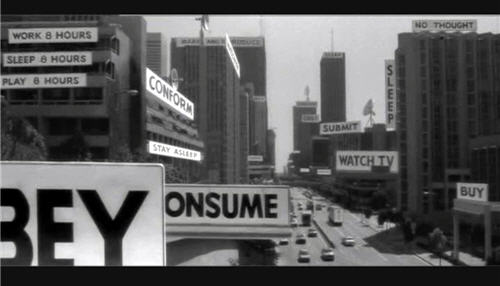
This state of denial and rejection of reality is the essential plot of John Carpenter’s 1988 film They Live, where a group of down-and-out homeless men discover that people have been, in effect, so hypnotized by media distractions that they do not see their prison environment and the real nature of those who control them—that is, an oligarchic elite.

Caught up in subliminal messages such as “obey” and “conform,” among others, beamed out of television and various electronic devices, billboards, and the like, people are unaware of the elite controlling their lives. As such, they exist, as media analyst Marshall McLuhan once wrote, in “prisons without walls.” And of course, any resistance is met with police aggression.

A key moment in the film occurs when John Nada, a homeless drifter, notices something strange about people hanging about a church near the homeless settlement where he lives. Nada decides to investigate. Entering the church, he sees graffiti on a door: They live, We sleep. Nada overhears two men, obviously resisters, talking about “robbing banks” and “manufacturing Hoffman lenses until we’re blue in the face.” Moments later, one of the resisters catches Nada fumbling in the church and tells him “it’s the revolution.” When Nada nervously backs off, the resister assures him, “You’ll be back.”

Rummaging through a box, Nada discovers a handful of cheap-looking sunglasses, referred to earlier as Hoffman lenses. Grabbing a pair and exiting the church, he starts walking down a busy urban street.

Sliding the sunglasses on his face, Nada is shocked to see a society bombarded and controlled on every side by subliminal messages beamed at them from every direction. Billboards are transformed into authoritative messages: a bikini-clad woman in one ad is replaced with the words “MARRY AND REPRODUCE.” Magazine racks scream “CONSUME” and “OBEY.” A wad of dollar bills in a vendor’s hand proclaims, “THIS IS YOUR GOD.”

What’s even more disturbing than the hidden messages, however, are the ghoulish-looking creatures—the elite—who appear human until viewed them through the lens of truth.

This is the subtle message of They Live, an apt analogy of our own distorted vision of life in the American police state. These things are in plain sight, but from the time we are born until the time we die, we are indoctrinated into believing that those who rule us do it for our good. The truth, far different, is that those who rule us don’t really see us as human beings with dignity and worth. They see us as if “we’re livestock.”

It’s only once Nada’s eyes have been opened that he is able to see the truth: “Maybe they’ve always been with us,” he says. “Maybe they love it—seeing us hate each other, watching us kill each other, feeding on our own cold f**in’ hearts.” Nada, disillusioned and fed up with the lies and distortions, is finally ready to fight back. “I got news for them. Gonna be hell to pay. Cause I ain’t daddy’s little boy no more.”

What about you?

As I point out in my book Battlefield America: The War on the American People, the warning signs have been cautioning us for decades. Oblivious to what lies ahead, most have ignored the obvious. We’ve been manipulated into believing that if we continue to consume, obey, and have faith, things will work out. But that’s never been true of emerging regimes. And by the time we feel the hammer coming down upon us, it will be too late.

As Rod Serling warned:

All the Dachaus must remain standing. The Dachaus, the Belsens, the Buchenwalds, the Auschwitzes—all of them. They must remain standing because they are a monument to a moment in time when some men decided to turn the earth into a graveyard, into it they shoveled all of their reason, their logic, their knowledge, but worst of all their conscience. And the moment we forget this, the moment we cease to be haunted by its remembrance. Then we become the grave diggers.

The message: stay alert.

Take the warning signs seriously. And take action because the paths to destruction are well disguised by those in control.

This is the lesson of history.

The Rise of “Criminal Capitalism”

corporate-crime-525

By James Petras

Source: Dissident Voice

About 75% of US employees work 40 hours or longer, the second longest among all OECD countries, exceeded only by Poland and tied with South Korea. In contrast, only 10% of Danish workers, 15% of Norwegian, 30% of French, 43% of UK and 50% of German workers work 40 or more hours. With the longest work day, US workers score lower on the ‘living well’ scale than most western European workers. Moreover, despite those long workdays US employees receive the shortest paid holidays or vacation time (one to two weeks compared to the average of five weeks in Western Europe). US employees pay for the costliest health plans and their children face the highest university fees among the 34 countries in the Organization for Economic Cooperation and Development (OECD).

In class terms, US employees face the greatest jump in income inequalities over the past decade, the longest period of wage and salary decline or stagnation (1970 to 2014) and the greatest collapse of private sector union membership, from 30% in 1950 down to 8% in 2014.

On the other hand, profits, as a percentage of national income, have increased significantly. The share of income and profits going to the financial sector, especially the banks and investment houses, has increased at a faster rate than any other sector of the US economy.

There are two polar opposite trends: Employees working longer hours, with costlier services and declining living standards while finance capitalists enjoy rapidly rising profits and incomes.

Paradoxically, these trends are not directly based on greater ‘workplace exploitation’ in the US.

The historic employee-finance capitalist polarization is the direct result of the grand success of the trillion dollar financial swindles, the tax payer-funded trillion dollar Federal bailouts of the crooked bankers, and the illegal bank manipulation of interest rates. These uncorrected and unpunished crimes have driven up the costs of living and producing for employees and their employers.

Financial ‘rents’ (the bankers and brokers are ‘rentiers’ in this economy) drive up the costs of production for non-financial capital (manufacturing). Non-financial capitalists resort to reducing wages, cutting benefits and extending working hours for their employees, in order to maintain their own profits.

In other words, pervasive, enduring and systematic large-scale financial criminality is a major reason why US employees are working longer and receiving less – the ‘trickle down’ effect of mega-swindles committed by finance capital.

Mega-Swindles, Leading Banks and Complicit State Regulators

Mega-swindles, involving trillions of dollars, are routine practices involving the top fifty banks, trading houses, currency speculators, management fund firms and foreign exchange traders.

These ‘white collar’ crimes have hurt hundreds of millions of investors and credit-card holders, millions of mortgage debtors, thousands of pension funds and most industrial and service firms that depend on bank credit to meet payrolls, to finance capital expansion and technological upgrades and raw materials.

Big banks, which have been ‘convicted and fined’ for mega-swindles, include Citi Bank, Bank of America, HSBC, UBS, JP Morgan, Barclay, Goldman Sachs, Royal Bank of Scotland, Deutsche Bank and forty other ‘leading’ financial institutions.

The mega-swindlers have repeatedly engaged in a great variety of misdeeds, including accounting fraud, insider trading, fraudulent issue of mortgage based securities and the laundering of hundreds of billions of illegal dollars for Colombian, Mexican, African and Asian drug and human traffickers.

They have rigged the London Interbank Official Rate (LIBOR), which serves as the global interest benchmark to which hundreds of trillions of dollars of financial contracts are tied. By raising LIBOR, the financial swindlers have defrauded hundreds of millions of mortgage and credit-card holders, student loan recipients and pensions.

Bloomberg News (5/20/2015) reported on an ongoing swindle involving the manipulation of the multi-trillion-dollar International Swaps and Derivatives Association (ISDA) fix, a global interest rate benchmark used by banks, corporate treasurers and money managers to determine borrowing costs and to value much of the $381 trillion of outstanding interest rate swaps.

The Financial Times (5/23/15, p. 10) reported how the top seven banks engaged in manipulating fraudulent information to their clients, practiced illegal insider trading to profit in the foreign exchange market (forex), whose daily average turnover volume for 2013 exceeded $5 trillion dollars.

These seven convicted banks ended up paying less than $10 billion in fines, which is less than 0.05% of their daily turnover. No banker or high executive ever went to jail, despite undermining the security of millions of retail investors, pensioners and thousands of companies.

The Direct Impact of Financial Swindles on Declining Living Standards

Each and every major financial swindle has had a perverse ripple effect throughout the entire economy. This is especially the case where the negative consequences have spread downward through local banks, local manufacturing and service industries to employees, students and the self-employed.

The most obvious example of the downward ripple effect was the so-called ‘sub-prime mortgage’ swindle. Big banks deliberately sold worthless, fraudulent mortgage-backed securities (MBS) and collateralized debt obligation (CDO) to smaller banks, pension funds and local investors, which eventually foreclosed on overpriced houses causing low income mortgage holders to lose their down payments (amounting to most of their savings).

While the effects of the swindle spread outward and downward, the US Treasury propped up the mega-swindlers with a trillion-dollar bailout in working people’s tax money. They anointed their mega-give-away as the bail out for ‘banks that are just too big to fail”! They transferred funds from the public treasury for social services to the swindlers.

In effect, the banks profited from their widely exposed crimes while US employees lost their jobs, homes, savings and social services. As the US Treasury pumped trillions of dollars into the coffers of the criminal banks (especially on Wall Street), the builders, major construction companies and manufacturers faced an unprecedented credit squeeze and laid off millions of workers, and reduced wages and increased the hours of un-paid work.

Service employees in consumer industries were hit hard as wages and salaries declined or remained frozen. The costs of the FOREX, LIBOR and ISDA fix swindles’ fell heavily on big business, which passed the pain onto labor: cutting pension and health coverage, hiring millions of ‘contingent or temp’ workers at minimum wages with no benefits.

The bank bailouts forced the Treasury to shift funds from ‘job-creating’ social programs and national infrastructure investment to the FIRE (finance, insurance and real estate) sector with its highly concentrated income structure.

As a result of the increasing concentration of wealth among the financial swindlers, inequalities in income grew; wages and salaries were frozen or reduced and manufacturers outsourced production, resulting in declines in production.

Employees, suffering from the loss of income brought on by the mega-swindles, found that they were working longer hours for less pay and fewer benefits. Productivity suffered. With the total breakdown of the ‘capitalist rules of the game’, investors lost confidence and trust in the system. Mega-swindles eroded ‘confidence’ between investors and traders, and made a mockery of any link between performance at work and rewards. This severed the nexus between highly motivated workers, engaged in ‘hard work, long hours’ and rising living standards, and between investment and productivity.

As a result, profits in the finance sector grew while the domestic economy floundered and living standards stagnated.

Financial Impunity: Regulatees Controlling the Regulators

Despite the proliferation of mega-swindles and their pervasive ripple effects throughout the economy and society, none of the dozens of federal or state regulatory agencies intervened to stop the swindle before it undermined the domestic economy. No CEO or banker was ever arrested for their part in the swindle of trillions. The regulators only reacted after trillions had ‘disappeared’ and swindles were ‘a done deal’. The impunity of the swindlers in planning and executing the pillage of hundreds of millions of employees, taxpayers and mortgage holders was because the federal and state regulatory agencies are populated by ‘regulatory administrators’ who came from or aspired to join the financial sector they were tasked with ‘regulating’.

Most of the high officials appointed to lead the regulatory agencies had been selected by the ‘Lords of Wall Street, Frankfurt, the City of London or Zurich.’ Appointees are chosen on the basis of their willingness to enable financial swindles. It therefore came as no surprise on May 28 2015 when US President Obama approved the appointment of Andrew Donahue, Managing Director and Associate General Council for the repeatedly felonious, mega-swindling banking house of Goldman Sachs to be the ‘Chief of Staff’ of the Security and Exchange Commission. His career has been typical of the Washington-Wall Street ‘Revolving Door’.

Only after fraud and swindles evoked the nationwide public fury of mortgage holders, investors and finance companies did the regulators ‘investigate’ the crimes and even then not a single major banker was jailed, not a single major bank was closed down.

There were a few low-level bond traders and bank employees who were fired or jailed as scapegoats. The banks paid puny (for them) fines, which they passed on to their customers. Despite pledges to ‘mend their ways’ the bankers concocted new schemes with their windfalls of billions of Federal ‘bailout’ money while the regulators looked on or polished their CV’s for the next pass through the ‘revolving door’.

Every top official in Treasury, Commerce and Trade, and every regulator in the Security Exchange Commission (SEC) who ‘retired to the private sector’ has ended up working for the same mega-criminal banks and finance houses they had investigated, regulated and ‘slapped on the wrist’.

As one banker, who insists on anonymity, told me: ‘The most successful swindlers are those who investigated financial transgressions’.

Conclusion

Mega-swindles define the nature of contemporary capitalism. The profits and power of financial capital is not the outcome of ‘market forces’. They are the result of a system of criminal behavior that pillages the Treasury, exploits the producers and consumers, evicts homeowners and robs taxpayers.

The mega swindlers represent much less than 1% of the class structure. Yet they hold over 40% of personal wealth in this country and control over 80% of capital liquidity.

They grow inexorably rich and richer, even as the rest of the economy wallows in crisis and stagnation. Their swindles send powerful ripples across the national economy, which ultimately freeze or reduce the income of the skilled (middle class) employees and undermine the living conditions for poor working-class whites, and especially under and unemployed Afro-American and Latino American young workers.

Efforts to ‘moralize’ capital have failed repeatedly since the regulators are controlled by those they claim to ‘regulate’.

The rare arrest and prosecution of any among the current tribe of mega-swindlers would only results in their being replaced by new swindlers. The problem is systemic and requires deep structural changes.

The only answer is to build a political movement independent of the two party system, willing to nationalize the banks and to pass legislation outlawing derivatives, forex trading and other unnatural parasitic speculative activities.

James Petras is author of Extractive Imperialism in the Americas: Capitalism’s New Frontier (with Henry Veltmeyer) and The Politics of Empire: The US, Israel and the Middle East. Read other articles by James, or visit James’s website.