When Collapse Is Cheaper and More Effective Than Reform

a-falling-house-of-cards

By Charles Hugh Smith

Source: Of Two Minds

Collapse begins when real reform becomes impossible.

We all know why reforms fail: everyone whose share of the power and money is being crimped by reforms fights back with everything they’ve got.

Reforms that can’t be stopped by the outright purchase of politicos are watered down in committee, and loopholes wide enough for jumbo-jets of cash to fly through are inserted.

The reform quickly becomes “reform”–a simulacrum that maintains the facade of fixing what’s broken while maintaining the Status Quo. Another layer of costly bureaucracy is added, along with hundreds or thousands of pages of additional regulations, all of which add cost and friction without actually solving what was broken.

The added friction increases the system’s operating costs at multiple levels. Practitioners must stop doing actual work to fill out forms that are filed and forgotten; lobbyists milk the system to eradicate any tiny reductions in the flow of swag; attorneys probe the new regulations for weaknesses with lawsuits, and the enforcing agencies add staff to issue fines.

None of this actually fixes what was broken; all these fake-reforms add costs and reduce whatever efficiencies kept the system afloat. Recent examples include the banking regulations passed in the wake of the 2008 meltdown and the ObamaCare Affordable Care Act (ACA).

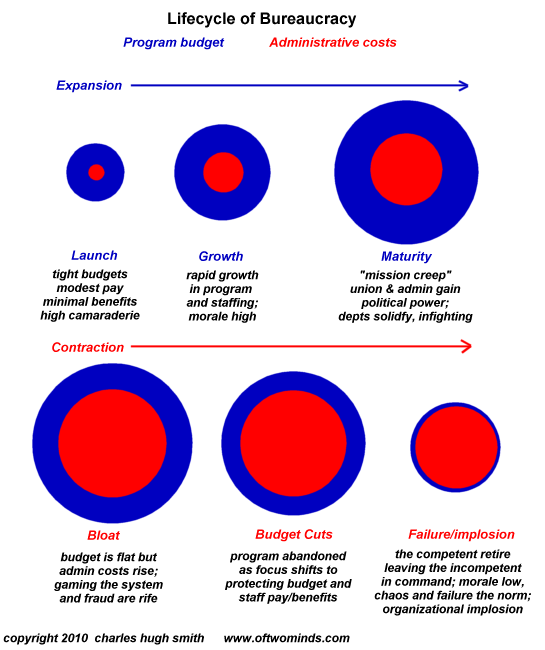
Back in 2010 I prepared this chart of The Lifecycle of Bureaucracy: as bureaucracies expand, they inevitably become less accountable, less efficient, more bloated with legacy staffing and requirements that no longer make sense, etc.

As costs soar, the bureaucracy’s budget is attacked, and the agency circles the wagons and focuses on lobbying politicos and the public to leave the budget untouched.

Since accountability has been dissipated, management becomes increasingly incompetent and larded with people who can’t be fired so they were kicked upstairs. Staff morale plummets as the competent quit/transfer out in disgust, leaving the least productive and those clinging on in order to retire with generous government benefits.

In this state of terminal decline, the agency’s original function is no longer performed adequately and the system implodes from the dead weight of its high costs, lack of accountability, gross incompetence, inability to adapt and staggering inefficiency.

lifecycle-bureaucracy

I’ve covered this dynamic a number of times:

Our Legacy Systems: Dysfunctional, Unreformable (July 1, 2013)

The Way Forward (April 25, 2013)

When Escape from a Previously Successful Model Is Impossible (November 29, 2012)

Complexity: Bureaucratic (Death Spiral) and Self-Organizing (Sustainable) (February 17, 2011)

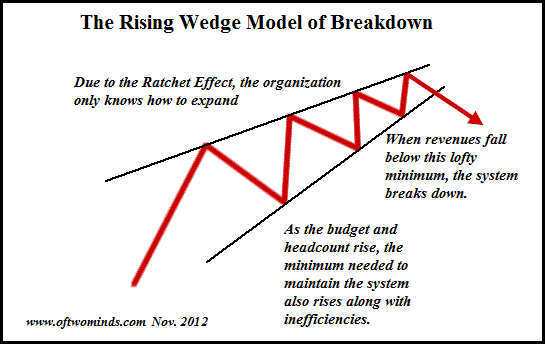
This generates a ratchet effect, where costs increase even as the bureaucracy’s output declines. The ratchet effect can also be visualized as a rising wedge, in which costs and inefficiencies continue rising until any slight decrease in funding collapses the organization.

Dislocations Ahead: The Ratchet Effect, Stick-Slip and QE3 (February 14, 2011)

The Ratchet Effect: Fiefdom Bloat and Resistance to Declining Incomes (August 23, 2010)

rising-wedge

The net result of the Ratchet Effect and the impossibility of reform is this: it’s cheaper and more effective to let the system collapse than squander time and treasure attempting reforms that are bound to fail as vested interests will fight to the death to retain every shred of power and swag.

Since the constituent parts refuse to accept any real reforms, the entire system implodes. We can look at healthcare, higher education and the National Security State as trillion-dollar examples of systems that become increasingly costly even as their performance declines or falls off the cliff.

This is the lesson of history, as described in the seminal book The Upside of Down: Catastrophe, Creativity, and the Renewal of Civilization.

Collapse does not need to be complete or sudden. Collapse tends to be a process, not an event.

Collapse begins when you can’t find any doctors willing to accept Medicaid payments, when the potholes don’t get filled even when voters approve millions of dollars in new taxes, and when kids aren’t learning anything remotely useful or practical despite the school board raising tens of millions of dollars in additional property taxes.

Collapse begins when real reform becomes impossible.

The U.S. Is At The Center Of The Global Economic Meltdown

maxresdefault

By Brandon Smith

Source: Alt-Market.com

While the economic implosion progresses this year, there will be considerable misdirection and disinformation as to the true nature of what is taking place. As I have outlined in the past, the masses were so ill informed by the mainstream media during the Great Depression that most people had no idea they were actually in the midst of an “official” depression until years after it began. The chorus of economic journalists of the day made sure to argue consistently that recovery was “right around the corner.” Our current depression has been no different, but something is about to change.

Unlike the Great Depression, social crisis will eventually eclipse economic crisis in the U.S. That is to say, our society today is so unequipped to deal with a financial collapse that the event will inevitably trigger cultural upheaval and violent internal conflict. In the 1930s, nearly 50% of the American population was rural. Farmers made up 21% of the labor force. Today, only 20% of the population is rural. Less than 2% work in farming and agriculture. That’s a rather dramatic shift from a more independent and knowledgeable land-utilizing society to a far more helpless and hapless consumer-based system.

What’s the bottom line? About 80% of the current population in the U.S. is more than likely inexperienced in any meaningful form of food production and self-reliance.

The rationale for lying to the public is certainly there. Economic and political officials could argue that to reveal the truth of our fiscal situation would result in utter panic and immediate social breakdown. When 80% of the citizenry is completely unprepared for a decline in the mainstream grid, a loss of savings through falling equities and a loss of buying power through currency destruction, their first response to such dangers would be predictably uncivilized.

Of course, the powers-that-be are not really interested in protecting the American people from themselves. They are interested only in positioning their own finances and resources in the most advantageous investments while using our loss and fear to extract more centralization, more control and more consent. Thus, the hiding of economic decline is enacted because the decline itself is useful to the elites.

And just to be clear for those who buy into the propaganda, the U.S. is indeed in a speedy decline.

In ‘Lies You Will Hear As The Economic Collapse Progresses’, published in summer of last year, I predicted that “Chinese contagion” would be used as the scapegoat for the downturn in order to hide the true source: American wealth destruction. Today, as the Dow and other markets plummet and oil markets tank due to falling demand and glut inventories, all we seem to hear from the mainstream talking heads and the people who parrot them in various forums is that the U.S. is the “only stable economy by comparison” and the rest of the world (mainly China) is a poison to our otherwise exemplary financial health. This is delusional fiction.

The U.S. is the No. 1 consumer market in the world with a 29% overall share and a 21% share in energy usage, despite having only 5 percent of the world’s total population. If there is a global slowdown in consumption, manufacturing, exports and imports, then the first place to look should be America.

Trucking freight in the U.S. is in steep decline, with freight companies pointing to a “glut in inventories” and a fall in demand as the culprit.

Morgan Stanley’s freight transportation update indicates a collapse in freight demand worse than that seen during 2009.

The Baltic Dry Index, a measure of global freight rates and thus a measure of global demand for shipping of raw materials, has collapsed to even more dismal historic lows. Hucksters in the mainstream continue to push the lie that the fall in the BDI is due to an “overabundance of new ships.” However, the CEO of A.P. Moeller-Maersk, the world’s largest shipping line, put that nonsense to rest when he admitted in November that “global growth is slowing down” and “[t]rade is currently significantly weaker than it normally would be under the growth forecasts we see.”

Maersk ties the decline in global shipping to a FALL IN DEMAND, not an increase in shipping fleets.

This point is driven home when one examines the real-time MarineTraffic map, which tracks all cargo ships around the world. For the past few weeks, the map has remained almost completely inactive with the vast majority of the world’s cargo ships sitting idle in port, not traveling across oceans to deliver goods. The reality is, global demand has fallen down a black hole, and the U.S. is at the top of the list in terms of crashing consumer markets.

To drive the point home even further, the U.S. is by far the world’s largest petroleum consumer. Therefore, any sizable collapse in global oil demand would have to be predicated in large part on a fall in American consumption. Oil inventories are now overflowing, indicating an unheard-of crash in energy use and purchasing.

U.S. petroleum consumption was actually lower in 2014 than it was in 1997 and 25% lower than earlier projections predicted. A large part of this reduction in gas use has been attributed to fewer vehicle miles traveled. Though oil markets have seen massive price cuts, the lack of demand continued through 2015.

This collapse in consumption is reflected partially in newly adjusted 4th quarter GDP forecasts by the Federal Reserve, which are now slashed down to 0.7%.  And remember, Fed and government calculate GDP stats by counting government spending of taxpayer money as “production” or “commerce”.  They also count parasitic programs like Obamacare towards GDP as well.  If one were to remove government spending of taxpayer funds from the equation, real GDP would be far in the negative.  That is to say, if the fake numbers are this bad, then the real numbers must be horrendous.

And finally, let’s talk about Wal-Mart. There is a good reason why mainstream pundits are attempting to marginalize Wal-Mart’s sudden announcement of 269 store closures, 154 of them within the U.S. with at least 10,000 employees being laid off. Admitting weakness in Wal-Mart means admitting weakness in the U.S. economy, and they don’t want to do that.

Wal-Mart is America’s largest retailer and largest employer. In 2014, Wal-Mart announced a sweeping plan to essentially crush neighborhood grocery markets with its Wal-Mart Express stores, building hundreds within months. Today, those Wal-Mart Express stores are being shut down in droves, along with some supercenters. Their top business model lasted around a year before it was abandoned.

Some in the mainstream argue that this is not necessarily a sign of economic decline because Wal-Mart claims it will be building 200 to 240 new stores worldwide by 2017. This is interesting to me because Wal-Mart just suffered its steepest stock drop in 27 years on reports that projected sales will fall by 6% to 12% for the next two years.

It would seem to me highly unlikely that Wal-Mart would close 154 stores in the U.S. (269 stores worldwide) and then open 240 other stores during a projected steep crash in sales that caused the worst stock trend in the company’s history. I think it far more likely that Wal-Mart executives are attempting to appease shareholders with expansion promises they do not plan to keep.

I am going to call it here and now and predict that most of these store sites will never see construction and that Wal-Mart will continue to make cuts, either with store closings, employee layoffs or both.

As the above data indicates, global demand is disintegrating; and the U.S. is a core driver.

The best way to sweep all these negative indicators under the rug is to fabricate some grand idea of outside threats and fiscal dominoes. It is much easier for Americans to believe our country is being battered from without rather than destroyed from within.

Does China have considerable fiscal issues including debt bubble issues? Absolutely. Is this a catalyst for global collapse? No. China’s problems are many but if there is a first “domino” in the chain, then the U.S. economy claims that distinction.

China is the largest exporter in the world, not the largest consumer. If anything, a crash in China’s economy is only a REFLECTION of an underlying collapse in U.S. demand for Chinese goods (among others). That is to say, the mainstream dullards have it backward; a crash in China is a herald of a larger collapse in U.S. markets. A crash in China is a symptom of the greater fiscal disease in America. The U.S. is the primary cause; it is not the victim of Chinese contagion. And the crisis in the U.S. will ultimately be far worse by comparison.

I wrote in ‘What Fresh Horror Awaits The Economy After Fed Rate Hike?’, published before Christmas:

“Market turmoil is a guarantee given the fact that banks and corporations have been utterly reliant on near-zero interest rates and free overnight lending from the Fed. They have been using these no-cost and low-cost loans primarily for stock buybacks, purchasing back their own stocks and reducing the number of shares on the market, thereby artificially elevating the value of the remaining shares and driving up the market as a whole. Now that near-zero lending is over, these banks and corporations will not be able to afford constant overnight borrowing, and the buybacks will cease. Thus, stock markets will crash in the near term.

This process has already begun with increased volatility leading up to and after the Fed rate hike. Watch for far more erratic stock movements (300 to 500 points or more) up and down taking place more frequently, with the overall trend leading down into the 15,000-point range for the Dow in the first two quarters of 2016. Extraordinary but short lived positive increases in the markets will occur at times (Christmas and New Year’s tend to result in positive rallies), but shock rallies are just as much a sign of volatility and instability as shock crashes.”

Markets moved immediately into crash territory after the new year began. This was an easy prediction to make and one that I have been reiterating for months — just as the timing of the Fed rate hike was an easy prediction to make, based on the Fed’s history of deliberately increasing instability through bad policy as the economy moves into deflationary spirals. The Fed did it during the Great Depression and is doing it again today.

It is no coincidence that global markets began to tank after the first Fed rate hike; no-cost overnight lending to banks and corporations was the key to maintaining equities in a relatively static position.  As the U.S. loses momentum, the world loses momentum.  As the Fed ends outright stimulation and manipulation, the house of cards falls.

I have said it many times and I’ll say it yet again: If you think the Fed’s motivation is to prolong or protect the U.S. economy and currency, then you will never understand why it takes the policy actions it does. If you understand and accept the fact that the Fed is a saboteur working carefully and incrementally toward the destruction of the U.S. to make way for a new globally centralized system, everything falls into place.

To summarize, the U.S. economy as we know it is not slated to survive the next few years. Read my article ‘The Economic Endgame Explained’ for more in-depth information on why a collapse is being engineered and what the openly admitted goal is, including the referenced 1988 article from The Economist titled “Get Ready A World Currency In 2018,” which outlines the plan for a reduction of the dollar and the U.S. system in order to make way for a global basket reserve currency (Special Drawing Rights).

It is astonishingly foolish to assume that even though the U.S. has held the title of king of global consumption share for decades, that our economy is somehow not a primary faulty part in the sputtering global economic engine.  Economies are falling because demand is falling.   Demand is falling because Americans are not buying.  Americans are not buying because Americans are broke. Americans are broke because central bank policy has created an environment of wealth destruction. This wealth destruction in the U.S. has been ongoing, but only now is it becoming truly visible.  The volatility we see in developing nations is paltry compared to the financial chaos we now face.  Anyone who attempts to dismiss the dangers of a U.S. breakdown or the threat to the unprepared public is either an idiot, or they are trying to divert and distract you from reality. The coming months will undoubtedly verify this.

Dead, White, and Blue

Supporters hold signs as Republican US presidential candidate Donald Trump speaks at a campaign rally in Norcross, Georgia, USA, 10 October 2015. The visit, attended by thousands, is Trump's first rally in metro Atlanta since he joined the race. (EPA/ERIK S. LESSER)

The Great Die-Off of America’s Blue Collar Whites 

By Barbara Ehrenreich

Source: TomDispatch.com

The white working class, which usually inspires liberal concern only for its paradoxical, Republican-leaning voting habits, has recently become newsworthy for something else: according to economist Anne Case and Angus Deaton, the winner of the latest Nobel Prize in economics, its members in the 45- to 54-year-old age group are dying at an immoderate rate. While the lifespan of affluent whites continues to lengthen, the lifespan of poor whites has been shrinking. As a result, in just the last four years, the gap between poor white men and wealthier ones has widened by up to four years. The New York Times summed up the Deaton and Case study with this headline: “Income Gap, Meet the Longevity Gap.”

This was not supposed to happen. For almost a century, the comforting American narrative was that better nutrition and medical care would guarantee longer lives for all. So the great blue-collar die-off has come out of the blue and is, as the Wall Street Journal says, “startling.”

It was especially not supposed to happen to whites who, in relation to people of color, have long had the advantage of higher earnings, better access to health care, safer neighborhoods, and of course freedom from the daily insults and harms inflicted on the darker-skinned. There has also been a major racial gap in longevity — 5.3 years between white and black men and 3.8 years between white and black women — though, hardly noticed, it has been narrowing for the last two decades. Only whites, however, are now dying off in unexpectedly large numbers in middle age, their excess deaths accounted for by suicide, alcoholism, and drug (usually opiate) addiction.

There are some practical reasons why whites are likely to be more efficient than blacks at killing themselves. For one thing, they are more likely to be gun-owners, and white men favor gunshots as a means of suicide. For another, doctors, undoubtedly acting in part on stereotypes of non-whites as drug addicts, are more likely to prescribe powerful opiate painkillers to whites than to people of color. (I’ve been offered enough oxycodone prescriptions over the years to stock a small illegal business.)

Manual labor — from waitressing to construction work — tends to wear the body down quickly, from knees to back and rotator cuffs, and when Tylenol fails, the doctor may opt for an opiate just to get you through the day.

The Wages of Despair

But something more profound is going on here, too. As New York Times columnist Paul Krugman puts it, the “diseases” leading to excess white working class deaths are those of “despair,” and some of the obvious causes are economic. In the last few decades, things have not been going well for working class people of any color.

I grew up in an America where a man with a strong back — and better yet, a strong union — could reasonably expect to support a family on his own without a college degree. In 2015, those jobs are long gone, leaving only the kind of work once relegated to women and people of color available in areas like retail, landscaping, and delivery-truck driving. This means that those in the bottom 20% of white income distribution face material circumstances like those long familiar to poor blacks, including erratic employment and crowded, hazardous living spaces.

White privilege was never, however, simply a matter of economic advantage. As the great African-American scholar W.E.B. Du Bois wrote in 1935, “It must be remembered that the white group of laborers, while they received a low wage, were compensated in part by a sort of public and psychological wage.”

Some of the elements of this invisible wage sound almost quaint today, like Du Bois’s assertion that white working class people were “admitted freely with all classes of white people to public functions, public parks, and the best schools.” Today, there are few public spaces that are not open, at least legally speaking, to blacks, while the “best” schools are reserved for the affluent — mostly white and Asian American along with a sprinkling of other people of color to provide the fairy dust of “diversity.” While whites have lost ground economically, blacks have made gains, at least in the de jure sense. As a result, the “psychological wage” awarded to white people has been shrinking.

For most of American history, government could be counted on to maintain white power and privilege by enforcing slavery and later segregation. When the federal government finally weighed in on the side of desegregation, working class whites were left to defend their own diminishing privilege by moving rightward toward the likes of Alabama Governor (and later presidential candidate) George Wallace and his many white pseudo-populist successors down to Donald Trump.

At the same time, the day-to-day task of upholding white power devolved from the federal government to the state and then local level, specifically to local police forces, which, as we know, have taken it up with such enthusiasm as to become both a national and international scandal. The Guardian, for instance, now keeps a running tally of the number of Americans (mostly black) killed by cops (as of this moment, 1,209 for 2015), while black protest, in the form of the Black Lives Matter movement and a wave of on-campus demonstrations, has largely recaptured the moral high ground formerly occupied by the civil rights movement.

The culture, too, has been inching bit by bit toward racial equality, if not, in some limited areas, black ascendency. If the stock image of the early twentieth century “Negro” was the minstrel, the role of rural simpleton in popular culture has been taken over in this century by the characters in Duck Dynasty and Here Comes Honey Boo Boo. At least in the entertainment world, working class whites are now regularly portrayed as moronic, while blacks are often hyper-articulate, street-smart, and sometimes as wealthy as Kanye West. It’s not easy to maintain the usual sense of white superiority when parts of the media are squeezing laughs from the contrast between savvy blacks and rural white bumpkins, as in the Tina Fey comedy Unbreakable Kimmy Schmidt. White, presumably upper-middle class people generally conceive of these characters and plot lines, which, to a child of white working class parents like myself, sting with condescension.

Of course, there was also the election of the first black president. White, native-born Americans began to talk of “taking our country back.” The more affluent ones formed the Tea Party; less affluent ones often contented themselves with affixing Confederate flag decals to their trucks.

On the American Downward Slope

All of this means that the maintenance of white privilege, especially among the least privileged whites, has become more difficult and so, for some, more urgent than ever. Poor whites always had the comfort of knowing that someone was worse off and more despised than they were; racial subjugation was the ground under their feet, the rock they stood upon, even when their own situation was deteriorating.

If the government, especially at the federal level, is no longer as reliable an enforcer of white privilege, then it’s grassroots initiatives by individuals and small groups that are helping to fill the gap — perpetrating the micro-aggressions that roil college campuses, the racial slurs yelled from pickup trucks, or, at a deadly extreme, the shooting up of a black church renowned for its efforts in the Civil Rights era. Dylann Roof, the Charleston killer who did just that, was a jobless high school dropout and reportedly a heavy user of alcohol and opiates. Even without a death sentence hanging over him, Roof was surely headed toward an early demise.

Acts of racial aggression may provide their white perpetrators with a fleeting sense of triumph, but they also take a special kind of effort. It takes effort, for instance, to target a black runner and swerve over to insult her from your truck; it takes such effort — and a strong stomach — to paint a racial slur in excrement on a dormitory bathroom wall. College students may do such things in part out of a sense of economic vulnerability, the knowledge that as soon as school is over their college-debt payments will come due. No matter the effort expended, however, it is especially hard to maintain a feeling of racial superiority while struggling to hold onto one’s own place near the bottom of an undependable economy.

While there is no medical evidence that racism is toxic to those who express it — after all, generations of wealthy slave owners survived quite nicely — the combination of downward mobility and racial resentment may be a potent invitation to the kind of despair that leads to suicide in one form or another, whether by gunshots or drugs. You can’t break a glass ceiling if you’re standing on ice.

It’s easy for the liberal intelligentsia to feel righteous in their disgust for lower-class white racism, but the college-educated elite that produces the intelligentsia is in trouble, too, with diminishing prospects and an ever-slipperier slope for the young. Whole professions have fallen on hard times, from college teaching to journalism and the law. One of the worst mistakes this relative elite could make is to try to pump up its own pride by hating on those — of any color or ethnicity — who are falling even faster.

Barbara Ehrenreich, a TomDispatch regular and founding editor of the Economic Hardship Reporting Project, is the author of Nickel and Dimed: On (Not) Getting By in America (now in a 10th anniversary edition with a new afterword) and most recently the autobiographical Living with a Wild God: A Nonbeliever’s Search for the Truth about Everything.

Leviathan and Behemoth

images

By Chris Shaw

Source: Center for a Stateless Society

Introduction

The capitalist economy has gone through another shock, and the potential for another, larger one is on the horizon. While it’s seemingly in its death throes, capitalism continues to fuel growth. Under such a system we have seen a vast improvement in general living standards across the globe, despite rigged markets and the omnipresent power of the state. However, who is this growth for? While absolute poverty has been rolled back, and in many Western nations completely eliminated, we still see a large, indebted underclass, a Global South regularly sold out to the interests of capital and a system of vast wealth that only seems accessible to a privileged few. Economists may say that if we look at BRIC countries we see an equalisation of wealth and growth with the West, but these BRIC markets are used as cogs in a hegemonic state-corporate machine. Third World entrepreneurship isn’t encouraged, but rather sidelined for corporate dominance. This is a system that needs to end. The debt economy, big government, the corporate-state partnership and modern globalisation all need to end. In their place we need truly free markets, where cooperation and exchange are paramount and aren’t controlled by corporate or government interests.

Our neoliberal society is composed of corporate hegemony backed by state power. By corporate hegemony I mean the power modern capital has over governance. This isn’t just found within corporations, but within guild-like occupational boards (Lawyers and Doctors and their licencing requirements) and corporate trade unions that support the maintenance of wage labour at the expense of worker independence from the structure of capital. Any markets we see are rigged in favour of corporate interests. The major monopolies of government control make sure that markets are a tool of big business and the ability of workers to break free from this paradigm is limited if not impossible. The entry barriers to markets, the restrictions on self-employment and the continued lobbying of government for patronage and favourable legislation leads to a corrupt, crony system that relies on the indenture of the poor in favour of employers and business.

There are many libertarians who unfortunately see this system as just and fair. They see sweatshop labour as an excellent solution to Third World poverty. The idea of growth is given religious prescience, without realising cultural antecedents and the importance of community within the realm of the individual. They don’t understand the power dynamics at play, and the continued collusion of corporate and state interests. They fail to see the monopolisation of social institutions and the commodification of culture and life. The destruction of livelihoods all in the name of GDP growth. This is not a free market, but rather capitalism at work. To move away from this we need to understand that free, or freed, markets are economic organisations free from coercive control, where the individual and community are the key players and profit is not reliant on its exploitative features, but rather the ability to meet real demand.

We need to look at the current capitalist system from the anarchist perspective that I put forward in this paper. Modern capitalism is a state-based system, reliant on enforced hierarchies and the provision of false choice. Real choice would confer power on individuals and communities, while under today’s system real choice is in the hands of bureaucrats and corporate oligarchies. Chartier’s definitions of capitalism, “capitalism: an economic system that features a symbiotic relationship between big business and government”[1] and “capitalism: rule—of workplaces, society, and (if there is one) the state—by capitalists (that is, by a relatively small number of people who control investable wealth and the means of production)”[2] shines light on this conception. Rather than capitalism being a system of free markets as posited by some libertarians (Block, Mises, Hayek, etc.) it is instead a system reliant on big government and its institutions and the control of said institutions via capital.

The vulgar libertarians who view the capitalist economy as some form of free market do not understand the forms of power present. If a worker wants to start a collectively-owned business, can he? Not without huge capital requirements and regulatory hoops to jump through. How about setting up a mutual credit system with a different currency? Well there are legal tender laws that in the United State are enforced with more brutality than the punishments given for heinous crimes[3]. When talking of free markets, we need to understand that freedom is only relative to where the power lies. If it lies with the state and its subsidiaries, then freedom is conferred on large employers and corporate unions whom receive forms of state funding and favourable regulation. If it lay with individuals and communities, we would most likely see a move away from one-size-fits-all regulation, the processes of commodification through rentierism and arbitrary entry barriers.

The Regulatory Apparatus

The regulatory apparatuses found within the economy also benefit the capitalist structure. While generally seen as a bulwark against corporate power, the regulations found in an economy create entry barriers to markets and a form of implicit subsidy to big business, as these businesses rent-seek government for more regulation, allowing for a monopoly within particular economic sectors. We can see in the banking, energy, manufacturing and retail sectors that this is the case. Childs noted this in relation to the development of monopoly power in American business during the late 19th and early 20th centuries. He states “this, then, was the basic context of big business; these were the problems that it faced. How did it react? Almost unanimously, it turned to the power of the state to get what it could not get by voluntary means”[4]. In particular Childs saw this occurring in the rail industry in America during the late 19th century. Massive competition had begun in the rail industry, which massively sunk profits for established companies and encouraged many start ups and smaller competitors. As large rail companies weren’t competitive enough in this environment, they came to rely on government intervention, where regulatory boards were created staffed mostly by executives from the large rail companies.

This is what regulation is really about. It isn’t a way of protecting the hapless consumer from the ravages of a free market, but is rather a tool of corporate power that forms entry barriers and enforces particular dichotomies of ownership and organisation in an economy. Capitalism becomes a system of patronage, where corporations gain favour due to their money and power, which itself comes from the state in the first place. As Paul notes “the rich are more than happy to secure for themselves a share of the loot – for example, in the form of subsidised low-interest loans…bailouts when their risky loans go sour, or regulatory schemes that hurt their smaller competitors”[5]. Rifkin shows a similar process, describing how “the critical industries that made up the infrastructure…banded together in a mega lobby to ensure…financial underwriting, as well as industry-friendly codes, regulations, and standards to ensure market success”[6].

The regulatory apparatuses also have the effect of distorting economies of scale, decoupling supply from demand and favouring largesse in business and ownership models. Thus we see the development of high overhead costs which restrict market entry to best capitalised of entrepreneurs. By limiting competition, we see perverse operations occurring that favour the interests of business over the worker and consumer. Thus things like planned obsolescence, guaranteed markets and a continuation of private gain and socialised loss. As had been noted by Childs, private cartels were difficult to maintain. Even the rail trusts, themselves built in contrived, government-produced markets, were ravaged by competition from smaller rail providers[7] that favoured more local economies of scale. So these corporations looked to the government, who enshrined their demands into acts and legislation which created cartels that were much more easily enforced. We just need to look where wage laws, licensure laws and planning/zoning laws are coming from and who lobbies for them. Invariably its dome by corporations and their lobbying arms. We also forms of legal privilege, as in the case of limited liability and corporate personhood, which are really only accessible with very high capital costs and a developed shareholder clientele. These systems are purely artificial, and whether they would work voluntarily is not the question. Rather it is, if they are efficient, why do they need the government to provide these privileges and apparatuses. The answer is simple, they aren’t efficient.

Even when there are laws supposedly to ameliorate the effects of marketisation, as in the case of welfare and government-provided services, they are usually built on the back of resilient communities who developed their own systems, and usually end up allowing employers to pay subpar wages and benefits and lessen the strength of community relations. It builds layers onto a poor foundation. Or to put it another way, the corporate-state nexus is putting a cinderblock on toothpicks. Bureaucrats don’t fully understand the problem with this but realise it is unstable. So to stabilise it, they put more toothpicks under the cinderblock, thinking it will stabilise. However, the system is inherently unstable and propping it up denies the inevitable.

This assurance of market success shows that under a truly free market they wouldn’t exist, or if they did it would be on a much smaller scale. The regulatory web is just another power dynamic that allows for capture and control. To describe this as a free market is laughable. These processes are completely involuntary, reliant on extortion through taxation and allow for the redistribution of wealth from the poor and middle class to the rich and privileged.

The Money Monopoly

While regulation, which “far from coming against the wishes of the regulated interests, was openly welcomed by them in nearly every case”[8], is an important part of the corporate state, the original four legal monopolies (as identified by Tucker), money, land, tariffs and patents, allowed for the development of rent-seeking corporations. These four monopolies, or as I see them structural monopolies as they create the structure of the socio-economic paradigm, are fundamentals of capitalism.

The money monopoly allows for the restriction of credit and the development of debt-based models that destroy stores of value and make individuals slaves to the desires of governments and banks through modern forms of debt peonage. As Dowd notes, over the 20th century “the US dollar has lost almost 85 per cent of its purchasing power even by official government statistics; for its part, sterling has lost 98 per cent of its value over the last century”[9]. The restriction of credit coupled with the inflationary tendencies of modern fiat currencies mean the poorest are effectively forced into wage labour, as they rely on pitiable increases in nominal wages and are unable to gain any real credit for self-employment or collective worker-owned enterprises. What happens is a redistribution of wealth from the poorest to the richest. Long shows that “inflationary monetary policies on the part of central banks also tend to benefit those businesses that receive the inflated money first in the form of loans and investments, when they are still facing the old, lower prices”[10]. The pre-inflation money allows investors and banks to capitalise on new production and investment while the poorer elements of a society receive minimal benefits as the inflationary course makes its run, with prices rising and wages following later.

This also leads to massive levels of debt found currently throughout the globe, as credit instruments are used to make up for stagnant wages that can’t afford increasing land prices and subsequently rent prices, as well as an increase in the price of consumer goods that are a significant chunk of working people’s wages. The process of rent extraction via high interest rates follows from this, as “the money monopoly also includes entry barriers against cooperative banks and prohibitions against private issuance of banknotes, by which access to finance capital is restricted and interest rates are kept artificially high”[11]. Carson notes further that the elimination of controlled interest rates would lead to “significant numbers (of workers) retiring in their forties or fifties, cutting back to part-time, or starting businesses; with jobs competing for workers, the effect on bargaining power would be revolutionary”[12]. The current banking system leads to the necessitation of wage labour through restricted credit dissemination and debt-based forms of finance.

The Land Monopoly

The land monopoly is another lynchpin of capitalism. Most modern land is either nationalised or corporatised through state structures, leading to massive land centralisation and the process of land expropriation that is visible in much of the Third World. Alternative land arrangements, such as those organised by tribes and local networks, are swallowed up in this process. Many commons regimes that have existed for centuries are being eliminated in favour of the interests of capital. This process of enclosure of common lands began at “the end of the Medieval Age, when royal and feudal landowners began to enclose common lands, especially in Tudor England and Trastamara Spain. Through legal and political manoeuvres, wealthy landowners marked and hedged off sections of the commons for their own profits, impoverishing many villagers and ultimately destroying their communitarian way of life”[13]. The enclosures have continued into the 20th century, where “common lands have suffered a third, global wave of commodification and enclosure, ‘land grabbing’ spurred by the dominant neoliberal doctrine and competition for non-renewable natural resources and supported now by the evolutionary theory of land rights”[14]. The modern enclosures of land occur most noticeably in Africa and South America. We see the elimination of common land owned by native tribes and the raping of natural resources. The Niger Delta and its oil reserves show this acutely, with oil spills being common and almost no compensation to the farmers and workers who rely on the Delta for their livelihoods.

In effect this is a process of neo-colonialism pushed through via the Washington Consensus that is epitomised in international groups like the IMF and WTO. The plight of Bangladeshi workers is caused by this problem of neocolonial practices. In Bangladesh “wealthy and influential people have encroached on public lands…, often with help of officials in land-administration and management departments”[15] which has led to a result of “Many of the rural poor in Bangladesh are landless, have only small plots of land, are depending on tenancy, or sharecropping”[16]. What follows is a continuation of the development of a landless mass of cheap labour as a result of the nationalisation and corporatisation of land.

Then there are planning and zoning laws and property laws which act as a form of implicit land nationalisation in many Western countries. Among their many effects, they artificially inflate land prices, which has a knock on effect of making housing unaffordable and making the purchase of land extremely difficult for small businesses. This further encourages the process of rentierism and indebtedness as individuals have to get out mortgages or rent accommodation, and individuals looking to start a business are priced out, thus favouring large corporations. If you want to self-build a home or business, it becomes impossible. Instead a series of state-favoured land developers are able to land bank and rent out at extortionate rates. They aren’t subject to competition and making new land isn’t possible, so you create a system of patronage and favouritism, simply adding to the enforced necessitation of wage labour.

These processes of land appropriation lead to the development of land speculation via government-favoured industries, creating artificially high land prices which price out small businesses, community groups and anyone who isn’t able seek rent from the state. This speculation also fuels boom-bust cycles, with much of the credit used by investors and businesses being put into the easy investments of land and housing. This creates economic bubbles through the wide diffusion of mortgages and an increase in house and infrastructure building that isn’t necessarily needed. In London, we see this playing out with high-price apartments and high-rises that don’t address the needs of the wider population and are fueled, at least partially, via QE-induced credit. The development of a rentier society occurs. With land prices held artificially high, rich landowners are able to rent out their properties at high prices, creating economic precarity and stimulating the larger wage labour monopoly that is caused by a combination of this monopoly and the money monopoly.

The Larger Wage Labour Monopoly

As previously mentioned, credit is restricted thus funding options are limited for workers. Add to this high land prices, and the ability to buy a house or develop a business are severely restricted, developing the large pool of wage labour seen today. This obviously favours large-scale employers such as corporations who are able develop to their current size due to this wage labour monopoly. It leads to a means of surplus value, or rent, extraction. As Solow notes “one important reason for the failure of real wages to keep up with productivity is that the division of rent in industry has been shifting against the labor side for several decades”[17].

Alongside the two monopolies, the increase in precarious wage labour is compounded by the restriction of collective action and the development of monopolist unions that complement the centralised economic actors. The legislation governing strikes and the ability to make a union add to this problem, making it difficult for freelance workers to unionise and stopping the development of radical trade unions and company unions. Thatcher’s trade union reforms in the UK created such a problem as the majority of private sector unions are part of the corporate system of economic centralisation. The final nail in the coffin is the minimum wage. This creates a wage ceiling and simply allows corporations to price smaller competitors out of the market while subsequently limiting the hours and benefits workers receive. As most minimum wages aren’t enough to live on, many workers rely on debt-based credit which pushes individuals further into wage labour, creating debt-led wage slavery and maintaining a massive, centralising economic monopoly on the choice of workers.

As Solow explains, in the US “in the past 10 years productivity has increased 12.3 percent in the non-farm business sector of our economy while real compensation of labor has increased by only 5.1 percent”[18]. So what we see is a form of surplus value extraction, whereby the excess product of labour is captured by the interests of capital and removed from the compensation of labour. This can’t simply be explained away by using the marginalist critique. The value of a product is at least partially informed by its labour input. Marshall’s analysis shows that “price was determined, at any given time, by the balance between the demand and supply that actually existed at that moment. As the time factor came into play…price approached closer and closer to cost”[19] thus showing that the equilibrium of supply to demand moves from subjective criteria of value toward the input of labour in that value. Again looking at Solow’s productivity figures, the compensation of labour isn’t in proportion to production.

Hodgskin’s idea of a market artificially privileged with rents, profits and interest becomes a reality in the modern context. The increase in freelancing and labour market individuation means the expropriation of rent and the limitation of choice, particularly as unions are simply a representation of the corporate interest, particularly since the Wagner Act in America and the trade union reforms in Britain. The individualisation of labour serves to increase these artificial privileges, meaning can be paid less and thus become more reliant on debt instruments such as mortgages and credit cards to simply earn a living and have a roof over their head. This system is even more acute in the Global South, with the restriction of choice via the structural monopolies being almost explicitly enforced via the government as land in enclosed and regulations used to restrict microeconomic activity that doesn’t serve the interests of global value chains. Their human capital is monopolised, wages restricted, collective action completely banned and working conditions extremely poor. The main profit garnered from this is simply the mark-up created by internal tariffs and intellectual property (to be discussed later in this paper), which limits domestic market production and serves only the interests of capital and big business, as both the workers and consumers are given low wages and higher prices respectively.

What happens then is the construction of a monopsony situation in wages and labour, where the product of labour isn’t adequately paid, becoming widespread due to companies paying below this level. This is compounded by wage laws favoured by corporate interests, and an inability for the worker to capture this value through collective bargaining or through the means of owning one’s productive capacities due to market entry barriers that restrict self-employment and worker or community ownership. It constrains the real choice of workers and puts the power dynamics upon employers and bureaucrats.

Tariffs

The next two monopolies that Tucker highlighted further the centralisation of economic power toward corporations. Tariffs are simply a form of direct state intervention to favour domestic industry over foreign competitors. There are arguments favourable to this position, such as those by List and Chang. However, there is a significant time limit on the ability of tariffs to produce any sort of growth (usually artificially induced by state policies), and eventually many of the protected industries become bloated and begin to rely on further government subsidy.

The use of tariffs today is much more limited than it was during the mercantile years of the 17th and 18th centuries. However, one area where tariffs are still largely used is modern agriculture in the West, particularly the US and the EU. The Farm Bill in the US creates price distortions within food markets that favours large agribusiness over small, family farms. As Reitzig explains “the farm bill perpetuates the myth of cheap food. It subsidizes Big Ag so that BA can sell its food to the market cheap and you find it at the grocery store for less than you’d pay for it from your local farmer”[20]. However as “it costs the small local farmer about the same to produce the same food as the Big Ag farmer”[21], all the Farm Bill does is redistribute tax money toward large agricultural firms. The economies of scale thus get changed, with farmers forced into retail sector bulk sell offs that are increasingly inefficient and perpetuate the agricultural tariffs and subsidies.

There also forms of internal tariffs that protect large industry through direct subsidisation. For example “between 1973 and 2003, the US government paid out $74 billion in energy subsidies to promote R&D in fossil fuels and nuclear power”[22]. This was despite these companies having huge profit margins, which shows the actual profitability of these industries. They are reliant on institutions of theft to simply develop critical infrastructure as a result of their internal unproductiveness and their falling foul of the economic calculation problem. It creates a system of perverse incentives as these firms aren’t induced to work and develop in smarter, cleaner ways and instead produce the same limited output. This is corporatism at its finest, with government purposefully favouring large firms over small firms, and thus encouraging wasteful practices. Returning to farming, the EU holds similar policies, which in many ways restrict crop diversification and mean that certain farmers are favoured over others. This leads to artificially low prices which allows for retail monopolisation due to farmers being unable to sell their own product due to EU regulations which create this system. It is a continuation of the obstinate incentives that leads to overproduction, false demand and the entrenchment of economic disadvantages and inefficiencies.

Patents

Patents act in a similar way. They privilege large businesses in rigged markets and allow for centralisation and monopolisation. “The patent privilege has been used on a massive scale to promote concentration of capital, erect entry barriers, and maintain a monopoly of advanced technology in the hands of western corporations. It is hard even to imagine how much more decentralized the economy would be without it”[23]. Patents act to lock up innovation in a legal quagmire. It puts new technology into the hands of capital, limiting its distribution and creating a rentier system, where the privilege to use new technology and even knowledge is commodified by large corporations in collusion with the state.

This inability to access new technologies and knowledge creates a form of entry barrier, with smaller competitors being unable to afford this access. Most modern tech companies (Google, Apple, Microsoft) are in effect monopolists of knowledge and technology, limiting its accessibility and collecting the rent they charge on these products. Their market position becomes entrenched with restrictive data laws and copyrights that mean the passage of information is blocked by virtual, artificial toll gates that wouldn’t exist if not for coercive legislation.

Then there is the direct government subsidisation of research and development (R&D) spending that allows for large companies to reap “monopoly profits from technology it didn’t spend a penny to develop”[24]. Modern tech companies then are not only monopolists of patented of knowledge but also rentiers of technology they had no real part in developing. So while small inventors and start ups toil away trying to create a product that can only be sold on a rigged market, large firms benefit purely because of their power and the revolving door of government benefaction. Similar processes occur in military-based R&D spending, where corporations are given large grants and procurement contracts to develop military hardware and weaponry that on a freed market would not even necessarily be required by any customer or business. As Chomsky notes, in the US “the Pentagon system has long been the country’s biggest welfare program, transferring massive public funds to high-tech industry on the pretext of defense and security”[25]. These companies’ profits and growth are not then created in a market mechanism of competition and demand-led supply, but rather in a bubble of government-led protection, where they ride on the coattails of stolen innovation and forms of theft AKA patents and taxation respectively. “If they had to face the market, they’d be out selling rags or something, but they need a nanny state, a powerful nanny state to pour money into their pockets”[26].

Further, this process of patenting becomes a pure form of commodification as they remove products and ideas from their cultural origins. For example, the Human Genome Diversity Project used DNA from certain indigenous tribes in Central and South America. Some of this DNA was patented, and thus removed from the culture it came from without any sort of compensation by the HGDP and the beneficiaries of this knowledge. Biocolonialism and biopiracy are the best terms for this occurrence. By extracting culturally sensitive information and knowledge, a process of commodification occurs, and the whole concept of property, that of the sovereign ownership of the individual or collective, becomes redundant. Further the innovative capacities that supposedly come from intellectual property are limited if not completely negative. In fact the information that was patented was found to be 30% less innovative than the information released for full public use[27].

This analysis is backed by evidence from Scherer, who showed “a survey of 91 companies in which only seven ‘accorded high significance to patent protection as a factor in their R & D investments.’ Most of them described patents as “the least important of considerations.’ Most companies considered their chief motivation in R & D decisions to be ‘the necessity of remaining competitive, the desire for efficient production, and the desire to expand and diversify their sales”[28]. Thus patents and intellectual property “eliminate ‘the competitive spur for further research’ because incremental innovation based on others’ patents is prohibited, and because the holder can ‘rest on his laurels for the entire period of the patent.’ with no fear of a competitor improving his invention”[29].

Transport Subsidies

The fifth monopoly, transport subsidies, is one that has been identified by Carson. As Carson describes, “spending on transportation and communications networks from general revenues, rather than from taxes and user fees, allows big business to ‘externalize its costs’ on the public, and conceal its true operating expenses”[30]. These transportation subsidies allow for the development of large business operations, particularly in the retail and manufacturing sectors. By subsidising the movement of goods by heavy duty vehicles, it means they are given a state-based competitive advantage against smaller, local competitors.

Companies like Wal-Mart and Tesco are able to price their goods artificially cheaply as a result of not adding the transportation costs. Many of these companies actively lobbied for such infrastructure projects. When the interstate system was being built, it “had both an immediate stimulus effect on the industries that participated…oil companies, general contractors, cement manufacturers, steel companies…were among the dozens of industries involved in the building of the great interstate highway system”[31] showing the degree of corporate-state cooperation. It was because these infrastructure projects benefitted their products and models that they lobbied for them.

Of course Carson’s view of this quite US-centric. In much of Europe, particularly the UK, we see other regulations that create a very different kind of transport subsidy. While these nations do subsidise transport via taxation to pay for roads rather than using user fees or road pricing, they also have high fuel duties and regulation on forms of transport, such as regulations on truck design and usage. The fuel duties act as a subsidy in the sense that they destroy small transport firms and simply monopolise the transport industry as only larger companies can afford the higher prices. The forms of regulation mentioned mean that innovation into new vehicle design and competition between firms is limited and simply continues the dominance of particular transport and production companies that aren’t subject to market competition. Thus what we see are two different types of transport subsidies that both act to continue the current economic paradigm.

These subsidies serve to amplify economies of scale, creating national and international markets largely in the control of corporate interests. These large markets create systems of disequilibrium, with monopoly interests being able to develop oligopoly markets from which rents can be extracted. A modern example of this is the creation of HS2 in the UK. It serves as a vanity project for political and bureaucratic elites, who can gain well-paying jobs as political advisors and construction directors. It also allows for the continuation of the North-South divide, with large London-centric firms sucking out talent from the North and Midlands, at little expense to themselves. As Wellings describes it, it’s an example of externalised costs and internalised benefits, with vested interests serving to gain[32]. Economies of scale are created artificially, with competition in local markets suffering due to a project only favourable to London-based businesses. Local economies of scale, which are more natural and more open to individual considerations and supply and demand, are priced out by government intervention. Local transport projects, like roads linking market towns and local rail infrastructure, are ignored due to a lack of political prestige for politicians and their donors and lobbyists.

Road and rail subsidised by the state leads to the current economies of scale that favour large, centralised business entities. It also prices out and discourages private infrastructure projects that could actually make an economic difference by increasing competition and lowering prices, while maintaining local economies of scale which benefit large swathes of areas that currently don’t benefit from the subsidised corporate model. These three monopolies further the wage labour monopoly, by erecting entry barriers against small business and self-employment and by creating feudalistic patent regimes and transport systems that create favourable economies of scale. National markets serve larger companies and hierarchical organisation, and international markets continue to serve and enlarge this. It pushes real costs onto the consumer/taxpayer, and further creates illegitimate profits taken from oligopoly markets.

The Corporate Infrastructure

This wage labour monopoly, with the five structural monopolies feeding it, is the basis of the modern corporate dominated economy. As a result, modern corporations act as oppressive actors on the world stage, using wage slaves and forms of indebtedness to develop the massive growth seen in the 20th and 21st centuries. As Carson states “in a very real sense, every subsidy and privilege described above is a form of slavery. Slavery, simply put, is the use of coercion to live off of someone else’s labor. For example, consider the worker who pays $300 a month for a drug under patent, that would cost $30 in a free market. If he is paid $15 an hour, the eighteen hours he works every month to pay the difference are slavery. Every hour worked to pay usury on a credit card or mortgage is slavery. The hours worked to pay unnecessary distribution and marketing costs (comprising half of retail prices), because of subsidies to economic centralization, is slavery. Every additional hour someone works to meet his basic needs, because the state tilts the field in favor of the bosses and forces him to sell his labor for less than it is worth, is slavery”[33].

Then there is the system of incentives created by this corporate-state monopoly. Infrastructures are developed that maintain the inefficiencies. Rifkin’s analysis of a series of Industrial Revolutions shows this to be the case. The Second Industrial Revolution, the current economic system we live in according to Rifkin, is reliant on state-invested infrastructure and subsidisation[34]. The subsidisation of natural capital is one example of this. Roberts shows that “the total unpriced natural capital consumed by the more than 1,000 “global primary production and primary processing region-sectors” amounts to $7.3 trillion a year — 13 percent of 2009 global GDP”[35]. The term natural capital is obviously a broad, all-encompassing term. The specifics are those of the production of pollutants that is subsidised by specific tax breaks and forms of limited liability. These follow from elements of the land monopoly which means pollution becomes an externalised cost upon taxpayers, furthering the inefficiencies of a particular economic paradigm, which Rifkin calls the Second Industrial Revolution but what I would call capitalism.

The maintenance of this system means most companies that are reliant on fossil fuels and the energy and transport infrastructures that follow from them have no incentive to divest into new market ventures, but instead have an interest in resource and capital accumulation. It creates ‘revolving door’ government, where lobbyists persist in convincing policy makers for subsidies here and tax breaks there all the while relying on the rent extraction they gain from state intervention.

This process within resource extraction and energy use is more widely seen in the general production processes of capitalism. The levels of overproduction and continued consumption are fed by the structural monopolies, as well as justifying the wage labour monopoly. To fund the levels of consumption needed to continue production means people are put into a paradigm of working longer to buy more things to enjoy. Its paradoxical as you spend more time at work, thus limiting the amount of time you have to actually enjoy consumer goods. Further, as goods become more expensive due to increasing cost mark-ups and inflationary policies, and housing prices and rents go up due to land speculation and monopoly ownership, more people become reliant on debt instruments to fund their everyday lives and their increasing consumer spending. This has created a precipitous debt bubble as Steve Keen’s work has shown. It has also meant that much of the current growth seen since the Great Recession has been on the back of consumer spending, as Blanchflower has documented.

Incentives are created which lead to increasing, unnatural growth and increasing levels of debt. In particular, levels of corporate debt have skyrocketed during the recession of 2008. This is due to systemic overproduction and waste that has developed due to mass production systems used by most multinationals. The structural subsidies create this system where large production facilities with forms of guaranteed profit are needed for massive market areas, usually on a national or international level. Carson has pointed out that modern markets are hardly an example of spontaneous order and aren’t reliant on supply and demand[36]. Rather the system is reliant on a system of planning, with codified relations between suppliers and distributors and systems of guaranteed consumption through external market control in the form of internal sales tariffs and the financialisation of the economy.

Internal sales tariffs limit what stores/areas products can be sold in, and are only viable as a result of intellectual property regimes that allow for increased costs and a further disconnect between production and consumption. Financialisation on the other hand simply maintains the production systems as well as processes of commodification. It makes corporate debt a commodity, and puts value into meaningless products, which allows for more accumulation and overproduction as business isn’t rewarded for genuine wealth production and creation, which comes from artificial processes, but is rewarded rather by debt financialisation, unsustainable growth in bureaucracy and the continued expropriation of surplus value, or human capital. This also represents a commodification process, as the social relation of debt, as identified by Graeber and Martin, is put into an economistic context, with debt serving the purposes of profit and capital. The debt relationship, that’s shaped by community relations and gift-giving and receiving[37], is taken as a value of capital. And this debt is allowed to build up and shape other economic activity. Consumer purchase after consumer purchase represents this. It is encouraged, and when it slows the government takes over and funds through quantitative easing programs, allowing for the construction of bigger, more complex bubbles. It shows that corporation and government are two sides of the same coin.

We have to remember that as much as governments, corporations are just as likely to be effected by the knowledge problem. To get around, every relationship and process is effectively planned. Business to business relations, as seen in distribution and supply chains, are maintained for decades by large manufacturers so as to continue guaranteed buyers of their products. In other cases, the supply and warehousing operations are subsumed by the manufacturer, owning every process from production to sale. Global value chains are an outgrowth of this hierarchalised control and planning, with much of their success being guaranteed by government. It is dictatorial governments in the Global South (who usually have the backing of the US government and its interests) that ban collective action among labourers through extraordinarily harsh measures, it is trade agreements with their backing by Western governments that maintain artificial property rights such as patents and it is government that externalises the cost of global transportation of these goods onto the taxpayer, thus distorting economies of scale to favour the large corporations and forms of state-corporate economic planning. In other the words, the commodification and Sovietisation of the economy.

Culture Under Capitalism

A paradigm that enforces this economic hierarchy is created, where life is work and your main identity is around the soul-crushing job you inhabit. Social relations are commodified and local economic activity is strangled. The whole idea of community in the 21st century is being replaced by a centralised state and economic activity that has no interest in that community, but is inward looking, determining profit margins rather building strong societal relations. The ability to escape this paradigm is extremely limited by the coercive hand of the state. It restricts collective organising, eliminates common and private property and develops extremely insufficient systems of economic organisation.

What we’ve seen is the disembedding of markets from their cultural and social origins[38]. Relations of debt and consumption, which were as much in political institutions and based around social relations, have been expropriated by capital. Thus instead of markets forming one of many different idea of economic organisation of which it could complement, we see the neoliberal discourse of praising markets and even seeing marketisation in what have been social relations up to this day. Thus public services such as health and energy are wrapped in discourses of competition and corporate ownership. However, markets aren’t actually like this. If we look to genuinely free markets, which are few and far between, we don’t see large production and corporate ownership. Instead we see markets crafted around local institutions and genuine demand for certain goods and services. Ownership is much more decentralised. However, due to government-based price and scale distortions, culture and its institutions are brought into the marketised economy, creating the marketised society.

 It leads to the development of modern consumerism, creating warped identities based around products. It kills culture and intelligence in favour of an advertised individual. Carson shows that “mass production divorces production from consumption. The rate of production is driven by the imperative of keeping the machines running at full capacity so as to minimize unit costs, rather than by customer orders. So in addition to contractual control of inputs, mass-production industry faces the imperative of guaranteeing consumption of its output by managing the consumer”[39]. The consumer is separated from the producer. Mass production means a consumer culture. Rather than supply meeting demand, demand is made to compensate for oversupply. It also creates forms of consumer inequality that mean Third World workers have almost no access to the products they help produce. The development of domestic markets in consumer goods is massively restricted via patents and tariffs.

Within the Western world there is similar consumer inequality, with a creation of an underclass who desire consumer goods that their limited wages can hardly afford. Bauman’s analysis of the London Riots in 2011 saw an element of this consumer yearning, with products like high-end trainers and flat-screen TVs being taken. Bauman notes that “from cradle to coffin we are trained and drilled to treat shops as pharmacies filled with drugs to cure or at least mitigate all illnesses and afflictions of our lives and lives in common. Shops and shopping acquire thereby a fully and truly eschatological dimension”[40]. The cultural backwater caused by modern consumerism creates a form of stigmatisation and symbol status, with haves and have nots developing into distinct classes in a consumer culture. As Bauman states “for defective consumers, those contemporary have-nots, non-shopping is the jarring and festering stigma of a life un-fulfilled — and of own nonentity and good-for-nothingness. Not just the absence of pleasure: absence of human dignity. Of life meaning”[41].

The processes of commodification amplify this systemic crisis. The divorcing of production from consumption leads to the most atomistic forms of individualism. It becomes a process of overconsumption and hoarding, without any appreciation of the product development. Cultural and societal obligations and considerations get uprooted by what is wanted and what can be bought. It puts value squarely into the hands of capital, with the determination of worth being decided in social hierarchies that follow from the enforced economic hierarchies of modern capitalism. It is a symptom of the false choice of employment or death, of work creating one’s value in life and of a market shaped not by workers, communities and cultures but by the interests capital and the state that props it up.

Conclusion

This system is massively unsustainable, and becomes more and more reliant on tax revenues to make it profitable. The price system becomes distorted, encouraging the mass production that “leads to ever-increasing demands on state services”[42]. This then shows the inefficiency of large corporations. They are as much subject to the economic calculation problem as the state. Their reliance on the theft of individual income via the taxation system means in anarchist society they are completely unviable. As a system of economic organisation “capitalism could not have survived at any point in its history without state intervention. Coercive state measures at every step have denied workers access to capital, forced them to sell their labor in a buyer’s market, and protected the centers of economic power from the dangers of the free market”[43].

In systems of anarchy, there would be an end to corporate dominance due to their inability to seek state rent and thus collapsing in their inefficiencies. As noted by Carson, there were two paths that could have been taken to organise industry and the economy. The one that was followed was “centralized production using expensive, product-specific machinery in large batches on a supply-push basis”[44]. However a better system was possible. One of “decentralized production for local markets, integrating general-purpose machinery into craft production and governed on a demand-pull basis with short production runs and frequent shifts between product lines”[45]. This would have required localised industry, networked communities and what Rifkin calls lateral, distributional, collaborative markets. Workers would be independent of capital, and have an ability to take back their surplus value. It would involve voluntary governance structures and self-organised communities. It would be an end to the corporate-state nexus.

By having this centralised system, we open the floodgates to the continuation of boom-bust cycles through monopoly government control. Since the delinking of production from consumption, there has been a development of mass production and the apparatuses that prop it up. Marx noted this particular phenomenon, with “the birth of large-scale industry this true proportion had to come to an end, and production is inevitably compelled to pass in continuous succession through vicissitudes of prosperity, depression, crisis, stagnation, renewed prosperity, and so on”[46]. This process in the end favours the capitalists. It destroys real value in an economy and allows for more government involvement. Further, it leads to capital accumulation through government subsidisation and the monopoly position many modern corporations hold within their respective markets.

It’s a process of artificial wealth accumulation and creation, backed by the five monopolies previously mentioned. High land prices, restrictive credit access and the use of interest rates to effectively distort the value of currency, the use of market entry barriers through regulations and patents and the use of transport subsidies all favour the main monopoly, that of wage labour. Because of the diminishing returns that many of these companies are finding, they are becoming increasingly reliant on the extraction of surplus value from their workers. As mentioned earlier, wage laws allow them to eliminate smaller competitors and the development of varied, precarious work contracts mean a diversification of their workforce, which allows them to reduce hours paid and thus reduce their labour costs. However, the compensation of a worker’s product isn’t necessarily met. Thus the accruing of capital simply means the extraction of rent from workers, which is enforced by the limitation of worker’s to pool their labour value and capital and develop their own industry in a truly free market.

Government is the glue which holds capitalism together. Without it, the economies of scale, the appropriation and centralisation of land and the distortion of inputs and outputs would be impossible. Without a central bank, the destructive tax of inflation wouldn’t be feasible in a competitive currency market. The redistribution of wealth and malinvestment couldn’t occur on the same scale as markets would act as a corrective against these activities. The use of tariffs and patents to lock up technology and create artificial wealth couldn’t happen without the state’s coercive power. Economic organisation is a fluid concept, that changes from place to place and people to people. What is right for one community or tribe is not what is necessarily right for another. A freed market would reflect this, as it would embed markets in pre-existing cultural/social structures and stop the developments of commodification and neo-colonialism that persist presently. This is a world free of state-action and corporate control. This is anarchism.

Bibliography

Bauman, Z. (2011). The London Riots – On Consumerism Coming Home To Roost. Available: http://www.socialeurope.eu/2011/08/the-london-riots-on-consumerism-coming-home-to-roost/. Last accessed 21st Sep 2015.

Carson, K (2007). Studies in Mutualist Political Economy. United States: BookSurge.

Carson, K. (2010). The Distorting Effects of Transportation Subsidies. Available: http://fee.org/freeman/the-distorting-effects-of-transportation-subsidies/. Last accessed 15th Sep 2015.

Carson, K (2010). The Homebrew Industrial Revolution. United States: BookSurge.

Carson, K. (2002). The Iron Fist Behind the Invisible Hand. Available: http://www.mutualist.org/id4.html. Last accessed 25th Sep 2015.

Chartier, G. (2010). Advocates of Freed Markets Should Embrace “Anti-Capitalism”. Available: http://c4ss.org/wp-content/uploads/2010/01/chartier.anticapitalism.pdf. Last accessed 14th Sep 2015.

Childs, R. (1971). Big Business and the Rise of American Statism. Available: http://praxeology.net/RC-BRS.htm. Last accessed 16th Sep 2015.

de Ugarte, D. (2015). Biomedical patents reduce innovation by 30%. Available: http://blog.p2pfoundation.net/biomedical-patents-reduce-innovation-by-30/2015/09/09. Last accessed 16th Sep 2015.

Dowd, K (2014). New Private Monies. London: Institute of Economic Affairs.

Long, R. (2008). Corporations versus the Market; or, Whip Conflation Now. Available: http://www.cato-unbound.org/2008/11/10/roderick-t-long/corporations-versus-market-or-whip-conflation-now. Last accessed 15th Sep 2015.

Martin, F (2013). Money: The Unauthorised Biography. London: Bodley Head.

Paul, R (2007). The Revolution: A Manifesto. 2nd ed. United States: Grand Central Publishing.

Polanyi, K (2002). The Great Transformation. 2nd ed. Boston: Beacon Press.

Reitzig, L. (2014). Farm Bill 2014 or “The Destruction of Small Family Farms”. Available: http://nourishingliberty.com/farm-bill-2014-just-how-bad-is-it/. Last accessed 21st Sep 2015.

Richman, S. (2013). Bangladeshi Workers Need Freed Markets. Available: http://fff.org/explore-freedom/article/bangladesh-needs-freed-markets/. Last accessed 16th Sep 2015.

Rifkin, J (2011). The Third Industrial Revolution. New York: Palgrave MacMillan.

Roberts, D. (2013). None of the world’s top industries would be profitable if they paid for the natural capital they use. Available: http://grist.org/business-technology/none-of-the-worlds-top-industries-would-be-profitable-if-they-paid-for-the-natural-capital-they-use/. Last accessed 16th Sep 2015.

Shorr, I. (1996). On US Military Budgets. Available: http://www.chomsky.info/interviews/19960211.htm. Last accessed 25th Sep 2015.

Solow, R. (2015). The Future of Work. Available: http://www.psmag.com/business-economics/the-future-of-work-why-wages-arent-keeping-up. Last accessed 16th Sep 2015.

StopHS2. (2013). “Classic Example” of Vested Interests. [Online Video]. 18 November. Available from: https://www.youtube.com/watch?v=r94VP3USOuE. [Accessed: 31 October 2015].

Vivero Pol, J. (2015). Transition towards a food commons regime. Available: http://poseidon01.ssrn.com/delivery.php?ID=9851100240740070870950101221090931190350100270460840350111130010740820980970930810660540551030481120240140671180910151151060840400590600730100851021250261111. Last accessed 15th Sep 2015.

Notes:

[1] Chartier, G. 2010, 1

[2] Chartier, G. 2010, 2

[3] Dowd, K. 2014

[4] Childs, R. 1971

[5] Paul, R. 2009, 70

[6] Rifkin, J. 2011, 134

[7] Childs, R. 1971

[8] Childs, R. 1971

[9] Dowd, K. 2014, 85-86

[10] Long, R. 2008

[11] Carson, K. 2002

[12] Carson, K. 2002

[13] Vivero Pol, L. 2015, 9

[14] Vivero Pol, L. 2015, 9

[15] Richman, S. 2013

[16] Richman, S. 2013

[17] Solow, R. 2015

[18] Solow, R. 2015

[19] Carson, K. 2007, 50

[20] Reitzig, L. 2014

[21] Reitzig, L. 2014

[22] Rifkin, J. 2011, 134

[23] Carson, K. 2002

[24] Carson, K. 2002

[25] Shorr, I. 1996

[26] Shorr, I. 1996

[27] de Ugarte, D. 2015

[28] Carson, K. 2002

[29] Carson, K. 2002

[30] Carson, K. 2002

[31] Rifkin, J. 2011, 134

[32] Wellings, R. https://www.youtube.com/watch?v=r94VP3USOuE

[33] Carson, K. 2002

[34] Rifkin, J. 2011

[35] Roberts, D. 2013

[36] Carson, K. 2010

[37] Martin, F. 2013

[38] Polanyi, K. 2002

[39] Carson, K. 2010, 50

[40] Bauman, Z. 2011

[41] Bauman, Z. 2011

[42] Carson, K. 2010, 111

[43] Carson, K. 2002

[44] Carson, K. 2010

[45] Carson, K. 2010

[46] Carson, K. 2010, 256

Life’s Most Important Dramas Are Being Disrupted

index

By Charles Hugh Smith

Source: Washington’s Blog

The idea that human life subdivides rather naturally into stages is based on our natural progression from childhood into adulthood and eventual (if we’re lucky) old age.

Confucian thought views life as a developmental process with seven stages, each roughly corresponding to a decade: childhood, young adulthood (16-30), age of independence (30-39), age of mental independence (40-49), age of spiritual maturity (50-59), age of acceptance (60-69), and age of unification (70 – end of life).

Each stage has various tasks, goals and duties, which establish the foundation for the next stage.

Each stage is centered on a core human drama: for the teenager, establishing an identity and life that is independent of parents; for the young adult, finding a mate and establishing a career; for the middle-aged, navigating the challenges of raising children and establishing some measure of financial security; for those in late middle-age, helping offspring reach independent adulthood and caring for aging parents; early old age, seeking fulfillment now that life’s primary duties have been accomplished and managing one’s health; and old age, the passage of accepting mortality and the loss of vitality.

The End of Secure Work and the diminishing returns of financialization are disrupting these core human dramas and frustrating those who are unable to proceed to the next stage of life:

1. Teenagers are being pressured to focus their lives on achieving a conventional financial success that is becoming harder to achieve.

2. Young adults without secure full-time careers cannot afford marriage or children, so they extend the self-absorption of late adolescence into middle age.

3. The middle-aged are finding financial security elusive or out of reach as they struggle to fund their young adult children, aging parents and their own retirement.

4. Increasing longevity is pressuring the late-middle-aged’s stage of fulfillment, as elderly parents may require care even as their children reach their own retirement (65-70).

The financial pressures generated by the demise of financialization and the End of Secure Work are not just disrupting each stage; they are upending essential financial balances between the young, the middle-aged and the old.

The elderly, protected by generous social welfare benefits paid by current taxpayers, also benefit from the soaring value of assets such as real estate and stocks. Meanwhile, financialization’s asset bubbles have pushed housing beyond the reach of most young people.

Downsizing, lay-offs, low-paying replacement work and poor decisions to buy houses near the peak of the prior bubble have left many of the middle-aged with high fixed costs and a stagnant or increasingly insecure income.

The stresses of trying to make enough money to afford what was once assumed to be a birthright–a “middle class” lifestyle–is taking a heavy toll on the mental and physical health of the middle-aged, leaving many of them too tired for any fulfilling activities and easy prey for destructive self-medication.

This erosion of opportunities to complete life’s stages and core dramas is gradual, and rarely recognized, much less addressed. We are constantly bombarded with messages to innovate, keep up, be fulfilled, etc.–essentially impossible demands for those with multiple generational and/or business duties.

The most productive response to these financial disruptions is to focus not on what’s scarce and fraught with intense competition (the top 5% slots of conventional financial security) but on what’s still abundant, which is opportunities outside conventional hierarchies, ways of reducing fixed costs and life-skills that are entrepreneurial, adaptive and fulfilling.

When I talk about the Mobile Creative class, I’m not talking about a finance-centric definition of success or a path to join the top 5% in Corporate America and the government. The herd is chasing those dwindling slots, too, guaranteeing frustration and failure for the 95% who won’t secure one of those slots.

What we’re really discussing is a way of living that places a premium on independent thinking, maintaining very low fixed costs, establishing a healthy honesty with oneself and one’s associates and customers, the ability to make realistic assessments of oneself, one’s successes, failures and errors, and a focus on challenges, opportunities, risks, adaptability, flexibility and experimentation, all with a goal of building one’s own human, social and physical capital–the foundations not just of well-being but of any meaningful measure of independent, real wealth.

Economic grace of ‘Social Credit’: national dividend with compensated retail prices for consumer goods distribution in an age of technology

quote-at-the-present-time-the-alternative-is-not-between-change-or-no-change-but-between-change-c-h-douglas-77-2-0224By Wallace Klinck

Source: The Daily Censored

“The unacknowledged, but obvious, truth is that unnecessary work, imposed by either edict or contrived financial legerdemain, is slavery and servitude—totally irrational and immoral.  Every engineer worthy of the name is trying to eliminate the need for human effort as a factor of production while every witless or hypocritical politician, pressured by the financial powers above and an insecure and uncomprehending population below, is professing, at least, to promote policies designed to ‘put people back to work.’” (from the below article)

Five minute video of Major C.H. Douglas, founder of Social Credit (1934):

Because of its deleterious impact on personal freedom and initiative, centralization of both economic and political power is the critical issue facing society. The primary obstacle to reversing this growing concentration of power is an almost universal ignorance of the manner in which the existing financial system renders the price-system increasingly non-self-liquidating, making impossible the recovery of industrial production costs through sales. Institutions and individuals attempt to resolve this problem by resorting to bank debt, thereby obtaining access to the products of industry by the self-defeating expedient of mortgaging our future–i.e., transferring these costs as an exponentially growing debt charge against future cycles of production–and by engaging in an orgy of wasteful and destructive activities, effectively culminating in continuous war.

Their monopolistic proclivities disincline both Finance-Capitalism operating under the Monopoly of Credit and every form of collectivist organization (e.g., socialism, communism or fascism) from grappling with this problem.  The solution must entail an appropriate modification of the existing financial-credit and price system so as to properly facilitate distribution of the immense output of modern technology-based industry, in the context of expanding leisure.

Nearly a century ago this emergent challenge was studied in depth by the British engineer Clifford Hugh Douglas, who not only analyzed the defects of the existing price system as it functions under present financial and industrial cost-accounting conventions, but also put forward realistic remedial proposals.  Between and for a period after the World Wars, Douglas’s ideas, which he named “Social Credit”, attracted large numbers of adherents and spawned many political movements in countries around the world.

Douglas recognized that life is more than bread alone and that in order to attain his full stature man must be released from unnecessary material concerns in order to make time for matters of the Mind and Spirit. This clearly was inherent in certain much-neglected aspects of the message of Jesus, who explicitly stated that lack of faith is the reason for our obsession with toiling our own way to material survival. Jesus asked how we could doubt that God, who provides for the fish and birds and the beasts, knows our needs and will provide even better for us. On more than one occasion Jesus unconditionally distributed loaves and fishes to crowds that had gathered to hear him. To indicate how reality operates outside of puritanical human notions of morality, Jesus pointed out that his heavenly Father causes the sun to rise on the evil and the good, and lets rain fall on both the just and the unjust.

An aspect of this divine caring is the ability we have been given to accumulate understanding of natural laws, which has resulted in an endless extension of “mechanical advantage”—termed by Social Crediters the Unearned Increment of Association—from which has emerged our amazing modern technology with its outflow of material abundance. Through learning how to associate effectively in the areas of both human endeavours and material resources, we have multiplied our productive capacity many thousands, if not millions, of times over.  The historical aggregation of Unearned Increments has provided the vast Cultural Heritage upon which we all so greatly, if unconsciously, depend.

This is the background of why Social Credit came to be perceived by its leading thinkers as “practical Christianity”. Although Douglas did not set out to design it as such, ongoing development of Social Credit thought has revealed it to be uniquely consonant with and revelatory of the assurances given by the founder of the Christian faith.

This realistic perception of our situation is absent from the major ideologies of our time.  For example, Libertarians promote the notion that the individual must “make it on his/her own”. No one today (apart maybe from individuals lost in the wilderness) is doing this; all have the benefit of the Cultural Heritage, which ties us in a web of dependencies not only with our contemporaries but also with previous generations.

Socialism, which calls for State ownership and administration of the means of production—the central planning of the economy and of human activity—similarly endeavors to alienate people from their heritage.  Besides specifically attacking the very principle of inheritance, Socialists force the energies of the members of society into mandatory employment in projects prescribed by the State. Suppression of individual initiative is an inevitable result of this constraint of access to the possibilities afforded by the richness of the Cultural heritage. This observation applies to all forms of “socialism”, whether national or international in nature.

Social Credit is the inverse of socialism and a negation of finance capitalism.  Many persons have it in their minds that a sharing society necessarily is socialistic; i.e., power centralizing. Presumably they think this way on the erroneous assumption that the sharing will be accomplished by redistributing existing wealth by means of various confiscatory forms of taxation.  However, Social Credit, uniquely, stands not for redistribution of earned incomes, but rather for distribution of consumer goods at source as they emerge from the production line.

Douglas enunciated and stressed the truism that production without consumption is sheer futility and waste.

The fundamental task of economic policy is to match and balance the cycles of consumption and production.  Producers’ costs cannot be recovered without money received from consumers, whose incomes alone provide business its means to liquidate all financial costs of production.

In order to effect this balance, Douglas recommended that National (Consumer) Dividends and Compensated (lowered) Prices at point of retail sale must be provided and financed by a Government Agency (created or existing, whatever is most efficient and convenient) with funds not derived from taxation but drawn down from a properly constructed National Credit Account.  This would be a continuously updated actuarial accounting of the nation’s real credit, being an inventory of all those resources which are available to be used for production and which, if so used, may result in the making of financial prices.

Unfortunately, the public are conditioned to reason from the false assumption that the economic “pie” is limited to the financial incomes paid out in production, and hence they perceive this as the only possible source of funding. This assumption includes the erroneous corollary that the price-system is self-liquidating; i.e., that incomes paid out as wages, salaries and dividends are not only equal to, but available to meet, the total financial costs of production. That this is a major fallacy is readily proved by the enormous accumulation of inflationary private and public debt created as loans by the banking system, which allows goods to be purchased after a fashion but does not liquidate their financial costs of production in a synchronized fashion.  As a kind of stop-gap expedient, these loans merely transfer these costs into the future, to be liquidated with income derived from later cycles of production unrelated to the cycles in which they were incurred.

The physical (i.e., real) costs of production are met as production takes place. Obviously, if this were not the case, production could not proceed.  This is self-evident and axiomatic. When goods are produced in finished form they are meant to be used and should be immediately available to the overall consuming public in toto and without entailing any residual financial debt.

This universal piling-up of debt is bogus and is required only because price increasingly includes, as real capital replaces labor as a factor of production, allocated charges in respect of real capital which are not distributed as income in the same cycle of production. Consumer income is cancelled prematurely, leaving a growing deficiency of income relative to the total prices of goods awaiting purchase. In other words, the flow of final prices increasingly exceeds the flow of effective financial purchasing-power. Purchasing-power is prematurely cancelled in respect of still existing real capital, whereas it should be cancelled only at the rate of actual physical consumption or depletion.  Money should be issued at the rate of production and cancelled at the rate of consumption

In the face of this predicament, we can simply forgo acquisition of these goods, leaving the producer no option but to warehouse or destroy them and go bankrupt—making his endeavors a mindless exercise in futility. Or we can ensure that, while required remaining actual “workers” (i.e., recipients of remuneration from others for services rendered) continue to have the benefit of their earnings, all citizens, workers included, have access to the full output of industry by being provided adequate aggregate purchasing-power to make this possible.

Besides being a practical necessity, such an arrangement recognizes the share all have in the almost fantastic Cultural Heritage of Civilization. In a Social Credit dispensation, Inheritance would be generalized.

In stark contrast is the socialist attitude, which is that inheritance is evil and should be abolished.

Social Credit stands most definitely, unashamedly and unabashedly, for a sharing society—and as labor is increasingly reduced by technology it would become more sharing with the passage of time. Unlike Socialism, which in reality has always been more about centralized control than about sharing, Social Credit does not involve State ownership, planning or administration of the economy or of social organization as such. By giving people as individuals full access to the ever-increasing abundance made possible by technology and to concomitant economic independence, it is in fact highly decentralizing.

The rational purpose of technology is to eliminate inefficiency, and “jobs” concocted merely for the sake of distributing incomes are precisely that—mere wasted energy and materials.  The solution to the problem of economic insecurity in the modern age of super-production does not lie primarily in “making” work, but increasingly in facilitating

distribution.  Those who clamor for “jobs” actually visualize a model along the lines of fascist and communist states, which give and demand of everyone endless work throughout their lifetime, in accordance with the rather suspect dictum that “work will make you free”—but not until you die.

The unacknowledged, but obvious, truth is that unnecessary work, imposed by either edict or contrived financial legerdemain, is slavery and servitude—totally irrational and immoral.  Every engineer worthy of the name is trying to eliminate the need for human effort as a factor of production while every witless or hypocritical politician, pressured by the financial powers above and an insecure and uncomprehending population below, is professing, at least, to promote policies designed to “put people back to work.”

Frankly, if I desire “work”, then I want to do it by my own choice and at my own leisure, increasingly freed from the enforced conformity and servitude of the existing system.

We should not be striving to provide more, and more, human work but rather more technological productive efficiency with augmented effective consumer purchasing-power capable of eliminating consumer debt and liquidating industrial costs in a timely manner.  Let robots do the work.  Tirelessly and without complaint, they perform the vast majority of it better than people can.

You want more work?  Then let’s have another war—or, better yet, continuous wars until we end up destroying the whole planet or all life upon it.

Indeed, the flaws in the current financial system provide a constant incentive for military war, which normally is just an extension of economic war. Unbalanced international trade is driven by the increasing inherent orthodox need to export—not to receive an equivalent of real wealth in return, but to capture financial credits from other nations to compensate for the internal intrinsic deficiency of consumer purchasing-power that exists in the domestic price-system of every nation.

Anyone who does not understand this compulsive destructive dynamic of the modern financial-economic system is totally unqualified even to comment on our economic position.

The abundance that technology makes possible should set men and women free from physical want, increasingly enabling them to choose independently and without duress their preferred activities in life. As opposed to the ubiquitous Keynesian, cognitively dissonant, counterfeit socialist concept of “economic democracy” as a centralized administrative proletarian Work-State, Social Credit gives real meaning to the concept of economic democracy by favoring a consumer-motivated system of production.

C. H. Douglas stressed the importance of understanding policy by tracing its pedigree.  From a metaphysical standpoint, Social Credit would be a practical, physical incarnation of the Christian Doctrine of Salvation by Unearned Grace—in contradistinction to the prevailing Judaic conception, and system, of Salvation through Works. The current financial system is predicated upon a materialist philosophy characterizable as do ut des,  meaning “this for that”—in other words, that nothing can be obtained except it be earned, that, as the saying goes, “There is no free lunch”. It is the underlying principle of the madness-inducing doctrine of “Salvation through Works”.

Hence, the existing financial system issues money only as debt for production and never for consumption, except in the latter case as debt which must be acquitted by future work This policy of issuing money only for work might have had some basis in equity in the primitive economy where production was primarily due to human effort. It makes no rational or moral sense whatever in the modern highly technological economy where non-human factors of production predominate and human intervention becomes increasingly a mere, although essential, catalyst within a vast productive complex.

Social Credit coheres profoundly with the Christian philosophy of Salvation through Unearned Grace–Grace being an outright gift from God. Spiritual Grace has, or should have, a physical counterpart, or incarnation, in the economic or material realm. Thus, from this philosophical standpoint access to consumer goods and services should increasingly be justified not by work alone but rather by the individual’s share in an inalienable inheritance of the communal capital that has accumulated over the ages.  The effect of growth of our historic Cultural Heritage has always been to advance the potential for faster, more diversified and less wasteful productivity, with an accompanying potential for enhanced human leisure.

Christian philosophy holds that it is a major sin to make an end of a means. The rational purpose and end of production is consumption, not to create work (a means). An economic system should provide goods and services for mankind as efficiently as possible with minimal trouble and effort for all concerned.

One might ask how it is possible for a nation such as the United States of America, professedly predicated upon Christian principles, to base its entire economy and social structure upon a financial system that is a total inversion of those principles. A clue to this strange contradiction may be found in Douglas’s observation that Finance and the Established Media are concentric. As a result, he said, society has been hypnotized, with the consequence that only a drastic de-hypnotization can save it.

If society can pursue a continuous, destructive, malevolent and malignant policy of devastating the continents and populations of foreign nations, then surely we can easily pursue instead the civilized alternative of providing (Consumer) Dividends and Compensated (lowered) Retail Prices to support a secure and leisured life for our citizens.  Under the existing iniquitous financial system we are driven to deliver those potential Dividends to other nations in the form of bombs.  This would appear to be insanity by any rational criterion, but it satisfies the overarching irrational one of providing plenty of “jobs” and “incomes” (not to mention “profits”)—albeit at the additional cost of stupendous physical waste, human suffering and a massive, exponentially expanding financial mortgage burdening our future.  This too would appear to be insanity, but apparently not to members of the banking fraternity, which finances it all with conspicuously detached equanimity.

Surely the time is long past when individuals and nations should have stopped “fighting” amongst themselves and instead concentrated their intelligence, energies and talents on demanding reality-grounded financial and economic policies.

I hope that the above commentary may help to clarify some of the major questions and issues often raised about Social Credit.

Dr. Oliver Heydorn has recently published a major informative book, comprehensively incorporating C. H. Douglas’s essential ideas. Refer:  http://www.socred.org

See also:

https://en.wikipedia.org/wiki/Social_credit

http://social-credit.blogspot.ca

http://www.socialcredit.com.au

http://socialcredit.schooljotter2.com

___________________________________________________________

The author was born during the so-called “Great Depression” when in 1935 the historic election of the world’s first “Social Credit” Government in the Province of Alberta, Canada startled the pundits and alarmed the global financial powers.  In later years he became acquainted with several Cabinet Ministers of that Government.  His close mentor was Mr. Leslie Denis Byrne, O.B.E., a British actuary and technical expert in Social Credit who was sent, with a colleague, from Britain by C. H. Douglas to advise the fledgling new Provincial Administration. The author holds baccalaureate degrees in Arts and Education. In Arts, he majored in political science, and minored in economics. In Education, he majored in social studies, secondary route.

Appreciation is expressed to Robert E. Klinck, M.A. for his considerate and patient assistance in editing this essay.


Breaking the chains: precarity in the Age of Anxiety

breaking-the-chainsBy Joseph Todd

Source: RoarMag.org

In our Age of Anxiety, society assaults us from every possible angle with an avalanche of uncertainty. How do we fight back under conditions of precarity?

­An Age of Anxiety is upon us, one where society assaults us from every possible angle with an avalanche of uncertainty, fear and alienation. We live with neither liberty nor security but instead precariousness. Our housing, our income and our play are temporary and contingent, forever at the whim of the landlord, policeman, bureaucrat or market. The only constant is that of insecurity itself. We are gifted the guarantee of perpetual flux, the knowledge that we will forever be flailing from one abyss to another, that true relaxation is a bourgeois luxury beyond our means.

Our very beings come to absorb this anxiety. We internalize society’s cruelty and contradiction and transform them into a problem of brain chemistry, one that is diagnosed and medicated away instead of being obliterated at root. All hope is blotted out. Authentic experience, unmediated conversation, distraction-free affection and truly relaxed association feel like relics of a bygone era, a sepia dream that perhaps never existed.

Instead we have the frenetic social arenas of late capitalism: the commodified hedonism of clubs and festivals, express lunches, binge culture and the escapist, dislocating experience of online video games, all underlined by either our desperate need to numb our anxieties or to create effective, time-efficient units of fun so we are available for work and worry.

This is assuming we have work, of course. Many of us are unemployed, or are instead held in constant precarity. Stuck on zero-hour contracts or wading through as jobbing freelancers in industries that used to employ but don’t anymore, we are unable to plan our lives any further than next week’s rota, unable to ever switch off as the search for work is sprawling and continuous.

And if we do have traditional employment, what then? We are imprisoned and surveilled in the office, coffee shop or back room, subject to constant assessment, re-assessment and self-assessment, tracked, monitored and looped in a perpetual performance review, one which even our managers think is worthless, but has to be done anyway because, hey, company policy.

Continuous is the effective probationary period and we are forever teetering on the edge of unemployment. We internalize the implications of our constant assessment, the knowledge that we’re always potentially being surveilled. We censor ourselves. We second-guess ourselves. We quash ourselves.

And thanks to the effective abolition of the traditional working day, work becomes unbearable and endless. The security of having delineated time — at work and then at play — has been eradicated. Often this is because individuals have to supplement their atrocious wages with work on the side. But it is also because traditional 9-to-5 jobs have suffered a continuous extension of working hours into out-of-office time, enabled and mediated by our laptops and smartphones. These gadgets demand immediacy and, when coupled with the knowledge that you are always reachable and thus available, they instill in us a frantic need to forever reply in the now.

And with this expectation comes obligation. Hyper-networked technologies gift our bosses the ability to demand action from us at any moment. Things that had to wait before become doable — and thus are done — in the now. If you are unwilling, then someone is ready to take your place. You must always be at their beck and call. From this, our only refuge is sleep, perhaps the last bastion of delineated time against frenetic capitalism, and one that is being gradually eroded and replaced.

For those that are out of work the situation is no better. They face the cruel bureaucracy of the Job Centre or the Atos assessment, institutions that have no interest in linking up job seekers with fulfilling employment but instead attempt only to lower the benefits bill through punitive, arbitrary sanctions and forcing the sick back to work. Insider accounts of these programs betray the mix of anxiety inducing micro-assessment and surveillance they employ.

Disabled claimants — always claimants, never patients, insists Atos — are assessed from the moment they enter the waiting room, noted as to whether they arrive alone, whether they can stand unassisted and whether they can hear their name when called. Compounding this is the hegemonic demonization of those that society has failed: if you are out of work, you are a scrounger, a benefit cheat and a liar. Utterly guilty of your failure, a situation individualized in its totality and attributable to no system, institution or individual but yourself.

We are surveilled, monitored and assessed from cradle to grave, fashioned by the demand that we must be empirical, computable and trackable, our souls transformed into a series of ones and zeros. This happens in the workplace, on the street and in various government institutions. But its ideological groundwork is laid in the nursery and the school.

These institutions bracket our imaginations while still in formation, normalizing a regime of continuous surveillance and assessment that is to last for the rest of our lives. Staff are increasingly taken away from educating and nurturing and instead are made to roam nurseries taking pictures and recording quotes, all to be computed and amalgamated so authorities can track, assess and predict a child’s trajectory.

It is true that this does not trouble the child in the same way traditional high intensity rote examination does. But what it instead achieves is the internalization of the surveillance/assessment nexus in our minds; laying the groundwork for an acquiescence to panoptical monitoring, a resignation to a private-less life and a buckling to regimes of continuous assessment.

Britain is particularly bad in this respect. Not only does our government have a fetish for closed-circuit television like no other, but also, GCHQ was at the heart of the Snowden revelations. Revelation, however, is slightly misleading — as what was most telling about the leaks wasn’t the brazen overstep by government institutions, but that few people were surprised. Although we didn’t know the details, we suspected such activity was going on. We acted as if we were being watched, tracked and monitored anyhow.

In this we see the paranoid fugitive of countless films, books and television dramas extrapolated to society writ large. We are all, to some extent, that person. Our growing distrust of governments, the knowledge that our technologically-integrated lives leave a heavy trace and the collection of “big” data for both commercial and authoritarian purposes contributes to our destabilized, anxious existence. An existence that impels us towards self-policing and control. One where we do the authority’s job for them.

Many individuals offer the amount of choice we have, or the amount of knowledge we can access at the click of a button, as the glorious consequences of late capitalist society. But our rampant choice society, one where we have to make an overwhelming number of choices — about the cereal we eat, the beer we drink, or the clothes we wear — is entirely one sided. While we have an incredible amount of choice over issues of little importance, we are utterly excluded from any choice about the things that matter; what we do with the majority of our time, how we relate to others or how society functions as a whole. Nearly always these choices are constricted by the market, the necessity of work, cultures of overwork and neoliberal ideology.

Again we find this ideology laid down in primary education. Over the years more and more “continuous” learning has been introduced whereby children, over a two week period or so, have to complete a set of tasks for which they can choose the order. This is an almost perfect example of how choice functions in our society, ubiquitous when insignificant but absent when important. The children can choose when they do an activity, which matters little as they will have to do it at some point anyway, but cannot choose not to do it, or to substitute one kind of activity with another.

Why does this matter? Because meaningful choices about our lives give us a sense of certainty and control. Avalanches of bullshit choices that still have to be made, as study after study has shown, make us incredibly anxious. Each of them takes mental effort. Each contains, implicitly, the multitude of choices that we didn’t make; all those denied experiences for every actual experience. This is fine if there are only one or two. But if there are hundreds, every act is riddled with disappointment, every decision shot with anxiety.

Compounding this orgy of choice, and in itself another root cause of anxiety, is the staggering amount of information that assaults us every day. Social media, 24-hour news, the encroachment of advertising into every crack — both spatially and temporally — and our cultures of efficiency that advocate consuming or working at every possible moment all combine to cause intense sensory overload. This world, for many, is just too much.

Although we’ve talked mostly about work, surveillance, assessment and choice, there are a multitude of factors one could add. The desolation of community due to the geographical dislocation of work, the increased transiency of populations and the growing privatization of previously public acts — drinking, eating and consuming entertainment are increasingly consigned to the home — shrinks our world to just our immediate families.

Camaraderie, extended community and solidarity are eroded in favor of mistrust, suspicion and competition. Outside of work our lives become little more than a series of privatized moments, tending to our property and ourselves rather than each other, flitting between the television shows, video games, home DIY and an incredible fetish for gardening with no hint towards the thought that perhaps these experiences would be better if they were held in common, if they appealed to the social and looked outward rather than in.

In the same way we could mention the ubiquity of debt — be it the mortgage, the credit card or the student loans — and the implicit moral judgment suffered by the debtor coupled with the anxiety-inducing knowledge that they could lose everything at any moment. Or we could consider the near-existential crises humanity faces, be it climate change, ISIS or the death throes of capitalism; all too abstract and total to comprehend, all contributing to a sense that there is no future, only a grainy, distant image of lawless brutality, flickering resolutely in our heads.

But the crux, and the reason anxiety could become a revolutionary battleground, is that neoliberal ideology has individualized our suffering, attributing it to imbalances in our brain chemistry, constructing it as a problem of the self, rather than an understandable human reaction to a myriad of cruel systemic causes. Instead of changing society the problem is medicalized and we change ourselves, popping pills to mold our subjectivities to late-capitalist structures, accepting the primacy of capitalism over humanity.

This is why “We Are All Very Anxious”, a pamphlet released by the Institute of Precarious Consciousness, is so explosively brilliant. Not only does it narrate the systemic causes of anxiety, but it situates the struggle within a revolutionary strategy, constructing a theory that is at once broad and personal, incorporating one’s own subjective experience into an explanatory framework, positing anxiety as a novel, contemporary revolutionary battleground, ripe for occupation.

It is, they claim, one of three eras spanning the last two-hundred years where we have progressed between different dominant societal affects. Until the postwar settlement we suffered from misery. The dominant narrative was that capitalism benefited everybody; while at the same time overcrowding, malnourishment and slum dwelling were rife. In response to this appropriate tactics such as strikes, mutual aid, cooperatives and formal political organization were adopted.

After the postwar settlement, until around the 1980s, a period of Fordist boredom ensued. Compared to the last era, most people had stable jobs, guaranteed welfare and access to mass consumerism and culture. But much of the work was boring, simple and repetitive. Life in the suburbs was beige and predictable. Capitalism, as they put it, “gave everything needed for survival, but no opportunities for life.” Again movements arose in opposition, positioned specifically against the boredom of the age. The Situationists and radical feminism can be mentioned, but also the counter-culture surrounding the anti-war movement in America and the flourishing DIY punk scene in the UK.

This period is now finished. Capitalism has co-opted the demand for excitement and stimulation both by appropriating formerly subversive avenues of entertainment — the festival, club and rave — while dramatically increasing both the amount and intensity of distractions and amusements.

In one sense we live in an age of sprawling consumerism that avoids superficial conformity by allowing you to ornament and construct your identity via hyper-customized, but still mass-produced products. But technological development also mean that entertainment is now more total, immersive and interactive; be it the video game or the full-color film watched on a widescreen, high-definition television.

Key to this linear conception is the idea of the public secret, the notion that anxiety, misery or boredom in these periods are ubiquitous but also hidden, excluded from public discourse, individualized and transformed into something unmentionable, a condition believed to be isolated and few because nobody really talked about it. Thus to even broach the subject in a public, systematic manner becomes not just an individual revelation but also a collective revolutionary act.

I’ve seen this first-hand when running workshops on the topic. Sessions, which were often argumentative and confrontational, became, when the subject was capitalism and anxiety, genuinely inquisitive and exploratory. Groups endeavored to broaden their knowledge of the subject, make theoretical links and root out its kernel rather than manning their usual academic ramparts and launching argument after rebuttal back and forth across the battlefield.

But more than this, there was a distinct edge of excitement, the feeling that we were onto something, a theory ripe with explosive newness, one that managed to combine our subjective experiences and situate them in a coherent theoretical framework.

However, we must be critical. To posit anxiety as a specifically modern affect, unique to our age, is contentious. What about the 1950s housewife, someone mentioned in one of the sessions, with her subjectivity rigidly dictated by the misogyny and overbearing cultural norms of the time? Didn’t this make her feel anxious?

Well, perhaps. But if we take anxiety to mean a general feeling of nervousness or unease about an uncertain outcome — with chronic anxiety being an actively debilitating form — then we can draw distinct differences. Although the housewife was oppressed, her oppression was codified and linear, her life depressingly mapped out with little room for choice or maneuver. Similarly with the slave — surely the universal symbol of oppression — hierarchies aren’t nebulous but explicit, domination is ensured by the whip and the gun, the master individualized and present.

This is in stark contrast to the current moment. While it is obvious that oppressions are distinct and incomparable, we can nevertheless see that the fug of the 21st century youth is of a different nature. Our only certainty is that of uncertainty. Our oppressor is not an individual but a diffuse and multiplicitous network of bureaucrats, institutions and global capital, hidden in its omnipotence and impossible to grasp.

We aren’t depressed by the inevitability of our oppression, but instead are baffled by its apparent (but unreal) absence, forever teetering on the brink, not knowing why, nor knowing who we should blame.

Similarly it is bold to claim that anxiety is the dominant affect of Western capitalism, tantamount to pitching it as the revolutionary issue of our age. Yet if we analyze the popular struggles of our time — housing, wages, work/life balance and welfare — they are often geared, in one way or another, towards promoting security over anxiety.

Housing for many is not about having a roof over their heads, but about security of tenure, be it via longer fixed-term tenancies or the guarantee that they won’t be priced out by rent rises that their precarious employment can’t possibly cover. In the same way struggles over welfare are often about material conditions, but what particularly strikes a chord is the cruel insecurity of a life on benefits, forever at the whim of sanction-wielding bureaucrats who are mandated to use any possible excuse to remove your only means of support.

Anxiety is also a struggle that unites diverse social strata, emanating from institutions such as the job center, loan shark, university, job market, landlord and mortgage lender, affecting the unemployed, precariously employed, office worker, indebted student and even the comparatively well-off. Again we find this unification in the near-universal adoption of the smartphone and other hyper-networked technologies. All of us, and especially our children, are beholden to a myriad of glowing screens, flitting between one identity and another, alienated and disconnected from our surroundings and each other.

This is not to say a movement against anxiety itself will ever arise. Such a rallying cry would be too abstract and fail to inspire. Instead, anxiety must be conceptualized both as an affect which underlies various different struggles, and a schema within which they can be assembled into a revolutionary strategy.

So, what is our tangible aim here? In part it must be to reduce the level of general anxiety so as to increase quality of life. Yet if we are to take a revolutionary rather than a mere humanitarian approach, this drop in anxiety must in some way translate into a rise in revolutionary disposition. In certain ways it obviously will. If there is a public realization that large swathes of the mentally ill are not as such because of their unfortunate brain chemistry but instead because of a misconfiguration of society, people are already thinking on an inherently challenging, systemic level.

Similarly, conflict with the state or capital — be it on the street, in the workplace or inside one’s own head — tends to be high-impact and anxiety-inducing. A drop in general anxiety will make it more likely that individuals will engage in such moments of conflict and, crucially, experience the intense radicalization and realization of hegemonic power that can only be achieved through such visceral moments. But a second part to this, hinted at already and integral to giving the struggle a revolutionary edge, is to emphasize that there is a public secret to be aired. As well as combating the sources of anxiety, we must say we are doing so; we must situate these struggles within larger frameworks and provide education on its systemic nature.

Thus, any strategy would need to be both abstract and practical. On one hand we must explode the public secret by raising consciousness. This would require a general onslaught of education, including, but not limited to, consciousness-raising sessions, participatory workshops, articles, books, pamphlets, leaflets, posters, YouTube videos and “subvertised” adverts. The emphasis would be to educate but also to listen, to intermingle theoretical understanding with subjective experience.

The second part would be to strategically support campaigns and make demands of politicians that specifically combat anxiety in its various different guises. When it comes to work, the abolition of zero-hour contracts, the raising of the minimum wage in line with the actual cost of living, and the tightening of laws on overwork as part of a broader campaign to assert the primacy of life over work, of love over pay, would be a good start.

For those out of work, underpaid or precarious, the introduction of a basic citizen’s income would represent a revolutionizing of the job market. In one move it would alleviate the cultural and practical anxieties of worklessness — ending the bureaucratic cruelty of the job center while removing the anxiety-inducing stigma associated with claiming benefits — while simultaneously allowing individuals to pursue culturally important and revolutionary activities such as art, music, writing or (dare I say it?) activism, without the crushing impossibility of trying to make them pay. When we look to housing obvious solutions include mandatory, secured five-year tenancies, capped rent increases and a guarantee of stable, suitable social housing for those who need it.

There are many more reforms I could list. You will notice, however, that these are indeed reforms; bread and butter social democracy. Does that mean such a program is counter-revolutionary? A mere placatory settlement between capital and the working class? No, it does not. Revolution does not emerge from the systematic subjection of individuals to increased misery, anxiety and hardship as accelerationist logic demands. Instead it flourishes when populations become aware of their chains, are given radical visions for the future and the means to achieve them. It is when leftists critique but also offer hope. It is when the population writ large are included in and are masters of their own liberation; not when they are viewed as a lumpen, otherly mass, of only instrumental importance in achieving the glorious revolution.

Look at the practicalities and this becomes obvious. How can we expect individuals to launch themselves into high-tension anxiety-inducing conflicts if the mere thought of such a situation causes them to have a panic attack? How can individuals, in the face of near panoptical surveillance and monitoring, combat the overwhelming desire to conform if they aren’t awarded some freedom from the practical anxieties of life? How are we to think and act in a revolutionary, and often abstract, manner if the very real and immediate anxieties of work, home and play fog our minds so totally?

This is not to say freedom will be given to us. It must always be taken, and we must not rely on electoral politics to hand us the revolution down from above. Nor will true struggle ever be an anxiety-free leisure pursuit. Genuine conflict with the state and capital will always entail danger, stress and the possibility of intensified precariousness.

Nevertheless, the dismissal of electoral politics in its totality represents abysmal revolutionary theory. The pursuit of reforms by progressive governments being bitten at the heels by sharp, vibrant social movements can produce real, tangible change.

It was what should have happened with Syriza, and it is what will hopefully happen with the new Labour leadership in the UK. And if, as individuals and communities, we are to puncture the distress, precariousness and general sense of cruel unknowing so particular to the moment in which we live, if we are to overcome the avalanche of bullshit and reclaim our confidence, if we to construct and disseminate a distinctly communal, hopeful revolutionary fervor, such changes are imminently needed.


Joseph Todd is a writer and an activist. Find more of his writings here or follow him on twitter.

Insurrection and Utopia, Part 1: “We are Eating From a Trashcan; This Trashcan is Ideology.”

AsoskW4CMAAPEf9

By Dr. Bones

Source: Gods and Radicals

It all started innocently enough. A friend asked me a question on facebook:

“How can you advocate anarchic revolution when your political vision is so far in the minority?”

The underlying premise was a good one: In a country of 300+ million, how can you call for the upheaval of society, the breaking of societal and political bonds, when so few would readily identify as Anarchists/Socialists/Communists/Leftists/Anti-Capitalists/What-have-you? It’s a question often thrown at the Left and unfortunately many haven’t fully wrapped their heads around it.

In a way it’s a watermark. For an ideology or political vision to go from outright dismissal and laughter to being asked to provide real world examples of what would be done if it came to pass is a sign of growth; it is a signal, an omen, that the winds are beginning to blow in our favor and many want to know what might lie ahead. It’s one thing to talk about “from each according to their ability, to each according to their need” but it’s quite another to discuss how restaurants would be run democratically and without profit or what exactly people might “do” on a day to day level in a classless, stateless society.

Still, the question is not an easy one. We could argue that it is the one question that has always plagued and nagged the Left: “Well that’s all good and well, but how do you plan to achieve this? How does such a world become born?” Staunch Marxists rely on a religious belief in the inevitable procession of history, Syndicalists will rail about the need for increased unionization, firebrand Neo-Bolsheviks plot to simply take power and liquidate class enemies, while the newly minted faux-left “Democratic Socialists” will hem-and-haw about passing enough laws to magically change the balance of power.

All of these options present difficult problems. History has been shown to be anything but inevitable (every year since 1914 has been “Late Capitalism”), a worker-owned McDonalds is still a site of exploitation, nobody ever bothers to explain just where all these people ready to kill for the Revolution are to come from, and the ludicrous doctrine of the Sandernistas that the wealthy and powerful will simply submit to higher taxes and the rule of law is so preposterous it’s only response should be derisive laughter.

So, where are we? Where do we go from here? How are we to change the world?

I start first with a question: Whose world?

You Can’t Teach an Old Carrion-Eater New Tricks

Society, technology, language, and culture all bear the birth marks and forms of the ideological underpinnings of the system they emerged from. Marx notes:

The ideas of the ruling class are in every epoch the ruling ideas, i.e. the class which is the ruling material force of society, is at the same time its ruling intellectual force. The class which has the means of material production at its disposal, has control at the same time over the means of mental production, so that thereby, generally speaking, the ideas of those who lack the means of mental production are subject to it. The ruling ideas are nothing more than the ideal expression of the dominant material relationships, the dominant material relationships grasped as ideas; hence of the relationships which make the one class the ruling one, therefore, the ideas of its dominance.

The Ruling Class, whether Capitalist or State Socialist, informs and projects its will and vision onto the rest of society by the sheer nature of being the dominant force in that society. Of course we can see this politically, but Marx notes this extends also into ideas, culture, anything that could be identified as a byproduct of human interaction and thinking.

The iron steel resolve and blatant disregard of human life so typical of the fearsome Bolshevik Commissar was not so much traits born as traits cultivated; ideals taken within the individual and digested. These cultivated traits came directly from the ideological call for early revolutionary Bolsheviks to identify themselves as “hards,” to be tough, to be ruthless and uncompromising in their goals; when they took state power it become propagated on a cultural level. This meme, this political trait, spiraled out and became a creature, a position, a symbolic figure to be adored/feared all onto its own. It transcended its existence as a mere “idea” or feeling about how party members should behave.

Uber, the trendy internet-based taxi service, could have just as easily manifested into the world as a collectively owned, worker-managed co-op. The internet platform itself is not that revolutionary, the people and tools to create the business were there all along and yet….it did not. Instead Uber emerged and was formed through an ideological lens that made sense to the Ruling Class and by a CEO who’s practically a poster boy for modern capitalism:

“Let’s consider how Kalanick treated his Uber taxi drivers in New York. When he was trying to convince them to break the law to boost Uber’s footprint in the city, Kalanick offered yellow cab drivers free iPhones and promised to “take care of” any legal problems they encountered with the TLC. A few short months later, when the service was forced to close, those same drivers received a message to come to Uber HQ. Reports the Verge ‘Multiple drivers said Uber called them into headquarters, claiming they needed to come by in order to get paid and would get a cash bonus for showing up. When the cabbies came in, Uber surprised them by asking for the device back, informing them that taxi service was no longer available in New York.’”

This is how Uber is evolving, this is how the entire concept other companies will build off is evolving: through actions committed under the dictate and logic of a particular ideology. Taken as gospel or rejected as too harsh new companies will only differ themselves in shades from this first “business plan” and mold their own social and economic arrangements within this ideological parameter. Even the technologies, once thought to be “pure” of politics develop along political lines.

“In an even stronger sense, many technologies can be said to possess inherent political qualities, whereby a given technical system by itself requires or at least strongly encourages specific patterns of human relationships. Winner (1985, 29–37) suggests that a nuclear weapon by its very existence demands the introduction of a centralized, rigidly hierarchical chain of command to regulate who may come anywhere near it, under what conditions, and for what purposes. It would simply be insane to do otherwise. More mundanely, in the daily infrastructures of our large-scale economies — from railroads and oil refineries to cash crops and microchips — centralization and hierarchical management are vastly more efficient for operation, production, and maintenance. Thus the creation and maintenance of certain social conditions can happen in the technological system’s immediate operating environment as well as in society at large.”

What’s interesting is the feedback loop this creates: technology is warped and shaped by the society(and thus dominant ideology), while at the same time the society becomes molded by the technology.

“As technologies are being built and put into use, significant alterations in patterns of human activity and human institutions are already taking place … the construction of a technical system that involves human beings as operating parts brings a reconstruction of social roles and relationships. Often this is a result of the new system’s own operating requirements: it simply will not work unless human behavior changes to suit its form and process. Hence, the very act of using the kinds of machines, techniques and systems available to us generates patterns of activities and expectations that soon become “second nature.”…

Winner gives several examples of technologies employed with intention to dominate, including post-1848 Parisian thoroughfares built to disable urban guerrillas, pneumatic iron molders introduced to break skilled workers’ unions in Chicago, and a segregationist policy of low highway overpasses in 1950s Long Island, which deliberately made rich, white Jones Beach inaccessible by bus, effectively closing it off to the poor. In all these cases, although the design was politically intentional, we can see that the technical arrangements determine social results in a way that logically and temporally precedes their actual deployment. There are predictable social consequences to deploying a given technology or set of technologies.”

In effect we our trapped in a web: We exist in a world not only molded and shaped by a Hierarchical and Capitalist mentality, but the very tools we use including our social selves maintain and reinforce this artifice. The ideology molds the world which molds the people which molds the technology which molds the world which molds the people, etc, etc, etc. As Slajov Zizek points out even those who wish to rebel against the system seem doomed(as if by design?) to remain within it:

“If, today, one follows a direct call to act, this act will not be performed in an empty space — it will be an act WITHIN the hegemonic ideological coordinates: those who ‘really want to do something to help people’ get involved in (undoubtedly honorable) exploits like Medecins sans frontiere, Greenpeace, feminist and anti-racist campaigns, which are all not only tolerated, but even supported by the media, even if they seemingly enter the economic territory (say, denouncing and boycotting companies which do not respect ecological conditions or which use child labor) — they are tolerated and supported as long as they do not get too close to a certain limit. This kind of activity provides the perfect example of interpassivity: of doing things not to achieve something, but to PREVENT from something really happening, really changing.”

Even if State power is seized, if the old masters are cast out, the very throne itself acts like a cursed object and corrupts those that sought to destroy it. People who fought for the worker’s emancipation end up crushing strikes, Greens end up debating just how much depleted uranium to bury underground and how much to fire out of tanks, anti-austerity Leftists end up dispatching riot police to break up protests, the list goes on and on throughout history. The simple truth is you can take the most noble pauper and make him a king, and he may be a great king, but he must still maintain certain conditions(however unjust) by simply being king. The more he becomes attached to this position the more “pragmatism” takes over, excusing acts once thought unthinkable in the name keeping the current conditions going if only to “continue to do good things.” Hugo Chavez and Castro can speak all day of “people’s liberation” but the fact is people aren’t liberated if simply holding a different opinion is so threatening to your revolution they have to be jailed. And thus the throne lives on. While the Kings may change shape or party color the throne of the State and Capital continue to exist, continue to propagate exploitative and domineering cultural memes, social conditions, and technological apparatus.

But there is hope, even on the hinterlands of the oh-so-popular activism of today, in that seemingly bizarre behavior the State displays when people, protests, and organizations are met with overwhelming force.  Why can millions march up and down streets freely “as long as they do not get close to a certain limit” of behavior? What is this Hedge, this boundary we must cross? What is this line so jealously guarded?

Push it to the Limit

Remember the Cuban Missile crises? Where the big bad Soviet Union brought us within an inch to war, ready to point nuclear warheads stationed in Cuba right at us? And how it was only through tough diplomacy and American bravado that we got them to turn around? No? Good, because it didn’t happen like that at all. The Soviets, arming an ally after a recent American-backed invasion, made the deal, not us: Remove the missiles stationed in Turkey(a country that shared a border with the USSR) pointed at Moscow and they would do the same. Kennedy liked the deal and took it. This brought horror to the Military-Industrial establishment; they saw it as backing down to the Soviets. Remember that ideology bit? They didn’t see it as two individuals avoiding nuclear war; their ideological lens would not permit them to. They instead saw it in a hierarchical, dominating dialectic: we had been submissive towards another power. But the Soviets didn’t see it that way, and neither did much of the world, and therein lay the true danger: a new way of thinking, a shift in vision had been displayed and put into practice. And this would not stand.

Others have covered just how against the grain Kennedy went, and how often those who went against him howled for war. I leave the fact that one of those two combatants is dead under your feet for you to play with and ponder. I could mention that right when Nobel Laureate Martin Luther King started talking about “economic justice” and planned on occupying DC until the Vietnam war was ended he too ended up dead. Interestingly enough his family won a wrongful death suit(full court transcripts available) alleging the government killed him. But I’ll instead stick with “accepted” facts like the long history of COINTELPRO, an FBI program specializing in infiltrating, discrediting, and disrupting domestic political organizations. And this wasn’t a kids games either.

“Infiltration: Agents and informers did not merely spy on political activists. Their main purpose was to discredit and disrupt. Their very presence served to undermine trust and scare off potential supporters. The FBI and police exploited this fear to smear genuine activists as agents.

Psychological warfare: The FBI and police used myriad “dirty tricks” to undermine progressive movements. They planted false media stories and published bogus leaflets and other publications in the name of targeted groups. They forged correspondence, sent anonymous letters, and made anonymous telephone calls. They spread misinformation about meetings and events, set up pseudo movement groups run by government agents, and manipulated or strong-armed parents, employers, landlords, school officials and others to cause trouble for activists. They used bad-jacketing to create suspicion about targeted activists, sometimes with lethal consequences.

Legal harassment: The FBI and police abused the legal system to harass dissidents and make them appear to be criminals. Officers of the law gave perjured testimony and presented fabricated evidence as a pretext for false arrests and wrongful imprisonment. They discriminatorily enforced tax laws and other government regulations and used conspicuous surveillance, “investigative” interviews, and grand jury subpoenas in an effort to intimidate activists and silence their supporters.

Illegal force: The FBI conspired with local police departments to threaten dissidents; to conduct illegal break-ins in order to search dissident homes; and to commit vandalism, assaults, beatings and assassinations. The object was to frighten or eliminate dissidents and disrupt their movements….

The FBI also conspired with the police departments of many U.S. cities (San Diego, Los Angeles, San Francisco, Oakland, Philadelphia, Chicago) to encourage repeated raids on Black Panther homes—often with little or no evidence of violations of federal, state, or local laws—which resulted directly in the police killing many members of the Black Panther Party…In order to eliminate black militant leaders whom they considered dangerous, the FBI is believed to have worked with local police departments to target specific individuals, accuse them of crimes they did not commit, suppress exculpatory evidence and falsely incarcerate them.”

Anyone who thinks this has ended is sorely mistaken. Really, really mistaken.

“Participants were tasked to “identify those who were ‘problem-solvers’ and those who were ‘problem-causers,’ and the rest of the population whom would be the target of the information operations to move their Center of Gravity toward that set of viewpoints and values which was the ‘desired end-state’ of the military’s strategy.”

Let me translate that for you: “We are actively studying political movements, identifying people whom might actually change things and are using propaganda techniques to change the conversations they have as well as they views they hold to better suit the military’s domestic strategy.” Let that one sink in.

Truth be told we may never fully know how deep the rabbit hole goes. But there is a unifying factor here: the State clamps down hard whenever the ongoing narrative, the ideology itself is shown not to be the only one. They’re afraid of ideas, because these things are what sparks action. The greatest threat to the system isn’t just learning things aren’t what they appear to be, but beginning to imagine a world where things are different. If something is outside the “parameters of acceptance” for the dominant ideology it presupposes that there are limitations to the system; if there are limitations to the system it can become old, worn out, made useless, and ultimately replaced.

So the Ruling Class will violently defend it’s doctrines at all costs. Can we beat such an invincible enemy, an enemy whose literally shaped us all our lives?  How can we achieve that? Can we ever free ourselves and stop eating out of the trashcan of Capitalist Ideology?

Follow me down a rabbit hole of our own making, lets…article6


Dr. Bones is an 8 year practitioner of the Southern occult tradition known as Conjure, Rootwork, and Hoodoo. A skilled card reader and Spiritworker, Dr. Bones has undertaken all aspects of the work, both benevolent and malefic. Politically he holds the Anarchist line that “Individuality can only flourish where equality of access to the conditions of existence is the social reality. This equality of access is Communism.” He resides in the insane State of Florida with his loving wife, a herd of cats, and a house full of spirits.
He can be reached through facebook and at drbones@gmail.com