There is More to BlackRock Than You Might Imagine

By F. William Engdahl

Source: New Eastern Outlook

A virtually unregulated investment firm today exercises more political and financial influence than the Federal Reserve and most governments on this planet. The firm, BlackRock Inc., the world’s largest asset manager, invests a staggering $9 trillion in client funds worldwide, a sum more than double the annual GDP of the Federal Republic of Germany. This colossus sits atop the pyramid of world corporate ownership, including in China most recently. Since 1988 the company has put itself in a position to de facto control the Federal Reserve, most Wall Street mega-banks, including Goldman Sachs, the Davos World Economic Forum Great Reset, the Biden Administration and, if left unchecked, the economic future of our world. BlackRock is the epitome of what Mussolini called Corporatism, where an unelected corporate elite dictates top down to the population.

How the world’s largest “shadow bank” exercises this enormous power over the world ought to concern us. BlackRock since Larry Fink founded it in 1988 has managed to assemble unique financial software and assets that no other entity has. BlackRock’s Aladdin risk-management system, a software tool that can track and analyze trading, monitors more than $18 trillion in assets for 200 financial firms including the Federal Reserve and European central banks. He who “monitors” also knows, we can imagine. BlackRock has been called a financial “Swiss Army Knife — institutional investor, money manager, private equity firm, and global government partner rolled into one.” Yet mainstream media treats the company as just another Wall Street financial firm.

There is a seamless interface that ties the UN Agenda 2030 with the Davos World Economic Forum Great Reset and the nascent economic policies of the Biden Administration. That interface is BlackRock.

Team Biden and BlackRock

By now it should be clear to anyone who bothers to look, that the person who claims to be US President, 78-year old Joe Biden, is not making any decisions. He even has difficulty reading a teleprompter or answering prepared questions from friendly media without confusing Syria and Libya or even whether he is President. He is being micromanaged by a group of handlers to maintain a scripted “image” of a President while policy is made behind the scenes by others. It eerily reminds of the 1979 Peter Sellers film character, Chauncey Gardiner, in Being There.

What is less public are the key policy persons running economic policy for Biden Inc. They are simply said, BlackRock. Much as Goldman Sachs ran economic policy under Obama and also Trump, today BlackRock is filling that key role. The deal apparently was sealed in January, 2019 when Joe Biden, then-candidate and long-shot chance to defeat Trump, went to meet with Larry Fink in New York, who reportedly told “working class Joe,” that, “I’m here to help.”

Now as President in one of his first appointees, Biden named Brian Deese to be the Director of the National Economic Council, the President’s main adviser for economic policy. One of the early Presidential Executive Orders dealt with economics and climate policy. That’s not surprising, as Deese came from Fink’s BlackRock where he was Global Head of Sustainable Investing. Before joining BlackRock, Deese held senior economic posts under Obama, including replacing John Podesta as Senior Adviser to the President where he worked alongside Valerie Jarrett. Under Obama, Deese played a key role in negotiating the Global Warming Paris Accords.

In the key policy post as Deputy Treasury Secretary under Secretary Janet Yellen, we find Nigerian-born Adewale “Wally” Adeyemo. Adeyemo also comes from BlackRock where from 2017 to 2019 he was a senior adviser and Chief of Staff to BlackRock CEO Larry Fink, after leaving the Obama Administration. His personal ties to Obama are strong, as Obama named him the first President of the Obama Foundation in 2019.

And a third senior BlackRock person running economic policy in the Administration now is also unusual in several respects. Michael Pyle is the Senior Economic Adviser to Vice President Kamala Harris. He came to Washington from the position as the Global Chief Investment Strategist at BlackRock where he oversaw the strategy for investing some $9 trillion of funds. Before joining BlackRock at the highest level, he had also been in the Obama Administration as a senior adviser to the Undersecretary of the Treasury for International Affairs, and in 2015 became an adviser to the Hillary Clinton presidential bid.

The fact that three of the most influential economic appointees of the Biden Administration come from BlackRock, and before that all from the Obama Administration, is noteworthy. There is a definite pattern and suggests that the role of BlackRock in Washington is far larger than we are being told.

What is BlackRock?

Never before has a financial company with so much influence over world markets been so hidden from public scrutiny. That’s no accident. As it is technically not a bank making bank loans or taking deposits, it evades the regulation oversight from the Federal Reserve even though it does what most mega banks like HSBC or JP MorganChase do—buy, sell securities for profit. When there was a Congressional push to include asset managers such as BlackRock and Vanguard Funds under the post-2008 Dodd-Frank law as “systemically important financial institutions” or SIFIs, a huge lobbying push from BlackRock ended the threat. BlackRock is essentially a law onto itself. And indeed it is “systemically important” as no other, with possible exception of Vanguard, which is said to also be a major shareholder in BlackRock.

BlackRock founder and CEO Larry Fink is clearly interested in buying influence globally. He made former German CDU MP Friederich Merz head of BlackRock Germany when it looked as if he might succeed Chancellor Merkel, and former British Chancellor of Exchequer George Osborne as “political consultant.” Fink named former Hillary Clinton Chief of Staff Cheryl Mills to the BlackRock board when it seemed certain Hillary would soon be in the White House.

He has named former central bankers to his board and gone on to secure lucrative contracts with their former institutions. Stanley Fisher, former head of the Bank of Israel and also later Vice Chairman of the Federal Reserve is now Senior Adviser at BlackRock. Philipp Hildebrand, former Swiss National Bank president, is vice chairman at BlackRock, where he oversees the BlackRock Investment Institute. Jean Boivin, the former deputy governor of the Bank of Canada, is the global head of research at BlackRock’s investment institute.

BlackRock and the Fed

It was this ex-central bank team at BlackRock that developed an “emergency” bailout plan for Fed chairman Powell in March 2019 as financial markets appeared on the brink of another 2008 “Lehman crisis” meltdown. As “thank you,” the Fed chairman Jerome Powell named BlackRock in a no-bid role to manage all of the Fed’s corporate bond purchase programs, including bonds where BlackRock itself invests. Conflict of interest? A group of some 30 NGOs wrote to Fed Chairman Powell, “By giving BlackRock full control of this debt buyout program, the Fed… makes BlackRock even more systemically important to the financial system. Yet BlackRock is not subject to the regulatory scrutiny of even smaller systemically important financial institutions.”

In a detailed report in 2019, a Washington non-profit research group, Campaign for Accountability, noted that, “BlackRock, the world’s largest asset manager, implemented a strategy of lobbying, campaign contributions, and revolving door hires to fight off government regulation and establish itself as one of the most powerful financial companies in the world.”

The New York Fed hired BlackRock in March 2019 to manage its commercial mortgage-backed securities program and its $750 billion primary and secondary purchases of corporate bonds and ETFs in no-bid contracts. US financial journalists Pam and Russ Martens in critiquing that murky 2019 Fed bailout of Wall Street remarked, “for the first time in history, the Fed has hired BlackRock to “go direct” and buy up $750 billion in both primary and secondary corporate bonds and bond ETFs (Exchange Traded Funds), a product of which BlackRock is one of the largest purveyors in the world.” They went on, “Adding further outrage, the BlackRock-run program will get $75 billion of the $454 billion in taxpayers’ money to eat the losses on its corporate bond purchases, which will include its own ETFs, which the Fed is allowing it to buy…”

Fed head Jerome Powell and Larry Fink know each other well, apparently. Even after Powell gave BlackRock the hugely lucrative no-bid “go direct” deal, Powell continued to have the same BlackRock manage an estimated $25 million of Powell’s private securities investments. Public records show that in this time Powell held direct confidential phone calls with BlackRock CEO Fink. According to required financial disclosure, BlackRock managed to double the value of Powell’s investments from the year before! No conflict of interest, or?

A Very BlackRock in Mexico

BlackRock’s murky history in Mexico shows that conflicts of interest and influence-building with leading government agencies is not restricted to just the USA. PRI Presidential candidate Peña Nieto went to Wall Street during his campaign in November 2011. There he met Larry Fink. What followed the Nieto victory in 2012 was a tight relationship between Fink and Nieto that was riddled with conflict of interest, cronyism and corruption.

Most likely to be certain BlackRock was on the winning side in the corrupt new Nieto regime, Fink named 52-year-old Marcos Antonio Slim Domit, billionaire son of Mexico’s wealthiest and arguably most corrupt man, Carlos Slim, to BlackRock’s Board. Marcos Antonio, along with his brother Carlos Slim Domit, run the father’s huge business empire today. Carlos Slim Domit, the eldest son, was Co-Chair of the World Economic Forum Latin America in 2015, and currently serves as chairman of the board of America Movil where BlackRock is a major investor. Small cozy world.

The father, Carlos Slim, at the time named by Forbes as World’s Richest Person, built an empire based around his sweetheart acquisition of Telemex (later America Movil). Then President, Carlos Salinas de Gortari, in effect gifted the telecom empire to Slim in 1989. Salinas later fled Mexico on charges of stealing more than $10 billion from state coffers.

As with much in Mexico since the 1980s drug money apparently played a huge role with the elder Carlos Slim, father of BlackRock director Marcos Slim. In 2015 WikiLeaks released company internal emails from the private intelligence corporation, Stratfor. Stratfor writes in an April 2011 email, the time BlackRock is establishing its Mexico plans, that a US DEA Special Agent, William F. Dionne confirmed Carlos Slim’s ties to the Mexican drug cartels. Stratfor asks Dionne, “Billy, is the MX (Mexican) billionaire Carlos Slim linked to the narcos?” Dionne replies, “Regarding your question, the MX telecommunication billionaire is.” In a country where 44% of the population lives in poverty you don’t become the world’s richest man in just two decades selling Girl Scout cookies.

Fink and Mexican PPP

With Marcos Slim on his BlackRock board and new president Enrique Peña Nieto, Larry Fink’s Mexican partner in Nieto Peña’s $590 billion PublicPrivatePartnership (PPP) alliance, BlackRock, was ready to reap the harvest. To fine-tune his new Mexican operations, Fink named former Mexican Undersecretary of Finance Gerardo Rodriguez Regordosa to direct BlackRock Emerging Market Strategy in 2013. Then in 2016 Peña Nieto appointed Isaac Volin, then head of BlackRock Mexico to be No. 2 at PEMEX where he presided over corruption, scandals and the largest loss in PEMEX history, $38 billion.

Peña Nieto had opened the huge oil state monopoly, PEMEX, to private investors for the first time since nationalization in the 1930s. The first to benefit was Fink’s BlackRock. Within seven months, BlackRock had secured $1 billion in PEMEX energy projects, many as the only bidder. During the tenure of Peña Nieto, one of the most controversial and least popular presidents, BlackRock prospered by the cozy ties. It soon was engaged in highly profitable (and corrupt) infrastructure projects under Peña Nieto including not only oil and gas pipelines and wells but also including toll roads, hospitals, gas pipelines and even prisons.

Notably, BlackRock’s Mexican “friend” Peña Nieto was also “friends” not only with Carlos Slim but with the head of the notorious Sinaloa Cartel, “El Chapo” Guzman. In court testimony in 2019 in New York Alex Cifuentes, a Colombian drug lord who has described himself as El Chapo’s “right-hand man,” testified that just after his election in 2012, Peña Nieto had requested $250 million from the Sinaloa Cartel before settling on $100 million. We can only guess what for.

Larry Fink and WEF Great Reset

In 2019 Larry Fink joined the Board of the Davos World Economic Forum, the Swiss-based organization that for some 40 years has advanced economic globalization. Fink, who is close to the WEF’s technocrat head, Klaus Schwab, of Great Reset notoriety, now stands positioned to use the huge weight of BlackRock to create what is potentially, if it doesn’t collapse before, the world’s largest Ponzi scam, ESG corporate investing. Fink with $9 trillion to leverage is pushing the greatest shift of capital in history into a scam known as ESG Investing. The UN “sustainable economy” agenda is being realized quietly by the very same global banks which have created the financial crises in 2008. This time they are preparing the Klaus Schwab WEF Great Reset by steering hundreds of billions and soon trillions in investment to their hand-picked “woke” companies, and away from the “not woke” such as oil and gas companies or coal. BlackRock since 2018 has been in the forefront to create a new investment infrastructure that picks “winners” or “losers” for investment according to how serious that company is about ESG—Environment, Social values and Governance.

For example a company gets positive ratings for the seriousness of its hiring gender diverse management and employees, or takes measures to eliminate their carbon “footprint” by making their energy sources green or sustainable to use the UN term. How corporations contribute to a global sustainable governance is the most vague of the ESG, and could include anything from corporate donations to Black Lives Matter to supporting UN agencies such as WHO. Oil companies like ExxonMobil or coal companies no matter how clear are doomed as Fink and friends now promote their financial Great Reset or Green New Deal. This is why he cut a deal with the Biden presidency in 2019.

Follow the money. And we can expect that the New York Times will cheer BlackRock on as it destroys the world financial structures. Since 2017 BlackRock has been the paper’s largest shareholder. Carlos Slim was second largest. Even Carl Icahn, a ruthless Wall Street asset stripper, once called BlackRock, “an extremely dangerous company… I used to say, you know, the mafia has a better code of ethics than you guys.” 
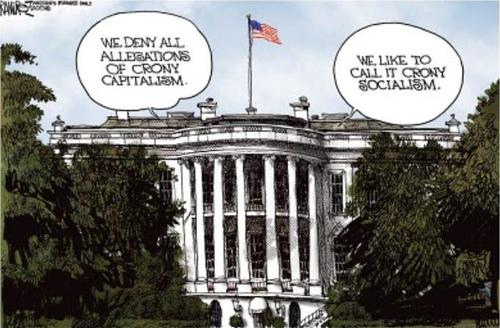
USA 2021: Capitalism For The Powerless, Crony-Socialism For The Powerful

By Tyler Durden

Source: Zero Hedge

The supposed “choice” between “capitalism” and “socialism” is a useful fabrication masking the worst of all possible worlds we inhabit: Capitalism for the powerless and Crony-Socialism for the powerful. Capitalism’s primary dynamics are reserved solely for the powerless: market price of money, capital’s exploitive potential, free-for-all competition and creative destruction.

The powerful, on the other hand, bask in the warm glow of socialism: The Federal Reserve protects them from the market cost of money–financiers and the super-wealthy get their money for virtually nothing from the Fed, in virtually unlimited quantities–and the Treasury, Congress and the Executive branch protect them from any losses: their gains are private, but their losses are transferred to the public. The Supreme Court ensures the super-rich maintain this cozy crony-socialism by ensuring they can buy political power via lobbying and campaign contributions–under the laughable excuse of free speech.

Cronies get the best political system money can buy and you–well, you get to carry a sign on the street corner, just before you’re hauled off to jail for disturbing the peace (and you’re banned by social media/search Big Tech, i.e. privatized totalitarianism, for good measure).

The Federal Reserve is America’s financial Politburo: cronies get a free pass, the powerless get nothing. While the three billionaires who own more wealth than the bottom 165 million Americans can borrow unlimited sums for next to nothing thanks to the Fed (i.e. Crony-Socialist Politburo), the 165 million Americans pay exorbitant interest on payday loans, used car loans, student loans, credit cards and so on.

Capitalism (market sets price of money) for the powerless, Crony-Socialism (nearly free money) for the powerful–thanks to America’s Crony-Socialist Politburo, the Fed. Consider the “free market” plight of America’s working poor: earning low wages that are rapidly losing their purchasing power makes them a credit risk, i.e. prone to defaulting, so lenders (i.e. capital’s exploitive potential) charge high interest rates on loans to the working poor.

Since they pay such high rates of interest and earn so little, they default on their debt at higher rates–just what the lenders expected, and what the lenders created by charging sky-high rates of interest: gee, you’re having trouble paying 24% interest? Too bad you’re poor. You see the point: low wages, poverty and exorbitant rates of interest are mutually reinforcing: a primary driver of defaults and poverty is paying sky-high rates of interest and all the late fees, bounced check fees, etc. that go with 24% interest rates.

The Crony-Socialists have a much different deal with the Fed and its crony-bankers: the super-wealthy arrange for the corporations they own shares in to borrow billions of dollars to fund stock buybacks (which in a less exploitive era were illegal market manipulation). The super-wealthy Crony-Socialist’s personal wealth rises by $100 million thanks to the stock buybacks, and then the super-wealthy Crony-Socialist borrows $10 million for next to nothing against this newly conjured “wealth” (thanks, Fed!) to fund living large.

Crony-Socialist corporations pay no income tax thanks to loopholes and the Crony-Socialists who own the shares report $1 in salary and zero income because they borrowed their living expenses against their Fed-conjured wealth. Do you discern the difference between capitalism for the powerless and crony-socialism for the super-wealthy?

If you can’t yet discern the difference, then ask yourself: can you borrow $1 billion from the Fed’s cronies to buy back shares of your own company, and then borrow $10 million for near-zero rates of interest against the newly conjured “wealth”? You can’t? Well, why not?

If you answer “I don’t have enough collateral,” you missed the key point here: thanks to America’s Crony-Socialist Politburo (the Fed), the super-wealthy have no exposure to the market price of money. The Fed manipulates the cost of money to near-zero, and then funnels unlimited sums of this nearly-free money to corporations, financiers and the super-wealthy.

Collateral is unnecessary in Crony-Socialism; that’s just a excuse given to the powerless. Crony-Socialists borrow $1 billion for next to nothing, buy Treasuries with the free money, put the Treasuries up as collateral (but wait, didn’t they borrow the money? Never mind, it doesn’t matter), originate some financial instruments (CDOs, etc.), post those as collateral, and then leverage up another bet on that fictitious collateral.

If the bets all go bad, the Crony-Socialist claims the whole fraud is now a systemic risk and so the losses are transferred to the public / taxpayers to “save the financial system from collapse.” Isn’t Crony-Socialism fantastic?

Just as the rich kid caught with smack gets a suspended sentence and probation while the powerless kid gets a tenner in the War on Drugs Gulag, the super-wealthy Crony-Socialists avoid all the consequences of their gambles and frauds. America’s Crony-Socialist Politburo (the Fed) takes care of its cronies and the powerless bear the brunt of predatory exploitation that’s passed off as “capitalism.”

The only dynamic that’s even faintly “capitalist” about America’s Crony-Socialism is the price of political corruption is still a “market”: what’s the current price of protecting your monopoly or cartel from competition? It’s moving up fast, so better get those bribes (oops, I mean campaign contributions for the 2022 election) in now before the price of corrupting “democracy” goes even higher.

America’s Fatal Synergies

By Charles Hugh Smith

Source: Of Two Minds

America’s financial system and state are themselves the problems, yet neither system is capable of recognizing this or unwinding their fatal synergies.

why do some systems/states emerge from crises stronger while similar systems/states collapse? Put another way: take two very similar political-social-economic systems/nation-states and two very similar crises, and why does one system not just survive but emerge better adapted while the other system/state fails?

The answer lies in what author Geoffrey Parker termed Fatal Synergies and Benign Synergies in his book Global Crisis: War, Climate Change, & Catastrophe in the Seventeenth Century. Synergy results from “interactions that produce a combined effect greater than the sum of their separate effects.” In other words, 2 + 2 + 2 + 2 = 8 is linear, while synergy is 2 X 2 X 2 X 2 = 16.

Given that the core function of states is the distribution of resources, capital and agencywe can distill the difference between Fatal Synergies and Benign Synergies into two questions:

1. What problems cannot be resolved by the financial system/state, no matter how many reforms are thrown at them?

2. Which groups have a meaningful voice in decision-making / governance and which groups are effectively voiceless / powerless?

The first question identifies the structural weak points in the system. These weak points could have any number of sources: they could be perverse incentives embedded in the system, elites caught up in their own enrichment, or even a willful blindness to the nature of the crisis threatening the system.

Here’s an example in the U.S. system: corporations reap $2.4 trillion in profits annually, roughly 15% of the nation’s entire output. Politicians need millions of dollars in campaign contributions to win elections. Those seeking political influence have not just billions but tens of billions. Those needing to distribute political favors will do so for mere millions.

Testing Theories of American Politics: Elites, Interest Groups, and Average Citizens:

“I’d say that contrary to what decades of political science research might lead you to believe, ordinary citizens have virtually no influence over what their government does in the United States. And economic elites and interest groups, especially those representing business, have a substantial degree of influence. Government policy-making over the last few decades reflects the preferences of those groups — of economic elites and of organized interests.”

This asymmetry cannot be overcome. Indeed, the past 40 years have witnessed an increasing concentration of wealth and power in corporations and their lobbyists and a decline of political influence of the masses to near-zero. Every reform has failed to slow this momentum, which is constructed of incentives to maximize profits, gain political favors and win elections.

In a similar fashion, the Imperial Presidency has gained power at the expense of Congress for decades–a reality that scholars bemoan but the reforms allowed by the system are unable to stop. So we have endless wars of choice without a declaration of war by Congress, one of the core powers of the elected body.

An analogy to these systemic weak points is the synergies of an organism’s essential organs: if any one organ fails, the organism dies even though the other organs are working just fine. In other words, any system is only as robust as its weakest essential component/process.

Whatever problems the system is incapable of resolving have the potential to bring down the system once they interact synergistically.

The second question identifies how many groups have been suppressed, silenced or ignored by those at the top of the heap. If these groups have an essential role in the system as producers, consumers and taxpayers, their demand to have a say in decisions that directly affect them is natural.

Another group with understandable frustrations at being left out of the decision-making are those in the educated upper classes whose expectations of roles in the top tier were encouraged by their families, society and training. When these expectations are not met because there are no longer enough slots in the top tier for the rapidly proliferating upper classes, the group left out in the cold has the time, education and motivation to demand a voice.

In other words, those denied access to resources, capital and agency who felt entitled to this access will not be as easily silenced as those who accept their low status and restricted access to resources, capital and agency as “the natural order of things.”

All the groups that are denied a voice and access to resources, capital and agency are in effect a sealed pressure cooker atop a flame. The pressure builds and builds without any apparent consequence until it explodes.

The more that power is concentrated in the hands of the few, the greater the desperation of the groups who are locked out of power. As their desperation rises, some of these groups are willing to go to whatever lengths are necessary to effect change.

The process of explosive demands for change erupting is difficult to manage once released. The system’s essential subsystems may be destabilized–the equivalent of organ failure–and once destabilized, it’s often no longer possible to restore the previous stability.

In this environment, the common good falls by the wayside and the system collapses.

In the context I’ve laid out, Fatal Synergies arise when access to resources, capital and agency are limited by elite hoarding or massive declines in available resources and capital.

Beneficial Synergies arise when whatever resources and capital are available are shared, if not equitably, at least in a process in which every group affected by the distribution has a voice in public decision-making.

Fatal Synergies arise when the identity of each group is based not on shared values and cooperation but on unyielding resistance to competing claims on the nation’s wealth and income.

Beneficial Synergies arise when all groups have a voice and a say in the process of distribution, even if it is limited.

Crises reveal the problems the system is incapable of resolving. How we respond to those constraints and weak points is the difference between Fatal Synergies and collapse and Beneficial Synergies that generate successful evolutionary responses to pressing selective pressures: simply put, “adapt or die.”

America’s financial system and state are themselves the problems, yet neither system is capable of recognizing this or unwinding their fatal synergies.

The Number Of Billionaires In America Has Absolutely Exploded During The Pandemic

By Michael Snyder

Source: Investment Watch Blog

For the wealthy and the ultra-wealthy, happy days are here again.  Even though we have just been through one of the most difficult 12 months in our history, the number of billionaires has increased dramatically during this pandemic.  That seems rather odd, but there is no denying that the rich have gotten even richer during this crisis.  In fact, Forbes revealed this week that the number of billionaires has risen by about 30 percent over the past year…

The number of newly minted and reissued billionaires soared last year, Forbes reported Tuesday in its annual ranking, a staggering accumulation of personal wealth that stands in sharp contrast with the widespread economic struggles unleashed by the coronavirus pandemic.

The number of billionaires on Forbes’ 35th annual ranking swelled by 660 to 2,755 — a roughly 30 percent jump from a year ago — and 493 of them are first-timers. Seven of eight are richer than they were before the pandemic. Forbes calculates net worth by using stock prices and exchange rates from March 5.

Of course thanks to the reckless policies of our leaders, a billion dollars does not go nearly as far as it once did.

But still, a billion dollars is a whole lot of money.

Needless to say, the biggest reason why the number of billionaires has exploded is because we have been witnessing one of the greatest stock market rallies in history.

A year ago, the Dow Jones Industrial Average was sitting at about 23,000.

Today, it is above 33,000, and some analysts expect it to shoot quite a bit higher throughout the rest of 2021.

Stock prices have never been more detached from economic reality as they have been over the past 12 months, and they have only risen so high because of unprecedented intervention by the Federal Reserve and because of extremely wild spending by the federal government.

Many have warned that the party will inevitably come to a crashing end at some point, but it hasn’t happened yet.

So for now, the market optimists look like champions.

And now that Joe Biden is in the White House, the corporate media is telling us that we are on the verge of a grand new era of American prosperity.  The corporate media insists that the pandemic will soon be behind us thanks to the vaccines, and the talking heads on television envision a return to the good old days very quickly.

In fact, Barron’s is already declaring that the “U.S. economy might be stronger than it’s ever been”.

And CNN is trying to convince us that “America’s economy could be heading for a golden era of growth”.

Really?

If the U.S. economy is actually improving, then why are new claims for unemployment benefits going up?

The number of Americans filing first-time unemployment benefits unexpectedly rose last week, according to the Labor Department.

Data released Thursday showed 744,000 Americans filed first-time jobless claims in the week ended April 3. Analysts surveyed by Refinitiv were expecting 680,000 filings. The previous week’s total was revised higher by 9,000 to 728,000.

If economic conditions were getting better, that number should be going the other way.

Even I didn’t expect a number this bad.

Prior to 2020, the all-time record high for new unemployment claims in a single week was 695,000.  That record was established in October 1982, and it stood all the way until the COVID pandemic hit the U.S. early last year.

Sadly, we have been above 695,000 almost every single week since then.

The numbers compiled by the states tell us that nearly three-quarters of a million Americans filed new claims for unemployment benefits last week.  That is an absolutely catastrophic number.  Nobody should be talking about a “golden era of growth” or claiming that the “economy might be stronger than it’s ever been” until we get that number back down to pre-pandemic levels.

And right now, we are at a level that is about three times as high as pre-pandemic levels.

Look, the truth is that anyone that tells you that unemployment is low in the United States is lying to you.

According to John Williams of shadowstats.com, if honest numbers were being used the unemployment rate in the United States would be 25.7 percent right now.

That is the sort of number that we would expect to see during an economic depression, and the truth is that we are in an economic depression.

Over the past year, more than 70 million new claims for unemployment benefits have been filed, and approximately 4 million U.S. businesses have gone out of existence permanently.

But don’t worry, the stock market is hovering near all-time record highs and the corporate media is telling you that everything is going to be wonderful now that Joe Biden is in control.

Come on man!

You can’t really believe that stuff that they are shoveling.

With each passing day, more Americans are losing their jobs, more Americans are falling out of the middle class, and the cost of living just keeps going up even higher.

In fact, we just learned that global food prices have now gone up for 10 months in a row

The global food-price rally that’s stoking inflation worries and hitting consumers around the world shows little sign of slowing.

Even with grain prices taking a breather on good crop prospects, a United Nations gauge of global food costs rose for a 10th month in March to the highest since 2014. Last month’s advance was driven by a surge in vegetable oils amid stronger demand and tight inventories, according to Abdolreza Abbassian, a senior economist at the UN’s Food and Agriculture Organization.

I am going to continue to watch global food prices very carefully, because I believe that it will be a very important trend in the months and years ahead.

But for now, the good news is that at least economic conditions are relatively stable.

Yes, things are not nearly as good as they were before the pandemic, but at least they are not getting a whole lot worse.

So even though things are not great, we should enjoy this period of relative stability while we still can, because it definitely will not last.

Jeff Bezos Embodies the Cruel Autocracy of Neoliberal Capitalism

Amazon CEO and richest-man-in-the-world Jeff Bezos wants you to work as much as he does—for one millionth of the pay

By Branko Marcetic

Source: In These Times

“Is Jeff Bezos a horrible boss and is that good?” That was the question posed by Forbes magazine in 2013, a sentiment that helps explain why Amazon’s founder and CEO is detested by the Left for his oligarchic ambitions, while simultaneously admired by America’s capitalist class for his business success. Ironically, Bezos is also loathed by former President Donald Trump, while celebrated by many liberals for so-called resistance.

But with Bezos and his $115 billion fortune laying claim to the title of richest man on Earth, and with Amazon playing an increasingly influential role in public life, it is worth asking: What does Jeff Bezos stand for?

A gifted child born to a teen mom, Bezos grew up not knowing his biological father, who was once one of the top-rated unicyclists in Albuquerque, N.M. Instead, Bezos was raised by the man his mother soon married: Miguel Bezos, who had fled Cuba and the Communist revolution, which had shuttered the elite private Jesuit school he attended, as well as his family’s lumberyard.

Journalists have speculated whether Bezos’ near-pathological competitiveness is a product of his early abandonment, similar to that of fellow tech overlord Steve Jobs. No doubt equally formative was Bezos’ adoptive father, who told Brad Stone, author of The Everything Store: Jeff Bezos and the Age of Amazon, that their home life was ​“permeated” by complaints about totalitarian governments of both the Right and the Left.

Bezos envisioned the concept of an ​“everything store” while working for a Wall Street hedge fund in the 1990s. He opened Amazon in 1994 as an online bookshop, a pragmatic starting point. Bezos gave the company his own $10,000 cash injection, took out interest-free loans, and received $245,000 from his parents and family trust.

Many of Amazon’s controversial labor practices can be traced to these early years as a plucky start-up. Amazon’s small team ran on tireless ambition to live up to the company’s customer-focused promise — key to its eventual market domination. Stone reports that, to meet Bezos’ ​“get big fast” directive, employees devoted themselves completely, working long, unusual, frenzied hours. One early warehouse worker who biked to work simply forgot about his improperly parked car, eventually discovering it had been ticketed, towed and sold at auction.

Such a relentless pace is one thing for a small group of true believers but is quite another when applied to low-wage workers just making ends meet. By 2011, Amazon’s workplace culture became known through a series of headline-grabbing reports that have come to define its public image: badly paid, ceaselessly surveilled, overworked workers, struggling to maintain a breakneck pace.

Bezos created a culture in which everyone from the lowest peon to the highest-ranking executive is expected to match his own devotion, an approach that resulted in spectacular levels of staff turnover by the early 2000s. A declared enemy of ​“social cohesion,” Bezos pushed his underlings to reject compromise and instead fiercely debate and criticize colleagues when they disagreed. One former employee described it as ​“purposeful Darwinism.” Known for withering put-downs — ​“Are you lazy or just incompetent?” ​“Did I take my stupid pills today?”—Bezos also isn’t above pulling out his phone or, in some cases, simply leaving the room when an employee fails to impress.

The flipside of Bezos’ intellect is a cold, clinical approach to human relations. Bezos described himself as a ​“professional dater” during his Wall Street days, trying to improve what he called his ​“women flow” — a riff on the Wall Street term ​“deal flow.”

“He was not warm,” one person who knew Bezos during his Wall Street days told the East Bay Express in 2014. ​“It was like he could be a Martian for all I knew.”

Bezos’ pitiless leadership style bled out beyond the Amazon boardroom as he used the company’s growing market share to bully book publishers into his terms. The company launched the ​“Gazelle Project”—as in, go after publishers ​“the way a cheetah would pursue a sickly gazelle” — allowing Amazon to undercut its competition at the cost of little to no profit for smaller publishers.

As Amazon inched closer to Bezos’ original vision, it began lobbying efforts in 2000 and became more transparently political by 2011, spending millions to defeat an internet sales tax and playing hardball with state governments, threatening to shutter Amazon facilities if its wishes went unfulfilled. In 2013, Amazon began lobbying Congress to cut corporate taxes.

The same year, Bezos bought the Washington Post, invested in Business Insider and donated to the publisher of the libertarian magazine Reason. Though Bezos argues his purchase of the Post was motivated by ​“a love affair [with] the printed word” and a desire to support American democracy, others suspect Bezos’ interest in media is related to bad press following a scathing Lehman Brothers report in 2000, which sent Amazon’s stock price tumbling.

Leading up to the Post purchase, Bezos was increasingly displaying what early Amazon investor Nick Hanauer called his ​“libertarian politics.” In addition to spending $100,000 in 2010 on a campaign to defeat a proposed Washington state tax on high-income earners, Bezos put hundreds of thousands of dollars toward boosting charter schools and other neoliberal education reforms.

Bezos’ political involvement reached a new apogee in 2019 during the re-election bid of Seattle’s socialist city councilwoman, Kshama Sawant, who called Bezos ​“our enemy” and tried to pass a head tax to fund housing for those displaced by Amazon’s Seattle footprint. Amazon spent $1.5 million against Sawant and other progressive candidates, a record at the local level, with more than a dozen of the company’s executives contributing to Sawant’s opponent. (Sawant won re-election anyway.)

As for Bezos’ endgame? A Trekkie since childhood, he has long dreamed of funding space exploration, a mission pursued by other superrich moguls (such as Elon Musk) in the face of the climate emergency. Opening the doors of his secretive Blue Origin aerospace company to journalists for the first time in 2016, Bezos told the New York Times he envisioned a future of ​“millions of people living and working in space,” exploiting the natural resources of surrounding planets and rezoning Earth ​“as light industrial and residential.”

Ironically, as Bezos pours the wealth he wrung out of exhausted, low-wage Amazon workers into space exploration, Amazon is busy hastening the very planetary collapse Bezos claims he’s trying to prevent — by silencing workers who speak out against Amazon’s assistance to oil and gas companies.

Let’s imagine, however, that Bezos, who accumulates $9 million an hour, lived in a world with Bernie Sanders’ 8% wealth tax (just on fortunes over $10 billion). A single year would see $9 billion flow from Bezos’ treasure trove into government coffers, more than enough to cover the 10-year cost of Elizabeth Warren’s universal child care plan ($1.7 billion) and maintain safe drinking water under Sanders’ plan ($6 billion).

Bezos’ career is a testament to the cruel autocracy and senseless misallocation of resources that our neoliberal capitalist system enables. But his opulence also reveals that the wealth exists to build a fairer and more equitable society — if redistributed. Bezos may loathe social cohesion, but in a world organized around democracy rather than the whims of space-billionaires, it’s something we may well be able to achieve.

Stand Up to Tyranny: How to Respond to the Evils of Our Age

By John W. Whitehead & Nisha Whitehead

Source: The Rutherford Institute

“The church must be reminded that it is not the master or the servant of the state, but rather the conscience of the state. It must be the guide and the critic of the state, and never its tool. If the church does not recapture its prophetic zeal, it will become an irrelevant social club without moral or spiritual authority.”—Martin Luther King Jr. (A Knock at Midnight, June 11, 1967)

In every age, we find ourselves wrestling with the question of how Jesus Christ—the itinerant preacher and revolutionary activist who died challenging the police state of his time, namely, the Roman Empire—would respond to the moral questions of our day.

For instance, would Jesus advocate, as so many evangelical Christian leaders have done in recent years, for congregants to “submit to your leaders and those in authority,” which in the American police state translates to complying, conforming, submitting, obeying orders, deferring to authority and generally doing whatever a government official tells you to do?

What would Jesus do? 

Study the life and teachings of Jesus, and you may be surprised at how relevant he is to our modern age.

A radical nonconformist who challenged authority at every turn, Jesus spent his adult life speaking truth to power, challenging the status quo of his day, pushing back against the abuses of the Roman Empire, and providing a blueprint for standing up to tyranny that would be followed by those, religious and otherwise, who came after him.

Those living through this present age of government lockdowns, immunity passports, militarized police, SWAT team raids, police shootings of unarmed citizens, roadside strip searches, invasive surveillance and the like might feel as if these events are unprecedented. However, the characteristics of a police state and its reasons for being are no different today than they were in Jesus’ lifetime: control, power and money.

Much like the American Empire today, the Roman Empire of Jesus’ day was characterized by secrecy, surveillance, a widespread police presence, a citizenry treated like suspects with little recourse against the police state, perpetual wars, a military empire, martial law, and political retribution against those who dared to challenge the power of the state.

A police state extends far beyond the actions of law enforcement.  In fact, a police state “is characterized by bureaucracy, secrecy, perpetual wars, a nation of suspects, militarization, surveillance, widespread police presence, and a citizenry with little recourse against police actions.”

Indeed, the police state in which Jesus lived (and died) and its striking similarities to modern-day America are beyond troubling.

Secrecy, surveillance and rule by the elite. As the chasm between the wealthy and poor grew wider in the Roman Empire, the ruling class and the wealthy class became synonymous, while the lower classes, increasingly deprived of their political freedoms, grew disinterested in the government and easily distracted by “bread and circuses.” Much like America today, with its lack of government transparency, overt domestic surveillance, and rule by the rich, the inner workings of the Roman Empire were shrouded in secrecy, while its leaders were constantly on the watch for any potential threats to its power. The resulting state-wide surveillance was primarily carried out by the military, which acted as investigators, enforcers, torturers, policemen, executioners and jailers. Today that role is fulfilled by the NSA, the FBI, the Department of Homeland Security and the increasingly militarized police forces across the country.

Widespread police presence. The Roman Empire used its military forces to maintain the “peace,” thereby establishing a police state that reached into all aspects of a citizen’s life. In this way, these military officers, used to address a broad range of routine problems and conflicts, enforced the will of the state. Today SWAT teams, comprised of local police and federal agents, are employed to carry out routine search warrants for minor crimes such as marijuana possession and credit card fraud.

Citizenry with little recourse against the police state. As the Roman Empire expanded, personal freedom and independence nearly vanished, as did any real sense of local governance and national consciousness. Similarly, in America today, citizens largely feel powerless, voiceless and unrepresented in the face of a power-hungry federal government. As states and localities are brought under direct control by federal agencies and regulations, a sense of learned helplessness grips the nation.

Perpetual wars and a military empire. Much like America today with its practice of policing the world, war and an over-arching militarist ethos provided the framework for the Roman Empire, which extended from the Italian peninsula to all over Southern, Western, and Eastern Europe, extending into North Africa and Western Asia as well. In addition to significant foreign threats, wars were waged against inchoate, unstructured and socially inferior foes.

Martial law. Eventually, Rome established a permanent military dictatorship that left the citizens at the mercy of an unreachable and oppressive totalitarian regime. In the absence of resources to establish civic police forces, the Romans relied increasingly on the military to intervene in all matters of conflict or upheaval in provinces, from small-scale scuffles to large-scale revolts. Not unlike police forces today, with their martial law training drills on American soil, militarized weapons and “shoot first, ask questions later” mindset, the Roman soldier had “the exercise of lethal force at his fingertips” with the potential of wreaking havoc on normal citizens’ lives.

A nation of suspects. Just as the American Empire looks upon its citizens as suspects to be tracked, surveilled and controlled, the Roman Empire looked upon all potential insubordinates, from the common thief to a full-fledged insurrectionist, as threats to its power. The insurrectionist was seen as directly challenging the Emperor.  A “bandit,” or revolutionist, was seen as capable of overturning the empire, was always considered guilty and deserving of the most savage penalties, including capital punishment. Bandits were usually punished publicly and cruelly as a means of deterring others from challenging the power of the state.  Jesus’ execution was one such public punishment.

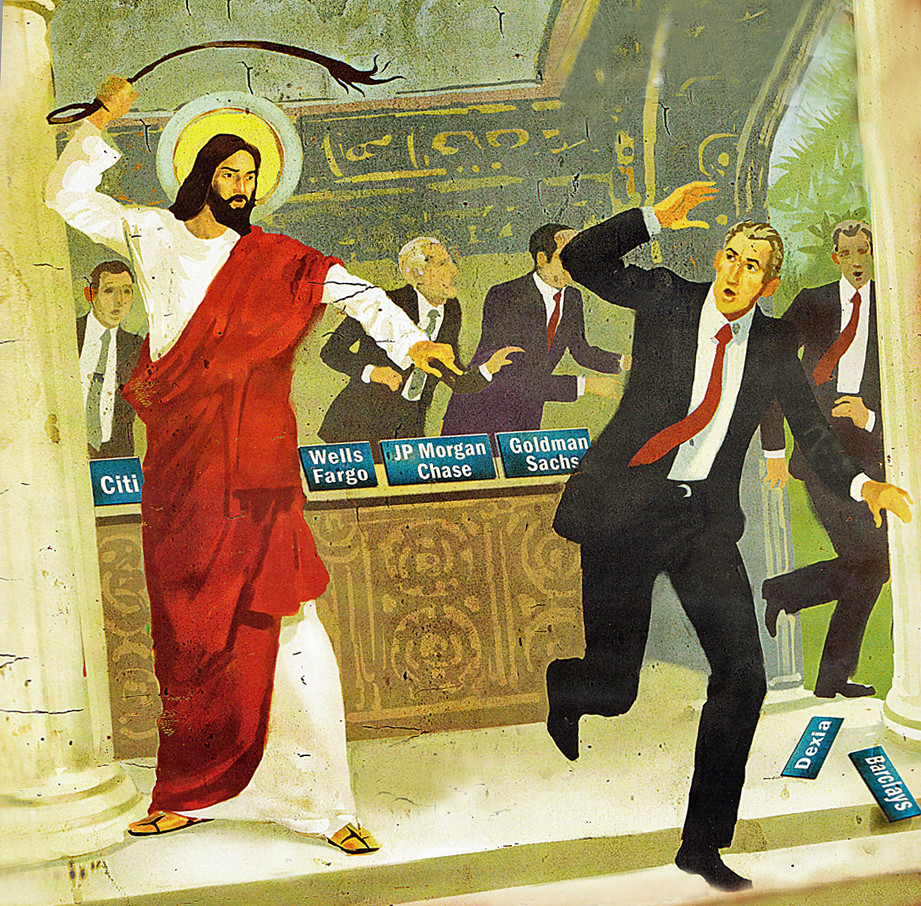
Acts of civil disobedience by insurrectionists. Starting with his act of civil disobedience at the Jewish temple, the site of the administrative headquarters of the Sanhedrin, the supreme Jewish council, Jesus branded himself a political revolutionary. When Jesus “with the help of his disciples, blocks the entrance to the courtyard” and forbids “anyone carrying goods for sale or trade from entering the Temple,” he committed a blatantly criminal and seditious act, an act “that undoubtedly precipitated his arrest and execution.” Because the commercial events were sponsored by the religious hierarchy, which in turn was operated by consent of the Roman government, Jesus’ attack on the money chargers and traders can be seen as an attack on Rome itself, an unmistakable declaration of political and social independence from the Roman oppression.

Military-style arrests in the dead of night. Jesus’ arrest account testifies to the fact that the Romans perceived Him as a revolutionary. Eerily similar to today’s SWAT team raids, Jesus was arrested in the middle of the night, in secret, by a large, heavily armed fleet of soldiers.  Rather than merely asking for Jesus when they came to arrest him, his pursuers collaborated beforehand with Judas. Acting as a government informant, Judas concocted a kiss as a secret identification marker, hinting that a level of deception and trickery must be used to obtain this seemingly “dangerous revolutionist’s” cooperation. 

Torture and capital punishment. In Jesus’ day, religious preachers, self-proclaimed prophets and nonviolent protesters were not summarily arrested and executed. Indeed, the high priests and Roman governors normally allowed a protest, particularly a small-scale one, to run its course. However, government authorities were quick to dispose of leaders and movements that appeared to threaten the Roman Empire. The charges leveled against Jesus—that he was a threat to the stability of the nation, opposed paying Roman taxes and claimed to be the rightful King—were purely political, not religious. To the Romans, any one of these charges was enough to merit death by crucifixion, which was usually reserved for slaves, non-Romans, radicals, revolutionaries and the worst criminals.

Jesus was presented to Pontius Pilate “as a disturber of the political peace,” a leader of a rebellion, a political threat, and most gravely—a claimant to kingship, a “king of the revolutionary type.” After Jesus is formally condemned by Pilate, he is sentenced to death by crucifixion, “the Roman means of executing criminals convicted of high treason.”  The purpose of crucifixion was not so much to kill the criminal, as it was an immensely public statement intended to visually warn all those who would challenge the power of the Roman Empire. Hence, it was reserved solely for the most extreme political crimes: treason, rebellion, sedition, and banditry. After being ruthlessly whipped and mocked, Jesus was nailed to a cross.

As Professor Mark Lewis Taylor observed:

The cross within Roman politics and culture was a marker of shame, of being a criminal. If you were put to the cross, you were marked as shameful, as criminal, but especially as subversive. And there were thousands of people put to the cross. The cross was actually positioned at many crossroads, and, as New Testament scholar Paula Fredricksen has reminded us, it served as kind of a public service announcement that said, “Act like this person did, and this is how you will end up.”

Jesus—the revolutionary, the political dissident, and the nonviolent activist—lived and died in a police state. Any reflection on Jesus’ life and death within a police state must take into account several factors: Jesus spoke out strongly against such things as empires, controlling people, state violence and power politics. Jesus challenged the political and religious belief systems of his day. And worldly powers feared Jesus, not because he challenged them for control of thrones or government but because he undercut their claims of supremacy, and he dared to speak truth to power in a time when doing so could—and often did—cost a person his life.

Unfortunately, the radical Jesus, the political dissident who took aim at injustice and oppression, has been largely forgotten today, replaced by a congenial, smiling Jesus trotted out for religious holidays but otherwise rendered mute when it comes to matters of war, power and politics.

Yet for those who truly study the life and teachings of Jesus, the resounding theme is one of outright resistance to war, materialism and empire.

Ultimately, as I point out in my book Battlefield America: The War on the American People, this is the contradiction that must be resolved if the radical Jesus—the one who stood up to the Roman Empire and was crucified as a warning to others not to challenge the powers-that-be—is to be an example for our modern age.

After all, there is so much suffering and injustice in the world, and so much good that can be done by those who truly aspire to follow Jesus Christ’s example.

We must decide whether we will follow the path of least resistance—willing to turn a blind eye to what Martin Luther King Jr. referred to as the “evils of segregation and the crippling effects of discrimination, to the moral degeneracy of religious bigotry and the corroding effects of narrow sectarianism, to economic conditions that deprive men of work and food, and to the insanities of militarism and the self-defeating effects of physical violence”—or whether we will be transformed nonconformists “dedicated to justice, peace, and brotherhood.”

As King explained in a powerful sermon delivered in 1954, “This command not to conform comes … [from] Jesus Christ, the world’s most dedicated nonconformist, whose ethical nonconformity still challenges the conscience of mankind.”

Furthermore:

We need to recapture the gospel glow of the early Christians, who were nonconformists in the truest sense of the word and refused to shape their witness according to the mundane patterns of the world.  Willingly they sacrificed fame, fortune, and life itself in behalf of a cause they knew to be right.  Quantitatively small, they were qualitatively giants.  Their powerful gospel put an end to such barbaric evils as infanticide and bloody gladiatorial contests.  Finally, they captured the Roman Empire for Jesus Christ… The hope of a secure and livable world lies with disciplined nonconformists, who are dedicated to justice, peace, and brotherhood.  The trailblazers in human, academic, scientific, and religious freedom have always been nonconformists.  In any cause that concerns the progress of mankind, put your faith in the nonconformist!

…Honesty impels me to admit that transformed nonconformity, which is always costly and never altogether comfortable, may mean walking through the valley of the shadow of suffering, losing a job, or having a six-year-old daughter ask, “Daddy, why do you have to go to jail so much?”  But we are gravely mistaken to think that Christianity protects us from the pain and agony of mortal existence.  Christianity has always insisted that the cross we bear precedes the crown we wear.  To be a Christian, one must take up his cross, with all of its difficulties and agonizing and tragedy-packed content, and carry it until that very cross leaves its marks upon us and redeems us to that more excellent way that comes only through suffering.

In these days of worldwide confusion, there is a dire need for men and women who will courageously do battle for truth.  We must make a choice. Will we continue to march to the drumbeat of conformity and respectability, or will we, listening to the beat of a more distant drum, move to its echoing sounds?  Will we march only to the music of time, or will we, risking criticism and abuse, march to the soul saving music of eternity?

Stagflation Subterfuge: The Real Disaster Hidden By The Pandemic

By Brandon Smith

Source: Alt-Market.us

In recent economic news, headlines are being dominated by concerns over rising bond yields. Increased bond yields are a sign of a possible spike in inflation and, logically, they call for the Federal Reserve to raise interest rates in order to prevent that inflation.

Higher bond yields also mean there is a competitive alternative to stocks for investors – both factors that could trigger a plunge in the stock market.

If one studies the real history behind the stock market crash during the Great Depression, they will find that it was the Federal Reserve’s interest rate hikes that caused and prolonged the disaster after they had created an environment of cheap and easy money throughout the 1920s. Former Chairman Ben Bernanke openly admitted the Fed was responsible back in 2002 in a speech honoring Milton Friedman. He stated:

“In short, according to Friedman and Schwartz, because of institutional changes and misguided doctrines, the banking panics of the Great Contraction were much more severe and widespread than would have normally occurred during a downturn. Let me end my talk by abusing slightly my status as an official representative of the Federal Reserve. I would like to say to Milton and Anna: Regarding the Great Depression. You’re right, we did it. We’re very sorry. But thanks to you, we won’t do it again.”

This then raises the question – inflation or deflation? Will the Fed “do it again?”

Probably not in exactly the same way, but we will see elements of both inflation and deflation soon in the form of stagflation.

It’s a Catch-22 that the central bank has created, and many (including myself) believe that the Fed has created the conundrum deliberately. All central banks are tied together by the Bank for International Settlements (BIS) and the BIS is a globalist institution through and through. The globalist agenda seeks to trigger what they call the “Great Reset,” a complete reformation of the global economy and capitalism into a single one world socialist system… managed by the globalists themselves, of course.

In my view the Fed has always been a kind of institutional suicide bomber; its job is to self-destruct at the right moment and take the U.S. economy down with it, all in the name of spreading its cult-like globalist ideology.

The only unknown at this point is how they will go about their sabotage. Will the central bank continue to allow inflation to explode the cost of living in the U.S., or will they intervene with higher interest rates and allow stock markets to crash?

Either way, we face a serious economic crisis in the near future.


Increasing Inflation Means Economic Recovery?

Mainstream economists will often argue that rising yields and inflation are a “good thing.” They claim this is a sign of rapid economic recovery. I disagree.

If “inflation” was the same as “recovery,” then there would not have been total economic collapses in Argentina in 2002, in Yugoslavia in 1994, or in Weimar Germany in the early 1920s.

I do not see recovery. What I see is the rapid devaluation of the dollar’s buying power due to massive fiat printing through stimulus measures. The Fed and the U.S. government are buying a short-term surge in economic activity, but at a hidden cost. This is a condition that the Dollar Index does not even begin to address, but obvious in prices of necessary goods and commodities.

Keep in mind that all of this is being done in the name of responding to the pandemic. The pandemic is the ultimate excuse for the active destruction of the U.S. economy. Stimulus measures have devolved into helicopter money being thrown about haphazardly as billions are siphoned primarily by major corporations and through fraud. People who are clamoring for a $2,000 relief check from the government have no idea that corporate welfare has been ongoing for the past year along with billions in retroactive tax refunds. All of that money printing is going to cause damage somewhere. It cannot be avoided.


It’s Not About The Pandemic

Let’s make something clear first: The pandemic is NOT the reason for the stimulus flood. The pandemic did very little to hurt actual business in the U.S. Rather, it was the lockdowns that did most of the damage.

Think about that for a moment – federal and state governments crushed the economy through lockdowns, then offered the solution of vast stimulus measures. This in turn is destroying financial stability and generating rapid price inflation.

Conservative states and counties that refused to shut down are recovering at a much faster pace than leftist states which imposed draconian restrictions on citizens. Yet, the lockdowns did nothing to stop the spread of COVID-19 in blue states. So, the lockdowns accomplished no discernible advantage for the public, but they did give the central bank a perfect rationale to further erode the dollar.

This resulting price inflation is something that not even the red states can escape.

For example, home prices are rapidly expanding beyond the market bubble of 2006. This is partially due to millions of people participating in perhaps the largest migration in the U.S. since the Great Depression. Anyone who is able is moving away from major cities into suburban and rural areas. But, home prices also have a historic habit of inflating along with currency devaluation. The cost of maintaining and remodeling an older home, or building a new home, rises as the prices of commodities like lumber inflate.

And lumber prices are certainly inflating! Softwood lumber prices are up at least 110% from a year ago, and are climbing as much as 10% in a week.

Home rentals also do not escape inflation, as the rising cost of maintaining properties forces landlords to increase rents. The only places where rents are decreasing are major cities that Americans are seeking to flee, such as New York and San Francisco.


Inflation In More Than Just Housing

The majority of commodities continue to see price inflation across the board. Food and energy prices have been creeping higher for the past year. Governments are once again blaming the pandemic and “stresses on the supply chain,” which may have been a believable claim nine months ago, but not today. Anything to hide the fact that all that stimulus has inflationary consequences.

Dollar devaluation is the most visible in terms of imported goods. In other words, it costs more dollars to buy goods outside the U.S. as the value of the dollar falls. And since the majority of U.S. retail is supplied by foreign producers, this means that average American consumers will suffer the brunt of inflationary consequences. Public stress and anger will be high.


Pandemic Lockdowns Are Just An Excuse

This is why the COVID-19 lockdowns must continue and the pandemic fear factory must remain active. The globalists need a cover event for the Reset and they need to keep the citizenry under control, and the pandemic can be blamed for just about anything. I think this is why we are already seeing the media hyping the existence of “COVID mutations.” Do not be surprised if the Biden Administration tries to implement a national lockdown sometime this year in the name of stopping the spread of a “more deadly” COVID-19 variant.

It won’t matter that the previous lockdowns were useless and all the data shows that keeping the economy open is a superior policy. It might seem like logic is going completely out the window, but there is a very logical reason for what is happening in the minds of globalists.

Stagflation comes into play through losses in certain sectors of the economy, high unemployment and the inability of wages to keep up with costs.

There is the continued dismantling of the small business sector, which, again, I believe is being destroyed deliberately. It’s not a mistake that small businesses were predominantly targeted as “non-essential” during the lockdowns. It’s also not a coincidence that the majority of COVID-19 PPP loans went to big box corporations while small businesses received almost nothing. The small business sector is being erased, leaving only the corporate sector to provide for consumers.

This may be why Democrats are so adamant about raising the federal minimum wage to $15 an hour. Wages are already rising according to market demand and region. The average non-skilled worker in the U.S. is making around $11 an hour. There is no need for the government to interfere, unless they have ulterior motives.

A $15 minimum wage would likely crush what’s left of small businesses, and only corporations that are receiving the bulk of stimulus dollars will be able to afford to pay workers the higher rate. On top of that, years from now the government could claim they “took action” to front-run stagflation by increasing people’s pay. But a $15 minimum wage is most useful to the establishment in the short term because it muddies the waters on the inflation issue.

Prices will continue to rise due to dollar devaluation, but the media and government will say that it has nothing to do with the dollar and everything to do with companies raising shelf prices to offset increased labor costs.


The Biggest Threat In The History Of American Society

I suspect that the establishment will do everything in its power to distract the public from the biggest threat in the history of American society – the stagflationary time bomb.

If they admit to its existence then the public could prepare for it, and they don’t want that. If Americans were to decentralize their local economies, support local small businesses instead of big box retailers, start producing necessities for themselves, and if they started developing currency alternatives like local scrip backed by commodities… then they would be able to survive a national financial crisis.

In fact, I guarantee that any community, county or state that takes these steps will immediately be targeted by the federal government, further revealing the truth: The establishment wants the public to suffer.

They want economic disaster. They do not want people to have the option of taking care of themselves. They need people scared, desperate and malleable, or they will never achieve their Reset agenda.

Is the American Dream Still Alive? (Infographic)

Source: Strategic Culture Foundation

The post-WWII United States was at the peak of its soft power. One of its pillars was the American Dream. Every American could expect that his children would be better off – better off in every respect: healthier, longer-lived, better educated, happier, richer – than he was. Seventy years later, this dream seems to be blown to bits.