Impeachment hearing opens with Democratic Party blast against Russia

By Patrick Martin

Source: WSWS.org

The House Judiciary Committee opened its first formal hearing on the impeachment of President Trump Wednesday with a statement by committee chairman Jerrold Nadler that confirmed the right-wing character of the Democratic campaign.

Nadler openly declared that the effort to impeach Trump for withholding military aid from Ukraine was a continuation of the investigation by Special Counsel Robert Mueller into alleged Russian interference in the 2016 elections in support of Trump.

He first recounted Trump’s withholding of military aid to browbeat Ukraine into opening an investigation into Hunter Biden, the son of former Vice President Joe Biden, an action that Trump hoped would benefit him in the 2020 election. Nadler then said, “Of course, this is not the first time that President Trump has engaged in this pattern of conduct.”

He continued: “In 2016, the Russian government engaged in a sweeping and systematic campaign of interference in our elections. In the words of Special Counsel Robert Mueller, ‘the Russian government perceived it would benefit from a Trump presidency and worked to secure that outcome.’ The President welcomed that interference.”

In invoking the bogus claims of massive Russian intervention in the 2016 elections—and raising the even less credible suggestion that Ukraine’s actions could play a major role in the 2020 elections—Nadler revealed the essential falsehood that underlies the entire Democratic impeachment campaign over Ukraine.

The United States is not the victim of global efforts to subvert its electoral processes. The reality is just the opposite. The US government is the most active and aggressive saboteur and manipulator of democratic processes all over the world, routinely intervening to ensure that pro-American regimes are placed in power. Its intelligence agencies regularly organize political overturns, up to and including bloody military coups, in those cases where the people of a targeted country vote the “wrong” way, from the perspective of Washington.

Ukraine is one of the most prominent recent examples of this, as the CIA and State Department backed a right-wing coup against the elected president, Viktor Yanukovych, viewed as too sympathetic to Moscow. US agencies financed and mobilized ultra-right and neo-Nazi forces who spearheaded the uprising that drove Yanukovych into exile in 2014. Since then, the US and its NATO allies have been preparing feverishly for a war with Russia in which Ukraine would serve as a key battlefront, even though such a conflict would bring with it the danger of nuclear conflict.

The Judiciary Committee’s opening hearing took testimony from a panel of four law school professors on the legal and constitutional requirements for a legitimate impeachment proceeding. This was an effort to mimic the initial hearings that began impeachment proceedings against Richard Nixon in 1973-74 and Bill Clinton in 1998-99.

The three professors chosen by the Democratic majority all testified that Trump’s actions constituted impeachable offenses. Each cited historical instances to demonstrate that those who drafted the US Constitution were deeply concerned about the possibility of foreign intervention into US elections, particularly as it related to the election of the president, the chief executive of the new government.

Citing these 230-year-old concerns of a small and newly independent country, in a world dominated by powerful foreign empires, only underscores the contradiction with today’s power realities. The United States is the most powerful imperialist nation. It is Ukraine that has been the target of a two-decades-long campaign of subversion and manipulation by Washington, aimed at transforming the country into a base of operations directed against Russia.

As several witnesses in the previous round of hearings held by the House Intelligence Committee asserted—and as reiterated in the Democrats’ 300-page impeachment report released Tuesday—the United States’ client regime in Kiev is already engaged in a “hot war” with Russian-backed forces in eastern Ukraine.

The campaign to transform Ukraine into a US subject state and military staging ground against Russia, on which the CIA, State Department and Pentagon have expended more than $10 billion, was threatened by Trump’s withholding of military aid. It was this action that sparked the retaliatory “whistleblower” complaint by a CIA officer formerly assigned to the White House, which then became the pretext for the launching of the impeachment inquiry.

Again and again, throughout the eight-hour hearing, Democratic members of the Judiciary Committee returned to the theme of alleged Russian intervention in the 2016 US elections and the ongoing US military-diplomatic operations directed against Moscow.

Eric Swalwell of California, for example, declared, “We’re here because of this photo,” while having a photograph displayed on a huge television screen showing President Volodymyr Zelensky dressed in combat gear in eastern Ukraine, where he stood on the “front line against Russia.” Swalwell added that the US was aiding Zelensky to fight Russia “so that we don’t have to fight them here,” as though Russian soldiers were about to parachute onto the streets of Washington DC.

The anti-Russian hysteria was combined with claims that Trump’s conduct in relation to Ukraine bore comparison to Watergate. One of the legal witnesses, Noah Feldman of Harvard University Law School, flatly stated, “Richard Nixon sent burglars to break into the headquarters of the Democratic National Committee. This president just made a direct phone call to the president of a foreign country asking for his intervention in our election.”

Another witness, Michael Gerhardt of the University of North Carolina Law School, went even further, declaring in his opening statement that Trump’s conduct was far worse than Nixon’s in Watergate—because Nixon used American operatives against his political rivals, while Trump resorted to foreign ones.

These comparisons collapse as soon as one considers the stark difference between the current political crisis and the situation that led to Nixon’s resignation in Watergate, as well as the crisis that shook the Reagan administration in the Iran-Contra affair of the 1980s. In both these cases, the president engaged in criminal conduct in order to pursue unpopular and illegal wars—in Nixon’s case, the wars in Vietnam, Cambodia and Laos; in Reagan’s case, the “contra” war against Nicaragua.

It was the massive popular opposition to these imperialist wars that led the president in each case to resort to criminal actions. Nixon approved the formation of the “plumbers” unit of ex-CIA agents to spy on his political opponents and collect information by illegal methods, including, ultimately, the burglarizing of the Democratic National Committee offices in the Watergate complex.

Reagan authorized his National Security Council, with Lt. Col. Oliver North taking the lead, to organize the sale of weapons to Iran to obtain funds that could be routed to the “contra” forces engaged in CIA-backed terrorist attacks in Nicaragua, in direct violation of the Boland Amendment, which prohibited such aid.

In the case of Ukraine, it is not Trump but his Democratic opponents who are demanding a more aggressive pursuit of illegal and militaristic foreign policy objectives, including the arming of the regime set up in the Ukraine by the CIA-backed “Maidan Revolution” of 2014. In this, the Democrats are acting as political attorneys for the CIA, Pentagon and State Department, as was made clear in the parade of national-security officials who defied Trump’s orders and testified before the House Intelligence Committee.

This embrace of the CIA-backed overthrow of an elected government in Ukraine makes nonsense of the Democrats’ claims that their concern in bringing charges against Trump is to defend democracy in America.

There would be no lack of grounds for a legitimate political indictment of Trump on charges of anti-democratic criminal actions: the forced separation of parents and children by his border Gestapo, the illegal diversion of congressionally appropriated funds to build the border wall, the “Muslim ban” on travelers from targeted countries, or Trump’s incessant appeals to racist and fascist forces.

The Democrats choose not to raise these issues because their invocations of democracy are entirely false and hypocritical. Trump’s drive towards fascism cannot and will not be fought by appealing to the CIA and State Department. These are merely two different roads to the same end: the establishment of an authoritarian regime in America.

The hypocrisy of the Democrats is demonstrated in the choice of the witness who led off the impeachment hearing. Professor Noah Feldman is not just a Harvard Law School professor. He has a long and noxious record as an apologist for American imperialist intervention, most notably serving in 2003 as a political adviser to the Iraqi Governing Council, the provisional administration set up after the US invasion.

After helping the Bush administration set up its puppet regime in Iraq at the onset of an imperialist war that has cost the lives of more than a million people and set in train a series of catastrophes in the Middle East, Feldman is hardly in a position to posture as an expert on the defense of democratic rights and constitutional processes.

Similarly, Pamela Karlan from Stanford University Law School, the second legal expert to testify, served in the Obama administration’s Department of Justice in 2014-2015, at a time when this agency was spearheading the attack on Edward Snowden and Julian Assange for exposing US war crimes and mass surveillance, and when Chelsea Manning was serving a 35-year prison term for her leaks of classified information detailing these crimes.

Hunting for Hunter: Evidence Reveals Biden, Burisma Ukraine Bond Scandal, Tied to U.S. Firm

By Sergey Belous

Source: 21st Century Wire

“Are we going to be sending massive amounts of money to a country and they’re corrupt and they steal the money and it goes into everybody’s bank account?”

This was the infamous rhetorical question posed by President Donald Trump which set off a hurricane of criticism from his political opponents on Capitol Hill. Immediately, the President was accused of “exaggerating” Ukrainian corruption, which, let’s remind ourselves, has triggered the Democrat-led House impeachment proceedings against Trump. According to Democrats, Trump is alleged to have pressured the newly elected President of Ukraine, Volodymyr Zelensky, in order to urge Kiev authorities to start an investigation into American Hunter Biden’s involvement in corruption schemes – in exchange for prompt military and financial aid. This wouldn’t normally have garnered so much attention, if not for the fact that Hunter Biden is the son of the ex-US Vice President and 2020 Democratic Party presidential candidate Joe Biden. Hence, Trump is being accused of soliciting a ‘Quid Pro Quo’ from a foreign government in order undermine his supposed political rival in the upcoming 2020 election. But it’s only part of the story.

For some reason, many in the US remain unaware that this very same investigation was actually initiated three years earlier by the General Prosecutor’s Office (GPO) of Ukraine, who had been forcibly backed-off looking into Ukrainian gas and energy firm Burisma Holdings as a result of an ultimatum laid down by none other than Joe Biden. Back in 2016, during one of his many official visits to Kiev in 2016, former US Vice President Biden threatened to revoke the decision to allocate $1 billion of credit and loan guarantees if then General Prosecutor Viktor Shokin, who initiated the investigation, was not fired immediately.

Amazingly enough, Joe Biden himself had no scruples about meddling in such a direct and harsh way into Ukrainian government affairs, and even openly bragged about it during a Council on Foreign Relations discussion panel in Washington on January 23, 2018:

“And I went over, I guess, the 12th, 13th time to Kiev. And I was supposed to announce that there was another billion-dollar loan guarantee. And I had gotten a commitment from [the President of Ukraine] Poroshenko and from [ex Prime Minister of Ukraine] Yatsenyuk that they would take action against the state prosecutor. And they didn’t. So they said they had—they were walking out to a press conference. I said, nah, I’m not going to—or, we’re not going to give you the billion dollars. They said, you have no authority. You’re not the president. The president said—I said, call him. I said, I’m telling you, you’re not getting the billion dollars. I said, you’re not getting the billion. I’m going to be leaving here in, I think it was about six hours. I looked at them and said: I’m leaving in six hours. If the prosecutor is not fired, you’re not getting the money. Well, son of a bitch. He got fired. And they put in place someone who was solid at the time.”

Why is this case so important? The original corruption inquiry three years ago was focused on the illicit activities of one of the biggest private gas-producing companies in Ukraine – Burisma Holdings, owned by Mykola Zlochevsky, the former Minister of Ecology, under the gaze of then President Viktor Yanukovich, where the licenses for new gas deposit developments had been issued by the very ministry headed by Zlochevsky. However, the most significant fact here is this: soon after the February 2014 Maidan coup’ d’etat in Ukraine, Hunter Biden was installed on to the Board of Directors of Burisma Holdings, supposedly as the head of its legal department, taking home the tidy sum of $83,000 per month. Note that this sum is four times more than the salary of his father as US Vice President.

Another amazing coincidence: at the same time son Hunter is moved into position at Burisma, father Joe comes to Kiev for an official visit, where he urged Ukrainian government to reduce its dependence on Russian natural gas supplies. For whatever reason, the Obama White House chose to ignore what was an obvious conflict of interests. As is obvious from the recent Impeachment Hearings, this denial of any conflict of interest continues to this day by Democrats.

Nevertheless, it was not only the Vice President’s son, who had his finger in the pie of Burisma Holdings. A close friend of John Kerry’s stepson, Devon Archer, was also in the company’s Board of Directors.

If what Serhiy Leschenko, a journalist and former Ukrainian MP, wrote, is anything to go by, after the shift of power in Ukraine the coterie of the General Prosecutor, Yuri Lutsenko, handed over to Trump’s personal attorney Rudolf Guiliani, a document that claimed that in March of 2014 the ex-Minister of Ecology Mykola Zlochevsky suggested to then US Secretary of State John Kerry and Vice President Joe Biden, that the profits from Burisma Ltd were to be shared by them and the payments received via Hunter Biden and Devon Archer. In return Zlochevsky actually obtained patronage of the top US officials, and the reputation of his company owing to such “respectable” composition of its Council of Directors, as its reputation rapidly grew in the eyes of its partners, competitors and state bodies.

Not surprisingly, the activities of Burisma Holdings had soon attracted the attention of Ukrainian law enforcement agencies. The company was suspected in tax evasion, money laundering and embezzlement of state funds. Soon after, in January of 2015 the General Prosecutor’s Office, headed by Vitaliy Yarema, put the company’s owner Mykola Zlochevsky on the wanted list. Later, Yarema’s successor in office, Viktor Shokin, continued with the Burisma case, with the aim of mounting an inquiry into corruption allegations, and even started a separate investigation into the activities of the firm’s Board of Directors, which included Hunter Biden. However, you already know the end of the story: after Shokin was fired, the search for Zlochevsky was ended on September 13, 2016, and the criminal cases closed by Yuri Lutsenko. Everything was settled with a payment of $7.5 million in taxes and penalty charges. Thus, Zlochevsky’s initial plan to hire Biden and Archer to provide “cover” worked: his patrons fulfilled his expectations.

Readers should be reminded here, that Washington’s supposedly “solid” nominee for General Prosecutor has made a notorious reputation for himself in Europe due to his drunken brawls in German airports, and who did not even have a law degree, normally a requirement for the country’s top legal enforcement position. The Verkhovna Rada (Ukrainian Parliament) even had to adopt a specific law annulling this job requirement in order for him to assume the post. How this passed by the supposed ‘anti-corruption’ mavens at the US Embassy in Kiev would have been a good question for Congressman Schiff’s panel of inquisitors.

There has been a new development in this case recently in Ukraine – with the General Prosecutor’s Office filing new charges against the owner of Burisma on November 14th. Non-aligned MP Andriy Derkach presented the issue (with colleague Oleksandr Dubynsky from the ruling Servant of the People Party) at their joint press-conference on November 20th. Particularly, Derkach said, “According to the charges filed by the GPO against Zlochevsky, Biden and his partners received $16.5 million for their services in regard to Burisma activities. Biden was given money that originated not from successful activities of Burisma, and not from any brilliant business ideas or recommendations. It was obtained by criminal means. This is what GPO claims.”

Indirectly, the MP’s claim were confirmed by prosecutor Kostyantyn Kulyk, who was in charge of Burisma investigation, who stated in one of his recent interviews:

“The funds that entered Burisma’s accounts, had illegal origins. Those two companies were managed, used, by a man close to Taras Kozak. So, the funds that entered Burisma’s accounts had illegal origins, and later, according to the evidence we have, they were transferred to the accounts of four persons, including Hunter Biden’s.”

More interestingly, in an earlier interview with The Hill newspaper in April of 2019, Kulyk revealed another key piece of information: at the time, when the Burisma investigation was underway, then US ambassador Marie Yovanovitch had blocked the visas of GPO officers, in order to disrupt their working visits to the USA where they hoped to share the case files with their American colleagues. “We were supposed to share this information during a working trip to the United States,” said Kulyk, before adding, “However, the [U.S.] ambassador blocked us from obtaining a visa. She didn’t explicitly deny our visa, but also didn’t give it to us.”

More specifically, they had evidence of illicit dealings on the part of Ukrainian businessmen from the inner circle of former Ukraine President Viktor Yanukovich. According to prosecutors, these businessmen had siphoned off embezzled Ukraine state budget funds with the help of an American financial – a firm with connections to high-ranking members of the US Democratic Party establishment.

“This bridge between Burisma and Biden demonstrates to us the ways of siphoning off money: Zlochevsky laundered it for several Yanukovich’s companies at once via his three companies in the Baltic states”, Dubynsky said, which appears to back-up Derkach’s story of how the money laundering operation was being run. “On the whole, it was a global operation which initially looting the money from Ukrainian budget, then transferring it to offshore companies, and finally investing it into Ukrainian state bonds.”  Derkach claims reflect the charges brought against Zlochevsky – that he is accused of “legalization (laundering) of the funds obtained illicitly by way of purchase by Franklin Templeton Investments of state bonds to the total sum of $7.4 billion USD.”  The MPs pointed out to the findings of the GPO investigations, according to which the criminal money that belonged to Yanukovich’s family and inner circle was transferred to offshore jurisdictions during 2013-2014, and then via Franklin Templeton Investments the money made its way back into Ukraine where it was spent on state bonds. Thus, as Dubynsky emphasizes, the beneficiaries of the scheme had first stolen funds from Ukrainian people, and then returned them to the country in the form of sovereign debt which paid bond holder a very high interest payment. This way, Ukrainian citizens were robbed twice, and all with the help of one criminal scheme with Burisma Holdings at the center of it.

It’s important to note here that Zlochevsky managed to pull it all off owing to his influential American “friends” and Board of Directors mentioned earlier. Complex financial operations were carried out with the help of Valeria Gontareva, the then head of the National Bank of Ukraine, now residing in London – she had negotiated amnesty for bonds which had been previously frozen following the regime change in 2014.

In fact, the scheme was happily picked up by Petro Poroshenko, who kept on increasing Ukraine’s sovereign debt. The algorithm of the corrupt scheme is as follows: with the help of American investment firms, the funds siphoned-off from the state budget were effectively ‘legalized’ by investing into state bonds, with pay-outs of 6 to 8 percent interest in dollars, and 15 to 17 percent in UAH (Ukraine Hryvnya currency). As a result, the sovereign debt has snowballed. Ukraine has to loan more in order to service the old debts. As a result, nearly 40 percent of the current state budget is spent on the reimbursement of the sovereign debt, including inflated state bonds interest rates. “A system of siphoning-off the country’s financial resources has been created by payment of colossal interest sums – 14 to 16 percent annually. That is, we are paying interest for money which was stolen from us. The payment of 440 billion UAH (18.3 billion USD) from state budget annually may be our final step towards default. Ukraine is being turned into a bankrupt country. This can happen either in the end of 2019, or in the early months of 2020,” Dubynsky concludes.

“We will reveal the information about the financial pyramid scheme that was created in Ukraine and developed by everyone beginning with Yanukovich and later by Poroshenko. This system is still working under the guidance of the current managerial board of the National Bank, ensuring that money flows in the interest of people who stole millions of dollars, took it offshore and bought Ukrainian public bonds turning them into the Ukrainian sovereign debt,” said Dubinsky, before adding that, “in both cases of Yanukovich and Poroshenko, Ms. Gontareva and companies she controls were investing the stolen funds.”

A Battle of the Oligarchs you might say, although this narrative was conspicuously absent in the mainstream media and during US House impeachment proceedings.
In the context of Trump-Ukraine scandal that is being built-up by the Democrats and their loyal media, the connection between the above mentioned Franklin Templeton fund and the Democratic Party deserves special attention:

“The son of the Templeton’s founder, John Templeton Jr., was one of the biggest donors of President Obama’s electoral campaign,” Derkach explained at the joint press conference. “One more figure with connections to the fund is Thomas Donilon, the chairman of the BlackRock Investment Institute, the biggest shareholder of Franklin Templeton Investments. It is significant that he (Donilon) had previously served as National Security Advisor to President Obama.”

Based on this, the partisan conflicts of interests extend far beyond the Bidens.

“President Zelensky should pick up the phone, dial Trump and ask for help and cooperation in the fight with corruption, or he should fly to Washington. The issue of fight with international corruption in Ukraine with involvement of US citizens , businessmen and officials should become the key issue at the meeting of the two presidents,” Andriy Derkach emphasizes.

That is exactly what the Democrat-led impeachment inquiry appears to be trying to prevent.

In actuality, the previous phone conversation with Zelensky proved to be costly for Trump, although, judging by the above listed facts and competent accounts, the concerns of American president in regard to the corrupt character of Ukrainian state system were well founded. Ukrainians themselves are far more pessimistic though, a daily reality which is illustrated in this statement with a quote from a sarcastic Facebook post by popular Ukrainian blogger and TV host Oleksiy Durnev, written back in 2015:

“A thought is torturing me in the course of the last several days – that I cannot phone our handlers there in Europe and say: Guys, do not give us money! Our government resembles a hopeless junkie, who is telling his mom that it is better for him to hit up than to suffer from withdrawals. If you want to help us, build factories here, get us employed, pay taxes here, give our agriculture new technologies, give us experts, let our students go for your training courses, but do not give us money, please!”


Related Article:

Member of Ukraine’s Parliament Leaks Trove of Biden Financial Records

New OPCW Leak Further Vindicates Skeptics Of Establishment Syria Narrative

By Caitlin Johnstone

Source: CaitlinJohnstone.com

On the sixth of July last year, the Organisation for the Prohibition of Chemical Weapons (OPCW) released its interim report on its findings regarding an alleged poison gas attack in Douma, Syria in April 2018. The incident, which resulted in dozens of civilian casualties, was blamed on the Syrian government by the US, UK and France, who launched retaliatory airstrikes on multiple targets in that nation.

The interim report claimed that “various chlorinated organic chemicals were found” in different locations on the scene, but strangely said nothing about the levels at which those chemicals were found. The Moon of Alabama blog highlighted this suspicious exclusion on the day the report came out, noting that levels are absolutely essential in determining chemical weapons use when you’re talking about compounds which are found virtually everywhere at some level in any industrialized region.

“The preliminary OPCW report says nothing about the concentrations in which these substances were found,” MoA observed. “Without knowing the concentrations, which may be extremely low, one can not come to further conclusion.”

“The ‘various chlorinated organic chemicals’ are unsurprising,” MoA wrote. “Chlorine is widely used for water purification and cleaning and ‘chlorinated organic chemicals’ will be found in any household.”

A new addition to the body of leaks which have been hemorrhaging from the OPCW shows that such skepticism was indeed entirely warranted. A leaked email sent shortly before the interim report was published reveals that the chlorinated organic chemicals which OPCW investigators found on the scene were as low as one or two parts-per-billion, meaning, just as Moon of Alabama speculated last year, that they were found at trace quantities you’d expect to find in any industrialized area.

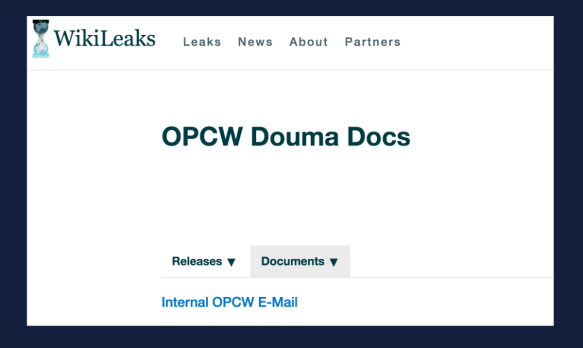
The leaked email, which has been published by WikiLeaks and several other outlets, was sent by an unnamed OPCW investigator to the OPCW’s then-cabinet chief Bob Fairweather, outright accusing OPCW leadership of misleading the public with the information it was omitting from the report it was drafting. Those who’ve been following this scandal closely may remember Fairweather as the man who journalist Jonathan Steele recently reported was responsible for calling investigators into his office to be intimidated by unknown officials from the United States government.

The email was sent to Fairweather on June 22nd, laden with pointed words and phrases like “misrepresents the facts”, “selectively omitting”, “highly misleading”, “disingenuous”, “inaccurate”, and “a major deviation from the original report.” Less than two weeks later, on July the fourth, the investigators were reportedly called into Fairweather’s office for a disturbing meeting with US officials which deeply rattled them.

“On July 4 there was another intervention,” Steele’s report reads. “Fairweather, the chef de cabinet, invited several members of the drafting team to his office. There they found three US officials who were cursorily introduced without making clear which US agencies they represented. The Americans told them emphatically that the Syrian regime had conducted a gas attack, and that the two cylinders found on the roof and upper floor of the building contained 170 kilograms of chlorine. The inspectors left Fairweather’s office, feeling that the invitation to the Americans to address them was unacceptable pressure and a violation of the OPCW’s declared principles of independence and impartiality.”

It’s worth noting at this time that the US government already has a known and established history of leveraging the ostensibly neutral and international OPCW to conform to its preexisting military agendas.

Fairweather’s intimidation ploy appears to have been a response to comments made in the email, and probably other similar internal objections made by other investigators at that time. The email reads as follows (transcript and parenthetical annotations made by Daily Mail):

Dear Bob,

I wish to express, as a member of the FFM (Fact Finding Mission) team that conducted the investigation into the alleged chemical attack in Douma on 7 April, my gravest concern at the redacted version of the FFM report, which I understand was at the behest of the ODG. (Office of the Director General). After reading this modified report, which incidentally no other team member who deployed into Douma has had the opportunity to do, I was struck by how much it misrepresents the facts. Many of the facts and observations outlined in the full version are inextricably interconnected and, by selectively omitting certain ones, an unintended bias has been introduced into the report, undermining its credibility. In other cases, some crucial facts that have remained in the redacted version have morphed into something quite different to what was initially drafted. If I may, I will outline some specific aspects to the redacted report that are particularly worrisome.

The statement in paragraph 8.3 of the final conclusions ‘The team has sufficient evidence at this time to determine that chlorine, or another reactive chlorine-containing chemical, was likely released from cylinders’, is highly misleading and not supported by the facts. The only evidence available at this moment is that some samples collected at Locations 2 and 4 were in contact with one or more chemicals that contain a reactive chlorine atom. Such chemicals could include molecular chlorine, phosgene, cyanogen chloride, hydrochloric acid, hydrogen chloride or sodium hypochlorite (the major ingredient of household chlorine-based bleach). Purposely singling out chlorine gas as one of the possibilities is disingenuous. It is also worth noting that the term ‘reactive chlorine-containing chemical’ used in the redacted report is, in fact, inaccurate. It actually describes a reactive chemical that contains chlorine which itself (the chlorine) is not necessarily reactive e.g. chlorophenol. The original report uses the more accurate term ‘a chemical containing reactive chlorine’.

The redacted report states that the gas was likely released from the cylinders (in Locations 2 and 4). The original report purposely emphasised the fact that, although the cylinders might have been the source of the suspected chemical release, there was insufficient evidence to affirm this. It is possible the error was simply a typo. This is a major deviation from the original report.

Paragraph 8.2 states that ‘based on the high levels of various chlorinated organic derivatives, […] detected in environmental samples’. Describing the levels as ‘high’ likely overstates the extent of levels of chlorinated organic derivatives detected. They were, in most cases, present only in parts per billion range, as low as 1-2 ppb, which is essentially trace quantities.

The original report discusses in detail the inconsistency between the victims’ symptoms, as reported by witnesses and seen in video recordings. Omitting this section of the report (including the Epidemiology which has been removed in its entirety) has a serious negative impact on the report as this section is inextricably linked to the chemical agent identified. It either supports or detracts from the confidence in the identity of any possible chemical. In this case the confidence in the identity of chlorine or any choking agent is drawn into question precisely because of the inconsistency with the reported and observed symptoms. The inconsistency was not only noted by the FFM team but strongly noted by three toxicologists with expertise in exposure to CW (Chemical Weapons) agents.

The original report has extensive sections regarding the placement of the cylinders at both locations as well as the relative damage caused to the impact points, compared to that caused to the cylinders suspected of being the sources of the toxic chemical. These sections are essentially absent from the redacted report. This information was important in assessing the likelihood of the ‘presence’ of toxic chemicals versus the ‘use’ of toxic chemicals.

A feature of this investigation and report was the robust and extensive scientific basis for sampling plans and analysing the data collected. A comprehensive bibliography of peer-reviewed scientific literature was attached to support and enhance the credibility of the work of the mission. This has unfortunately been omitted from the redacted report.

By singling out chlorine above other equally plausible substances containing reactive chlorine and presenting it as a fact in isolation creates, I believe, a level of partiality that would negatively impact on the perceived credibility of the report, and by extension that of the Organisation. I am requesting that the fact-finding report be released in its entirety as I fear that this redacted version no longer reflects the work of the team. The original report contains facts and observations that are all equally valid. The fact that inconsistencies are highlighted or observations not fully understood does not justify their omission. The inconsistencies and observations are based on the evidence and data collected. Further information in the future may help resolve them but the facts as they stand at present will not alter and need to be reported.

If the redacted version is to be released, I respectfully request to attach my differing observations, in accordance with the spirit of paragraph 62 of part II of the Verification Annex of the CWC.

Yours sincerely

The OPCW’s final report published March of this year continued the pattern of crucial omissions even more egregiously than the interim report.

“Regarding the alleged use of toxic chemicals as a weapon in Douma, the evaluation and analysis of all the above-referenced information gathered by the FFM provide reasonable grounds that the use of a toxic chemical as a weapon has taken place on 7 April 2018,” the final report claims. “This toxic chemical contained reactive chlorine. The toxic chemical was likely molecular chlorine.”

Again, the information complained about in the leaked email remained omitted.

The unfolding scandal about the US and its allies once again deceiving the world about yet another military intervention in yet another Middle Eastern nation is a major story, and hardly anyone’s been on top of it.

Back when I published an article about the first OPCW whistleblower this past May it was shared by actress Susan Sarandon on Twitter, who captioned it with the question, “This is really important. Why aren’t we talking about it?” Click on the tweet and read through the comments if you want to see the platoon of blue-checkmarked narrative managers who converged on her post telling her I’m a crazed conspiracy theorist who mustn’t be listened to. I got this story right, and everyone who’s been ignoring it or dismissing it has made an ass of themselves.

So congratulations to me. Congratulations to Moon of Alabama for getting this story right from day one. Congratulations to Piers Robinson, Tim Hayward, and the Working Group on Syria, Propaganda and Media who published the first OPCW leak back in May of this year in the face of numerous obnoxious smear pieces from the mainstream media. Congratulations to Jimmy Dore, Aaron Maté and the handful of other alternative media figures who’ve been keeping this story alive while all the “reputable” mainstream news outlets tried to let it die.

We were right, they were wrong. Maybe going forward people should listen to us a bit more and listen to them a bit less.

Bolivia’s New Puppet Regime Wastes No Time Aligning With US Foreign Policy

By Caitlin Johnstone

Source: CaitlinJohnstone.com

The Washington-recognized interim government which just ascended to power via US-backed military coup in Bolivia is already shifting the nation’s foreign policy into alignment with the US-centralized empire, severing important ties with two governments which have resisted absorption into the imperial blob.

“Bolivia’s caretaker government isn’t wasting any time overhauling its foreign policy, announcing Friday that it will expel hundreds of Cuban officials and break ties with longtime ally Venezuela,” The Miami Herald reports. “In a series of statements, Bolivia’s new foreign minister, Karen Longaric, told local media that about 725 Cubans — including doctors and medical staff — would begin leaving Bolivia on Friday.”

“In that same interview she also said she’d be recalling Bolivia’s diplomatic staff from Venezuela,” Miami Herald adds. “Later, asked if she would maintain ties with Venezuelan leader Nicolás Maduro, she said, ‘Of course we’ll break diplomatic relations with the Maduro government.’”

Of course they will.

This news comes as no surprise to anyone who’s been paying attention. US foreign policy is essentially an endless war on disobedience, in which governments that refuse to bow to US interests are toppled by any means necessary and replaced by governments who will.

International affairs are much easier to understand once you stop thinking in terms of separate, sovereign nations and start thinking in terms of alliances and empire. What we are witnessing can best be described as a slow-motion third world war between what amounts to an unofficial globe-spanning empire centralized around the United States and its military on one side, and all the nations which have refused to be absorbed into this empire on the other. Nations which allow themselves to be absorbed are rewarded with the carrot of military and economic alliance with the empire, and nations which refuse are punished with the stick of invasions, sanctions, trade wars, and coups, with the ultimate goal being total unipolar global domination. The bigger the imperial blob grows, the stronger and more effective it becomes in undermining the interests of unabsorbed nations like Venezuela and Cuba.

Nothing takes precedence over this agenda of unipolar hegemony. As long as a nation remains loyal to the empire, it can fund terrorists, butcher Washington Post columnists, and create the worst humanitarian crisis in the world without fear of any retribution of any kind from the US-centralized empire. As a leaked State Department memo explained in 2017, so far as the empire is concerned human rights violations are nothing more than a strategic narrative control weapon with which to attack unabsorbed nations, and to be ignored when they are perpetrated by absorbed nations.

It should therefore also surprise no one that this same Washington-recognized government installed via US-backed military coup is now murdering demonstrators who object to it.

As of this writing there have been five protesters confirmed to have been killed by gunfire in Cochabamba, where security forces are cracking down on demonstrations with extreme aggression against majority-Indigenous demonstrations in support of the ousted president Evo Morales.

The narrative managers at The New York Times are reporting on the events in Cochabamba with the obnoxious insinuation that it may actually be Morales and Bolivia’s Indigenous population who are to blame for current tensions. Here are a couple of excerpts from NYT’s latest contribution to the narrative matrix titled “Ethnic Rifts in Bolivia Burst Into View With Fall of Evo Morales” (emphases mine):

Mr. Morales’s nearly 14 years in power represented a breakthrough for the three-quarters of Bolivians who are either of Indigenous descent or identify as members of Indigenous groups. But he also reinforced his base of support with explicit appeals to racial identity that many Bolivians found threatening and polarizing.

“Racism exists in Bolivia; it existed before Evo, and it will never disappear,” said Michelle Kieffer, an insurance broker, as she sipped a cappuccino in an upper-middle-class neighborhood of the country’s administrative capital, La Paz.

“While Evo started an important discussion,” she added, “he also manipulated the race issue, and that has caused disunity. And now people of different races look at each other with suspicion.”

Right. Gotcha. Maybe it’s the impoverished brown-skinned people who are in fact the real fascists, and not the literal Christian fascist coupmongers whose US-backed government takeover they are protesting. Thanks, NYT.

Morales won re-election by over ten percentage points last month, and his previously-elected term wasn’t scheduled to end until January. He was commanded to resign during a current term by the military despite fully acquiescing to demands for a new internationally supervised election. Now it’s being reported that the popular leftist party to which he belonged, MAS, may be banned by the Jeanine Añez-led interim government from participating in the next elections.

Despite all this the western mass media are continuing their cartoonishly ridiculous pattern of resisting the use of the word ‘coup’ when reporting on Bolivia, except to admonish people for using that word as in the case of recent narrative management pieces by The Washington Post, The Washington Examiner, and The Economist.

“Supporters of the coup in Bolivia can’t call it a coup,” US politician Lee Carter recently noted. “The US has a law preventing us from sending foreign aid to a new government if it was installed by a coup. So they come up with absurd claims that the military forcing Evo out somehow isn’t a coup.”

And the western mass media are falling right in line with the government forces in refusing to use this word, despite the ousting of a government by the military being exactly the thing that a coup is. This is because in a plutocracy, plutocrat-owned media is functionally the same as state media. Reporters for plutocratic media know what they are and are not permitted to say without being told, so they advance narratives which favor the status quo upon which their plutocrat employers have built their respective kingdoms. This is the status quo of the US-centralized empire, which just absorbed Bolivia and pivoted its foreign policy against the unabsorbed governments of Venezuela and Cuba.

Bolivia coup led by Christian fascist paramilitary leader and millionaire – with foreign support

Bolivian coup leader Luis Fernando Camacho is a far-right multi-millionaire who arose from fascist movements in the Santa Cruz region, where the US has encouraged separatism. He has courted support from Colombia, Brazil, and the Venezuelan opposition.

By Max Blumenthal and Ben Norton

Source: The Grayzone

When Luis Fernando Camacho stormed into Bolivia’s abandoned presidential palace in the hours after President Evo Morales’s sudden November 10 resignation, he revealed to the world a side of the country that stood at stark odds with the plurinational spirit its deposed socialist and Indigenous leader had put forward.

With a Bible in one hand and a national flag in the other, Camacho bowed his head in prayer above the presidential seal, fulfilling his vow to purge his country’s Native heritage from government and “return God to the burned palace.”

“Pachamama will never return to the palace,” he said, referring to the Andean Mother Earth spirit. “Bolivia belongs to Christ.”

Bolivia’s extreme right-wing opposition had overthrown leftist President Evo Morales that day, following demands by the country’s military leadership that he step down.

Virtually unknown outside his country, where he had never won a democratic election, Camacho stepped into the void. He is a powerful multi-millionaire named in the Panama Papers, and an ultra-conservative Christian fundamentalist groomed by a fascist paramilitary notorious for its racist violence, with a base in Bolivia’s wealthy separatist region of Santa Cruz.

Camacho hails from a family of corporate elites who have long profited from Bolivia’s plentiful natural gas reserves. And his family lost part of its wealth when Morales nationalized the country’s resources, in order to fund his vast social programs — which cut poverty by 42 percent and extreme poverty by 60 percent.

In the lead-up to the coup, Camacho met with leaders from right-wing governments in the region to discuss their plans to destabilize Morales. Two months before the putsch, he tweeted gratitude: “Thank you Colombia! Thank you Venezuela!” he exclaimed, tipping his hat to Juan Guaido’s coup operation. He also recognized the far-right government of Jair Bolsonaro, declaring, “Thank you Brazil!”

Camacho had spent years leading an overtly fascist separatist organization called the Unión Juvenil Cruceñista. The Grayzone edited the following clips from a promotional historical documentary that the group posted on its own social media accounts:

While Camacho and his far-right forces served as the muscle behind the coup, their political allies waited to reap the benefits.

The presidential candidate Bolivia’s opposition had fielded in the October election, Carlos Mesa, is a “pro-business” privatizer with extensive ties to Washington. US government cables published by WikiLeaks reveal that he regularly corresponded with American officials in their efforts to destabilize Morales.

Mesa is currently listed as an expert at the Inter-American Dialogue, a DC-based think tank funded by the US government’s soft-power arm USAID, various oil giants, and a host of multi-national corporations active in Latin America.

Evo Morales, a former farmer who rose to prominence in social movements before becoming the leader of the powerful grassroots political party Movement Toward Socialism (MAS), was Bolivia’s first Indigenous leader. Wildly popular in the country’s substantial Native and peasant communities, he won numerous elections and democratic referenda over a 13-year period, often in landslides.

On October 20, Morales won re-election by more than 600,000 votes, giving him just above the 10 percent margin needed to defeat opposition presidential candidate Mesa in the first round.

Experts who did a statistical analysis of Bolivia’s publicly available voting data found no evidence of irregularities or fraud. But the opposition claimed otherwise, and took to the streets in weeks of protests and riots.

The events that precipitated the resignation of Morales were indisputably violent. Right-wing opposition gangs attacked numerous elected politicians from the ruling leftist MAS party. They then ransacked the home of President Morales, while burning down the houses of several other top officials. The family members of some politicians were kidnapped and held hostage until they resigned. A female socialist mayor was publicly tortured by a mob.

Following the forced departure of Morales, coup leaders arrested the president and vice president of the government’s electoral body, and forced the organization’s other officials to resign. Camacho’s followers proceeded to burn Wiphala flags that symbolized the country’s Indigenous population and the plurinational vision of Morales.

The Organization of American States, a pro-US organization founded by Washington during the Cold War as an alliance of right-wing anti-communist countries in Latin America, helped rubber stamp the Bolivian coup. It called for new elections, claiming there were numerous irregularities in the October 20 vote, without citing any evidence. Then the OAS remained silent as Morales was overthrown by his military and his party’s officials were attacked and violently forced to resign.

The day after, the Donald Trump White House enthusiastically praised the coup, trumpeting it as a “significant moment for democracy,” and a “strong signal to the illegitimate regimes in Venezuela and Nicaragua.”

Emerging from the shadows to lead a violent far-right putsch

While Carlos Mesa timidly condemned the opposition’s violence, Camacho egged it on, ignoring calls for an international audit of the election and emphasizing his maximalist demand to purge all supporters of Morales from government. He was the true face of the opposition, concealed for months behind the moderate figure of Mesa.

A 40-year-old multi-millionaire businessman from the separatist stronghold of Santa Cruz, Camacho has never run for office. Like Venezuelan coup leader Juan Guaidó, whom more than 80 percent of Venezuelans had never heard of until the US government anointed him as supposed “president,” Camacho was an obscure figure until the coup attempt in Bolivia hit its stride.

He first created his Twitter account on May 27, 2019. For months, his tweets went ignored, generating no more than three or four retweets and likes. Before the election, Camacho did not have a Wikipedia article, and there were few media profiles on him in Spanish- or English-language media.

Camacho issued a call for a strike on July 9, posting videos on Twitter that got just over 20 views. The goal of the strike was to try to force the resignation of Bolivian government’s electoral organ the Supreme Electoral Tribunal (TSE). In other words, Camacho was pressuring the government’s electoral authorities to step down more than three months before the presidential election.

It was not until after the election that Camacho was thrust into the limelight and transformed into a celebrity by corporate media conglomerates like the local right-wing network Unitel, Telemundo, and CNN en Español.

All of a sudden, Camacho’s tweets calling for Morales to resign were lighting up with thousands of retweets. The coup machinery had been activated.

Mainstream outlets like the New York Times and Reuters followed by anointing the unelected Camacho as the “leader” of Bolivia’s opposition. But even as he lapped up international attention, key portions of the far-right activist’s background were omitted.

Left unmentioned were Camacho’s deep and well-established connections to Christian extremist paramilitaries notorious for racist violence and local business cartels, as well as the right-wing governments across the region.

It was in the fascist paramilitaries and separatist atmosphere of Santa Cruz where Camacho’s politics were formed, and where the ideological contours of the coup had been defined.

Cadre of a Francoist-style fascist paramilitary

Luis Fernando Camacho was groomed by the Unión Juvenil Cruceñista, or Santa Cruz Youth Union (UJC), a fascist paramilitary organization that has been linked to assassination plots against Morales. The group is notorious for assaulting leftists, Indigenous peasants, and journalists, all while espousing a deeply racist, homophobic ideology.

Since Morales entered office in 2006, the UJC has campaigned to separate from a country its members believed had been overtaken by a Satanic Indigenous mass.

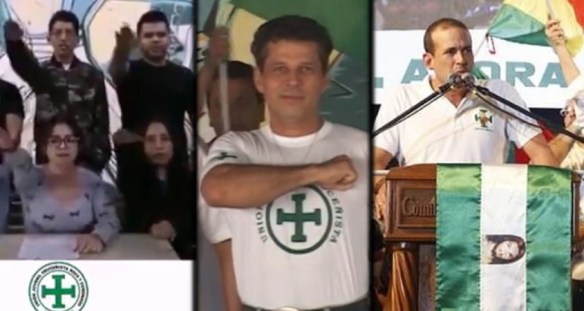
The UJC is the Bolivian equivalent of Spain’s Falange, India’s Hindu supremacist RSS, and Ukraine’s neo-Nazi Azov battalion. Its symbol is a green cross that bears strong similarities to logos of fascist movements across the West.

And its members are known to launch into Nazi-style sieg heil salutes.

https://twitter.com/GrayzoneProject/status/1194137427474038784

Even the US embassy in Bolivia has described UJC members as “racist” and “militant,” noting that they “have frequently attacked pro-MAS/government people and installations.”

After journalist Benjamin Dangl visited with UJC members in 2007, he described them as the “brass knuckles” of the Santa Cruz separatist movement. “The Unión Juvenil has been known to beat and whip campesinos marching for gas nationalization, throw rocks at students organizing against autonomy, toss molotov cocktails at the state television station, and brutally assault members of the landless movement struggling against land monopolies,” Dangl wrote.

“When we have to defend our culture by force, we will,” a UJC leader told Dangl. “The defense of liberty is more important than life.”

Camacho was elected as vice president of the UJC in 2002, when he was just 23 years old. He left the organization two years later to build his family’s business empire and rise through the ranks of the Pro-Santa Cruz Committee. It was in that organization that he was taken under the wing of one of the separatist movement’s most powerful figures, a Bolivian-Croatian oligarch named Branko Marinkovic.

In August, Camacho tweeted a photo with his “great friend,” Marinkovic. This friendship was crucial to establishing the rightist activist’s credentials and forging the basis of the coup that would take form three months later.

Camacho’s Croatian godfather and separatist powerbroker

Branko Marinkovic is a major landowner who ramped up his support for the right-wing opposition after some of his land was nationalized by the Evo Morales government. As chairman of the Pro-Santa Cruz Committee, he oversaw the operations of the main engine of separatism in Bolivia.

In a 2008 letter to Marinkovic, the International Federation for Human Rights denounced the committee as an “actor and promoter of racism and violence in Bolivia.”

The human rights group added that it “condemn[ed] the attitude and secessionist, unionist and racist discourses as well as the calls for military disobedience of which the Pro-Santa Cruz Civic Committee for is one of the main promoters.”

In 2013, journalist Matt Kennard reported that the US government was working closely with the Pro-Santa Cruz Committee to encourage the balkanization of Bolivia and to undermine Morales. “What they [the US] put across was how they could strengthen channels of communication,” the vice president of the committee told Kennard. “The embassy said that they would help us in our communication work and they have a series of publications where they were putting forward their ideas.”

In a 2008 profile on Marinkovic, the New York Times acknowledged the extremist undercurrents of the Santa Cruz separatist movement the oligarch presided over. It described the area as “a bastion of openly xenophobic groups like the Bolivian Socialist Falange, whose hand-in-air salute draws inspiration from the fascist Falange of the former Spanish dictator Franco.”

The Bolivian Socialist Falange was a fascist group that provided safe haven to Nazi war criminal Klaus Barbie during the Cold War. A former Gestapo torture expert, Barbie was repurposed by the CIA through its Operation Condor program to help exterminate communism across the continent. (Despite its antiquated name, like the German National Socialists, this far-right extremist group was violently anti-leftist, committed to killing socialists.)

The Bolivian Falange came into power in 1971 when its leader, Gen. Hugo Banzer Suarez, ousted the leftist government of Gen. Juan Jose Torres Gonzales. The government of Gonzales had infuriated business leaders by nationalizing industries and antagonized Washington by ousting the Peace Corps, which it viewed as an instrument of CIA penetration. The Nixon administration immediately welcomed Banzer with open arms and courted him as a key bulwark against the spread of socialism in the region. (An especially ironic 1973 dispatch appears on Wikileaks showing Secretary of State Henry Kissinger thanking Banzer for congratulating him on his Nobel Peace Prize).

The movement’s putschist legacy persevered during the Morales era through organizations like the UJC and figures such as Marinkovic and Camacho.

The Times noted that Marinkovic also supported the activities of the UJC, describing the fascist group as “a quasi-independent arm of the committee led by Mr. Marinkovic.” A member of the UJC board told the US newspaper of record in an interview, “We will protect Branko with our own lives.”

Marinkovic has espoused the kind of Christian nationalist rhetoric familiar to the far-right organizations of Santa Cruz, calling, for instance, for a “crusade for the truth” and insisting that God is on his side.

The oligarch’s family hails from Croatia, where he has dual citizenship. Marinkovic has long been dogged by rumors that his family members were involved in the country’s powerful fascist Ustashe movement.

The Ustashe collaborated openly with Nazi German occupiers during World War Two. Their successors returned to power after Croatia declared independence from the former Yugoslavia – a former socialist country that was intentionally balkanized in a NATO war, much in the same way that Marinkovic hoped Bolivia would be.

Marinkovic denies that his family was part of the Ustashe. He claimed in an interview with the New York Times that his father fought against the Nazis.

But even some of his sympathizers are skeptical. A Balkan analyst from the private intelligence firm Stratfor, which works closely with the US government and is popularly known as the “shadow CIA,” produced a rough background profile on Marinkovic, speculating, “Still don’t know his full story, but I would bet a lot of $$$ that this dude’s parents are 1st gen (his name is too Slavic) and that they were Ustashe (read: Nazi) sympathizers fleeing Tito’s Communists after WWI.”

The Stratfor analyst excerpted a 2006 article by journalist Christian Parenti, who had visited Marinkovic at his ranch in Santa Cruz. Evo Morales’ “land reform could lead to civil war,” Marinkovic warned Parenti in the Texas-accented English he picked up while studying at the University of Texas.

Today, Marinkovic is an ardent supporter of Brazil’s far-right leader Jair Bolsonaro, whose only complaint about Chilean dictator Augusto Pinochet was that he “didn’t kill enough.”

Marinkovic is also a public admirer of Venezuela’s far-right opposition. “Todos somos Leopoldo” — “we are all Leopoldo,” he tweeted in support of Leopoldo López, who has been involved in numerous coup attempts against Venezuela’s elected leftist government.

While Marinkovic denied any role in armed militant activity in his interview with Parenti, he was accused in 2008 of playing a central role in an attempt to assassinate Morales and his Movement Toward Socialism party allies.

He told the New York Times less than two years before the plot developed, “If there is no legitimate international mediation in our crisis, there is going to be confrontation. And unfortunately, it is going to be bloody and painful for all Bolivians.”

An assassination plot links Bolivia’s right to international fascists

In April 2009, a special unit of the Bolivian security services barged into a luxury hotel room and cut down three men who were said to be involved in a plot to kill Evo Morales. Two others remained on the loose. Four of the alleged conspirators had Hungarian or Croatian roots and ties to rightist politics in eastern Europe, while another was a right-wing Irishman, Michael Dwyer, who had only arrived in Santa Cruz six months before.

The ringleader of the group was said to be a former leftist journalist named Eduardo Rosza-Flores who had turned to fascism and belonged to Opus Dei, the traditionalist Catholic cult that emerged under the dictatorship of Spain’s Francisco Franco. In fact, the codename Rosza-Flores assumed in the assassination plot was “Franco,” after the late Generalissimo.

During the 1990s, Rosza fought on behalf of the Croatian First International Platoon, or the PIV, in the war to separate from Yugoslavia. A Croatian journalist told Time that the “PIV was a notorious group: 95% of them had criminal histories, many were part of Nazi and fascist groups, from Germany to Ireland.”

By 2009, Rosza returned home to Bolivia to crusade on behalf of another separatist movement in Santa Cruz. And it was there that he was killed in a luxury hotel with no apparent source of income and a massive stockpile of guns.

The government later released photos of Rosza and a co-conspirator posing with their weapons. Publication of emails between the ringleader and Istvan Belovai, a former Hungarian military intelligence officer who served as a double agent for the CIA, cemented the perception that Washington had a hand in the operation.

Marinkovic was subsequently charged with providing $200,000 to the plotters. The Bolivian-Croatian oligarch initially fled to the United States, where he was given asylum, then relocated to Brazil, where he lives today. He denied any involvement in the plan to kill Morales.

As journalist Matt Kennard reported, there was another thread that tied the plot to the US: the alleged participation of an NGO leader named Hugo Achá Melgar.

“Rozsa didn’t come here by himself, they brought him,” the Bolivian government’s lead investigator told Kennard. “Hugo Achá Melgar brought him.”

The Human Rights Foundation destabilizes Bolivia

Achá was not just the head of any run-of-the-mill NGO. He had founded the Bolivian subsidiary of the Human Rights Foundation (HRF), an international right-wing outfit that is known for hosting a “school for revolution” for activists seeking regime change in states targeted by the US government.

HRF is run by Thor Halvorssen Jr., the son of the late Venezuelan oligarch and CIA asset Thor Halvorssen Hellum. The first cousin of the veteran Venezuelan coup plotter Leopoldo Lopez, Halvorssen was a former college Republican activist who crusaded against political correctness and other familiar right-wing hobgoblins.

After a brief career as a firebrand right-wing film producer, in which he oversaw a scandalous “anti-environmentalist” documentary financed by a mining corporation, Halvorssen rebranded as a promoter of liberalism and the enemy of global authoritarianism. He launched the HRF with grants from right-wing billionaires like Peter Thiel, conservative foundations, and NGOs including Amnesty International. The group has since been at the forefront of training activists for insurrectionary activity from Hong Kong to the Middle East to Latin America.

Though Achá was granted asylum in the US, the HRF has continued pushing regime change in Bolivia. As Wyatt Reed reported for The Grayzone, HRF “freedom fellow” Jhanisse Vaca Daza helped trigger the initial stage of the coup by blaming Morales for the Amazon fires that consumed parts of Bolivia in August, mobilizing international protests against him.

At the time, Daza posed as an “environmental activist” and student of non-violence who articulated her concerns in moderate-seeming calls for more international aid to Bolivia. Through her NGO, Rios de Pie, she helped launch the #SOSBolivia hashtag, which signaled the imminent foreign-backed regime-change operation.

Courting the regional right, prepping the coup

While HRF’s Daza rallied protests outside Bolivian embassies in Europe and the US, Fernando Camacho remained behind the scenes, lobbying right-wing governments in the region to bless the coming coup.

In May, Camacho met with Colombia’s far-right President Ivan Duque. Camacho was helping to spearhead regional efforts at undermining the legitimacy of Evo Morales’ presidency at the Inter-American Court of Human Rights, seeking to block his candidacy in the October election.

That same month, the rightist Bolivian agitator also met with Ernesto Araújo, the chancellor of Jair Bolsonaro’s ultra-conservative administration in Brazil. Through the meeting, Camacho successfully secured Bolsonaro’s backing for regime change in Bolivia.

This November 10, Araújo enthusiastically endorsed the ouster of Morales, declaring that “Brazil will support the democratic and constitutional transition” in the country.

Then in August, two months before Bolivia’s presidential election, Camacho held court with officials from Venezuela’s US-appointed coup regime. These included Gustavo Tarre, Guaido’s faux Venezuelan OAS ambassador, who formerly worked at the right-wing Center for Strategic and International Studies (CSIS) think tank in Washington.

After the meeting, Camacho tweeted gratitude to the Venezuelan coup-mongers, as well as to Colombia and Brazil.

Mesa and Camacho: a marriage of capitalist convenience

Back in Bolivia, Carlos Mesa occupied the spotlight as the opposition’s presidential candidate.

His erudite image and centrist policy proposals put him in a seemingly alternate political universe from fire-breathing rightists like Camacho and Marinkovic. For them, he was a convenient front man and acceptable candidate who promised to defend their economic interests.

“It might be that he is not my favorite, but I’m going to vote for him, because I don’t want Evo,” Marinkovic told a right-wing Argentine newspaper five days before the election.

Indeed, it was Camacho’s practical financial interests that appeared to have necessitated his support for Mesa.

The Camacho family has formed a natural gas cartel in Santa Cruz. As the Bolivian outlet Primera Linea reported, Luis Fernando Camacho’s father, Jose Luis, was the owner of a company called Sergas that distributed gas in the city; his uncle, Enrique, controlled Socre, the company that ran the local gas production facilities; and his cousin, Cristian, controls another local gas distributor called Controgas.

According to Primera Linea, the Camacho family was using the Pro-Santa Cruz Committee as a political weapon to install Carlos Mesa into power and ensure the restoration of their business empire.

Mesa has a well-documented history of advancing the goals of transnational companies at the expense of his own country’s population. The neoliberal politician and media personality served as vice president when the US-backed President Gonzalo “Goni” Sanchez de Lozada provoked mass protests with his 2003 plan to allow a consortium of multinational corporations to export the country’s natural gas to the US through a Chilean port.

Bolivia’s US-trained security forces met the ferocious protests with brutal repression. After presiding over the killing of 70 unarmed protesters, Sanchez de Lozada fled to Miami and was succeeded by Mesa.

By 2005, Mesa was also ousted by huge demonstrations spurred by his protection of privatized natural gas companies. With his demise, the election of Morales and the rise of the socialist and rural Indigenous movements behind him were just beyond the horizon.

US government cables released by WikiLeaks show that, after his ouster, Mesa continued regular correspondence with American officials. A 2008 memo from the US embassy in Bolivia revealed that Washington was conspiring with opposition politicians in the lead-up to the 2009 presidential election, hoping to undermine and ultimately unseat Morales.

The memo noted that Mesa had met with the chargé d’affaires of the US embassy, and had privately told them he planned to run for president. The cable recalled: “Mesa told us his party will be ideologically similar to a social democratic party and that he hoped to strengthen ties with the Democratic party. ‘We have nothing against the Republican party, and have in fact gotten support from IRI (International Republican Institute) in the past, but we think we share more ideology with the Democrats,’ he added.”

wikileaks bolivia carlos mesa

Today, Mesa serves as an in-house “expert” at the Inter-American Dialogue, a neoliberal Washington-based think tank focused on Latin America. One of the Dialogue’s top donors is the US Agency for International Development (USAID), the State Department subsidiary that was exposed in classified diplomatic cables published on Wikileaks for strategically directing millions of dollars to opposition groups including those “opposed to Evo Morales’ vision for indigenous communities.”

Other top funders of the Dialogue include oil titans like Chevron and ExxonMobil; Bechtel, which inspired the initial protests against the administration in which Mesa served; the Inter-American Development Bank, which has forcefully opposed Morales’ socialist-oriented policies; and the Organization of American States (OAS), which helped delegitimize the Morales’s re-election victory with dubious claims of irregular vote counts.

Finishing the job

When Carlos Mesa touched off nationwide protests in October by accusing the Evo Morales government of committing electoral fraud, the right-wing firebrand hailed by his followers as “Macho Camacho” emerged from the shadows. Behind him was the hardcore separatist shock force that he led in Santa Cruz.

Mesa faded into the distance as Camacho emerged as the authentic face of the coup, rallying his forces with the uncompromising rhetoric and fascist symbology that defined the Unión Juvenil Cruceñista paramilitary.

As he declared victory over Morales, Camacho exhorted his followers to “finish the job, let’s get the elections going, let’s start judging the government criminals, let’s put them in jail.”

Back in Washington, meanwhile, the Trump administration released an official statement celebrating Bolivia’s coup, declaring that “Morales’s departure preserves democracy.”

MSM Adamantly Avoids The Word “Coup” In Bolivia Reporting

By Caitlin Johnstone

Source: CaitlinJohnstone.com

There has been a military coup in Bolivia backed by violent right-wing rioters and the US government, but you’d hardly know this from any of the mainstream media headlines.

“Bolivian President Evo Morales steps down following accusations of election fraud” proclaims CNN.

“Bolivia’s Morales resigns amid scathing election report, rising protests” reports The Washington Post.

“Bolivian Leader Evo Morales Steps Down” says The New York Times.

“Bolivian President Evo Morales resigns amid fraud poll protests” declares the BBC.

“President of Bolivia steps down amid allegations of election rigging” we are informed by Telegraph.

“Bolivia’s President Morales resigns after backlash to disputed election” says the Sydney Morning Herald.

So there you have it. The indigenous leader of a socialist South American government which has successfully lifted masses of people out of crushing poverty, which happens to control the world’s largest reserves of lithium (which may one day replace oil as a crucial energy resource due to its use in powering smartphones, laptops, hybrid and electric cars), which has an extensive and well-documented history of being targeted for regime change by the US government, simply stepped down due to some sort of scandal involving a “disputed election”. Nothing to do with the fact that right-wing mobs had been terrorizing this leader’s family, or the fact that the nation’s military literally commanded him to step down and are now currently searching for him to arrest him, leading to ousted government officials being rounded up and held captive by soldiers wearing masks.

All perfectly normal and not suspicious at all.

As is usual, mass media’s reporting on this story is in full alignment with the US State Department, with Secretary of State Mike Pompeo also advancing the “disputed election” line in a tweet shortly before the forced resignation of Morales. Pompeo cited the evidence-free and discredited allegation of suspicious vote tallies during Morales’ re-election last month from the Washington-based Organization of American States (OAS). As Mark Weisbrot of the Center for Economic & Policy Research explains in a recent article for The Nation, the OAS receives 60 percent of its funding from Washington, which gives the US tremendous leverage over the supposedly neutral and international body. This ties in interestingly with what we discussed the other day about Washington’s known history of using its disproportionate financial support for the Organization for the Prohibition of Chemical Weapons as leverage to force that supposedly neutral and international body to comply with US agendas.

The field of narrative management keeps making more and more advances.

The US-centralized empire just keeps throwing coup attempts at unabsorbed governments until they stick. The coup in Venezuela failed in 2002 and again in 2019, but they’ll just keep attempting them until one takes hold. A kickboxer throws strikes in combinations with the understanding that most attacks will miss or do minimal damage against a trained opponent, but eventually one will get through and score the knockout blow. Imperialist regime change agendas employ the same punches-in-bunches philosophy: just keep attacking and undermining at every possible turn, and eventually something will stick.

And the empire can afford to do this. When you have all the power and resources, you can bide your time, knowing that if the current attempt at toppling the government in a sovereign nation fails, there’s always tomorrow.

At a United Nations Security Council meeting last year, President Morales summed up the true nature of America’s role in the world very accurately, and, it turns out, very presciently.

“I would like to say to you, frankly and openly here, that in no way is the United States interested in upholding democracy,” Morales said. “If such were the case it would not have financed coups d’etat and supported dictators. It would not have threatened with military intervention democratically elected governments as it has done with Venezuela. The United States could not care less about human rights or justice. If this were the case, it would have signed the international conventions and treaties that have protected human rights. It would not have threatened the investigation mechanism of the International Criminal Court, nor would it promote the use of torture, nor would it have walked away from the Human Rights Council. And nor would it have separated migrant children from their families, nor put them in cages.”

“The United States is not interested in multilateralism,” Morales continued. “If it were interested in multilateralism it would not have withdrawn from the Paris Agreement or given the cold shoulder to the global compact on migration, it would not have launched unilateral attacks, nor have taken decisions such as illegally declaring Jerusalem to be the capital of Israel. This contempt for multilateralism is motivated by the thirst of the United States for political control and for the seizing of natural resources.”

“Each time that the United States invades nations, launches missiles, or finances regime change, it does so behind a propaganda campaign which incessantly repeats the message that it is acting in the course of justice, freedom and democracy, in the cause of human rights or for humanitarian reasons,” Morales also said.

“The responsibility of our generation is to hand over a fairer and more secure world to the following generation,” Morales concluded. “We will only achieve this dream if we work together to consolidate a multipolar world, a world with common rules that are respected by and defended from all the threats ranged against the United Nations.”

Indeed, the only reason the US is able to wage its endless campaign of regime change agendas against unabsorbed governments is because the unipolar world order it rules has allowed it the power, resources and leisure to do so. A multipolar world would enable the citizenry of this planet to have a say in what happens to them in a way that is not dictated by a few sociopaths in and around Washington, DC. A multipolar world is to democracy as a unipolar world is to monarchy. The citizens of the world should oppose this unipolarity.


Resignation of Bolivia’s Evo Morales was no victory for democracy, but a US-sponsored coup

By Eva Bartlett

Source: RT.com

Evo Morales, an indigenous leader who bucked the IMF and condemned US imperialism, has been pressured by the military to resign after winning an election. Yet Washington calls this blatant coup in Bolivia a victory for democracy?

Morales was re-elected as Bolivia’s president on October 20. The coup-backing Organization of American States (OAS) wasn’t pleased and went ahead interfering in a sovereign nation – as the US itself does so well – issuing a report that the vote result wasn’t satisfactory to their desires.The heavy funding from the US surely has no influence on OAS policies…

In any case, on November 10, President Morales first announced a new election. Later that day, he announced his resignation, naming as reason the recent brutality of Bolivia’s right-wing opposition, including “kidnapping and mistreating” families of indigenous leaders and burning down the homes of public officials.

I resign from my position as president so that (Carlos) Mesa and (Luis Fernando) Camacho do not continue to persecute socialist leaders.

Morales was clear that his move was solely due to the violence incited opposition leaders. However, it soon became clear that this was a coup, not a resignation.

Former Brazilian president Dilma Rousseff tweeted her solidarity with the “legitimate president of Bolivia [Evo Morales] who was deposed by a military coup, had his house raided by the police and suffered an illegal arrest warrant. A very serious attack on democracy in Latin America and violence against the Bolivian people.” 

Another Brazilian ex-president, Lula, likewise declared the “stepping down” a coup. And even before the events of November 10, Argentina’s Cristina Kirchner foresaw there would be pressure to force Morales out of office, as did Venezuela’s President Nicolás Maduro.

As most readers know, this is not the first US-backed coup in Latin America. Washington’s history of meddling in sovereign nations stretching back many decades. But let’s look at how Bolivia changed under Morales’ leadership.

Poverty, unemployment and illiteracy all decreased significantly under Morales. In fact, according to a report by the Center for Economic and Policy Research (CEPR), Bolivia’s was the “fastest-growing” economy in South America, having “basically been stagnant for a quarter century prior to Morales becoming president in 2006.”

To do so, however, “the Bolivian government ended 20 years of IMF agreements in 2006,” the same CEPR report notes. Furthermore, expelling US military bases, threatening to close the US embassy in Bolivia, and nationalizing the oil and gas industries haven’t done much to put him in the good graces of ‘democracy-bringers’.

https://twitter.com/camilateleSUR/status/1193718218705264641

After all, with America’s lust to ‘democratize’ the world and steal precious resources in the process, nationalizing a country’s goods really mucks up Washington’s dirty plans. It doesn’t help that Bolivia has $2.3 billion worth of contracts to develop its lithium deposits with China, not the US.

Who benefits from Bolivia losing Morales as president? Not the Bolivian people, that’s for certain. In fact, some predict Bolivia’s future could be very dire under the rule of a US puppet.

https://twitter.com/O_Rich_/status/1193641286433161219

“My sin is being a union leader, indigenous. We are giving up so that my brothers do not continue to be kicked,” Morales said, when submitting his forced resignation.

This statement poignantly demonstrates the racism and utter lack of concern by the US for the people of Bolivia. Concerned citizens around the world are holding rallies in solidarity with Bolivia’s elected President and against yet another US-backed coup of a sovereign nation.

“He is now in hiding with his Indigenous Nation, and the death squads have issued an arrest warrant for him,” analyst Laith Marouf noted. “Know now that if they kill him claiming he resisted arrest, or that he committed suicide; that it was an assassination in the land that saw the assassination of Che Guevara.”

As events unfold in Bolivia, it’s important to keep in mind the possible frightening outcomes. Anything is possible when US imperial interests are at stake.

Surviving on the Battlefield in the Information War

By Tony Cartalucci

Source: New Eastern Outlook

There is undoubtedly an information war raging. There are intentional liars, people who witlessly repeat these lies, poor research, and opinions spun to look as if it is research. To sort the ever increasing amount of information from disinformation, there are a few simple methods people can use.

But above all, people must personally dedicate themselves to following the truth no matter where it brings them, having the courage to accept a reality that may not necessarily mesh with their current perception. The inability to do this will render moot all other means of determining the veracity of any given report or piece of analysis.

Find the Original Source

This is fundamental. When anyone, anywhere makes a claim, whether it is in a historical documentary or book, or regarding current events, one must find the original source. Where did this information come from? Is it a direct quote? If so, can this quote be verified? If the quote is “alleged” or “leaked” or otherwise second-hand information or the sources never revealed, it is impossible to verify and therefore impossible to consider as verified.

Often conversations relayed by second-hand sources serve as the basis of propaganda. It is essentially the process of placing words into the mouths of people who never said anything of the sort. Media that repeatedly uses quotes that are impossible to verify may be engaged in disinformation.

If the quote is confirmed, that alone does not mean that what was said was “true.” It simply means that someone made a statement – the veracity of which must be determined through other means. Finding the source of a claim often helps shatter long-held myths. This is particularly true in regards to historical matters.

Follow the Money

All protests, political movements, and armed struggles require immense amounts of resources to start, perpetuate, and most importantly to succeed.  They also require leadership. If one finds themselves reading reports of events that do not mention funding or the names of specific leaders, either those reporting on the events don’t have these facts and should make note that such information is both missing and essential to find, or misdirection and disinformation is at play.

Omitting these facts has been done intentionally across the Western media to obfuscate Western involvement particularly in “political uprisings” and “armed rebellions” that are made to appear spontaneous and indigenous but are in fact long-planned, foreign-backed conspiracies. The so-called “Arab Spring” is perhaps the most notorious example of this, where the Western media failed intentionally and repeatedly to identify the funding and individuals involved in both street protests and subsequent armed attacks on security agencies across the Middle East and North Africa (MENA) region.

Had the public carefully read through reports, and followed the money, they would have found a combination of US State Department money and the Anglo-American-backed Muslim Brotherhood behind each and every “uprising” across the Middle East, with Al Qaeda forming the subsequent armed groups that overran Libya and are currently leading attempts to overthrow the government of Syria.

Look at What People Do, Not at What They Say…

There are media reports, government press releases, op-eds, analysis, and policy papers of every kind. Many times, these various sources contradict each other. How does one go about determining which is true and which is disinformation? It is quite simple, don’t simply listen to what reporters, analysts, and policymakers say, look at what they and those they have influence over are doing.

The United States claims that it is fighting the so-called “Islamic State” (ISIS) in Syria. However, if we “follow the money” and realize that it is impossible for ISIS to sustain its fighting capacity within Syria or Iraq alone, and requires an immense amount of resources from abroad to continue its operations, we realize those resources are undoubtedly passing through territory the US and its allies in fact control.

That the US is not interdicting these vital supplies, including additional fighters, weapons, and cash, is proof that claims in the media and amid government press releases that the US is “fighting ISIS” are false.

Conversely, in veteran journalist Seymour Hersh’s 2007 New Yorker article, “The Redirection,” he stated explicitly, citing US and Saudi officials, that the West and its regional allies planned to use sectarian extremists affiliated with Al Qaeda to wage a regional proxy war against Syria and Iran. This also so happens to be precisely what is now playing out across the MENA region. Hersh’s analysis can be tracked down through his sources, by following the money – as only state-sponsorship can explain Al Qaeda and ISIS’ fighting capacity in Syria, Iraq, and beyond – and by simply looking at what is now unfolding across the region.

None of what the current corporate media or government press releases say can be verified in a similar manner, and certainly, none of what is said by the West currently, matches what is actually happening on the ground.

Finally, let us consider policy papers released by corporate-funded think tanks like the Brookings Institution. Such policy papers have repeatedly laid out plans for arming extremists, incrementally invading and occupying Syria, and eventually toppling the Syrian government. This too, is precisely what we see happening on the ground, though the Western media and Western representatives claim the cause is not a  premeditated Western conspiracy, but a series of coincidences and unfortunate turns of fate.

Final Thoughts 

The truth is hard to arrive at, not only because people intentionally seek to fool others, but because often, many unintentionally fool themselves. Reality can be unpleasant. Watching a nation be destroyed can be heartbreaking and the desire to insulate oneself from the pain through cognitive dissonance can be overwhelming. However, one of the greatest maxims in human conflict is to truly know yourself and know your enemy. Truth isn’t just a matter of virtue, it is a factor that will make the difference between victory and defeat.

If victory over the forces of greed and hegemony is truly our goal, then we must face the facts no matter how unpleasant. Our failure to do so will cost us everything – and those driven by greed and hegemony know. That is why they have invested so much in clouding reality and obfuscating the truth. We must invest more in seeing through this clouded reality, and discover the truth, no matter how unpleasant.