Researchers Find Massive Anti-Russian ‘Bot Army’

By Peter Cronau

Source: Consortium News

A team of researchers at the University of Adelaide have found that as many as 80 percent of tweets about the 2022 Russia-Ukraine invasion in its early weeks were part of a covert propaganda campaign originating from automated fake “bot” accounts.

An anti-Russia propaganda campaign originating from a “bot army” of phony automated Twitter accounts flooded the internet at the start of the war.

The research shows that of the more than 5 million tweets studied, 90.2 percent (both bot and non-bot) came from accounts that were pro-Ukraine, with fewer than 7 percent of the accounts being classed as pro-Russian.

The university researchers also found these automated tweets had been purposely used to drive up fear amongst people targeted by them, boosting a high level of statistically measurable “angst” in the online discourse.

The research team analysed a massively unprecedented 5,203,746 tweets, sent with key hashtags, in the first two weeks of the Russian invasion of Ukraine from Feb. 24. The researchers looked at predominately English-language accounts. A calculated 1.8 million unique Twitter accounts in the dataset posted at least one English-language tweet.

The results were published in August in a research paper, titled “#IStandWithPutin versus #IStandWithUkraine: The interaction of bots and humans in discussion of the Russia/Ukraine war,” by the University of Adelaide’s School of Mathematical Science.

The size of the sample under study, of over 5-million tweets, dwarfs other recent studies of covert propaganda in social media surrounding the Ukraine war. 

The little-reported Stanford University/Graphika research on Western disinformation, analysed by Declassified Australia in September, examined just under 300,000 tweets from 146 Twitter accounts.

The Meta/Facebook research on Russian disinformation reported widely by mainstream media, including by the Australian Broadcasting Corporation (ABC) a fortnight later, looked at only 1,600 Facebook accounts.

Reports on the new research have appeared in only a few independent media sites, and on Russia’s RT.  The ground-breaking study exposing a massive anti-Russia social media disinformation campaign has been effectively ignored by Western establishment media, showing how stories that don’t fit the desired pro-Western narrative are routinely buried. 

Disinformation Blitz Krieg

The Adelaide University researchers unearthed a massive organised pro-Ukraine influence operation underway from the early stages of the conflict. Overall, the study found automated “bot” accounts to be the source of between 60 to 80 percent of all tweets in the dataset. 

The published data shows that in the first week of the Ukraine-Russia war there was a huge mass of pro-Ukrainian hashtag bot activity. Approximately 3.5 million tweets using the hashtag #IStandWithUkraine were sent by bots in that first week. 

In fact, it was like someone had flicked a switch at the start of the war as pro-Ukraine bot activity suddenly burst into life. In that first day of the war the #IStandWithUkraine hashtag was used in as many as 38,000 tweets each hour, rising to 50,000 tweets an hour by day three of the war. 

By comparison, the data shows that in the first week there was an almost total absence of pro-Russian bot activity using the key hashtags. During that first week of the invasion, pro-Russian bots were sending off tweets using the #IStandWithPutin or #IStandWithRussia hashtags at a rate of only several hundred per hour.

Given the apparent long-range planning for the invasion of Ukraine, cyber experts expressed surprise that Russian cyber and internet responses were so laggard. A researcher at the Centre for Security Studies in Switzerland, said: “The [pro-Russian] cyber operations we have seen do not show long preparation, and instead look rather haphazard.”

After being apparently left flatfooted, the #IStandWithPutin hashtag mainly from automated bots, eventually fired up a week after the start of the war. That hashtag started appearing in higher numbers on  March 2, day 7 of the war. It reached 10,000 tweets per hour just twice over the next two days, still way behind the pro-Ukraine tweeting activity. 

The #IStandWithRussia hashtag use was even smaller, reaching only 4,000 tweets per hour. After just two days of operation, the pro-Russian hashtag activity had dropped away almost completely. The study’s researchers noted the automated bot accounts “likely used by Russian authorities,” were “removed likely by pro-Ukrainian authorities.”

The reaction against these pro-Russian accounts had been swift. On March 5, after the #IStandWithPutin hashtag had trended on Twitter, the company announced it had banned over 100 accounts using the hashtag for violating its “platform manipulation and spam policy” and participating in “coordinated inauthentic behaviour.”

Later that month, the Ukraine Security Service (SBU) reportedly raided five “bot farms”’ operating inside the country. The Russia-linked bot operators were reportedly operating through 100,000 fake social media accounts spreading disinformation that was “intended to inspire panic among Ukrainian masses.”

Ukrainian security forces unearthed a pro-Russian automated “bot army” operating out of an apartment in March 2022. The raid found 100 sets of GSM-gateways, left, and 10,000 sim cards, right, operating 100,000 fake bot accounts. (SBU)

Unfiltered Research

The landmark Adelaide University research differs from these earlier revelations in another most unique and spectacular way. 

While the Stanford-Graphika and Meta research was produced by researchers who have long-term deep ties to the U.S. national security state, the Adelaide University researchers are remarkably independent. The academic team is from the university’s School of Mathematical Science.

Using mathematical calculations, they set out to predict and model people’s psychological traits based on their digital footprint.

Unlike the datasets selected and provided for the Stanford/Graphika and the Meta research, the data the Adelaide University team accessed did not come from accounts that had been detected for breaching guidelines and shut down by Meta or Twitter. 

Joshua Watt is one of the lead researchers on the university team, and is a Master of Philosophy candidate in applied mathematics.

He told Declassified Australia that the dataset of 5 million tweets was accessed directly by the team from Twitter accounts on the internet using an academic license giving access to the Twitter API.

The “Application Programming Interface” is a data communication software tool that allows researchers to directly retrieve and analyse Twitter data.

The fake tweets and automated bot accounts had not been detected and removed by Twitter before being analysed by the researchers, although some were possibly removed in Twitter’s March sweep.

Watt told Declassified Australia that in fact many of the bot accounts behind the 5 million tweets studied are likely to be still up and running.

Declassified Australia contacted Twitter to ask what action they may have taken to remove the fake bot accounts identified in the University of Adelaide research. They had not responded by the time of going to press.

Critical Tool in Info War

This new research paper confirms mounting fears that social media has covertly become what the researchers call “a critical tool in information warfare playing a large role in the Russian invasion of Ukraine.”

The Adelaide University researchers tried their best to be noncommittal in describing the activities of the fake Twitter accounts, although they had found the vast majority – over 90 percent – were anti-Russian messages. They stated: “Both sides in the Ukrainian conflict use the online information environment to influence geopolitical dynamics and sway public opinion.”

They found the two main participating sides in the propaganda war have their own particular goals and style. “Russian social media pushes narratives around their motivation, and Ukrainian social media aims to foster and maintain external support from Western countries, as well as promote their military efforts while undermining the perception of the Russian military.”

While the research findings concentrated on automated Twitter bots, there were also findings on the use of hashtags by non-bot tweeters. They found significant information flows from non-bot pro-Russian accounts, but no significant flows from non-bot pro-Ukraine accounts.

As well as being far more active, the pro-Ukraine side was found to be far more advanced in its use of automated bots. The pro-Ukrainian side used more “astroturf bots” than the pro-Russians. Astroturf bots are hyper-active political bots that continuously follow many other accounts to increase followers of that account.

Social Media Role in Boosting Fear

Crucially, the University of Adelaide researchers also investigated the psychological influence the fake automated bot accounts had on the online conversation during those early weeks of the war. 

These conversations in a target audience may develop over time into support or opposition towards governments and policies – but they may also have more instant effects influencing the target audiences’ immediate decisions.

The study found that it was the tweets from the fake “bot” accounts that most drove an increase in conversations surrounding “angst” amongst people targeted by them. They found these automated bot accounts increased “the use of words in the angst category which contains words related to fear and worry, such as ‘shame,’ ‘terrorist,’ ‘threat, ‘panic.’”

By combining the “angst” messaging with messages about “motion” and geographical locations, the researchers found “the bot accounts are influencing more discussion surrounding moving/fleeing/going or staying.” The researchers believe this effect may well have been to influence Ukrainians even away from the conflict zones to flee from their homes.

The research shows that fake automated social media “bot” accounts do manipulate public opinion by shaping the discourse, sometimes in very specific ways. The results provide a chilling indication of the very real malign effects that mass social media disinformation campaigns can have on an innocent civilian population. 

Origins of Twitter Bot Accounts

The researchers report that the overwhelming level of Twitter disinformation that was anti-Russian was from bots “likely [organised] by pro-Ukrainian authorities.”

The researchers asserted no further findings about the origin of the 5 million tweets, but did find that some bots “are pushing campaigns specific to certain countries [unnamed], and hence sharing content aligned with those timezones.” The data does show that the peak time for a selection of pro-Ukrainian bot activity occurred between 6pm and 9pm across U.S. time zones.

Some indication of the origin and the targeting of the messages could be deduced from the specific languages used in the 5 million tweets. Over 3.5 million tweets, or 67 percent, were in the English language, with fewer that 2 percent in Russian and Ukrainian. 

In May 2022, the National Security Agency (NSA) director and U.S. cyber command chief, General Paul Nakasone, revealed that the Cyber Command had been conducting offensive Information Operations in support of Ukraine.

“We’ve conducted a series of operations across the full spectrum: offensive, defensive, [and] information operations,” Nakasone said. 

Nakasone said the U.S. has been conducting operations aimed at dismantling Russian propaganda. He said the operations were lawful, conducted through policy determined by the U.S. Defense Department and with civilian oversight.

Nakasone said the U.S. seeks to tell the truth when conducting an information operation, unlike Russia.

U.S. Cyber Command had deployed to Ukraine a “hunt forward” cyber team in December to help shore up Ukraine’s cyber defences and networks against active threats in anticipation of the invasion.

A newly formed European Union cyber rapid response team consisting of 12 experts joined the Cyber Command team to look for active cyber threats inside Ukrainian networks and to strengthen the country’s cyber defences.

The U.S. has invested $40 million since 2017 in helping Ukraine buttress its information technology sector. According to U.S. Deputy Secretary of State Wendy Sherman, the investments have helped Ukrainians “keep their internet on and information flowing, even in the midst of a brutal Russian invasion.”

Wars & Lies in Our Pockets

With the rise of the internet, war and armed conflict will never be the same. Analysts have noted that the Russian invasion of Ukraine has ushered in a “new digital era of military, political and economic conflict” being manipulated by “laptop generals and bot armies.”

“In all dimensions of this conflict, digital technology plays a key role – as a tool for cyberattacks and digital protest, and as an accelerator for flows of information and disinformation,” wrote analysts at the Heinrich Boll Stiftung in Brussels. “Propaganda has been a part of war since the beginning of history, but never before could it be so widely spread beyond an actual conflict area and targeted to so many different audiences.”

Joshua Watt, one of the lead researchers on the University of Adelaide team that conducted the landmark study, summed it up: “In the past, wars have been primarily fought physically, with armies, air force and navy operations being the primary forms of combat. However, social media has created a new environment where public opinion can be manipulated at a very large scale.”

“CNN brought once-distant wars into our living rooms,” another analyst stated, “but TikTok and YouTube and Twitter have put them in our pockets.”

We are all carrying around with us a powerful source of information and news media – and also, most certainly, disinformation that’s coming relentlessly at us from influence operations run by “bad actors” whose aim is to deceive.

The 500 Years Old WESTERN HEGEMONY is Coming to an END and the World is about to ENTER a VERY DANGEROUS PERIOD

For 500 years the world has been run from Europe or the US: that’s about to change and nobody is sure what its replacement will look like

By Timofey Bordachev

Source: The 21st Century

The most dramatic and unique aspect of the current state of affairs in international politics is that we cannot count on the ability of a single state, or a group of sufficiently powerful countries, to play a leadership role in the future.

This means it is difficult for us to imagine who will be able to force states to comply with the rules of conduct in their foreign policy, and how such strictures can even be enforced.

Indeed, the question of why individuals, or in this case countries, should abide by regulations is the most fundamental one in political philosophy.

And despite all the imperfections of the power method, humanity has not yet invented any other way of achieving such goals, even in minimal amounts, other than by force.

Over the last 500 years, the rules of international communication have been created within the narrow community of Western countries, first in Europe, before in the 20th century the US joined in, providing the power needed to enforce the system.

At first, this was done through the balance of power of leading European states, joined by Russia in 1762.

After the international order that had emerged in the mid-17th century came under attack from revolutionary France, control of the rules became a matter for a small group of major empires.

They, led by Russia and Britain, defeated Napoleon and in 1815 created an order which had at its heart a general agreement that mutiny in international affairs was unacceptable.

By the end of the nineteenth century, politics had become global, but the European powers, including Russia, could still control the rest through brute force and their colossal military-industrial superiority.

The dramatic events of 1914-1945 brought the US to the forefront of global politics, as the leader of the Western community on a global scale.

International institutions, starting with the United Nations, were established with the primary objective of preserving the monopoly position of the West.

This, however, required the emergence of formal institutions of justice in the form of international law, or the participation in the highest UN body, the Security Council, of the Soviet Union and China, which were inherently hostile to US and Western European interests.

The institutional form of Western power dominance has become overbearing and the main question now is whether it can be preserved.

Therefore, the collapse of US and Western European power positions in international politics entails not just a change of leadership, but a revision of the existing institutions and rules at the global level.

In other words, the entire formal international order that has emerged after World War II (and in reality over the last few centuries) will cease to exist.

It was based on a special system of rights and privileges for a limited group of great powers, and later the illusion of fairness of which was created by international institutions led by the UN.

It was this system that played the role of the main legitimizing principle of the existing world order, although in practice it was often replaced by the West’s ability to exert a decisive influence on world affairs

Thus, the collapse of international political institutions will very probably prove to be a consequence of the disappearance of their power base, whose presence has been unchallenged for several centuries.

We are now witnessing the destruction of both the formal and the real basis of the international order. In all likelihood, this process can no longer be stopped.

The coming period will be a time of defining the new global power base, and it is difficult to say yet which players, and to what extent, will become part of it.

What is important is that the top states of the present time – the US, Russia, China and India – are not close to each other, especially in terms of values and understanding of the basic principles of international rules.

The greatest problem so far is the behaviour of the US and certain Western European countries, which, for internal reasons, are pursuing an aggressive policy towards the outside world.

These states have embarked on a very troubling path of qualitative changes in the basic things that make up the social, gender and, consequently, political structures of society. For most other civilizations, this path is a challenge and will be rejected.

We also do not know the extent to which the internal development of the West depends on the spread of its ideals, as it did in previous periods.

In the event that the trends emerging in the West will, like revolutionary France, the Bolshevik regime or Nazi Germany, demand not just recognition from others, but expansion globally, the future will become very worrying.

We can already see that the conflict between the values favored by the West and the foundations of domestic legitimacy in a number of countries, is becoming a ground for aggravated political relations.

It would, however, be a mistake to hope that the other great and middle powers confronting the West are completely united in their understanding of the foundations of justice at the domestic level.

Even if Russia, India, China or Brazil now demonstrate a common understanding of the basic principles of a “proper” world order, this does not mean that they have the same vision of a better domestic order.

This is all the more true of the states of the Islamic world and other major developing countries. Their conservative values are often in conflict with those of the West, but this does not mean that they can create unity between themselves.

In other words, the new international order will, for the first time, be without a reliable link with the domestic ambitions of the leading powers, and this is indeed a qualitative change compared to all the historical eras we discussed.

Such a phenomenon seems very important because we have no experience of understanding how relations between states will develop under such conditions.

Brute force could become the only relatively tangible basis to assert the order, but this may not be enough to make the conditions imposed by it sustainable, even in the short term.

Another unique feature of today’s revolutionary situation is that the revision of the international order is not being carried out by one or a few powers – it has now become the business of the world’s majority.

The countries that make up about 85% of the world’s population are in one way or another no longer prepared to live with conditions created without their direct involvement.

That said, their resistance is often expressed without direct intention and depends on the power capabilities of the particular power.

What from the point of view of Russia or Iran looks like lack of resolve in dealing with the US may seem like a great challenge for Kazakhstan or another young sovereign country – after all, their entire socio-economic system was created to exploit a liberal world order.

The fragile states of Africa, or the former Soviet space, are far less capable of behaving consistently than the prosperous monarchies of the Persian Gulf. China, though now the second most powerful economic power, is also aware of its weaknesses.

But all this does not change the most important thing – even if the destruction of the existing status quo takes the form of soft sabotage rather than decisive military action, it does not simply reflect a general discontent with Western authoritarianism, but creates a new order, and the basic features of this are as yet undetermined.

In the coming years, most countries in the world will seek to make the most of the weakening of the power base of international politics in their self-interest.

So far, these actions constitute a constructive conflict, since they objectively undermine a system based on fantastic injustice.

However, as time goes on the US-EU bloc will weaken and lock itself away, and Russia or China will never be strong enough to take their place.

And in the perspective of the next 10 to 15 years, the international community will face the problem of replacing the power monopoly of the West with new universal instruments of coercion, the nature and content of which are still unknown to us.

A war Russia set to win

The Europeans have been nicely played by the Americans

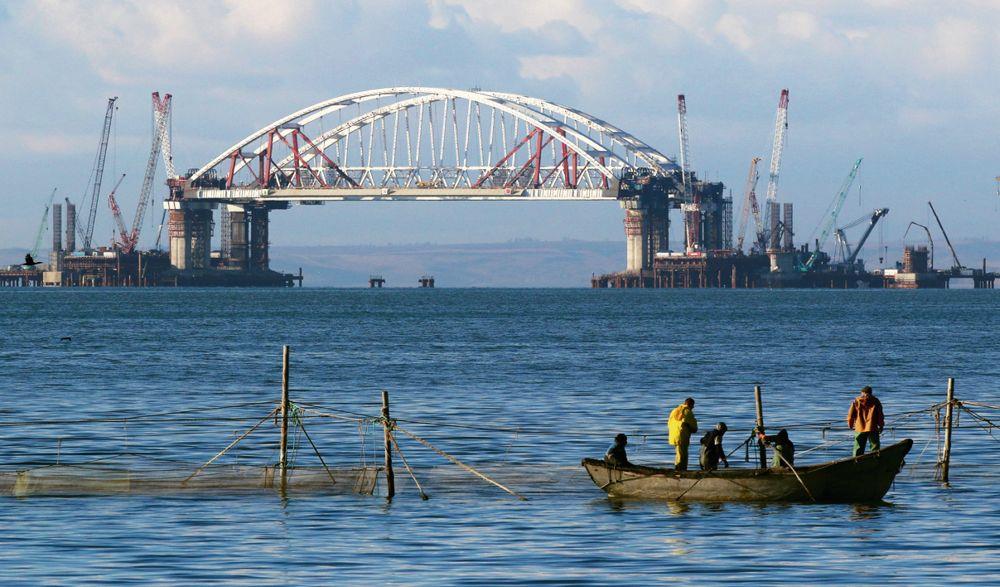
Breached: With the attack on the Crimean Bridge, Ukrainian President Zelenskyy has crossed a red line that Moscow had warned him against. Reuters

By MK Bhadrakumar

Source: The Tribune of India

Two massive terrorist strikes misfired spectacularly and a terrible beauty is born in the Ukraine war. These two carefully planned attacks in quick succession — on Nord Stream gas pipelines and Crimean Bridge — were intended as a knockout blow to Russia. According to President Vladimir Putin, people ‘who want to finally sever ties between Russia and the EU, weaken Europe’ are behind the Nord Stream blasts. He named the US, Ukraine and Poland as ‘beneficiaries’.

Last Wednesday, Russia’s domestic intelligence service FSB identified Ukraine’s military intelligence chief, Kyrylo Budanov, as the mastermind behind the Crimean attack. The New York Times and Washington Post also pointed fingers at Kiev, quoting ‘sources’. While Nord Stream-1 has been crippled, one of the strings of Nord Stream-2 remains intact. Putin said last week that the pipeline could be restored and Russia could deliver about 27 billion cubic metres of gas. ‘The ball is on the side of the European Union, if they want — let’s turn on the tap,’ he said.

But mum’s the word from Brussels. It is a profoundly embarrassing moment for the EU. The triumphalism has vanished as Europe is threatened by years of recession caused by the blowback from sanctions against Russia, where the US insisted on the cut off of energy ties with Moscow. The EU has now become a captive market for Big Oil and is left to buy LNG from the US at the asking price, which is six to seven times higher than the domestic price in the US. (Contracted price for long-term Russian supply for Germany used to be about $280 per 1,000 cubic metres as against the current market price hovering around $2,000.)

Plainly put, the Europeans have been nicely played by the Americans. India should take note of the US’ sense of entitlement. Basically, the Biden administration created a contrived energy crisis whose real aim is war profiteering.

The Crimean Bridge attack of October 8 is much more serious. Zelenskyy has crossed a red line that Moscow had repeatedly warned him against. Putin has disclosed that there have also been three terrorist attacks against the Kursk NPP. Russians will settle for nothing less than the ouster of the Zelenskyy regime.

Russia’s retaliation against Ukraine’s ‘critical infrastructure’, something Moscow refrained from so far, has serious implications. Since October 9, Russia has begun systematically targeting Ukraine’s power system and railways. Noted Russian military expert Vladislav Shurygin told Izvestia that if this tempo was kept up for a week or so, it ‘will disrupt the entire logistics of the Ukrainian military — system for transporting personnel, military equipment, ammunition, related cargo, as well as the functioning of military and repair plants.’

The Americans are cocooned in a surreal world of their self-serving narrative that Russia ‘lost’ the war. In the real world, though, Ivan Tertel, KGB chief in Belarus, who has an insider view of Moscow, said last Tuesday that with Russia boosting its troop strength in the war zone — 3 lakh troops who have been mobilised plus 70,000 volunteers — and the deployment of advanced weaponry, ‘the military operation will enter a key phase. According to our estimates, a turning point will come in the period from November of this year to February of next year.’

Policy-makers and strategists in Delhi should make a careful note of the timeline. The bottom line is, Russia is looking for an all-out victory and will not settle for anything less than a friendly government in Kiev. Western politicians, including Biden, understand that there is nothing stopping the Russians now. The US’ weapon kitty is running dry as Kiev keeps asking for more.

When asked whether he’d meet Biden at the G20 in Bali, Putin derisively remarked on Friday, ‘He (Biden) should be asked whether he is ready to hold such negotiations with me or not. To be honest, I don’t see any need, by and large. There is no platform for any negotiations for the time being.’

However, Washington has not yet thrown in the towel and the Biden administration remains obsessed with exhausting the Russian military — even at the cost of Ukraine’s destruction. And, for the Russians too, there is still much to be worked out on the battlefield: the oppressed Russian populations in Odessa (which suffered unspeakable atrocities from the neo-Nazis), Mykolaiv, Zaporizhya, Dnipropetrovsk, Kharkov are expecting ‘liberation’. It’s a highly emotive issue for Russia. Again, the overarching agenda of ‘demilitarisation’ and ‘denazification’ of Ukraine must be taken to its logical conclusion.

When all that is over, Putin knows Biden will not even want to meet him. Hungarian PM Viktor Orban said last week, ‘Anyone who seriously believes that the war can be ended through Russian-Ukrainian negotiations lives in another world. Reality looks different. In reality, such issues can only be discussed between Washington and Moscow. Today, Ukraine is able to fight only because it receives military assistance from the United States…

‘At the same time, I do not see President Biden as the person who would really be suitable for such serious negotiations. President Biden has gone too far. Suffice it to recall his statements to Russian President Putin.’

India should expect the defeat of the US and NATO, which completes the transition to a multipolar world order. Sadly, Indian elites are yet to purge their ‘unipolar predicament’. Europe, including Britain, is devastated and there is palpable discontent over the US’s ‘transatlantic leadership’. Indo-Pacific strategy is hopelessly adrift. New power centres are emerging in India’s extended neighbourhood, as the OPEC’s rebuff to Washington shows. A profound adjustment is needed in the Indian strategic calculus.

The endless proxy war, by design

While privately conceding that its ally Ukraine is not “capable of winning the war,” the Biden administration keeps fueling it.

By Aaron Maté

Source: Aaron Maté Substack

Russia’s invasion of Ukraine has presented the White House with a geopolitical crisis that it played a critical role in creating. In February 2014, Victoria Nuland, a current senior State Department official and former Dick Cheney advisor, was caught on tape plotting the installation of a new Ukrainian government – a plan, she stressed, that would involve Biden and his then-top aide, and current National Security Advisor, Jake Sullivan. Weeks later, the democratically elected Ukrainian president Viktor Yanukovych was ousted and replaced by Washington-backed leaders – including a prime minister selected by Nuland.

The regime change in Kiev made Biden the most influential US political figure in Ukraine, as underscored by the lucrative Burisma board seat gifted to his son Hunter. While the Biden family and other well-connected players profited, Ukraine fell into civil war. In the eastern Donbas region, Kremlin-backed Ukrainian rebels took up arms against a fascist-infused coup government that cracked down on Russian culture and countenanced murderous assaults on dissidents. Rather than promote the 2015 Minsk II accords — the agreed-upon formula for ending the Donbas conflict – the US fueled the fight with a weapons and training program that turned Ukraine into a NATO proxy. Influential US politicians left no doubt about their intentions. As the Donbas war raged, lawmakers declared that they were using Ukraine to “fight Russia over there” (Adam Schiff) and vowed to “make Russia pay a heavier price,” (John McCain). In February of this year, Russia invaded to bring the eight-year fight to an end, leaving Ukraine to pay the heaviest price of all.

The Biden administration shunned multiple opportunities to prevent the Russian assault. When Russia submitted draft peace treaties in December 2021, the White House refused to even discuss the Kremlin’s core demands: a pledge of neutrality for Ukraine, and the rollback of NATO military forces in post-1997 member states that neighbor Russia. At the final round of talks on implementing Minsk II in early February, the “key obstacle,” the Washington Post reported, “was Kyiv’s opposition to negotiating with the pro-Russian separatists.” Siding with Ukraine’s far-right, which had threatened to overthrow Volodymyr Zelensky if he signed a peace deal, the US made no effort to encourage diplomacy. Emboldened to escalate its war on the Donbas, the Ukrainian government then massively increased shelling on rebel-held areas in the days immediately preceding Russa’s February 24th invasion.

Looking back at the pre-invasion period, Jack Matlock, the US ambassador to the Soviet Union under Bush I, now concludes that “if Ukraine had been willing to abide by the Minsk agreement, recognize the Donbas as an autonomous entity within Ukraine, avoid NATO military advisors, and pledge not to enter NATO,” then Russia’s war “probably would have been prevented.”

For Washington, preventing the war would have interfered with longstanding objectives. As US policymakers have openly recognized, Ukraine’s historical, geographical, and cultural links to Russia could be used as a tool to achieve regime change in Moscow, or, at minimum, leave it “weakened.”

As Ukraine enters another winter of war, this time facing an intensified Russian assault, the Biden administration is apparently in no mood to end a crisis that it helped start.

The US-Nazi Connection since World War II: From Inspiring the Third Reich to Supporting the Neo-Nazis of Ukraine

By Timothy Alexander Guzman

Source: Silent Crow News

The mafia in Washington, London, Brussels and Tel Aviv would do anything to keep their “Unipolar World Order” project in place, in fact, there are getting desperate to hold on to whatever remaining powers they have left even if it means collaborating with its worst enemies. There is a well-known ancient proverb “The enemy of my enemy is my friend” that rings true today especially since Washington, the CIA, the Military-Industrial Complex, along with Mossad and NATO have supported well-known terrorists including the Islamic State (ISIS), Al Qaeda, and other groups to overthrow governments they don’t approve of especially in the Middle East. However, their support of terrorists who were their enemies at one time or another did not start with their regime change wars against Syria or Libya, the idea of supporting its enemies began during and after World War II when the US government recruited Ukrainian Nazis to counter their new enemy, the Soviet Union. What a strange turn of events knowing that the Soviets who fought the Nazis with their American and European allies during the war were seen as a new threat. Washington and the rest of their mafia cohorts used the Nazis back then as they are now using jihadi terrorists today in their war for world domination no matter what the costs are in the long-term.

So who were the Nazis and why was Washington interested in recruiting them in the first place? For starters, the Nazis had members involved in several scientific and technological disciplines that the US government was interested in and would later utilize them to produce all sorts of weapons of war and psychological operations for its future military operations, but we will get into further details shortly. However, the Nazis did follow a far-right fascist ideology that was authoritarian that coincided with ultranationalist principals that rejected anarchy, communism, democracy, republicanism, socialism and other forms of government that was seen as a threat to their rising power. And as insane as this sounds, the Nazis also used scientific racism, or what we can call eugenics to manipulate human gene pools by separating certain groups of people between those who are considered inferior to advancing those who were deemed superior.  Then there is the element of antisemitism that was prevalent within the Third Reich. Nazism has led to genocide, torture, forced sterilizations, imprisonment of its opposition, deportations and other atrocities among those who did not fit the profile of being an ultra-nationalist especially if you did not have the racial qualities that they demanded for their movement. 

If we look back into the history of fascism, its roots were based in Europe as historians have claimed that Louis-Napoléon Bonaparte ‘aka’ Napoleon III who ruled France with an iron fist from 1848 to 1852 had the elements of a fascist/Nazi state. 

America’s Extermination of Red Savages was Adolf Hitler’s Inspiration 

Adolf Hitler, Germany’s new chancellor took the lead in imposing fascist policies in his country when he came to power. Hitler’s allies also known as the Axis Alliance, Benito Mussolini of Italy and Hirohito of Imperial Japan had similar policies.   

So, what inspired this sort of ideology?  Where did the Nazis get their inspiration from?  It’s a known fact that Adolf Hitler admired America’s ways of dealing with certain groups in their short history from the Jim Crow laws against African Americans to the indigenous populations who were sent to prison camps during the American Indian wars.  John Toland’s ‘Adolf Hitler: The Definitive Biography’ states that “Hitler’s concept of concentration camps as well as the practicality of genocide owed much, so he claimed, to his studies of English and United States history,” and that “He admired the camps for Boer prisoners in South Africa and for the Indians in the wild west; and often praised to his inner circle the efficiency of America’s extermination—by starvation and uneven combat—of the red savages who could not be tamed by captivity.”  So, when did the idea of a ‘concentration camp’ came into effect? It was under US President and Democrat, Andrew Jackson who introduced “emigration depots” as part of his Indian Removal Act of 1830 where tens of thousands of Indigenous peoples who were forced into what was called ‘prison camps’ and they included the Seminoles, Cherokee, Choctaw, Muscogee, and other tribal nations mainly in the Southern part of the United States and that included Alabama and Tennessee. 

One other element of how the US model of governance that influenced Nazi Germany was the Jim Crow Laws.  James Q. Whitman, a legal scholar and author of ‘Hitler’s American Model: The United States and the Making of Nazi Race Law’ wrote an introduction on how the Nazis viewed American race laws:

In the opening minutes, Justice Minister Gurtner presented a memo on American race law, which had been carefully prepared by officials of the ministry for purposes of the gathering; and the participants returned repeatedly to the American models of racist legislation in the course of their discussions.  It is particularly startling to discover that the most radical Nazis present were the most ardent champions of the lessons that American approaches held for Germany.  Not, as we shall see, in this transcript the only record of Nazi engagement with American race law.  In the late 1920’s and early 1930’s many Nazis, not least Hitler himself, took a serious in the racist legislation of the United States.  Indeed in Mein Kampf Hitler praised America as nothing less than “the one state” that had made progress toward the creation of a healthy racist order of the kind the Nuremberg Laws were intended to establish. 

My purpose is to chronicle this neglected history of Nazi efforts to mine American race law for inspiration during the making of the Nuremberg Laws, and to ask what it tells us about Nazi Germany, about the modern history of racism, and especially about America     

The Nazis saw US race laws as a suitable policy that they can implement on various groups such as the Jews who were a wealthy and powerful class of people which many Germans despised at the time, became non-citizens.  Native Americans, Filipinos, African Americans, and others were also considered non-citizens even if they lived in the US or its colonized territories.  But there was one aspect of US race laws that interested the Nazis and that was the anti-miscegenation laws that prohibited interracial marriages in about 30 US states where those who broke the law in the US received a severe criminal punishment.  US-inspired race laws were imposed on German society with the establishment of the Nuremberg laws that was passed on September 15th, 1935.  

Operation Paperclip: Why the US Government Recruited Nazis After WWII

The rumor of a nuclear war is more prevalent today more than ever before since Russia’s invasion of Ukraine has taken place.  Ukraine’s actor, oh, excuse me, I meant President, Volodymyr Zelensky has called for “preventive strikes” to deter Russia from using nuclear weapons although he backtracked the claims shortly after, but he did call for for the West to hit Russia with nuclear weapons for preventative measures which was extremely dangerous rhetoric coming out of his mouth.  Speaking of nuclear weapons, do you know who originally proposed the idea of placing nuclear bombs on ballistic missiles in the first place?  It was an idea that was derived from Nazi rocket scientists who was hired by the US government during World War II.  The original program was called Uranprojekt or the “Uranium Project” for the purpose of developing nuclear technology to build weapons and reactors.  

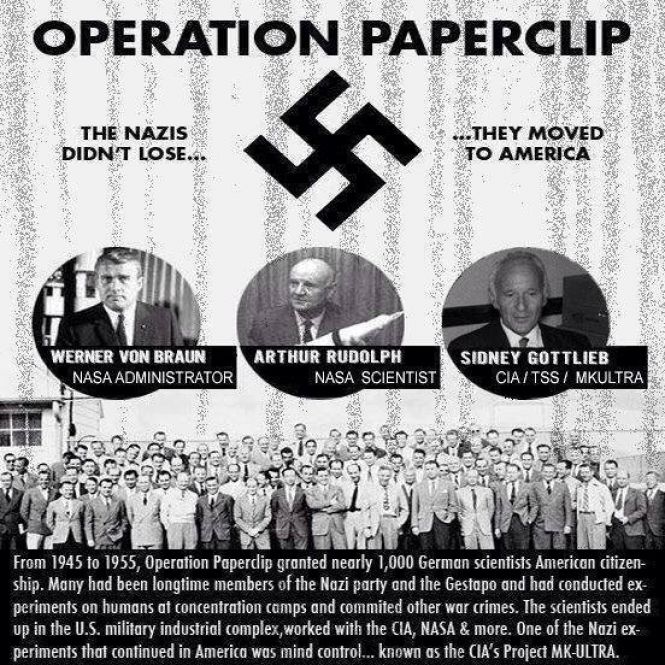
In the last years of World War II, US intelligence agencies and the Military-Industrial Complex secretly transferred more than 1,600 Nazi scientists and their families from Germany who were experts in various fields that included rocket science, aerodynamics, chemical weapons, and medicine in what was called Operation Paperclip.  There were Nazis working for the US military who also prepared intelligence briefs creating fear and panic that the Soviets were going to take over the world which was over-exaggerated.  But what the US government feared most was that the Soviet Union under Operation Osoaviakhim with more than 2,500 former Nazi scientists and engineers who were recruited in the Soviet occupation zone of Germany (SBZ) and the Soviet sector of Berlin would be one step ahead of the US government in weapons development and other areas. 

One important historical fact about America’s Nazi Scientists was the recruitment of Wernher von Braun or known by his full name as Wernher Magnus Maximilian Freiherr von Braun who was a member of the Nazi Party and the Allgemeine SS or the “General SS” which was a major branch of Nazi Germany’s paramilitary forces.  Wernher von Braun was also the head of developing rocket technology who is considered the pioneer of rocket and space technology in the US.  He was also the chief architect of the Saturn V super heavy-lift launch vehicle that allegedly helped launch the Apollo spacecraft to the Moon.  

Nazi scientists also helped the US government and the CIA develop chemical and biological weapons programs that included the use of sarin gas and other dangerous weapons of war including VX (nerve agent) and of course, the most used biological weapon during the Vietnam war, Agent Orange.  So, in other words, the US government hired Nazi scientists for their knowledge of creating weapons of mass destruction that has inflicted damage on various populations around the world since then.  During the Vietnam war, the US military unleashed Agent Orange on the Vietnamese population causing more than 3 million people to develop birth defects and other health related problems to this day.  The Nazi scientists were indeed evil geniuses when it came to developing advanced weapons of war and that was something that the US military and the intelligence community were solely interested in and that was and still is a scary thought.      

America’s Frankenstein: The Neo-Nazis of Ukraine

As we know from the valuable lessons of history that the US government and the CIA had supported and trained Ukrainian Nazis since 1946.  The CIA had organized “Stay Behind” operations with the OUN-B (neo-Nazi Organization of Ukrainian Nationalists) in Eastern Europe and other areas to assist Ukrainian nationalist who were sent to destabilize Soviet Ukraine with covert operations such as using commandos to assassinate Soviet officials, to sabotage infrastructure and to commit acts of terrorism. 

The history of the US government and its CIA operatives shows that it supported Ukrainian war criminal Stephan Bandera to advance the Ukrainian underground movement to destabilize Soviet Ukraine, so the CIA and their Office of Policy Coordination (OPC) and the Office of Special Operations (OSO) planned covert operations with the OUN-B and provided support to the anti-Soviet Ukraine Insurgent Army (UPA) for psychological warfare within the Soviet sphere of influence.   The CIA declassified their historical account of their association with Ukrainian Nationalists who collaborated with the Nazis during the Cold War in ‘Cold War Allies: The Origins of CIA’s Relationship with Ukrainian Nationalists’ by Kevin C Ruffner detailed how the “CIA reestablished and expanded its contacts with the Ukrainians and others for covert action against the Communists and as wartime assets to be used behind Red Army lines as guerrillas, saboteurs, and resistance leaders.”  The historical account went further and stated that “The sometimes brutal war record of many emigre groups became blurred as they became more critical to the CIA.”

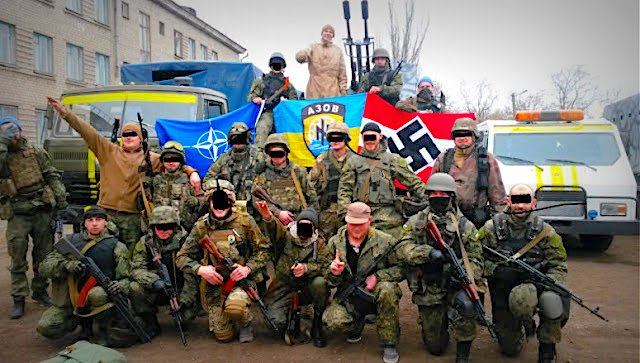
Fast forward to November 2013 were there were large-scale protests which was known as the Euromaidan against the policies of President Victor Yanukovych who made the decision to have closer ties with Russia and the Eurasian Economic Union instead of proceeding with the idea of having a political and economic relationship with the European Union by rejecting their free-trade agreement.  Then in February 2014, what is known as the Maidan Revolution took place that ended up in violent clashes between the protesters and the government’s security forces in the Ukrainian capital, Kyiv which led to a coup against the democratically elected president, Viktor Yanukovych.  Soon after, the Russo-Ukrainian war began and the birth of the Neo-Nazi inspired Azov Battalion was established as they became the resistance against basically, anything Russian.   

On January 22nd of this year, Yahoo News who is part of the mainstream media published an article titled CIA-trained Ukrainian paramilitaries may take central role if Russia invades basically admitted that the CIA was secretly training Ukrainian forces since 2015:

While the covert program, run by paramilitaries working for the CIA’s Ground Branch — now officially known as Ground Department — was established by the Obama administration after Russia’s invasion and annexation of Crimea in 2014, and expanded under the Trump administration, the Biden administration has further augmented it, said a former senior intelligence official in touch with colleagues in government

According to Yahoo News, an unnamed former senior intelligence official said that “If the Russians invade, those [graduates of the CIA programs] are going to be your militia, your insurgent leaders,” and that “we’ve been training these guys now for eight years. They’re really good fighters. That’s where the agency’s program could have a serious impact.”  One must wonder how many were actually radicalized neo-Nazis. 

In 2018, Reuters published a commentary by Josh Cohen ‘Ukraine’s neo-Nazi problem’ that explains Ukraine’s problem with the Nazis filling the ranks of its National Militia.  Cohen said that in “a January 28 demonstration, in Kiev, by 600 members of the so-called “National Militia,” a newly-formed ultranationalist group that vows “to use force to establish order,” illustrates this threat.”  Cohen added that the National Militia has recruited members from the Nazi-affiliated Azov Battalion:

Many of the National Militia’s members come from the Azov movement, one of the 30-odd privately-funded “volunteer battalions” that, in the early days of the war, helped the regular army to defend Ukrainian territory against Russia’s separatist proxies. Although Azov uses Nazi-era symbolism and recruits neo-Nazis into its ranks, a recent article in Foreign Affairs downplayed any risks the group might pose, pointing out that, like other volunteer militias, Azov has been “reined in” through its integration into Ukraine’s armed forces. While it’s true that private militias no longer rule the battlefront, it’s the home front that Kiev needs to worry about now

Cohen obviously is following the mainstream media narrative when he said that Putin seized Crimea which in fact, it was the Russian-speaking Crimean people who voted in a referendum to reunite with the Russian federation.  But to his credit, Cohen does mention the fact that the Azov Battalion and the Right Sector are held in high-regards since they fought Russian-backed separatists.  Cohen also mentioned the Azov battalion’s children’s training camps:   

When Russian President Vladimir Putin’s seizure of Crimea four years ago first exposed the decrepit condition of Ukraine’s armed forces, right-wing militias such as Azov and Right Sector stepped into the breach, fending off the Russian-backed separatists while Ukraine’s regular military regrouped. Though, as a result, many Ukrainians continue to regard the militias with gratitude and admiration, the more extreme among these groups promote an intolerant and illiberal ideology that will endanger Ukraine in the long term. Since the Crimean crisis, the militias have been formally integrated into Ukraine’s armed forces, but some have resisted full integration: Azov, for example, runs its own children’s training camp, and the careers section instructs recruits who wish to transfer to Azov from a regular military unit

Although Cohen’s claims expose Ukraine’s Neo-Nazis, he also follows the Western establishment and the mainstream media’s narrative that “the Kremlin’s claims that Ukraine is a hornets’ nest of fascists are false: far-right parties performed poorly in Ukraine’s last parliamentary elections, and Ukrainians reacted with alarm to the National Militia’s demonstration in Kiev” which are all lies.  Cohen’s statement is false, in fact, it’s a contradiction when he wrote at the beginning of his article that the “National Militia’s members were recruited from the Azov movement” but not to worry because “Azov has been “reined in” through its integration into Ukraine’s armed forces” at least according to Cohen who sourced his misinformation from Foreign Affairs magazine which is a publication owned by the Council of Foreign Relations, a favorite of of the US political establishment. 

So, does the US government, the Military-Industrial Complex, and the CIA support Ukrainian Neo-Nazis in their ongoing war efforts against Russia today?  Well, the answer to that question should be obvious by now.     

The US is pushing the situation towards a clash of major nuclear powers

By Valery Kulikov

Source: New Eastern Outlook

With its actions in recent months, the United States is blatantly pushing the international situation towards a clash of major nuclear powers. This is true of Washington’s blatantly provocative moves against both Russia and China.

US officials continue to inflame the situation, intimidating their own and the world public with “imaginary nuclear threats” from Russia by spreading fake information. For example, during a speech at the UN General Assembly, US President Biden cited non-existent quotes from Putin. Foreign Ministry Spokeswoman Maria Zakharova called it at least “indecent” that US President Joe Biden falsely quoted Russian leader Vladimir Putin when he “attributed” to the Russian President saying that “our country threatens the world with nuclear weapons”. According to her, someone took advantage of the White House head’s inability to reflect on difficult subjects.

The anti-Russian actions of Joe Biden and members of his administration are now harshly criticized by numerous politicians and media both within and outside the US. The US President was harshly criticized in particular by Fox News political observer Tucker Carlson, who said that Biden was guilty of wanting to destroy Russia for the sake of American hegemony in the world.

Russian President Vladimir Putin has repeatedly reminded the Russian and international public in his recent speeches that Washington is pushing Kiev to move hostilities to Russian territory and has recently even resorted to nuclear blackmail. “Washington, London and Brussels are directly pushing Kiev to transfer hostilities to our territory, and they are already openly saying that Russia must be defeated by all means on the battlefield, followed by the deprivation of economic, political, cultural and any kind of sovereignty, and the complete pillaging of our country,” the Russian leader said in a televised address on September 21. “We are talking not only about Western-encouraged shelling of the Zaporozhye NPP, which threatens a nuclear disaster, but also about statements by some high-ranking representatives of some NATO states about the possibility and admissibility of using weapons of mass destruction, nuclear weapons, against Russia,” Putin explained.

As highlighted in an article by Russia’s Ambassador to the US Anatoly Antonov published in The National Interest magazine, Washington’s actions are pushing the situation towards a clash of major nuclear powers. Western countries appear to be testing Russia’s mettle. “Today it is obvious that the United States is directly involved in the military actions of the Kiev regime. Washington is openly building up the supply of lethal weapons to Ukraine and provides it with intelligence. They jointly plan military operations against the Russian Armed Forces. Ukrainians are being trained to use NATO military hardware in a fight,” the article notes.

Following US media reports in late September that the US was allegedly developing plans to hit the Russian military and political leadership and the Kremlin, the Russian Embassy in Washington commented on the hoaxes, stressing that this was someones’ delusion. The Russian Embassy expressed the hope that such delusional reasoning does not reflect the official position of the US military establishment, as Washington must be well aware of the escalating nature of such reckless rhetoric.

The fact that the US is actively working for an armed clash with Russia is evidenced not only by numerous policies, but also by documents.

The Swedish newspaper Nya Dagbladet, for example, published what it admitted was a “shocking document” about how the US was planning an armed conflict with Russia and an energy crisis in Europe in January. The source of this information was a “leak” from the RAND Corporation, the leading US think-tank responsible for making recommendations to the White House. The report, which was obtained by a Swedish publication, states in particular that one of the reasons for an armed clash between the West and Russia would be its push for military intervention in Ukraine in response to the aggressive foreign policy pursued by the Kiev regime under instructions from Washington. According to the pervasive key objective of this cynical strategy, as described in the document, one of the most important US objectives has been to destroy cooperation not only between Germany and Russia, but also between Berlin and Paris, dragging both of these Western European countries into the conflict in Ukraine.

As the European media is already reporting, although there are still hopes and opportunities to stop the Western-initiated conflict with Russia, they are being increasingly dashed by unprecedented propaganda, the spread of war hysteria through the media and the fanatical insanity of Western politicians. All this shows that military decisions have long been made and there is less and less realistic possibility of stopping the conflict. This has been seriously illustrated by the active calls by the US and its NATO allies for their citizens to urgently leave Russian territory, which, in a well-known historical analogy, is usually done on the eve of the outbreak of a serious armed conflict.

On September 28, the US Embassy in Moscow, for example, called on compatriots to urgently leave the territory of the Russian Federation. In particular, one of the recent reports published on the Embassy’s website said: “US citizens should not travel to Russia and those residing or travelling in Russia should depart Russia immediately while limited commercial travel options remain”.

The Polish Foreign Ministry on September 27 also advised its citizens “leave [Russian] territory using the available commercial and private means”. At the same time, Polish citizens are warned that “in case of a drastic deterioration of the security situation, the closure of borders or other unforeseen circumstances, evacuation may prove significantly impeded or even impossible”. At the same time, according to the Deputy Minister of Interior and Administration Błażej Poboży, an inspection of bomb shelters, even those that are not in the possession of the city authorities, has been launched on the territory of Poland.

The Italian Embassy in Moscow, Latvian Foreign Minister Edgars Rinkēvičs, the Lithuanian Foreign Ministry and several other NATO foreign ministries also advised fellow citizens to leave Russia on September 29.

Although the Latvian authorities admit that the situation on the Latvian-Russian border is stable, calm and under strict control, the country introduced an emergency situation for the next three months. At the same time, the North Atlantic Alliance Command reported the deployment of two HIMARS MLRSs by the US in Latvia, ostensibly in preparation for the NAMEJS exercise.  The exact same MLRSs are already being actively used by the US in military operations in Ukraine to shell Donbas territory by the Kiev regime under the guidance of US military advisors.

While the current US leadership has long acted adventurously and irresponsibly towards the people of eastern Ukraine and the Russian Federation, supporting and fomenting hostilities with its arms deliveries, it must understand that a nuclear conflict, if it occurs, cannot remain a regional issue. And if, through the fault of the White House, the conflict with Moscow descends into nuclear war, such war would be global. It will primarily destroy the United States, as well as the countries where NATO armaments are located and from where the security of Russia and Russian citizens will be threatened. And Washington should be clear that this risk is higher than what the current US political elite expects.

Brainwashed for War With Russia

By Ray McGovern

Source: AntiWar.com

Thanks to Establishment media, the sorcerer apprentices advising President Joe Biden – I refer to Secretary of State Antony Blinken, national security adviser Jacob Sullivan, and China specialist Kurt Campbell – will have no trouble rallying Americans for the widest war in 77 years, starting in Ukraine, and maybe spreading to China. And, shockingly, under false pretenses.

Most Americans are oblivious to the reality that Western media are owned and operated by the same corporations that make massive profits by helping to stoke small wars and then peddling the necessary weapons. Corporate leaders, and Ivy-mantled elites, educated to believe in U.S. “exceptionalism,” find the lucre and the luster too lucrative to be able to think straight. They deceive themselves into thinking that (a) the US cannot lose a war; (b) escalation can be calibrated and wider war can be limited to Europe; and (c) China can be expected to just sit on the sidelines. The attitude, consciously or unconsciously, “Not to worry. And, in any case, the lucre and luster are worth the risk.”

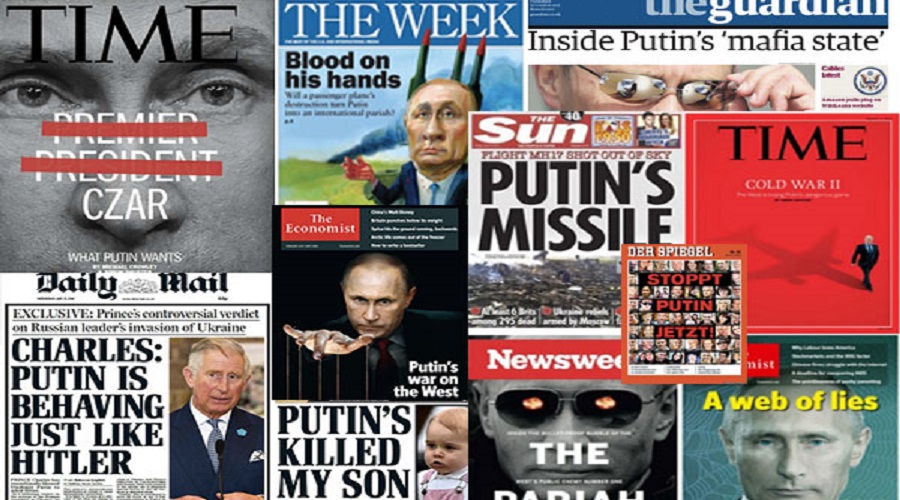
The media also know they can always trot out died-in-the-wool Russophobes to “explain,” for example, why the Russians are “almost genetically driven” to do evil (James Clapper, former National Intelligence Director and now hired savant on CNN); or Fiona Hill (former National Intelligence Officer for Russia), who insists “Putin wants to evict the United States from Europe … As he might put it: “Goodbye, America. Don’t let the door hit you on the way out.”

Absent a miraculous appearance of clearer heads with a less benighted attitude toward the core interests of Russia in Ukraine, and China in Taiwan, historians who survive to record the war now on our doorstep will describe it as the result of hubris and stupidity run amok. Objective historians may even note that one of their colleagues – Professor John Mearsheimer – got it right from the start, when he explained in the autumn 2014 issue of Foreign Affairs “Why the Ukraine Crisis is the West’s Fault.”

Historian Barbara Tuchman addressed the kind of situation the world faces in Ukraine in her book “The March of Folly: From Troy to Vietnam.” (Had she lived, she surely would have updated it to take Iraq, Afghanistan, Syria, and Ukraine into account). Tuchman wrote:

“Wooden-headedness…plays a remarkably large role in government. It consists in assessing a situation in terms of preconceived fixed notions while ignoring or rejecting any contrary signs. It is acting according to wish while not allowing oneself to be deflected by the facts.”

Six Years (and Counting) of Brainwashing

Thanks to US media, a very small percentage of Americans know that:

  • 14 years ago, then US Ambassador to Russia (current CIA Director) William Burns was warned by Russian Foreign Minister Sergei Lavrov that Russia might have to intervene in Ukraine, if it were made a member of NATO. The Subject Line of Burns’s Feb. 1, 2008 Embassy Moscow cable (#182) to Washington makes it clear that Amb. Burns did not mince Lavrov’s words; the subject line stated: “Nyet means nyet: Russia’s NATO enlargement redlines.”Thus, Washington policymakers were given forewarning, in very specific terms, of Russia’s redline regarding membership for Ukraine in NATO. Nevertheless, on April 3, 2008, a NATO summit in Bucharest asserted: “NATO welcomes Ukraine’s and Georgia’s Euro-Atlantic aspirations for membership in NATO. We agreed today that these countries will become members of NATO.”
  • 8 years ago, on Feb. 22, 2014, the US orchestrated a coup in Kiev – rightly labeled “the most blatant coup in history’, insofar as it had already been blown on YouTube 18 days prior. Kiev’s spanking new leaders, handpicked and identified by name by US Assistant Secretary of State Victoria Nuland in the YouTube-publicized conversation with the U.S. ambassador in Kiev, immediately called for Ukraine to join NATO.
  • 6 years ago, in June 2016, Russian President Vladimir Putin told Western reporters of his concern that so-called antiballistic missiles sites in Romania and Poland could be converted overnight to accommodate offensive strike missiles posing a threat to Russia’s own nuclear forces. (See this unique video, with English subtitles, from minute 37 to 49.) There is a direct analogy with the 1962 Cuban missile crisis when Moscow put offensive strike missiles in Cuba and President John Kennedy reacted strongly to the existential threat that posed to the US.
  • On December 21, 2021, President Putin told his most senior military leaders:“It is extremely alarming that elements of the US global defense system are being deployed near Russia. The Mk 41 launchers, which are located in Romania and are to be deployed in Poland, are adapted for launching the Tomahawk strike missiles. If this infrastructure continues to move forward, and if US and NATO missile systems are deployed in Ukraine, their flight time to Moscow will be only 7–10 minutes, or even five minutes for hypersonic systems. This is a huge challenge for us, for our security.” [Emphasis added.]
  • On December 30, 2021, Biden and Putin talked by phone at Putin’s urgent request. The Kremlin readout stated:
  • On February 12, 2022, Ushakov briefed the media on the telephone conversation between Putin and Biden earlier that day.
  • On February 24, 2022, Russia invaded Ukraine.

Unprovoked?

The US insists that Russia’s invasion was “unprovoked”. Establishment media dutifully regurgitate that line, while keeping Americans in the dark about such facts (not opinion) as are outlined (and sourced) above. Most Americans are just as taken in by the media as they were 20 years ago, when they were told there were weapons of mass destruction in Iraq. They simply took it on faith. Nor did the guilty media express remorse – or a modicum of embarrassment.

The late Fred Hiatt, who was op-ed editor at the Washington Post, is a case in point. In an interview with the Columbia Journalism Review [CJR, March/April 2004] he commented:

“If you look at the editorials we wrote running up [to the war], we state as flat fact that he [Saddam Hussein] has weapons of mass destruction.” “If that’s not true, it would have been better not to say it.”

(My journalism mentor, Robert Parry, had this to say about Hiatt’s remark. “Yes, that is a common principle of journalism, that if something isn’t real, we’re not supposed to confidently declare that it is.”)

It’s worse now. Russia is not Iraq. And Putin has been so demonized over the past six years that people are inclined to believe the likes of James Clapper to the effect there’s something genetic that makes Russians evil. “Russia-gate” was a big con (and, now, demonstrably so), but Americans don’t know that either. The consequences of prolonged demonization are extremely dangerous – and will become even more so in the next several weeks as politicians vie to be the strongest in opposing and countering Russia’s “unprovoked” attack on Ukraine.

THE Problem

Humorist Will Rogers had it right:

“The problem ain’t what people know. It’s what people know that ain’t so; that’s the problem.”

Deafening Silences: propaganda through censorship, smearing and coercion

By Dr Piers Robinson

Source: Off-Guardian

There is a case to be made that the most important part of any propaganda campaign is the drive to ensure that certain voices, claims and arguments either never see the light of day or otherwise remain contained within “fringe” or “alternative” circles.

Since the start of the COVID event, authorities around the world have sought to implement quite extraordinary policies including the so-called “locking down” of entire populations, compulsory masking and coercion through, for example, the mandating of multiple ‘vaccine’ injections. Many of these policies fly in the face of long-established and well-evidenced public health approaches to dealing with respiratory viruses whilst the scientific cogency of these measures – including lockdowns, community masking and “vaccine” injections – is coming under increased scrutiny.

At the same time, the catastrophic consequences, the so-called “collateral damage” (a military euphemism for wartime civilian casualties), of these extreme policies for populations around the world is becoming well-established. Randomised controlled trials of the injections to date have not shown net overall benefit, while accumulating evidence from passive reporting suggests they may be a cause of significant levels of harm. A central part of selling these extreme, and ultimately highly destructive, policies has involved the use of propaganda.

One of the problems with researching and writing about propaganda is that many people believe it to be alien to democratic states. However, as Edward Bernays, considered by many to be a key figure in the development of 20th century propaganda techniques, explained and promoted…

the conscious and intelligent manipulation of the organized habits and opinions of the masses is an important element in democratic society.

At least to an extent, this belief in propaganda rests upon an assumption or belief that people are ultimately selfish, egotistical, power-hungry and hedonistic beings who require guidance and incentive; it therefore follows that propaganda is required by powerful actors in order to provide a degree of structure, order and purpose to a given society. In contrast, if one assumes that humans are ultimately good and well-inclined towards each other and to the natural world, and that they are capable of great things if conditions permit, propaganda emerging from self-interested and powerful actors equates to a parasite within the human mind that seeks to lead humans away from their better instincts [1].

To this one might add the propensity of those with power to define themselves as the arbiters of truth and morality:

The moral attitudes of dominant and privileged groups are characterised by universal self-deception and hypocrisy. The unconscious and conscious identification of their special interests with general interests and universal values […]. […] the intelligence of privileged groups is usually applied to the task of inventing specious proofs for the theory that universal values spring from, and that general interests are served by, the special privileges which they hold.[2]

Whatever one’s position on the justifiability of propaganda, and although we usually call these techniques by different names today, employing euphemisms such as “public relations” or “strategic communication”, it is a fact that techniques of manipulation are part and parcel of contemporary liberal democracies.

PROMOTING THE NARRATIVE

In the case of the COVID-19 event, propaganda has been deployed across democracies on an unprecedented scale. In order to gain compliance with the unorthodox and intrusive measures adopted during the COVID-19 event many forms of “non-consensual persuasion” have been employed, ranging from manipulated messaging designed to increase “fear levels” through to coercion.

Indeed, very early on it came to light that behavioural scientists were providing advice to the UK government’s Scientific Advisory Group for Emergencies (SAGE). UKColumn reported that this group, named the “Scientific Pandemic Influenza group on Behaviour (SPI-B)”, was (re)convened on 13 February 2020. One document produced by this group identified “options for increasing adherence to social distancing measures” which include persuasion, incentivization and coercion.

In the section on “persuasion” it states that the…

perceived level of personal threat needs to be increased among those who are complacent, using hard-hitting emotional messaging

The document also referred to using…

media to increase sense of personal threat.

Many of these “behavioural science” approaches to manipulation used in the UK context have been documented in Laura Dodsworth’s influential work State of Fear whilst Dr Gary Sidley has written about the remarkable reluctance of anyone in authority to accept responsibility for the deliberate manipulation of the public. Dr Colin Alexander has, for some time, been tracking the propaganda output across the UK public sphere.

More widely, and as described by Iain Davis, these approaches have been paralleled at the global level. In February 2020, according to Davis, the World Health Organisation (WHO) had established the Technical Advisory Group on Behavioural Insights and Sciences for Health (TAG);

The group is chaired by Prof. Cass Sunstein and its members include behavioural change experts from the World Bank, the World Economic Forum, and the Bill and Melinda Gates Foundation. Professor Susan Michie, from the UK, is also a TAG participant*.

Since then, Susan Michie has taken over as chair.

CREATING DEAFENING SILENCES

One aspect of the COVID-19 event propaganda has been the aggressive promotion of official narratives; but just as important has been the suppression and censorship of those questioning authorities. Indeed, there is a case to be made that the most important part of any propaganda campaign is the drive to ensure that certain voices, claims and arguments either never see the light of day or otherwise remain contained within “fringe” or “alternative” circles.

Part of this process of suppressing arguments and opinion involves superficially well-meaning attempts to manage what has been increasingly labelled as “misinformation” and “disinformation”. Elizabeth Woodworth documents the emergence of the so-called Trusted News Initiative (TNI) prior to the 2020 COVID-19 event and which involved a coalition of mainstream/legacy media establishing a network that would serve to combat “misinformation” and “bias”. She quotes the then BBC Director-General Tony Hall:

“Last month I convened, behind closed doors, a Trusted News Summit at the BBC, which brought together global tech platforms and publishers. The goal was to arrive at a practical set of actions we can take together, right now, to tackle the rise of misinformation and bias … I’m determined that we use [the BBC’s] unique reach and trusted voice to lead the way – to create a global alliance for integrity in news. We’re ready to do even more to help promote freedom and democracy worldwide”

By 2020, according to Woodworth, the TNI had incorporated “Twitter, Microsoft, Associated Press, Agence France-Presse, Reuters, and the Reuters Institute for the Study of Journalism” and, predictably, adopted the role of tackling “harmful coronavirus disinformation”.

In the UK at least, there has also been military involvement with the 77th Brigade operating as part of the COVID-19 communication strategy. 77th Brigade activities include information warfare and “supporting counter-adversarial information activity” which includes…

creating and disseminating digital and wider media content in support of designated tasks.

Tobias Ellwood, who is both a Member of Parliament and Chair of the House of Commons Defence Select Committee, is, remarkably, a reservist with 77th Brigade. In an answer to a written question in parliament it was confirmed that “members of the Army’s 77th Brigade” are…

currently supporting the UK government’s Rapid Response Unit in the Cabinet Office and are working to counter dis-information about COVID-19.

The Rapid Response Unit itself was established in 2018 in order to, according to its head Fiona Bartosch, counter “misinformation” and “disinformation”, and “reclaim a fact-based public debate”.

The World Health Organisation (WHO) has also followed a similar tack cautioning the public about “misinformation” and “disinformation”. In a release titled “Let’s flatten the infodemic curve”, they advise people to refer to “factcheckers” and legacy media:

When in doubt, consult trusted fact-checking organizations, such as the International Fact-Checking Network and global news outlets focused on debunking misinformation, including the Associated Press and Reuters

The WHO describes in detail its involvement with social media and “big tech”:

“WHO has been working closely with more than 50 digital companies and social media platforms, including Facebook, Twitter, LinkedIn, TikTok, Twitch, Snapchat, Pinterest, Google, Viber, WhatsApp and YouTube, to ensure that science-based health messages from the organization or other official sources appear first when people search for information related to COVID-19. WHO has also partnered with the Government of the United Kingdom on a digital campaign to raise awareness of misinformation around COVID-19 and encourage individuals to report false or misleading content online. In addition, WHO is creating tools to amplify public health messages – including its  WHO Health Alert chatbot, available on WhatsApp, Facebook Messenger and Viber – to provide the latest news and information on how individuals can protect themselves and others from COVID-19.”

AN INSTITUTIONALISED CULTURE OF CENSORSHIP AND SUPPRESSION OF “WRONG THINK”

These developments, along with others to be documented in due course via work at PANDA, would appear to have had major consequences in terms of suppression of debate. A preliminary examination of events over the last 2.5 years indicates this suppression has operated in at least three different ways:

  • direct censorship through removal of content and deplatforming;
  • sponsoring of hostile coverage designed to smear and intimidate anyone raising critical questions regarding the COVID-19 narrative;
  • coercive approaches involving threats to livelihood and employment.

I shall deal with each in turn.

• Censorship and deplatforming

Formal approaches to censorship via state-backed action were seen early on in the UK context with the regulatory body OFCOM issuing guidelines to broadcasters.

Dodsworth (p.31) reports that broadcasters were instructed to be alert to:

health claims related to the virus which may be harmful; medical advice which may be harmful: accuracy or material misleadingness in programmes in relation to the virus or public policy regarding it”(Dodsworth p. 31).

One possible manifestation of this policy was the remarkable instruction issued to Oxford professor Sunetra Gupta. On October 14, 2020, she appeared on BBC News to talk about the lockdowns imposed in the north of England. It is claimed that just before she went on air, one of the producers told her not to mention the Great Barrington Declaration, a document signed by eminent scientists setting out an alternative policy that would avoid lockdowns and other unorthodox measures.

Across social media, from almost day one of the COVID-19 event, tech giants (“big tech”) were willingly signing up to a strategy of censorship.

In April 2020 it was reported that YouTube CEO Susan Wojcicki had declared that it would act to remove anything going against World Health Organization” recommendations. Notable removals from YouTube included interviews with Dr John Ioannidis of Stanford University and British physician Professor Karol Sikora whilst US Senator Rand Paul’s speech questioning the efficacy of facemasks in August 2021 was removed by YouTube. Dr Robert Malone, inventor of part of the MRnA technology used in the COVID-19 injections, and who has become a notable critic of official policies and narratives, was also removed from Twitter.

A large part of the policing of debate across social media platforms has involved issuance of warnings that a given post violates “community standards” in some way and some, such as LinkedIn, state that content at variance with authorities can lead to censoring. As Dr David Thunder has documented, the exact wording of Linkedin’s policy on “misinformation” states: “Do not share content that directly contradicts guidance from leading global health organizations and public health authorities.“

Thunder notes:

What does this actually mean, in practice? It means that some select persons, just because they got nominated to a “public health authority” or a “leading global health organization,” are protected by Linkedin from any robust criticism from the public or from other scientists.

Furthermore, censorship and suppression of academic debate has been reported with respect to academic journals whereby articles and research running against the so-called scientific consensus appear to have been unfairly removed or blocked. For example Dr Peter McCullough reports unjustified censorship of a peer reviewed and published article relating to COVID-19 whilst, more broadly, undue suppression of legitimate research findings was reported by Dr Tess Lawrie with respect to Ivermectin trials. All of these are worrying indications that academic processes themselves have become subject to nefarious censorship and control.

The censorship continues unabated and it might even be intensifying. Whilst detailed and systematic research should be conducted in order to identify the scale and range of the censorship that has been occurring, it is reasonably clear now that, relative to pre-2020, the levels are unprecedented and represent a normalization, or routinization, of censorship.

• Character Assassination through Smearing

Suppression of debate is achieved not only through formal censorship, but also through indirect tactics whereby attempts are made to destroy the reputation of those challenging power. Although perhaps not widely appreciated, the tactic of character assassination appears to have become more prevalent in recent years and it appears to be an important feature of contemporary propaganda and our ‘democratic’ landscape.

Broadly speaking, smear campaigns are designed to avoid substantive rational debate and instead denigrate the person making the argument – ‘playing the man rather than the ball’ or ‘shooting the messenger’. A feature of smear campaigns is the use of identity politics sensibilities such as concern (legitimate) over racism and the deployment of pejorative and tendentious labels. For example, those questioning COVID-19 policies have sometimes been described as far right or fascist whilst pejorative use of the term “conspiracy theorist” is frequently employed to describe those questioning official narratives.

Smear campaigns can be justifiably seen as underhand and disreputable approaches to challenging dissenting voices and they frequently pass off without observers or even the victims being fully aware that they are being targeted: those ordering or enabling the smears have good reason to avoid being uncovered whilst those executing the smears, i.e. the journalists, will defend their hit pieces as legitimate critique.

In the case of the COVID-19 event, however, at least one high level smear campaign has been identified.

At the time of the release of the Great Barrington Declaration (GBD) during autumn 2020, the authors were only aware of a barrage of hostile media attention such as the above noted instruction by the BBC to Professor Sunetra Gupta to not mention the Declaration during an interview. But at least some of the hostile coverage was not simply a spontaneous reaction by journalists but had been initiated by high-level officials. When the GBD was published, leaked emails showed Anthony Fauci and National Institute of Health director Francis Collins discussing the need to swiftly shut it down. Collins wrote in an email that this…

proposal from the three fringe epidemiologists … seems to be getting a lot of attention … There needs to be a quick and devastating published takedown of its premises.

Rather than a civilised and robust scientific debate, a smear campaign followed.

Other prominent instances, unproven but which bear the hallmarks of a directed smear campaign, include repeated attacks on the popular US podcaster Joe Rogan. In the European sphere, Professor Bhakdi, an early and prominent critic of COVID-19 policies has been repeatedly accused of anti-semitism and is now being prosecuted by the German authorities for inciting hatred (*see Endnotes for alt. link -Ed.). None of the accusations made in these attacks appear to be reasonable. Rogan, for example, was chastised for promoting the use of Ivermectin with many journalists referring to it, misleadingly, as “horse dewormer”. The vast bulk of Bhakdi’s work and output concerns the COVID-19 policies and, relatively speaking, his references to any issue related to Judaism is at most vanishingly small.

A subtle and arguably more widespread form of smearing involves the routine labelling of information by social media companies as harmful; for example the independent UK-based outlet OffGuardian has its tweets subject to a blanket warning suggesting their output might be ‘unsafe’ and contain…

violent or misleading content that could lead to real-world harm.

Such labelling is, arguably, defamatory.

• Coercion

Suppression of inconvenient opinions works through both the realm of information – censoring a person’s voice or ad hominem attacks – but also through action in the real, “material”, world via coercion. This could be the creation of conditions that deter people from speaking their mind by offering material incentives or, alternatively, threatening to deplete someone’s material circumstances. Put simply, the threat of loss of earnings.

In the case of the COVID-19 event the role of coercion can be seen through the threats to employment experienced by those challenging the narrative.

For example, Professor Julie Ponesse was forced from her position at Western University in Canada because of her refusal to receive the COVID-19 injection following the issuing of “vaccine” mandate there whilst a similar fate was suffered by Dr Aaron Kheriarty (Professor at University of California Irvine, School of Medicine and director of the Medical Ethics Program). Other academics have cited lack of institutional support with respect to their academic freedom, such as Professor Martin Kuldorff.

The coercive nature of mandates is particularly pernicious in that their implementation in universities forces ‘dissident’ academics to either go against their beliefs and opinions and comply or otherwise leave their posts. The disciplining effect is, of course, much more widely felt across the academy: the few who lose their posts serve as a warning to everyone else to reconsider their beliefs and actions. In particular, younger academics and those completing their PhDs will come to understand that compliance with the dominant narrative is the only realistic option if they are to realise their goal of an academic career.

The tactics of censorship, smearing and coercion are synergistic and help construct an environment in which self censorship becomes ubiquitous: Deplatforming of dissident scientists sends a clear warning as to the subject matter and issues that are off limits whilst examples of smearing highlight the potential unpleasant consequences of discussing such issues.

Coercion acts as a final hardstop for anyone entertaining the possibility of risking talking about censored issues and riding out the smears that will result: loss of job and income is simply too much to bear. Overall, the role of authorities in enabling censorship and coercion results in, broadly speaking, an institutionalised culture in which suppression of opinions and debate becomes the norm.

THE DANGERS TO DEMOCRACY AND RATIONAL DEBATE: ONLINE HARM LEGISLATION AND DIS/MISINFORMATION ‘FACT CHECKERS’

Clearly this situation has deleterious consequences for rational debate and democracy. John Stuart Mill explained that silencing the expression of an opinion robs us all of the opportunity to either hear an argument that might turn out to be true, or refine or reject an opinion that is faulty. There are very good reasons for this, as Mill notes:

First: the opinion which it is attempted to suppress by authority may possibly be true. Those who desire to suppress it, of course deny its truth; but they are not infallible. … All silencing of discussion is an assumption of infallibility.

And:

if wrong, they lose, what is almost as great a benefit, the clearer perception and livelier impression of truth, produced by its collision with error.

Scientific and scholarly research demands such openness to questioning and critique and, behind concepts such as tenure, is the core grounding for the academy that scholars need to be allowed to present what might appear to be controversial and even offensive (to some) opinions.

Of course, there are well argued and established limits to freedom of expression – incitement to violence for example – but we are not talking about the usual areas of debate and controversy that lie at the limits of permissible speech. Rather, we are talking about the right of people to raise questions and concerns about policies that directly affect them, such as lockdown, masking and ‘vaccinations’, and, moreover, the right of credentialed experts to raise such questions in the public sphere. That the censorship, smearing and coercion of such people has come to be tolerated is a clear indicator of how far our democracies have slipped into an authoritarian abyss.

And things are, potentially, about to become even worse with the pushing through of so-called ‘online harm bills’ including in the UK, Europe and Canada. In the UK, the proposed bill creates a category of legal but ‘harmful’ speech: as described by the pressure group Big Brother Watch:

Under the threat of penalties, the legislation will compel online intermediaries to censor swathes of online discussion including in matters of general discourse and public policy. Harmful content is defined entirely by the Secretary of State who is also granted a host of executive powers throughout the legislation.

Liberty has explained further the potential dangers of such developments:

We are concerned that the ‘legal but harmful’ category set out in the OSB is inadequately prescribed by law and risks disproportionately infringing on individuals’ right to freedom of expression and privacy. In particular, we are concerned about the wide definition of online harm as meaning “physical or psychological harm” (clause 187). This is an extremely low threshold, and encompasses innumerable kinds of harm, the extent of which in our view far exceeds the qualifications on Article 10 provided by the ECHR and HRA.

And, as Lord Sumption points out regarding the proposed UK online harm bill:

The real vice of the bill is that its provisions are not limited to material capable of being defined and identified. It creates a new category of speech which is legal but ‘harmful’. The range of material covered is almost infinite, the only limitation being that it must be liable to cause ‘harm’ to some people. Unfortunately, that is not much of a limitation. Harm is defined in the bill in circular language of stratospheric vagueness. It means any ‘physical or psychological harm’. As if that were not general enough, ‘harm’ also extends to anything that may increase the likelihood of someone acting in a way that is harmful to themselves, either because they have encountered it on the internet or because someone has told them about it.”

It is likely that such legislative developments will operate in tandem with so-called “fact checking” entities and algorithms that work to define and then exclude what is defined as “misinformation”, “disinformation”, and now “malinformation”.

The latter two are being defined now as, respectively, false information spread in order to mislead or cause harm and accurate information which is used out of context in order to harm or mislead. These terms are so nebulous that they will enable authorities to proscribe virtually any serious debate or criticism in the public sphere.

Here we see the continuing development and entrenchment of the mis/disinformation fact checking industry noted earlier. During the COVID-19 event the United Nations itself started working with the public relations entity Purpose to “combat the growing scourge of COVID-19 misinformation” which is described as a “virus spread by people”.

Purpose states:

[t]hrough Verified, we are leveraging the UN brand, as well as popular brands that connect audiences online and offline: from Cartoon Network in Brazil to Flipkart in India.

UNESCO, similarly, is promoting education about so-called “conspiracy theories”. Remarkably, and in apparent contradiction to rhetoric regarding inclusiveness and community-driven decisionmaking, the WHO actually asks people to report on people spreading “misinformation”: As such, an un-elected international organization is actively advocating for the suppression of free speech in democratic societies.

Entities tasked with deciding what is true and what is false, as opposed to allowing ideas and arguments to be openly debated as Mill would suggest, are already creating the link between dis/misinformation and harm. For example, the Institute for Strategic Dialogue, a state-sponsored think tank, attacked the disparate groups questioning the COVID-19 response with a publication titled “Between Conspiracy and Extremism: A Long COVID Threat?” The institute tweeted:

Today we launch a new series of reports on the global anti-lockdown movement, beginning with this paper examining how COVID restrictions have brought together a broad church of activists in a conspiracy-extremist movement we call a ‘hybrid threat’

On the issue of coercive measures, the recent passing of a bill in California, that will enable doctors who spread ‘false information’ to be charged with ‘unprofessional conduct’ and have their licenses revoked, is a worrying sign of just how aggressive authorities are becoming.

The trajectory here is clear to discern and it entails the move to a world where the truth is defined by factcheckers and authorities, and legislation provides the underlying coercive framework to ensure any deviance is punished. This is entirely at odds with basic principles of open debate, objective scholarship and freedom of expression and is not compatible with democracy.

THE END OF DEMOCRACY?

There is nothing new about censorship, smearing and coercion in western democracies. For some time now, those questioning, for example, western foreign policy have been subjectedto such tactics whilst the broader 9/11 global war on terror spawned wide ranging examples of censorship, smearing and coercion in order to shore up official narratives and the belligerent wars that have been fought under its banner.

Indeed, in the realm of foreign policy and war, the prevalence of propaganda and associated drives to marginalise dissent are well known to researchers in these fields. And, today, in 2022, we are witnessing a preeminent example of coercion as we see the Wikileaks founder, Julian Assange, facing the prospect of deportation to the US and the rest of his life in prison. His crime was to reveal accurate information about the 9/11 wars, especially those in Iraq and Afghanistan. There is little reason to doubt that authorities in the West are seeking to make a powerful example of Assange; a warning to the rest of us as to the price of questioning our governments when they commit illegal wars of aggression.

What is new with the COVID-19 event is a combination of the spread of these strategies of suppression and a sharp uptick in awareness amongst increasingly large swathes of the population as to the existence of propaganda in democracies. The spread can be seen in how it is now a large number of medical scientists who have been at the receiving end of drives to suppress debate, whereas before it was often just a handful of relatively unknown dissident social scientists researching foreign policy issues.

Regarding public awareness, attempting to censor high profile researchers from the medical sciences alerts more of the public as to what is going on.

And, of course, as we rapidly see the dissident scientists now being vindicated by the facts – lockdowns don’t work, the “vaccinations” can harm etc – more people become aware of the basic truth that the official COVID-19 response has been underpinned by ferocious propaganda campaigns designed to silence any experts speaking truth to power.

It is also apparently the case that trust in mainstream, or legacy, media continues a sharp decline whilst, presumably, increasing numbers of people seek out the new independent media platforms and go to organisations such as PANDA and HART for reliable information on COVID-19 related issues and more widely. [3]

And yet the broader trajectory for our public spheres looks ominous.

Further legislative measures to redefine free speech, networks of sponsored factcheckers defining what is and what is not, resources poured into censoring, smearing and coercing dissident voices all parallel what some analysts argue is a wider drive to restructure Western societies.

Ending any semblance of democracy may indeed be the goal, starting with the ending of freedom of expression. There are likely to be dark days ahead and it has never been so important for there to be a robust and uncompromising defence of freedom of expression.

Endnotes:

  1. Thanks to Colin Alexander for comments on the justifiability of propaganda and to David Bell, Maryam Ebadi, Gary Sidley and David Thunder for other comments and feedback.
  2. Niebuhr, R., (1932), Moral Man and Immoral Society: A Study in Ethics and Politics. New York: Charles Scriber’s Sons.
  3. The array of new and independent media and organisations is vast; some of those, with which the author is most familiar, include media such as OffGuardianMultipolarthe GrayzoneUnlimited HangoutUKColumn; and Organisations such as Brownstone InstituteWould Council for HealthChildren’s Health DefenceGlobal Collateral.