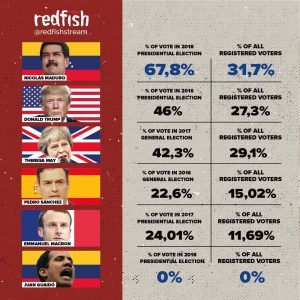
THE NEOCON PLAYBOOK IS A RECIPE FOR DISASTER IN VENEZUELA

Neocon Nosferatu: Making South America Great Again. Photo credit: DonkeyHotey / WhoWhatWhy (CC BY-SA 2.0)

By Klaus Marre and Donkeyhotey

Source: Who.What.Why.

When Donald Trump promised that he would only hire the “best people,” maybe he should have been pressed on what, exactly, they would be good at. Because it’s clearly not running the US government. Over the past two years, it has become clear that liars, grifters, conmen, opportunists, and crooks seem to be drawn to the president like flies to … well, you know.

Now, however, a situation is arising for which one of Trump’s “best people” seems ideally suited for forcing regime change somewhere in the Americas.

At a time when the president seems intent on getting the US out of Syria and Afghanistan, he appears to be equally determined to plunge headfirst into the chaos in Venezuela.

His point person for this adventure is Elliott Abrams, who has a long history of mucking around in the US’s backyard — often with dubious methods. In other words, he’ll fit right in.

To those unfamiliar with Abrams, here are the CliffsNotes: In the early 1980s, Abrams served as assistant secretary of state for human rights, which, in retrospect, seems like some kind of cruel joke. In that position, Abrams once stated that former Guatemalan leader General Efraín Ríos Montt “brought considerable progress” to human rights in his country. In case you are not familiar with Ríos Montt, he was convicted of genocide and crimes against humanity in 2013.

Abrams’s motives back then seemed to be consistent with the goals of the military-industrial complex: He wanted an embargo on military aid to Guatemala to be lifted. Just as an aside, and unrelated to Abrams but possibly relevant to Venezuela, the CIA-engineered coup in Guatemala in 1954 did nothing to stabilize the country and led to a brutal and lengthy civil war.

Around the same time, Abrams sought to downplay reports of a massacre in El Salvador and testified before the Senate that the incident was being used for guerilla propaganda. A decade later, however, the UN-approved Salvadoran Truth Commission found that more than 500 civilians were “deliberately and systematically” murdered during that massacre. At the time, the Reagan administration was worried about El Salvador becoming a communist country and falling under the influence of the Soviet Union and spent billions to provide weapons to El Salvador’s military. Oh, and there was a brutal and lengthy civil war.

But Abrams truly left his mark when trying to solicit funding for the Nicaraguan Contras from the Sultan of Brunei. He later tried to cover up what happened and ended up pleading guilty to two counts of withholding information from Congress. He was pardoned by George H.W. Bush. All of this, of course, had to do with the US government supporting far-right “rebels” in Nicaragua and it involves a lengthy civil war that took a terrible toll on the country.

You may be detecting a pattern here.

We were certainly skeptical when it was announced that Abrams would be the special envoy for Venezuela. Throw in John Bolton and you have all of the ingredients you need for another neocon clusterfuck.

While Venezuela seems in urgent need of assistance, history has shown time and again that when the US “helps” in the Americas, almost everybody ends up worse than before — apart from the new US-backed right-wing regime and the people who supply the weapons. Just ask Abrams, who has had a front-row seat for some of the worst examples.

Based on his track record, he will make a terrible situation much worse. But maybe that’s the plan. And then he would certainly be the right man for the job.

Some interesting new information about 9/11

Source: TruePublica.org

TruePublica Editor: We have published almost nothing about 9/11 on TruePublica. When independent news outlets do, they are immediately branded by the mainstream media and so-called ‘fact-checkers’ as conspiracy theorists. The BBC makes this point precisely in a 2018 article that starts like this – “On 11 September 2001, four passenger planes were hijacked by radical Islamist terrorists – almost 3,000 people were killed as the aircraft were flown into the World Trade Centre, the Pentagon and a Pennsylvania field. Just hours after the collapse of New York’s Twin Towers, a conspiracy theory surfaced online which persists more than 16 years later.”

The entire article is dedicated to all the ‘conspiracy theories’ involved in 9/11 and makes a mockery of anyone or anything that questions the official government line. They even heavily mock the brother of one man killed in 9/11 and frankly, true or not, the BBC’s report itself is rather sickening to read.

And yet, here we are, all these years later and it’s hardly surprising the theories of a conspiracy continue.

2016 study from Chapman University in California, found more than half of the American people believe the government is concealing information about the 9/11 attacks. This is in part because, large sections of the official US government report were redacted for years – and is still missing to this day.

The big problem is that the government is withholding crucial evidence. And then there’s other evidence the state and mainstream media refuse to even consider.

Paul Craig Roberts is an American economist and former United States Assistant Secretary of the Treasury for Economic Policy under President Reagan. Roberts was an associate editor and columnist for The Wall Street Journal and columnist for Business Week and has received the Warren Brookes Award for Excellence in Journalism. In 1993 the Forbes Media Guide ranked him as one of the top seven journalists in the United States.

Roberts wrote this really interesting piece of information just a few days ago that the mainstream media has been completely silent about: “Although the United States is allegedly a democracy with a rule of law, it has taken 17 years for public pressure to bring about the first grand jury investigation of 9/11. Based on the work of Architects & Engineers for 9/11 Truth led by Richard Gage, first responder and pilots organizations, books by David Ray Griffin and others, and eyewitness testimony, the Lawyers’ Committee for 9/11 Inquiry has presented enough hard facts to the US Attorney for the Southern District of New York to force his compliance with the provisions of federal law that require the convening of a federal grand jury to investigate for the first time the attacks of September 11, 2001. https://www.lawyerscommitteefor9-11inquiry.org

This puts the US Justice (sic) Department in an extraordinary position. There will be tremendous pressures on the US Attorney’s office to have the grand jury dismiss the evidence as an unpatriotic conspiracy theory or otherwise maneuver to discredit the evidence presented by the Lawyers’ Committee, or modify the official account without totally discrediting it.

“What the 9/11 truthers and the Lawyers’ Committee have achieved is the destruction of the designation of 9/11 skeptics as “conspiracy theorists.” No US Attorney would convene a grand jury on the basis of a conspiracy theory. Clearly, the evidence is compelling that has put the US Attorney in an unenviable position.”

If the Lawyers’ Committee and the 9/11 truthers trust the US Attorney to go entirely by the facts, little will come of the grand jury. If the United States had a rule of law, something as serious as 9/11 could not have gone for 17 years without investigation.”

Three weeks before Roberts’ made this statement a letter was published by Off-Guardian about a Huffington Post hit piece about an academic teaching journalism. Its first paragraph explains entirely its own position.

An academic teaching journalism students at one of the UK’s top universities has publicly supported long-discredited conspiracy theories about the 9/11 terror attack, HuffPost UK can reveal.

This entire article, like that of the BBC’s, vigorously attacks any individual or organisation that has the temerity to question the ‘official’ narrative on any major incident as offered up by the state, such as the Skripal poisonings, Syria’s chemical weapons, Iraq and Chilcot Report.

HuffPost even uses an unnamed former head of MI6 and an unnamed former Supreme Commander of Nato to dispel such challenges to this narrative and then attacks other sources of news such as RT as nothing more than Russian propaganda irrespective of the source. As a rule, TruePublica does not publish news sourced by RT but that does not make all of its content propaganda.

David Ray Griffin, a retired American professor and political writer who founded the Center for Process Studies which seeks to promote the common good by means of the relational approach found in process thought was the co-author of the book ‘9/11 Unmasked’ – part of the attack piece was centred on by the HuffPost hit piece.

The head of the 9/11 Consensus Panel, the other co-author, responded to the HuffPost.  For information, the goal of the Consensus Panel is to “provide a ready source of evidence-based research to any investigation that may be undertaken by the public, the media, academia, or any other investigative body or institution.”

That letter is as follows:


Jess Brammer, UK Huffington Post
Chris York, UK Huffington Post

Dear Ms. Brammar and Mr. York:

I was the head information specialist serving the Medical Health Officers of British Columbia, Canada, for 25 years.

Your attack piece on Professor Piers Robinson and on the scholarly work of Dr. David Ray Griffin is the least accurate and the lowest quality published article I have ever seen.

I have assisted Dr. Griffin with 10 of his investigative books into the events of 9/11. In 2011 we decided to create the international 9/11 Consensus Panel to review and evaluate the official claims relating to September 11, 2001. The Panel we formed has 23 members, including people from the fields of physics, chemistry, structural engineering, aeronautical engineering, piloting, airplane crash investigation, medicine, journalism, psychology, and religion (For the full list, see here).

In seeking a consensus methodology, I was advised by the former provincial epidemiologist of British Columbia to employ a leading model that is used in medicine to establish the best diagnostic and treatment evidence to guide the world’s doctors using medical consensus statements.

The Panel methodology has produced, seven years later, 51 refutations of the official claims, which were published as 911 Unmasked: An International Review Panel Investigation in September, 2018.

Each Consensus Point, now a chapter in this book, was given three rounds of review and feedback by the Panel members. The panelists were blind to one another throughout the process, providing strictly uninfluenced individual feedback. Any Points that did not receive 85% approval by the third round were set aside.

The Honorary Members of the Panel include the late British (and longest-serving) parliamentarian Michael Meacher, the late evolutionary biologist Lynn Margulis, and the late Honorary President of the Italian Supreme Court, Ferdinando Imposimato.

The Huffington Post drastically lowered its standards to publish this hit piece, and what influenced it to do so is a question worth pursuing.

Yours truly

Elizabeth Woodworth, Co-author with Dr. David Ray Griffin
9/11 Unmasked


It is over 18 years now since the world-changing event of 9/11. One wonders when the information held by the American government, that continues to anger so many people affected by it will ever emerge.

However, one reason why such questions persist is precisely that of the actions of the US government itself. One should not forget those so-called ‘conspiracy theories’ that actually came true that continues to pour petrol on the flames of doubt.

For example, the American government killed thousands by poisoning alcohol to prove its point that alcohol was bad for the general public during prohibition. This was a ‘conspiracy theory’ that went on for decades – until it was proven to be true.

Then, you can take your pick of the lies government tells when it comes to starting wars – how about the lie the Saddam Hussain and Iraq had WMD ready to fire at Western targets. Total deaths exceeded 1 million. Yet another classic American lie was the Gulf of Tonkin incident in August 1964, as a pretext for escalating the country’s involvement in the Vietnam War that killed 60,000 American soldiers. Total deaths racked up 1.35 million, all based on a lie. That incident only came about because of an unintentional declassification of an NSA file in 2005.

Edward Snowden proved with his revelations in 2013 that the government was spying on everyone when the government had denied they had ever done so. It took a whistleblower to let us all know. The UK government has been found by the highest courts in the land to have broken numerous privacy and surveillance laws as a result of mass civilian surveillance systems.

Operation Mockingbird was a US government operation where journalists were paid to publish CIA propaganda, only uncovered by the Watergate scandal. It took a thief to unknowingly capture secret documents and recordings for the public to find out.

The list goes on and on – just as 9/11 will, so it will be interesting to see how the US Attorney, presented with evidence from so many prominent professionals will bury yet more 9/11 evidence. Don’t hold your breath though, the same questions will, no doubt, still be being asked in another 18 years time.

A Nonviolent Strategy to Defeat a US Military Invasion of Venezuela

By Robert J. Burrowes

To the People of Venezuela

Recently I wrote an article explaining how you could defeat, using nonviolent strategy, the US coup attempt that is taking place in your country. See ‘A Nonviolent Strategy to Defeat the US Coup Attempt in Venezuela’.

I would like to complement that article by now briefly explaining how you can also defeat a military invasion by the United States and any collaborating invaders by using a strategy of nonviolent defense as well.

In making this suggestion, I acknowledge the extraordinary difficulties inflicted on Venezuela by the US sanctions imposed over many years as part of its ‘undeclared war against Venezuela’ (partly designed to destroy its progressive social banking model), explained straightforwardly by Ellen Brown in her article ‘The Venezuela Myth Keeping Us From Transforming Our Economy’ as well as alternative proposals to resolve the crisis, ranging from that by several governments to facilitate dialogue between the Venezuelan government and the opposition – see, for example, ‘Russia Proposes Venezuelan “Peaceful Measures” Initiative to UN’ – to Stephen Lendman’s suggestion that a peacekeeping force be deployed to Venezuela by such countries as Russia, China and non-aligned nations. See ‘Save Venezuelan Sovereignty: Oil Economy Destabilized. Peace-keeping Role by Russia, China, Non-alligned Nations?’

I understand that your first reaction to the idea of a strategy of nonviolent defense might be one of scepticism or even outright disbelief. However, if you are willing to consider what I write below, I will briefly explain why a strategy of nonviolent defense is theoretically and empirically sound, has often been successful in a wide range of contexts in the past, and why I believe it is important and how it can be done.

Of course, I am well aware that this history of successful nonviolent defense is little known because it has been, and still is, suppressed. And yet the history of nonviolent resistance in many diverse contexts clearly demonstrates that a strategy of nonviolent defense has the best chance of defending your country while minimizing the death and destruction in doing so (which does not mean that it would be without cost).

Moreover, if you want to read many carefully documented historical accounts of nonviolent struggles that were successful against military opponents, including those that were ruthlessly violent, you can do so in The Strategy of Nonviolent Defense: A Gandhian Approach. The book also carefully explains why these successes occurred without incurring heavy casualties on the defense, particularly in comparison to military campaigns and guerrilla struggles.

In my view then, the idea of implementing a strategy of nonviolent defense is important to consider for two essential reasons.

First, you are dealing with an opponent that is insane – see ‘The Global Elite is Insane Revisited’ with a more detailed explanation in ‘Why Violence?’ and ‘Fearless Psychology and Fearful Psychology: Principles and Practice’incredibly ignorant – see this interview of US Secretary of State, Mike Pompeo ‘Venezuelan military will realize Maduro’s time is up: Mike Pompeo’ which is critiqued in these articles ‘Pompeo: America “obligated” to fight “Hezbollah” in Venezuela to save “duly elected” Guaido’ and ‘Pompeo Attempts to Link Iran, Hezbollah to Crisis in Venezuela’ – and grotesquely violent – see ‘The History – and Hypocrisy – of US Meddling in Venezuela’ and Killing Hope: US Military and CIA Interventions Since World War II – that, history teaches us, is highly likely to destroy your country to gain the geostrategic advantage and natural resources that control of your country offers, as the people of Iraq and Libya, for example, can testify.

And second: no matter how committed and courageous are the (loyal) members of your military forces and civilian militia (the National Bolivarian Militia of Venezuela), and the military forces of any allies who will stand with you in the defense of Venezuela, even a ‘successful’ outcome, such as that which Syria may be on the verge of ‘celebrating’, will only come at enormous cost in terms of human lives, infrastructure (including national heritage), ecological impact and time, all of which can be far more gainfully employed to continue building Venezuela, including overcoming outstanding problems, as you decide.

The Background

As I know that you are well aware, given the declared interest of the US elite in stealing your natural resources, including oil – see, for example, ‘“Good for business”: Trump adviser Bolton admits US interest in Venezuela’s “oil capabilities”’ and ‘Regime Change for Profit: Chevron, Halliburton Cheer On US Venezuela Coup’ – the US elite has long interfered with – see, for example, ‘US Influence in Venezuela Is Part of a Two Centuries-old Imperial Plan’ – and threatened military invasion of Venezuela to seize control of these resources in clear violation of international law. For recent examples only, see ‘Trump pressed aides on Venezuela invasion, US official says’ and ‘Time for talks “long passed”: US weaponizes aid amid push for regime change in Venezuela’.

Consequently, the US administration has finally used the pretext of an unfair election result in 2018 to call for the overthrow of your government despite the widely accepted result, verified by independent sources, and even the testimony of a former US president that your electoral system is without peer. See ‘Former US President Carter: Venezuelan Electoral System “Best in the World”’.

Moreover, the US puppet Juan Guaidó, anointed by the US to replace your elected President, has effectively indicated his support for US intervention, which clearly reveals where his loyalties lie, his willingness to now provide a pretext for a US invasion, and his complete disregard for the well-being of those Venezuelans who will inevitably be killed, injured and/or dispossessed during an invasion to support the ‘neocon regime-changers’ in Washington. See ‘Venezuela’s self-proclaimed “president” Guaido isn’t ruling out “authorizing” US intervention’ and ‘The Cynicism of Empire: Sen. Rubio Tells Venezuelans to Overthrow Their Government… or Starve!’

This threat of military intervention, as the historical record clearly demonstrates, has every prospect of being carried out. See ‘Before Venezuela: The long history of U.S. intervention in Latin America’ and ‘Overthrowing other people’s governments: The Master List’.

Despite this threat, as you are aware, President Nicolás Maduro has persisted in offering to discuss the issues arising from this conflict while also calling on the international community to ‘“Stop Trump’s insane actions!” Venezuela’s Maduro talks to RT about avoiding war’ and even writing an appeal to the people of the United States which, of course, was ignored by the corporate media so that it does not even reach a wide audience. See ‘An Open Letter to the People of the United States from President Nicolas Maduro’.

While I applaud your President for his persistent calls for dialogue to resolve this issue – for a recent example, see ‘Maduro Asks International Community to End US’s Threats of War’there are simply three realities that make it highly unlikely that his call will be heeded, whether by the US administration that has already rejected such a call – see ‘Time for talks “long passed”: US weaponizes aid amid push for regime change in Venezuela’ – or by the international community, a substantial section of which has already declared their support for the US puppet Juan Guaidó, who has been carefully groomed for a decade for the role he is now playing. See ‘The Making of Juan Guaidó: How the US Regime Change Laboratory Created Venezuela’s Coup Leader’.

These three realities are those I mentioned above: You are dealing with an insane, incredibly ignorant and grotesquely violent opponent: an elite that seeks geopolitical control and endless resources for profit no matter what the cost to fellow human beings and the biosphere, as the record demonstrates.

Moreover, in seeking to secure its objectives, the US elite will endeavour to control the narrative in relation to Venezuela. Hence, as you have noticed, the corporate media is lying prodigiously about Venezuela as it ‘beats the drums of war’. See, for example, ‘Dissecting the jingoistic media coverage of the Venezuela crisis’, ‘Venezuela Blitz – Part 1: Tyrants Don’t Have Free Elections’, ‘Venezuela Blitz – Part 2: Press Freedom, Sanctions And Oil’ and ‘The BBC and Venezuela: bias and lies’.

For you and those of us outside Venezuela who have some knowledge of your country’s history, we are well aware of the enormous gains made by the Bolivarian movement, despite the enormously damaged country that the movement inherited. See, for example, ‘Venezuela: From Oil Proxy to the Bolivarian Movement and Sabotage’.

This progress, of course, does not mean that all problems have been resolved, most of which have been exacerbated by the sanctions imposed in recent years by the United States government. See, for example, the report by Alfred de Zayas on behalf of the United Nations Human Rights Council – ‘Report of the Independent Expert on the promotion of a democratic and equitable international order on his mission to the Bolivarian Republic of Venezuela and Ecuador’ – which identified the crisis the US ‘economic warfare’ was precipitating. See ‘Former UN Rapporteur: US Sanctions Against Venezuela Causing Economic and Humanitarian Crisis’.

Defending Against a US Military Invasion of Venezuela

So, while your effort to defeat the coup attempt continues, even if the United States military invades Venezuela before or after this issue is resolved, you have the powerful option of resisting any invasion effectively by employing a strategy of nonviolent defense.

I have explained the essential points of this strategy on the website Nonviolent Defense/Liberation Strategy. The pages of this website provide clear guidance on how to easily plan and then implement the twelve components of this strategy.

If you like, you can see a diagrammatic representation of this strategy by looking at the Nonviolent Strategy Wheel.

And on the Strategic Aims page you can see the basic list of 30 strategic goals necessary to defeat a military invasion. These strategic goals can easily be adopted, modified and/or added to if necessary, in accordance with your precise circumstances as you decide.

If you want to read a straightforward account of how to plan and conduct a nonviolent tactic so that it has strategic impact, you can do so here: ‘Nonviolent Action: Why and How it Works’.

This will require awareness of the difference between ‘The Political Objective and Strategic Goal of Nonviolent Actions’.

And, to ensure that the military violence directed against you is made as difficult as possible to perpetrate and, in many cases, does not eventuate, you are welcome to consider the 20 points designed to ensure that you are ‘Minimizing the Risk of Violent Repression’ whenever you take nonviolent action to defend yourselves when repression is a risk. This information is useful for both neutralizing violent provocateurs but also to ensure that invading military forces are compelled to deal with complex emotional and moral issues that do not arise against a violent opponent who is threatening them, and which will lead some, and perhaps very many, to desist as the historical record clearly documents. Again, for many examples, see The Strategy of Nonviolent Defense: A Gandhian Approach.

Conclusion

The US government and its sycophantic allies might not invade Venezuela. It may transpire that the diplomatic and other efforts of your government to defeat the coup and avert a US-led military invasion of Venezuela will be successful. There is also a fracturing of the opposition forces within Venezuela, in several ways, which works against the success of ongoing efforts to remove your government. See ‘Venezuela Regime Change “Made in the USA”’.

However, the extensive historical evidence of US interventions in violation of international law, the geostrategic and natural resource advantages that will accrue to the US elite from an invasion that removes your elected government, the anointment of a puppet president of Venezuela, the recent posturing and declarations by key members of the US administration and many US-allied governments, and the manufacture of public acquiescence by the corporate media all point heavily in the direction of invasion. And, as you are well aware, it is wise to treat this possibility seriously.

The elite conducting these preparatory moves is insane and, if it attacks Venezuela, there is a serious risk it will destroy your country as it has destroyed Iraq and Libya, especially if it meets significant military resistance. Their insanity precludes them caring about you, the people of Venezuela (even as they present any intervention as ‘humanitarian’). See ‘Love Denied: The Psychology of Materialism, Violence and War’. They care about nothing more than geostrategic advantage, eliminating progressive elements of your society’s development, and seizing your natural resources from which they can profit enormously.

Nevertheless, a strategy of nonviolent defense would enable you to defend yourselves and enable every last member of your population, irrespective of age and ability, to be strategically involved, as well as any solidarity activists overseas. It would also minimize the loss of life and destruction inflicted on your country.

Importantly, even if you suffer setbacks, unless and until you accept outright defeat, your strategy of nonviolent defense, ongoingly refined to maintain effective strategic coordination and to retain the initiative, will ultimately prevail.

As always, however, whether or not you decide to consider/adopt my suggestion, you have my solidarity.


Biodata: Robert J. Burrowes has a lifetime commitment to understanding and ending human violence. He has done extensive research since 1966 in an effort to understand why human beings are violent and has been a nonviolent activist since 1981. He is the author of ‘Why Violence?’ His email address is flametree@riseup.net and his website is here.

Saker interview with Michael Hudson on Venezuela, February 7, 2019

By The Saker and Michael Hudson

Source: The Saker

Introduction: There is a great deal of controversy about the true shape of the Venezuelan economy and whether Hugo Chavez’ and Nicholas Maduro’s reform and policies were crucial for the people of Venezuela or whether they were completely misguided and precipitated the current crises.  Anybody and everybody seems to have very strong held views about this.  But I don’t simply because I lack the expertise to have any such opinions.  So I decided to ask one of the most respected independent economists out there, Michael Hudson, for whom I have immense respect and whose analyses (including those he co-authored with Paul Craig Roberts) seem to be the most credible and honest ones you can find.  In fact, Paul Craig Roberts considers Hudson the “best economist in the world“!
I am deeply grateful to Michael for his replies which, I hope, will contribute to a honest and objective understanding of what really is taking place in Venezuela.
The Saker

The Saker: Could you summarize the state of Venezuela’s economy when Chavez came to power?

Michael Hudson: Venezuela was an oil monoculture. Its export revenue was spent largely on importing food and other necessities that it could have produced at home. Its trade was largely with the United States. So despite its oil wealth, it ran up foreign debt.

From the outset, U.S. oil companies have feared that Venezuela might someday use its oil revenues to benefit its overall population instead of letting the U.S. oil industry and its local comprador aristocracy siphon off its wealth. So the oil industry – backed by U.S. diplomacy – held Venezuela hostage in two ways.

First of all, oil refineries were not built in Venezuela, but in Trinidad and in the southern U.S. Gulf Coast states. This enabled U.S. oil companies – or the U.S. Government – to leave Venezuela without a means of “going it alone” and pursuing an independent policy with its oil, as it needed to have this oil refined. It doesn’t help to have oil reserves if you are unable to get this oil refined so as to be usable.

Second, Venezuela’s central bankers were persuaded to pledge their oil reserves and all assets of the state oil sector (including Citgo) as collateral for its foreign debt. This meant that if Venezuela defaulted (or was forced into default by U.S. banks refusing to make timely payment on its foreign debt), bondholders and U.S. oil majors would be in a legal position to take possession of Venezuelan oil assets.

These pro-U.S. policies made Venezuela a typically polarized Latin American oligarchy. Despite being nominally rich in oil revenue, its wealth was concentrated in the hands of a pro-U.S. oligarchy that let its domestic development be steered by the World Bank and IMF. The indigenous population, especially its rural racial minority as well as the urban underclass, was excluded from sharing in the country’s oil wealth. The oligarchy’s arrogant refusal to share the wealth, or even to make Venezuela self-sufficient in essentials, made the election of Hugo Chavez a natural outcome.

The Saker: Could you outline the various reforms and changes introduced by Hugo Chavez? What did he do right, and what did he do wrong?

Michael Hudson: Chavez sought to restore a mixed economy to Venezuela, using its government revenue – mainly from oil, of course – to develop infrastructure and domestic spending on health care, education, employment to raise living standards and productivity for his electoral constituency.

What he was unable to do was to clean up the embezzlement and built-in rake-off of income from the oil sector. And he was unable to stem the capital flight of the oligarchy, taking its wealth and moving it abroad – while running away themselves.

This was not “wrong”. It merely takes a long time to change an economy’s disruption – while the U.S. is using sanctions and “dirty tricks” to stop that process.

The Saker: What are, in your opinion, the causes of the current economic crisis in Venezuela – is it primarily due to mistakes by Chavez and Maduro or is the main cause US sabotage, subversion and sanctions?

Michael Hudson: There is no way that’s Chavez and Maduro could have pursued a pro-Venezuelan policy aimed at achieving economic independence without inciting fury, subversion and sanctions from the United States. American foreign policy remains as focused on oil as it was when it invaded Iraq under Dick Cheney’s regime. U.S. policy is to treat Venezuela as an extension of the U.S. economy, running a trade surplus in oil to spend in the United States or transfer its savings to U.S. banks.

By imposing sanctions that prevent Venezuela from gaining access to its U.S. bank deposits and the assets of its state-owned Citco, the United States is making it impossible for Venezuela to pay its foreign debt. This is forcing it into default, which U.S. diplomats hope to use as an excuse to foreclose on Venezuela’s oil resources and seize its foreign assets much as Paul Singer hedge fund sought to do with Argentina’s foreign assets.

Just as U.S. policy under Kissinger was to make Chile’s “economy scream,” so the U.S. is following the same path against Venezuela. It is using that country as a “demonstration effect” to warn other countries not to act in their self-interest in any way that prevents their economic surplus from being siphoned off by U.S. investors.

The Saker: What in your opinion should Maduro do next (assuming he stays in power and the USA does not overthrow him) to rescue the Venezuelan economy?

Michael Hudson: I cannot think of anything that President Maduro can do that he is not doing. At best, he can seek foreign support – and demonstrate to the world the need for an alternative international financial and economic system.

He already has begun to do this by trying to withdraw Venezuela’s gold from the Bank of England and Federal Reserve. This is turning into “asymmetrical warfare,” threatening what to de-sanctify the dollar standard in international finance. The refusal of England and the United States to grant an elected government control of its foreign assets demonstrates to the entire world that U.S. diplomats and courts alone can and will control foreign countries as an extension of U.S. nationalism.

The price of the U.S. economic attack on Venezuela is thus to fracture the global monetary system. Maduro’s defensive move is showing other countries the need to protect themselves from becoming “another Venezuela” by finding a new safe haven and paying agent for their gold, foreign exchange reserves and foreign debt financing, away from the dollar, sterling and euro areas.

The only way that Maduro can fight successfully is on the institutional level, upping the ante to move “outside the box.” His plan – and of course it is a longer-term plan – is to help catalyze a new international economic order independent of the U.S. dollar standard. It will work in the short run only if the United States believes that it can emerge from this fight as an honest financial broker, honest banking system and supporter of democratically elected regimes. The Trump administration is destroying illusion more thoroughly than any anti-imperialist critic or economic rival could do!

Over the longer run, Maduro also must develop Venezuelan agriculture, along much the same lines that the United States protected and developed its agriculture under the New Deal legislation of the 1930s – rural extension services, rural credit, seed advice, state marketing organizations for crop purchase and supply of mechanization, and the same kind of price supports that the United States has long used to subsidize domestic farm investment to increase productivity.

The Saker: What about the plan to introduce a oil-based crypto currency? Will that be an effective alternative to the dying Venezuelan Bolivar?

Michael Hudson: Only a national government can issue a currency. A “crypto” currency tied to the price of oil would become a hedging vehicle, prone to manipulation and price swings by forward sellers and buyers. A national currency must be based on the ability to tax, and Venezuela’s main tax source is oil revenue, which is being blocked from the United States. So Venezuela’s position is like that of the German mark coming out of its hyperinflation of the early 1920s. The only solution involves balance-of-payments support. It looks like the only such support will come from outside the dollar sphere.

The solution to any hyperinflation must be negotiated diplomatically and be supported by other governments. My history of international trade and financial theory, Trade, Development and Foreign Debt, describes the German reparations problem and how its hyperinflation was solved by the Rentenmark.

Venezuela’s economic-rent tax would fall on oil, and luxury real estate sites, as well as monopoly prices, and on high incomes (mainly financial and monopoly income). This requires a logic to frame such tax and monetary policy. I have tried to explain how to achieve monetary and hence political independence for the past half-century. China is applying such policy most effectively. It is able to do so because it is a large and self-sufficient economy in essentials, running a large enough export surplus to pay for its food imports. Venezuela is in no such position. That is why it is looking to China for support at this time.

The Saker: How much assistance do China, Russia and Iran provide and how much can they do to help? Do you think that these three countries together can help counter-act US sabotage, subversion and sanctions?

Michael Hudson: None of these countries have a current capacity to refine Venezuelan oil. This makes it difficult for them to take payment in Venezuelan oil. Only a long-term supply contract (paid for in advance) would be workable. And even in that case, what would China and Russia do if the United States simply grabbed their property in Venezuela, or refused to let Russia’s oil company take possession of Citco? In that case, the only response would be to seize U.S. investments in their own country as compensation.

At least China and Russia can provide an alternative bank clearing mechanism to SWIFT, so that Venezuela can by pass the U.S. financial system and keep its assets from being grabbed at will by U.S. authorities or bondholders. And of course, they can provide safe-keeping for however much of Venezuela’s gold it can get back from New York and London.

Looking ahead, therefore, China, Russia, Iran and other countries need to set up a new international court to adjudicate the coming diplomatic crisis and its financial and military consequences. Such a court – and its associated international bank as an alternative to the U.S.-controlled IMF and World Bank – needs a clear ideology to frame a set of principles of nationhood and international rights with power to implement and enforce its judgments.

This would confront U.S. financial strategists with a choice: if they continue to treat the IMF, World Bank, ITO and NATO as extensions of increasingly aggressive U.S. foreign policy, they will risk isolating the United States. Europe will have to choose whether to remain a U.S. economic and military satellite, or to throw in its lot with Eurasia.

However, Daniel Yergin reports in the Wall Street Journal (Feb. 7) that China is trying to hedge its bets by opening a back-door negotiation with Guaido’s group, apparently to get the same deal that it has negotiated with Maduro’s government. But any such deal seems unlikely to be honored in practice, given U.S. animosity toward China and Guaido’s total reliance on U.S. covert support.

The Saker: Venezuela kept a lot of its gold in the UK and money in the USA. How could Chavez and Maduro trust these countries or did they not have another choice? Are there viable alternatives to New York and London or are they still the “only game in town” for the world’s central banks?

Michael Hudson: There was never real trust in the Bank of England or Federal Reserve, but it seemed unthinkable that they would refuse to permit an official depositor from withdrawing its own gold. The usual motto is “Trust but verify.” But the unwillingness (or inability) of the Bank of England to verify means that the formerly unthinkable has now arrived: Have these central banks sold this gold forward in the post-London Gold Pool and its successor commodity markets in their attempt to keep down the price so as to maintain the appearance of a solvent U.S. dollar standard.

Paul Craig Roberts has described how this system works. There are forward markets for currencies, stocks and bonds. The Federal Reserve can offer to buy a stock in three months at, say, 10% over the current price. Speculators will by the stock, bidding up the price, so as to take advantage of “the market’s” promise to buy the stock. So by the time three months have passed, the price will have risen. That is largely how the U.S. “Plunge Protection Team” has supported the U.S. stock market.

The system works in reverse to hold down gold prices. The central banks holding gold can get together and offer to sell gold at a low price in three months. “The market” will realize that with low-priced gold being sold, there’s no point in buying more gold and bidding its price up. So the forward-settlement market shapes today’s market.

The question is, have gold buyers (such as the Russian and Chinese government) bought so much gold that the U.S. Fed and the Bank of England have actually had to “make good” on their forward sales, and steadily depleted their gold? In this case, they would have been “living for the moment,” keeping down gold prices for as long as they could, knowing that once the world returns to the pre-1971 gold-exchange standard for intergovernmental balance-of-payments deficits, the U.S. will run out of gold and be unable to maintain its overseas military spending (not to mention its trade deficit and foreign disinvestment in the U.S. stock and bond markets). My book on Super-Imperialism explains why running out of gold forced the Vietnam War to an end. The same logic would apply today to America’s vast network of military bases throughout the world.

Refusal of England and the U.S. to pay Venezuela means that other countries means that foreign official gold reserves can be held hostage to U.S. foreign policy, and even to judgments by U.S. courts to award this gold to foreign creditors or to whoever might bring a lawsuit under U.S. law against these countries.

This hostage-taking now makes it urgent for other countries to develop a viable alternative, especially as the world de-dedollarizes and a gold-exchange standard remains the only way of constraining the military-induced balance of payments deficit of the United States or any other country mounting a military attack. A military empire is very expensive – and gold is a “peaceful” constraint on military-induced payments deficits. (I spell out the details in my Super Imperialism: The Economic Strategy of American Empire (1972), updated in German as Finanzimperium(2017).

The U.S. has overplayed its hand in destroying the foundation of the dollar-centered global financial order. That order has enabled the United States to be “the exceptional nation” able to run balance-of-payments deficits and foreign debt that it has no intention (or ability) to pay, claiming that the dollars thrown off by its foreign military spending “supply” other countries with their central bank reserves (held in the form of loans to the U.S. Treasury – Treasury bonds and bills – to finance the U.S. budget deficit and its military spending, as well as the largely military U.S. balance-of-payments deficit.

Given the fact that the EU is acting as a branch of NATO and the U.S. banking system, that alternative would have to be associated with the Shanghai Cooperation Organization, and the gold would have to be kept in Russia and/or China.

The Saker:  What can other Latin American countries such as Bolivia, Nicaragua, Cuba and, maybe, Uruguay and Mexico do to help Venezuela?

Michael Hudson: The best thing neighboring Latin American countries can do is to join in creating a vehicle to promote de-dollarization and, with it, an international institution to oversee the writedown of debts that are beyond the ability of countries to pay without imposing austerity and thereby destroying their economies.

An alternative also is needed to the World Bank that would make loans in domestic currency, above all to subsidize investment in domestic food production so as to protect the economy against foreign food-sanctions – the equivalent of a military siege to force surrender by imposing famine conditions. This World Bank for Economic Acceleration would put the development of self-reliance for its members first, instead of promoting export competition while loading borrowers down with foreign debt that would make them prone to the kind of financial blackmail that Venezuela is experiencing.

Being a Roman Catholic country, Venezuela might ask for papal support for a debt write-down and an international institution to oversee the ability to pay by debtor countries without imposing austerity, emigration, depopulation and forced privatization of the public domain.

Two international principles are needed. First, no country should be obliged to pay foreign debt in a currency (such as the dollar or its satellites) whose banking system acts to prevents payment.

Second, no country should be obliged to pay foreign debt at the price of losing its domestic autonomy as a state: the right to determine its own foreign policy, to tax and to create its own money, and to be free of having to privatize its public assets to pay foreign creditors. Any such debt is a “bad loan” reflecting the creditor’s own irresponsibility or, even worse, pernicious asset grab in a foreclosure that was the whole point of the loan.

The Saker:  Thank you very much for taking the time to reply to my questions!

Saturday Matinee: Z

Review by Roger Ebert

Source: RogerEbert.com

There are some things that refuse to be covered over. It would be more convenient, yes, and easier for everyone if the official version were believed. But then the facts begin to trip over one another, and contradictions emerge, and an “accident” is revealed as a crime.

The film “Z” is about one of these things: about the assassination, six years ago, of a leader of the political opposition in Greece. It is also about all the rest of them. For Americans, it is about the My Lai massacre, the killing of Fred Hampton, the Bay of Pigs. It is no more about Greece than “The Battle of Algiers” was about Algeria. It is a film of our time. It is about how even moral victories are corrupted. It will make you weep and will make you angry. It will tear your guts out.

It is told simply, and it is based on fact. On May 22, 1963, Gregorios Lambrakis was fatally injured in a “traffic accident.” He was a deputy of the opposition party in Greece. The accident theory smelled, and the government appointed an investigator to look into the affair.

His tacit duty was to reaffirm the official version of the death, but his investigation convinced him that Lambrakis had, indeed, been assassinated by a clandestine right-wing organization. High-ranking army and police officials were implicated. The plot was unmasked in court and sentences were handed down — stiff sentences to the little guys (dupes, really) who had carried out the murder, and acquittal for the influential officials who had ordered it.

But the story was not over. When the Army junta staged its coup in 1967, the right-wing generals and the police chief were cleared of all charges and “rehabilitated.” Those responsible for unmasking the assassination now became political criminals.

These would seem to be completely political events, but the young director Costa-Gravas has told them in a style that is almost unbearably exciting. “Z” is at the same time a political cry of rage and a brilliant suspense thriller. It even ends in a chase: Not through the streets but through a maze of facts, alibis and official corruption.

Like Gillo Pontecorvo, who directed “Battle of Algiers,” Costa-Gravas maintains a point of view above the level of the events he photographs. His protagonist changes during the film as he leads us from an initial personal involvement to the indictment of an entire political system. At first, we are interested in Yves Montand, the wise and gentle political leader who is slain. Then our attention is directed to the widow (Irene Papas) and to the opposition leaders who will carry on (Charles Denner and Bernard Fresson).

And then, in the masterful last third of the film, we follow the stubborn investigator (Jean-Louis Trintignant) as he resists official pressure to conceal the scandal. He puts together his evidence almost reluctantly; he has no desire to bring down the government, but he must see justice done if he can. His sympathies are neutral, and a truly neutral judge is the most fearsome thing the Establishment can imagine. What good is justice if it can be dealt out to the state as well as to the people? (The implications here for Chicago’s conspiracy trial are obvious.)

The movie at first seems to end with triumph. The rotten core of the government is exposed. The military men and the police chief are indicted for murder, official misconduct, obstructing justice. One of the assassinated leader’s young followers races to bring the widow the good news. He finds her waiting by the seashore. He is triumphant; justice will be done; the government will fall. Irene Papas hears his news silently and then turns and looks out to sea. Her face reflects no triumph; only suffering and despair. What is really left for her to say?

Nothing, as we know now. The right wing won in the long run and controls Greece today. This film’s director, writer, composer and Miss Papas are all banned in Greece (“banned” — that terrible word we heard from Russia and South Africa, and now from Greece). Even the letter “Z” (which means “he is alive”) is banned in Greece.

When this film was shown at the San Francisco Film Festival, it was attacked in some quarters as being anti-American, but does it not tell the simple truth? We do support the Greek junta. We do recognize the government that murdered Lambrakis. We did permit the junta to prevent free elections in Greece. And in Vietnam, the candidate who placed second in the “free elections” we sponsored sits in a Saigon jail today. His name is also banned.

Watch the full film here: https://christiebooks.co.uk/anarchist_films/z-1969-costa-gavras/

The Five Stages of Collapse, 2019 Update

By Dmitry Orlov

Source: Club Orlov

Collapse, at each stage, is a historical process that takes time to run its course as the system adapts to changing circumstances, compensates for its weaknesses and finds ways to continue functioning at some level. But what changes rather suddenly is faith or, to put it in more businesslike terms, sentiment. A large segment of the population or an entire political class within a country or the entire world can function based on a certain set of assumptions for much longer than the situation warrants but then over a very short period of time switch to a different set of assumptions. All that sustains the status quo beyond that point is institutional inertia. It imposes limits on how fast systems can change without collapsing entirely. Beyond that point, people will tolerate the older practices only until replacements for them can be found.

Stage 1: Financial collapse. Faith in “business as usual” is lost.

Internationally, the major change in sentiment in the world has to do with the role of the US dollar (and, to a lesser extent, the Euro and the Yen—the other two reserve currencies of the three-legged globalist central banker stool). The world is transitioning to the use of local currencies, currency swaps and commodities markets backed by gold. The catalyst for this change of sentiment was provided by the US administration itself which sawed through its own perch by its use of unilateral sanctions. By using its control over dollar-based transactions to block international transactions it doesn’t happen to like it forced other countries to start looking for alternatives. Now a growing list of countries sees throwing off the shackles of the US dollar as a strategic goal. Russia and China use the ruble and the yuan for their expanding trade; Iran sells oil to India for rupees. Saudi Arabia has started to accept the yuan for its oil.

This change has many knock-on effects. If the dollar is no longer needed to conduct international trade, other nations no longer have hold large quantities of it in reserve. Consequently, there is no longer a need to buy up large quantities of US Treasury notes. Therefore, it becomes unnecessary to run large trade surpluses with the US, essentially conducting trade at a loss. Further, the attractiveness of the US as an export market drops and the cost of imports to the US rises, thereby driving up cost inflation. A vicious spiral ensues in which the ability of the US government to borrow internationally to finance the gaping chasm of its various deficits becomes impaired. Sovereign default of the US government and national bankruptcy then follow.

The US may still look mighty, but its dire fiscal predicament coupled with its denial of the inevitability of bankruptcy, makes it into something of a Blanche DuBois from the Tennessee Williams play “A Streetcar Named Desire.” She was “always dependent on the kindness of strangers” but was tragically unable to tell the difference between kindness and desire. In this case, the desire is for national advantage and security, and to minimize risk by getting rid of an unreliable trading partner.

How quickly or slowly this comes to pass is difficult to guess at and impossible to calculate. It is possible to think of the financial system in terms of a physical analogue, with masses of funds traveling at some velocity having a certain inertia (p = mv) and with forces acting on that mass to accelerate it along a different trajectory (F = ma). It is also possible to think of it in terms of hordes of stampeding animals who can change course abruptly when panicked. The recent abrupt moves in the financial markets, where trillions of dollars of notional, purely speculative value have been wiped out within weeks, are more in line with the latter model.

Stage 2: Commercial collapse. Faith that “the market shall provide” is lost.

Within the US there is really no other alternative than the market. There are a few rustic enclaves, mostly religious communities, that can feed themselves, but that’s a rarity. For everyone else there is no choice but to be a consumer. Consumers who are broke are called “bums,” but they are still consumers. To the extent that the US has a culture, it is a commercial culture in which the goodness of a person is based on the goodly sums of money in their possession. Such a culture can die by becoming irrelevant (when everyone is dead broke) but by then most of the carriers of this culture are likely to be dead too. Alternatively, it can be replaced by a more humane culture that isn’t entirely based on the cult of Mammon—perhaps, dare I think, through a return to a pre-Protestant, pre-Catholic Christian ethic that values people’s souls above objects of value?

Stage 3: Political collapse. Faith that “the government will take care of you” is lost.

All is very murky at the moment, but I would venture to guess that most people in the US are too distracted, too stressed and too preoccupied with their own vices and obsessions to pay much attention to the political realm. Of the ones they do pay attention, a fair number of them seem clued in to the fact that the US is not a democracy at all but an elites-only sandbox in which transnational corporate and oligarchic interests build and knock down each others’ sandcastles.

The extreme political polarization, where two virtually identical pro-capitalist, pro-war parties pretend to wage battle by virtue-signaling may be a symptom of the extremely decrepit state of the entire political arrangement: people are made to watch the billowing smoke and to listen to the deafening noise in the hopes that they won’t notice that the wheels are no longer turning.

The fact that what amounts to palace intrigue—the fracas between the White House, the two houses of Congress and a ghoulish grand inquisitor named Mueller—has taken center stage is uncannily reminiscent of various earlier political collapses, such as the disintegration of the Ottoman Empire or of the fall and the consequent beheading of Louis XVI. The fact that Trump, like the Ottoman worthies, stocks his harem with East European women, lends an eerie touch. That said, most people in the US seem blind to the nature of their overlords in a way that the French, with their Gilets Jaunes movement (just as an example) are definitely not.

Stage 4: Social collapse. Faith that “your people will take care of you” is lost.

I have been saying for some years now that within the US social collapse has largely run its course, although whether people actually believe that is an entire matter entirely. Defining “your people” is rather difficult. The symbols are still there—the flag, the Statue of Liberty and a predilection for iced drinks and heaping plates of greasy fried foods—but the melting pot seems to have suffered a meltdown and melted all the way to China. At present half the households within the US speak a language other than English at home, and a fair share of the rest speak dialects of English that are not mutually intelligible with the standard North American English dialect of broadcast television and university lecturers.

Throughout its history as a British colony and as a nation the US has been dominated by the Anglo ethnos. The designation “ethnos” is not an ethnic label. It is not strictly based on genealogy, language, culture, habitat, form of government or any other single factor or group of factors. These may all be important to one extent or another, but the viability of an ethnos is based solely on its cohesion and the mutual inclusivity and common purpose of its members. The Anglo ethnos reached its zenith in the wake of World War II, during which many social groups were intermixed in the military and their more intelligent members were allowed to become educated and to advance socially by the GI Bill.

Fantastic potential was unleashed when privilege—the curse of the Anglo ethnos since its inception—was temporarily replaced with merit and the more talented demobilized men, of whatever extraction, were given a chance at education and social advancement by the GI Bill. Speaking a new sort of American English based on the Ohio dialect as a Lingua Franca, these Yanks—male, racist, sexist and chauvinistic and, at least in their own minds, victorious—were ready to remake the entire world in their own image.

They proceeded to flood the entire world with oil (US oil production was in full flush then) and with machines that burned it. Such passionate acts of ethnogenesis are rare but not unusual: the Romans who conquered the entire Mediterranean basin, the barbarians who then sacked Rome, the Mongols who later conquered most of Eurasia and the Germans who for a very brief moment possessed an outsized Lebensraum are other examples.

And now it is time to ask: what remains of this proud conquering Anglo ethnos today? We hear shrill feminist cries about “toxic masculinity” and minorities of every stripe railing against “whitesplaining” and in response we hear a few whimpers but mostly silence. Those proud, conquering, virile Yanks who met and fraternized with the Red Army at the River Elbe on April 25, 1945—where are they? Haven’t they devolved into a sad little subethnos of effeminate, porn-addicted overgrown boys who shave their pubic hair and need written permission to have sex without fear of being charged with rape?

Will the Anglo ethnos persist as a relict, similar to how the English have managed to hold onto their royals (who are technically no longer even aristocrats since they now practice exogamy with commoners)? Or will it get wiped out in a wave of depression, mental illness and opiate abuse, its glorious history of rapine, plunder and genocide erased and the statues of its war heroes/criminals knocked down? Only time will tell.

Stage 5: Cultural collapse. Faith in “the goodness of humanity” is lost.

The term “culture” means many things to many people, but it is more productive to observe cultures than to argue about them. Cultures are expressed through people’s stereotypical behaviors that are readily observable in public. These are not the negative stereotypes often used to identify and reject outsiders but the positive stereotypes—cultural standards of behavior, really—that serve as requirements for social adequacy and inclusion. We can readily assess the viability of a culture by observing the stereotypical behaviors of its members.

• Do people exist as a single continuous, inclusive sovereign realm or as a set of exclusive, potentially warring enclaves segregated by income, ethnicity, education level, political affiliation and so on? Do you see a lot of walls, gates, checkpoints, security cameras and “no trespassing” signs? Is the law of the land enforced uniformly or are there good neighborhoods, bad neighborhoods and no-go zones where even the police fear to tread?

• Do random people thrown together in public spontaneously enter into conversation with each other and are comfortable with being crowded together, or are they aloof and fearful, and prefer to hide their face in the little glowing rectangle of their smartphone, jealously guarding their personal space and ready to regard any encroachment on it as an assault?

• Do people remain good-natured and tolerant toward each other even when hard-pressed or do they hide behind a façade of tense, superficial politeness and fly into a rage at the slightest provocation? Is conversation soft in tone, gracious and respectful or is it loud, shrill, rude and polluted with foul language? Do people dress well out of respect for each other, or to show off, or are they all just déclassé slobs—even the ones with money?

• Observe how their children behave: are they fearful of strangers and trapped in a tiny world of their own or are they open to the world and ready to treat any stranger as a surrogate brother or sister, aunt or uncle, grandmother or grandfather without requiring any special introduction? Do the adults studiously ignore each others’ children or do they spontaneously act as a single family?

• If there is a wreck on the road, do they spontaneously rush to each others’ rescue and pull people out before the wreck explodes, or do they, in the immortal words of Frank Zappa, “get on the phone and call up some flakes” who “rush on over and wreck it some more”?

• If there is a flood or a fire, do the neighbors take in the people who are rendered homeless, or do they allow them to wait for the authorities to show up and bus them to some makeshift government shelter?

It is possible to quote statistics or to provide anecdotal evidence to assess the state and the viability of a culture, but your own eyes and other senses can provide all the evidence you need to make that determination for yourself and to decide how much faith to put in “the goodness of humanity” that is evident in the people around you.

Jacques Ellul: A Prophet for Our Tech-Saturated Times

Read his works to understand how we’ve been caught in technology’s nightmarish hold.

By Andrew Nikiforuk

Source: The Tyee

By now you have probably read about the so-called “tech backlash.”

Facebook and other social media have undermined what’s left of the illusion of democracy, while smartphones damage young brains and erode the nature of discourse in the family.

Meanwhile computers and other gadgets have diminished our attention spans along with our ever-failing connection to reality.

The Foundation for Responsible Robotics recently created a small stir by asking if “sexual intimacy with robots could lead to greater social isolation.”

What could possibly go wrong?

The average teenager now works about two hours of every day — for free — providing Facebook and other social media companies with all the data they need to engineer young people’s behaviour for bigger Internet profits.

Without shame, technical wonks now talk of building artificial scientists to resolve climate change, poverty and, yes, even fake news.

The media backlash against Silicon Valley and its peevish moguls, however, typically ends with nothing more radical than an earnest call for regulation or a break-up of Internet monopolies such as Facebook and Google.

The problem, however, is much graver, and it is telling that most of the backlash stories invariably omit any mention of technology’s greatest critic, Jacques Ellul.

The ascent of technology

Ellul, the Karl Marx of the 20th century, predicted the chaotic tyranny many of us now pretend is the good and determined life in technological society.

He wrote of technique, about which he meant more than just technology, machines and digital gadgets but rather “the totality of methods rationally arrived at and having absolute efficiency” in the economic, social and political affairs of civilization.

For Ellul, technique, an ensemble of machine-based means, included administrative systems, medical tools, propaganda (just another communication technique) and genetic engineering.

The list is endless because technique, or what most of us would just call technology, has become the artificial blood of modern civilization.

“Technique has taken substance,” wrote Ellul, and “it has become a reality in itself. It is no longer merely a means and an intermediary. It is an object in itself, an independent reality with which we must reckon.”

Just as Marx deftly outlined how capitalism threw up new social classes, political institutions and economic powers in the 19th century, Ellul charted the ascent of technology and its impact on politics, society and economics in the 20th.

My copy of Ellul’s The Technological Society has yellowed with age, but it remains one of the most important books I own. Why?

Because it explains the nightmarish hold technology has on every aspect of life, and also remains a guide to the perplexing determinism that technology imposes on life.

Until the 18th century, technical progress occurred slowly and with restraint. But with the Industrial Revolution it morphed into something overwhelming due in part to population, cheap energy sources and capitalism itself.

Since then it has engulfed Western civilization and become the globe’s greatest colonizing force.

“Technique encompasses the totality of present-day society,” wrote Ellul. “Man is caught like a fly in a bottle. His attempts at culture, freedom, and creative endeavour have become mere entries in technique’s filing cabinet.”

Ellul, a brilliant historian, wrote like a physician caught in the middle of a plague or physicist exposed to radioactivity. He parsed the dynamics of technology with a cold lucidity.

Yet you’ve probably never heard of the French legal scholar and sociologist despite all the recent media about the corrosive influence of Silicon Valley.

His relative obscurity has many roots. He didn’t hail from Paris, but rural Bordeaux. He didn’t come from French blue blood; he was a “meteque.”

He didn’t travel much, criticized politics of every stripe and was a radical Christian.

But in 1954, just a year before American scientists started working on artificial intelligence, Ellul wrote his monumental book, The Technological Society.

The dense and discursive work lays out in 500 pages how technique became for civilization what British colonialism was for parts of 19th-century Africa: a force of total domination.

In the book Ellul explains in bold and uncompromising terms how the logic of technological innovation conquered every aspect of human culture.

Ellul didn’t regard technology as inherently evil; he just recognized that it was a self-augmenting force that engineered the world on its terms.

Machines, whether mechanical or digital, aren’t interested in truth, beauty or justice. Their goal is to make the world a more efficient place for more machines.

Their proliferation combined with our growing dependence on their services inevitably led to an erosion of human freedom and unintended consequences in every sphere of life.

Ellul was one of the first to note that you couldn’t distinguish between bad and good effects of technology. There were just effects and all technologies were disruptive.

In other words, it doesn’t matter if a drone is delivering a bomb or book or merely spying on the neighbourhood, because technique operates outside of human morality: “Technique tolerates no judgment from without and accepts no limitations.”

Facebook’s mantra “move fast and break things” epitomizes the technological mindset.

But some former Facebook executives such as Chamath Palihapitiya belatedly realized they have engineered a force beyond their control. (“The short-term dopamine-driven feedback loops that we have created are destroying how society works,” Palihapitiya has said.)

That, argued Ellul, is what technology does. It disrupts and then disrupts again with unforeseen consequences, requiring more techniques to solve the problems created by latest innovations.

As Ellul noted back in 1954, “History shows that every technical application from its beginnings presents certain unforeseeable secondary effects which are more disastrous than the lack of the technique would have been.”

Ellul also defined the key characteristics of technology.

For starters, the world of technique imposes a rational and mechanical order on all things. It embraces artificiality and seeks to replace all natural systems with engineered ones.

In a technological society a dam performs better than a running river, a car takes the place of the pedestrians — and may even kill them — and a fish farm offers more “efficiencies” than a natural wild salmon migration.

There is more. Technique automatically reduces actions to the “one best way.” Technical progress is also self-augmenting: it is irreversible and builds with a geometric progression.

(Just count the number of gadgets telling you what to do or where to go or even what music to play.)

Technology is indivisible and universal because everywhere it goes it shows the same deterministic face with the same consequences. And it is autonomous.

By autonomous, Ellul meant that technology had become a determining force that “elicits and conditions social, political and economic change.”

The role of propaganda

The French critic was the first to note that technologies build upon each other and therefore centralize power and control.

New techniques for teaching, selling things or organizing political parties also required propaganda.

Here again Ellul saw the future.

He argued that propaganda had to become as natural as breathing air in a technological society, because it was essential that people adapt to the disruptions of a technological society.

“The passions it provokes — which exist in everybody — are amplified. The suppression of the critical faculty — man’s growing incapacity to distinguish truth from falsehood, the individual from the collectivity, action from talk, reality from statistics, and so on — is one of the most evident results of the technical power of propaganda.”

Faking the news may have been a common practice on Soviet radio during Ellul’s day, but it is now a global phenomenon leading us towards what Ellul called “a sham universe.”

We now know that algorithms control every aspect of digital life and have subjected almost aspect of human behaviour to greater control by techniques whether employed by the state or the marketplace.

But in 1954 Ellul saw the beast emerging in infant form.

Technology, he wrote, can’t put up with human values and “must necessarily don mathematical vestments. Everything in human life that does not lend itself to mathematical treatment must be excluded… Who is too blind to not see that a profound mutation is being advocated here.”

He, too, warned about the promise of leisure provided by the mechanization and automatization of work.

“Instead of being a vacuum representing a break with society,” our leisure time will be “literally stuffed with technical mechanisms of compensation and integration.”

Good citizens today now leave their screens at work only to be guided by robots in their cars that tell them the most efficient route to drive home.

At home another battery of screens awaits to deliver entertainments and distractions, including apps that might deliver a pizza to the door.

Stalin and Mao would be impressed — or perhaps disappointed — that so much social control could be exercised with such sophistication and so little bloodletting.

Ellul wasn’t just worried about the impact of a single gadget such as the television or the phone but “the phenomenon of technical convergence.”

He feared the impact of systems or complexes of techniques on human society and warned the result could only be “an operational totalitarianism.”

“Convergence,” he wrote, “is a completely spontaneous phenomenon, representing a normal stage in the evolution of technique.”

Social media, a web of behavioural and psychological systems, is just the latest example of convergence.

Here psychological techniques, surveillance techniques and propaganda have all merged to give the Russians and many other groups a golden opportunity to intervene in the political lives of 126 million North Americans.

Social media has achieved something novel, according to former Facebook engineer Sam Lessin.

For the first time ever a political candidate or party can “effectively talk to each individual voter privately in their own home and tell them exactly what they want to hear… in a way that can’t be tracked or audited.”

In China the authorities have gone one step further. Using the Internet the government can now track the movements of every citizen and rank their political trustworthiness based on their history of purchases and associations. It is, of course, a fantastic “counterterrorism” tool.

The Silicon Valley moguls and the digerati promised something less totalitarian. They swore that social media would help citizens fight bad governments and would connect all of us.

Facebook, vowed the pathologically adolescent Mark Zuckerberg, would help the Internet become “a force for peace in the world.”

But technology obeys its own rules and prefers “the psychology of tyranny.”

The digerati also promised that digital technologies would usher in a new era of decentralization and undo what mechanical technologies have already done: centralize everything into big companies, big boxes and big government.

Technology assuredly fragments human communities, but in the world of technique centralization remains the norm.

“The idea of effecting decentralization while maintaining technical progress is purely utopian,” wrote Ellul.

Towards ‘hypernormalization’

It is worth noting that the word “normal” didn’t come into currency until the 1940s along with technological society.

In many respects global society resembles the Soviet Union just prior to its collapse when “hypernormalization” ruled the day.

A recent documentary defined what hypernormalization did for Russia: it “became a society where everyone knew that what their leaders said was not real, because they could see with their own eyes that the economy was falling apart. But everybody had to play along and pretend that it was real because no one could imagine any alternative.”

In many respects technology has hypernormalized a technological society in which citizens exercise less and less control over their lives every day and can’t imagine anything different.

Throughout his life Ellul maintained that he was “neither by nature, nor doctrinally, a pessimist, nor have I pessimistic prejudices. I am concerned only with knowing whether things are so or not.”

He called a spade a spade, and did not sugarcoat his observations.

If you are growing more anxious about our hypernormalized existence and are wondering why you own a phone that tracks your every movement, then read The Technological Society.

Ellul believed that the first act of freedom a citizen can exercise is to recognize the necessity of understanding technique and its colonizing powers.

Resistance, which is never futile, can only begin by becoming aware and bearing witness to the totalitarian nature of technological society.

Ellul believed that Christians had a special duty to condemn the worship of technology, which has become society’s new religion.

To Ellul, resistance meant teaching people how to be conscious amphibians, with one foot in traditional human societies, and to purposefully choose which technologies to bring into their communities.

Only citizens who remain connected to traditional human societies can see, hear and understand the disquiet of the smartphone blitzkrieg or the Internet circus.

Children raised by screens and vaccinated only by technology will not have the capacity to resist, let alone understand, this world any more than someone born in space could appreciate what it means to walk in a forest.

Ellul warned that if each of us abdicates our human responsibilities and leads a trivial existence in a technological society, then we will betray freedom.

And what is freedom but the ability to overcome and transcend the dictates of necessity?

In 1954, Ellul appealed to all sleepers to awake.

Read him. He remains the most revolutionary, prophetic and dangerous voice of this or any century.

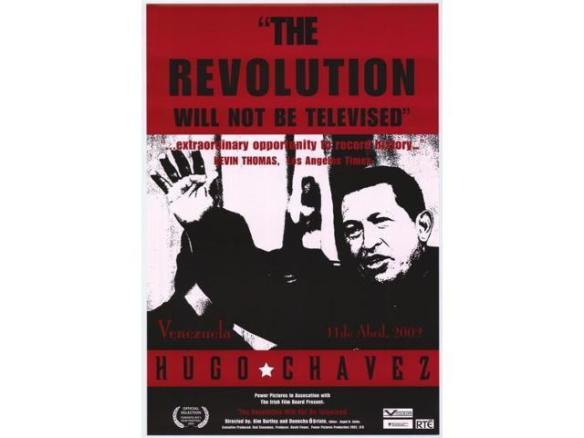
Saturday Matinee: The Revolution Will Not Be Televised

Source: Top Documentary Films

The Revolution Will Not Be Televised (a.k.a. Chavez: Inside the Coup) is a 2002 documentary about the April 2002 Venezuelan coup attempt which briefly deposed Venezuelan President Hugo Chávez.

A television crew from Ireland’s Radio Telifís Éireann happened to be recording a documentary about Chávez during the events of April 11, 2002.

Shifting focus, they followed the events as they occurred. During their filming, the crew recorded images of the events that they say contradict explanations given by Chávez opposition, the private media, the US State Department, and then White House Press Secretary Ari Fleischer.

The documentary says that the coup was the result of a conspiracy between various old guard and anti-Chávez factions within Venezuela and the United States.