Fiscal Insanity: The Government Borrows $6 Billion a Day, and We’re Stuck with the Bill

By John & Nisha Whitehead

Source: The Rutherford Institute

We’re not living the American dream.

We’re living a financial nightmare.

The U.S. government is funding its existence with a credit card.

The government—and that includes the current administration—is spending money it doesn’t have on programs it can’t afford, and “we the taxpayers” are the ones being forced to foot the bill for the government’s fiscal insanity.

According to the number crunchers with the Committee for a Responsible Federal Budget, the government is borrowing roughly $6 billion a day.

As the Editorial Board for the Washington Post warns:

“The nation has reached a hazardous moment where what it owes, as a percentage of the total size of the economy, is the highest since World War II. If nothing changes, the United States will soon be in an uncharted scenario that weakens its national security, imperils its ability to invest in the future, unfairly burdens generations to come, and will require cuts to critical programs such as Social Security and Medicare. It is not a future anyone wants.

Let’s talk numbers, shall we?

The national debt (the amount the federal government has borrowed over the years and must pay back) is $31 trillion and will grow another $19 trillion by 2033. That translates to roughly $246,000 per taxpayer or $94,000 for every single person in the country.

The bulk of that debt has been amassed over the past two decades, thanks in large part to the fiscal shenanigans of four presidents, 10 sessions of Congress and two wars.

It’s estimated that the amount this country owes is now 130% greater than its gross domestic product (all the products and services produced in one year by labor and property supplied by the citizens).

In other words, the government is spending more than it brings in.

The U.S. ranks as the 12th most indebted nation in the world, with much of that debt owed to the Federal Reserve, large investment funds and foreign governments, namely, Japan and China.

Interest payments on the national debt are estimated to top $395 billion this year, which is significantly more than the government spends on veterans’ benefits and services, and according to Pew Research Center, more than it will spend on elementary and secondary education, disaster relief, agriculture, science and space programs, foreign aid, and natural resources and environmental protection combined.

According to the Committee for a Reasonable Federal Budget, the interest we’ve paid on this borrowed money is “nearly twice what the federal government will spend on transportation infrastructure, over four times as much as it will spend on K-12 education, almost four times what it will spend on housing, and over eight times what it will spend on science, space, and technology.”

In ten years, those interest payments will exceed our entire military budget.

This is financial tyranny.

We’ve been sold a bill of goods by politicians promising to pay down the national debt, jumpstart the economy, rebuild our infrastructure, secure our borders, ensure our security, and make us all healthy, wealthy and happy.

None of that has come to pass, and yet we’re still being loaded down with debt not of our own making while the government remains unrepentant, unfazed and undeterred in its wanton spending.

Indeed, the national deficit (the difference between what the government spends and the revenue it takes in) remains at more than $1.5 trillion.

If Americans managed their personal finances the way the government mismanages the nation’s finances, we’d all be in debtors’ prison by now.

Despite the government propaganda being peddled by the politicians and news media, however, the government isn’t spending our tax dollars to make our lives better.

We’re being robbed blind so the governmental elite can get richer.

In the eyes of the government, “we the people, the voters, the consumers, and the taxpayers” are little more than pocketbooks waiting to be picked.

“We the people” have become the new, permanent underclass in America.

Consider: The government can seize your home and your car (which you’ve bought and paid for) over nonpayment of taxes. Government agents can freeze and seize your bank accounts and other valuables if they merely “suspect” wrongdoing. And the IRS insists on getting the first cut of your salary to pay for government programs over which you have no say.

We have no real say in how the government runs, or how our taxpayer funds are used, but we’re being forced to pay through the nose, anyhow.

We have no real say, but that doesn’t prevent the government from fleecing us at every turn and forcing us to pay for endless wars that do more to fund the military industrial complex than protect us, pork barrel projects that produce little to nothing, and a police state that serves only to imprison us within its walls.

If you have no choice, no voice, and no real options when it comes to the government’s claims on your property and your money, you’re not free.

It wasn’t always this way, of course.

Early Americans went to war over the inalienable rights described by philosopher John Locke as the natural rights of life, liberty and property.

It didn’t take long, however—a hundred years, in fact—before the American government was laying claim to the citizenry’s property by levying taxes to pay for the Civil War. As the New York Times reports, “Widespread resistance led to its repeal in 1872.”

Determined to claim some of the citizenry’s wealth for its own uses, the government reinstituted the income tax in 1894. Charles Pollock challenged the tax as unconstitutional, and the U.S. Supreme Court ruled in his favor. Pollock’s victory was relatively short-lived. Members of Congress—united in their determination to tax the American people’s income—worked together to adopt a constitutional amendment to overrule the Pollock decision.

On the eve of World War I, in 1913, Congress instituted a permanent income tax by way of the 16th Amendment to the Constitution and the Revenue Act of 1913. Under the Revenue Act, individuals with income exceeding $3,000 could be taxed starting at 1% up to 7% for incomes exceeding $500,000.

It’s all gone downhill from there.

Unsurprisingly, the government has used its tax powers to advance its own imperialistic agendas and the courts have repeatedly upheld the government’s power to penalize or jail those who refused to pay their taxes.

While we’re struggling to get by, and making tough decisions about how to spend what little money actually makes it into our pockets after the federal, state and local governments take their share (this doesn’t include the stealth taxes imposed through tolls, fines and other fiscal penalties), the government continues to do whatever it likes—levy taxes, rack up debt, spend outrageously and irresponsibly—with little thought for the plight of its citizens.

To top it all off, all of those wars the U.S. is so eager to fight abroad are being waged with borrowed funds. As The Atlantic reports, “U.S. leaders are essentially bankrolling the wars with debt, in the form of purchases of U.S. Treasury bonds by U.S.-based entities like pension funds and state and local governments, and by countries like China and Japan.”

Of course, we’re the ones who have to repay that borrowed debt.

For instance, American taxpayers have been forced to shell out more than $5.6 trillion since 9/11 for the military industrial complex’s costly, endless so-called “war on terrorism.” That translates to roughly $23,000 per taxpayer to wage wars abroad, occupy foreign countries, provide financial aid to foreign allies, and fill the pockets of defense contractors and grease the hands of corrupt foreign dignitaries.

Mind you, that’s only a portion of what the Pentagon spends on America’s military empire.

The United States also spends more on foreign aid than any other nation, with nearly $300 billion disbursed over a five-year period. More than 150 countries around the world receive U.S. taxpayer-funded assistance, with most of the funds going to the Middle East, Africa and Asia. That price tag keeps growing, too.

As Forbes reports, “U.S. foreign aid dwarfs the federal funds spent by 48 out of 50 state governments annually. Only the state governments of California and New York spent more federal funds than what the U.S. sent abroad each year to foreign countries.”

Most recently, the U.S. has allocated nearly $115 billion in emergency military and humanitarian aid for Ukraine since the start of the Russia invasion.

As Dwight D. Eisenhower warned in a 1953 speech, this is how the military industrial complex continues to get richer, while the American taxpayer is forced to pay for programs that do little to enhance our lives, ensure our happiness and well-being, or secure our freedoms.

This is no way of life.

Yet it’s not just the government’s endless wars that are bleeding us dry.

We’re also being forced to shell out money for surveillance systems to track our movements, money to further militarize our already militarized police, money to allow the government to raid our homes and bank accounts, money to fund schools where our kids learn nothing about freedom and everything about how to comply, and on and on.

There was a time in our history when our forebears said “enough is enough” and stopped paying their taxes to what they considered an illegitimate government. They stood their ground and refused to support a system that was slowly choking out any attempts at self-governance, and which refused to be held accountable for its crimes against the people. Their resistance sowed the seeds for the revolution that would follow.

Unfortunately, in the 200-plus years since we established our own government, we’ve let bankers, turncoats and number-crunching bureaucrats muddy the waters and pilfer the accounts to such an extent that we’re back where we started.

Once again, we’ve got a despotic regime with an imperial ruler doing as they please.

Once again, we’ve got a judicial system insisting we have no rights under a government which demands that the people march in lockstep with its dictates.

And once again, we’ve got to decide whether we’ll keep marching or break stride and make a turn toward freedom.

But what if we didn’t just pull out our pocketbooks and pony up to the federal government’s outrageous demands for more money?

What if we didn’t just dutifully line up to drop our hard-earned dollars into the collection bucket, no questions asked about how it will be spent?

What if, instead of quietly sending in our tax checks, hoping vainly for some meager return, we did a little calculating of our own and started deducting from our taxes those programs that we refuse to support?

As I make clear in my book Battlefield America: The War on the American People and in its fictional counterpart The Erik Blair Diaries, if we don’t have the right to decide what happens to our hard-earned cash, then we don’t have any rights at all.
The Nord Stream-Andromeda Cover Up

U.S. intelligence was too quick to leak information about the German investigation to The New York Times. It raises the distinct impression that the real culprit is nervous about the investigative work of Seymour Hersh. 

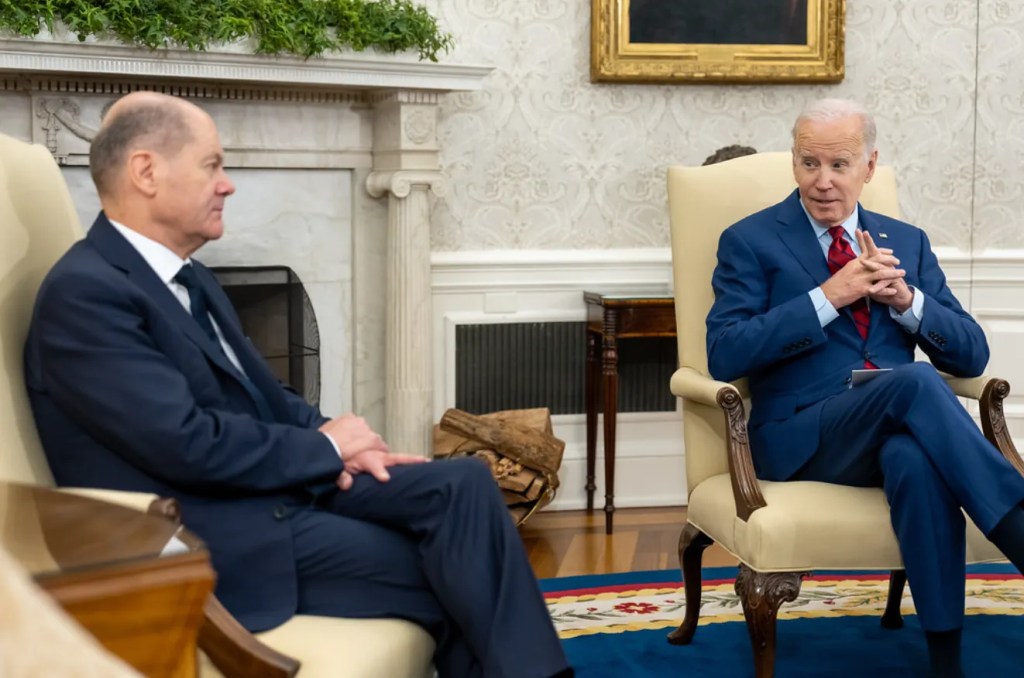
President Joe Biden meeting with German Chancellor Olaf Scholz in the Oval Office, March 3, 2023. (Official White House Photo by Adam Schultz)

By Scott Ritter

Source: Consortium News

Back in 2000, the television series “Andromeda”  premiered, based upon unused material from Gene Roddenberry, the creator of the Star Trek series and franchise. The plot is premised on the notion of a spaceship, “Andromeda,” frozen in time, which is given the opportunity to reverse the clock and undo history.

The series ran five years.

Fast forward to the present.

History has dealt a tough hand to the administration of U.S. President Joe Biden, who openly confessed his intent to “bring an end” to the Nord Stream pipeline system which delivered Russian natural gas to Europe through four pipelines (Nord Stream 1 and Nord Stream 2, consisting of two pipelines each).

Since then, the Biden White House was compelled to deny the president’s stated intent after an explosive report by Pulitzer-Prize winning investigative journalist Seymour Hersh detailed damning information which, if true (and there is no reason to suspect it’s not) casts the responsibility for a series of underwater explosions that took place on Sept. 26, 2022, on Biden himself.

Hersh’s report was ignored by the mainstream media in the United States, with neither The New York Times, for whom Seymour Hersh wrote on national security issues for many years, nor The Washington Post even hinting that the greatest living investigative journalist had broken a blockbuster story.

Enter the “Andromeda” — not the spaceship of the eponymous television series, but rather a Bavaria C50 15-meter (49-foot) yacht based out of the German Baltic port city of Rostock. On March 7 — nearly a month after Hersh self-published his article on Substack — a team of German reporters from the ARD capital studio, Kontraste, Südwestrundfunk (SWR) and Die Zeit collaboratively reported that they had uncovered the existence of “the boat that was allegedly used for the secret operation.”

The boat was “a yacht rented from a company based in Poland, apparently owned by two Ukrainians.” According to the story, “the secret operation at sea was carried out by a team of six people.”

The name of the yacht was “The Andromeda.”

According to the German reporting, the team — five men, consisting of a ship captain, two primary divers, two supporting divers and a female doctor — used the Andromeda to transport the team, along with the explosives used to destroy the pipelines, to the scene of the crime. The boat was returned to Rostock in “an uncleaned condition,” allowing German law enforcement officials, who carried out a search of the vessel between Jan. 8-11, to detect “traces of explosives” on a table in the ship’s cabin.

The same day the German reporting on the new Nord Stream attack narrative broke, The New York Times ran a front-page story entitled “Intelligence Suggests Pro-Ukrainian Group Sabotaged Pipelines, US Officials Say.”

[Related: As Bakhmut Falls, US May Turn From Ukraine, Starting With Pipeline Story]

For the first time, The New York Times referred to Hersh’s reporting, writing, “Last month, the investigative journalist Seymour Hersh published an article on the newsletter platform Substack concluding that the United States carried out the operation at the direction of Mr. Biden,” before closing with “U.S. officials say Mr. Biden and his top aides did not authorize a mission to destroy the Nord Stream pipelines, and they say there was no U.S. involvement.”

As if echoing the Biden White House denials, The New York Times led off with this:

“New intelligence reporting amounts to the first significant known lead about who was responsible for the attack on the Nord Stream pipelines that carried natural gas from Russia to Europe” (emphasis added.)

The New York Times, it seems, was more than happy about proceeding with its own anonymous intelligence sources, while dismissing Hersh’s.

The problem with both the German reporting and that of The New York Times (whose source was clearly referring to the same data reported by the German reporters) is that the Andromeda narrative doesn’t hold water.

Take, for instance, the Tom Clancy-like tale of derring-do that has four allegedly Ukraine-affiliated divers defy physiology by conducting dives that would require the use of a decompression chamber for them to survive an ascent of 240 feet (the depth of the Nord Stream pipelines that were destroyed). A rule of thumb is that decompression takes approximately one day per 100 feet of seawater plus a day.

This means that the team of divers would have required three days of decompression per dive. But to decompress, one needs a decompression chamber. For a dive involving two divers, the Andromeda would have to have been outfitted with either a two-person Class A decompression chamber, or two single-person Class B chambers, as well as the number of large oxygen bottles needed to operate these chambers over time. \

A simple examination of the interior cabin space of the Bavarian C50 yacht would quickly dispossess one of any notion that either option was viable.

Simply put — no decompression chamber, no dive, no story.

‘Traces’ of High Explosives 

There is another aspect of the story to probe. According to the German reporting, law enforcement officials detected “traces” of high explosives on the tables in the cabin of the Andromeda.

According to the Swedish Prosecution Authority, in a statement released on Nov. 19, 2022, Swedish investigators discovered “traces of explosives on several of the foreign objects that were found” at the site of the explosions.

These explosives, according to a Nov. 22, 2022, report issued by Nord Stream AG, the Swiss-based parent company that owned the Nord Stream 1 and 2 pipelines, produced “technogenic [i.e., “of or pertaining to a process or substance created by human technology”] craters with a depth of 3 to 5 meters” separated “by a distance of about 248 meters.”

“The section of the pipe between the craters is destroyed, the radius of pipe fragments dispersion is at least 250 meters,” the report noted.

In a report to the United Nations, both Denmark and Sweden said that the damage done to the Nord Stream pipelines was caused by blasts equivalent to the power of “several hundred kilograms of explosive.”

It should be noted that underwater pipelines like those used in Nord Stream are designed to withstand proximal explosions from devices up to several hundred kilograms in size. Indeed, in locations such as the Baltic Sea, where unexploded military ordnance from multiple world wars abounds, the threat of a drifting device striking a pipeline and detonating is quite real.

Computer modeling shows that a 600-kilogram high explosive charge detonated approximately 5 meters from a 34mm-thick steel pipeline filled with gas would not compromise the structural integrity of the pipeline.

At the location of the explosions, the Nord Stream pipelines consisted of 26.8 mm steel pipes with an addition 33.2 mm of concrete coating, for a total thickness of 60 mm. The weight of a single pipe section was over 11 tons.

In short, a standard high-explosive charge of several hundred kilograms would not be sufficient to cause the destruction that occurred on the Nord Stream pipeline.

Enter Hersh, who reported that the explosives used were “shaped charges.”

With a shaped charge, the energy of the explosion is focused in one direction, usually by creating a concave shape in the explosive that is them lined with a metal sheet, so that it usually achieves an armor- and/or concrete-penetrating effect.

Without getting too technical, the design of an underwater shaped charge that would be sufficient to penetrate concrete-lined steel pipe at a depth of 240 feet is not common knowledge. The charge would have to be prepared by qualified explosives experts and ideally tested prior to being employed operationally to validate the design and functionality of the device.

These are not tasks undertaken by a small ad hoc team of Ukrainian underwater saboteurs, but rather state-sponsored actors with access to military grade explosives and testing facilities.

Strike two for the German reporting.

But the most glaring deficiency in the German reporting deals with the detection of “trace explosive” onboard the Andromeda. This information would identify the precise explosive used. Moreover, when compared and contrasted with the “trace explosive” found by the Swedes at the location of the Nord Stream attacks, it could provide a clear linkage between the Andromeda and the attacks.

But Sweden has sealed the files of its investigation into the Nord Stream attack on national security grounds, meaning that it will not cooperate with Germany to see if the explosive traces found at the scene of the Nord Stream crime match those onboard the Andromeda.

The obvious reason behind this decision: because the two traces won’t match. One — the Swedish sample — points to the culprit. The other — the Andromeda sample — is evidence of a cover up.

Strike three, and you’re out.

The German government’s crude effort to manufacture an alternative narrative regarding who attacked the Nord Stream pipeline fails the smell test — in short, it stinks. The holes in this story are such that even the most gifted screenwriters could not turn this Andromeda tale of changing history into something remotely believable. In short, Gene Roddenberry would not be impressed.

Moreover, the fact that the U.S. intelligence community was quick to leak information about the German investigation to The New York Times appears to be de facto evidence of U.S. complicity in this cover up.

And the reason for this cover up is quite clear: the Germans and Americans both fear the reporting being done by Hersh.

The GATHERING Storm in Ukraine Spells Doom for the West

Photo by by Adam Brummett

By Col. Douglas MacGregor

Source: Information Clearing House

The crisis of American national power has begun. America’s economy is tipping over, and Western financial markets are quietly panicking. Imperiled by rising interest rates, mortgage-backed securities and U.S. Treasuries are losing their value. The market’s proverbial “vibes”—feelings, emotions, beliefs, and psychological penchants—suggest a dark turn is underway inside the American economy.

American national power is measured as much by American military capability as by economic potential and performance. The growing realization that American and European military-industrial capacity cannot keep up with Ukrainian demands for ammunition and equipment is an ominous signal to send during a proxy war that Washington insists its Ukrainian surrogate is winning.

Russian economy-of-force operations in southern Ukraine appear to have successfully ground down attacking Ukrainian forces with the minimal expenditure of Russian lives and resources. While Russia’s implementation of attrition warfare worked brilliantly, Russia mobilized its reserves of men and equipment to field a force that is several magnitudes larger and significantly more lethal than it was a year ago.

Russia’s massive arsenal of artillery systems including rockets, missiles, and drones linked to overhead surveillance platforms converted Ukrainian soldiers fighting to retain the northern edge of the Donbas into pop-up targets. How many Ukrainian soldiers have died is unknown, but one recent estimate wagers between 150,000-200,000 Ukrainians have been killed in action since the war began, while another estimates about 250,000.

Given the glaring weakness of NATO members’ ground, air, and air defense forces, an unwanted war with Russia could easily bring hundreds of thousands of Russian Troops to the Polish border, NATO’s Eastern Frontier. This is not an outcome Washington promised its European allies, but it’s now a real possibility.

In contrast to the Soviet Union’s hamfisted and ideologically driven foreign policymaking and execution, contemporary Russia has skillfully cultivated support for its cause in Latin America, Africa, the Middle East, and South Asia. The fact that the West’s economic sanctions damaged the U.S. and European economies while turning the Russian ruble into one of the international system’s strongest currencies has hardly enhanced Washington’s global standing.

Biden’s policy of forcibly pushing NATO to Russia’s borders forged a strong commonality of security and trade interests between Moscow and Beijing that is attracting strategic partners in South Asia like India, and partners like Brazil in Latin America. The global economic implications for the emerging Russo-Chinese axis and their planned industrial revolution for some 3.9 billion people in the Shanghai Cooperation Organization (SCO) are profound.

In sum, Washington’s military strategy to weaken, isolate, or even destroy Russia is a colossal failure and the failure puts Washington’s proxy war with Russia on a truly dangerous path. To press on, undeterred in the face of Ukraine’s descent into oblivion, ignores three metastasizing threats: 1. Persistently high inflation and rising interest rates that signal economic weakness. (The first American bank failure since 2020 is a reminder of U.S. financial fragility.) 2. The threat to stability and prosperity inside European societies already reeling from several waves of unwanted refugees/migrants. 3. The threat of a wider European war.

Inside presidential administrations, there are always competing factions urging the president to adopt a particular course of action. Observers on the outside seldom know with certainty which faction exerts the most influence, but there are figures in the Biden administration seeking an off-ramp from involvement in Ukraine. Even Secretary of State Antony Blinken, a rabid supporter of the proxy war with Moscow, recognizes that Ukrainian President Volodymyr Zelensky’s demand that the West help him recapture Crimea is a red line for Putin that might lead to a dramatic escalation from Moscow.

Backing down from the Biden administration’s malignant and asinine demands for a humiliating Russian withdrawal from eastern Ukraine before peace talks can convene is a step Washington refuses to take. Yet it must be taken. The higher interest rates rise, and the more Washington spends at home and abroad to prosecute the war in Ukraine, the closer American society moves toward internal political and social turmoil. These are dangerous conditions for any republic.

From all the wreckage and confusion of the last two years, there emerges one undeniable truth. Most Americans are right to be distrustful of and dissatisfied with their government. President Biden comes across as a cardboard cut-out, a stand-in for ideological fanatics in his administration, people that see executive power as the means to silence political opposition and retain permanent control of the federal government.

Americans are not fools. They know that members of Congress flagrantly trade stocks based on inside information, creating conflicts of interest that would land most citizens in jail. They also know that since 1965 Washington led them into a series of failed military interventions that severely weakened American political, economic, and military power.

Far too many Americans believe they have had no real national leadership since January 21, 2021. It is high time the Biden administration found an off-ramp designed to extricate Washington, D.C., from its proxy Ukrainian war against Russia. It will not be easy. Liberal internationalism or, in its modern guise, “moralizing globalism,” makes prudent diplomacy arduous, but now is the time. In Eastern Europe, the spring rains present both Russian and Ukrainian ground forces with a sea of mud that severely impedes movement. But the Russian High Command is preparing to ensure that when the ground dries and Russian ground forces attack, the operations will achieve an unambiguous decision, making it clear that Washington and its supporters have no chance to rescue the dying regime in Kiev. From then on, negotiations will be extremely difficult, if not impossible.

Related Video:

Don’t Believe Anything – But Recognize the Verge of a New Dark Age

By Phil Butler

Source: New Eastern Outlook

A decade ago, discovering every significant media outlet in the western world as tabloid news would have been inconceivable. Well, the unbelievable is all around us pounding pure lies into our brains on behalf of people eviler than Emperor Caligula. Just Google Putin, Russia, or even China, and with some effort, you’ll see what I mean.

In the mainstream, your average American gets, President Joe Biden is some kind of Dwight Eisenhower or Harry Truman figure. A man who cannot find his way off a stage or navigate the White House lawn is somehow a fit chess competitor for Vladimir Putin. The latest snafu is about his visit with Ukraine’s Zelensky a day before Putin spoke about a new phase of Russian policy. The CNN headline read “Biden’s Ukraine visit upstages Putin and leaves Moscow’s military pundits raging.” As an American who served his country in the military and other capacities, it’s sickening. Get this.

These media outlets and the Neocons have Americans believing a Chinese weather balloon that blew off course was gathering vital US nuclear missile silo intel. And Joe Biden waited until it flew all the way across the country before launching a multi-million-dollar F-22 strike to kill the spy machine. Days later, US fighter pilots shot down UFOs over Alaska. The only positive note after that was the Internet memes poking fun at the senile President and our goofball policies. Oh, but there’s more, oh so much more.

The New York Times and the rest are providing pushback on the Biden-authorized Nord Stream sabotage reported by one of the world’s most respected investigative journalists, Seymour Hersh. The guy who uncovered the My Lai massacre and its cover-up during the Vietnam War, key facts on Watergate, CIA domestic spy, and a lot more busted the Biden administration for using Navy Seals to detonate undersea charges dooming a Russia to Germany gas pipeline. The Pulitzer Prize-winning journalist’s revelations should have caused a media frenzy, a UN summit, and a NATO emergency meeting. But the people in charge can’t have that. The story of the decade so far is being slid under the rug. The reason why is explained in something Russian Foreign Minister Sergey Lavrov said recently:

“In many cases, ruling elites in unfriendly countries do not act of their free will, but only because they must show solidarity within their block. NATO and the EU enforce heavy-handed discipline on their members at the initiative of an aggressive minority.”

“How America Took Out The Nord Stream Pipeline” should be a reason for Biden’s impeachment hearings to be planned. The Germans should be banning US military personnel from their borders. And the Russians should probably go ahead and declare war when it all pans out true. We have this from Hersh’s sources and research:

“Last June, the Navy divers, operating under cover of the highly publicized NATO exercise known as BALTOPS 22, planted the remotely triggered explosives that, three months later, destroyed three of the four Nord Stream pipelines, according to a source with knowledge of the operational planning.”

The pipelines, which supplied Germany and much of Europe with cheap gas to run industry and fueled the lives of millions, were sabotaged without so much as a mention of the plan to America’s lawmakers. Hersh went on to describe how Biden, Jake Sullivan, Victoria Nuland, and Anthony Blinken were key conspirators in the illegal plan to undermine a NATO ally just to get to Putin and Russia. Biden had announced months before, after a meeting with Germany’s Scholz, that if Russia invaded Ukraine, “there would be no pipeline.”

Of course, Biden and his scandalous minions knew Russia had to act to prevent further NATO shenanigans in Ukraine, as we learned from the revelations of former German Chancellor Angela Merkel about the Minsk accords being a ruse. Talk about world-class liars and thugs. America’s leadership makes the worst Israeli mafioso seem harmless as Mickey Mouse. These people will get our world blown up.

Now Biden, Zelensky, all the EU criminals, and even exiled Putin enemy and Russian mafioso Mikhail Borisovich Khodorkovsky have been seen at the Munich Security Council predicting Putin’s demise—some more. Once we’d have thought US presidents, New York Times publishers, and killer thugs kicked from Russia like bullying kids from the schoolyard would be strange bedfellows. But this Biden administration has to be the most corrupt bunch since the days of Al Capone and Lucky Luciano.

Get this, one of the men involved in the Hunter Biden laptop affair, Prof. Gal Luft, is now in leg irons in a Cyprus jail awaiting extradition to the US for, you won’t believe it, being an arms dealer. Luft had helped the FBI and other agencies with highly incriminating facts about Hunter Biden, and now he’s on a path like Jeffrey Epstein or Julian Assange. Hanged by the neck, or something like that. Oh, and congressional investigators are asking who paid millions of dollars for Hunter Biden’s art? The lunacy goes on, and on, and on.

I’ll leave off with the European Parliament bosses blocking public scrutiny of Ursula von der Leyen over a Pfizer contract she clearly benefitted from. And Pfizer gate is not the EU President’s only worry. She’s now pledged another €1 billion for Ukraine’s fast recovery. That is, if there is a Ukraine to rebuild once western weapons and mercenaries force the Russians to obliterate the country just to keep NATO and bio-weapons labs out. For me, it now seems obvious why the liberal world order has gone all in with this proxy war against Russia. If the citizens of our countries ever find out what their leaders have really done, there will be public hangings Mussolini style across the NATO cabal.

So, forget the tabloids except to use reverse psychology for understanding the news. If the White House says we did not blow up Nord Stream, you can bet your last dollar we did. Think about our track record, America’s I mean. Our leaders operate like very drunken Roman senators, and our military operates as if Hannibal were commanding the armed forces of every third-world country. We even have officials swearing that Putin does not have any nuclear weapons. No really. This is where we are with detente in the 21st century, on the verge of a new Dark Ages.

Send in the Clowns

Yellen and Garland perform back-to-back surprise visits to Ukraine

By Philip Giraldi

Source: The Unz Review

Sometimes I think that the script being used by the Biden Administration to manage its foreign and national security policies has been written by George Orwell, though I am not sure if it based on 1984 or Animal Farm. Maybe it is a combination of the two. Either way, it would help explain why there is something seriously wrong here. For example, at the end of February Congress, confronted by a debt ceiling, began discussing cutting Medicare and Social Security while more recently a banking sector crisis seems to be developing so Treasury Secretary Janet Yellen decided to go off doing photo-ops in Kiev embracing Ukraine’s President Volodymyr Zelensky shortly after handing him the keys to the US economy. She explained to Zelensky how the White House had approved an additional $12 billion in aid to Ukraine during the previous week, including $2 billion for the military and $10 billion to support Zelensky’s government and other infrastructure needs. The US Treasury is now de facto the source of the Ukraine government’s entire annual budget. In addition, Yellen described glowingly how the Treasury and State Departments will implement a new round of sanctions against more than 200 entities and individuals with ties to Russia’s military, high-technology industries, and its metals and mining sectors. The US Department of Commerce is also enforcing export restrictions on materials and technology, including semiconductors, sold by American companies to customers in Russia and China.

In defense of her grand mission, Yellen penned an op-ed for the always compliant New York Times explaining the importance of Ukraine to the United States. She wrote how in Ukraine “…Russia’s barbaric attacks continue — but Kyiv stands strong and free. Ukraine’s heroic resistance is the direct product of the courage and resilience of Ukraine’s military, leadership and people. But President Volodymyr Zelensky and the Ukrainians would be the first to admit that they can’t do this alone — and that international support is crucial to sustaining their resistance. I’m in Kyiv to reaffirm our unwavering support of the Ukrainian people. Mr. Putin is counting on our global coalition’s resolve to wane, which he thinks will give him the upper hand in the war. But he is wrong. As President Biden said here last week, America will stand with Ukraine for as long as it takes… Ukrainians are fighting for their lives on the front lines of the free world. Today, and every day, they deserve America’s unyielding support.”

The Yellen op-ed drones on with a lie so large that it is astonishing that the New York Times would even print it: “When confronted with scenes of brutality and oppression, Americans have always been quick to stand up and do the right thing. Our strength as a nation comes from our commitment to our ideals — and our capacity to see in others the same desires that animated our own struggles for freedom and justice.” But then she tops that with assurances from “President Zelensky, [who] has pledged to use these funds in the ‘most responsible way.’ We welcome this commitment, as well as his longstanding agenda to strengthen good governance in Ukraine.” Huh?

And here is Yellen’s version of “Why We Fight!”: “Our support is motivated, first and foremost, by a moral duty to come to the aid of a people under attack. We also know that, as President Zelensky has said, our assistance is not charity. It’s an investment in ‘global security and democracy.’ Let’s look at the strategic impact of our support for Ukraine so far. Mr. Putin’s war poses a direct threat to European security, as well as to the laws and values that underpin the rules-based international system.”

So, Americans have a “moral duty” apparently up to and including sending their sons and daughters to die supporting Ukraine. And ah yes, it’s all about the “free” world, democracy and the notorious rules based international system! Has anyone yet cited Hegel’s observation that the President Joe Biden Administration’s foreign policy has already “repeated itself, first as a tragedy in Afghanistan, second as a farce”? Meanwhile one suspects Zelensky was laughing all the way to the bank as Yellen disappeared over the horizon to come up with the cash, as that old expression goes, and he probably already has one of his buddies shopping for a new villa on the French Riviera to supplement his other real estate! But wait! The story became even more exciting the following week, involving another visit to Mr. Z by America’s nearly invisible Attorney General Merrick Garland, a man who can literally look Z in the eye as they are both very short. Garland is generally engaged in chasing white supremacists and requiring all new FBI hires to learn all about how to identify and pursue antisemites, but he has made two trips to Kiev to meet mano-a-mano with the brave olive drab t-shirt clad warrior who is already being beatified as the twenty-first century’s Winston Churchill.

Garland was in town to do the other thing the engages his sense of law and order, which is to set up a tribunal to arrest, prosecute and punish Russian war criminals after Ukraine emerges triumphant from its conflict with the unimaginably evil President Vladimir Putin. It would be modeled on the Nuremberg Tribunals that tried leading Nazis after the Second World War, and Garland has cited his family’s escape from the so-called holocaust to explain why he is intent on personally being involved in delivering what he describes as “justice.” A Justice Department spokeswoman described Garland’s mission as being in Kiev to personally “reaffirm America’s commitment to help hold Russia responsible for war crimes committed in its unjust and unprovoked invasion against its sovereign neighbor.”

Garland had several meetings with President Volodymyr Zelensky and foreign law enforcement officials including Ukrainian Prosecutor General Andriy Kostin while attending what was billed as the “United for Justice Conference.” Zelensky elaborated that the purpose of the conference was to hold Russia’s leadership accountable for the alleged atrocities carried out by its army. “The main issue of all these meetings is accountability,” he said. The US Justice Department is reportedly actively engaged in the gathering of evidence to indict the Russians. During Garland’s first visit to Ukraine in June 2022 he announced the appointment of Eli Rosenbaum, an Office of Special Investigations prosecutor best known for going after former Nazis, to direct American efforts to identify and track Russian war criminals.

Garland laid it on thick, as was expected from someone responsible for prosecuting the rest of the world when it steps out of line. He told his hosts that “Just over twelve months ago, invading Russian forces began committing atrocities at the largest scale in any armed conflict since the Second World War. We are here today in Ukraine to speak clearly, and with one voice: the perpetrators of those crimes will not get away with them. In addition to our work in partnership with Ukraine and the international community, the United States has also opened criminal investigations into war crimes in Ukraine that may violate US law.” He concluded by throwing out the complete bullshit party line much beloved by Joe Biden and Tony Blinken, that “The United States recognizes that what happens here in Ukraine will have a direct impact on the strength of our own democracy.”

Of course, there is more than a little bit of irony in all this, not to mention top level hypocrisy, as the United States has killed more people directly or indirectly while committing more crimes against humanity dished out in various ways over the past twenty years than any other country, except, predictably, Israel, which currently is committing crimes against humanity on a nearly daily basis. Curiously, however, the normally tone-deaf White House and Pentagon seem to understand, on a certain level, that opening up Pandora’s box might not be a good idea when it comes to war crimes. Last week Secretary of Defense Lloyd Austin refused to share US information on alleged Russian crimes with the International Criminal Court (ICC) in the Hague. The Pentagon is blocking the Biden administration from sharing evidence with the ICC collected by American intelligence agencies regarding Russian activities in Ukraine because helping the court investigate Russians might set a precedent that could help pave the way for it to prosecute Americans. Washington does not recognize the ICC, fearing that it might well seek to examine the sorry record of US military crimes in Asia and Africa. Israel similarly does to recognize the court for roughly the same reason.

So here we are, two top level officials from the Biden regime sneak into Kiev to give an arch crook money and unlimited moral support, together with a pledge that more cash is on the way as are arms and war crimes tribunals await those nasty Russians. And guess what? It is all packaged as being good for America! This sounds like a song that was sung previously in places like Vietnam, Iraq and Afghanistan and it was a tissue of lies then just as it is now. Yellen ought to have stayed home to tend to the banking system and should be giving the billions of dollars earmarked for Zelensky back to the American people. If Garland wants to investigate anyone it should be the Pentagon, the intelligence agencies, and Congress. And yes, his own FBI! And don’t forget how the Bidens and Clintons became multi-millionaires! And then there is the destruction of Nord Stream. Funny how every time one turns over a rock in and around the US government something really smelly surfaces.

A Fed-Issued Digital Currency: The Mark of the Beast

A Fed-issued digital currency would be no more in our interests than the current dollar system.

By Jeremy R. Hammond

Source: Jeremy R. Hammond Blog

China’s ‘Social Credit’ System

“And he causeth all, both small and great, rich and poor, free and bond, to receive a mark in their right hand, or in their foreheads: And that no man might buy or sell, save he that had the mark, or the name of the beast, or the number of his name.” — Revelation 13:16-17

In China, as you have likely heard, the government has been experimenting with a “social credit” system aimed at giving politicians even greater control over people’s behavior. China was, of course, also the country whose authoritarian “lockdown” response to the outbreak of SARS‑CoV‑2—the coronavirus that causes COVID‑19 and was likely engineered in a Chinese lab with US government funding—was pointed to as a model for the rest of the world to follow by the World Health Organization (WHO).

The WHO has since been aiming to acquire even more centralized global authority to issue diktats in the event of another pandemic, such as implementation of “lockdown” measures that might include travel restrictions, prevention of employment, and vaccine mandates or passport systems.

As of December 2020, around the time of the initial outbreak of the virus in Wuhan, China, social credit laws and regulations had been implemented in an estimated 80 percent of the country.

Naturally, the system is characterized by its proponents as a benevolent means to reward socially responsible people while denying privileges to unsavory and untrustworthy characters and businesses. But you and I both recognize the grave threat posed by politicians wielding this type of power and control over the population. It is an obvious threat to privacy and liberty.

The people of China regrettably but unsurprisingly appear to have welcomed this system, although the perception of public approval might be largely an artifact of people being afraid to publicly criticize the system lest their names be placed on one of the government’s “blacklists”.

As with any law or government policy, we should view it through the lens of how such power could be used as opposed to how politicians say they intend to use it.

A glimpse of how it could be used is the city of Rongcheng’s prohibition on “spreading harmful information”, violations of which could result in subtraction of points off residents’ social credit scores.

Such prohibitions must be seen in light of how governments are in the habit of interpreting “harmful information” as any information that does not align with the adopted political agenda. In the US during the COVID‑19 pandemic, there has been no greater purveyor of misinformation than the US government itself.

According to MIT Technology Review, the central government actually pressed the city to scale back the threat to individual liberty posed by its social credit system, such as enabling residents to opt-out. “The Chinese government did emphasize that all social-credit-related punishment has to adhere to existing laws,” the Review states, “but laws themselves can be unjust in the first place.”

The takeaway from that article is that “the social credit system does not (yet) exemplify abuse of advanced technologies like artificial intelligence”. But that’s no reason for the citizenry to consent to the implementation of systems that are conducive to extreme governmental abuses of authority.

A July 2019 article in Wired magazine related the example of Liu Hu, a journalist who was arrested, fined, and blacklisted, reportedly for writing about censorship and government corruption. He found himself on a “List of Dishonest Persons Subject to Enforcement by the Supreme People’s Court as ‘not qualified’ to buy a plane ticket, and banned from travelling some train lines, buying property, or taking out a loan.”

A more recent Newsweek article appropriately describes the system this way:

On an individual level, the government seeks to instill in the public an increased sense of morality to discourage everything from fraud and plagiarism to counterfeit goods and petty crime. But a system to make individual actions more transparent would necessitate the creation of tools to monitor all aspects of life. Social control, if not the original aim, could be an inevitable consequence, researchers say.

. . . While China’s vision of the system has yet to emerge as a dystopian tool for control driven by big data, there are real concerns about the way personal information is to be collected and processed to create social credit profiles, which could have lasting implications for individuals.

An untrustworthy government has no place dictating to its citizens what types of behaviors should be regarded as creating or breaking trust.

Human Rights Watch provides the example of lawyer Li Xioaolin, who was denied a plane ticket home while away on a work trip inside China because his name was on a blacklist of “untrustworthy” people in relation to a years-old court-related issue that he thought he had resolved.

According to Human Rights Watch, journalist Liu Hu was punished not for criticizing the government and exposing corruption but for having offered an apology that the government deemed “insincere” after losing a defamation case for publishing an article alleging that someone was an extortionist. Still, the organization notes, in both cases, “penalties were exacted in wildly arbitrary and unaccountable manners.” Additionally, “the courts failed to notify them, leaving them no chance to contest their treatment.”

According to the human rights organization, between 2013 and 2017, the Chinese government imposed more than seven million punishments to people for failing to carry out local court orders, which punishments have included publicly naming and shaming individuals and barring them from flights and trains.

After experiencing the totalitarianism of the disastrously harmful lockdown regimes and the accompanying efforts to coerce the population into accepting COVID‑19 vaccines and to censor truths countering the government’s incessant lies (I was permanently banned from LinkedIn, for example, for accurately reporting that the CDC’s claim that COVID‑19 vaccines provide greater protection against SARS‑CoV‑2 infection than natural immunity was a bald-faced lie), it should not be too difficult to imagine such a system being dangerously used to silence critics and punish dissenters so that whatever ruling regime can continue its crimes against humanity unobstructed.

The idea of a “social credit” score, of course, is inherently tied to the idea of central banking. In the US, the central bank is the Federal Reserve, a government-legislated private monopoly over the supply of currency. Increasingly, there is talk of a central bank digital currency, heightening concerns about the government having the means to exercise power over us and control our behavior.

“Project Hamilton”

As an example of how the Fed is exploring the idea of adopting a digital currency, the Massachusetts Institute of Technology (MIT) has teamed up with the Federal Reserve Bank of Boston under the appropriately named “Project Hamilton”.

Alexander Hamilton, of course, was instrumental in the adoption of central banking by the US government, famously at odds with Thomas Jefferson, who rightly opposed the idea and warned about the dangers inherent in such an institution. Jefferson appeared to hold the view that the means of exchange and interest rates ought to be determined by the market as opposed to being determined by fiat by a roomful of central planners.

Jefferson accurately foresaw how the government would use the central bank to pay for its spending as an alternative to raising taxes directly, and how the debt that would consequently be incurred by this uncontrolled spending would ultimately be borne by future generations.

In a letter to John Wayles Eppes in 1813, for example, Jefferson wrote:

I have said that the taxes should be continued by annual or biennial re-enactments; because a constant hold, by the nation, of the strings of the public purse, is a salutary restraint, from which an honest government ought not to wish, nor a corrupt one to be permitted, to be free. No tax should ever be yielded for longer than that of the Congress granting it, except when pledged for the reimbursement of a loan.

. . . Bank-paper must be suppressed, and the circulating medium must be restored to the nation to whom it belongs. . . . Treasury bills, bottomed on taxes, bearing, or not bearing interest, as may be found necessary, thrown into circulation, will take the place of so much gold & silver, which last, when crouded, will find an efflux into other countries, and thus keep the quantum of medium at its salutary level.

In a letter to John Taylor in 1816, Jefferson described central banking as rightly “reprobated” and as “a blot left in all our constitutions, which, if not covered, will end in their destruction”. He wrote, “And I sincerely believe with you, that banking establishments are more dangerous than standing armies; & that the principle of spending money to be paid by posterity, under the name of funding, is but swindling futurity on a large scale”.

Jefferson viewed the federal government as having no authority to institute a central banking system. As he wrote in 1791, “The incorporation of a bank, and the powers assumed by this bill, have not, in my opinion, been delegated to the United States, by the Constitution.”

The stated aim of Project Hamilton “is to investigate the technical feasibility of a general purpose central bank digital currency (CBDC) that could be used by an economy the size of the United States and to gain a hands-on understanding of a CBDC’s technical challenges, opportunities, risks, and tradeoffs.”

The project is part of MIT’s “Digital Currency Initiative”, which is aimed at bringing minds together “to conduct the research necessary to support the development of digital currency and blockchain technology.”

The aim of the collaboration with the Federal Reserve Bank of Boston has been “to develop a hypothetical CBDC.” MIT describes the possibility of a “central-bank-issued digital currency” as “a unique opportunity to address challenges in our existing payments system and design an economy that is more resilient, participatory, and open.”

We can reasonably assume that Thomas Jefferson, were he alive today, would disagree and view the idea as anathema to both a sound economy and a free society.

Noting that it was Alexander Hamilton “who laid the foundation for a U.S. central bank”, a project white paper published in February 2022 concluded that it is “critical” for research to continue for “achieving goals for a CBDC.” That is, it is not a question of whether the Fed should adopt a digital currency but how and when.

Biden’s Executive Order and Project Lithium

In January 2022, the Federal Reserve Board of Governors similarly published a paper titled “Money and Payments: The U.S. Dollar in the Age of Digital Transformation”, the aim of which was “to foster a broad and transparent public dialogue about CBDCs in general, and about the potential benefits and risks of a U.S. CBDC.”

Then in March 2022 President Joe Biden signed an “Executive Order on Ensuring Responsible Development of Digital Assets”, which declares the supposed need for the US government to “regulate” digital assets, including for the purpose of preventing circumvention of its sanctions regimes—in which context we might remember the US government’s criminal sanctions regime against Iraq in the 1990s and how Secretary of State Madeleine Albright insisted that the “price” of half-a-million dead Iraqi children was “worth it”.

The executive order, number 14067, describes how the government has an interest in maintaining the US dollar’s “central role” in “the global financial system”, which refers to the use of the dollar as a reserve currency. To that end, the order states, the Biden administration “places the highest urgency on research and development efforts into the potential design and deployment options of a United States CBDC.”

The White House is intent on determining what actions would be required to launch such a currency “if doing so is deemed to be in the national interest”. Of course, as the example of half a million excess childhood deaths in Iraq due to sanctions once again illustrates, determining just what is in the “national interest” is not a task that government policymakers seem particularly good at.

The lockdown measures, which utterly failed to project those at highest risk from COVID-19 while causing devastating harms globally, are another useful example of the ineptitude of policymakers when it comes to making decision that are in our best interests.

Following Biden’s executive order, in April 2022, the Depository Trust & Clearing Corporation (DTCC) announced “the development of the first prototype to explore how a CBDC might operate”. This endeavor was given the name “Project Lithium”, on which the DTCC is collaborating with The Digital Dollar Project (DDP), an organization that advocates US leadership “in advancing a CBDC” and encourages the executive branch of government “to support appropriate legislation” to authorize further research and development of such a currency.

The DDP published a white paper in May 2020 concluding that the US government “should, and must, take a leadership role in this new wave of digital innovation” and preserve the dollar’s role as “the world’s primary reserve currency” by working toward “the launch of a tokenized digital dollar”.

End the Fed!

Naturally, advocates of a central bank digital currency describe the aims of such a development as benign, just as the Federal Reserve system was originally established on the pretext that having a more centrally controlled economy would benefit all.

In truth, the Federal Reserve system serves the interests of the financially and political elite at the expense of the rest of us. Central banking itself, whatever the form of currency issued, is harmful to the economy because central banks essentially exist to effect a transfer of wealth upward. Schools of economic thought like Keynesianism and Modern Monetary Theory (MMT), which I like to refer to as “Keynesianism 2.0”, exist to justify the existence of central banks.

The Fed, a government-legislated private monopoly over the currency supply, enables the government to spend on whatever, including endless wars (euphemistically called “defense” spending), but the means of paying for it all, the creation of “money” out of thin air, results in upward wealth transfer. The elite classes who receive the newly created dollars first are able to spend it for purchasing assets prior to the resulting devaluation that manifests in the form of higher prices for goods and services.

Monetary inflation robs us of our purchasing power and so serves as a hidden tax. It also causes widespread malinvestment and major economic distortions like the housing bubble that burst in 2007 and precipitated the 2008 financial crisis, not to mention the current housing bubble and general asset inflation. (For more on that, see my book Ron Paul vs. Paul Krugman: Austrian vs. Keynesian Economics in the Financial Crisis.)

We are meant to believe we need centralized control over the currency supply for economic growth, but central banks instead serve to impede real economic growth in favor of enabling the government’s endlessly wasteful and harmful spending.

The chief appeal of a cryptocurrency like Bitcoin is that it is a decentralized medium of exchange that serves to compete with central-bank-issued currency and potentially enables people to opt-out of the exploitative dollar system. The idea of a “legal tender” digital currency in the hands of the bankers and politicians is anathema to the whole concept of a peer-to-peer electronic cash system.

One might argue that the replacement of print dollars with a centrally controlled cryptocurrency is just a natural evolution from the current system, in which exchange of actual cash is becoming less frequent and most transactions occur digitally anyway. We should keep up with the times and adapt to advancements in technology, the argument goes.

However, this overlooks the more fundamental issue that we should not have central banks in the first place. The way I see it, the movement towards replacing the US dollar with a Fed-issued cryptocurrency is far from benign. We have seen in the past few years just how far government policymakers are willing to go to exercise authoritarian control over us.

To illustrate, remember how businesses deemed “non-essential” were shut down by clueless bureaucrats under threat of punishment, and how coercive measures including mandates and travel restrictions were used to get people to accept COVID‑19 vaccinations?

With the World Economic Forum (WEF) having announced its “Great Reset” agenda, which ties directly into the global mass vaccination agenda, the advocates of greater centralized control over society do not deserve the benefit of our doubt about their intentions. It would be naïve to think that if the authoritarians in government had even greater means to penalize citizens for disobedience to the regime that they would not attempt to use it. It is safer to assume that if they can utilize a digital currency to control our behavior, they will.

It seems therefore imperative to oppose a centralized digital currency, but we also need to go further than that and oppose the existence of the Federal Reserve altogether. Whatever the form of currency, centralized economic planning is an abomination and anathema to the principle of a free market.

“And I heard another voice from heaven, saying, Come out of her, my people, that ye be not partakers of her sins, and that ye receive not of her plagues.” — Revelation 18:4

Ukraine is America’s Afghanistan More Than Russia’s

By Peter Van Buren

Source: We Meant Well

The thinking in Washington goes like this: for the “low cost” of Ukrainian lives and some American dollars, the West can end Putin’s strategic threat to the United States. No Americans are dying. It’s not like Iraq or Afghanistan ’01-’21. This is post-modern, something new, a clean great power war, Jackson Pollack for war. Getting a lot of foreign policy mojo at little cost. It’s almost as if we should have though of this sooner.

Um, we did. It didn’t work out past the short run and there’s the message. Welcome to Afghanistan 1980’s edition with the U.S. playing both the American and the Soviet roles.

At first glance it seems all that familiar. Russia invades a neighboring country who was more or less just minding its own business. Russia’s goals are the same, to push out its borders in the face of what it perceives as Western encroachment on the one hand, and world domination on the other. The early Russian battlefield successes break down, and the U.S. sees an opportunity to bleed the Russians at someone else’s bodily expense. “We’ll fight to the last Afghani” is the slogan of the day.

The CIA, via our snake-like “ally” in Pakistan, floods Afghanistan with money and weapons. The tools are different but the effect is the same: supply just enough firepower to keep the bear tied down and bleeding but not enough to kill him and God forbid, end the war which is so profitable — lots of dead Russkies and zero Americans killed (OK, maybe a few, but they are the use-and-forget types of foreign policy, CIA paramilitary and Special Forces, so no fair counting them.) And ironic historical bonus: in both Afghanistan 1980s and Ukraine, some of the money spent is Saudi. See the bothersome thread yet?

Leaving aside some big differences that enabled initial successes in Afghanistan, chief among which is the long supply lines versus Ukraine’s border situation, let’s look at what followed early days.

Though NATO countries and others sent small numbers of troops and material to Afghanistan, the U.S. has gone out of its way to make Ukraine look like a NATO show when it is not. Washington supposedly declared support for Ukraine to preserve and empower NATO (despite the fact that Ukraine was not a member.) Yet, to keep Germany on sides in the Russian-Ukraine war, Washington (allegedly) conducted a covert attack on Germany’s critical civilian infrastructure that will have lasting, negative consequences for the German economy. Seymour Hersh reported the Nord Stream pipeline connecting cheap Russian natural gas to Europe via Germany was sabotaged by the United States. An act of war. The destruction of an ally’s critical infrastructure, and no doubt a brush back pitch carefully communicated to the Germans alongside a stern warning to stay put on sanctions against energy trade with Russia. It’s a helluva thing, blowing up the pipeline to force Germany to color inside the lines NATO (actually the U.S.) laid out. This, in addition to the U.S. treating NATO countries as convenient supply dumps and little more, shows that NATO will emerge from Ukraine broken. One does also wonder if the future of Europe is at stake why the greatest concern is expressed in Washington and not Bonn or Paris.

As with Afghanistan, there are questions if we Americans will ever be able to leave, about whether Colin Powell’s “Pottery Barn” rules applies — you break it, you bought it. President Zelensky, portrayed in the West as a cross between Churchill and Bono, in actuality was a comedian and TV producer who won the 2019 Ukrainian presidential election. Zelensky’s popularity was due in part to his anti-establishment image and promises to fight corruption and improve the economy. He was also aided by his portrayal of a fictional president in a popular TV show, which helped to increase his name recognition and appeal to young voters.

Zelensky was preceded by the Ukrainian Revolution, also known as the Euromaidan Revolution, which began in late 2013 as a series of protests in response to then-President Viktor Yanukovych’s decision to reject an association agreement with the European Union and instead pursue closer ties with Russia. The protests grew in size and intensity, with demonstrators occupying the central Maidan Nezalezhnosti square in Kiev, demanding Yanukovych’s resignation and new elections. In February 2014, the situation escalated when Yanukovych’s security forces cracked down on protesters, resulting in violent clashes that left dozens dead. This led to Yanukovych fleeing the country and a new government being formed in Ukraine. The revolution also sparked tensions with Russia, which subsequently annexed Crimea and supported separatists in eastern Ukraine. None of those problems goes away even if the Russia army retreats to its pre-invasion borders. The notion that there is nothing going on here except a rough land grab by a power-made Putin is shallow and incomplete.

What’s left are concerns about the level of corruption in Ukraine, and the U.S.’s role in addressing it. Despite the U.S. providing significant financial aid to Ukraine, there have been reports of corruption and mismanagement of funds. Some have argued that the U.S. has not done enough to address these issues, and has instead turned a blind eye in order to maintain its strategic interests in the region. America’s history with pouring nearly unlimited arms and money into a developing nation and corruption is not a good one (see either Afghanistan, 1980s or ’01 onward.) Corruption can only get worse.

A great fear in Afghanistan was arms proliferation, weapons moving off the battlefield into the wrong hands. Whether that be a container of rifles or the latest anti-aircraft systems, an awful lot of weapons are loose in Ukraine. In the case of Afghanistan, the real fear was for Stinger missiles, capable of shooting down modern aircraft, ending up in terrorist hands. The U.S. has been chasing these missiles through the world’s arms bazaars ever since, right into the Consulate in Benghazi. It is worse in Ukraine. America’s top-of-the-line air defense tools are being employed against Russian and Iranian air assets. What would those countries pay for the telemetry data of a shoot down, never mind actual hardware to reverse engineer and program against? There are no doubt Russian, Chinese, Iranian and other intelligence agencies on the ground in Ukraine with suitcases full of money trying to buy up what they can. Another cost of war.

It is also hard to see the end game as the demise of Putin. This would mean the strategy is not fight until the last Afghani/Ukrainian but to fight until the last Russian. The plan is for that final straw to break, that last Russian death, to trigger some sort of overthrow of Putin. But by whom? Trading Putin for a Russian-military lead government seems a small gain. Look what happened the last time Russia went through a radical change of government — we got Putin. In Afghanistan, it was the Taliban x 2.

History suggests the U.S. will lose in a variety of ways in Ukraine, with the added question of who will follow Putin and what might make that guy a more copacetic leader towards the United States. As one pundit put it, it is like watching someone play Risk drunk.

Rage Against The War Machine: What Rage? ‘When Will They Ever Learn?’

By Robert J. Burrowes

In his iconic 1950s anti-war hit song ‘Where Have All the Flowers Gone?’, Pete Seeger posed the eternal question about war: ‘when will they ever learn?’ Of course, Seeger’s question was primarily directed at those individuals who choose to participate in the fighting. But it might equally have been directed at those in the ‘anti-war’ movement.

A few years later in 1963, Native Canadian Buffy Sainte-Marie penned the equally iconic ‘Universal Soldier’ to draw attention to ‘individual responsibility’ for war.

The question ‘Why war?’ has troubled human beings for millennia and individuals of conscience have long resisted it, sometimes paying a heavy price for doing so. And back in 1932, two of humanity’s giants – Albert Einstein and Sigmund Freud – grappled with the question, exchanging letters on the subject.

See ‘Why War?’

Beyond war, a great deal of effort has gone into understanding conflict and violence, including their structural and cultural components, and I have noted some of these efforts, including my own, in a wide range of documents such as these:

‘Why Violence?’,

‘Comforting a Baby is Violent’,

‘The War to End War 100 Years On: An Evaluation and Reorientation of our Resistance to War’ and

‘Einstein and Freud’s ‘Why War?’

Revisited: Why Anti-War Efforts Go Nowhere’.

Four things fundamentally missing from all previous efforts to halt a particular war or to end war generally, however, are these:

  1. a serious effort to understand the dysfunctional psychology, and what causes it, that drives human violence generally,
  2. a serious effort to analyse war as a system of power: Who is causing it, why and how? (This is important because understanding how power works in the world system as well as who, precisely, is driving what is happening, why, and how they are doing it are crucial prerequisites for developing an effective strategy to resist, or end, war.)
  3. a sophisticated nonviolent strategy based on this understanding and analysis that is thoughtfully designed to address each of the foundational components of war, and
  4. sufficient courageous people committed to implementing this strategy by participating in it themselves and mobilizing others to do so too.

Consequently, to say that anti-war efforts lack sophistication is to put it mildly in the extreme. As the very long history of ‘anti-war’ struggle clearly demonstrates.

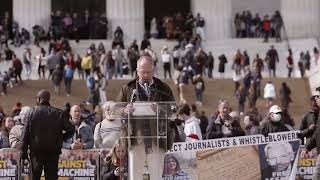
And so it was listening to the anti-war speeches delivered in Washington DC at the Rage Against the War Machine rally on 19 February 2023. You can watch whole or abridged versions of these speeches here: Rage Against the War Machine.

Rage might give a person power in some contexts but, in itself, rage has zero strategic value. And are these people really feeling ‘rage’ about the ongoing war all over the planet or even the war in Ukraine? And acting on it? Of course not. Even if they were, as mentioned ‘rage’ is no substitute for acting powerfully (that is, strategically) to end war.

Moreover, there is a simple reason for this. Most anti-war activists do not feel rage against the war machine for the simple reason that they are terrified of it.

And this fear incapacitates them, leaving most anti-war activists too scared to seriously commit themselves to doing what is necessary to end war. Again, as the record demonstrates.

Hence, they complain powerlessly, rather than analysing, devising strategy and then acting powerfully knowing that their actions will contribute to the long-term struggle to end war once and for all.

So let me go back a step and analyze why the anti-war movement is so frightened and powerless and why it cannot learn from its own history of failure.

Why do most people complain?

In essence, this happens because when they were children, their parents interfered with their emotional expression which, in turn, stifled those innate behaviors bestowed by evolution to ensure that the baby, and later the child and then adult, acted to have their needs met. Usually by a young age, the child will learn to complain powerlessly when they do not get what they want. But complaining, rather than acting, does not meet their needs.

Thus, just as the child, endlessly thwarted by a parent who ignores the child’s genuine needs and then ignores their pleas to have these addressed, is trapped in the mode of complaining, most activists never learn that the role of politicians is to ignore them too. Of course, the value in this for those who genuinely wield power in society and whose aim is to facilitate perpetual war to achieve a variety of Elite ends (notably including the ongoing consolidation of Elite power and the maximization of corporate profits by financing both sides in any war) is that efforts of this nature, such as public protests against ‘government policies’ absorb and dissipate dissent, as intended.

And so it was on 19 February 2023 when a list of anti-war speakers echoed the eternal cries of powerlessness at one of the latest manifestations of an anti-war street protest:

‘Enough is enough! We demand change! Do the right thing! Implement ceasefire in Ukraine!’ See ‘Twenty Years after the Start of the War in Iraq, People Around the World are still Raging Against the War Machine’.

Einstein and Freud’s ‘Why War?’ Revisited: Why Anti-War Efforts Go Nowhere

Really?

As even former US Secretary of State Alexander Haig once noted about a massive anti-war demonstration: ‘Let them march all they want, as long as they continue to pay their taxes.’ See Alexander Haig. As a four-star general, Haig, not regarded as the most intelligent Secretary of State in US history, certainly understood that tactical choice is a question of strategy. Most activists have no idea.

So What Must We Do to End War?

Earlier in this article I identified four elements missing from the anti-war movement’s efforts. Let me restate them and offer my own learning in relation to these points.

  1. a serious effort to understand the dysfunctional psychology, and what causes it, that drives human violence generally.

As the final stage of more than four decades investigating the cause of violence, I spent 14 years living in seclusion with Anita McKone. You can read what I learned in the document ‘Why Violence?’, in which I explain the destructive impact of the ‘visible’, ‘invisible’ and ‘utterly invisible’ violence that adults relentlessly inflict on children – resulting in the bulk of the adult human population being unconsciously terrified, self-hating and powerless, with Anita’s description of our process in:

‘Fearless Psychology and Fearful Psychology: Principles and Practice’.

If you like, you can also read other articles I have written such as

‘The Psychology of Projection in Conflict’ and

‘Challenges for Resolving Complex Conflicts’.

  1. a serious effort to analyse war as a system of power: Who is causing it, why and how? This is important because understanding how power works in the world system as well as who, precisely, is driving what is happening, why, and how they are doing it are crucial prerequisites for developing an effective strategy to resist, or end, war.

I made considerable effort to explain this as part of a wider study identifying the Global Elite and how its power is exercised in the world system. This included explaining why the Elite has a vested interest in ensuring that war continues. For more than 200 years, members of this Elite have carefully facilitated the precipitation of war and then profited immensely from financing both sides in any war of significance as well as the rebuilding of infrastructure and the care of injured soldiers in its aftermath. Hence, preparations for war, the conduct of war and the rebuilding/healing necessary post-war is the most profitable economic venture, by far, conducted on Planet Earth and it greatly enriches Elite families, such as the Rothschilds and Rockefellers, as well as their agents.

See Historical Analysis of the Global Elite: Ransacking the World Economy Until ‘You’ll Own Nothing.’

  1. a nonviolent strategy based on this understanding and analysis that is thoughtfully designed to address each of the foundational components of war.

First, this requires a completely different approach to parenting if we want to raise powerfully nonviolent children.

See ‘My Promise to Children’ and

‘Do We Want School or Education?’

And given that strategy has long been a passion of mine and nonviolent strategy particularly, I investigated this thoroughly when I wrote The Strategy of Nonviolent Defense: A Gandhian Approach.

But for the simplest explanation of nonviolent strategy to end war, you can read it on this website starting with the list of ‘Strategic Goals for Ending War’.

  1. sufficient courageous people committed to implementing this strategy by participating in it themselves and mobilizing others to do so too. This is important because nonviolent activism to end war has a price, measured in jail terms, adverse psychological assessments from people intent on stopping you, and a myriad other penalties depending on the legal jurisdiction in which the activist operates.

But if the antiwar activist is not willing to pay the price of their nonviolent activism, then the victims of wars in other places will pay the price of war with their lives.

Clearly, identifying sufficient courageous people is a primary challenge and the obvious shortage of courageous and tenacious people committed to strategically resisting war is just another outcome of our violently dysfunctional parenting of children mentioned in the first point above.

So if we are going to mobilize sufficient people willing to act powerfully over an extended period to resist all of those foundational elements that make war possible, we must profoundly alter our parenting model to produce powerful children and offer adults a chance to heal from the violence they suffered as children as well.

See ‘Putting Feelings First’ and ‘Nisteling: The Art of Deep Listening’.

Otherwise we are condemned to watch people speak against war and march up and down in ‘anti-war’ rallies (or employ other tactics devoid of strategic impact) until the world is blown up.

An Obvious Criticism

An obvious criticism of the approach I have outlined above is that it is ‘too slow’. It offers no quick solution to deal with the immediacy of the threat we face at the current moment with the proxy war being fought by the US and NATO through Ukraine against Russia which includes the risk of the war ‘going nuclear’.

See ‘The Dire Significance of Putin’s Feb 21 Speech’.

And I am well aware of the many calls for negotiations on the one hand – see, for example, ‘The Ukraine War: Think Deeper Or We Shall All Lose’ – and long-standing US war-fighting policy on the other as routinely explained in a plethora of US Government ‘defense strategy’ documents.

See, for example, ‘2022 National Defense Strategy of The United States of America’ and a thoughtful discussion of US nuclear strategy by Professor Michel Chossudovsky in

‘“Preemptive Nuclear War”: The Historic Battle for Peace and Democracy. A Third World War Threatens the Future of Humanity’.

I am also aware of calls, such as that by Scott Ritter, for US anti-war activists to focus on nuclear arms control as the highest priority for now.

See ‘Scott Ritter on the War Machine and the Future of the Antiwar Movement’.

And other perspectives and proposals besides.

But the obvious response to the ‘too slow’ criticism of my longer-term proposals above is simple: The result of the current crisis is so far beyond the existing anti-war movement to realistically influence, it is laughable. And so, in my view – which is consistent with my research into, and analysis of, what has transpired historically:

see Historical Analysis of the Global Elite: Ransacking the World Economy Until ‘You’ll Own Nothing.’ – the war will most probably end when Russia has defeated the Ukrainian state but only after the war has been dragged on for as long as it can be conducted profitably, from an Elite perspective.

And while there is undoubtedly considerable risk of the war ‘going nuclear’ through policy or strategic miscalculation – see ‘Stanislav Petrov, “The Man Who Saved The World,” Dies At 77’ – accident – see Command and Control – or rogue local ‘initiative’, the Elite will ‘gamble’ against these possibilities while (presumably) constraining it at policy level, as has most likely occurred throughout the nuclear age.

Insane? Of course, it is insane. See ‘The Global Elite is Insane Revisited’. It’s just that, in my view, there is nothing new to observe here: Just repetition of what we have seen before, which includes being taken to the brink of nuclear war and relying on ‘unknown factors’ – including, but not exclusively, background control by the Elite – to avoid it.

Conclusion

War is brutal. The Elite perpetuates war endlessly to capture control of people and resources to maintain the existing system of world power and make monumental profits. It will not be stopped because we make fine speeches, chant anti-war slogans at rallies or call for negotiations.

The human world is a system of power. And we need to understand how that system of power works to understand, and change, the world. This applies particularly when dealing with systems, structures and processes at the heart of Elite power, such as economics and war.

But underlying even this we need to understand the psychology of human violence because this also enables us to understand why the Elite controls world affairs to precipitate war (among a vast range of other violent and exploitative outcomes) as well as why ‘ordinary’ people fight in wars and the vast bulk of people who identify as ‘anti-war’ are so powerless.

In essence, war will be ended by analysing and understanding what makes it all happen and taking action intelligently, courageously and tenaciously to change what makes it possible; that is, by resisting in strategically appropriate ways the foundational components on which the entire system of war is built.

And given the ultimate foundation of the war system is our violent parenting model that renders virtually all humans into a state of fearful submission to violence, we haven’t even started the long journey to end war yet.

Nevertheless, while my own lifetime of effort has failed to remedy anything significant about the war system, out of love for my uncles, great uncles and humanity generally – see ‘Who Am I?’ – I continue to focus my own attention on undermining its foundations as documented above. It is slow, ‘unrewarding’ work in the short term.

But my hope is that some future generations of humans, assuming we effectively resist a myriad of current and future threats notably including the vast range of threats we all face at the hands of the Elite now – see ‘We Are Being Smashed Politically, Economically, Medically and Technologically by the Elite’s “Great Reset”: Why? How Do We Fight Back Effectively?’ – will live in a world without violence and war.

Obviously, given the precarious state of the world in many respects, a tremendous amount of intelligent, strategically-oriented action will be needed for this hope to be realized.

Biodata: Robert J. Burrowes has a lifetime commitment to understanding and ending human violence. He has done extensive research since 1966 in an effort to understand why human beings are violent and has been a nonviolent activist since 1981. He is the author of ‘Why Violence?’ http://tinyurl.com/whyviolence His email address is flametree@riseup.net and his website is here. http://robertjburrowes.wordpress.com