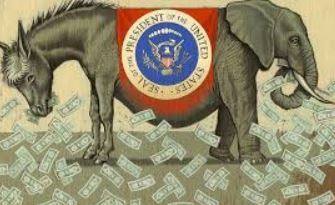
The Pentagon Budget as Corporate Welfare for Weapons Makers

By William Hartung (with introduction by TomDispatch)

Source: TomDispatch.com

What company gets the most money from the U.S. government? The answer: the weapons maker Lockheed Martin. As the Washington Post recently reported, of its $51 billion in sales in 2017, Lockheed took in $35.2 billion from the government, or close to what the Trump administration is proposing for the 2019 State Department budget. And which company is in second place when it comes to raking in the taxpayer dollars? The answer: Boeing with a mere $26.5 billion. And mind you, that’s before the good times even truly begin to roll, as TomDispatch regular and weapons industry expert William Hartung makes clear today in a deep dive into the (ir)realities of the Pentagon budget.  When it comes to the Department of Defense, though, perhaps we should retire the term “budget” altogether, given its connotation of restraint. Can’t we find another word entirely? Like the Pentagon cornucopia?

Sometimes, it’s hard to believe that perfectly sober reportage about Pentagon funding issues isn’t satire in the style of the New Yorker’s Andy Borowitz.  Take, for instance, a recent report in the Washington Examiner that Army Secretary Mark Esper and other Pentagon officials are now urging Congress to release them from a September 30th deadline for fully dispersing their operation and maintenance funds (about 40% of the department’s budget).  In translation, they’re telling Congress that they have more money than even they can spend in the time allotted.

It’s hard to be forced to spend vast sums in a rush when, for instance, you’re launching a nuclear arms “race” of one by “modernizing” what’s already the most advanced arsenal on the planet over the next 30 years for a mere trillion-plus dollars (a sum that, given the history of Pentagon budgeting, is sure to rise precipitously).  In that context, let Hartung usher you into the wondrous world of what, in the age of The Donald, might be thought of (with alliteration in mind) as the Plutocratic Pentagon. Tom

How the Pentagon Devours the Budget
Normalizing Budgetary Bloat
By William D. Hartung

Imagine for a moment a scheme in which American taxpayers were taken to the cleaners to the tune of hundreds of billions of dollars and there was barely a hint of criticism or outrage.  Imagine as well that the White House and a majority of the politicians in Washington, no matter the party, acquiesced in the arrangement.  In fact, the annual quest to boost Pentagon spending into the stratosphere regularly follows that very scenario, assisted by predictions of imminent doom from industry-funded hawks with a vested interest in increased military outlays.

Most Americans are probably aware that the Pentagon spends a lot of money, but it’s unlikely they grasp just how huge those sums really are.  All too often, astonishingly lavish military budgets are treated as if they were part of the natural order, like death or taxes.

The figures contained in the recent budget deal that kept Congress open, as well as in President Trump’s budget proposal for 2019, are a case in point: $700 billion for the Pentagon and related programs in 2018 and $716 billion the following year.  Remarkably, such numbers far exceeded even the Pentagon’s own expansive expectations.  According to Donald Trump, admittedly not the most reliable source in all cases, Secretary of Defense Jim Mattis reportedly said, “Wow, I can’t believe we got everything we wanted” — a rare admission from the head of an organization whose only response to virtually any budget proposal is to ask for more.

The public reaction to such staggering Pentagon budget hikes was muted, to put it mildly. Unlike last year’s tax giveaway to the rich, throwing near-record amounts of tax dollars at the Department of Defense generated no visible public outrage.  Yet those tax cuts and Pentagon increases are closely related.  The Trump administration’s pairing of the two mimics the failed approach of President Ronald Reagan in the 1980s — only more so.  It’s a phenomenon I’ve termed “Reaganomics on steroids.”  Reagan’s approach yielded oceans of red ink and a severe weakening of the social safety net.  It also provoked such a strong pushback that he later backtracked by raising taxes and set the stage for sharp reductions in nuclear weapons.

Donald Trump’s retrograde policies on immigration, women’s rights, racial justice, LGBT rights, and economic inequality have spawned an impressive and growing resistance.  It remains to be seen whether his generous treatment of the Pentagon at the expense of basic human needs will spur a similar backlash.

Of course, it’s hard to even get a bead on what’s being lavished on the Pentagon when much of the media coverage failed to drive home just how enormous these sums actually are. A rare exception was an Associated Press story headlined “Congress, Trump Give the Pentagon a Budget the Likes of Which It Has Never Seen.” This was certainly far closer to the truth than claims like that of Mackenzie Eaglen of the conservative American Enterprise Institute, which over the years has housed such uber-hawks as Dick Cheney and John Bolton.  She described the new budget as a “modest year-on-year increase.” If that’s the case, one shudders to think what an immodest increase might look like.

The Pentagon Wins Big

So let’s look at the money.

Though the Pentagon’s budget was already through the roof, it will get an extra $165 billion over the next two years, thanks to the congressional budget deal reached earlier this month.  To put that figure in context, it was tens of billions of dollars more than Donald Trump had asked for last spring to  “rebuild” the U.S. military (as he put it).  It even exceeded the figures, already higher than Trump’s, Congress had agreed to last December.  It brings total spending on the Pentagon and related programs for nuclear weapons to levels higher than those reached during the Korean and Vietnam wars in the 1950s and 1960s, or even at the height of Ronald Reagan’s vaunted military buildup of the 1980s. Only in two years of Barack Obama’s presidency, when there were roughly 150,000 U.S. troops in Iraq and Afghanistan, or about seven times current levels of personnel deployed there, was spending higher.

Ben Freeman of the Center for International Policy put the new Pentagon budget numbers in perspective when he pointed out that just the approximately $80 billion annual increase in the department’s top line between 2017 and 2019 will be double the current budget of the State Department; higher than the gross domestic products of more than 100 countries; and larger than the entire military budget of any country in the world, except China’s.

Democrats signed on to that congressional budget as part of a deal to blunt some of the most egregious Trump administration cuts proposed last spring.  The administration, for example, kept the State Department’s budget from being radically slashed and it reauthorized the imperiled Children’s Health Insurance Program (CHIP) for another 10 years.  In the process, however, the Democrats also threw millions of young immigrants under the bus by dropping an insistence that any new budget protect the Deferred Action for Childhood Arrivals, or “Dreamers,” program.  Meanwhile, the majority of Republican fiscal conservatives were thrilled to sign off on a Pentagon increase that, combined with the Trump tax cut for the rich, funds ballooning deficits as far as the eye can see — a total of $7.7 trillion worth of them over the next decade.

While domestic spending fared better in the recent congressional budget deal than it would have if Trump’s draconian plan for 2018 had been enacted, it still lags far behind what Congress is investing in the Pentagon.  And calculations by the National Priorities Project indicate that the Department of Defense is slated to be an even bigger winner in Trump’s 2019 budget blueprint. Its share of the discretionary budget, which includes virtually everything the government does other than programs like Medicare and Social Security, will mushroom to a once-unimaginable 61 cents on the dollar, a hefty boost from the already startling 54 cents on the dollar in the final year of the Obama administration.

The skewed priorities in Trump’s latest budget proposal are fueled in part by the administration’s decision to embrace the Pentagon increases Congress agreed to last month, while tossing that body’s latest decisions on non-military spending out the window.  Although Congress is likely to rein in the administration’s most extreme proposals, the figures are stark indeed — a proposed cut of $120 billion in the domestic spending levels both parties agreed to. The biggest reductions include a 41% cut in funding for diplomacy and foreign aid; a 36% cut in funding for energy and the environment; and a 35% cut in housing and community development.  And that’s just the beginning.  The Trump administration is also preparing to launch full-scale assaults on food stamps, Medicaid, and Medicare.  It’s war on everything except the U.S. military.

Corporate Welfare

The recent budget plans have brought joy to the hearts of one group of needy Americans: the top executives of major weapons contractors like Lockheed Martin, Boeing, Northrop Grumman, Raytheon, and General Dynamics. They expect a bonanza from the skyrocketing Pentagon expenditures. Don’t be surprised if the CEOs of these five firms give themselves nice salary boosts, something to truly justify their work, rather than the paltry $96 million they drew as a group in 2016 (the most recent year for which full statistics are available).

And keep in mind that, like all other U.S.-based corporations, those military-industrial behemoths will benefit richly from the Trump administration’s slashing of the corporate tax rate.  According to one respected industry analyst, a good portion of this windfall will go towards bonuses and increased dividends for company shareholders rather than investments in new and better ways to defend the United States.  In short, in the Trump era, Lockheed Martin and its cohorts are guaranteed to make money coming and going.

Items that snagged billions in new funding in Trump’s proposed 2019 budget included Lockheed Martin’s overpriced, underperforming F-35 aircraft, at $10.6 billion; Boeing’s F-18 “Super Hornet,” which was in the process of being phased out by the Obama administration but is now written in for $2.4 billion; Northrop Grumman’s B-21 nuclear bomber at $2.3 billion; General Dynamics’ Ohio-class ballistic missile submarine at $3.9 billion; and $12 billion for an array of missile-defense programs that will redound to the benefit of… you guessed it: Lockheed Martin, Raytheon, and Boeing, among other companies.  These are just a few of the dozens of weapons programs that will be feeding the bottom lines of such companies in the next two years and beyond.  For programs still in their early stages, like that new bomber and the new ballistic missile submarine, their banner budgetary years are yet to come.

In explaining the flood of funding that enables a company like Lockheed Martin to reap $35 billion per year in government dollars, defense analyst Richard Aboulafia of the Teal Group noted that “diplomacy is out; air strikes are in… In this sort of environment, it’s tough to keep a lid on costs. If demand goes up, prices don’t generally come down. And, of course, it’s virtually impossible to kill stuff. You don’t have to make any kind of tough choices when there’s such a rising tide.”

Pentagon Pork Versus Human Security

Loren Thompson is a consultant to many of those weapons contractors.  His think tank, the Lexington Institute, also gets contributions from the arms industry.  He caught the spirit of the moment when he praised the administration’s puffed-up Pentagon proposal for using the Defense Department budget as a jobs creator in key states, including the crucial swing state of Ohio, which helped propel Donald Trump to victory in 2016.  Thompson was particularly pleased with a plan to ramp up General Dynamics’s production of M-1 tanks in Lima, Ohio, in a factory whose production line the Army had tried to put on hold just a few years ago because it was already drowning in tanks and had no conceivable use for more of them.

Thompson argues that the new tanks are needed to keep up with Russia’s production of armored vehicles, a dubious assertion with a decidedly Cold War flavor to it.  His claim is backed up, of course, by the administration’s new National Security Strategy, which targets Russia and China as the most formidable threats to the United States.  Never mind that the likely challenges posed by these two powers — cyberattacks in the Russian case and economic expansion in the Chinese one — have nothing to do with how many tanks the U.S. Army possesses.

Trump wants to create jobs, jobs, jobs he can point to, and pumping up the military-industrial complex must seem like the path of least resistance to that end in present-day Washington.  Under the circumstances, what does it matter that virtually any other form of spending would create more jobs and not saddle Americans with weaponry we don’t need?

If past performance offers any indication, none of the new money slated to pour into the Pentagon will make anyone safer.  As Todd Harrison of the Center for Strategic and International Studies has noted, there is a danger that the Pentagon will just get “fatter not stronger” as its worst spending habits are reinforced by a new gusher of dollars that relieves its planners of making any reasonably hard choices at all.

The list of wasteful expenditures is already staggeringly long and early projections are that bureaucratic waste at the Pentagon will amount to $125 billion over the next five years.  Among other things, the Defense Department already employs a shadow work force of more than 600,000 private contractors whose responsibilities overlap significantly with work already being done by government employees.  Meanwhile, sloppy buying practices regularly result in stories like the recent ones on the Pentagon’s Defense Logistics Agency losing track of how it spent $800 million and how two American commands were unable to account for $500 million meant for the war on drugs in the Greater Middle East and Africa.

Add to this the $1.5 trillion slated to be spent on F-35s that the nonpartisan Project on Government Oversight has noted may never be ready for combat and the unnecessary “modernization” of the U.S. nuclear arsenal, including a new generation of nuclear-armed bombers, submarines, and missiles at a minimum cost of $1.2 trillion over the next three decades.  In other words, a large part of the Pentagon’s new funding will do much to fuel good times in the military-industrial complex but little to help the troops or defend the country.

Most important of all, this flood of new funding, which could crush a generation of Americans under a mountain of debt, will make it easier to sustain the seemingly endless seven wars that the United States is fighting in Afghanistan, Pakistan, Syria, Iraq, Libya, Somalia, and Yemen.  So call this one of the worst investments in history, ensuring as it does failed wars to the horizon.

It would be a welcome change in twenty-first-century America if the reckless decision to throw yet more unbelievable sums of money at a Pentagon already vastly overfunded sparked a serious discussion about America’s hyper-militarized foreign policy.  A national debate about such matters in the run-up to the 2018 and 2020 elections could determine whether it continues to be business-as-usual at the Pentagon or whether the largest agency in the federal government is finally reined in and relegated to an appropriately defensive posture.


William D. Hartung, a TomDispatch regular, is the director of the Arms and Security Project at the Center for International Policy and the author of Prophets of War: Lockheed Martin and the Making of the Military-Industrial Complex.
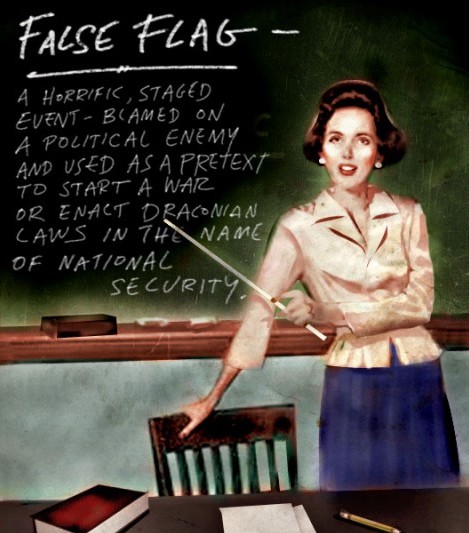
 

How false flag operations are carried out today

By Philip M. Giraldi

Source: Intrepid Report

False Flag is a concept that goes back centuries. It was considered to be a legitimate ploy by the Greeks and Romans, where a military force would pretend to be friendly to get close to an enemy before dropping the pretense and raising its banners to reveal its own affiliation just before launching an attack. In the sea battles of the eighteenth century among Spain, France and Britain hoisting an enemy flag instead of one’s own to confuse the opponent was considered to be a legitimate ruse de guerre, but it was only “honorable” if one reverted to one’s own flag before engaging in combat.

Today’s false flag operations are generally carried out by intelligence agencies and non-government actors including terrorist groups, but they are only considered successful if the true attribution of an action remains secret. There is nothing honorable about them as their intention is to blame an innocent party for something that it did not do. There has been a lot of such activity lately and it was interesting to learn by way of a leak that the Central Intelligence Agency (CIA) has developed a capability to mimic the Internet fingerprints of other foreign intelligence services. That means that when the media is trumpeting news reports that the Russians or Chinese hacked into U.S. government websites or the sites of major corporations, it could actually have been the CIA carrying out the intrusion and making it look like it originated in Moscow or Beijing. Given that capability, there has been considerable speculation in the alternative media that it was actually the CIA that interfered in the 2016 national elections in the United States.

False flags can be involved in other sorts of activity as well. The past year’s two major alleged chemical attacks carried out against Syrian civilians that resulted in President Donald Trump and associates launching 160 cruise missiles are pretty clearly false flag operations carried out by the rebels and terrorist groups that controlled the affected areas at the time. The most recent reported attack on April 7 might not have occurred at all, according to doctors and other witnesses who were actually in Douma. Because the rebels succeeded in convincing much of the world that the Syrian government had carried out the attacks, one might consider their false flag efforts to have been extremely successful.

The remedy against false flag operations such as the recent one in Syria is, of course, to avoid taking the bait and instead waiting until a thorough and objective inspection of the evidence has taken place. The United States, Britain and France did not do that, preferring instead to respond to hysterical press reports by “doing something.” If the U.N. investigation of the alleged attack turns up nothing, a distinct possibility, it is unlikely that they will apologize for having committed a war crime.

The other major false flag that has recently surfaced is the poisoning of Sergei Skripal and his daughter Yulia in Salisbury, England, on March 4. Russia had no credible motive to carry out the attack and had, in fact, good reasons not to do so. The allegations made by British Prime Minister Theresa May about the claimed nerve agent being “very likely” Russian in origin have been debunked, in part through examination by the U.K.’s own chemical weapons lab. May, under attack even within her own party, needed a good story and a powerful enemy to solidify her own hold on power so false flagging something to Russia probably appeared to be just the ticket as Moscow would hardly be able to deny the “facts” being invented in London. Unfortunately, May proved wrong and the debate ignited over her actions, which included the expulsion of twenty-three Russian diplomats, has done her severe damage. Few now believe that Russia actually carried out the poisoning and there is a growing body of opinion suggesting that it was actually a false flag executed by the British government or even by the CIA.

The lesson that should be learned from Syria and Skripal is that if “an incident” looks like it has no obvious motive behind it, there is a high probability that it is a false flag. A bit of caution in assigning blame is appropriate given that the alternative would be a precipitate and likely disproportionate response that could easily escalate into a shooting war.

US Collapse – the Spectacle of Our Time

By Finnian Cunningham

Source: Axis of Logic

May you live in interesting times, goes the Chinese proverb. Few can doubt that we are indeed living in such an interesting time. Big changes are afoot in the world, it seems.

None more so than the collapsing of the American Empire.

The US is going through an historic “correction” in the same way that the Soviet Union did some 30 years ago when the latter was confronted with the reality of its unsustainable political and economic system. (That’s not meant to imply, however, that socialism is unviable, because arguably the Soviet Union had fatally strayed from its genuine socialist project into something more akin to unwieldy state capitalism.)

In any case, all empires come to an end eventually. History is littered with the debris of countless empires. Why should the American Empire be any different? It’s not. Only arrogant “American exceptionalism” deludes itself from the reality.

The notable thing is just how in denial the political class and the US news media are about the unfolding American crisis.

This is partly where the whole “Russiagate” narrative comes into play. Blaming Russia for allegedly destabilizing US politics and society is a cover for denial over the internal rot facing the US.

Some may scoff at the very idea of an “American Empire”. That’s something Europeans did, not us, goes the apologist for US power. The quick retort to that view is to point out that the US has over 1,000 military bases in more than 100 countries around the world. If that is not a manifestation of empire then what is?

For seven decades since the Second World War, “Pax Americana” was the grandiose name given to US imperial design for the global order. The period was far from peaceful as the vainglorious name suggests. Dozens of wars, proxy conflicts and violent subversions were carried by the US on every continent in order to maintain its empire. The so-called “global policeman” was more often a “global thug”.

That US empire is now teetering at the cusp of an emerging multipolar world order led by China, Russia and other rising powers.

When US leaders complain about China and Russia “reshaping the global order” to reflect their interests what the American leaders are tacitly admitting is the coming end of Washington’s presumed hegemony.

Rather than accepting the fate of demise, the US is aggressively resisting by denigrating China and Russia’s power as somehow illegitimate. It’s the classic denial reaction of a sore loser.

So, what are the telltale signs that the US is indeed undergoing a seminal “correction” — or collapse?

The heyday of American capitalism is well passed. The once awesome productive system is a skeleton of its former self. The rise of massive social poverty alongside obscene wealth among a tiny elite is a sure sign that the once mighty American economy is chronically moribund. The country’s soaring $20 trillion national debt is another symptom of chronic atrophy.

Recent self-congratulatory whooping by President Trump of “economic recovery” is like the joy felt from looking at a mirage. The roaring stock market is an elite phenomenon which can just as easily slump over night.
What the champagne bubbles can’t disguise is the structural failing of US capitalism to reverse exploding inequality and endemic poverty across America. The national prowess of US capitalism has been superseded by global capitalism where American corporations among others scour the planet for cheap labor and tax havens. There is no going back to a supposed golden age, no matter how much Trump crows about “America First”.

The other side of the coin from historic US economic demise is the concomitant rise in its militarism as a way to compensate for its overall loss of power.

It is no coincidence that since the end of the Cold War following the dissolution of the Soviet Union, US military interventions around the world have erupted with increased frequency and duration. The US is in a veritable permanent state of war actively deploying its forces simultaneously in several countries, particularly in the oil-rich Middle East.

Washington of course gives itself a fig leaf cover by calling its surge in militarism a “war on terror” or “defending allies”. But, increasingly, US war conduct is seen for what it plainly is — violation of international law and the sovereignty of nations for the pursuit of American imperial interests.

In short, the US is patently lashing out as a rogue regime. There’s no disguising that fiendish fact.

In addition to waging wars, bombing countries, sponsoring terrorist proxies and assassinating enemies at will with drones, Washington is increasingly threatening others with military aggression. In recent months, North Korea and Iran have been openly threatened based on spurious claims. Russia and China have also been explicitly warned of American aggression in several strategic documents published by the Trump administration.

The grounds for American belligerence are baseless. As noted, the real motive is to do with compensating for its own inherent political, economic and social crises. That then amounts to American leaders inciting conflicts and wars, which is in itself a grave violation of international law — a crime against peace, according to Nuremberg principles.

The American Empire is failing and flailing. This is the spectacle of our time. The Western mainstream news media are either blind, ignorant or complicit in denying the historic collapse. Such media are indulging reckless fantasies of the US political class to distract from the potential internal implosion. Casting around for scapegoats to “explain” the deep inherent problems, the political class are using Russia and alleged Russian “interference” as a pretext.

World history has reached a foreboding cross-roads due to the collapsing of the American Empire. Can we navigate a safe path forward avoiding catastrophic war that often accompanies the demise of empires?

A lot, it seems, depends on ordinary American people becoming politically organized to challenge their dysfunctional system run by and for the elites. If the American people cannot hold their elites to account and break their corrupt rule, overhauling it with something more equitable and democratic, then the world is in peril of being plunged into total war. We can only but wish our American brothers and sisters solidarity and success.

Fake News Is Fake Amerika

America’s ‘Unlimited Imperialists’


By Francis Boyle

Source: Consortium News

Historically the latest eruption of American militarism in the 21st Century is akin to that of America opening the 20th Century by means of the U.S.-instigated Spanish-American War in 1898.

The then Republican administration of President William McKinley grabbed their colonial empire from Spain in Cuba, Puerto Rico, Guam, and the Philippines; inflicted a near genocidal war against the Filipino people; while at the same time illegally annexing the Kingdom of Hawaii and subjecting the Native Hawaiian people (who call themselves the Kanaka Maoli) to genocidal conditions.

Additionally, McKinley’s military and colonial expansion into the Pacific was also designed to secure America’s economic exploitation of China pursuant to the euphemistic rubric of the “open door” policy.   But over the next four decades America’s aggressive presence, policies, and practices in the so-called “Pacific” Ocean would ineluctably pave the way for Japan’s attack at Pearl Harbor on Dec. 7, 1941, and thus America’s precipitation into the ongoing Second World War.

Today a century later, the serial imperial aggressions launched, waged, and menaced by the neoconservative Republican Bush Junior administration, then the neoliberal Democratic Obama administration and now the reactionary Trump administration threaten to set off World War III.

This Time the Stakes are Higher

By shamelessly exploiting the terrible tragedy of September 11, the Bush Junior administration set forth to steal a hydrocarbon empire from the Muslim states and peoples of color living in Central Asia, the Middle East and Africa under the bogus pretexts of (a) fighting a war against “international terrorism” or “Islamic fundamentalism”; and/or (b) eliminating weapons of mass destruction; and/or (c) promoting democracy; and/or (d) self-styled humanitarian intervention and its avatar “responsibility to protect” (R2P).

Only this time the geopolitical stakes are infinitely greater than they were a century ago:  control and domination of the world’s hydrocarbon resources and thus the very fundaments and energizers of the global economic system – oil and gas.

The Bush Junior and Obama administrations targeted the remaining hydrocarbon reserves of Africa, Latin America (e.g., the Pentagon’s reactivating the Fourth Fleet in 2008), and Southeast Asia for further conquest and domination, together with the strategic choke-points at sea and on land required for their transportation (e.g., Syria, Yemen, Somalia, Djibouti).  Today the U.S. Fourth Fleet threatens oil-rich Venezuela and Ecuador, along with Cuba.

Toward accomplishing that first objective, in 2007, the neoconservative Bush Junior administration announced the establishment of the U.S. Pentagon’s Africa Command (AFRICOM) in order to better control, dominate, steal, and exploit both the natural resources and the variegated peoples of the continent of Africa, the very cradle of our human species.

In 2011 Libya and the Libyans proved to be the first victims to succumb to AFRICOM under the neoliberal Obama administration, thus demonstrating the truly bi-partisan and non-partisan nature of U.S. imperial foreign policy decision-making. Let us put aside as beyond the scope of this article, the American conquest, extermination, and ethnic cleansing of the Native Americans from the face of the continent.

Since America’s instigation of the Spanish-American War in 1898, U.S. foreign policy decision-making has been alternatively conducted by reactionary imperialists, conservative imperialists, and liberal imperialists for the past 120 years and counting.

Trump is just another representative for U.S. imperialism and neoliberal capitalism. He forthrightly and proudly admitted that the United States is in the Middle East in order to steal their oil. At least he was honest about it. Unlike his predecessors who lied about the matter going back to President George Bush Sr. with his War for Persian Gulf oil against Iraq in 1991. Just recently, Trump publicly threatened illegal U.S. military intervention against oil-rich Venezuela and now he’s poised to strike Syria.

It’s About Power, Not Just Resources

But oil and other resources are not the only U.S. motive. Enforcing its global power and undermining or removing leaders who defy it are also at play.

As my teacher, mentor, and friend, the late, great Professor Hans Morgenthau, who coined the term “unlimited imperialism” in his seminal 1948 critique of U.S. foreign policy, Politics Among Nations, said:

          “The outstanding historic examples of unlimited imperialism are the expansionist policies of Alexander the Great, Rome, the Arabs in the seventh and eighth centuries, Napoleon I, and Hitler. They all have in common an urge toward expansion which knows no rational limits, feeds on its own successes and, if not stopped by a superior force, will go on to the confines of the political world. This urge will not be satisfied so long as there remains anywhere a possible object of domination–a politically organized group of men which by its very independence challenges the conqueror’s lust for power. It is, as we shall see, exactly the lack of moderation, the aspiration to conquer all that lends itself to conquest, characteristic of unlimited imperialism, which in the past has been the undoing of the imperialistic policies of this kind…”

Since September 11, 2001, it is the Unlimited Imperialists along the lines of Alexander, Rome, Napoleon, and Hitler who have been in charge of conducting American foreign policy decision-making.  The factual circumstances surrounding the outbreaks of both the First World War and the Second World War currently hover like twin Swords of Damocles over the heads of all humanity.


Francis Boyle is a professor of international law at the University of Illinois Urbana-Champaign. Among his many books is “Destroying World Order.”

The ‘Values,’ ‘Vision,’ and ‘Democracy’ of an Inauthentic Opposition

Average Americans, whose economic survival is threatened, have no political party to represent them, including deceptive Democrats who claim to be their champions and blame others when their deception fails, says Paul Street.

By Paul Street

Source: Consortium News

Never underestimate the capacity of the United States’ Inauthentic Opposition Party, the corporate Democrats, for self-congratulatory delusion and the externalization of blame.

Look, for example, at the Democratic National Committee’s (DNC) recently filed 66-page lawsuit against Russia, WikiLeaks, and the 2016 Donald Trump campaign. The document accuses Russia of “mount[ing] a brazen attack on the American democracy,” “destabilize[ing] the U.S. political environment” on Trump’s (and Russia’s) behalf, and “interfering with our democracy….”

“The [RussiaGate] conspiracy,” the DNC Complaint says, “undermined and distorted the DNC’s ability to communicate the [Democratic] party’s values and vision to the American electorate” and “sowed discord within the Democratic Party at a time when party unity was essential…”

Yes, Russia, like numerous other nations living under the global shadow of the American Superpower, may well have tried to have some surreptitious say in 2016 U.S. presidential election. (Why wouldn’t the Kremlin have done that, given the very real and grave threats Washington and its Western NATO allies have posed for many years to post-Soviet-era Russian security and peace in Eastern Europe?)

Still, charging Russia with interfering with US-“American democracy” is like me accusing the Washington Capital’s star left winger Alex Ovechkin of interfering with my potential career as a National Hockey League player (I’m middle aged and can’t skate backwards). The U.S. doesn’t have a functioning democracy to undermine, as numerous careful studies (see this,this,this,this,this,this,this,this, and this) have shown.

We have, rather, a corporate and financial oligarchy, an open plutocracy. U.S.-Americans get to vote, yes, but the nation’s “unelected dictatorship of money” reigns nonetheless in the United States, where, as leading liberal political scientists Benjamin Page (Northwestern) and Marin Gilens (Princeton) find, “government policy…reflects the wishes of those with money, not the wishes of the millions of ordinary citizens who turn out every two years to choose among the preapproved, money-vetted candidates for federal office.”

Our Own Oligarchs

Russia and WikiLeaks “destabilized the U.S. political environment”? Gee, how about the 20 top oligarchic U.S. mega-donors who invested more than $500 million combined in disclosed campaign contributions (we can only guess at how much “dark,” that is undisclosed, money they gave) to candidates and political organizations in the 2016 election cycle? The 20 largest organizational donors also gave a total of more than $500 million. The foremost plutocratic election investors included hard right-wing billionaires like casino owner Sheldon Adelson ($83 million disclosed to Republicans and right-wing groups), hedge-fund manager Paul Singer ($26 million to Republicans and the right), hedge fund manager Robert Mercer ($26 million) and packaging mogul Richard Uihlein ($24 million).

How about the multi-billionaire Trump’s own real estate fortune, which combined with the remarkable free attention the corporate media oligopoly granted him to help catapult the orange-tinted fake-populist beast past his more traditional Republican primary opponents? And what about the savagely unequal distribution of wealth and income in Barack Obama’s America, so extreme in the wake of the Great Recession that Hillary’s primary campaign rival Bernie Sanders could credibly report that the top tenth of the upper U.S.1% possessed nearly as much wealth as the nation’s bottom 90%? Such extreme disparity helped doom establishment, Wall Street- and Goldman Sachs-embroiled candidates like Jeb Bush, Marco Rubio, and Mrs. Clinton in 2016. Russia and WikiLeaks did not create that deep, politically- and neoliberal-policy-generated socioeconomic imbalance.

Double Vision

And just what were the Democratic Party “values and vision” that Russia, Trump, and WikiLeaks supposedly prevented the DNC and the Clinton team from articulating in 2016? As the distinguished political scientist and money-politics expert Thomas Ferguson and his colleagues Paul Jorgensen and Jie Chen noted in an important study released three months ago, the Clinton campaign “emphasized candidate and personal issues and avoided policy discussions to a degree without precedent in any previous election for which measurements exist….it deliberately deemphasized issues in favor of concentrating on what the campaign regarded as [Donald] Trump’s obvious personal weaknesses as a candidate.” Strangely enough, the Twitter-addicted reality television star Trump had a lot more to say about policy than the former First Lady, U.S. Senator, and Secretary of State Hillary Clinton, a wonkish Yale Law graduate.

The Democrats “values and vision” in 2016 amounted pretty much to the accurate but hardly inspiring or mass-mobilizing notion that Donald Trump was an awful person who was unqualified for the White House. Clinton ran almost completely on candidate character and quality. This was a blunder of historic proportions, given Clinton’s own highly problematic character brand. Any campaign needs a reasonably strong policy platform to stand on in case of candidate difficulties.

By Ferguson, Jorgenson, and Chen’s account, Hillary’s peculiar policy silence was about U.S. oligarchs’ campaign money. Thanks to candidate Trump’s bizarre nature and his declared isolationism and nationalism, Clinton achieved remarkable campaign finance success with normally Republican-affiliated capitalist sectors less disposed to abide the standard, progressive-sounding policy rhetoric of Democratic Party candidates than their more liberal counterparts.

One ironic but “fateful consequence” of her curious connection to conservative business interests was her “strategic silence about most important matters of public policy. … Misgivings of major contributors who worried that the Clinton campaign message lacked real attractions for ordinary Americans were rebuffed. The campaign,” Ferguson, Jorgenson, and Chen wrote, “sought to capitalize on the angst within business by vigorously courting the doubtful and undecideds there, not in the electorate.”

Other Clinton mistakes included failing to purchase television ads in Michigan, failing to set foot in Wisconsin after the Democratic National Convention, and getting caught telling wealthy New York City campaign donors that Trump’s white supporters were “a basket of” racist, sexist, nativist, and homophobic “deplorables.” This last misstep was a Freudian slip of the neoliberal variety. It reflected and advanced the corporate Democrats’ longstanding alienation of and from the nation’s rural and industrial and ex-industrial “heartland.”

Fake Progressives

As left historian Nancy Fraser noted after Trump was elected, the Democrats, since at least the Bill Clinton administration, had joined outwardly progressive forces like feminism, antiracism, multiculturalism, and LGBTQ rights to “financial capitalism.” This imparted liberal “charisma” and “gloss” to “policies that …devastated…what were once middle-class lives” by wiping out manufacturing, weakening unions, slashing wages, and increasing the “precarity of work.”

To make matters worse, Fraser rightly added, the “progressive neoliberal” blue-and digital-zone Democrats “compounded” the “injury of deindustrialization” with “the insult of progressive moralism,” which rips red-and analog-zone whites as culturally retrograde (recall candidate Obama’s problematic 2008 reflection on how rural and small-town whites “cling to religion and guns”) and yet privileged by the simple color of their skin.

Such insults from elite, uber-professional class neo-liberals like Obama (Harvard Law) and the Clintons (Yale Law) would sting less in the nation’s “flyover zones” if the those uttering them had not spent their sixteen years in the White House governing blatantly in accord with the wishes of Wall Street, Silicon Valley, and the leading multinational corporations. Like Bill Clinton’s two terms, the Obama years were richly consistent with Sheldon Wolin’s early 2008 description of the Democrats as an “inauthentic opposition” whose dutiful embrace of “centrist precepts” meant they would do nothing to “substantially revers[e] the drift rightwards” or “significantly alter the direction of society.”

The fake-“progressive” Obama presidency opened with the expansion of Washington’s epic bailout of the very parasitic financial elites who recklessly sparked the Great Recession (this with no remotely concomitant expansion of federal assistance to the majority middle- and working-class victims), the abandonment of campaign pledges to restore workers’ right to organize (through the immediately forgotten Employee Free Choice Act), and the kicking of Single Payer health care advocates to the curb as Obama worked with the big drug and insurance syndicates to craft a corporatist, profit-friendly health insurance reform. Obama’s second term ended with him doggedly (if unsuccessfully) championing the arch-authoritarian global-corporatist Trans Pacific Partnership.

This Goldman Sachs and Citigroup-directed policy record was no small part of what demobilized the Democrats’ mass electoral base in ways that “destabilized the U.S. political environment” to the benefit of the reactionary populist Trump, whose Mercer family-backed proto-fascistic strategist and Svengali Steve Bannon was smartly attuned to the Democrats’ elitist class problem.

There was a major 2016 presidential candidate who ran with genuinely progressive “values and vision” – Bernie Sanders. The most remarkable finding in Ferguson, Jorgenson, and Chen’s study is that the self-declared “democratic socialist” Sanders came tantalizingly close to winning the Democratic presidential nomination with no support from Big Business. The small-donor Sanders campaign was “without precedent in American politics not just since the New Deal, but across virtually the whole of American history … a major presidential candidate waging a strong, highly competitive campaign whose support from big business was essentially zero.”

Sanders was foiled by the big-money candidate Clinton’s advance control of the Democratic National Committee and convention delegates. Under a formal funding arrangement it worked up with the Democratic National Committee (DNC) in late September of 2015, the depressing “lying neoliberal warmonger” Hillary’s campaign was granted advance control of all the DNC’s “strategic decisions.” The Democratic Party’s presidential caucuses and primaries were rigged against Sanders in ugly ways that provoked a different lawsuit last year – a class-action suit against the DNC on behalf of Sanders’ supporters. The complaint was dismissed by a federal judge who ruled on the side of DNC lawyers by agreeing that the DNC was within its rights to violate their party’s charter and bylaws by selecting its candidate in advance of the primaries.

How was that for the noble “values and vision” that “American democracy” inspires atop the not-so leftmost of the nation’s two major and electorally viable political parties?

Under Cover of Russia-gate

That’s what “sowed discord within the Democratic Party at a time when party unity was essential…” Russia didn’t do it. Neither did WikiLeaks or the Trump campaign. The Clinton campaign and the Democratic Party establishment – themselves funded by major U.S. oligarchs like San Francisco hedge-fund billionaire Tom Steyer– did that on their own.

Could Sanders – the most popular politician in the U.S. (something rarely reported in a “mainstream” corporate media that could barely cover his giant campaign rallies even as it obsessed over Trump’s every bizarre Tweet) – have defeated the orange-tinted beast in the general election? Perhaps, though much of the oligarchic funding Hillary got would have gone to Trump if “socialist” Bernie had been the Democratic nominee. It is unlikely that Sanders could have accomplished much as president in a nation long controlled by the capitalist oligarchy in numerous ways that go far beyond campaign finance alone.

Meanwhile, under the cover of RussiaGate, the still-dismal and dollar-drenched corporate-imperial Democrats seem content to continue tilting to the center-right, purging Sanders-style progressives from the party’s leadership and citing the party’s special election victories (Doug Jones and Conor Lamb) against deeply flawed and Trump-backed Republicans in two bright-red voting districts (the state of Alabama and a fading Pennsylvania canton) as proof that tepid neoliberal centrism is still (even after Hillary’s stunning defeat) the way to go.

Along the way, the Inauthentic Opposition’s candidate roster for the upcoming Congressional mid-term election is loaded with an extraordinary number of contenders with U.S. military and intelligence backgrounds, consistent with Congressional Democrats repeated votes to give massive military and surveillance-state funds and power to a president they consider (accurately enough) unbalanced and dangerous.

The trick, the neoliberal “CIA Democrats” think, is to run conservative, Wall Street-backed imperial and National Security State veterans who pretend (see Eric Draitser’s recent piece on “How Clintonites Are Manufacturing Faux Progressive Congressional Campaigns”) to be aligned with majority-progressive left-of-center policy sentiments and values. It’s still very much their party.

Whatever happens during the next biennial electoral extravaganza, “the crucial fact” remains, in Wolin’s words nine years ago, “that for the poor, minorities, the working class and anti-corporatists there is no opposition party working on their behalf” in the United States – the self-declared homeland and headquarters of global democracy.


Paul Street is an independent radical-democratic policy researcher, journalist, historian, author and speaker based in Iowa City, Iowa, and Chicago, Illinois.  He is the author of seven books. His latest is They Rule: The 1% v. Democracy (Paradigm, 2014)

Russia’s Seattle Consulate Broken Into: the US Openly Flouts its International Obligations

By Alex Gorka

Source: Strategic Culture Foundation

They did it again. On April 25, US inspectors broke into the Russian consulate in Seattle, which had been shuttered and vacated at the order of the American government, in a response to the Skripal case. The “inspection” was actually a break-in, since the locks had to be forced. The Russian staff had closed the mansion on April 24 but kept the keys, as the house is still the property of the Russian government. Officially, the Russian Federation (RF) still owns the mansion and its flag still flies from the roof, but the US owns the land and consular activities will no longer be authorized on that site.

The forced entry into the consulate was a flagrant violation of international law. True, the US government has the right to declare that the mission has been stripped of its diplomatic immunity. But it takes two to tango, and Russia never agreed to lift that immunity. That declaration has no validity without Russia’s consent.

The Vienna Convention on Diplomatic Relations of 1961 protects embassy and consulate property abroad by bestowing upon it the status of inviolability (Article 22). No unauthorized entry is allowed. Moreover, the host country is responsible for protecting all foreign missions from intrusions, damage, and similar events. Diplomatic sites cannot be searched. No document or property can be seized.

The 1963 Vienna Convention on Consular Relations states that consulates, along with their property, are always to be protected by their host, even during an armed conflict. No entrance without permission is allowed (Article 31).

According to the US-USSR Consular Convention of 1968, the diplomatic properties on each other’s soil are sacrosanct. The consulates enjoy diplomatic immunity. Like it or not, the US has just violated that document by entering the Seattle consulate.

As one can see, all the relevant international conventions state, by and large, the same thing – there is no entrance without permission. This is a hard-and-fast rule, but now all of these conventions have just been breached in broad daylight!

The question arises — what’s the use of signing agreements with someone who flouts them? Today they enter foreign compounds, tomorrow they unilaterally pull out of the Iran deal, and then what? The US can walk away from any major arms-control agreement, just like it abandoned the 1972 ABM Treaty in 2002. Washington signs agreements in order to force others to comply with them, while the US enjoys the freedom to interpret them at will. Nothing is binding upon that “shining city on a hill.”

The relevant domestic law in the US, the 1982 Foreign Missions Act, states that the secretary of state may demand that any foreign mission be stripped of its property if such a move is needed to protect US interests. This can be done provided that one year has passed from the date on which that foreign mission ceased its diplomatic or consular functions. In this case, one year has not passed. What’s more, no clear explanation is offered as to what exactly is meant by “US interests.” And in fact, this act is contradicted by international law. Why should a foreign mission comply with it, if all the conventions listed above are very explicit about property rights and the US is a party to all of them? Anyway, the US law is not relevant in this case, unlike the binding accords America has signed.

It is true that the two nations are engaged in an ongoing “diplomatic war.” That’s a process that’s easy to start and extremely difficult to end. It was not Moscow that started this folly. But even wars have their rules. The US actions are unprecedented and are doing serious damage to the country’s international image. The Seattle consulate’s closure has greatly complicated the lives of many people who have nothing to do with politics.

What about gains? There have been hardly any, especially taking into consideration that the US mission in St. Petersburg, which is going to be closed in response, is much more important for Americans than the consulate office in Seattle was for Russians. The expulsions and closures may go on until the ambassadors are the only ones left, but no one will win. “Tit-for-tat” expulsions are a game with no winners or losers. They are meaningless and doomed to ineffectuality

The ongoing Russian-US “diplomatic war” cannot continue forever. The day will inevitably come when Washington will have to reach some new agreements with Moscow about consulate offices. It’s highly likely that Russia will demand additional guarantees of the safety of its property on American soil. Other nations may follow suit.

Gross violations of international law inflict great damage. The US will not be trusted. It will be viewed as a state that can reject its commitments at any time it chooses. From now on, all nations will know that their embassies and consulates in the US are not protected by the international agreements the American government flouts so easily.


Freedom Rider: Syria and Press Propaganda

By Margaret Kimberly

Source: Black Agenda Report

“Trump protects himself with war as Democrats and the rest of the ruling elite support his militarism.”

It is difficult for Americans to find out what is happening in their country and around the world. That is because corporate media outlets have nearly complete control over what they see and hear and because those interests are closely allied with the state. The promise of the internet, the hoped for level playing field for communication and information gathering, is also under corporate control. It is now part of a well coordinated censorship effort and attack against left wing sites such as Black Agenda Report.

The lies which allowed the United States, France and Britain to attack Syria are presented without contradiction. The people with knowledge and expertise who can counter these narratives are disappeared from access to newspapers or television stations. The close relationship between the deep state, the corporate media, and the establishment elite at home and abroad continues without hindrance.

“British prime minister Theresa May refused to allow a parliamentary vote on the Syrian missile strike.”

Donald Trump may be labeled a fascist but he attacked Syria with the help of France and Britain. Apparently every leader of a “free world” country is also a fascist. They certainly behave that way as they trample on the rights of millions of people. Far from being the “civilized” nations that Trump referred to in his televised address, these three countries are among the most criminal that have ever existed. They all grew rich on the slave trade, indigenous genocides, the plantation economies in the Americas, and the theft of resources all over the world. Now they run roughshod over their own people. British prime minister Theresa May refused to allow a parliamentary vote on the Syrian missile strike and showed the hollowness of claims that hers is a democratic nation. The same can be said of her partners in crime.

France impoverished Haiti with nearly 100 years of theft, murdered Algerians in the streets of Paris and keeps its former African colonies financially dependent. Former president Nicolas Sarkozy took millions of dollars from Muammar Gaddafi and then had him murdered, just like a mob boss would do. Now they have connived with the help of press propagandists in all three countries to fool millions of people as they try to continue their gangsterish aggression against Syria.

“Sarkozy took millions of dollars from Muammar Gaddafi and then had him murdered, just like a mob boss would do.”

If even mediocre journalists were allowed to report freely on this issue the crime would be obvious. Consider the timeline of events. On March 4, former Russian double agent Sergei Skripal and his daughter are poisoned with a chemical agent in Britain. The British government immediately blames Russia, which has no motive to harm a former spy they swapped eight years earlier. Saudi crown prince Mohammed bin Salman arrives in London for an official visit on March 7. On March 12 French president Emmanuel Macron states that France will attack Syria if any chemical weapons are used there. The next day the Russian military claims to have evidence that a chemical attack will be carried out against Syrian civilians as a pretext for war. On March 16 France warns French journalists to leave Syria. Mohammed bin Salman arrives in Washington on March 19. On April 8 he goes to Paris for yet another official visit. That same day Saudi funded jihadist groups and the White Helmets, who were created by a British intelligence officer, claim that a chemical weapons attack occurred in the city of Douma. On April 14 the United States, France and Britain join in the missile strike.

“They have connived with the help of press propagandists in all three countries to fool millions of people.”

The aggressors are very transparent. The plot was carried out in the open. But because they have a compliant media behind them they have no reason to worry. No journalist asked why Sergei Skripal and his daughter are in effect held hostage and denied access to Russian officials as a treaty between the two countries demands. No one questions a strangely worded statement allegedly from Yulia Skripal but issued by the London Metropolitan Police in which she said she didn’t want help from her government or contact with her own relatives.

Why shouldn’t Mohammed bin Salman openly plan with presidents and prime ministers? Who will question him? The New York Times and MSNBC and the Washington Post and the BBC and AFP certainly will not. We will probably never know the name of the person or persons who poisoned the Skripals but common sense tells us that the intended murders were ordered by someone with a motive to create a pretext for war.

“The plot was carried out in the open.”

The actual air strike was limited because of back channel negotiations between these countries. The danger may look like Kabuki theater but no one should assume that the peril is over. The criminals in Washington, London and Paris may yet go too far and provoke a major hot war.

All three heads of state have their own concerns. Macron was put into power to kill off his country’s welfare state and any remnants of left politics. May is struggling with Brexit negotiations and cruel austerity measures that have made her so unpopular she actively avoids voters. Trump may be impeached but he protects himself with war as Democrats and the rest of the ruling elite support his militarism.

Regardless of individual rationales these three people pose a threat to the entire planet. They are aided and abetted by corporate media who act as scribes and present war propaganda as fact. The Nuremberg trials after World War II established that planning aggressive war is a crime and so is the propaganda that promotes it. May, Trump and Macron are guilty but so-called journalists are as well. The criminals could not commit their dirty deeds without their help.


Margaret Kimberley’s Freedom Rider column appears weekly in BAR, and is widely reprinted elsewhere. She maintains a frequently updated blog as well at http://freedomrider.blogspot.com . Ms. Kimberley lives in New York City, and can be reached via e-Mail at Margaret.Kimberley(at)BlackAgendaReport.com.