
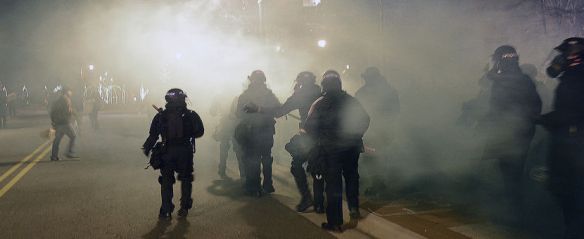
Cycle of Insurgency: How the US military is expected to put down an insurrection

Suspect Death

By Justin King

Source: The Fifth Column

One of the overriding questions when discussing an insurgency within the United States has always been the debate over how the military would respond. Those who hope for the military to break ranks and join the resistance will be disappointed. Those who would believe the military will employ surgical strikes to remove dissidents through technology will be surprised. The American people don’t have to guess how the US military would respond any longer. Two respected academics chose to war game a scenario using the United States Operating Concept (2010) as a guide.

The first thing to understand about an insurrection is that it isn’t terrorism. The terms are often used interchangeably by the media, but there is a significant difference.

As pointed out throughout this series, insurgencies that matured through the cycle of insurgency win. Always. There is a reason for this. Insurgencies, though typically weaker militarily, have great advantages over their adversaries. One of the greatest small unit commanders and unconventional warfare experts in modern times, Richard Marcinko, described three things needed to win in combat: speed, surprise, and violence of action. When transferred to the strategic and operational levels, the insurgency possesses these attributes. The greatest advantages of the insurgency are:

Mobility: The refusal to stay in a static location negates technologically advanced weapons systems.
Initiative: The insurgency is able to choose the time and place of most of the battles they fight.
Surprise: Because the insurgents have the ability to choose the time and place of the fight, they can select moments when the opposition is weakest.
Camouflage: The insurgent does not wear a uniform. As the father of modern insurgency, Michael Collins, said: “Our uniform will be that of the man on the street and the peasant in the field.” This makes distinguishing between friend and foe difficult for the opposition.
Unpredictability: A force that is unpredictable on a battlefield is dangerous. Field commanders train to fight conventional wars, in which both sides attempt to take and hold territory, the insurgent seeks destabilization of the opposition’s government, not land. Tactics designed to defeat a conventional army are useless against an enemy that doesn’t seek to hold territory. The value of remaining unpredictable has created an adage in military circles: “Professional soldiers are predictable, but the world is full of amateurs.” The implied meaning is that the amateur is more dangerous.
Factional divides: In a conventional military setting, a force should function like a well-oiled machine and have clear command and control. Insurgencies typically operate with loose alliances between factions who follow a particular commander. Sometimes they work together, sometimes they don’t. Just when the opposition gains a feel for the tactics and strategy of an insurgent commander, a new one arises. This leads to unpredictable actions being taken by the various factions, which increases their overall effectiveness.
Civilian sympathies: Insurgencies typically maintain a great deal of support from the local populace, which means the opposition can’t move without information detailing those moves reaching the insurgents. In a conventional conflict, the lines of battle hinder civilians from collecting intelligence and passing it to the opposing force. It can be done, but it is difficult. Insurgencies have no front lines.

Insurgencies maintain several other key advantages, but they are more nuanced and are beyond the scope of this article.

The US Army has adopted a doctrine of “Full Spectrum Operations”. Loosely it means the combination of offensive, defensive, and either stability operations overseas or civil support operations on U.S. soil. It’s a concept developed for conventional wars, with little application in unconventional conflicts. To produce a desired outcome (a US military win), the scenario has to be carefully crafted. The academics who published Full Spectrum Operations in the Homeland: A “Vision” of the Future were able to accomplish that. The scenario they present is:

The Great Recession of the early twenty-first century lasts far longer than anyone anticipated.  After a change in control of the White House and Congress in 2012, the governing party cuts off all funding that had been dedicated to boosting the economy or toward relief.  The United States economy has flatlined, much like Japan’s in the 1990s, for the better part of a decade.  By 2016, the economy shows signs of reawakening, but the middle and lower-middle classes have yet to experience much in the way of job growth or pay raises.  Unemployment continues to hover perilously close to double digits, small businesses cannot meet bankers’ terms to borrow money, and taxes on the middle class remain relatively high.  A high-profile and vocal minority has directed the public’s fear and frustration at nonwhites and immigrants.  After almost ten years of race-baiting and immigrant-bashing by right-wing demagogues, nearly one in five Americans reports being vehemently opposed to immigration, legal or illegal, and even U.S.-born nonwhites have become occasional targets for mobs of angry whites.

In May 2016 an extremist militia motivated by the goals of the “tea party” movement takes over the government of Darlington, South Carolina, occupying City Hall, disbanding the city council, and placing the mayor under house arrest.  Activists remove the chief of police and either disarm local police and county sheriff departments or discourage them from interfering.  In truth, this is hardly necessary.  Many law enforcement officials already are sympathetic to the tea party’s agenda, know many of the people involved, and have made clear they will not challenge the takeover.  The militia members are organized and have a relatively well thought-out plan of action.

With Darlington under their control, militia members quickly move beyond the city limits to establish “check points” – in reality, something more like choke points — on major transportation lines.  Traffic on I-95, the East Coast’s main north-south artery; I-20; and commercial and passenger rail lines are stopped and searched, allegedly for “illegal aliens.”  Citizens who complain are immediately detained.  Activists also collect “tolls” from drivers, ostensibly to maintain public schools and various city and county programs, but evidence suggests the money is actually going toward quickly increasing stores of heavy weapons and ammunition.  They also take over the town web site and use social media sites to get their message out unrestricted.

The scenario continues with descriptions of the activities of politicians prior to the military being involved, but the actions of the “insurgent” already guarantee a US military victory. In the presented scenario, the insurgents surrender every single advantage they have. They attempt to hold territory, losing the advantages of mobility, surprise, initiative, and unpredictability. Because they are operating openly and in a defined area, they have lost the advantage of camouflage. The battle lines established by the insurgents themselves at the checkpoints negate the benefits of civilian sympathy. They have a unified command structure that reduces unpredictability.

In the scenario, DOD responds to this threat by establishing a “show of force” to demoralize the insurgents. They then mount offensive operations by surprise to take down the checkpoints. Towards the end of the campaign, the military seizes power and radio stations and so on. It then begins mopping up operations once the civilians of Darlington have fled.

When faced with the realities of a modern insurgency, this response is completely fictional. There can be no “show of force” to insurgents who don’t take and hold territory. Because the insurgency would operate in a loosely defined area, it would be the US military setting up checkpoints (as in Iraq) that would be ambushed, not the insurgents. Wise insurgents would use mobile communications to spread their message, not a static radio station. The power stations would have been destroyed to foster a belief in the civilian populace that the government can’t even keep the lights on, much less defeat the insurgency. The civilians that conveniently remove themselves from the battlefield in the scenario will be in the line of fire during an insurgency because there is no front line. There is nowhere to evacuate to.

The academics responsible for this scenario specifically created a simple set of conditions that allowed them to explore the logistical aspects of the doctrine on US soil, without considering the real world applications. The US counterinsurgency doctrine is fundamentally flawed. Even when practiced in a foreign country, away from the intense criticism of the US media and populace, it failed to pacify Iraq or Afghanistan. In the US, the doctrine is worthless.

In the joint publication on counterinsurgency doctrine used by all branches, even before the table of contents, it spells out the expected failure. On page iii it states:

“US counterinsurgency efforts should provide incentives to the host-nation government to undertake reforms that address the root causes of the insurgency.”

In a US-based insurgency, the United States is the “host-nation government”. While the above scenario makes for a fun read, current US doctrine is to meet the demands of domestic insurgents, while protecting as much of its credibility as possible.

Former World Bank Staffer Explains How Neoliberalism Is Destroying The World

neoliberal

By Dylan Charles

Source: Waking Times

More destructive than bombs, money has become the weapon of choice for the global elite, for the hidden hand of finance can plunder and conquer entire nations, assimilate whole cultures, exploit resources and rape the earth while forcing billions into poverty, all with the surprising stealth of pen-strokes and business contracts.

Neoliberalism is the economic and political philosophic driving force in the world today. It suggests that human progress is the result of competition, best expressed by an extremist version of unfettered capitalism, where privatization of profits and socialization of losses are acceptable ethics, regardless of human and environmental costs incurred along the way.

Neoliberalism is the killer plague of the 21st century. Neoliberalism is economic fascism. It is a criminal doctrine. Globalized neoliberalism privatizes public goods for private profit. Neoliberalism led by Washington with the shameful complicity of Europe has in the last fifteen years killed between 12 and 15 million people by wars, famine, deprived health services… forced refugees. Today a small world elite of corporate and Wall Street CEOs and selected politicians call the shots. ~Peter Koenig

First defined in 1938, its global implementation today is the product of the Washington Consensus of 1989 which describes a set of economic prescriptions for developing and crisis-wracked nations created by the World Bank, the International Monetary Fund and the U.S. Treasury Department. It is a policy which relies on the creation of social and financial crises to distract and soften target nations and peoples, creating problems while providing the ‘solutions.’

At present, Mexico is on the brink of revolution, a direct result of the fallout of three decades of neoliberal policy.

It [Neoliberalism] finds that representative democracy has been perverted through fear, putting central political decisions in the hands of power groups with special interests.The social impact of this process has been devastating, with a polarized income distribution, falling wages, increased precarious jobs, rising inequality, and extreme violence. Health conditions have also deteriorated and disorders associated with violence, chronic stress, and a changing nutritional culture have become dominating. [Source]

Journalist George Monbiot describes neoliberalism as follows:

Neoliberalism sees competition as the defining characteristic of human relations. It redefines citizens as consumers, whose democratic choices are best exercised by buying and selling, a process that rewards merit and punishes inefficiency. It maintains that “the market” delivers benefits that could never be achieved by planning.

Attempts to limit competition are treated as inimical to liberty. Tax and regulation should be minimised, public services should be privatised. The organisation of labour and collective bargaining by trade unions are portrayed as market distortions that impede the formation of a natural hierarchy of winners and losers. Inequality is recast as virtuous: a reward for utility and a generator of wealth, which trickles down to enrich everyone. Efforts to create a more equal society are both counterproductive and morally corrosive. The market ensures that everyone gets what they deserve. ~[Source]

Economic hitman turned whistleblower, John Perkins, wrote in detail of his ‘boots-on-the-ground’ experiences in conquering third-world nations through economic aid and infrastructure financing in his seminal classic, Confessions of an Economic Hitman. He’s since been on a world crusade to expose the madness of neoliberalism, seeking redemption by connecting with many of the indigenous cultures he previously had worked to enslave and oppress.

In recent years, Greece has become a more visible victim of this policy as the IMF and the European Union have forced the people of this ancient culture into austerity and starvation as part of a plan of economic restructuring to force repayment of illegitimate debts to international bankers.

Speaking at The Delphi Initiative in 2015, economist, geopolitical analyst, and former World Bank staffer, Peter Koenig, explained the scourge of this political and economic philosophy and how it is destroying our world today.

What we are confronted with today is the globalization, and the globalization basically that we are living is like a fetish of the neoliberals. The neoliberals who want to reduce the world to one culture, to one set of values, all based on greed consumption and maximizing profits. ~Peter Koenig

Koenig also speaks of neoliberalism as the root of the type of endless global conflict we see today, including wars of occupation and their resulting terrorism, noting that the U.S. economy is now so dependent on military spending that if peace were to break out, our economy would collapse.

Although from 2015, Koenig’s message is critically important today as the world continues to wake up to the reality that our lives are in the hands of a small exploitative group of inhumane corporations and governments who will stop at nothing to control the resources which make life possible, including water, destroying any civilization that stands in its way.


How 90% of American Households Lost an Average of $17,000 in Wealth to the Plutocrats in 2016

By Paul Buchheit

Source: Information Clearing House

America has always been great for the richest 1%, and it’s rapidly becoming greater. Confirmation comes from recent work by Thomas Piketty, Emmanuel Saez, and Gabriel Zucman; and from the 2015-2016 Credit Suisse Global Wealth Databooks (GWD). The data relevant to this report is summarized here.

The Richest 1% Extracted Wealth from Every Other Segment of Society 

These multi-millionaires effectively shifted nearly $4 trillion in wealth away from the rest of the nation to themselves in 2016. While there’s no need to offer condolences to the rest of the top 10%, who still have an average net worth of $1.3 million, nearly half of the wealth transfer ($1.94 trillion) came from the nation’s poorest 90% — the middle and lower classes, according to Piketty and Saez and Zucman. That’s over $17,000 in housing and savings per lower-to-middle-class household lost to the super-rich.

Put another way, the average 1% household took an additional $3 million of our national wealth in one year while education and infrastructure went largely unfunded.

It Gets Worse: Each MIDDLE-CLASS Household Lost $35,000 to the 1% 

According to Piketty and Saez and Zucman, the true middle class is “the group of adults with income between the median and the 90th percentile.” This group of 50 million households lost $1.76 trillion of their wealth in 2016, or over $35,000 each. That’s a $35,000 decline in housing and financial assets, with possibly increased debt, for every middle-class household.

Housing Wealth for the 90% Has Been Converted into Investment Wealth for the Plutocrats

In the 1980s, the housing wealth of the bottom 90% made up about 15 percent of total household wealth (Figure 8 here and Page 41 here).

In the 1980s, the corporate equities owned by the richest .01% made up about 1.2 percent of total household wealth (Figure 8 here).

Housing was 12 times greater than super-rich stock holdings back then. Now they’re nearly equal. The home values of 112,000,000 households have been reduced to just over 5 percent of total wealth, while the stocks and securities of the richest 12,000 households are approaching 5 percent of total wealth. Our homes have turned to dust, and the plutocrats have turned the dust into gold.

Even the Wages of the Poorest Americans Have Been Transferred to the Plutocrats 

It’s bad enough that the poorest 50% of America have no appreciable wealth, but their income has not increased in 40 years (see Table 1 here). More evidence comes from Pew Research.

As Piketty, Saez, and Zucman note, the richest 1% and the poorest 50% “have basically switched their income shares.” They explain, “We observe a complete collapse of the bottom 50% income share in the US between 1978 and 2015, from 20% to 12% of total income, while the top 1% income share rose from 11% to 20%.”

Making America Great for 1% of Us 

In his book, Glass House: The 1% Economy and the Shattering of the All-American Town, Brian Alexander describes today’s America through the lens of his hometown of Lancaster, Ohio, which had been a leading glasswares manufacturer. But the town started falling apart in the 1980s. A major glasswares company was bought up with borrowed money by private equity firms, which then cut jobs and wages, allowed manufacturing facilities to fall into disrepair, stopped contributing to pensions, moved company headquarters out of state, and demanded tax breaks to keep the glassware plant in Lancaster.

Capitalism as usual. Yet 59 percent of Lancaster’s county voted for Trump. Alexander explains that the people of Lancaster “remained captured by an ultra-conservative, anti-tax philosophy that prevented them from raising funds to repair the crumbling streets..”

Delusions persist about the power of the market and the dangers of governing ourselves. The business media has conditioned us to fear the words ‘social’ and ‘public,’ as if they connote evil or ineptitude or anti-Americanism. But the public good depends on cooperation. Society fosters individual accomplishment, not the other way around.

The obscene transfer of wealth and income to the plutocrats won’t end until we demand a return to the Commons, where we work as a society rather than allow predatory plutocratic individuals to control us. There are 112 million households in America that are giving thousands of their hard-earned dollars to the 1%, and we have finally begun to fight back, together, as a massive force of Americans who refuse to let the theft continue.


Paul Buchheit is a writer for progressive publications, and the founder and developer of social justice and educational websites, including: UsAgainstGreed.org, PayUpNow.org, and RappingHistory.org. This article was first published at Common Dreams

Against meaninglessness and precarity: the crisis of work

work

By David Frayne

Source: ROAR Magazine

If work is vital for income, social inclusion and a sense of identity, then one of the most troubling contradictions of our time is that the centrality of work in our societies persists even when work is in a state of crisis. The steady erosion of stable and satisfying employment makes it less and less clear whether modern jobs can offer the sense of moral agency, recognition and pride required to secure work as a source of meaning and identity. The standardization, precarity and dubious social utility that characterize many modern jobs are a major source of modern misery.

Mass unemployment is also now an enduring structural feature of capitalist societies. The elimination of huge quantities of human labor by the development of machine technologies is a process that has spanned centuries. However, perhaps due to high-profile developments like Apple’s Siri computer assistant or Amazon’s delivery drones, the discussion around automation has once again been ignited.

An often-cited study by Carl Frey and Michael Osborne anticipates an escalation of technological unemployment over the coming years. Occupations at high risk include the likes of models, cooks and construction workers, thanks to advances such as digital avatars, burger flipping machines and the ability to manufacture prefabricated buildings in factories with robots. It is also anticipated that advances in artificial intelligence and machine learning will allow an increasing quantity of cognitive work tasks to become automated.

What all of this means is that we are steadily becoming a society of workers without work: a society of people who are materially, culturally and psychologically bound to paid employment, but for whom there are not enough stable and meaningful jobs to go around. Perversely, the most pressing problem for many people is no longer exploitation, but the absence of opportunities to be sufficiently and dependably exploited. The impact of this problem in today’s epidemic of anxiety and exhaustion should not be underestimated.

What makes the situation all the crueler is the pervasive sense that the precarious victims of the crisis are somehow personally responsible for their fate. In the UK, barely a week goes by without a smug reaffirmation of the work ethic in the media, or some story that constructs unemployment as a form of deviance. The UK television show Benefits Street comes to mind, but perhaps the most outrageous example in recent times was not from the world of trash TV, but from Dr. Adam Perkins’ thesis, The Welfare Trait. Published last year, Perkins’ book tackled what he defined as the “employment-resistant personality”. Joblessness is explained in terms of an inter-generationally transmitted psychological disorder. Perkins’ study is the most polished product of the ideology of work one can imagine. His study is so dazzled by its own claims to scientific objectivity, so impervious to its own grounding in the work ethic, that it beggars belief.

It seems we find ourselves at a rift. On the one hand, work has been positioned as a central source of income, solidarity and social recognition, whereas on the other, the promise of stable, meaningful and satisfying employment crumbles around us. The crucial question: how should societies adjust to this deepening crisis of work?


This is an excerpt from David Frayne’s “Towards a Post-Work Society”, which will appear in ROAR Issue #2, The Future of Work, scheduled for release in June/July.

Made For Each Other

 2565241-avp__democrats_vs__republicans_by_cwgodzilla

By James Howard Kunstler

Source: Kunstler.com

Don’t be fooled by the idiotic exertions of the Red team and the Blue team. They’re just playing a game of “Capture the Flag” on the deck of the Titanic. The ship is the techno-industrial economy. It’s going down because it has taken on too much water (debt), and the bilge pump (the oil industry) is losing its mojo.

Neither faction understands what is happening, though they each have an elaborate delusional narrative to spin in the absence of any credible plan for adapting the life of our nation to the precipitating realities. The Blues and Reds are mirrors of each other’s illusions, and rage follows when illusions die, so watch out. Both factions are ready to blow up the country before they come to terms with what is coming down.

What’s coming down is the fruit of the gross mismanagement of our society since it became clear in the 1970s that we couldn’t keep living the way we do indefinitely — that is, in a 24/7 blue-light-special demolition derby. It’s amazing what you can accomplish with accounting fraud, but in the end it is an affront to reality, and reality has a way of dealing with punks like us. Reality has a magic trick of its own: it can make the mirage of false prosperity evaporate.

That’s exactly what’s going to happen and it will happen because finance is the least grounded, most abstract, of the many systems we depend on. It runs on the sheer faith that parties can trust each other to meet obligations. When that conceit crumbles, and banks can’t trust other banks, credit relations seize up, money vanishes, and stuff stops working. You can’t get any cash out of the ATM. The trucker with a load of avocados won’t make delivery to the supermarket because he knows he won’t be paid. The avocado grower will have to watch the rest of his crop rot. The supermarket shelves empty out. And you won’t have any guacamole.

There are too many fault lines in the mighty edifice of our accounting fraud for the global banking system to keep limping along, to keep pretending it can meet its obligations. These fault lines run through the bond markets, the stock markets, the banks themselves at all levels, the government offices that pretend to regulate spending, the offices that affect to report economic data, the offices that neglect to regulate criminal misconduct, the corporate boards and C-suites, the insurance companies, the pension funds, the guarantors of mortgages, car loans, and college loans, and the ratings agencies. The pervasive accounting fraud bleeds a criminal ethic into formerly legitimate enterprises like medicine and higher education, which become mere rackets, extracting maximum profits while skimping on delivery of the goods.

All this is going to overwhelm Trump soon, and he will flounder trying to deal with a gargantuan mess. It will surely derail his wish to make America great again — a la 1962, with factories humming, and highways yet to build, and adventures in outer space, and a comforting sense of superiority over all the sad old battered empires abroad. I maintain it could get so bad so fast that Trump will be removed by a cadre of generals and intelligence officers who can’t stand to watch someone acting like Captain Queeg in the pilot house.

That itself might be salutary, since only some kind of extreme shock is likely to roust the Blue and Red factions from their trenches of dumb narrative. If the Democratic Party had put one-fiftieth of the effort it squanders on transgender bathroom privileges into policy for mitigating our tragic misinvestments in suburban sprawl, we might have gotten a head-start toward a plausible future. Instead, the Democratic Party has turned into a brats-only nursery school, with the kiddies fighting over who gets to play with the Legos. The Republican Party is Norma Desmond’s house in Sunset Boulevard, starring Donald Trump as Max the Butler, working extra-hard to keep the illusions of yesteryear going.

All of this nonsense is a distraction from the task at hand: figuring out how to live in the post techno-industrial world. That world is not going to operate the ways we’re used to. It will crush our assumptions and expectations. Lying about everything won’t be an option. We won’t have the extra resources to cover up our dishonesty. Our money better be sound or it will be laughed at, and then you’ll starve or freeze to death. You’d better hope the rule of law endures and work on keeping it alive where you live. And nobody will get special brownie points for the glory of sexual confusion.

I look for the financial fireworks to start around March – April, as the irresolvable debt ceiling debate in congress grinds into a bitter stalemate, and it becomes obvious that there will be no voucher for the great infrastructure spending orgy that Trump’s MAGA is based on. Elections in France and the Netherlands have the potential to shake apart the European Union, and with that the footing of European banks. Pretty soon, everybody in all parties and factions will be asking: “Where did the glittering promises of Modernity go…?” As we slip-side into the first stages of a world made by hand.

How the Super-Rich Will Destroy Themselves

HangTheBankers

By Paul Buchheit

Source: Nation of Change

Perhaps they believe that their underground survival bunkers with bullet-resistant doors and geothermal power and anti-chemical air filters and infrared surveillance devices and pepper spray detonators will sustain them for two or three generations.

Perhaps they feel immune from the killings in the streets, for they rarely venture into the streets anymore. They don’t care about the great masses of ordinary people, nor do they think they need us.

Or do they? There are a number of ways that the super-rich, because of their greed and lack of empathy for others, may be hastening their own demise, while taking the rest of us with them.

1. Pandemic (Because of Their Disdain for Global Health)

“A year ago the world was in a panic over Ebola. Now it’s Zika at the gate. When will it end?” –Public health expert Dr. Ali Khan.

It could end with a global pandemic that spreads with the speed of the 1918 Spanish Flu, but with a virulence that kills over half of us, rich and poor alike. Vanderbilt University’s Dr. William Schaffner warned us a decade ago, “You’ve got to really invest vast resources right now to protect us from a pandemic.” Added infectious disease specialist Dr. Stephen Baum, “There’s nobody making vaccines anymore because the profitability is low and the liability is high.”

The flu is just one of our worries. It has been estimated that less than 10 percent of the budget for health research is spent on diseases that cause 90 percent of the world’s illnesses. According to a study in The Lancet, of the 336 new drugs developed in the first decade of this century, only four of them were for diseases impacting third-world peoples. World Health Organization director Margaret Chan lamented the long decades of disregard for the African-centered effects of the Ebola virus: “Ebola has historically been confined to poor African nations. The R&D incentive is virtually non-existent. A profit-driven industry does not invest in products for markets that cannot pay.”

The super-rich had better make sure their anti-chemical air filters are also anti-viral.

2. Terrorism (Because of Global Inequality)

In The Spirit Level, Richard Wilkinson and Kate Pickett document some of the most frightening effects of inequality: higher levels of crime and violence, impacting all classes of people.

Inequality is worst at the global level, and the victims of global greed are getting more violent. The World Protests report concluded that the most recent decade represents one of the most agitated periods in modern history — comparable to pre-Civil-War days, World War 1, and the Civil Rights era. According to expert Scott Atran, terrorism primarily appeals to young men who are bored and underemployed; for them, “jihad is an egalitarian, equal-opportunity employer.”

The terrorism of the future could easily take the form of the viral killers mentioned above. As Dr. Khan notes, “A deadly microbe like smallpox — to which we no longer have immunity — can be easily recreated in a rogue laboratory.”

3. Drought (Because of Their Denial of Environmental Destruction)

National Geographic’s 2012 Greendex Survey reveals a remarkable human response to environmental damage: “[Those] demonstrating the least sustainable behavior as consumers, are least likely to feel guilty about the implications of their choices for the environment.” Citizens of Mexico, Brazil, China, and India tend to be most concerned about climate change, pollution, and species loss, while American, French, and British consumers are more concerned about the state of the economy and the cost of energy and fuel.

Even worse than denial is the outright suppression of climate-saving technologies, as, for example, by the American Legislative Exchange Council (ALEC), which wants to charge the “freeriders” who install solar panels on their roofs.

The result of this environmental contempt, according to a Columbia University study, is the prospect of “drought beyond the sub-tropics and into the Northern Hemisphere mid-latitudes, regions of globally important agricultural production.”

The super-rich can while away the hours in their underground bunkers watching videos of the good old days when the earth was cool.

4. Atrophy (Because of the Debt-Induced Collapse of Innovation)

A Small Business Administration study found that only 2% of the Millennial Generation are entrepreneurs (self-employed or business owners), compared to 6.7% of Baby Boomers and 5.4% in Generation X. According to the Kauffman Foundation, 20- to 34-year-olds made up over a third of all new business startups in 1997, but less than a quarter of them today. The super-rich have manipulated the financial system to the point that would-be entrepreneurs, many of them young and deeply in debt, are unable or unwilling to take chances on new startups.

Yet on a global scale youth entrepreneurship is on the rise. America is exceptional in its entrepreneurial decline.

5. Decay (Because of Their Disregard for Our Crumbling Infrastructure)

The corporate elite may face further business collapse if they continue to ignore the breakdown in our nation’s infrastructure. The American Society of Civil Engineers estimates that every American household is losing $3,400 per year in disposable income due to infrastructure deficiencies.

The tens of billions of dollars already being paid for additional transportation and storage costs may not kill the capitalists, but the losses to China and other fast-developing nations will surely deflate their stock prices and their egos.

How the Super-Rich Could Help Themselves

Amidst all the talk of unity and prayer and peace, a solution exists: job opportunities and affordable housing. The super-rich could prolong life for all of us, including themselves, if they recognized the need to support a strong society. If not, they’ll be ensconced in their bunkers with their children at their sides, with nowhere to go and nothing to do.

On the Process of Awakening

lifestyle

By Charles Hugh Smith

Source: Of Two Minds

We cannot help but feel a hunger for authenticity, honesty, spiritual solace and human connection, but these are precisely what is scarce in our social and economic structure.

There is a tremendous amount of pain in our society. There are many sources of this pain: the emotional desertification of dysfunctional families, the knowledge that we don’t fit in and never will, a widening disconnect between the narratives we’re told are true and our experience, and a social and economic structure that tosses many of us on the trash heap.

The lifestyle we’re told we need to be happy is unattainable to many, and disconcertingly unsatisfactory to the top 10% who reach it.

We cannot help but feel a hunger for authenticity, honesty, spiritual solace and human connection, but these are precisely what is scarce in our social and economic structure.

The process of awakening has many paths. For some, the path starts with the incoherence of official explanations and narratives. For others, it’s the inner search for truth via psychotherapy or spiritual practice.

For some, it’s an investigation into the way our economic and political hierarchy function. For others, art is the starting point: a film, a novel, a comic, a song.

For many of us, it begins with this simple but devastating realization: I don’t fit in. I don’t fit in, have never fit in and never will fit in. I play along because it’s easier on me and everyone I interact with to do so, and I value my independence which means I have to find a way to support myself. That is difficult, as what I like to do has little to no value in our economy.

What interests me is how the epidemic of pain and alienation that characterizes our society is the direct result of how our economy and social order is structured. Incoherence, self-destruction, pain and alienation are the only possible outputs of the system we inhabit.

I have explored this dynamic in my books, starting with Survival+ in 2009 and working forward to my latest book, Why Our Status Quo Failed and Is Beyond Reform. (My other books are: A Radically Beneficial World: Automation, Technology and Creating Jobs for All; Get a Job, Build a Real Career and Defy a Bewildering Economy; The Nearly Free University and the Emerging Economy: The Revolution in Higher Education; Resistance, Revolution, Liberation: A Model for Positive Change; Why Things Are Falling Apart and What We Can Do About It and An Unconventional Guide to Investing in Troubled Times.)

I recently had an amazing free-form 1:50 hour conversation on these topics with New Zealand talk-show host Vinny Eastwood. Any conversation that stretches from the erosion of community to loneliness to Daniel Ellsberg to Marx to Taoism to alienation to Michelangelo Antonioni and on to the process of awakening is amazing in my view.

Here’s Vinny’s page with listening/viewing/downloading options, and the program on Youtube (please ignore my goofy expressions): The magic of bitcoin and cryptocurrencies (1:49:54)

My conclusion may strike many as radical, but to me it is self-evident: the primary source of the rot, insecurity, inequality and alienation of our society is the way we create and distribute money, which is the conduit for creating and distributing political power.

I explain why this is so in my books A Radically Beneficial World: Automation, Technology and Creating Jobs for All and Why Our Status Quo Failed and Is Beyond Reform.

If we don’t change the way money is created and distributed, we change nothing. Money = power. If we don’t devise a form of money that is beyond the reach of central banks and states, all “reform” is just window-dressing, simulacra of “change” that simply solidifies the system’s bogus claim of being reformable.

Cryptocurrencies are in their infancy. There will be many more iterations of Cryptocurrencies beyond bitcoin and Ethereum; recall that bitcoin went public in 2009.

There are security challenges with cryptocurrencies, and the potential for central-state meddling via backdoors in computer operating systems. But once we understand that community and the potential for a less toxic society and economy are crippled by the centralized structure of the state and its money, then there is no way forward but to develop structures of money, work, community, purpose and meaning that are outside the direct control of the state and central bank.

This sort of “crazy talk” is unwelcome. As I noted earlier this week on my chart of the Ministry of Propaganda, in the status quo, skepticism is always a conspiracy or a hoax.

So instead we consider an exploding opiate epidemic, an epidemic of obesity and metabolic illnesses, a discourse of inchoate rage and a Grand Canyon-sized gap between what we’re told is true and what we experience as true “normal.” These things are not normal; they are manifestations of a system that can only generate one output: self-destruction.

Millions Around the World Fleeing from Neoliberal Policy

Source: The Real News Network

Economist Michael Hudson says neoliberal policy will pressure U.S. citizens to emigrate, just as it caused millions to leave Russia, the Baltic States, and now Greece in search of a better life.

A research team from Columbia University’s Mailman School of Public Health in New York estimates 875,000 deaths in the United States in year 2000 could be attributed to social factors related to poverty and income inequality.

According to U.S. government statistics, 2.45 million Americans died in the same year. When compared to the Columbia research team’s finding, social deprivation could account for some 36% of the total deaths in 2000.

“Almost all of the British economists of the late 18th century said when you have poverty, when you have a transfer of wealth to the rich, you’re going to have shorter lifespans, and you’re also going to have emigration,” says Michael Hudson, Distinguished Research Professor of Economics at the University of Missouri-Kansas City.

Many countries, such as Russia, the Baltic States, and now Greece, have seen a massive outflow of their populations due to worsening social conditions after the implementation of neoliberal policy.

Hudson predicts the United States will undergo the same trend, as greater hardship results from the passage of the Trans-Pacific Partnership, changes to social security, and broader policy shifts due to prospective appointments to the U.S. Supreme Court and the next presidential cabinet.

“Now, the question is, in America, now that you’re having as a result of this polarization shorter lifespans, worse health, worse diets, where are the Americans going to emigrate? Nobody can figure that one out yet,” says Hudson.

Transcript

SHARMINI PERIES, TRNN: It’s the Real News Network. I’m Sharmini Peries coming to you from Baltimore.

After decades of sustained attacks on social programs and consistently high unemployment rates, it is no surprise that mortality rates in the country have increased. A research team from Columbia University’s Mailman School of Public Health in New York has estimated that 875,000 deaths in the United States in the year 2000 could be attributed to clusters of social factors bound up with poverty and income inequality. According to U.S. government statistics, some 2.45 million Americans died in the year 2000, thus the researchers’ estimate means that social deprivation was responsible for some 36 percent of the total deaths that year. A staggering total.

Now joining us to discuss all of this from New York City is Michael Hudson. Michael is a Distinguished Research Professor of Economics at the University of Missouri Kansas City. His latest book is Killing the Host: How Financial Parasites and Debt Bondage Destroy the Global Economy. Michael, good to have you with us.

MICHAEL HUDSON: Good to be back here.

PERIES: So, Michael, what do you make of these recent research and what it’s telling us about the death total in this country?

HUDSON: What it tells is almost identical to what has already been narrated for Russia and Greece. And what’s responsible for the increasing death rates is actually neoliberal economic policy, neoliberal trade policy, and the polarization and impoverishment of a large part of society. After the Soviet Union broke up in 1991, death rates soared, lifespans shortened, health standards decreased all throughout the Yeltsin administration, until finally President Putin came in and stabilized matters. Putin said that the destruction caused by neoliberal economic policies had killed more Russians than all of whom died in World War II, the 22 million people. That’s the devastation that polarization caused there.

Same thing in Greece. In the last five years, Greek lifespans have shortened. They’re getting sicker, they’re dying faster, they’re not healthy. Almost all of the British economists of the late 18th century said when you have poverty, when you have a transfer of wealth to the rich, you’re going to have shorter lifespans, and you’re also going to have immigration. The countries that have a hard money policy, a creditor policy, people are going to emigrate. Now, at that time that was why England was gaining immigrants. It was gaining skilled labor. It was gaining people to work in its industry because other countries were still in the post-feudal system and were driving them out. Russia had a huge emigration of skilled labor, largely to Germany and to the United States, especially in information technology. Greece has a heavy outflow of labor. The Baltic states have had almost a 10 percent decline in their population in the last decade as a result of their neoliberal policies. Also, health problems are rising.

Now, the question is, in America, now that you’re having as a result of this polarization shorter lifespans, worse health, worse diets, where are the Americans going to emigrate? Nobody can figure that one out yet. There’s no, seems nowhere for them to go, because they don’t speak a foreign language. The Russians, the Greeks, most Europeans all somehow have to learn English in school. They’’re able to get by in other countries. They’re not sure where on earth can the Americans come from? Nobody can really figure this out.

And the amazing thing, what’s going to make this worse, is the trade, the Trans-Pacific trade agreement, and the counterpart with the Atlantic states. In today’s news there’s news that President Obama plans to make a big push for the Trans-Pacific trade agreement, essentially the giveaway to corporations preventing governments from environmental protection, preventing them from imposing health standards, preventing them from having cigarette warnings or warning about bad food. Obama says he wants to push this in after the election. And the plan is the Republicans also are sort of working with them and saying okay, we’re going to wait and see. Maybe Donald Trump will come in and he’ll really do things. Or maybe we can get Hillary, who will move way further to the right than any Republican could, and bring the Congress.

But let’s say that we don’t know what’s happening after the elections, and the Republicans don’t want a risk. They’re going to do a number of things. They’re going to approve Obama’s Republican nominee to the Supreme Court that he’s already done, figuring, well, maybe Hillary will put in someone worse, or even Trump may put in someone worse. They may go along, at this point, with ratifying a trade agreement that’s going to vastly increase unemployment here, especially in industrial labor, turning much of the American industrial urban complex into a rust belt. And they’’re also talking about an October surprise or an early November surprise. It’s the last chance that Obama has, really, to start a war with Russia.

And there’s Stephen Cohen and a number of other sites have warned that there’s going to be a danger when they put in the atomic weapons in Romania. President Putin has said this is a red line. We’re not going to warn. We don’t have an army. We can only use atomic weapons. So you have danger coming not only from domestic decline in population, you have a real chance of war. And Obama has stepped things up. Hillary has, I think, almost announced that she is going to appoint Victoria Nuland as secretary of state, and Nuland is the person who was pushing the Ukrainian fascists in the [inaud.] assassinations and shootout.

So it looks, this trend looks very bad. If you want to see where America is going demographically, best to look at Greece, Latvia, Russia, and also in England. A Dr. Miller has done studies of health and longevity, and he’s found that the lower the income status of any group in England, the shorter the lifespan. Now, this is very important for the current debate about Social Security. You’’re having people talk about extending the Social Security age because people are living longer. Who’s living longer in America? The rich are living longer. The wealthy are living longer. But if you make under $30,000 a year, or even under $50,000 a year, you’re not living longer.

So the idea is how do we avoid having to pay Social Security for the lower-income people, you know, the middle class and the working class that die quicker, and only pay social security for the wealthier classes that live longer? Nobody’s somehow plugged this discussion of lifespans and longevity into the Social Security debate that Obama and Hillary are trying to raise the retirement age, to ostensibly save Social Security. By save Social Security she means to avoid taxing the higher brackets and paying for Social Security out of the general budget, which of course would entail taxing the higher-income people as well as the lower-income people.

PERIES: All right, Michael. Thank you for your report today, and we look forward to seeing you next week.

HUDSON: Thank you.

PERIES: And thank you for joining us on the Real News Network.

End


Michael Hudson is a Distinguished Research Professor of Economics at the University of Missouri, Kansas City. He is the author of The Bubble and Beyond and Finance Capitalism and its Discontents. His most recent book is titled Killing the Host: How Financial Parasites and Debt Bondage Destroy the Global Economy.