“Red Cliff” (2008) is Chinese historical war film loosely based on the Battle of Red Cliffs (AD 208–209) and events at the end of the Han dynasty preceding the Three Kingdoms period in imperial China. The film was directed by John Woo, and stars Tony Leung, Takeshi Kaneshiro, Zhang Fengyi, Chang Chen, Zhao Wei, Hu Jun, and Lin Chi-ling. There’s plenty of action-oriented costume epics from China but few come close to Red Cliff in terms of acting, screenplay, direction, special effects, and other criteria.
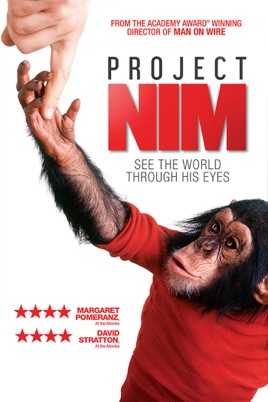
“Project Nim” (2011) is a British documentary film directed by James Marsh focusing on a research project commenced in the early 1970s to determine whether a primate socialized by humans could communicate using a language based on American Sign Language. The subject of the experiment was a chimpanzee named Nim Chimpsky, who was taken from his mother at birth and adopted by a human family in a brownstone on the upper West Side of New York. Project Nim documents Nim’s challenges throughout his forced immersion in human society and the lasting impact he makes on the people in his life.
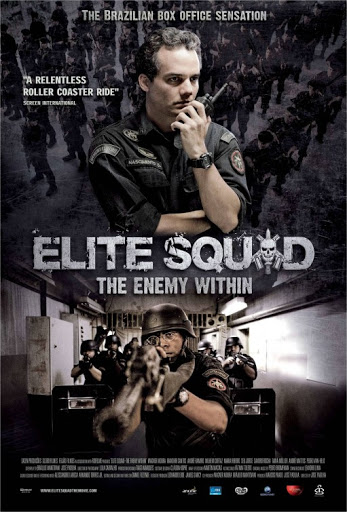
Elite Squad: The Enemy Within (Portuguese: Tropa de Elite 2 – O Inimigo Agora é Outro, lit. ”Elite Troop 2: The Enemy is Now Another”; also known as Elite Squad 2) is a 2010 Brazilian crime film directed, produced and co-written by José Padilha, starring Wagner Moura. It is a sequel to 2007 film Elite Squad. It furthers the plot of a semi-fictional account of BOPE (Portuguese: Batalhão de Operações Policiais Especiais), the special operations force of the Rio de Janeiro Military Police, with a focus on the relationship between law enforcement and politics. The film was released in Brazil on October 8, 2010. Like its predecessor, the film was met with critical acclaim and became the largest box office ticket seller and highest-grossing film of all time in Brazil, ahead of Dona Flor and Her Two Husbands and Avatar, respectively. It was selected as the Brazilian entry for the Best Foreign Language Film at the 84th Academy Awards, but did not make the final shortlist.
“Simply mind-blowing. A must see!” – Niels Matthijs, Screen Anarchy
From groundbreaking animation outfit STUDIO 4°C (MFKZ, Mind Game) comes two extraordinary projects with a shared, simple vision: to take an all-star team of some of the best animators working in anime today, and give each free reign to tell a unique short story built around “the spirit of creativity.” The results are GENIUS PARTY and GENIUS PARTY BEYOND, two animated anthology films featuring contributions from directors Shoji Kawamori, Shinichiro Watanabe, Masaaki Yuasa, Mahiro Maeda, and many others. Full of boundless imagination, fantastic worlds, and unique visual styles, these two acclaimed films are now available for the first time in North America.
The Out Of Shadows documentary lifts the mask on how the mainstream media & Hollywood manipulate & control the masses by spreading propaganda throughout their content. Our goal is to wake up the general public by shedding light on how we all have been lied to & brainwashed by a hidden enemy with a sinister agenda.
This project is the result of two years of blood, sweat and tears by a team of woke professionals. It’s been independently produced and funded and is available on many different platforms for FREE for anyone to watch. Patriots made this documentary with the sole purpose of getting the truth out there. If you like the documentary, please share this video.
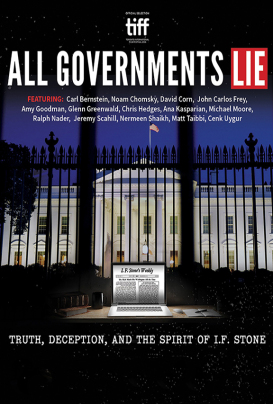
Independent journalists expose government lies and corporate deception, inspired by the legendary investigative journalist I.F. Stone.
With government deception rampant, and intrusion of state surveillance into private life never more egregious, independent voices like Glenn Greenwald, Jeremy Scahill, and Amy Goodman are crucially important. All three are inspired by the iconoclastic rebel journalist named I. F. Stone, whose fearless, independent reporting from 1953 to 1971 filled a tiny 4-page newsletter which he wrote, published and carried to the mailbox every week.
This documentary will change the way you look at the mainstream media. Giant media conglomerates are increasingly reluctant to investigate or criticize government policies, particularly on defense, security and intelligence issues.
Acrobat, musician, composer, clown, mime, movie star, director and producer, Academy Award winner for lifetime achievement, but still driven from the United States for his backing of the Soviet Union, Charlie Chaplin should need little introduction, except perhaps for Millennials and other late alphabet generations. He was the global star in the crossover from silent films to talkies, making an astonishing $10,000 a week during the Depression, with $150,000 in signing bonuses. Knighted by the Queen, Charlot was universally loved and admired.
But is he relevant today beyond his reputation as a comic icon?
During a recent visit to the magnificent Manoir de Ban near Lausanne, Switzerland, which was his home from 1952 until his death in 1977 and now houses a museum in his honor, I was impressed how his films were political, and how they speak to today’s human rights agenda.
In 1954 Chaplin was awarded the International Peace Prize by the World Peace Council for his outstanding contribution to the cause of peace and friendship among nations. Who can forget his mocking of Hitler in The Dictator when he spins a globe and dances with the world at his fingertips?)
Two examples from his classics show how his films relate to human rights:
The 1921 production The Kid is the story of an unwed, down-and-out mother who abandons her child because she cannot afford to look after him. She places him in an expensive car with a note to the owner to take care of him. After some intrigue, a tramp, Charlie Chaplin, finds the boy and raises and loves him like his own, cementing the idea of the kindness of the fellow impoverished. The tramp and the kid work together against the moneyed class; the kid breaking windows and the tramp repairing them.
The kid is eventually taken away from the tramp by the authorities – border police separating children from their loved ones on the U.S. southern border? – to be returned to his mother. In the end, the kid, the tramp and the mother are re-united.
The Kid was chosen to be preserved in the Library of Congress’s National Film Registry in 2011. It was praised as “an artful melding of touching drama, social commentary and inventive comedy.” The social commentary is what today we would call human rights: the right to a decent life for the mother when she is poor; the right for the mother to have minimum support to raise her boy and not to have to abandon him; the right of the tramp to have a decent wage for his job so he would be able to live properly without having to use illegal means to earn a living; the right to have proper housing for the tramp and the kid; the right to have affordable medical care; the right for the boy to stay with the tramp instead of being sent to an orphanage.
All of these we would call basic social, economic and cultural rights. They are at the heart of Chaplin’s advocacy; they are what make the film so endearing and why we are so relieved when the tramp, kid and mother unite at the end to live happily together. According to Chaplin, and The Kid, there is justice in this world. The good guys overcome injustices and the cruel indifference of the rich with their expensive cars (a foreboding of the 1%?). Although the mother became a rich actress, she takes in the tramp to form a supportive family for the kid, re-uniting him with her son (without the son’s losing the support of the foster father who had raised him, a win-win situation that no family judge could have better decided).
And how does Modern Times, Chaplin’s critique of industrialization, relate to human rights and our modern times of numeric technology? The tramp in Modern Times is a factory worker slaving away on mechanical assembly line. Is this different from today’s information workers tied to their computer screens, forced to work at accelerated speeds as the information flow gets faster and faster, like the quickening assembly line? The hero suffers a nervous breakdown after which he is unemployed, again suffering from having no unemployment insurance or other benefits to carry him over. He is mistakenly arrested with no legal recourse but wishes to stay in jail since he has had no vocational training and is living better in jail than in the street.
The remainder of the film deals with his romance with a fellow hobo who is fleeing punishment because she stole a single loaf of bread (proportional justice?). The film recounts the couple’s various adventures to escape poverty and the desperation of those with no guaranteed income, no right to food or right to housing. Whenever authorities are presented, they are unsympathetic. The poor have no recourse to representation and are left to their own devices to survive. The police – the authorities – are constantly trying to arrest the downtrodden who must seek refuge outside the authoritative system. There is no hope for them within the system; they are left to their own devices in a world with no guaranteed rights.
There is little justice in Modern Times in terms of a happy ending where the heroes overcome injustices. At the end, there is only the love between Chaplin and Ellen. But in the film, as in The Kid, struggles of the underclass represent all the injustices that the 99% of the world today must endure. While economic inequality continues to grow, Chaplin’s films have an important lesson of the struggles of the disenfranchised if one can view the horrors of industrialization and the Depression in our modern context. When 26 individuals are worth as much as 50% of the world’s population, Chaplin’s comic/tragic hero is a pertinent reminder of what it means to live in poverty.
The Manoir de Ban is a beautiful domaine with a lovely park and spectacular view of Lake Geneva. Chaplin died a very rich man. His vision of and advocacy for the poor should remain his greatest legacy. A visit to his museum is a reminder of the schism between the haves and have nots and how a talented, rich genius was able to give such a profound representation of all those who couldn’t afford to live in Vevey and to have the human rights he and many of us enjoy.
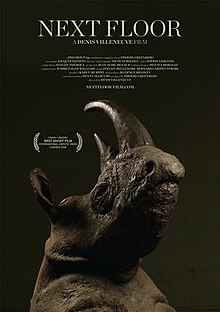
“Next Floor” (2008) is a Canadian short directed by Denis Villeneuve. The mostly wordless film depicts a decadent banquet attended by servers and valets, with eleven gluttonous guests endlessly engorging themselves until they reach a sudden limit to their apparent abundance.




 After the Crash