Syria: Where the Rubber Meets the Road

By Mike Whitney

Source: Unz Review

“Our U.S. Army contacts in the area have told us this is not what happened. There was no Syrian ‘chemical weapons attack.’ Instead, a Syrian aircraft bombed an al-Qaeda-in-Syria ammunition depot that turned out to be full of noxious chemicals and a strong wind blew the chemical-laden cloud over a nearby village where many consequently died…..This is what the Russians and Syrians have been saying and – more important –what they appear to believe happened.”

— Veteran Intelligence Professionals for Sanity, 20 former members of the US Intelligence Community 

You don’t have to be a genius to figure out that the case against Syrian President Bashar al Assad is extremely weak. The chemical weapons attack in Khan Shaykhun, has produced no smoking gun, no damning evidence, in fact, no evidence at all. Similar to the Russia hacking fiasco, (not a shred of evidence so far) the western media and the entire political class has made the case for attacking a sovereign country on the thin gruel of a few videos of an incident that took place in a location that is currently under the control of militant groups connected to al Qaida. That’s pretty shaky grounds for a conviction, don’t you think?

And it’s not up to Assad to prove his innocence either. That’s baloney. The burden of proof rests with the prosecution. If Trump and his lieutenants have evidence that the Syrian President used chemical weapons, then– by all means– let’s see it and be done with it. If not, we have to assume that Assad is innocent, not because we like Assad, but because these are the legal precedents that one follows to establish the truth. And that’s what we want, we want to know what really happened.

Neither Trump nor the media care about the truth, what they care about is regime change, which is the driving force behind Washington’s six year-long war on Syria. The fact that Washington has concealed its support by secretly arming-and-training Sunni militias, does not absolve it from responsibility. The US is totally responsible for the mess in Syria. Without Washington’s support none of this would have happened. 7 million Syrians wouldn’t have fled their homes, 400,000 Syrians wouldn’t have been killed, and the country would not be the anarchic wastelands it is today. The United States is entirely is responsible for the death and destruction of Syria. These are Washington’s killing fields.

As we said earlier, there is no evidence that Assad used chemical weapons against his people nor has there been any investigation to substantiate the claims. The Trump administration launched its Tomahawk missile barrage before consulting with the Organization for the Prohibition of Chemical Weapons which essentially preempted the organization from doing its job. The administration’s rejection of the normal investigative procedures and rush to judgement reinforces the belief that they know they have no case and are just peddling pro-war BS in the mad pursuit of their geopolitical objectives.

Since we don’t have an organization like the OPCW to conduct an investigation, we should at least consider the informed opinions of professionals who have some background in intelligence. This doesn’t provide us with iron-clad proof one way or another, but at least it gives us an idea of some probable scenarios. Here’s a quote from former CIA officer and Director of the Council for the National Interest, Philip Giraldi, who stated last week on the Scott Horton show:

“I am hearing from sources on the ground, in the Middle East, the people who are intimately familiar with the intelligence available are saying that the essential narrative we are all hearing about the Syrian government or the Russians using chemical weapons on innocent civilians is a sham. The intelligence confirms pretty much the account the Russians have been giving since last night which is that they hit a warehouse where al Qaida rebels were storing chemicals of their own and it basically caused an explosion that resulted in the casualties. Apparently the intelligence on this is very clear, and people both in the Agency and in the military who are aware of the intelligence are freaking out about this because essentially Trump completely misrepresented what he should already have known — but maybe didn’t–and they’re afraid this is moving towards a situation that could easily turn into an armed conflict.” (The Impending Clash Between the U.S. and Russia, Counterpunch)

We hear a very similar account from retired Colonel Lawrence Wilkerson, who was former chief of Staff to General Colin Powell. Here’s what he said in a recent interview on the Real News Network:

“I personally think the provocation was a Tonkin Gulf incident….. Most of my sources are telling me, including members of the team that monitors global chemical weapons –including people in Syria, including people in the US Intelligence Community–that what most likely happened …was that they hit a warehouse that they had intended to hit…and this warehouse was alleged to have to ISIS supplies in it, and… some of those supplies were precursors for chemicals….. conventional bombs hit the warehouse, and due to a strong wind, and the explosive power of the bombs, they dispersed these ingredients and killed some people.” (“Lawrence Wilkerson: Trump Attack on Syria Driven by Domestic Politics“, Real News Network)

Finally, we have the collective judgement of 20 former members of the US Intelligence Community, the so-called Steering Group of the Veteran Intelligence Professionals for Sanity. Here’s what they say:

“Our U.S. Army contacts in the area have told us this is not what happened. There was no Syrian “chemical weapons attack.” Instead, a Syrian aircraft bombed an al-Qaeda-in-Syria ammunition depot that turned out to be full of noxious chemicals and a strong wind blew the chemical-laden cloud over a nearby village where many consequently died…..This is what the Russians and Syrians have been saying and – more important –what they appear to believe happened.”

So, why is the administration so eager to jump to conclusions? Why do they want to use such a sketchy incident to justify an attack on sovereign nation that poses no threat to US national security? What’s really going on here?

To answer that, we need to review an interview with President Trump’s new National Security Advisor, Lt. General H.R. McMaster, that took on place on Sunday on Fox News. McMaster– you may recall– recently replaced General Michael Flynn at the same position. Flynn’s failing was that he wanted to “normalize” relations with Russia which the behind-the-scenes powerbrokers rejected out-of-hand and worked to have him replaced with far-right wing militarist-neocon McMaster. Now, McMaster is part of the one-two combo that decides US foreign policy around the world. Trump has essentially dumped Syria in the laps of his two favorite generals, McMaster and James “Mad Dog” Mattis who have decided to deepen Washington’s military commitment in Syria and intensify the conflict even if it means a direct confrontation with Russia.

In the Fox interview, McMaster was asked a number of questions about Trump’s missile attack. Here’s part of what he said:

“The objective (of the strikes) was to send a very strong political message to Assad. And this is very significant because…. this is the first time the United States has acted directly against the Assad regime, and that should be a strong message to Assad and to his sponsors….

He added,

“Russia should ask themselves, what are we doing here? Why are we supporting this murderous regime that is committing mass murder of its own population and using the most heinous weapons available….Right now, I think everyone in the world sees Russia as part of the problem.” (Fox News with Chris Wallace)

Can you see what’s going on? Trump’s missile attack was not retaliatory, not really. It was a message to Putin. McMaster was saying as clearly as possible, that ‘the US military is coming for Assad, and you’d better stay out of the way if you know what’s good for you.’ That’s the message. It has nothing to do with chemical weapons or the suffering of innocent people. McMaster was delivering a threat. He was putting Putin ‘on notice’.

Like McMaster said, “this is the first time the United States has acted directly against the Assad regime, and that should be a strong message to Assad and to his sponsors….”

In other words, McMaster wants Putin to know that he’s prepared to attack the Syrian government and its assets directly and, that, if Putin continues to defend Assad, Russian forces will be targeted as well.

There was some confusion about this in the media because UN ambassador Nikki Haley and Secretary of State Rex Tillerson got their talking-points mixed up and botched their interviews. But the Washington Post clarified the policy the next day by stating bluntly:

“Officials in the Trump administration on Sunday demanded that Russia stop supporting the Syrian government or face a further deterioration in its relations with the United States.”

Bingo. That’s the policy in a nutshell. The issue isn’t chemical weapons. The issue is Russia’s support for Assad, the leader who remains the target of US regime change plans. We are seeing a fundamental shift in the policy from mainly covert support for CIA-backed Sunni militias to overt military intervention. This is just the first volley in that new war.

The media wants the American people to believe that President Trump impulsively ordered the missile attacks in response to the use of chemical weapons. But there’s reason to suspect that the attacks had been planned for some time in advance. As one blogger pointed out:

“In the weeks before the missile strikes, Trump met with the Saudis, the president of Egypt, and the King of Jordan, while Secretary of State met with Turkish President Erdogan. In other words, the administration met with the entire Middle East ‘Sunni alliance’ just days before ordering the missile strikes. Coincidence?

Probably not. They were probably tipped off and asked for their continued support.

Also, Trump waited until the evening that he was having dinner with President Xi Jinping to launch the attacks. How’s that for timing?

Do you think that the announcement that Trump just attacked Syria would have an impact on the two leaders’ conversation about North Korea? Do you think Xi might have seen the announcement as a not-so-subtle threat of violence against the North unless China forces its ally to make concessions?

Of course, he did. The man wasn’t born yesterday.

It seems unlikely that Trump’s attack was a snap decision made by an impulsive man. Instead, it looks like there was a significant amount of planning that went on beforehand, including the deploying of 400 additional Special Ops to Syria and 2,500 combat troops to nearby Kuwait. It appears as though Washington had been building up its troop-strength for some time before it settled on the right pretext for taking things to the next level. As journalist Bill Van Auken noted at the World Socialist Web Site:

“We have been here so many times before that it is hardly worth wasting the time required to refute the official story. It is now 14 years since the US launched its invasion of Iraq over similar lies about weapons of mass destruction, setting into motion a vast slaughter that has claimed the lives of over one million people and turned millions more into refugees……..

Once again, as in the air war against Serbia in 1999, the invasion of Afghanistan in 2001 and Iraq in 2003, and the attack on Libya in 2011, the United States has concocted a pretext to justify the violation of another country’s sovereignty…” (“The Bombing of Syria, Bill Van Auken, World Socialist Web Site)

I have no way of knowing whether Assad used chemical weapons or not, but I found Russian President Vladimir Putin’s analysis particularly interesting. Reporters asked Putin — “What is your view about the use of chemical weapons in Syria?”

Putin answered-:

“You all know that the Syrian government has repeatedly asked the international community to come and inspect the sites where the rebels used chemical weapons. But they always ignored those requests. The only time the international community has responded, was to this last incident. So, what do I think?

I think we can figure out what’s going on by just using a little common sense. The Syrian army was winning the war, in some places they had the rebels completely surrounded. For them to throw it all away and give their trump card to the people who have been calling for regime change is, frankly, a crock of shit.”. (Russian President Vladimir Putin.)

Putin’s response to Trump’s missile attack has been subdued to say the least. He did issue a perfunctory presidential press statement on the incident, but the tone of the statement was neither incendiary or belligerent. If anything, it sounded like he found the whole matter irritating, like the man who sits down to a picnic lunch and finds he has to deal with pesky mosquito before he can eat. But, of course, this is the way that Putin handles most matters. He’s a master of understatement who is not easily given to emotional outbursts or displays of rage. He’s more apt to scratch himself, roll his eyes and give a shrug of the shoulders, than wave his fist and issue threats.

But from a strategic point of view, Putin’s measured response makes perfect sense, after all, the real battle isn’t going to be won or lost in Syria. It’s much bigger than that. Putin is challenging the present world order in which a disproportionate amount of political and economic power has accrued to one unipolar center of authority, a global hegemon that imposes its economic model wherever it goes and topples sovereign states with a wave of the hand. Putin’s task is to build resistance among the vassals, form new alliances, and strengthen the collective resolve for a different world where national sovereignty and borders are guaranteed under an impartial set of international laws that protect the weak as well as the strong.

That’s Putin’s real objective, to rebuild the system of global security based on a solid foundation of respect for the vital interests of each and every country. To accomplish that, Putin must seem like a reasonable and trustworthy ally who honors his commitments and stands by his friends even when they are under attack. That’s why Putin won’t abandon Assad. It’s because he can’t.

Syria is the battlefield where competing visions of the future meet head on. It’s where the rubber meets the road.


MIKE WHITNEY lives in Washington state. He is a contributor to Hopeless: Barack Obama and the Politics of Illusion (AK Press). Hopeless is also available in a Kindle edition. He can be reached at fergiewhitney@msn.com.

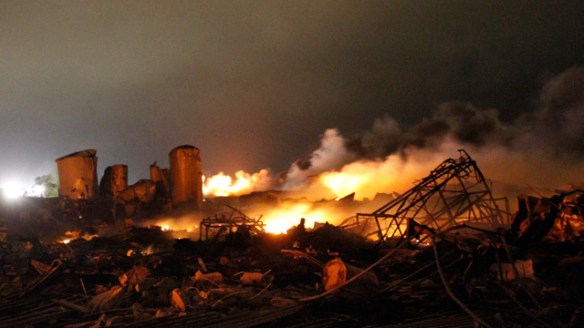
Long Buried Texas Fertilizer Plant Explosion Conspiracy Re-Emerges From Shadows Of Boston Bombing

The remains of a fertilizer plant after explosion in West, Texas

By Bernie Suarez

Source: Truth and Art TV

Sometimes conspiracies are truly forgotten when there are so many other state crimes and conspiracies to choose from. Such is the case with the Waco Texas fertilizer plant “explosion” of April 17, 2013. I’m talking about the Texas fertilizer plant explosion which was conveniently buried in the immediate aftermath of the April 15, 2013 Boston bombing. I’m sure many have forgotten about this event in the same way they don’t remember or have completely forgotten that two days earlier, on the very same day of the Boston bombing “event” a wave of bombings and shootings took place in Iraq just before their elections leaving at least 75 people dead and hundreds injured. The mainstream media conveniently gave little to no attention to this story as the Boston bombing event was selected as the featured story we were supposed to be thinking about at the time.

Meanwhile in Waco Texas 2 days later, on the evening of April 17th a fertilizer plant caught fire and was being consumed in flames when some 22 minutes later a mighty suspicious massive explosion took place; an explosion captured nicely on camera by nearby residents that was so loud and so bright that many have suspected it was some sort of missile strike. Sounds crazy? You decide:

Now let’s listen in to what Nevada Governor candidate at the time David Lory VanDerBeek had to say about this. The Governor candidate breaks down some of the features of this evidence very nicely showing you the trajectory of the energy being provided by the missile. After seeing this video no one should wonder why he had no chance at winning the governor race.

The plant was owned by Adair Grain Inc a family owned food plant which also goes by or is closely associated with “Texas Grain Inc” a competitor of Monsanto who had filed a lawsuit against Monsanto accusing Monsanto of artificially inflating the price of their Roundup herbicide. This additional explosion to this day is highly suspicious and now that the mainstream media is briefly covering this story it’s a good time to examine this event a bit more closely.

According to mainstream media sources the federal government “investigators” claim the factory was an explosion waiting to happen:

The source of the explosion was ammonium nitrate stored in a wooden container at the plant, investigators have said.

The ammonium nitrate detonated with the force of approximately 15,000 pounds to 20,000 pounds (6,800 kg to 9,100 kg) of TNT, according to federal officials.

But if we examine the explosion claim we must take into consideration that the Adair Grain fertilizer plant reported to the EPA a very different picture:

The fertilizer plant that exploded Wednesday night in West, Texas, reported to the Environmental Protection Agency and local public safety officials that it presented no risk of fire or explosion, documents show.

West Fertilizer Co. reported having as much as 54,000 pounds of anhydrous ammonia on hand in an emergency planning report required of facilities that use toxic or hazardous chemicals.

But the report, reviewed Wednesday night by The Dallas Morning News, stated “no” under fire or explosive risks. The worst possible scenario, the report said, would be a 10-minute release of ammonia gas that would kill or injure no one.

The second worst possibility projected was a leak from a broken hose used to transfer the product, again causing no injuries.

The plan says the facility did not have any other dangerous chemicals on hand. It says that the plan was on file with the local fire department and that the company had implemented proper safety rules.

ATF Chief investigator Rob Elder recently announced:

“the fire has been ruled as an incendiary. This means this fire was a criminal act”.

Elder then says that numerous evidences were taken into account including, witnesses, images and video footage. But was the video evidence really taken into account? Even more intriguing, Mr Elder has announced a $50,000 award for information leading to the capture of the arsonist so if anyone wants to take him on please do. I can’t help but to be reminded of the 1933 Reichstag fire false flag in Germany and how a patsy of choice was afterward chosen and executed in the period that followed.

Let’s consider some additional ironies and peculiar accounts surrounding this explosion. According to the reported investigation conclusions:

The explosion damaged an area measuring roughly the size of 37 city blocks, Elder said, and left a crater 93 feet (28 metres) wide by 12 feet (3.7 metres) deep.

The ammonium nitrate detonated with the force of approximately 15,000 pounds to 20,000 pounds (6,800 kg to 9,100 kg) of TNT, according to federal officials.

This conjures up memories of the government claims that on 9/11 WTC 7 was packed with “diesel fuel tanks” which they would then use in an attempt to sell the theory that office fires alone could destroy the building in the controlled demolition manner in which it was destroyed.

The problem with looking at the entire story, looking at all the evidence and then listening to the government “investigation” statements (or lack thereof) is that the whole story doesn’t fit like it should, and that alone should lead us to wonder, was the fertilizer plant purposely struck with a sophisticated military missile to send Texas Grain Inc a message? Can Ammonium Nitrate alone cause such a wide and deep crater in the damaged area? And is the quality, direction and trajectory of the explosion consistent with an explosion originating from the plant as the government would have you believe?

Suspicions run high that this was not only a classic military style (think 9/11 Pentagon style) attack on the plant but specifically this may have involved a new “Advanced Hypersonic Weapon” (AHW) developed by the Army in 2011 seen here. The video below explains this possibility more in-depth. Again, you decide.

When analyzing this let’s keep in mind that conspiracies are now the norm and today it is well within reason for any critical thinker to suspect government conspiracy as a reasonable possible explanation. It is also incumbent upon us to consider all evidence including the irony of this story being buried in the height of the Boston bombing event. That they are just now briefly talking about this explosion after 3 years of hiding the story is suspicious in itself. The multiple video analysis above demonstrating reasonable probability of a sophisticated military style missile strike should matter to everyone. If true, this constitutes another blatant murderous act of violence of our government against its own people potentially on behalf of its global organized crime cartel partner Monsanto who is known to work with Blackwater/XE.

Now that investigators are officially ruling this event as a “criminal act” it will be very interesting to see if they produce a patsy of their choice in the future (Reichstag fire style) to throw off anyone suspicious of government activity in this crime.

It sure does seem like a criminal act to my eyes, and as usual no one in the mainstream media or the usual pre-selected government “investigative” body is looking for or even suspecting that the plant was ultimately pulverized by a missile strike. We all know that government investigative bodies never even look for possibilities that imply that the State is involved in the crime. So this phony search including their phony $50,000 reward will never lead to any real justice.

Don’t think for a moment the ruling class wouldn’t commit a crime like this to protect their interest and send a message. These are ultimately the same people who funded the attacks in Iraq on April 15, 2013 and organized the Boston bombing “event” on the same day. In order for truth seekers to remain vigilant and to stay on top of government crimes and conspiracies they need to take events like this serious and do their own research. It’s not about being paranoid it’s about believing your own eyes and ears, looking for patterns, exercising critical thinking, and maintaining a clear overall awareness of the big picture.


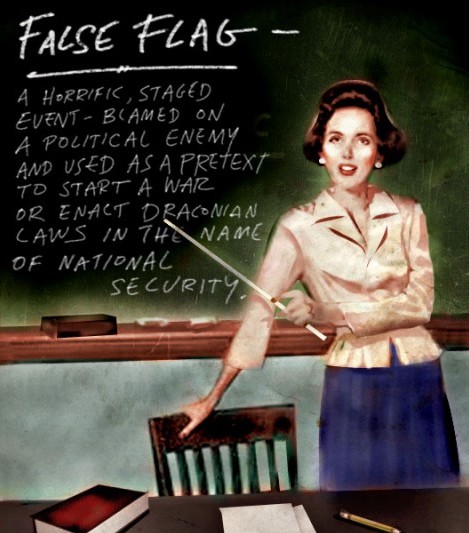
‘False flag,’ another weapon in the US arsenal

By Dave Alpert

Source: Intrepid Report

Now hear this . . . Noam Chomsky, respected intellect and political guru of the “left,” a man that ridiculed and denounced the efforts of the 9/11 Truth Movement, has joined the ranks of the conspiracy theorists.

On Monday, March 27, Noam, in an interview, as reported by AlterNet, stated that Donald Trump could stage a “false flag” terror attack in order to consolidate his power.

Trump’s administration is currently on thin ice. Not only does he not have the support of Democrats, but members of his own party have been distancing themselves from him. It also should be noted that Trump’s standing amongst the voters, according to poll numbers, is at an historic low.

George W. Bush’s Secretary of the Treasury, from January 2001 to December 2002, Paul O’Neill, revealed in his book, “The Price of Loyalty,” published in 2004, that the war in Iraq was planned from the first National Security Council meeting, soon after the administration took office. At the first cabinet meeting of the new Bush administration, O’Neill observed that the debate was not “should we attack Iraq?” but rather “how do we go about attacking Iraq?”

It was and is clear that the Bush administration needed to gather popular support for an invasion of Iraq through an event that would guarantee such support. Fortunately, along came 9/11, a perfect example of how a “false flag” event is organized and implemented.

Predictably, the people rallied behind the Bush administration’s stated desire to hold the guilty parties accountable and pursue retribution. Bush was given carte blanche powers to fulfill his promise to find and destroy those responsible for the savage attack on US soil.

Trump knows that people are losing faith in his presidency and, according to Chomsky, will look to scapegoat someone or some group in order to draw our attention away from his failings and, as the G.W. Bush administration did, mobilize support. Trump has already identified those he is likely to scapegoat, the vulnerable, the immigrants, the Muslims, the terrorists, etc.

Chomsky states, “I think that we shouldn’t put aside the possibility that there would be some kind of staged or alleged terrorist act, which can change the country instantly.” WOW, he really said that?

The first and crucial step in a planned false flag event is for the government initiating the action to prime the public by demonizing the target, the country or group that will be scapegoated and assume the blame for the event, and creating fear and anger among the populace. For that, Trump has a fairly large group of possible scapegoats if, in fact, Chomsky’s projections get played out. As mentioned above, there are, of course, Muslims as well as extremists from any of the immigrant groups coming from countries that the US has decimated or from our Mexican neighbors to the South, as well as any group that can conveniently be labeled “terrorists.”

Immediately after the event, there is a comprehensive narrative and a convenient, ready-made culprit is identified by officials. With the help of law enforcement and the media, the narrative is repeated often enough to convince the public of its accuracy. Not only is the official explanation not questioned by the media, their responsibility is to ensure that no alternative views of the event in question are heard. In fact, the media often actively denounce and mobilize against alternative theories regarding the events in question. Most often they marginalize the people who raise questions about the official version, labeling them as “conspiracy nuts.”

Coincidently, it should be noted, if you believe in coincidences, a large percentage of major domestic or international terror attacks have involved simultaneous “training drills.” This list includes, but is not limited to, the infamous NORAD drills of 9/11, the 7/7 London Bombings, the 2011 Norway shooting, the Aurora shooting, and the Boston Marathon.

These training drills serve to confuse respondents to the “terror” attack. During the 9/11 attack, a military officer could be heard, when he was informed, asking “Is this real time?” At the time of the attacks, several military exercises were in progress and were a factor in immobilizing and confusing respondents. Is this another coincidence?

So, the question still hangs out there, unanswered, “Why now, Mr. Chomsky?” Why project the possible false flag operation orchestrated by the Trump people, while ignoring the overwhelming real evidence demonstrating that 9/11 was a false flag event?

The answer to that question may be in Chomsky’s personal feelings about Trump, the man. Chomsky has called Trump a “con man” who will drag civilization “down to the utter depths of barbarism.”

Yet, Mr. Chomsky, despite the events of the past century, when various US presidents have played the role of “con men” and have dragged civilization down to a deadly and destructive level of barbarism, has decided to vent his anger and frustration at Trump, who I’m certain will also continue his assignment to drag the world into a state of savagery. After all, world domination and making America great again is not for sissies.

Yet, he and many other so-called leftists abandoned the 9/11 Truth Movement, made up of people who did not accept the government’s mythological version of that day and were seeking truth.

During the past 16 years, millions of people were either killed, mutilated, or displaced from their homes as a result of 9/11. Where have these “progressive” voices been during this time? Now he’s going to speak out . . . screw him!!!

Who has Committed the Recent Gas Attack in Syria?

By Jean Perier

Source: New Eastern Outlook

Just a couple of days ago the better part of the Western media found themselves actively engaged in yet another propaganda campaign, provoked by allegations of “yet another” gas attack allegedly committed in the Syrian city of Khan Sheikhun in the northern province of Idlib, which remain under control of the Al Qaeda affiliated Jabhat Fatah al-Sham terrorist group. The group was formally known as Jabhat al-Nusra before being re-branded by its foreign sponsors. According to the reports distributed by the Western media, gas attacks in the city Khan Sheikhun resulted in the death of up to a 100 people due to suffocation and severe gas poisoning.

Once these allegations were published, the United States, Britain and France immediately distributed a draft resolution within the UN Security Council designed to condemn Damascus for the alleged chemical attack. At the same time, as it has repeatedly happened before, the White House was acting on a premise without demanding any sort of verification of such claims. Both US President Donald Trump and Secretary of State Rex Tillerson claimed that responsibility for the use of chemical weapons in the province of Idlib was solely of Syrian President Bashar al-Assad, even though the Pentagon recognized that it doesn’t possess any information to assign such blame, as it’s been stated, in particular, by the head of the US Air Mobility Command, General Carlton D. Everhart.

In tune with Washington’s position, a string of similar accusations were voiced by the United Kingdom’s Permanent Representative to UN, Matthew Rycroft who seems to be convinced of “the guilt of President Assad”.

However, if we try to trace these allegations back to their original source, we may found out that they were initially released by the so-called Syrian Observatory For Human Rights based in London, not Syria, which is widely known for its commitment to Western special interests and its funding received by American and British special services. After all, if the genuine defense of human rights was of any interests for this so-called “observatory” why would it choose to keep silent about the massive carnage of the civilian populations of Iraq and Syria when it is the United States and other NATO states killing civilians in air attacks?

A lot has been said about the repeated attempts to assign blame for the staged and alleged gas attacks in Syria on Damascus. Among others, such claims have been dissected by French journalists, who have managed to expose not only the trace of US special services in similar cases, but also traces of their own French colleagues.

The details of the Western criminal scheme aimed at the overthrow of the Syrian government has recently been uncovered by a Lebanese edition of the Middle East Panorama. In particular, this media source would present the information received about a criminal plot against Syria that was prepared by the special services of several countries, including those of Saudi Arabia, Qatar, Bahrain, Turkey, Israel, France, UK and the United States, which continue providing logistical support to various terrorist groups inside Syria. The last meeting of the representatives of the above mentioned intelligence agencies, where the plan to incriminate the Syrian government for the use of chemical weapons, was at an Israeli army camp deep inside the occupied territory of the Golan Heights. The meeting was also attended by the leaders of a number of terrorist groups.

As for the events that took place on April 4 in the vicinity of Idlib, the Syrian authorities have already announced that there was no chance that any of their forces took part in such a crime. The Syrian Air Force did carry out a number of strikes against a large ammunition depot near Khan Sheikhun controlled by terrorists. It turned out that this warehouse was used as a workshop for the production of landmines filled with poisonous substances. Once produced in large numbers, those munitions would be used by militants against both Syrian and Iraqi government forces.

The politicians who criticized the Syrian Air Force’s attack on the chemical weapons stockpiles, in fact, have completely compromised themselves, since they turn out to be protecting terrorist forces instead of waging a war on them and the Persian Gulf monarchies that are sponsoring their activities.

Of course, the truth will once again triumph. However, one cannot help but notice that yet another attempt was made to exacerbate the Syrian conflict with the use of various Western propaganda sources. Some political forces in this world could care less about the suffering that has been inflicted upon the Syrian people for years now by Western special interests. It’s imperative that the international community recognizes that such steps are unacceptable when serious attempts are being made to reconcile the parties amid the Syrian conflict at the Geneva talks.

Airstrikes Without Justice

By John Wight

Source: CounterPunch

To describe the US attack on Syria as a serious development is to be guilty of understatement.

Without any recourse to international law or the United Nations, the Trump administration has embarked on an act of international aggression against yet another sovereign state in the Middle East, confirming that neocons have reasserted their dominance over US foreign policy in Washington. It is an act of aggression that ends any prospect of détente between Washington and Moscow in the foreseeable future, considerably increasing tensions between Russia and the US not only in the Middle East but also in Eastern Europe, where NATO troops have been conducting military exercises for some time in striking distance of Russian territory.

In the wake of the horrific images that emerged from Idlib after the alleged sarin gas attack, the clamour for regime change in Damascus has reached a crescendo in the West, with politicians and media outlets rushing to judgement in ascribing responsibility for the attack to the Syrian government. No one knows with any certainty what happened in Idlib, which is why an independent investigation should have been agreed and undertaken in pursuit of the truth and, with it, justice.

However only the most naïve among us could believe that this US airstrike against Syria was unleashed with justice in mind. How could it be when US bombs have been killing civilians, including children, in Mosul recently? And how could it be given the ineffable suffering of Yemeni children as a result of Saudi Arabia’s brutal military campaign there?

No, this US attack, reportedly involving 59 Tomahawk missiles being launched from ships in the eastern Mediterranean, was carried out with regime change in mind, setting a precedent that can only have serious ramifications for the entire region.

Regarding the attack in Idlib, what we can say with certainty is that a time when pro-government forces in Syria were in the ascendancy on the ground, and when the Syrian government was making significant progress on the diplomatic front, it would have constituted an act of ineffable self-harm to launch a chemical weapons attack of any kind, much less one of this magnitude. In fact it would have conformed to the actions of a government that was intent on bringing about its own demise. What also must be taken into consideration is the fact that the Organisation for the Prohibition of Chemical Weapons (OPCW), an organisation supported by the US, confirmed back in June 2014 that the process to destroy Syria’s entire stock of chemical weapons had been completed.

Moreover, the horrific images and eyewitness testimony that have emanated from Idlib in the wake of the attack have come from pro-opposition sources. No Western journalist or news crew would dare set foot in Idlib, or indeed any other part of opposition-held territory in Syria, knowing that as soon as they did they would be abducted and slaughtered.

Trump has proved with this unilateral military intervention that he can easily be dragged into conflict. Just a few days after his administration confirmed that regime change in Syria was off the table, that its focus was on defeating terrorism, he unleashes an airstrike that will only have emboldened the very forces of terrorism whose defeat he had stressed was the focus of his foreign policy previously.

So what now? Clearly, this military action places Russia in a very difficult position. Since joining the conflict in Syria at the end of September 2015, at the behest of the country’s government, Moscow had been working tirelessly to bring about a negotiated settlement, one involving opposition forces and parties deemed moderate relative to the Salafi-jihadi fanatics of ISIS and Nusra, etc. It is a diplomatic process that has just been dealt a shattering blow, with the opposition now undoubtedly convinced that regime change is in the offing via Washington and therefore encouraged to work towards this end.

Meanwhile, as for Washington’s regional allies – Israel, Saudi Arabia, Qatar, and Turkey (with Erdogan guaranteed to hitch his wagon to whoever appears to be in the driving seat) – they will most likely begin calling for more military action against Damascus now, viewing the US airstrike as the catalyst for open season on the country’s sovereignty.

As for Trump himself, having been under inordinate pressure since assuming office in January from the Washington media, political, and intelligence establishment, this action will earn him some much needed approval and, with it, respite. The signs with regard to his administration had been ominous for some time, starting with the forced resignation of Mike Flynn as his National Security Adviser in February, and continuing recent departure of Steve Bannon from the President’s National Security Council. It comes as further evidence that neocons have reasserted their dominance over the White House after a short and intense power struggle.

On a wider note, the lack of short-term memory in Washington is staggering to behold. Fourteen years after the disastrous US invasion of Iraq, which only succeeded in opening the gates of hell out of which ISIS and other Salfi-jihadi groups emerged, and six years after turning Libya into a failed state, in the process sparking a refugees crisis of biblical proportions, here we have yet another act of aggression against a sovereign state in the Middle East by the US.

Destroying countries in order to save them is the story of every empire there has been. But as history reveals, every empire carries within itself the seeds of its own destruction. Donald Trump is now on course to end up going down in history as a leader who rather than save the US from itself, may only have helped speed it down the path to its ultimate demise.

“Rome has grown since its humble beginning that it is now overwhelmed by its own greateness.” 

John Wight is the author of a politically incorrect and irreverent Hollywood memoir – Dreams That Die – published by Zero Books. He’s also written five novels, which are available as Kindle eBooks. You can follow him on Twitter at @JohnWight1

From Russia, with Panic

Cozy bears, unsourced hacks—and a Silicon Valley shakedown

By Yasha Levine

Source: The Baffler

The Russians hacked America.

After Donald Trump’s surprise victory in November, these four words reverberated across the nation. Democratic Party insiders, liberal pundits, economists, members of Congress, spies, Hollywood celebrities, and neocons of every stripe and classification level—all these worthy souls reeled in horror at the horribly compromised new American electoral order. In unison, the centers of responsible opinion concurred that Vladimir Putin carried off a brazen and successful plan to throw the most important election in the most powerful democracy in the world to a candidate of his choosing.

It seemed like a plotline from a vintage James Bond film. From his Moscow lair, Vladimir Putin struck up an alliance with Julian Assange to mount a massive cyber-offensive to discredit Hillary Clinton and her retinue of loyal Democratic Party operatives in the eyes of the American public.

The plot was full of twists and turns and hair-raising tangents, including tales of Russian-American retiree-agents sunning in Miami while collecting payoffs from Russia’s impoverished pension system. But the central ruse, it appears, was to enter the email server of the Democratic National Committee and then tap into the Gmail account belonging to John Podesta, founder of the Center for American Progress and premier D.C. Democratic insider.

As the long 2016 general election campaign unwound, WikiLeaks released a steady stream of embarrassing revelations from the DNC—though the disclosures were no more compromising than what you’d find in the correspondence of any mid-sized private-sector company: dumb boardroom gossip, petty press intrigues, and sleazy attempts to undermine a well-placed executive rival (namely Bernie Sanders). Truly, it would have been astonishing to learn that the DNC went about its business in any other way. But the sheer fact of the data breach was dispositive in the eyes of Democratic operatives and their many defenders in the liberal press. After all, WikiLeaks also reportedly collected data from the Republican National Committee, and did nothing with it. Clearly this was cyber-espionage of the most sophisticated variety.

On the Trump side of the ledger, things were murkier. Trump’s political advisers indeed had ties to Russia and Ukraine—but this was hardly surprising given the authoritarian-friendly lobbying climate within Washington. During the campaign the GOP nominee was disinclined to say anything critical about Putin. Indeed, breaking with decades of Republican tradition, Trump openly praised the Russian leader as a powerful, charismatic figure who got things done. But since the candidate also refused to disclose his tax returns, a commercial alliance with the Russian autocrat was necessarily a matter of conjecture. That didn’t stop theories from running wild, culminating in January with the titillating report from BuzzFeed that U.S. intelligence agencies believed that Putin had compromising footage of Trump cavorting with prostitutes at a Moscow hotel previously patronized by Barack and Michelle Obama. Not only was the Yank stooge defiling the very room where the first couple had stayed, but he allegedly had his rented amorous companions urinate in the bed. Behold, virtuous American republic, the degradation Vladimir Putin has in store for you!

Taking the Piss

The dossier published by BuzzFeed had been circulating for a while; on closer inspection, it appeared to be repurposed opposition research from the doomed Jeb Bush campaign. Its author was a former British intelligence operative apparently overeager to market salacious speculation. By the end of this latest lurid installment of the Russian hacking saga, no one knew anything more than they had when the heavy-breathing allegations first began to make their way through the political press. Nevertheless, the Obama White House had expelled Russian diplomats and expanded sanctions against Putin’s regime, while the FBI continued to investigate reported contacts between Trump campaign officials and Russian intelligence operatives during the campaign.

This latter development doesn’t exactly inspire confidence. As allegations of Russian responsibility for the DNC hack flew fast and furious, we learned that the FBI never actually carried out an independent investigation of the claims. Instead, agency officials carelessly signed off on the findings of CrowdStrike, a private cybersecurity firm retained by the Democratic National Committee. Far from establishing an airtight case for Russian espionage, CrowdStrike made a point of telling its DNC clients what it already knew they wanted to hear: after a cursory probe, it pronounced the Russians the culprits. Mainstream press outlets, primed for any faint whiff of great-power scandal and poorly versed in online threat detection, likewise treated the CrowdStrike report as all but incontrovertible.

Other intelligence players haven’t fared much better. The Director of National Intelligence produced a risible account of an alleged Russian disinformation campaign to disrupt the 2016 presidential process, which hinged on such revelations as the state-sponsored TV news outlet Russia Today airing uncomplimentary reports on the Clinton campaign and reporting critically on the controversial U.S. oil-industry practice of fracking as a diabolical plot to expand the market for Russian natural gas exports. In a frustratingly vague statement to Congress on the report, then-DNI director James Clapper hinted at deeper and more definitive findings that proved serious and rampant Russian interference in America’s presidential balloting—but insisted that all this underlying proof must remain classified. For observers of the D.C. intelligence scene, Clapper’s performance harkened back to his role in touting definitive proof of the imminent threat of Saddam Hussein’s WMD arsenal in the run-up to the U.S. invasion of Iraq.

It’s been easy, amid the accusations and counteraccusations, to lose sight of the underlying seriousness of the charges. If the hacking claims are true, we are looking at a truly dangerous crisis that puts America’s democratic system at risk.

The gravity of the allegation calls for a calm, measured, meticulously documented inquiry—pretty much the opposite of what we’ve seen so far. The level of wild assertion has gotten to the point that some of the most respected pro-Western voices in Russia’s opposition have expressed alarm. As much as they despise Putin, they don’t buy the bungled investigations. “In the real world outside of soap operas and spy novels . . . any conclusions concerning the hackers’ identity, motives and goals need to be based on solid, demonstrable evidence,” wrote Leonid Bershidsky. “At this point, it’s inadequate. This is particularly unfortunate given that the DNC hacks were among the defining events of the raging propaganda wars of 2016.”

The lack of credible evidence, the opaque nature of cyber attacks, the partisan squabbles and smears, and the national-security fearmongering have all made this particular scandal very difficult to navigate. It may be years before we find out what really happened. Meanwhile, I’d like to tell a cautionary tale. It’s a story about the last time American and European cyber experts accused Russia of launching an attack against another country—and nearly provoked a war with a nuclear power. The moral of the tale is that cyberwarfare is a fraught and high-stakes theater of conflict, in which the uncertain nature of cyber-attack attribution can be exploited to support any politicized version of events that one chooses.

All Georgians Now

On August 8, 2008, war broke out between Georgia and Russia. Backed up by heavy artillery, truck-mounted Grad rockets, and tanks, Georgia launched a surprise invasion of South Ossetia, a tiny mountainous breakaway republic on its northern flank that had been at the center of a long-simmering regional territorial dispute. A prolonged artillery barrage reduced parts of Tskhinvali, South Ossetia’s capital, to rubble. Civilians were given no warning—those not killed in the initial assault hid in basements or fled on foot. A Russian peacekeeping force, which had been stationed in South Ossetia under an Organization for Security and Cooperation in Europe agreement since 1992, was targeted in the attack. By the end of the first day, Georgian troops were on the verge of taking the whole city.

Mikheil Saakashvili, Georgia’s charismatic nationalist president, had campaigned on a nationalistic platform, promising to reabsorb the country’s breakaway regions. His initial success did not last long. Russian jets pounded Georgian military command posts and communications, while Russian troops streamed into South Ossetia. By the end of day two, the tide had turned: Georgian forces began retreating. By day five, Russian forces had control over South Ossetia and huge swaths of northern Georgia. Tanks and infantry entered several northern towns and moved around unimpeded just an hour away from Tbilisi, Georgia’s capital, where euphoria and jubilation turned to sickly fear. News footage showed Saakashvili cowering as Russian jets flew overhead. He appeared on television nervously chewing his tie, prompting the BBC to ask wryly: “The Georgian president chews over his next move. Is he weaker or stronger than before?”

Weaker, definitely. But in the war’s aftermath, Russia and Georgia were each determined to claim victim status. Russia pointed out that Georgia had started the war; Georgia blamed Russia for launching a full-scale invasion. President Saakashvili appealed to the United States, hoping it would intervene militarily on Georgia’s behalf.

The Bush White House was firmly aligned with Georgia. For years, Georgia had been an important neocon project in a grander scheme to peel away former Soviet Republics from Moscow’s influence. American NGOs and soft-power outfits like USAID backed Saakashvili’s rise to power during the country’s “Rose Revolution.” Since 2004, the Bush administration had lavished military aid on Saakashvili’s government, outfitted its army, and trained its soldiers. John McCain and Hillary Clinton jointly nominated Saakashvili for the Nobel Peace Prize in 2005. Support for Georgia was bipartisan and continued right up to Georgia’s attack on South Ossetia; more than a thousand American troops held a joint exercise with Georgia near the South Ossetian border in July.

As a complement to the Georgia PR offensive, the Bush White House continued to hammer away at its stable of anti-Putin talking points. For years, the United States had portrayed Vladimir Putin as a strongman leader bent on world domination. The invasion of Georgia seemed to confirm the official narrative: Russia would stop at nothing to crush the democratic aspirations of its neighbors.

It was a dangerous moment. Vice president Dick Cheney pushed for directly engaging the Russians in “limited military options”—including aerial bombardment to seal the Roki Tunnel linking North Ossetia and South Ossetia that was being used to transport reinforcements. Luckily, president George W. Bush, who had a street in Tbilisi named after him, wavered, sensibly fearing a real war with Russia.

The episode occurred during a U.S. presidential election. Senator John McCain used the conflict to showcase his hawkish foreign policy bona fides, arguing that America needed to intervene to protect Georgia’s budding democratic society from the authoritarian Putin. Claiming that “today, we are all Georgians,” McCain called for NATO forces to be deployed against Russia, which would have triggered a war with a nuclear power.

I was in Moscow at the time, reporting on the war. Those who had covered the region understood that Georgia was no innocent. The ethnic conflict between Ossetians and Georgians has old, festering roots—indeed, Georgia’s invasion of South Ossetia was centuries in the making. The Ossetians consider the territory of South Ossetia to be native lands they have occupied for centuries, while Georgians view Ossetians as relatively recent interlopers. When South Ossetia declared its independence after the breakup of the Soviet Union, Georgia’s ultra-nationalistic first president attempted to quash the independence movement by force. After a short war, South Ossetia stood its ground—and Georgia and South Ossetia squared off in an uneasy peace administered by Russian, Georgian, and South Ossetian peacekeepers. Two-thirds of the breakaway republic were ethnic Ossetians. They feared Georgia and favored Russia as a military bulwark. Russia handed out Russian passports to South Ossetians and provided military protection, making the territory a de facto member of the Russian Federation.

Seasoned observers of the region’s tangled geopolitics understood that Russia shared amply in the blame but that the fault lay primarily with President Saakashvili. When he came to power, he took on the mantle of a medieval Georgian king who had unified the country. “Today Georgia is split and humiliated. We should unite to restore Georgia’s territorial integrity. Georgia has existed and will exist. Georgia will become a united strong country,” he declared in 2004. With deteriorating political support at home, Saakashvili was itching for a popular war. Skirmishes increased along Georgia’s border with Abkhazia and South Ossetia; finally, Georgia fired the first shot.

Suddenly, America found itself at the edge of a precipice: a war over a complex sectarian conflict in a remote part of the world. American policymakers wanted a simple explanation, and conveniently, they were offered one: cyber-aggression.

The Sites Go Out in Georgia

When war broke out, a slew of Georgian websites came under attack. The Central Bank of Georgia was hacked, according to Russian reports. Its internal networks were not penetrated, but the hackers tinkered with the homepage to give the Georgian unit of currency, the lari, a less than favorable exchange rate, forcing the government to issue an order that suspended all electronic banking services. Georgia’s Ministry of Foreign Affairs was hacked, its homepage replaced with a slideshow depicting Mikhail Saakashvili as Hitler. “And he will suffer the same fate,” read an ominous message beside it.

A Russian-language forum called “Stop Georgia” suddenly came online, hosted in, of all places, the United States. Against a green camouflage-inspired background, its creators decried Georgia’s propaganda war against Russia. “We, as representatives of the Russian hacker-underground, will not tolerate provocations from Georgia.” The forum was crude and looked like it had been put together in a few hours. Its primary function was to distribute a simple, easily available program permitting anyone with a computer and an internet connection to become part of a denial-of-service attack swarm. The forum conveniently provided a list of Georgian target websites and helped organize and direct the cyber-mob action.

Georgian officials proclaimed these cyber attacks a strategic maneuver by the Russian military designed to take out the country’s communication system, facilitating the Russians’ armed invasion. The coordinated nature of the attacks, they insisted, showed that Russia had planned the invasion long in advance. “The opening shots of the Russian invasion of Georgia were fired over the Internet, proving Russian online aggression predated Georgian actions,” declared an official report by the Georgian government. The government called the people behind the attack “cyber terrorists.”

Cybersecurity experts came out of the woodwork to confirm and expand on Georgia’s allegations. Some implicated a shadowy cybercrime group from St. Petersburg that analysts had dubbed the “Russian Business Network” and linked it to the FSB, Russia’s secret police. Others claimed that Nashi, a Kremlin-backed young nationalist group, was involved. American military officials weighed in, agreeing that Russia had used cyber attacks to confuse and disorient the Georgian government. “The Russians just shot down the government command nets so they could cover their incursion,” Michael Wynne, former U.S. Air Force Secretary, told the AP on August 13.

One hack in particular became a sort of poster action for the sinister Russian cyber-offensive and conveniently doubled as a warning signal for greater Russian-authored threats ahead. In July, just after secretary of state Condoleezza Rice had visited Georgia and reaffirmed America’s support for the country’s desire to exit Russia’s sphere of influence, President Saakashvili’s site had been taken down by a stream of junk requests with a string of text that read: “win+love+in+Rusia.”

What did it all mean? The war had barely ended, but John Markoff, longtime technology reporter for the New York Times, offered an answer: “As it turns out, the July attack may have been a dress rehearsal for an all-out cyberwar once the shooting started between Georgia and Russia. According to Internet technical experts, it was the first time a known cyber attack had coincided with a shooting war.” Other journalists chimed in as well: the Wall Street Journal, CNN, the Washington Post. The consensus, according to cyber experts, was that Russia was indeed behind the attacks—and the rhetoric was getting more and more belligerent.

And so, within the space of a news cycle or two, internet analysts turned into warmongers and cyber-hawks, comparing rudimentary internet attacks to atomic weapons. “These attacks in effect had the same effect that a military attack would have. That suddenly means that in cyberspace anyone can build an A-bomb,” Rafal Rohozinski, a respected cyber analyst with Citizen Lab, told the Washington Post. The Financial Times concurred: “The crisis in Georgia has not only stoked fears of a belligerent Russia. It has also served as a reminder that a new style of warfare—potentially as devastating as those that terrified previous generations—is almost upon us: cyberwar.”

That’s right: defacing a government website with a repetitive string of crude slogans was now the twenty-first-century equivalent of a nuclear first strike. The hysteria sloshed around and spilled over into fears that America was defenseless against similar attacks from Russia. “It’s a grave concern be the same thing could happen here in America,” CNN host John Roberts exclaimed.

Point, Click, Panic

I began investigating the cyberwar as soon as it erupted. I knew something about the way computers, websites, and the internet worked, having spent two years studying computer science at UC Berkeley, and I had serious doubts about the cyber dimension of the Russia-Georgia War. The hacks and attacks all seemed rather crude and for the most part targeted non-critical cyber portals: ceremonial government websites, several news sites, the public-facing website of a central bank. This was hardly the ruinous infrastructure offensive that cybersecurity experts were warning people about. As I got deeper into the story—interrogating my contacts in Moscow, traveling to Georgia, interviewing hackers, politicians, and cyber experts in Europe, Russia, and the United States—the cyberwar battle cries sounded more and more like ideologically manufactured hysteria.

To be sure, the assaults were troubling. Hacks against Georgian websites took place, they were in some way connected to the war, and Russia’s cyber criminal world had ties to the country’s security establishment. But it was an enormous—and dangerous—leap to interpret these attacks as a pre-planned Russian intelligence operation, possibly justifying an American military response. What’s more, it seemed clear that most of the people doing the investigating were working backward. They started from the premise that Russia started the war and then proceeded to show that the cyber attacks were an element of this premeditated invasion.

Living in Moscow, I saw a striking split-screen effect taking hold around the Georgia crisis. America was freaking out about the danger of Russian cyber attacks, while people I talked to in Russia mocked the hysteria. Looking at my reporting notes from that time, I can’t find a single Russian source who took it seriously. Nikita Kislitsin, former editor of Russia’s Hacker magazine, laughed at Western cybersecurity experts who suggested that the Georgian attacks were the entering wedge of a sophisticated plan for complete Russian takeover, explaining that hackers can have all sorts of unconventional motives for taking part in a political web war. One regular contributor to his magazine’s how-to break-in section, for example, had hacked into a few Georgian sites just so he had something to write—and brag—about. Kris Kaspersky, a well-known Russian hacker and security expert, also ridiculed the notion that the Georgia hacks were hatched as part of a military intelligence campaign. “A prepubescent kid could have carried out the attacks,” Kaspersky told me. “A well-funded organization like the FSB can pull off much more effective Web site attacks.” Bringing down a few rinky-dink government and newspaper websites is a far cry from network warfare, Kaspersky argued. Indeed, it was at least as plausible that the hacks could have been self-inflicted: “In these kinds of conflicts, you have to look at who benefits,” he said. “If I was Georgia, I would attack myself.”

The Fog of the Data Log

There was a second, underreported side to the conflict: the cyber attacks went in both directions.

Even before the war broke out in August, South Ossetian websites came under attack. A few days before the shelling of South Ossetia began, someone skillfully broke into the website of the Republic’s television station, replacing news items on the number of Georgian troops killed in a shootout with South Ossetian troops with ones that claimed Russian mercenary fighters were among the casualties. As Georgian tanks rolled across the border, other South Ossetian news sites—some of which were hosted in Moscow—came under cyber attack. The website of South Ossetia’s Ministry of Information, a clearinghouse for South Ossetian news, buckled under a denial-of-service attack. At the same time, Russian news sites—including the Kremlin-funded Russia Today—were hit and suffered downtime during the war.

If you squinted at the conflict and looked at it from Russia’s and South Ossetia’s perspective, you could use the cyber attacks to prove the opposite of what Georgia and Western cyber experts were claiming: the cyber attacks proved that Georgia had planned its military invasion. And that was exactly what the South Ossetians were telling me. “They hoped that a media blackout of the atrocities they were committing against a civilian population would reduce resistance to the invasion, both locally and globally,” Yuri Beteyev, the founder and editor in chief of OsInform, South Ossetia’s only news agency, told me. He had been in Tskhinvali when Georgia’s heavy artillery rolled into town.

I traveled to Tbilisi, looking for evidence of the alleged Russian attack. I had scheduled interviews with newspapers, government agencies, and internet service providers. They all made grand claims about Russian cyber attacks, all of them short on specific evidence. Caucasus Online, one of Georgia’s largest ISPs, claimed the attacks started the day before the military action—which served in the company’s view as undeniable proof that the Russian government was coordinating them. But ISP officials could not provide any supporting data, and when I requested a sample of their logs from that day, company spokesmen claimed the data had been deleted.

I was shown a former Soviet government compound in the center of Tbilisi. The building was a modernist fortress: a slab of granite and concrete perched at the top of a steep hill. The seventh floor housed Georgia’s National Security Council, the coordinating body for the country’s military and intelligence agencies. In this ultrasecure location, Georgian officials spun a series of talking points about how the cyberwar proved Russian aggression. “For a small country like ours, information is the most powerful tool with which you can protect yourself. The Russians knew this,” Security Council director Alexander Lomaia told me. “One day, we find out that we are cut off from the world. All major websites—including government and media—were attacked. Their aim was to limit our ability to electronically communicate, and they succeeded.”

But Georgia is a poor, largely rural country with low internet connectivity outside the capital. Its level of cyber-activity ranked below that of countries like Nigeria, Bangladesh, Bolivia, and El Salvador. You could hardly launch a real cyber attack if you wanted too, since few Georgians outside Tbilisi used the internet at all, let alone for anything important. It was all hype and bluster—and very superficial.

Indeed, as in Moscow, critical journalists and techies in Georgia dismissed much of the hype. Yes, there were cyber attacks. Yes, they could have been directed by the Russian government. But they were so amateur and inconsequential that they had little effect. Their biggest contribution, in fact, was to bolster Georgian counter-propaganda claims, as each little hack was taken up by the Georgian government and broadcast as proof of Russian aggression. One journalist told me his colleagues had cheered news of Georgia-based cyber attacks against Russia. “A wave of jubilation spread through the forum when they managed to take down Russia Today for a few hours.” Patriotic hackers doing their part to fight Russia? This is exactly what cyber experts accused Russian security services of orchestrating against Georgia as part of the military invasion.

Following the Money

By the time I left Georgia in October, the cyberwar story was no longer obsessing political leaders and media producers in the West. Congress had voted to bail out Wall Street. The Georgia-Russia War dropped out of America’s collective memory almost as quickly as it had appeared, eclipsed by a scarier and much more direct threat to America: the meltdown of our financial system and the threat of a new Great Depression.

A year later, a European Union commission issued a detailed report that showed just how empty all the talk about cyber attacks and premeditated Russian war really was. The report put the blame for starting the war squarely on Georgia. But by then the Georgia-Russia War was ancient news. No one cared, and the report barely got a mention in the press. But Silicon Valley noticed.

While the financial industry was teetering on the brink of oblivion, another industry was being born: the cybersecurity complex. By now it is a multibillion-dollar boondoggle, employing shoddy forensic techniques and politicized investigations. But it is highly profitable. The boom has been driven by the grim leaky reality of our digital world. Not a month goes by without some huge corporation or government agency getting hacked, its data splattered across the internet or siphoned off for the exclusive use of scammers, corporate spies, and intelligence agencies.

Cybersecurity firms have stepped up to the challenge. They’ve attracted funding from the biggest and most powerful venture capital houses: Sequoia, Google Capital, and the like. Not surprisingly, the CIA’s in-house VC outfit, In-Q-Tel, has been a leading investor in this space. All these firms position themselves as objective forensic investigators, patiently sifting through the evidence to find the guilty party and then figuring out how to defend against it. They have been involved with diagnosing and attributing big hacks for shamefaced clients like Target, J.P. Morgan, and Sony Pictures. Investors and intelligence agencies sing the praises of the critical services these outfits offer in an online environment teeming with hostile threats.

But in private conversations, as well as little-noticed public discussions, security professionals take a dimmer view of the cybersecurity complex. And the more I’ve looked at the hysteria surrounding Russia’s supposed hacking of our elections, the more I’ve come to see it as a case study of everything wrong and dangerous about the cyber-attribution business.

Fancy Bears, Cozy Bears—Oh My!

Take CrowdStrike, the hottest cybersecurity firm operating today. Based in Irvine, California, CrowdStrike was launched in 2012 by two veterans of the cyber-attribution business: George Kurtz and Dmitri Alperovitch. Both previously worked for McAfee, an antivirus-turned-massive-cybersecurity firm now partially owned by Intel. But Kurtz and Alperovitch saw a market opportunity for a new boutique type of cyber-defense outfit and decided to strike out on their own. They also brought on board Shawn Henry, a top FBI official who had been in charge of running the agency’s worldwide cyber investigations.

CrowdStrike positioned itself as a next-generation full-service cybersecurity firm. Company officials argued that cybersecurity was no longer just about defense—there was too much data and too many ways of getting at it to protect everything all the time. You had to know your attacker. “Knowing their capabilities, objectives, and the way they go about executing on them is the missing piece of the puzzle in today’s defensive security technologies,” wrote CrowdStrike cofounder George Kurtz. “By identifying the adversary . . . we can hit them where it counts.”

CrowdStrike hit the big time in 2015 with a $100 million infusion from Google Capital (now Capital G), Google’s first-ever investment in a cybersecurity company. It was good timing, because CrowdStrike was about to be catapulted into the front ranks of cyber-threat assessors. Sometime in April or May, CrowdStrike got a call from the Democratic National Committee to investigate a possible intrusion into their servers. The company’s investigators worked with surprising efficiency. As one DNC insider explained to the New York Times, the company was able to make a definite attribution within a day. There was no doubt, CrowdStrike told its DNC clients—the Russian government did it.

The results of CrowdStrike’s investigation were first broken by the Washington Post and then followed up in greater detail by CrowdStrike itself. In a post entitled “Bears in the Midst,” Dmitri Alperovitch attributed the hack to two distinct and very nefarious “Russian espionage” groups: Cozy Bear and Fancy Bear, among the most sophisticated cyber-operators CrowdStrike had ever come across. “In fact, our team considers them some of the best adversaries out of all the numerous nation-state, criminal and hacktivist/terrorist groups we encounter on a daily basis,” he wrote. “Their tradecraft is superb, operational security second to none and the extensive usage of ‘living-off-the-land’ techniques enables them to easily bypass many security solutions they encounter.”

These cyberspooks were allegedly behind a string of recent attacks on American corporations and think tanks, as well as recent penetrations of the unclassified networks of the State Department, the White House, and the U.S. Joint Chiefs of Staff. According to CrowdStrike, Cozy Bear was most likely the FSB, while Fancy Bear was linked to the “GRU, Russia’s premier military intelligence service.”

Here, the cyber experts were telling us, was conclusive evidence that both the FSB and the GRU targeted the central apparatus of the Democratic Party. CrowdStrike’s findings didn’t just cause a sensation; they carpet-bombed the news cycle. Reports that Vladimir Putin had tried to hack America’s democratic process raced around the world, making newspaper front pages and setting off nonstop cable news chatter.

The story got even hotter after a hacker who called himself Guccifer 2.0 suddenly appeared. He took credit for the DNC hack, called CrowdStrike’s investigation a fraud, and began leaking select documents pilfered from the DNC—including a spreadsheet containing names and addresses of the DNC’s biggest donors. The story finally started going nuclear when WikiLeaks somehow got hold of the entire DNC email archive and began dribbling the data out to the public.

A Terrible System

CrowdStrike stuck to its guns, and other cybersecurity firms and experts likewise clamored to confirm its findings: Russia was behind the attack. Most journalists took these security savants at their word, not bothering to investigate or vet their forensic methods or look at the way CrowdStrike arrived at its conclusions. And how could they? They were the experts. If you couldn’t trust CrowdStrike and company, who could you trust?

Unfortunately, there were big problems with CrowdStrike’s account. For one thing, the names of the two Russian espionage groups that CrowdStrike supposedly caught, Cozy Bear and Fancy Bear, were a fiction. Cozy Bear and Fancy Bear are what cyber monitors call “Advanced Persistent Threats,” or APTs. When investigators analyze an intrusion, they look at the tools and methods that the hackers used to get inside: source code, language settings, compiler times, time zones, IP settings, and so on. They then compare all these things against a database of previously recorded hacks that is shared among cyber professionals. If the attack fits an old profile, they assign it to an existing APT. If they find something new, they create a group and give it an official name (say, APT911) and then a cooler moniker they can throw around in their reports (say, TrumpDump).

CrowdStrike followed the protocols for existing APTs. Its investigation of DNC servers turned up two known threat actor groups: APT28 and APT29. Depending on the cybersecurity firm doing the analysis, these two APTs have been called by all sorts of names: Pawn Storm, Sofacy, Sednit, CozyCar, The Dukes, CozyDuke, Office Monkeys. Neither of them has ever been linked by any cybersecurity firm to the Russian government with certainty. Some firms have tried—most notably FireEye, CrowdStrike’s bigger and wealthier competitor. But FireEye’s evidence was ridiculously thin and inferential—in nearly any other industry, it would have been an embarrassment. Consider, for example, FireEye’s report on APT29:

We suspect the Russian government sponsors the group because of the organizations it targets and the data it steals. Additionally, APT29 appeared to cease operations on Russian holidays, and their work hours seem to align with the UTC +3 time zone, which contains cities such as Moscow and St. Petersburg.

Or consider FireEye’s report on APT28—which, among other things, attributes this attack group to a Russian intelligence unit active in Russia’s “invasion of Georgia,” an invasion that we know never took place.

They compile malware samples with Russian language settings during working hours consistent with the time zone of Russia’s major cities, including Moscow and St. Petersburg.While we don’t have pictures of a building, personas to reveal, or a government agency to name, what we do have is evidence of long-standing, focused operations that indicate a government sponsor—specifically, a government based in Moscow.

So, FireEye knows that these two APTs are run by the Russian government because a few language settings are in Russian and because of the telltale timestamps on the hackers’ activity? First off, what kind of hacker—especially a sophisticated Russian spy hacker—keeps to standard 9-to-5 working hours and observes official state holidays? Second, just what other locations are in Moscow’s time zone and full of Russians? Let’s see: Israel, Belarus, Estonia, Latvia, Moldova, Romania, Lithuania, Ukraine. If non-Russian-speaking countries are included (after all, language settings could easily be switched as a decoy tactic), that list grows longer still: Greece, Finland, Turkey, Jordan, Lebanon, Syria, Iraq, Saudi Arabia, Somalia, Yemen, Ethiopia, Kenya—the countries go on and on.

The flimsiness of this evidence didn’t stop CrowdStrike. Its analysts matched some of the tools and methods used in the DNC hack to APT28 and APT29, slapped a couple of Russian-sounding names with “bear” in them on their report, and claimed that the FSB and GRU did it. And most journalists covering this beat ate it all up without gagging.

“You don’t know there is anybody there. It’s not like it’s a club and everyone has a membership card that says Fancy Bear on it. It’s just a made-up name for a group of attacks and techniques and technical indicators associated with these attacks,” author and cybersecurity expert Jeffrey Carr told me. “There is rarely if ever any confirmation that these groups even exist or that the claim was proven as correct.”

Carr has been in the industry a long time. During the Russia-Georgia war, he led an open-source intelligence effort—backed by Palantir—in an attempt to attribute and understand the actors behind the cyberwar. I read his reports on the conflict back then and, even though I disagreed with some of his conclusions, I found his analysis nuanced and informative. His findings at the time tracked with those of the general cybersecurity industry and bent toward implicating the Russian government in the cyber attacks on Georgia. But these days Carr has broken with the cyberworld consensus:

Any time a cyber attack occurs nowadays you have cybersecurity companies looking back and seeing a historical record and seeing assignments on responsibility and attribution and they just keep plowing ahead. Whether they are right or wrong, nobody knows, and probably will never know. That’s how it works. It’s a terrible system.

This is forensic science in reverse: first you decide on the guilty party, then you find the evidence that confirms your belief.

Not for Attribution

Over time, bad evidence was piled on top of unsubstantiated claims and giant inductive leaps of logic to the point that, if you tried to figure out what was actually happening, you’d lose all sense of direction.

Matt Tait, a former GCHQ analyst and founder of Capital Alpha Security who blogs under the influential Twitter handle @pwnallthethings, found a Word document pilfered from the DNC and leaked by Guccifer 2.0. As he examined its data signatures, he discovered that it had been edited by Felix Edmundovich—a.k.a. Felix Dzerzhinsky, founder of the Cheka. To him, it was proof that Guccifer 2.0 was part of the same Russian intelligence operation. He really believed that the super sophisticated spy group trying to hide its Russian ties would register its Microsoft Word processor in the name of the leader of the infamously brutal Soviet security service.

Meanwhile, Thomas Rid, a cyber expert based in London, drew a straight line from the DNC hacks to the attempted hacking of the Germans and TV5 to attacks on Georgia and Baltic States—even though on closer inspection none of those efforts had been linked to the Russian government.

John Podesta’s Gmail account was hacked with a rudimentary spear-phishing attack that tricked him into entering his password with a fake Google login page. His emails ended up on WikiLeaks, too. All sorts of people linked this to Russian military intelligence, with no concrete evidence to speak of.

Sensing its moment had arrived, CrowdStrike went into frenetic PR mode. The company released a series of cyber-attribution reports illustrated with sexy communist robots wearing fur hats, using visual marketing techniques in lieu of solid evidence.

After Donald Trump won the presidency, all these outlandish claims were accepted as unassailable truth. The “hacking” of the 2016 presidential election was the ultimate damning conclusion that cybersecurity experts were now working backward from. Just as Georgia’s compromised net infrastructure provided conclusive proof of Russia’s concerted plan to invade Georgia, Trump’s improbably successful presidential run demonstrated that Russian subterfuge, rather than the collapse of American political institutions, had elected a dangerous outsider president.

Watching this new round of cyber-attribution hysteria, I got a queasy feeling. Even Dmitri Alperovitch’s name sounded familiar. I looked through my notes and remembered why: he was one of the minor online voices supporting the idea that the cyber attacks against Georgia were some kind of Russian plot. Back then, he was in charge of intelligence analysis at Secure Computing Corporation, a cybersecurity company that also made censorship tools used by countries like Saudi Arabia. He was now not only running his own big shop, but also playing a central role in a dangerous geopolitical game.

In other words, the election-hacking panic was a stateside extension of the battle first joined on the ISP frontiers of the Georgia-Russia war. Impressionable journalists and Democratic party hacks who ignore this background do so at their peril—and ours.

The Future of Crime

mindinvaders

(Editor’s note: This essay was originally published in G-Spot 14 Winter 1994 and later included in the anthology book Mind Invaders: A Reader in Psychic Warfare, Cultural Sabotage and Semiotic Terrorism [Home, 1997]. Though intended as speculative satire, aspects of it now seem eerily prophetic.)

By Stewart Home

Source: Stewart Home Society

In the nineteen-sixties a group of French radicals called the Situationists suggested that ‘freedom is the crime that contains all other crimes’. Things have changed a lot since then, although those at the top of the social heap still believe that the vast mass of humanity are simply cattle to be fattened and slaughtered. It sounds like a cliche, but it’s now ten years since 1984 and the hardware for our total electronic control not only exists, it is also completely obsolete.

The industrial economy based around railways, electricity and the car is a historical curiosity. Until recently, the technological innovations revolutionising society were centred on the generation, storage, processing and transmission of information. Today, we are witnessing the rise of a new technological revolution, a bioeconomy dependent upon genetic engineering, nanotechnology and neurocomputers. Obviously, the level of scientific, technological and cultural development within any given society dictates the types of crime that may be committed within it. Among nomadic tribes, the chief crimes are rape and murder. With the establishment of agriculture and the development of a class system, theft became the major concern of those who controlled the fast expanding, and increasingly bureaucratic, legal system.

A lot of would-be trendy magazines and tv programmes like to pretend they’re covering the cutting edge of crime by running features on computer hacking. Basically, what these people present as the future of crime is hi-tech theft, with cybernauts ripping off money from bank accounts and credit card facilities. When you think about it, this scenario isn’t so different from some farmer of three thousand years ago stealing his neighbour’s cow. A theft, is a theft, is a theft, despite the fact that the methodology of larceny is transformed by technological developments.

What isn’t being reported by the mainstream media is the way in which biotechnology, based on genetic engineering, is being used to boost the profits of multinational corporations as it simultaneously destroys the health of ordinary people. At its most simple, this consists of drugs like Thalidomide being prescribed to pregnant women in Brazil, despite the fact that Thalidomide is banned in Europe because it causes children to be born without limbs. Biotechnology gets even sicker when it’s combined with pre-existing forms of mind control based on psychiatric and electro-shock treatments.

While RoboCop and Terminator were presented to the public as futuristic scenarios, they portray a situation that already exists. The technology required to remake a man or woman, either psychologically or physically, has existed for years. This is where the future of crime really lies, because the police and intelligence services require criminal activity to keep them in a job. While biotechnology is being used to transform the bulk of the population into obedient slaves, the psychological aspect of such mass brainwashing works much more effectively when a minority of individuals are programmed to act as violent psychopaths. The passive majority already accept that the constant surveillance of both public places and cyberspace is fully justified to protect them from those maniacs who threaten the smooth functioning of a well ordered society.

A huge body of publicly available literature exists on CIA experiments such as MK-Ultra, which used LSD as a means of turning ordinary men and women into mind controlled zombies. A number of MK-Ultra test subjects were programmed to slaughter their fellow citizens. Everyone from Luc Jouret and Charles Manson, to Jim Jones and Mark Chapman, the bloke who murdered former Beatle John Lennon, is a victim of coercive psychiatry which transformed them from a regular guy into a murder maniac. During LSD sessions, these future killers were subjected to ‘psychic driving’, a torture technique which consists of revelations extracted under psychoanalysis being played back over and over again, via a helmet the victim can’t remove. In the future, virtually every piece of mayhem to gain widespread publicity will be the involuntary act of some helpless sap whose murderous antics were pre-programmed in a government institution.

Alongside increasingly sophisticated mass murder programmes sponsored by the security services and multinational corporations, there will be resistance from those groups who have already been criminalised for wanting the freedom to party. The Criminal Justice Act, now in force, makes raves illegal and worse is to follow. Fortunately there are still plenty of people about who want to defend themselves from this crackdown. In England, the resistance will be led by the London Psychogeographical Association, who will use games of three-sided football to free people from the shackles of dualistic thinking. Already, the state is preparing to outlaw football played on triangular pitches, with three goals, where a tally of the goals conceded reveals who has won. The shifting allegiances this game brings into play teaches people to break out of the dualistic system of thought that tricks them into becoming victims of the mind control techniques employed by the ruling class.

When three-side football is banned, which will certainly happen in the next two or three years, the London Psychogeographical Association will organise games in abandoned multi-storey car parks and the basements of deserted office blocks. Some games will be played for a full ninety minutes, while others will be broken up by the cops. Anyone arrested will have been told in advance to claim that they are Luther Blissett, a name which has been appearing mysteriously on buildings all over Bologna, Italy, in recent weeks.  Some of those who are nicked during games of three-sided football will later reappear among their friends, and with great sadness they will be killed, to free them from the programming that’s destroyed their personality and will compulsively drive them to murder anyone who resists the state. This is the future of crime and it demonstrates that the Situationists were right. FREEDOM IS THE CRIME THAT CONTAINS ALL OTHER CRIMES.

Propaganda Techniques of Empire

index

By James Petras

Source: Axis of Logic

Introduction
Washington’s quest for perpetual world power is underwritten by systematic and perpetual propaganda wars. Every major and minor war has been preceded, accompanied and followed by unremitting government propaganda designed to secure public approval, exploit victims, slander critics, dehumanize targeted adversaries and justify its allies’ collaboration.

In this paper we will discuss the most common recent techniques used to support ongoing imperial wars.

Propaganda Techniques of Empire

Role Reversal
A common technique, practiced by the imperial publicists, is to accuse the victims of the same crimes, which had been committed against them.  The well documented, deliberate and sustained US-EU aerial bombardment of Syrian government soldiers, engaged in operations against ISIS-terrorist, resulted in the deaths and maiming of almost 200 Syrian troops and allowed ISIS-mercenaries to overrun their camp.   In an attempt to deflect the Pentagon’s role in providing air cover for the very terrorists it claims to oppose, the propaganda organs cranked out lurid, but unsubstantiated, stories of an aerial attack on a UN humanitarian aid convoy, first blamed on the Syrian government and then on the Russians.  The evidence that the attack was most likely a ground-based rocket attack by ISIS terrorists did not deter the propaganda mills.  This technique would turn US and European attention away from the documented criminal attack by the imperial bombers and present the victimized Syrian troops and pilots as international human rights criminals.

Hysterical Rants
Faced with world opprobrium for its wanton violation of an international ceasefire agreement in Syria, the imperial public spokespeople frequently resort to irrational outbursts at international meetings in order to intimidate wavering allies into silence and shut down any chance for reasonable debate resolving concrete issues among adversaries.

The current ‘US Ranter-in-Chief’ in the United Nations, is Ambassador Samantha Power, who launched a vitriolic diatribe against the Russians in order to sabotage a proposed General Assembly debate on the US deliberate violation (its criminal attack on Syrian troops) of the recent Syrian ceasefire.  Instead of a reasonable debate among serious diplomats, the rant served to derail the proceedings.

Identity Politics to Neutralize Anti-Imperialist Movements
Empire is commonly identified with the race, gender, religion and ethnicity of its practioners.  Imperial propagandists have frequently resorted to disarming and weakening anti-imperialist movements by co-opting and corrupting black, ethnic minority and women leaders and spokespeople.  The use of such ‘symbolic’ tokens is based on the assumption that these are ‘representatives’ reflecting the true interests of so-called ‘marginalized minorities’ and can therefore presume to ‘speak for  the oppressed peoples of the world’.  The promotion of such compliant and respectable ‘minority members’ to the elite is then propagandized as a ‘revolutionary’, world liberating historical event – witness the ‘election’ of US President Barack Obama.

The rise of Obama to the presidency in 2008 illustrates how the imperial propagandists have used identity politics to undermine class and anti-imperialist struggles.

Under Obama’s historical black presidency, the US pursued seven wars against ‘people of color’ in South Asia, the Middle East and North Africa.  Over a million men and women of sub-Saharan black origin, whether Libyan citizens or contract workers for neighboring countries, were killed, dispossessed and driven into exile by US allies after the US-EU destroyed the Libyan state – in the name of humanitarian intervention.  Hundreds of thousands of Arabs have been bombed in Yemen, Syria and Iraq under President Obama, the so-called ‘historic black’ president.  Obama’s ‘predator drones’ have killed hundreds of Afghan and Pakistani villagers.  Such is the power of ‘identity politics’ that ignominious Obama was awarded the ‘Nobel Peace Prize’.

Meanwhile, in the United States under Obama, racial inequalities between black and white workers (wages, unemployment, access to housing, health and educational services) have widened.  Police violence against blacks intensified with total impunity for ‘killer cops’.  Over two million immigrant Latino workers have been expelled – breaking up hundreds of thousands of families– and accompanied by a marked increase of repression compared to earlier administrations.  Millions of black and white workers’ home mortgages were foreclosed while all of the corrupt banks were bailed out – at a greater rate than had occurred under white presidents.

This blatant, cynical manipulation of identity politics facilitated the continuation and deepening of imperial wars, class exploitation and racial exclusion.  Symbolic representation undermined class struggles for genuine changes.

Past Suffering to Justify Contemporary Exploitation
Imperial propagandists repeatedly evoke the victims and abuses of the past in order to justify their own aggressive imperial interventions and support for the ‘land grabs’ and ethnic cleansing committed by their colonial allies – like Israel, among others. The victims and crimes of the past are presented as a perpetual presence to justify ongoing brutalities against contemporary subject people.

The case of US-Israeli colonization of Palestine clearly illustrates how rabid criminality, pillage, ethnic cleansing and self-enrichment can be justified and glorified through the language of past victimization.  Propagandists in the US and Israel have created ‘the cult of the Holocaust’, worshiping a near century-old Nazi crime against Jews (as well as captive Slavs, Gypsies and other minorities) in Europe, to justify the bloody conquest and theft of Arab lands and sovereignty and engage in systematic military assaults against Lebanon and Syria.  Millions of Muslim and Christian Palestinians have been driven into perpetual exile.  Elite, wealthy, well-organized and influential zionist Jews, with primary fealty to Israel, have successfully sabotaged every contemporary struggle for peace in the Middle East and have created real barriers for social democracy in the US through their promotion of militarism and empire building.  Those claiming to represent victims of the past have become among the most oppressive of contemporary elites.  Using the language of ‘defense’, they promote aggressive forms of expansion and pillage.  They claim their monopoly on historic ‘suffering’ has given them a ‘special dispensation’ from the rules of civilized conduct:  their cult of the Holocaust allows them to inflict immense pain on others while silencing any criticism with the accusation of ‘anti-Semitism’ and relentlessly punishing critics.  Their key role in imperial propaganda warfare is based on their claims of an exclusive franchise on suffering and immunity from the norms of justice.

Entertainment Spectacles on Military Platforms
Entertainment spectacles glorify militarism.  Imperial propagandists link the public to unpopular wars promoted by otherwise discredited leaders.  Sports events present soldiers dressed up as war heroes with deafening, emotional displays of ‘flag worship’ to celebrate the ongoing overseas wars of aggression.  These mind-numbing extravaganzas with crude elements of religiosity demand choreographed expressions of national allegiance from the spectators as a cover for continued war crimes abroad and the destruction of citizens’ economic rights at home.

Much admired, multi-millionaire musicians and entertainers of all races and orientations, present war to the masses with a humanitarian facade. The entertainers smiling faces serve genocide just as powerfully as the President’s benign and friendly  face accompanies his embrace of militarism.  The propagandist message for the spectator is that ‘your favorite team or singer is there just for you… because our noble wars and valiant warriors have made you free and now they want you to be entertained.’

The old style of blatant bellicose appeals to the public is obsolete:  the new propaganda conflates entertainment with militarism, allowing the ruling elite to secure tacit support for its wars without disturbing the spectators’ experience.

Conclusion
Do the Imperial Techniques of Propaganda Work?

How effective are the modern imperial propaganda techniques?  The results seem to be mixed.  In recent months, elite black athletes have begun protesting white racism by challenging the requirement for choreographed displays of flag worship. . . opening public controversy into the larger issues of police brutality and sustained marginalization.  Identity politics, which led to the election of Obama, may be giving way to issues of class struggle, racial justice, anti-militarism and the impact of continued imperial wars.  Hysterical rants may still secure international attention, but repeated performances begin to lose their impact and subject the ‘ranter’ to ridicule.

The cult of victimology has become less a rationale for the multi-billion dollar US-tribute to Israel, than the overwhelming political and economic influence and thuggery of billionaire Zionist fundraisers who demand US politicians’ support for the state of Israel.

Brandishing identify politics may have worked the first few times, but inevitably black, Latino, immigrant and all exploited workers, all underpaid and overworked women and mothers reject the empty symbolic gestures and demand substantive socio-economic changes – and here they find common links with the majority of exploited white workers.

In other words, the existing propaganda techniques are losing their edge – the corporate media news is seen as a sham.  Who follows the actor-soldiers and flag-worshipers once the game has begun?

The propagandists of empire are desperate for a new line to grab public attention and obedience.   Could the recent domestic terror bombings in New York and New Jersey provoke mass hysteria and more militarization? Could they serve as cover for more wars abroad . . .?

A recent survey, published in Military Times, reported that the vast majority of active US soldiers oppose more imperial wars. They are calling for defense at home and social justice.  Soldiers and veterans have even formed groups to support the protesting black athletes who have refused to participate in flag worship while unarmed black men are being killed by police in the streets.   Despite the multi-billion dollar electoral propaganda, over sixty percent of the electorate reject both major party candidates.  The reality principle has finally started to undermine State propaganda!