Congress Approves Greater Corporate Predation

2013-08_cartoon

By Stephen Lendman

Source: Steve Lendman Blog

On June 18, House members narrowly approved fast track Trade Promotion Authority (TPA) – using procedural gimmicks, bribes and heavy pressure, the usual way corrupt politicians operate.

On June 23, Senate members followed suit. A cloture motion to end debate passed – clearing the way for a Wednesday vote expected to support TPA.

Public Citizen President Robert Weissman commented saying:

The usual “legislative contortions an gimmicks…hand(ed) (corporate predators) their top priority” – the right to ram through Congress with minimal debate and no amendments anti-consumer rapacious trade deals no responsible societies would tolerate.

Overwhelming public opposition doesn’t matter. So-called “free” trade deals are hugely unfair.

People know “these deals will means more export of jobs, more downward pressure on wages,” said Weissman – plus more environmental destruction and loss of consumer protections.

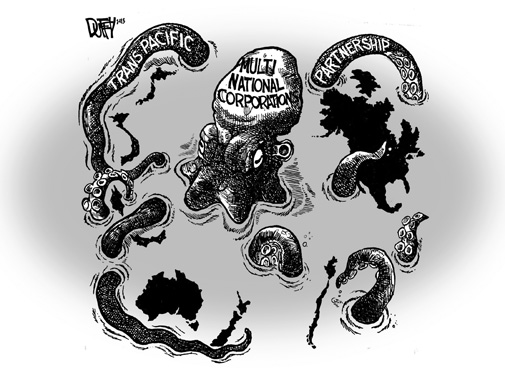
Proposed TPP and TTIP trade bills are corporate scams – designed to rip off populations for maximum profits, no matter the cost to human lives and welfare.

They’ll wreck public healthcare. They’ll make it unaffordable for growing millions. They’ll undermine food safety. They’ll advance environmental destruction. Their secret provisions if made public would cause mass outrage.

Weissman struck a positive note saying when “the American people see what (are) actually in (these) agreements, they are going to force their representatives in Washington to vote (them) down.”

Environmental organization 350.org executive director May Boeve expressed “outrage that Congress…voted to fast track pollution, rather than the job-creating clean energy we need to address climate change.”

“It’s clear this deal would extend the world’s dependence on fracked gas, forbid our negotiators from ever using trade agreements in the fight against global warming, and make it easier for big polluters to burn carbon while suing anyone who gets in the way.”

“That’s why we’re so disappointed President Obama has taken up the banner for ramming this legislative pollution through the halls of Congress, in a way he never pushed for a climate bill.”

Food and Water Watch executive director Wenonah Hauter said “(s)enators who who provided the margin of Fast Track victory will face angry voters in their next elections.”

“Constituents will hold them accountable for putting the interests of transnational corporations ahead of the public.”

Monied interests run things. Whatever they want, they get. Congressional support for fast track and nightmarish trade deals to follow alone show why America is unfit to live in.


Stephen Lendman lives in Chicago. He can be reached at lendmanstephen@sbcglobal.net.

His new book as editor and contributor is titled “Flashpoint in Ukraine: US Drive for Hegemony Risks WW III.”

http://www.claritypress.com/LendmanIII.html

Visit his blog site at sjlendman.blogspot.com.

Listen to cutting-edge discussions with distinguished guests on the Progressive Radio News Hour on the Progressive Radio Network.

The Mall of American Progress

a-grand-canyon-strip-mall

By Scott Beauchamp

Source: The Baffler

Malls may not be an American monopoly, but America’s not really thinkable without them. They’re where we come together, octogenarian mall walkers and teen Goths alike, as we aim for that perfect, elusive balance between over- and under-stimulation. They’re our own controlled-climate variation on the outdoor European arcade; only in the multipurposed American mallspace, you don’t simply exchange money for goods: you exercise, see movies, attend concerts, go to school, and worship God. They’re our culture’s vapid response to the depletion of the commons. And their increasingly empty and abandoned carapaces mottle the American landscape like munition-citadels in the war between consumerism and community.

If the war metaphor seems too dramatic, consider the name of latest big American mall project to announce itself: The Grand Canyon Escalade Project. An “escalade” is a form of military attack that uses ladders to scale a wall.  (Though civilian American consumers probably know the word as a synonym for “gargantuan Cadillac SUV.”) And the Grand Canyon is, well, the Grand Canyon. The Grand Canyon Escalade Project is a proposal to build a mall on the eastern rim of the world’s largest canyon. It’s also a handy metaphor for everything debauched, short-sighted, and self-infatuated about our consumer culture: a belligerent outpost of gaudy merchandise, perched on the very cusp of the void. It doesn’t make much economic sense, it doesn’t make much environmental sense, and it’s an exercise in rapaciousness that represents the worst of American attitudes about unbridled growth.

The Escalade Project has been in the works for some time. The moneymen behind the project call themselves the Confluence Group, LLC, after the confluence of the Colorado and Little Colorado Rivers, where the mall will be built. According to James Joiner’s dispatch on the development in the Daily Beast, the mall will occupy 420 acres “of remote land” and offer a wide array of “retail shops, restaurants, and hotels on the upper rim.” The lowest level of the project would continue to tickle the shopping and appetites of mall visitors, while also offering “stadium seating to take in the views, a museum, visitors center, and elevated river walk.” An IMAX theater will wow moviegoers for whom the splendors of erosion across the millennia may not sufficiently diverting. Meanwhile, the stubborn holdouts who still want to experience the canyon floor beneath their feet will at least be able to do so in the comfort of a people-moving tram. Hiking and donkey-packs are, like nature itself, just a series of needless trials for the single-minded shopper.

The Confluence Group isn’t the only significant regional backer of the Escalade Project. Another key player is the Navajo Nation, which, much to the consternation of some of its members, is promoting the as a claiming it will provide thousands of jobs. Others aren’t so convinced. A group of people opposing the project, calling themselves Save the Confluence, stress that the river confluence is a sacred site to 18 American Indian tribes. Renae Yellowhorse, who has lived on Navajo land her entire life, recently led a New York Times reporter to the precipice of the canyon and surveyed the land below, saying, “This is where the tram would go. This is the heart of our Mother Earth. This is a sacred area. This is going to be true destruction.”

And pace the advocates of commercial development everywhere, at all costs, this doesn’t necessarily promise to be creative (or even merely profitable) destruction. Malls are not guaranteed moneymakers. Crestwood Court Mall, the local mall in my suburban St. Louis hometown, where I would go as a teenager to eat Panda Express and buy discount CD’s as all the music stores slowly closed, is now a “ghost mall,”—a mordant coinage that’s become distressingly common along the American interior. Indeed, the desiccated caverns of Crestwood Court are something of a Grand Canyon unto itself. Crestwood was the first mall to open in the St. Louis area in 1957; now it’s an eerie one million square feet of shopping space, completely devoid of shoppers, stores, and products. It is, fittingly enough, now part of an art project called “Contemporary Ruins.”

The empty, dead mall has become a ubiquitous part of pop culture. Movies like Gone Girl and Tim and Eric’s Billion Dollar Movie have employed ghost malls as spooky and/or comic backdrops. There’s even a website devoted to the exploration of ghost malls.

And the retail decline evoked in all this ominous imagery is real enough. According to numbers reported by the New York Times, 94 percent of American malls were still economically viable in 2006; today, that rate is down to something just shy of 80 percent. They’re being carved out from the inside, with almost 20 percent of malls being at least 10 percent vacant. The trend continues unabated, in what D.J. Busch, a senior analyst at Green Street, calls a “death spiral.” Filling a million square feet or more of retail space, and keeping it filled, while even more big box stores and malls are built just neighborhoods away is quite a tall order.

Still, boosters of the Escalade Project insist that they enjoy the time-honored commercial advantages conferred by a prime location: it’s on the edge of a national park in the middle of a relatively undeveloped landscape. But in broader environmental terms, that means that things might be even worse if the mall does survive. Saying that it’s going to be “bad for the environment” is a bit like saying that being shot in the head would “impair thinking.” The pressure that the influx of visitors and the population boom of permanent residence would put on the already scant water supply could be catastrophic. The rivers are already strained and dirty from overuse. The group American Rivers recently named the Colorado River, which already serves 35 million people, the most endangered river in the United States. As Bob Irvin, president of American Rivers, recently told the New York Times, “Building this suburban development there would have an impact on the lifeblood of the national park. It’s a threat to the groundwater supply of the Colorado River.”

On top of the project’s all-but certain disastrous impact on the region’s severe water strain and waste issues, there’s also the pending repeal of twenty-year ban on uranium mining near the proposed building site. Where’s J.G. Ballard when you need him?

The Escalade Project embodies and amplifies the worst aspects of the American myth of progress. It’s cheap, of course—and stunningly heedless of the sacred meaning of the site to the region’s original inhabitants. But it’s also disrespectful to our own humanity. The Grand Canyon isn’t just “beautiful” in the sense that a travel brochure or IMAX exhibition might glibly characterize it. It’s sublime, in the way that Edmund Burke famously defined the notion as an otherworldly compound of astonishment and terror. As Burke argued, the full impact of the sublime should overwhelm our minds, and lift us out of the stupor of everyday life: it is, he wrote, “productive of the strongest emotion which the mind is capable of feeling.”

As the callow progress of the Escalade Project has made all too clear, we’ve all but lost our ability to recognize, and properly revere, the sublime. Instead, we’ve traded it for food courts, tram-conducted group tours, and emojis. In his introduction to Oakley Hall’s magisterial novel of the myth of the American West, Warlock, Thomas Pynchon observes that “we are a nation that can, many of us, toss with all aplomb our candy wrapper into the Grand Canyon itself, snap a color shot, and drive away; and we need voices . . . to remind us how far that piece of paper, still fluttering brightly behind us, has to fall.


Scott Beauchamp is a veteran and writer. His work has appeared in The Atlantic, The Daily Beast, and Deadspin, among other places.

Breaking Out of the Invisible Prison: The Ten-Point Global Paradigm Revolution

fdd6bbdb9e13032615137

By Prof. John McMurtry

Source: GlobalResearch.ca

As we enter 2015, the global corporate system deepens and spreads in its eco-genocidal effects. But the dots are not joined in their common cause across domains. Money-value coordinates like gross domestic product (GDP), commodity productivity and stock market indexes are still adopted as the measures of “economic performance” rather than life capital development which is systemically depredated.

More than any prior stage of history, we know not what we are doing at the macro level of life organization, nor why no uptick of American sales can remotely solve the problem of collapsing social and natural life support systems. Greece – the world’s emblem of the sacrifice of society to bank debt servicing – is now 45 per cent more in debt than it was before the “austerity” programs started. Global social and ecological collapse proceed in lock-step with predatory corporate and bank globalization, but the connection is taboo to examine.

Fatal mind blocks now rule that no economists see from within received models of understanding, and that no cognitive science lays bare. Unconnected spectacles of crisis are alone reported. Obviously, no recovery from the most wasteful and destructive economic disorder in history is possible so long as it is unseen. This is why we continue over the long cliff of catastrophe without an evident clue of what is happening at the macro level. As another new year opens with all degenerate trends deepening, a point-by-point resetting of our economic parameters to life reality is more than ever demanded. The fatally absurd economic box within which we have been conditioned to conform at a preconscious level remains life-blind at every step without knowledge of it.

Every one of the 10 points of re-framing the economy to life coherence is self-evident once seen. But every step is also revolutionary in paradigm shift from money-capital sequence to life-capital sequence as primary system decider. Once our thought is freed from the bars of the eco-genocidal disorder that now misrules, no step can be reasonably denied.

1. The One-Way Eco-Genocidal Trends

The evidence is now overwhelming that life on earth is in systematic decline toward collapse on all levels. But the meaning is nowhere recognized by any economic model. We have come to know that the climates destabilize to ever greater extremes, but do not connect this long denied reality to the deeper macro facts that the air, soil, forests and water sources are all cumulatively despoiled across the planet as the oceans themselves die back. Vertebrate species simultaneously become extinct at a spasm rate across cultures and continents, but no macro policy arrests their one-way collapse from song birds to coral reefs to pollinators to large animals all at once. Pollution cycles and volumes increase to endanger life systems at all levels, but no global system reduction has been made since the Ozone protocol over 25 years ago.

All the while, public sectors, services and regulators are defunded and dismantled to leave ever more tens of millions of people dispossessed, but tax evasion by the rich multiplies at the same time in one-way disastrous trend. The global food system produces more disabling and contaminated junk than it does food with nutritional value, while man-made non-contagious diseases from obesity to cancer escalate into the world’s biggest killer. Corporate state wars for the resources of the majority world never stop under false pretexts, while transnational corporate-rights treaties to the life capital (means of life that can produce more means of life without loss and cumulative gain) of all societies multiply at the same time. At the core of the system, the global financial system ceases to function for productive investment in life goods, while the future of the next generations collapses toward 25-50 per cent real unemployment, and a world where no birds sing. Yet nowhere is the common cause investigated or even conceived in the business press, education or high theory.

2. The Moral DNA of the Cancer Stage of Capitalism

In fact, the underlying value code driving every degenerate trend is never defined. It is, rather, assumed without question or examination and set into mathematical disconnect as the sole meaning of economic inquiry. Bertrand Russell’s warning here is apposite. “Mathematics may be defined as the subject where we never know what we are talking about, nor whether what we say is true.” The co-author of Principia Mathemtica thus nailed “neo-classical economics” over a century ago. Yet no-one knew what it would come to mean. An academically coded corporate rule in a completely life-blind “Economics” was instituted with its assumption drivers hidden in symbols and closed to disconfirmation by facts. Behind all the self-referential hocus-pocus incapable of predicting its predictable disasters, a ruling value code crystallized to drive the world to ruin with no-one knowing why. This moral DNA of globalization regulates beneath consciousness by four absolute equations assumed in every moment of what is now still masked as “the neoliberal turn.”

Rationality = Self-Maximizing Choice
= Always More Money-Value for Self is Good
= Self-Multiplying Sequences of Ever More Money to the Top Under 1%
= the Ruling Growth System with No Committed Life Functions
= All Else is Disposable Means to this Multiplying Pathogenic Growth

One can test this ruling moral meta program on every degenerate trend. But because it is not seen, the greatest of all fatal confusions comes to be built into societies’ ruling meaning: that money-sequence growth = life value growth. No more malignant mutation of value and meaning has ever occurred. As on the micro level where the surrounding cell community does not recognise the multiplying gross cells eating the life-host alive, so too on the macro social level. Leading the mutant tides of hollowing-out dispossession and ruin of social and ecological life hosts is a private bank system creating tidal notes of bets, credit and debt without legal tender, and partnering with transnational corporations in predation of local economies across the world. It loots life and life bases as ‘necessary reforms’ everywhere it is allowed to move.

This is why there is not inflation while trillions of new dollars are printed for private banking operations with no life productive function. Endless slashing of life goods in wages, benefits, social security and environmental security take corresponding tides of money demand away from people’s lives and life support systems as money-demand powers multiply to the non-producing top. One can track back every step to the ruling value code at work that is taboo to see.

3. Contemporary Economics is a Pseudo-Science

None of this can be seen by ‘Economics’ because it is a pseudo-science. Its ruling categories are disconnected from reality with no life coordinates, and its defining postulates are unfalsifiable by any facts of the world. All organic, social and ecological life requirements are assumed away a-priori. Infinite demand on finite resources is presupposed as sustainable. Reversibility of all processes is taken for granted in a nineteenth-century liquid mechanics model. Consequences follow in the long run that are predictably fatal to human and planetary life organization.

Yet whatever does not fit this a-priori life-blind construction is heretical in graduate schools supplying economic advisers to governments and corporations, and taboo in the corporate press and media to the extent of its contradiction. It is not only a mechanical model, but is absurdly “freedom” and “well-being” at the same time. Whatever deviates from it, conversely, is “irrational” or “despotic.” At the system-wide level of ruling story, the plot is universal for all societies. Purely self-maximizing atomic selves in the market are believed to necessitate the best of possible worlds by an invisible hand of competition ensuring lowest money costs. Life costs do not compute, and “economic growth” is consistent with destroying all life support systems.

We find here, in fact, the underlying form of a fanatic religion. Supra-human laws dictate commands across peoples, and no deadly consequences diminish certitude in its production of the optimal state for all by the perfect design of the system. With the supreme conceit of a just-so story of dyadic market exchange producing the best of possible worlds multiplied to infinity with no possibility of being wrong, we find the inner logic of the global disorder. It rules as a totalitarian creed blind to all but its own growth free of any life value, standard or regulator.

4. Knowledge Wins in the End, but Not Until It is Known

Societies have thus been everywhere ‘restructured’ as subordinate functions to the inexorable transformation of humanity and the world into ever more private commodities and profits. This mutant value system is malignant to the marrow with no consciousness of its derangement or ill consequences. It is taboo to recognize what is everywhere confirmed – deregulated borderless money sequences multiplying themselves by life-blind models, treaties and wars through all that exists on earth whatever their destruction of human and ecological life systems.

Alarm at the growing deadly symptoms increases across thoughtful people, but without decoding connection. Top-down embargo on any other economic view or reality – including by NATO wars – suppresses alternative at every level. Policies of ‘solution’ only extend the pathogenic system further. Even as the reversal of life evolution on earth becomes undeniable under the global rule of private money-sequence multiplication, life-coherent restructuring is anathema and prohibited a-priori by the unexamined value system. It all seems hopeless, but knowledge wins in the end if not suffocated. Behind every step of degeneration lie failures of social knowledge:

(1) failure to diagnose the regulating value mechanism at work;

(2) failure to connect across the domains of life despoliation as predictable from the system’s blind money-demand multiplications;

(3) failure to define or demand any public policies against its despoiling and devouring life support systems with the public increasingly financing the out-of-control feeding cycles;

(4) failure to recognise any life-value principle or ground of the real economy itself.

5. Re-Grounding in Real Capital and Goods, True Supply and Demand

The failure to recognise the life ground and processes of “the economy” is built into the ruling paradigm in principle. As in the prior ruling religion, disconnection of categories and system from empirical reality and life needs rules out disbelief. But disconnect is in the name of “science” and “the invisible hand” rather than “God’s commands” and “divine design.” Adam Smith the founder of modern economics was a Deist, but doctrinal abdication of life ground and reality became totalized in so-called “neo-classical economics” which displaces the class divisions of classical economics and the possibility of any alternative social order.

Thus an absurd metaphysics comes to rule which cannot be decoded because its first principles and axioms are a-priori dictates not subject to critical examination. The first principle of this life-blind economics begins by disconnection from all life requirements, grounds and needs – thus mutating the economy’s provision of otherwise scarce material life goods into an opposite meaning where life goods and life capital do not exist. Capital is assumed as private money-sequences multiplying themselves with life capital blinkered out. Private commodities are assumed to be ‘goods’ although they are in fact increasingly bads for organic, social and ecological life hosts.

The ‘laws of supply and demand’ are simultaneously reduced to self-maximizing private money exchanges indifferent to the real economy of providing life goods otherwise in short supply. Demand is not need or necessity as in any real economy. It is money demand minted by private banks without the legal tender to back over 97 per cent of it: which is ever more unequally held by those serving no productive function, and which nowhere today stands for any life need whatever. The fatal metaphysic built into first principles does not end here. ‘Supply’ is not the life goods people need to survive and flourish, but increasingly the opposite – ever more priced commodities for profit now promoting ever more human and ecological ill-being across the world. Capital is not life wealth that can produce more life wealth without loss, but increasing transnational private money sequences hollowing out life capital on every plane.

6. Knowing Good from Bad as the Baseline of Life-Coherent Economics

At the normative level of this doctrine, a ludicrous and fatal doctrine of freedom rules the war and peace of nations beneath consciousness of it. Freedom = freedom for private money demand only = in proportion to the amount controlled = ever less freedom for those with less of it = no right to life for those without it.

Sane people, in contrast, recognise that life value matters more, the more coherently inclusive in self and world the better. But this ultimately self-evident value ground has been reversed without recognition. People called ‘pro-life’ usurp women’s choice of how they live. Nations assume that ‘standard of living’ is measured by private money spent. ‘Life sciences’ sacrifice billions of animal lives a year for the private money-sequence gains of big corporations. Animal rights theory itself has no criterion to tell the life value of a slug from a person. ‘New and better technology’ is the ruling panacea, but no life-value standard exists to decide better from worse.

What then are we to ground in as life value that the real economy must provide? The objective standard and measure can be stated in three incisive steps:

    1. all value whatever is life value,
    2. good versus bad equals the extent to which life is more coherently enabled versus disabled, by
    3. greater/lesser ranges or capacities of thought, felt being and action through time.

This criterion of life value is no more a matter of opinion than people’s life necessities are. But what are these life needs that no economic paradigm – orthodox or revolutionary – defines? They are in every case that without which life capacities are reduced. Life capital, in turn, is that which produces and reproduces these life goods – from literacy and extending knowledge to the soil we grow in and air we breathe. The ruling value mechanism miscalled ‘the global economy’ is the opposite. It attacks life goods and capital everywhere as ‘externalities’ to its self-multiplying money-sequence and commodity cycles. But because such growth is assumed to be growing life value, the greatest value reversal in history is unseen.

7. Life Capital Base and Growth as the Real Economy Across Cultures

The moving line of the war of liberation begins with what we are able to control, our own lives. Here we can recognise that every value we enjoy, lose or gain has a bottom line – its life capital, that is, the life wealth that produces more life wealth without loss and with cumulative gain. We defend it by life goods to ensure our life capacities are not reduced but grow through time. Most are unpriced – the sun and air, the learning, the home environment, the delight in nature, the play, the love, the raising of children, the fellow arts, and so on. On the social level, the same holds and any well-governed society provides for them in many ways. All may recognise the principle of life capital in their own lives as self-evident, and that all which lasts through time that is worthwhile is life capital. But life capital does not exist as a concept in received economics. It is ruled out a-priori by money capital, the social instrument made the lord without life function.

Addictive internalization is how the system disorder grows on. Knowledge of life goods and bads is how it is rooted out, the unrecognised through-line of human evolution. That is why we find we live far better without corporate-ad television, regular private gas-vehicle use, any junk food or beverage, any throwaway item, any new fashion or commodity not more life enabling than the old, any business with big private banks. The organizing principle is as old as the good life, but is forgotten. The life-capital code is not stated, but becomes ever clearer in our time: minimize market demand that disables life capacities to enable life capital to grow and flourish. This principle is unthinkable within the ruling thought system, but defines transformation to true economy and life emancipation on earth. It liberates life wherever it moves.

The underlying turning point is as old as human evolution itself. Every human advance is by knowing what enables life through time from what does not. Collective life advance is transmitting this life-and-death knowledge across selves and generations. The life capital code holds across cultures. Life goods are always that without which life capacities decline and die. All real needs, all real demand, all real supply, and all real economics are known by this criterion. The lost line between good and evil is found in this principle, and so too human freedom and well-being.

We can define the meaning more concretely as follows Every human life suffers and degenerates toward disease and death without breathable and unpolluted air, clean water and waste cycles, nourishing food and drink, protective living space, supportive love, healthcare when needed, a life-coherent environment, symbolic interaction, and meaningful work to perform. All are measurable in sufficiency across cases. All are now degraded, polluted or perverted by the self-multiplying money-capital system defined above.

8. Collective Life Capital the Missing Link across Divisions

Collective life capital is the long-missing principle of the common interest and collective agency. The life capital code goes deeper than gender, culture or individual differences, and includes past as well as future generations by definition. It is objective, impartial, and universally applicable. It is the ultimate regulator of the economic principles of efficiency, productivity and development. It grounds political legitimacy and supersedes ruinous man-nature, economy-environment splits and individual-social conflicts of interest. By its regulation, freedom is made responsible to its own conditions of possibility. Life capital defines an inner logic of life value which cannot in principle go wrong within or beyond economics.

Collective life capital is the missing common ground and measure across the lines of death itself. It is the this-worldly bridging concept across the impasse of global culture wars, economy-versus – environment thinking, present-versus-future interests, male versus female conflicts, and all other warring dichotomies wrenching us from our shared life ground beneath property lines and the mors immortalis of reality on earth.

The difference from received ultimate principles of value across time and theories is in the objective precision of meaning and direction when value judgement and decision are governed by its laws of:

    1. life value regulator from start to finish,
    2. production of more life value capacity through generational time,
    3. life-value measure to tell greater from lesser in any domain by margins of capacity loss or gain,
    4. cumulative life gain as the organizing goal of the process throughout, and
    5. the meta principle: the more coherently inclusive any decision or action is in enabling life capacities, the better it always is for the world.

9. The Life-and-Death War of the World

In fact, the global corporate commodity and money-sequence system usurps these life capital principles with impunity across continents, while captive corporate states increasingly subsidize, de-regulate, privatize and militarily enforce this life-blind rule over all ecological and human requirements and rights.But who sees the moving lines of the global life-and-death war?

Obviously a real economy would regulate for life capital conservation and advance with money sequences only as means – as is already is the case in a human way of life. Societies and individuals would transform to better lives if the paradigm revolution was enacted in their spheres of choice. Victory or loss in the war of the world lies as always in how we live. Knowledge of bads versus goods is always the inner logic of human evolution at individual and collective levels of action. It is the mark of being human, and begins in what we do not demand – for example, any new fashion or commodity not more life enabling than the old or the used.

The organizing principle of real economy is long anticipated by China’s Tao-te Ching and the West’s autarkia of human self-realization, and many prove it in their own lives. Minimal demand on short resources to enable maximum life capacities is the war of recovery on social as well as individual levels. While every corporate state now presses for ever more energy extraction and use with no limit of public and life costs at every imaginable level, the root of economic rationality – ration to need – is effectively taboo in official culture.

Once the life-capital system decider kicks in, the rules of selection for what compossibly enables rather than disables human and fellow life on earth become evident to reason and learning from mistakes – the ultimate incapacity of the now ruling global system. This is the transformation to true economy and life emancipation, and it can only proceed in accord with the life capital principle that holds across individual, social and environmental life hosts.

10. The Ultimate Choice Space of Humanity

Collective life capital is now fatally endangered on almost every plane across generational and ecological time. The common life interest has no meaning in the ruling global system because its sole law of growth is to multiply the very private commodities and money sequences without life function that mindlessly drive the end-game world disorder.

It follows that humanity’s very provision for the universal human life necessities that have evolved over millennia are blinkered out by the life-blind value measures of what is miscalled ‘the economy.’ Everything that makes a society civilized or liveable is excluded from view – life-protective laws including sufficient minimum wages and environmental regulations, common water and sewage systems for all, free movement pathways and life spaces without cost to use, non-profit healthcare and disease-prevention by public institution, public income security from disemployment, old age and disability, primary to higher education without multiplying debts, family housing, food and life means assistance for children without sufficient parental money, and public libraries and arts facilities with accessible books, films and works of art and art creation. This is more or less a complete index of the collective life capital bases modern society has evolved, but all are dismantled by the global corporate disorder to maximally profit from.

In truth, the organizing principles of common life interest and human agency cross the lines of death itself in the life capital code of value that steers any real economy in any place through generational time. It is the system-deciding choice all societies face without knowing it. History is the record of successes and failures at what still remains unconscious in economic thought. It is nowhere defined beyond slogan even in communism, and ‘the public interest’ has no life coordinates or ground in known modern politics across the spectrum. Yet life goods and life capital denote the only true economic necessity and growth – that without which human life capacities degrade and die. ‘The economy’ is not run by natural or divine laws, as the modern paradigm assumes. It is a social construction of binding rules which directs toward how we live better by what is not otherwise there.

The ruling value code fails more momentously in world waste and destruction than all other systems in history, but beneath recognition. Its built-in contempt for all life requirements and indifference to life ruin multiplies its demands across the planet in a fanaticism beyond ISIL in attacking life capital and goods with no committed life functions. Yet no economics yet allows the recognition of its predictably rising catastrophe through time as a global economic system.

The life capital economy is opposite in its regulating value logic. It grounds in common life capital and produces more of it by life measure as its goal and moral science. Its logic of value is not utopian, but the ultimate through-line of human development since language and cooperative provision of human means of life. It lives in all the civil commons we are made human by in the life security of a free humanity. It is invaded wherever its life capital and goods are turned into more private money demand, resource depletion and waste without limits – the moral cancer of the ruling system. The ultimate choice space of humanity and society lies in this unrecognised life and death meaning. •

John McMurtry is an elected Fellow of the Royal Society of Canada and his work is published and translated from Latin America to Japan. He is the author and editor of the three-volume Philosophy and World Problems published by UNESCO’s Encyclopedia of Life Support Systems (EOLSS), and his latest book is The Cancer Stage of Capitalism: from Crisis to Cure.

Why Are So-Called Progressives Defending Special Ops Training?

jadehelm1

By Carol Miller

Source: Counterpunch

Anti-militarism activists are shaking their heads in amazement. We have been working for years to push back against the massive military expansion underway both in the US and around the world, fighting back one threatened community at a time. The national media has barely mentioned these efforts and local media chooses to mostly ignore the work.

Militarized violence has become the new normal in the USA. It barely matters whether these militarized forces are controlled by the Pentagon, or state governors, each in control of a national guard (state-based militia), state or local police chief, or even a county sheriff with their own militarized departments.

Yet, the largest war “game” ever undertaken by the Pentagon is now getting huge amounts of superficial media attention. The media is not focusing on the tremendous financial cost, the potential environmental consequences, or the unconstitutionality of the plan. The media of both the left and the right are using the plan as yet another convenient tool in enabling the divide and conquer strategy of the Pentagon.

Jade Helm 15 and Texas have become the convenient punch lines of jokes and mocking by so-called progressives and the mainstream media without a single serious look at what the actual activity will do on the ground. Think about this; Viet Nam is the size of New Mexico. Iraq is smaller than Texas. Afghanistan is also smaller than Texas.

What war is being practiced for in an area comprised of seven of the largest states in the US including New Mexico and Texas – Russia? China? Africa? Europe? These are the questions the media should be asking. The public needs to know the endgame of all the proposed and ongoing war games.

The majority of people taking the Jade Helm 15 seriously are not conspiracy theorists, they are community volunteers and environmental attorneys that have been working for years to stop military expansion. Among the volunteers are retired people, school children, veterans, ranchers, peace activists, business people, and environmentalists. They are people who know and oppose intrusive, polluting, environmentally destructive, economically damaging military operations whether overhead, on the ground or in waterways.

Communities Organized Against Military Expansion

Across the US, communities are kept busy responding to endless Pentagon NEPA actions. NEPA is the National Environmental Policy Act, which supposedly protects or limits the environmental impacts of government activities. People are most familiar with the Environmental Impact Statement (EIS), which is the final stage of the lengthy NEPA process.

The group I work with is the Peaceful Skies Coalition, organized in 2010 to stop air force special ops from flying and practicing war at very low altitudes over most of northern New Mexico and southern Colorado. Over the past five years, the coalition has intervened in numerous Pentagon NEPA actions from Vermont to Alaska. We also stand in solidarity with the people around the world fighting US militarism; Okinawa, Guam, Jeju Island Korea and Sicily to name just a few.

A meeting of anti-militarization community leaders was held both online and in person in Taos, New Mexico in April. As community after community told their story we realized that the situation was identical no matter where in the US the military was expanding. Communities are organized to fight current Pentagon expansion plans. The Pentagon wants to expand the bootprint not only of its bases, but also to expand military activities across public lands; national forests, national parks and Bureau of Land Management (BLM). As a result of agreeing to shared values in April, the organizations are in the process of creating a national organization to strengthen the reach and voice of the anti-militarization movement.

Pentagon’s Planned Gulf of Alaska Ecocide is Also Not a Joke

While attention is focused Jade Helm 15 in the southwest US, barely a speck of attention is being paid to the real navy plan to begin live ammunition bombing and sonar war “games” in the Gulf of Alaska (GOA) in June. Without a miracle that intervenes to stop this project, the navy bombing will begin next month and be repeated every year for at least the next five years.

Public outcry, especially to the secretary of the navy and members of Congress, might help stop the planned bombings. (http://www.eyakpreservationcouncil.org/navy-training-facts/write-letter-navy-2/) The sample letter prepared by the Eyak Preservation Council states that “The coastline around the GOA is home to many coastal communities and Alaska Native people who rely on marine and freshwater resources… These exercises are planned during the most prolific breeding and migratory periods of the marine supported life in the region (salmon, whales, birds and more)… Commercial fishing is the largest private sector employer in Alaska, providing some 80,000 jobs as well as a healthy food source.”

The Eyak Preservation Council, which is fighting a lonely battle to stop the navy, describes the importance of salmon to their lives; “The life blood of our region – the basis for a culture, economy and community. The Copper River and Prince William Sound are spectacular watersheds that host a rich, plentiful, unique and roadless pristine ecosystem that supports one of the most sought after wild salmon runs in the world, known as the Copper River wild salmon. One of the last truly wild places on earth.”

The Gulf of Alaska fight is just one of the fights against the navy currently taking place all along the Pacific Rim including the West Coast of the US and Hawai’i. Community volunteers and a handful of attorneys versus the Pentagon, is a scenario repeated in one community after another.

Jade Helm 15 is Not a Joke

Jade Helm 15 is not a joke and must be taken seriously. Mock invasions, mock terrorist manhunts, shootouts, and roundups are not jokes. They are reminders that in the Global War On Terror (GWOT) being a US citizen doesn’t matter. Because in the eyes of the State, everyone is a suspect, everyone must stand up against war and war practice. The last shreds of democracy are at stake.

Carol Miller is a community organizer from Ojo Sarco, New Mexico (population 300) and an advocate for “geographic democracy,” the belief that the United States must guarantee equal rights and opportunities to participate in the national life, no matter where someone lives. She is an officer of the Peaceful Skies Coalition.


Columbians Tired of US Planes Dumping Tons of Monsanto’s Roundup on Them to Fight the Drug War

monsanto-columbian-drug-war

By Matt Agorist

Source: Free Thought Project

For over two decades now, US planes have been dumping tons of pesticides over Columbian coca fields. America’s immoral and asinine policy of the War on Drugs has perpetuated the aerial spraying of Monsanto’s Roundup over rural areas of Columbia since 1994.

Originally the Columbian government wholeheartedly supported the ridiculous notion of mass killing all vegetation in attempt to cull the drug trade. However, it is no longer a secret that the health effects of long-term exposure to glyphosate are less than desirable.

Just last month, the World Health Organization was forced to admit that glyphosate is “probably carcinogenic to humans.”

The recent acceptance by the mainstream that Monsanto’s Roundup causes a slew of negative health effects has sparked fear and infighting among the Columbian government.

According to the AFP,

Health Minister Alejandro Gaviria said last week that Colombia should “immediately suspend” spraying — a move vehemently opposed by Defense Minister Juan Carlos Pinzon, who said it would “give criminals the upper hand.”

The row erupted just as US Deputy Secretary of State Antony Blinken paid a visit to Colombia, which the United States sees as one of its closest allies in the region.

The politicians who are fear-mongering about stopping the program are likely scared of losing the hundreds of millions in funds received annually from the US to combat the cultivation of this plant.

Daniel Mejia, the head of Colombia’s Center for Research on Security and Drugs explained why they are worried about the program. “We carried out a study that showed fumigating caused dermatological and respiratory problems and provoked miscarriages,” he said.

Even if dumping massive amount of carcinogenic pesticides from airplanes was a good idea, it’s not effective. According to the United Nations Office on Drugs and Crime, this program has aided Colombia in reducing its coca fields from more than 140,000 hectares (346,000 acres) in 2001 to 48,000 hectares in 2013. However, they conveniently left out the increase seen last year. The amount of land under coca cultivation in Colombia jumped 39 percent in 2014 to 112,000 hectares (about 27,000 acres), according to the Office of National Drug Control Policy.

Cocaine trafficking in Latin American region has caused a slew violence and turmoil, including the Columbian civil war. However, this turmoil is a direct result of prohibition spearheaded by the United States.

Columbia never had a cocaine trafficking problem until the US-funded war on drugs began its destructive path across South America.

During the 1980s, Peru, Bolivia and Colombia were responsible for 65%, 25% and 10% of the world’s coca production respectively. By 2000, however, the US “war on drugs” in neighboring Andean countries had turned Colombia into the world’s largest cocaine producer by far, representing 90% of the total, according to a report from the from the Woodrow Wilson International Center for Scholars.

The coca plant is one of the most beneficial and astonishingly resilient plants in the world. Resistant to drought and disease, coca needs no irrigation and the alkaloids it contains provide a myriad of medicinal uses. From its analgesic effects to digestive aid, coca’s positive influence in medicine is vast.

The plant has played an important role in history dating back to the Pre-Inca period.

According to a study published by Harvard University in 1975, (Nutritional Value of Coca Leaf (Duke, Aulick, Plowman 1975)) chewing 100 grams of coca is enough to satisfy the nutritional needs of an adult for 24 hours. Thanks to the calcium, proteins, vitamins A and E, and other nutrients it contains, the plant offers even better possibilities to the field of human nutrition than it does to that of medicine, where it is commonly used today.

However, the state cares not about the benefit of such a plant, only that it can be turned into a white powdery substance and snorted to stimulate long and often nonsensical conversations. Instead of cultivating the plant for its benefits, the immoral war on drugs drops carcinogens from airplanes to stop its growth.

The president of Columbia, Juan Manuel Santos, is avoiding any stance on the aerial spraying program whatsoever. According to the AFP, his staff said the final authority on the matter is the National Narcotics Council, which falls under the Justice Ministry. In the meantime, however, the spraying continues.

Deepwater Capitalism

gulf-oil-spill17

Reflections on the Fifth Anniversary of One of the Biggest Oil Spills in History

By Quincy Saul

Source: Counterpunch

In memory of Gabriel García Márquez, March 6, 1927-April 17, 2014.

In September of 2009, the BP corporation dug the deepest oil well in history. The 35,055-foot deep Tiber prospect, 300 miles off the Texas coast, promised six billion barrels: one of the largest oil fields ever discovered in the country. So of course, they kept looking for more: They moved their massive drilling rig named Deepwater Horizon fifty miles south of the Louisiana coastline, to a prospect called Macondo, named after the setting of the famous book 100 Years of Solitude, by Gabriel García Márquez.

On April 20, 2010, as they began to seal the well, something went wrong: a mix of oil and gas escaped, rushing up through earth and water, blowing up the Deepwater Horizon, and killing eleven workers, whose bodies were never recovered. Over the next eighty seven days, the whole world watched as over 200 million gallons of oil erupted from the ocean floor into the Gulf of Mexico.

It was the largest oil spill in history – more than ten times the size of the Exxon Valdez disaster in Alaska. The images of animals covered in oil began to haunt our screens again, and the scale of death was so great it still seems impossible to quantify – estimates of the number of birds killed within the first hundred days ranges between 100,000 and one million. But the real nightmare was offshore, as riptides and hired hands collected thousands of animal carcasses into “death gyres”. Riki Ott explains:

“Hurricane Creekkeeper John Wathen managed to get the only footage of what I came to call the ‘death gyres.’ the rip currents that collected dead animals offshore. The Incident Command – BP and the US Coast Guard – kept the media 1,500 feet up in the air so the press couldn’t really capture the situation there. The animal carcasses were corralled, taken out to sea, and dumped at night, according to fishermen who were involved with so-called ‘Night-time Operations.’ Offshore workers reported ‘thousands of dolphins, birds too numerous to count, sea turtles too numerous to count,’ and even whales in the death gyres.” (Earth at Risk, Building a Resistance Movement to Save the Planetedited by Derrick Jensen and Lierre Keith, p. 49)

Five years later, what can we say? If hindsight is 20-20 then presumably we can learn from our mistakes. How did it happen? Was it BP’s fault? Or is there a bigger picture to blame? Five years later, the common sense of this tragedy has yet to dawn, as if the oil has clogged our hearts and minds along with our oceans and beaches. Like the pioneers of Márquez’s Macondo, searching for a way through the swamp, we seem lost, desperately hacking our way through nature and through our own nature. And the past, like the path, seems to always be disappearing behind us.

“…and the cries of the birds and the uproar of the monkeys became more and more remote, and the world became eternally sad. The men on the expedition felt overwhelmed by their most ancient memories in that paradise of dampness and silence, going back to before original sin, as their boots sank into pools of steaming oil and their machetes destroyed bloody lilies and golden salamanders. . . . They could not return because the strip that they were opening as they went along would soon close up with a new vegetation that almost seemed to grow before their eyes.” (Márquez, p. 11-12)

How did it Happen?

“The main thing is not to lose our bearings.” (Márquez, p. 12)

Whodunit? What was the crime scene, and who are the criminals? What murder weapon spawned gyres of death? Five years later, we must look through the tangled jungle of events which have grown up behind us, and remember how we got here. Michael Klare’s insightful blow-by-blow of the events leading up to the accident is worth revisiting. 

“When BP first deployed the rig at the Macondo prospect in January 2010, it set a target date of March 7 for completion of that well. However, due to a series of geological obstacles and technical mishaps, drilling was not completed until April 19, producing a cost overrun on the project of approximately $58 million. It is not surprising, then, that BP’s site managers felt particular pressure to seal the well and move the Deepwater Horizon, to its next scheduled location. In their rush, the site managers made several last-minute decisions. . . . When preparing for the final cementing that would prevent natural gas from leaking into the wellbore, for instance, they decided to use only six “centralizers” to position the well’s steel casing, whereas the original design had called for twenty-one centralizers. They also went ahead with the sealing of the well even though several ‘negative-pressure’ tests suggested a dangerous buildup of gas in the wellbore. . . . the desire to complete the job swiftly and move the expensive drillship to its next assignment certainly contributed to the disaster.” (The Race for What’s Left, The global scramble for the world’s last resourcesKlare, p. 47-8)

One way to solve this crime is to blame the workers – the crime scene is the workplace, and the murder weapon is the botched job. They failed to follow industry regulations; using less than half of the recommended number of centralizers, and ignoring the test results indicating a dangerous buildup of gas. But this explanation is not sufficient, and hides another suspect. If the workers pulled the trigger, who gave the order?

As Klare explains, the workers were in a rush. It was the BP site managers – their cost overrun, their “pressure to seal the well and move,” and the “desire to complete the job swiftly,” which created the conditions in which the oil workers made their fateful decisions. So is BP the murderer? Is the crime scene the BP board room?


Inside BP

At the dawn of the 21st century, BP had a tabloid affair with alternative energy. John Browne, its CEO from 1995 to 2007 re-branded the company, from “British Petroleum” to “Beyond Petroleum”, and urged its shareholders and broader public “to look beyond oil and gas to fuels which can be produced locally and which do not threaten the sustainability of the world’s climate.” In 2008, Browne was replaced by Tony Hayward, whose more sober vision re-branded the company simply “BP”, and clarified that “the energy of the future will be more than oil, but oil will still be a major part of it.” In 2010 he closed BP’s “alternative energy office.” (Klare, p. 41)

Perhaps the public relations team from that office had all been moved to the Gulf Coast, where it has been working overtime since 2010. This has included classroom visits with “hands-on” experiments, substituting cocoa for oil and dish soap for chemical dispersant, to win young hearts and minds to the efficacy of BP’s cleanup efforts.[1] According to the company, the case is closed. A recently released report from BP concluded: “BP has seen no data to suggest a significant long-term population-level impact to any species.” In fact, “BP is claiming that wildlife in the Gulf is thriving and more abundant since the disaster.” (Jensen and Keith, p. 61) In a recent press conference, BP’s executive vice president for response and environmental restoration in the region Laura Folse said “I personally have no concern about oil washing in from the offshore to the shoreline.”

BP is preparing for the punchline, because currently pending in court is the case which will decide how much money BP has to pay in damages for the disaster. While BP is a giant – listed by Fortune magazine as the fourth largest publicly held company in the world – some on Wall Street have expressed fear that the court’s decision could kill the company. This panic began almost immediately after the spill, and BP began to sell off assets all over the world, in Colombia, Egypt, the US, Canada and Argentina. (Klare, p. 215, 216)

But according to forensic accounting expert Ian Ratner who testified recently on the case, BP “actually, has a better balance sheet today than it had before the spill.” Despite around $40 billion in oil spill liabilities, the company is financially better off than before the disaster. What’s more, they are back at the scene of the crime: “We expect to be back and actively drilling during the second half of the year,” said BP Chief Financial Offcer Byron Grote in April 2011. And he kept his promise: like Colonel Buendía in Márquez’s novel, BP gives orders for execution but is isolated and naive about to the results: “Lost in the solitude of his immense power, he began to lose direction.” (Márquez, p. 171) BP seems both all-powerful and powerless, returning to the scene of the crime like a dog unto its vomit, at the mercy of some god or godlessness which demands more drilling.

There is more than meets the eye in this case. Is BP the only culprit on trial? If the workers pulled the trigger, and BP gave the order, who put the gun in its hand? And who made the gun? There is an African saying that “if you want to get at the root of the murder, you have to look for the blacksmith who made the machete.” (Anthills of the SavannahChinua Achebe, p. 159)

The World System

“That was perhaps the only mystery that was never cleared up in Macondo. . . . A trickle of blood came out under the door, crossed the living room, went out into the street, continued on in a straight line across the uneven terraces, went down steps and climbed over curbs, passed along the Street of the Turks, turned a corner to the right and another to the left, made a right angle at the Buendía house, went in under the closed door, crossed through the parlor, hugging the walls so as not to stain the rugs, went on to the other living room, made a wide curve to avoid the dining-room table, went along the porch with the begonias, and passed without being seen under Amaranta’s chair as she gave an arithmetic lesson to Aureliano José, and went through the pantry and came out in the kitchen, where Úrsula was getting ready to crack thirty-six eggs to make bread.” (Márquez, p. 135)

What was the blacksmith that built and blew the Deepwater Horizon? Like the mystery of Macondo in Márquez’s story, the trail of blood climbs and descends, turns corners and crosses paths, taking us from the work place, to the board room, to the stock exchange, and from there it seems to flow into the ocean of normal every-day modern life. As Lamar McKay, chairman and president of BP America said, “the deepwater is indispensable to the world’s energy future.” (Klare, p. 69) The trail doesn’t go cold, it goes everywhere. Like the war of Colonel Buendía, our search for justice in the death gyres seems to get stuck in a stalemate of business as usual: “’Everything normal, Colonel.’ And normality was precisely the most fearful part of that infinite war.” (Márquez, p. 171)

In the early 2000s, the deep sea drilling industry boomed. All the big oil corporations competed to dig the deepest wells, at depths and conditions that boggle the imagination – deeper than Mt. Everest is tall, under thousands of feet of water (and pressure). These projects out-compete space exploration in the audacity of their engineering and in their cost: Shell built a rig called Mars that was three times more expensive than the Mars Pathfinder mission, with arguably more complex technology. (Klare, p. 44) While their locations are industry secrets – no one knows how many or where they all are – they are everywhere, from the Falkland Islands to the Arctic Circle, from South America to West Africa.

A 2010 report by energy expert Michael Smith estimated that big oil would spend $387 billion on offshore drilling between 2010 and 2014 – 33% more than over the previous five years – building 20,000 offshore wells in ever deeper waters. (Klare, p. 44-45) The Deepwater Horizon explosion, which came nineteen days after President Obama announced plans for more offshore drilling, did little or nothing to change the plan. Three days after the explosion, with Macondo still gushing, a White House spokesperson assured that increase in offshore drilling would continue, promising that it would be done “safely, securely, and without harm to the environment.” (Klare, p. 51)

Before Deepwater Horizon, regulations on the industry had been lax. In the United States, the Interior Department’s Mineral Management Service (MMS) took a hands-off approach to the industry, never, for instance, setting any criteria for minimum-pressure tests, which had such fateful consequences in the Gulf. (Klare, p. 50) After a six month moratorium on drilling in the Gulf after the disaster, oil companies began to lobby the courts to being reissuing permits. A new set of safety rules was established, and by April 2011, one year after the disaster, deep drilling in the Gulf, by BP and others, was back online. (Klare, p. 52) Everything normal, Colonel.

This is the normalcy of the infinite war on mother earth: While the fallout of the disaster continues to inflict irreparable damage to the Gulf, the industry which created the crisis is allowed to resume the activity which created it. And the same agencies that failed to regulate the industry before are being trusted to do it right this time. How can this be?

The answer can be found by following the money, like the trickle of blood in Macondo, from the scene of the crime, and out into the world-system. In an energy analysis report from several years ago, it was predicted that due to declining reserves of conventional oil, offshore oil output would contribute 35 percent of global supplies by 2020. By 2015, the report continued, deep-offshore fields would be “the only source of growth to power the world’s expanding economy. . . . Any energy firm that intends to continue being involved in the production of hydrocarbons must, therefore, establish a significant presence in the major deepwater drilling zones.” (Klare, p. 45)

In other words, the industry is too big to fail – even if does fail. Big oil cannot be too strictly regulated or restricted – or punished. Their alibi is the world-system; the modern way of life. This logic was recently re-asserted by Justice Department attorney Steve O’Rourke in the buildup to the court case that will decide BP’s punishment, who said that the penalty “has to be high enough that companies of this size won’t let a spill like this ever happen again. But, again, not so high as to be ruinous to their operation.” In the great state of Louisiana, individuals who murder get capital punishment, but corporations who murder get rehabilitation. Questioned about whether the company would attempt to drill at Macondo again, BP senior vice president Kent Wells responded that “there is a good reservoir there,” and there was no reason to rule it out, because if BP didn’t, someone else would. (Klare, p. 52)

And so BP and the Gulf and all of us have come full circle, back to the scene of the crime. As death approaches for Márquez’s Ursula Buendía, so does the realization for all of us: “time was not passing. . . . it was turning in a circle.” (Márquez, p409) As big oil races ever faster and ever deeper, time somehow seems to stand still. The rush put on the workers is the rush put on the managers, is the rush put on the CEOs, is the rush put on the shareholders, is the same rush put again upon the workers. And in this “race for what’s left,” as Michael Klare calls it, we are left standing still, watching death approaching, as the drilling rigs, like monster space-age vultures, circle Macondo once again.

We must ask again, and answer again, to keep our bearings, and to clear a path to the truth: Is the crime scene the workplace, or is it the board room? The stock exchange, or the gas station down the street? Like the trickle of blood weaving through the town of Macondo, the evidence leads everywhere; back to normal modern life. The crime scene is everywhere. The murder weapon is the world-system. The criminal and the culprit is deepwater capitalism.

Deepwater capitalism is a terminal stage in the global metastasis of a social cancer we call the economy. Capitalism has gone to deep water, as it has gone to the hearts of mountains and into the depths of the earth. Offshore oil drilling is but one horseman, in a world-wide apocalypse of extreme resource extraction. The others are fracking, tar sands, and mountaintop removal. If imperialism is the highest stage of capitalism, then today’s resource extraction apocalypse reveals the highest stage of imperialism – genocide and extinction.

Captain Ahab from Moby Dick, the insane captain of a whaling ship – distant ancestors of today’s offshore oil rigs – speaks for the system: “all my means are sane, my object and my motive mad.” (Melville, p. 177) With sane means and mad motives, Captain Ahab is both a model and a metaphor for today’s economy, whose command will sink civilization. It is the immense power without direction, the normal infinite war, the gravity at the center of a world-wide death gyre.


Conclusions

At the beginning of the road into the swamp they put up a sign that said ‘Macondo’ and another larger one on the main street that said ‘God exists’.” (Márquez, p. 49)

Five years later we owe it to ourselves and to the world to come to some conclusions. It may take millions of years for the ecosystems of the Gulf to recover, but in the meantime we must recover our hearts and our minds from a modernity in which such disasters are normal aspects of every-day life. We must come to some conclusions about this world-system, and about the generations of people who will live and die on the front lines of an infinite struggle against an infinite war.

Regardless of the severity of the punishment BP receives, the fact that it is back at the scene of the crime, drilling, gives us an indication of the real scale of the problem. If BP is a psychopathic recidivist criminal, it is not alone. The global economy which depends on this kind of extreme resource extraction, which gives corporations like BP orders and alibis, and which bends executive, legislative and judicial power to its needs, is on the move, and it will strike again. Bhopal, Macondo, Fukushima – the beat will go on until we pull the emergency break. Michael Klare writes in conclusion to his comprehensive global survey of our doomsday terrain: “As the race for what’s left gains momentum, this sort of predatory behavior will become more frequent and more brutal. . . . Only if we abandon the race altogether . . . . can we hope to avoid calamity on a global scale.” (Klare, p. 218 and 210)

To abandon the race: This is the conclusion to which we must come. It will, however, require much more of us than the reformist measures Klare proposes – increasing efficiency, developing alternative energies, and supporting “green” versus “brown” capital. These will only buy Captain Ahab more time. It’s time for mutiny. It’s time for the emergency break. It’s time for revolution.

Conclusions on the local level in the Gulf are more difficult. Big picture political conclusions will not bring back the fish and the birds, will not restore livelihoods and dreams swept away by poisoned waters. In a region that the federal government has all but abandoned, the future is wholly in the hands of the common people of the Gulf coast.[2] It is an immense burden for any people, let alone those who are still recovering, ten years later, from Hurricane Katrina, and who live trapped between “cancer alley” and rising ocean levels, with the ground literally sinking under their feet. Thus the struggles of the people of the Gulf symbolize for the entire world a last stand for meaning, in a civilization on the brink of oblivion: “It was the last that remained of a past whose annihilation had not taken place because it was still in a process of annihilation, consuming itself from within, ending at every moment but never ending its ending.” (Márquez, p409) After them, the flood.

Like children, many of us are afraid of the dark. We hide from the creeping annihilation even as it seeps ever closer to home. We close off our hearts to the horror, and mute our minds before the madness, even as it consumes us and enlists our complicity. As John W. Tunnell, witness for BP, recently testified, “The images of those dead birds that were oiled, like pelicans, stick in people’s minds more, and so it’s easy to get emotionally involved in those things. . . . you have to step back and critically and unemotionally, objectively to look at what’s going on.”

While BP’s witnesses, as personifications of capital, would have us immerse ourselves in the infamous “icy waters of egotistical calculation,” some people in the Gulf prefigure a different path to the truth. A documentary titled My Louisiana Love chronicles the story of Monique Verdin, a young Native American woman in search of love and life amidst death and indifference: “I want to keep living on our land, but I’m inheriting a dying delta.” She sets out fearlessly into a landscape of annihilation with an open heart, an open mind, and open hands, and in her story there is a universal story.

It is a story of salvation blossoming next to damnation, a story which promises like Holderin that “where danger threatens, that which saves from it also grows.” Like jewelweed growing next to poison ivy, like women’s liberation in Rojava alongside to the patriarchal crusade of ISIS, like God next to Macondo: There is hope here, perhaps the only kind of hope that is real in a world where everything is at least partly toxic, where dioxin swirls in breast milk, and death gyres spiral in the oceanic cradle of life. It is a story that slumbers in a world consumed with cynicism, a world awash in the icy waters of ego. But like the people of Macondo, we await only the right magnet to re-ignite our wonder. As the gypsy proclaimed, “things have a life of their own. . . . It’s simply a matter of waking up their souls.” (Márquez, p. 2)

Quincy Saul is the author of Truth and Dare: A Comic Book Curriculum for the End and the Beginning of the World, and the co-editor of Maroon the Implacable: The Collected Writings of Russell Maroon Shoatz. He is a musician and a co-founder of Ecosocialist Horizons.

REFERENCES

100 Years of Solitude, by Gabriel García Márquez, Harper Perennial Modern Classics, 2006

The Race for What’s Left, The global scramble for the world’s last resources, by Michael T. Klare, Metopolitan Books, Henry Holt and Company, NY, 2012

Earth at Risk, Building a Resistance Movement to Save the Planet, edited by Derrick Jensen and Lierre Keith, Flashpoint Press, 2012

Anthills of the Savannah, by Chinua Achebe, Anchor Book, 1998

Moby Dick, by Herman Melville, St. Botolph Society, 1892

“Suffering a Sea Change,” by Joel Kovel, Capitalism Nature Socialism, Volume 21, Issue 3, September 2010

Notes.

[1]  “NOAA and BP teamed up to visit eighth-grade classrooms in the Gulf to show children how to safely clean up an oil spill. They spilled cocoa powder in a little aquarium to mimic an oil spill – cocoa powder, right? Yummy. They sprinkled in Dawn dish soap to ‘disperse’ the oil. ‘See children? Dispersant works to clean up the oil, and we’re going to save the world. It’s OK.’ (Riki Ott, in Jensen and Keith, p52) Chemical dispersants can best be described with the poem by Gerard Manley Hopkins, “where we, even where we mean to mend her, we end her”: the toxicity of chemical dispersants – arguably more dangerous than the oil they purport to clean up – has been analyzed and documented by many organizations.

[2]  “It really is all up to us. In the Gulf, it didn’t take people twenty years like with the Exxon Valdez spill to realize the federal government was not in control of the situation; it took them two months.” -Riki Ott (Jensen and Keith, p52)


G.M.O. Resistance

GMO-Protect-the-land-and-farmers-from-GMOs

By Rebel Fagin

Source: The Daily Censored

We don’t have to do what the corporate death state says. We can choose how we’ll live, what media we’ll consume, and what foods we’ll eat.

Genetically Modified Organisms (GMO) have been added to a dozen crops. GMOs are used in Monsanto’s Roundup Ready seeds – the only seeds that will allegedly survive an attack of the herbicide Roundup. Roundup contains glyphosate, a chemical that disrupts photosynthesis and the immune system. It is a civilian off-shoot of Agent Orange, Monsanto’s notorious herbicide made from 2, 4-D and 2, 4, 5-T.

Here’s how the chemical farmer’s cycle goes. A farmer uses Roundup and other glyphosate based chemicals. Most of the weeds die. Those that survive pass on this survival gene to their offspring and the weeds come back stronger. The farmer then uses more chemicals. Ever wonder where those chemicals go?

You are what you eat. The American Academy of Environmental Medicine (AAEM) states, “Several animal studies indicate serious health risks associated with GM foods.” These include: infertility, immune problems, accelerated aging, faulty insulin regulation, allergic reactions, gastrointestinal disorders, obesity, heart disease, depression, infertility, cancers, and Alzheimer’s disease.

It’s worse for infants. Their immune systems are still developing and they metabolize food at a much higher rate than adults. This makes them more sensitive to chemical toxins. Independent laboratory tests have found genetically engineered soy in four popular infant formulas: Similac Soy (42%), Gerber Good Start Soy (48%), Enfamil Pro Soybee (49%), and Walmart Soy (66%). The Cornucopia Institute Report found GMO contamination in several cereals including: Mother’s Bumpers (28%), Kix Corn Puffs (56%), Nutritious Living Hi-Lo (85%), and Kashi Go Lean (100%)!

GMOs are common in processed foods. They frequently turn up in the forms of sugar, corn starch, corn syrup, cotton seed oil, and canola oil.

GMOs arrive in meat and meat byproducts as rbGH and rbST. These growth hormones have been banned in Canada.

Another dangerous GMO product is aspartame which is found in Nutrisweet and Equal. Aspartame has been linked to disorders ranging from tumors to seizers.
As of March 2015 we know that soy, cotton, canola, sugar beets (not cane sugar), corn, salmon, Hawaiian papaya, alfalfa used for hay, a small amount of yellow and crookneck squash, and recently Arctic Apples can all contain GMOs.

So what can we do? First look at the label. If it says Federal Organic, Non GMO Project Verified, or rbGH and rbST free then it is GMO free. Web sites like http://www.ocsoco.org/gmo, LabelGMOs.org. NonGMOShoppingGuide.com will keep you up to date. However, looking out only for number one is half steppin’. To do the whole dance, couple these labels with Fair Trade or Fair for Life labels and look out for the people who provide you with your food as well.

Shop at your local farmer’s market and get to know your farmers and their practices. Shop at stores that champion organic foods. You can always raise your own food. D.I.Y.
Here’s how to grow a simple organic garden in 10 easy steps.

1) Build beds and put soil in them. Soil is not dirt. Dirt is what happens when you don’t clean. Soil is interactive biological communities. Beds can be made from wood, bricks, chicken wire, etc. You can build them on the ground or at any convenient height. Build them to last several years. Rake out the rocks and level the ground.

2) Add green vegetable cuttings, animal manure, and rock nutrients to your soil. Mix well and level again.

3) You can plant seeds directly in the ground or start them indoors and then transplant them. Space them according to their mature size. This is a good time to put in a flex line drip irrigation system. Drip irrigation is a good way to conserve water. Many people like to include timers.

4) Lay mulch, such as organic hay, between your beds. It will both help retain water and control pests. Till the mulch into the soil at the end of the season.

5) Water and weed regularly. Spend time in your garden and get to know it well. Your garden will serve you for this. Add organic nutrients only as needed. Usually you need more nitrogen in the beginning. Check with your local organic gardener for what works best in your region.

6) For large pests you’ll need a fence tall enough for deer and deep enough so wild pigs don’t dig under it.

7) For smaller pests good soil preparation and a clean garden is your best foundation. Rotate crops for both pest control and to keep soil healthy.

8) Compost discarded organic, non-meat foods in a compost bin. Mix together green (vegetables) and brown (leaves), stir them up, water them, close the lid, and let ‘em cook. Avoid thick skinned foods like bananas and melon rinds as they take longer to break down. Coffee grounds and egg shells add beneficial nutrients to the soil. Stir and wait. After a year or two you’ll retrieve rich black soil from the bottom of your compost to add to your garden. Good compost is warm and alive with worms and other creatures.

9) Check your plants for color, firmness, and smell before you harvest them. You can either harvest the whole plant or take clippings from it and allow it to grow. It depends on the plant and what you want.

10) Take extra food to your local Food Pantry or contact cropmobsters.com and they will help you with distribution.
We are not slaves to the corporate death state. We can choose how we’ll live. Choose life over death and make conscious choices about food today.

Sources: Monsanto A Corporate Profile © 2013 by Food & Water Watch, ResponsibleTechnology.org, LabelGMOs.org, Herbicide forum in Willits, CA 3/8/15

Rebel can be read at the Sonoma County Peace Press & the Daily Censored.

It’s the End of the World as We Know It . . . and He Feels Fine

paul_kingsnorth

By Daniel Smith

Source: NYTimes Magazine

Late one night last August, on the chalk downlands of southern England, Paul Kingsnorth stood in a field beside an old-growth forest, two yurts and a composting toilet. Kingsnorth is 41, tall, slim and energetic, with sweeping brown hair and a sparse beard. He wears rimless glasses and a silver stud in his ear, and he talks with great ardor, often apologizing for having said too much or for having said it too strongly.

On this occasion, Kingsnorth was silent. It was the final night of Uncivilization, an outdoor festival run by the Dark Mountain Project, a loose network of ecologically minded artists and writers, and he was standing with several dozen others waiting for the festival’s midnight ritual to begin. Kingsnorth, a founder of the group, had already taken part in several sessions that day, including one on contemporary nature writing; a panel about the iniquities of mainstream psychiatric care; and a reading from his most recent book, “The Wake,” a novel set in the 11th century and written in a “shadow language” — a mash-up of Old and modern English. He had also helped his two young children assemble a train set while trying to encapsulate his views on climate change and environmental degradation in what Kingsnorth describes as an era of global disruption. The “human machine,” as he sometimes puts it, has grown to such a size that breakdown is inevitable. What, then, do we do?

In the clearing, above a pyre, someone had erected a tall wicker sculpture in the shape of a tree, with dense gnarls and hanging hoops. Four men in masks knelt at the sculpture’s base, at cardinal compass points. When midnight struck, a fifth man, his head shaved smooth and wearing a kimono, began to walk slowly around them. As he passed the masked figures, each ignited a yellow flare, until finally, his circuit complete, the bald man set the sculpture on fire. For a couple of minutes, it was quiet. Then as the wicker blazed, a soft chant passed through the crowd, the words only gradually becoming clear: “We are gathered. We are gathered. We are gathered.”

After that came disorder. A man wearing a stag mask bounded into the clearing and shouted: “Come! Let’s play!” The crowd broke up. Some headed for bed. A majority headed for the woods, to a makeshift stage that had been blocked off with hay bales and covered by an enormous nylon parachute. There they danced, sang, laughed, barked, growled, hooted, mooed, bleated and meowed, forming a kind of atavistic, improvisatory choir. Deep into the night, you could hear them from your tent, shifting every few minutes from sound to sound, animal to animal and mood to mood.

The next morning over breakfast, Dougie Strang, a Scottish artist and performer who is on Dark Mountain’s steering committee, asked if I’d been there. When he left, at 3 a.m., he said, people were writhing in the mud and singing, in harmony, the children’s song “Teddy Bears’ Picnic.” (“If you go down in the woods today, you’re sure of a big surprise.”) “Wasn’t it amazing?” he said, grinning. “It really went mental. I think we actually achieved uncivilization.”

The Dark Mountain Project was founded in 2009. From the start, it has been difficult to pin down — even for its members. If you ask a representative of the Sierra Club to describe his organization, he will say that it promotes responsible use of the earth’s resources. When you ask Kingsnorth about Dark Mountain, he speaks of mourning, grief and despair. We are living, he says, through the “age of ecocide,” and like a long-dazed widower, we are finally becoming sensible to the magnitude of our loss, which it is our duty to face.

Kingsnorth himself arrived at this point about six years ago, after nearly two decades of devoted activism. He had just completed his second book, “Real England,” a travelogue about the homogenizing effects of global capitalism on English culture and character. “Real England” was a great success — the first of his career. All the major newspapers reviewed the book; the archbishop of Canterbury and David Cameron (then the opposition leader) cited it in speeches; Mark Rylance, the venerated Shakespearean actor, adopted it as a kind of bible during rehearsals for his hit play “Jerusalem.” Yet Kingsnorth found himself strangely ambivalent about the praise. “Real England” was a painful book to write. For months he interviewed publicans, shopkeepers and farmers fighting to maintain small, traditional English institutions — fighting and losing. Everywhere Kingsnorth traveled, he saw the forces of development, conglomeration and privatization flattening the country. By the time he published his findings, he was in little mood to celebrate.

At the same time, he felt his longstanding faith in environmental activism draining away. “I had a lot of friends who were writing about climate change and doing a lot of good work on it,” he told me during a break from his festival duties. “I was just listening and looking at the facts and thinking: Wow, we are really screwed here. We are not going to stop this from happening.”

The facts were indeed increasingly daunting. The first decade of the 21st century was shaping up to be the hottest in recorded history. In 2007, the Arctic sea ice shrank to a level not seen in centuries. That same year, the NASA climatologist James Hansen, who has been ringing the climate alarm since the 1980s, announced that in order to elude the most devastating consequences, we’d need to maintain carbon dioxide in the atmosphere at a level of 350 parts per million. But we’d already surpassed 380, and the figure was rising. (It has since reached 400 p.p.m.) Animal and plant species, meanwhile, were dying out at a spectacular rate. Scientists were beginning to warn that human activity — greenhouse-gas emissions, urbanization, the global spread of invasive species — was driving the planet toward a “mass extinction” event, something that has occurred only five times since life emerged, 3.5 billion years ago.

“Everything had gotten worse,” Kingsnorth said. “You look at every trend that environmentalists like me have been trying to stop for 50 years, and every single thing had gotten worse. And I thought: I can’t do this anymore. I can’t sit here saying: ‘Yes, comrades, we must act! We only need one more push, and we’ll save the world!’ I don’t believe it. I don’t believe it! So what do I do?”

The first thing that Kingsnorth did was draft a manifesto. Also called “Uncivilization,” it was an intense, brooding document that vilified progress. “There is a fall coming,” it announced. “After a quarter-century of complacency, in which we were invited to believe in bubbles that would never burst, prices that would never fall . . . Hubris has been introduced to Nemesis.”

The initial print run of “Uncivilization” was only 500 copies. Yet the manifesto gained widespread attention. The philosopher John Gray reviewed it in The New Statesman. Professors included it on their reading lists. An events space in Wales invited Kingsnorth and Dougald Hine, Dark Mountain’s co-founder, to put on a festival; 400 people showed up. Doug Tompkins, the billionaire who started the outdoor-apparel company the North Face, and his wife, Kristine Tompkins, the former C.E.O. of Patagonia, offered financing and invited Kingsnorth and his family to spend two months on land they own in southern Chile.

There were others, however, who saw Kingsnorth’s new work as a betrayal. With waters rising, deserts spreading and resource wars looming, how could his message be anything but reckless — even callous? He and his sympathizers were branded “doomers,” “nihilists” and (Kingsnorth’s favorite epithet) “crazy collapsitarians.” One critic, a sustainability advocate, published an essay in The Ecologist — a magazine Kingsnorth once helped run — comparing Dark Mountaineers to the complacent characters in the Douglas Adams novel “The Restaurant at the End of the Universe”: “Diners [who] enjoyed watching the obliteration of life, the universe and everything whilst enjoying a nice steak.”

Kingsnorth regards such charges with equanimity, countering that the only hope he has abandoned is false hope. The great value of Dark Mountain, he has claimed, is that it gives people license to do the same. “Whenever I hear the word ‘hope’ these days, I reach for my whiskey bottle,” he told an interviewer in 2012. “It seems to me to be such a futile thing. What does it mean? What are we hoping for? And why are we reduced to something so desperate? Surely we only hope when we are powerless?”

Instead of trying to “save the earth,” Kingsnorth says, people should start talking about what is actually possible. Kingsnorth has admitted to an ex-activist’s cynicism about politics as well as to a worrying ambivalence about whether he even wants civilization, as it now operates, to prevail. But he insists that he isn’t opposed to political action, mass or otherwise, and that his indignations about environmental decline and industrial capitalism are, if anything, stronger than ever. Still, much of his recent writing has been devoted to fulminating against how environmentalism, in its crisis phase, draws adherents. Movements like Bill McKibben’s 350.org, for instance, might engage people, Kingsnorth told me, but they have no chance of stopping climate change. “I just wish there was a way to be more honest about that,” he went on, “because actually what McKibben’s doing, and what all these movements are doing, is selling people a false premise. They’re saying, ‘If we take these actions, we will be able to achieve this goal.’ And if you can’t, and you know that, then you’re lying to people. And those people . . . they’re going to feel despair.”Whatever the merits of this diagnosis (“Look, I’m no Pollyanna,” McKibben says. “I wrote the original book about the climate for a general audience, and it carried the cheerful title ‘The End of Nature’ ”), it has proved influential. The author and activist Naomi Klein, who has known Kingsnorth for many years, says Dark Mountain has given people a forum in which to be honest about their sense of dread and loss. “Faced with ecological collapse, which is not a foregone result, but obviously a possible one, there has to be a space in which we can grieve,” Klein told me. “And then we can actually change.”

Kingsnorth would agree with the need for grief but not with the idea that it must lead to change — at least not the kind of change that mainstream environmental groups pursue. “What do you do,” he asked, “when you accept that all of these changes are coming, things that you value are going to be lost, things that make you unhappy are going to happen, things that you wanted to achieve you can’t achieve, but you still have to live with it, and there’s still beauty, and there’s still meaning, and there are still things you can do to make the world less bad? And that’s not a series of questions that have any answers other than people’s personal answers to them. Selfishly it’s just a process I’m going through.” He laughed. “It’s extremely narcissistic of me. Rather than just having a personal crisis, I’ve said: ‘Hey! Come share my crisis with me!’ ”

In 2012, in the nature magazine Orion, Kingsnorth began to publish a series of essays articulating his new, dark ecological vision. He set his views in opposition to what he called neo-environmentalism — the idea that, as he put it, “civilization, nature and people can only be ‘saved’ by enthusiastically embracing biotechnology, synthetic biology, nuclear power, geoengineering and anything else with the prefix ‘new’ that annoys Greenpeace.” Or as Stewart Brand, the 75-year-old “social entrepreneur” best known as the publisher of the ” Whole Earth Catalog,” has put it: “We are as gods and have to get good at it.”

For Kingsnorth, the notion that technology will stave off the most catastrophic effects of global warming is not just wrong, it’s repellent — a distortion of the proper relationship between humans and the natural world and evidence that in the throes of crisis, many environmentalists have abandoned the principle that “nature has some intrinsic, inherent value beyond the instrumental.” If we lose sight of that ideal in the name of saving civilization, he argues, if we allow ourselves to erect wind farms on every mountain and solar arrays in every desert, we will be accepting a Faustian bargain.

When Kingsnorth describes how he came to this way of thinking, he nearly always begins with an ancient chalk hill outside Winchester, not far from the site of the recent Uncivilization festival. It was 1992, and the conservative British government was about to break ground on a vast network of highways across England.

The highways were proposed three years earlier by Margaret Thatcher, whose administration announced that they would constitute the “biggest road-building program since the Romans.” As it happened, they would also cut through areas that had remained unspoiled since the Romans. Direct opposition to the program began at a hill called Twyford Down, through which the government planned to build a six-lane highway. The purpose of the road was to reduce the commute to London by a matter of minutes. In 1992, a small band of radicals calling themselves the Dongas staged a demonstration. Soon road protests were popping up across the country, drawing support from itinerant hippies, the working classes and the nobility.

Students of popular movements often credit the road protests of the 1990s with radicalizing a generation of British youth. This is certainly true of Kingsnorth. While at Oxford, he spent many weekends at Twyford Down — locking arms, waving placards, shouting slogans. He found it intoxicating to put himself on the line for a cause. At Twyford Down, he was arrested for the first time, for chaining himself, along with 50 others, to a bridge. He loved it. (He later sued the police and received a settlement of $5,000.) Kingsnorth was even more intoxicated by the proud impracticality of the protests. The core of the demonstrators’ complaints was not that the new highways would worsen air pollution, cause car accidents or fracture communities; it was that some things, like wilderness and beauty, were — despite, or perhaps because of, their “uselessness” — more important than getting to work on time. The motivation was raw, intuitive and, in its Wordsworthian love of the Arcadian, very, very English. In an essay titled “Confessions of a Recovering Environmentalist,” Kingsnorth wrote that after Twyford Down, he “vowed, self-importantly, that this would be my life’s work: Saving nature from people. Preventing the destruction of beauty and brilliance, speaking up for the small and the overlooked and the things that could not speak for themselves.”

It proved easier to make this vow than to act on it. The chief obstacle was his father: a driven, competitive man who scraped his way up from a working-class background to become the head of a manufacturing firm. Kingsnorth’s father was not without a love of the outdoors, but it was a striving, willful kind of love. He often took Kingsnorth on long, arduous hiking trips, forcing him to carry heavy packs and disappearing far up the trail to teach his son the virtues of independence and struggle.

These trips were both trials and revelations. It was while backpacking with his father on the moors of Cornwall and atop the hills of Northumberland that Kingsnorth had his first cathartic experiences in nature — experiences that were responsible for the direction his life was now taking. But his father wasn’t prone to seeing that as a consolation. “I’d gone off to Oxford as a guy in jeans and a T-shirt,” Kingsnorth says, “then I started wearing tie-dye tops and putting beads in my hair and walking around in big boots, as dudes do.”

Kingsnorth wouldn’t tell his father about his arrest for 10 years. Nor would he find a way to elude the expectations placed on him. His 20s were an awkward — and not very successful — mix of idealism and ambition. At Oxford he was editor of Cherwell, the university’s longest-running student newspaper, whose staff has included Graham Greene, W. H. Auden and (on the business end) Rupert Murdoch. He parlayed this honor into an entry-level position as a researcher at The Independent, in London. He was miserable. He found the work frivolous and his superiors out of touch. In 1995, seven years after the creation of the Intergovernmental Panel on Climate Change and six years after a global treaty regulating CFCs, he had to explain to an editor the difference between global warming and ozone depletion.

Kingsnorth lasted on Fleet Street for less than a year. He stayed in London another two, working for a poorly run nonprofit, writing a protest novel no one wanted to publish and getting increasingly fed up with the congestion and noise. Finally he returned to Oxford, figuring he would freelance. The rent was cheap, and in the late 1990s the pubs were filled with green activists and writers. But Kingsnorth has always found it difficult to stand still — another trait, he says, he inherited from his father. In 2001, hungry to travel, he took his agent’s advice to write a book about the growing anti-globalization movement, which came to prominence two years before when thousands gathered to protest the World Trade Organization in Seattle.

For Kingsnorth, the anti-globalization movement was both opportunity and mission. He attended mass protests in Prague, where he was tear-gassed for the first time, and Genoa, where the police shot and killed a young anarchist two streets from where Kingsnorth was marching. The experiences radicalized him anew. “It was similar to what I’d felt at the road protests,” he told me. “Here’s millions of people who don’t like this way of measuring the world, don’t like this way of living, don’t like this way of seeing the world.” He made reporting trips to four continents, tracing the movement’s roots and common themes.

His timing could not have been worse. His book came out in March 2003, during the first week of the Iraq war. It landed “with an inaudible thud.” He returned to Oxford and spent the next few years writing pamphlets, articles and another novel (for which, again, he could not find a publisher), and he began “Real England.”

In August 2007, as he was picking flowers in the small back garden of his house, he got a call that his father had killed himself. Kingsnorth’s father had been living in Cyprus, in semiretirement. His marriage had fallen apart. He had a nervous breakdown and spent time in a psychiatric hospital. One morning, he wrote a bitter suicide note, got in his car and drove full speed into a parked truck.

Kingsnorth’s reaction to his father’s death was conflicted. He’d often suspected that behind his own drive to achieve — to have his opinions aired on television and his books published by mainstream presses, to lead mass movements — was a need to satisfy his father’s more conventional expectations of him. Now that need was obsolete. He felt a sense of release, as if he’d been given permission to say what he wanted to say, in any way he wanted to say it. He felt he could finally, with a clear conscience, “go to the margins.” All he had to do was figure out what that meant.

“Do you know what the ‘first follower’ is?” Dougald Hine, Dark Mountain’s co-founder, asked me. It was Friday at dusk during the Uncivilization festival, and we had taken our dinners out to the woods to talk. We were sitting on logs, our paper plates balanced on our knees.

The first follower is a concept introduced by the musician and entrepreneur Derek Sivers in a short TED talk titled, “How to Start a Movement.” In the talk, Sivers shows an amateur video that begins with a shirtless man gyrating wildly on a hillside at what seems to be a concert. For a while the man dances alone, swinging his hips and arms as if possessed, or more likely high. Eventually someone joins him, and they hold hands and gyrate together. Before you know it, a full-fledged dance party has broken out.

“The point being,” Hine said, “that the first follower transforms you from a lunatic into someone who’s got the beginning of something.”

For Hine, the equivalent of the lone dancer was a pair of blog posts Kingsnorth wrote in late 2007. The first was a bilious rant announcing his retirement from journalism. (“The media can go hang. I’ve had it. I’m out.”) The second, written after yet another international climate conference sputtered out, expressed his “joyous” abandonment of hope that global warming could be stopped. Hine was just turning 30. A scruffy, bright-eyed man with an unruly mop of hair, he had for years worked, unhappily and off and on, as a radio reporter for the BBC. Like Kingsnorth, he quit in a spasm of disgust. Also like Kingsnorth, Hine experienced a transformation in his feelings about climate change: first an obsessive phase of turning off light switches and idling electronics; then a despondent “Oskar Schindler phase of ‘It’s never enough’ ”; then a point of curious repose. He emailed Kingsnorth and introduced himself. In the fall of 2008, they met at a pub in Oxford to discuss how they might collaborate.

During their first meeting, Kingsnorth and Hine spent most of their time exchanging influences — “showing each other our maps,” is how Hine puts it. Hine talked about his passion for the author and critic John Berger, who for the past four decades has lived and farmed in a small French village, and for the late Austrian priest and polymath Ivan Illich, a fierce critic of Western culture. Kingsnorth, in turn, introduced Hine to the American poet Robinson Jeffers, who quickly became a kind of lodestar for Dark Mountain.

Jeffers is little read today, but he was one of the most celebrated writers of the 1930s and 1940s. A friend of Edward Weston and D. H. Lawrence, he lived, as one critic put it, “like a reclusive movie-star-wizard” in a stone tower overlooking the Pacific, writing hundreds of poems endowed with the spirit of what he came to call Inhumanism — “a shifting of emphasis and significance from man to not-man.” At a time when the Great Depression was destroying millions of lives and Europe was militarizing for a new war, Jeffers saw human history as an inexorable, almost naturally destructive force. “The beauty of modern/Man is not in the persons,” he wrote in “Rearmament,” a poem that became the epigraph for “Uncivilization,’, “but in the/Disastrous rhythm, the heavy and mobile masses, the dance of the/Dream-led masses down the dark mountain.”

Kingsnorth and Hine’s aspirations for their manifesto weren’t revolutionary, but neither were they nihilistic. Each man draws a distinction between a “problem,” which can be solved, and a “predicament,” which must be endured. “Uncivilization” was firm in its conviction that climate change and other ecological crises are predicaments, and it called for a cadre of like-minded writers to “challenge the stories which underpin our civilization: the myth of progress, the myth of human centrality and the myth of separation from ‘nature.’ ”

Writers whose work more or less fit the manifesto’s bill answered Kingsnorth’s and Hine’s call. In 2010, he and Hine published the first in what has become a series of Dark Mountain books — literary journals, essentially — hard-bound and lavishly illustrated. Naomi Klein is by far the best known of the contributors, but the series also includes lengthy interviews with the cultural ecologist David Abram and the social critic Derrick Jensen.

Kingsnorth and Hine consider the books to be the heart of Dark Mountain’s work. Had it not been for the surge of interest that greeted the manifesto, Kingsnorth might have stopped there, retreating into the private life of a father and an artist. Retreat was, after all, what he was after — or what he thought he was after. In 2009, he and his wife, a psychiatrist with the National Health Service, decided to move from Oxford to Cumbria, in the far north of England. Kingsnorth wanted to spend his time writing; taking his children for hikes in the hills, as his father had taken him; and improving his skills on the scythe, a tool he valued for its simplicity and efficiency. (For the past three summers, he has taught scything classes in the area around his home.) Instead he found himself at the head of a burgeoning organization that even its critics might concede was changing the environmental debate in Britain and the rest of Europe. It was a slightly awkward position. Just when Kingsnorth had publicly abandoned faith in movements, he became the leader of one.

On the first night of the Uncivilization festival, in an open-sided shelter made of soft-wood planks and cedar shingles drawn from the surrounding woods, there was a concert. A choral group from London, the Songlines Choir, stood in front of a wide clay fireplace and performed music from Cape Verde and Turkey, as well as a song based on a poem that appeared in the third Dark Mountain book. The song centered on the plaintive, almost pleading refrain, “What matters is already here.” All the performers were dressed in fire-engine red. Later, a singer-songwriter named Marmaduke Dando — he describes himself, alternately, as “a neo-pagan vaudeville crooner” and the “bard of disempire” — sang a bitter and languid ballad titled “Love My Country, Hate My State.”

Watching the concert at the edge of the shelter, I met a young woman, Sarah Thomas, who’d spent the summer backpacking around England. Halfway through the show, we decided to check out an art project by Strang, the Scottish artist, that had emerged as the festival’s most popular draw. It was raining, and we walked up and down hills in the dark until we came to a tiny makeshift hut with a red door and a round wooden sign that read “Charnel House for Roadkill.”

The installation was inspired by a Barry Lopez essay in which he suggests that people pay respect to the lives of animals killed crossing roads and highways. (“You never know,” Lopez writes, “the ones you give some semblance of a burial, to whom you offer an apology, may have been like seers in a parallel culture. It’s an act of respect, a technique of awareness.”) The hut was cramped and eerie, decorated with the bones of small animals in illuminated glass cases. Haunting music was piped in from an iPod. You walked through a curtain, sat down and put on a heavy papier-mâché mask — a badger surrogate. Directly across from you, seated behind a window in the back wall, was another person — a volunteer — also wearing a badger mask. He or she sat silently, except when mirroring whatever movements you made, until, driven by emotion, fatigue, satisfaction or plain discomfort, you left.

Sitting in the hut, the air stale and the light almost nonexistent, I thought of something Hine told me earlier. “People think that abandoning belief in progress, abandoning the belief that if we try hard enough we can fix this mess, is a nihilistic position,” Hine said. “They think we’re saying: ‘Screw it. Nothing matters.’ But in fact all we’re saying is: ‘Let’s not pretend we’re not feeling despair. Let’s sit with it for a while. Let’s be honest with ourselves and with each other. And then as our eyes adjust to the darkness, what do we start to notice?’ ”

Hine compared coming to terms with the scope of ecological loss to coming to terms with a terminal illness. “The feeling is a feeling of despair to begin with, but within that space other things begin to come through.” Yet arriving at this acute state of “awareness of what’s worth doing with the time you’ve got left” isn’t always easy for Dark Mountain’s followers. “Some people come here,” Hine told me, “they get very excited by the fact that people are inspired, and they go: ‘Right! Great! So what’s the plan?’ ” He and Kingsnorth have worked hard to check this impulse, seeing Dark Mountain as a space to set aside what Kingsnorth refers to as “activist-y” urges.

This wasn’t always the case. At the first festival, in 2010, Kingsnorth behaved the way he thought the leader of a new movement ought to behave. He proselytized. He lectured. He gave a talk that he describes as “Here’s what’s wrong with environmentalism, and this is what must change!” But he quickly concluded that a didactic tone was inappropriate for the new group. Dark Mountain had more in common with the anarchism of Occupy Wall Street than with the collectivism of 350.org: everyone was to choose his or her own course of action. Recently, Kingsnorth and Hine decided not to hold any more festivals. They want to focus their limited resources on publishing more books more frequently, but they also don’t want the gatherings to ossify into a predictable program — or worse, an annual party.

For more conventional activists, Dark Mountain’s insistence on remaining impractical can be not only disorienting but also irksome. George Monbiot, one of the England’s most prominent environmental journalists, is among Kingsnorth’s oldest friends. In 2009, after the manifesto was published, he and Kingsnorth held a debate in The Guardian, for which Monbiot writes a column. It was a heated exchange. Kingsnorth argued that civilization was approaching collapse and that it was time to step back and talk about how to live through it with dignity and honor. Monbiot responded that “stepping back” from direct political action was equivalent to a near-criminal disavowal of one’s moral duty. “How many people do you believe the world could support without either fossil fuels or an equivalent investment in alternative energy?” he asked. “How many would survive without modern industrial civilization? Two billion? One billion? Under your vision, several billion perish. And you tell me we have nothing to fear.”

Naomi Klein also sees a troubling abdication in Kingsnorth’s work. “I like Paul, but he’s said rather explicitly that he’s giving up,” she told me. “We have to be honest about what we can do. We have to keep the possibility of failure in our minds. But we don’t have to accept failure. There are degrees to how bad this thing can get. Literally, there are degrees.”

On the surface, it can indeed seem as if Kingsnorth is giving up. Last week, he and his wife made a long-planned move to rural Ireland, where they will be growing much of their own food and home schooling their children — a decision, he explained to me, that stemmed in part from a desire to distance himself from technological civilization and in part from wanting to teach his children skills they might need in a hotter future. Yet Kingsnorth has never intended to retreat altogether. For the past three years, he has spent a good portion of his time trying to stop a large supermarket from being built in Ulverston, in northern England. “Why do I do this,” he wrote to me in an email, anticipating my questions, “when I know that in a national context another supermarket will make no difference at all, and when I know that I can’t stop the trend caused by the destruction of the local economy, and when I know we probably won’t win anyway?” He does it, he said, because his sense of what is valuable and good recoils at all that supermarket chains represent. “I’m increasingly attracted by the idea that there can be at least small pockets where life and character and beauty and meaning continue. If I could help protect one of those from destruction, maybe that would be enough. Maybe it would be more than most people do. “

It’s an ethic reflected in the novel he has just published. When he was a schoolboy, Kingsnorth told me, his teachers described the Norman Conquest, in 1066, as a swift transformation. An army of Norman and French soldiers from across the channel invaded England and swept away Anglo-Saxon civilization. The old ways vanished, and a new world emerged. He was surprised to learn, much later, that a resistance movement bedeviled the conquerors for a full decade. These resisters were known as the Silvatici, or “wild men.” Eventually William the Conqueror drove them from the woods and slaughtered every last one of them. They were doomed from the start, and knew it. But that hadn’t stopped them from fighting.

In Kingsnorth’s telling, it also didn’t stop them from wondering whether they should keep fighting. On the afternoon following the concert, standing in the wooden shelter, he described his novel as being both about the collapse of a civilization and about the collapse of long-cherished certainties about what it means to be civilized. His introductory remarks were lively and entertaining, but nervously so, as if he were reluctant to begin. Later, he told me it was the first time he’d ever read publicly from the book. He read a strange excerpt, a sort of dream vision about a young boy and a stag. “I have no idea which part of my subconscious I dredged this up from,” he later wrote me, “but the conversation they end up having is pretty much the conversation I have with myself at the moment when it comes to what the hell I can possibly do to be of any use at all”:

when will i be free saes the cilde to the stag

and the stag saes thu will nefer be free

then when will angland be free

angland will nefer be free

then what can be done

naht can be done

then how moste i lif

thu moste be triewe that is all there is

be triewe

be triewe

“I hope these ramblings are of some use to you!” he signed off. “I will have a glass of wine now and try not to worry about it.”