HOW THE WESTERN MEDIA HELPED BUILD THE CASE FOR GENOCIDE IN GAZA

From obscuring the West’s role in starving Gaza to sensationalised accounts of mass rape by Hamas, journalists are playing the role of propagandists, not reporters.
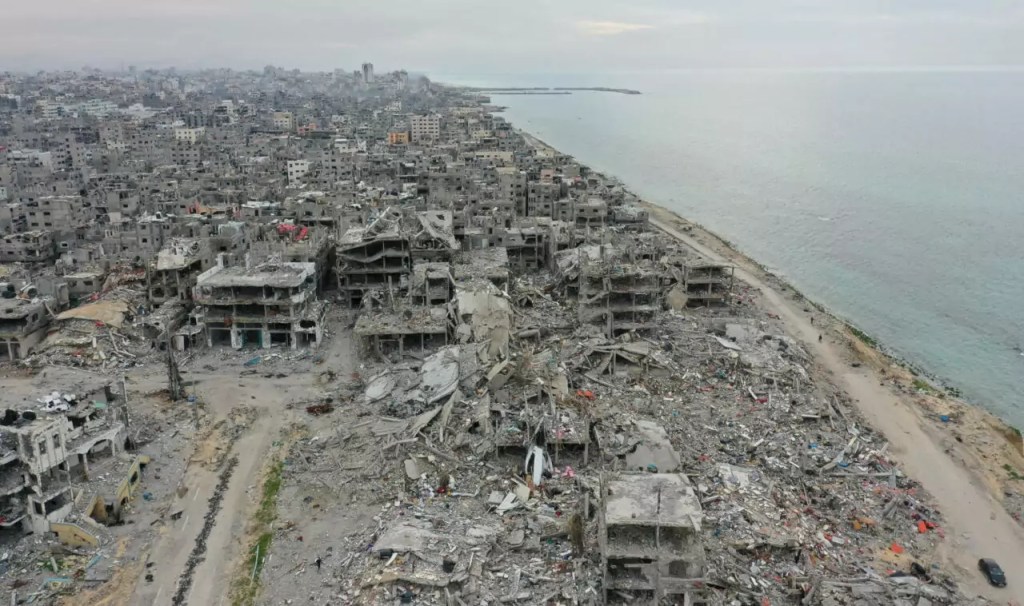
Israel has reduced Gaza to ruins. (Photo: UNRWA)

By Jonathan Cook

Source: Declassified UK

The past five months have been clarifying. What was supposed to be hidden has been thrust into the light. What was supposed to be obscured has come sharply into focus.

Liberal democracy is not what it seems.

It has always defined itself in contrast to what it says it is not. Where other regimes are savage, it is humanitarian. Where others are authoritarian, it is open and tolerant. Where others are criminal, it is law-abiding. When others are belligerent, it seeks peace. Or so the manuals of liberal democracy argue.

But how to keep the faith when the world’s leading liberal democracies – invariably referred to as “the West” – are complicit in the crime of crimes: genocide?

Not just law-breaking or a misdemeanour, but the extermination of a people. And not just quickly, before the mind has time to absorb and weigh the gravity and extent of the crime, but in slow motion, day after day, week after week, month after month.

What kind of system of values can allow for five months the crushing of children under rubble, the detonation of fragile bodies, the wasting away of babies, while still claiming to be humanitarian, tolerant, peace-seeking?

And not just allow all this, but actively assist in it. Supply the bombs that blow those children to pieces or bring houses down on them, and sever ties to the only aid agency that can hope to keep them alive.

The answer, it seems, is the West’s system of values.

The mask has not just slipped, it has been ripped off. What lies beneath is ugly indeed.

Depravity on show

The West is desperately trying to cope. When Western depravity is fully on show, the public’s gaze has to be firmly directed elsewhere: to the truly evil ones.

They are given a name. It is Russia. It is Al Qaeda, and Islamic State. It is China. And right now, it is Hamas.

There must be an enemy. But this time, the West’s own evil is so hard to disguise, and the enemy so paltry – a few thousand fighters underground inside a prison besieged for 17 years – that the asymmetry is difficult to ignore. The excuses are hard to swallow.

Is Hamas really so evil, so cunning, so much of a threat that it requires mass slaughter? Does the West really believe that the attack of 7 October warrants the killing, maiming and orphaning of many, many tens of thousands of children as a response?

To stamp out such thoughts, Western elites have had to do two things. First, they have tried to persuade their publics that the acts they collude in are not as bad as they look. And then that the evil perpetrated by the enemy is so exceptional, so unconscionable it justifies a response in kind.

Which is exactly the role Western media has played over the past five months.

Starved by Israel

To understand how Western publics are being manipulated, just look to the coverage – especially from those outlets most closely aligned not with the right but with supposedly liberal values.

How have the media dealt with the 2.3 million Palestinians of Gaza being gradually starved to death by an Israeli aid blockade, an action that lacks any obvious military purpose beyond inflicting a savage vengeance on Palestinian civilians? After all, Hamas fighters will outlast the young, the sick and the elderly in any mediaeval-style, attritional war denying Gaza food, water and medicines.

headline in the New York Times, for example, told readers last month, “Starvation is stalking Gaza’s children”, as if this were a famine in Africa – a natural disaster, or an unexpected humanitarian catastrophe – rather than a policy declared in advance and carefully orchestrated by Israel’s top echelons.

The Financial Times offered the same perverse framing: “Starvation stalks children of northern Gaza”.

But starvation is not an actor in Gaza. Israel is. Israel is choosing to starve Gaza’s children. It renews that policy each day afresh, fully aware of the terrible price being inflicted on the population.

As the head of Medical Aid for Palestinians warned of developments in Gaza: “Children are being starved at the fastest rate the world has ever seen.”

Last week Unicef, the United Nations children’s emergency fund, declared that a third of children aged under two in northern Gaza were acutely malnourished. Its executive director, Catherine Russell, was clear: “An immediate humanitarian cease-fire continues to provide the only chance to save children’s lives and end their suffering.”

Were it really starvation doing the stalking, rather than Israel imposing starvation, the West’s powerlessness would be more understandable. Which is what the media presumably want their readers to infer.

But the West isn’t powerless. It is enabling this crime against humanity – day after day, week after week – by refusing to exert its power to punish Israel, or even to threaten to punish it, for blocking aid. 

Not only that, but the US and Europe have helped Israel starve Gaza’s children by denying funding to the UN refugee agency, UNRWA, the main humanitarian lifeline in the enclave. 

All of this is obscured – meant to be obscured – by headlines that transfer the agency for starving children to an abstract noun rather than a country with a large, vengeful army.

Attack on aid convoy

Such misdirection is everywhere – and it is entirely intentional. It is a playbook being used by every single Western media outlet. It was all too visible when an aid convoy last month reached Gaza City, where levels of Israeli-induced famine are most extreme.

In what has come to be known by Palestinians as the “Flour Massacre”, Israel shot into large crowds desperately trying to get food parcels from a rare aid convoy to feed their starving families. More than 100 Palestinians were killed by the gunfire, or crushed by Israeli tanks or hit by trucks fleeing the scene. Many hundreds more were seriously wounded.

It was an Israeli war crime – shooting on civilians – that came on top of an Israeli crime against humanity – starving two million civilians to death.

“The Israeli attack on those waiting for aid was not a one-off”

The Israeli attack on those waiting for aid was not a one-off. It has been repeated several times, though you would barely know it, given the paucity of coverage.

The depravity of using aid convoys as traps to lure Palestinians to their deaths is almost too much to grasp.

But that is not the reason the headlines that greeted this horrifying incident so uniformly obscured or soft-soaped Israel’s crime.  

For any journalist, the headline should have written itself: “Israel accused of killing over 100 as crowd waits for Gaza aid.” Or: “Israel fires into food aid crowd. Hundreds killed and injured”

But that would have accurately transferred agency to Israel – Gaza’s occupier for more than half a century, and its besieger for the last 17 years – in the deaths of those it has been occupying and besieging. Something inconceivable for the Western media.

So the focus had to be shifted elsewhere.

BBC contortions

The Guardian’s contortions were particularly spectacular: “Biden says Gaza food aid-related deaths complicate ceasefire talks”. 

The massacre by Israel was disappeared as mysterious “food aid-related deaths”, which in turn became secondary to the Guardian’s focus on the diplomatic fallout.

Readers were steered by the headline into assuming that the true victims were not the hundreds of Palestinians killed and maimed by Israel but the Israeli hostages whose chances of being freed had been “complicated” by “food aid-related deaths”.

The headline on a BBC analysis of the same war crime – now reframed as an author-less “tragedy” – repeated the New York Times’ trick: “Aid convoy tragedy shows fear of starvation haunts Gaza”.

Another favourite manoeuvre, again pioneered by the Guardian, was to cloud responsibility for a clear-cut war crime. Its front-page headline read: “More than 100 Palestinians die in chaos surrounding Gaza aid convoy”. 

Once again, Israel was removed from the crime scene. In fact, worse, the crime scene was removed too. Palestinians “died” apparently because of poor aid management. Maybe UNRWA was to blame.

Chaos and confusion became useful refrains for media outlets keener to shroud culpability. The Washington Post declared: “Chaotic aid delivery turns deadly as Israeli, Gazan officials trade blame”. CNN took the same line, downgrading a war crime to a “chaotic incident”. 

But even these failings were better than the media’s rapidly waning interest as Israel’s massacres of Palestinians seeking aid became routine – and therefore harder to mystify.

A few days after the Flour Massacre, an Israeli air strike on an aid truck in Deir al-Balah killed at least nine Palestinians, while last week more than 20 hungry Palestinians were killed by Israeli helicopter gunfire as they waited for aid. 

“Food aid-related” massacres – which had quickly become as normalised as Israel’s invasions of hospitals – no longer merited serious attention. A search suggests the BBC managed to avoid giving significant coverage to either incident online.

Food-drop theatrics

Meanwhile, the media has ably assisted Washington in its various deflections from the collaborative crime against humanity of Israel imposing a famine on Gaza compounded by the US and Europe de-funding UNRWA, the only agency that could mitigate that famine.

British and US broadcasters excitedly joined air crews as their militaries flew big-bellied planes over Gaza’s beaches, at great expense, to drop one-off ready-made meals to a few of the starving Palestinians below.

Given that many hundreds of truckloads of aid a day are needed just to stop Gaza sliding deeper into famine, the drops were no more than theatrics. Each delivered at best a solitary truckload of aid – and then only if the palettes didn’t end up falling into the sea, or killing the Palestinians they were meant to benefit.

The operation deserved little more than ridicule.

Instead, dramatic visuals of heroic airmen, interspersed with expressions of concern about the difficulties of addressing the “humanitarian crisis” in Gaza, usefully distracted viewers’ attention not only from the operations’ futility but from the fact that, were the West really determined to help, it could strong-arm Israel into letting in far more plentiful aid by land at a moment’s notice.

The media were equally swept up by the Biden administration’s second, even more outlandish scheme to help starving Palestinians. The US is to build a temporary floating pier off Gaza’s coast so that aid shipments can be delivered from Cyprus.

The plot holes were gaping. The pier will take two months or more to construct, when the aid is needed now. In Cyprus, as at the land crossings into Gaza, Israel will be in charge of inspections – the main cause of hold-ups.

And if the US now thinks Gaza needs a port, why not also get to work on a more permanent one?

The answer, of course, might remind audiences of the situation before 7 October, when Gaza was under a stifling 17-year siege by Israel – the context for Hamas’ attack that the Western media never quite finds the space to mention.

For decades, Israel has denied Gaza any connections to the outside world it cannot control, including preventing a sea port from being built and bombing the enclave’s only airport way back in 2001, shortly after it was opened.

And yet, at the same time, Israel’s insistence that it no longer occupies Gaza – just because it has done so at arm’s length since 2005 – is accepted unquestioningly in media coverage.

Again, the US has decisive leverage over Israel, its client state, should it decide to exercise it – not least billions in aid and the diplomatic veto it wields so regularly on Israel’s behalf.

The question that needs asking by the media on every piece about “starvation stalking Gaza” is why is the US not using that leverage.

In a typical breathless piece titled “How the US military plans to construct a pier and get food into Gaza”, the BBC ignored the big picture to drill down enthusiastically on the details of “huge logistical” and “security challenges” facing Biden’s project. 

The article revisited precedents from disaster relief operations in Somalia and Haiti to the D-Day Normandy landings in the Second World War. 

Credulous journalists

In support of these diversionary tactics, the media have also had to accentuate the atrocities of Hamas’ 7 October attack – and the need to condemn the group at every turn – to contrast those crimes from what might otherwise appear even worse atrocities committed by Israel on the Palestinians. 

That has required an unusually large dose of credulousness from journalists who more usually present as hard-bitten sceptics.

Babies being beheaded, or put in ovens, or hung out on clothes lines. No invented outrage by Hamas has been too improbable to have been denied front-page treatment, only to be quietly dropped later when each has turned out to be just as fabricated as it should have sounded to any reporter familiar with the way propagandists exploit the fog of war. 

Similarly, the entire Western press corps has studiously ignored months of Israeli media revelations that have gradually shifted responsibility for some of the the most gruesome incidents of 7 October – such as the burning of hundreds of bodies – off Hamas’ shoulders and on to Israel’s.

Though Western media outlets failed to note the significance of his remarks, Israeli spokesman Mark Regev admitted that Israel’s numbering of its dead from 7 October had to be reduced by 200 because many of the badly charred remains turned out to be Hamas fighters. 

Testimonies from Israeli commanders and officials show that, blindsided by the Hamas attack, Israeli forces struck out wildly with tank shells and Hellfire missiles, incinerating Hamas fighters and their Israeli captives indiscriminately. The burnt cars piled up as a visual signifier of Hamas’ sadism are, in fact, evidence of, at best, Israel’s incompetence and, at worst, its savagery.

The secret military protocol that directed Israel’s scorched-earth policy on 7 October – the notorious Hannibal procedure to stop any Israeli being taken captive – appears not to have merited mention by either the Guardian or the BBC in their acres of 7 October coverage.

Despite their endless revisiting of the 7 October events, neither has seen fit to report on the growing demands from Israeli families for an investigation into whether their loved ones were killed under Israel’s Hannibal procedure. 

Nor have either the BBC or the Guardian reported on the comments of the Israeli military’s ethics chief, Prof Asa Kasher, bewailing the army’s resort to the Hannibal procedure on 7 October as “horrifying” and “unlawful”. 

Claims of bestiality

Instead, liberal Western media outlets have repeatedly revisited claims that they have seen evidence – evidence they seem unwilling to share – that Hamas ordered rape to be used systematically by its fighters as a weapon of war. The barely veiled implication is that such depths of depravity explain, and possibly justify, the scale and savagery of Israel’s response.

Note that this claim is quite different from the argument that there may have been instances of rape on 7 October.

That is for good reason: There are plenty of indications that Israeli soldiers regularly use rape and sexual violence against Palestinians. A UN report in February addressing allegations that Israeli solders and officials had weaponised sexual violence against Palestinian women and girls since 7 October elicited none of the headlines and outrage from the Western media directed at Hamas. 

To make a plausible case that Hamas changed the rules of war that day, much greater deviance and sinfulness has been required. And the liberal Western media have willingly played their part by recycling claims of mass, systematic rape by Hamas, combined with lurid claims of necrophilic perversions – while suggesting anyone who asks for evidence is condoning such bestiality.

But the liberal media’s claims of Hamas “mass rapes” – initiated by an agenda-setting piece by the New York Times and closely echoed by the Guardian weeks later – have crumbled on closer inspection.

Independent outlets such as Mondoweiss, Electronic Intifada, the Grayzone and others have gradually pulled apart the Hamas mass rape narrative.

But perhaps most damaging of all has been an investigation by the Intercept that revealed it was senior Times editors who recruited a novice Israeli journalist – a former Israeli intelligence official with a history of supporting genocidal statements against the people of Gaza – to do the field work.

More shocking still, it was the paper’s editors who then pressured her to find the story. In violation of investigative norms, the narrative was reverse engineered: imposed from the top, not found through on-the-ground reporting.

‘Conspiracy of silence’

The New York Times’ story appeared in late December under the headline “‘Screams Without Words’: How Hamas Weaponized Sexual Violence on Oct. 7”. The Guardian’s follow-up in mid-January draws so closely on the Times’ reporting that the paper has been accused of plagiarism. Its headline was: “Evidence points to systematic use of rape and sexual violence by Hamas in 7 October attacks”. 

However, under questioning from the Intercept, a spokesperson for the New York Times readily walked back the paper’s original certainty, conceding instead that “there may have been systematic use of sexual assault.” [emphasis added] Even that appears too strong a conclusion.

Holes in the Times’ reporting quickly proved so glaring that its popular daily podcast pulled the plug on an episode dedicated to the story after its own fact check.

The rookie reporter assigned to the task, Anat Schwartz, has admitted that despite scouring the relevant institutions in Israel – from medical institutions to rape crisis centres – she found no one who could confirm a single example of sexual assault that day. She was also unable to find any forensic corroboration.

She later told a podcast with Israel’s Channel 12 that she viewed the lack of evidence to be proof of “a conspiracy of silence”.

Instead, Schwartz’s reporting relied on a handful of testimonies from witnesses whose other easily disprovable assertions should have called into question their credibility. Worse, their accounts of instances of sexual assault failed to tally with the known facts.

One paramedic, for example, claimed two teenage girls had been raped and killed at Kibbutz Nahal Oz. When it became clear nobody fitted the description there, he changed the crime scene to Kibbutz Beeri. None of the dead there fitted the description either.

Nonetheless, Schwartz believed she finally had her story. She told Channel 12: “One person saw it happen in Be’eri, so it can’t be just one person, because it’s two girls. It’s sisters. It’s in the room. Something about it is systematic, something about it feels to me that it’s not random.”

Schwartz got further confirmation from Zaka, a private ultra-Orthodox rescue organisation, whose officials were already known to have fabricated Hamas atrocities on 7 October, including the various claims of depraved acts against babies.

No forensic evidence

Interestingly, though the main claims of Hamas rape have focused on the Nova music festival attacked by Hamas, Schwartz was initially sceptical – and for good reason – that it was the site of any sexual violence.

As Israeli reporting has revealed, the festival quickly turned into a battlefield, with Israeli security guards and Hamas exchanging gunfire and Israeli attack helicopters circling overhead firing at anything that moved.

Schwartz concluded: “Everyone I spoke to among the survivors told me about a chase, a race, like, about moving from place to place. How would they [have had the time] to mess with a woman, like – it is impossible. Either you hide, or you – or you die. Also it’s public, the Nova … such an open space.”

But Schwartz dropped her scepticism as soon as Raz Cohen, a veteran of Israel’s special forces, agreed to speak to her. He had already claimed in earlier interviews a few days after 7 October that he had witnessed multiple rapes at Nova, including corpses being raped.

But when he spoke to Schwartz he could only recall one incident – a horrific attack that involved raping a woman and then knifing her to death. Undermining the New York Times’ central claim, he attributed the rape not to Hamas but to five civilians, Palestinians who poured into Israel after Hamas fighters broke through the fence around Gaza.

Notably, Schwartz admitted to Channel 12 that none of the other four people hiding in the bush with Cohen saw the attack. “Everyone else is looking in a different direction,” she said.

And yet in the Times’ story, Cohen’s account is corroborated by Shoam Gueta, a friend who has since deployed to Gaza where, as the Intercept notes, he has been posting videos of himself rummaging through destroyed Palestinian homes.

Another witness, identified only as Sapir, is quoted by Schwartz as witnessing a woman being raped at Nova at the same time as her breast is amputated with a box cutter. That account became central to the Guardian’s follow-up report in January.

Yet, no forensic evidence has been produced to support this account.

Story invented

But the most damning criticism of the Times’ reporting came from the family of Gal Abdush, the headline victim in the “Screams without Words” story. Her parents and brother accused the New York Times of inventing the story that she had been raped at the Nova festival.

Moments before she was killed by a grenade, Abdush had messaged her family and made no mention of a rape or even a direct attack on her group. The family had heard no suggestion that rape was a factor in Abdush’s death.

A woman who had given the paper access to photos and video of Abdush taken that day said Schwartz had pressured her to do so on the grounds it would help “Israeli hasbara” – a term meaning propaganda designed to sway foreign audiences.

Schwartz cited the Israeli welfare ministry as claiming there were four survivors of sexual assault from 7 October, though no more details have been forthcoming from the ministry.

Back in early December, before the Times story, Israeli officials promised they had “gathered ‘tens of thousands’ of testimonies of sexual violence committed by Hamas”. None of those testimonies has materialised.

None ever will, according to Schwartz’s conversation with Channel 12. “There is nothing. There was no collection of evidence from the scene,” she said.

Nonetheless, Israeli officials continue to use the reports by the New York Times, the Guardian and others to try to bully major human rights bodies into agreeing that Hamas used sexual violence systematically.

Which may explain why the media eagerly seized on the chance to resurrect its threadbare narrative when UN official Pramila Patten, its special representative on sexual violence in conflict, echoed some of their discredited claims in a report published this month. 

The media happily ignored the fact that Patten had no investigative mandate and that she heads what is in effect an advocacy group inside the UN. While Israel has obstructed UN bodies that do have such investigative powers, it welcomed Patten, presumably on the assumption that she would be more pliable. 

In fact, she did little more than repeat the same unevidenced claims from Israel that formed the basis of the Times and Guardian’s discredited reporting.

Statements retracted

Even so, Patten included important caveats in the small print of her report that the media were keen to overlook.

At a press conference, she reiterated that she had seen no evidence of a pattern of behaviour by Hamas, or of the use of rape as a weapon of war – the very claims the Western media had been stressing for weeks.

She concluded in the report that she was unable to “establish the prevalence of sexual violence”. And further, she conceded it was not clear if any sexual violence occurring on 7 October was the responsibility of Hamas, or other groups or individuals.

All of that was ignored by the media. In typical fashion, a Guardian article on her report asserted wrongly in its headline: “UN finds ‘convincing information’ that Hamas raped and tortured Israeli hostages”. 

Patten’s primary source of information, she conceded, were Israeli “national institutions” – state officials who had every incentive to mislead her in the furtherance of the country’s war aims, as they had earlier done with a compliant media.  

As the US Jewish scholar Normal Finkelstein has pointed out, Patten also relied on open-source material: 5,000 photos and 50 hours of video footage from bodycams, dashcams, cellphones, CCTV and traffic surveillance cameras. And yet that visual evidence yielded not a single image of sexual violence. Or as Patten phrased it: “No tangible indications of rape could be identified.”

She admitted she had seen no forensic evidence of sexual violence, and had not met a single survivor of rape or sexual assault.

And she noted that the witnesses and sources her team spoke to – the same individuals the media had relied on – proved unreliable. They “adopted over time an increasingly cautious and circumspect approach regarding past accounts, including in some cases retracting statements made previously”.

Collusion in genocide

If anything has been found to be systematic, it is the failings in the Western media’s coverage of a plausible genocide unfolding in Gaza.

Last week a computational analysis of the New York Times’ reporting revealed it continued to focus heavily on Israeli perspectives, even as the death-toll ratio showed that 30 times as many Palestinians had been killed by Israel in Gaza than Hamas had killed Israelis on 7 October. 

The paper quoted Israelis and Americans many times more regularly than they did Palestinians, and when Palestinians were referred to it was invariably in the passive voice. 

In Britain, the Muslim Council of Britain’s Centre for Media Monitoring has analysed nearly 177,000 clips from TV broadcasts covering the first month after the 7 October attack. It found Israeli perspectives were three times more common than Palestinian ones.

A similar study by the Glasgow Media Group found that journalists regularly used condemnatory language for the killing of Israelis – “murderous”, “mass murder”, “brutal murder” and “merciless murder” – but never when Palestinians were being killed by Israel. “Massacres”, “atrocities” and “slaughter” were only ever carried out against Israelis, not against Palestinians.

Faced with a plausible case of genocide – one being televised for months on end – even the liberal elements of the Western media have shown they have no serious commitment to the liberal democratic values they are supposedly there to uphold.  

They are not a watchdog on power, either the power of the Israeli military or Western states colluding in Israel’s slaughter. Rather the media are central to making the collusion possible. They are there to disguise and whitewash it, to make it look acceptable.

Indeed, the truth is that, without that help, Israel’s allies would long ago have been shamed into action, into stopping the slaughter and starvation. The Western media’s hands are stained in Gaza’s blood.
A Low-Trust Society Is an Impoverished Society

By Charles Hugh Smith

Source: Of Two Minds

The sole remaining reservoirs of trust in American life are personal networks, local enterprises and local institutions.

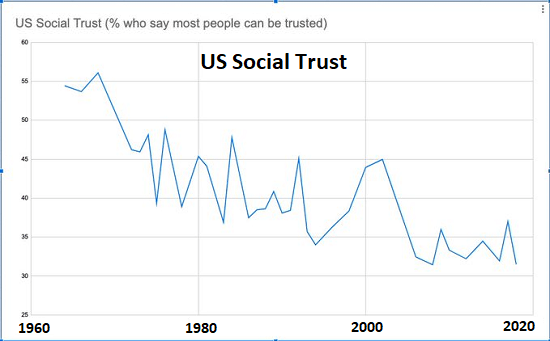
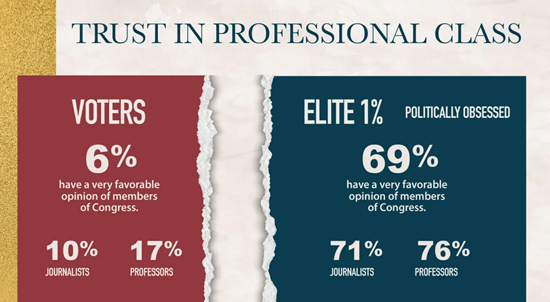
It’s not exactly news that social trust has declined significantly in the United States. Surveys find that public trust in institutions and the professional classes that dominate those institutions has cratered. (see chart below) Social trust–our confidence that other people are trustworthy–has also fallen to multi-decade lows.

This was not the case in decades past. Americans maintained high levels of trust in their institutions, government and fellow citizens. The decline in social trust is across the entire spectrum: our trust in institutions, professional elites and our fellow Americans has declined precipitously.

The causes of this decay of social trust can be debated endlessly, but several factors are obvious:

1. Institutions forfeited the trust of the citizenry by withholding / editing realities to serve the interests of hidden agendas and insiders’ careers. The Vietnam War was pursued on fabrications, as was the second Gulf War to topple Saddam. Watergate eroded trust on multiple levels, as did the Church Committee’s investigation of America’s security agencies’ domestic spying / over-reach.

2. The managerial / professional elites at the top of the nation’s institutions no longer put the citizenry’s interests above their own. The public’s trust has eroded as institutions are primarily viewed as vehicles for self-enrichment and career advancement: healthcare CEOs pay themselves millions, higher education is bloated with layers of non-teaching administration, defense contractors and the Pentagon have greased the revolving door to the benefit of incumbents and insiders, and so on, in an endless parade of self-serving cloaked with smirking PR claims of “serving the public.”

The shift from a high-trust society to a low-trust society is consequential economically, politically and socially. Low-trust societies have stagnant economies, as nobody trusts anyone they don’t know personally or through personally trusted networks, and nobody trust institutions to function effectively or fulfill their stated mission to serve the public good.

Faced with incompetent, unaccountable, corrupt bureaucracies and a culture overflowing with scams, frauds, imposters and get-rich-quick schemes, people give up and drop out. Rather than start a business and accept all the risks just to get dumped on or ripped off, they don’t even try to start a business. Given the financial insecurity that is now the norm, they decide not to get married or have children.

The vast trading networks of the Roman Empire were based on personal trusted networks and trust in Rome’s functionaries / institutions. The owners of trading ships dealt with trusted captains and merchants, who then paid duties to Roman functionaries in Alexandria and other major trading ports.

In other words, tightly bound personal trusted networks work well as long as the state institutions that bind the entire economy are trusted as fair and reliable–not perfect, of course, but efficient and “good enough.”

But when public institutions are viewed as unfair, unreliable, corrupt or incompetent, the entire economy decays. Even personal trusted networks cannot survive in an economy of unfair, unreliable, corrupt or incompetent state bureaucracies and private institutions.

The American economy is now dominated by enormous privately owned and managed monopolies and cartels that are the private-sector equivalent of self-serving state bureaucracies. Big Tech, Big Pharma, Big Healthcare, Big Ag, Big Finance, etc., are even worse than state bureaucracies because there are no legal requirements for transparency or recourse. Try getting a response from a Big Tech corporation when you’ve been shadow-banned or sent to Digital Siberia.

The sole remaining reservoirs of trust in American life are personal networks, local enterprises and local institutions. These are not guaranteed, of course; in many locales, even these reservoirs have been drained. But in other locales, enterprises and institutions such as the county water utility, the local newspaper, the local community college, etc. continue to earn the trust of the public by performing the services they exist to provide effectively and at a reasonable cost.

The larger the institution and the greater its wealth and power, the lower the social trust–for good reasons. The greater the influence of the managerial elites, the greater the disconnect from the everyday experiences of the citizenry and customers, and the more extreme the self-serving PR.

Sure, I trust Big Tech, Big Pharma, Big Healthcare, Big Finance–to rip me off, profiteer, send me obfuscating bills, jack up junk fees, make it impossible to contact them, and send me to Digital Siberia if I complain.

The divide between the elites and the commoners should prompt us to examine the low-trust path we’re sliding down:

In a society in which everything is phony, low quality or fraudulent, you’re taking a chance trusting anyone you don’t know personally–and even that can be risky now that self-aggrandizing flim-flam is the last remaining path to financial security for non-elites.

A low-trust society is an impoverished society, economically stagnant and socially threadbare. That’s where we are now, and the more fragmented, greedy, self-serving, desperate and deranged we become, the lower the odds that we’ll find the means to rebuild trust.

Sadly, we already know that anyone claiming to “rebuild trust” is spouting PR designed to mask self-enrichment. We also know that the vast army of well-paid flacks, factotums, enforcers, happy-story apologists, lackeys, toadies and sell-out minions are declaring “everything’s great!”

Just mumble, “Uh, sure” and continue to Tune in (to degrowth), drop out (of hyper-consumerism and debt-serfdom) and turn on (to self-reliance and relocalizing capital and agency).

Rule by Criminals: When Dissidents Become Enemies of the State

By John & Nisha Whitehead

Source: The Rutherford Institute

In these days of worldwide confusion, there is a dire need for men and women who will courageously do battle for truth.”— Martin Luther King Jr.

When exposing a crime is treated as committing a crime, you are being ruled by criminals.

In the current governmental climate, obeying one’s conscience and speaking truth to the power of the police state can easily render you an “enemy of the state.”

The government’s list of so-called “enemies of the state” is growing by the day.

Wikileaks founder Julian Assange is merely one of the most visible victims of the police state’s war on dissidents and whistleblowers.

Five years ago, on April 11, 2019, police arrested Assange for daring to access and disclose military documents that portray the U.S. government and its endless wars abroad as reckless, irresponsible, immoral and responsible for thousands of civilian deaths.

Included among the leaked materials was gunsight video footage from two U.S. AH-64 Apache helicopters engaged in a series of air-to-ground attacks while American air crew laughed at some of the casualties. Among the casualties were two Reuters correspondents who were gunned down after their cameras were mistaken for weapons and a driver who stopped to help one of the journalists. The driver’s two children, who happened to be in the van at the time it was fired upon by U.S. forces, suffered serious injuries.

There is nothing defensible about crimes such as these perpetrated by the government.

When any government becomes almost indistinguishable from the evil it claims to be fighting—whether that evil takes the form of war, terrorism, torture, drug trafficking, sex trafficking, murder, violence, theft, pornography, scientific experimentations or some other diabolical means of inflicting pain, suffering and servitude on humanity—that government has lost its claim to legitimacy.

These are hard words, but hard times require straight-talking.

It is easy to remain silent in the face of evil.

What is harder—what we lack today and so desperately need—are those with moral courage who will risk their freedoms and lives in order to speak out against evil in its many forms.

Throughout history, individuals or groups of individuals have risen up to challenge the injustices of their age. Nazi Germany had its Dietrich Bonhoeffer. The gulags of the Soviet Union were challenged by Aleksandr Solzhenitsyn. America had its color-coded system of racial segregation and warmongering called out for what it was, blatant discrimination and profiteering, by Martin Luther King Jr.

And then there was Jesus Christ, an itinerant preacher and revolutionary activist, who not only died challenging the police state of his day—namely, the Roman Empire—but provided a blueprint for civil disobedience that would be followed by those, religious and otherwise, who came after him.

Indeed, it is fitting that we remember that Jesus Christ—the religious figure worshipped by Christians for his death on the cross and subsequent resurrection—paid the ultimate price for speaking out against the police state of his day.

A radical nonconformist who challenged authority at every turn, Jesus was a far cry from the watered-down, corporatized, simplified, gentrified, sissified vision of a meek creature holding a lamb that most modern churches peddle. In fact, he spent his adult life speaking truth to power, challenging the status quo of his day, and pushing back against the abuses of the Roman Empire.

Much like the American Empire today, the Roman Empire of Jesus’ day had all of the characteristics of a police state: secrecy, surveillance, a widespread police presence, a citizenry treated like suspects with little recourse against the police state, perpetual wars, a military empire, martial law, and political retribution against those who dared to challenge the power of the state.

For all the accolades poured out upon Jesus, little is said about the harsh realities of the police state in which he lived and its similarities to modern-day America, and yet they are striking.

Secrecy, surveillance and rule by the elite. As the chasm between the wealthy and poor grew wider in the Roman Empire, the ruling class and the wealthy class became synonymous, while the lower classes, increasingly deprived of their political freedoms, grew disinterested in the government and easily distracted by “bread and circuses.” Much like America today, with its lack of government transparency, overt domestic surveillance, and rule by the rich, the inner workings of the Roman Empire were shrouded in secrecy, while its leaders were constantly on the watch for any potential threats to its power. The resulting state-wide surveillance was primarily carried out by the military, which acted as investigators, enforcers, torturers, policemen, executioners and jailers. Today that role is fulfilled by the NSA, the FBI, the Department of Homeland Security and the increasingly militarized police forces across the country.

Widespread police presence. The Roman Empire used its military forces to maintain the “peace,” thereby establishing a police state that reached into all aspects of a citizen’s life. In this way, these military officers, used to address a broad range of routine problems and conflicts, enforced the will of the state. Today SWAT teams, comprised of local police and federal agents, are employed to carry out routine search warrants for minor crimes such as marijuana possession and credit card fraud.

Citizenry with little recourse against the police state. As the Roman Empire expanded, personal freedom and independence nearly vanished, as did any real sense of local governance and national consciousness. Similarly, in America today, citizens largely feel powerless, voiceless and unrepresented in the face of a power-hungry federal government. As states and localities are brought under direct control by federal agencies and regulations, a sense of learned helplessness grips the nation.

Perpetual wars and a military empire. Much like America today with its practice of policing the world, war and an over-arching militarist ethos provided the framework for the Roman Empire, which extended from the Italian peninsula to all over Southern, Western, and Eastern Europe, extending into North Africa and Western Asia as well. In addition to significant foreign threats, wars were waged against inchoate, unstructured and socially inferior foes.

Martial law. Eventually, Rome established a permanent military dictatorship that left the citizens at the mercy of an unreachable and oppressive totalitarian regime. In the absence of resources to establish civic police forces, the Romans relied increasingly on the military to intervene in all matters of conflict or upheaval in provinces, from small-scale scuffles to large-scale revolts. Not unlike police forces today, with their martial law training drills on American soil, militarized weapons and “shoot first, ask questions later” mindset, the Roman soldier had “the exercise of lethal force at his fingertips” with the potential of wreaking havoc on normal citizens’ lives.

A nation of suspects. Just as the American Empire looks upon its citizens as suspects to be tracked, surveilled and controlled, the Roman Empire looked upon all potential insubordinates, from the common thief to a full-fledged insurrectionist, as threats to its power. The insurrectionist was seen as directly challenging the Emperor.  A “bandit,” or revolutionist, was seen as capable of overturning the empire, was always considered guilty and deserving of the most savage penalties, including capital punishment. Bandits were usually punished publicly and cruelly as a means of deterring others from challenging the power of the state.  Jesus’ execution was one such public punishment.

Acts of civil disobedience by insurrectionists. Much like the Roman Empire, the American Empire has exhibited zero tolerance for dissidents such as Julian Assange, Edward Snowden and Chelsea Manning who exposed the police state’s seedy underbelly. Jesus was also branded a political revolutionary starting with his attack on the money chargers and traders at the Jewish temple, an act of civil disobedience at the site of the administrative headquarters of the Sanhedrin, the supreme Jewish council.

Military-style arrests in the dead of night. Jesus’ arrest account testifies to the fact that the Romans perceived Him as a revolutionary. Eerily similar to today’s SWAT team raids, Jesus was arrested in the middle of the night, in secret, by a large, heavily armed fleet of soldiers.  Rather than merely asking for Jesus when they came to arrest him, his pursuers collaborated beforehand with Judas. Acting as a government informant, Judas concocted a kiss as a secret identification marker, hinting that a level of deception and trickery must be used to obtain this seemingly “dangerous revolutionist’s” cooperation. 

Torture and capital punishment. In Jesus’ day, religious preachers, self-proclaimed prophets and nonviolent protesters were not summarily arrested and executed. Indeed, the high priests and Roman governors normally allowed a protest, particularly a small-scale one, to run its course. However, government authorities were quick to dispose of leaders and movements that appeared to threaten the Roman Empire. The charges leveled against Jesus—that he was a threat to the stability of the nation, opposed paying Roman taxes and claimed to be the rightful King—were purely political, not religious. To the Romans, any one of these charges was enough to merit death by crucifixion, which was usually reserved for slaves, non-Romans, radicals, revolutionaries and the worst criminals.

Jesus was presented to Pontius Pilate “as a disturber of the political peace,” a leader of a rebellion, a political threat, and most gravely—a claimant to kingship, a “king of the revolutionary type.” After Jesus is formally condemned by Pilate, he is sentenced to death by crucifixion, “the Roman means of executing criminals convicted of high treason.”  The purpose of crucifixion was not so much to kill the criminal, as it was an immensely public statement intended to visually warn all those who would challenge the power of the Roman Empire. Hence, it was reserved solely for the most extreme political crimes: treason, rebellion, sedition, and banditry. After being ruthlessly whipped and mocked, Jesus was nailed to a cross.

Jesus—the revolutionary, the political dissident, and the nonviolent activist—lived and died in a police state. Any reflection on Jesus’ life and death within a police state must take into account several factors: Jesus spoke out strongly against such things as empires, controlling people, state violence and power politics. Jesus challenged the political and religious belief systems of his day. And worldly powers feared Jesus, not because he challenged them for control of thrones or government but because he undercut their claims of supremacy, and he dared to speak truth to power in a time when doing so could—and often did—cost a person his life.

Unfortunately, the radical Jesus, the political dissident who took aim at injustice and oppression, has been largely forgotten today, replaced by a congenial, smiling Jesus trotted out for religious holidays but otherwise rendered mute when it comes to matters of war, power and politics.

Yet for those who truly study the life and teachings of Jesus, the resounding theme is one of outright resistance to war, materialism and empire.

What a marked contrast to the advice being given to Americans by church leaders to “submit to your leaders and those in authority,” which in the American police state translates to complying, conforming, submitting, obeying orders, deferring to authority and generally doing whatever a government official tells you to do.

Telling Americans to blindly obey the government or put their faith in politics and vote for a political savior flies in the face of everything for which Jesus lived and died.

Will we follow the path of least resistance—turning a blind eye to the evils of our age and marching in lockstep with the police state—or will we be transformed nonconformists “dedicated to justice, peace, and brotherhood”?

As Martin Luther King Jr. reminds us in a powerful sermon delivered 70 years ago, “This command not to conform comes … [from] Jesus Christ, the world’s most dedicated nonconformist, whose ethical nonconformity still challenges the conscience of mankind.”

Ultimately, as I make clear in my book Battlefield America: The War on the American People and in its fictional counterpart The Erik Blair Diaries, this is the contradiction that must be resolved if the radical Jesus—the one who stood up to the Roman Empire and was crucified as a warning to others not to challenge the powers-that-be—is to be an example for our modern age.

Net Zero, the Digital Panopticon and the Future of Food 

By Colin Todhunter

Source: Off-Guardian

The food transition, the energy transition, net-zero ideology, programmable central bank digital currencies, the censorship of free speech and clampdowns on protest. What’s it all about? To understand these processes, we need to first locate what is essentially a social and economic reset within the context of a collapsing financial system.

Writer Ted Reece notes that the general rate of profit has trended downwards from an estimated 43% in the 1870s to 17% in the 2000s. By late 2019, many companies could not generate enough profit. Falling turnover, squeezed margins, limited cashflows and highly leveraged balance sheets were prevalent.

Professor Fabio Vighi of Cardiff University has described how closing down the global economy in early 2020 under the guise of fighting a supposedly new and novel pathogen allowed the US Federal Reserve to flood collapsing financial markets (COVID relief) with freshly printed money without causing hyperinflation. Lockdowns curtailed economic activity, thereby removing demand for the newly printed money (credit) in the physical economy and preventing ‘contagion’.

According to investigative journalist Michael Byrant, €1.5 trillion was needed to deal with the crisis in Europe alone. The financial collapse staring European central bankers in the face came to a head in 2019. The appearance of a ‘novel virus’ provided a convenient cover story.

The European Central Bank agreed to a €1.31 trillion bailout of banks followed by the EU agreeing to a €750 billion recovery fund for European states and corporations. This package of long-term, ultra-cheap credit to hundreds of banks was sold to the public as a necessary programme to cushion the impact of the pandemic on businesses and workers.

In response to a collapsing neoliberalism, we are now seeing the rollout of an authoritarian great reset — an agenda that intends to reshape the economy and change how we live.

SHIFT TO AUTHORITARIANISM

The new economy is to be dominated by a handful of tech giants, global conglomerates and e-commerce platforms, and new markets will also be created through the financialisation of nature, which is to be colonised, commodified and traded under the notion of protecting the environment.

In recent years, we have witnessed an overaccumulation of capital, and the creation of such markets will provide fresh investment opportunities (including dodgy carbon offsetting Ponzi schemes)  for the super-rich to park their wealth and prosper.

This great reset envisages a transformation of Western societies, resulting in permanent restrictions on fundamental liberties and mass surveillance. Being rolled out under the benign term of a ‘Fourth Industrial Revolution’, the World Economic Forum (WEF) says the public will eventually ‘rent’ everything they require (remember the WEF video ‘you will own nothing and be happy’?): stripping the right of ownership under the guise of a ‘green economy’ and underpinned by the rhetoric of ‘sustainable consumption’ and ‘climate emergency’.

Climate alarmism and the mantra of sustainability are about promoting money-making schemes. But they also serve another purpose: social control.

Neoliberalism has run its course, resulting in the impoverishment of large sections of the population. But to dampen dissent and lower expectations, the levels of personal freedom we have been used to will not be tolerated. This means that the wider population will be subjected to the discipline of an emerging surveillance state.

To push back against any dissent, ordinary people are being told that they must sacrifice personal liberty in order to protect public health, societal security (those terrible Russians, Islamic extremists or that Sunak-designated bogeyman George Galloway) or the climate. Unlike in the old normal of neoliberalism, an ideological shift is occurring whereby personal freedoms are increasingly depicted as being dangerous because they run counter to the collective good.

The real reason for this ideological shift is to ensure that the masses get used to lower living standards and accept them. Consider, for instance, the Bank of England’s chief economist Huw Pill saying that people should ‘accept’ being poorer. And then there is Rob Kapito of the world’s biggest asset management firm BlackRock, who says that a “very entitled” generation must deal with scarcity for the first time in their lives.

At the same time, to muddy the waters, the message is that lower living standards are the result of the conflict in Ukraine and supply shocks that both the war and ‘the virus’ have caused.

The net-zero carbon emissions agenda will help legitimise lower living standards (reducing your carbon footprint) while reinforcing the notion that our rights must be sacrificed for the greater good. You will own nothing, not because the rich and their neoliberal agenda made you poor but because you will be instructed to stop being irresponsible and must act to protect the planet.

NET-ZERO AGENDA

But what of this shift towards net-zero greenhouse gas emissions and the plan to slash our carbon footprints? Is it even feasible or necessary?

Gordon Hughes, a former World Bank economist and current professor of economics at the University of Edinburgh, says in a new report that current UK and European net-zero policies will likely lead to further economic ruin.

Apparently, the only viable way to raise the cash for sufficient new capital expenditure (on wind and solar infrastructure) would be a two decades-long reduction in private consumption of up to 10 per cent. Such a shock has never occurred in the last century outside war; even then, never for more than a decade.

But this agenda will also cause serious environmental degradation. So says Andrew Nikiforuk in the article The Rising Chorus of Renewable Energy Skeptics, which outlines how the green techno-dream is vastly destructive.

He lists the devastating environmental impacts of an even more mineral-intensive system based on renewables and warns:

“The whole process of replacing a declining system with a more complex mining-based enterprise is now supposed to take place with a fragile banking system, dysfunctional democracies, broken supply chains, critical mineral shortages and hostile geopolitics.”

All of this assumes that global warming is real and anthropogenic. Not everyone agrees. In the article Global warming and the confrontation between the West and the rest of the world, journalist Thierry Meyssan argues that net zero is based on political ideology rather than science. But to state such things has become heresy in the Western countries and shouted down with accusations of ‘climate science denial’.

Regardless of such concerns, the march towards net zero continues, and key to this is the United Nations Agenda 2030 for Sustainable Development Goals.

Today, almost every business or corporate report, website or brochure includes a multitude of references to ‘carbon footprints’, ‘sustainability’, ‘net zero’ or ‘climate neutrality’ and how a company or organisation intends to achieve its sustainability targets. Green profiling, green bonds and green investments go hand in hand with displaying ‘green’ credentials and ambitions wherever and whenever possible.

It seems anyone and everyone in business is planting their corporate flag on the summit of sustainability. Take Sainsbury’s, for instance. It is one of the ‘big six’ food retail supermarkets in the UK and has a vision for the future of food that it published in 2019.

Here’s a quote from it:

“Personalised Optimisation is a trend that could see people chipped and connected like never before. A significant step on from wearable tech used today, the advent of personal microchips and neural laces has the potential to see all of our genetic, health and situational data recorded, stored and analysed by algorithms which could work out exactly what we need to support us at a particular time in our life. Retailers, such as Sainsbury’s could play a critical role to support this, arranging delivery of the needed food within thirty minutes — perhaps by drone.”

Tracked, traced and chipped — for your own benefit. Corporations accessing all of our personal data, right down to our DNA. The report is littered with references to sustainability and the climate or environment, and it is difficult not to get the impression that it is written so as to leave the reader awestruck by the technological possibilities.

However, the promotion of a brave new world of technological innovation that has nothing to say about power — who determines policies that have led to massive inequalities, poverty, malnutrition, food insecurity and hunger and who is responsible for the degradation of the environment in the first place — is nothing new.

The essence of power is conveniently glossed over, not least because those behind the prevailing food regime are also shaping the techno-utopian fairytale where everyone lives happily ever after eating bugs and synthetic food while living in a digital panopticon.

FAKE GREEN

The type of ‘green’ agenda being pushed is a multi-trillion market opportunity for lining the pockets of rich investors and subsidy-sucking green infrastructure firms and also part of a strategy required to secure compliance required for the ‘new normal’.

It is, furthermore, a type of green that plans to cover much of the countryside with wind farms and solar panels with most farmers no longer farming. A recipe for food insecurity.

Those investing in the ‘green’ agenda care first and foremost about profit. The supremely influential BlackRock invests in the current food system that is responsible for polluted waterways, degraded soils, the displacement of smallholder farmers, a spiralling public health crisis, malnutrition and much more.

It also invests in healthcare — an industry that thrives on the illnesses and conditions created by eating the substandard food that the current system produces. Did Larry Fink, the top man at BlackRock, suddenly develop a conscience and become an environmentalist who cares about the planet and ordinary people? Of course not.

Any serious deliberations on the future of food would surely consider issues like food sovereignty, the role of agroecology and the strengthening of family farms — the backbone of current global food production.

The aforementioned article by Andrew Nikiforuk concludes that, if we are really serious about our impacts on the environment, we must scale back our needs and simplify society.

In terms of food, the solution rests on a low-input approach that strengthens rural communities and local markets and prioritises smallholder farms and small independent enterprises and retailers, localised democratic food systems and a concept of food sovereignty based on self-sufficiency, agroecological principles and regenerative agriculture.

It would involve facilitating the right to culturally appropriate food that is nutritionally dense due to diverse cropping patterns and free from toxic chemicals while ensuring local ownership and stewardship of common resources like land, water, soil and seeds.

That’s where genuine environmentalism and the future of food begins.

The US Economy Looks Good On Paper – Here’s Why It’s Actually A Disaster In Progress

By Brandon Smith

Source: Alt-Market.us

One of my favorite false narratives floating around corporate media platforms has been the argument that the American people “just don’t seem to understand how good the economy really is right now.” If only they would look at the stats, they would realize that we are in the middle of a financial renaissance, right? It must be that people have been brainwashed by negative press from conservative sources…

I have to laugh at this claim because it’s a very common one throughout history – It’s an assertion made by almost every single political regime right before a major collapse. These people always say the same things, and when you study economics as long as I have you can’t help but throw up your hands and marvel at their dedication to the propaganda.

One example that comes to mind immediately is the delusional optimism of the “roaring” 1920s and the lead up to the Great Depression. At the time around 60% of the US population was living in poverty conditions (according to the metrics of the decade) earning less than $2000 a year. However, in the years after WWI ravaged Europe, America’s economic power was considered unrivaled.

The 1920s was an era of mass production and rampant consumerism but it was all fueled by easy access to debt, a condition which had not really existed before in America. It was this illusion of prosperity created by the unchecked application of credit that eventually led to the massive stock market bubble and the crash of 1929. This implosion, along with the Federal Reserve’s policy of raising interest rates into economic weakness, created a black hole in the US financial system for over a decade.

There are two primary tools that various failing regimes will always use to distort the true conditions of the economy: Debt and inflation. In the case of America today, we are experiencing BOTH problems simultaneously and this has made certain economic indicators appear healthy when they are, in fact, highly unstable. The average American knows this is the case because they see the effects daily. They see the damage to their wallets, to their buying power, in the jobs market and in their quality of life. This is why public faith in the economy has been stuck in the dregs since 2021.

The establishment can shove out-of-context stats in people’s faces, but they can’t force the populace to see a recovery that simply does not exist. Let’s go through a short list of the most faulty indicators and the real reasons why the fiscal picture is not as rosy as the media would like us to believe…

The “Miracle” Labor Market Recovery

In the case of the US labor market, we have a clear example of distortion through inflation. The $8 trillion+ dropped on the economy in the first 18 months of the pandemic response sent the system over the edge into stagflation land. Helicopter money has a habit of doing two things very well: Blowing up a bubble in stock markets and blowing up a bubble in retail. Hence, the massive rush by Americans to go out and buy, followed by the sudden labor shortage and the race to hire (mostly for low wage part-time jobs).

The problem with this “miracle” is that inflation leads to price explosions, which we have already experienced. The average American is spending around 30% more for goods, services and housing compared to what they were spending in 2020. This is what happens when you have too much fiat money chasing too few goods and limited production.

The jobs market looks great on paper, but the majority of jobs generated in the past few years are jobs that returned after the covid lockdowns ended (the same lockdowns Democrats tried to keep in place perpetually). The rest are jobs created through monetary stimulus, and then there is the issue of “immigrant jobs” and data that is revised to the negative months later.  I suspect we won’t ever hear the real stats unless Trump enters office in 2025.  Then the media discussion will focus intently on how terrible the labor market really is.

Part time low wage service sector jobs are not going to keep the country rolling for very long in a stagflation environment. The question is, what happens now that the stimulus punch bowl has been removed?

Just as we witnessed in the 1920s, Americans have turned to debt to make up for higher prices and stagnant wages by maxing out their credit cards to historic levels. With the central bank keeping interest rates high, the credit safety net will soon falter. This condition also goes for businesses; businesses that will soon jump headlong into mass layoffs when they realize the party is over.  It happened during the Great Depression and it will happen again today.

Stock Market Bonanza

We saw cracks in in the armor of the financial structure in 2023 with the spring banking crisis, and without the abrupt Federal Reserve backstop many more small and medium banks would have dropped dead. The weakness of US banks is offset by the relative strength of the US dollar, which lures in foreign investors hoping to protect their wealth using dollar denominated assets.

But something is amiss. Gold and Bitcoin have rocketed higher along with stocks and the dollar. This is the opposite of what’s supposed to happen. Gold and BC are supposed to be hedges against a weak dollar and weak equities, right? If global faith in the dollar and in stocks is so high, why are investors diving into protective assets like gold?

Again, as noted above, inflation distorts everything. Tens of trillions of extra dollars printed by the Fed are floating around and it’s no surprise that much of that cash is flooding into the stock market which simply pushes higher right along with prices on the shelf. But, gold and BC are telling us a more nuanced story about what’s really happening.

Right now, the US government is adding around $1 Trillion every 100 days to the national debt as the Fed holds rates higher to fight inflation.  Higher interest means exponential debt conditions, and this debt is going to crush America’s financial standing for global investors who will eventually ask HOW the US is going to handle that growing millstone? As I predicted years ago, the Fed has created a perfect Catch-22 scenario in which the US must either return to rampant inflation, or, face a debt breakdown. In either case, US dollar denominated assets will lose their appeal and stock markets will ultimately plummet.

Beyond this reality, stocks are not a leading indicator of anything, let alone the stability of the financial system. Stocks are a trailing indicator; they crash well after all the other warning signals have made it obvious that something is wrong. Average Americans, for good reason, do not care what stock markets have to say.

Healthy GDP Is A Complete Farce

Beyond the stock market, GDP is the most common out-of-context stat used by governments to convince the citizenry that all is well. It is yet another stat that is entirely manipulated by inflation. It is also manipulated by the way in which modern governments define “production and market value.”

GDP is primarily driven by spending. Meaning, the higher inflation goes, the higher prices go, and the higher GDP climbs (to a point). Eventually prices go too high, credit cards tap out and spending ceases. But, for a short time inflation makes GDP (as well as retail) look good.

Another factor that creates a bubble is the reality that government spending is actually included in the calculation of GDP. That’s right, every dollar of your tax money that the government wastes helps the establishment by propping up GDP numbers. This is why government spending increases will never stop – It’s too valuable for them to spend as a way to make the economy appear healthier than it is.

The Real Economy Is Eclipsing The Fake Economy

The bottom line is that Americans used to be able to ignore the warning signs because their bank accounts were not being directly affected. This is over. Now, every person in the country is dealing with a massive decline in buying power and higher prices across the board in all assets. Even the wealthy are seeing a compression to their profits and many are struggling to keep their businesses in the black.

The unfortunate truth is that the elections of 2024 will probably be the turning point at which the whole edifice comes tumbling down. Even if the public votes for change, the system is already broken and cannot be repaired without a complete overhaul. We have consistently avoided taking our medicine and our weaknesses have only accumulated.

People have lost faith in the economy because they have not faced this kind of uncertainty since the 1930s. Even the stagflation crisis of the 1970s will likely pale in comparison to what is about to happen. On the bright side, at least a large number of Americans are aware of the threat, as opposed to the 1920s when the vast majority of people were utterly conned by the government, the banks and the media into thinking all was well. Knowing is the first step to preparing.

Why Journalism is Going Extinct

By Peter Van Buren

Source: We Meant Well

Is journalism going extinct? asks The Atlantic in an article of roughly the same name. The numbers are deadly: the grimmest news was from the Los Angeles Times, the biggest newspaper outside of the east coast. The paper announced it was cutting 115 people, more than 20 percent of its newsroom. In June of last year the Times previously dropped 74 people from its newsroom. Some 2,900 newspapers closed or merged since 2005. Sports Illustrated is in trouble. The Washington Post, NBC News, ABC News, CNN, NPR, ViceVox, and BuzzFeed, among others, have shed hundreds of journalists over the past year, including the author of the Atlantic article himself. Job losses among print, digital, and broadcast-news organizations grew by nearly 50 percent during 2023.

The reason for all this professional carnage according to the article? Something something the Internet something something digital advertising revenues blah blah social media.

One proposed solution calls for “direct and muscular government intervention” and legislation forcing Facebook and others to pay for “news” they feature off sources such as the New York Times. Yet, as journalist Glenn Greenwald asked rhetorically, “Will there ever come a moment when liberal journalists who work for corporate outlets, and who are being completely consumed by layoffs and financial failures and audience indifference, ask whether there’s anything they’ve done to contribute to the profession’s failure?”

The answer of course is no, no one is going to ask but Glenn. Somewhere along the way (we’ll tag it as the beginning of the first Trump campaign of the modern era) journalism lost all pretext of objectivity and decided to devote itself fully toward advocacy. It is clear now the public wants accurate reporting, not advocacy, but never you mind, the media elites on each coast know better what you need. As long as the MSM traffics in falsehoods people will disappear from their audiences.

Let’s look at one almost silly example: did Donald Trump says people should drink bleach to kill off Covid?

No, Donald Trump did not suggest that people should drink bleach to kill off Covid. However, during a White House briefing in April 2020, Trump did make comments about the potential use of disinfectants and ultraviolet light to treat the virus. His remarks were widely criticized because they seemed to suggest the possibility of injecting or ingesting disinfectants, which would be extremely harmful. The media, however, would not be stopped, making the bleach thing into a meme, handing it off to Late Night, then picking it up again throughout the 2020 presidential campaign.

Twelve months after the supposed statement, to keep things alive, Politico wrote “One year ago today, President Donald Trump took to the White House briefing room and encouraged his top health officials to study the injection of bleach into the human body as a means of fighting Covid. It was a watershed moment, soon to become iconic in the annals of presidential briefings. It arguably changed the course of political history.” “For me, it was the craziest and most surreal moment I had ever witnessed in a presidential press conference,” said ABC’s chief Washington correspondent.

A year after the “fact” it is bad enough the media could not accurately report what was said but how about some four years later, twice in recent New York Times articles, on January 24 and on January 29, 2024 (“oblivious or worse, peddling bleach as a quack cure.”)

The thing is Trump never said people should drink or inject bleach; knowing what he said is as easy as listening to what he said. Here it is in its entirety: “So, supposing we hit the body with a tremendous — whether it’s ultraviolet or just very powerful light — and I think you said that that hasn’t been checked, but you’re going to test it. And then I said, supposing you brought the light inside the body, which you can do either through the skin or in some other way, and I think you said you’re going to test that, too. It sounds interesting. And then I see the disinfectant, where it knocks it out in a minute. One minute. And is there a way we can do something like that, by injection inside or almost a cleaning. Because you see it gets in the lungs, and it does a tremendous number on the lungs. So it would be interesting to check that.” It was obvious Trump was talking via example, hypothetically in that hyperbolic style of his. It takes a selfish media mind to roll all that into an admonishment to the suffering American people to drink a poisonous substance but that’s what happened. Even four years later.

There are so many other example which persist in the media as untruths, exaggerations, or something evil done by other presidents but uniquely ascribed to Trump. Think that he wrenched children from their parents at the border into concentration camps, that he denounced fallen soldiers as suckers, and that he incited a bloody insurrection to overturn an election, and still peddles the Big Lie to the point where he is supposedly Constitutionally ineligible to run for president.

Journalism is at a crossroads at best (it may have already crossed into the abyss.) The old models of reader -supported or advertising-supported media no longer are sturdy and seem still to apply only to a few giants like the New York Times. Americans’ trust in the mass media’s reporting matches its lowest point in Gallup’s trend line, largely because of Democrats’ decreased trust (the Republicans were lost an election or two ago, see Russiagate, though independents still lead the two parties in lost trust.) Just 7 percent of Americans have “a great deal” of trust and confidence in the media, and 27 percent have “a fair amount.”

Meanwhile, 28 percent of U.S. adults say they do not have very much confidence and 39 percent have none at all in newspapers, TV, and radio. Social media is still the least trustworthy sector, while simultaneously being one of the most read/seen. The declines for the MSM have been steady since peaking in 1977 at about 70 percent trust levels. It has gotten worse since Trump but you can’t blame it all on him. It’s the media’s own fault.

The loss of trust is because of a perception the MSM is biased. Some 78 percent of conservatives think the mass media is biased, as compared with 44 percent of liberals and 50 percent of moderates. Only about 36 percent view mass media reporting as “just about right”. A September 2014 Gallup poll found that a plurality of Americans believe the media is “too liberal.”

Half of Americans in a recent survey indicated they believe national news organizations intend to mislead, misinform or persuade the public to adopt a particular point of view through their reporting. The survey goes beyond others that have shown a low level of trust in the media to the startling point where many believe there is an intent to deceive. Asked whether they agreed with the statement that national news organizations do not intend to mislead, 50 percent said they disagreed. Only 25 percent agreed.

The pattern is pretty clear: as long as the MSM is a significant source of misinformation never mind out-and-out lies, the people’s trust in it will continue to fall. We’ve reached a breaking point where many people believe the media intends to deceive. That distrust is entirely a self-own by the media, and finds itself expressed in the most direct terms. People literally are not buying what the MSM is selling.

Technocensorship: When Corporations Serve As a Front for Government Censors

By John & Nisha Whitehead

Source: The Rutherford Institute

“Once a government is committed to the principle of silencing the voice of opposition, it has only one way to go, and that is down the path of increasingly repressive measures, until it becomes a source of terror to all its citizens and creates a country where everyone lives in fear. We must, therefore, be on our guard against extremists who urge us to adopt police state measures. Such persons advocate breaking down the guarantees of the Bill of Rights in order to get at the communists. They forget that if the Bill of Rights were to be broken down, all groups, even the most conservative, would be in danger from the arbitrary power of government.”—Harry S. Truman, Special Message to the Congress on the Internal Security of the United States (August 8, 1950)

Nothing good can come from allowing the government to sidestep the Constitution.

Unfortunately, the government has become an expert at disregarding constitutional roadblocks intended to protect the rights of the citizenry.

When these end-runs don’t suffice, the government hides behind the covert, clandestine, classified language of national security; or obfuscates, complicates, stymies, and bamboozles; or creates manufactured diversions to keep the citizenry in the dark; or works through private third parties not traditionally bound by the Constitution.

This last tactic is increasingly how the government gets away with butchering our freedoms, by having its corporate partners serve as a front for its nefarious deeds.

This is how the police state has managed to carry out an illegal secret dragnet surveillance program on the American people over the course of multiple presidential administrations.

Relying on a set of privacy loopholes, the White House (under Presidents Obama, Trump and now Biden) has been sidestepping the Fourth Amendment by paying AT&T to allow federal, state, and local law enforcement to access—without a warrant—the phone records of Americans who are not suspected of a crime.

The government used a similar playbook to get around the First Amendment, packaged as an effort to control the spread of speculative or false information in the name of national security.

As the House Judiciary Select Subcommittee on Weaponization of the Federal Government revealed, the Biden administration worked in tandem with social media companies to censor content related to COVID-19, including humorous jokes, credible information and so-called disinformation.

Likening the government’s heavy-handed attempts to pressure social media companies to suppress content critical of COVID vaccines or the election to “an almost dystopian scenario,” Judge Terry Doughty warned that “the United States Government seems to have assumed a role similar to an Orwellian ‘Ministry of Truth.’

Restricting access to social media has become a popular means of internet censorship.

Dare to voice politically incorrect views in anything louder than a whisper on social media and you might find yourself suspended on Twitter, shut out of Facebook, and banned across various social media platforms. This authoritarian intolerance masquerading as tolerance, civility and love is what comedian George Carlin referred to as “fascism pretending to be manners.”

Social media censorship runs the gamut from content blocking, throttling, and filtering to lockouts, shutdowns, shadow banning and de-platforming.

In fact, these tactics are at the heart of several critical cases before the U.S. Supreme Court over who gets to control, regulate or remove what content is shared on the internet: the individual, corporate censors or the government.

Yet what those who typically champion the right of corporations to be free from government meddling get wrong about these cases is that there can be no free speech when corporations such as Facebook, Google or YouTube become a front for—or extensions of—government censors.

This is the very definition of technocensorship.

On paper—under the First Amendment, at least—we are technically free to speak.

In reality, however, we are now only as free to speak as a government official—or corporate entities such as Facebook, Google or YouTube—may allow.

Clothed in tyrannical self-righteousness, technocensorship is powered by technological behemoths (both corporate and governmental) working in tandem to achieve a common goal: to muzzle, silence and altogether eradicate any speech that runs afoul of the government’s own approved narrative.

This is political correctness taken to its most chilling and oppressive extreme.

This authoritarian impulse to censor and silence “dangerous” speech masquerading as tolerance, civility and a concern for safety (what comedian George Carlin referred to as “fascism pretending to be manners”) is the end result of a politically correct culture that has become radicalized, institutionalized and tyrannical.

You see, the government is not protecting us from “dangerous” disinformation campaigns. It is laying the groundwork to insulate us from “dangerous” ideas that might cause us to think for ourselves and, in so doing, challenge the power elite’s stranglehold over our lives.

Thus far, the tech giants have been able to sidestep the First Amendment by virtue of their non-governmental status, but it’s a dubious distinction at best when they are marching in lockstep with the government’s dictates.

As Philip Hamburger and Jenin Younes write for The Wall Street Journal: “The First Amendment prohibits the government from ‘abridging the freedom of speech.’ Supreme Court doctrine makes clear that government can’t constitutionally evade the amendment by working through private companies.”

It remains to be seen whether the Supreme Court can see itself clear to recognizing that censorship by social media companies acting at the behest of the government runs afoul of the First Amendment.

Bottom line: either we believe in free speech or we don’t.

The answer to the political, legal and moral challenges of our day should always be more speech, not less.

Any individual or group—prominent or not—who is censored, silenced and made to disappear from Facebook, Twitter, YouTube and Instagram for voicing ideas that are deemed politically incorrect, hateful, dangerous or conspiratorial should be cause for alarm across the entire political spectrum.

To ignore the long-term ramifications of such censorship is dangerously naïve, because whatever powers the government and its corporate operatives are allowed to claim now will eventually be used against the populace at large.

These social shunning tactics borrow heavily from the mind control tactics used by authoritarian cults as a means of controlling its members. As Dr. Steven Hassan writes in Psychology Today: “By ordering members to be cut off, they can no longer participate. Information and sharing of thoughts, feelings, and experiences are stifled. Thought-stopping and use of loaded terms keep a person constrained into a black-and-white, all-or-nothing world. This controls members through fear and guilt.”

This mind control can take many forms, but the end result is an enslaved, compliant populace incapable of challenging tyranny.

As Rod Serling, creator of The Twilight Zone, once observed, “We’re developing a new citizenry, one that will be very selective about cereals and automobiles, but won’t be able to think.”

The problem is that we’ve allowed ourselves to be persuaded that we need someone else to think and speak for us, and we’ve bought into the idea that we need the government and its corporate partners to shield us from that which is ugly or upsetting or mean. The result is a society in which we’ve stopped debating among ourselves, stopped thinking for ourselves, and stopped believing that we can fix our own problems and resolve our own differences.

In short, we have reduced ourselves to a largely silent, passive, polarized populace incapable of working through our own problems and reliant on the government to protect us from our fears.

As Nat Hentoff, that inveterate champion of the First Amendment, once observed, “The quintessential difference between a free nation, as we profess to be, and a totalitarian state, is that here everyone, including a foe of democracy, has the right to speak his mind.”

What this means is championing the free speech rights of those with whom we might disagree.

That’s why James Madison, the author of the Bill of Rights, fought for a First Amendment that protected the “minority” against the majority, ensuring that even in the face of overwhelming pressure, a minority of one—even one who espouses distasteful viewpoints—would still have the right to speak freely, pray freely, assemble freely, challenge the government freely, and broadcast his views in the press freely. He understood that freedom for those in the unpopular minority constitutes the ultimate tolerance in a free society.

The government has no tolerance for freedom or free speech of any kind that challenges its chokehold on power.

At some point or another, depending on how the government and its corporate allies define what constitutes “disinformation,” “hate” or “extremism, “we the people” might all be considered guilty of some thought crime or speech transgression or other.

Yet as I make clear in my book Battlefield America: The War on the American People and in its fictional counterpart The Erik Blair Diaries, it’s a slippery slope from censoring so-called illegitimate ideas to silencing truth.

Eventually, as George Orwell predicted, telling the truth will become a revolutionary act.

Ultimately, the government’s war on free speech—and that’s exactly what it is—is a war that is driven by a government fearful of its people.

As President John F. Kennedy observed, “[A] nation that is afraid to let its people judge the truth and falsehood in an open market is a nation that is afraid of its people.”

The State of Our Nation No One’s Talking About: Tyranny Is Rising as Freedom Falls

By John & Nisha Whitehead

Source: The Rutherford Institute

“Never has our future been more unpredictable, never have we depended so much on political forces that cannot be trusted to follow the rules of common sense and self-interest—forces that look like sheer insanity, if judged by the standards of other centuries.”—Hannah Arendt, The Origins of Totalitarianism

Day by day, tyranny is rising as freedom falls.

The U.S. military is being used to patrol subway stations and police the U.S.-Mexico border, supposedly in the name of national security.

The financial sector is being used to carry out broad surveillance of Americans’ private financial data, while the entertainment sector is being tapped to inform on video game enthusiasts with a penchant for violent, potentially extremist content, all in an alleged effort to uncover individuals subscribing to anti-government sentiments

Public and private venues are being equipped with sophisticated surveillance technologies, including biometric and facial recognition software, to track Americans wherever they go and whatever they do. Space satellites with powerful overhead surveillance cameras will render privacy null and void.

This is the state of our nation that no is talking about—not the politicians, not the courts, and not Congress: the government’s power grabs are growing bolder, while the rights of the citizenry continue to be trampled underfoot.

Hitler is hiding in the shadows, while the citizenry—the only ones powerful enough to stem the authoritarian tide that threatens to lay siege to our constitutional republic—remain easily distracted and conveniently diverted by political theatrics and news cycles that change every few days.

This sorry truth has persisted no matter which party has controlled Congress or the White House.  

These are dangerous times.

Yet while the presidential candidates talk at length about the dangers posed by the opposition party, the U.S. government still poses the gravest threat to our freedoms and way of life.

Police shootings of unarmed individuals, invasive surveillance, roadside blood draws, roadside strip searches, SWAT team raids gone awry, the military industrial complex’s costly wars, pork barrel spending, pre-crime laws, civil asset forfeiture, fusion centers, militarization, armed drones, smart policing carried out by AI robots, courts that march in lockstep with the police state, schools that function as indoctrination centers, bureaucrats that keep the Deep State in power: these are just a few of the ways in which the police state continues to flex its muscles in a show of force intended to intimidate anyone still clinging to the antiquated notion that the government answers to “we the people.”

Consider for yourself the state of our nation:

Americans have little protection against police abuse. The police and other government agents have been generally empowered to probe, poke, pinch, taser, search, seize, strip and generally manhandle anyone they see fit in almost any circumstance, all with the general blessing of the courts. It is no longer unusual to hear about incidents in which police shoot unarmed individuals first and ask questions later. What is increasingly common, however, is the news that the officers involved in these incidents get off with little more than a slap on the hands.

Americans are little more than pocketbooks to fund the police state. If there is any absolute maxim by which the federal government seems to operate, it is that the American taxpayer always gets ripped off. This is true, whether you’re talking about taxpayers being forced to fund high-priced weaponry that will be used against us, endless wars that do little for our safety or our freedoms, or bloated government agencies with their secret budgets, covert agendas and clandestine activities.

Americans are no longer innocent until proven guilty. We once operated under the assumption that you were innocent until proven guilty. Due in large part to rapid advances in technology and a heightened surveillance culture, the burden of proof has been shifted so that the right to be considered innocent until proven guilty has been usurped by a new norm in which all citizens are suspects. Indeed, the government—in cahoots with the corporate state—has erected the ultimate suspect society. In such an environment, we are all potentially guilty of some wrongdoing or other.

Americans no longer have a right to self-defense. While the courts continue to disagree over the exact nature of the rights protected by the Second Amendment, the government itself has made its position extremely clear. When it comes to gun rights in particular, and the rights of the citizenry overall, the U.S. government has adopted a “do what I say, not what I do” mindset. Nowhere is this double standard more evident than in the government’s attempts to arm itself to the teeth, all the while viewing as suspect anyone who dares to legally own a gun, let alone use one in self-defense. Indeed, while it still technically remains legal to own a firearm in America, possessing one can now get you pulled over, searched, arrested, subjected to all manner of surveillance, treated as a suspect without ever having committed a crime, shot at, and killed.

Americans no longer have a right to private property. If government agents can invade your home, break down your doors, kill your dog, damage your furnishings and terrorize your family, your property is no longer private and secure—it belongs to the government. Likewise, if government officials can fine and arrest you for growing vegetables in your front yard, praying with friends in your living room, installing solar panels on your roof, and raising chickens in your backyard, you’re no longer the owner of your property.

Americans no longer have a say about what their children are exposed to in school. Incredibly, the government continues to insist that parents essentially forfeit their rights when they send their children to a public school. This growing tension over whether young people, especially those in the public schools, are essentially wards of the state, to do with as government officials deem appropriate, in defiance of the children’s constitutional rights and those of their parents, is at the heart of almost every debate over educational programming, school discipline, and the extent to which parents have any say over their children’s wellbeing in and out of school.

Americans are powerless in the face of militarized police forces. With local police agencies acquiring military-grade weaponry, training and equipment better suited for the battlefield, Americans are finding their once-peaceful communities transformed into military outposts patrolled by a standing military army.

Americans no longer have a right to bodily integrity. The debate over bodily integrity covers broad territory, ranging from abortion and euthanasia to forced blood draws, biometric surveillance and basic healthcare. Forced vaccinations, forced cavity searches, forced colonoscopies, forced blood draws, forced breath-alcohol tests, forced DNA extractions, forced eye scans, forced inclusion in biometric databases: these are just a few ways in which Americans continue to be reminded that we have no control over what happens to our bodies during an encounter with government officials.

Americans no longer have a right to the expectation of privacy. Despite the staggering number of revelations about government spying on Americans’ phone calls, Facebook posts, Twitter tweets, Google searches, emails, bookstore and grocery purchases, bank statements, commuter toll records, etc., Congress, the president and the courts have done little to nothing to counteract these abuses. Instead, they seem determined to accustom us to life in this electronic concentration camp.

Americans no longer have a representative government. We have moved beyond the era of representative government and entered the age of authoritarianism, where all citizens are suspects, security trumps freedom, and so-called elected officials represent the interests of the corporate power elite. This topsy-turvy travesty of law and government has become America’s new normal.

Americans can no longer rely on the courts to mete out justice. The U.S. Supreme Court was intended to be an institution established to intervene and protect the people against the government and its agents when they overstep their bounds. Yet through their deference to police power, preference for security over freedom, and evisceration of our most basic rights for the sake of order and expediency, the justices of the Supreme Court have become the architects of the American police state in which we now live, while the lower courts have appointed themselves courts of order, concerned primarily with advancing the government’s agenda, no matter how unjust or illegal.

I haven’t even touched on the corporate state, the military industrial complex, SWAT team raids, invasive surveillance technology, zero tolerance policies in the schools, overcriminalization, or privatized prisons, to name just a few, but what I have touched on should be enough to show that the landscape of our freedoms has already changed dramatically from what it once was and will no doubt continue to deteriorate unless Americans can find a way to wrest back control of their government and reclaim their freedoms.

This steady slide towards tyranny, meted out by militarized local and federal police and legalistic bureaucrats, has been carried forward by each successive president over the past seventy-plus years regardless of their political affiliation.

The more things change, the more they stay the same.

We are walking a dangerous path right now.

Having allowed the government to expand and exceed our reach, we find ourselves on the losing end of a tug-of-war over control of our country and our lives. And for as long as we let them, government officials will continue to trample on our rights, always justifying their actions as being for the good of the people.

Yet the government can only go as far as “we the people” allow. Therein lies the problem.

The pickle we find ourselves in speaks volumes about the nature of the government beast we have been saddled with and how it views the rights and sovereignty of “we the people.”

Now you don’t hear a lot about sovereignty anymore. Sovereignty is a dusty, antiquated term that harkens back to an age when kings and emperors ruled with absolute power over a populace that had no rights. Americans turned the idea of sovereignty on its head when they declared their independence from Great Britain and rejected the absolute authority of King George III. In doing so, Americans claimed for themselves the right to self-government and established themselves as the ultimate authority and power.

In other words, in America, “we the people”— sovereign citizens—call the shots.

So when the government acts, it is supposed to do so at our bidding and on our behalf, because we are the rulers.

That’s not exactly how it turned out, though, is it?

In the 200-plus years since we boldly embarked on this experiment in self-government, we have been steadily losing ground to the government’s brazen power grabs, foisted upon us in the so-called name of national security.

We have relinquished control over the most intimate aspects of our lives to government officials who, while they may occupy seats of authority, are neither wiser, smarter, more in tune with our needs, more knowledgeable about our problems, nor more aware of what is really in our best interests.

The government has knocked us off our rightful throne. It has usurped our rightful authority. It has staged the ultimate coup. Its agents no longer even pretend that they answer to “we the people.”

Worst of all, “we the people” have become desensitized to this constant undermining of our freedoms.

How do we reconcile the Founders’ vision of the government as an entity whose only purpose is to serve the people with the police state’s insistence that the government is the supreme authority, that its power trumps that of the people themselves, and that it may exercise that power in any way it sees fit (that includes government agents crashing through doors, mass arrests, ethnic cleansing, racial profiling, indefinite detentions without due process, and internment camps)?

They cannot be reconciled. They are polar opposites.

We are fast approaching a moment of reckoning where we will be forced to choose between the vision of what America was intended to be (a model for self-governance where power is vested in the people) and the reality of what it has become (a police state where power is vested in the government).

We are repeating the mistakes of history—namely, allowing a totalitarian state to reign over us.

Former concentration camp inmate Hannah Arendt warned against this when she wrote:

“No matter what the specifically national tradition or the particular spiritual source of its ideology, totalitarian government always transformed classes into masses, supplanted the party system, not by one-party dictatorships, but by mass movement, shifted the center of power from the army to the police, and established a foreign policy openly directed toward world domination.”

So where does that leave us?

Aldous Huxley predicted that eventually the government would find a way of “making people love their servitude, and producing dictatorship without tears, so to speak, producing a kind of painless concentration camp for entire societies, so that people will in fact have their liberties taken away from them, but will rather enjoy it, because they will be distracted from any desire to rebel by propaganda or brainwashing, or brainwashing enhanced by pharmacological methods. And this seems to be the final revolution.”

The answer? Get un-brainwashed, as I make clear in my book Battlefield America: The War on the American People and in its fictional counterpart The Erik Blair Diaries,

Stop allowing yourself to be distracted and diverted.

Learn your rights.

Stand up for the founding principles.

Make your voice and your vote count for more than just political posturing.

Never cease to vociferously protest the erosion of your freedoms at the local and national level.

Most of all, do these things today.