Mohandas Karamchand Gandhi was born on 2 October 1869: 150 years ago this year.
There will be many tributes to Gandhi published in 2019 so I would like to add one of my own.
This reflects not just my belief that he gave the world inspiration, ideas and powerful strategies for tackling violence in a wide range of contexts but because my own experience in applying his ideas has proven their worth. This included his awareness that led him to declare that ‘If we are to make progress, we must not repeat history but make new history. We must add to the inheritance left by our ancestors.’ and his encouragement to reflect deeply and listen to one’s ‘inner voice’: ‘you should follow your inner voice whatever the consequences’ and ‘even at the risk of being misunderstood’.
In essence, we can productively learn from history but we can build on it too. And, vitally, this includes dealing more effectively with violence.
So how did Gandhi influence me?
Shortly after midnight on 1 July 1942, my Uncle Bob was killed when the USS Sturgeon, a U.S. submarine, fired torpedoes into the Japanese prisoner of war (POW) ship Montevideo Maru. The ship sank immediately and, along with 1,052 other POWs, Bob was killed.
Apart from his older brother, my father’s twin brother was also killed in World War II. In Tom’s case, he was shot down over Rabaul on his first (and final) mission. He was a wireless air gunner on a Beaufort Bomber. See ‘The Last Coastwatcher: My Brothers’.
My childhood is dotted with memories of Bob and Tom. The occasional remembrance service, war medals and the rare story shared by my father.
In 1966, the year I turned 14, I decided to devote my life to finding out why human beings kill each other and to work out how such killing could be ended. The good news about this ‘decision’ is that, at 14, it all felt manageable! But I wasn’t much older before my preliminary investigations proved that even understanding why humans are violent was going to be a profound challenge. And I intuitively understood that I needed this understanding if any strategy to end violence was to be effective.
In any case, as one might expect, my research into violence and strategies for addressing it led me to nonviolence. I came across virtually nothing about nonviolence during my own studies at school and university but was regularly presented with news reports of people participating in activities – such as demonstrations and strikes – that I later learned to label ‘nonviolent action’.
In 1981 I decided to seek out materials on nonviolence and nonviolent action so that I could learn more about it. I had not been reading for long when the routine reference to Mohandas K. (or Mahatma) Gandhi, about whom I had heard a little and knew of his role in leading the Indian independence struggle, forced me to pay more attention to his life and work. So I sought out his writing and started to read some of his published work. An Autobiography: The Story of My Experiments with Truth was an obvious and early book but there were many others besides. I also read many books about Gandhi, to get a clearer sense of his life as a whole, as reported by his coworkers and contemporaries, as well as documented by scholars since his death. And I spent a great many hours in a library basement poring over The Collected Works of Mahatma Gandhi.
The thing that struck me immediately about Gandhi was that his own interest in tackling violence had a comprehensive ‘feel’ about it. That is, he was not just interested in the violence that occurs when nations fight wars or one person kills or injures another. He was interested in addressing the violence that occurs when individuals and nations exploit other individuals/nations (such as when British imperialism exploited India and Indians) and the violence that occurs when a structure (such as capitalism or socialism) exploits the individuals within it. In his words: ‘exploitation is the essence of violence’. He was interested in the violence that occurs when members of one social group (say, Hindus) ‘hate’ the members of another social group (such as Muslims). He was interested in the violence that occurs when men oppress women or caste Hindus oppress ‘untouchables’. He was interested in the violence that occurs when humans destroy the environment. And he was interested in the violence that one inflicts on oneself.
This comprehensive interest resonated deeply with me because, apart from war, my own childhood and adolescence had revealed many manifestations of violence ranging from the starvation of people in developing countries to the racism in the United States (highlighted by Rev. Martin Luther King Jr. during the 1960s) to the destruction of the environment, each of which had gradually but deeply embedded itself in my consciousness. Tackling violence was a far bigger task than the large one I had originally imagined. Violence is everywhere. Most importantly, it seemed to me, there was enormous violence directed against children in the family home but little was spoken or written about this.
So how did Gandhi explain violence and what was his strategy for addressing it?
Gandhi on Conflict and Violence
For Gandhi, conflict was a perennial condition. He also viewed it positively and considered it desirable. For him, it is an important means to greater human unity precisely because their shared conflict could remind antagonists of the deeper, perhaps transcendental, unity of life, which is far more profound than the bond of their social relationship.
He viewed violence differently, however. And, as might be gleaned from the many configurations of violence that concerned him, as noted above, he considered that violence was built into social structures and not into people.
Fundamentally, as Leroy Pelton characterized it, Gandhi understood that the truth cannot be achieved through violence (‘which violates human needs and destroys life’), because violence itself is a form of injustice. In any case, violence cannot resolve conflict because it does not address the issues at stake.
To reiterate then, for Gandhi there was nothing undesirable about conflict. However, Gandhi’s preoccupation was working out how to manage conflict without violence and how to create new social arrangements free of structural violence. The essence, then, of Gandhi’s approach was to identify approaches to conflict that preserved the people while systematically demolishing the evil structure. Nevertheless, he firmly believed that structural purification alone is not enough; self-purification is also essential.
In other words, in Gandhi’s view, resolving the conflict (without violence) is only one aspect of the desired outcome. For Gandhi, success also implies the creation of a superior social structure, higher degrees of fearlessness and self-reliance on the part of both satyagrahis (nonviolent activists) and their opponents, and a greater degree of human unity at the level of social relationships.
Two Key Questions
Despite the enormous influence that Gandhi had in shaping my own conception of conflict and the precise conception of nonviolence that should be used in dealing with it, I nevertheless remained convinced that two questions remained unanswered: What is the psychological origin of the violent behavior of the individual who perpetrates it? And what theory or framework should guide the application of nonviolent action so that campaigns of all kinds are strategically effective?
The first question is important because even if someone is trapped within a social structure (such as the class system) that is violent, the individual must still choose, consciously or unconsciously, to participate (as perpetrator, collaborator or victim) in the violence perpetrated by that structure or one must choose, consciously, to resist it. Why do so many individuals perform one of the first three roles and so few, like Gandhi himself, choose the role of resister?
The second question is important because while Gandhi himself was an astonishingly intuitive strategic thinker (whose 30-year nonviolent strategy liberated India from British occupation), no one before him or since his death has demonstrated anything remotely resembling his capacity in this regard.
Hence, while nonviolence, which is inherently powerful, has chalked up some remarkable successes, vital struggles for peace (and to end war); to halt assaults on Earth’s biosphere; to secure social justice for oppressed and exploited populations; to liberate national groups from dictatorship, occupation or genocidal assault; and struggles in relation to many other just causes limp along devoid of strategy (or use one that is ill-conceived). So badly are we failing, in fact, that humans now teeter on the brink of precipitating our own extinction. See ‘Human Extinction by 2026? A Last Ditch Strategy to Fight for Human Survival’.
Anyway, having studied Gandhi extensively and learned from his strategic approach to nonviolence (elements of which I was progressively including in nonviolent campaigns in which I was involved myself), I resumed my original research to understand the fundamental origin of human violence and also decided to develop a strategic theory and framework for addressing violence in the campaign context so that Gandhi’s strategic thinking could be readily copied by other nonviolent activists.
Despite my preliminary efforts in the 1990s to encourage fellow activists to use this framework, it soon became clear that only the rarest of activists has the capacity to think strategically about an issue, even when presented with a framework for doing so.
The Origin of Human Violence
Consequently, the vital importance of understanding the origin of human violence was starkly demonstrated to me yet again because I knew it would answer key supplementary questions such as these: Why to do so many people live in denial/delusion utterly incapable of perceiving structural violence or grappling powerfully with (military, social, political, economic and ecological) violence? Why is it that so many people, even activists, are powerless to think strategically? How can activists even believe that success can be achieved, particularly on the major issues of our time (such as the threats of nuclear war, ecological devastation and climate cataclysm), without a focused and comprehensive strategy, particularly given elite resistance to such campaigns? See ‘The Global Elite is Insane Revisited’.
Hence, in an attempt to answer questions such as these, Anita McKone and I went into seclusion in an endeavor to understand how our own minds functioned so that we might better understand the minds of others. I hoped it would take a few months. It took 14 years.
So what is the cause of violence in all contexts and which, depending on its precise configuration in each case, creates perpetrators of violence, people who collaborate with perpetrators of violence, people who are passive victims of violence, people who live in denial/delusion, people who are sexist or racist, and activists who cannot think strategically (among many other adverse outcomes)?
Each of these manifestations of human behaviour is an outcome of the adult war on children. That is, adult violence against children is the fundamental cause of all other violence.
How does this happen? It happens because each child, from birth, is socialized – more accurately, terrorized – so that they fit into their society. That is, each child is subjected to an unrelenting regime of ‘visible’, ‘invisible’ and ‘utterly invisible’ violence until they offer the obedience that every adult – parent, teacher, religious figure… – demands.
So what constitutes ‘visible’, ‘invisible’ and ‘utterly invisible’ violence?
‘Visible’ violence includes hitting, screaming at and sexually abusing a child which, sadly enough, is very common.
But the largest component of damage arises from the ‘invisible’ and ‘utterly invisible’ violence that we adults unconsciously inflict on children during the ordinary course of the day. Tragically, the bulk of this violence occurs in the family home and at school. For a full explanation, see ‘Why Violence?’ and ‘Fearless Psychology and Fearful Psychology: Principles and Practice’.
‘Invisible’ violence is the ‘little things’ we do every day, partly because we are just ‘too busy’. For example, when we do not allow time to listen to, and value, a child’s thoughts and feelings, the child learns to not listen to themSelf thus destroying their internal communication system. When we do not let a child say what they want (or ignore them when they do), the child develops communication and behavioral dysfunctionalities as they keep trying to meet their own needs (which, as a basic survival strategy, they are genetically programmed to do).
When we blame, condemn, insult, mock, embarrass, shame, humiliate, taunt, goad, guilt-trip, deceive, lie to, bribe, blackmail, moralize with and/or judge a child, we both undermine their sense of Self-worth and teach them to blame, condemn, insult, mock, embarrass, shame, humiliate, taunt, goad, guilt-trip, deceive, lie, bribe, blackmail, moralize and/or judge.
The fundamental outcome of being bombarded throughout their childhood by this ‘invisible’ violence is that the child is utterly overwhelmed by feelings of fear, pain, anger and sadness (among many others). However, mothers, fathers, teachers, religious figures and other adults also actively interfere with the expression of these feelings and the behavioral responses that are naturally generated by them and it is this ‘utterly invisible’ violence that explains why the dysfunctional behavioral outcomes actually occur.
For example, by ignoring a child when they express their feelings, by comforting, reassuring or distracting a child when they express their feelings, by laughing at or ridiculing their feelings, by terrorizing a child into not expressing their feelings (for instance, by screaming at them when they cry or get angry), and/or by violently controlling a behavior that is generated by their feelings (for example, by hitting them, restraining them or locking them into a room), the child has no choice but to unconsciously suppress their awareness of these feelings.
However, once a child has been terrorized into suppressing their awareness of their feelings (rather than being allowed to have their feelings and to act on them) the child has also unconsciously suppressed their awareness of the reality that caused these feelings. This has many outcomes that are disastrous for the individual, for society and for the biosphere because the individual will now easily suppress their awareness of the feelings that would tell them how to act most functionally in any given circumstance and they will progressively acquire a phenomenal variety of dysfunctional behaviors, including some that are violent towards themself, others and/or the Earth.
So what do we do?
Well, if you want to make an enormous contribution to our effort to end violence, you can make the commitment outlined in ‘My Promise to Children’. If you need to do some healing of your own to be able to nurture children in this way, then consider the information provided in the article ‘Putting Feelings First’.
If you want to systematically tackle violence against the biosphere, consider (accelerated) participation in the fifteen-year strategy, inspired by Gandhi, outlined in ‘The Flame Tree Project to Save Life on Earth’. This project outlines a simple plan for people to systematically reduce their consumption, by at least 80%, involving both energy and resources of every kind – water, household energy, transport fuels, metals, meat, paper and plastic – while dramatically expanding their individual and community self-reliance in 16 areas, so that all environmental concerns are effectively addressed. As Gandhi observed 100 years ago: ‘Earth provides enough for every person’s need but not for every person’s greed.’
But, critically important though he believed personal action to be, Gandhi was also an extraordinary political strategist and he knew that we needed to do more than transform our own personal lives. We need to provide opportunities that compel others to consider doing the same.
So if your passion is campaigning for change, consider doing it strategically, as Gandhi did. See Nonviolent Campaign Strategy.
Gandhi was assassinated on 30 January 1948. But his legacy lives on. You can learn from it too, if you wish.
Biodata: Robert J. Burrowes has a lifetime commitment to understanding and ending human violence. He has done extensive research since 1966 in an effort to understand why human beings are violent and has been a nonviolent activist since 1981. He is the author of ‘Why Violence?’ His email address is flametree@riseup.net and his website is here.
Robert J. Burrowes
P.O. Box 68
Daylesford, Victoria 3460
Australia
It is easy to identify the ongoing and endless violence being inflicted on life on Earth. This ranges from the vast multiplicity of assaults inflicted on our children and the biosphere to the endless wars and other military violence as well as the grotesque exploitation of many peoples living in Africa, Asia and Central/South America. But for a (very incomplete) list of 40 points see ‘Reflections on 2018, Forecasting 2019’.
However, despite the obvious fact that it is human beings who are inflicting all of this violence, it is virtually impossible to get people to pay attention to this simple and incontrovertible fact and to ask why, precisely, are human beings behaving in such violent and destructive ways? And can we effectively address this cause?
Of course, one part of this problem is the existence of many competing ideas about what causes violence. For example, some ideologies attribute the cause to a particular structural manifestation of violence, such as patriarchy (which generates a gendered system of violence and exploitation) or capitalism (which generates a class system of violence and exploitation). However, none of these ideologies explains why humans participate in structures of violence and exploitation in the first place. Surely a person who was not violent and exploitative to begin with would reject such violent and exploitative structures out of hand and work to create nonviolent and egalitarian structures instead.
But most people really just accept the elite-promulgated delusion that humans are innately dysfunctional and violent and this must be contained and controlled by socialization processes, laws, legal systems, police forces and prisons or, in the international arena, by such measures as economic sanctions and military violence. It is a rare individual who perceives the blatant dysfunctionality and violence of socialization, laws, legal systems, police forces, prisons, economic sanctions and military violence, and how these institutions and their violence serve elite interests.
Hence, humans are trapped in a cycle of attempting to address the vast range of manifestations of violent human behaviour – the wars, the climate catastrophe, destruction of the environment, the economic exploitation of vast sectors of the human population (women, indigenous peoples, working peoples…), the military dictatorships and occupations – without knowing what, fundamentally, causes dysfunctional and violent human behaviours and draws many people to participate in (and benefit from) violence in whatever form it takes.
Well I, for one, find it boring to see the same manifestations of violence repeated endlessly because we do not understand or address the fundamental cause (and so even well-meaning efforts to address it in a variety of contexts are doomed to fail). How about you?
Moreover, I find it boring to listen to (or read about) people endlessly deluding themselves about the violence; that is, deluding themselves that it isn’t happening, ‘it was always like that’, ‘it isn’t as bad as it seems’, ‘nothing can be done’, ‘there is another explanation’, that I am ‘doing enough already’, and so on.
To illustrate the above let me write some more frequent examples of people deluding themselves about the cause. You may have heard delusions like these expressed yourself; you may know some of the many others.
‘The child deserved the punishment.’
‘She asked for it.’
Violence is innate: it is ‘in our nature’.
‘War is inevitable.’
The people in Africa/Asia/Central/South America ‘have always been poor’.
‘The weather hasn’t changed; it was like that when I was a child.’
‘We can’t control Mother Nature.’
‘Nature is abundant.’
Of course, the most common delusional state is the one in which most people are trapped: they are just not paying significant attention to critical issues and have no knowledge (and informed opinion) about them but allow themselves to be distracted from reality by the various elite channels used for doing so, such as the corporate media.
So why do most people delude themselves rather than carefully observe reality, seek out and analyze the evidence in relation to it, and then behave appropriately and powerfully in response?
Because they are (unconsciously) terrified.
‘Is that all?’ you might say. ‘Surely the explanation for dysfunctional (and violent) human behaviour is more complex than that! Besides, when people I observe doing the sorts of dysfunctional and violent behaviours you mention above, they don’t look frightened, let alone terrified.’
So let me explain why the explanation above – that most human beings live in delusion, behave dysfunctionally and violently, fail to observe and analyze reality and then behave powerfully in response to it, because they are terrified – is the complete explanation and why people who are utterly terrified don’t ‘look frightened’.
At the moment of birth, the human individual has a genetically-embedded potential to seek out and powerfully pursue their own unique destiny by progressively developing a complex set of capacities to observe and listen, to think and feel, to analyze and evaluate, to plan and strategize, and to behave with awareness and power in response to their own astute insight into reality and the guidance provided by their conscience.
However, rather than nurture this potential so that the child grows up deeply in touch with their conscience, sensing capacities, thoughts, feelings and other faculties necessary to seek out and powerfully travel their own unique path, the significant adults in the child’s life immediately start to ‘socialize’ (that is, terrorize) the child into conforming with culturally and socially-acceptable norms of thought and behaviour on the basis that one human is more-or-less identical with another (give or take some minor variations among races, languages….).
The idea that each human mind might be unique in the way that each body is unique (while conforming to a general pattern in relation to shape, height and other physical characteristics) never even occurs to anyone. The idea that their child could have the potential to be as creative, powerful and unique as Leonardo Da Vinci, Mary Wollstonecraft, Sojourner Truth, Albert Einstein, Mohandas K. Gandhi or Rosalind Franklin never enters the mind of the typical parent.
Instead, we parent and teach children to conform to an endless sequence of beliefs and behavioural norms on the basis that ‘one size fits all’ because we are literally (but unconsciously) terrified that our child might be ‘different’ or, horror of horrors, unique! And we reward most highly those individuals who do conform and can demonstrate their conformity by passing, often literally, the endless series of socially-approved tests, formal and otherwise, that we set. See, for example, ‘Do We Want School or Education?’
The last thing we want is an individual who fearlessly thinks, feels and behaves as they personally decide is best for themself, perhaps even because their conscience dictates. But when they do act out of their own volition, we punish them to ensure that behaviour that is generated by their unique ‘Self’ is, if possible, terrorized out of them.
Of course, there are ‘good reasons’ for doing this. If we want obedient students, soldiers, employees and citizens, it is the perfect formula. Terrorize the child when they are young and obedience to a set of parentally/socially-approved beliefs and behaviours is virtually guaranteed.
Equally importantly, by starting this onslaught against the child from the moment of birth, they will grow up utterly unaware of the fact that they were terrorized out of becoming their ‘True Self’ and seeking their own unique destiny so that they could be the slave of their society, performing some function, menial or even ‘professional’, after they have submitted to sufficient training. The slave who never questions their role is truly a slave. And that is what we want!
Equally importantly, the person who has fearfully surrendered their Self at the alter of physical survival cannot observe or listen to the fear expressed by anyone else, including their own children. So they simply ‘fail to notice’ it.
So what, exactly, do we do so that each human being’s individual Self is crushed and they are rendered too terrified, self-hating and powerless to pursue their own life path, to honestly observe and listen to their own children and to mindfully consider the state of our world and act powerfully in response?
We inflict enormous, ongoing violence on the child, starting immediately after their birth.
‘How?’ you might ask. ‘I don’t scream at or hit my child. And I never punish them.’
Well, if that is true, it is a good start.
But, unfortunately, it is far more complex than these obvious types of violence and, strange though it may seem, it is not just the ‘visible’ violence (such as hitting, screaming at and sexually abusing) that we normally label ‘violence’ that causes the main damage, although this is extremely damaging. The largest component of damage arises from the ‘invisible’ and ‘utterly invisible’ violence that we adults unconsciously inflict on children during the ordinary course of the day. Tragically, the bulk of this violence occurs in the family home and at school. See ‘Why Violence?’ and ‘Fearless Psychology and Fearful Psychology: Principles and Practice’.
So what is ‘invisible’ violence? It is the ‘little things’ we do every day, partly because we are just ‘too busy’. For example, when we do not allow time to listen to, and value, a child’s thoughts and feelings, the child learns to not listen to themSelf thus destroying their internal communication system. When we do not let a child say what they want (or ignore them when they do), the child develops communication and behavioral dysfunctionalities as they keep trying to meet their own needs (which, as a basic survival strategy, they are genetically programmed to do).
When we blame, condemn, insult, mock, embarrass, shame, humiliate, taunt, goad, guilt-trip, deceive, lie to, bribe, blackmail, moralize with and/or judge a child, we both undermine their sense of Self-worth and teach them to blame, condemn, insult, mock, embarrass, shame, humiliate, taunt, goad, guilt-trip, deceive, lie, bribe, blackmail, moralize and/or judge.
The fundamental outcome of being bombarded throughout their childhood by this ‘invisible’ violence is that the child is utterly overwhelmed by feelings of fear, pain, anger and sadness (among many others). However, mothers, fathers, teachers and other adults also actively interfere with the expression of these feelings and the behavioral responses that are naturally generated by them and it is this ‘utterly invisible’ violence that explains why the dysfunctional behavioral outcomes actually occur.
For example, by ignoring a child when they express their feelings, by comforting, reassuring or distracting a child when they express their feelings, by laughing at or ridiculing their feelings, by terrorizing a child into not expressing their feelings (e.g. by screaming at them when they cry or get angry), and/or by violently controlling a behavior that is generated by their feelings (e.g. by hitting them, restraining them or locking them into a room), the child has no choice but to unconsciously suppress their awareness of these feelings.
However, once a child has been terrorized into suppressing their awareness of their feelings (rather than being allowed to have their feelings and to act on them) the child has also unconsciously suppressed their awareness of the reality that caused these feelings. This has many outcomes that are disastrous for the individual, for society and for nature because the individual will now easily suppress their awareness of the feelings that would tell them how to act most functionally in any given circumstance and they will progressively acquire a phenomenal variety of dysfunctional behaviors, including some that are violent towards themself, others and/or the Earth.
From the above, it should also now be apparent that punishment should never be used. ‘Punishment’, of course, is one of the words we use to obscure our awareness of the fact that we are using violence. Violence, even when we label it ‘punishment’, scares children and adults alike and cannot elicit a functional behavioural response. See ‘Punishment is Violent and Counterproductive’.
If someone behaves dysfunctionally, they need to be listened to, deeply, so that they can start to become consciously aware of the feelings (which will always include fear and, often, terror) that drove the dysfunctional behaviour in the first place. They then need to feel and express these feelings (including any anger) in a safe way. Only then will behavioural change in the direction of functionality be possible. See ‘Nisteling: The Art of Deep Listening’.
‘But these adult behaviors you have described don’t seem that bad. Can the outcome be as disastrous as you claim?’ you might ask. The problem is that there are hundreds of these ‘ordinary’, everyday behaviors that destroy the Selfhood of the child. It is ‘death by a thousand cuts’ and most children simply do not survive as Self-aware individuals. And why do we do this? As noted above, we do it so that each child will fit into our model of ‘the perfect citizen’: that is, obedient and hardworking student, reliable and pliant employee/soldier, and submissive law-abiding citizen.
Moreover, once we destroy the Selfhood of a child, it has many flow-on effects. For example, once you terrorize a child into accepting certain information about themself, other people or the state of the world, the child becomes unconsciously fearful of dealing with new information, especially if this information is contradictory to what they have been terrorized into believing. As a result, the child will unconsciously dismiss new information out of hand.
In short, the child has been terrorized in such a way that they are no longer capable of learning (or their learning capacity is seriously diminished by excluding any information that is not a simple extension of what they already ‘know’).
Fundamentally, the child is now incapable of carefully observing reality, analyzing the evidence in relation to that reality and responding strategically so that conflicts and problems are moved closer to resolution. That is, the child is now unconsciously trapped, believing and behaving precisely within the spectrum of socially-approved beliefs and behaviours that society terrorized them into accepting, no matter how dysfunctional and violent these beliefs and behaviours might be.
In industrialized countries, for example, this will invariably include overconsuming, which is standard (but highly dysfunctional and violent) behaviour, particularly given the current state of the biosphere. See ‘Love Denied: The Psychology of Materialism, Violence and War’.
Responding Powerfully to Reality
So how do we nurture children to become the unique and powerful individual that is their birthright? Someone who is able to clearly identify what they need and what outcomes work for them, and who does not learn to progressively compromise themselves until there is nothing left of their unique identity. Someone, in short, who is so powerless, that they are incapable of considering themself, others and the state of the biosphere. Someone who lives in delusion.
If, after reading this ‘Promise’, you feel unable to nurture children properly, you might consider doing the healing necessary so that you can do so. See ‘Putting Feelings First’.
If you are powerful enough to campaign for change against one or more of the ongoing manifestations of violence in the world, consider doing so strategically so that you have maximum impact. See Nonviolent Campaign Strategy.
And if none of the options I have offered immediately above appeals, ask yourself if you are serious about helping to end the violence or just deluding yourself like all of those people I described above.
Biodata: Robert J. Burrowes has a lifetime commitment to understanding and ending human violence. He has done extensive research since 1966 in an effort to understand why human beings are violent and has been a nonviolent activist since 1981. He is the author of ‘Why Violence?’ His email address is flametree@riseup.net and his website is here.
Robert J. Burrowes
P.O. Box 68
Daylesford, Victoria 3460
Australia
For a long time we’ve been taught that evolution is a process that is happening to us. Thankfully we’re living in times where the human race is finally getting a grasp on the fact that we’re actually actively involved in how we evolve as a species.
As humans, our bodies are constantly changing in response to the environment around us. Our muscles change according to whether we choose to use them or not. The enzymes in our digestive system change in response to the foods we choose to eat. Our endocrine system is in a constant feedback loop with our emotions which can change dramatically according to what’s happening in the world around us. As Dr Bruce Lipton put it, “the cell is a carbon-based ‘computer chip’ that reads the environment”, and the field of epigenetics teaches us that our DNA changes in quality – again, according to our environment.
When science talks about ‘environmental influence’ it seems to imply ‘all that which is outside ourselves’. It’s easy to overlook the fact that that our conscious choices about which environmental factors we engage with are part of what shapes the way our bodies restructure. We are part of the environment that influences our own development; our free will lets us choose and change the environment. We participate in our own evolution during our lifetime and what we do in our own lives can also affect future generations. In this way, personal evolution is collective evolution, and nowhere is personal evolution more apparent than how we are capable of rewiring our own brain.
How Reprogramming the Mind Is Helpful To Us
Humans work really well with routines. We repeat the same pattern over and over, and through neuroplasticity our brain wires itself so that it doesn’t have to think too much about that task anymore, it just runs that established electrical pathway. To riff off Noel Burch, it’s like when we learn to drive a car: we move from unconscious incompetence ‘I don’t know how bad at this I’m going to be’; to conscious competence ‘I now know how bad I am at this’; to conscious competence ‘OK, I can do this but I have to keep my mind on the job’; to unconscious competence ‘I can wind the window down, change the radio, turn a corner and change gears all at the same time, without even thinking about it’.
We program ourselves all the time with repetition, so we don’t have to waste energy engaging isolated focus on every task. The question is whether these are routines we are choosing for ourselves or that have been imposed on us? If they are imposed, are they helpful to us both personally and as a species?
When Are We Most Easily Able To Wire And Re-wire Our Mind?
During early childhood our brains are wiring themselves for the first time. While this process slows after the intense surge of development in first few years, our brains are still establishing the wiring we will largely use for the rest of our life throughout childhood. When we hit our teenage years we experience the second surge of new wiring and there is an opportunity for patterns to be created during this time that can setup behaviours for years to come. After this period, neuroplasticity still occurs but it just isn’t as fluid as it was before. So you can teach an old dog new tricks, it’s just a slower process.
The problem here is that our subconscious is overhearing everything our conscious mind is hearing, and is therefore to a being programmed by whatever influence we’re being exposed to. The Jesuits knew this 400 years ago. They would boast:
“Give me a child until it’s seven, it will belong to the church for the rest of its life.’” – Dr Bruce Lipton, paraphrasing Jesuit priests.
We Are Always Programming Ourselves
I like to imagine the subconscious mind is like an autopilot system. It is overhearing everything we ever think or say, and it’s mission (in the background and whenever possible) is to guide us towards whatever we want… or at least whatever it thinks we want according to what it overhears. An extra level of challenge is introduced when we imagine that the conscious mind has the capacity for judgment its higher expression – discernment. The subconscious, however, doesn’t have that ability. When it is overhearing everything you think and every word you say it simply hears the topic, not the context. ‘I don’t want to be fat’ with the judgment of ‘I don’t want’ removed becomes the topic only: ‘be fat’. The subconscious ‘overhears’ the topic of what is active in your conscious mind and it is listening for repetition. This is how it figures out for how ready we need to be for that particular thought process.
Repetition Is The Key. Repetition Is The Key.
If we lift weights we are using repetition to say to the muscles, ‘be ready for this, we may need to do this at any moment, so restructure yourself’. Scientists have found the fastest way to get fit is to do interval sprints, which is basically a physical way of saying to the body through repetition ‘you need to restructure yourself so we can sprint at top speed at any time, at the drop of a hat’. Rest, get your breath back and sprint again, over and over. This repetition tells the body that it’s a high priority to restructure and be ready for this at all times. My observation is that the same appears to be true for our brain. When our subconscious overhears our thoughts and words and there is repetition, there is an increased likelihood of neural rewiring. After all – neurons that fire together wire together.
The path of least resistance
When attempting to re-wire an old habit or behaviour pattern, it is useful to remember the old adage from high school science: electricity follows the path of least resistance. Imagine the old pattern as a well-established electrical pathway in your brain. As you put conscious focus into creating a new electrical pathway to replace the old pattern, you make that new electrical pathway fatter. As soon as you stop putting conscious focus into running the new behaviour pattern the electricity will revert to the old cable for as long as it is the fatter of the two cables, as that is the path of least resistance. As soon as the day comes when the new electrical pathway is thicker than the old one you have a new program in your autopilot system, that will now run on it’s own without you needing to focus conscious intention on it. You have reached a level of conscious competence. According to Dan Coyle a key to making the consciously chosen wiring stick is holding the intention that ‘I want to know this for the rest of my life’. Coyle suggests this causes the brain to coat the new electrical pathway in the brain with myelin insulation, making it much more permanent.
Taking care with the programs we allow our subconscious to overhear
As stated earlier, our autopilot system is taking direction from everything you’re experiencing – which includes the media we watch, the people we surround ourselves with and more. For this reason, one of the most powerful things we can do is exercise discernment around the kind of experiences we expose ourselves to, and their level of intensity and repetition.
“It is easier to build strong children than to repair broken men.” – Frederick Douglass
More importantly is the need for extra care in exercising this discernment on behalf of the children in our care and teaching this discernment to teenagers as, in both cases they are in a heightened state of neuroplasticity and are more susceptible to influence. To be clear, I am by no means advocating prudishness or avoidance of the truth, just a higher level of awareness of how we are either consciously or inadvertently being programmed all the time.
In the video below Bruce Lipton speaks passionately on this very subject, citing this discernment on behalf of our children as a clear solution to war and conflict.
“He who controls the past, controls the future; and he who controls the present, controls the past.”–George Orwell
“The mistake of judging the men of other periods by the morality of our own day has its parallel in the mistake of supposing that every wheel and bolt in the modern social machine had its counterpart in more rudimentary societies…”–H.S. Maine
“The past is a foreign country; they do things differently there.” –L.P. Hartley
I’ve often referred to the “Flintstonization of history”—a concept I borrowed from the book Sex at Dawn. It’s the tendency to project our present-day circumstances onto the past, assuming that people basically thought and acted much as we do. But when we do that, we bring our “modern” sensibilities and worldview along with us. And those have been decisively shaped by the time and culture in which we live.
Today I’d like to introduce a related concept–the retconning of history.
Looking back, that’s been the theme of a lot of my writing over the past year. I’ve looked at a lot of history which challenges and overturns the conventional narrative that our present-day circumstances and social organization are basically the same as past societies, except with better technology and a few more creature comforts (i.e. the past, but with cell phones). Or that they are the way things have always been, and that there are no alternatives.
Now, most of you probably know what retconning is. It is short for the phrase “retroactive continuity”. In order to make a narrative coherent, the authors “rewrite” (or simply ignore) what has occurred in previous episodes or iterations of a long-running franchise in order to maintain continuity with the ongoing “new” narrative arc and characters. The phrase originated with comic books, and is typically used in reference to films, television shows, books, video games, etc.
From there, the word has passed into common parlance. Normally, retcon is still used in the context of a work of fiction. However, I’ve seen the word spread beyond just talking about movies and TV shows to the world in general. When people say retcon now, they are usually referring to an attempt to “rewrite” past events by deliberately distorting them or altering the record after the fact. That is, “[people] tell themselves a different story about what happened in prior events in order to maintain consistency with their current circumstances.” That story may include a blatant distortion of facts and a general disregard for reality. Much of this is derived from our current political situation. A politician may suddenly reverse their position, and then declare that what came before didn’t happen (“fake news”), or simply ignore it altogether if it doesn’t fit with the narrative “spin” of the political parties.
At it’s heart, it is an attempt to “erase” or “rewrite” the past for the sake of present circumstances. As one of it’s earliest descriptions had it, “retroactive continuity ultimately means that history flows fundamentally from the future into the past.”
What’s any of this got to do with history? It strikes me that much of what we learn about history are attempts to “retcon” the past.
What do I mean by this? It seems that history often adopts a “modern” point of view to explain past events. In this narrative, we were always heading to exactly where we are: globalized free-market corporate monopoly capitalism.This is done to depict our present circumstances not as deliberately engineered, or contingent on any historical circumstances, or political choices, but rather as something “natural” and just an expression of unchanging human nature. With this retconning, we are unable to think of different ways of organizing things, because those ways—even in the very recent past—have been retconned out of history. Even things in recent living memory—such as not going into debt for an education, or being able to afford a single family house on 25 percent of your income—are retconned to make it so that they never happened.
Here are just a few of the major retcons I have discovered over the past year or so:
1. Economists tend to depict all of human history as heading towards “free and open” markets, if only government would only just “get out of the way” and drop all restrictions and regulations on merchant princes and wealthy oligarchs. That is, globalized corporate free trade is “natural” (as is currency), and collective governance is “artificial” and unnecessary. Our “natural instinct” is to “truck, barter and exchange” declared Adam Smith. John Locke argued that the reason governments came to exist was to protect and secure private property, and that they should do little else besides this.
Of course, all of this is false. For example, an attempt at retconning history was engaged in by economists Santhi Hejeebu and Deirdre McCloskey (of ‘bourgois virtues’fame) attempting to refute some of Karl Polanyi’s book The Great Transformation. As political economist Mark Blyth countered, citing the works of Polanyi and Albert Hirschmann:
“While gain-seeking has indeed existed throughout history…the historical oddity was that gain-seeking became equated with market transactions only relatively recently. This was a qualitative and not a quantitative change; otherwise Incas, Mayans, Romans, and contemporary Britons were/are all living in societies that were more or less similar in their economic structure, despite the differences in, for example, the presence of slaves.”
“Painting the history of all hitherto existing societies as the history of capitalism in vitro probably obscures more economic history than it illuminates…capitalism did not simply evolve, it was argued for. It was propagandized by Scottish enlightenment intellectuals, English liberals, and French physiocrats long “before its triumph”. And it was as much a project of governance; limiting the state; constructing the commodified individual; building a singular notion of economically based self-interest, as much as it was one of creating wealth…”
“Capitalism was created, it did not just ‘happen’, and labeling all hitherto existing societies as ‘almost capitalism’ hardly erases the distinctions between historical periods and economic systems. The fact the ‘we’ today accept Smith far more readily than ‘we’ accept Polanyi speaks directly to the power of ideas rather than the discovery of facts…”
As Polanyi himself summed it up: “Laissez-faire was planned, planning was not”. From The Great Transformation:
Indeed, on the evidence available it would be rash to assert that local markets ever developed from individual acts of barter.
Obscure as the beginnings of local markets are, this much can be asserted: that from the start this institution was surrounded by a number of safeguards designed to protect the prevailing economic organization of society from interference on the part of market practices. The peace of the market was secured at the price of rituals and ceremonies which restricted its scope while ensuring its ability to function within the given narrow limits. The most significant result of markets—the birth of towns and urban civilization—was, in effect, the outcome of a paradoxical development. Towns, insofar as they sprang from markets, were not only the protectors of those markets, but also the means of preventing them from expanding into the countryside and thus encroaching on the prevailing economic organization of society…
Such a permanent severance of local trade and long-distance trade within the organization of the town must come as another shock to the evolutionist, with whom things always seem so easily to grow into one another. And yet this peculiar fact forms the key to the social history of urban life in Western Europe…Internal trade in Western Europe was actually created by the intervention of the state.
Right up to the time of the Commercial Revolution what may appear to us as national trade was not national, but municipal…The trade map of Europe in this period should rightly show only towns, and leave blank the countryside—it might as well have not existed as far as organized trade was concerned. So-called nations were merely political units, and very loose ones at that, consisting economically of innumerable smaller and bigger self sufficing households and insignificant local markets in the villages. Trade was limited to organized townships which carried it on either locally, as neighborhood trade, or as long-distance trade—the two were strictly separated, and neither was allowed to infiltrate into the countryside indiscriminately…neither long-distance trade nor local trade was the parent of the internal trade of modern times—thus apparently leaving no alternative but to turn for an explanation to the deus ex machina of state intervention…
This retconning has been particularly egregious by the debunked “Austrian economic school” which was expressly created to overturn history and rewrite it for the benefit of capitalists and the wealthy. Michael Hudson, an economist who probably knows more about ancient economic organization than anyone since Polanyi, writes:
…Karl Polanyi[‘s] doctrine was designed to rescue economics from [the Austrian] school, which makes up a fake history of how economics and civilization originated.
One of the first Austrian’s [sic] was Carl Menger in the 1870s. His “individualistic” theory about the origins of money – without any role played by temples, palaces or other public institutions – still governs Austrian economics. Just as Margaret Thatcher said, “There’s no such thing as society,” the Austrians developed a picture of the economy without any positive role for government. It was as if money were created by producers and merchants bartering their output. This is a travesty of history.
All ancient money was issued by temples or public mints so as to guarantee standards of purity and weight. You can read Biblical and Babylonian denunciation of merchants using false weights and measures so see why money had to be public. The major trading areas were agora spaces in front of temples, which kept the official weights and measures. And much exchange was between the community’s families and the public institutions.
Most important, money was brought into being not for trade (which was conducted mainly on credit), but for paying debts. And most debts were owed to the temples and palaces for pubic services or tribute. But to the Austrians, the idea was that anything the government does to protect labor, consumers and society from rentiers and grabbers is deadweight overhead.
Above all, they opposed governments creating their own money, e.g. as the United States did with its greenbacks in the Civil War. They wanted to privatize money creation in the hands of commercial banks, so that they could receive interest on their privilege of credit creation and also to determine the allocation of resources.
So we see that in this case that there is a very specific political agenda behind the retconning of history. It’s pressed in economic textbooks and expressly designed to promote a libertarian point of view. Much of retconning history does serve a political agenda that benefits a select group of people.
Trying to analyze all premodern economies as though they were just proto-capitalists lead to all sorts of errors, as Branko Milanovich points out in a recent post:
“The equilibrium (normal) price in a feudal economy, or in a guild system where capital is not allowed to move between the branches will be different from equilibrium prices in a capitalist economy with the free movement of capital. To many economists this is still not obvious. They use today’s capitalist categories for the Roman Empire where wage labor was (to quote Moses Finley) ‘spasmodic, casual and marginal’.”
2. The individual has always been the basic unit of social organization. People have always thought of themselves primarily as citizens of territorial nation-states (British, German, French, Canadian, etc.) with well-defined borders. The neolocal monogamous nuclear family is the only natural and logical form of human social organization.
None of these statements are true, of course. Such arrangements are very contingent upon time and place and culture, and often very recent. For most of human history, the nation-state did not exist. There is nothing “natural” about it–it was created from above by oligarchic elites, just like the One Big Market. They are artificial creations.
And while families are, indeed, “natural,” the form they take varies widely. Most families were extended, and consisted of many generations living either on the same land or under the same roof, together with agnatic relations. Who was or was not considered a part of the family had to do with kinship structures, typically encoded into the language and culture.
Extended kinship networks were the primordial form of human social organization (as Lewis Henry Moran discovered). Religion, too, played a significant role, especially ancestor worship, collective rituals, and food-sharing meals and feasts (even bonobos do it).
This was the conclusion made by Henry Sumner Maine by studying ancient legal structures and comparing to them to surviving village communities in India, Java, North America, and elsewhere. He writes, “We have the strongest reason for thinking that property once belonged not to individuals nor even to isolated families, but to larger societies composed on the patriarchal model.” Concerning private property, he concludes,
“…[P]rivate property, in the shape in which we know it, was chiefly formed by the gradual disentanglement of the separate rights of individuals from the blended rights of a community. Our studies…seemed to show us the Family expanding into the Agnatic group of kinsmen, then the Agnatic group dissolving into separate households; lastly the household supplanted by the individual; and it is now suggested that each step in the change corresponds to an analogous alteration in the nature of Ownership.”
“…if it be true that far the most important passage in the history of Private Property is its gradual elimination from the co-ownership of kinsmen, then the great point of inquiry…what were the motives which originally prompted men to hold together in the family union? To such a question, Jurisprudence, unassisted by other sciences, is not competent to give a reply. The fact can only be noted.” (p. 159)
This is why Marxists argued that “primitive communism” was the original form of property ownership, i.e. socialism. Historically, this is correct. The problem was that this was predicated upon extended kinship networks and not large, industrial, nation states, composed of strangers. That is, primitive communism does not scale, which is why market economies came to supplant them over time.
Regarding the “lone individual” posited by Classical Liberals as the primordial atomic unit of society, this, too, is ahistorical. Like the primitive barter economy, anthropology has failed to turn it up anywhere it has looked for it:
It is here that archaic law renders us one of the greatest of its services, and fills up a gap which otherwise could have only been bridged by conjecture. It is full, in all its provinces, of the clearest indications that society in primitive times was not what it is assumed to be at present, a collection of *individuals*. In fact, and in the view of the men who composed it, it was an *aggregation of families*. The contrast may be most forcibly expressed by saying that the *unit* of an ancient society was the Family, or a modern society the individual. We must be prepared to find in ancient law all the consequences of this difference.
[Archaic Law] is so framed as to be adjusted to a system of small independent corporations. It is therefore scanty, because it is supplemented by the despotic commands of the heads of households. It is ceremonious, because the transactions to which it pays regard resemble international concerns much more than the quick play of intercourse between individuals.
Above all…it takes a view of *life* wholly unlike any which appears in developed jurisprudence. Corporations never die, and accordingly primitive law considers the entities with which it deals, i.e. the patriarchal or family groups, as perpetual and inditinguishable…
Ancient Law pp. 134-135
Surveying continental Europe and much of the colonial world, French scholar Emile de Lavaleye came to the same conclusion:
Originally the clan, or village, is the collective body owning the soil ; later on, it is the family, which has all the characteristics of a perpetual corporation. The father of the family is merely the administrator of the patrimony: when he dies, he is replaced by another administrator. There is no place for the testament, nor even for individual succession…Such was also the law everywhere where these communities have existed; and, probably, every nation has passed through the system.
The point of all this, of course, is not to advocate a rewind to the past. Rather, it is to show us that social forms change over time; and what may adaptive in one context (say, Fordism), will not work in another (say, an information economy). Lavaleye points this out himself:
“…the object of this book is not to advocate a return to the primitive agrarian community; but to establish historically the natural right of property as proclaimed by philosophers, as well as to show that ownership has assumed very various forms, and is consequently susceptible of progressive reform.”
3. Everyone before the Industrial Revolution was miserable, sick, and hungry all the time, irrespective of time and place. Life was, as Hobbes argued, “nasty, brutish and short” throughout prehistory before the last hundred years or so. We’ve doubled the human lifespan—a thirty year-old man was considered “old” just a few generations ago.
I’ve written so much disproving this idea that it’s not worth reiterating here. But here is yet another item that shows us that life in the past was not as horrible as it is commonly depicted by the evangelists of the Progress Gospel:
According to my history professor at Dalhousie University, Cynthia Neville (one of the top scholars in early medieval Scottish history), the Scots in medieval times had an incredibly healthy diet compared to many other parts of Europe at the time.
Wheat doesn’t grow well so far north, but hardier grains like oats and barley do quite well, and provide much better staple foodstock, along with many native vegetable varieties. Also, because cows weren’t as viable (except for the wealthiest lowland nobles), they lived on sheep’s milk and goat milk, which are much easier on the human digestive system. Much of their proteins came from seafood, which, as we know today, are loaded with omega fatty acids and essential vitamins.
There was a bit more to it, but that’s about all I can recall off the top of my head from her classes. This is one of the reasons why the Scots had a reputation for being taller and stronger, because their diets and hardy lifestyles kept them fit and healthy.
And:
When the Romans invaded Gaul, they noticed the Gauls were more than a foot taller, on average, than the Romans. This was due to better nutrition. Many prehistoric people’s had great nutrition. They were defeated by “civilized” people’s who had the advantages of greater numbers and organization. The same was true of the Indians of Massachusetts, when the Pilgrims arrived.
Not all prehistoric people had good nutrition, and not so people’s proliferate societies had bad nutrition. The Norse (Vikings) were dairy farmers and fishermen, and had excellent nutrition, like the Scotch, in medieval times.
4. People need “jobs” in order to feel valuable, or else they will go crazy. That is, we need to find a willing buyer for our labor, or we will feel like a useless burden on society. Furthermore, working forty hours a week is something we’ve just always done since forever. We would all be bored otherwise.
Of course, “jobs” are very recent invention. Most people in the past did not have formalized “jobs”—wage-labor was actually seen as a kind of slavery for much of ancient history. Yet today we’re told that jobs are an absolute necessity to feel “meaningful” and to have any kind of social outlet in today’s society.
Moreover, even when wages were paid, it was for a specific task and a specific duration (say, bringing in the harvest), not selling precisely 40 hours a week of your time to the highest bidder. Modern jobs are more of a babysitting operation than anything else. Of course people in earlier times had occupations and professions—farmers, craftsmen, warriors, artisans, clerks, priests, and so on. One of the biggest challenges capitalism faced was overcoming the previous work/leisure patterns and “disciplining” workers. Ryan Cooper sums up the very novelty of these ‘eternal’ notions:
The idea that work is a bedrock of society, that absolutely everyone who is not too old, too young, or disabled must have a job, was not handed down on tablets from Mount Sinai. It is the result of a historical development, one which may not continue forever. On the contrary, based on current trends, it is already breaking down.
The history of nearly universal labor participation is only about a century and a half old. Back in the early days of capitalism, demand for labor was so strong that all the ancient arrangements of society and family were shredded to accommodate it. Marx’s Capital famously described how women and very young children were press-ganged into the textile mills and coal mines, how the nighttime was colonized for additional shifts, and how capitalists fought to extend the working day to the very limits of human endurance (and often beyond).
The resulting misery, abuse, and wretchedness were so staggering, and the resulting class conflicts so intense, that various hard-won reforms were instituted: the eight-hour day, the weekend, the abolition of child labor, and so forth.
But this process of drawing more people into the labor force peaked in the late 1990s, when women finally finished joining the labor force (after having been forced out to make room for returning veterans after World War II). The valorization of work as the source of all that is good in life is to a great degree the result of the need to legitimate capital’s voracious demand for labor.
And here’s investigative journalist Yasha Levine recounting part of capitalism that have been retconned out of existence, citing the underappreciated work of economist Michael Perelman:
One thing that the historical record makes obviously clear is that Adam Smith and his laissez-faire buddies were a bunch of closet-case statists, who needed brutal government policies to whip the English peasantry into a good capitalistic workforce willing to accept wage slavery.
Francis Hutcheson, from whom Adam Smith learned all about the virtue of natural liberty, wrote: ”it is the one great design of civil laws to strengthen by political sanctions the several laws of nature. … The populace needs to be taught, and engaged by laws, into the best methods of managing their own affairs and exercising mechanic art.”
Yep, despite what you might have learned, the transition to a capitalistic society did not happen naturally or smoothly. See, English peasants didn’t want to give up their rural communal lifestyle, leave their land and go work for below-subsistence wages in shitty, dangerous factories being set up by a new, rich class of landowning capitalists. And for good reason, too. Using Adam Smith’s own estimates of factory wages being paid at the time in Scotland, a factory-peasant would have to toil for more than three days to buy a pair of commercially produced shoes. Or they could make their own traditional brogues using their own leather in a matter of hours, and spend the rest of the time getting wasted on ale. It’s really not much of a choice, is it?
But in order for capitalism to work, capitalists needed a pool of cheap, surplus labor. So what to do? Call in the National Guard!
Faced with a peasantry that didn’t feel like playing the role of slave, philosophers, economists, politicians, moralists and leading business figures began advocating for government action. Over time, they enacted a series of laws and measures designed to push peasants out of the old and into the new by destroying their traditional means of self-support.
“The brutal acts associated with the process of stripping the majority of the people of the means of producing for themselves might seem far removed from the laissez-faire reputation of classical political economy,” writes Perelman. “In reality, the dispossession of the majority of small-scale producers and the construction of laissez-faire are closely connected, so much so that Marx, or at least his translators, labeled this expropriation of the masses as “primitive accumulation.”
Indeed, average non-agricultural workers had much more autonomy and leisure time in the past, according to Perelman:
A medieval peasant had plenty of things to worry about, but the year-round control of daily life was not one of them. Perelman points out that in pre-capitalist societies, people toiled relatively few hours over the course of a year compared to what Americans work now. They labored like dogs during the harvest, but there was ample free time during the off-seasons. Holidays were abundant – as many as 200 per year. It was Karl Marx, in his Theory of Alienation, who saw that modern industrial production under capitalist conditions would rob workers of control of their lives as they lost control of their work. Unlike the blacksmith or the shoemaker who owned his shop, decided on his own working conditions, shaped his product, and had a say in how his goods were bartered or sold, the modern worker would have little autonomy. His relationships with the people at work would become impersonal and hollow.
Clearly, the technological wonders of our capitalist system have not released human beings from the burden of work. They have brought us more work. They have not brought most of us more freedom, but less.
Yet now we’re told that we need “jobs” to have any sort of meaning? Really?? WTF??? The vast majority of human existence has occurred outside of formalized wage work, as anthropologist James Suzman points out. Yet society will fall apart if we don’t submit ourselves to worker ‘discipline’ and scientific management? I don’t buy it. Whom does this narrative benefit, anyway?
In addition, laborers who recalled the previous autonomous lifeways–as late as the eighteenth century–were much more resistant to the constraints and insults of corporate capitalism. Now that the past has been retconned, we no longer even remember those past ways of being. Why is there no longer any resistance to the crushing or workers? Why do we not resist, even celebrate, the fortunes of today’s robber barons, unlike our forefathers? American resistance to our ruling elites has vanished. A lot of it has to do with the retconning of history, as this review of the Steve Fraser’s excellent book The Age of Acquiescence makes clear:
The fight against slavery had loosened the tongues of capitalism’s critics, forging a radical critique of the market’s capacity for barbarism. With bonded labor now illegal, the target pivoted to factory “wage slavery.” This comparison sounds strange to contemporary ears, but as Fraser reminds us, for European peasants and artisans, as well as American homesteaders, the idea of selling one’s labor for money was profoundly alien.
This is key to Fraser’s thesis. What fueled the resistance to the first Gilded Age, he argues, was the fact that many Americans had a recent memory of a different kind of economic system, whether in America or back in Europe. Many at the forefront of the resistance were actively fighting to protect a way of life, whether it was the family farm that was being lost to predatory creditors or small-scale artisanal businesses being wiped out by industrial capitalism. Having known something different from their grim present, they were capable of imagining — and fighting for — a radically better future.
It is this imaginative capacity that is missing from our second Gilded Age, a theme to which Fraser returns again and again in the latter half of the book. The latest inequality chasm has opened up at a time when there is no popular memory — in the United States, at least — of another kind of economic system. Whereas the activists and agitators of the first Gilded Age straddled two worlds, we find ourselves fully within capitalism’s matrix. So while we can demand slight improvements to our current conditions, we have a great deal of trouble believing in something else entirely.
A similar point is made in this review of the book in the London Review of Books:
Resistance to capitalism, it appeared, could look back as well as forwards; it was rooted not only in utopian visions of the future but also in concrete experience of the present and past, in older ways of being in the world, depending on family, craft, community, faith – all of which were threatened with dissolution (as Marx and Engels said) in ‘the icy waters of egotistical calculation’. Radical critiques of capitalism might well arise from conservative commitment to pre-capitalist ways of life, or memories of that life.
This wasn’t only an American pattern. E.P. Thompson, in The Making of the English Working Class (1963), rescued the Luddites and other artisans from ‘the enormous condescension of posterity’ by showing that their apparently reactionary attachments to custom and tradition created the leading edge of working-class consciousness. Soon American historians were making similar discoveries.
The Thompsonian history of the working class revealed a common pattern on both sides of the Atlantic: as workers became less grounded in traditional ways, their critique of capitalism tended to soften.
5. New technology and innovation increases leisure time.The Industrial Revolution was accomplished purely by technological advances with no dislocation or bloodshed, and it made everyone better off with no government intervention whatsoever.
If there’s one consistent trend in technology, it’s this – new technology increases the amount of work! Greater leisure has only and ever been delivered due to worker insurrection and deliberate organization, and not by the “invisible hand” of the Market. Furthermore, entire generations were sacrificed and written out of the historical narrative to make the Industrial Revolution seem like a harmless win-win. As this commenter to Slashdot writes:
“Luddites weren’t just angry conservatives (literal, not political) trying to maintain some mythical “way of life”, it was a movement stated due to massive unemployment brought on by innovation in the textile industry. It became a generic insult because we’re so far removed from their (very real) suffering.”
“There was [sic] close to 80 years of unemployment following the industrial revolution that is seldom talked about (if you took history in high school or college you got maybe a paragraph at best). This is because text book historians like to keep an upbeat tone and because school boards are often staffed by economically conservative (political now) who don’t want anyone speaking ill of capitalism. Go find a book called “A People’s History of the United States” if you want a sense for how screwed up American history actually is.”
5. Ancient people were uniformly ruled over by evil despots (i.e. ‘Oriental Despotism’). The “West” was all about freedom, justice, and democracy compared to the yoke of despotism the rest of the world lived under in primitive places such as Asia, Africa and the Americas.
As we’ve seen, Classical civilization–from the ancient Greeks to the Romans–was the most slave-driven economy in history to that point (only to be surpassed in the ‘Western’ colonial Americas). While that slavery decayed due to the dissolution of the Roman Empire, subsequent serfdom could hardly be considered freedom. By contrast, not all “primitive” societies were anywhere near as despotic as Western Europe and Imperial China were. That was a retconning of history to depict Western European civilization as “enlightened” in opposition to the ignorant “heathens.” For example, here is an excerpt from the book The Story of Manual Labor:
At no time in the history of ancient Mexico do we find that heartless oppression of the poor by the rich, that lack of humanity toward the wage-worker, that blackens the annals of so many European peoples. Luxury existed in the court of the Montezumas, it is true, but to support that luxury the poorer classes were not plunged into poverty and degradation. They were a simple people, and their needs were small and easily satisfied. Living in a tropical climate, upon a soil that repaid a thousandfold the slightest effort of the farmer; surrounded by forests full of game and rivers teeming with edible fish, the Mexican lived a life of comfort that to the Saxon churl or French bourgeoise of the same day would have seemed idyllic.
There are countless other examples, from long car commutes, to 20+ years of formalized schooling and expensive post-graduate degrees required for a job (or any formalized education at all), but I think you get the point.
As Chris Hedges poignantly writes in his latest book, America: the Farewell Tour:
If we do not know our history and our culture, if we accept the history and culture manufactured for us by the elites, we will never free ourselves from the forces of oppression. The recovery of memory and culture in the 1960s by radical movements terrified the elites. It gave people an understanding of their own power and agency. It articulated and celebrated the struggles of working men and women and the oppressed rather than the mythical beneficence of the powerful. It exposed the exploitation and mendacity of the ruling class. And that is why corporatists spent billions to crush and marginalize these movements and their histories in schools, culture, the press, and in our systems of entertainment.
Not only does the people have no precise consciousness of its own historical identity,” Gramsci lamented under fascism, “it is not even conscious of the historical identity or the exact limits of its adversary.
If we do not know our history we have no point of comparison. We cannot name the forces that control us or see the long continuity of capitalist oppression and resistance… p. 17
Anyway, here’s to a happy (or at least, tolerable) 2019, and I hope you all stick around and continue reading and commenting. Thanks!
While it is now very late in the life cycle of homo sapiens, with extinction now due to consign us to Earth’s fossil record – see ‘Will humans be extinct by 2026?’ – I would like to make a belated pitch for the importance of the human individual and why nurturing each individual’s uniqueness is so important even if it is now probably too late.
‘Why are you writing about this?’ you might ask, adding that many people accept that each one of us is unique, important and deserves the opportunities and support necessary to live a fulfilling life according to our own culture and choices. It is just the sexists, racists, bigots (religious and otherwise), upper class, governments, corporations, members of the global elite, and some other categories of people, as well as many organizations, particularly those that are violent, that do not.
Well, I wish that this was true. But I am troubled by the overwhelming evidence that suggests it is not. In fact, from my own observations and investigations, I see virtually no evidence that anyone really works to actively nurture the uniqueness of individual human beings. The whole purpose of socialization is to terrorize the child into surrendering their unique individuality so that they become like everyone else.
Of course, you might counter my claim by noting that socialization is necessary to make the child fit into their society but once they have done so, they can make certain choices of their own. This particularly applies once the individual is an adolescent or an adult when, for example, they can choose their own school subjects (from the range offered), their work (from the employment options available), decide for whom they will vote to govern them (from a narrow selection of individuals and political parties) if they live in a ‘democracy’ and, if they work hard enough at socially-approved employment and thereby accumulate enough wealth while living in a relatively wealthy industrial society, they can also choose the foods, clothing, housing, entertainment and travel options they will consume.
Needless to say, to children we do not even offer this parody of ‘freedom’ whether they live in an impoverished country where many of these opportunities are not available or even if they live in a wealthy industrialized one. Under the unending threat of violence (usually labeled ‘punishment’ to obscure from ourselves that we are using violence) by parents, teachers, religious figures and adults generally, children are coerced into doing what we believe is in their ‘best interests’ as we define them. We do not listen to children so that they can tell us what they need in order to travel their own unique life journey.
You might argue that children do not have this capacity to tell us what they need. But this is not my experience and I wonder if it is really yours. Most parents are ready to complain about the enormous effort (that is, violence) it takes ‘to train a child to do as they are told’; that is, to obey the orders of all adults in all contexts.
But because each adult, when they were a child, was terrorized into unconsciously accepting the importance of obedience, only the rarest individual ever reaches a point in life where they are able to consciously reflect on their own childhood and ask fundamental questions about it. Questions such as these: ‘Why do I believe that obedience is so important? And is it?’, ‘Is terrorizing a child into obedience really the best way to raise a child?’ and ‘What would happen if I listened to a child and let them guide me on the support they need to become their own unique Self?’
Tragically, it is that most hallowed of institutions – school – which I call ‘prison for children’ where much of the damage is done. Designed to terrorize children into obedience and conformity on the basis that ‘one size fits all’, school destroys the physical, sensory, intellectual and emotional capacities of children churning out individuals with near-zero capacity to feel anything profound, think creatively and behave powerfully with integrity.
That is, we take the uniquely gifted baby at the moment of birth and turn them into an individual who has multiple lifetime disabilities, physically, sensorily, intellectually and emotionally. For further information and a fuller explanation with links to background documentation, see ‘Do We Want School or Education?’
Of course, this suits governments and those corporations who want vast quantities of cheap labor to work as soldiers, in a factory or at one of the other dangerous and/or meaningless jobs that qualify as ‘employment’ in the modern economy. But before you conclude that it is only working class employment that is in this category, only the rarest of professionals, in any industry, has the capacity to feel deeply, think genuinely creatively (as distinct from within the narrow parameters of their profession) and to act powerfully with integrity. In short, those who work 8-5, five days (or more) a week, doing what others trained them to do at University or elsewhere, are simply being better rewarded for surrendering their soul as a child.
But, unfortunately, it is not school that does the most damage. All children within the childhood home experience extensive ‘invisible’ and ‘utterly invisible’ violence, and many experience ‘visible’ violence as well. These are comprehensively explained in ‘Why Violence?’ and ‘Fearless Psychology and Fearful Psychology: Principles and Practice’.
The inevitable outcome of this violence is that the child suppresses their awareness of the feelings that would have guided them to behave most functionally in each and every circumstance of their life (including about whether or not to attend school). Moreover, a consequence of suppressing their awareness of these feelings is that the child is left with an (unconscious) legacy of fear, self hatred and powerlessness, precisely because they have been terrorized into suppressing their own Self-will and obeying the will of another.
So by the time the child is forced to attend school – no free choices about this, you may have noted, with homeschooling (to an externally-imposed syllabus) only marginally less violent – they have already been terrorized into submission, doing what they have learned is least terrifying and, hopefully, also gains them approval by adults.
Thus, virtually all children are utterly powerless to perceive the world clearly, analyze it, make intelligent and moral choices about how to respond, and to then behave powerfully in doing so. And a decade, more or less, of school makes sure that only the rarest of individuals survives to achieve some version of their evolutionary potential, which required a nurturing, not terrifying, social environment.
In short, this person is not an individual with an unshakable sense of their own self-worth who, as a result, inherently values the worth of all others. They are simply a person who has been terrorized into conformity with a set of localized norms by the significant adults in their life.
At its worst, the outcome is an adult who is so devoid of a Self that they identify with other similarly and equally damaged individuals and then violently attack people in ‘legitimized victim groups’. See, for example, ‘What is Generation Identity?’ This individual might be a prominent political leader who wages war against other national groups that are ‘different’, it might be a corporate executive who exploits people in other parts of the world who are ‘different’ or it might be an ‘ordinary’ person who hurls abuse at someone in their neighborhood who is ‘different’.
But the most common outcome is those who are simply too scared and powerless to respond meaningfully to the violence in our world and particularly the extinction-threatening assault on Earth’s biosphere.
And so, at this point in human history, it is extraordinarily difficult to get the typical human being to focus their attention on reality (including military, economic and ecological reality), astutely observe the phenomena presented, analyze the evidence in relation to it, devise (or seek out) a thoughtful strategy to resolve any problem or conflict that has arisen without resorting to violence, and to then behave appropriately, powerfully and with integrity in response.
Hence, instead of nurturing emotionally and intellectually resourceful and resilient individuals who are engaged with the world and capable of identifying and grappling powerfully with problems and conflicts early so that they do not spiral out of control, we are now faced with a last-ditch fight to avert our own extinction with most people still living in the delusion that we have an ‘end of century’ timeframe. See ‘Human Extinction by 2026? A Last Ditch Strategy to Fight for Human Survival’. How intelligent is that?
So can we get out of this mess?
I don’t know and, frankly, I doubt it. But if you want to be part of the effort to try, consider making ‘My Promise to Children’, which particularly requires the capacity to listen deeply to children – see ‘Nisteling: The Art of Deep Listening’ – so that we start to nurture each child to become the extraordinarily powerful individual that is built into their genetic potential.
And we don’t have to settle for just improving how we relate to children. We can improve our own functionality and access our conscience and courage too. How? See ‘Putting Feelings First’.
If you are following the evidence in relation to the imminent extinction of human beings – see articles above – rather than the garbage published in the corporate media, and want to respond powerfully, consider joining those participating in ‘The Flame Tree Project to Save Life on Earth’.
So how important is the human individual? In the context of life on Earth at the current time, I simply respond with ‘What is more important?’
We can do nothing about our fate if we do not value, above all else, the human individual and their potential. Including our own. This potential is difficult to nurture; it is easily destroyed.
But, as Mohandas K. Gandhi once observed in one of his many memorable lines: ‘The individual is the one supreme consideration.’
And remember, if the challenge to honour the human individual and to act powerfully yourself (as vital parts of our strategy to avert human extinction) sounds daunting, Gandhi also noted that ‘Whatever you do may seem insignificant to you, but it is most important that you do it.’
In essence, the foundation of any strategy for human survival must be the powerful individual. It is this individual who will mobilize some of those around them simply by making their own life-enhancing behavioural choices consciously and courageously.
Biodata: Robert J. Burrowes has a lifetime commitment to understanding and ending human violence. He has done extensive research since 1966 in an effort to understand why human beings are violent and has been a nonviolent activist since 1981. He is the author of ‘Why Violence?’ http://tinyurl.com/whyviolence His email address is flametree@riseup.net and his website is here. http://robertjburrowes.wordpress.com
Robert J. Burrowes
P.O. Box 68
Daylesford, Victoria 3460
Australia
Hallucination (huh-loo-suh–ney-shuh n) : a sensory experience of something that does not exist outside the mind, caused by various physical and mental disorders, or by reaction to certain toxic substances, and usually manifested as visual or auditory images.
Psychiatry has built an entire infrastructure around the definition of normal.
In my training, I learned clinical, diagnostic terms like “magical thinking” to pedantically dismiss any flourishes of wonderment, “delusions of reference” to coldly malign any experience of meaning or synchronicity, and even “grandiosity” if you might deign to think too much of yourself.
When human behavior is medicalized, the foundation of a shared belief system is set up. Some behaviors are unacceptable, some are not. And conforming to these expectations – even through force and involuntary submission, retention, and medication – is essential to reinforcing what is considered normal. Those who are not performing their expected part in the machinery of this system are deemed less or non-functional (the quantification of which, psychiatry assigns a numerical value based on the Global Assessment of Functioning metric scale). But what if it is, as Krishnamurti warned, “no measure of health to be well-adapted to a profoundly sick society”? What if being “functional” requires buying into an entire matrix of illusions, many of which require a total divorce from one’s own soul?
Mental Illness as an indicator of sensitivity
It’s my belief that those who are mentally ill are the canaries in this coal mine. Whose bodies, minds, and spirits are exquisitely sensitive to all that is off, amiss, misaligned, and divergent from truth. What if these illnesses are a special invitation to wake up, to embody, and to move through a dark night, a tight passage, shedding one more artificial skin, revealing a layer closer to an unfettered experience of being, of freedom, and of joy. A sometimes loud reminder to stop eating chemical food, stop participating in the poisoning of this planet, stop working just to work, and start making room for whatever it takes to awaken.
In this case, those hallucinating are those who still believe, despite all of the evidence to the contrary, that we are, as my favorite philosopher, Alan Watts says, flesh robots on a dead rock, spinning out in the middle of nowhere. That the natural world is an indifferent backdrop subject to random forces that we must shield ourselves from. Those who still believe, despite the grossly exposed limitations of the model, that Newtonian physics – linear cause and effect, what you get out is what you put in, push-pull hydraulics – reigns over subtler, nonlinear quantum processes. Quantum physics introduces all manner of uncomfortable concepts to those firmly fixated on the delusional belief that there is an objective, quantifiable, measurable reality of known variables that predictably govern a non-sentient universe.
What if this is a collectively held delusion? Those who have had mystical experiences know that it is but an illusion that our selfness is between our ears and behind our eyes, and that the natural world needs to be managed and controlled. We know that we emerge from the complexity of beingness on this planet and that there is no objective good and bad, and perhaps no objective anything at all.
Alan Watts, puts it this way:
I wonder what you mean when you use the word I.
I’ve been very interested in this problem for a long, long time. And I’ve come to the conclusion that what most civilized people mean by that word is a hallucination—that is to say a false sense of personal identity that is at complete variance with the facts of nature.
And as a result of having a false sense of identity, we act in a way that is inappropriate to our natural environment. And when that inappropriate way of action is magnified by a very powerful technology, we swiftly begin to see the results of a profound discord between man and nature.
As is well known, we are now in the process of destroying our environment as a result of an attempt to conquer it and master it. And we have not realized therefore that our environment is not something other than ourselves.
In assuming that it is, we have made a great mistake and are now paying the price for it.
Resolving the hallucinations of the dominant narrative
The thing is, that a hallucination that becomes aware of itself, dissolves, if it is, indeed a hallucination. In the case of the dominant belief system – the most collectively shared hallucination – this is called awakening and it has everything to do with generating an awareness of the story that we have been telling ourselves.
We have been telling ourselves that we control our lives – or we wouldn’t experience anxiety.
We have been telling ourselves that we are supposed to simply feel ok with what is happening on this planet – or we wouldn’t feel depressed.
We have been telling ourselves that the world is unsafe – or we wouldn’t feel paranoid.
We have been telling ourselves to stay in line, punch the clock, and behave – or we wouldn’t get manic.
So what if we simply turn the light on and wake up to the story and recognize it as such.
Here’s how to wake up and dissolve the illusion:
1. Feel better
Information, in and of itself, changes nothing. We have to experience the truth, viscerally, for our bodies, minds, and spirits to shift and open. In order to generate the conditions of a reunion with the natural world, and a felt sense of having emerged from it, it becomes critical to experience the environment as an inextricable part of oneself. This means that nature is rendered sacred again. The human organism is seen as a miracle before which your consciousness bows. In this light, the only proper comportment is to strip away chemicals and the participation in a chemical free lifestyle, eat whole organic food, and begin the process of healing from many years of desecration. It is my belief that these simple behaviors – being in nature, cleaning up your consumerism, your eating, and beginning to detox – not only result in feeling better but in feeling apart, feeling held, and feeling a deep sense of ok-ness that stands in sharp contrast to the feeling of discord generated by the modern lifestyle.
2. Know better
Once you feel better, you are ready to learn about why. This is a good time to explore the wisdom of our forefathers and mothers, of indigenous cultures, and of modern visionaries. If you’re attracted to science as a means of narrating our shared perceptions, then begin to enjoy a growing body of science that tells a totally different story about the natural world, healing, and the wonder of this planet. Continue to look at the places where you may still be asleep, delusional, or hallucinating!
Part of this process is claiming radical responsibility for your journey, your decisions, and your experience. If you can reclaim all of the energy you are putting towards blaming, resenting, hating, and otherwise feeling victimized, you will be amazed at the experience of empowerment that results. Deeper change, reflexive self-examination, and compassion towards others comes from this shift in perspective.
3. Do better
Once you feel better and you know better, then you are ready to live differently – to do better. But here’s the surprising news. There’s no pilgrimage required, no major planning or strategy, no big decisions. Doing better, in an awakened state, involves simply caring for yourself – kneeling at the altar of your body and getting clear enough to see the programs of fear and control when they creep back into your consciousness. Getting clear involves pausing, every day.
This is how you keep the “I” illusion at bay. You resist the temptation to do, fix, better yourself and your life circumstances endlessly. You let it be. You say yes, I accept. And you work with the flow. You give to others even when you feel most in need. In short, you burn your stories and you have faith. Watts says,
“To have faith is like when you trust yourself to the water. You don’t grab hold of the water when you swim, because if you do you will become stiff and tight in the water, and sink. You have to relax, and the attitude of faith is the very opposite of clinging, and holding on. In other words, a person who is fanatic in matters of religion, and clings to certain ideas about the nature of God and the universe becomes a person who has no faith at all. Instead they are holding tight. But the attitude of faith is to let go, and become open to truth, whatever it might turn out to be.”
Call it living in the Matrix, call it hallucinating, call it Biopolitic, or Maya, if you live life according to what mainstream media, government, and appointed authorities say is, there will come a time when you crack. Freak out. Or choose to opt out. Or when you simply leave the premises. You’ll be labeled with ADHD, Generalized Anxiety, Major Depression, Schizophrenia, or Bipolar Disorder. You will be told you are the sick one, that something is wrong with your inbuilt hardware. The figurative bone will be pointed at you and the collective will support your containment, restraint, and oppression to keep the infrastructure of the illusion intact.
But the mortar is cracking. Too many of us who have felt the truth that is spirituality. To be infused with spirit. To feel your own soul. To stop and inspire, breathe, and understand that without the entire ecosystem of beingness on this planet, you yourself are nothing. And once you have felt the fearlessness of this faith, you can never be controlled again, and you are finally free.
Transcript:
I wonder what you mean when you use the word I.
I’ve been very interested in this problem for a long, long time. And I’ve come to the conclusion that what most civilized people mean by that word is a hallucination—that is to say a false sense of personal identity that is at complete variance with the facts of nature.
And as a result of having a false sense of identity, we act in a way that is inappropriate to our natural environment. And when that inappropriate way of action is magnified by a very powerful technology, we swiftly begin to see the results of a profound discord between man and nature.
As is well known, we are now in the process of destroying our environment as a result of an attempt to conquer it and master it. And we have not realized therefore that our environment is not something other than ourselves.
In assuming that it is, we have made a great mistake and are now paying the price for it.
But most people would agree with the lines of the poet who said “I, a stranger and afraid. In a world I never made” because we have the strong sensation that our own being inside our skin is extremely different from the world outside our skin, that while there may be intelligence inside human skins, and while there may be values and loving feelings, outside the skin is a world of mechanical process which does not give a damn about any individual and which is basically unintelligent, being gyrations of blind force, and so far as the merely biological world is concerned, gyrations of libido, which is Freud’s word for “blind lust.”
It should be obvious that the human being goes with the rest of the universe even though we say in popular speech “I came into this world.”
Now, it is not true that you came into this world. You came out of it in the same way as a flower comes out of a plant or a fruit comes out of a tree. And as an apple tree apples, the solar system in which we live, and therefore the galaxy in which we live, and therefore the system of galaxies in which we live, that system peoples. And therefore, people are an expression of its energy and of its nature.
If people are intelligent—and I suppose we have to grant that if—then the energy which people express must also be intelligent because one does not gather figs from thistles and grapes from thorns. But it does not occur, you see, to the ordinary civilized person to regard himself or herself as an expression of the whole universe. It should be obvious that we cannot exist except in an environment of earth, air, water, and solar temperature, that all these things go with us and are as important to us, albeit outside our skins, as our internal organs, heart, stomach, brain, and so forth.
Now, if then we cannot describe the behavior of organisms without at the same time describing the behavior of their environments, we should realize that we have a new entity of description—not the individual organism alone, but what would now be called a field of behavior, which we must call rather clumsily the “organism environment.” You go with your environment in the same way as your head goes with the rest of your body. You do not find in nature faces arriving in the world sui generis; they go with a body.
But also, bodies do not arrive in a world which would be, for example, a plane, ball of scrubbed rock floating without an atmosphere far away from a star. That will not grow bodies. There is no soil for bodies. There is no complexity of environment which is body-producing.
So, bodies go with a very complicated natural environment. And if the head goes with the body, and the body goes with the environment, the body is as much an integral part of the environment as the head is part of the body.
It is deceptive of course because the human being is not rooted to the ground like a tree. A human being moves about and therefore can shift from one environment to another. But these shifts are superficial. The basic environment of the planet remains a constant. And if the human being leaves the planet, he has to take with him a canned version of the planetary environment.
Now, we are not really aware of this. Upon taking thought and due consideration, it does occur to us, yes, indeed, we do need that environment. But in the ordinary way, we don’t feel it, that is to say we don’t have a vivid sensation of belonging to our environment in the same way that we have a vivid sensation of being an ego inside a bag of skin located mostly in the skull about halfway between the ears and a little way behind the eyes. And it issues in these disastrous results of the ego which, according to 19th century common sense, feels that it is a fluke in nature, and that if it does not fight nature, it will not be able to maintain its status as intelligent fluke.
So, the geneticists are now saying, and many others are now saying, that man must take the course of his evolution into his own hands. He can no longer trust the wiggly, random, and unintelligible processes of nature to develop him any further, but he must interfere with his own intelligence, and through genetic alterations, breed the kind of people who will be viable for human society and that sort of thing.
Now, this I submit is a ghastly error because human intelligence has a very serious limitation. That limitation is that it is a scanning system of conscious attention which is linear—that is to say it examines the world in lines rather as he would pass the beam of a flashlight across a room (or a spotlight).
That’s why our education takes so long. It takes so long because we have to scan miles of lines of print. And we regard that, you see, as basic information.
Now, the universe does not come at us in lines. It comes at us in a multi-dimensional continuum in which everything is happening all together everywhere at once. And it comes at us much too quickly to be translated into lines of print or of other information however fast they may be scanned. And that is our limitation so far as the intellectual life and the scientific life is concerned.
The computer will greatly speed up linear scanning, but it’s still linear scanning. And so long as we are stuck with that form of wisdom, we cannot deal with more than a few variables at once.
Now, what do I mean by that? What is a variable? A variable is any one linear process. Let’s take music. When you play a Bach fugue, and there are four parts to it, you have four variables. You have four moving lines, and you can take care of that with two hands. An organist using two feet can put in two more variables and have six going. And you may realize, if you’ve ever tried to play the organ, that it’s quite difficult to make six independent motions go at once. The average person cannot do that without training. The average person cannot deal with more than three variables at once without using a pencil.
Now, when we study physics, we are dealing with processes in which there are millions of variables. This, however, we handle by statistics in the same way as insurance companies use actuarial tables to predict when most people will die. If the average age of death is 65, however, this prediction does not apply to any given individual. Any given individual will live through plus or minus 65 years. And the range of difference may be very wide indeed of course. But this is alright. The 65 guess is alright when you’re doing large-scale gambling. And that’s the way the physicists works in predicting the behavior of nuclear wavicles.
But the practical problems of human life deal with variables in the hundreds of thousands. Here, statistical methods are very poor. And thinking it out by linear consideration is impossible.
With that equipment then we are proposing to interfere with our genes. And with that equipment also, be it said, we are trying to solve our political, economic, and social problems. And naturally, everybody has the sense of total frustration. And the individual fears “Well, what on earth can I do?”
We do not seem to know a way of calling upon our brains because our brains can handle an enormous number of variables that are not accessible to the process of conscious attention. Your brain is now handling your total nervous system, to be more accurate, your blood chemistry, the secretions from your glands, the behavior of millions of cells. It is doing all that without thinking about it—that is to say without translating the processes it is handling into consciously reviewed words, symbols, or numbers.
Now, when I use the word “thinking,” I mean precisely that process, translating what is going on in nature into words, symbols or numbers—of course, both words and numbers are kinds of symbols.
Symbols bear the same relation to the real world that money bears to wealth. You cannot quench anybody’s thirst with the word “water,” just as you cannot eat a dollar bill and derive nutrition from it.
But using symbols and using conscious intelligence—scanning—has proved very useful to us. It has given us such technology as we have.
But at the same time, it has proved too much of a good thing. At the same time, we’ve become so fascinated with it that we confuse the world as it is with the world as it is thought about, talked about, and figured about—that is to say with the world as it is described. And the difference between these two is vast.
And when we are not aware of ourselves except in a symbolic way, we are not related to ourselves at all. We are like people eating menus instead of dinners. And that’s why we all feel psychologically frustrated.
So then we get back to the question of what do we mean by I?
Well, first of all, obviously, we mean our symbol of ourselves. Now, our ourselves in this case is the whole psychophysical organism, conscious and unconscious, plus its environment. That’s your real self.
Your real self, in other words, is the universe as centered on your organism. That’s you.
Let me just clarify that a little for one reason. What you do is also a doing of your environment. Your behavior is its behavior as much as its behavior is your behavior; it’s mutual. We could say it is transactional. You are not a puppet which your environment pushes around, nor is the environment a puppet which you push around. They go together, they act together.
In the same way, for example, if I have a wheel, one side of it going down is the same as the other side of it going up. When you handle the steering wheel of a car, are you pulling it or are you pushing it? No, you’re doing both, aren’t you? When you pull it down this side, you are pushing it up that side. It’s all one.
So, there’s a push-pull between organism and environment. We are only rarely aware of this as when in curious alterations of consciousness, which we call “mystical experience,” “cosmic consciousness,” an individual gets the feeling that everything that is happening is his own doing, or the opposite of that feeling that he isn’t doing anything, but that all his doings, his decisions, and so forth, are happenings of nature.
You can feel it either way. You can describe it in these two completely opposite ways, but you’re talking about the same experience. You’re talking about experiencing your own activity and the activity of nature as one single process. And you can describe it as if you were omnipotent like God or as if it were completely deterministic and you hardly existed at all.
But remember, both points of view are right. And we’ll see where that gets us.
But we don’t feel that, do we, ordinarily? What we feel instead is an identification of ourselves with our idea of ourselves, or I would rather say, with our “image” of ourselves. And that’s the person or the ego.
You play a role, you identify with that role. I play a role. It’s called Alan Watts. And I know very well that that’s a big act. I can play some other roles besides Alan Watts if necessary. But I find this one is better for making a living.
But I assure you, it’s a mask, and I don’t take it seriously. The idea of my being a kind of messiah or guru or savior of the world just breaks me up because I know me. It’s very difficult to be holy in the ordinary sense.
So, I know I’m not that. But most of us are taught to think that we are whom we are called. And when you’re a little child, and you begin to learn a role, and your parents and your peers approve of your being that, they know who you are. You’re predictable, so you can be controlled.
But when you act out of role, and you imitate some other child’s behavior, everybody points the finger and says, “You’re not being true to yourself.” “Johnny, that’s not you. That’s Peter.” And so you learn to stay Peter or to stay Johnny.
But of course, you’re not either… because this is just the image of you. It’s as much of you as you can get into your conscious attention which is precious little.
Your image of yourself contains no information about how you structure your nervous system. It contains no information about your blood chemistry. It contains almost no information about the subtle influences of society upon your behavior. It does not include the basic assumptions of your culture, which are all taken for granted and unconscious. You can’t find them out unless you study other cultures to see how their basic assumptions differ.
It includes all kinds of illusions that you’re completely unaware of as, for example, that time is real and that there is such a thing as a past which is pure hokum. But nevertheless, all these things are unconscious in us and they are not included in our image of ourselves, nor of course included in our image of ourselves. Is there any information about our inseparable relationships with the whole natural universe?
So, this is a very impoverished image. When you ask a person, “What did you do yesterday?” they’ll give you a historical account of a certain number of events in which they participated and a certain number of things which they saw, used, or were clobbered by. But realize at once that this history leaves out most of what happened.
I, in trying to describe what happens to me this evening, will never be able to describe it because there are so many people here that if I were to talk about everyone whom I’ve seen, what they were wearing, what color their hair was, what sort of expressions they had on their faces, I would have to talk through doomsday.
So, instead of this rich physical experience—which is very rich indeed—I have to attenuate it in memory in description to saying, “Oh, I met a lot of people in Philadelphia. There were men, and there were women. Lots of them were young, and some of them were old.” It’s a most utterly impoverished account of what went on.
So, therefore, in thinking of ourselves in this way, what I did yesterday, what I did the day before, in terms of this stringy, mangy account, all I have is a caricature of myself. And you know the caricaturist doesn’t draw you all in; he just put certain salient features whereby people will recognize you. It’s all a skeleton.
So, we are, as it were, conceiving ourselves as a bunch of skeletons. And they’ve got no flesh on them, just a bunch of bones. And no wonder we all feel inadequate!
We’re all looking for something—to the future to bring us the goodie that we know we ought to have. There’s a golden goodie at the end of the line somewhere. There’s a good time coming be it ever so far away, that one far-off divine event which all creation moves… we hope.
And therefore, we say of something that’s no good, it has no future. I would say it has no present, but everybody says it has no future.
Now, here we are, as it were, psychically starved and always therefore looking—seeking, seeking, seeking. And this confused seeking is going on everywhere. We don’t know what we want. Nobody knows what they want. We say, yes, we think of what we want in vague terms—pleasure, money, wealth, love, fulfillment, personal development. But we don’t know what we mean by all that.
If a person really sits down to figure out, write a long essay, 20 pages, on your idea of heaven, it’ll be a sorry production.
You could see it already in medieval art whether it be depictions of heaven and hell. Hell is always much better than heaven—although it’s uncomfortable. It’s a sadomasochistic orgy. Wowie! Hell is really rip-roaring. Whereas all the saints in heaven are sitting very, very smug and demure like they were in church.
And you’ll see also the multitudes of the saved. Instead of this writhing wormy thing, you can see all their heads which the artist has drawn to abbreviate them, just the tops of their heads in masses. They look like cobblestone street flattened out.
So, what has happened then is this, that our eye is an illusion. It’s an image. And it is no more our self than an idol is the godhead.
But we say, “It can’t be so because I feel I really exist. It isn’t just an idea in my head. It’s a feeling. I feel me!” Well, what is it that you feel when you feel I?
Well, what is it that you feel when you feel I, I’ll tell you.
What do you do when somebody says, “Pay attention”? What is the difference between looking at something and taking a hard look at it, or between hearing something and listening intently? What’s the difference? What’s the difference between waiting while something goes on and enduring it?
Why, the difference is this.
When you pay attention instead of just looking, you screw up your face. You frown and stare. That is a muscular activity around here. When you will, you grit your teeth or clench your fists. When you endure or control yourself, you pull yourself together physically, and therefore, you get uptight. You hold your breath. You do all kinds of muscular things to control the functioning of your nervous system. And none of them have the slightest effect on the proper operation of the nervous system.
If you stare at things, you will rather fuzz the image than see them clearly. If you listen intently by concentrating on muscles around the ears, you will be so much attending to muscles here that you won’t hear things properly. And you may get singing in the ears. If you tighten up with your body to pull yourself together, all you do is constrict yourself.
I remember in school, I sat next to a boy who had great difficulty in learning to read. And what they always say to children is, “Try! If you can’t do something, you must try!” So the boy tries. And what has he done? When he’s trying to get out words, he grunts and groans as if he were lifting weights. And the teacher is impressed. The boy is really trying and gives him a B for effort.
It has nothing to do with it.
Now, we all make this muscular straining with the thought that it’s achieving psychological results, the sort of psychological results it’s intended to achieve. Now all this amounts to is this. You’re taking off in a jet plane, you’re a mile down the runway. The thing isn’t up in the air yet, you get nervous, so you start pulling at your seatbelt. That’s what it is now.
Now, that is a chronic feeling. We have it in us all the time. And it corresponds to the word I. That’s what you feel when you say I. You feel that chronic tension. When an organ is working properly, you don’t feel it.
If you see your eye, you’ve got cataract. If you hear your ears, you’ve got singing in your ears. You’re getting in the way of hearing. When you are fully functioning, you are unaware of the organ.
When you’re thinking clearly, your brain isn’t getting in your way. Actually, of course, you are seeing your eyes in the sense that everything you see out in front of you is a condition in the optic nerves at the back of the skull. That’s where you’re aware of all this. But you’re not aware of the eye as the eye. I’m talking about the optical eye.
So, when we are aware of the ego I, we are aware of this chronic tension inside ourselves. And that’s not us. It’s a futile tension. So when we get the illusion, the image of ourselves, married to a futile tension, you’ve got an illusion married to a futility. And then, you wonder “why I can’t do anything, why I feel, in the face of all the problems of the world, impotent, and why I somehow cannot manage to transform I.”
Now, here we get to the real problem. We’re always telling each other that we should be different. I’m not going to tell you that tonight. Why not? Because I know you can’t be. I’m not going to. That may sound depressing, but I’ll show you it isn’t. It’s very heartening.
Everybody you see who is at all sensitive and awake to their own problems and human problems is trying to change themselves. We know we can’t change the world unless we change ourselves. If we’re all individually selfish, we’re going to be collectively selfish. If we don’t really love people, and only pretend to, somehow we’ve got to find a way to love. After all, it’s said in the Bible, “Thou shalt love the Lord, thy God, and your neighbor as yourself.” You must love. Yeah, we all agree. Sure! But we don’t.
In fact, one psychologist very smartly asked a patient, “With whom are you in love against?” And this particularly becomes appalling when we enter into the realm of higher things, by which I mean spiritual development.
Everybody these days is interested in spiritual development—and wisely because we want to change our consciousness. Many people are well aware that this egocentric consciousness is a hallucination. And that they presume it’s the function of religion to change it because that’s what the Zen Buddhists and yogis and all these people in the Orient are doing, they are changing their state of consciousness to get something called satori or mystical experience or nirvana or moksha or what-have-you.
And everybody around here is really enthused about that because you don’t get that in church. I mean, there has been Christian mystics, but the church has been very quiet about them.
In the average church, all you get is talk. There’s no meditation, no spiritual discipline. They tell God what to do interminably as if He didn’t know. And then, they tell the people what to do as if they could or even wanted to. And then, they sing religious nursery rhymes.
And then, to cap it all, the Roman Catholic Church, which did at least have an unintelligible service, which was real mysterious and suggested vast magic going on, they wouldn’t put the thing into bad English. They took away incense, and they took away… they became a bunch of Protestants. The thing was just terrible!
So now, all these Catholics are at loose ends. As Claire Boothe Luce put it—not to be a pun, but she said, “It’s no longer possible to practice contemplative prayer at mass” because you’re being advised, exhorted, edified all the time. That becomes a bore. Think of God listening to all those prayers. I mean, talking about grieving the Holy Spirit. It’s just awful! People have no consideration for God at all.
But in pursuing these spiritual disciplines—yoga and Zen and so forth, and also psychotherapy—there comes up a big difficulty. And the big difficulty is this: I want to find a method whereby I can change my consciousness, therefore to improve myself. But the self that needs to be improved is the one that is doing the improving. And so I’m rather stuck.
I find out the reason that I think I believe say in God is that I sure hope that, somehow, God will rescue me. In other words, I want to hang on to my own existence. I feel rather shaky about doing that for myself, but I just hope there’s a god who’ll take care of it. Or if I could be loving, I would have a better opinion of myself. I’d feel better about it. “I could face myself,” as people say, “if I were more loving.”
So, the unloving me, somehow, by some gimmickry, has to turn itself into a loving me. And this is just like trying to lift yourself off the ground with your own bootstraps. It can’t be done!
And that’s why religion, in practice, mainly produces hypocrisy and guilt because of the constant failure of these enterprises.
People go and study Zen. They come back and say, “Wow! Getting rid of your ego is a superhuman task.” I assure you, it’s going to be very, very difficult to get rid of your ego. You’re going to have to sit for a long time and you’re going to get the sorest legs. It’s hard work! All you wretched kids who think you’re getting rid of your ego or something or another, easy yoga, you don’t know what you’re in for.
When it really comes down to the nitty-gritty, you know, the biggest ego trip going is getting rid of your ego.
And the joke of it all is our ego doesn’t exist! There’s nothing to get rid of. It’s an illusion as I tried to explain. But you still want to ask how to stop the illusion. Well, who’s asking?
In the ordinary sense in which you use the word I, how can I stop identifying myself with the wrong me? But the answer is simply you can’t.
Now, the Christians put this in their way when they say that mystical experience is a gift of divine grace. Man, as such, cannot achieve this experience. It is a gift of God. And if God doesn’t give it to you, there’s no way of getting it. Now, that is solidly true. You can’t do anything about it because you don’t exist.
Well, you say, “That’s pretty depressing news.” But the whole point is it isn’t depressing news. It is the joyous news. There’s a Zen poem which puts it like this. Talking about it, it means the mystical experience, Satori, the realization that you are the eternal energy of the universe like Jesus did. It like this:
“You cannot catch hold of it, nor can you get rid of it. In not being able to get it, you get it! When you speak, it’s silent. When you’re silent, it speaks.”
Now, in not being able to get it, you get it, because this whole feeling, what Krishnamurti is trying to explain to people, for example, when he says, “Why do you ask for a method? There is no method. All methods are simply gimmicks for strengthening your ego.”
So, how do we not do that? He says, “You’re still asking for a method.” There is no method. If you really understand what your I is, you will see there is no method.
Is it just so sad? But it’s not. This is the gospel, the good news, because if you cannot achieve it, if you cannot transform yourself, that means that the main obstacle to mystical vision has collapsed. That was you.
What happens? You can’t do anything about it. You’re at your wit’s end. What would you do? Commit suicide. But supposing you just put that off for a little while, wait and see what happens.
You can’t control your thoughts, you can’t control your feelings because there is no controller. You are your thoughts and your feelings. They’re running along, running along, running along. Just sit and watch them. There they go!
You’re still breathing, aren’t you? Still growing your hair? Still seeing and hearing? Are you doing that? I mean is breathing something that you do? Do you see, I mean do you organize the operations of your eyes? You know exactly how to work those rods and cones in the retina? Do you do that? It’s a happening. It happens.
So, you couldn’t feel all this happening. Your breathing is happening. Your thinking is happening. Your feeling is happening—your hearing, your seeing. The clouds are happening across the sky. The sky is happening blue. The Sun is happening shining.
There it is, all that’s happening. And may I introduce to you… this is yourself.
This begins to be a vision of who you really are. And that’s the way you function. You function by happening, that is to say, by spontaneous occurrence.
And this is not a state of affairs that you should realize. I cannot possibly preach it to you because the minute you start thinking, “I should understand that,” this is the stupid notion again of “I should bring it about” when there is no you to bring it about. So that’s why I’m not preaching. You can only preach to egos. All I can do is to talk about what is. It amuses me to talk about what is because it’s wonderful. I love it. And therefore, I like to talk. If I get paid for it, then I make my living. And sensible people get paid for doing what they enjoy doing.
So, you see, the whole approach here is not to convert you, not to improve you, but for you to discover that if you really knew the way you are, things would be sane. But you see, you can’t do that. You can’t make that discovery because you’re in your own way, so long as you think “I’m I,” so long as that hallucination blocks it.
And the hallucination disappears only in the realization of its own futility, when at last you see you can’t do it. You cannot make yourself over. You cannot really control your own mind.
See, when we try to control the mind, a lot of yoga teachers try to get you to control your own mind mainly to prove to you that you can’t do it. There’s nothing, you know, a fool who persists in his folly will become wise. So what they do is they speed up the folly.
And so, you get concentrating. And you can have a certain amount of superficial and initial success by a process commonly called self-hypnosis. You can think you’re making progress, and a good teacher will let you go along that way for a while until he really throws you with one. Why are you concentrating?
See, Buddhism works this way. The Buddha said, “If you suffer, you suffer because you desire, and your desires are either unattainable. You’re always being disappointed or something. So cut out desire.” So, those disciples went away, and they stamped on desire, jumped on desire, cut the throat of desire, and threw out desire. But then they came back and Buddha said, “But you are still desiring not to desire.” Now they want to know how to get rid of that.
So when you see that that’s nonsense, there naturally comes over you a quietness. And seeing that you cannot control your mind, you realize there is no controller. What you took to be the thinker of thoughts is just one of the thoughts. What you took to be the feeler of the feelings, which was that chronic muscular strain, was just one of the feelings. What you took to be the experience of experience is just by the experience.
So, there isn’t any thinker of thoughts, feeler of feelings. We get into that bind because we have a grammatical rule that verbs have to have subjects. And the funny thing about that is that verbs are processes and subjects are nouns which is supposed to be things. How does a noun start a verb? How does a thing put a process into action? Obviously, it can’t.
But we always insist that there is this subject called the “knower.” And without a knower, there can’t be knowing. Well, that’s just a grammatical rule. It isn’t a rule of nature. In nature, there’s just knowing like you’re feeling it.
I have to say you are feeling it as if you were somehow different from the feeling. When I say, “I am feeling,” what I mean is there is feeling here. When I say you are feeling, I mean there is feeling there. I have to say even “there is feeling.” What a cumbersome language we have. Chinese is easier. You don’t have to put all that in. And you say things twice as fast in Chinese as you can in any other language.
Well, anyway, when you come to see that you can do nothing, that the play of thought, of feeling, et cetera, just goes on by itself as a happening, then you are in a state which we will call meditation. And slowly, without being pushed, your thoughts will come to silence—that is to say all the verbal symbolic chatter going on in the skull.
Don’t try and get rid of it because that will again produce the illusion that there’s a controller. It goes on, it goes on, it goes on. Finally, it gets tired of itself and bored and stops. And so then there’s a silence. And this is a deeper level of meditation.
And in that silence, you suddenly begin to see the world as it is. You don’t see any past. You don’t see any future. You don’t see any difference between yourself and the rest of it. That’s just an idea. You can’t put your hand on the difference between myself and you. You can’t blow it. You can’t bounce it. You can’t pull it. It’s just an idea. You can’t find any material body because material body is an idea; so is spiritual body. This is somebody’s philosophical notions.
So, reality isn’t material. That’s an idea. Reality isn’t spiritual. That’s an idea. Reality is {claps}.
So, we find, if I’ve got to put it back into words, that we live in an eternal now. You’ve got all the time in the world because you’ve got all the time there is which is now.
And you are this universe. You feel the strange feeling when—ideas don’t define the differences. You feel that other people’s doings are your doings. And that makes it very difficult to blame other people. If you’re not sophisticated theologically, you may of course run screaming in the streets and say that you’re God.
In a way, that’s what happened to Jesus because he wasn’t sophisticated theologically. He only had Old Testament biblical theology behind him. If he’d had Hindu theology, he could have put it more subtly. But it was only that rather primitive theology of the Old Testament. And that was a conception of God as a monarchical boss. And you can’t go around and say, “I’m the boss’ son.” If you’re going to say, “I’m God,” you must allow it for everyone else too.
But this was a heretical idea from the point of view of Hebrew theology. So what they did with Jesus was they pedestalized him. That means “kicked him upstairs,” so that he wouldn’t be able to influence anyone else. And only you may be God. That stopped the gospel cold right at the beginning. It couldn’t spread.
Well, anyway, this is therefore to say that the transformation of human consciousness through meditation is frustrated. So long as we think of it in terms of something that I, myself, can bring about by some kind of wangle, by some sort of gimmick.
Because you see, that leads to endless games of spiritual one-upmanship and of guru competitions. “My guru is more effective than your guru. My yoga is faster than your yoga. I’m more aware of myself than you are. I’m humbler than you are. I’m sorrier for my sins than you are. I love you more than you love me.” There is interminable goings-on about which people fight and wonder whether they are a little bit more evolved than somebody else and so on. All that can just fall away.
And then, we get this strange feeling that we have never had in our lives except occasionally by accident. Some people get a glimpse that we are no longer this poor little stranger and afraid in the world it never made, but that you are this universe and you are creating it at every month.
Because, you see, it starts now. It didn’t begin in the past. There was no past. So if the universe began in the past, when that happened, it was now, see? But it’s still now.
And the universe is still beginning now and it’s trailing off like the wake of a ship from now. When the wake of the ship fades out, so does the past. You can look back there to explain things, but the explanation disappears. You’ll never find it there. Things are not explained by the past. They’re explained by what happens now that creates the past. It begins here.
That’s the birth of responsibility because, otherwise, you can always look over your shoulder and say, “Well, I’m the way I am because my mother dropped me. And she dropped me because she was neurotic because her mother dropped her” and away we go back to Adam and Eve or to a disappearing monkey or something. We’ll never get at it.
But in this way, you’re faced with… you’re doing all this. And that’s an extraordinary thought.
So, cheer up! You can’t blame anyone else for the kind of world you’re in. And if you know, you’ll see that I, in the sense of the person, the front, the ego, it really doesn’t exist, then it won’t go to your head too badly if you wake up and discover that you’re God.
Our entire economy is characterized by cartel rentier skims, central-bank goosed asset bubbles and stagnating earned income for the bottom 90%.
Despite the rah-rah about the “ownership society” and the best economy ever, the sobering reality is very few Americans are able to get ahead, i.e. build real financial security via meaningful, secure assets which can be passed on to their children.
As I’ve often discussed here, only the top 10% of American households are getting ahead in both income and wealth, and most of the gains of these 12 million households are concentrated in the top 1% (1.2 million households). (see wealth chart below).
Why are so few Americans able to get ahead? there are three core reasons:
1. Earnings (wages and salaries) have not kept up with the rising cost of living.
2. The gains have flowed to capital, which is mostly owned by the top 10%, rather than to labor ((wages and salaries).
3. Our financialized economy incentivizes cartels and other rentier skims, i.e. structures that raise costs but don’t provide any additional value for the additional costs.
It’s instructive to compare today’s household with households a few generations ago. As recently as the early 1970s, 45 years ago, it was still possible for a single fulltime-earner to support the household and buy a home, which in 1973 cost around $30,000 (median house price, as per the St. Louis FRED database).
As recently as 20 years ago, in 1998, the median house price in the U.S. was about $150,000— still within reach of many two-earner households, even those with average jobs.
As the chart below shows, real median household income has only recently exceeded the 1998 level— and only by a meager $1,000 annually. If we use real-world inflation rather than the under-estimated official inflation, real income has plummeted by 10% or more in the past 20 years.
This reality is reflected in a new study of wages in Silicon Valley, which we might assume would keep up due to the higher value of the region’s output. The study found the wages of the bottom 90% declined when adjusted for inflation by as much as 14% over the past 20 years:
“The just-released report showed that wages for 90 percent of Silicon Valley workers (all levels of workers except for the top 10 percent)are lower now than they were 20 years ago, after adjusting for inflation. That’s in stark contrast to the 74 percent increase in overall per capita economic output in the Valley from 2001 to 2017.”
Meanwhile, the median house price has more than doubled to $325,000 while median household income has stagnated. Please note this price is not adjusted for inflation, like the median income chart. But if we take nominal household income in 1998 (around $40,000 annually) and compare it to nominal household income now in 2018 (around $60,000), that’s a 50% increase–far below the more than doubling of house prices.
To raise stagnant incomes, the Federal Reserve and other central banks have attempted to generate a wealth effect by boosting the valuations of risk-on assets such as stocks, bonds and commercial real estate. But the Fed et al. overlooked the fact that the vast majority of these assets are owned by the top 10%–and as noted above, the ownership of the top 10% is concentrated in the top 1% and .1%.
As a result, the vast majority of the wealth effect capital gains have flowed to the top 1%:
Lastly, the cartel structure of the U.S. economy has raised costs while providing no additional value. One example is higher education, a cartel that issues diplomas with diminishing economic value that now cost a fortune, a reality reflected in this chart of student loan debt, which simply didn’t exist a generation ago:
Our entire economy is characterized by cartel rentier skims, central-bank goosed asset bubbles and stagnating earned income for the bottom 90%. Given these realities, the bottom 90% are left with few pathways to get ahead in terms of financial security and building secure family wealth.
“As nightfall does not come at once, neither does oppression. In both instances, there is a twilight when everything remains seemingly unchanged. And it is in such twilight that we all must be most aware of change in the air – however slight – lest we become unwitting victims of the darkness.” ― Supreme Court Justice William O. Douglas
Yet another ratcheting up of the calls for the government to clamp down on the citizenry by imposing more costly security measures without any real benefit, more militarized police, more surveillance, more widespread mental health screening of the general population, more threat assessments and behavioral sensing warnings, more gun control measures, more surveillance cameras with facial recognition capabilities, more “See Something, Say Something” programs aimed at turning Americans into snitches and spies, more metal detectors and whole-body imaging devices at so-called soft targets, more roaming squads of militarized police empowered to do more stop-and-frisk searches, more fusion centers to centralize and disseminate information to law enforcement agencies, and more government monitoring of what Americans say and do, where they go, what they buy and how they spend their time.
All of these measures play into the government’s hands.
All of these measures add up to more government power, less real security and far less freedom.
As we have learned the hard way, the phantom promise of safety in exchange for restricted or regulated liberty is a false, misguided doctrine that has no basis in the truth.
Things are falling apart.
When things start to fall apart or implode, ask yourself: who stands to benefit?
In most cases, it’s the government that stands to benefit by amassing greater powers at the citizenry’s expense.
Unfortunately, the government’s answer to civil unrest and societal violence, as always, will lead us further down the road we’ve travelled since 9/11 towards totalitarianism and away from freedom.
With alarming regularity, the nation is being subjected to a spate of violence that not only terrorizes the public but also destabilizes the country’s fragile ecosystem, and gives the government greater justifications to crack down, lock down, and institute even more authoritarian policies for the so-called sake of national security without many objections from the citizenry.
Clearly, America is being pushed to the brink of a national nervous breakdown.
This breakdown—triggered by polarizing circus politics, media-fed mass hysteria, racism, classism, xenophobia, militarization and militainment (the selling of war and violence as entertainment), a sense of hopelessness and powerlessness in the face of growing government corruption and brutality, and a growing economic divide that has much of the population struggling to get by—is manifesting itself in madness, mayhem and an utter disregard for the very principles and liberties that have kept us out of the clutches of totalitarianism for so long.
Yet there is a method to this madness.
Remember, authoritarian regimes begin with incremental steps. Overcriminalization, surveillance of innocent citizens, imprisonment for nonviolent—victimless—crimes, etc. Bit by bit, the citizenry finds its freedoms being curtailed and undermined for the sake of national security. And slowly the populace begins to submit.
No one speaks up for those being targeted.
No one resists these minor acts of oppression.
No one recognizes the indoctrination into tyranny for what it is.
Historically this failure to speak truth to power has resulted in whole populations being conditioned to tolerate unspoken cruelty toward their fellow human beings, a bystander syndrome in which people remain silent and disengaged—mere onlookers—in the face of abject horrors and injustice.
Time has insulated us from the violence perpetrated by past regimes in their pursuit of power: the crucifixion and slaughter of innocents by the Romans, the torture of the Inquisition, the atrocities of the Nazis, the butchery of the Fascists, the bloodshed by the Communists, and the cold-blooded war machines run by the military industrial complex.
We can disassociate from such violence.
We can convince ourselves that we are somehow different from the victims of government abuse.
We can continue to spout empty campaign rhetoric about how great America is, despite the evidence to the contrary.
We can avoid responsibility for holding the government accountable.
We can zip our lips and bind our hands and shut our eyes.
In other words, we can continue to exist in a state of denial.
Whatever we do or don’t do, it won’t change the facts: the nation is imploding, and our republic is being pushed ever closer to martial law.
Trumpism demands that violence be solved by local militarization: increased security at schools, the arming of teachers, and now, the adoption of guns in places intended quite literally to be sanctuaries from the scourges of the world. Taken altogether, what Trumpism seems to intend is the creation—or perhaps the expansion—of the machinery of a police state…
Where Newkirk misses the point is by placing the blame squarely on the Trump Administration.
This shift towards totalitarianism and martial law started long before Trump, set in motion by powers-that-be that see the government as a means to an end: power and profit.
Roberts was not comparing Trump to Hitler, as so many today are wont to do.
Rather, he was comparing the American Police State to the Nazi Third Reich, which is a far more apt comparison.
After all, U.S. government agencies—the FBI, CIA and the military—have fully embraced many of the Nazi’s well-honed policing tactics and have used them repeatedly against American citizens for years now.
Indeed, with every passing day, the United States government borrows yet another leaf from Nazi Germany’s playbook: Secret police. Secret courts. Secret government agencies. Surveillance. Censorship. Intimidation. Harassment. Torture. Brutality. Widespread corruption. Entrapment. Indoctrination. Indefinite detention.
These are not tactics used by constitutional republics, where the rule of law and the rights of the citizenry reign supreme. Rather, they are the hallmarks of authoritarian regimes, where the only law that counts comes in the form of heavy-handed, unilateral dictates from a supreme ruler who uses a secret police to control the populace.
The empowerment of the Gestapo, Germany’s secret police, tracked with the rise of the Nazi regime in much the same way that the rise of the American police state corresponds to the decline of freedom in America.
How did the Gestapo become the terror of the Third Reich?
It did so by creating a sophisticated surveillance and law enforcement system that relied for its success on the cooperation of the military, the police, the intelligence community, neighborhood watchdogs, government workers for the post office and railroads, ordinary civil servants, and a nation of snitches inclined to report “rumors, deviant behavior, or even just loose talk.”
In other words, ordinary citizens working with government agents helped create the monster that became Nazi Germany. Writing for the New York Times, Barry Ewen paints a particularly chilling portrait of how an entire nation becomes complicit in its own downfall by looking the other way:
In what may be his most provocative statement, [author Eric A.] Johnson says that ‘‘most Germans may not even have realized until very late in the war, if ever, that they were living in a vile dictatorship.’’ This is not to say that they were unaware of the Holocaust; Johnson demonstrates that millions of Germans must have known at least some of the truth. But, he concludes, ‘‘a tacit Faustian bargain was struck between the regime and the citizenry.’’ The government looked the other way when petty crimes were being committed. Ordinary Germans looked the other way when Jews were being rounded up and murdered; they abetted one of the greatest crimes of the 20th century not through active collaboration but through passivity, denial and indifference.
Much like the German people, “we the people” have become passive, polarized, gullible, easily manipulated, and lacking in critical thinking skills. Distracted by entertainment spectacles, politics and screen devices, we too are complicit, silent partners in creating a police state similar to the terror practiced by former regimes.
Can the Fourth Reich happen here?
It’s already happening right under our noses. Much like the German people, “we the people” are all too inclined to “look the other way.”
In our state of passivity, denial and indifference, here are some of the looming problems we’re ignoring:
Our government is massively in debt. Currently, the national debt is somewhere in the vicinity of $21 trillion. Approximately half of our debt is owned by foreign countries, namely China, Japan and Saudi Arabia.
Parents, no longer viewed as having an inherent right to raise their children as they see fit, are increasingly being arrested for letting their kids walk to the playground alone, or play outside alone. Similarly, parents who challenge a doctor’s finding or request a second opinion regarding their children’s health care needs are being charged with medical child abuse and, in a growing number of cases, losing custody of their children to the government.
Court rulings undermining the Fourth Amendment and justifying invasive strip searches have left us powerless against police empowered to forcefully draw our blood, forcibly take our DNA, strip search us, and probe us intimately. Accounts are on the rise of individuals—men and women alike—being subjected to what is essentially government-sanctioned rape by police in the course of “routine” traffic stops.
Americans can no longer rely on the courts to mete out justice. The courts were established to intervene and protect the people against the government and its agents when they overstep their bounds. Yet the courts increasingly march in lockstep with the police state, while concerning themselves primarily with advancing the government’s agenda, no matter how unjust or unconstitutional.
Americans have no protection against police abuse. It is no longer unusual to hear about incidents in which police shoot unarmed individuals first and ask questions later. What is increasingly common, however, is the news that the officers involved in these incidents get off with little more than a slap on the hands.
If there is any absolute maxim by which the federal government seems to operate, it is that the American taxpayer always gets ripped off. This is true, whether you’re talking about taxpayers being forced to fund high-priced weaponry that will be used against us, endless wars that do little for our safety or our freedoms, or bloated government agencies such as the National Security Agency with its secret budgets, covert agendas and clandestine activities. Rubbing salt in the wound, even monetary awards in lawsuits against government officials who are found guilty of wrongdoing are paid with taxpayer funds.
Americans are powerless in the face of militarized police. In early America, government agents were not permitted to enter one’s home without permission or in a deceitful manner. And citizens could resist arrest when a police officer tried to restrain them without proper justification or a warrant. Daring to dispute a warrant with a police official today who is armed with high-tech military weapons would be nothing short of suicidal. Moreover, as police forces across the country continue to be transformed into extensions of the military, Americans are finding their once-peaceful communities transformed into military outposts, complete with tanks, weaponry, and other equipment designed for the battlefield.
Now these are not problems that you can just throw money at, as most politicians are inclined to do.
These are problems that will continue to plague our nation—and be conveniently ignored by politicians—unless and until Americans wake up to the fact that we’re the only ones who can change things.
We’re caught in a vicious cycle right now between terror and fear and distraction and hate and partisan politics and an inescapable longing for a time when life was simpler and people were kinder and the government was less of a monster.
Our prolonged exposure to the American police state is not helping.
As always, the solution to most problems must start locally, in our homes, in our neighborhoods, and in our communities.
We’ve got to refrain from the toxic us vs. them rhetoric that is consuming the nation.
We’ve got to work harder to build bridges, instead of burning them to the ground.
We’ve got to learn to stop bottling up dissent and disagreeable ideas and learn how to work through our disagreements without violence.
We’ve got to de-militarize our police and lower the levels of violence here and abroad, whether it’s violence we export to other countries, violence we glorify in entertainment, or violence we revel in when it’s leveled at our so-called enemies, politically or otherwise.
For starters, we’ll need to actually pay attention to what’s going on around us, and I don’t mean by turning on the TV news. That will get you nowhere. It’s a mere distraction from what is really going on. In other words, if you’re watching, that means you’re not doing. It’s time to get active.
Pay attention to what your local city councils are enacting.
Pay attention to what your school officials are teaching and not teaching.
Pay attention to whom your elected officials are giving access and currying favor.
Most of all, stop acting like it really matters whether you vote for a Republican or Democrat, because in the grand scheme of things, it really doesn’t.
While you’re at it, start acting like citizens who expect the government to work for them, rather than the other way around. While that bloated beast called the federal government may not listen to you without a great deal of activism and effort brought to bear, you can have a great—and more immediate—impact on your local governing bodies.
This will mean gathering together with your friends and neighbors and, for example, forcing your local city council to start opposing state and federal programs that are ripping you off. And if need be, your local city council can refuse to abide by the dictates that continue to flow from Washington, DC. In other words, nullify everything the government does that is illegitimate, egregious or blatantly unconstitutional.
Finally, remember that when you strip away all of the things that serve to divide us, we’re no different underneath: we all bleed red, and we all suffer when violence becomes the government’s calling card.
As I make clear in my book Battlefield America: The War on the American People, the oppression and injustice—be it in the form of shootings, surveillance, fines, asset forfeiture, prison terms, roadside searches, and so on—will come to all of us eventually unless we do something to stop it now.
Unless we can learn to live together as brothers and sisters and fellow citizens, we will perish as tools and prisoners of the American police state.



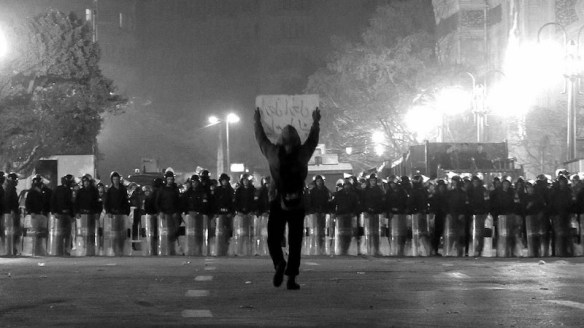


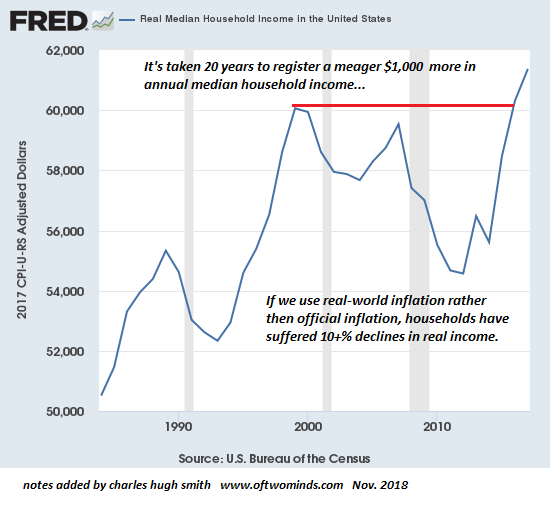


 After the Crash