The Birth of the Time-Motion Human

QuantimetricSelfSensingPrototypeMannApparatus

By Dale Lately

Source: The Baffler

In a darkened room, a woman lies watched by an infra-red camera as she sleeps. It monitors her breathing, her movements, the flicker of her eyelids. Some hours later it stings her with a painful electric shock. She wakes, tumbles out of bed and into the restroom, whereupon a chip installed in her toothbrush tracks her arm movements. She’s photographed, silently, every thirty seconds. As she sets off in the morning her location is logged and data is streamed on the steps she takes. Her pulse and calorie count are recorded and sent to unseen observers. She has a dog at her side. The dog’s data is logged as well.

Such a tableau would be the envy of any futuristic dictatorship. In fact, the devices outlined above are all available on the consumer market now, for voluntary use. The impetus towards tracking our lives with smartphones, apps and stats represents a massive growth area into which companies like Jawbone, MyFitnessPal, RunKeeper, Runtastic, MapMyRun, Foodzy, GymPact, and Fitocracy are flooding. Alongside the Nike+ Fuelband, there’s the popular Fitbit Flex, a wristband that counts the steps you take by day and the number of times you stir in your sleep. There are smart cups to track what you drink and wristbands programmed to give you electric shocks for not achieving your goals. There’s even a “Fitbit for your vagina” in the form of the KGoal Smart Kegel Trainer—a Kickstarter project designed to track kegels, exercises for women’s pelvic floor muscles to improve childbirth and continence, and for helping them to achieve a better “clench strength” via Bluetooth.

With all this biofeedback now available on our phones, the act of walking, living and breathing can—at least to the “datasexuals” who embrace it—be an ongoing project with limitless potential for improvement. But might such potential also lead to a kind of “Taylorism within”? Applying scientific management to twentieth century business created a workforce optimized for maximum efficiency. Likewise, life-tracking is encouraging us to internalize this dream by optimizing ourselves. Rather than a tool for liberation, we’re using the tech, in other words, to tune our lives for maximum “productivity.”

Perhaps none of this should seem surprising for a consumer society that drives on anxiety. If bad breath had to be invented as a disease mouthwash would help to cure a century ago, now the Quantified Self movement suggests we must live in permanent beta, to aim not just at maintaining ourselves but to become “better than well.” And so, Dave Allen’s Getting Things Done and websites like Lifehacker help to turn our lives into a series of sanctioned tasks and goals, where one must carry a “Surprise Journal” to find areas for self-improvement in one’s life, and sleep comes in the form of “power” naps. There’s the Lumo Back, a gizmo that monitors the tricky process of sitting in a chair, while the Narrative wearable camera snaps your life twice a minute. Time management lessons are now available for kids, while the iPotty seems to give toddlers the message that they shouldn’t take their eyes off a screen even when satisfying the most basic of human needs.

Silicon Valley, naturally, is more than happy to export the mantra of ongoing product optimization to our bodies: life-hacking fanatics talk of “upgrades” and “body hacks,” with often obsessive results. In a Financial Times article that marked a mainstream recognition of the movement, Tim Ferriss–author of The 4-Hour Body–claimed that he could teach people how to lose weight without exercising, work on two hours’ sleep, and have a fifteen-minute orgasm, while bio-hacker Dave Asprey was adamant that he’s made himself twenty years younger and forty IQ points smarter through life-tracking and smart pills (“I’ve rewired my brain,” he said). All of this task management can become a considerable task in itself, leading to the piling up of Catch 22 ironies—like the fact that developers are now working on smartphone apps to solve the problem of people spending too much time on their smartphones.

Luckily, some are questioning the use of intimate monitoring devices in our lives. The information asymmetry provided by the emergent “Internet of Things” may create a class of uninsurable people, while ”digital Taylorism”—the tracking and tagging of workers like cattle—has been roundly criticized as it has begun to emerge at companies like Amazon. What’s disquieting about the popularization of life-tracking is the voluntary desire to become “time-motion humans,” to subject ourselves to a self-imposed surveillance state. “Track everything. Track your entire day—wherever you go,” says the website for the LumoBack. “VESSYL AUTOMATICALLY KNOWS AND TRACKS EVERYTHING YOU DRINK,” the Vessyl “smart mug” warns us in stark capitals. And once we’ve volunteered for this intimate biological scrutiny, we’re keen to publicize the results—using tools like the Withings scale, which threatens to broadcast our weight gains to our Twitter followers as “encouragement.” Self-Improvement Macht Frei.

Since the invention of the forceps we’ve been introducing machinery into our bodies to improve our lives (the aforementioned KGoal is actually based on a biofeedback device from the 1940s by Dr. Arnold Kegel), and undoubtedly many of these trackers are helping to make people healthier. But life tracking also comes from a certain ideological background, one that denigrates macro-interventions in our lives (nationalized health care) in favor of individual micro-solutionism (becoming our own gym instructors and fitness trainers).

We’re living in an entrepreneurial model of humanity, a vision of human beings as start-ups, where unfitness or obesity are viewed as “bugs” to be fixed rather than as products of an economy based on long hours and precarious work. Daily exercise has always been an individual responsibility, but sharing our biofeedback via social media encourages people to compete like businesses, vying for better health scores with the personal data that makes us special. (Flex boasts that it reflects “your stats, not any average Joe’s.”) Here we can all be Superman—“Join over 141,000 other people who want to discover their inner superhero,” urges website Superheroyou—while, back in the complex, unquantifiable real world, we often struggle to maintain control over the most basic facts of our finances and job prospects.

The Quantified Self literature is full of such fantasizing. It all treats the body as a fun challenge, a puzzle to be solved. We see this in the current trend towards adding game-like features to the process of life tracking, which leads to some quite startlingly intimate results (“Spreadsheets,” an app that promises to gamify your sex life, has the user get on the bed and talk dirty to a computer). Even antenatal workouts aren’t immune: the KGoal promises gamification in forthcoming product updates for those who fancy comparing their pelvic thrust scores to those of their peers.

The friendly rivalry that has always been a part of amateur fitness starts to look less inspiring, and more controlling, when it’s built into the architecture of smartphones and social media. It’s more like a crowd-sourced version of what philosopher Michel Foucault termed “Biopower,” the control over our bodies wielded by states and their institutions. But in this version, it’s not the institutions; we control ourselves, and each other.

As more and more aspects of our lives are seen as legitimate targets for intrusion by technology, the gaze inevitably falls on the newly born. Start-ups like Sproutling, Owlet, and Mimo are springing up to replace old-fashioned baby monitors with comprehensive, round-the-clock surveillance (temperature, pulse, breathing, position, room ambience) as well as all the attendant data crunching. These infants may be the first humans to grow up entirely in the lens of machines, with the process of rearing having been refashioned as a high-tech, high-maintenance project, requiring endless inputs from both parent and child alike. They will be the first “time-motion babies”: faster, happier, more productive, in the words of Radiohead’s Ok Computer.

Will they really be happier, versed as they will be, since birth, in the techniques of maximizing their sleep, optimizing their nutrients, and tracking the number of steps they walk? It seems doubtful, but then, it’s impossible to really tell when we talk about happiness—even Silicon Valley hasn’t worked out how to put a number on that.

 

Dale Lately writes about culture and communications and has contributed to the Guardian, 3:AM Magazine, OpenDemocracy, Litro and Pop Matters. His regular musings can be found at @dalelately and www.dalelately.blogspot.com.

Privatized Ebola

Red Cross workers burry 14 May Italian nun Dinaros

By Margaret Kimberly

Source: Black Agenda Report

“The world of private dollars played a role in consigning thousands of people to death.”

Sierra Leone has waved the white flag in the face of Ebola Virus Disease (EVD). Its meager infrastructure has buckled under the onslaught of a disease which could have been curtailed. The announcement that infected patients will be treated at home because there is no longer the capacity to treat them in hospitals is a surrender which did not have to happen. Not only did Europe and the United States turn a blind eye to sick and dying Africans but they did so with the help of an unlikely perpetrator.

The World Health Organization is “the directing and coordinating authority for health within the United Nations system.” Its very name implies that it takes direction from and serves the needs of people all over the world but the truth is quite different. The largest contributor to the WHO budget is not a government. It is the Bill and Melinda Gates Foundation which provides more funding than either the United States or the United Kingdom. WHO actions and priorities are no longer the result of the consensus of the world’s people but top down decision making from wealthy philanthropists.

The Bill and Melinda Gates Foundation may appear to be a savior when it provides $300 million to the WHO budget, but those dollars come with strings attached. WHO director general Dr. Margaret Chan admitted as much when she said, “My budget [is] highly earmarked, so it is driven by what I call donor interests.” Instead of being on the front line when a communicable disease crisis appears, it spends its time administering what Gates and his team have determined is best.

The Ebola horror continues as it has for the last ten months in Guinea, Liberia and Sierra Leone. The cruelty of the world’s lack of concern for Africa and all Africans in the diaspora was evident by the inaction of nations and organizations that are supposed to respond in times of emergencies. While African governments and aid organizations sounded the alarm the WHO did little because its donor driven process militates against it. The world of private dollars played a role in consigning thousands of people to death.

Critics of the Gates Foundation appeared long before this current Ebola outbreak. In 2008 the WHO’s malaria chief, Dr. Arata Kochi, complained about the conflicts of interest created by the foundation. In an internal memo leaked to the New York Times he complained that the world’s top malaria researchers were “locked up in a ‘cartel’ with their own research funding being linked to those of others within the group.” In other words, the standards of independent peer reviewed research were cast aside in order to please the funder.

Private philanthropy is inherently undemocratic. It is a top down driven process in which the wealthy individual tells the recipient what they will and will not do. This is a problematic system for charities of all kinds and is disastrous where the health of world’s people is concerned. Health care should be a human right, not a charity, and the world’s governments should determine how funds to protect that right are spent. One critic put it very pointedly. “…the Gates Foundation, Bill & Melinda Gates, do not believe in the public sector, they do not believe in a democratic, publically owned, publically accountable system.”

There is little wonder why the Ebola outbreak caught the WHO so flat footed as they spent months making mealy mouthed statements but never coordinating an effective response. The Gates foundation is the WHO boss, not governments, and if they weren’t demanding action, then the desperate people affected by Ebola weren’t going to get any.

Privatization of public resources is a worldwide scourge. Education, pensions, water, and transportation are being taken out of the hands of the public and given to rich people and corporations. The Ebola crisis is symptomatic of so many others which go unaddressed or improperly addressed because no one wants to bite the hands that do the feeding.

The Bill and Melinda Gates Foundation has pledged an additional $50 million to fight the current Ebola epidemic but that too is problematic, as Director General Chan describes. “When there’s an event, we have money. Then after that, the money stops coming in, then all the staff you recruited to do the response, you have to terminate their contracts.” The WHO should not be lurching from crisis to crisis, SARS, MERS, or H1N1 influenza based on the whims of philanthropy. The principles of public health should be carried out by knowledgeable medical professionals who are not dependent upon rich people for their jobs.

The Gates are not alone in using their deep pockets to confound what should be publicly held responsibilities. Facebook founder Mark Zuckerberg announced that he was contributing $25 million to fight Ebola. His donation will go to the Centers for Disease Control Foundation. Most Americans are probably unaware that such a foundation even exists. Yet there it is, run by a mostly corporate board which will inevitably interfere with the public good. The WHO and its inability to coordinate the fight against Ebola tells us that public health is just that, public. If the CDC response to Ebola in the United States fails it may be because it falls prey to the false siren song of giving private interests control of the people’s resources and responsibilities.


Margaret Kimberley’s Freedom Rider column appears weekly in BAR, and is widely reprinted elsewhere. She maintains a frequently updated blog as well as at http://freedomrider.blogspot.com. Ms. Kimberley lives in New York City, and can be reached via e-Mail at Margaret.Kimberley(at)BlackAgendaReport.com.

Standard & Poor’s: Runaway Inequality Dampens GDP Growth, Leads to Boom/Bust Cycles and Discourages Trade, Investment and Hiring

income-inequality-yahoo

Source: Washington’s Blog

Inequality Also Dampens Social Mobility, Increases Political Pressure and Produces a Less Competitive Workforce

Standard & Poor’s released a report on inequality today, concluding:

Higher levels of income inequality increase political pressures, discouraging trade, investment, and hiring. Keynes first showed that income inequality can lead affluent households (Americans included) to increase savings and decrease consumption (1), while those with less means increase consumer borrowing to sustain consumption…until those options run out. When these imbalances can no longer be sustained, we see a boom/bust cycle such as the one that culminated in the Great Recession (2).

Aside from the extreme economic swings, such income imbalances tend to dampen social mobility and produce a less-educated workforce that can’t compete in a changing global economy. This diminishes future income prospects and potential long-term growth, becoming entrenched as political repercussions extend the problems.

Our review of the data, as well as a wealth of research on this matter, leads us to conclude that the current level of income inequality in the U.S. is dampening GDP growth, at a time when the world’s biggest economy is struggling to recover from the Great Recession and the government is in need of funds to support an aging population.

S&P joins many others in concluding that runaway inequality hurts the economy, including:

  • Former U.S. Secretary of Labor and UC Berkeley professor Robert Reich
  • Global economy and development division director at Brookings and former economy minister for Turkey, Kemal Dervi
  • Societe Generale investment strategist and former economist for the Bank of England, Albert Edwards
  • Michael Niemira, chief economist at the International Council of Shopping Centers
  • Former executive director of the Joint Economic Committee of Congress, senior policy analyst in the White House Office of Policy Development, and deputy assistant secretary for economic policy at the Treasury Department, Bruce Bartlett
  • Deputy Division Chief of the Modeling Unit in the Research Department of the IMF, Michael Kumhof

Even the father of free market economics – Adam Smith – didn’t believe that inequality should be a taboo subject.

Numerous investors and entrepreneurs agree that runaway inequality hurts the economy, including:

Indeed, extreme inequality helped cause the Great Depression, the current financial crisis … and the fall of the Roman Empire . And inequality in America today is twice as bad as in ancient Rome, worse than it was in Tsarist Russia, Gilded Age America, modern Egypt, Tunisia or Yemen, many banana republics in Latin America, and worse than experienced by slaves in 1774 colonial America. (More stunning facts.)

Bad government policy – which favors the fatcats at the expense of the average American – is largely responsible for our runaway inequality.

And yet the powers-that-be in Washington and Wall Street are accelerating the redistribution of wealth from the lower, middle and more modest members of the upper classes to the super-elite.

8 Facts About American Inequality

income-inequality-graphic

By Pierce Nahigyan

Source: Nation of Change

…that dream of a land in which life should be better and richer and fuller for everyone, with opportunity for each according to ability or achievement. It is a difficult dream for the European upper classes to interpret adequately, and too many of us ourselves have grown weary and mistrustful of it. It is not a dream of motor cars and high wages merely, but a dream of social order in which each man and each woman shall be able to attain to the fullest stature of which they are innately capable, and be recognized by others for what they are, regardless of the fortuitous circumstances of birth or position.”

– James Truslow Adams, The Epic of America (1931)

The American Dream has been defined many ways by writers of both poetic and prosaic bent, but its essentials tend to involve life, liberty and the pursuit of happiness (or property, depending on your source).

The Declaration of Independence, upon which an entire nation was radically brought into existence, asserts that not only are all men created equal but that this is a “self-evident” truth. The significance of this fact lies not in its semantics, which epistemologists would challenge, but in its utilization as a primary foundational creed. By this “unanimous Declaration of the thirteen united States of America,” a contract was agreed to, that their union would be founded on this principle. Furthermore, life, liberty and the pursuit of happiness are rights that governments are created to uphold. Thus, America was endowed with its dream at the moment of its conception: the freedom to succeed.  

The United States has promoted a self-congratulating exceptionalism for decades, waving its Declaration and Constitution in the faces of other sovereign nations as if the latter had never beheld such concepts. Our capital F “Freedom” sets us apart from the rest of the world, as the political rhetoric has repeated ad nauseam, no matter the freedoms enjoyed by democracies on every continent. And yet our basic freedom, the freedom to succeed, America’s contractual promise, has been shrinking for thirty years.

The freedom to succeed transcends economic systems but it is most potently expressed by capitalist gains. The ability to go “from rags to riches” is ingrained in this nation’s ethos and there is nothing intrinsically immoral about that goal. However, the current state of American inequality reveals a very real and expanding gap between the rich and poor that betrays the foundational endowment of this Union. When the freedom to succeed is denied every citizen, their equality is equally denied. 

The wealth and income inequalities in America do not require socialist reforms to fix, and capitalism is not the problem. The problem is that we have let inequality advance in this country so gradually that its obviousness is masked by its familiarity. Below I outline eight facts about inequality in America that every American should know. 

1) 400 Americans have more wealth than half of all Americans combined. To put that into context, as of 2013 there are an estimated 316,128,839 people living in the United States, according to the U.S. Census Bureau. Just 400 Americans have more money than over 158 million of their fellow citizens. Their net worth is over $2 trillion, which is approximate to the Gross Domestic Product of Russia. This ratio has been verified by Politifact and former Labor Secretary Robert Reich. One explanation for the vast discrepancy in wealth is the definition of “worth,” which includes everything a person or household owns. This means savings and property but also mortgages, bills and debt. Poorer households can owe so much in debt that they possess a negative net worth.

2) America has the second-highest level of income inequality, after Chile. The Organization for Economic Cooperation and Development studies thirty-four developed countries and ranks them both before and after taxes and government transfers take effect (government transfers include Social Security, income tax credit and unemployment insurance). Before taxes and government transfers, America ranks tenth in income inequality. After taxes and transfers, it ranks second. Whereas its developed peers reduce inequality through government programs, the United States’ government exacerbates it. 

3) The current state of inequality can be traced back to 1979. After the Stock Market Crash of 1929, the gap between the rich and the poor began to narrow. For fifty years, wages still differed greatly between the upper- and working-classes, but a robust middle-class took shape, as well as the opportunity for working-class individuals to ascend. In his book, “The Great Divergence,” journalist Timothy Noah traces today’s inequality to the beginning of the 1980s and the widening gap between the middle- and upper-classes. This gap was influenced by the following factors: the failure of American schools to prepare students for new technology; poor immigration policies that favor unskilled workers and drive down the price of already low-income labor; federally-mandated minimum wage that has failed to keep pace with inflation; and the decline of labor unions.

4) Non-union wages are also affected by the decline of unions. The Economic Policy Institute claims that 20% of the growth in the wage gap between high-school educated and college educated men can be attributed to deunionization. Between 1978 and 2011, union representation for blue-collar and high-school educated workers declined by more than half. This has also diminished the “union wage effect,” whereby the existence of unions (more than 40% of blue-collar workers were union members in ’78) was enough to boost wages in non-union jobs – in high school graduates by as much as 8.2%. Not only did unions protect lower- and middle-class workers from unfair wages, they also established norms and practices that were then adopted by non-union employers. Two prime examples are employee pensions and healthcare. Today about 13% of workers belong to unions, which has reduced their bargaining power and influence. 

5) There is less opportunity for intergenerational mobility. In December 2011, President Obama spoke at Osawatomie High School in Kansas. He was very clear about the prospects of the poor in today’s United States:

“[O]ver the last few decades, the rungs on the ladder of opportunity have grown farther and farther apart, and the middle class has shrunk. You know, a few years after World War II, a child who was born into poverty had a slightly better than 50-50 chance of becoming middle class as an adult. By 1980, that chance had fallen to around 40 percent. And if the trend of rising inequality over the last few decades continues, it’s estimated that a child born today will only have a one-in-three chance of making it to the middle class – 33 percent.”

As refreshing as that honesty is, Obama promised no fix beyond $1 trillion in spending cuts and a need to work toward an “innovation economy.” 

In a speech one month later, Obama’s Chairman of Economic Advisers, Alan Krueger, elaborated on the dire state of America’s shrinking middle-class. The contraction, he stated, could partially be attributed to “skill-biased technical change”: work activities that have become automated over time, reducing the need for unskilled labor and favoring those with analytical training. He also highlighted the 50 year decline in tax rates for the top 0.1%, increased competition from overseas workers, and a lack of educational equality for children. Poor children are denied the private tutors, college prep and business network of family and friends available to their wealthier peers, which locks them into the class they are born into.

6) Tax cuts to the wealthiest have not improved the economy or created more jobs. Krueger also revealed that the tax cuts of the 2000s for top earners did not improve the economy any better than they did in the 1990s (meanwhile, income growth was stronger for lower- and middle-class families in the 1990s than in the last forty years). Tax rates for the top income earners in America peaked in 1945 at 66.4 percent. Following decades of gradual reductions, they have since been cut in half. During the same time, the payroll tax has increased since the 1950s and individual income tax has bounced between 40-50% through the present day. Conversely, corporate tax declined from above 30% in the 1950s to under 10% in 2011. All of these tax cuts are made ostensibly to improve the economy and create jobs. However, the National Bureau of Economic Research has concluded that it is young companies, “regardless of their size,” that are the real job creators in America. Tax cuts to the wealthiest do not create jobs

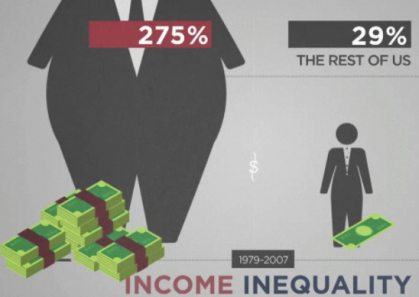
7) Incomes for the top 1% have increased (but the top 0.01% make even more). Between 1979 and 2007, the average incomes of the 1% increased 241%. Compare that to 19% growth for the middle fifth of America and 11% for the bottom fifth. Put another way, in 1980 the average American CEO earned forty-two times as much as his average worker. In 2001, he earned 531 times as much

Average income across the 1% is actually stratified into widely disparate echelons. Compare the $29,840 average income for the bottom 90% to the $161,139 of the top 10%. Compare the $1 million average income of the top 1% to the $2.8 million of the top 0.1%. Yet both still pale beside the $23 million average income of the top 0.01%. 

If those numbers seem a bit overwhelming, Politizane has created a video that illustrates this staggering inequality:

8) The majority of Congress does not feel your pain. Empowered by the Constitution to represent their constituents, United States Congress members are, for the first time in history, mostly millionaires. The 2012 financial disclosure information of the 534 current Congress men and women reveals that over half of them have a net worth of $1 million or more. After the past seven facts it is difficult to read this last one and believe that these 268 legislators have the best interests of the remaining 99% at heart. But if that is too presumptuous a leap, it is not too bold to say that wealthier donors, lobbyists and special interest groups enjoy greater access to these lawmakers than the average American. 

Life, and the Liberty to Go Hungry

Last week Congress failed to extend emergency benefits for unemployment, leaving 1.3 million people without federal aid. Congress is currently on a weeklong recess that will keep them from debating the issue until their return on January 27. The bill was too divisive for Republicans and Democrats to reach an agreement on, though unemployment is still above 7% nationally. 

Thankfully, the unemployed have their Congress working for them. And at $174,000 annual pay, those representatives are sure to return from vacation committed to fresh solutions. 

The pursuit of happiness is an ephemeral affair, but the freedom to succeed is not. It is something one possesses or lacks. It is the difference between enjoying a more prosperous life than one’s parents and believing there is no way out. A “self-evident” truth is one that is meaningful without proof, much akin to faith. If inequality continues to rise in America, the self-evident truths of its founding will be no more than words on an old piece of paper, its American Dream a tattered faith paid lip service by the deceitful and the blind.

Clear as Mud

Middle East Explained_0The current state of U.S. foreign policy in a nutshell:

Are you confused by what is going on in the Middle-East? Let me explain. We support the Iraqi government in its fight against Islamic State (IS/ISIL/ISIS). We don’t like IS but IS is supported by Saudi Arabia whom we do like. We don’t like President Assad in Syria. We support the fight against him, but not IS, which is also fighting against him.

We don’t like Iran, but the Iranian government supports the Iraqi gov’t against IS. So, some of our friends support our enemies and some of our enemies are our friends, and some of our enemies are fighting our other enemies, whom we don’t want to lose, but we don’t want our enemies who are fighting our enemies to win.

If the people we want to defeat are defeated, they might be replaced by people we like even less. And, all this was started by us invading a country to drive out terrorists who weren’t actually there until we went in to drive them out – do you understand now?

Ruling-Class Supremacy and the Free World

tn51f8143d

By Mark Weiser

Source: Dissident Voice

Soon after children start noticing differences between others and themselves, they’re old enough to believe they’re superior or entitled in some ways. These feelings come naturally, and are reinforced by adults as children learn social behaviors by comparing attributes and values so they can fit in with, or be seen apart from, certain others in society. This is all instinctual to some degree and a normal part of life. To make the case for instinct and superiority, think about what anyone would consider when choosing a partner for a serious or long-term relationship. If a potential partner does not meet the standards of another, by default one person is considering their self above the other in some way. And speaking generally for superior humans, when considering procreation, they don’t want their superior self to mix with inferior genes. Everybody has standards of age, looks, intelligence, income, occupation, social standards and more or less, it’s different for everybody.

Pro-creationist superiority is instinctual to best insure our genetic code is passed along into the future. Of course there’s pure romantic attraction, but that’s only triggered because the partner being considered hasn’t been ruled out. It could ultimately be the depth and types of emotions which compel the romantic to get deeply involved, but they still make relative comparisons the first time meeting someone and along the way. We’re not speaking hypothetical, these attitudes are accepted realities and I would guess, at minimum, 96% of all readers over age twenty can relate by direct experience, even if they’ve not been in a serious intimate relationship.

Instinct and human nature overlap when it comes to seeking society with others, and societies or social groups necessarily have a culture that sets boundaries for ideological beliefs, abilities, practices, social status etc. If a group doesn’t set boundaries, by default, that group would be all inclusive and non-judgmental concerning any specific particulars. As individuals or groups looking at others, it’s all so much instinct and human second-nature, we may not be aware we’re being judgmental. Whether superiority by comparison is instinct due to genetics and the natural workings of the mind, or is influenced by personal nature and prejudices, or results from ideological and social culture, it makes no difference at all in the real world if the end result is the same.

What does make a difference in the real world is whether or not we unjustly impose on others. If our sense of imposing or taking advantage of others is not disabled, and we do impose unjustly on others, ultimately it’s some sense of superiority or entitlement which allows us to impose. Benign superiority is basically harmless as no actions are taken which harm or impose on others; although, if a person feels superior to others and doesn’t participate in something that could benefit himself, he could be a victim of his own perceived superiority.

In the U.S. we have laws against supremacist entitlement being imposed on the unwilling, but because of social conditioning there are times we might assume we’re not being imposed on when, in fact, we are the victim(s). It’s often considered justifiable that one should feel morally or intellectually superior to racists or sexists. But what about assuming religious or ideological superiority and entitlement(s)? Why would either of those be considered fair game in certain circles or social situations? If you have moral values you may feel superior to Wall Street bankers and our enabling Washington D.C politicians – as those two groups were literally the driving forces behind the 2008 economic crash – while at the same time they enriched themselves at the expense of innocent U.S. and world citizens.

The 2008 economic collapse was brought about by the deregulation and non-enforcement of banking laws which resulted in the Federal Reserve and banks both taking excessive risks. There was the Federal Reserve policy of giving the banks too much low interest money to begin with. The banks relaxed loan qualifications which led to real estate and stock market bubbles. It was all tied to fraudulent mortgage default insurance known as credit default swaps being used to prop up bundled mortgage securities which were sold all over the world to individuals, groups and all sizes of governments. The fraudulent mortgage default insurance and grossly exaggerated security ratings made the bundled mortgages securities look much less risky than they actually were, and the bundled mortgage securities were fraudulent due to the grossly misrepresented financial risks. So great were the cumulative risks of all combined, the world economy in 2008 was lined up like dominoes and literally ready to fall as soon as the mortgage defaults started adding up. By the time this was all recognized publicly as the unsustainable confidence game it was, the banks’ corporate officers had already pocketed hundreds of million$ and intended on leaving you and your grandchildren to pay for their entitlements.

With D.C. politicians, the regulatory boards, and Department of Justice looking the other way – while they’re supposed to oversee banking practices in some manner – the bankers were able to pull off the greatest financial scheme in human history. The two main groups which lined those dominoes up, the bankers and D.C. politicians, in this instance are prime examples of interdependent criminals. Our Republican and Democratic parties essentially accepted election campaign funding (bribes) from the bankers, in exchange for legislation the bankers wanted, which finally led to the 2008 crash. And because politicians wanted those campaign funding bribes to continue after 2008, they didn’t pressure the U.S. Attorney General to prosecute the bankers and most likely instructed him not to. These types of crimes and failure to prosecute are nearly guaranteed with the existing campaign funding laws when combined with the accepted political culture among the “ruling-class” in Washington D.C. Not only was the 2008 crash painful for many at the time, but people in the U.S and around the world are, in fact, enslaved to a certain degree while the true costs of those violations are still being paid off.

Assuming they didn’t suffer from psychological disorders, the bankers necessarily had to feel superior or entitled to put their personal interests above the U.S. law and country. A complex and intertwined scheme of 2008 magnitude could only have taken place if the laws on the books prior to the crash were non-existent (deregulated), corrupt as written, corrupted as practiced, or corrupted by enforcement (or non-enforcement) thereof; and we had all of those contributing factors leading up to the crash.

In the U.S. today we have a ruling-class supremacist culture holding itself, the self-chosen few, above the law. And they demand you comply with the law as they cultivate systemic enslavement to a degree as it’s being imposed on the vast majority of citizen-victims. And by all means they invite you, as a dupe, to join their party as a Democrat or Republican, neither of which are looking out for the American people; but join them, and you too can shill for the status quo. If big money likes you enough, they might select you through a screening and grooming process, to be in the U.S. Senate or Congress representing the personal best interests of ruling-class elites to the overall detriment of the country.

As a collective in the U.S. we believe ourselves to be validly non-supremacist as decreed by law, while also believing our culture is morally grounded, and that moral citizens wouldn’t impose unjust self-entitlements by forcing citizens into a degree of slavery. So what is it in our human instinct, human nature or various cultures which allow these types of supremacist-entitlement violations to occur? If the collective sense of injustice is not disabled by some psychological disorder, then as a “moral culture”, these transgressions could only take place by having a population with sufficiently corrupted-intellects, or by having a few corrupted-intellects imposing on the vast majority through concentrated political power. Corrupted-intellect for our purposes here would include the mindset to commit any act of deceitfulness, denial, or false rationalizations by either the perpetrators or victims, which allow legal violations to be committed without eventual prosecution. And regardless of whether or not we suffer from a disabling disorder, corrupted-intellect has collectively disabled our society from attaining a reasonable amount of “liberty and justice for all”. Among those unable to maintain intellectual integrity due to the influence of religious, academic or political cultures, collective denial can take the form of institutionalized supremacist-entitlements as we’ve seen with bankers and politicians surrounding the 2008 fiasco.

Does that mean we’re stuck in a non-democracy being run by a collective of predominately corrupted-intellects of a self-entitled ruling-class supremacist culture? That may depend on Americans understanding just how openly and blatantly they’re still being taken advantage of, and whether or not enough of them are outraged enough to demand some changes. Our two-party political system is essentially a self-perpetuating power structure and would require a major mutiny among members of at least one party to change the existing campaign funding laws, or the Supreme Court would have to overrule itself; the first case is extremely unlikely specifically because getting elected requires receiving huge amounts of campaign funds from the excessively wealthy “ruling-class”, and there’s little hope for the Supreme Court considering the corrupted-intellects sitting there on the bench without a clue.

The joke may be on “we the people” for the time being, but unjust power structures historically fail as the one in question is failing now by eroding the strength and health of its own population. It’s only a matter of time as to when and how a major shift takes place. And regardless of anyone’s sentiment toward the system as is, it’s not working to represent the best interests of the country. What’s left to be said for a system that has systemic corruption guaranteed by existing laws enjoyed by unjustly self-entitled ruling-class supremacists? According to the Declaration of Independence “we the people” have final say and it’s our duty as patriotic Americans, “to throw off such Government”.

Another group which more than deserves mention in the grand scheme of supremacy-entitlements is the so called “news” media. The press has immense power to pressure both, corporate industry and the government to operate within legal and moral parameters that would be beneficial to our overall society. What’s often referred to as “corporate news” isn’t really news, but is actually manipulative propaganda. And those running the show behind the scenes perceive personal benefits by having a bias slanted strongly toward corporate or special interests – which also means not exposing the government because the government works for corporate and special interests also. With the press not using its immense power to benefit U.S citizens and country as a whole, the people running the major news networks are performing a great disservice to the country by denying citizens the absolute truth for their own considerations. Corrupted-intellects are everywhere…

And going back to speaking of dupes, we need to acknowledge the entire subservient culture of politicians around the globe that cater to the whims of Washington D.C. Those foreign office holders often see their compliance to Washington as benefitting themselves personally while it victimizes their own citizens. If those “leaders” are not plain ignorant for any reason, then by default they are willing accomplices on some level. Whatever the case, they’re arguably not fit to look out for the best interests of their own countrymen – just as they’re currently not doing. This subservience is not only applicable to economic issues at present, but also enables unjust military incursions and illegal “wars” of chosen aggression for some perceived political or monetary gain.

If a constant and stable life could be realized, the vast majority of world citizens would prefer to live without trespassing on others. But the brokers of industry, media, and politics, who seek extreme wealth and power, are a different sort – some of these people are beyond being supremely self-entitled, where sociopath or psychopath would be a fitting definition. They act without consideration for truth or the lives they abuse and destroy. Nothing is beneath them, not robbing granny’s life savings while personally benefitting, not starting and backing unnecessary wars of personal choice for monetary or political gain. Over just the last five-and-a-half decades the U.S is directly and indirectly responsible for the deaths of millions in various places around the world. The worldwide self-entitled “ruling-class” supremacists of the “free world” predominately exists in a cultural bubble of extreme criminal immorality and exceptionalism — all due to a combination of genetic instinct, human nature and social culture(s) rendering their corrupted-intellects incapable of acknowledging absolute truth and the motives behind their actions. With most of these activities being approved and orchestrated from the epicenter in Washington D.C., the destructive earthquakes travel around the globe through varying forms of imposed ideological and economic tyranny, often with a military “solution” being carelessly and recklessly forced on countless innocent victims of the current day, year, decade or century as the case may be… The “ruling-class” puts all of our lives at risk by keeping our planet in constant jeopardy.

Due to the shear waste and destruction of war along with the possibility of wanton escalation, the entire earth and the world’s population are threatened by the practices of a tiny and miniscule minority comprising the collective ruling-class supremacist culture; and with everything on earth being directly and indirectly interconnected to everything else, their victims, I’m sure you know, include all living things and every last human being.


Perceptions of Power

Fascism-s-b-called-Corporatism-Mussolini

By

Source: Center for a Stateless Society

Parsing Political Divides in the Mainstream and in Anarchism

CNBC describes the Corporate Perception Indicator as “a far-reaching survey of business executives and the general population from 25 markets,” “research firm Penn Schoen Berland survey[ing] 25,012 individuals and 1,816 business executives.” The results of the survey show quite unsurprisingly that the general public associates government with words like “corruption,” “lies,” “incompetence,” and “thieves.” As for big business, the words that came to the minds of those surveyed included, again, “corruption” and “thieves,” also “monopoly” and “power.” Interestingly, overall perceptions of both corporations and government appear to be largely negative. In American political discourse, the political right is characterized by a perceptible overpraise of business, devoted to a view of corporations that sees them as essentially free market actors, “creators” and “doers” that give us progress and innovation. Even if this is not true of everyone on the American right, certainly such sentiments are important to the right’s narrative on free markets. The right looks on government, in contrast, as the bungling and inept meddler attempting to hold back our industrious and our productive, the supporter of the lazy and parasitic who would rather live on the government dole than work for a living.

On the left, corporations are perceived as putting profits above people, as willing to do anything to suck more and more of the world’s natural wealth into the hands of a grasping, extravagant one percent. Government, on the other hand, is treated as the agent of “the greater good” or “the public good,” a kind of benevolent, altruistic mother to us all.

In the United States, people who identify themselves as free marketers or libertarians are much more likely to align with the former of these competing narratives, the right’s assertion that the corporation is the home of the movers and the shakers, the creative and energetic champions of free enterprise. This relationship between self-identified libertarians and the American right helps explain the broader anarchist movement’s pardonable reluctance to accept individualist or market anarchists as the genuine article. Further, hostility toward communism has a long history in individualist anarchism, typified by Benjamin Tucker’s frequent denunciations, yet certainly preceding them.[1]

We may observe at this juncture that both the right and the left share the historically and empirically ridiculous theory that government and corporate power are locked in an eternal war. But it is a great politico-economic myth that governments and large corporations operate at variance with one another, that one must align herself in her political commitments with one or the other, never both, never neither. For left wing individualists, surveys which demonstrate dissatisfaction with and negative attitudes toward both actually make perfect sense. That big business should be associated with greed and governments with corruption is hardly astonishing or remarkable. Further, these results underline the problem with seeing corporate power and government power as rivals, rather than seeing them much more accurately as codependent partners in crime, mutually reinforcing components parts of a larger phenomenon we might call a ruling class or power elite.

We needn’t risk the cognitive dissonance that comes with treating the State as the great restraint upon the socially destructive avarice of multinational corporations. For we find, whenever we bother to look, that elites in the business community regularly work with the public sector to create conditions accommodating to monopolism. The ideal of free and open competition, however championed in corporate press releases and political campaigning, is nowhere to be found and indeed never has been. Thus do market anarchists prosecute our laissez faire critique of capitalism. We come from an older tradition of American libertarians, radicals who contemned capitalism as much as any communist, but understood the importance of individual rights and mutually beneficial trade.

It is interesting to witness anarchist communists and syndicalists develop strict, exclusionary criteria for anarchism, particularly insofar as the arguable father of our doctrine, Pierre-Joseph Proudhon, was neither, his mutualism containing many market-friendly if not outright pro-market elements. No less important for anarchism as it developed in America is Josiah Warren, whose first forays into anarchist thought antedate Proudhon. If market or individualist anarchism represents a form of “pseudo-intellectualism,” then some of the anarchist tradition’s brightest lights must apparently be relegated to the dustbin of history. Granting that opposition to not only political but also economic authority is a necessary condition for the true anarchist, individualists like Warren (and his followers such as Benjamin Tucker) more than qualify.

Whether our communist and syndicalist comrades admit it or not, free market ideas figured prominently in fledgling anarchist thought, regarded as perfectly consistent with and a natural outgrowth of, to quote Warren, “the absolute right of supreme individuality.” Considering Warren as an example, many contemporary anarchists may not know that anarchist luminary Peter Kropotkin acknowledged Warren as an inspiration and, in the words of Crispin Sartwell, “a precursor of (and influence on?) Proudhon.” In discussing Warren’s legacy, Sartwell observes one of the major, continuing tensions between the individualist and communist strains of anarchism, the debate on “lifestyle anarchism.” Sartwell argues, quite correctly in the author’s view, that Warren “belongs squarely in what is called by its opponents ‘lifestyle anarchism’: that strain concerned with creating alternatives within the interstices in the existing system rather than arming to overthrow it.” “Peaceful Revolutionist” that he was, Warren emphasized experiments in the creation of practical alternatives to dominant economic and social modalities. To Warren, the whole of life was open to and the subject of reform. This holistic approach, the universality of his critique of the existing state of affairs, he likely inherited from Robert Owen, even while dispensing with other aspects of Owenite thinking. Indeed, Warren’s departure from Owen and his ideas offers us an illuminative proxy for the tensions and debates that still divide individualist from communist elements within anarchism. Warren worried about the overwhelming of the individual within combinations and, paraphrasing Sartwell, imposed a priori schemes. Communists often tend to see the undisciplined “lifestylism” of Warren-type experimentation as essentially bourgeois, outside of or ancillary to genuine class struggle.

Discussing early figures in anarchism such as Warren opens opportunities to reflect on the similarities that unite all anarchists. We can pause to wonder what someone with Warren’s breadth of interests and hopes for reform might think of twenty-first century problems and perceptions thereof.

As all anarchists understand, politics is at bottom conquest, spoliation and rape. Everything else, everything peaceful, voluntary and consensual is something different, throwing the distinction between the “politics means” and the “economic means” once again into sharp relief. The economic means to wealth is defined by the normal, even obvious standards we refer to in interactions with merchants, our friends, and family, the mutually beneficial guidelines we use to cooperate and trade with coequals. The political means, by contrast, is the acquisition of wealth by aggression, by forcible extraction through systematic privilege. The State, being the organization with a monopoly on the legal use of force, is the wellspring of such privilege. As Josiah Warren pointed out in Equitable Commerce:

Theorists have told us that laws and governments are made for the security of person and property; but it must be evident to most minds, that they never have, never will accomplish this professed object; although they have had the world at their control for thousands of years, they have brought it to a worse condition than that in which they found it, in spite of immense improvements in mechanism, division of labor, and other elements of civilization to aid them. On the contrary, under the plausible pretext of securing person and property, they have spread wholesale destruction, famine, and wretchedness in every frightful form over all parts of the earth, where peace and security might otherwise have prevailed. They have shed more blood, committed more murders, tortures, and other frightful crimes in the struggles against each other for the privilege of governing, than society ever would or could have suffered in the total absence of all government whatever.

A deep, principled loathing of both big business and government unites all anarchists. Confronted with the alarming realities of the present moment, its authoritarian repressions and economic maladies, anarchists ought to help one another in peaceful projects to build a freer, better world. Data such as those contained in the Corporate Perception Indicator survey show a world fully primed for our anti-authoritarian, anti-capitalist critiques. It falls upon us to communicate our message, to do the constructive work of inaugurating a new order.

[1] Relatedly, in True Civilization, Josiah Warren wrote, “What is called conservatism has all the time been entirely right in its objections to communism, and in insisting on individual ownership and individual responsibilities both of which communism annihilates; conservatism has also shown wisdom in its aversion to sudden and great changes, for none have been devised that contained the elements of success.”


How a Minimal Ebola Outbreak Will Devastate the U.S. Economy

By Dave Hodges

Source: Investment Watch

A World Bank analysis of the economic impact of Ebola on national economies suggests that only a minimal outbreak of the virus could very well devastate the United States and its economic interests.

Economic Consequences of the Perceived Threat of Ebola

There are two dominant theories related to the present Ebola crisis. One theory states that the media and certain government sponsored agencies such as the CDC, NIH and the FDA are hyping the Ebola crisis to promote the roll-out of mandatory vaccines. This notion promotes the belief that Ebola will not impact that many people but the fear being promoted will drive people to help people like Bill Gates make a fortune from the inevitable vaccines that  will follow this crisis. The theory certainly has merit.

The second theory postulates that Ebola will serve as a depopulation instrument AND the elite (e.g. Bill Gates) will make money on the demise of much of humanity through the implementation of mandatory vaccines, while Ebola rips through the population claiming millions of lives.

This second theory also proposes that the super-elite need not worry about succumbing to Ebola because of the fact that there are at least two vaccines and one vaccine, the 2006 human-tested Crucell vaccine, is being withheld from the public and is not being reported on in the media despite a paper trail pointing to its existence and possible efficacy as a treatment agent in the fight against Ebola. This fact has given rise to the possibility that the Crucell vaccine is effective, but the majority of the population will be receiving the hastily prepared and subsequently dangerous GSK vaccine. On the surface, this would seem like crazy thinking. However, it is actually very logical thinking because the Obama administration refuses to shut down air travel from West Africa or to shut down our porous border while trying to prevent the possibility of bioterrorism involving Ebola. Any prudent person would shut down the entry points of Ebola into the U.S. Therefore, we need to be asking what does the Obama administration know that the rest of us do not?

Which of the two theories is true? In terms of economic collapse, it does not matter which is true because either scenario will result in economic devastation.

The globalists are already warning the world about what lies ahead. On October 8, 2014, the World Bank warned about economic consequences of Ebola outbreaks on West African economies.

 “With Ebola’s potential to inflict massive economic costs on Guinea, Liberia, and Sierra Leone and the rest of their neighbors in West Africa, the international community must find ways to get past logistical roadblocks and bring in more doctors and trained medical staff, more hospital beds, and more health and development support to help stop Ebola in its tracks,” says Jim Yong Kim, the President of the World Bank Group.

In fact, the World Bank has published an economic analysis and a series of projections regarding the impacted Ebola countries in West Africa.
ebola-economics-in-africa

Ebola’s Critical Mass Impact On the U.S. Economy

What is the threshold of GDP loss that a country like the United States can endure before the wheels come off of the economy? In other words, how much of a percentage impact would Ebola have to have on the economy to devastate most businesses? Recently, the Washington Post published figures which set the historical average profit margin for a U.S. business at 4.6%. This means that if the spin-off effects of Ebola exceeds a 5% impact on the economy, the wheels will quickly come off the U.S. economy. Business failures will lead to a Stock Market collapse. Because the Glass-Steagall Act was repealed under Clinton, the Banks would be the next to fail  because they are recklessly tied to  underwriting and insuring many investment events in the Stock Market and individual savings and retirement accounts would disappear as well when the banks collapse.

Quickly, the country would fall into chaos. As widespread as the cascading economic collapse would become, no amount of martial law would contain the chaos.
Turn your attention to the World Bank chart, listed above, with regard to the projected economic impact on Liberia based upon low, medium and high projected effects  of an Ebola outbreak on their economy. Pay attention to the percentage of loss of their economic base listed in the above World Bank projections.


Ebola’s Impact on Liberia             Percentage of Impact

Low Impact From Ebola                          – 3.4%

Medium Impact From Ebola                   –  5.8%

High Impact From Ebola                         –  12.0%


Some are wondering why Liberia was chosen to illustrate the economic impact of Ebola and what this could potentially mean to the United States economy? Sierra Leone and Guinea have very primitive economies compared to Liberia, therefore, the impact of Ebola on their respective economies would be insignificant as a basis of comparison to the United States. To some extent, a Liberian comparison is invalid on its face because the Liberians do not have anything close to a 3,000 mile salad. In Liberia, there is virtually no “Just In Time” (JIT) delivery which forms the backbone of our service economy here in the United States. However, the Liberian numbers give us some idea of what we could expect in the U.S. when Ebola gains a foothold.

Since the economy of the United States is based upon JIT and our economic institutions are considerably more well-integrated and intertwined than they are in Liberia, what do you suppose would be the low, medium and high impact on the United States? Undeniably, the impact of Ebola as a factor of economic devastation would be catastrophically higher. The social consequences are devastatingly higher as well because a lower percentage of Americans are able to provide their own food supply as compared to Liberia. There are no numbers that I can point to with regard to the low, medium and high impact effect of Ebola on the U.S. economy except to say that any analysis would place the percentage of impact at a far higher rate than the World Bank projections listed for Liberia. It is safe to conclude that even a low impact effect of Ebola on the U.S. economy would exceed the 5% threshold.

When Going Out In Public Becomes Too Much of a Risk

As any politician, sociologist or policeman will tell you that the fabric that holds society together is voluntary conformity and trust. Most Americans obey most laws because we understand the importance of societal cooperation as opposed to the dangers of living in a state of anarchy. The other factor that binds society together is trust. One of the key elements of trust in America is that our citizens trust the fact that it is safe to go out in public. And going out in public is where much of America’s economic business is conducted (i.e. restaurants, movie theaters, shopping malls, football games, concerts, etc.).

Mike Adams, appearing as a guest on The Common Sense Show on October 6, 2014, captured this notion when he stated that when Americans lose trust in the belief that it is safe to be in crowds, the impact on our way of life, and especially on our economy, will be catastrophic.

To illustrate just how devastating the effects can be on the economy when people lose trust in the belief that it is safe to go out in public, let’s take a look at the immediate reaction from the citizens of Dallas when only one Ebola case, Thomas Duncan, surfaced in the city.

When it was announced that Thomas Duncan had contact with some Dallas school children, we saw the immediate impact as Dallas moms began to keep their children home from school. Officials in Louisiana refused to receive Thomas Duncan’s property. Subsequently, and according to the AP and Veolia North America, Duncan’s effects were  disposed of in drums taken from a Dallas apartment where Duncan became ill and were burned at the company’s incinerator in Port Arthur., TX.

It does not matter what I write or what someone broadcasts on their talk show about Ebola, once people perceive there is a threat, even a low-level threat posed by someone like Thomas Duncan, the people will panic. Rationality will not be part of the decision making process. Fear will take over.

How long would police, fire, EMT personnel, hospital personnel, people that service our water supplies and the doctors that service our infirm, stay on the job following an Ebola outbreak? An examination of this question, by using Hurricane Katrina, as a comparison, tells us that by the third day, virtually all essential  services would be seriously compromised because of personnel defections. In this scenario, how would chronically ill people receive their medications? How would people get emergency appendectomies or other emergency medical procedures?  There will be no “911, what’s your emergency”? The factors that bind society together will quickly unravel  as Ebola spreads even on a relatively low level of impact.

What can you do to prepare if the economy collapses because of the economic impact of Ebola?